Forex Daily Market Commentary

By GCI Forex Research

Fundamental Outlook at 0800 GMT (EDT + 0400)

USD

The outcome of the G20 meeting seemed to boost the risk appetite, but it was not until a strong Australian PPI reading was reported that the US dollar began to weaken significantly. EURUSD traded in a range of 1.3917-1.4044, and USDJPY traded 80.90-82.20. Asian equities were slightly firmer and US stocks closed fractionally ahead on Friday, inspired by the latest Q3 earnings and the prospect of further Fed easing drawing ever nearer. The G20 failed to agree on specific limits for current account imbalances. On the subject of FX intervention, G20 countries pledged “to refrain from competitive devaluation”. Nevertheless, delegates agreed to remain vigilant to “disorderly movements in exchange rates”, with the aim of reducing the risk of “excessive volatility in capital flows facing some emerging countries”. This does not suggest a willingness to engage in coordinated intervention, but is rather an acknowledgement that policy decisions in advanced economies “including those with reserve currencies” can create problems for emerging markets. Treasury Secretary Geithner said that the US, Europe and Japan recognized the importance of preserving FX stability, and he reaffirmed that the policy of the US is to support a strong dollar. Philadelphia Fed President Plosser said he is not convinced that more asset purchases will help the economy at this juncture, and said Fed policymakers hold differing views on the relative merits of “shock and awe” versus incremental asset buying. Director of Research Waller at the St. Louis Fed said the probability of further easing being announced on Nov 3 is “probably pretty high”, adding that a case could be made for an initial easing of $500 bn followed by subsequent steps of $250 bn.
EUR

The German Economy Minister Bruederle said intensive G20 discussions took place on US liquidity policy, by which he presumably means the policy of quantitative easing. He said he does not support an increase in US liquidity as it indirectly influences the exchange rate.
Referring to the debate over G20 current account imbalances, ECB President Trichet implied that a focus on Germany’s large trade surplus alone would be misguided, and that the current account of the EU as a whole should instead be considered. Trichet added that, according to some G20 participants, the monetary policy of advanced economies could create problems for EM.
JPY

After the G20 meeting, Finance Minister Noda said that he had gained an understanding from his G20 counterparts on Japan’s policy of FX intervention, and that Japan would continue to take decisive steps on FX as needed. Noda added that he does not expect the debate over current account imbalances to be settled at the upcoming G20 Summit on Nov. 11-12.
Against expectations, the adjusted trade balance for September was broadly stable despite the stronger yen, coming in at ?587.6 bn (cons. ?495.5 bn, prev. ?570.2 bn).
AUD

The AUD got a significant boost from a much stronger than expected Q3 PPI rising +2.2% y/y (cons. +1.4%, prev. +1.0%). This suggests upstream price pressures are intensifying, which should keep the RBA hawkish, although Wednesday’s Q3 CPI will still be key to the November policy decision.
RBA Governor Stevens spoke but offered few clues on the likely path of the policy rate. He showed his determination to maintain the RBA’s 2-3% target range for the cash rate and said higher inflation will not be tolerated. He said mining investment is now at its strongest since the 1960s, and would very likely increase further.
CAD

Canadian CPI was slightly stronger than expected on a monthly basis at +0.2% m/m (cons. +0.1%), but the headline annualised rate was in line at +1.9% y/y, and probably not strong enough to force the BoC back onto a more hawkish track. Core inflation actually dipped to +1.5% y/y (cons. +1.6%). Retail sales meanwhile were much stronger in August, growing +0.5% (cons. -0.1%, prev. +0.1%).
CAD

Ahead, Canada CPI readings for September will be released as will retail sales for August.

TECHNICAL OUTLOOK


EURCHF 1.3924 resistance.
EURUSD BULLISH Remains constructive above 1.3637/1.3559 support zone, trigger to bear trend. Resistance at 1.4159 ahead of 1.4373.
USDJPY BEARISH Outlook is bearish, expect extension of downleg towards 79.75 ahead of 77.91.
GBPUSD BULLISH Holds above 1.5606 keeping our focus on the upside. Resistance at 1.5942 ahead of 1.6107.
USDCHF BEARISH Recovery has scope for 0.9918 breakout low. Next big support below 0.9463 at 0.9225.
AUDUSD BULLISH Upside gains held at 1.0004; move above the level would expose 1.0166. Support defined at 0.9662 ahead of 0.9542 reaction low.
USDCAD BEARISH Remains heavy below 1.0380/1.0407 area. Initial support at 1.0162 ahead of 0.9981.
EURCHF BULLISH Violation of 1.3665 triggers acceleration of gains towards 1.3924. Near-term support at 1.3456 ahead of 1.3265.
EURGBP BULLISH Move above 0.8908 exposes 0.9039 next. Near-term support defined at 0.8773.
EURJPY BULLISH Focus is back on the upside; expect gains to target 115.68 and 116.68 next.

Forex Daily Market Commentary provided by GCI Financial Ltd.

GCI Financial Ltd (”GCI”) is a regulated securities and commodities trading firm, specializing in online Foreign Exchange (”Forex”) brokerage. GCI executes billions of dollars per month in foreign exchange transactions alone. In addition to Forex, GCI is a primary market maker in Contracts for Difference (”CFDs”) on shares, indices and futures, and offers one of the fastest growing online CFD trading services. GCI has over 10,000 clients worldwide, including individual traders, institutions, and money managers. GCI provides an advanced, secure, and comprehensive online trading system. Client funds are insured and held in a separate customer account. In addition, GCI Financial Ltd maintains Net Capital in excess of minimum regulatory requirements.

DISCLAIMER: GCI’s Daily Market Commentary is provided for informational purposes only. The information contained in these reports is gathered from reputable news sources and is not intended to be U.S.ed as investment advice. GCI assumes no responsibility or liability from gains or losses incurred by the information herein contained.

Bernanke Speech Likely to Drive Market Direction Today

Source: ForexYard

As the market’s get set for another week of heavy trading, investors are eagerly awaiting a speech from the Fed Chairman today, scheduled to occur at 12:30 GMT. Traders will want to watch out for any mention regarding the size of the Fed’s plan for quantitative easing, which is likely to occur as early as next month. The dollar may take further losses today if investors continue to doubt the pace of US economic recovery.

Economic News

USD – Dollar May Drop Further Ahead of Fed Chairman Speech

Taking a quick look at last week’s trading, the dollar saw some heavy market movement against its main currency rivals. A mid-week return to safe haven assets led to huge gains for the USD against the euro. Ultimately, the dollar reversed courses once again, and by week’s end, the EUR/USD pair was once again trading around the 1.4000 level. The greenback performed better against the UK pound and Swiss franc. The GBP/USD is pair is down almost 100 pips from the middle of last week, although moderate bullish movement was seen in overnight trading. The USD/CHF pair saw continuous upward movement last week, and is currently trading around the 0.9730 level.

Today, traders will want to pay careful attention to Fed Chairman Bernanke’s speech, scheduled to take place at 12:30 GMT. Bernanke will likely hint at the scope of the quantitative easing measures set to take place in the US next month. Should the speech renew investor confidence in the troubled US economy, traders can expect the dollar to make some afternoon gains, particularly against the euro.

Turning to the rest of the week, traders will want to pay attention to Tuesday’s US Consumer Confidence report, as well as a batch of significant news set for Wednesday. Early predictions are for slight increases in many of the indicators over their previous releases. Whether this means that US economy is finally improving is yet to be seen. What is for certain is that the dollar is set for a big week.

EUR – EUR Moves Up against Safe Havens

Starting off the week, the euro continues to make gains on the safe haven US dollar and Japanese yen. The EUR/USD pair has gone up over 100 pips in overnight trading, and currently stands at the 1.4030 level. The EUR/JPY pair has moved up close to 50 since markets opened, and is currently trading at around the 113.75 level.
Analysts attribute the euro’s gains to renewed investor concerns about the US economy ahead of a speech from the Fed Chairman later today.

Today, in addition to the US news scheduled to be released, traders will want to pay attention to the euro-zone Industrial New Orders figure, set to be released at 9:00 GMT. A significant increase over last month’s figure is predicted. If so, the euro is likely to receive a boost in morning trading.

As for the rest of the week, traders will want to pay attention to a batch of French and German indicators set to be released. Germany in particular, which represents the largest economy in the euro-zone, tends to have a large impact on euro values. The German economy has seen steady upward momentum as of late. Positive news this week will likely help the euro against its main currency rivals.

JPY – Yen Continues to Gain on USD

The USD/JPY pair has tumbled close to 40 pips since markets opened for the week and is once again set to fall below the 81.00 level. The yen had begun to lose ground against its US counterpart late last week, but following the G20 summit that occurred over the weekend, has once again resumed its bullish trend.

The summit ended with a pledge from the participating countries to not actively devalue their currencies. Traders will remember that the Bank of Japan did just that several weeks ago, in an effort to weaken the JPY. Japan is dependent on a week yen in order to boost its vital export industry.

With the yen once again gaining on the dollar, investors are eagerly waiting to see if Japan will maintain its pledge of non-interference in the marketplace. Comments from officials in Japan are not encouraging, and traders will want to pay close attention for any surprise moves the BoJ may make this week. If something indeed happens, expect the USD to spike against the yen.

Crude Oil – Oil Prices Spike As Markets Open for the Week

Following a late week rally on Friday, crude oil prices continued to move up in overnight trading. Currently right around the 82.30 level, oil is up close to 70 pips since markets opened. Analysts attribute oil’s bullish movement to the downward pressure the US dollar has experienced as of late. Investors often turn commodities like crude oil as an alternative investment when the dollar is down.

Today, with no news forecasted that will directly impact oil prices, traders will want to pay close attention to the Fed Chairman’s speech at 12:30 GMT. Should the speech mention in any detail the level of quantitative easing the Fed is likely to implement to help revive the stalled US economy, the dollar may go down further. If the dollar does indeed drop following the speech, traders can anticipate that oil prices will increase further as a result.

Technical News

EUR/USD

The Williams Percent Range on the 8-hour chart indicates that this pair may be approaching overbought territory, and could see a downward correction in the near future. The Relative Strength Index (RSI) on the 4-hour chart is approaching the overbought zone as well. Traders will want to watch out for the RSI moving above the 70 line, in which case a bearish move would likely occur.

GBP/USD

Most technical indicators show this pair trading in neutral territory. This typically means that the pair has yet to decide what direction it will be taking in trading today. Traders may want to take a wait and see approach, as a clearer picture will likely present itself later on.

USD/JPY

Most technical indicators show this pair approaching oversold territory. Traders may want to pay close attention to the Relative Strength Index (RSI), on the 8-hour chart. Should it drop below the 30 level, the pair may see an upward correction in trading today. Going long with tight stops may be the preferred strategy.

USD/CHF

After making some fairly substantial gains in trading late last week, this pair appears to be now trading in neutral territory. With technical indicators showing no clear direction at this point, traders may want to take a wait and see approach for the pair today.

The Wild Card

EUR/GBP

The Stochastic Slow on the 4-hour chart shows a bearish cross forming. Typically, this is seen as a sign of an impending downward move. This theory is supported by the Williams Percent Range on the 8-hour chart, which is well into overbought territory. Forex traders will want to go short with tight stops today.

Forex Market Analysis provided by ForexYard.

© 2006 by FxYard Ltd

Disclaimer: Trading Foreign Exchange carries a high level of risk and may not be suitable for all investors. There is a possibility that you could sustain a loss of all of your investment and therefore you should not invest money that you cannot afford to lose. You should be aware of all the risks associated with Foreign Exchange trading.

Forex daily analysis: 25-10-2010

USD/CHF

Daily graph: http://www.real-forex.com/charts-daily/251010/CHF_DAILY_251010.JPG

About a week ago, the pair started to increase after a long bearish trend. During this increase, a resistance at 0.9727 has been crossed, confirming the uptrend started. The strength of last week’s candles suggests that the bulls may still winning against the bears for quite a long period.

Our analyses estimate the pair will correct 33% of the previous downtrend until the next resistance at 0.9906 and may even break it.

An opportunity for a “Long” trade may be created by the identification of an increasing configuration on One-Hour graph.

Potential trade

One Hour graph: http://www.real-forex.com/charts-daily/251010/CHF_1H_251010.JPG

Our analysts estimate the creation of the required configuration once the resistance (ONE HOUR graph resistance) of 0.9804 will be broken. Our analysts’ transaction:

  • “Limit Order” on “Long” position 10 pips above the given resistance, meaning 0.9814.
  • “Stop Loss” order on the last low reached: 0.9777
  • “Take Profit” on the following daily resistance: 0.9906

NZD/USD

Daily graph: http://www.real-forex.com/charts-daily/251010/NZD_DAILY_251010.JPG

Once the resistance 0.7625 reached, the pair decreased for a few sessions but was stopped by the support 0.7425. Actually, the pair is based above the support, and until now, didn’t success in breaking that support.

This stop suggests a reversing trend very soon, which should continue until the resistance 0.7550 and even higher, opening the opportunity to trade “Long”.  Two options may confirm this new trend:

  1. A vain breach of the daily support: 0.7425
  2. On one-Hour graph, the identification on an increasing configuration.

Have a profitable day!

Real-Forex team.

Sponsored by Real-Forex

A Different look into Exit Strategies – Trailing Stop Loss

By Warren Seah – Let’s start off with an introduction of what stop loss is which is an order placed with a broker to sell a security when it reaches a certain price. It is designed to limit the loss of a security position of an investor and often termed as stop order or stop market order.

In the case of trailing stop loss, it is just a set of more complex rule for stop loss to automatically shift accordingly to market conditions whereby the trailing stop loss behaviour is predetermined by the trader. More often than not the employment of trailing stop loss is overlooked with preference on the focus of entry strategies by many traders.

If you have experienced trading before and you tried to outsmart the market without a stop loss, how many points do you allow the market to move against you? 100points, 200points or 1000points? If it happens, how do you handle such a situation or did you just lay battered and bruise over the huge losses you have incurred because of your stubbornness?

I have been through such situations before and it was a torture until I have learnt my lesson on placing stop loss. Upon further experimentation with stop losses, I have come across something even more powerful which is the trailing stop loss.

The trailing stop loss order is beneficial in that it will follow the movement of the market when the order starts to profit. When you profit, the stop loss you set will move up a certain number of pips set by your own trailing stop rules as the market moves in favour of your trade position. Otherwise should the market go against your position, the stop loss will stay where it last trailed and will exit the trade should the market price hits your stop loss.

For example, if I am trading currency and I bought EUR/USD at 1.3000 with a stop loss of 1.2800. the market price rose up by a 100 points, at this point if I were to shift my stop loss to break-even point, I will just be trading on the risk of my profits and any other further movements upwards allows me to ride on the profits.

In short, if the market continues to move in your favour, trailing stop loss will rise along with it, locking in your profits whenever the market price reaches a certain level. If the market goes against you, the trailed stop loss is there to limit the damage on your profits or in the worse case even it does not trail, you do have your fundamental stop loss level in place.

As you progress further in your trade, never forget the number one rule which is to protect yourself in the market at all times. Only by having protective stop or in a more advanced case which is the trailing stop loss that you can prosper in the markets or survive another day even after a bad fall.

Feel free to use this article on your website or ezine as long as the following information about author/website is included.

About the Author

Warren Seah

“Introducing 11 Exit Strategies, What Every Disciplined Traders Need … Go Without It You Could End Up Being A PIP VICTIM Just Like Thousands Of Traders Out There.”

Download Your Trailing Stop EA Now

Fibonacci Forex Trading Systems – Why they Work?

By Chris Donnell

The Fibonacci Forex concept is the crux of numerous successful investment systems, and it is used by a tremendous number of forex professionals. This ancient mathematical concept has spawned huge profits for those adherents who have the required discipline and work ethic to follow it religiously.

Fibonacci was a renowned mathematician who is remembered for his Fibonacci patterns, which is a mathematical sequence with relationships between each number and the sum of the previous two – 1,1,2,3,5,8, etc. However, currency trading is more concerned with the fractional relationships between the values, such as .236, .5,and .382, which are used to indicate critical price levels by defining the likely scope of a price “retracement”, or a move against the direction of the primary trend.

Also, this information is used as a leading indicator, or a predictor of price. Therefore correct use of the Fibonacci principles will enable one to pinpoint important price moves in advance, or in essence to predict the future activity of the futures market in question. Indeed, one can correctly estimate the behavior of the forex futures market!

As an example, the .382 fraction is universally popular among professional forex traders. The wild price swings of the forex futures are easily observed on a price chart, with the attendant extreme highs and lows which typify market behavior. The maximum of an up move is referred to as resistance, the minimum low after a large drop is called support.

The first step is to calculate the distance from top to bottom of the market in your preferred time horizon, such as daily, weekly, monthly, etc. Multiply the result by the established Fibonacci value of .382. If the move in question is an upward trending one, you will then subtract the value from the high of the price move to establish support, and conversely you would add the value to the bottom to find the appropriate resistance level to watch.

Having this data at your fingertips will enable you to put into play an action plan to establish a position with an excellent chance of a trading profit. If you applied the .382 Fibonacci fraction to an upward price move, you will be trying to put in a likely support area for a future increase in price, and if you use the ratio with a decrease i price, you will be establishing a likely support level.

All successful futures trading systems revolve around the key concept of exiting loser trades with little financial damage, and the Fibonacci is no different. The predicted price areas typically work out, and the winners are very lucrative, while the losers are usually small. In fact, all trading, whether futures or equities, requires a mechanism for limiting losses and maximizing profits.

About the Author

Chris Donnell is CEO of LeverageFX.com and developer of one of the most high probability and profitable Forex currency trading system which gives statistically probable entry and exit levels based on cross currency currency comparisons.

A Continuing Discussion of Support and Resistance Implementation in Forex Trading

By Chris Donnell

We previously covered Fibonacci retracements and extensions, pivots, highs and lows, and whole and half numbers (00 and 05). These are all support and resistance concepts. Any decent forex trading system should cover these areas.

We, however, will go beyond those concepts and present such support and resistance strategies as moving averages, the balance point line, trend channels, trading zones, and clusters. Furthermore, the “Once broken, support becomes resistance and resistance becomes support” will be covered as a possibility to include in your forex strategy.

First, we will touch upon the balance point line, designed by a member of “Top Gun Software” who has, remarkably, more than ten years of forex trading experience. It is a proprietary study that looks similar to a moving average, but is a more dynamic forex system indicator. This is a system where the user chooses a certain number of minutes in which they have orders, and the average price is then presented based on that chosen time period. The amount of time can be modified at the users’ discretion. Some of the more common settings are 180 minutes (or 3 hours) and 1440 minutes (or one day). The difference between the balance point line and the moving average is that the former accounts for price activity and volatility.

The moving average is an overview of the average prices in a given number of minutes, hours, or days. As with the balance point line, it is also charted as a line. There are various moving averages that have different mathematical formulas such as exponential and weighted averages.

Balance point line and moving averages are not only areas of support and resistance concepts related to forex trading, but they are also filters. Those, as well as additional filters, will be discussed in subsequent articles.

Next, we will embark on the discussion of trend channels. Traders chart these trend lines, as well. However, they differ in the manner in which they are charted, as trend channels are charted in quadrants. Top Gun Software implements this type of charting. With this charting concept, there are four zones, but only the extreme top line and extreme bottom line can be identified with support and resistance.

Trading Zones are also proprietary and are available to students of Top Gun Software. The advantage is that a thorough analysis is undertaken by a member of the Top Gun team to determine areas where the market is likely to stall or reverse itself. One of these “areas” is another concept of support and resistance worthy of discussing. They are called “clusters.”

Clusters are characterized by several different concepts of support and resistance that actually overlap. Imagine looking at a number of the separate concepts. If you find, for example, a monthly R1 pivot, a simple 20 period daily moving average, and a Fibonacci extension all within close proximity, that could be considered a cluster. This could represent an opportunity, as it could very likely be a “Trading Zone.” The market often stalls or reverses in such an area.

Now let’s take a look at the familiar “Once broken, support becomes resistance and resistance becomes support” concept which is fundamental to many forex trading strategies. A classic example of this idea is when the market is projecting upward, then hits an area of resistance, perhaps several times, then breaks beyond that area of resistance. It may then return down to that area, bounce off of it, and continue to climb higher. This is representative of a time in which the market may have broken an area of resistance, and that resistance acted as support.

To review, we have reflected upon the balance point line, moving averages, trend channels, trading zones, and clusters, and the concept of “Once broken, support becomes resistance and resistance becomes support.”

We will continue this series of articles on forex trading and will present useful tips on the various methods that can be used in actual real time trading near areas of support and resistance. These future articles will guide you through implementing the theory previously discussed and putting them into practice.

It is important to understand that this article is intended to educate and familiarize investors with forex trading systems and not to be regarded or interpreted as investment advice.

About the Author

Chris Donnell is a full time Forex trader and software developer.

Position Sizing- Can Small Investors Trade Forex At Higher Time Frames?

By Warren Seah

Many seasoned traders know position sizing or determining the size of each trade is a vital part in forex trading. Many beginning traders however make the mistake of not paying adequate attention to this step. They believe that it is enough to simply define the initial stops. The problem happens when they begin to trade the higher time frames.

Trading higher time frames in forex market usually demands a trader to set a greater stop loss than trading smaller time frames. If traders trade the same lot while trading the higher time frames, it will require a stop loss set further away from the presumed entry price. This will mean that they are taking more risk. That is where position sizing comes into picture.

Position sizing helps a forex trader limit their risks in trading. It not only limit the amount of risk per trade, it also allows a small time trader to trade forex market at a higher time frame taking advantage of longer term market opportunities.

Small investors will not be restricted at a particular time frame. It is a powerful investing concept. This article will explained position sizing in simple terms, the benefits and the ways in which to incorporate it.

Getting the right position size to enter a trade isn’t as complicated as you would imagine. You will first need to decide how much money as a percentage of the account you are willing to lose on a single trade.

The amount varies for every trader, depending on the amount of risk the trader is willing to take on, but generally speaking, 2 to 5 percent is a typical number. The more money you risk on each trade, the faster your account will be damaged if you lose more than one trade consecutively.

Second, you will need to calculate how many pips is your stop loss away from your presumed entry price. Using the following position sizing formula which only applies for the forex market):

(Account balance X Acceptable risk per trade %) / (Number of Pips stop loss away from presumed entry price) = ( value denominated in mini lot )

($20,000 X 3%) / (75) = 8 mini lots

Using this calculation, we have determined the proper position size for this trade to be eight mini lots. It is important to note the leverage ratio and the margin required for trading 8 mini lots.

Forex position sizing therefore determines the amount of contracts a trader can buy without exceeding their maximum risk per trade. With this example, even beginning investors can position size their trades without risking too much on one position and he has the choice to choose whether to trade for short term profits or longer term market opportunities.

About the Author

Warren Seah

“Introducing 11 Exit Strategies, What Every Disciplined Traders Need … Go Without It You Could End Up Being A PIP VICTIM Just Like Thousands Of Traders Out There.”

Download Your Trailing Stop EA Now

Forex Economic Calendar: October 25, 2010

By CountingPips.com

Important News Releases for October 25, 2010.

00:30 Australia Producer price index (3rd Q)
08:30 United Kingdom BBA mortgage approvals
09:00 Eurozone Industrial new orders
12:30 United States Bernanke speaks on mortgages
14:00 United States Existing home sales
14:30 United States Dallas Fed manufacturing
17:30 United States Fed James Bullard speaks on finance
21:15 United States Former Fed Donald Kohn speaks on regulation
23:50 Japan Corporate service price

See full Calendar here

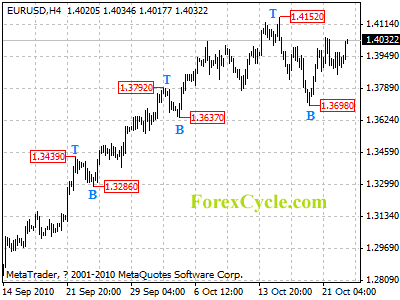
EURUSD stays in a trading range

EURUSD stays in a trading range between 1.3698 and 1.4152. Another rise to test 1.4152 key resistance is still possible later today, a break above this level will indicate that the uptrend from 1.2587 has resumed, then further rise towards 1.4500 could be seen. Support is at 1.3860, below this level could bring price back towards 1.3698 key support.

eurusd

Daily Forex Forecast

Forex Exchange Exclusive: Complex Foreclosures and The USD

By James McKee

One of the main causes of the current financial fiasco in the United States is admittedly the housing market bubble burst. Many banks are experiencing drastic losses as homeowners are being heard regarding their belief that banks have issued them mortgages without due analysis, and due process with regard to the fairness and legal nature of the loans being issued. Quite often banks are allowed to simply reclaim property that a loan holder is unable to pay for but currently a new breed of attorney has stepped up, the foreclosure defense attorney.

This specific breed of attorney is new to the legal arena and has only recently been made necessary due to the large number of foreclosures currently occurring in the United States. The fact that banks had to borrow over half a trillion dollars from the government to stay afloat demonstrates the danger to the USD that this prolonged mortgage “battle royal” represents in terms of further financial problems. Banks are actually having rulings made against them and have been ordered to pay damages to mortgage holders whose mortgage was signed by a “robo-signer”. Such a trend certainly spells out ever-increasing and volatile trouble for the banks since this means that more homeowners will be resisting foreclosure on legal grounds, and given that the number of robo-signed contracts is vast the fallout from this series of events is very grave indeed.

While the DJIA recovered from its losses yesterday one has to wonder when the big crash is coming, given what banks stand to lose from these faulty contracts another big bailout may be necessary to again protect banks from losses regarding mortgages. Consumer confidence in banks and the financial system at large in the United States is at an all-time low, and given this is just the beginning of this latest fiasco the dollar’s slide seems imminent. I would avoid pairing the dollar with majors that experiencing their own detrimental complications, make sure to avoid the Yen or the Euro and stick to the CAD and/or AUD.

Any change is a good change in the Forex exchange if you are able to anticipate it and invest accordingly. Continue to watch the USD carefully and wait for either a dip in the DJIA or an announcement regarding the current developments in mortgage market, either of these will certainly be a precursor to a drop in USD value. Keep your eyes peeled, and happy trading!

About the Author

Author is a Forex trader and financial analyst residing in Denver, Colorado. To stay up to date on all the latest developments in the financial world and beyond be sure to check out the forex exchange rates regularly.