Forex Daily Market Commentary

By GCI Forex Research

Fundamental Outlook at 0800 GMT (EDT + 0400)

USD

In the run-up to the FOMC meeting next week the jungle drums are beating. Why does the NY Fed poll market participants on their expectations regarding the QE volume? The USD positive explanation is: It is uncertain how large the volume should be. As a fine balance has to be struck between a sufficiently large effect on the bond markets (to ensure that yields fall or remain low) and inflation effects that are manageable (so that yields do not rise). The USD negative “conspiracy” theory is: The Fed wants to maximise the effect with a surprisingly large QE 2.0 volume. For that to be possible it will have to know what sort of volume would surprise. We do not believe in conspiracy theories.
Today’s US GDP data is unlikely to have much of an effect – unless it surprises notably. Regardless of whether the GDP will be slightly higher or lower: QE is a fait accompli.


EUR

European Council President Van Rompuy said EU leaders agreed to changes in the EU treaty focused on creating a mechanism for crisis resolution. However, he also said that the “no-bailout” principle will be kept. ECB Governing Council Weber said a mechanism needs to be developed for any acute Eurozone crisis, and that the problem of internal Eurozone imbalances must be dealt with.

Portuguese Prime Minister Socrates said the government wants to reach an agreement on the 2011 budget proposal to ensure that it is passed on November 2. Eurozone spreads had widened when discussions between the government and the main opposition ended but reports that the ECB bought Irish bonds in the market helped curb the spread widening. That said, investors are still pricing in a good deal of uncertainty in peripheral economies, which is likely restraining significant euro upside.

SNB officials Danthine and Hildebrand were on the wires but did not offer much new regarding monetary policy. Danthine was largely non-committal on the Swiss outlook, which indicated the SNB’s comfort with current policy. Hildebrand spoke on “Monetary Policy and the Real Estate Market”. His comments indicated he considers inflation to be a non-issue and sees some risks in the Swiss housing market. All in all there were no signs of any imminent monetary tightening.


JPY

Manufacturing PMI in October was 47.2, down from 49.5 in September. Similarly industrial production in September was -1.9% m/m (cons. -0.6%, prev. -0.3%). The slowdown in manufacturing activity is mainly due to slowing export growth on the back of a stronger yen. Core inflation came in at -1.1% y/y (cons. -1.0%, prev. -1.0%), falling for the 19th consecutive month. Labour data was also released, with the unemployment rate slipping to 5.0% versus consensus for a flat 5.1% reading.

USDJPY remained capped for much of the session as investors recalibrated Fed expectations, though the BoJ’s decision to bring forward the Nov 15-16 meeting to Nov 4-5, suggesting scope for more immediate action based on what the Fed does, could lend some support to USDJPY.


TECHNICAL OUTLOOK


EURUSD BULLISH While support holds at 1.3637, expect recovery towards 1.4159 and 1.4373 next

USDJPY BEARISH Outlook is bearish with initial support defined at 80.41 ahead of 79.75 and 77.91. Resistance at 81.99

GBPUSD BULLISH Upside potential has scope for 1.6107. Support holds at 1.5606

USDCHF BEARISH Rise above 0.9918 breakout low exposes 1.0183. Support holds at 0.9703 ahead of 0.9463

AUDUSD BULLISH Break of 0.9662 support but holds well above 0.9542 reaction low. Resistance at 1.0004

USDCAD BEARISH As long as 1.0380 continues to cap the upside, expect decline towards 1.0154 ahead of 0.9981

EURCHF BULLISH Momentum is positive; expect acceleration of gains towards 1.3924. Near-term support at 1.3456 ahead of 1.3265

EURGBP BULLISH Pullback from 0.8942 eyes 0.8689 with scope for 0.8636 next. Resistance at 0.8885

EURJPY BULLISH Remains constructive above 111.56, keeping our focus on the upside. Upside capped at 115.68 ahead of 116.68

Forex Daily Market Commentary provided by GCI Financial Ltd.

GCI Financial Ltd (”GCI”) is a regulated securities and commodities trading firm, specializing in online Foreign Exchange (”Forex”) brokerage. GCI executes billions of dollars per month in foreign exchange transactions alone. In addition to Forex, GCI is a primary market maker in Contracts for Difference (”CFDs”) on shares, indices and futures, and offers one of the fastest growing online CFD trading services. GCI has over 10,000 clients worldwide, including individual traders, institutions, and money managers. GCI provides an advanced, secure, and comprehensive online trading system. Client funds are insured and held in a separate customer account. In addition, GCI Financial Ltd maintains Net Capital in excess of minimum regulatory requirements.

DISCLAIMER: GCI’s Daily Market Commentary is provided for informational purposes only. The information contained in these reports is gathered from reputable news sources and is not intended to be U.S.ed as investment advice. GCI assumes no responsibility or liability from gains or losses incurred by the information herein contained.

USD/CHF Reversal Signal

By Russell Glaser – Heading into the monthly close, the USD/CHF is showing a bullish reversal signal in the long term downtrend.

Following last month’s breach below the bearish pennant pattern on the monthly chart, the dollar has rallied creating a bullish hammer. This candlestick pattern is identified by a long lower shadow with a small real body at the top. The candlestick is found at the bottom of a downtrend and the appearance of the hammer signals a potential bullish reversal in the downtrend trend. The candlestick pattern is similar to its bearish counterpart the hanging man.

Traders will need to wait for a close of the month to confirm the reversal signal.

Initial resistance is found at this week’s high at 0.9930. A potential target for any further appreciation in the pair may be found at the lower boundary of the pennant pattern at 1.0080. Traders should be aware that just as a support level turns into a resistance level; previously broken trend lines can serve as new resistance levels.

Forex Market Analysis provided by ForexYard.

© 2006 by FxYard Ltd

Disclaimer: Trading Foreign Exchange carries a high level of risk and may not be suitable for all investors. There is a possibility that you could sustain a loss of all of your investment and therefore you should not invest money that you cannot afford to lose. You should be aware of all the risks associated with Foreign Exchange trading.

Dollar Anticipates Release of US Advance GDP

Source: ForexYard

The US Advance GDP is the primary publication today that is set to determine the level of the dollar when the report is released at 12:30 GMT. The other main releases that are set to dominate forex trading, especially for currencies such as the dollar and euro, is the publication of the European Unemployment Rate and Revised University of Michigan (UoM) Consumer Sentiment report at 9:00 and 13:55 GMT, respectively. Traders may find good opportunities to enter the market following these vital announcements.

Economic News

USD – US Dollar Extends Losses

The US dollar extended losses against most of its major currency pairs on Thursday as speculation grew on a government stimulus plan to inject cash into the financial markets. By yesterday’s close, the dollar had fallen around 1% against the EUR to 1.3930. The dollar experienced similar behavior against the GBP and closed at 1.5940.

The greenback has trended lower in recent weeks amid expectations the Federal Reserve will soon renew large-scale asset purchases to boost the economy, in what is known as quantitative easing. Speculation on easing steps grew after the New York Fed on Wednesday released a survey which asked market participants about their expectations for the size of any further debt purchases by the Fed. This survey is having some impact on market sentiment.

Another leading indicator released yesterday was US Unemployment Claims. This number handily beat last week’s results, but failed to provide strength to the dollar as investors may be waiting for key data due to be released today to implement their trading strategies.

Today’s Advance GDP and Revised UoM Consumer Sentiment data are expected to have a strong impact on the US currency. These figures could be a surprise, and the dollar could go either way as a result of highly positive or negative data. In any case, traders are unsure about how the market will react to today’s news. A weak report could feed risk aversion, boost Treasuries and actually aid the US dollar. Then again, a better than expected result might be seen as a sign of relative US economic strength, and lift the dollar. Or it could also encourage risk-taking and aid commodities and higher-yielding currencies at the dollar’s expense. Today will be exciting for intra-day, retail traders, that is certain.

EUR – EUR Gains on Stock Market Rallies and Bearish Dollar

The euro strengthened against most of its major counterparts yesterday, continuing to prove that, for the time being, this is one of the more solid currencies that traders can rely on to provide them with steady profits. The 16-nation single currency extended gains versus the USD on Thursday, to close around 1.3930 amid a broad sell-off in the US currency. The EUR experienced similar behavior against the CHF and closed at 1.3690.

The EUR was affected by the global stock market rally and the bearish dollar. The US stock market rally led investors to buy-back into the EUR, as they looked for returns on buying commodity-linked and higher-yielding currencies in Thursday’s trading.

Looking ahead to today, the most important economic indicator scheduled to be released from the euro zone is the Unemployment Rate at 9:00 GMT. Analysts are forecasting this figure to increase from its previous reading. Traders will be paying close attention to today’s announcement as a better than expected result may continue to boost the EUR in today’s trading.

JPY – Expect Another Volatile Session as No Japanese News is Expected

The Japanese yen completed yesterday’s trading session with mixed results versus the other major currencies. The JPY was broadly unchanged versus the EUR yesterday and closed its trading session around the 112.80 level. The JPY also saw bullishness against the USD as it jumped around 80 points and closed at 80.90.

Investors are showing concern over a recent rise in the JPY as it makes Japanese products less competitive abroad and hurts the value of overseas sales when translated back into the Japanese currency. With steady gains primarily against the dollar, much of the yen’s bullish movement could be contributed to the repatriation of overseas earnings by Japanese companies into the local economy. This has had a positive effect on major JPY currency pairings, as the rising turmoil in the market is leading to more investment in the Japanese currency.

Crude Oil – Crude Oil Rises on Weaker Dollar

Oil prices rose yesterday in seesaw trading as traders eyed the weak dollar and a surprise drop in weekly job claims which bolstered confidence in the US economic recovery.

Oil and other commodities denominated in dollars for global trading tend to rise when the US currency falls since they become cheaper for holders of other currencies. A move away from dollar-based pricing of the world’s leading commodity could further weaken the greenback.

As for today, traders should pay attention to the US Advance GDP report, as it has tended to have a large impact on Crude Oil’s prices recently, especially in the short-term.

Technical News

EUR/USD

The EUR/USD experienced a bullish trend yesterday. However, it seems that this trend may be coming to an end. For example, the 4-hour chart’s Stochastic (slow) signals that a bearish reversal is imminent. A downward trend today is also supported by the weekly chart’s Stochastic (slow). Going short with tight stops may turn out to pay off today.

GBP/USD

The daily chart is showing mixed signals with its RSI fluctuating in the neutral territory. However, there is a fresh bearish cross forming on the 4-hour chart’s Stochastic (slow) indicating a bearish correction might take place in the nearest future. When the downwards breach occurs, going short with tight stops appears to be a preferable strategy.

USD/JPY

There is a fresh bullish cross forming on the 4-hour chart’s Stochastic (slow) indicating a bullish correction might take place in the nearest future. The upward direction on the weekly chart’s Momentum oscillator also supports this notion. Going long with tight stops might be the right strategy today.

USD/CHF

The bullish trend is losing steam and the pair seems to be consolidating around the 0.9850 level. The daily chart’s RSI is already floating in the over-bought territory suggesting that the recent upward trend is losing strength and a bearish correction may be impending. Going short with tight stops might be the right strategy today.

The Wild Card

Gold

Gold prices rose significantly in the last week and peaked at $1345.50 an ounce. However, the 4-hour chart’s Stochastic (slow) is now giving bearish signals, indicating that gold prices might go down today. This could give forex traders a great opportunity to enter a correction period, and at a nice entry point.

Forex Market Analysis provided by ForexYard.

© 2006 by FxYard Ltd

Disclaimer: Trading Foreign Exchange carries a high level of risk and may not be suitable for all investors. There is a possibility that you could sustain a loss of all of your investment and therefore you should not invest money that you cannot afford to lose. You should be aware of all the risks associated with Foreign Exchange trading.

Forex daily analysis 29-10-2010

AUD/USD

Daily graph:  http://www.real-forex.com/charts-daily/291010/AUD_DAILY_291010.JPG

AUD/USD daily

The bearish trend started in the beginning of the week has been corrected by exactly 50% during the 28-10-2010 session. Such a correction let us anticipate the renewal of the original trend. The future downtrend, once identified, should create an opportunity to go “Short”.

Suggestion: Looking for a decreasing configuration on one-hour graph in order to detect the new trend ASAP.

Potential trade

Hourly graph:  http://www.real-forex.com/charts-daily/291010/AUD_1H_291010.JPG

AUD/USD 1H

The required configuration should appear once the support (1H-graph support) of 0.9762 will be crossed downward. When crossed, we suggest ordering those commands:

  • “Limit” order on “Short” position 10 pips below the 1H support mentioned above, meaning: 0.9752.
  • “Stop Loss” order on the last high appeared: 0.9814.
  • “Take Profit” on the following support, which is: 0.9722

NZD/USD

Daily graph:  http://www.real-forex.com/charts-daily/291010/NZD_DAILY_291010.JPG

NZD/USD daily

During this trading week, the pair didn’t stop to navigate between the resistance 0.7564 and the support 0.7428. Actually, the pair is very close to the resistance mentioned. The way it will behave once the level will be reached will determine the trend as well as the position to adopt toward the movement:

–        A vain breach of the resistance (test) may indicate a reversal, suggesting a position “Short” until the closest support (0.7428).

–        The resistance is crossed and broken, suggesting a longer uptrend. To go “long” would be very profitable.

Have a nice week-end!

Real-Forex team.  logo

Forex Economic Calendar: October 29, 2010

By CountingPips.com

Important News Releases – October 29, 2010

00:00 Australia HIA new home sales
00:30 Australia private-sector credit
04:00 Australia NAB business confidence
05:00 Japan housing starts
08:30 United Kingdom British mortgage approvals
08:30 United Kingdom British net lending
09:00 Eurozone unemployment rate
09:30 Switzerland KOF leading indicator
12:30 Canada GDP – August
12:30 Canada from materials index/industrial price
12:30 United States GDP – 3rd quarter
12:30 United States personal consumption
12:30 United States Chicago purchasing manager
12:30 United States UMichigan consumer confidence

See full Calendar here

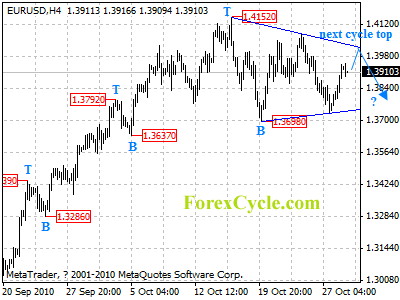
EURUSD rebounded from 1.3734

Being contained by 1.3698 support, EURUSD rebounded from 1.3734, suggesting that sideways movement in a range between 1.3698 and 1.4152 is underway. Lengthier consolidation in the trading range is expected in a couple of days, and further rise to 1.4000 area to reach next cycle top would more likely be seen later today.

eurusd

Forex Forecast

Warren Buffet is Not a Day Trader

By Markus Heitkoetter

Day traders often seek out stories of people who have had amazing success in the markets for guidance. They flock to biographies of financial celebrities hoping to gain insight and tips to get an edge on their own careers. One such celebrity, Warren Buffet, is often seen as a role model, and a recently released book on him, The Snowball: Warren Buffet and the Business of Life, will no doubt increase his influence. But while Buffet has plenty to teach us about investing, his lessons are less applicable to day traders because of the kind of investing strategies that he uses. I’m not at all discounting Buffet’s success, but I do want to stress that traders need to understand the difference between the strategies that will work for them and Buffet’s kind of investing.

Warren Buffet is, of course, a legend. Before he gave almost his entire fortune to charity, he was the richest man in the entire world. In 1962, when he began buying stock in Berkshire Hathaway, a single share cost $7.50. Today, Buffet is Berkshire’ chairman and CEO, and one “Class A” stock is worth more than $118,000.

Buffet is doubtless a financial genius, and many try to follow his advice to become rich. But you need to understand that he is not a stock trader. His investments are not in stocks. Instead he invests in companies.

Buffet has tried to make this clear himself. As he once said, “If, when making a stock investment, you’re not considering holding it at least ten years, don’t waste more than ten minutes considering it.” He has also said, “[s]hares are not mere pieces of paper. They represent part ownership of a business. So, when contemplating an investment, think like a prospective owner.” Based on these principles, he developed what he calls the Inner Scorecard, according to which he invests in “wonderful businesses” that fulfill, amongst others, the following criteria:

• They have a good return on capital without a lot of debt. • They are understandable. • They see their profits in cash flow. • They have strong franchises and, therefore, freedom to price. • They don’t take a genius to run. • Their earnings are predictable. • The management is owner-oriented.

But Buffet goes even further, looking for “subjective” clues to a company’s long term profitability. For example, it is said that once he purchased a company whose owner counted the sheets on the rolls of 500-sheet toilet paper to see if he was being cheated. (It turns out that he was.) Or, in another case, Buffet considered investing in a company whose owner painted only the side of the building facing the street in order to save money. And, in 1983, Buffet acquired the Nebraska Furniture Mart because he liked the way its founder, Rose Blumkin, did business: as a Russian immigrant, her strategy was to undersell the big shots, and she was a merciless negotiator.

There’s a clear pattern here. Before Buffet invests in a company, his team analyzes everything: the financial data, the management (including their biographies and sometimes even their personal spending habits), the company’s vision, mission and principles, the human resource policy, and much more. Then he buys enough shares to actively influence and change the company’s strategies and policies. As he said “Shares represent part ownership of a business,” and he acts on that idea once he is invested in a business.

Warren Buffet may well be the world’s greatest investor. He buys and sells businesses, and he uses the company’s shares to buy himself part ownership of a business. But Buffet is not a trader, and his strategies for success are completely different from those that make money for day traders. He does not analyze market trends, looking for movements. Instead, he looks at a company’s fundamentals and decides whether he thinks that company can grow over the long term. It’s important to keep this distinction in mind if you want to make money in the market. A day trader may well admire Warren Buffet, but he will have to look elsewhere for a model.

About the Author

Markus Heitkoetter is the author of the international bestseller “The Complete Guide To Day Trading” and a professional day trading coach. For more free information on day trading visit his website http://www.rockwelltrading.com

Forex – AUD/USD up toward the end of U.S. session

By ForexPros – The Australian Dollar was higher against the U.S. Dollar on Thursday after the release of U.S. data on Initial Jobless Claims.

AUD/USD was trading at 0.9786, up 0.67% at time of writing.

The pair was likely to find support at 0.9652, Wednesday’s low, and resistance at 0.9974, Monday’s high.

Earlier in the day, official data showed that U.S. Initial Jobless Claims fell unexpectedly to a seasonally adjusted 434.00K last week from 455.00K in the preceding week whose figure was revised up from 452.00K.

Analysts had expected Initial Jobless Claims to rise to 455.00K last week.

Meanwhile, the Australian Dollar was down against the Euro and the Japanese Yen, with EUR/AUD gaining 0.48% to hit 1.4234 and AUD/JPY falling 0.23% to hit 79.29.

About the Author

ForexPros.com
Forex Pros offers a diverse set of professional tools for trading in forex, futures and CFDs. These include real-time data streams, technical and fundamental analysis by in-house experts, and a widely used economic calendar.

US Dollar About to Weaken Again

USDX october 2010. us dollar index, usd, us dollar, ron acoba, laidtrades, laid trades, forex, forex trading

Good day Forex peeps! Here’s a technical update on the US Dollar index or USDX. For those who do not know, the USDX is an index that measures the value of the greenback against a basket of currencies. This basket is composed of the following currencies: euro (57.6% weight), British pound (11.9% weight), Canadian dollar (9.1% weight), Swiss franc (3.6% weight), Swedish krona (4.2% weight), and Japanese yen (13.6% weight). Simply put, the valuation of the USDX and the dollar itself increases when its rival currencies losses value. The opposite, however, occurs when the euro’s price, for example jumps.

So based on the given chart, it looks like the index and the USD is about to weaken again. As you can see, the index has been forming a rising wedge pattern after it broke down from a head and shoulders formation. While a rising wedge pattern appears to be bullish at first, it is in fact bearish since it only reflects a rally in prices due perhaps to short covers that are done by the short sellers or by profit taking. A breakdown from the wedge, therefore, is likely. When it does, the index would almost certainly revisit its recent low at 76.144. A breach of this level could even send it much lower towards the 74.00 area. Notice also that there is a potential hidden bearish divergence (prices make lower lows while the stochastics indicator register higher highs) in the works. But since the stochastics are still far from the overbought territory, the index may still a bit before it finally falls down.

More on LaidTrades.com

US Advance GDP Report

printprofile

Tomorrow the advanced version of the US 3rd quarter GDP is expected to be released at 12:30 GMT. The GDP is the annualized change in the inflation-adjusted value of all goods and services produced by the economy. The GDP estimate is the first of three for the quarter, with the other releases scheduled in November and December when more information becomes available. Being the earliest, the Advance release tends to provide the most market volatility for the USD and its crosses.

The GDP data will be the most watched economic report of the week. The expectation is for a slight recovery from the previous quarter, with an expectation of 2.1% growth, an improvement from the 1.7% of the previous quarter. The rise in growth for this quarter is largely attributed to higher consumer spending. The GDP data will likely join the slew of various economic indicators released this past week that showed improvement in the U.S economy. However, the release is still unlikely to brighten the gloomy long term outlook for the economy, marred by the persistently high unemployment rate.

Economists continue to anticipate Nov. 2nd-3rd FOMC meeting will likely yield expansion of quantitative easing measures as the economic recovery, though showing signs of improvement, continues to be slower than expected. This outlook continues to weigh on the USD. While the greenback recovered this week from its record lows, particularly versus the ERU and JPY, aided by the slew of better than expected economic data released throughout the week, it is unable to maintain its gains and ultimately recedes most of them.

With tomorrow’s release the USD is expected to follow this week’s trend. If the result of the GDP is as expected or higher the greenback will likely appreciate versus its rivals, possibly moving 50-100 pips. However, traders should be cautious of a possible downward correction as investors will likely be uneasy with a strong Dollar heading to next week’s FOMC meeting minutes.