Safe Haven Currencies Rise on High Risk Aversion

Source: ForexYard

Traders moving assets to safer, lower yielding currencies appear to be playing a factor in the correction of the major crosses. The USD and JPY, which are seen as a safer bet than others currencies in times of market stress, will likely keep drawing demand as investors stay away from riskier assets.

Economic News

USD – Dollar Recovery Continues

The U.S. dollar rose broadly, climbing to a 7-week peak versus a basket of currencies as sharply lower stock and commodities prices boosted the greenback’s safe haven allure. The stronger dollar also prompted investors to unwind bets against the U.S. currency built up in recent months. As a result, the USD finished yesterday’s trading session 150 pips higher against the EUR at the1.3490 level. The greenback also saw bullishness against the GBP and closed at 1.5885.

Moreover, the dollar on Tuesday climbed against key currencies amid increasing concerns over the euro zone debt handling and prospects of an interest rate hike in China. Investors followed with concern the euro zone’s struggle to deal with alarming levels of sovereign debt, especially in Ireland, amid growing speculation that the former Celtic Tiger nation could be bailed out.

Looking ahead to today, the most important economic indicators scheduled to be released from the U.S. are the Building Permits, Core CPI and Crude Oil Inventories reports. Traders will be paying close attention to today’s announcements as stronger than expected results could further boost the USD in the short-term. Traders are also advised to follow a speech by FOMC member Bullard around 14:15 GMT. His speech is very likely to impact dollar volatility. Traders are advised to watch closely, as this is likely to set the pace of the dollar going into the rest of the week’s trading.

EUR – EUR Strength Not Likely to Return this Week

The EUR fell to a 7-week low against the U.S. dollar on Tuesday as investors grew increasingly risk-averse amid concern about fiscal problems in peripheral euro zone nations. By yesterday’s close, the EUR fell sharply against the USD, pushing the oft-traded currency pair to 1.3490. The 16-nation single currency experienced similar behavior against the JPY and closed at 112.40.

Ireland has come under intense pressure over its debt crunch, with a top European Union official saying the future of the 27-country union was at stake. Adding to worries was news that Greece will likely miss its fiscal targets this year and next, and Austria has not yet submitted its contribution to the aid package for Greece for December.

The British pound also fell to a session low against the dollar as Bank of England (BOE) Governor Mervyn King said it was a concern that UK inflation was above target. King said the central bank could do further quantitative easing if that turns out to be necessary. The GBP fell as low as 1.5839, before recovering to 1.5885 yesterday

JPY – Additional Volatility Forecasted with Light Japanese News Day

The Japanese yen strengthened against most of its major counterparts yesterday, continuing to prove that for the time being this is a solid currency that traders can rely on to provide them with steady profits. The yen extended gains versus the EUR on Tuesday, to trade around 112.40 amid a broad sell-off in the EUR. The JPY also saw bullishness against the GBP and closed at 132.40.

As for today, Japan will be absent from the economic calendar. The JPY’s trends will be affected by the rallies of its primary currency pairs. It seems the USD and EUR are expected to continue a volatile trading session today and their crosses with the JPY will likely be as well. Traders should keep a close look on the news coming from the U.S. and Europe as these economies will be the deciding factors in the JPY’s movement today, especially the U.S. Building Permits at 13:30.

Crude Oil – Crude Oil Falls 3%

Oil slumped 3% on Tuesday to a 2-week low as the dollar rose on euro zone debt concerns and as fears that China’s attempts to cool inflation will reduce demand. China’s move sparked a broad commodities sell off yesterday.

A stronger U.S. dollar can pressure oil, and other dollar-denominated commodities, by attracting investors to foreign exchange markets seeking higher yields, increasing the value of greenbacks paid to producers and making commodities more expensive for users of other currencies.

Oil has retreated after hitting a 25-month peak above $88 a barrel last Thursday, the highest prices since the financial crisis.

Technical News

EUR/USD

The EUR/USD cross has experienced a bearish trend for the past few days. However, it seems that this trend may be coming to an end. The RSI of the 4-hour chart shows the pair floating in the over-sold territory, indicating that an upward correction may happen anytime soon. Going long with tight stops might be a wise choice.

GBP/USD

The price of this pair appears to be floating in the over-sold territory on the daily chart’s RSI, indicating an upward correction may be imminent. The upward direction on the hourly chart’s Momentum oscillator also supports this notion. When the upward breach occurs, going long with tight stops appears to be a preferable strategy

USD/JPY

The hourly chart is showing mixed signals with its RSI fluctuating in the neutral territory. However, the daily chart’s RSI is already floating in the over-bought territory indicating that a bearish correction might take place in the nearest future. Going short with tight stops might be a wise choice.

USD/CHF

The USD/CHF cross has experienced a bullish trend for the past week. However, it seems that this trend may be coming to an end. For example, the daily chart’s Stochastic Slow signals that a bearish reversal is imminent. A downward trend today is also supported by the 4-hour chart’s Slow Stochastic. Going short may turn out to pay off today.

The Wild Card

Crude Oil

Crude oil prices have dropped significantly yesterday and peaked at $82.50 a barrel. However, on the 8-hour chart, the RSI is floating in the over-sold territory which suggests that a bullish correction is impending. This might be a great opportunity for forex traders to enter the trend at a very early stage.

Forex Market Analysis provided by ForexYard.

© 2006 by FxYard Ltd

Disclaimer: Trading Foreign Exchange carries a high level of risk and may not be suitable for all investors. There is a possibility that you could sustain a loss of all of your investment and therefore you should not invest money that you cannot afford to lose. You should be aware of all the risks associated with Foreign Exchange trading.

“Real-Forex” daily market analysis

USD/CHF

Daily graph: http://www.real-forex.com/charts-daily/November2010/CHF_DAILY_171110.JPG

USD/CHF daily

A resistance level on 0.9731 was crossed and during yesterday’s trading session, and clearly closed above it. For several sessions, the pair is on its way to the next resistance on the daily graph at 0.9931. During last session that resistance was crossed as well and visibly closed above it.

Currently, a “Long” trade is not an option since the pair requires a little correction in order to confirm the uptrend and the opportunity created. Two options are possible:

  1. The pair is corrected but did not cross back the resistance of 0.9931. After the correction we suggest the identification of an increasing configuration on 1H graph.
  2. A vain breach of the 0.9931 is done downward, immediately followed by a new increase, and creates the opportunity to go “Long”

Our analyses suggest the creation of such an opportunity during the tomorrow’s session or the following day.

AUD/USD

Daily graph: http://www.real-forex.com/charts-daily/November2010/AUD_DAILY_171110.JPG

AUD/USD daily

Following an uptrend, which lasted for several months, the pair began to decrease back a few sessions ago by crossing a support level at 1.0002 and clearly closing below it.

Currently, the pair is making its way to the following support on the daily graph at 0.9661. When the pair will reach that support, it should be analyzed with the usual tools:

1)      Test of the support èindication of close reversal, potential for “Long” trades.

2)      Stop on the level. It could be better waiting for a “Parking” of about a session and a half, and then entering a “Long” order.

3)      Clear and sharp breach of the support è it could be safer waiting for a small correction and after the identification of a decreasing configuration on 1H graph, go “Short” along with the new trend.

Have a profitable day!

Real – Forex team logo

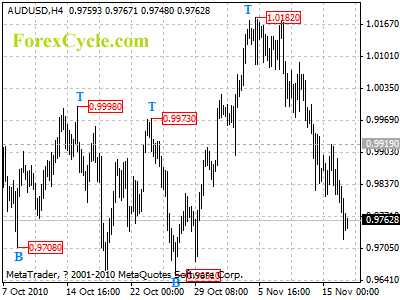
AUDUSD continues its downward movement from 1.0182

AUDUSD continues its downward movement from 1.0182 and the fall extended to as low as 0.9724 level. Deeper decline towards 0.9651 key support is still possible later today, a breakdown below this level will suggest that the long term uptrend from 0.8066 (May 25 low) has completed at 1.0182 already, then the following downward move could bring price to 0.9000 or even lower. Resistance is at 0.9919, only break above this level could indicate that the fall from 1.0182 has completed, then another rise towards 1.0182 previous high could be seen.

audusd

Daily Forex Analysis

Forex – US Dollar rises to 6-week high vs Indian Rupee. USD/INR over 45.50

The US dollar has continued its recent surge higher against the Indian rupee in the forex market today and has touched its highest exchange rate in approximately six weeks.

The USD/INR currency pair reached a high point exchange rate today at 45.85 rupees per dollar after opening the day near the 45.30 exchange rate. The pair currently trades around the 45.79 exchange rate near the end of the US session.

The dollar’s strength follows the recent decline to a 26-month low point against the rupee that was reached on November 5th at the 44.03 level. Since that recent low point, the dollar has reversed course and risen to its highest level since late September against the rupee.

USD/INR – Dollar/Rupee currency pair rises above 50-day simple moving average (sma) with the 200-day sma sitting close above near 46.00.

About the Author

FxNewsIndia.com – India Forex News

NOK Vulnerable to European Debt Concerns

By Greg Holden – The pressure being placed on Ireland to accept a bailout of its financial institutions has been weighing on risk appetite throughout the region. Traders appear weary of taking on too much risk, which has pulled funds away from the higher yielding assets. One result has been a weakening Norwegian krone (NOK).

Norway’s central bank remarked on October 26 that it would be waiting until mid-2011 to continue its monetary tightening policies. The dovish statement made clear that Norway was awaiting further recovery in other economies before attempting to expand more aggressively. As a result, the NOK has become vulnerable to risk aversion, which appears to have spiked in recent weeks.

Meanwhile, Sweden’s krona (SEK) is expected to gain from this influx of risk aversion. Analysts are forecasting a rise in capital inflows over the next few months for Sweden as its hawkish bank statements and monetary tightening appear to increase its appeal. The SEK has, in fact, been the second highest performing currency in 2010, only slightly behind the Australian dollar.

USD/NOK Breaches Resistance at 5.9825

The current price of the USD/NOK around the 5.9965 level shows a price which has recently breached the significant 38.2% Fibonacci retracement line. On the chart below, we can see that the MACD and RSI both show additional room for upward mobility since neither has yet entered their respective over-bought regions.

As with the above analysis, if pressure continues to mount throughout Europe due to Irish debt concerns, risk aversion will likely continue to loom large. With the current stance of Norgesbank, the NOK is open to downward pressure from the fundamental side. We can also see that the pair has yet to meet any significant resistance on the technical side, and appears to have the momentum to continue towards 6.1500, indicated by the 50% Fibonacci retracement line.

USD/NOK – Daily Chart

Forex Market Analysis provided by ForexYard.

© 2006 by FxYard Ltd

Disclaimer: Trading Foreign Exchange carries a high level of risk and may not be suitable for all investors. There is a possibility that you could sustain a loss of all of your investment and therefore you should not invest money that you cannot afford to lose. You should be aware of all the risks associated with Foreign Exchange trading.

Forex: Currency Futures Speculators decrease positions against US Dollar, trim Euro, Aussie longs

By CountingPips.com

The latest Commitments of Traders (COT) report, released on Monday by the Chicago Mercantile Exchange, showed that futures speculators decreased their bets in favor of the major currencies against the US dollar. Non-commercial futures positions, those taken by hedge funds and large speculators, were overall net short the US dollar by $21.85 billion against other major currencies as of November 9th, down from a total short position of $24.53 billion on November 2nd, according to data published by Reuters which calculates the dollar positions against the euro, British pound, Japanese yen, Australian dollar, Canadian dollar and the Swiss franc. Speculators have raised their bets for the dollar three out of the last four weeks.

*The COT report is usually released on Fridays but was delayed until Monday due to a bank holiday.

On an individual currency basis, speculators added to their long positions for the British pound sterling, Canadian dollar, Mexican peso, Swiss franc and the New Zealand dollar while cutting long positions in the euro, Japanese yen and the Australian dollar compared to the week before.

EuroFx: Currency specs were net long the euro against the U.S. dollar by 23,283 contracts as of November 9th. This is a decrease of approximately 15,000 contracts following net long positions of 38,610 contracts on November 2nd and the third straight week of declining euro long positions.

The COT report is published every Friday by the Chicago Mercantile Exchange (CME) and shows futures positions as of the previous Tuesday. It can be a useful tool for traders to gauge investor sentiment and to look for potential changes in the direction of a currency or commodity. Each currency contract is a quote for that currency directly against the U.S. dollar, where as a net short amount of contracts means that more speculators are betting that currency to fall against the dollar and net long position expect that currency to rise versus the dollar. Open interest is the number of open contracts that have not been closed by a transaction or by delivery.

GBP: The British pound sterling positions rose higher to a net of 21,266 contracts after being long on November 2nd by 15,182 positions. The latest data is a second straight week of increasing pound positions following three weeks of declines in the GBP long positions.

JPY: The Japanese yen net long contracts declined to 36,654 contracts as of November 9th from 46,455 net long contracts reported on November 2nd.

CAD: The Canadian dollar positions advanced higher for a second straight week to a net total of 37,338 contracts after totaling 23,365 net longs on November 2nd.

CHF: Swiss franc long positions were essentially unchanged for third straight week at 12,615 long contracts as of November 9th after totaling a net of 12,465 long contracts on November 2nd.

AUD: The Australian dollar positions decreased lower for the sixth straight week after reaching their highest level since April on September 28th. AUD futures contracts declined to a net amount of 47,616 long contracts as of November 9th from 51,180 long contracts on November 2nd.

NZD: New Zealand dollar futures positions jumped higher to their highest level all year at a total of 22,250 long contracts after a total of 19,148 long contracts the week before.

MXN: Mexican peso long contracts increased as of November 9th to 88,746 net long positions from 82,272 longs the week prior. The latest data marks two straight weeks of increases for the Mexican peso speculative positions.

COT Data Summary as of November 9th, 2010
Large Speculators Net Positions vs. the US Dollar

Euro: + 23,283 contracts from +38,610 contracts
British pound sterling: + 21,266 contracts from +15,182 contracts
Australian dollar: + 47,616 contracts from +51,180 contracts
Canadian dollar: + 37,338 contracts from +23,365 contracts
Japanese yen: + 36,654 contracts from +46,455 contracts
Mexican peso: + 88,746 contracts from +82,272 contracts
New Zealand dollar: + 22,250 contracts from +19,148 contracts
Swiss franc: + 12,615 contracts from +12,465 contracts

Go to the Commitment of Traders CME raw futures data

Further COT Resources from around the web:

Santa to Send the Philippine Peso Back to P42.00 Vs. the US Dollar?

usdphp, us dollar, php, philippine peso, philippines, remittances, remittance

Roughly a month ago, the Philippine Peso together with many other currencies were trading strongly against the US dollar. If you look at the dollar-to-peso chart (USD/PHP), the peso even reached a high of P41.991 versus the greenback last November 4. However, the P42.00 marker proved to be resilient, at least at that time, as the dollar rebounded off of it. At present, the Philippine Peso is trading back at around P43.70. Several technical factors, though, indicate that the dollar’s rally could be over and the peso could appreciate once more. As mentioned, the peso is exchanging at around the P43.70 level which used to be a former support. A support, as we know is a level where traders buy the currency. But after breaking through that level, that level’s role could flip from a support to a resistance. Noticeably, the dollar has been unable to rally above it for the last couple of days. Coincidentally, this level also magically corresponds to the 38.2% Fibonacci retracement level that I drew. A hidden bearish divergence, where the price registers lower lows and the stochastic oscillator marks higher highs, is also evident (for those who are newbies, these concepts might be a little off the roof but we at LaidTrades will soon include these in our wikipedia and lessons portion). And with conditions in the overbought territory as indicated in the stochastics, traders could soon pick up the peso in exchange of the dollar.

One main factor that is affecting the Peso exchange rate is the level of remittance (dollars) from abroad that is sent back to the country. For those who do not know, about 11% of the country’s gross domestic product or simply total output comes from the money sent home by overseas Filipino workers (OFWs). In 2009, remittances went up by 5.4 % to a new historical of $17.348 billion from $16.426 billion in 2008. For 2010, remittances are even seen to reach $21.3 billion, reflecting a 23% jump from last year. Now it is very likely that the dollar inflows for the year would hit or even exceed that target. Remember, Christmas is very much celebrated in the Philippines since more than 90% of its population are Catholic. Christmas shopping and giving gifts to family and friends have always been an indelible part of Filipinos’ culture. Having said that, remittances from abroad will surely soar during the holiday season because of this. As you know, the more money we receive, the more we can spend. More money spent would then benefit the individual businesses and the whole economy in general which would likewise reflect on the currency (peso). Moreover, improved consumer sentiment during this season would lead investors towards the higher yielding assets and away from the USD. Such would also indirectly benefit the peso exchange rate.

More on LaidTrades.com

GBP/JPY Looks to Correct Gains

By Yan Petters – The GBP/JPY pair recently saw an extraordinary bullish trend, gaining almost 700 pips and peaking at the 133.77 level. However, the pair saw several failed attempts to reach to the 134.00 level, and a bearish correction appears to be imminent.

• The chart below is the GBP/JPY 8-hour chart by ForexYard.
• There is a very notable bullish trend line, which took off at October 27, and has peaked on November 12, at the level of 133.77.
• However, the pair saw about 4 failed attempts to cross the 133.80 level, indicating that the bullish pressure is losing steam.
• Currently, a bearish cross has been forming on the Slow Stochastic, suggesting that a bearish move might be impending.
• In addition, the RSI is now pointing down, also indicating that a bearish move could be imminent. If the RSI will fall below the 70-line it might validate the bearish correction.
• The next support levels are located at 132.85, 131.90 and 130.95
• The next resistant levels are located at 133.80 and 135.00

Forex Market Analysis provided by ForexYard.

© 2006 by FxYard Ltd

Disclaimer: Trading Foreign Exchange carries a high level of risk and may not be suitable for all investors. There is a possibility that you could sustain a loss of all of your investment and therefore you should not invest money that you cannot afford to lose. You should be aware of all the risks associated with Foreign Exchange trading.
Forex Daily Market Commentary

By GCI Forex Research

Fundamental Outlook at 0800 GMT (EDT + 0400)

USD

The dollar weakened during the US session after New York Fed President Dudley said that the Fed’s latest round of Treasury purchases is equivalent to a 75bp cut in the policy rate. EURUSD traded 1.3561-1.3656, and USDJPY 82.72-83.27. FOMC Vice Chairman Yellen earlier sounded extremely dovish and said she saw “inflation lingering near current levels for a long time”. Yellen said she could be in favour of extended purchases beyond June “if I were to continue to be concerned about the outlook and thought that further purchases could work.” Both speakers also said that the Fed’s latest policy initiative was not designed to weaken the dollar. The S&P 500 finished down -0.12%. US data were largely overshadowed by Eurozone comments on the developing sovereign risk story. The NY Fed’s Empire State manufacturing current activity index plunged to -11.1, weaker than expected. In contrast, total retail sales were better than expected at 1.2% (cons: +0.7%, UBSe: +0.6%) in October after an upwardly revised 0.7% gain in September (was 0.6%). Ex-autos sales rose in line with expectations: up 0.4% after an upwardly revised 0.5% (was 0.4%) in September. Ahead, US October PPI, September TIC data, October industrial production, and the November NAHB housing market index will be released.
EUR

Various policymakers across Europe commented on the Irish situation yesterday. An Irish junior minister said that Ireland has not approached the EU or IMF to arrange a sovereign bailout. However, despite the denials from the Irish government, media reports continue to run the story. Irish opposition spokesperson Noonan said he believed that European intervention for Ireland is underway and that matters could come to a head over the next 24 hours.
The FT reported that Portugal’s Finance Minister said the risk was high that Portugal would need external assistance. However, in subsequent comments, he said there is “no imminent” request for foreign aid and that Portugal will maintain its strategy of raising financing from the markets.
Greek debt figures provided grim reading as the level of government debt in 2009 was revised up to 126.8% of GDP from 115.1%. The revisions from eurostat also revised the budget deficit upwards to 15.4% of GDP.
GBP

Ahead of the BoE minutes on Wednesday, MPC member Martin Weale suggested that the committee will be split as he expressed his worries about the effectiveness of any monetary tightening or loosening.
CHF

The combined PPI and IPI index in Switzerland was slightly lower than market consensus at -0.4% (m/m) and +0.3% (y/y), providing further evidence that pricing pressures remain largely subdued.
AUD

The minutes from the RBA’s Nov 2 policy meeting revealed that the decision to hike the policy rate by +25bp was finely-balanced. Ultimately the policy board chose to be forward-looking on inflation, although a strong AUD, tame CPI, and subdued credit growth were noted as reasons that argued in favour of not hiking at that particular meeting.

TECHNICAL OUTLOOK

EURUSD support at 1.3235.
EURUSD BEARISH Breach of 1.3574 exposes 1.3235. Resistance at 1.3777 ahead of 1.4282.
USDJPY BULLISH Focus on 83.99, only a break above 85.93 would confirm a bull trend. Initial support at 81.66 reaction low.
GBPUSD BULLISH Upside potential holds below 1.6379 ahead of 1.6458. Support holds at 1.5952.
USDCHF BULLISH Push through 0.9972 would expose 1.0183. Support at 0.9671 ahead of 0.9463.
AUDUSD NEUTRAL Pullback from 1.0183 has support at 0.9652 ahead of 0.9542 reaction low.
USDCAD BEARISH Stalled in front of 0.9931, push through the level would expose 0.9820 with scope for 0.9712 next. Resistance at 1.0156.
EURCHF BEARISH Push through 1.3229 and 1.3072 would expose 1.2766. Sustained break of 1.3834 required for resumption of bull trend.
EURGBP BEARISH Move below 0.8390 would expose 0.8311. Resistance at 0.8638.
EURJPY BEARISH Remains heavy below 115.68; break of 111.05 reaction low would expose 107.73.

Forex Daily Market Commentary provided by GCI Financial Ltd.

GCI Financial Ltd (”GCI”) is a regulated securities and commodities trading firm, specializing in online Foreign Exchange (”Forex”) brokerage. GCI executes billions of dollars per month in foreign exchange transactions alone. In addition to Forex, GCI is a primary market maker in Contracts for Difference (”CFDs”) on shares, indices and futures, and offers one of the fastest growing online CFD trading services. GCI has over 10,000 clients worldwide, including individual traders, institutions, and money managers. GCI provides an advanced, secure, and comprehensive online trading system. Client funds are insured and held in a separate customer account. In addition, GCI Financial Ltd maintains Net Capital in excess of minimum regulatory requirements.

DISCLAIMER: GCI’s Daily Market Commentary is provided for informational purposes only. The information contained in these reports is gathered from reputable news sources and is not intended to be U.S.ed as investment advice. GCI assumes no responsibility or liability from gains or losses incurred by the information herein contained.