Dollar Advances Ahead Of ADP Non-Farm Payrolls Release

Source: ForexYard

The dollar gained against most of its major currency rivals yesterday, partly due to expectations that this week’s labor reports will provide further evidence that the U.S. economy is recovering. The first of these reports is the ADP’s forecast for the past month’s Non-Farm Employment Change. Large volatility is likely to take place due to this release, and traders are advised to be prepared.

Economic News

USD – Dollar Soars as Risk-Aversion Increases

The U.S. dollar strengthened yesterday against most of the major currencies. The dollar began yesterday’s session with a down trend against the euro, but was able to reverse by midday. The EUR/USD pair reached as low as the 1.3285 level by the end of the session. The dollar also saw a 200 pip appreciation against the Swiss franc.

The USD gained yesterday following a drop in the Standard & Poor’s 500 Index, which boosted demand for safer assets. In addition, significant bearish trading for commodities, such as crude oil and gold, also increased demand for the dollar as a safe haven. Gold dropped about 4,000 pips in yesterday’s session and crude oil fell from $92.00 a barrel to $88.35.

The dollar’s bullishness was also supported by forecasts that U.S. reports on jobs and services, which are expected later on this week, might provide further evidence that the economy is recovering.

As for today, several economic releases are scheduled from the U.S. economy. The most significant reports are likely to be the ADP Non-Farm Employment Change, and the Non-Manufacturing Purchasing Managers’ Index. The ADP report is a forecast for the Non-Farm Payrolls data, which is scheduled for Friday, and is considered to be quite reliable. Thus, its result tends to have a large impact on the market.

EUR – Euro Falls vs. the Majors amid Commodities Bearishness

The euro weakened against most of its major currency counterparts in Tuesday‘s trading session. The euro saw a 150 pip drop against the U.S. dollar and about a 100 pip loss against the British pound. The euro also fell about 120 pips vs. the Japanese yen.

The currency fell yesterday in response to a sharp decline in commodities trading. Crude oil erased all of Friday’s gains, and a barrel of crude oil is once again trading below $90. In addition, gold saw a sharp decline, falling from $1,415 an ounce to as low as $1,374 an ounce. The fall in commodities trading took place due to reduced risk-appetite in the market.

The euro also fell vs. the dollar after a report showed that Factory Orders in the U.S. rose by 0.7 percent in November, beating expectations for 0.1% decline. The positive data has further boosted the dollar, and as a result weakened the euro.

Looking ahead to today, the most significant economic release from the euro-zone looks to be the European Industrial New Orders. This report measures the change in the total value of new purchase orders placed with manufacturers. A positive figure, following a 4.2% decline in the previous report, might support the euro.

JPY – Yen Sees Mixed Results against the Majors

The Japanese yen saw an extremely volatile session during yesterday’s trading. The yen began yesterday’s trading with a 60 pip gain against the U.S. dollar, which was subsequently erased by the end of the session. The yen also a 120 pips gain vs. the euro and a 150 pips loss vs. the British pound.

The yen’s bullishness vs. the euro took place as a result of lower risk-appetite in the market. The euro has weakened against most of the major currencies, and the yen was no exception.

On the other hand, the yen fell against the dollar following a better than expected Factory Orders figure. The report showed that factory orders in the U.S. have increased by 0.7% in November, beating projections for a 0.1% decline. As a result, the dollar gained against most of the major currencies.

As for today, no significant data is expected from the Japanese economy. Traders are advised to follow the Japanese and the U.S. equity markets as they are likely to have a large impact on the yen’s trading.

Crude Oil – Crude Oil Falls From 27-Month High to $88.36 a Barrel

Crude oil fell yesterday from a 27-month high and reached as low as $88.36 a barrel. Crude opened yesterday’s session with a 60 pip gain, only to see a remarkable 360 pip fall. Crude is currently trading near $89.00 a barrel.

Crude oil prices fell sharply yesterday after traders sold long contracts to secure profits. In addition, a drop in the Standard & Poor’s 500 Index has led to reduced risk-appetite in the market, which has weakened oil prices as well. Another commodity that was largely influenced by it was gold, which fell by 4,000 pips yesterday to $1,375 an ounce.

Looking ahead to today, the U.S. Crude Oil Inventories figure is scheduled for 15:30 GMT. This report measures the change in the number of barrels of crude oil held in inventories by commercial firms during the past week. The currently projection is that supplies have contracted by 1.4M over the past week. Such a result might support oil prices.

Technical News

EUR/USD

The EUR/USD pair saw a sharp bearish move yesterday, and dropped about 160 pips. Currently, in the 4-hour chart we are seeing what seems to be the beginning of a “M” pattern, which suggests that the pair has potential to fall down to the 1.3100 level.

GBP/USD

The cable gained about 190 pips yesterday, and the pair is currently trading near the 1.5560 level. Nevertheless, as a bearish cross has completed on the 4-hour chart’s Slow Stochastic, it seems that a correction might take place today. Going short with tight stops might be the right strategy today.

USD/JPY

The USD/JPY continued with the bullish reversal yesterday, and is currently trading above the 82.00 level. In addition, as the RSI on the daily chart has crossed the 30-line and continues to point up, it seems that another bullish session might take place today. Going long appears to be the preferable choice today.

USD/CHF

The USD/CHF saw a bullish correction yesterday, and reached as high as the 0.9515 level. Currently, as the MACD on the 4-hour chart continues to provide bullish signals, the upward move looks to continue with the potential to reach the 0.9600 level.

The Wild Card

Gold

Gold saw a rather abnormal trading session yesterday, and dropped about 4,000 pips in a single-day. In addition, as a bearish cross has been completed on the daily chart’s Slow Stochastic, and the RSI continues to point down, the bearish move looks to proceed. This might be a great opportunity for forex traders to join a very popular trend.

Forex Market Analysis provided by ForexYard.

© 2006 by FxYard Ltd

Disclaimer: Trading Foreign Exchange carries a high level of risk and may not be suitable for all investors. There is a possibility that you could sustain a loss of all of your investment and therefore you should not invest money that you cannot afford to lose. You should be aware of all the risks associated with Foreign Exchange trading.
AUDCAD seen Drowning on Bearish Channel

By Forex Signs, Inc.

The floods in Australia seem to also drown the AUDCAD as the pair faces a bearish channel today. The pair began with price level of 1.0085; the initial candle stick at H1 time frame was bullish then it was followed by a number of bearish sticks. At the time of writing, the pair already knocked down 90 pips. The downward trend was fabricated during yesterday’s trade. Before 2010 ended, the AUDCAD trend was sleeping, and then at the start of 2011, an Elliot wave in H1 chart was determined. Two bullish corrections were seen yesterday and right now, the trend is within the fifth wave. Initial key resistance line is at 1.0057 while key support is at 0.9998. There is an expectation of minor corrections however AUDCAD is still forecast to pursue further declines. The MACD (12, 26, 9) can attest to the aforementioned analysis. The MACD signal at the moment is posted at -0.0022, the lowest value reached since December 16 of last year. The signal can navigate further down as the red line (signal) has not yet touched the peak of the yellow line (dispersion). More, the %R (14) is seen loitering on between -80 and -100. There were corrections yet the indicator remained below -80. For the longest time, the technical indicators for AUDCAD strongly indicate a trading bias of sell.

Asian Session Outlook

Yesterday’s Asian session went antagonistic for the three musketeers of the Asian currencies as they lost a couple of pips against a basket of their major currency counterparts. The Japanese yen lost more than 50 pips against the U.S. dollar, this is probably because the latter reported a good economic indicator during the trade. The EURJPY pair also gained more than 70 pips. Something fundamentally good might have happened in the EU zone. Meanwhile, the Australian dollar drowned in the bearish trend as AUDUSD fell more than 100 pips in the trend; aussie against EUR also sunk by roughly 100 pips. The New Zealand dollar, on the other hand, failed to boost as well as NZDUSD pair collapsed after a strong bullish force last week; EURNZD soared above a hundred pips also. The bearish force felt among the Asian currencies were perhaps the effect of their holiday abnormally high volatility. A strong correction might have probably been made.

For today’s session, there are no economic indicators for the Japanese yen and New Zealand dollar. Traders can expect that the trend would depend on the indicators set for their currency pairs. Should indicators for their pairs turn worst-than-expected, chances are the yen and kiwi will channel to a bullish force.
Meanwhile, the Australian dollar may expect a streak of bullish candle sticks should the Building Approvals in November post an increase. However, there is a bigger chance that the aussie may still drown as their nation still faces problems in Queensland floods.

About the Author

Forex Signs, Inc., Founded in 2006 in Wall Street, New York City, FSI relentlessly strives to be the premier Forex brokerage company in the industry by providing exclusive and unmatched trading and investment related services while constantly developing innovative solutions that cater to the vast requirements of both individual and institutional market participants.

CHFJPY Continues Bullish Trend

By Forex Signs, Inc.

The pair CHFJPY is looking bullish as it remains within the bullish channel as seen on H4 time chart. Price currently consolidates between support level 87.010 and resistance level 87.765. Buy bias in the long term is feasible as price moves within bullish channel. As of this writing price has formed a weak downtrend. If price makes a break below the support level price action may form a bearish correction, testing 86.083. A break below 86.083 level may signal a bearish reversal for this pair. If price makes a break above the resistance level it will only confirm the buy bias for the long term. RSI (14) shows price remains in neutral, suggesting an upward trend may continue momentum.

Green is Wealth for Japan

There is a slight chance that the Japanese yen may hit a bullish mark against its Asian currency colleague, the New Zealand dollar, as Japan’s government is set to invest in green technologies. The government of the land of the rising sun, together with its industries, is likely to endow $6.4 billion in green energy technologies over the next 15 months. With this project, economy in Japan is expected to be healthy as employment will arise together with the manufacturing industry.

Further, the government would offer financial backings worth $1.9 billion while the rest of the outlay is likely to come from some 142 companies which include Fuji Electric Holding, Toda Kogyo Corp, Toshiba Corp, Sharp Corp and Panasonic Corp. Investments would be made in a wide range of green technologies like fuel-efficient cars, energy-efficient appliances, LED lighting systems and solar panels.

With this, the Japanese yen can expect a boost as speculators may see optimism in Japan’s economy. However, as soon as Japan sees a strengthened yen, there is a chance that they will do something to wane it as it may harm their export industry.

About the Author

Forex Signs, Inc., Founded in 2006 in Wall Street, New York City, FSI relentlessly strives to be the premier Forex brokerage company in the industry by providing exclusive and unmatched trading and investment related services while constantly developing innovative solutions that cater to the vast requirements of both individual and institutional market participants.

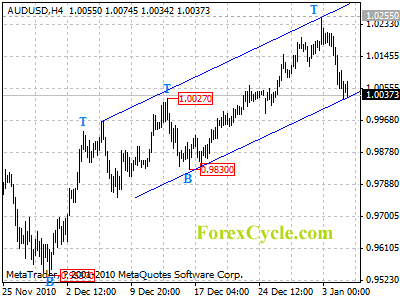
AUDUSD formed a cycle top at 1.0255

AUDUSD formed a cycle top at 1.0255 level on 4-hour chart, the subsequent pullback had bring price to the lower border of the price channel. Rebound from the bottom line of the channel would likely be seen later today. Resistance is at 1.0110, a break above this level could trigger another rise towards 1.0300 area. However, a clear break below the channel support will indicate that the uptrend from 0.9537 had completed at 1.0255 already, then the following downward move could bring price back to 0.9650-0.9700 area.

audusd

Daily Forex Forecast

Prechter on CNBC – “Not a bear among them”

Prechter on CNBC – “Not a bear among them”

Robert Prechter of Elliott Wave International and Don Luskin of Trend Macro
share their opposing market views with CNBC host Larry Kudlow. (Note:
Prechter’s interview starts about four minutes into the interview).

Get Up to Speed on Robert Prechter’s Latest Perspective — Download this
Special FREE Report Now.

About the Publisher, Elliott Wave International
Founded in 1979 by Robert R. Prechter Jr., Elliott Wave International (EWI) is the world’s largest market forecasting firm. Its staff of full-time analysts provides 24-hour-a-day market analysis to institutional and private investors around the world.

Is Your Bank on the “100 Safest” List? Maybe You Should Find Out

Close to Collapse: Bailed-Out Banks Facing Bankruptcy

By Elliott Wave International

We want to trust in the financial stability of our bank. After all, most of us have money in these institutions.

In spite of our wishful thinking, the tide of bank failures has not stopped. And these failures are occurring well after the heart of the financial crisis — and even after some of these banks received bailouts.

“Nearly 100 U.S. banks that got bailout funds from the federal government show signs they are in jeopardy of failing.

The total, based on an analysis of third-quarter financial results by The Wall Street Journal, is up from 86 in the second quarter, reflecting eroding capital levels, a pileup of bad loans and warnings from regulators.

The 98 banks in shaky condition got more than $4.2 billion in infusions from the Treasury Department under the Troubled Asset Relief Program.”

Wall Street Journal (12/26)

Seven of the 98 small banks mentioned have already failed.

In the U.S. so far this year, 157 banks have failed — that’s the highest number since 1992.

More failures are likely because many banks are burdened by questionable “assets” and bad real estate loans.

“…your money is only as safe as the bank’s loans. In boom times, banks become imprudent and lend to almost anyone. In busts, they can’t get much of that money back due to widespread defaults.

If the bank’s portfolio collapses in value, say, like those of the Savings & Loan institutions in the U.S. in the late 1980s and early 1990s, the bank is broke, and its depositors’ savings are gone.”

Conquer the Crash, 2nd edition, pp. 175-176

Yes, the Federal Deposit Insurance Corporation (FDIC) insures depositors, but the question is: Does the FDIC have the wherewithal to “make whole” all depositors if scores of banks go under at the same time? Here at Elliott Wave International, we do not recommend that you count on the FDIC. Here’s why:

“…did you know that most of the FDIC’s money comes from other banks? This funding scheme makes prudent banks pay to save the imprudent ones, imparting weak banks’ frailty to the strong ones.

When the FDIC rescues weak banks by charging healthier ones high ‘premiums,’ overall bank deposits are depleted, causing the net loan-to-deposit ratio to rise.

The result, in turn, means that in times of bank stress, it will take a progressively smaller percentage of depositors to cause unmanageable bank runs.”

Conquer the Crash, 2nd edition, p. 177

Are some banks safer than others? We think so.

“Hope is not a strategy.” If you plan to have money on deposit at a bank, we suggest reading our FREE report, Discover the Top 100 Safest U.S. Banks.” This 10-page bank safety report is available to you after you become a Club EWI member.Inside the revealing free report, you’ll discover:

  • The 100 Safest U.S. Banks (2 for each state)
  • Where your money goes after you make a deposit
  • How your fractional-reserve bank works
  • What risks you might be taking by relying on the FDIC’s guarantee

Please protect your money. Download the free 10-page “Safe Banks” report now.
Learn more about the “Safe Banks” report, and download it for free here.

This article was syndicated by Elliott Wave International and was originally published under the headline Is Your Bank on the “100 Safest” List? Maybe You Should Find Out. EWI is the world’s largest market forecasting firm. Its staff of full-time analysts led by Chartered Market Technician Robert Prechter provides 24-hour-a-day market analysis to institutional and private investors around the world.

US Dollar advances on better US Factory Data

The US dollar gained on start of the North American Session on Tuesday backed by better US Factory data. The dollar index DXY which measures the greenback’s performance versus its major six rival currencies surged to 79.44 as compared to 79.152 on Monday’s late trading session.

The latest report released by US Commerce Department showing that factory data gained 0.7 percent in November surpassing all expectations which stood around increase of 0.1 percent.

Senior market analyst Andrew Wilkinson from Interactive Brokers commented, “The dollar ought to be on the wane as investors stretch to reach incremental yield elsewhere. But with signs that the domestic economy is once again expanding and ahead of the major nonfarm employment report due on Friday, there seems to be a revival in support for the dollar.”

The US dollar advanced versus the Japanese Yen to 81.94 as compared to 81.24 as on Monday. The Euro also gained 0.2 percent to 109.15 against the Japanese Yen whereas the Euro slightly declined versus the greenback to 1.3309 as compared to 1.3363 on Monday’s late trading session.

The Euro have been trading on much optimistic sentiments since the start of North American trading session on the latest data  released by European Union’s statistics agency depicting that consumer price inflation increased to 2.2 percent in December as compared to 1.9 percent in the month of November.

The British Pound advanced 0.8 percent to 1.559 against the US dollar. Sterling moved up on the CIPS manufacturing PMI of 58.3 which happens to be the highest in last 16 years.

About the Author

Daily forex trading news written by Rehan from DailyForexTrade.com

FOREX: Large Currency Speculators trim bearish bets against US Dollar

By CountingPips.com

The latest Commitments of Traders (COT) report, released on Monday by the Commodity Futures Trading Commission (CFTC), showed that futures speculators trimmed their short bets of the US dollar against the other major currencies. Non-commercial futures positions, those taken by hedge funds and large speculators, were overall net short the US dollar by $8.85 billion against other major currencies as of December 28th. This is down from the total short position of $8.97 billion on December 21st, according to the CFTC data and calculations by Reuters which calculates the dollar positions against the euro, British pound, Japanese yen, Australian dollar, Canadian dollar and the Swiss franc.

EuroFx: Currency speculators added to their shorts of the euro against the U.S. dollar for a second straight week as of December 28th. Euro positions fell to 26,479 short contracts from a total of 14,093 short positions registered on December 21st. This is the largest short position in the euro since July 2010.

The COT report is published every Friday (or Monday due to holidays) by the Chicago Mercantile Exchange (CME) and shows futures positions as of the previous Tuesday. It can be a useful tool for traders to gauge investor sentiment and to look for potential changes in the direction of a currency or commodity. Each currency contract is a quote for that currency directly against the U.S. dollar, where as a net short amount of contracts means that more speculators are betting that currency to fall against the dollar and net long position expect that currency to rise versus the dollar.

GBP: Speculators added to their British pound sterling short positions to a total of 13,121 short contracts on December 28th following the previous week’s short positions of 7,432 contracts. Pound sterling contracts have now been short for five straight weeks dating back to November 30th.

JPY: The Japanese yen net long contracts more than doubled as of December 28th with 29,641 long contracts from 12,529 net long contracts reported on December 21st.

CHF: Swiss franc long positions rose higher for a fourth straight week to a total of 14,002 long contracts as of December 28th after totaling a net of 12,527 long contracts on December 21st.

CAD: The Canadian dollar positions increased as of December 28th. CAD long positions registered 34,787 contracts after totaling 24,948 net longs on December 21st.

AUD: The Australian dollar positions advanced higher for a fourth consecutive week. AUD contracts increased to a net amount of 64,316 long contracts as of December 28th from 60,550 long contracts on December 21st.

NZD: New Zealand dollar futures positions reversed five straight weeks of decline to rise to 8,115 long positions as of December 28th. NZD large speculator long positions had fallen to a total of 7,366 long contracts on December 21st.

MXN: Mexican peso long contracts edged slightly higher as of December 28th to 82,246 net long positions from 78,002 longs the week prior. The latest data is a third straight week of increase for the Mexican peso speculative positions.

COT Data Summary as of December 28th, 2010
Large Speculators Net Positions vs. the US Dollar

EuroFx: -26,479
British pound sterling: -13,121
Japanese yen: +29,641
Swiss franc: +14,002
Canadian dollar: +34,787
Australian dollar: +64,316
New Zealand dollar: +8,115
Mexican peso: +82,246

Go to the Commitment of Traders CME raw futures data

Further COT Resources from around the web:

Dollar May See Boost against NOK

By Dan Eduard

Since early last week, the US dollar has been steadily dropping against its Norwegian counterpart. The USD/NOK pair has fallen close to 1300 pips since the 27th of December, largely due to the low volatility that existed in the marketplace around the Christmas holiday. It now appears that the pair may be due for a reversal, with technical indicators showing an impending bullish move is likely to occur.

We will be analyzing the daily chart for the USD/NOK pair, provided by Forexyard. We will be looking at the Stochastic Slow, Williams Percent Range and Relative Strength Index (RSI).

1. As we can see, the Stochastic Slow has formed a bullish cross. This is typically a solid sign that the pair is in oversold territory, and an upward correction is likely to take place.

2. When analyzing the Williams Percent Range, we typically view the -80 and -20 levels as the borders for the instrument being in oversold and overbought territory, respectively. As we can see, the indicator is just below the -80 level, meaning the USD/NOK is likely oversold and may see bullish movement.

3. The RSI is currently right on the border of being in the oversold region. Traders will want to keep a close eye on this indicator. When it crosses the bottom support line, upward movement will likely follow.

Forex Market Analysis provided by ForexYard.

© 2006 by FxYard Ltd

Disclaimer: Trading Foreign Exchange carries a high level of risk and may not be suitable for all investors. There is a possibility that you could sustain a loss of all of your investment and therefore you should not invest money that you cannot afford to lose. You should be aware of all the risks associated with Foreign Exchange trading.

GBP/USD Reaches Short Term Resistance

By Russell Glaser

The GBP/USD has risen in early trading to a resistance line that may contain the pair for the rest of the trading day.

As the Cable rises, it has run into a resistance level at 1.5650. Traders may be able to use this as an entry point to short the pair with a first target at the short term support level at 1.5540 followed by the December low at 1.5340.

Further resistance may be found at the falling trend line from the November high which comes in today at 1.5700.

Forex Market Analysis provided by ForexYard.

© 2006 by FxYard Ltd

Disclaimer: Trading Foreign Exchange carries a high level of risk and may not be suitable for all investors. There is a possibility that you could sustain a loss of all of your investment and therefore you should not invest money that you cannot afford to lose. You should be aware of all the risks associated with Foreign Exchange trading.