Apple’s (AAPL) iPhone 5 will likely use Qualcomm (QCOM) chipsets and a new, potentially more advanced processor, according to electronista. The use of Qualcomm’s chipset indicate that one version of the phone may be able to run on Verizon’s (VZ) network, according to the publication.
MyPhone Sales Pushing Solid Group, Inc. (SGI) Higher
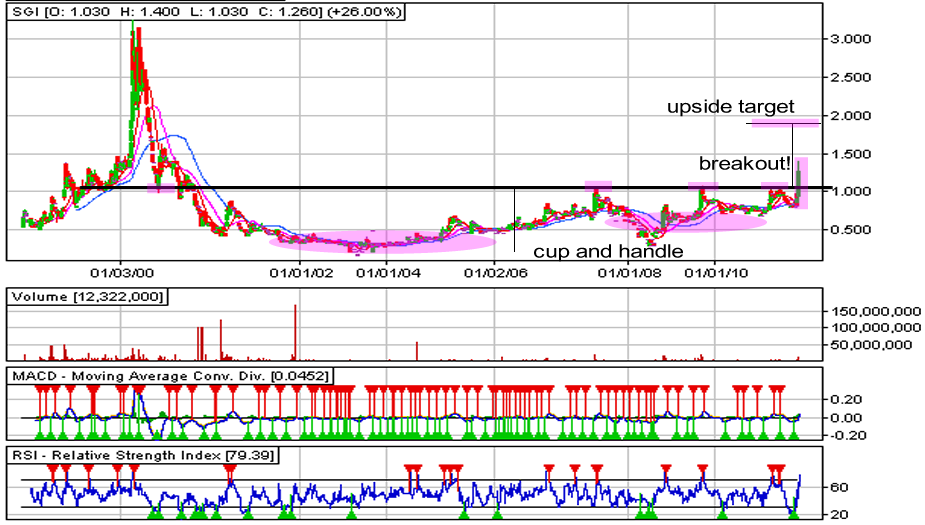
Solid Group, Inc. or SGI in the Philippine Stock Exchange, the name behind the only Philippine-mobile phone brand MyPhone, pocketed PHP 2 billion in unit sales for the year 2010, reflecting a 9-fold sales increase from 2009. The company holds as much as 40% of the Philippines’ mobile phone market and with the introduction of more affordable phones that are wifi-capable and the apparent improvement in consumer appetite, revenues for 2011 could even be rosier. SGI is also looking to launch a tablet PC that is similar to Apple’s iPad this year.
From a technical perspective, the shares of SGI have been consolidating into what appears to be a very wide cup and handle formation for about a decade now before finally breaking out from the pattern just today. If SGI manages to keep itself above the pattern’s neckline which is around PHP 1.06 in the next few days, then it could spring all the way up to just below PHP 2.00. No technical resistance are on the horizon which means that its upside target could be reached sooner than later.
More on LaidTrades.com …
Oanda to offer the Metatrader 4 Forex Trading Platform
By Zac, CountingPips.com
Count Oanda in as another forex broker that will be offering the popular Metatrader4 to its forex trading customers. In its annual update sent out to current customers, Oanda CEO and President Michael Stumm said one of the company’s developments in 2011 will be a release of the Metatrader4 platform and categorized the release as “imminent”. MetaTrader4 will join the FxTrade trading platform that Oanda currently offers.
The Metatrader4 platform is extremely popular due to its openness for customization and automated capabilities. Metatrader4 is also offered by numerous forex brokers which allows traders to pick and choose their preferred broker while using the same platform.
SEC Reportedly Probes Deals With Sovereign Wealth Fund
The Securities and Exchange Commission is reportedly investigating whether financial firms violated bribery laws by making improper payments to sovereign wealth funds to encourage them to make investments. The Wall Street Journal first reported on the probe, citing unnamed sources familiar with the matter.
With the Apple iPhone Coming, Is Verizon a Mobile Phone Stock to Buy?
By Jared Levy, Editor, Smart Investing Daily, taipanpublishinggroup.com
By the time many of you read my notes, chances are good that Verizon (VZ:NYSE) and Apple (AAPL:NASDAQ) have formally announced the new Apple iPhone offering on the Verizon network. As we learn more, rest assured that I will offer updated commentary on the deal. (I started my writing late Monday night.)
There are so many considerations surrounding this deal. It’s actually not just about Verizon or even Apple, for that matter.
Before we even get into these two companies, one must back up a minute and look at the evolution of the mobile device and how the “smart phone” is changing the world that we are living in.
Flash Back to 2001
Just 10 years ago, if you were a techie who wanted to stay “plugged in” and mobile you probably needed to own and/or carry the following items:
- Mobile phone and or pager — $499 for phone/$99 for basic pager
- Mobile phone service — $199+ for unlimited back in 2001
- Data service — no unlimited data plans (good luck browsing the web)
- Camera — $399
- GPS — $249
- Digital organizer (pocket PC) — $499.99
- Laptop — $1,699
- Video Camera/Recorder — $449
- Broadband connection — $75 per month
All told, your tech tab was close to $4,000 in hardware costs alone. That’s not including the per minute and gigabyte voice and data charges you had to pay a wireless carrier if you wanted to communicate off a landline and browse the web on the go (which was next to impossible back then).
Flash-forward to 2011 and you’ll find that the Apple iPhone (and a few of its competitors, including select Android, BlackBerry and even Microsoft phones) offers you the consumer more than the equivalent of all of the devices listed above.
You can currently buy a brand-new Apple iPhone 3GS for $49 (with a two-year contract) from AT&T (T:NYSE). The iPhone 4 will set you back $199.
Those price points, which are similar among many of the competing phones as well, make the smart phone a “no brainer” choice for most people (techie or not) around the world. You can try to resist all you want, but the reality is that if you can pick up an Apple iPhone for $49, with all those capabilities, it becomes really hard to say no.
The global smart phone penetration is somewhere around 14-18% (I am estimating based off a Goldman Sachs report from last year). This means that there is still much upside to be had in this sector, but it’s most likely not going to be for the carriers themselves and here is why.
(Investing doesn’t have to be complicated. Sign up for Smart Investing Daily and let me and my fellow editor Sara Nunnally simplify the stock market for you with our easy-to-understand investment articles.)
Mobile Phone Subsidies, Service and Competition
What many of us don’t realize is that carriers like AT&T, Verizon and Sprint subsidize the cost of the phone. They purchase the phone from Apple, Google, Samsung, etc. for, say, $499 and then sell it to you for $99, hopefully making the difference back in monthly usage fees and early termination costs if you try to leave.
We all know that our mobile phone bills and plans (especially in the U.S.) can be pricey and complicated, and it seems like those phone companies should be making money hand over fist, but the reality is that customer retention is tough and because many service areas overlap, there is always stiff competition. Plus, they are usually handling most of the front-end customer service and tech support calls and maintaining these complex networks, towers, technology, etc.
The phone companies are much less nimble and typically have lower profit margins than the phone makers themselves.
Since the first Apple iPhone went on sale June 29, 2007, AT&T stock is down 28% (in red), while Apple is up about 185%; where would you put your money?

Invest With the Leaders in a Growing Mobile Phone Industry
In my humble opinion, forget Verizon, AT&T and even Sprint; the smart phone revolution is not just an American fad! As the world grows and wants to connect, the smart phone is an inexpensive way for many to get several gadgets all rolled into one seamless, useful product.
Competition is fierce and there are dozens of mobile phone carriers around the world; here is a list of the largest. You will notice that Verizon and AT&T are 16th and 17th respectively. There are about six smart phone companies that produce the lion’s share of phones globally.
The Bottom Line for Mobile Phone Stocks
The iPhone launch at Verizon should be another big win for Apple, but that doesn’t mean you can’t make money with these other companies in 2011:
Google (GOOG:NASDAQ) — The spread of Android-based phones and Google’s continued position as leader of search and all things online give it exposure to the smart phone revolution. Expect it to use its massive cash reserves to grow its presence as well.
Research in Motion (RIMM:NASDAQ) — While this company has lagged, its product line is still very stable and widely accepted and growing. It also held several spots on Amazon’s top-10-selling smart phones in 2010. The stock is well valued at its current levels.
Motorola Mobility (MMI:NYSE) — This is the recent spinoff of Motorola’s mobile unit. The stock has not traded long, but is focusing its high-quality pedigree and history on creating some really exciting new products that could make this an interesting company to watch. Management spent the past year getting in touch with the global consumer, according to the chief market officer at the CES show last week. Sanjay Jha (who definitely doesn’t have Steve Jobs’ delivery) discussed the new product pipeline here, including the new Atrix 4G, which is being billed as the world’s most powerful smart phone to date (it’s pretty awesome and runs Android and Flash, which the iPhone doesn’t).
When investing in anything, don’t just look at the sector and buy any stock within — find those stocks that have not only the best growth potential, but the flexibility to keep up with the ever-changing times that we live, work and play in.
Editor’s Note: Have You Heard of “Technology Metals”? Without “technology metals” there would be no cell phones, no iPods and no personal computers. There would be no hybrid cars, solar panels or modern wind turbines. And you could say goodbye to almost all military technology. This URGENT FREE REPORT tells you exactly what “technology metals” are… why they are key to more than $4.6 trillion in global commerce… how China seized a choke hold on the market… and how you could make gains of 950% as shortages arrive.
About the Author
Jared Levy is Co-Editor of Smart Investing Daily, a free e-letter dedicated to guiding investors through the world of finance in order to make smart investing decisions. His passion is teaching the public how to successfully trade and invest while keeping risk low.
Jared has spent the past 15 years of his career in the finance and options industry, working as a retail money manager, a floor specialist for Fortune 1000 companies, and most recently a senior derivatives strategist. He was one of the Philadelphia Stock Exchange’s youngest-ever members to become a market maker on three major U.S. exchanges.
He has been featured in several industry publications and won an Emmy for his daily video “Trader Cast.” Jared serves as a CNBC Fast Money contributor and has appeared on Bloomberg, Fox Business, CNN Radio, Wall Street Journal radio and is regularly quoted by Reuters, The Wall Street Journal and Yahoo! Finance, among other publications.
Forex & Commodities: Dollar up & Gold, Silver down?
By J.W. Jones, optionstradingsignals.com
The U.S. Dollar Index Futures have been sold heavily and interestingly enough, gold and silver have not rallied. In fact, gold and silver have sold off while the dollar experienced downward price action as well. How does that whole scenario make any sense? I do not fancy myself as an expert in the area of reasoning why a stock or commodity rises or falls. I firmly believe that the media is nearly always wrong as to the real reasons stocks and commodities are rallying or falling.
I believe that the market is a giant discounting mechanism. The market discounts news, political variables, and the future supposedly. It is hard to know if the future is actually priced in, but the experts say that it is as do the academics, therefore we might as well consider it fact else be thrown to the proverbial wolves. The point in all of this is that I have no earthly idea why the U.S. Dollar, gold, and silver were all sold on Thursday. I would also point out that light sweet crude oil futures closed the day lower.
I can’t believe I am about to say this, but I believe the U.S. Dollar Index may be setting up to rally here. If we take a look at the daily chart of the U.S. Dollar Index Futures we can see that the dollar has been under serious selling pressure accompanied with high volume. However the price action represented on the chart below illustrates that support is located around its 50 period moving average. It might take several days before the U.S. Dollar forms a bottom, but should it start to rally it may attempt to break out over recent highs.

Time will tell, but the U.S. Dollar has several support levels that should help support the price action and push prices higher. A rally in the U.S. Dollar would be somewhat contrarian as most people are expecting a pullback. I am not trying to imply that the U.S. Dollar is going to rally for the next 5 years. I am trying to point out a short term rally in the dollar is possible right now based on the daily chart. I would urge caution for those who are leaning heavily into shorting the dollar as it could backfire, particularly if gold, silver, and oil are unable to rally on dollar weakness.
The U.S. Dollar Index futures (/DX) traded lower on heavy volume today yet gold futures (/GC) closed the trading session down around $11.70 / an ounce or (0.83%). We have all been conditioned to believe that the U.S. Dollar Index and gold move inversely with one another. For those of you that say this inverse relationship is constant I would love an explanation of how this happened. I have been ridiculed for discussing the possibility that gold and silver could go through a correction. When we look at the gold futures daily chart, the price action is ominous as it is currently trading below its 50 period moving average while it has put in a lower high.

In addition to the selling pressure in gold, silver futures were unable to move higher on the lower dollar. In fact, silver futures closed trading down by nearly $0.42 an ounce, or (1.45%). Silver performed worse on a lower dollar than gold. The daily chart of silver futures (/SI) reveals that price is testing the 50 period moving average and at this point a rally is still possible. The daily silver futures chart is shown below:

Another reason to be cautious of precious metals in the short run is the price action in the gold miners ETF GDX. The daily chart of GDX leaves little to the imagination as it was sold off heavily on Thursday. GDX traded lower by $1.85 / share or (3.20%) which is not exactly a great way to demonstrate relative strength in the marketplace. The action in GDX on Thursday was quite simply ugly and more selling could transpire in coming days. The daily chart of GDX is illustrated down below.

It remains to be seen if the price action today in the U.S. Dollar, precious metals, and the miners really means much of anything. However, it would be foolish to ignore the price action in the metals and the U.S. Dollar Index. The divergence from the norm could be a warning that gold and silver are about to go through a correction. The price action in GDX would be supportive of that conclusion and the dollar trading down near a support level where a bounce higher is likely also point to potentially lower prices in the precious metals complex.
In the short term I am very cautious with regards to precious metals and the miners, while I am cautiously bullish about the U.S. Dollar Index in the short run. For those trading precious metals, the U.S. Dollar, and the gold miners risk is excruciatingly high.
NFA Forex brokers to come under tighter scrutiny on slippage pricing concerns
By Zac, CountingPips.com
A new article out today has said that the National Futures Association is going to begin tighter scrutiny of its member companies for possible “slippage” pricing abuses. The article, written by Sarah Morgan and published on the Wall Street Journal website, says the NFA will start analyzing trades by the 16 Forex firms registered with the NFA to make sure these firms are not taking advantage of any slippage improprieties.
Slippage occurs when a trader places a market order at a certain price but the order is executed at a different price. This can occur in fast-moving markets like the forex markets and can have a detrimental effect to your trade.
Two firms, Gain Capital and IkonFx, have already paid a fine this year due to investigations of slippage by the NFA without acknowledging or denying any wrongdoing.
Forex Update: Retail Sales increase by 0.6% in December. US Dollar higher in Fx Trading
By CountingPips.com
US retail sales increased for the sixth consecutive month in December although gaining by slightly less than expected, according to the monthly report by the US Commerce Department. The advance estimate of the US monthly retail sales showed that sales increased by 0.6 percent to total sales of $380.9 billion in December. The data was just behind the market expectations that were predicting a 0.8 percent rise for the month. November’s sales data was unrevised at an increase of 0.8 percent.
 On an annual basis, the December retail sales data increased by 7.9 percent above the December 2009 sales level following November’s annual increase of 7.5 percent.
Core retail sales, excluding automobiles and parts, rose by 0.5 percent in December following a 1.0 percent increase in November. The economic forecasts were expecting a monthly core sales to rise by 0.7 percent.
Contributing to the higher sales level for December was a rise in automotive sales by 1.1 percent while building material, garden and supply stores increased by 2.0 percent for the month. Gasoline stations sales increased by 1.6 percent and nonstore retailers rose by 2.6 percent in December while health and personal care store sales rose by 1.6 percent.
US Dollar gains in Forex Markets, Stocks edge higher, Gold down sharply
The US dollar has been mostly stronger in the forex markets against the other major currencies since the start of the day. The American currency has been gaining ground so far versus the euro, Japanese yen, Swiss franc, Australian dollar, New Zealand dollar and the Canadian dollar while declining against the British pound sterling in today’s fx trading action.
The U.S. stock markets, meanwhile, have been modestly higher today with the Dow Jones increasing by over 20 points, the NASDAQ up by approximately 8 points and the S&P 500 rising by over 3 points in the middle of the US trading session.
Oil has edged lower by $0.46 to the $90.94 level while gold futures have decreased sharply by $29.90 to trade currently at the $1,357.00 level.
Stocks to Watch Today: Friday, January 14th 2011
Coinstar gave some 4Q guidance late yesterday that was disappointing. CEO Paul Davis admits the company made a couple demand miscalculations and experienced inventory management issues within the quarter. Shares fell 24% after hours Thursday. Sanofi Aventis and Genzyme – Sanofi is trying to broker a deal to buy Genzyme for $76 per share. Google getting hit from all sides today. The search-giant’s $700M acquisition of travel software company, ITA is being challenged by the U.S. government. The Justice Department is looking into antitrust issues concerning that deal, while in South Korea the site is accused of breaking federal laws with it’s Street View mapping application. Also use caution around Citigroup stock today, the TARP Special Inspector General Neil Barofsky said in a report yesterday that it’ s 2008 bailout was ‘ad-hoc’. He says there is serious ‘moral hazard associated with the continued existence of institutions that remain ‘too big to fail’. So keep your eye on the financials on Friday. Finally, the last stock to look out for today, Intel may see a boost. The tech-company had beat the street’s earnings expectations late yesterday. Intel put out it’s best quarterly and yearly results ever and made an optimistic forecast for the year ahead, projecting 10% increase in revenue in 2011 versus 2010. Shares went up 2% in after hours trade. We interviewed Mahesh Sanganeria from RBC Capital Markets so make sure you watch that clip on Intel earnings for further detail on the stock.
US Consumer Prices rise 0.5% in December on higher gasoline prices
By CountingPips.com
U.S. Consumer Prices increased in December for a sixth straight month as rising gasoline prices boosted the index higher, according to a report released today by the U.S. Department of Labor. The Consumer Price Index, a key measurement of inflation, increased by 0.5 percent in December following an increase of 0.1 percent in November.  Today’s data surpassed economic forecasts that were expecting a 0.4 percent increase.
The annual rate of consumer prices rose by 1.5 percent when compared to December 2009 following an annual increase in November by 1.1 percent.
Rising gasoline prices contributed to 80 percent of the increased inflation for the month as the report showed that gasoline prices rose by 8.5 percent. Gasoline prices had increased by just 0.7 percent in November.
The core inflation reading, excluding volatile food and energy prices, edged higher by 0.1 percent for the month and matched the market forecasts. The annual rate of core inflation increased by 0.8 percent for December following an increase of 0.8 percent in November.
Food prices increased by 0.1 percent for the month while overall energy prices rose by 4.6 percent after an increase of just 0.2 percent in November.
