Gold Continues to Fluctuate Within a Converging Wedge Pattern

By Fast Brokers – Gold has highlighted the relevance of the wedge pattern we spotted last week by bouncing off of our 2nd tier uptrend line once again. Meanwhile, our downtrend line is gradually converging with our 2nd tire uptrend line, implying gold may wake from its consolidative slumber soon. Fortunately for bulls, gold continues to set higher lows while hinting at a topside preference by continually resisting a noteworthy retreat below the highly psychological $1050/oz level. All eyes remain on the Dollar, particularly the Euro and Aussie crosses. Gold has seemed to follow the EUR/USD and AUD/USD more closely than the GBP/USD and USD/JPY due to the erratic behaviors of the BoE and BoJ, respectively. Therefore, investors should eye the EUR/USD’s ability to move higher and create some space between present price and the currency pair’s psychological 1.50 level. We notice a similar consolidative pattern in the AUD/USD, so investors should watch to see if the currency pair can break above its own October highs. A breakout in either major cross could result in a similar movement in gold.

Meanwhile, the S&P futures are in a topside battle of their own. The S&P has had a lot of trouble breaking through its psychological 1100 level. A large movement above 1100 in the S&P would likely come with a broad-based depreciation of the Dollar, thereby pushing gold higher due to correlative forces. As a result, investors should pay attention to the S&P’s reaction to upcoming Q3 earnings reports and econ data releases, most notably tomorrow’s CB and HPI data along with Wednesday’s Advance GDP and Durable Goods numbers. That being said, the presence of key econ and earnings releases among key psychological levels across the board presents the opportunity for high volatility should results steam in either highly positive or negative.

In terms of technicals, the topside barriers remain our makeshift downtrend line along with previous 2009 highs and the psychological $1075/oz and $1100/oz levels. As for the downside, the psychological $1050/oz level continues to serve as an important technical cushion along with our 1st and 2nd tier uptrend lines.

Present Price: $1058.50/oz

Resistances: $1058.75/oz, $1061.40/oz, $1065.15/oz, $1068.06/oz, $1070.66/oz

Supports: $1055.46/oz, $1051.91/oz, $1048.62/oz, $1045.32/oz, $1042.96/oz

Psychological: $1050/oz, $1075/oz, $1100/oz

Market Commentary provided by Fast Brokers.

Disclaimer: FastBrokers’ market commentary is provided for information purposes only and under no circumstances should be regardedneither as an investment advice nor as a solicitation or an offer to sell/buy any financial product. FastBrokers assumes no responsibility or liability from gains or losses incurred by the information herein contained.

Risk Disclosure: There is a substantial risk of loss in trading futures and foreign exchange. Please carefully review all risk disclosure documents before opening an account as these financial instruments are not appropriate for all investors.

USD/JPY Consolidates with an Upward Bias

By Fast Brokers – The USD/JPY is consolidating around our 2nd tier downtrend line while maintaining its upward bias from last week. Positive U.S. Q3 earnings and econ data have given investors renewed faith in the U.S. economy as a whole, allowing investors to feel more comfortable with the USD/JPY risk trade. By sending the USD/JPY higher last week, investors are showing their support for the belief that the Fed will be able to raise rates before the BoJ, making the Yen the preferred funding currency once again. The USD/JPY has successfully created some breathing room between present price and the psychological 90 level while knocking down a few downtrend lines. However, the currency pair still faces quite a few topside technical barriers to overcome considering the extent of its pullback from August highs.

Investors will get a better idea of the BoJ’s current monetary stance towards the end of the week when the central bank makes its scheduled policy decision late Thursday/early Friday EST. The recent upturn in the USD/JPY supports the BoJ’s more hawkish monetary stance. Therefore, analysts are expecting the BoJ will stick to its tighter approach towards monetary policy considering the USD/JPY is back above 92. Japan will roll out a couple econ releases between now and then, including Retail Sales late Tuesday EST followed by Prelim Industrial Production late Wednesday EST. While investors are expecting an improvement in Retail Sales due to the appreciation of the Yen, Prelim Industrial Production should carry more weight since Japan’s economy is export-focused.

Technically speaking, the USD/JPY’s potential encounter with our 3rd tier downtrend line is an important development since it runs through 8/28 highs. Our 3rd and 4th tier downtrend lines carry a heavier weight since they represent the USD/JPY’s ability to extend its present upward movement towards the psychological 95 level. Besides our downtrend lines, 9/21 highs could serve as a formidable technical barrier should they be reached. That being said, the USD/JPY’s topside obstacles are wearing thin, and an accelerated near-term breakout is becoming more probable. As for the downside, the USD/JPY’s recent run has created several technical cushions, including multiple uptrend lines along with 10/23, 10/22, 10/21, and 10/20 lows. Speaking of which, this set of higher lows is normally a positive technical sign trend-wise.

Present Price: 91.90

Resistances: 91.93, 92.05, 92.18, 92.38, 92.51, 92.67

Supports: 91.70, 91.57, 91.41, 91.19, 91.08, 90.88

Psychological: 90

Market Commentary provided by Fast Brokers.

Disclaimer: FastBrokers’ market commentary is provided for information purposes only and under no circumstances should be regardedneither as an investment advice nor as a solicitation or an offer to sell/buy any financial product. FastBrokers assumes no responsibility or liability from gains or losses incurred by the information herein contained.

Risk Disclosure: There is a substantial risk of loss in trading futures and foreign exchange. Please carefully review all risk disclosure documents before opening an account as these financial instruments are not appropriate for all investors.

GBP/USD Stabilizes along our 2nd Tier Uptrend Line

By Fast Brokers – The GBP/USD has balanced along our 2nd tier uptrend line after getting pummeled on Friday. Britain’s Prelim GDP data printed 6 basis points below analyst expectations (-0.4% vs 0.2%), shocking investors and igniting speculation that the BoE will keep its QE package open. This sentiment contradicts recent optimism garnered from strong Services PMI and CCC data points. However, investors should keep in mind that the Cable’s incredible run from 10/13-10/23 was provoked by a more neutral monetary stance emanating from the BoE. Therefore, one can only speculate how the BoE will approach its monetary policy over the near-term. As we explained in our previous post, there’s a chance the BoE changed its tone in advance to Prelim GDP data to help put the Pound in a more favorable position once the news hit the wire. Regardless, the BoE will likely continue its psychological tango with investors to move the Cable in a direction it deems appropriate for Britain’s economy.

Investors will receive more heavily-weighted econ data from Britain tomorrow with the release of CB Realized Sales. A positive consumer-oriented release could help stem the bleeding and allow the Cable to right itself. However, it’s difficult to imagine tomorrow’s CB number coming in ahead of expectations since Britain’s last two Retail Sales numbers have flat lined (0%). Regardless, investors will be keyed in since Friday’s GDP number has put the spotlight on Sterling for the time being. The U.S. will be releasing important econ data of its own, including HPI and CB Consumer Confidence figures along with a public address from Treasury Secretary Geithner. Activity in the U.S. will only heat up as the weak progresses with Durable Goods and New Home Sales tomorrow along with Advance GDP on Wednesday. The S&P futures haven’t been able to break through 1100 time and again. The S&P’s resistance at 1100 has been a problem for the Cable since the two are positively correlated. Therefore, the performance of upcoming U.S. data and Q3 releases should have a noticeable, broad-based impact on the Greenback. On the other hand, the Cable has had a mind of its own this Autumn, showing its direction ultimately relies upon the BoE’s perceived monetary policy.

Technically speaking, the Cable is suddenly facing four fresh downtrend lines and 1.65 is serving as a psychological barrier once again. The GBP/USD’s last run topped out beneath 9/11 highs, meaning the currency pair has its work cut out for it to the topside since a reversal into a longer downtrend isn’t out of the question. As for the downside, the Cable has managed to avoid a retest of 9/21 lows thus far. Our 2nd tier uptrend line should play an importance role in preventing such an occurrence. Meanwhile, though far away, the Cable still has our 1st tier uptrend line to fall back on along with the psychological 1.60 level and previous October lows should the situation deteriorate further. Therefore, the Cable’s uptrend is salvageable as long as near-term technical cushions hold up.

Present Price: 1.6341

Resistances: 1.6366, 1.6391, 1.6413, 1.6445, 1.6467, 1.6493

Supports: 1.6329, 1.6295, 1.6265, 1.6247, 1.6227, 1.6205, 1.6185

Psychological: 1.65, 1.60

Market Commentary provided by Fast Brokers.

Disclaimer: FastBrokers’ market commentary is provided for information purposes only and under no circumstances should be regardedneither as an investment advice nor as a solicitation or an offer to sell/buy any financial product. FastBrokers assumes no responsibility or liability from gains or losses incurred by the information herein contained.

Risk Disclosure: There is a substantial risk of loss in trading futures and foreign exchange. Please carefully review all risk disclosure documents before opening an account as these financial instruments are not appropriate for all investors.

EUR/USD Consolidates Around 1.50

By Fast Brokers – The EUR/USD is continuing its consolidation around the highly psychological 1.50 mark after Germany’s Consumer Climate number came in weak as anticipated. Despite the miss, the EUR/USD is showing little reaction since today’s data reading could be just a bump in the road to improvement and doesn’t confirm a material slowdown. Psychologically, the Euro is getting a bit of support today after a Chinese official released a statement implying that it would be in the country’s best interest to diversify more of its reserves away from Dollars towards the Euro and Yen. While the official did reiterate the Dollar’s prevalence as the global monetary standard, his comments nonetheless support China’s waning confidence in the Greenback. However, the Yen is actually weakening this morning, and it remains to be seen whether this news will have a noticeable impact on the Dollar.

Today’s session will be light on the data front, meaning prevailing near-term trends may play through. Although the EU will be releasing its M3 Money Supply number tomorrow, investors will likely be paying closer attention to British and U.S. data points. Britain sent a shock through the FX markets last week after printing a Prelim GDP figure 6 basis points weaker than expected (-0.4% vs 0.2%E). Britain’s GDP number rattled investor confidence. Therefore, investors will likely be paying close attention to tomorrow’s CBI Realized Sales data. However, it’s difficult to expect positive Realized Sales numbers tomorrow considering the last two Retail Sales releases have come in flat at 0% growth. On the other hand, outperformance of tomorrow’s release could provide a bit of relief to investor anxiety and help buoy the Pound. As for the U.S., investors will receive CB Consumer Confidence along with some S&P HPI data. More strong U.S. data could drive the Dollar lower and help the EUR/USD create a little separation from 1.50.

Meanwhile, the Euro has regained its footing against the Pound, signified by Friday’s solid pop in the EUR/GBP. Britain’s surprisingly weak Prelim GDP figured has reignited speculation that the BoE will keep the liquidity window open. However, it will be interesting to see if the ECB reiterates its desire for a stronger Dollar this week. For the time being the EUR/USD continues to float around its highly psychological 1.50 level. We’ve highlighted the significance of 1.50 in our past commentaries, and it seems growing investor uncertainty in other risk currencies is preventing the EUR/USD from creating topside separation. However, the technicals and fundamentals are still working in favor of the Euro, and considering the lack of topside technicals all the EUR/USD may need is a little boost before taking off towards 1.55. On the other hand, any underperformance in U.S. Q3 earnings or econ data next week could undermine the EUR/USD’s uptrend.

Technically speaking, the EUR/USD is right around where we left it last week. Our makeshift 3rd tier downtrend line and 1.50 continue to serve as the only foreseeable topside barriers separating the currency pair from accelerated upward movements. As for the downside, the EUR/USD has several uptrend lines serving as technical cushions along with 10/22, 10/20, and 10/19 lows. Therefore, while the EUR/USD has seemingly hit at wall at 1.50, near-term technical supports appear to outweigh resistances, normally a positive sign.

Present Price: 1.5030

Resistances: 1.5052, 1.5086, 1.5127, 1.5146, 1.5183

Supports: 1.5013, 1.4981, 1.4942, 1.4921, 1.4880, 1.4860

Psychological: 1.50

Market Commentary provided by Fast Brokers.

Disclaimer: FastBrokers’ market commentary is provided for information purposes only and under no circumstances should be regardedneither as an investment advice nor as a solicitation or an offer to sell/buy any financial product. FastBrokers assumes no responsibility or liability from gains or losses incurred by the information herein contained.

Risk Disclosure: There is a substantial risk of loss in trading futures and foreign exchange. Please carefully review all risk disclosure documents before opening an account as these financial instruments are not appropriate for all investors.

One Indicator The Government Can’t Ignore

By Adam Hewison – Here’s One Indicator The Government Can’t Ignore.

There is an indicator which has been around since 1957. It has accurately forecasted every inflationary and deflationary cycle since.

I believe that this is the indicator that everyone should watch. If you trade stocks or futures and are interested in world trade trends, this is the indicator to track.

This is my third video on this indicator.

Take a few minutes to watch todays short video and see how you can benefit from this indicator. There is no fee and there is no registration required.

The video is free to watch and there is no need to register.

Watch the New Video Here…

All the best,
Adam Hewison
President, INO.com
Co-creator, MarketClub

The EUR/USD Trades Past $1.50 First Time in 14 Months

Source: ForexYard

The U.S dollar fell against the EUR and the Yen in Asian trading this morning after an official newspaper of the Chinese central bank said China should cut its USD holdings, adding to concerns over the unit’s global reserve currency status. The greenback could weaken further later in the day, particularly against the risk-sensitive EUR, which is also benefiting from stronger stock markets, analysts said.

Economic News

USD – Dollar Sees Mixed Results against the Majors

The Dollar saw an extremely volatile session during last week’s trading. The Dollar dropped to a 14-months low against the Euro, as the pair crossed the 1.50 level. However the Dollar appreciated against the Yen, and saw mix results against the Pound.

It appears that the mixed results of the major economic publications from the U.S economy could explain the irregular trading of the Dollar. On the positive side, the housing sector continues to recover. The Existing Home Sales, which are the number of residential buildings that were sold during September, rose to 5.57M from 5.37M on August. In addition, the Building Permits, which measures the number of new residential permits issued during September, remained at a high level as well.

Nevertheless, the Producer Price Index (PPI), a leading indicator of consumer inflation, failed to rise, and dropped by 0.6% in September. If the relatively low inflation rate fails to rise, it is a warning sign that the U.S economy may not recover as quickly as some may expect. In addition, the employment condition in the U.S continues to be fragile. The weekly Unemployment Claims showed that 531,000 individuals filed for employment insurance for the first time during the past week – the largest number in 3 weeks.

As for the week ahead, the most impacting data expected from the U.S economy looks to be the Consumer Confidence on Tuesday, the Durable Goods Order indices and the New Home Sales on Wednesday, the Unemployment Claims scheduled on Thursday. The results of these indicators are likely to determine the Dollar’s direction for this week, and traders are advised to follow their results.

EUR – Euro Continues to Strengthen against Majors

The most significant trend in the currencies world appears to be the European currency. During last week the Euro saw a 14-months record high against the Dollar, as the EUR/USD pair reached the 1.5055 level. The Euro also extended its bullish trend against the Yen, and the EUR/JPY pair is now traded above the 138.0 level.

One of the reasons that the Euro continues to strengthen against most of the major currencies seems to be the positive data from the German economy, which shows clear signs of recovery. The German Business Climate, which is a survey of about 7,000 businesses who are asked to rate the level pf current business conditions and expectations for the next 6 months, kept an above 90 rate for the third month in a row. This indicator rose to a 13-month high, which means that German businesses are under the impression that the recession is over. In addition, several other German economic indicators have provided positive results lately. Considering that the German economy is the largest and strongest economy in the Euro-Zone, any recovery signals are likely to support the Euro.

In addition, it seems that another significant reason for the Euro’s bullish trend, is the weak, or unsettled Dollar. Due to an unclear condition of the U.S economy, the Dollar continues to drop against most of the major currencies. As long as this tend continues, the Euro could remain as the safest trend in the market.

Looking ahead to this week, a batch of data is expected from the Euro-Zone. Traders should follow the leading publications, especially from the German and French economies, as they have proven to have a large impact on the Euro. The most influencing news event looks to be the German Preliminary Gross Domestic Product on Wednesday. A positive figure, above expectations could elevate the Euro even further.

JPY – Can the Yen Drop Further?

During the last few weeks, one of the safest investments in the market was to go against the Yen. Even so the Yen saw some bullish corrections close to the weekend, last week was no exception. The Yen continues to sharply drop, especially against the Dollar and the Euro.

The number one reason for the Yen’s weakness appears to be the Bank of Japan’s (BoJ) policy. The BoJ feels that it is the Japanese interest to keep a very weak Yen. The logic behind this stance is that the Japanese economy relies greatly on its export, and thus the weaker the Yen, the more exporters will allegedly profit. The main tool the BoJ uses in attempt to reach this target is the low interest rate. Japan currently holds the lowest interest rate in the in the industrial world, merely 0.10%.

However, the BoJ’s policy may have missed its target. Last week, the Japanese Trade Balance was published. The report showed that the difference in value between imported and exported goods during September have accumulated to 0.06T, failing to reach expectations for 0.38T, and much lower than the 0.17T result from August. Currently it seems that until the Japanese export will recover and a show similar figure to the ones prior recession, the Yen is likely to continue to drop, especially against the Dollar and the Yen.

As for this week, many interesting news events are expected from the Japanese economy. Yet the most fascinating publication seems to be the Overnight Call Rate, which is scheduled for Friday. The Overnight Call Rate is in fact the Japanese Interest Rate announcement. Analysts expect that the BoJ will retain the 0.10% rate. However, if the BoJ will surprise and decide to hike rates, turmoil is expected in the market.

OIL – Will Crude Oil Continue to Slide?

Crude oil continued to rise during most of last week’s trading, and a barrel of oil almost reached $82. However, close to the weekend, prices of oil dropped, and a barrel of crude oil is currently traded for less than $80 a barrel.

The rising trend of crude oil, which took place on the first half of last week, came mainly as a result of the weak Dollar. Oil is valued in Dollars and thus tends to strengthen when the Dollar drops. However, later on the week, the prices of oil saw a sudden drop. The main reason for the decline in oil prices seems to be the increasing concerns about global recovery, especially regarding the U.S economy. Current expectations are that the economic recovery in the U.S will elevate demand for oil.

However, the unsatisfying data received from the U.S economy has questioned the reliability of economic recovery, and increased worries that demand for oil may not rise during the first half of 2010. As long as these concerns will remain, crude may fail to see higher prices than $80 a barrel.

As for the week ahead, traders are advised to continue follow the major economic publications from the U.S and the Euro-Zone, as they seems to have the strongest effect on oil’s value. In addition, traders should follow the U.S Crude Oil Inventories on Wednesday, as this indicator tends to have an immediate impact on crude oil’s trading.

Technical News

EUR/USD

The Bollinger Bands on the hourly chart for this pair appear to be tightening in expectation of a volatile price movement. With a recent bearish cross on the hourly chart’s Slow Stochastic, this pair may be due for a strong downward correction. As the RSI of the 4-hour chart is floating in the over-bought territory, going short may be a wise choice today.

GBP/USD

The price of this pair is apparently floating in the over-sold territory on the 4-hour chart’s RSI, signaling upward pressure. With a fresh bullish cross on the 4H chart supporting this notion, going long may indeed be a good choice today.

USD/JPY

The bullish trend is loosing its steam and the pair seems to consolidate around the 91.90 level. The daily chart’s RSI is already floating in an overbought territory suggesting that a recent upwards trend is loosing steam and a bearish correction is impending. When the downwards breach occurs, going short with tight stops appears to be preferable strategy.

USD/CHF

Narrow range trading continues as the pair did not make a significant move in either direction, and is currently traded around the 1.0070 level. The 4-hour chart’s Slow Stochastic is showing a fresh bearish cross suggesting that downwards correction might take place in the nearest time frame. When the downwards breach occurs, going short with tight stops appears to be preferable strategy.

The Wild Card – Gold

Gold prices are once again dropping, and it is currently traded around $1054 per ounce. And now, the hourly chart’s Slow Stochastic is giving bullish signals, indicating that gold prices might go up. This might give forex traders a great opportunity to enter a very popular trend.

Forex Market Analysis provided by Forex Yard.

© 2006 by FxYard Ltd

Disclaimer: Trading Foreign Exchange carries a high level of risk and may not be suitable for all investors. There is a possibility that you could sustain a loss of all of your investment and therefore you should not invest money that you cannot afford to lose. You should be aware of all the risks associated with Foreign Exchange trading.

eToro Weekly Market Review Oct 26, 2009

Consolidation across the Board

‘Directionless’ was the best way to describe how the equity markets acted last week, as the major indices bounced back and forth in a volatility week of trading. Most equity traders were whipsawed by the week’s movements, as the markets pushed higher and then dropped towards the end of the week.  The benchmark S&P 500 index finished the week down 0 .75% or 8.8 points, while the leading Nasdaq closed with a loss of 0.82%.  From a technical point of view the major equity indices have now seemed to have run into strong resistance, a level that is creating extremely choppy trading.

US, European and Asian stocks climbed on Monday after the Bank of Japan said the economy has strengthened in all nine regions.  The central bank’s regional report came out after policymakers upgraded their view of the economy for the second month. Despite the good news, the market was on the defensive side on Tuesday and Wednesday as weak economic news outweighed strong earning numbers.  US Housing starts increased 0.5% in September to a 590,000 seasonally adjusted annual rate, the latest piece of data to show that the housing market is slowly stabilizing due to low prices and government tax credits. Furthermore, the Labor Department reported that wholesale prices for finished goods fell 0.6% in September, while the “core” measure that excludes volatile food and energy prices fell 0.1%, a sign that despite the current recovery, producers still have little leeway to raise prices. One must note that the Housing number where worse than expectation, and the PPI number created a fear of deflation, during the trading week.

The markets rebounded on Thursday after strong earning numbers from Caterpillar, helped to drive the indices higher. Furthermore, the Beige book, released on Thursday, helped to boost sentiment, as the report showed a recovering situation. Even though, U.S. consumer spending was weak in most parts of the U.S. during late summer and early fall, leaving unexciting prospects for economic growth into the rest of 2009, a  report showed on Wednesday that its 12 districts indicated either stabilization or modest improvements from depressed levels in many sectors of the economy. Furthermore, reports of gains in economic activity generally outnumber declines, but virtually every reference to improvement was qualified as either small or scattered.

The markets retreated on Friday, even after strong US existing home sales.   Home re-sales increased by 9.4% to a 5.57 million annual rate from 5.09 million in August.  Consensus estimates by economist expected a 5.5% gain in sales during September, to a rate of 5.38 million. The level of 5.57 million is now the highest since 5.73 million reported in July 2007.

Data released across the globe also had an effect on the week, showing a slow recovery.  A blow to the UK market came in the form of extremely weak GDP.  The U.K. economy saw a record sixth straight quarter drop between July and September, confounding economists’ expectations that a deep recession was coming to an end.  In its preliminary estimate Friday, the Office for National Statistics said that output fell 0.4% in the third quarter from the previous one and was 5.2% lower from the year-earlier period.  Economists were expecting the U.K. to grow by 0.1% in the third quarter, a number which would have been the first three months of growth since the start of 2008.

Currency Pairs Get Stuck For the Week

The currency market, similar to the major equity averages hit a wall of resistance last week, as a mixed week on Wall Street had its affect on tradable assets. Even with strong fundamental news the EUR/USD could not break through the $1.50 zone.   As shown on the chart below, the EUR/USD is now trading around strong resistance.

The euro-zone economy grew at the fastest rate since the end of 2007 in October, according to a survey of purchasing managers at manufacturers and service providers Friday. Markit Economics said the composite Purchasing Managers Index — a measure of private-sector activity — rose to 53 in October from 51.1 in September. One must note that a reading above 50 indicates an expansion.  Last week’s number was the third straight month in which the PMI indicated that private-sector activity grew, and it was the highest measure since December 2007.

Moving on to the GBP/USD, this pair had a nice run during the middle of the week, as the Dollar lost further ground.  UK house prices continued to show signs of revitalization with Rightmove reporting further gains in October. Across the UK, prices rose 2.8% from a month earlier, the seventh gain in the past nine months. Friday’s session presented the most movement, after the U.K’s GDP number showed a decline of .4% for the quarter. The sterling was hammered and erased all of its prior gains.

The minutes from Australia’s Reserve Bank policy meeting on October 6th emphasized the prospect of further rate hikes in coming months. The minutes described the previous policy with rates at 3% as ‘very expansionary’ and, crucially, ‘possibly imprudent,’ strongly reinforcing the sense that the central bank is firmly on a hiking agenda.  The minutes pointed out that even though inflation was due to fall in the coming year, the ‘trough’ was significantly higher than the bank had expected. Policymakers welcomed the strength in the currency for its possible contribution to keeping a lid on inflation.  This news continued to effect the bull trend in the AUD/USD.

The Week Ahead

Next week market participants will be watching numerous economic indicators.  On Monday, Australian PPI is scheduled to be released, followed by US Consumer Confidence and Japan’s Retail Trade on Tuesday.  Wednesday the US has on its list Durable Goods and New Home Sales.  Market participants will be watching to see if the New Home Sales number match Existing Home Sales improvement, released on Friday.  On Thursday the US will release GDO which is followed by EMU IFO and UK Housing Prices on Friday.

In addition to all the standard news, investors will deal with 2 rate decisions, from the New Zealand bank and from Japan. Both banks aren’t expected to make an surprise announcements.

Market Analysis provided by eToro

Disclaimer: Trading in the Foreign Exchange market might carry potential rewards, but also potential risks. You must be aware of the risks and are willing to accept them in order to trade in the foreign exchange market. Don’t trade with money you can’t afford to lose.

© 2009 eToro Blog.

UK GDP surprises to the downside. Pound Sterling drops sharply in Forex Trade.

By CountingPips.com

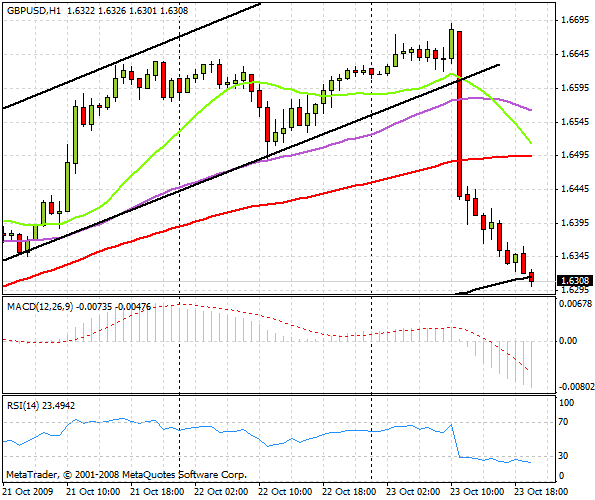
The British pound today fell sharply in forex trading as the U.K. economy has continued to be stuck in its longest economic slump since 1955.  Preliminary third quarter results for the U.K. gross domestic product showed that the U.K. economy fell by 0.4 percent according to the Office for National Statistics. This marked the sixth straight quarter of decline and the longest recession 250140twentypndsfreesince 1955 when official economic records began.  The GDP decline surprised economic forecasters that were expecting a 0.2 percent rise for the July to September quarter.  The second quarter GDP had declined by 0.6 percent while the first quarter fell by 2.5 percent.

On an annual basis, GDP fell by 5.2 percent in the third quarter from the 2008 third quarter level following a 5.5 percent decrease in the second quarter. Contributing to the decrease was a 0.7 percent decline in the production industries and a 0.2 percent fall in the service industries.  Manufacturing fell by 0.2 percent for the quarter while construction dropped 1.1 percent and mining & quarrying decreased 3.5 per cent.

The GDP data sent the British currency plunging against the other major currencies today after the pound had a gaining week last week on speculation that the Bank of England may discontinue its quantitative easing program. The news today has pushed speculation back to the other side as the BOE may need to extend the program to help its struggling economy.

The pound has declined by over 300 pips today against the US dollar while also falling by more than 200 pips against the Swiss franc and Canadian dollar.  The euro has advanced versus its currency rival by over 150 pips while the Japanese yen has jumped by over 180 pips against the British currency.

GBP/USD Chart – The British Pound Sterling falling against the US Dollar in forex trading after the UK’s 3rd quarter GDP data came in lower than expected. The GBP/USD trades right around its 200-hour moving average (black) after falling more than 300 pips today.

10-23gbp

Gold Bounces after Touching $1050/oz

By Fast Brokers – Gold is recovering from earlier losses after edging beneath our 2nd tier uptrend line and tapping its psychological $1050/oz level.  Gold was initially hit by the massive selloff in the Cable in reaction to a shockingly negative Prelim GDP release.  However, EU PMI data printed positively mixed and gold continues to take its cue from the Euro and Aussie.  As a result, gold is holding strong above $1050/oz while continuing its consolidative pattern.  We still believe the wedge applies, and we may witness an inflection point once our downtrend line collides with our 2nd tier uptrend line.  That being said, gold’s uptrend is alive and well despite uncertainty regarding Britan’s economic fundamentals.  U.S. Q3 earnings and Existing Home Sales also came in better than expected today, and increased optimism surrounding the health of America’s economy bodes well for gold’s medium-term outlook due to its negative correlation with the Dollar.  Although the Dollar is strengthening today, it’s reasonable to believe that the Euro and Aussie can head higher while the Pound slides.  After all, we’ve seen this negative correlation occur only recently.

Meanwhile, attention will remain focused on the U.S. and Britain since we will receive more important econ data early next week in conjunction with the Q3 earnings flow.  A recovery in British econ data coupled with more optimistic U.S. numbers would likely accelerate the broad-based devaluation of the Dollar and send gold higher.  However, uncertainty has re-entered the marketplace, so investors should be wary of upcoming releases.

Technically speaking, gold’s consolidation is building a solid base should the precious metal decide to head towards $1100/oz.  Furthermore, gold continues to set higher lows and has avoided the idea of heading beneath $1050/oz and 10/16 lows.  However, it seems gold will reach a breaking point in the near-future, and we will have to wait and see whether the Dollar works in favor of the precious metal.  Previous October highs continue to serve as a technical barrier along with our downtrend line.  As for the downside, gold has a couple uptrend lines serving as technical cushions to go along with 10/21 and 10/16 lows as well as $1050/oz.  For the time being, investors should pay particularly close attention to the EUR/USD’s present interaction with its highly psychological 1.50 level.

Present Price: $1057.90/oz

Resistances: $1058.75/oz, $1061.40/oz, $1065.15/oz, $1068.06/oz, $1070.66/oz

Supports: $1055.46/oz, $1051.91/oz, $1048.62/oz, $1045.32/oz, $1042.96/oz

Psychological: $1050/oz, $1075/oz, $1100/oz

Market Commentary provided by Fast Brokers.

Disclaimer: FastBrokers’ market commentary is provided for information purposes only and under no circumstances should be regardedneither as an investment advice nor as a solicitation or an offer to sell/buy any financial product. FastBrokers assumes no responsibility or liability from gains or losses incurred by the information herein contained.

Risk Disclosure: There is a substantial risk of loss in trading futures and foreign exchange. Please carefully review all risk disclosure documents before opening an account as these financial instruments are not appropriate for all investors.

EUR/USD Retreats with U.S. equities and Broad Dollar Strength

By Fast Brokers – Investors are favoring the Dollar today after Q3 earnings continued to roll in positively, most notably MSFT and AMZN.  Furthermore, U.S. Existing Home Sales blew past estimates while Britain’s Prelim GDP printed a shocking -0.4%.  Therefore, investors are suddenly favoring the U.S. economy, and are heading towards the Dollar in speculation that the Fed may be able to tighten sooner than anticipated.  However, the excitement is a little premature since unemployment remains a thorn in the recovery’s side.  Regardless, investors are taking today as an opportunity to liquidate some of their long positions and lock in profits.  We notice pullbacks not only in the Euro, but the Aussie, Yen, and gold as well.  Naturally, the Pound is the biggest loser today and is highlighted by a pop in the EUR/GBP.  However, the Euro is holding up relatively well due to the EU’s positively mixed PMI data.

France continues to outperform Germany, whose Services PMI came in lighter than anticipated.  Though Germany’s Ifo Business Climate number also printed a bit weak, the data is altogether encouraging.  France’s stellar performance helped drive the EU’s headline Services and Manufacturing PMIs beyond analyst expectations.  The EU’s fundamental performance is holding the EUR/USD together despite the large selloff in the Pound.  The EU’s fundamental strength should carry over into next week since the union’s econ releases will be light and scattered.  The EU will release Germany’s GfK Consumer Climate data on Monday.  It’s hard to believe this number will print positively considering Germany’s econ data has been underperforming lately, and consumption is likely feeling the pinch.

Since the EU will have a quiet calendar, investor attention should remain focused on the U.S. and Britain.  The U.S. will continue to roll out Q3 earnings along with important econ data, particularly Advance GDP on Thursday.  Meanwhile, the S&P futures are having a lot of trouble breaking through their psychological 1100 level.  However, any strong movement above could give a boost of energy to the EUR/USD’s uptrend.  Therefore, investors should keep an eye on the S&P’s interaction with our uptrend lines and 1100.  In terms of Britain, today’s GDP figure is a shocker and has dented investor optimism concerning the global economic recovery.  Therefore, Britain’s upcoming econ releases will likely carry added weight.  Britain will release its Nationwide HPI and CBI Realized Sales on Tuesday.  On the other hand, we have seen the EUR/USD move in a negative correlation against the Cable recently.  Hence, underperformance in Britain’s economy doesn’t necessarily mean the Euro will get dragged down with the Pound should its decline accelerate.  As a result, investors should pay equal attention to the AUD/USD and gold since the EUR/USD was moving in tandem with these investment vehicles when it exhibited a negative correlation with the GBP/USD.

Meanwhile, the EUR/USD continues to float around its highly psychological 1.50 level.  We’ve highlighted the significance of 1.50 in our past commentaries, and it seems growing investor uncertainty in other risk currencies is preventing the EUR/USD from creating topside separation.  However, the technicals and fundamentals are still working in favor of the Euro, and all the EUR/USD needs is a little boost before taking off towards 1.55.  On the other hand, any underperformance in U.S. Q3 earnings or econ data next week could undermine the EUR/USD’s uptrend.

Technically speaking, the EUR/USD is right around where we left it yesterday.  Our makeshift 3rd tier downtrend line and 1.50 continues to serve as the only foreseeable topside barriers separating the currency pair from accelerated upward movements.  As for the downside, the EUR/USD has several uptrend lines serving as technical cushions along with 10/22, 10/20, and 10/19 lows.

Present Price: 1.5014

Resistances: 1.5021, 1.5052, 1.5086, 1.5127, 1.5146

Supports: 1.4981, 1.4942, 1.4921, 1.4880, 1.4860, 1.4834

Psychological: 1.50

Market Commentary provided by Fast Brokers.

Disclaimer: FastBrokers’ market commentary is provided for information purposes only and under no circumstances should be regardedneither as an investment advice nor as a solicitation or an offer to sell/buy any financial product. FastBrokers assumes no responsibility or liability from gains or losses incurred by the information herein contained.

Risk Disclosure: There is a substantial risk of loss in trading futures and foreign exchange. Please carefully review all risk disclosure documents before opening an account as these financial instruments are not appropriate for all investors.