FX Buzz: Focus on the Fed


The Federal Reserve on Focus

After some surprisingly upbeat US data including the unemployment falling to 10% from 10.2% and retail Sales rising 1.3% MoM investors moved to reassess the rates expectations in the US. With rate hikes in the US seem closer than before, and economic woes in Greece and Dubai, demand for the Dollar remerged pushing the long battered Greenback higher by around 4% against the Euro and the Sterling. Now that the US economy is showing signs of recovery investors are keen to figure the timeline of the Fed monetary tightening with the Fed rate decision at the centre.

Today at the Fed rate decision interest rates are again expected to be left unchanged at 0.25% with the Fed rhetoric on rates getting special attention. After Producer price index gained 1.8% MoM yesterday a strong gain by all measures and official CPI (core inflation) due today investors are increasingly worried the Fed might need to raise rates sooner than it actually intends to. At the moment  as capacity levels still remain low, consumer spending is subdued and credit is tight the Fed is largely expected to outline once against rates will remain low for a prolonged period and keeping inflationary projections tamed. If economic figures will continue to improve the Fed rhetoric could change sooner than expected with rate expectations rising accordingly. This is the main reason for attention on the Fed rate decision. Investors wait for the rhetoric on rates to change.

So what should you look for?

Higher inflation expectations- Although not likely if the Fed will raise inflation expectation this will make monetary tightening closer thus providing strong demand for the Dollar against its peers. A much higher than expected CPI reading today could have just the same effect, spurring bets inflation expectations will bring monetary tightening closer.

Exit from Stimulus- The Fed currently holds around 7% of the total MBS market (mortgage backed securities) to keep mortgage rates low and stabilize the housing market. With the Fed expected to stop its MBS purchases in Q1 2010 investors are waiting for news on when the Fed will start exiting the MBS it holds on its balance sheet. An announcement on that context or an announcement of unwinding any other emergency facilities could lead risk appetite to fold with investors betting on a higher Greenback. However if the Fed will announce an extension to the deadline of MBS purchases this could have the opposite effect on the Dollar with Dollar bids emerging.

Technical Analysis

GBP/USD

Bullish Scenario- Currently the pair is find strong support in the 1.62 level which could provide enough demand for a move towards the 1.64-1.66 area to regain bearish momentum

Target A: 1.637

Target B: 1.659

Bearish Scenario- A daily close below the 1.62 support would move the pair to test lower resistances with a strong momentum

Target A: 1.612

Target B: 1.5750

Daily Forex Market Analysis provided by eToro

Disclaimer: Trading in the Foreign Exchange market might carry potential rewards, but also potential risks. You must be aware of the risks and are willing to accept them in order to trade in the foreign exchange market. Don’t trade with money you can’t afford to lose.
© 2009 eToro Blog.

Fundamental Analysis for British Pound and the U.S Dollar

By Rita Ruvinski – Here are the most important fundamental releases for December 16th:

09:30 GMT GBP Claimant Count Change

– Change in the number of people claiming unemployment. This figure relates to November that ended recently – what makes this figure fresh and important.

– Last month’s number of people asking for unemployment benefits rose by 12.9K, much less than previous months and early expectations. This improvement is now expected to be slightly erased, with a rise of 13.9K jobs this time

– The GBP already lost over 200 pips this week, suffering from a strong U.S dollar.
If the actual result will come in line or higher than expected that might weight further on the British pound.

13:30 GMT USD Building Permits

– Annualized number of new residential building permits issued during the previous month. It’s an excellent gauge of future construction activity because obtaining a permit is among the first steps in constructing a new building.

– With a great deal of speculation that the housing market has bottomed, it will be very important to see this trend continue in the right direction. While new homes make up a much smaller percentage of the overall real estate market when compared to existing homes, it is still a very important indicator in the fact new homes require construction crews, inspectors, subcontractors and so the long term affect can be great.

– After a dip in the October data to 550K housing starts on an annualized basis, analysts are expecting this number to jump back up to 580K in November. With higher than expected number we could once again see a U.S. equity and U.S. dollar rally at the same time which has been a very abnormal occurrence over the last year as these two have typically had an inverse relationship.

19:15 GMT USD Federal Funds Rate

– Traders and investors pay close attention to any decisions made by the FOMC as these decisions can directly affect short and long-term interest rates, foreign exchange rates and the amount of money and credit in the economy.

– With such a broad impact on the overall economy, any decisions or statements indicating the health of the economy are closely watched and can have both an immediate and long-term impact.

– The market impact of this release can be both dramatic and immediate but also sustainable. The FOMC is scheduled to meet eight times per year with the goal of providing monetary and economic stability. It is not out of the realm of possibility that the FOMC could shock the market by pushing rates up to 0.50%. While this is very unlikely, if that is what happens, the U.S. dollar would most likely appreciate rapidly vs. majors.

Forex Market Analysis provided by Forex Yard.

© 2006 by FxYard Ltd

Disclaimer: Trading Foreign Exchange carries a high level of risk and may not be suitable for all investors. There is a possibility that you could sustain a loss of all of your investment and therefore you should not invest money that you cannot afford to lose. You should be aware of all the risks associated with Foreign Exchange trading.

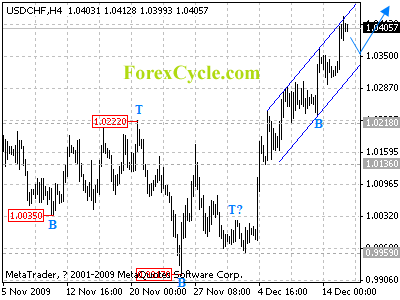
USDCHF’s uptrend extends further to as high as 1.0428

USDCHF’s uptrend extends further to as high as 1.0428. Now the pair is facing the upper border of the rising price channel on 4-hour chart, a minor consolidation is expected in a couple of days and pullback to the bottom of the channel would more likely be seen. As long as the channel support holds, we’d expect uptrend to resume and one more rally towards1.0500 area is still possible after consolidation.

usdchf

Written by ForexCycle.com

Producer Prices rise, NY Manufacturing falls, Foreign Investment in US declines in October. USD gains in Forex.

By CountingPips.com

The Producer Price Index, released by the Department of Labor, rose more than expected in November as energy costs increased and boosted inflation on finished goods. Producer prices increased by 1.8 percent in the month of November following an increase of 0.3 percent in October and a decrease of 0.6 percent in September. The annual rate of increase for November showed that producer prices were 2.4 percent higher than November of 2008 after October’s SimpleChart200x150annual rate registered a 1.9 percent decrease. This was the first annual increase in producer prices since November 2008. Market forecasts were expecting monthly producer prices to gain by 0.8 percent and the annual rate of increase to register 1.8 percent.

Core producer prices, excluding food and energy prices, rose by 0.5 percent in November following a fall of 0.6 percent in October and surpassing market expectations of a 0.2 percent gain. On an annual basis, core producer prices advanced by 1.2 percent in November compared with an increase of 0.7 percent in October and just below expectations of a 0.9 percent increase.

Helping to contribute to the increased producer prices in November was the cost of energy which advanced by 6.9 percent for the month after increasing by 1.6 percent in October.  The crude goods index climbed by 5.7 percent while the foods index also registered a 0.5 percent increase for the month.

Empire State Manufacturing index falls

New York manufacturing activity fell in December as sentiment among New York manufacturers declined by more than expected after four months of improvements according to data released today by the New York Federal Reserve. The Empire State Manufacturing Survey, a monthly business survey of New York State manufacturers, showed that the general business index in New York declined from a 23.5 score in November to a 2.6 score in December. The 21-point drop was the biggest monthly drop on record and easily surpassed forecasts calling for a 24.00 score.

The new orders index fell this month by over 14 points to a 2.20 score while the prices paid index rose from 10.53 points in November to 19.74 in December. The unfilled orders index decreased by over 18 points to a -21.1 score. The employment indexes also decreased in December with the number of employees index falling by 7 points and the average workweek index declining by 11 points.

The Empire State Manufacturing Survey is a monthly business assessment of New York State manufacturers produced by the New York Federal Reserve.

Foreign Investment in US declines in October

Also released today was the Treasury Department report on foreign investment for United States securities and it showed foreign investors scaled back on US investments in October. This important data to watch capital flows in and out of the US showed that foreign investors bought a total of $43.4 billion in long-term US securities in October after spending $55.7 billion in September.  The net purchases by foreign investors was $28.8 billion while foreign official institutions purchased $14.6 billion in October. US residents, meanwhile, purchased a net of $22.7 billion worth of long-term foreign securities.

US Dollar is stronger in Forex Trading as Stocks are lower

The U.S. dollar has traded higher today against the other major currencies in the spot forex market.  The dollar has gained versus the euro, British pound, Japanese yen, Australian dollar, Canadian dollar, Swiss franc and New Zealand dollar according to currency data by Oanda at 2:44 pm EST.

The US stock markets have declined so far today with the Dow falling by approximately 30 points, the Nasdaq decreasing by almost 1 point and the S&P 500 down by over 3 points.  Oil has increased by almost $1 to $70.67 while gold has lost $.60 to level at $1,122.70 per ounce.

EUR/USD 4H Chart
– The Euro falling today versus the US Dollar and declining towards the 1.4500 threshold. The Euro has fallen sharply in the last couple of weeks since trading at the high of 1.5140  as recently as December 3rd.

12-15eur

USD/JPY’s Pop Falls Short of 12/11 Highs

By Fast Brokers – The USD/JPY’s pop from Monday’s lows has fallen short of 12/11 highs and the currency pair is being negated by our 2nd tier downtrend line once more.  Positive activity in the USD/JPY initially stemmed from positive pricing data from both the UK and U.S.  An increase in prices yielded further speculation that the Fed may tighten its monetary stance a bit.  However, today’s U.S. data set turned out mixed with manufacturing and production data sending a murky signal.  Today’s mixed U.S. data has taken some energy out of the Dollar’s recent broad based rally and the Greenback is presently weakening across the board.  However, weakness in the USD/JPY has been minimal thus far, and the currency pair remains within the confines of December highs and lows.  Attention will now shift to tomorrow’s wealth of economic data along with the Fed’s monetary policy meeting.  The EU will release its Flash PMI data set along with CPI while the UK prints its CCC figure.  In addition to the Fed’s monetary policy decision, the U.S. will also release CPI and Building Permits.  Since Japan will be sitting on the sidelines tomorrow, the USD/JPY will likely follow the path of the Dollar.  Hence, investors should monitor activity in the EUR/USD and GBP/USD as investor react to the data stream.

Technically speaking, the USD/JPY is presently locked between our 2nd tier downtrend and 4th tier uptrend lines, a supportive environment for a continuation of the currency pair’s present trading range.  As for the topside, the currency pair faces multiple downtrend lines along with the highly psychological 90 area, 12/11 highs, and 12/7 highs.  As for the downside, the USD/JPY has built a comfort zone between present price and our uptrend lines.  Additionally, the USD/JPY has 12/14, 12/8, and 12/9 lows serving as technical cushions.

Present Price: 89.47

Resistances: 89.78, 89.89, 90.01, 90.25, 90.39, 90.58

Supports: 89.35, 89.14, 88.99, 88.77, 88.60, 88.34

Psychological: 90, December Highs and Lows

Market Commentary provided by Fast Brokers.

Disclaimer: FastBrokers’ market commentary is provided for information purposes only and under no circumstances should be regardedneither as an investment advice nor as a solicitation or an offer to sell/buy any financial product. FastBrokers assumes no responsibility or liability from gains or losses incurred by the information herein contained.

Risk Disclosure: There is a substantial risk of loss in trading futures and foreign exchange. Please carefully review all risk disclosure documents before opening an account as these financial instruments are not appropriate for all investors.

Gold Stabilizes with Dollar

By Fast Brokers – Gold has continued to avoid a retest of the psychological $1100/oz level, finding support above 12/11 lows and our 4th tier uptrend line.  The precious metal is experiencing a bit of intraday strength after U.S. economic data printed mixed.  Although PPI came in 10 basis points above analyst expectations, U.S. manufacturing and production data sent a mixed signal.  Hence, investors are taking today as an opportunity to lock in gains on the Dollar.  The EUR/USD, GBP/USD, and AUD/USD are all stabilizing from intraday lows, supporting today’s consolidation in gold.  However, volatility could pick up tomorrow with more key data from the EU, UK, and U.S. along with the Fed’s monetary policy decision.  Although the Fed is expected to keep its monetary policy unchanged, any slight shift in its monetary policy stance in response to recent unemployment and consumption data could yield Dollar strength and gold weakness.  However, if the Fed downplays the recent upturn in economic data and affirms its past monetary policy, then we may witness a bounce in gold and weakness in the Dollar.  Naturally, the abundance of fundamental economic data releases has the potential to move the market as well.  Hence, investors should monitor activity in the FX markets as investors react to tomorrow’s events.  That being said, the EUR/USD and Cable are flirting with some important uptrend lines.  Any significant setbacks in these currency pairs could drag gold lower due to the precious metal’s negative correlation with the Dollar.

Technically speaking, gold has multiple uptrend lines serving as technical cushions along with 12/11, 12/9, 11/13, and 11/10 lows.  Furthermore, the psychological $1100/oz level could serve as a reliable technical support should it be tested.  As for the topside, we’ve placed a downtrend line on our chart, albeit a steep one.  Additionally, gold faces topside technical barriers in the form of 12/11,12/9 and 12/7 highs along with the psychological $1150/oz and $1175/oz levels.

Present Price: $1121.60oz

Resistances: $1123.03/oz, $1128.34/oz, $1134.47/oz, $1141.42/oz, $1147.54/oz, $1152.85/oz

Supports: $1115.27/oz, $1110.77/oz, $1105.05/oz, $1100.15/oz, $1097.29/oz, $1088.30/oz

Psychological: $1100/oz, $1150/oz, $1175/oz

Market Commentary provided by Fast Brokers.

Disclaimer: FastBrokers’ market commentary is provided for information purposes only and under no circumstances should be regardedneither as an investment advice nor as a solicitation or an offer to sell/buy any financial product. FastBrokers assumes no responsibility or liability from gains or losses incurred by the information herein contained.

Risk Disclosure: There is a substantial risk of loss in trading futures and foreign exchange. Please carefully review all risk disclosure documents before opening an account as these financial instruments are not appropriate for all investors.

GBP/USD Holds Strong Following Positive Pricing Data

By Fast Brokers – The Cable is holding strong around our 1st tier uptrend line after both CPI and RPI data points printed one basis point hotter than analyst expectations.  Hence, the recovery in UK inflation appears on track.  This should be reassuring to the BoE since prices are nearing its comfort level of 2% growth.  U.S. PPI data printed 10 basis points hotter than anticipated, a positive development for the concept of a tighter monetary policy from the Fed.  However, U.S. manufacturing and production data printed mixed, taking a bit of wind out of the Dollar’s sails.  Mixed fundamental data from the U.S. is helping stabilize both the Cable and EUR/USD as gold stages a little rally.  Meanwhile, the EUR/GBP has taken another step down, indicating a relative strength in the Pound likely stemming from encouraging UK CPI and RPI results.   The UK will release some more data points tomorrow, most notably a new CCC figure.  Should the UK’s CCC come in stronger than expected like the last release this could help add onto the Pound’s present relative strength.  However, a discouraging CCC number could damage the argument from a tighter monetary policy from the BoE, yielding weakness in the Cable.

In addition to more key data from the UK and EU, the U.S. will release Building Permits along with its CPI data followed by the Fed’s announcement of its monetary policy decision.  Although the Fed is likely to keep its monetary policy unchanged, investors will be paying close attention to the Fed’s wording to monitor whether the central bank takes a more hawkish stance in light of positive developments in U.S. unemployment and consumption data.  That being said, any unexpected action from the Fed would likely yield noticeable volatility due to the psychological influence of central banks on the FX markets.  Regardless, activity could pick up in the next 24-48 considering the wealth of data and news investors will be digesting.

Technically speaking, the Cable still still flirting with dangerous territory since our 2nd tier uptrend line runs through October lows.  Hence, should our 2nd tier uptrend line give way, we could witness another sizable leg down towards the 1.58-1.60 area.  Below our 2nd tier uptrend line the Cable does have our 1st tier uptrend line (off chart) serving as a technical cushion along with the psychological 1.60 level, September lows and October lows.  As for the topside, the Cable still faces multiple downtrend lines along with 12/9 and 12/7 highs.  Furthermore, the psychological 1.65 level could serve as a technical barrier should it be tested.

Present Price: 1.6218

Resistances: 1.6252, 1.6265, 1.6286, 1.6325, 1.6346, 1.6371

Supports: 1.6205, 1.6186, 1.6163, 1.6133, 1.6113, 1.6098

Psychological: 1.60, 1.65, September and October lows

Market Commentary provided by Fast Brokers.

Disclaimer: FastBrokers’ market commentary is provided for information purposes only and under no circumstances should be regardedneither as an investment advice nor as a solicitation or an offer to sell/buy any financial product. FastBrokers assumes no responsibility or liability from gains or losses incurred by the information herein contained.

Risk Disclosure: There is a substantial risk of loss in trading futures and foreign exchange. Please carefully review all risk disclosure documents before opening an account as these financial instruments are not appropriate for all investors.

EUR/USD Steps Down in Response to Hot U.S. PPI Data

By Fast Brokers – The EUR/USD took another step down today after the U.S. printed a PPI figure 10 basis points hotter than analyst expectations.  Investors also received strong pricing data from the UK today, leaving central banks open to tighten liquidity should the recovery in prices continue and unemployment decline.  Meanwhile, the EUR/GBP is also experiencing a pullback, indicating a relative weakness in the Euro.  The Euro’s weakness likely stems from a weaker than expected headline ZEW Economic Sentiment number.  Hence, although the Euro is logging sizable losses against the Dollar today, the Pound is holding strong for the time being.  In addition to today’s U.S. PPI release, America also printed a set of mixed data points.  The Empire Index and TIC numbers both came well below expectations while Industrial Production and the Capacity Utilization Rate each printed strongly.  Hence, investors received a mixed picture of U.S. production and manufacturing while foreign interest in U.S. assets waned.  The mixed data points could help the EUR/USD and GBP/USD stabilize since the results don’t broadly support tighter monetary policy from the Fed.

That being said, the Fed will make its monetary policy decision tomorrow.  While the central bank will likely keep its policy unchanged, investors will be paying close attention to Bernanke’s language to see whether there is a more hawkish tone in reaction to recent improvements in employment and consumption data.  Any surprise from the Fed would naturally move currency movements since psychological forces have had considerable influence on the Dollar in the past.  Additionally, the EU will release some key data tomorrow, including a wave of Flash PMIs along CPI data.  Hence, volatility could remain at a heightened state for the next 24-48 hours.

Technically speaking, the EUR/USD is experiencing a discouraging setback today by dropping below our previous 1st tier uptrend line.  What is now our 2nd tier runs through 8/17 lows, meaning a more protracted decline towards 1.40 could be in the works should the EUR/USD not make a concerted effort to regain lost ground today.    Meanwhile, the psychological 1.45 are could prove to be a reliable support with October lows hanging nearby.  We’ve initiated a new 1st tier uptrend line (off chart), which is resting at about the 1.44 level right now.  As for the topside, the EUR/USD still faces multiple downtrend lines along with 12/14 and 12/9 highs.

Present Price: 1.4530

Resistances: 1.4541, 1.4556, 1.4573, 1.4588, 1.4600, 1.4617, 1.4634

Supports: 1.4528, 1.4519, 1.4501, 1.4483, 1.4467, 1.4444, 1.4412

Psychological: 1.45, 1.40, 1.50, October Lows

Market Commentary provided by Fast Brokers.

Disclaimer: FastBrokers’ market commentary is provided for information purposes only and under no circumstances should be regardedneither as an investment advice nor as a solicitation or an offer to sell/buy any financial product. FastBrokers assumes no responsibility or liability from gains or losses incurred by the information herein contained.

Risk Disclosure: There is a substantial risk of loss in trading futures and foreign exchange. Please carefully review all risk disclosure documents before opening an account as these financial instruments are not appropriate for all investors.

Popular Culture and the Stock Market

By Robert Prechter, CMT

The following article is adapted from a special report on “Popular Culture and the Stock Market” published by Robert Prechter, founder and CEO of the technical analysis and research firm Elliott Wave International. Although originally published in 1985, “Popular Culture and the Stock Market” is so timeless and relevant that USA Today covered its insights in a recent Nov. 2009 article. For the rest of this revealing 50-page report, download it for free here.

Popular Culture and the Stock Market

Both a study of the stock market and a study of trends in popular attitudes support the conclusion that the movement of aggregate stock prices is a direct recording of mood and mood change within the investment community, and by extension, within the society at large. It is clear that extremes in popular cultural trends coincide with extremes in stock prices, since they peak and trough coincidentally in their reflection of the popular mood. The stock market is the best place to study mood change because it is the only field of mass behavior where specific, detailed, and voluminous numerical data exists. It was only with such data that R.N. Elliott was able to discover the Wave Principle, which reveals that mass mood changes are natural, rhythmic and precise. The stock market is literally a drawing of how the scales of mass mood are tipping. A decline indicates an increasing ‘negative’ mood on balance, and an advance indicates an increasing ‘positive’ mood on balance.

Trends in music, movies, fashion, literature, television, popular philosophy, sports, dance, mores, sexual identity, family life, campus activities, politics and poetry all reflect the prevailing mood, sometimes in subtle ways. Noticeable changes in slower-moving mediums such as the movie industry more readily reveal changes in larger degrees of trend, such as the Cycle. More sensitive mediums such as television change quickly enough to reflect changes in the Primary trends of popular mood. Intermediate and Minor trends are likely paralleled by current song hits, which can rush up and down the sales charts as people change moods. Of course, all of these media of expression are influenced by mood changes of all degrees. The net impression communicated is a result of the mix and dominance of the forces in all these areas at any given moment.

Fashion:

It has long been observed, casually, that the trends of hemlines and stock prices appear to be in lock step. Skirt heights rose to mini-skirt brevity in the 1920’s and in the 1960’s, peaking with stock prices both times. Floor length fashions appeared in the 1930’s and 1970’s (the Maxi), bottoming with stock prices. It is not unreasonable to hypothesize that a rise in both hemlines and stock prices reflects a general increase in friskiness and daring among the population, and a decline in both, a decrease. Because skirt lengths have limits (the floor and the upper thigh, respectively), the reaching of a limit would imply that a maximum of positive or negative mood had been achieved.

Movies:

Five classic horror films were all produced in less than three short years. ‘Frankenstein’ and ‘Dracula’ premiered in 1931, in the middle of the great bear market. ‘Dr. Jekyll and Mr. Hyde’ played in 1932, the bear market bottom year, and the only year that a horror film actor was ever granted an Oscar. ‘The Mummy’ and ‘King Kong’ hit the screen in 1933, on the double bottom. Ironically, Hollywood tried to introduce a new monster in 1935 during a bull market, but ‘Werewolf of London’ was a flop. When filmmakers tried again in 1941, in the depths of a bear market, ‘The Wolf Man’ was a smash hit. These are the classic horror films of all time, along with the new breed in the 1970’s, and they all sold big. The milder horror styles of bull market years and the extent of their popularity stand in stark contrast. Musicals, adventures, and comedies weave into the pattern as well.

Popular Music:

Pop music has been virtually in lock-step with the Dow Jones Industrial Average as well. The remainder of this report will focus on details of this phenomenon in order to clarify the extent to which the relationship (and, by extension, the others discussed above) exists.

As a 78-rpm record collector put it in a recent Wall Street Journal article, music reflects ‘every fiber of life’ in the U.S. The timing of the careers of dominant youth-oriented (since the young are quickest to adopt new fashions) pop musicians has been perfectly in line with the peaks and troughs in the stock market. At turns in prices (and therefore, mood), the dominant popular singers and groups have faded quickly into obscurity, to be replaced by styles which reflected the newly emerging mood.

The 1920’s bull market gave us hyper-fast dance music and jazz. The 1930’s bear years brought folk-music laments (‘Buddy, Can You Spare a Dime?’), and mellow ballroom dance music. The 1932-1937 bull market brought lively ‘swing’ music. 1937 ushered in the Andrews Sisters, who enjoyed their greatest success during the corrective years of 1937-1942 (‘girl groups’ are a corrective wave phenomenon; more on that later). The 1940’s featured uptempo big band music which dominated until the market peaked in 1945-46. The ensuing late-1940’s stock market correction featured mellow love-ballad crooners, both male and female, whose style reflected the dampened public mood.

Learn what’s really behind trends in the stock market, music, fashion, movies and more… Read Robert Prechter’s Full 50-page Report, “Popular Culture and the Stock Market,” FREE.


Robert Prechter, Chartered Market Technician, is the founder and CEO of Elliott Wave International, author of Wall Street best-sellers Conquer the Crash and Elliott Wave Principle and editor of The Elliott Wave Theorist monthly market letter since 1979.

Spot Gold Trading and the Correlation with Dollar Strengthening

By Russell Glaser – Gold trading is feeling the squeeze with the appreciating dollar and could be poised for further declines if this type of market environment continues.

The price of spot gold dropped during the morning hours of European trading as the U.S. dollar climbed higher. Spot gold was trading down at $1112 from an opening price of $1126.40. The dollar rallied against most major currencies. Against the Euro the dollar is trading at near a low of 1.4528 from 1.4653, down 0.8%.

Driving the price differential is this week’s Federal Open Market Committee meetings. During the two day meeting the Fed is widely expected to hold interest rates steady and signal it will do so to continue the economic turnaround in the U.S. Other analysts speculate rise in the dollar is due to the currency being oversold and this is simply a temporary price correction.

It is no secret that equities and commodities are known to track the value of the U.S. dollar. However, recently we have experienced a break in the reverse correlation between the price of oil and the dollar, but not with gold. It appears this negative correlation continues to hold and could be a major factor in trading of spot gold.

Trading of the dollar and gold are beginning to show signs of their traditional trading patterns, rising on positive U.S. economic news and falling on negative news. This began with the previous U.S. Non Farm Payrolls and may continue into this week’s trading.

Currently we are seeing heavy buying near the $1100 price level as the price of spot gold has failed to break this major support line. If the price of spot gold can exceed this lower level, traders may see an opportunity at this price to enter into the market as spot gold prices could continue their decline.

Forex Market Analysis provided by Forex Yard.

© 2006 by FxYard Ltd

Disclaimer: Trading Foreign Exchange carries a high level of risk and may not be suitable for all investors. There is a possibility that you could sustain a loss of all of your investment and therefore you should not invest money that you cannot afford to lose. You should be aware of all the risks associated with Foreign Exchange trading.