Gold Pops Back Above $1100/oz

By Fast Brokers – Gold is logging solid gains today as we witness broad based Dollar weakness in the FX markets today.  Dollar weakness is an ideal environment for gold bulls since the precious metal has proven to be negatively correlated against the Greenback as investors head towards the risk trade.  Meanwhile, investors are waiting for America’s ISM Manufacturing PMI number coming in about an hour’s time.  It will be interesting to monitor the Dollar’s reaction to today’s U.S. release since investors were buying up the Greenback on positive data during the month of December.  Hence, a strong Manufacturing PMI figure could temper gold’s present upward momentum.  Despite today’s data release, investors are likely honing in on Wednesday’s U.S. Non-Farm Employment Change number.  December’s Dollar rally was triggered by a turnaround in U.S. employment data.  Therefore, Wednesday’s release could really move gold and the Dollar should the figure surprise in either direction.

Technically speaking, gold has multiple uptrend lines serving as technical cushions along with 12/31, 12/30 and 12/22 lows.  On an encouraging note, gold has set consecutive higher lows after bottoming out in December and we are unable to form a noteworthy downtrend line.  Therefore, gold could have some decent upward mobility should the Dollar continue to weaken.  Meanwhile, our 4th tier uptrend line could prove to be an important trend line since it runs through 10/28 lows, or the $1025/oz level.  As for the topside, gold faces technical barriers in the form of 12/17 highs along with the psychological $1150/oz level.

Present Price: $1117.55/oz

Resistances:  $1117.80/oz, $1122.70/oz, $1128.09/oz, $1132.99/oz, $1137.41/oz, $1141.33/oz

Supports: $1110.94/oz, $1104.83/oz, $1100.55/oz, $1096.27/oz, $1092.91/oz

Psychological: $1100/oz, $1150/oz, December lows

Market Commentary provided by Fast Brokers.

Disclaimer: FastBrokers’ market commentary is provided for information purposes only and under no circumstances should be regardedneither as an investment advice nor as a solicitation or an offer to sell/buy any financial product. FastBrokers assumes no responsibility or liability from gains or losses incurred by the information herein contained.

Risk Disclosure: There is a substantial risk of loss in trading futures and foreign exchange. Please carefully review all risk disclosure documents before opening an account as these financial instruments are not appropriate for all investors.

GBP/USD Trades Higher after Encouraging Data Set

By Fast Brokers – The Cable has recovered nicely from December lows and strengthened earlier today following an encouraging data set.  Britain’s Manufacturing PMI, Net Lending to Individuals, and Mortgages Approvals data all printed stronger than expected, an encouraging sign for the Pound ahead of Thursday’s BoE monetary policy meeting.  However, at its previous meeting the BoE did imply that it would likely take a wait-and-see approach in regards to inflation before deciding whether to take action monetarily.  Therefore, should the rest of this week’s UK economic data print positively the BoE would be encouraged to keep its monetary policy unchanged before February’s meeting.  Speaking of economic data, tomorrow the UK will release its Halifax HPI figure followed by Services PMI data on Wednesday.  The Services PMI number should garner additional attention since the services industry comprises a majority of the UK’s GDP.  Meanwhile, investors will be eyeing America’s ISM Manufacturing PMI report coming later today.  A stronger than expected U.S. Manufacturing PMI number could take a bite out of the Cable’s intraday gains as investors favor the Dollar again.  However, weak U.S. data would be another reason for investors to snap up the Cable and could lead to a test of 12/11/09 highs.

Technically speaking, the Cables pop back above its psychological 1.60 level is an encouraging sign considering the extent of December’s pullback.  That being said, the Cable does have a downward force at play until the currency pair can overcome a few more topside barriers.  The Cable faces multiple downtrend lines along 12/11, 12/16, and 12/7 highs.  Furthermore, the psychological 1.65 level could serve as a topside obstacles should it be tested.  As for the downside, the Cable now has multiple uptrend lines serving as technical cushions along with intraday, 12/23, and 12/30 lows.  Additionally, the psychological 1.60 level could serve as a sturdy support should it be tested.

Present Price: 1.6155

Resistances: 1.6164, 1.6185, 1.6204, 1.6240, 1.6266, 1.6289

Supports: 1.6134, 1.6105, 1.6075, 1.6050, 1.6024, 1.5976

Psychological: 1.60, December highs and lows

Market Commentary provided by Fast Brokers.

Disclaimer: FastBrokers’ market commentary is provided for information purposes only and under no circumstances should be regardedneither as an investment advice nor as a solicitation or an offer to sell/buy any financial product. FastBrokers assumes no responsibility or liability from gains or losses incurred by the information herein contained.

Risk Disclosure: There is a substantial risk of loss in trading futures and foreign exchange. Please carefully review all risk disclosure documents before opening an account as these financial instruments are not appropriate for all investors.

EUR/USD Climbs with Broad Dollar Weakness

By Fast Brokers – The EUR/USD has popped off our 2nd tier uptrend line and is trying to set a bottom above December lows as the Dollar experiences broad-based weakness.  Equity markets are looking up for the first trading session of 2010 and investors are favoring the risk trade after encouraging economic data from Britain.  The improvement in Britain’s Manufacturing PMI and Net Lending to Individuals yielded a pop in both the Cable and the EUR/USD with investors regaining confidence in the global economic recovery.  The U.S. has ISM Manufacturing PMI data on deck, which could also prove to be a market mover.  Speaking of Manufacturing PMI, China’s beat analyst estimates on January 1st, showing the recovery in the world’s 3rd largest economy has not slowed.  Although investors will receive another wave of data tomorrow, including the EU’s CPI Flash Estimate, more attention will likely be paid to America’s ADP Non-Farm Employment Change.  Most of the excitement in the Dollar can be attributed to America’s turnaround in employment data.  Hence, investors will likely focus in on Wednesday’s ADP release.

Technically speaking, the EUR/USD still faces multiple downtrend lines along with the psychological 1.45 level, 12/29, 12/23, and 12/18 highs.  Hence, some challenging near-term topside technicals are in place due to the EUR/USD’s December downturn.  As for the downside, the EUR/USD has technical cushions in the form of our 1st (off chart) and 2nd tier uptrend lines along with intraday and 12/22 lows.  However, the EUR/USD is still trading well below our 3rd tier uptrend line that runs through July lows, meaning the currency pair could be in for more losses over the medium-term towards the psychological 1.40 area should economic data outside of the U.S. continue to recover.

Present Price: 1.4392

Resistances: 1.4401, 1.4430, 1.4454, 1.4478, 1.4509, 1.4540

Supports: 1.4371, 1.4348, 1.4323, 1.4303, 1.4272, 1.42464187

Psychological: 1.45, 1.40, December and September Lows

Market Commentary provided by Fast Brokers.

Disclaimer: FastBrokers’ market commentary is provided for information purposes only and under no circumstances should be regardedneither as an investment advice nor as a solicitation or an offer to sell/buy any financial product. FastBrokers assumes no responsibility or liability from gains or losses incurred by the information herein contained.

Risk Disclosure: There is a substantial risk of loss in trading futures and foreign exchange. Please carefully review all risk disclosure documents before opening an account as these financial instruments are not appropriate for all investors.

EURUSD Preparing for Bullish Correction?

By Greg Holden – I’d like to welcome everybody to the year 2010! I hope you enjoyed the New Year holiday celebrations this weekend. As many may have already noticed, last week’s trading did not represent what was actually happening in the forex market. The thin holiday trading week acted as a brief pause in trading as we transitioned from 2009 to 2010. In theory, we should see the market return to relatively normal trading behavior in the days ahead.

Glancing over our charts this morning I noticed two important trends to watch. The first is a consolidation of the EURUSD pair which seems to be preparing for a bullish correction to this morning’s down-turn. The second is the flattening out of Gold and Silver in preparation for what may be a bullish correction, coupled with the continued bull-run in Crude Oil. All of these commodity movements strongly increase the possibility of a bullish correction in the EURUSD, since commodity prices are directly linked with this oft-traded currency pair.

Early estimates put a price target around 1.44 for the EURUSD, and a pretty solid chance that Crude Oil will easily break $80 a barrel in a few hours time. You don’t want to miss out on these price movements! Get in the market today!

Forex Market Analysis provided by Forex Yard.

© 2006 by FxYard Ltd

Disclaimer: Trading Foreign Exchange carries a high level of risk and may not be suitable for all investors. There is a possibility that you could sustain a loss of all of your investment and therefore you should not invest money that you cannot afford to lose. You should be aware of all the risks associated with Foreign Exchange trading.

Non-Farm Payrolls Week Begins

Source: ForexYard

Now that the holidays are behind us, it’s time to regain focus. This week will provide unique opportunities to make profits, as one of the most important economic publications is expected on Friday – the U.S. Non-Farm Payrolls. As employment numbers in the U.S. improve, the Dollar generally increases in value. Will this week see a similar trend?

Economic News

USD – EUR/USD Close to 4-Month Low

The Dollar continued to strengthen last week. The Dollar rose close to 100 pips against the EUR, and over 100 pips against the Yen. The EUR/USD pair is now trading near a 4-months low.

The Dollar’s bullish trend comes as a direct result of the positive economic indicators coming out of the U.S. lately. According to a report published last week, U.S. consumer confidence reached a 4 month high at 52.9 points. This simply states that U.S. citizens are feeling more secure regarding their financial security, and are consequently spending more. In addition, the weekly Unemployment Claims Numbers showed that 432,000 people filed for unemployment insurance for the first time during the past week. This is the lowest level seen since July 2008. Both of these publications have increased investors’ optimism, and thus boosting the value of the Dollar.

As for this week, many interesting economic publications are expected. The most significant new event will likely be the Non-Farm Employment Change on Friday. The Non-Farm Employment Change is one of the most deep impacting publications, and it usually creates mayhem in the market. Analysts are forecasting that employment conditions continued to improve during December. If the end result will prove the predictions true, the Dollar will likely be supported as a result. Traders are also advised to follow the ADP forecast on Wednesday, as it has a large impact on the market as well.

EUR – Euro Slides Against the Majors

The Euro failed to extend its bullish trend from two weeks ago, and last week it dropped against most of the major currencies. The Euro dropped almost 100 pips against the Dollar and about 250 pips vs. the Pound.

The Euro continues to weaken due to the recovery of the Dollar. It seems that while the U.S. economy was lagging, the Euro strengthened based on the positive news coming from the Euro-Zone countries. However, now that the U.S. is showing signs that its economy will pull out of the recession by early 2010, the Dollar is strengthening at the expense of the Euro, its major rival. Considering that the European Central Bank prefers to see a weaker Euro in order to support European exports, it appears that the current trend may continue.

Looking ahead to this week, the economic calendar is packed with publications from the Euro-Zone. Traders should focus on the news releases from Germany and France, as they tend to have the largest impact on the Euro. Special attention should be given to the German Unemployment Change on Tuesday and the German Retail Sales on Friday. If the end results of these indicators come in as expected, they are likely to support the Euro.

JPY – Yen Drops on All Fronts

The Yen saw an extremely bearish session during last week’s trading. The Yen dropped close to 200 pips against the Dollar and the Euro, and over 400 pips vs. the Pound.

The Yen continues to lose ground against the major currencies as Japanese economic indicators continues to be negative. The Japanese Retails Sales report for January dropped by 1.0% compared to October. This is the 15th consecutive month in a row in which the total value of sales at the retail level decreased in Japan. The Japanese Average Cash Earning, which measures the change in the total value of employment income collected by workers during November, dropped by 2.8% as well. It appears that for as long as the Japanese economic data remains negative, the Yen is likely to waken further.

The week ahead will have less Japanese economic publications relative to previous weeks. Nevertheless, traders are advised to follow the Leading Indicators report on Friday. This report is a composite index based on 12 economic indicators. Analysts forecast that the Leading Indicators rose by 91.4% during November. If the end result comes in as expected, it could erase some of the Yen’s recent losses.

Crude Oil – Crude Oil Prices Continue to Rise

Crude Oil saw a bullish trend during last week’s trading session, continuing its appreciation of recent months. Crude oil rose to a 1-month high, trading at $80 a barrel.

The main reason for the rise of oil is the positive figures coming out of the U.S. economy. A solid American economy generally creates optimism in the market leading to an increase in fuel demand. In addition, the cold weather also created speculations that stockpiles of winter fuels, including heating oil will decrease further. When oil stockpiles are down, prices typically go up.

Looking ahead to this week, traders should continue to focus on the major publications from the U.S. economy, as they usually have a significant impact on oil prices. In addition, traders should pay attention to the Crude Oil Inventories report on Wednesday, as this report has proven to create an immediate reaction in the market.

Technical News

EUR/USD

The pair has resumed its bullish activity for the past couple of days and is currently trading at the 1.4289 level. However, it failed to breach the 1.4360 level and has provided mixed results ever since. If the pair will indeed breach the 1.436 level, a sharp bullish move might take place.

GBP/USD

There is a very distinct bearish channel formed on the 4H chart, as the cable is now floating near its upper border. Now, as all oscillators on the hourly charts are pointing down, it appears that another bearish session could take place today.

USD/JPY

The pair is in the middle of a very intensive uptrend that started last week and shows great momentum that on a bigger scale appears to have more room to run. The Slow Stochastic bullish cross on the 30min chart indicates that there is still plenty of steam left in this bullish move. Once this pair breaches the 93.20 level it’s likely to make another sharp break upwards.

USD/CHF

After a moderate bearish correction, a bullish momentum on the 4H chart continues with no signs of a stop. The chart’s Slow Stochastic is showing a double top formation with a positive slope, indicating the possible continuation of the upwards trend. Going long appears to be the right move today.

The Wild Card – Crude Oil

There is still a bullish configuration on the daily chart, indicating that the momentum is still up. In the shorter time frame there is a bearish cross forming on the hourly charts indicates that there might be a small bearish correction before the bullish move resumes. Forex traders can maximize profits by buying on lows and taking advantage of a currently bullish trend.

Forex Market Analysis provided by Forex Yard.

© 2006 by FxYard Ltd

Disclaimer: Trading Foreign Exchange carries a high level of risk and may not be suitable for all investors. There is a possibility that you could sustain a loss of all of your investment and therefore you should not invest money that you cannot afford to lose. You should be aware of all the risks associated with Foreign Exchange trading.

Forex Weekly Market Review January 4, 2010


The final week of 2009 lacked direction as traders exited positions prior to Christmas, causing low volume across the board.  The dollar index closed unchanged while the S&P 500 index dropped by 1%, despite better than expected Jobless Claims data.

The week began slowly with analyst dissecting information out of China.   Chinese Premier Wen Jiabao warned of growing inflation expectations in a rare domestic media interview, expressing his concerns about the nation’s fast-rising real-estate prices and acknowledging that Beijing may be paying a price for its aggressive response to the global financial crisis.  Speaking to the state-run Xinhua news agency on Sunday, Mr. Wen also flatly rejected foreign criticism of China’s exchange-rate policy, saying that stability in the yuan’s value helps the global economy and that China won’t bow to pressure to let it appreciate. “Keeping the yuan’s value basically steady is our contribution to the international community at a time when the world’s major currencies have been devalued,” he said.

On Tuesday, market participants were required to absorb data on U.S. housing prices.  U.S. home prices decreased at a slower annual rate in October, according to the S&P Case-Shiller home-price indexes, but prices were flat compared with September.  The indexes showed that prices in 10 major metropolitan areas fell 6.4% in October from a year earlier, while in 20 major metropolitan areas, home prices dropped 7.3% on the year. Both indexes were flat in October compared with the previous month.  David M. Blitzer, chairman of S&P’s index committee, said the data, best described as flat overall, will likely “spark worries that home prices are about to take a second dip” as they come after solid improvement.

All 20 major metropolitan areas again posted declines from a year earlier, the 19th time in a row. Las Vegas continued relative weakness, remaining the one market that had not seen a glimmer of hope throughout 2009. Prices have declined there for already 38 consecutive months.

On Wednesday the market bounced due to positive manufacturing news from the US.  Companies in the U.S. expanded in December at the fastest pace in almost four years, signaling the economic recovery is gaining speed heading into 2010.  The Institute for Supply Management Chicago Inc. said today its business barometer rose to 60, exceeding economist’s expectations and reaching the highest level since January 2006. Readings above 50 signal expansion. Stimulus programs and discounting have propelled a rebound in global sales that is reducing stockpiles, which may spur manufacturers to further increase production in coming months.

On Thursday the Labor Department reported that the number of people filing new claims for unemployment benefits in the U.S. fell to its lowest level in nearly 18 months, a sign the labor market may be turning a corner.  Initial claims for unemployment benefits fell by 22,000 to a seasonally adjusted 432,000 in the week ended Dec. 26, the lowest level since July 19, 2008. The four-week average of new claims, which smoothes volatility in the data, dropped by 5,500 to 460,250, its 17th consecutive drop. The Labor Department said in its weekly report, released Thursday, that 4.98 million people had been collecting jobless benefits for more than a week in the week ended Dec. 19, a decline of 57,000.  The unemployment rate for workers with unemployment insurance for the week ending Dec. 19 remained unchanged at 3.8%.

Forex

On the Forex market the sterling bounced back strongly during the week, after Thursday’s mixed session helped to push the GBP higher. Furthermore, to date there are talks of M&A related demand, which is helping to push the Sterling higher. The sterling rallied back to its 20 day moving average which is now at $1.6180, and could provide strong resistance for Cable.  Earlier in the week, Sterling tested $1.5820 which provided strong support.  The low 1.58 provided support in late September and early October and will be a key level for Sterling moving forward.

The dollar continued its climb against the Yen and continues to look very attractive from a technical point of view.  The currency pair, USD/JPY broke above trend line support at 91.80 and looks to be headed toward the next resistance levels near 97.00.  Additionally, the 20 day moving average crossed above the 50 day moving average on USD/JPY which drove a lot of technicians into the trade.  The bullish trend will likely continue into the beginning of 2010.

The Week Ahead

Next week traders will be eyeing the EMU Purchasing Managers Index and the UK PMI on Monday. The market moving data will be immediately followed by the US ISM and Construction Spending figures.  On Tuesday the EMU CPI and US Factory Orders and Pending Home Sales take center stage.

Towards the end of the week a wave of data will be released including the US ISM Services and ADP Employment figures.  The BOE will also approach the market and release its rate decision. The week will end with a bang as the U.S is scheduled to release its employment report. The unemployment rate is currently expected to hover around the 10% level at 10.1%.

Daily Forex Market Analysis provided by eToro

Disclaimer: Trading in the Foreign Exchange market might carry potential rewards, but also potential risks. You must be aware of the risks and are willing to accept them in order to trade in the foreign exchange market. Don’t trade with money you can’t afford to lose.

© 2009 eToro Blog.

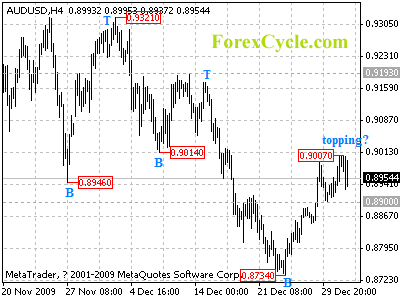
AUDUSD’s uptrend extends to 0.9007

Written by ForexCycle.com

AUDUSD’s uptrend from 0.8734 extends further to as high as 0.9007 level. As long as 0.8900 support holds, we’d expect uptrend to continue and one more rise towards 0.9050 area is still possible later today. On the downside, the pair could possibly be forming a short term cycle top at 0.9007 level on 4-hour chart. Key support is located at 0.8900, a breakdown below this level will confirm the cycle top and indicate that the rise from 0.8734 has completed, then another fall towards 0.8734 could be seen.

audusd

EURUSD traded in a narrow range

Written by ForexCycle.com

EURUSD traded in a narrow range between 1.4218 and 1.4457 for several days. As long as 1.4457 resistance holds, downtrend from 1.5144 could be expected to continue and another fall towards 1.4000 area is still possible. However, a break above 1.4457 key resistance could indicate that a cycle bottom has been formed at 1.4218 on daily chart, and the fall from 1.5144 has completed, then further rally could be seen to 1.4600 or even 1.4700.

For long term analysis, EURUSD has formed a cycle top at 1.5144 level on weekly chart. Pullback towards 1.4000 area to reach next cycle bottom is expected in next several weeks.

eurusd

Fundamental Outlook at 1500 GMT (EDT + 0500)

By GCI Fx Research

The euro moved lower vis-à-vis the U.S. dollar today as the single currency tested bids around the US$ 1.4305 level and was capped around the $1.4440 level.  The common currency gained 2.52% in 2009.  Data released in the U.S. today saw weekly initial jobless claims improve to +432,000 from a revised +454,000 while continuing claims improved to 4.981 million from a revised 5.038 million the week before.  The common currency fell to three-month lows on U.S. economic recovery signs and an improved economic outlook from the Fed.  Some dealers believe the Fed is inching closer to removing more of its monetary stimulus measures.  Recently, the U.S. dollar has started to benefit from improving U.S. economic fundamentals, a reversal from earlier in the year when the greenback failed to markedly improve from better fundamentals.  In eurozone news, data released yesterday saw EMU-16 bank lending decline 0.7% m/m last month, the third consecutive month of declines.  Also, the EMU-16 leading economic index rose 0.7% to 107.1 last month following October’s 0.6% gain and September’s 0.9% gain.  Moreover, the EMU-16 M3 money supply fell by 0.2% y/y, far below the forecast.  The euro’s share of global foreign reserves has risen to all-time highs according to the International Monetary Fund.  The euro’s share of global foreign reserves is now at 27.7% whereas the U.S. dollar’s weighting has falledn to 61.6%.  ECB member Mersch this week reported the eurozone economic recovery looks “moderate and precarious.”  In contrast, ECB member Kranjec reported there are signs the global economic crisis is over. ECB member Bini Smaghi reported global central banks should be able to adopt a more “minor role” in managing the economy next year “and the real economy can take over again.” Euro bids are cited around the US$ 1.3885 level.

¥/ CNY

The yen depreciated vis-à-vis the U.S. dollar today as the greenback tested offers around the ¥93.10 level and was supported around the ¥91.90 level.  The pair gained 2.63% in 2009.  In the absence of major news overnight, traders continue to square their books at year-end and react positively to dollar-supportive U.S. economic data.  Ongoing doubts concerning Japan Airlines and the company’s possible bankruptcy are having a negative impact on the yen.  Standard & Poors yesterday warned Japan’s “AA” credit rating could be lowered if Japan fails to stabilize its debt levels.  The Japanese government released a long-term strategy yesterday that aims to achieve GDP growth of an average 2% over the next decade.  Data released in Japan yesterday saw December PMI improve to 53.8.  Minutes from Bank of Japan’s latest Policy Board meeting were released last week in which the government asked the central bank to monitor deflation.  The minutes revealed “many” Policy Board members agreed “the bank would maintain its stance of responding promptly to changes in the market situation.”  Policymakers said the central bank “would adopt the most effective method for money-market operations that conformed to changes in financial markets.”  After an emergency meeting on 1 December, the central bank introduced a ¥10 trillion fixed-rate lending facility that was designed to arrest the yen’s advances and counter deflation.  The central bank also characterized the most recent bout of deflation as “mild.”  The Nikkei 225 stock index lost 0.86% to close at ¥10,546.44.  U.S. dollar offers are cited around the ¥94.75 level.  The euro moved higher vis-à-vis the yen as the single currency tested offers around the ¥133.60 level and was supported around the ¥132.45 level.  The British pound moved higher vis-à-vis the yen as sterling tested offers around the ¥150.65 level while the Swiss franc moved higher vis-à-vis the yen and tested offers around the ¥90.05 level. In Chinese news, the U.S. dollar appreciated vis-à-vis the Chinese yuan as the greenback closed at CNY 6.8270 in the over-the-counter market, up from CNY 6.8255.  People’s Bank of China Governor Zhou reported “2010 is a crucial year in strengthening the stabilization and recovery of the economy and defeating the international financial crisis.”  People’s Bank of China reported China’s foreign reserves management will face a larger challenge in 2010.  PBoC reaffirmed it will “gradually proceed” with exchange rate reform.

The British pound appreciated vis-à-vis the U.S. dollar today as cable tested offers around the US$ 1.6235 level and was supported around the $1.6050 level.  Cable gained 10.71% in 2009.  A Bank of England survey released today reported banks were more willing to lend to homeowners and companies in Q4 2009.  The quarterly credit conditions survey also indicated the availability of mortgage loans is expected to rise in Q1 2010 also.  Data released in the U.K. today saw Nationwide December housing prices rise 0.4% m/m and 5.9% y/y.  Prime Minister Brown talked up the U.K.’s economic growth prospects yesterday but acknowledged the economic recovery remains “fragile.” Brown must call a general election by early June.  Large spending cuts will likely be required to improve the U.K.’s fiscal position.  Most traders believe Bank of England’s Monetary Policy Committee remains in a wait-and-see mode and will expand its quantitative easing programs if required.  Monetary policy is expected to remain unchanged until February, however, when Q4 GDP and the latest quarterly inflation report are due.  Cable bids are cited around the US$ 1.5755 level.  The euro moved lower vis-à-vis the British pound as cable tested bids around the ₤0.8855 level and was capped around the ₤0.8955 level.

CHF

The Swiss franc appreciated vis-à-vis the U.S. dollar today as the greenback tested bids around the CHF 1.0285 level and was capped around the CHF 1.0385 level.  The pair lost 2.98% in 2009.  Data released in Switzerland yesterday saw the December KOF leading indicator improve to 1.68 from 1.62 in November.  KOF, however, also reported the Swiss economy will “significantly lose momentum” in the coming months.   Data released in Switzerland this week saw the UBS November consumption indicator rise to 1.28 from 0.88 in October.  This represents the third consecutive monthly increase, evidencing an increase in consumer spending.  U.S. dollar offers are cited around the CHF 1.0615 level.  The euro moved lower vis-à-vis the Swiss franc as the single currency tested bids around the CHF 1.4855 level while the British pound appreciated vis-à-vis the Swiss franc and tested offers around the CHF 1.6700 figure.

Daily Market Commentary provided by GCI Financial Ltd.

GCI Financial Ltd (”GCI”) is a regulated securities and commodities trading firm, specializing in online Foreign Exchange (”Forex”) brokerage. GCI executes billions of dollars per month in foreign exchange transactions alone. In addition to Forex, GCI is a primary market maker in Contracts for Difference (”CFDs”) on shares, indices and futures, and offers one of the fastest growing online CFD trading services. GCI has over 10,000 clients worldwide, including individual traders, institutions, and money managers. GCI provides an advanced, secure, and comprehensive online trading system. Client funds are insured and held in a separate customer account. In addition, GCI Financial Ltd maintains Net Capital in excess of minimum regulatory requirements.

DISCLAIMER: GCI’s Daily Market Commentary is provided for informational purposes only. The information contained in these reports is gathered from reputable news sources and is not intended to be U.S.ed as investment advice. GCI assumes no responsibility or liability from gains or losses incurred by the information herein contained.

AUD and NZD 2009 Review and Outlook for 2010

By Ashley Smith – The Australian and New Zealand Dollars were among the top performers versus the U.S Dollar this year with the AUD advancing 27% against the greenback and the NZD 25%. This rise is due to the large difference in interest rates between the south pacific currencies and the USD. While the U.S interest rates are near zero, Australia’s lowest interest rate during the recession was 3% and New Zealand’s rate is 2.5%. Australia was among the first western countries to begin raising interest rates, hiking them a record 3 consecutive times since October to 3.75%.

The Australian economy has performed relatively well during the recession, assisted mostly by exports in commodities, particularly to China. While the New Zealand economy has not fared as well, the currency has benefited from the growth in AUD as the two currencies tend to move in the same direction. The two currencies have also benefited from the continuous rise in equity markets, as the Aussie and Kiwi are among the favorite higher yielding currencies.

The two currencies have come under much pressure in the past month as the USD rallied, after a surge of positive economic data from the U.S increased investors’ expectations that the Federal Reserve will raise interest rates sooner than expected. However, the steep decline of the two currencies appears to have been exaggerated and a correction has already begun taking place. As economic conditions continue to improve in the two countries, boosted by demand from China and the expectation for further interest rate hikes by the two Central Banks mount, the outlook for 2010 for the south Pacific Currencies remains optimistic.

Forex Market Analysis provided by Forex Yard.

© 2006 by FxYard Ltd

Disclaimer: Trading Foreign Exchange carries a high level of risk and may not be suitable for all investors. There is a possibility that you could sustain a loss of all of your investment and therefore you should not invest money that you cannot afford to lose. You should be aware of all the risks associated with Foreign Exchange trading.