EUR/USD Dives Amidst Risk Aversion

By Fast Brokers – The EUR/USD is continuing Friday’s sell-off stemming from the SEC’s action against Goldman.  The UK and Germany are initiating investigations of their own, meaning these headlines could be clogging the headlines for quite a while.  The SEC’s investigation serves as a defense for financial legislation and is worrying investors that whatever bill is passed could be more constrictive than anticipated.  Hence, we’ve seen a pullback in the risk trade across the board in reaction, supported by investors rushing to the Yen.  In addition to the Goldman news, China has taken its most aggressive action to prick its real estate bubble by forbidding banks from providing loans for 3rd home purchases.  Therefore, the Chinese government is showing no signs of releasing its grip on the banking sector, particularly since housing prices increased by over 10% in March.  Altogether, fear of regulation in the U.S. coupled with fear of an economic slowdown in China is leading investors towards the Dollar and the Yen.  On a positive note, Citigroup earnings topped estimates and the risk trade is bouncing a bit right now in reaction to this news.  Meanwhile, investors shouldn’t forget about Greece even though the spotlight has shifted.  If psychological conditions don’t improve in either China or the U.S., another Greece debt scare could topple the EUR/USD.  However, this is all heresy and what we can say is that the EUR/USD is still trading above some key March and April lows.  Therefore, even though the risk trade has been pummeled the last two session, the EUR/USD can still salvage its uptrend should psychological forces make an about face.  The EU will release its ZEW Economic Sentiment data tomorrow and a positive showing could help turn the negative tide.  Meanwhile, earnings will continue to flood in with tech bellweathers reporting throughout the week.  As a result, this could prove to be a very active trading week.

Technically speaking, the EUR/USD has fresh uptrend lines serving as technical cushions along with intraday and 3/31 lows.  As for the topside, the psychological 1.35 now becomes a technical barrier along with an accumulation of downtrend lines and 4/9 highs.

Present Price: 1.3461
Resistances: 1.3473, 1.3485, 1.3496, 1.3506, 1.3521, 1.3530
Supports:  1.3455, 1.3442, 1.3431, 1.3423, 1.3416, 1.3401
Psychological: April highs and lows, 1.35, 1.34

(click chart to enlarge)

Market Commentary provided by Fast Brokers.

Disclaimer: FastBrokers’ market commentary is provided for information purposes only and under no circumstances should be regarded neither as an investment advice nor as a solicitation or an offer to sell/buy any financial product. FastBrokers assumes no responsibility or liability from gains or losses incurred by the information herein contained.

Risk Disclosure: There is a substantial risk of loss in trading futures and foreign exchange. Please carefully review all risk disclosure documents before opening an account as these financial instruments are not appropriate for all investors.

FOREX: US Dollar mixed in trading. Leading Indicators continue to gain in March

By CountingPips.com

The U.S. Dollar has been mixed in the forex markets on a day without major news releases while the U.S. stock markets have been mostly negative. The dollar has advanced versus the euro, Japanese yen, Canadian dollar and the Australian dollar while trading virtually unchanged against the British pound, Swiss franc and the New Zealand dollar, according to currency data from Oanda at 1:34 pm EST. Earlier today, the dollar jumped out to quick gains in risk averse trading but Forex - US Dollarhas given back some ground to the other major currencies as the day has progressed.

The U.S. stock markets, meanwhile, are having a down session today with the Dow falling over 5 points, the Nasdaq decreasing by over 20 points and the S&P 500 dropping by almost 5 points at time of writing. Oil has edged lower by $1.56 to $81.68 per barrel while gold has been declined by $1.10 to the $1,135.20 per ounce level.

Economic news today showed that the U.S. Leading Indicators Index published by the Conference Board increased for the twelveth straight month in March and surpassed market forecasts. The Leading Indicator Index, which measures future economic activity, rose by 1.4 percent in March following a 0.4 percent gain in February and a 0.6 percent rise in January. February’s advance beat the market forecasts which were predicting the gain of 1.1 percent for the month.

The coincident index, which is viewed as a measure of the current economic activity, increased by 0.1 percent in March, matching February’s rise, while the lagging index rose by 0.2 percent in March after gaining by 0.1 percent in February.

An economist at the Conference Board, Ken Goldstein commented in the report saying, “The indicators point to a slow recovery that should continue over the next few months. The leading, coincident and lagging series are rising. Strength of demand remains the big question going forward. Improvement in employment and income will be the key factors in whether consumers push the recovery on a stronger path.”

Important news still to come today is the consumer price index release out of New Zealand for the first quarter. Forecasts are expecting a 0.6 percent quarterly rise and a 2.3 percent year-over-year gain. The fourth quarter of 2009 cpi registered -0.2 while on an annual basis the cpi rose by 2.0 percent.

Raising The BAR: Bar Patterns & Trading Opportunities

How a 3-in-1 formation in cotton “triggered” the January selloff

By Nico Isaac

For Elliott Wave International’s chief commodity analyst Jeffrey Kennedy, the single most important thing for a trader to have is STYLE— and no, we’re not talking business casual versus sporty chic. Trading “style,” as in any of the following: top/bottom picker, strictly technical, cyclical, or pattern watcher.

Jeffrey himself is (and always has been) a “trend” trader, meaning: he uses the Wave Principle as his primary tool, with a few secondary means of select technical studies. Such as: Bar Patterns. And Jeffrey counts one bar pattern in particular as his favorite: the 3-in-1.

Here’s the gist: The 3-in-1 bar pattern occurs when the price range of the fourth bar (named, the “set-up” bar) engulfs the highs and lows of the last three bars. When prices penetrate above the high — or — below the low of the set-up bar, it often signals the resumption of the larger trend. Where this breach occurs is called the “trigger bar.” On this, the following diagram offers a clear illustration:

3-in-1

Now, how about a real world example of the 3-1 formation in the recent history of a major commodity market? Well, that’s where the picture below comes in. It’s a close-up of Cotton from the February 5, 2010 Daily Futures Junctures.

3-in-1 Bar Pattern Foresaw A Fall

As you can see, a classic 3-in-1 bar pattern emerged in Cotton at the very start of the New Year. Within a few day the trigger bar closed below the low of the set-up bar, signaling the market’s return to the downside. Immediately after, cotton prices plunged in a powerful selloff to four-month lows.

February arrived, and with it the end of cotton’s decline. In the same chart you can see how Jeffrey used the Wave Principle to calculate a potential downside target for the market at 66.33. This area marked the point where Wave (5) equaled wave (1), a reliable for impulse patterns. Since then a winning streak in cotton has carried prices to new contract highs.

This example shows the power of a fully-equipped technical analysis “toolbox.” By using the Wave Principle with Bar Patterns, one has a solid, objective chance of anticipating the trend in volatile markets.

And in a 15-page report titled “How To Use Bar Patterns To Spot Trade Set-ups,” Jeffrey Kennedy identifies the top SIX Bar Patterns included in his personal repertoire. They are Double Inside Days, Arrows, Popguns, 3-in-1, Reverse 3-in-1, and Outside-Inside Reversal.

In this comprehensive collection, Jeffrey provides each pattern with a definition, illustrations of its form, lessons on its application and how to incorporate it into Elliott wave analysis, historical examples of its occurrence in major commodity markets, and ultimately — compelling proof of how it identified swift and sizable moves.

Best of all is, you can read the entire, 15-page report today at absolutely no cost. You read that right. The limited How To Use Bar Patterns To Spot Trade Setups” is available with any free, Club EWI membership.

Nico Isaac writes for Elliott Wave International, a market forecasting and technical analysis firm.

EUR/USD May Recover ahead of German Economic Sentiment

By Rita, ForexYard – The European single currency fell against the U.S dollar and Japan’s currency Monday as short-term market players sold the common currency, which often tracks equities, as share markets across Asia weakened. The EUR traded at $1.3467 from $1.3506 and at Y123.96 from Y124.47 late Friday.

The 16-nation currency weakened against the USD after European Union finance ministers told Greece to brace itself for the International Monetary Fund’s conditions on a bailout package. Although worries about Greece continue to weight on the EUR, the upcoming Tuesday will be dominated by economic indicators, with two major surveys to rock the European currency:

06:00 GMT EUR German PPI

– After a leap two months ago, German producer prices took a break and remained unchanged last month. Given the rise in commodity prices, this inflation indicator is expected to rise by 0.5% this time

09:00 GMT EUR German ZEW Economic Sentiment

– What may benefit the European currency most is this survey of German institutional investors and analysts. In the past 6 months, the ZEW economic sentiment has been on the fall, hurting the Euro almost each time.

– This time, it’s predicted to edge up from last month’s score of 44.5 to 45.2 points. This survey of 350 analysts and institutional investors always rocks the Euro. If the number comes in line with or higher the EUR/USD cross may extend its gains above 1.3555.

Forex Market Analysis provided by Forex Yard.

© 2006 by FxYard Ltd

Disclaimer: Trading Foreign Exchange carries a high level of risk and may not be suitable for all investors. There is a possibility that you could sustain a loss of all of your investment and therefore you should not invest money that you cannot afford to lose. You should be aware of all the risks associated with Foreign Exchange trading.

Forex Market Review 19/04/2010

Forex Market Ideas by Finexo.com

Past Events
• USD Housing Starts, out at 0.63M versus expected 0.60M, prior 0.62M (revised)
• USD Building Permits, out at 0.69M versus 0.63M, prior 0.64M (revised)
• USD Prelim UoM Consumer Sentiment, out at 69.5 versus 74.7, prior 73.6 (revised)
• EUR CPI, out at 1.4% versus expected 1.5%, prior 1.5% (revised)
• EUR Core CPI, out at 1.0% versus expected 0.9%, prior 0.8%
• CAD Manufacturing Sales, out at 0.1% versus expected 1.0%, prior 1.8% (revised)

Upcoming Events
• USD Fed Chairman Ben Bernanke to address Financial Literacy and Education Summit in Chicago (1300 GMT)
• NZD CPI q/q (2245 GMT)

Market Commentary
US Housing starts climbed to an annual rate of 626,000 last month, up 1.6% from February’s 616,000 pace, according to Commerce Department figures released Friday in Washington. Building permits, an indicator of future construction, climbed to the highest level since October 2008. An improvement in the housing market, after a crash that contributed to the deepest recession since World War II ended signals a broadening of the economic recovery.

New-home construction rose 20% in March from the same month last year. Permits were up 34% in the 12 months ended in March.  Construction of single-family houses decreased 0.9% to a 531,000 rate in March, while permits increased 5.6%. Work on multifamily homes, such as townhouses and apartment buildings, climbed 19% to an annual rate of 95,000. The increase in starts was concentrated in the South. New construction fell in the rest of the country.
A separate report showed consumer confidence unexpectedly slumped in April, indicating Americans are worried the expansion will be too slow to bolster the labor market. The Reuters/University of Michigan preliminary index of consumer sentiment unexpectedly dropped to 69.5 this month from a final reading of 73.6 in March. The gauge was projected to rise to 75.

A measure of current conditions, which reflects Americans’ perceptions of their financial situation and whether it’s a good time to buy big-ticket items like cars, dropped to the lowest level this year. The index of expectations six months from now, which more closely projects the direction of consumer spending, posted its weakest reading since March 2009.

Stocks fell on Friday, halting a six-day rally, after the Securities and Exchange Commission charged Goldman Sachs Group Inc. with fraud. The Standard & Poor’s 500 Index declined 1.6% to close at 1,192.13. As a result Friday saw the US Dollar climb against the Euro for the second day, the Dollar gained 0.50% to close at EUR 1.35011. The US Dollar also climbed against the Pound for the second day in a row, appreciating 0.65% to close at GBP 1.53607.


Gold was steady on Friday, as safe-haven buying related to worries about Greece’s debt crisis helped the metal defy pressure from a rising U.S. Dollar.

In the Euro zone annual inflation was revised downwards in March, with energy costs continuing to fuel year-over-year price growth, while the core rate inched up after an upward revision in February’s figure, Eurostat reported on Friday.
On the year, the consumer price index rose 1.4%, revised down from the initial 1.5% figure. In monthly terms, inflation accelerated to 0.9% following February’s 0.3% increase. Excluding energy, food, alcohol and tobacco costs consumer prices increased 1.0% on the year, up from February’s record low of 0.9%, which was revised upward from 0.8%. The core inflation rate followed by the European Central Bank, which excludes both energy and unprocessed food costs, was up 0.9% on the year, from the record low of 0.8% in February.

Transport costs registered the strongest jump among the larger components, gaining 1.5% due to a 4.4% rise in fuel prices, while housing maintenance costs rose 0.5% over the same period. Boosted by a 20.2% year on year rise in fuel prices, transport costs also registered a strong annual gain, rising 6.1% compared to March 2009. Conversely, food prices were 0.6% lower on the year.

For 2010 as a whole, the European Commission confirmed its initial forecast of 1.1% inflation for the Euro zone, while the latest ECB’s staff projections suggest inflation ranging between 0.8% and 1.6% this year.
“The outcome of the monetary analysis confirms the assessment of low inflationary pressures over the medium term,” ECB President Jean-Claude Trichet said earlier this month.  However, ECB Executive Board member Juergen Stark, speaking at an event in Washington D.C., stressed the need to keep an eye on the price situation, both within the Euro zone and beyond.

“We need to monitor price developments in the more dynamic regions of the world very closely, as well as the evolution of commodity prices and their potential impact on global inflation,” Stark said. “Notably, a multi-speed recovery of the world economy, with some regions growing fast, while the recovery in others remains rather slow, has the potential to exert upward pressure on prices,” he warned.

The Euro fell against Sterling on Friday after posting gains the previous two days. The single currency fell 0.14% to close trading before the weekend at GBP 0.87872.

In Canada manufacturing sales edged up by a weaker than expected 0.1% in February from January as weakness in the energy and auto sectors partially offset gains across a dozen industries, Statistics Canada said on Friday. Statscan also revised down its January sales growth figure to 1.8% from the 2.4% initially published.
Following the report the Canadian Dollar fell back to close down 1.06% against its American counterpart at CAD 1.01271.

The disappointing numbers suggest the economy grew at a slower pace in February than in the preceding five months. Still, analysts expect first-quarter growth to come in just as strong as the fourth quarter, at about 5% annualized. That will keep pressure on the Bank of Canada to raise interest rates either in June or July.

“We expect that, with evidence mounting that the economic recovery in Canada is on increasingly solid footing, the Bank of Canada will look to begin tightening monetary policy,” Nathan Janzen, economist at Royal Bank of Canada, wrote in a note to clients.

“However, economic slack built up during the recent recession is expected to keep inflation subdued in the near term, allowing the pace of tightening to be undertaken at a gradual rate,” he said.

The majority of primary dealers in Canada expect the first rate rise in July, but markets have also priced in a hike as early as June 1st.

February sales were strong in plastic and rubber products as well as in chemical products, partly the result of pharmaceutical and medical aid to Haiti following the recent earthquake. Much of the weakness came from a 3.9% drop in sales by the petroleum and coal products industry due to lower oil prices and slowdowns caused by fires at two refineries. Transportation equipment sales fell 1.8%, the second straight monthly decline as a result of temporary auto factory shutdowns and lower parts and aerospace sales.

Forex Market Ideas & Analysis by Finexo.com

Disclaimer: Trading the foreign exchange (Forex) carries a high level of risk, and may not be suitable for all investors. All information and opinions contained on this website are to be used for general informational purposes only and do not consitute investment advice.

Forex Technical Analysis – EUR/USD Fibonacci

By Russell, ForexYard – The dollar has significantly gained against the euro and has paused in the recent downward trend at the support line which coincides with the 23.6% Fibonacci retracement level on the 4-hour chart.

The EUR/USD made a sharp move lower during Friday’s trading and that move has continued into Monday’s European trading session.

However, the pair has reached a technical barrier at the price of 1.3443. This is the 23.6% Fibonacci retracement level from a downward trend that began on February 3rd.

The EUR/USD has encountered technical resistance at this support level before. Following a failed breach of this price, the pair made a move higher to1.3800.

If the EUR/USD makes a significant breach of the 1.3443 support level, the pair could fall to the levels of the double bottom pattern near the price of 1.3280.

A failure to breach the support could send the pair back to the 38.2% Fibonacci retracement level at a price of 1.3550.

Forex Market Analysis provided by Forex Yard.

© 2006 by FxYard Ltd

Disclaimer: Trading Foreign Exchange carries a high level of risk and may not be suitable for all investors. There is a possibility that you could sustain a loss of all of your investment and therefore you should not invest money that you cannot afford to lose. You should be aware of all the risks associated with Foreign Exchange trading.

Bernanke’s Speech on Tap

By Yan, ForexYard – After a very volatile trading week, the weekend continued with the same direction. The Dollar keeps strengthening on all fronts, the Yen remains the strongest currency at the moment, and crude oil drops sharply.

The main story in the market continues to be the aid package for Greece. Despite publications from the previous weekend, the Greek bailout plan wasn’t competed and there is still high uncertainty about it. It currently seems that as long as the uncertainty remains, the Dollar and the Yen will continue to strengthen.

Here are today leading news events:

• 12:30 GMT: Canadian Foreign Securities Purchases – This report measures the total value of domestic stocks and bonds that were purchased by foreigners in February. If the end result will reach expectations for 8.65B, the CAD is likely to strengthen.

• 13:00 GMT: Fed Chairman Bernanke Speaks – The Federal Reserve Chairman Ben Bernanke is due to deliver opening remarks at the Financial Literacy and Education Summit, in Chicago. Bernanke is expected to discuss future monetary policy, and high volatility could be observed during his speech.

Forex Market Analysis provided by Forex Yard.

© 2006 by FxYard Ltd

Disclaimer: Trading Foreign Exchange carries a high level of risk and may not be suitable for all investors. There is a possibility that you could sustain a loss of all of your investment and therefore you should not invest money that you cannot afford to lose. You should be aware of all the risks associated with Foreign Exchange trading.

Will Crude Oil Continue To Drop?

Source: Forex Yard

Over the past week, Crude Oil saw an extremely volatile session. After peaking at $86.60 a barrel, crude oil sharply dropped and is currently trading at $83.30 a barrel. At the same time, the Dollar is correcting losses against the Euro and the two trends seem to be correlated. Will this proceed?

Economic News

USD – Dollar Corrects Losses vs. the Euro

The Dollar Saw mixed trading during last week’s session. The Dollar began last week with a sharp drop against the Euro, and since then managed to erase all losses. The Dollar also rose against the Pound. On the other hand the Dollar saw a bearish trend against the Yen.

The Dollar began last week with a deep fall against the Euro. The main reason for the fall was the Greek rescue plan. After several weeks of speculations, the EU countries have finally gathered a bailout plan for the Greek debt crisis. As a result the Euro rose against all the major currencies. However as the week progressed, the Dollar began to erase the losses, mainly due to positive U.S. economic data. The U.S. Retails Sales rose by 1.6% in March, beating expectations for a 1.1% rise. This showed that the U.S. consumers have confidence in their financial outlook and that they feel safer to consume. In addition, the U.S. Building Permits report showed that the number of new residential building permits that were issued on March rose by 0.69M, also beating expectations for a 0.63M result. Considering that the U.S. housing sector was the catalyst for the recent recession, inventors follow carefully after every release on this subject. As a result, every positive data from the U.S. housing sector tends to instantly boost the Dollar.

Looking ahead to this week, many interesting economic publications are expected from the U.S. The leading publications look to be the Producer Price Index, the Unemployment Claims, the Existing Home Sales, the Durable Goods Orders reports and the New Home Sales. Analysts currently forecast rather positive results for these publications. If the end result will indeed turn to be positive, the Dollar is likely to strengthen as a result.

EUR – Euro Drops against the Majors

The Euro saw a very volatile session during last week’s trading. The Euro began last week with a sharp uptrend against the major currencies. However, by Friday the Euro saw a bearish correction that erased all its gains. At the moment the Euro continues to drop against the Dollar and the Yen.

The Euro began last week’s trading session with a sharp rise, mainly due to the Greek rescue plan. The European countries have agreed on a bailout plan for the Greek debt crisis over the past weekend. As a result, the Euro promptly rose against all the major currencies. However, as the week progressed the Euro saw a bearish trend, and erased profits. As it appears, the main reason for the Euro’s downtrend was that there was no development to the Greece rescue plan. While investors were looking for every piece of data regarding the Greek debt crisis, it suddenly seemed that the Euro-Zone fails to deliver any updates on the issue. This has led investors once again to look for safer assets, such as the Dollar and the Yen. In addition, a series of positive data have been released from the U.S. economy. This has supported the Dollar against its major rivals, such as the Euro. In general, when the Dollar rallies, the Euro tends to drop and vice versa.

As for the week ahead, a batch of data is expected from the Euro-Zone. The most significant publications look to be the German ZEW Economic Sentiment on Tuesday and the German Business Climate on Friday. Traders should also follow the six leading publications which are expected from the Euro-Zone on Thursday morning.

JPY – Risk Aversion Boosts the Yen

The Yen rallied against all the major currencies during last week’s trading session. The Yen gained about 100 pips against the Dollar, about 400 pips against the Euro and about 250 pips against the Pound.

It appears that concerns that an aid package to Greece will falter have turned investors to look for safe-haven assets, such as the Yen. By the beginning of last week, it seemed that the European leaders have finalized a rescue plan to the Greek economy, however a lack of progression on the aid package have created concerns that the Greek economy might continue to trample. As a result, the Yen has corrected its losses, and continued to rally against all the major currencies. In addition several positive data from the Japanese economy has also supported the Yen. The M2 Money Stock report showed the change in the total quantity of domestic currency in circulation and deposited in banks has rose by 2.6%, which created speculations that the Bank of Japan might hike rates soon.

As for this week, many significant economic data is expected from Japan. Traders are advised to provide special attention to the Trade Balance publication on Wednesday. This report measures the difference in value between imported and exported goods during March. Analysts have forecasted that the Japanese Trade Balance has widened by 0.66T. If the actual result will be similar, it has potential to further boost the Yen.

Crude Oil – Crude Oil Drops Below $83.50 a Barrel

Crude Oil saw an extremely volatile session during last week’s trading. With the beginning of last week, Crude Oil dropped to $82.50 a barrel. Then by Thursday, crude bounced back to $86.60 a barrel, just to drop to $83.30 a barrel by Sunday night.

It seems that speculations that gains have outpaced demand have weakened oil for the third day in a row. For the past few weeks, oil prices have been growing constantly on speculations that global recovery will increase demand for energy. However, the continuing uncertainty over the Greece debt crisis has supported concerns that global recovery could be damaged. In addition, the strengthening of the Dollar has also added to the falling oil prices. Crude Oil is traded in Dollars, and thus whenever the Dollar rises vs. the Euro, Crude Oil tends to drop.

Looking ahead to this week, traders should follow the major economic publications from the U.S. and the Euro-Zone, as they seem to have the largest impact on Crude Oil. In addition, traders are advised to follow the U.S. Crude Oil Inventories report which is expected on Wednesday, as this report tends to have an immediate impact on the market.

Technical News

EUR/USD

A much needed correction may be taking place for the pair today following its recent bearish trend as the 2 hour and 4 hour RSI are floating in the oversold territory indicating an impending upward movement. Furthermore, a bullish cross is evident on the 2 hour and 8 hour charts’ Slow Stochastic. Going long for the day may be advised.

GBP/USD

The RSI for the pair seems to be floating in the oversold territory on the hourly, 2 hour and 4 hour while a bullish cross is evident on the 2 hour and 4 hour charts’ Slow Stochastic. Furthermore a breach of the lower Bollinger Band is evident on the 4 hour and 8 hour charts. Going long for the day may be a good option.

USD/JPY

The pair’s RSI seems to be floating in the oversold territory as evident on the 2 hour, 4 hour and daily chart and with a bullish cross seen on the 4 hour and 8 hour charts’ Slow Stochastic. Going long for the day may be a good option.

USD/CHF

A correction might be taking place for the pair today as the pair’s RSI seems to be floating in the overbought territory on the 2 hour and 4 hour charts and with a bearish cross evident on the 2 hour, 4 hour and 8 hour charts. Going short for the day may be advised.

The Wild Card

Crude Oil

After last weeks drop a correction may be seen today as the hourly, 2 hour and 4 hour RSI seen floating in the oversold territory and a bullish cross is seen on the 4 hour and 2 hour charts’ Slow Stochastic. Forex traders may be advised to go long for the day.

Forex Market Analysis provided by Forex Yard.

© 2006 by FxYard Ltd

Disclaimer: Trading Foreign Exchange carries a high level of risk and may not be suitable for all investors. There is a possibility that you could sustain a loss of all of your investment and therefore you should not invest money that you cannot afford to lose. You should be aware of all the risks associated with Foreign Exchange trading.

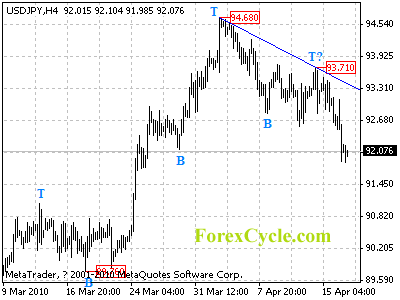
USDJPY continues its downward movement from 94.68

USDJPY continues its downward movement from 94.68 and the fall has reached as low as 91.87 level. Deeper decline is still possible in a couple of days and next target would be at 91.00 area. Resistance is at the falling trend line from 94.68 to 93.71, as long as the trend line resistance holds, downtrend could be expected to continue.

usdjpy

Daily Forex Signals

Forex Weekly Market Review April 19, 2010

By eToro – The news on Friday that the Securities and Exchange Commission of the United States was charging Goldman Sachs with Fraud related to sub-prime mortgages rocked the equity markets disturbing a week that had seen the Dow and the S&P 500 make new 18 month and 19 month highs.  The petroleum complex was hit as crude oil fell more than $2.25 dollars a barrel.  The news overshadowed excellent earnings released during the week from Intel, JP Morgan Chase, Bank of America and GE which all beat analyst estimates by robust margins.  For the week, the S&P 500 lost on .2%, but shed 19.5 points or 1.6% on Friday.

112

Will Europe formally discuss Greece?

The European summit in Madrid appears to be underway and the general news environment is not promising.  The Greek Prime Minister still is denying that funds are needed, claiming the facility is a safety net and unbelievably suggests that the IMF involvement was not a Greek idea.  Germany, in effect, for its own reasons, called the Greek Prime Minister Papandreou’s bluff, and will use this advantage to demand more concessions from Greece.  Many European officials still seem to be in denial.  Rather than prepare the public for an eventual use of those funds, for example, the German Finance Minister, is saying that Greece is on the right path and there is no need for emergency funds.  The ECB’s is saying that backstop can only be used if Greece looses market access.  To summarize, an issue that desperately needs closure will not likely see an end to Greece’s insolvency problems for a while.   Europe’s proposed facility, even if implemented, has a few important short falls.  First, the sums discussed will only produce coverage for one year.  Second, Europe is not considering what will happen to other countries such as Portugal or Spain.  European officials could have helped stabilize investor sentiment if they would have used the Greek crisis to recognize the sovereign risk and come up with a scalable plan and facility.   Additionally, interest in a Greek dollar-denominated issue is reportedly unsatisfactory and the anticipated size has been cut dramatically, which could lead to the entire issue being pulled.   Comments by ECB’s Trichet about the difficulties Greek banks are facing in terms of liquidity have somewhat undermined the Euro.  A Brookings Institute report highlights the bribery, patronage and corruption behind Greece’s debt.  The study estimates that their nefarious activities cost Greece 8% of GDP or around 20 billion Euros.

210

China continues to impress

Global markets initially needed to absorb a plethora of data release by China on Thursday.  As expected Q1 GDP, rose 11.9% and March CPI increased 2.4%.  Industrial output rose 18.0% in March, retail sales was up 18%, fixed asset investment was up 26.4% and all were in line with expectations.  There is heightened talk of another hike in reserve requirements and of course speculation of an imminent revaluation.  China did hike mortgage rates and boosted required down payments on some home purchases, warning that “more forceful” steps are needed to stem the rise in property prices that rose at a record pace last month.  Additionally,   China reported that it would raise the prices for retail fuels by 320 Yuan ($46.81) a metric ton to reflect higher costs for crude oil, according to the National Development and Reform Commission, the country’s top economic planner.  The current average of the retail price ceilings for Chinese provinces and major cities is 7,900 Yuan per ton for gasoline and 7,160 Yuan per ton for diesel. A 320-Yuan increase would amount to a price boost of 4.0% for gasoline and 4.5% for diesel. China will also raise the benchmark ex-factory price of No.3 jet kerosene by 500 Yuan per ton, or 9.6%, to 5,690 Yuan. The price rises will boost the April consumer price index by about 0.07 percentage points.  In general, the rise is to support refiners, but it might have the effect of decreasing demand, which could put a damper on the Chinese economy.

Bernanke Pledges to Keep Rates Low

There was some speculation that Bernanke would tout a less dovish line in his testimony before the Joint Economic Committee of Congress.  This week’s CPI figures and market inflation expectations underscore the reason why it may still be appropriate to look for rates to remain low for “an extended period of time”.   Headline CPI rose 0.1% and the core was flat.  The core CPI was flat for the entire first quarter.  This is the weakest quarterly performance in more than a quarter of a century.  Excluding housing costs, core CPI rose 0.1%.  Clothing prices fell 0.4% year-over-year service prices were up 0.2%.  Auto prices are up 5.3% year-over-year while the medical care index rose 3.7% year-over-year.   The Beige Book report also showed a positive outlook on the economy.  The U.S. economy continued to improve across much of the country last month, according to the Federal Reserve report released Wednesday.  The Fed in its monthly beige book said that overall economic activity rose in 11 of its 12 districts between February’s end and April 5 2010. The commercial real estate sector, however, remained weak across most of the country. The overall labor market, also remained weak.

US Housing Picks Up Some Steam

In the Housing sector, the National Association of Home Builders’ monthly gauge of confidence in new-home sales rose to 19 from an unrevised 15 in March.  The better-than-expected reading of 19 matched its level in September 2009, just before the government’s first tax credit for buyers expired.  Housing starts increased 1.6% to a seasonally adjusted 626,000 annual rate in comparison to the prior month, according to the Commerce Department. Construction rose in the South but fell in the three other regions of the US.  March single-family housing starts slipped, after two big increases.  February starts, originally seen down 5.9%, were revised to an increase of 1.1%. January starts jumped 6.3%.  Single-family housing starts in March fell 0.9% to 531,000 month-over-month.  In February, single-family starts climbed 5.7%, revised up from a previously reported 0.6% decline. January single-family starts rose 5.4%.  March apartment construction, housing with two or more units, rose 18.8% to 95,000. Within that multi-family category, groundbreakings of homes with five or more units were 39.7% higher.  Regionally, housing starts in March rose 18.2% in the South. Starts fell 8.3% in the Northeast, 28.4% in the Midwest, and 2.1% in the West.  Year-over-year overall housing starts in the U.S. last month was 20.2% higher than the pace of construction in March 2009.

Japan’s Government has two views

Japanese government appears to be increasing pressure on the BOJ to take more steps to counter deflation.  Yesterday a panel called for yen at 120.  The BOJ recently upgraded its assessment of the economy.  The government, which is the ministry of finance, did not follow suit.  A Japanese government spokesperson raised the prospect of intervention to weaken the yen and for the BOJ to buy more government bonds.  The ministry of finance is determined to increase the liquidity in the market to increase domestic growth, increase exports and fend off deflation.  Unfortunately, the flight to quality lifted the Yen against the dollar, closing the week near 92.10.

313

Next week the markets will begin on edge as Asia might feel the brunt of the SEC action against Goldman Sachs.  Market participants will also be watching Japanese Consumer Confidence on Monday.  On Tuesday, the RBA will release minutes from its recent central bank meeting.  UK CPI will also be important, as recent numbers have been conflicting.  On Wednesday, UK Jobless claims will be closely watched.  US Jobless Claims, PPI and Existing Homes Sales will the economic headlines on Thursday.  Friday the main market mover will be the UK GDP and US Home Sales.

Daily Forex Market Analysis provided by eToro

Disclaimer: Trading in the Foreign Exchange market might carry potential rewards, but also potential risks. You must be aware of the risks and are willing to accept them in order to trade in the foreign exchange market. Don’t trade with money you can’t afford to lose.

© 2009 eToro Blog.