Enjoy 8 Free Chapters from Robert Prechter’s Conquer the Crash

Prechter’s New York Times and Wall Street Journal business best-seller remains a useful read.

By Editorial Staff

In 2002, Elliott Wave International’s president Robert Prechter published his New York Times and Wall Street Journal business best-seller Conquer the Crash, a prescient book that explained why a financial crisis was inevitable and predicted almost exactly how it would unfold.

Now in the 2nd edition, Conquer the Crash remains a very useful read. To give you an idea of just how useful, we are releasing 8 chapters of the book to all 150,000+ free Club EWI members. Here’s an excerpt. (Details on how to read full report are below.)

Robert Prechter
Conquer the Crash
Chapter 23, “What To Do With Your Pension Plan,” excerpt

Make sure you fully understand all aspects of your government’s individual retirement plans. In the U.S., this includes such structures as IRAs, 401Ks and Keoghs. If you anticipate severe system-wide financial and political stresses, you may decide to liquidate any such plans and pay whatever penalty is required. Why? Because there are strings attached to the perk of having your money sheltered from taxes. You may do only what the government allows you to do with the money. It restricts certain investments and can change the list at any time. It charges a penalty for early withdrawal and can change the amount of the penalty at any time.

What is the worst that could happen? In Argentina, the government continued to spend more than it took in until it went broke trying to pay the interest on its debt. In December 2001, it seized $2.3 billion dollars worth of deposits in private pension funds to pay its bills. …

With the retirement setup in the U.S., the government need not be as direct as Argentina’s. It need merely assert, after a stock market fall decimates many people’s savings, that stocks are too risky to hold for retirement purposes. Under the guise of protecting you, it could ban stocks and perhaps other investments in tax-exempt pension plans and restrict assets to one category: “safe” long-term U.S. Treasury bonds. Then it could raise the penalty of early withdrawal to 100 percent. Bingo. The government will have seized the entire $2 trillion — or what’s left of it given a crash — that today is held in government-sponsored, tax-deferred 401K private pension plans. I’m not saying it will happen, but it could, and wouldn’t you rather have your money safely under your own discretion? …

Perhaps you have no such opportunity for a tax saving and do not want to pay the penalty attached to premature withdrawal. If your balance is high enough, you may wish to consider converting your retirement plan investments into an annuity at a safe insurance company (see Chapter 24). It is highly likely (though not assured) that such investments would be left alone even in a national financial emergency. …

If you or your family owns its own small company and is the sole beneficiary of its pension or profit sharing plan, you should lodge its assets in a safe bank or money market fund. As an alternative, depending upon your age and requirements, you may consider converting it into an annuity, issued by a safe insurance company. Such insurance companies are few and far between, but the next chapter shows you where to find them.

Read the rest of the 8 free chapters from Robert Prechter’s Conquer the Crash now, free! All you need is to create a free Club EWI profile. Here’s what you’ll learn:

  • Chapter 10: Money, Credit and the Federal Reserve Banking System
  • Chapter 13: Can the Fed Stop Deflation?
  • Chapter 23: What To Do With Your Pension Plan
  • Chapter 28: How to Identify a Safe Haven
  • Chapter 29: Calling in Loans and Paying off Debt
  • Chapter 30: What You Should Do If You Run a Business
  • Chapter 32: Should You Rely on Government to Protect You?
  • Chapter 33: A Short List of Imperative “Do’s” and Crucial “Don’ts”

Keep reading this free report now — all you need to do is create a free Club EWI profile.

Elliott Wave International (EWI) is the world’s largest market forecasting firm. EWI’s 20-plus analysts provide around-the-clock forecasts of every major market in the world via the internet and proprietary web systems like Reuters and Bloomberg. EWI’s educational services include conferences, workshops, webinars, video tapes, special reports, books and one of the internet’s richest free content programs, Club EWI.

Euro Stages Slight Rebound in Overnight Trading

Source: Forex Yard

After falling to one year lows against several of its main currency rivals, the Euro was able to bounce back slightly last night. Following news that U.S. interest rates will likely remain at their current levels for the foreseeable future, the single currency was able to make very slight advances against the greenback and is currently trading around the 1.3200 level.

Economic News

USD – Dollar Gains Big on Euro-Zone Woes

The U.S. Dollar was able to stage an impressive rally against several of its main currency rivals yesterday, including the Euro and British Pound. Negative news coming out of the Euro-zone largely fueled the greenback’s gains, which were largely maintained despite the announcement that U.S. short-term interest rates will remain at their current levels for some time.

Currently, EUR/USD is trading around the 1.3200 level, over 150 pips down from 24-hours ago. The drop in GBP/USD was even more drastic. At the moment, the pair is trading around the 1.5170 level, almost 300 pips down from this time yesterday. In both cases, the Dollar should be able to maintain its respective gains in trading today, providing news set to be released today shows a continuous improvement in the American economy.

Traders will want to pay attention to the U.S. Unemployment Claims Report, the results of which will be announced at 12:30 GMT today. With most analysts predicting a slight drop in the number of new unemployment claims compared to last week, the Dollar may see gains, not only against the Euro, but also against riskier currencies like the Canadian Dollar and Aussie.

EUR – Euro Tumbles Following Spanish Downgrade

Adding to the long list of economic problems currently confronting the Euro-zone, Spain’s long term credit rating was downgraded yesterday, causing the single currency to tumble against its major counterparts. In addition to the USD, the Euro has also fallen against the more volatile currencies like the Canadian Dollar and Aussie. In the last 24-hours, the single currency has fallen over 60-70 pips against both the CAD and AUD.

Today, traders will want to pay attention to several European news events likely to impact the marketplace. At 7:55 GMT, the German Unemployment Change is set to be released. As the leading Euro-zone economy, Germany plays a somewhat inflated role in how the Euro moves in the forex marketplace. Additionally, a speech from ECB President Trichet is set to take place at 11:30 GMT. Typically, a speech from the ECB President creates mild market volatility, but considering the events of yesterday, todays might take on added significance. Whether either of these news events will help the Euro recoup yesterday’s losses is yet to be seen.

JPY – Yen Able to Maintain Gains Despite Return To Risk Taking

Capitalizing on the continued bad economic news coming out of the Euro-zone, the Yen was able to record significant gains against the single currency in trading yesterday. At one point, EUR/JPY fell over 100 pips before correcting itself slightly. Currently the pair is trading around the 123.95, still down 80 pips or so from its high yesterday.

Against the U.S. Dollar, the Yen has not been as fortunate. Good U.S. economic news has fueled an uptrend in the USD/JPY pair over the last several days. The pair went as high as 94.28 yesterday, and is currently trading only slightly lower at 93.90.

Today, JPY traders will want to focus on both the U.S. and Japanese economic news. If American unemployment figures come in higher then expected, the Yen may be able to make some gains on the greenback. Furthermore, the Japanese Prelim Industrial Production report, set to be released at 23:50 GMT, will likely boost the Yen providing the results are at or above the forecasted figure of 0.9%.

Crude Oil – Crude Struggling to Maintain Prices Above $83 a Barrel

After dropping as low as $81.40 a barrel yesterday, crude oil managed to stage a mild comeback in evening trading. Prices were largely boosted due to the latest news regarding the formation of a Greek rescue plan. That being said, crude is currently stuck around the $83 level, a far cry from earlier in the week when prices were well above $84 a barrel.

Today, crude prices will likely be determined by U.S. economic news. If the American unemployment figure gives the greenback a boost, oil prices will likely fall as a result. That being said, if a disappointing unemployment figure is released, risk taking may return to the forex marketplace leading to a boost for the commodity.

Technical News

EUR/USD

The price of this pair appears to be floating in the over-sold territory on the daily chart’s RSI indicating an upward correction may be imminent. The upward direction on the 8-hour chart’s RSI also supports this notion. When the upwards breach occurs, going long with tight stops appears to be preferable strategy.

GBP/USD

The daily chart is showing mixed signals with its RSI fluctuating at the neutral territory. However, the 4-hour chart’s RSI is already floating in the oversold territory indicating that a bullish correction might take place in the nearest future. Going long with tight stops may turn out to be the right choice today.

USD/JPY

The pair has been range-trading for a while now, with no specific direction. The Daily chart’s Slow Stochastic providing us with mixed signals. The 4 hour charts do not provide a clear direction as well. Waiting for a clearer sign on the hourlies chart might be a good strategy today.

USD/CHF

The USD/CHF cross has experienced a bullish trend for the past week. However, it seems that this trend may be coming to an end. The RSI of the daily chart shows the pair floating in the overbought territory, indicating that a downward correction will happen anytime soon. Going short with tight stops might be a wise choice.

The Wild Card

Gold

Gold prices rose significantly in the last week and peaked at $1065.10 for an ounce. And now, the daily chart’s Slow Stochastic is giving bullish signals, indicating that gold prices might go up. This might give forex traders a great opportunity to enter a very popular trend.

Forex Market Analysis provided by Forex Yard.

© 2006 by FxYard Ltd

Disclaimer: Trading Foreign Exchange carries a high level of risk and may not be suitable for all investors. There is a possibility that you could sustain a loss of all of your investment and therefore you should not invest money that you cannot afford to lose. You should be aware of all the risks associated with Foreign Exchange trading.

Hang Seng Index Expected to Rebound Today

printprofile

The Hang Seng Index has recorded much bearish behavior in the past several days. However, the technical data indicates that this trend may reverse anytime soon. For example, as I demonstrate below, the 4-hour chart signals that a bullish reversal is imminent. CFD traders can take advantage of this imminent upward movement by entering long positions at an excellent entry price.

• Below is the 4-hour chart of the Hang Seng Index.

• The technical indicators used are the Relative Strength Index, MACD, and Williams Percent Ranges.

• Point 1: The Relative Strength Index (RSI) signals that the price of this pair currently floats in the over-sold territory, indicating upward pressure.

• Point 2: The MACD indicates an impeding bullish cross, signaling that the next move may be in an upward direction.

• Point 3: The Williams Percent Range is showing that this pair is heavily over-sold and may be experiencing strong upward pressure.

Hang Seng Index 4-Hour Chart
Hange seng index 29-4

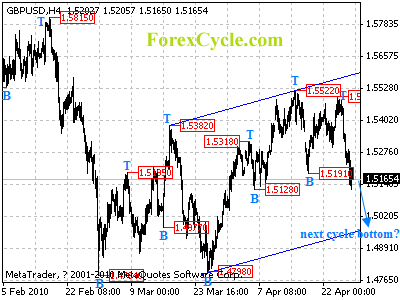
GBPUSD broke below 1.5191 key support

GBPUSD broke below 1.5191 key support, suggesting that a cycle top has been formed at 1.5497 level on 4-hour chart, and the bounce from 1.4798 has completed at 1.5522 already. Deeper decline is expected later today and target would be at the lower border of the price channel. Resistance is now at 1.5240, as long as this level holds, downtrend from 1.5497 could be expected to continue.

gbpusd

Daily Forex Forecast

Forex Daily Market Commentary

By GCI Forex Research

Fundamental Outlook at 1400 GMT (EDT + 0400)

The euro appreciated vis-à-vis the U.S. dollar today as the single currency tested offers around the US$ 1.3245 level and was supported around the $1.3140 level.   As expected, the Federal Open Market Committee decided to keep interest rates unchanged.  The FOMC reported “Information received since the Federal Open Market Committee met in March suggests that economic activity has continued to strengthen and that the labor market is beginning to improve. Growth in household spending has picked up recently but remains constrained by high unemployment, modest income growth, lower housing wealth, and tight credit. Business spending on equipment and software has risen significantly; however, investment in nonresidential structures is declining and employers remain reluctant to add to payrolls. Housing starts have edged up but remain at a depressed level. While bank lending continues to contract, financial market conditions remain supportive of economic growth. Although the pace of economic recovery is likely to be moderate for a time, the Committee anticipates a gradual return to higher levels of resource utilization in a context of price stability.  With substantial resource slack continuing to restrain cost pressures and longer-term inflation expectations stable, inflation is likely to be subdued for some time.  The Committee will maintain the target range for the federal funds rate at 0 to 1/4 percent and continues to anticipate that economic conditions, including low rates of resource utilization, subdued inflation trends, and stable inflation expectations, are likely to warrant exceptionally low levels of the federal funds rate for an extended period. The Committee will continue to monitor the economic outlook and financial developments and will employ its policy tools as necessary to promote economic recovery and price stability.  In light of improved functioning of financial markets, the Federal Reserve has closed all but one of the special liquidity facilities that it created to support markets during the crisis. The only remaining such program, the Term Asset-Backed Securities Loan Facility, is scheduled to close on June 30 for loans backed by new-issue commercial mortgage-backed securities; it closed on March 31 for loans backed by all other types of collateral.”  Kansas City Fed President Hoenig dissented with the majority and he argued that “continuing to express the expectation of exceptionally low levels of the federal funds rate for an extended period was no longer warranted because it could lead to a build-up of future imbalances and increase risks to longer run macroeconomic and financial stability, while limiting the Committee’s flexibility to begin raising rates modestly.”  President Obama will announce new Fed Board nominees tomorrow.  Data released in the U.S. today saw MBA mortgage applications decline 2.9% from the prior reading of +13.6%.  In eurozone news, data released today saw the EMU-16 April business climate indicator improve to -0.12 while EMU-16 April industrial confidence improved to -18 with consumer confidence remaining unchanged, economic confidence improved, and services confidence improved.  German data saw April harmonized consumer price inflation decline 0.1% m/m and increase 1.0% y/y.  All eyes remain on Greece, Portugal, and Spain.  It is being reported that Greece may require €120 billion in financial assistance over the next three years.  Spain’s credit rating was downgraded today and worsening sovereign credit conditions may exacerbate conditions in the eurozone.  Euro bids are cited around the US$ 1.3175 level.

¥/ CNY

The yen depreciated vis-à-vis the U.S. dollar today as the greenback tested offers around the ¥94.05 level and was supported around the ¥93.00 figure.  Bank of Japan’s Policy Board is expected to keep its monetary policy unchanged and its main unsecured overnight call rate unchanged at 0.1% on Friday.  The central bank is also expected to upgrade its assessment of current economic conditions and raise its consumer price inflation forecasts.  The government will continue to pressure the central bank to maintain an ultra-easy monetary policy and possibly adopt an inflation target of 2%.  Data released in Japan overnight saw March retail trade climb 0.8% m/m and 4.7% y/y.  Also, March large retailers’ sales were off 5.0%.  The Nikkei 225 stock index lost 2.57% to close at ¥10,924.79.  U.S. dollar offers are cited around the ¥96.85 level.  The euro moved higher vis-à-vis the yen as the single currency tested offers around the ¥124.55 level and was supported around the ¥122.35 level.  The British pound moved higher vis-à-vis the yen as sterling tested offers around the ¥141.70 level while the Swiss franc moved higher vis-à-vis the yen and tested offers around the ¥86.85 level. In Chinese news, the U.S. dollar depreciated vis-à-vis the Chinese yuan as the greenback closed at CNY 6.8254 in the over-the-counter market, down from CNY 6.8257.  People’s Bank of China pledged to keep flexible policies to react to “new conditions.”  PBoC added “The world economy may stage a recovery in 2010, yet the foundation is still fragile and complicated by the growth rates of various economies and shifts in the macroeconomic policies.”

Forex Daily Market Commentary provided by GCI Financial Ltd.

GCI Financial Ltd (”GCI”) is a regulated securities and commodities trading firm, specializing in online Foreign Exchange (”Forex”) brokerage. GCI executes billions of dollars per month in foreign exchange transactions alone. In addition to Forex, GCI is a primary market maker in Contracts for Difference (”CFDs”) on shares, indices and futures, and offers one of the fastest growing online CFD trading services. GCI has over 10,000 clients worldwide, including individual traders, institutions, and money managers. GCI provides an advanced, secure, and comprehensive online trading system. Client funds are insured and held in a separate customer account. In addition, GCI Financial Ltd maintains Net Capital in excess of minimum regulatory requirements.

DISCLAIMER: GCI’s Daily Market Commentary is provided for informational purposes only. The information contained in these reports is gathered from reputable news sources and is not intended to be U.S.ed as investment advice. GCI assumes no responsibility or liability from gains or losses incurred by the information herein contained.

FOREX: EUR/USD edges above 1.3200 after touching One-Year Low

By CountingPips.com

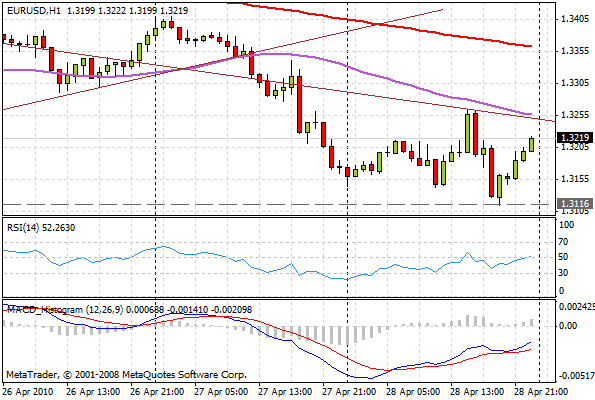
The euro has traded higher against the U.S. dollar in forex trading despite touching a one-year low point earlier today. The euro-dollar pair (EUR/USD) has ascended above the 1.3200 exchange rate to show a current gain of approximately 30 pips on the day after dropping yesterday by over 200 pips. The EUR/USD rose to an intraday high of 1.3266 early in trading before falling to 1.3114 and marking the lowest trading level since April 28th, 2009. The euro has managed to pare that downtrend and has risen to currently trading near the 1.3220 level.
In today’s news, we learned that Spain had its debt rating downgraded to AA by the ratings agency Standard & Poor’s. This is only one day after similar downgrades on debts of Greece and Portugal and has heightened speculation the Greece crisis may be spreading.

Out of the U.S., the Federal Reserve held its interest rate at 0.25 percent as widely expected. The statement said that “economic activity has continued to strengthen and that the labor market is beginning to improve.” The statement also highlighted many of the aspects constraining the economy such as high unemployment, tight credit and the troubled housing market. The Fed did not change course from saying that the rate would stay at “exceptionally low levels” for an “an extended period” and once again passed on giving any signal on when a change in policy may come. Fed member Thomas M. Hoenig dissented from the committee for the third straight meeting as he objected to the expectations of low levels of interest rates going forward which may cause “imbalances” in the long-term.

Tomorrow’s economic schedule includes German employment results, Euro-Zone Industrial Confidence, the Chicago Fed national activity index and the U.S. weekly jobless claims.

EUR/USD Chart – The Euro today rebounding slightly against the US dollar on the 1-hour chart after touching over a one-year low earlier today. The pair fell over 200 pips yesterday after Greece and Portugal’s debt ratings were downgraded and while Goldman Sachs executives were grilled in front of Congress. Spain’s debt was also downgraded by the S&P today but didn’t hold the euro down for too long as the EUR/USD has popped its head back over 1.3200.

forex-eurusd

AUD/USD Climbs Back Above .92

By Fast Brokers – The usually reliable Aussie joined in on the risk aversion yesterday, setting new April lows before bouncing back above its psychological .92 level.  Debt fears in Greece spread to Portugal and other PIIGS nations, sparking speculation of contagion.  Such uncertainty even dragged the Aussie lower since instability in the EU may lead the RBA to be cautious and neutral come May’s meeting.  After all, Steven’s recently expressed that interest rates may be approaching a reasonable level.  With the end of the RBA’s rate hikes coming into view, any additionally fiscal flare ups in the EU could have a more noticeable impact on the Aussie.  Although yesterday’s PPI figures printed a bit hotter than expected, today’s CPI number was in line with analyst expectations.  Hence, with prices tame and Australian fundamentals cooling down as of late, the RBA may become more incline to stand pat, an Aussie negative.  Although Australia will be relatively quiet on the data wire tomorrow, the next 24 hours could prove to be active with the Fed’s monetary policy decision on the way.

Technically speaking, the Aussie faces technical barriers in the form of intraday, 4/26, 4/21, 4/15 and 4/12 highs.  Additionally, the psychological .93 and .94 levels could serve as psychological obstacles over the near-term.  As for the downside, the Aussie has multiple uptrend lines serving as technical cushions along with intraday and 3/22 lows.

Price: .9217
Resistances: .9219, .9227, .92.40, .92.51, .92.59, .92.68, 92.83
Supports: .9211, .9200, .9188, .9171, .9158, .9134
Psychological: .93, .94, .92, April highs and lows

(click chart to enlarge)

Market Commentary provided by Fast Brokers.

Disclaimer: FastBrokers’ market commentary is provided for information purposes only and under no circumstances should be regarded neither as an investment advice nor as a solicitation or an offer to sell/buy any financial product. FastBrokers assumes no responsibility or liability from gains or losses incurred by the information herein contained.

Risk Disclosure: There is a substantial risk of loss in trading futures and foreign exchange. Please carefully review all risk disclosure documents before opening an account as these financial instruments are not appropriate for all investors.

Gold Rushes Higher with Risk Aversion

By Fast Brokers – Gold has regained its luster as a safe haven, casting aside its negative dollar correlation and rushing higher as the Euro and Pound dive.  The S&P’s downgrades of Greek and Portugal debt really rocked the markets yesterday, sending the VIX, dollar and yen higher as investors headed for the exits.  Meanwhile, attention turns to the Fed and investors will be looking to see whether the central bank alters its timeline for loose policy due to the recent upturn in U.S. economic fundamentals.  However, since the Fed is likely to keep its policy unchanged due to high U.S. unemployment, new developments in fiscally troubled EU nations and in UK parliamentary elections will likely have the largest impact on gold over the near-term.  Should EU bond yields continue to rise, this could boost the precious metal higher due to risk averse flows.  Additionally, the closer the UK gets to a hung parliament the more uncertainty investor uncertainty will increase, a negative for the Pound and possibly a positive for gold.

Technically speaking, gold burst through previous April highs yesterday, certainly a positive development for the precious metal in terms of momentum.  That being said, gold is beginning to square its sights on the highly psychological $1200/oz level and previous all-time highs.  As for the downside, gold has multiple uptrend lines serving as technical cushions along with intraday and 4/27 lows.  Additionally, the psychological $1160/oz and $1150/oz areas could serve as solid cushions should they be tested.

Present Price: $1167.78/ oz
Resistances: $1168.59/oz, $1170.23/oz, $1172.43/oz, $1174.22/oz, $1176.48/oz, $1178.77/oz
Supports: $1165.17/oz, $1163.59/oz, $1161.37/oz, $1159.47/oz, $1157.26/oz, $1154.73/oz
Psychological: $1170/oz, $1160/oz, $1150/oz, April highs and lows

(click chart to enlarge)

Market Commentary provided by Fast Brokers.

Disclaimer: FastBrokers’ market commentary is provided for information purposes only and under no circumstances should be regarded neither as an investment advice nor as a solicitation or an offer to sell/buy any financial product. FastBrokers assumes no responsibility or liability from gains or losses incurred by the information herein contained.

Risk Disclosure: There is a substantial risk of loss in trading futures and foreign exchange. Please carefully review all risk disclosure documents before opening an account as these financial instruments are not appropriate for all investors.

USD/JPY Moves Back Towards 94

By Fast Brokers – The USD/JPY has popped back to its psychological 94 level after suffering a sizable leg down yesterday.  The USD/JPY headed south yesterday as investors snapped up the Yen in reaction to risk-averse flows across the FX market.  The USD/JPY showed that the Yen is still a favored safe haven in times of accelerated uncertainty.  However, the USD/JPY has recovered quickly with investors buying up Japanese bonds as investors divest from Greece and other fiscally troubled EU nations.  Additionally, Japan’s retail sales stormed higher by 4.7%, signaling the nation’s economic recovery is gaining traction.  As a result, there may be less pressure on the BoJ to loosen its policy since inflation may pick up with consumption.  Japan will be on a banking holiday tomorrow, meaning attention will be focused on the Fed’s monetary policy decision later today.  Though the central bank is expected to keep its policy unchanged, any tightening in the time frame could really boost the USD/JPY.  However, if the Fed’s statement remains unchanged then the reaction may be negligible.  Altogether, it wouldn’t be unreasonable to presume that activity will pick up over the next 24 hours since the Fed normally packs the punch to really move the FX markets.

Technically speaking, the USD/JPY faces technical barriers in the form of previous April highs.  As for the downside, the USD/JPY has multiple uptrend lines serving as technical cushions along with intraday, 4/23, 4/22, and 4/19 lows.  Additionally, the psychological 93 level could continue to serve as a psychological cushion should it be tested.

Present Price: 93.92
Resistances: 94.03, 94.20, 94.33, 94.52, 94.66, 94.79
Supports:   93.88, 93.73, 93.60, 93.45, 93.29, 93.04
Psychological: .94, .93, April highs and lows

(click chart to enlarge)

Market Commentary provided by Fast Brokers.

Disclaimer: FastBrokers’ market commentary is provided for information purposes only and under no circumstances should be regarded neither as an investment advice nor as a solicitation or an offer to sell/buy any financial product. FastBrokers assumes no responsibility or liability from gains or losses incurred by the information herein contained.

Risk Disclosure: There is a substantial risk of loss in trading futures and foreign exchange. Please carefully review all risk disclosure documents before opening an account as these financial instruments are not appropriate for all investors.