WTI Crude: Cheaper Than Brent Oil for the Foreseeable Future
by David Fessler, Investment U Senior Analyst
Monday, December 12, 2011
The gap between West Texas Intermediate (WTI) crude and Brent, its international counterpart, has been cut in half in recent weeks. Just a few months ago, the price difference was $23 a barrel. Lately it’s under $10 a barrel.
Take a look at the graph below from the EIA, and you can clearly see the convergence. But that gap won’t get any smaller, and may head back towards $20 a barrel. I’ll explain why below, and how you can make money on the spread.
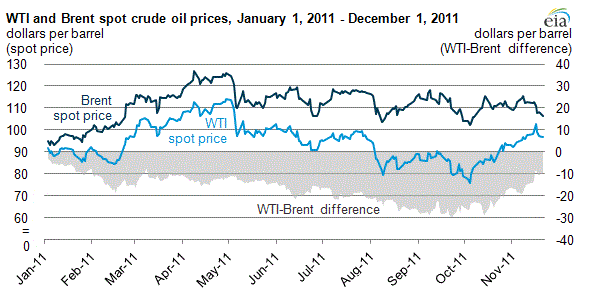
The narrowing between the two isn’t because Brent has gone down much. As you can see from the graph, it traded in a fairly narrow range of between $110 and $120 a barrel since June.
What really narrowed the gap is the rise in WTI prices. More on the rise in a moment, but first, let’s talk about where WTI is stored.
Much of the crude oil produced in the United States eventually finds its way to the enormous Cushing, Oklahoma storage facility. Cushing is the delivery location, and the NYMEX pricing point, for West Texas Intermediate (WTI) crude oil.
Cushing has not one, but two big problems. First, it’s out of storage capacity. While it continues to add more tanks at a feverish pace, storage demand at Cushing will continue to outstrip capacity for years to come.
Over the last year, increasing supplies from Canada and the Bakken have continued to increase, and move their way through Cushing.
Second, it’s pipeline limited in its ability to get oil out of its storage complex.
When more oil comes into Cushing than can leave – by any method – WTI prices remain under pressure: to the downside.
Without access to the cheaper WTI crude, Gulf coast refineries must use the more expensive Brent and Louisiana Light crudes. That’s largely why U.S. gasoline prices are more of a reflection of Brent prices as opposed to WTI.
The main reason for the recent rise seen in WTI is that a few weeks ago, Enbridge Inc. (NYSE: ENB) announced it would reverse the flow of its newly purchased Seaway crude oil pipeline.
The Seaway currently transports crude oil from wells to Cushing. When it’s reversed sometime in the spring, it will begin to transport oil in the direction of Gulf refineries.
That news immediately sent WTI prices surging up. But by now, the reality set in. Even at full tilt (slated for 2013), the Seaway pipeline will only be able to transport 400,000 barrels per day out of Cushing.
That won’t be enough to eliminate the bottleneck at Cushing, (the Bakken alone is currently pumping 464,000 barrels a day) and it will keep WTI priced at a discount with respect to its sea-borne counterpart, Brent.
U.S. Oil Boom Will Keep WTI Prices (Somewhat) in Check
With increases in both Canadian oil sands and shale oil expected to increase for years, WTI will be priced at a significant discount to global oil.
Transportation costs have to be accounted for, and that means if it can’t move by pipeline, rail and trucks will be bringing the oil in to refineries.
Of course, the easiest way to play the difference isn’t via some complicated options spread between the two. It’s simply to buy any company in the oil production or transportation business.
The simple fact is that while the spread between WTI and Brent may widen over the coming year, the overall trend in both will be up.
Both global and domestic demand will keep a floor of $100 for WTI and $110 for Brent. By the end of 2012? Look for them both to be $10 to $20 a barrel higher. Any unforeseen geopolitical events will send both soaring.
Want to bet on Brent and WTI? International explorer and producer Anadarko Petroleum Corporation (NYSE: APC) is a good bet. Shares are only a few dollars shy of their 52-week high, and are poised to go higher.
Anadarko is active off the coast of West Africa, and has several major offshore areas it’s exploring there.
Domestically, it just announced that its acreage in the Niobrara shale in Colorado could contain as much as 1.5 billion barrels of recoverable oil. That’s a huge find by any standards, and great news given it’s here in the United States.
Even if WTI prices retreat, producers, pipeline carriers (like the aforementioned Enbridge), railroads and trucking firms are all going to benefit from the U.S. oil boom.
Good Investing,
David Fessler
Article by Investment U
