Jan. 27 (Bloomberg) — Global investors are bracing for the end of China’s relentless economic growth, with 45 percent saying they expect a financial crisis there within five years. An additional 40 percent anticipate a Chinese crisis after 2016, according to a quarterly poll of 1,000 Bloomberg customers who are investors, traders or analysts conducted Jan. 21-24. Bloomberg’s Andrea Catherwood reports. (Source: Bloomberg)
Potential Reversal for EUR/CAD
By Anton Eljwizat
The volatile of the EUR/CAD pair continues to be affected by the volatile forex market. The last two weeks has seen a lot of bullish strength in the EUR/CAD pair. However, as I demonstrated below, it seems that the pair’s bullish run may have run out of steam, and a bearish correction could be underway soon. This might be a good opportunity for forex traders to enter the trend at a very early stage and at a great entry price.
• Below is the 8-hour chart of the EUR/CAD currency pair.
• The technical indicators that are used are the MACD, Relative Strength Index (RSI), and Slow Stochastic.
• Point 1: There is a “doji” candlestick that has formed on the chart, indicating that a reversal should take place.
• Point 2: The Slow Stochastic indicates a bearish cross, signaling that the next move may be in a downward direction.
• Point 3: The Relative Strength Index (RSI) indicates that the price of this cross currently floats in the overbought territory, signaling downward pressure.
• Point 4: The MACD indicates an impending bearish cross, signaling that the next move may be in a downward direction.
EUR/CAD Daily Chart

Forex Market Analysis provided by ForexYard.
© 2006 by FxYard Ltd
Disclaimer: Trading Foreign Exchange carries a high level of risk and may not be suitable for all investors. There is a possibility that you could sustain a loss of all of your investment and therefore you should not invest money that you cannot afford to lose. You should be aware of all the risks associated with Foreign Exchange trading.
Forex Daily Market Commentary
By GCI Forex Research
Fundamental Outlook at 0800 GMT (EDT + 0400)
USD
The dollar was largely unchanged against the euro during the Asia session, but relinquished some ground to the yen. EURUSD traded 1.3641-1.3714. USDJPY traded 82.02-82.61. The FOMC kept current policy unchanged, given it still has concerns about low inflation and a weak labour market. No dissenting votes were cast. Clearly, although regional Fed Presidents Plosser and Fisher have publicly expressed some misgivings about QE2, they are willing to go along with the existing asset purchase program for now at least. Intriguingly, the policy statement appeared to signal a possible slowdown in the pace of UST purchases before the end of June, which would result in a more gradual end to the program. Any decline in the pace of purchases likely reduces the risk of an extension of the program beyond the end of June. This is entirely consistent with the views of our analyst team who continue to expect an end to asset purchases in June, followed by the first rate hike in Q1 2012. Elsewhere, the CBO markedly increased its budget deficit forecast for the current fiscal year to $1.5 trn from $1.06 trn.
EUR
ECB’s Nowotny said that markets were “too euphoric” about possible changes to Europe’s financial rescue mechanisms. He added that even if a Eurozone country were to restructure its sovereign debt, “the country would still remain in the Eurozone”.
ECB President Trichet said he would not exclude the possibility of a revamped financial rescue mechanism having the right to buy bonds, as this would be “useful in certain circumstances”. ECB Governing Council member Noyer agreed, noting that having the capacity “to intervene in secondary markets” would be “an interesting feature in some cases”. Both Trichet and Noyer stressed however that any enhancement to the rescue facility is ultimately a decision for governments.
ECB Executive Board member Stark said that, although interest rates are currently appropriate, the ECB “are ready to act at any moment, should it become necessary”. ECB Governing Council member Quaden said he is concerned about Belgian inflation and the ECB would “follow closely the evolution of the situation and we will evaluate and react if it is necessary”. Noyer and that he was “quite confident that we will be able to keep inflation at bay” adding that he was not signaling that the ECB is “going to raise interest rates”.
GBP
The minutes of the BoE’s Jan. 13 policy meeting revealed a further shift towards the hawkish end of the policy spectrum. Two votes were cast in favour of a policy rate hike, up from one previously: MPC member Weale now joins MPC member Sentence in calling for a 25bp hike. Also, some of those who had concerns over inflationary pressures but still voted for no change, said their decisions were ‘finely balanced’. Clearly such hawkish sympathies could easily translate into dissenting votes at a future meeting. MPC member Posen continued to vote for a resumption of the QE program and, as before, advocated a further ?50 bn in asset purchases. However, when the vote was taken, it was not yet known that GDP had suffered a -0.5% q/q contraction in Q4. This new piece of data would likely have surprised the MPC, and may give hawkish members some grounds to reconsider their stance.
AUD
The AUD fell after Australian Prime Minister Gillard announced the introduction of a new tax to fund reconstruction projects in the wake of the extensive floods. She hopes that the tax will ultimately raise A$1.8 bn. She estimated the total direct costs of the clean-up operation to the federal government would run to A$5.6 bn.
TECHNICAL OUTLOOK
GBPUSD support at 1.5752.
EURUSD BULLISH Big external resistance zone is at 1.3741/86; break through this would expose 1.3825. Support at 1.3573.
USDJPY BEARISH Remains bearish with focus on 81.85; breach of this level would expose 81.61 ahead of 80.93. Near-term resistance is at 82.67.
GBPUSD BULLISH Next support below 1.5752 lies at 1.5702. Initial resistance is at 1.6017.
USDCHF BEARISH Negative momentum with focus on 0.9301 key low. Initial resistance is at 0.9523.
AUDUSD NEUTRAL 1.0077 and 0.9804 mark the near-term directional triggers.
USDCAD NEUTRAL While initial resistance is at 1.0031 support lies at 0.9909.
EURCHF BULLISH Positive momentum with resistance at 1.3069 ahead of 1.3118. Near term support is defined at 1.2815.
EURGBP BULLISH Momentum is constructive with focus on resistance at 0.8691 Fibonacci level. Initial support lies at 0.8529.
EURJPY BULLISH Stalled in front of 113.03; breach of this level would expose 113.59 Fibonacci level next. Initial support lies at 111.64.
Forex Daily Market Commentary provided by GCI Financial Ltd.
GCI Financial Ltd (”GCI”) is a regulated securities and commodities trading firm, specializing in online Foreign Exchange (”Forex”) brokerage. GCI executes billions of dollars per month in foreign exchange transactions alone. In addition to Forex, GCI is a primary market maker in Contracts for Difference (”CFDs”) on shares, indices and futures, and offers one of the fastest growing online CFD trading services. GCI has over 10,000 clients worldwide, including individual traders, institutions, and money managers. GCI provides an advanced, secure, and comprehensive online trading system. Client funds are insured and held in a separate customer account. In addition, GCI Financial Ltd maintains Net Capital in excess of minimum regulatory requirements.
DISCLAIMER: GCI’s Daily Market Commentary is provided for informational purposes only. The information contained in these reports is gathered from reputable news sources and is not intended to be U.S.ed as investment advice. GCI assumes no responsibility or liability from gains or losses incurred by the information herein contained.
The Truth About ‘Leveraged ETFs’
By Jared Levy, Editor, Smart Investing Daily, taipanpublishinggroup.com
Back in early October, after a visit to the Texas State Fair, I wrote about inflation and the global food “problem” and how you can take advantage. Every stock I mentioned in the report has seen substantial runs since then.
Keeping all of our greed under control, Sara recently detailed why commodities and the agri-stocks climbing with them needed a nap, and why maybe it was time to take profits.
What does this have to do with leveraged ETFs, you might be asking? Well, I thought I would use food as an intro, because it offers a great analogy for my views on leveraged ETFs (OK, and maybe I wanted to remind you how Smart Investing Daily keeps you ahead of the curve).
Both gluttony and greed are two of the “seven deadly sins,” but with food especially, some of us tend to eat more than we need to and with that, the very thing that brings us life and energy can also cause illness disease and death (in severe cases). I bring up these morbid reminders, not to scare you out of satisfying your hunger for food, but to remind (or inform) you that some investment vehicles (leveraged ETFs) might be just as unhealthy and perhaps even dangerous for your portfolio, forcing you to “eat” fees and expose yourself to risks you may not even be aware of. Too much of something is not always a good thing.
Leverage
According to Wikipedia, “leverage is a general term for any technique to multiply gains and losses.” You can attain leverage by borrowing money, purchasing fixed assets or using derivatives like options or futures. Basically, you can think of it as using a lesser amount of money to buy (or sell) a larger amount of something like a stock or other investments.
Leverage can be a good thing of course; many of us use our credit as a source of leverage, so we can purchase high-ticket items now that we feel may rise in value (take your home, for instance).
You also use leverage when you purchase a stock on margin from your broker.
There is no such thing as a free lunch; for that leverage we have to pay fees, costs, interest, etc. (These are called carrying costs.) Hopefully the amount that we are paying in carrying costs is less than the appreciation or income we are receiving from the asset we have leveraged.
If we take on too much leverage and the asset doesn’t appreciate or even worse, decreases in value, you will still have to digest tons of carrying costs. You will have to “consume” those costs with nothing to show for it, except for maybe heartburn, caused now by stress.
Greed and Leveraged ETFs
Leveraged ETFs like Direxion Daily Financial Bull 3X Shares (FAS:NYSE), Direxion Daily Financial Bear 3X Shares (FAZ:NYSE), Direxion Daily Gold Miners Bear (DUST:NYSE), Direxion Daily Real Estate Bull 3X Shares (DRN:NYSE) and many others have become extremely popular; they enable you to maybe make $2 or $3, even when a stock or index were to only move $1 (of course you would lose $2 or $3 for a $1 move in the opposite direction). There are even ETFs that move opposite to the way the underlying stock or index is moving. So if the stock is UP $1, the ETF would be DOWN $1 or $2 or $3, depending on what type of leverage they are using (talk about confusing).
For that leverage, ETFs charge you a fee — more on that in a second.
Leveraged ETFs are not evil; if you know exactly what you are doing, how they work and how to invest in them, you can profit. The reality though is that the “leveraged” part appeals to the greedy side of most retail investors, who have minimal knowledge of the way they work and end up losing money because they didn’t do their homework.
(Investing doesn’t have to be complicated. Sign up for Smart Investing Daily and let me and my fellow editor Sara Nunnally simplify the stock market for you with our easy-to-understand investment articles.)
The Mechanics of Leveraged ETFs
Leveraged ETFs were specifically created for professionals and short-term traders and most have nuances you must understand before investing even $1 into them.
Here is an example, using the Direxion Daily Financial Bull 3X Shares (FAS:NYSE), which is a very popular leveraged ETF.
The FAS is purported to return 3X (300%) the movement of the financial sector index on a daily basis, which it can do so, but not all the time and not if held for a duration longer than a day (yes, a day).
Here are some nuances of the FAS:
- FAS bases its return off of the Russell 1000 financial index (RIFIN.X) (make sure you know what the ETF you are trading is based off of, it may surprise you).
- FAS charges about 1% per year in basic expenses; there are also transaction costs and tax implications you should discuss with your financial and tax advisor.
- Most leveraged ETFs like FAS use derivatives and complex financial instruments like total return swaps to gain their leverage, which are created by and traded with firms like Goldman Sachs, UBS, Deutsche Bank and others, they (you) pay those firms a fee to provide this.
- Returns of the ETF over time may NOT be even close to the returns of the index it’s tracking!
Get this — In 2009, the Russell 1000 financial index was up about 30%. You would think that the FAS should be up three times that (maybe 90%) in the same time frame. Wrong! The FAS actually lost 34%, so if you were completely correct in your trade and held the FAS for a year, you lost money!
The Devil Is in Daily Rebalancing
Most leveraged ETFs get their leverage only for the day and then at the end of the day, that leverage resets, which can hurt you in the long term. This is the biggest profit siphon when investing in a leveraged ETF.
*Check out what happens if the Russell 1000 index moves up 3% today and drops 3% tomorrow and you are long the FAS.
If you bought FAS today at $30, it would move up about $2.70 (9%). At the end of today, the ETF would actually take those profits and invest them the next day starting fresh (this is rebalancing).
So tomorrow, you now have $32.70 invested at three times leverage, so if the Russell index then drops 3%, the FAS would drop 9% (of $32.70) and you would now lose $2.95, leaving you with a net loss of $0.25, even though the underlying index is actually flat.
Scared, Confused or Both?
In closing, don’t get sucked in with the lure of leverage, it may just leave you with a really bad case of high carrying costs and losses in your account. Know what is in the ETF and how it works before you trade. If you do trade them, you should only be trading very short term, less than three days, preferably intraday.
P.S. Join Smart Investing Daily’s Sara Nunnally as she sits down for a one-on-one discussion with Jordan Goodman of The Money Answers Show. Sara will discuss the new book, Barbarians of Wealth, she co-authored with Taipan’s Executive Publisher Sandy Franks… and how you can protect yourself against today’s greedy, self-serving barbarians in Washington and on Wall Street.
The Money Answers Show with Jordan Goodman airs on Monday, Jan. 24th at 12 pm PT. You can learn more about Sara’s interview here.
Editor’s Note: “The 30% Stepping Stone”! Did you know you could make a certain 30% return… every 12 months… without a bit of risk? Transform your financial destiny with Wealth Legacy Advisory.
About the Author
Jared Levy is Co-Editor of Smart Investing Daily, a free e-letter dedicated to guiding investors through the world of finance in order to make smart investing decisions. His passion is teaching the public how to successfully trade and invest while keeping risk low.
Jared has spent the past 15 years of his career in the finance and options industry, working as a retail money manager, a floor specialist for Fortune 1000 companies, and most recently a senior derivatives strategist. He was one of the Philadelphia Stock Exchange’s youngest-ever members to become a market maker on three major U.S. exchanges.
He has been featured in several industry publications and won an Emmy for his daily video “Trader Cast.” Jared serves as a CNBC Fast Money contributor and has appeared on Bloomberg, Fox Business, CNN Radio, Wall Street Journal radio and is regularly quoted by Reuters, The Wall Street Journal and Yahoo! Finance, among other publications.
EUR/GBP – Technical Update
By Anton Eljwizat
A bullish movement in EUR/GBP has pushed a number of technical indicators into the over-bought territory. As I will demonstrate below, the EUR/GBP may very well be heading for a reversal, as a bearish cross has taken place on the Slow Stochastic. In addition, the Relative Strength Index (RSI) indicates that the price of this cross currently floats in the overbought territory, signaling downward pressure. Forex traders can take advantage of this impending movement by having their Entry Orders in place to capture this reversal. Don’t forget your Stops and Limits!

Forex Market Analysis provided by ForexYard.
© 2006 by FxYard Ltd
Disclaimer: Trading Foreign Exchange carries a high level of risk and may not be suitable for all investors. There is a possibility that you could sustain a loss of all of your investment and therefore you should not invest money that you cannot afford to lose. You should be aware of all the risks associated with Foreign Exchange trading.
Further Bearish Movement Expected for USD Today
Source: ForexYard
The EUR/USD pair is once again floating around the 1.3700 level, as analysts are predicting yet another bearish day for the greenback. A batch of data is expected to show declines in the production, employment and home sales sectors of the US economy, which if true, will likely cause the EUR/USD to test new resistance levels.
Economic News
USD – Dollar Weakens on all Fronts
The dollar fluctuated against its main currency rivals yesterday, following the announcement that the Federal Reserve will keep interest rates at their current record lows for the foreseeable future. Investors interpreted the announcement as a sign that the US economic recovery still has a ways to go, and shorted the greenback as a result. The EUR/USD went as high as 1.3720 yesterday staging a slight downward correction. Currently the pair is trading around the 1.3700 level. The USD/JPY fell over 40 pips last night, and is currently trading at 82.15.
Today, a batch of US economic news may put further downward pressure on the dollar. At 13:30 GMT, traders will want to pay attention to the Core Durable Goods Orders and Unemployment Claims figures, while at 15:00, the Pending Home Sales figure is set to be released. All three indicators are known to create heavy volatility, and are all forecasted to show a decline in their respective sectors of the US economy.
Assuming today’s news comes in as forecasted; analysts are warning that the EUR/USD could test the 1.3785 resistance level. At the same time, the Unemployment Claims figure in particular has proven notoriously difficult to predict. Should the figure come in below the expected number of 407K, the dollar may see some short term gains in afternoon trading.
EUR – Euro Trading Mixed Against Main Currency Rivals
While the euro saw some fairly substantial gains against the dollar yesterday, the currency was bearish against the UK pound and Japanese yen. The EUR/GBP fell some 60 pips yesterday, and is currently trading around the 0.8605 level. The EUR/JPY pair fell over 40 pips yesterday before staging a slight correction. Currently the pair is trading around the 112.50 level.
Analysts attribute the mixed euro movement to predictions that the euro-zone will likely raise interest rates before the United States. At the same time the most recent Bank of England MPC meeting highlighted positive growth forecasts for the UK economy, resulting in gains for sterling.
Today, traders will want to pay attention to the major news events out of the United States. Current predictions are calling for a decline in several key US economic sectors, which if true, is likely to further boost the euro against the greenback. Analysts are currently predicting the EUR/USD pair could test the 1.3785 resistance level before the end of the day.
JPY – Yen Records Solid Gains Against USD and EUR
The yen saw a fairly positive overnight session against most of its main currency rivals. After reaching as high as 82.60 during yesterday’s session, the USD/JPY saw a downward correction and is currently trading around the 82.15 level. The EUR/JPY saw similar downward movement last night, falling just over 40 pips before staging a very minor upward correction. Currently the pair stands at 112.55.
The yen is forecasted to increase its gains today, assuming that economic indicators being released out of the US come in as forecasted. Negative US figures are likely to lessen the USD’s appeal as a safe haven currency while demand for the yen will likely go up.
Tonight, traders will want to pay attention to the Bank of Japan’s Monetary Policy Meeting Minutes, set to be released at 23:50 GMT. Any predictions for further growth in the Japanese economy will likely lead to further bullish movement for the yen.
Crude Oil – Oil Prices Remain Above $87 a Barrel
Crude oil received a substantial boost yesterday, as investors rallied around commodities following President Obama’s recent State of the Union Address. The price of crude oil rose from $86.18 yesterday, to as high as $87.75 before staging a slight bearish correction. Currently, the commodity is trading around $87.37 a barrel.
Today, traders will want to pay close attention to the main economic indicators set to be released out of the US. Currently analysts are forecasting that the USD will likely fall following today’s news. Typically, the price of oil rises when the dollar is bearish, as investors view the commodity as an alternative to the greenback. If crude oil does receive a boost today, it is likely to test the $88.00 resistance level.
Technical News
EUR/USD
Virtually all long-term technical indicators place this pair in overbought territory, indicating a downward correction is likely to occur today. The daily chart’s Stochastic Slow has formed a bearish cross, while the Williams Percent Range on the 8-hour chart is currently at -5. Traders are advised to go short today.
GBP/USD
Most technical indicators show this pair trading in neutral territory at the moment, although there are signs on the daily chart that the cross may be approaching the overbought zone. Traders are advised to take a wait and see approach today, as clearer signs are likely to appear later on.
USD/JPY
Both the Relative Strength Index and the Williams Percent Range on the 8-hour chart place this pair in oversold territory, indicating a bullish correction is likely to occur today. Traders are advised to open up long positions before the upward breach occurs.
USD/CHF
A bullish cross has formed on the 8-hour chart’s Stochastic Slow indicating that upward movement is likely to occur. Furthermore, the Relative Strength Index on the daily chart is currently in oversold territory. Going long with tight stops may be the preferred strategy today.
The Wild Card
CAD/CHF
The Williams Percent Range on the daily chart is currently in oversold territory and angling up, indicating that bullish movement is likely to occur for the pair. This theory is supported by a bullish cross on the 8-hour chart’s Stochastic Slow. Now may be a great time for forex traders to open up long positions for the pair, before the upward breach takes place.
Forex Market Analysis provided by ForexYard.
© 2006 by FxYard Ltd
Disclaimer: Trading Foreign Exchange carries a high level of risk and may not be suitable for all investors. There is a possibility that you could sustain a loss of all of your investment and therefore you should not invest money that you cannot afford to lose. You should be aware of all the risks associated with Foreign Exchange trading.
US dollar declines on Wednesday in reaction to Decision of Federal Reserve
The US dollar declined versus the euro on Wednesday as the US Federal Reserve decided to keep its low interest and maintains their bond purchasing program. According to the Federal Reserve US economic growth has been sluggish for which the decision of keeping low interests rates were taken.
The dollar index DXY which measure the greenback’s performance versus its major six rivals declined to 77.776 as compared to 77.973on Tuesday’s late trading session.
The Euro advanced to 1.3703 against the US dollar as compared to $1.3682 on Tuesday. Against the Japanese Yen the US dollar traded at 82.26 as compared to 82.23 on Tuesday’s late trading session.
Global Head of Currency Marc Chandler form Brown Brothers Harriman commented, “The continuation of Treasury purchases, coupled with the modification of the labor market assessment triggered a quick push lower on the dollar.
The greenback did moved up for a brief movement in start of US trading session on Wednesday as US homes sales increased more than expected. But later on selling pressure increased in the US dollar on decrease of treasury yield as President Obama has proposed to stop domestic discretionary spending.
The British Pound increased by 0.8 percent to 1.5912 versus the US dollar as per latest Bank of England’s meeting six members voted for unchanged monetary policy. Two of the members voted to increase the bank rate by 25 basis points while Adam Posen proposed to increase the asset purchase program by 50 billion pounds to 250 billion pounds.
According to experts Pound Sterling trading is more like a roller coaster and high volatile changes could be expected.
About the Author
Daily forex trading news written by Rehan from DailyForexTrade.com
Simulated Forex Trading Can Save You A Fortune
By Donald Saunders
We are all familiar with such things as flight simulators used to train airline pilots, but did you know that there are also such things as forex simulators?
Forex simulators, which operate very much like many PC games which start out by giving you a scenario and then setting you a target, allow you not simply to practice trading in a safe environment without risking any money, but also allow you to ‘rewind’ your trading and analyze just what you got right and what you got wrong. They also allow you to practice trading in your own time and at your own pace and can pack weeks of conventional training into just a few days.
Here are just some of the benefits of using a forex simulation package:
Learning currency relationships. Many traders have no problem understanding the workings of a single currency but find it difficult to get used to working with a currency pair. A simulator however teaches and reinforces the relationship on one currency to another and the impact that one currency can have on another.
Understanding market conditions. An understanding of the forex market and, more importantly, a knowledge of how to use the market to your own advantage is critical to success. Simulation updates traders on economic conditions and news which can affect the market and shows, often quite dramatically, how economic events can move trading currencies. This is a powerful lesson to learn because it is fundamental to gauging when to enter and when to exit the market.
Differentiating between short-term and long-term trading. By allowing you to work with short-term and long-term trades, simulation clearly demonstrates that there are significant differences between to two and that forex traders often choose to trade in one or the other, but not both.
Understanding the advantages and dangers of caution. All too many traders, and especially novice traders, are too cautious when trading and simulation allows you to throw caution to the wind and experiment with setting stop losses less tightly than you would otherwise do in live trading.
Identifying trading preferences. Simulation can allow you to trade independently or with the help of a broker and, in so doing, decide whether you prefer to involve a broker in your trading decisions or to make your own trading decision, based upon your own knowledge and advice sought from a variety of different reputable sources.
Identifying and setting trading strategies. On of the most important things for any forex trader is to set himself a trading strategy and then stick to it. However, establishing the right trading strategy can be difficult and traders are often tempted to switch strategies believing that an alternative just might be more profitable. With simulated trading you have the opportunity to test out as many different strategies as you wish quickly and in a safe environment and to select the best strategy before you enter the world of live trading.
The world of forex trading is both exciting and profitable but it can also be very dangerous if you do not know exactly what you are doing. The first step for any novice trader must therefore be to learn everything he can about the currency trading world and then get in some serious practice before beginning live trading.
About the Author
LearningForexTradingOnline.com provides the ideal place to learn forex trading and covers everything from the history of forex to choosing forex charting software.
Toyota Recalls 1.7M Vehicles
The worlds top-selling automaker is recalling 1.7 million vehicles worldwide. Toyota (TM) is recalling about 1.3 million vehicles, mainly in Japan, related to fuel pump issues.
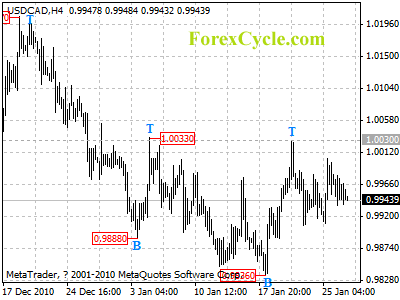
USDCAD continues its sideways movement
USDCAD continues its sideways movement in a range between 0.9836 and 1.0033. As long as 1.0033 key resistance holds, the price action in the range is treated as consolidation of downtrend, and another fall towards 0.9600 is still possible. However, a break above 1.0033 will indicate that lengthier consolidation of downtrend is underway, then further rally could be seen to 1.0100-1.0200 area.