| Title: | EUR/USD – Down Trend |
| Story: | Trend is currently bearish in EUR/USD currency pair. Intraday charts are oversold and I am expecting possible bullish corrective recovery in EUR/USD. However; daily time frame is showing a top in EUR/USD. So, after the end of this bullish recovery, I expect more decline. |
 | |
| Read Full Elliott Wave Forecast – Click Here…… | |
Forex News: USD Rising on Positive Growth Forecasts?
By Greg Holden – The U.S. dollar has been rising for the past four days against most of its currency counterparts following statements by the Fed that measures will be taken to counter recent weakness. Market data has perked up slightly as a result and we could see further strength arising out of news events to be released later today.
Today’s leading news events:
12:30 GMT: USD – Retail Sales / Core Retail Sales
– Retail sales is a figure which provides a look into the status of the American consumer market, which in turn has a direct correlation with the demand for American goods, and thus the American currency required to purchase those goods.
– Retail sales are expected to have been on the rise this past month, and this data may already be playing a role in the recent rise of the dollar as speculators price in this forecast. If today’s numbers are in line with forecasts, the USD could continue to gain strength going into the weekend.
13:55 GMT: USD – UoM Consumer Confidence
– The University of Michigan’s consumer confidence report provides a modest glimpse into the grass-roots rumblings taking place about the American economy by small businesses and private consumers.
– When this figure is rising, it points to a growth in confidence about the future of the economy and signals that people are more willing to purchase and expand, which in turn fuels growth, optimism, employment, and demand; leading to a stronger USD. If the figure comes in line with today’s forecast, we could see the greenback rise a little bit further before the market closes for the weekend.
Forex Market Analysis provided by ForexYard.
© 2006 by FxYard Ltd
Disclaimer: Trading Foreign Exchange carries a high level of risk and may not be suitable for all investors. There is a possibility that you could sustain a loss of all of your investment and therefore you should not invest money that you cannot afford to lose. You should be aware of all the risks associated with Foreign Exchange trading.
US Dollar Gaining Ground; Analysts Uncertain about Why
Source: ForexYard
With retail sales and consumer confidence figures expected from the United States later today, there is a high possibility that the greenback will experience a modest level of volatility before the market closes out for the weekend. If the figures come in line with the expected wave of positive news, the USD could go either way depending on which forces are actually in control of the market. If optimism is in charge, then positive figures will drive the USD higher. However, if risk aversion is the dominant theme, the USD could actually decline from a positive release as traders bail out of their USD safe-haven positions and move into riskier assets.
Economic News
USD – Which Market Force is Behind the USD’s Rise?
Tuesday’s Federal Open Market Committee (FOMC) statement on future monetary policy seems to have taken its toll on US dollar trading. The greenback has risen steadily against most of its primary currency rivals since the announcement was made that steps would be taken to correct the recent wave of bearishness.
The greenback has pared much of its recent losses to the euro, British pound, Canadian dollar, and Australian dollar. Against the euro, the USD changed direction, breaking its bullish channel, and went from 1.3333 to 1.2833. Similar gains were seen on the GBP/USD cross as well; currently trading at 1.5600, down from 1.6000.
While it appears that the statement released by the Fed’s FOMC is the cause of the dollar’s recent strength, there is a second explanation which many analysts are putting forth. Mainly, that global growth concerns have played an instrumental role in shifting investments away from the riskier assets and back into safe-havens. This is not a new story, considering it has been taking place frequently since the start of the financial crisis and recession back in 2007.
With retail sales and consumer confidence figures expected from the United States later today, there is a high possibility that the greenback will experience a modest level of volatility before the market closes out for the weekend. If the figures come in line with the expected wave of positive news, the USD could go either way depending on which forces are actually in control of the market. If optimism is in charge, then positive figures will drive the USD higher. However, if risk aversion is the dominant theme, the USD could actually decline from a positive release.
EUR – Euro’s Decline Continuing as Risk Aversion Takes Hold
The euro has been in steady decline this week versus most of its currency counterparts. The sudden trading shift away from the 16-nation single European currency has many analysts debating the potential causes behind this movement.
The euro has fallen against the US dollar from 1.3333 towards 1.2860 since Tuesday. Against the British pound, we have seen a decline from 0.8355 to as low as 0.8200. Also, versus the Japanese yen the euro zone currency has gone from just below 114.00 to as low as 109.00, and currently trades at 110.40 after Japan’s yen took a dive from statements made by the Japanese finance minister.
The question on the minds of many analysts now is whether this transition away from the euro represents a return of weakness to the euro zone – a type of resurgence of the Greek crisis from earlier this year – or just a rise in risk aversion as traders seek to put their assets into safer investments. Statements from the American Federal Reserve about monetary policy shifts has made many traders feel uneasy about future growth prospects and could explain the move back into safer investments.
With the euro zone primarily absent today’s economic news, the euro shouldn’t be much affected by today’s events except indirectly. The US market appears to be the front-runner in today’s market with a number of indicators carrying a traditionally heavy impact. Traders would be well advised to follow the opening of the US market since it will be releasing its retail sales and core retail sales figures at that time.
JPY – Japan’s Finance Minister Hints at Possible Currency Manipulation
While the Japanese yen has been predominantly gaining on most of its currency rivals lately, it seems a sharp weakness struck the island currency today following statements from Japan’s finance minister. It seems that a comment made to a reporter by Japanese Finance Minister Yoshihiko Noda put a level of unease in yen-trading as many are now speculating a further possibility of government intervention.
Noda’s statement seemed to suggest that unnatural strengthening of the yen was looked upon as unfavorable and harmful to the Japanese economy. The message appears to have been interpreted as a comment that future market meddling may be in the works by the Bank of Japan (BOJ). As a result, traders have seen the JPY losing ground against most of its rivals in yesterday’s and today’s trading.
OIL – Crude Oil Price in Decline on Rising USD
The price of spot crude oil has been declining moderately for over a week as growth concerns continue to take their toll. The various market forecasts made by the United States, Europe and Australia have apparently put a damper on demand and pushed a number of traders out of riskier assets and back into safe-havens for the time being. The result has been a strengthening US dollar, and weakening commodity prices.
While the USD climbs in value, the commodities which are linked to the greenback will react in an opposite fashion; losing value as it becomes more expensive to purchase them. If the dollar continues its rise, either from risk aversion or market growth in the US, the price of commodities such as oil will undoubtedly continue their fall.
Technical News
EUR/USD
The pair continues to fall following a breach under the bullish channel that the pair had traded in. Yesterday the pair fell as low as 1.2775, just above the next support level at 1.2740. A bullish cross is forming on the daily chart’s Slow Stochastic oscillator, indicating a move higher could be in store for the pair. The first resistance level for the pair rests at yesterday’s high of 1.2930.
GBP/USD
Yesterday the pair fell as low as 1.5560, dropping below the 20-day moving average, but managed to close near the 50% Fibonacci retracement level from the high seen last August. Further drops in the price today may test the bullish trend line that has held since early June. Support for the pair comes in at 1.5450 followed by 1.5250.
USD/JPY
The pair has seen strong resistance near the price of 86.20 as the price has failed to close above this level all week. The Momentum (7) has pushed above the 100 level, indicating the next move may be to the upside with resistance at 87. Traders may want to cover shorts prior to the bullish move.
USD/CHF
Strong resistance for the pair is seen at 1.6050, the 61.8% Fibonacci retracement from the previous bullish trend that ended at a high in June. Support is found at the 78.4% Fibonacci retracement at a price of 1.0350. Traders may want to use this support level as a take profit target with the range trading that is taking place between these two levels.
The Wild Card
Oil
Spot crude oil prices have fallen dramatically from a recent high of $82.95 to test the support level at $75.50. A breach below this support line would then test the bullish trend line that began in late May. CFD traders will want to target the price of $74.50 today as close below this level would signal a shift in the long term trend.
Forex Market Analysis provided by ForexYard.
© 2006 by FxYard Ltd
Disclaimer: Trading Foreign Exchange carries a high level of risk and may not be suitable for all investors. There is a possibility that you could sustain a loss of all of your investment and therefore you should not invest money that you cannot afford to lose. You should be aware of all the risks associated with Foreign Exchange trading.
Forex Daily Market Review Aug 13, 2010
By eToro – The Euro continued to correct, moving down slightly as investors continued to move into the dollar. The Euro should consolidate as the bottom end of the Bollinger Band and bounce from this level. Click here to read the full daily Review
Forex Market Analysis provided by eToro
Disclaimer: Trading in the Foreign Exchange market might carry potential rewards, but also potential risks. You must be aware of the risks and are willing to accept them in order to trade in the foreign exchange market. Don’t trade with money you can’t afford to lose.
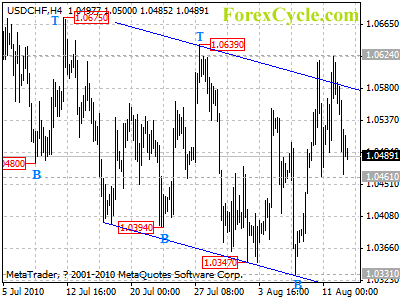
USDCHF pulled back from 1.0624
After touching the upper border of the price channel on 4-hour chart, USDCHF pulled back from 1.0624, taking price back to test 1.0461 key support, a breakdown below this level could trigger another fall towards 1.0331 previous low. However, the price action in the trading range between 1.0461 and 1.0624 could possibly be consolidation of uptrend from 1.0331, as long as 1.0461 key support holds, one more rise to test 1.0675 key resistance is still possible.
Stocks: Is the NASDAQ repeating itself?
By Adam Hewison – I just finished a short video in which I discovered an eerily similar pattern in the NASDAQ. If the pattern repeats then it certainly is going to be a rough third and fourth-quarter for most investors.
In this short three minute video I give you exact points and the formation that I’ve seen that could make a huge difference to most people’s portfolios.
Please feel free to comment with your thoughts on this market.
All the best,
Adam Hewison
President of INO.com
Co-founder of MarketClub
To see more of Adam’s Videos click here or sign up for Adam’s Free 10-part Professional Trading Course.
7 Ways to Become an Unsuccessful Trader
Q&A with an experienced Elliott wave trader reveals seven common trading mistakes.
By Elliott Wave International
To be a successful trader demands knowledge.
If you’d prefer to become an unsuccessful trader, you can start by making the following common trading mistakes, detailed by a professional who spent 25 years in portfolio management, trading and forecasting in the financial capital of the world, New York City.
In 2002, Wayne Gorman, long-time Elliott wave trader and current head of trader education at Elliott Wave International, left his 35th floor Manhattan apartment and moved to the quiet of North Georgia. He’s been sharing his knowledge and skills with aspiring traders ever since — in both online seminars and before live audiences around the world.
Wayne graciously agreed to a Q&A about trading mistakes. In his interview, Wayne reveals seven common mistakes traders make.
——–
EWI: Could you name two mistakes frequently made by stock traders?
Wayne Gorman: (mistake 1) The first big mistake is the flawed logic of extrapolation. Many traders and investors assume that a trend will remain in force until an “event” comes along to change it. But market trends are not like billiard balls on a pool table. This false assumption will put you on the wrong side of the market more times than not, especially at major turning points.
(mistake 2) The second big mistake is to suppose that news events drive market trends. In fact, the opposite is true: economic, political and social events lag market trends.
EWI: What are two common mistakes among options traders?
WG: (mistake 3) One common mistake is to buy puts or calls that are way “out of the money,” with no other transactions to compliment them. Unless your timing is absolutely perfect — and who has perfect timing? — your chance of success is low. It’s like buying a lottery ticket.
(mistake 4) Another common mistake is to buy options with too little time left to expiration. With less than one month to expiration, the time decay begins to accelerate and the chances of success diminish.
EWI: Please name a frequent mistake among traders who aim to catch the beginning of a particular Elliott wave.
WG: (mistake 5) In the middle of a corrective pattern, it’s common to run out of patience while waiting for confirmation of a trend change. You have to give corrective patterns time to unfold before you jump in. This requires discipline, and a solid understanding of the many ways corrective patterns can unfold.
EWI: What’s the biggest misconception among traders about using Elliott waves?
WG: (mistake 6) Too many traders think Elliott wave is a trading system that tells you exactly where to enter and exit a particular market. That’s the biggest misconception. The reality is that it’s an analytical and forecasting tool, which helps you develop and use your own trading system, based on your own personal risk tolerance.
EWI: What technical indicators do you believe traders over-rely on, and why?
WG: (mistake 7) Traders tend to over-rely on momentum indicators such as RSI, Stochastics and MACD to precisely spot turning points. But to paraphrase Mark Twain, markets can stay overbought or oversold a lot longer than either you or I can remain solvent.
EWI: How would you characterize today’s market action, and do you teach courses that address this environment?
WG: This is a difficult stock market in the near term. Prices haven’t strayed far from where they began in January. The action has yet to break out significantly to the downside or upside. This situation may not last much longer. I can suggest these online courses to deal with the current situation, and to prepare for the next big move:
- How to Spot Trading Opportunities, Parts 1 and 2
- How to Trade Choppy, Sideways Markets
- 5 Options Strategies Every Elliott Wave Trader Should Know
- Trading the Line – How to Use Trendlines to Spot Reversals and Ride Trends
This article was syndicated by Elliott Wave International and was originally published under the headline Do You Recognize These Six Common Trading Mistakes?. EWI is the world’s largest market forecasting firm. Its staff of full-time analysts lead by Chartered Market Technician Robert Prechter provides 24-hour-a-day market analysis to institutional and private investors around the world.
FOREX Update: US Dollar mixed, Stocks fall. Jobless Claims edge higher
By CountingPips.com
The U.S. dollar has been mixed in forex market trading today against the other major currencies while the American stock markets have fallen for a second consecutive day. The dollar has gained ground versus the euro, Australian dollar, British pound, Japanese yen, and  New Zealand dollar while losing ground against the Swiss franc and Canadian dollar in forex trading action. Yesterday, the US dollar was stronger almost across the board on risk aversion following the Federal Reserve’s comments that the economic recovery has slowed.
The U.S. stock markets, meanwhile, have had a negative day so far with the Dow declining by approximately 50 points, the Nasdaq decreasing by over 15 points while the S&P 500 is down by over 5 points at time of writing. Oil has moved lower by $1.57 to $76.45 per barrel while gold has surged higher by $15.80 to trade at the $1,213.30 per ounce level.
Today’s economic news schedule was light with weekly jobless claims making up the only major US release today. Jobless claims increased unexpectedly in the week that ended on August 7th, according to data by the U.S. Labor Department. New jobless claims rose by 2,000 workers to a total of 484,000 unemployed workers while the 4-week moving average of unemployed workers increased by 14,250 workers from the previous week to a total of 473,500.
Market forecasts were expecting jobless claims to fall to 465,000 workers following the prior week’s 482,000 number of claims.
Workers seeking continuing claims for unemployment benefits for the week ending July 31st decreased for the week by 118,000 workers to a total of 4,452,000 unemployed workers. The four week moving average of continuing claims dropped by 64,500 workers to a total of 4,518,500.
FOREX: EUR/USD Daily Chart – The Euro trading lower against the US Dollar in forex trading after hitting its highest exchange rate in almost three months last week. The EUR/USD fell to its lowest level since July 22nd today and is on its way to be declining for the week after six straight gaining weeks. Today’s decline bounced off the 50.0 percent fibonacci level near the 1.2780 exchange rate (on the decline from April 12th at the 1.3691 to June 7th low at 1.1876) and just above the rising trendline that started on June 7th low.

How A Japanese Chart Formation Could DOOM the DOW
By Adam Hewison – It’s déjà vu all over again”. Is one of Yogi Berra’s famous original quotes and the same can be said for the DOW right now.
The weekly chart on the DOW is flashing the same Japanese candlestick signal that it had earlier in April of this year. Back then the DOW dropped from 11,200 to 9,700 in the space of just 10 weeks!
If nothing else watch this video as this could be one of the most important weeks for the DOW and its future. The video runs three minutes. You will find it both interesting and educational from both a Fibonacci and Japanese candlestick point of view.
All the best,
Adam Hewison
President of INO.com Co-founder of MarketClub.com
To see more of Adam’s Videos click here or sign up for Adam’s Free 10-part Professional Trading Course.
USD/CHF Range Trading Opportunity
By Russell Glaser – Following a dramatic downtrend for the USD/CHF, the pair has been caught in a range trading environment. This provides an opportunity to short the USD/CHF between two previously tested support and resistance levels.
The USD/CHF is consolidating from the previous bearish trend that occurred from June until July. Prices for the pair have been found consistently trading between the 61.8% and the 76.4% Fibonacci retracement from the last bullish trend the pair experienced during the period of November 2009 until the height at 1.1729 in June of this year.
The Slow Stochastic oscillator is in the midst of forming a bearish cross, indicating the next move may be to the downside.
The 7-day Momentum indicator is downward sloping and is approaching the 100 level. A move below the 100 line will confirm the sell signal.
Traders can use this range trading environment to enter short on the USD/CHF with a target near the lower Fibonacci level at the price of 1.0350.
Should the pair breakout above the 61.8% Fibonacci retracement level, a protective stop should be placed at the daily high from July 12th at 1.0675.

Forex Market Analysis provided by ForexYard.
© 2006 by FxYard Ltd
Disclaimer: Trading Foreign Exchange carries a high level of risk and may not be suitable for all investors. There is a possibility that you could sustain a loss of all of your investment and therefore you should not invest money that you cannot afford to lose. You should be aware of all the risks associated with Foreign Exchange trading.
