The monthly payrolls report from the US saw employers adding 224,000 jobs during June. This was higher than the estimates of 162,000 jobs.
The unemployment rate ticked higher to 3.7% on an increased participation rate. The average hourly earnings rose 0.2% on the month to an annualized pace of 3.1%.
The payrolls report soothed concerns about a slowdown in the US economy. Following the reports, investors scaled back their bets of a larger rate cut at the July Fed meeting.
Euro Dips as German Manufacturing Orders Fall
Germany’s manufacturing orders showed a 2.2% decline on a month over month basis in May. Economists forecast a 0.1% decline. On a yearly basis, German manufacturing is down 8.6%.
The euro remained weak on the data besides the stronger USD. Traders will be closely watching the data out of the eurozone ahead of the ECB meeting due later in July. ECB President Draghi has promised to lower interest rates if the economy continues to deteriorate.
EURUSD Breaks the 1.1250 Support
The currency pair broke past the support level at 1.1250 level on Friday. This pushed the EURUSD to test a two-week low at 1.1206 before pulling back slightly. In the near term, we expect the currency pair to test the 1.1250 level to establish resistance. If resistance forms, then we expect the downside bias to push the EURUSD to lower lows. The next main target is seen at 1.1190.
WTI Rallies as OPEC Production hits 2014 Lows
Crude oil prices posted a modest rally on Friday, gaining over 1.50% on the day. The gains came after reports showed that OPEC oil production dropped in June to 2014 lows.
OPEC production was recorded at 30 million bpd, down 170,000 bpd from May. This was the lowest output since April 2014 despite higher production from Saudi Arabia.
Crude Oil Maintains the Bearish Flag Pattern
Despite the gains on Friday, oil prices failed to clear the resistance level of 57.50. This has kept the bias to the downside. A breakdown off recent lows could validate the bearish flag pattern. This will see oil prices targeting the 50.00 handle. To the upside, if oil breaks past the 57.50 handle, we could expect to see prices settling back within the 60 and 57.50 range that was previously established.
Gold Slips on Strong Payrolls Report
The precious metal was seen giving up the gains on Friday as it extended declines for the third consecutive day. Gold closed 1.18% lower on Friday following the US payrolls report which came out stronger than expected.
The payrolls report dampened expectations of easy monetary policy. Improved market sentiment also helped to keep the price of the precious metal in check.
Gold Breaches the Trend Line
Gold prices broke past the rising trend line connecting the lows from May 30 and June 17. The breach of this trend line potentially indicates a move to the downside. The minor support at 1383.60 remains the initial barrier. However, a break down below this level could push gold lower to the 1354 handle. To the upside, the resistance level at 1404 will likely keep a lid on the gains.
Since the economic calendar is very thin for the start of the week, we want to focus on the technical side and have a look at the DAX30 CFD.
After Friday’s NFPs came in at 224k and significantly above expectation, the German index nevertheless kept on sharpening a bearish divergence on H1 in the RSI.
In general, such a divergence is only an indication that the latest bullish momentum is about to diminish and Long engagements should be carefully considered from a risk-reward perspective.
Still, we see short-term bearish potential at least as low as 12,440/450 points, going hand in hand with the close of the gap which occurred after the announced truce between the US and China in their trade war at the G20 summit at the June 29.
If we get to see such a bearish push, traders should carefully watch the price action against 12,440/450: usually this region should act as a potential long-trigger, but if bulls fail to regain momentum and the DAX30 CFD keeps on dropping and falls below 12,400 points, the bearish divergence could be considered confirmed and further losses are a serious option.
On the other hand: if no bearish momentum is taken on and the DAX30 CFD takes out 12,650 points, further gains up to 12,850/900 are very likely:
Source: Admiral Markets MT5 with MT5-SE Add-on DAX30 CFD Hourly chart (between June 17, 2019, to July 5, 2019). Accessed: July 5, 2019, at 10:00pm GMT – Please note: Past performance is not a reliable indicator of future results, or future performance.
In 2014, the value of the DAX30 CFD increased by 2.65%, in 2015, it increased by 9.56%, in 2016 it increased by 6.87%, in 2017 it increased by 12.51%, in 2018 it fell by 18.26%, meaning that after five years, it was up by 10.5%.
Source: Admiral Markets MT5 with MT5-SE Add-on DAX30 CFD daily chart (between 23 March 2018 to 05 July 2019). Accessed: 05 July 2019 at 10:00 PM GMT
Investing in Forex with Admiral Markets
Admiral Markets offers professional traders the ability to trade with a custom, upgraded version of MetaTrader 5, allowing you to experience trading at a significantly higher, more rewarding level. Experience benefits such as the addition of the Market Heat Map, so you can compare various currency pairs to see which ones might be lucrative investments, access real-time trading data, and so much more. Click the banner below to start your FREE download of MT5 Supreme Edition!
Disclaimer: The given data provides additional information regarding all analysis, estimates, prognosis, forecasts or other similar assessments or information (hereinafter “Analysis”) published on the website of Admiral Markets. Before making any investment decisions please pay close attention to the following:
This is a marketing communication. The analysis is published for informative purposes only and are in no way to be construed as investment advice or recommendation. It has not been prepared in accordance with legal requirements designed to promote the independence of investment research, and that it is not subject to any prohibition on dealing ahead of the dissemination of investment research.
Any investment decision is made by each client alone whereas Admiral Markets shall not be responsible for any loss or damage arising from any such decision, whether or not based on the Analysis.
Each of the Analysis is prepared by an independent analyst (Jens Klatt, Professional Trader and Analyst, hereinafter “Author”) based on the Author’s personal estimations.
To ensure that the interests of the clients would be protected and objectivity of the Analysis would not be damaged Admiral Markets has established relevant internal procedures for prevention and management of conflicts of interest.
Whilst every reasonable effort is taken to ensure that all sources of the Analysis are reliable and that all information is presented, as much as possible, in an understandable, timely, precise and complete manner, Admiral Markets does not guarantee the accuracy or completeness of any information contained within the Analysis. The presented figures refer that refer to any past performance is not a reliable indicator of future results.
The contents of the Analysis should not be construed as an express or implied promise, guarantee or implication by Admiral Markets that the client shall profit from the strategies therein or that losses in connection therewith may or shall be limited.
Any kind of previous or modeled performance of financial instruments indicated within the Publication should not be construed as an express or implied promise, guarantee or implication by Admiral Markets for any future performance. The value of the financial instrument may both increase and decrease and the preservation of the asset value is not guaranteed.
The projections included in the Analysis may be subject to additional fees, taxes or other charges, depending on the subject of the Publication. The price list applicable to the services provided by Admiral Markets is publicly available from the website of Admiral Markets.
Leveraged products (including contracts for difference) are speculative in nature and may result in losses or profit. Before you start trading, you should make sure that you understand all the risks.
On Friday the 5th of July, trading on the euro closed down. The euro declined against the dollar to reach the 1.1207 mark. This sharp drop was brought about by strong US jobs data.
224k new jobs were added to the US economy in June. The decrease in unemployment was met by a rise in the participation rate from 62.8% to 62.9%. Employment figures for the previous 2 months were revised downwards by 31k.
After the report’s release, the likelihood of a 50-bp rate slash by the Fed in July dropped from 5.4% to 4.9%, while the likelihood of a 25-bp rate slash rose from 94.6% to 95.1%. The dollar rose across the board.
Day’s news (GMT+3):
09:00 Germany: industrial production (May), current account (May).
11:30 Eurozone: Sentix investor confidence (Jul).
22:00 US: consumer credit change (May).
Current situation:
At the time of writing, the euro is trading at 1.1227. In Friday’s US session, the bears managed to break through the reversal zone between the 112th and 135th degrees. The drop came to an end around the 180th degree at 1.1207. Considering that the stochastic oscillator is in the sell zone on the hourly timeframe, pressure will remain on the single currency for the time being. The bulls will make an appearance once the stochastic enters the buy zone.
I expect the rate to recover to 1.1240 on the back of some Take Profit action on short positions. The stronger the rebound, the higher the likelihood of the recovery extending to 1.1290. If the bulls don’t manage to break 1.1250, we can expect a renewed decline to take us to 1.1180.
By Hussein Sayed, Chief Market Strategist (Gulf & MENA), ForexTime
Global stocks and bonds have been surging throughout the past week with all major US equity indices reaching new record highs. The rally in risk assets was not driven by a prosperous economic outlook, but rather a dim one. Investors have shifted into the mentality of “weaker the better,” suggesting that weaker economic data across the globe will force central banks to begin a synchronized easing in monetary policy. Lower interest rates will make valuations more attractive to investors and improve corporate financials by lowering borrowing costs. However, a lot of such optimism has already been priced in with markets’ expectations of looser monetary policy being extremely high, leaving little room for further upside.
On Friday, the US non-farm payrolls headline number took many market participants by surprise. The US economy added 224,000 jobs last month versus expectations of 160,000. The strong figure was not enough to change market expectations of the Fed easing policy by the end of this month, but clearly ended speculations of an aggressive 50 basis-points rate cut. The scaled-back expectations triggered a sell signal in Asian markets today led by Chinese stocks; meanwhile, S&P 500 futures are also pointing towards a lower open after falling 0.2% on Friday.
Expectations of 25 basis-points rate cut seem reasonable as unemployment ticked slightly higher, and with wage growth no longer indicating an overheated labor market.
This week investors will be all ears to Fed’s Chairman Jerome Powell when he delivers his twice-yearly monetary policy report to the Congress on Tuesday. His speech is likely to be the key event to equity, fixed income, and currency markets. With President Trump increasing his comments on the Fed and several economic indicators pointing south, it will be interesting to see if Powell lays a clear case of monetary easing in his testimony.
On Wednesday the Federal Reserve will release minutes from its last meeting. Any clues of what policymakers were thinking of will also help shape expectations for the upcoming decision on July 31.
The Turkish Lira is back to the news headlines after President Recep Tayyib Erdogan’s decision to dismiss the country’s central bank governor. The Lira was down 2.5% at the time of writing as investors became more confident that interest rates will begin to decline at a fast pace. As traders go short on the Turkish currency, state banks are likely to begin selling foreign currencies to stabilize the Lira. Whether we’re going to see a sharp rate cut of several 100-basis points in the next policy meeting on July 25 remains to be seen, however, expect the currency to remain volatile for the next several weeks.
Disclaimer: The content in this article comprises personal opinions and should not be construed as containing personal and/or other investment advice and/or an offer of and/or solicitation for any transactions in financial instruments and/or a guarantee and/or prediction of future performance. ForexTime (FXTM), its affiliates, agents, directors, officers or employees do not guarantee the accuracy, validity, timeliness or completeness, of any information or data made available and assume no liability as to any loss arising from any investment based on the same.
US stock market pulled back on Friday as strong jobs report dampened Fed rate cut expectations. The S&P 500 slid 0.2% to 2990.41, rebounding 1.7% for the week. Dow Jones industrial lost 0.2% to 26922.12. The Nasdaq slipped 0.1% to 8161.79. The dollar strengthened after report US economy created above-expected 224,000 new jobs in June, after 75,000 jobs created in May. The live dollar index data show the ICE US Dollar index, a measure of the dollar’s strength against a basket of six rival currencies, jumped 0.5% to 97.22 but is lower currently. Stock index futures point to lower market openings today
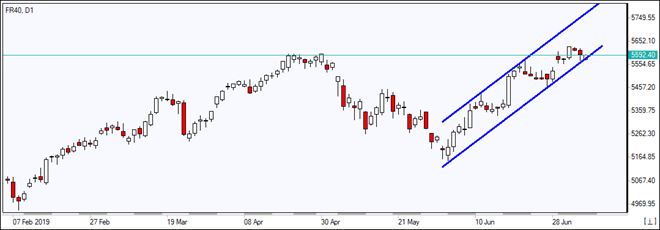
FTSE 100 leads European indexes retreat
European stocks snapped six-session winning streak on Friday. The EUR/USD joined GBP/USD’s continued slide with euro higher currently while Pound lower still. The Stoxx Europe 600 Index lost 0.7% Friday. The DAX 30 slid 0.5% to 12568.53 weighed by steeper than expected fall in German industrial orders in May. France’s CAC 40 slumped 0.5% and UK’s FTSE 100 fell 0.7% to 7553.14.
Shanghai Composite leads Asian indexes losses
Asian stock indices are all in red today. Nikkei lost 1% to 21534.35 with yen resuming its climb against the dollar. China’s markets are falling: the Shanghai Composite Index is down 2.6% and Hong Kong’s Hang Seng Index is 1.7% lower. Australia’s All Ordinaries Index turned 1.7% lower as the Australian dollar reversed its slide against the greenback.
Brent futures prices are edging higher today. Prices rose on Friday: Brent for September settlement ended 1.5% higher at $64.23 a barrel Friday, declining 0.8% for the week.
Note: This overview has an informative and tutorial character and is published for free. All the data, included in the overview, are received from public sources, recognized as more or less reliable. Moreover, there is no guarantee that the indicated information is full and precise. Overviews are not updated. The whole information in each overview, including opinion, indicators, charts and anything else, is provided only for familiarization purposes and is not financial advice or а recommendation. The whole text and its any part, as well as the charts cannot be considered as an offer to make a deal with any asset. IFC Markets and its employees under any circumstances are not liable for any action taken by someone else during or after reading the overview.
We have been focused on the upside price move in Gold and Precious Metals, we’ve been engaged in multiple private conversations with members and friends about the potential for a renewed debt crisis between now and the end of 2020.
This research post should help to put some perspective into what we believe the next 16+ months of trading and what the US economy should look like for our followers.
First, we want to talk about one of our most favorite topics of the past 24+ months – the “capital shift” phenomenon. We first identified this facet of global economic dynamics back in 2015 or so.
As the global economy shifts focus on risks and opportunities, capital shifts with these expectations and moves away from risks and into investments that are seen as opportunistic and safer. This dynamic is still very much at play within the global markets.
Second, we want to discuss global Central Banks and their attempts to spark growth after the 2008-09 credit crisis event. Even though Global Central banks have continued to spark some type of fundamental economic growth over the past 9+ years, these QE activities have also produced a very high level of debt arising from extended government spending, consumer spending and lack of real savings initiatives. While governments and central banks were chasing the “gold ring” of inflation, they lost focus on the fundamental elements of the economy which are debt levels, price valuation levels and future operational capabilities with regards to debt vs. income.
Recently, the Bank of International Settlements (BIS) issues a scathing annual report suggesting the global Central Banks have been negligent in properly managing debt levels, QE functions, and fundamental economic policies in an attempt to continually chase growth and inflation. BIS Review by Bloomberg.
Third, Gold and precious metals have started to rally from levels near historical low points. This increased upside price activity is a very clear sign that FEAR and GREED have re-entered the global markets and that global investors/traders are starting to react to unknown and unseen potential risk factors. Are they reacting to future trade issues, future debt issues, future growth issues?? What is it?
The reality is, we never really know until the event is complete as the hind site is 20/20. What really matters is understanding that this type of money flow is happening and that we have a way to track and forecast these levels of fear and greed.
The gold chart below shows our expected price of gold forecast from October of 2018. As you can see, we identified the bottom and rally, then the more recent bottom in April/May, and today we are experiencing the extended rally (fear/greed) driven rally.
Not only can we accurately forecast gold long term moves but we can also pinpoint short term bottoms and tops using our intraday cycle and fear/greed tools as shown here.
Forth, the breakout economy in the world, the US, is not something that happened by chance. After the 2008-09 global economic crisis, the US entered a period of extended QE throughout President Obama’s term. The US QE functions didn’t really end until just before the 2016 Presidential Elections. Thus, from roughly 2009 till 2015, the US was engaging in some form of QE measures which supported the global Central Banks by allowing for cheap US Dollars. The continued US QE efforts allowed foreign nations, governments, and enterprises to take advantage of a very unique extended cheap US Dollar event that has now GONE AWAY.
It is our belief that this fundamental change in the US Federal Reserve, wanting to attempt to normalize rates, while President Trump’s attempt to restructure and settle more suitable trade deals with China, Europe, Mexico, Canada, and others has disrupted the apple cart – so to say.
The easy access to the US Dollar is gone. Easy trade and special deals for China and others are gone. The US economy is strengthening because of fundamental economic strength – size, capabilities, pricing valuations and the attraction of foreign capital investments.
All of these points raise some very interesting questions – primarily “what is the unwinding event going to look like?”
Global Central banks will do everything within their power to push off any signs of crisis events and to foster some level of economic growth for as long as possible. We all know this to be true.
The spark all these Central Banks have been waiting for is economic growth. What happens if that growth initiates at the same time that Inflation initiates at a 2x or 3x rate? Economic growth would support increased demand for commodities and other items. This increased demand will likely prompt moderate inflation – making these items even more expensive to purchase much beyond the pricing we see now.
A combination of moderate growth and increased inflation in the US could prompt the US to raise rates even further in an effort to contain inflation. A spike in rates, at this point, could completely destroy support for current asset levels, Real Estate, Debt and other operational components of our already stressed local state and federal governments. Yikes.
We believe we know what the unwinding event will eventually become once the trigger event initiates the move. We believe it will become a price “revaluation” event where assets and commodities prices attempt to identify an “equilibrium” based on historic and current supply/demand expectations. The one caveat to this whole presumption is DEBT – what about all the DEBT?
In Part II of this multi-part research post, we’ll share our current understanding of the market cycle and what the next 16 to 24 months will likely bring for investors/traders.
I urge you visit my Wealth Building Newsletter and if you like what I offer, join me with the 1 or 2-year subscription to lock in the lowest rate possible and ride my coattails as I navigate these financial market and build wealth while others lose nearly everything they own during the next financial crisis. Join Now and Get a Free 1oz Silver Round or Gold Bar!
I can tell you that huge moves are about to start unfolding not only in metals, or stocks but globally and some of these super cycles are going to last years. A gentleman by the name of Brad Matheny goes into great detail with his simple to understand charts and guide about this. His financial market research is one of a kind and a real eye-opener. PDF guide: 2020 Cycles – The Greatest Opportunity Of Your Lifetime
As a technical analysis and trader since 1997, I have been through a few bull/bear market cycles. I believe I have a good pulse on the market and timing key turning points for both short-term swing trading and long-term investment capital. The opportunities are massive/life-changing if handled properly.
Welcome to this week’s Market Wrap Podcast, I’m Mike Gleason.
Coming up Michael Pento of Pento Portfolio Strategies joins me for a tremendous interview on what he sees as pending doom in the stock market and why he believes we’re in for a bout of stagflation that will make the 1970s look like a walk in the park. He also makes a compelling case for gold during an interest rate environment that he believes will soon be turning profoundly negative in real terms. So don’t miss a must-hear interview with Michael Pento, coming up after this week’s market update.
Following yesterday’s Independence Day celebrations, perhaps more Americans will wake up to the need to declare their independence from the financial system. One of the best ways to do that is by shifting dollar-denominated wealth from bank and brokerage accounts into physical precious metals.
Although the public isn’t yet clamoring in huge numbers to buy bullion, we have seen some encouraging price action of late in metals markets. The main fireworks have been in gold – rising to a multi-year high – and palladium.
This week, palladium posted a new all-time high. Palladium prices currently come in at $1,568, up 0.7% since last Friday’s close. Its sister metal platinum is down 3.5% on the week to trade at $809.
Turning to the monetary metals, which are selling off a bit here today during thin trading in the futures markets on this holiday weekend – surprise, surprise. Gold shows a slight weekly decline of 1.0% now to bring spot prices to $1,396 per ounce. Silver, meanwhile, continues to play second fiddle to gold and has yet to generate any real upside momentum of its own this year. For the week silver is off by 2.2% with essentially all of that decline coming here today and is at $15.03 as of this Friday morning recording.
Gold bugs took notice of President Donald Trump’s newest attempt to re-shape the Federal Reserve. He had previously floated Herman Cain and Stephen Moore as nominations to the central bank’s Board of Governors, but they each withdrew after coming under attack by the media and getting preemptively rebuked in the Senate by “Never Trump” Republican Mitt Romney.
Earlier this week, President Trump announced plans to nominate two new candidates to fill the remaining seats on the Fed’s Board of Governors.
One is a conventional pick, Christopher Waller of the St. Louis Fed. Along with St. Louis Fed President James Bullard, Waller is regarded as dovish and would likely be a voice for the interest rate cuts currently favored by the White House.
Trump’s other pick is less conventional – and of more interest to sound money advocates. He has tapped one of his economic advisors and a longtime gold standard proponent named Judy Shelton.
Yahoo Finance Newswoman: So we know President Trump has had trouble getting some of his recent Fed picks confirmed in the past. Do you think it’ll be different this time around?
Mainstream News Media Commentator: Well, that’s a great question. Judy Shelton seems to have preferred the going back on the gold standard, which I’m not sure how popular that idea will be.
Sarah Bloom Raskin: Judy Shelton is somebody who has some unorthodox views. She’s known as a gold bug, for example.
CNBC Newswoman: What do you make of her previous support for going back to a gold standard?
Stephen Moore: Well, look, I’m one who’s always believed we should make the dollar as good as gold. You want the dollar anchored to something.
That last comment was from Stephen Moore, who has off and on advocated for a gold or commodity-backed dollar. But Moore and now Judy Shelton also advocate for the Fed to cut rates, citing low inflation and efforts by Europe and China to gain trade advantages through depreciating their currencies.
If Shelton makes it through the Senate – which may be an uphill battle – it wouldn’t be the first time the Fed had a policymaker who advocated a gold standard in theory but not in practice. Former Fed chairman Alan Greenspan was a pro-gold free-market economist before becoming an easy money, bubble blowing central banker.
We will certainly be watching Judy Shelton’s nomination process with interest. It will be good to see some of her sound money ideas at least being brought up in the public discourse. But there is simply too much political pressure in opposition to sound money for the Fed to move toward a gold standard anytime soon.
A larger sound money movement needs to be built first, one that makes the moral and practical case for declaring independence from fiat money and its abuses by bankers and politicians.
Thomas Jefferson himself once said of fiat money that it “is liable to be abused, has been, is, and forever will be abused, in every country in which it is permitted.”
The author of the Declaration of Independence believed that precious metals were a necessary foundation of a free and fair economy. The Founders specifically wrote gold and silver into the U.S. Constitution as the legal tender of each of the states.
Restoring Constitutional money to the United States is going to be a long and difficult battle. The Federal Reserve and the financial and political interests that control it won’t give up their power to print voluntarily.
It will probably take a crisis event that causes the public to lose confidence in the dollar. Then, perhaps, the current monetary order will be called into question and have a chance of being replaced with a system of sound money.
In the meantime, Americans should prepare themselves financially for more currency manipulation and depreciation ahead. You can gain a measure of independence from the inflationary fiat system by putting your own finances on a hard money standard with backing in gold and silver bullion.
Well now, without further delay, let’s get right to this week’s exclusive Money Metals interview.
Mike Gleason: It is my privilege now to welcome back Micheal Pento, President and Founder of Pento Portfolio Strategies. Michael’s a well-known money manager and a terrific market commentator and author of the book The Coming Bond Market Collapse: How to Survive the Demise of the U.S. Debt Market. He’s a regular guest right here on the Money Metals Podcast and we always love having him on.
Michael, thanks for the time again today and welcome back.
Michael Pento: Great to be back on your program.
Mike Gleason: Well Michael, when we spoke last in March, you noted something very important, that being the equity markets were celebrating the Fed’s shift to a more dovish posture. At that time, the Fed hadn’t actually done much. They were telegraphing a pause in rate hikes but still selling assets. The celebration continues today but, in point of fact, the Fed still hasn’t done a whole lot. It’s all about expectations and right now everyone is sure they will be cutting rates in July. They’re getting a lot of mileage out of a little more than some jawboning. The S&P 500 is up 20% from its December lows. What do you make of these expectations? Is the FOMC going to meet them with some aggressive rate cutting or do you think people are going to quickly find out that talk is cheap and the economy is headed for recession regardless of what the Fed does?
Michael Pento: Well, first of all, the market’s doing well this year but that’s because the calendar changed and the market went up after going down 30%… the Russell was down almost 30%, 28%, the S&P was down 20%. So, you pretty much just reversed what happened in the fall of 2018. So, this is not a runaway stock market by any means and people are going crazy how well the market’s doing. It’s actually, I think, it’s putting in a triple top, that would be my best analysis of the situation. And the reason why I say that… well, before I go into that let me answer your question first, so you’re asking me, will the Fed cut rates? I believe the Fed will cut rates later this year. I think they’ll probably go 25 basis points in July and the reason why I think they’ll go 25 basis points in July is that they are trying to catch up to what the bond market has already done.
So, if you look at the bond market, the Fed funds money market rates right now, the effective Fed funds rate is about 2.38%. And the 10-year treasury is below 2%. So, you have a pretty significantly inverted yield curve, which really hurts banks’ profits and diminishes their rationale when it comes to making a loan. In other words, they’re not going to make a lot of loans when they don’t have a lot of profit margins. And they think the economy’s slowing because of the reduction in nominal rates on the long end of the yield curve and they don’t want to make loans to people who probably aren’t going to pay the loan back because then their capital will go away. So, that’s the reason why I think the Fed is going to cut rates in July. But the market is 100% convinced that they’re going to cut rates probably as much as 50 basis points.
So, two or three rate cuts this year, and I will say that that is a possibility. However, if the Fed is aggressively cutting rates it’s because the global economic recession is well underway. That would be the rationale behind cutting interest rates so aggressively. Don’t forget that at the end of last year we had a Fed that was absolutely avowed to raise rates to 3% and then another 50 basis points… so 3% was what they deemed as being neutral… and then they were going to go above 50 basis points, right? You remember this? And you’ll also recall that the balance sheet withdrawal process, the burning of cash, was supposed to be on autopilot. In other words, the Fed’s destruction of its balance sheet to the tune of maybe two trillion dollars was supposed to be on autopilot. That all changed. So, they’ve gone a pretty trenchant difference, they’ve gone more than a country mile as they say, from being one central bank is going to raise rates to three and a half percent and drained the balance sheet down from four and a half trillion to around two trillion to one that is now supposed to be aggressively cutting rates?
I’ll just say one more thing about this. The fact that the Federal Reserve is going to be cutting rates, they have two and a half percent, less than two and a half percent, before they go to zero. So, the question I have and I don’t have the answer, I have a model that tells them what the answer will be, but I am willing to guess based upon the myriad and the plethora of evidence that I have that merely cutting rates by 25 basis points in July is not going to be nearly enough to stem the tide of a global recession, which by the way I believe has already begun.
Mike Gleason: You recently wrote a great piece on corporate debt, stating that it’s a bubble that will eventually pop. You made a comparison between today’s corporate debt and the housing bubble of 2007 and the dot com bubble of 2000. You pointed out that both Ben Bernanke and Alan Greenspan attempted to shirk responsibilities for the massive bubbles the Fed creates, the claim was that nobody can identify a bubble before it bursts. We know that isn’t exactly true. You’ve done it and anyone willing to take an objective look can see that debt is one of the next bubbles likely to burst. The obligations are so large that they simply cannot be paid. Talk about the bubble in corporate debt if you would and what would you think are some signs that listeners should be watching for that maybe the reckoning is about to arrive?
Michael Pento: I have to laugh when I hear people tell me, “This is time is much better than 2008… because in 2008, don’t you know, that there was all kinds of malfeasance in the banking system.” And people were making loans to people who couldn’t pay back those loans, mortgages that were going to default, but there was only about one and a half trillion dollars’ worth of subprime mortgage debt. But I went and did the numbers myself and added up triple B debt, leveraged loans and junk bonds… and triple B is just one notch above junk… and basically the covenants behind these triple B loans make them essentially junk. That number is 5.4 trillion dollars. And what makes me laugh is, when I look back and I hear people on CNBC and all the financial networks, all the pundits come out, the carnival barkers, will tell you that in 2019 there are no massive dislocations, there are no excesses in the economy.
Well, how do you explain the fact that there are now 13 trillion dollars’ worth of sovereign debt that has a minus sign in front of it? Is it normal for a Japanese, a Swiss and a German 10-year note to have a negative yield? Think about that. Central banks have gone so insane concurrently that they have now forced bond yields so low that going out 10 years they get paid to borrow. And that hasn’t caused any dislocations or malformations in the stock market or the junk bond market or the leveraged loan market or the housing market or the stock market? That is insane, prima facie. It’s a prima facie case for insanity, in my opinion.
Mike Gleason: Let’s talk about China for a bit. China has always been a tough one for us to evaluate. There have been people speculating that Chinese central bankers have blown a massive bubble of their own and the bursting of that bubble is imminent, but if they were close to a crisis, they’ve done a pretty good job of keeping the wheels on thus far. You’ve been watching developments in the Chinese banking sector and perhaps things are starting to get serious there. The Central Bank of China recently took control of a Chinese bank when it failed. There are certainly other banks then buried in bad debts. What are you expecting from China in the months ahead and what you think it will mean for investors here in the U.S.?
Michael Pento: Well, you have to understand, just to stay at 36,000 feet, China quadrupled their debt since 2007. And when any nation, not just China but any nation… and by the way there has been no nation that has done that in the history of mankind… but any nation that will quadruple the amount of existing debt outstanding in 12 years and have done so by an edict from the central government is sitting on a massive pile of unproductive loans that will go bankrupt. Baoshang Bank is just one example. This is replete throughout China and even in Hong Kong where their banking system is many, many times the size of their GDP. So, you’re going to have a situation where – and this is by the way speaking parenthetically as I tend to do – why I am bearish on the global economy, not because of trade conflicts or conflagrations so much, more to the fact that China can no longer be the engine of global growth, responsible for one third of global growth since 2008.
They can’t do it anymore because they’re sitting on 40 trillion dollars’ worth of debt dung that they cannot pay back. And if China’s not the global engine of the world, then Europe is going to suffer. It might surprise you to know, maybe not you but your audience and certainly those that watch mainstream financial media, it might surprise everybody to know that Japan, Europe, the U.K. and China are all in a manufacturing recession. Now that is not something that Michael Pento came up to talk about on Money Metals. That is public information released by governments, they’re publicly released, purchasing managers indexes. They all show that all of those countries I mentioned and much of the developed world is in a manufacturing recession. Now, I want to pose this question to you. How can China, which was erstwhile in the habit of providing one-third of global growth by building out massive unproductive fixed asset investments, how can China possibly be growing at 6% if their manufacturing base is in a recession?
The answer is that they are not growing at 6%. China is lucky if they’re growing at all because China has a shrinking labor force and plunging productivity. And if China isn’t growing, then Europe’s in deep trouble and Asia’s in trouble and the Korean nation is in trouble and Japan is in trouble. And even in the United States, our manufacturing, the new order component just released for June, the manufacturing new orders component of ISM was 50. Flat. No growth. So, we are in the midst of a global manufacturing recession. We are in the middle of, according to Fact Set – which is the definitive voice on earnings on the S&P 500 – we are in the middle of an earnings recession that’s going to last for three quarters. So, it’s not the second derivative of earnings growth is falling, so we’re not going to grow from 24% earnings to maybe 20% or 15% or 5%, earnings growth is going to be negative, according to Fact Set, for three quarters in a row.
You add that to a manufacturing recession and then you add it to the fact that we have a stock market that is near all-time record high valuations – if you look at price for sales, if you look at total market cap to GDP. I’m not trying to scare people. I manage money for a living so I can’t short the market and buy gold always and hope to be in business. So I have a model that tells me when to get net short and when to overweight gold, which we are at this point. Because, by the way, when you live in a world where interest rates are going towards zero and below, the carrying cost of gold doesn’t look so bad. I could put a bar of gold in my safe at home that earns no interest and I can lament the fact that I’m not sitting in a bank earning 10% with my cash. But if I’m sitting at my house looking at my bar of gold and saying, “Gee, I’m forgoing almost nothing at the bank, and because interest rates are negative in a real sense because inflation is the goal of every horrific central banker on the planet, I’m actually making money, much more than I would in the bank.” Because gold, for 5,000 years, has maintained its purchasing power.
So, I’m not trying to scare people, I’m just telling people that this is not normal. It is not normal to have one-dollar worth of sovereign debt that has a negative yield and it’s certainly beyond the twilight zone to have 13 trillion dollars’ worth of sovereign debt with a negative sign in front of it. It is certainly completely abnormal to have the stock market at a record high valuation when you’re in the middle of an earnings and manufacturing recession globally. So, if you think I’m trying to scare you, you’re wrong, but if you think you want to go and call your local broker and put your money into a closet index fund and go to sleep at night, don’t be surprised if very soon you wake up and find out you’re in the middle of an event much like we saw in December of 2018, or October of 2008, or March of 2000, where are you at the cusp – especially in those last two I mentioned, the recession of 2000 and the recession of 2008 – where you are on the cusp of going off the cliff in the stock market.
And this time around, we don’t have the tools available to readily pull us out of deflationary depression because, as I just mentioned, bond yields are already in the toilet of history. So, there is not going to be any rapid relief from plummeting bond yields around the world and there certainly isn’t going to be this fiscal response coming from countries which are already massive overly indebted. We have a problem; it’s going to take a lot of fiscal and monetary wrangling to get out of. That takes time, but in the interim I wouldn’t be surprised to see the stock market lose half of its value again for the third time since the year 2000.
Mike Gleason: Obviously, a lot of black swans circling about and certainly a number of very interesting situations that we could see unfold here and obviously confidence is a big reason that the central bankers have been able to sort of get us out these messes in the past, and you’ve got to wonder if anybody’s going to have any confidence in them this time around.
Well, Michael, I wanted to kind of further the point on gold before we let you go. These markets have been pretty range bound for a while, talking about gold specifically, sliver as well. Gold finally broke out to a five year high recently, driven primarily by escalating tariffs and maybe perhaps the Fed will be cutting rates. Do you see gold finally starting a new trend higher here or are we going to drop back into the range?
Michael Pento: That’s not a prediction any longer, it’s the fact. You just said it, it’s a fact. Gold massively broke out of that $1,350 ceiling that it was staring at. It went all the way well into the $1,400s. It pulled back here recently but what a wonderful buying opportunity, in my humble opinion. The fact is that we live in a world where money is going to be mostly free for a very long time because central banks have gotten into the business of eviscerating markets. So, for instance, in Japan, the Bank of Japan now owns 80% of all ETFs and over 50% of the entire Japanese government bond market. So, when do I have to worry about the Bank of Japan raising rates? They can’t even get out of the business of buying ETFs, manipulating their stock market, or trying to manipulate their stock market higher. Likewise, with the ECB, when are we going to talk about raising rates? They threatened they were going to raise rates but now they’re talking about lowering rates and getting back into QE.
And the same can be said for the United States. We were talking about draining the balance sheet and raising rates back to, normal now not being five and a quarter percent like it was in 2007, but they’re talking about trying to get to three and a half and they barely got to two and a half, and now we’re supposedly heading back to zero. So, the competition for a real currency, a real money, a real store of value, is going to increase exponentially and why would people go anywhere else but what’s proven for millennia to be the best place to store your wealth and your purchasing power?
So, I predict that rates going to be… well it’s not a prediction because rates are already at zero… I think the United States will soon be back to zero and then after that back into Quantitative Easing, which means you’re going to get a much higher rate. And by the way, you should understand that if rates are zero and you get even one basis point of inflation, real interest rates are negative.
But I can’t see them stopping until they get 2% inflation. So, your real interest rates will be -2% but that’s the way the government measures inflation and they do a hell of a bad job doing that. So, if the government’s measuring it at two, it’s probably closer to eight. You’re going to get profoundly negative real interest rates, which is rocket fuel for gold, and why anybody would have nay faith in any fiat currency, not just hating the dollar, but how could you have faith in the euro over the dollar, or the yen, or the yuan? You have to have the belief that gold will rise and will continue to rise in all currencies, and I think that dynamic is just getting started.
Mike Gleason: All these central bankers are pretty much going from the same playbook, this Keynesian world that we live in and never-ending money creation.
Well, we’ll leave it there for today, Michael. We appreciate the time as always and love getting your comments. Before we let you go though, please tell people a little bit about Pento Portfolio Strategies and then how they can contact you and then also follow you more closely.
Michael Pento: Well great. So, the website is PentoPort.com. On the website you can see all of my media appearances and you can get my weekly commentary. For $49 a year you can get access to a podcast that really gets into the minutia and the data points that you absolutely need to know about what’s really going on in the world. You can’t get that from mainstream financial media that much anymore really. Then you can become a client because I actually have a portfolio that’s designed to protect your principal while we wait for this occurrence to happen, I believe a minimum of 35% downturn in the market.
And then I also believe most importantly after, if you want to have a chance to actually protect your principal, make a little money while you wait hopefully, then capitalize on the destruction of this mirage of an economy and a market… on the backend of that, I think we’re going to have, we will engender, a protracted period of stagflation like we’ve never before seen. So, it’s going to be the ’70s on steroids, but for a long time. There’s a model on how to invest for that.
So, you have to know when to buy bonds and when to buy stocks. What kind of stocks? When to be short stocks. All these things are imperative because 80% of the stock market now, 80% is on autopilot just like the Fed’s balance was supposed to be. 80% of the market is passive investing strategies. In other words, strategies are designed by machines to mimic the momentum of the stock market, and when that breaks, you’re going to see nothing but offers and no humans to support the stock market. No fundamental reason, no fiscal, no monetary reason will come in time to protect you.
That’s where I come in, and if you’re interested in capitalizing on that, and then after the central banks master the business of destroying your currency, and they get to the 2%, but it will really be more like double digit inflation, you have to know what to own. So, if you’re interested in that, my email is [email protected]. the website is PentoPort.com, and the office number here is 732-772-9500.
Mike Gleason: Money can be made in any markets, and obviously preserving wealth may be also the big key, and somebody like Michael, of course, has a great handle on all of that, and definitely I think you should take his advice there.
Well, thanks Michael. I hope you have a great 4th of July week and enjoy the rest of your summer as well, and we look forward to catching up with you again before long. Take care.
Michael Pento: Thank you so much.
Mike Gleason: Well, that will wrap it up for this week. Thanks again to Michael Pento of Pento Portfolio Strategies, for more info please visit PentoPort.com. You can sign up for his email list, listen to his midweek podcasts and get his fantastic market commentaries on a regular basis. Again, just go to PentoPort.com.
Mike Gleason: And don’t forget to tune in here next Friday for next Weekly Market Wrap Podcast, until then this has been Mike Gleason with Money Metals Exchange, thanks for listening and have a great weekend everybody.
The Money Metals News Service provides market news and crisp commentary for investors following the precious metals markets.
Presidential candidates Bernie Sanders and Elizabeth Warren are promising as much as $1.6 trillion in student debt forgiveness for millions of borrowers. Critics smell a cynical campaign ploy to try to buy the youth vote.
How is it either realistic or fair to declare an entire category of debt to be assumed by taxpayers?
Regardless, pie-in-the-sky proposals to cancel student debt shed light on a very down-to-earth problem for not only college students and recent graduates – but also for the economy and financial markets.
Student loans now rank as the second largest biggest category of American consumer debt – bigger than credit cards, bigger than auto loans, and behind only mortgages.
Generation Z (composed of those now in their college years) faces the bleak prospect of crushing student loan debt combined with the crushing burden of more than $100 trillion in unfunded liabilities they will inherit from Uncle Sam.
No generation before has ever entered their prime working years with such enormous financial burdens. To make matters worse, they will enter their investing years with the stock market in extremely overvalued territory.
As the Baby Boomers head into retirement and begin steadily drawing wealth out of their IRA and 401(k) accounts, debt-saddled younger generations will likely lack the buying power to keep markets propped up.
Perhaps the Federal Reserve will step in as a “buyer of last resort” to keep debt and equity market bubbles from bursting. But it will take an unprecedent amount of buying (i.e., currency printing) to prevent another 2008-style (or worse) meltdown.
In the 2000s, the federal government, through the Community Reinvestment Act, started aggressively pushing banks to extend financing to “underserved communities.”
In practice, that meant lowering standards and pushing people better suited to renting into becoming holders of mortgages on overpriced properties.
In the 2010s, bureaucrats began aggressively pushing millions of people better suited to blue-collar work or trade schools into attending overpriced four-year colleges.
The U.S. government assumed near total control of the student loan market in 2010. It has issued $1 trillion of student loans since – many to people who have pursued economically worthless degrees in dubious subjects taught by leftist professors who care more about pushing their ideology than providing value to students.
As a consequence, more than 5 million “higher educated” Americans are now in default on their student loans. Millions more are foregoing things like home ownership and family formation because their bloated student loan payments are financially equivalent to having a mortgage.
A study by the Economic Policy Institute found that 54% of recent college graduates were either unemployed or employed in a job that doesn’t require a college degree.
Why College May No Longer Be a Good Investment
The government-subsidized student loan bubble has enabled college administrators to push tuitions and fees higher and higher on an accelerated slope, far outpacing overall price inflation.
The biggest growth in university hiring has been not for professors but for administrators who sit in offices and push paper or push social agendas.
Defenders of the traditional four-year college insist that it’s still a good investment. They argue that college graduates go on to earn several hundred thousand dollars more than non-grads over the course of their lifetimes – more than enough to justify the escalating costs of college.
But as any mere undergrad should know, correlation does not imply causation. Students who enter elite universities tend to have relatively high IQs to begin with.
They will tend to find their way to career success with or without college.
IQ has been shown to be a better predictor of job performance than number of years in school. And IQ tends to be a relatively stable trait after age 18 – meaning college won’t turn an average 100-IQ individual into a 150-IQ genius.
And a true genius may find college to be a waste of time (some of the greatest modern innovators in business, arts, and technology either never attended college, dropped out, or pursued their passion independently of their college work).
Standardized tests such as the SAT are strongly indicative of IQ. But social engineers are now pushing for the SAT to include an “adversity score” which would give bonus points on the basis of adverse life circumstances such as poverty and single mother households.
Some people face more adversity in life than others. Overcoming it is an achievement that should be celebrated. But the education establishment now celebrates adversity and perceived victimhood itself – encouraging students to wallow in their “marginalized” intersectional status and become dependent on authorities who pose as their saviors.
Despite all the political corruption and unnecessary cost inflation of higher education, college may still be the only viable path to certain types of careers. Some majors (such as engineering) are economically more valuable than others (such as gender studies).
Sending a kid off to college with no particular plan other than to acquire a well-rounded education doesn’t work anymore. It’s no longer even possible to obtain a classical education at most universities. They instead feature (and often mandate) courses aimed at deconstructing the foundations of Western civilization.
The Gold Standard vs. the Ph.D Standard
According to data from Open Syllabus Project, Karl Marx’s Communist Manifesto is the most frequently assigned book on economics.
Even if most economic professors aren’t outright Marxists, they still won’t teach students the most strident critiques of Marxism. Most economics majors will be taught from a Keynesian, mixed-economy interventionist perspective.
They won’t even be exposed to alternative schools of thought such as Austrian economics.
Students might read Milton Friedman, but they will have to seek out on their own books by more radical free-market thinkers such as Ludwig von Mises, Murray Rothbard, and Hans Herman Hoppe.
Forget about learning any appreciation for the gold standard in a typical Economics 101 class. Standard economics textbooks portray the decisions of central bankers and bureaucrats as being data-driven, careful, and sophisticated. Sound money backed by gold and silver is likened to something too primitive and simplistic for a modern economy.
In reality, sound money is scorned by the economics establishment because it is more effective than any number of Ph.D’s at constraining debt levels in the economy and spending levels by government.
Sound Money Scholarships Offered to Deserving Students
For students who are interested in sound money principles, there is some good news!
Money Metals Exchange is teaming up with the Sound Money Defense to help students pay for the ever-increasing costs of college. They have set aside 100 ounces of physical gold to reward outstanding students who display a thorough understanding of economics, monetary policy, and sound money.
The Sound Money Scholarship is the first gold-backed scholarship of the modern era.
It is open to high school seniors, undergraduate, and graduate students with an interest in economics, specifically the tradition of the Austrian school. The deadline to submit applications is September 30, 2019.
Recent drill results and their implications are presented in a ROTH Capital Partners report.
In a June 27 research note, ROTH Capital Partners analyst Jake Sekelsky reported that recent exploration at SilverCrest Metals Inc.’s (SIL:TSX.V) Las Chispas in Mexico “confirms previous expectations and sets the stage for further derisking” of the project.
Specifically, the Santa Rosa decline hit the high-grade Area 51 zone of the Babicanora vein and the newly discovered Babi Vista vein. The Babicanora vein was intersected within 10 meters of the existing resource model, confirming the estimated 3.6 meter (3.6m) true width and demonstrating the potential for Las Chispas resource expansion.
SilverCrest will follow up these events in H2/19 with bulk sampling for metallurgical testing, obtaining geotechnical studies, stockpiling of high-grade material and developing improved access to the Babicanora vein for additional infill and exploration drilling.
Also at Chispas, infill drilling over 18,488m in the Area 51 zone showed an average true width of 2.2m grading 7.1 grams per ton (7.1 g/t) gold and 752.6 g/t silver, or 1,290 g/t silver equivalent. “These results confirm both grades and thickness outlined in the existing resource estimate announced in Q1/19,” Sekelsky wrote.
He noted, too, that the Babi Vista vein, discovered in Q2/19, could add high-grade ounces to the existing resource base at Las Chispas in the short term.
Sekelsky highlighted that SilverCrest is “swiftly advancing Las Chispas towards a feasibility study,” which is anticipated in H2/20. He added that because further upside at the project likely exists, investors should view the preliminary economic assessment as merely a basis upon which the feasibility study can build.
ROTH has a Buy rating and a US$5.50 per share target price on SilverCrest, whose current share price is about US$4.07.
Disclosure: 1) Doresa Banning compiled this article for Streetwise Reports LLC and provides services to Streetwise Reports as an independent contractor. She or members of her household own securities of the following companies mentioned in the article: None. She or members of her household are paid by the following companies mentioned in this article: None. 2) The following companies mentioned in this article are billboard sponsors of Streetwise Reports: None. Click here for important disclosures about sponsor fees. 3) Comments and opinions expressed are those of the specific experts and not of Streetwise Reports or its officers. The information provided above is for informational purposes only and is not a recommendation to buy or sell any security. 4) The article does not constitute investment advice. Each reader is encouraged to consult with his or her individual financial professional and any action a reader takes as a result of information presented here is his or her own responsibility. By opening this page, each reader accepts and agrees to Streetwise Reports’ terms of use and full legal disclaimer. This article is not a solicitation for investment. Streetwise Reports does not render general or specific investment advice and the information on Streetwise Reports should not be considered a recommendation to buy or sell any security. Streetwise Reports does not endorse or recommend the business, products, services or securities of any company mentioned on Streetwise Reports. 5) From time to time, Streetwise Reports LLC and its directors, officers, employees or members of their families, as well as persons interviewed for articles and interviews on the site, may have a long or short position in securities mentioned. Directors, officers, employees or members of their immediate families are prohibited from making purchases and/or sales of those securities in the open market or otherwise from the time of the interview or the decision to write an article until three business days after the publication of the interview or article. The foregoing prohibition does not apply to articles that in substance only restate previously published company releases.
Disclosures from ROTH Capital Partners, SilverCrest Metals, Company Note, June 27, 2019
Regulation Analyst Certification (“Reg AC”): The research analyst primarily responsible for the content of this report certifies the following under Reg AC: I hereby certify that all views expressed in this report accurately reflect my personal views about the subject company or companies and its or their securities. I also certify that no part of my compensation was, is or will be, directly or indirectly, related to the specific recommendations or views expressed in this report.
Shares of SilverCrest Metals may be subject to the Securities and Exchange Commission’s Penny Stock Rules, which may set forth sales practice requirements for certain low-priced securities.
ROTH Capital Partners, LLC expects to receive or intends to seek compensation for investment banking or other business relationships with the covered companies mentioned in this report in the next three months.
A description of the properties and how this precious metals company will benefit from their addition are provided in a CIBC report.
In a June 27 research note, CIBC analyst Cosmos Chiu reported that SSR Mining Inc. (SSRM:NASDAQ) acquired two past-producing mines adjacent to its Nevada project Marigold for $22 million in cash plus the assumption of $23.1 million in long-term environmental and reclamation requirements and a 0.5% net smelter royalty.
“We view today’s transaction favorably from SSR Mining’s perspective as a lower risk and a lower cost way to grow the company’s assets,” Chiu commented. “We expect the company to be able to leverage its existing infrastructure to grow its production n while lowering costs in the Marigold region.”
The analyst described the two acquired properties, including their size, location and past production history. Together spanning 8,900 hectares, they take the SSR Mining’s total land ownership in the region to 19,800 hectares.
One of the assets, Trenton Canyon, 7,350 hectares in size and immediately south from Marigold, was previously run by Newmont Goldcorp Corp. (NEM:NYSE) as an open-pit run of mine, heap-leach operation from 1996 to 2001. Past production totaled about 290,000 ounces of gold.
The other asset, Buffalo Valley, comprises 1,550 hectares and sits to the southwest of Marigold. Production, which occurred there from 1989 to 1991, amounted to about 50,000 ounces of gold. The project was a joint venture between Newmont and Fairmile Gold Mining.
Both Trenton Canyon and Buffalo Valley “host the same rock formations as the Marigold mine while displaying more intense host rock alteration,” Chiu highlighted.
He noted that upcoming potential catalysts for SSR Mining’s stock include a technical study, expected mid-year, determining whether Red Dot can expand or extend production at Marigold. Others are a successful ramp-up at Chinchillas and a possible decision by SSR Mining on whether to divest of or increase its 9.7% ownership stake in SilverCrest Metals Inc. (SIL:TSX.V) and its Las Chispas project in Mexico.
CIBC has an Outperformer rating and a $16.25 per share target price on SSR Mining, whose stock is now trading at around $13.56 per share.
Disclosure: 1) Doresa Banning compiled this article for Streetwise Reports LLC and provides services to Streetwise Reports as an independent contractor. She or members of her household own securities of the following companies mentioned in the article: None. She or members of her household are paid by the following companies mentioned in this article: None. 2) The following companies mentioned in this article are billboard sponsors of Streetwise Reports: None. Click here for important disclosures about sponsor fees. 3) Comments and opinions expressed are those of the specific experts and not of Streetwise Reports or its officers. The information provided above is for informational purposes only and is not a recommendation to buy or sell any security. 4) The article does not constitute investment advice. Each reader is encouraged to consult with his or her individual financial professional and any action a reader takes as a result of information presented here is his or her own responsibility. By opening this page, each reader accepts and agrees to Streetwise Reports’ terms of use and full legal disclaimer. This article is not a solicitation for investment. Streetwise Reports does not render general or specific investment advice and the information on Streetwise Reports should not be considered a recommendation to buy or sell any security. Streetwise Reports does not endorse or recommend the business, products, services or securities of any company mentioned on Streetwise Reports. 5) From time to time, Streetwise Reports LLC and its directors, officers, employees or members of their families, as well as persons interviewed for articles and interviews on the site, may have a long or short position in securities mentioned. Directors, officers, employees or members of their immediate families are prohibited from making purchases and/or sales of those securities in the open market or otherwise from the time of the interview or the decision to write an article until three business days after the publication of the interview or article. The foregoing prohibition does not apply to articles that in substance only restate previously published company releases. As of the date of this article, officers and/or employees of Streetwise Reports LLC (including members of their household) own securities of Newmont Goldcorp, a company mentioned in this article.
Disclosures from CIBC, SSR Mining Inc., Company Update, June 27, 2019
Analyst Certification: Each CIBC World Markets Corp./Inc. research analyst named on the front page of this research report, or at the beginning of any subsection hereof, hereby certifies that (i) the recommendations and opinions expressed herein accurately reflect such research analyst’s personal views about the company and securities that are the subject of this report and all other companies and securities mentioned in this report that are covered by such research analyst and (ii) no part of the research analyst’s compensation was, is, or will be, directly or indirectly, related to the specific recommendations or views expressed by such research analyst in this report.
Analysts employed outside the U.S. are not registered as research analysts with FINRA. These analysts may not be associated persons of CIBC World Markets Corp. and therefore may not be subject to FINRA Rule 2241 restrictions on communications with a subject company, public appearances and trading securities held by a research analyst account.
Potential Conflicts of Interest: Equity research analysts employed by CIBC World Markets Corp./Inc. are compensated from revenues generated by various CIBC World Markets Corp./Inc. businesses, including the CIBC World Markets Investment Banking Department. Research analysts do not receive compensation based upon revenues from specific investment banking transactions. CIBC World Markets Corp./Inc. generally prohibits any research analyst and any member of his or her household from executing trades in the securities of a company that such research analyst covers. Additionally, CIBC World Markets Corp./Inc. generally prohibits any research analyst from serving as an officer, director or advisory board member of a company that such analyst covers.
In addition to 1% ownership positions in covered companies that are required to be specifically disclosed in this report, CIBC World Markets Corp./Inc. may have a long position of less than 1% or a short position or deal as principal in the securities discussed herein, related securities or in options, futures or other derivative instruments based thereon.
Recipients of this report are advised that any or all of the foregoing arrangements, as well as more specific disclosures set forth below, may at times give rise to potential conflicts of interest.
Important Disclosure Footnotes for SSR Mining Inc. (SSRM) SSR Mining Inc. is a client for which a CIBC World Markets company has performed investment banking services in the past 12 months. CIBC World Markets Inc. has received compensation for investment banking services from SSR Mining Inc. in the past 12 months. CIBC World Markets Inc. expects to receive or intends to seek compensation for investment banking services from SSR Mining Inc. in the next 3 months.