Dollar falls after New York Fed President Williams’ dovish comments
US stock indexes resumed advancing on Wednesday as Fed’s Beige Book indicates ‘modest’ expansion in key districts. The S&P 500 rose 1.1% to 2937.78. The Dow Jones industrial average gained 0.9% to 26355.47. Nasdaq advanced 1.3% to 7976.88. The dollar weakening accelerated after comments by New York Fed President John Williams the U.S. economy outlook was worse than previously thought: the live dollar index data show the ICE US Dollar index, a measure of the dollar’s strength against a basket of six rival currencies, fell 0.6% to 98.38 but is higher currently. Stock index futures point to higher openings today.
CAC 40 still leader among European indexes
European stocks recovered on Wednesday buoyed by news Italian rival political parties the 5-Star Movement and the Democratic Party will form a coalition. Both GBP/USD and EUR/USD rose sharply yesterday with both pairs lower currently. The Stoxx Europe 600 gained 0.9% led by energy shares. Germany’s DAX 30 advanced 1.0%. France’s CAC 40 rallied 1.2% and UK’s FTSE 100 gained 0.6% to 7311.26 as lawmakers defeated Boris Johnson in parliament n a bid to prevent him from taking Britain out of the EU without an agreement, prompting the prime minister Johnson to demand a snap election.
Hang Seng falls while Asian indexes gain
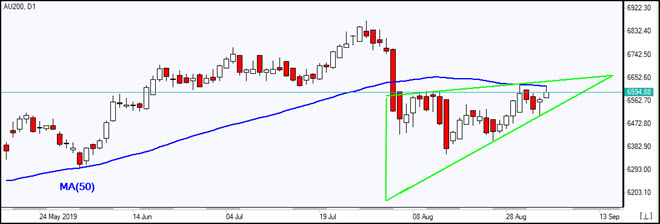
Asian stock indices are rising today after China’s Ministry of Commerce announced the US and China negotiators will meet in Washington in early October. Nikkei jumped 2.1% to 21085.94 as yen continued sliding against the dollar. Chinese stocks are mixed: the Shanghai Composite Index is up 1.0% while Hong Kong’s Hang Seng Index is 0.6% lower. Australia’s All Ordinaries Index rebounded 0.9% despite continuing climb of Australian dollar against the greenback.
Brent futures prices are lower today. The American Petroleum Institute late Wednesday report indicated US crude inventories rose by 401 thousand barrels last week while gasoline stockpiles fell by 877 thousand. Prices rose yesterday: November Brent crude rallied 4.2% to $60.70 a barrel on Wednesday. Today at 16:30 CET the Energy Information Administration will release US Crude Oil Inventories.
Note: This overview has an informative and tutorial character and is published for free. All the data, included in the overview, are received from public sources, recognized as more or less reliable. Moreover, there is no guarantee that the indicated information is full and precise. Overviews are not updated. The whole information in each overview, including opinion, indicators, charts and anything else, is provided only for familiarization purposes and is not financial advice or а recommendation. The whole text and its any part, as well as the charts cannot be considered as an offer to make a deal with any asset. IFC Markets and its employees under any circumstances are not liable for any action taken by someone else during or after reading the overview.
Technical analyst Clive Maund presents his dystopian view of the future.
The distinguishing feature of fiat money systems is that they are licentious, they are created by corrupt politicians so that they can act without restraint by, for example, promising the citizens the earth in order to improve their chances of being re-elected. The population can pick up the tab later in the form of devalued money that buys them less. The current dollar fiat money system was created by then President Richard Nixon in 1971, hardly an edifying character, and, thinking about it, it was very apt that it was him who created it by getting rid of the gold standard.
It is inherent in fiat money systems that they self-destruct, since they are essentially fraudulent, their modus operandi being to enable politicians to go on endless spending binges, knowing that society at large will foot the bill as a result of their money being devalued. The current fiat money system, which can be dated back to the ending of the gold standard in 1971, is 48 years old and in its death throes. What happens with fiat is that money becomes increasingly worthless at an accelerating rate until it enters the final terminal phase which is a hyperinflationary vortex that results in it becoming utterly worthlessand we are right on the doorstep of that phase now.
When the global financial crisis hit in 20082009 the world was at a crossroadsit is was the last chance to clean up the mess and get back to the straight and narrow. Cleaning up the mess would have involved letting the banks and brokerage houses that created it go bust, but those responsible for it didn’t want to “face the music” and they had the political influence to make sure they didn’t have to. So, society at large had to pick up the tab for their misdemeanors. They were bailed out at huge cost and the system put on life support in the form of massive fiat creationquantitative easingwhich enabled them to drop interest rates to zero to stop debt compounding and then use the cheap money to engage in an orgy of speculation, while the “little guy” continued to be charged usurious rates if he wanted to borrow any money.
One unsavory result of the low interest rates of the past 10 years was that debt continued to grow at an exponential rate, since there was no penalty for incurring it, and now corporate, public and private debt has risen off the scale, examples being auto and student debt and the debt that has helped fuel stock buybacks, and as a result of all this the central banksnot just the Fed but all of themhave painted themselves into a cornerdebt is at such astronomic levels that interest rates have to be close to zero, or even beneath it, to stop them compounding and getting even more out of control. They simply cannot permit rates to ever return to normal levels, and as we know the recent attempt by the Fed to partially normalize rates threatened to implode the economy and it had to abort it. The method used in the U.S. to clamp rates close to zero is that the Fed monetizes Treasuries, since no one else but a lunatic or a pension fund would buy this stuff, but the low or non-existent returns on capital resulting from these extremely low rates make the dollar extremely vulnerable, and if the U.S. dollar should ever lose its reserve currency status, which it is getting ever closer to doing, then it will collapse and interest rates skyrocket creating an instant credit crisis of mammoth proportions.
Faced with a choice between rising rates leading to a dramatic widespread default and an economic implosion, and slashing rates to zero and returning to QE on a massive scale to keep the zombified economy limping along, it is clear that central banks will opt for the latter course, as it buys them more time. However, this course of action represents the final terminal end game phase of this fiat cycle, which must end in a hyperinflationary depressionthat is where we are now headed, and fast. That is what gold and silverand now platinumare picking up on, which is why the sharp rise in all three metals in recent weeks is not regarded as a normal uptrend that will require to be corrected, but instead marks the start of a gargantuan melt-up that will take the prices of all three metals to fantastic levels that even those who know what’s going on, or think they do, can scarcely imagine.
A key point to keep in mind in all this is that although the metals will be appreciating in price, they are simply moving to hold their value, which is intrinsic, as the value of fiat collapses. Of course, we can expect them to do more than that, to gain in value even after factoring in the depreciation of fiat, as investors scramble to find safe haven as the hyperinflationary vortex draws ever closer.
A related development at this time is the recent huge appreciation in Treasuries, caused by investors seeking safe haven in these vehicles too, despite the U.S. government being technically bankrupt and having over $100 trillion in unfunded liabilities that it cannot and never will honor. It is hard to overstate the stupidity of investing in the paper of a bankrupt government that is destined at some point to go “belly up,” but of course, most investors in these instruments are putting other people’s money into them. The way this will play out is as followsthe low or negative interest rates coupled with the efforts of various countries around the world to end trading in dollars will together cause a severe decline in the dollar and interest rates to soar. At this point the Treasury market will crash and burn and the U.S. will enter a period of very hard times indeed. The precious metals are already picking up on all this and starting a rally that could end up being of stupendous proportions.
The reason for setting out all of the above is to make sure you understand why the current rally in the precious metals is not “just another rally” that will lead to another heavy correction or a reversal. It looks very much at this point like the start of a mammoth melt-up. This is vital to grasp, because if this is the case, then once you find worthy investments in the sector, you can take positions and then sit on them.
Now let’s review the charts in order to gain perspective on what’s going on.
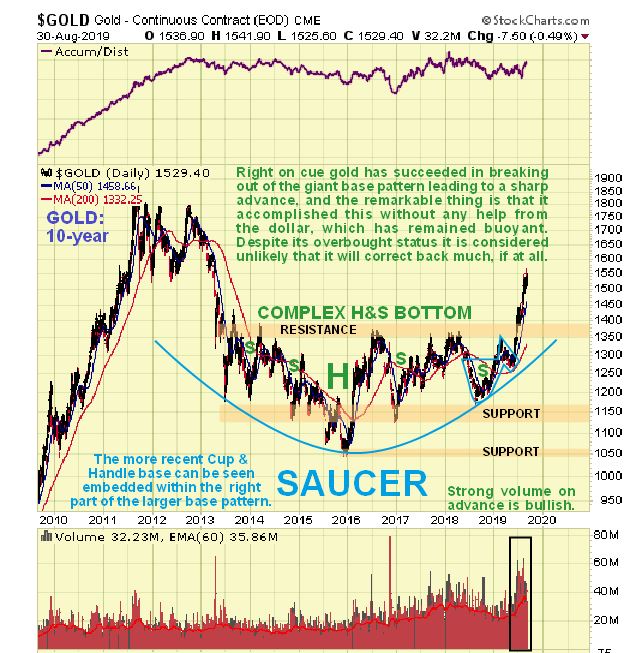
I had been pounding the table all year about an impending breakout by gold from its giant complex Head-and-Shoulders bottom or Saucer base until it happened, as can be seen on the chart from the 6th April Gold Market update
and this latest chart shows that it has succeeded in making a decisive breakout resulting in a sharp advance
Now it’s on its way, and notwithstanding the occasional correction, it should not have too much trouble breaking out to new all-time highs in due course, especially given what is going on. Yes, it’s overbought, yes COT readings are at high levels, yes it could correct, perhaps quite sharply, but the big picture is that it has broken out to start a bull market that is expected to be of epic proportions as the cornered banks take the only route left open to them, which is low or even negative rates, bail-ins (theft from customers’ accounts) and rampant QE on a gargantuan scale that will lead to hyperinflation.
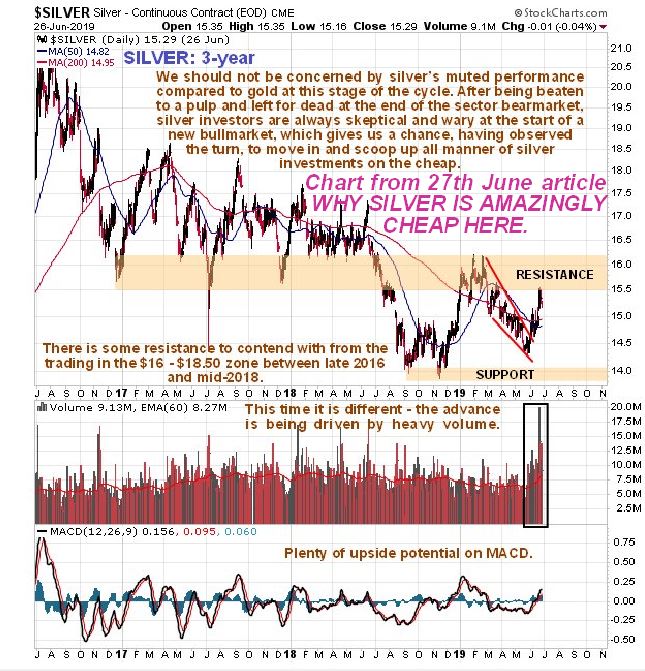
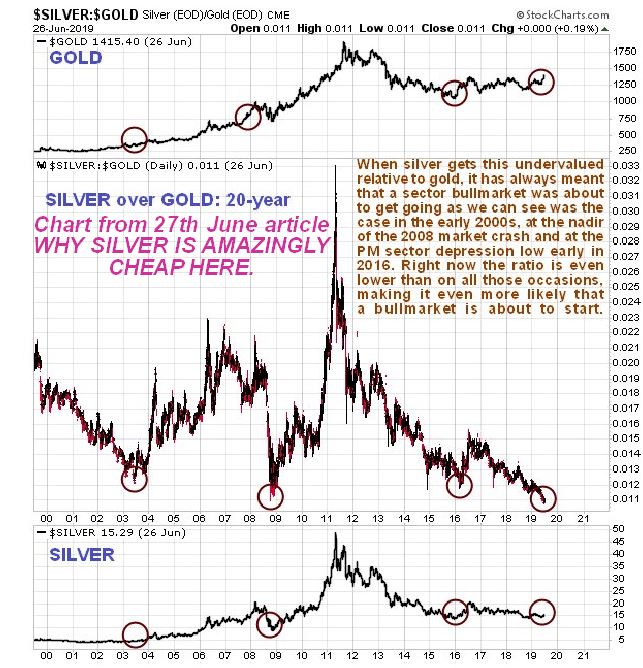
A few months ago the weak performance of silver relative to gold had many investors wary, but they had got things the wrong way round as usual. The extremely low silver to gold ratio had created an explosively bullish situation for silver, as we had observed in WHY SILVER IS AMAZINGLY CHEAP HERE posted on 27th June. Here are a couple of charts from that report
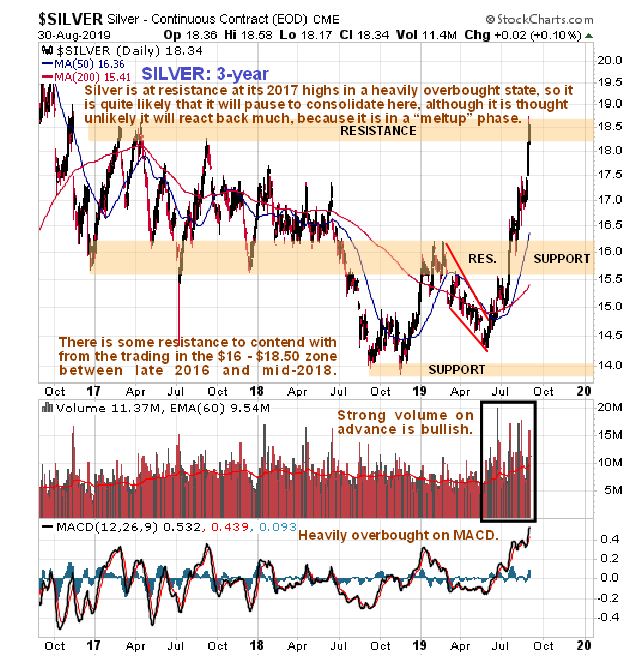
And here is the latest 3-year chart showing what followed
The following chart is what really alerted us that a major silver bullmarket was about to start
Looks overbought, doesn’t it? Well, it is, but that doesn’t mean that it will react back much, if at all. There are a lot of investors who missed this move and are waiting on a correction to climb aboard, which of course makes a significant correction a lot less likely. On the 10-year chart (not shown) this move looks like the start of a major melt-up that could take silver prices much higher, which is hardly surprising considering what is going on.
And what about platinum? On several occasions earlier this year I had pointed out that platinum was an even more undervalued precious metal than silver, especially considering that the envy-riddled, racist, tribal Marxist buffoons now running South Africa are hell bent on turning it into another Zimbabwe, and it just happens that South Africa produces almost 70% of the world’s platinum. But as usual, no one was interested. Here is a chart from the update and what about Platinum, that was posted on the site on 4th July, showing what was expected
And here is the latest 6-month chart showing that in just the past 3 days platinum has broken out on heavy volume to join its buddies gold and silver in a major melt-up
Thus, we now have all three precious metals advancing strongly in lockstep and because of the extraordinary circumstances now prevailing it looks unlikely that they will correct back much, if at all. Instead, it is considered likely that they will march higher and higher.
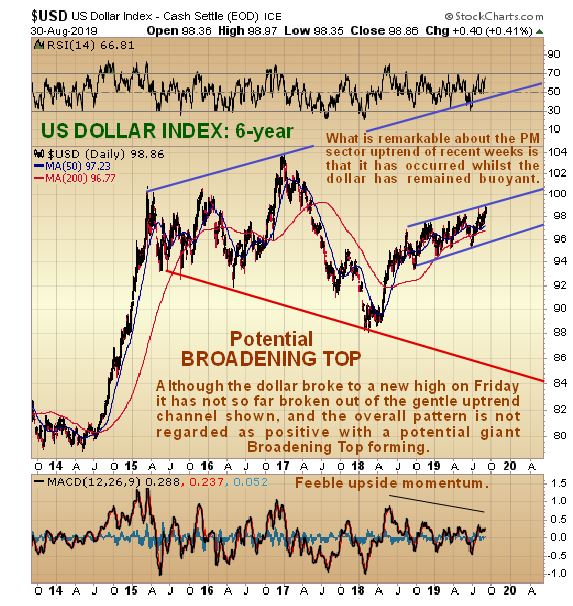
One of the most extraordinary aspects of this new vigorous bull market in gold and silver (and now platinum) is that it is happening without any help from the dollar, which has remained buoyant. The reason for this is that both the dollar and the Precious Metals are viewed as a safe haven at this time. If they continued to raise rates threatening a rapid economic stall out, then the dollar would soar as overseas holders of dollar debt raced to cover (poor old Argentina, eh?), but they are going to do the opposite, lower rates to zero or lower and pump money like crazy to stop the system seizing up, which will push the dollar off its perch, at which point the afterburners will be lit driving gold and silver higher at an accelerating rate, as rates rise and the Treasury market collapses, at which point you can kiss your pension goodbye, as the stock market will have cratered by then too.
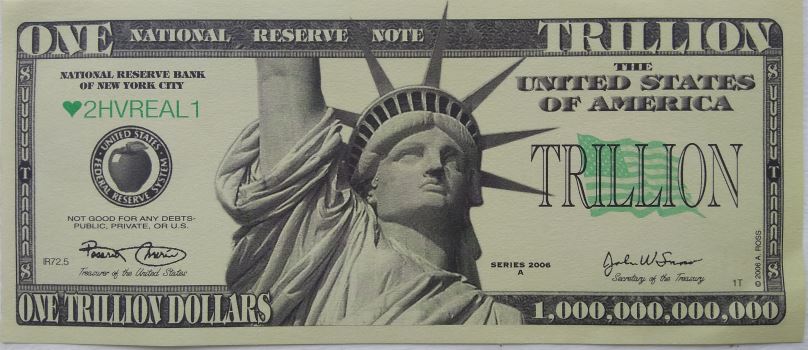
If you would like an insight regarding where all this will ultimately end, I recently took a trial run trip in the time machine that I have been working on to the America of the future. I set the time to about 10 years in the future and then hit the button. At first I thought there was some mistake because when I got there, there were derelicts lying around on the sidewalks, with bottles, syringes and excrement everywhere, garbage fires and packs of wild dogsI thought I was in the present day socialist paradise of Sacramento or San Francisco, but then some guy walked past me with a big wheelbarrow full of bundled banknotes. “Where are you going,” I enquired? “To buy a house in Silicon Valley?” “No,” he replied, “I’m just going to buy a loaf of bread.” It was then I realized the awful truth that the machine had worked and that I was indeed in the America of the future. Before he left, he let me have a banknote which I brought back with me and is shown below.
Now you will never be able to say that you weren’t warned.
Originally published on CliveMaund.com on September 01, 2019
Clive Maund has been president of www.clivemaund.com, a successful resource sector website, since its inception in 2003. He has 30 years’ experience in technical analysis and has worked for banks, commodity brokers and stockbrokers in the City of London. He holds a Diploma in Technical Analysis from the UK Society of Technical Analysts.
Disclosure: 1) Statements and opinions expressed are the opinions of Clive Maund and not of Streetwise Reports or its officers. Clive Maund is wholly responsible for the validity of the statements. Streetwise Reports was not involved in the content preparation. Clive Maund was not paid by Streetwise Reports LLC for this article. Streetwise Reports was not paid by the author to publish or syndicate this article. 2) This article does not constitute investment advice. Each reader is encouraged to consult with his or her individual financial professional and any action a reader takes as a result of information presented here is his or her own responsibility. By opening this page, each reader accepts and agrees to Streetwise Reports’ terms of use and full legal disclaimer. This article is not a solicitation for investment. Streetwise Reports does not render general or specific investment advice and the information on Streetwise Reports should not be considered a recommendation to buy or sell any security. Streetwise Reports does not endorse or recommend the business, products, services or securities of any company mentioned on Streetwise Reports. 3) From time to time, Streetwise Reports LLC and its directors, officers, employees or members of their families, as well as persons interviewed for articles and interviews on the site, may have a long or short position in securities mentioned. Directors, officers, employees or members of their immediate families are prohibited from making purchases and/or sales of those securities in the open market or otherwise from the time of the interview or the decision to write an article until three business days after the publication of the interview or article. The foregoing prohibition does not apply to articles that in substance only restate previously published company releases.
Charts and graphics provided by the author.
CliveMaund.com Disclosure: The above represents the opinion and analysis of Mr Maund, based on data available to him, at the time of writing. Mr. Maund’s opinions are his own, and are not a recommendation or an offer to buy or sell securities. Mr. Maund is an independent analyst who receives no compensation of any kind from any groups, individuals or corporations mentioned in his reports. As trading and investing in any financial markets may involve serious risk of loss, Mr. Maund recommends that you consult with a qualified investment advisor, one licensed by appropriate regulatory agencies in your legal jurisdiction and do your own due diligence and research when making any kind of a transaction with financial ramifications. Although a qualified and experienced stock market analyst, Clive Maund is not a Registered Securities Advisor. Therefore Mr. Maund’s opinions on the market and stocks can only be construed as a solicitation to buy and sell securities when they are subject to the prior approval and endorsement of a Registered Securities Advisor operating in accordance with the appropriate regulations in your area of jurisdiction.
Clinical-stage specialized biopharmaceutical company Ardelyx announced positive results today for its phase 3 AMPLIFY study for tenapanor aimed at improving treatment for cardiorenal diseases.
This morning clinical-stage biopharmaceutical developer of medicines for the treatment of cardiorenal diseases Ardelyx Inc. (ARDX:NASDAQ)announced positive results from the company’s pivotal Phase 3 AMPLIFY study evaluating tenapanor in dialysis patients who have uncontrolled hyperphosphatemia despite phosphate binder treatment.
The AMPLIFY Study was a double-blind, placebo-controlled, randomized study that enrolled a total of 236 patients with chronic kidney disease (CKD) on dialysis, who despite a stable phosphate binder regimen, had a serum phosphorus level greater than or equal to 5.5 mg/dL and less than or equal to 10.0 mg/dL at screening.
The study findings indicated that the primary and all key secondary endpoints were met. Tenapanor in combination with binders met the primary endpoint demonstrating a statistically significant (p=0.0004) reduction of serum phosphorus compared to binders alone. Approximately two times more patients achieved the established serum phosphorus treatment goal of less than 5.5mg/dL in the tenapanor arm compared to binders alone (p-values ≤0.0097) for each week of treatment. The study also showed that tenapanor was well tolerated with only 4.3% of patients in the tenapanor arm discontinuing treatment compared to 2.5% in the binder arm.
Glenn Chertow, M.D., M.P.H., division chief of nephrology and professor of medicine at Stanford University, commented on the study’s findings, “I believe tenapanor has the potential to change the landscape of hyperphosphatemia treatmentfinally, a novel agent that can lower serum phosphorus alone or in conjunction with binders…Faced with an extremely high mortality rate of approximately 18% per year in dialysis patients, we are very focused on managing and treating elevated serum phosphorus…The AMPLIFY study results provide convincing evidence that controlling hyperphosphatemia will soon be within our reach.”
Ardelyx’s President and CEO Mike Raab added, “We are thrilled with the positive results from the AMPLIFY study demonstrating that tenapanor can help significantly more patients achieve the established serum phosphorus treatment goal of less than 5.5 mg/dL…For too long, hyperphosphatemia management has been an enormous challenge for patients and clinicians. With tenapanor, patients may finally be able to achieve their treatment goal. We look forward to reporting results from our second Phase 3 monotherapy study, PHREEDOM, in the fourth quarter of this year. With additional positive results from that trial, we will complete our New Drug Application for tenapanor, encompassing two indications: monotherapy and combination therapy for the treatment of hyperphosphatemia. The promising results from AMPLIFY bring us one step closer to providing this important medicine to patients with CKD on dialysis.”
The firm states that it discovered and developed tenapanor, a first-in-class, proprietary, oral, medicine in late-stage clinical development for the control of serum phosphorus in patients with CKD on dialysis, and claims that tenapanor has a unique mechanism of action and acts locally in the gut to inhibit the sodium hydrogen exchanger 3 (NHE3). The firm believes that, if approved, tenapanor can become a foundational therapy for all CKD patients on dialysis who experience elevated serum phosphorus. Hyperphosphatemia is a serious condition resulting in an abnormally elevated level of phosphorus in the blood that is estimated to affect more than 745,000 dialysis patients in major developed countries.
Ardelyx is a clinical-stage biopharmaceutical company based in Fremont, Calif., focused on addressing cardiorenal and gastrointestinal (GI) diseases. The firm’s cardiorenal pipeline includes the Phase 3 development of tenapanor for the treatment of hyperphosphatemia in people with CKD on dialysis, and RDX013, a potassium secretagogue program for the potential treatment of high potassium, or hyperkalemia, a problem among certain patients with kidney and/or heart disease. The company also states that it has also completed Phase 3 development of tenapanor for the treatment of irritable bowel syndrome with constipation (IBS-C) and submitted a new drug application (NDA) to the U.S. Food and Drug Administration (FDA) for the treatment of patients with IBS-C, which has been granted a target action date under the Prescription Drug User Fee Act (PDUFA) of September 12, 2019.
ARDX shares opened higher today after the holiday weekend at $4.01 (+$0.61, +17.94%) over Friday’s close of $3.40. Since the open shares have traded between $3.77 and $5.72, setting a 52-week high price on much higher than average volume. At present, the stock is trading at $5.60 (+$2.21, +65.00%).
Disclosure: 1) Stephen Hytha compiled this article for Streetwise Reports LLC and provides services to Streetwise Reports as an independent contractor. He or members of his household own securities of the following companies mentioned in the article: None. He or members of his household are paid by the following companies mentioned in this article: None. 2) The following companies mentioned in this article are billboard sponsors of Streetwise Reports: None. Click here for important disclosures about sponsor fees. 3) Comments and opinions expressed are those of the specific experts and not of Streetwise Reports or its officers. The information provided above is for informational purposes only and is not a recommendation to buy or sell any security. 4) The article does not constitute investment advice. Each reader is encouraged to consult with his or her individual financial professional and any action a reader takes as a result of information presented here is his or her own responsibility. By opening this page, each reader accepts and agrees to Streetwise Reports’ terms of use and full legal disclaimer. This article is not a solicitation for investment. Streetwise Reports does not render general or specific investment advice and the information on Streetwise Reports should not be considered a recommendation to buy or sell any security. Streetwise Reports does not endorse or recommend the business, products, services or securities of any company mentioned on Streetwise Reports. 5) From time to time, Streetwise Reports LLC and its directors, officers, employees or members of their families, as well as persons interviewed for articles and interviews on the site, may have a long or short position in securities mentioned. Directors, officers, employees or members of their immediate families are prohibited from making purchases and/or sales of those securities in the open market or otherwise from the time of the interview or the decision to write an article until three business days after the publication of the interview or article. The foregoing prohibition does not apply to articles that in substance only restate previously published company releases.
Another defeat for Boris Johnson. No-one is able to predict the intensifying political turmoil engulfing Brexit-weary Britain, meaning the only way to secure your wealth and assets is to remain invested and diversified.
This is the message from the CEO and founder of deVere Group, one of the world’s largest independent financial advisory organizations, as UK Prime Minister Boris Johnson lost yet another crucial parliamentary vote on Wednesday evening. Against this backdrop, Boris Johnson has tabled a motion for a snap general election.
British lawmakers passed a bill aimed at preventing a no-deal Brexit, in another decisive blow to Mr Johnson. It cleared the House of Commons by 327 votes to 299.
It now goes to the House of Lords where it can be expected that there will be extensive delaying tactics.
Mr Green comments: “In the last few days, Prime Minister Boris Johnson has ordered the UK parliament to be suspended, lost his working majority in the House of Commons, and purged senior politicians from within his own party – including the grandson of his idol, Winston Churchill.
“On Wednesday, his highly controversial ‘do or die’ approach to Brexit was thrown out yet again by MPs, meaning the chance of a no-deal Brexit is further slashed.
“Whichever way you look at, Mr Johnson’s political options for his agenda are now significantly reduced and therefore he’s moved a motion for a snap general election.
“However, he might not get his way on that either. The leader of the opposition Labour Party, Jeremy Corbyn, has said that he would only agree to a general election after a law is passed removing the risk of a no-deal Brexit.”
The deVere CEO insisted on Wednesday: “The squeeze on Boris Johnson’s plans will have a positive effect on the pound in the short term – we can expect it to trade considerably higher in the coming sessions as the potential for the PM losing his threat of no-deal increases.”
“However, this might also be put in context. The rebound will be tempered by an imminent election.
“An election always creates uncertainty and therefore turbulence for sterling, but even before it is called there will be major question marks as Jeremy Corbyn, the Labour leader, is now demanding no-deal is off the table before he agrees to go to the polls.
“And should a Corbyn-led Labour party win that election, there will be even more bad news for the pound.
“His anti-business rhetoric and high tax and low-profit policies would lead to a significant sterling sell-off.”
The deVere CEO concludes: “No-one – but no-one- is able to predict the frenetic intensifying political turmoil engulfing Brexit-weary Britain – there are too many variables and too many potential outcomes and consequences.
“This means the only way to secure your wealth and assets is to remain invested, to take advantage of the upswing when it happens, and to be diversified across asset classes, sectors and regions.”
About:
deVere Group is one of the world’s largest independent advisors of specialist global financial solutions to international, local mass affluent, and high-net-worth clients. It has a network of more than 70 offices across the world, over 80,000 clients and $12bn under advisement
Tomorrow there are two events which could move the Swissie. The first is before the European markets open, with the release of the long-anticipated Q2 GDP data.
Normally this would drive the markets on its own. But given the strong demand for safe havens, it could have an extra impact this time. Then the SNB’s Chairman Jordan will be giving a speech later in the evening.
Switzerland’s economy has been facing numerous challenges lately. Chief among them is the slowdown in the world economy. But, more specifically, the slowdown in the eurozone, their largest trading partner.
Switzerland relies heavily on exports and capital markets. And the race to the bottom with interest rates around the world is likely to have a negative impact.
What We Are Looking For
The consensus among analysts is that the Swiss economy grew by 0.3% in the second quarter. This would b half the pace from 0.6% in the prior quarter. A result like this is not entirely unexpected since, during the first quarter, many Swiss firms reported that they were frontloading their investment programs.
With the change in global outlook during the second quarter, a good portion of capital expenditure went on hold, as reported during the recent earnings’ season.
On an annualized basis, expectations are for GDP to pick up the pace to 2.0% from 1.7% in the prior reading. While this is barely at replacement level, it’s still substantially better than Switzerland’s main trading partner, Germany. The lack of German growth is being blamed, in part, for Switzerland’s underperformance.
It’s Not Always Good to Be the Best
Swiss exports rely primarily on high-skill, high-technology products with an emphasis on luxury goods. With the global economy on shaky ground, often where costs are first cut is with luxury goods.
With the disparate results between the US and EU, the Swiss have been trying to switch their trading towards the Americas. However, they haven’t made significant enough of a change to support the GDP yet.
The other factor weighing on the economy is how the country is seen as stable and a good investment. Investors are desperate to find safe havens, like CHF-denominated assets. This has pushed the franc up, making it harder for Swiss exporters.
Politics Are Not Exactly Helping
Even as the world is facing the impacts of the trade war and Brexit, Switzerland and the EU are stuck renegotiating the terms of their relationship, with little progress. Both sides accuse the other of intransigence.
In fact, some tit-for-tat measures are already being taken. These include refusing to allow cross-border equity trading. The uncertainty of how that will play out over the next year is a factor keeping some investors wary.
On a positive note, however, Switzerland is about to sign a free trade deal with Mercosur. This will broaden its export reach while providing access to cheaper raw materials. There is even talk that the UK might join the EFTA after Brexit.
The Markets
Switzerland has a solid reputation among investors. Therefore, it would take a severe miss of expectations to knock down market sentiment. As long as Switzerland is performing better than Germany (not a hard feat at the moment), generally we could expect the CHF to be bolstered by the results.
Everyone wanted to piece of Gold yesterday after US manufacturing activity decelerated in August for the first time in three years – fuelling concerns over deecelerating growth in the world’s largest economy.
Appetite towards the precious metal remains robust on Wednesday with prices finding comfort near a 6-month high at $1546 thanks to Dollar weakness, Brexit uncertainty and lingering trade concerns. Gold is set to extend gains towards $1550 and $1570 in the short to medium term as geopolitical risk and overall market uncertainty accelerate the flight to safety.
Another key theme stimulating demand Gold is the low-interest rate environment caused by central banks across the globe easing monetary policy. Bulls certainly remain in the driver’s seat with $1550 acting as the first point of interest in the near term. A breakout above this level should open the doors towards $1570. Should $1550 prove to be a stubborn resistance, prices are likely to sink back towards $1525.
Pound gains confidence as No-Deal Brexit fears recede
The Pound extended gains against the Dollar and other G10 currencies on Wednesday as concerns about a no-deal Brexit eased after British lawmakers wrested control of the parliamentary timetable.
While expectations are rapidly rising over a bill to delay Brexit by three months being passed by parliament, the risk of “no-deal” Brexit is still in the cards, especially if Boris Johnson calls for a snap election.
Focusing on the technical picture, the GBPUSD is trading around 1.2190 as of writing and could extend gains towards 1.2250 in the short to medium term. Given how sensitive the Pound is to Brexit developments, the currency could easily sink back towards 1.2100 and 1.2000 should no-deal fears make a return.
Disclaimer: The content in this article comprises personal opinions and should not be construed as containing personal and/or other investment advice and/or an offer of and/or solicitation for any transactions in financial instruments and/or a guarantee and/or prediction of future performance. ForexTime (FXTM), its affiliates, agents, directors, officers or employees do not guarantee the accuracy, validity, timeliness or completeness, of any information or data made available and assume no liability as to any loss arising from any investment based on the same.
In August, manufacturing activity in Japan declined four months in a row. Is the weakening of Japanese Yen possible?
The macroeconomic indicator Jibun Bank Japan Manufacturing Purchasing Managers’ Index (PMI) in August fell to 49.3 points. For 4 months now, it has been below 50 points, which means a decrease in activity in the industry. The last time such a long negative period was observed in Japan in 2016. An additional negative for the yen could be the normalization and mutual concessions in trade relations between China and the United States during the planned negotiations. Investors previously viewed the yen as a defensive asset, which largely determined its strengthening.
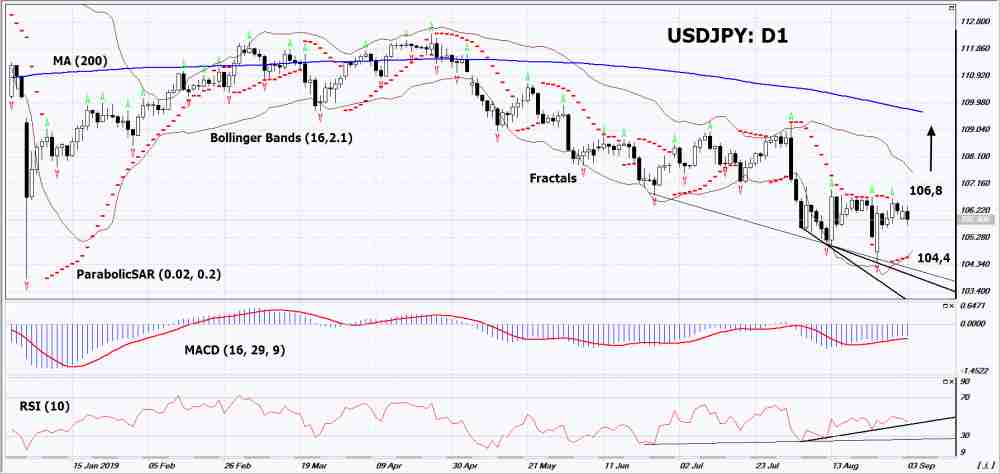
On the daily timeframe USDJPY: D1 is in a downtrend. At the same time, the decline slowed down and various technical analysis indicators formed upward reversal signals. Further growth of quotations is possible if negative macroeconomic data will be published in Japan and positive in the USA, as well as normalization of US-Chinese foreign trade relations.
The Parabolic indicator demonstrates a signal to increase.
The Bolinger bands narrowed, indicating volatility decrease. The bottom line has a slope up.
The RSI indicator is below the 50 mark. It has formed several divergences to increase.
The bullish momentum may develop if USDJPY exceeds two upper fractals: 106.8. This level can be used as an entry point. Initial stop lose may be placed below the last lower fractal, Parabolic signal and the lower Bollinger line: 104.4. After opening the pending order, the stop shall be moved following the Bollinger and Parabolic signals to the next fractal minimum. Thus, we are changing the potential profit/loss to the breakeven point. More risk-averse traders may switch to the 4-hour chart after the trade and place a stop loss moving it in the direction of the trade. If the price meets the stop level (104,4) without reaching the order (106,8), we recommend to cancel the order: the market sustains internal changes that were not taken into account.
An FX trader looking to automate their trading strategy with an algorithmic Forex solution, or replace it with a ready automated FX trading system, is bound to end up struggling to decide on the trading strategy rules. They could even struggle with the selection of the automated expert advisor itself.
Creating An MT4 EA Is Not That Easy
When it comes to switching your visual strategy to an autotrader, you will be surprised at how hard it is to translate the rules into a meaningful piece of code.
Whether it’s you or a pro MetaTrader 4 developer putting the expert advisor together, you will have to provide the FX strategy rules. And the strategy rules are not “buy” at the bottom, “sell” at the top. You have to give precise numbers and details on the MT4 indicators you want to integrate into your FX trading system.
For example, a condition would look like this:
When the current price moves above the 50 MA at the hourly candle, buy at the candlestick close.
But, of course, forex trading isn’t as simple as generating trading signals with the use of one MT4 indicator. This is the simplest of its examples.
Once you are done with the trading strategy rules, it can get quite overwhelming to decide which optimization variables and metrics you want to play with to boost the EA’s live performance.
Should I Build My Own System Or Buy A Forex Robot?
It’s no surprise that most FX traders who seek a good Forex EA often end up hopping from building an algorithm to buying a ready-made Forex robot. In fact, it’s just like when an FX trader ends up jumping from one trading strategy to another!
It’s not easy. But, is this a good idea?
For starters, when you see a Forex trading robot come with some money-back guarantees, it certainly offers a level of security when you making a purchase. But, more often than not, vendors won’t honor your request. This type of vendor’s sole purpose is to take your money. And they will trick you by offering an unbeatable deal, on top of providing fake MetaTrader 4 results for the said EA. Due diligence on the vendor and on the EA itself is essential! Ask for the EA’s historical performance as a first move.
Finding a winning automated trading strategy is, by no means, an easy task. But a quick look around various forums will often reveal more negative reviews than positive reviews. Not too hard, then, to spot a scam!
Building your own MT4 EA is certainly not as risky, nor is it as costly as you may have in mind. You don’t need to build a Forex robot that takes trades automatically at first. You can start with a simple alerts EA that notifies you when certain conditions are being met, instead of spending all day looking at your MetaTrader 4 charts.
Why Do Most Trades Looking To Switch
One of the main reasons Forex robots are in demand is that they bypass the human factor. They only open trading positions according to certain conditions being met. In addition, the simplest answer is time.
Why spend hours looking at your MT4 charts for opportunities, when you could spend just a few minutes validating an alert signal? Or even checking your account, if you use an automated trading system.
Nevertheless, switching is not that simple. There are some drawbacks involved as well. A robot, for example, cannot easily recognize forex market shifts.
Forex EA’s are, therefore, vulnerable to this variable. This highlights the fact that when choosing or building an algorithmic Forex trading solution, you should consider that you will need clear and precise rules to build something good.
It’s not uncommon to find most beginners FX traders on the lookout for an MT4 expert advisor. Chances are that the FX trader tried manual Forex trading, lost money and then started looking for different ways of making money from trading the Forex markets.
But is this the right approach?
What Are The Advantages of Using An MT4 EA?
A Forex robot can trade round the clock, unlike a human being. Since the Forex markets are not centralized and operate 24 hours a day, 5 days a week, the potential trading opportunities one might miss without an autotrader can often be the ones to make a difference in your Forex trading account.
The biggest advantage of using an MT4 EA is the fact that trades can be taken while you sleep, work or relax!
As a matter of fact, many FX traders will use a MetaTrader 4 EA to avoid emotional trading. Beginner traders often mismanage their trading capital or take wrong trading decisions. An expert advisor fits in well to that type of FX trader.
Note that a Forex trading EA is built based on a trading strategy. The basis of the trading strategy could be a trend-following strategy that works on higher time frames. Or it could, perhaps, merely take advantage of the markets when they enter a sideways range. If you have your own strategy, you too can build or automate it and enjoy more free time, avoiding emotional trading.
Regardless, FX traders should note that Forex robots are not the holy grail. They are simply a manual trading strategy which has been automated. How successfully, is a matter of accuracy of translating the rules into code. The second part is easy for a professional MT4 developer. The first, is up to you!
What Are The Disadvantages of Using A MetaTrader 4 EA?
We talked about optimization in the first few paragraphs. There is a high risk that the MT4 EA settings have been optimized to bring about the best results when backtesting the expert advisor’s automated trading strategy. We refer to this as ‘curve-fitting’ and it’s one of the biggest pitfalls when backtesting a Forex robot.
Forex trading with an automated algorithm can often be expensive. But you can certainly purchase one for as little as $100 and use it to your advantage.
The question of how much you should pay is very subjective. However, it is good to know that in order to forward test the MT4 EA, it would require testing in live FX markets with real money. How much you want to throw in is at your own discretion.
Do I Really Need An Automated MT4 Expert Advisor?
Now that you have an understanding of the pros and cons of using an automated Forex trading strategy, the question is basically one of personal choice.
If you are short on time and can’t dedicate resources to learn Forex, investing in an automated trading Forex system could be the most ideal choice.
If you lack confidence in managing risk or you tend to make the opposite decision of what your Forex strategy tells you to, an expert advisor should help as well.
Don’t forget, expert advisors are not only helping with rule automation but also with your entry and exit policies. And more often than not, those are the main variables that lead to losses!
Yesterday’s Manufacturing PMI figures seem to have an enduring influence on today’s session, at least up to now. The decline to 3-year contractionary lows rejuvenated investors’ fears of an emerging recession.New orders dropped to a 7-year low.
Despite Services PMI represent nearly 80% of economic activity, market participants remain cautious as services could stagnate should manufacturing remain in a free-fall.
The downside on the US Index, however, could find a stop at 98.40. Traders are patiently waiting for Friday’s NonFarm payroll numbers.
Euro Up, Undeterred By Contractionarry Retail Sales
An array of Euro-wide PMIs in the earlier session supported Euro’s move to the upside. Euro was and still is, influenced by a weaker dollar. With the upbeat figures, EURUSD was able to cross above the 1.10 psychological hurdle.
Note that the flows remained positive despite the Euro Area Retail Sales numbers came out at -0.6% (exp -0.1% vs prv 1.2%). EURUSD traders now seem to be eyeing the 1.1025 level.
Poor UK Services PMI Saves Bulls A Breath
UK’s Markit Services PMI was unable to stop the bulls. Although the decline was minimum compared to the forecast (50.6 vs 50.7), the data set was indeed worst that the previous month’s figures at 51.4. Such numbers indicate that GBPUSD is also influenced by negative USD flows. PMI figures are nearing the 50 contraction mark.
Regardless, the pair is bullishly biased and could reach the 1.22 level before any meaningful pullback is seen.
Commodity Pairs Soar Too, Despite Disappointing Data
Loonie, Kiwi and Loonie did report weaker data than the European and UK economies, however, they remain strong as risk flows shift.
Australia’s Services PMI fell to a deeper contractionary level at 49.1 and its GDP remained flat at 0.5%. Despite a 1.1% forecast, New Zealand’s Commodity Price Index came out 30 basis points worse than expected. Canada’s PMI also crossed into recessionary levels at 49.1, from a 51.4 estimate.
With recession fears rising and the dollar being driven down, AUDUSD traders eye the 68c level. Kiwi eyes 64c., and USDCAD is looking towards the 1.33 support.
Safe Havens Under Pressure
While risk assets become currencies of choice, gold, yen and the Swiss franc weaken from a safe-haven perspective.
Gold is pulling back after forming a double top at 1510/oz yesterday. USDJPY seems to be heading back up at yesterday’s high at 106.40. Finally, USDCHF which although is affected by the shift in sentiment indeed, it trades lower contrary to gold and yen. This is likely amid optimistic GDP expectations. These will be released tomorrow during the European session.
Equities Break Tandem With Dollar
Despite the dollar and indices have been moving in tandem over the past few sessions on the back of trade war narratives, the relationship just broke. This is owned to a shift in sentiment. This most likely has investors thinking that now, and following the PMI drama yesterday, the Fed could be forced to cut rates in the next FOMC meeting on September 18th.
The UK PM lost the first and most critical battle in Parliament yesterday. MPs voted to block a no-deal Brexit.
Rebel Torry MPs joined other party MPs in a bid to take power from Boris Johnson and avoid a hard Brexit. Forex traders were initially thought to have taken the headlines with a positive tone, but it was the dollar’s weakness that allowed cable to surge over 100 pips.
Cable’s Surge Mainly Owed to a Weaker USD
The opposition supported another extension up until January 31st and not a snap election. Given that, one would think that market participants would have discounted earlier losses on the British pound to that end.
However, the market’s reaction was rather minimal as the UK PM threatened a snap election by October 15. And it was the dollar’s weakness that allowed GBPUSD to soar to fresh highs, as well as a technical rejection at the $1.20 psychological level.
The USD plummeted at the NY open after a long-awaited reaction to the additional tariffs on Chinese products, as well as a recessionary manufacturing PMI. The latter, of course, is seemingly a result of the trade war escalation.
Extention & Snap Election Bills to be Voted on Today
Today, parliament will vote on a bill that will legally prevent a no-deal exit by October 31st. In addition, they will vote on a motion to call a general election.
Parliamentarians made it clear, however, that before the Brexit delay bill passes, there won’t be any support in the Commons. And their vote is necessary as the motion requires a 2/3 majority.
This keeps the general election vote in the picture, but not before October 19th. That was the date on which MPs suggested the extension bill should be triggered should the UK government fail to agree with the EU.
Pound Higher as Trump Debacle Continues
The $1.20 rejection seems to suggest a reversal. Following a false breakout below the key level during the early London session yesterday at 1.1960, prices on GBPUSD formed a pin bar. Should the pair break above 1.2185, chances of a further slide would decrease. If the exchange rate crosses outside the upper descending trendline, GBPUSD could really turn around.