Media Hypes Recession while Trump Proposes a Tax on Savings

By Money Metals News Service

Welcome to this week’s Market Wrap Podcast, I’m Mike Gleason.

Coming up, Axel Merk of Merk Investments joins me for a conversation on the latest central banking shenanigans, why he believes the economy may heat up again in the near term, and why the war on cash and the move to digital money will continue to drive people into gold. So don’t miss another great interview with Axel Merk, coming up after this week’s market update.

Gold and silver markets are testing support levels this week. Gold has been hanging around the $1,500 level while silver trades sideways through Thursday’s close at just above $18 an ounce.

As of this Friday recording, gold prices come in at $1,498 per ounce, down 0.7% for the week. Silver, meanwhile, now shows a weekly loss of 2.0%, with most of that loss coming here today, to bring spot prices to $17.89.

The bright spot in the metals space this week is palladium. The catalytic metal pierced through $1,600 an ounce on Thursday to record a new record high. Palladium prices now check in at $1,609 after gaining $60 or 3.9% on the week.

As for platinum, it is putting in a slight weekly gain of 0.2% to trade at $956 an ounce.

Metals investors will await the market’s reaction to next week’s FOMC policy meeting. It wouldn’t be surprising to see an attempt in the futures markets to smash gold and silver prices down to lower support zones in the trading around the Fed’s decision.

Flushing out some more speculative longs and late comers with weak hands would be a healthy development in setting up the next rally. Those who got left behind in this summer’s big moves in metals markets should certainly consider taking advantage of favorable buying opportunities as they present themselves ahead of a possible seasonal push higher in the sector this fall.

Conventional financial markets could become volatile as uncertainties surrounding America’s economy and political future weigh on investors. We are potentially only one election away from falling into socialism and one quarter’s GDP report away from falling into recession.

Lately, the mainstream media has been fixated on the possibility of the Trump economy heading toward recession, as heard in the following montage:

President Trump: Certain people in the media are trying to build up, because they’d love to see a recession.

News Report Clip 1: Why are people talking about a recession? And, you say it’s here.

News Report Clip 2: There are indicators that the US could be headed for a recession.

News Report Clip 3: … could be headed for a recession.

News Report Clip 4: … be inching toward a recession.

News Report Clip 5: They see a potential recession on the horizon.

News Report Clip 6: Happening now, recession fears.

News Report Clip 7: What are the odds that you see of a recession?

News Report Clip 8: A recession.

News Report Clip 9: Recession.

News Report Clip 10: Recession.

News Report Clip 11: At some point, there’s going to be a recession.

Yes, at some point there will be a recession. But it’s not here yet. And economic forecasters as a whole have a terrible track record when it comes predicting major turns in the economy.

All the recession talk now spewing from the media is speculative at best – politically calculated at worst. Let’s face it, some anti-Trump partisans in the media are giddy over the potential for a recession to bring down the President’s poll numbers.

That said, we do see signs of an economic slowdown of at least some magnitude. Despite a low official unemployment rate, jobs are being created at the slowest pace since 2011. Corporate earnings growth is also weakening. And GDP growth in the in the second quarter fell from 3% to 2%.

Other indicators suggest recession fears are overblown – or at least premature. Household purchasing power remains strong. The stock market is trading up near record highs. And the yield curve is no longer inverted. Long-term bond yields spiked this week as the latest CPI report showed core inflation picking up.

However, copper and other industrial metals are struggling to gain ground as the PMI manufacturing data has slumped to a multi-year low. Weakness in industrial output comes largely as a result of the ongoing trade war between the U.S. and China.

This week, the Trump administration touted some potential breakthroughs with China. Beijing will reportedly agree to buy more agricultural products from U.S. farmers. That news sent grain futures surging.

If more progress is made in resolving trade disputes, then the economic growth numbers could tick up and spoil the recession hopes and dreams of Trump’s Democrat rivals.

The biggest wild card for President Trump’s re-election prospects could be the Federal Reserve. Although Fed officials are finally cutting rates, they aren’t doing so rapidly enough as far as Trump is concerned.

This week he called Jerome Powell and company “boneheads” for keeping rates too high. Trump suggested the Fed should take rates down to zero, or even into negative territory, to bring the U.S. more in line with the rest of the world.

On Thursday, the European Central Bank lowered its rate on deposits from banks down yet another notch to negative 0.5%. The ECB also announced it would restart its bond-buying program and pump 20 billion euros a month into government and corporate bonds.

Next week the Federal Reserve will make its move. It is widely expected to cut rates by 25 basis points.

The race to depreciate national currencies is on. Central bankers and politicians will be undeterred as long as they see no major inflation consequence to their actions. But inflation can creep up slowly before it spirals out of control like it did in Zimbabwe.

Former Zimbabwean dictator Robert Mugabe passed away last Friday. His heavy-handed socialist policies turned what was a prosperous and stable country known as Rhodesia under British rule into a hyperinflationary hellhole. The central bank of Zimbabwe began issuing its common currency in trillions of dollars per note.

Of course, none of the “trillionaires” created by the Zimbabwe hyperinflation actually gained wealth as a result. Instead, they lost purchasing power minute by minute while they held their rapidly depreciating Zimbabwe dollars.

Nothing better encapsulates the distinction between inflation-prone fiat money and sound money than our Silver versus Zimbabwe Dollar Display. It features a genuine silver American Eagle coin and an authentic Ten Trillion Zimbabwe dollar banknote that is now worthless as a medium of exchange. The display poses the essential question – “Which Has Real Value?”

It makes for a thought-provoking gift or addition the desk of anyone who appreciates sound money and is available at MoneyMetals.com.

Well now, without further delay, let’s get right to this week’s exclusive interview.
Axel Merk

Mike Gleason: It is my privilege now to welcome in Axel Merk, President and Chief Investment Officer of Merk Investments and, author of the book Sustainable Wealth. Axel is a well-known market commentator and money manager and is a highly sought-after guest at financial conferences and on news outlets throughout the world, and it’s great to have him back on with us.

Axel, it’s a pleasure as always. Thanks for joining us again.

Axel Merk: Great to be with you.

Mike Gleason: Well, Axel, we recently took a look at the September US Business Cycle Chartbook and for those that are interested, they can download that for free at MerkInvestments.com and click on research. But in there, Axel, you put together a number of great charts on a variety of factors and ultimately the outlook is a bit mixed for the U.S. economy.

You think the odds favor continued expansion in the months just ahead, but there are some warning signs as well. Can you give our listeners a couple of the pros and cons? What are some of the important signals of continued growth and what are some of the things that could throw a wrench into the economy in the months ahead?

Axel Merk: Sure. And let me try not to be too academic about it. Everybody knows we’ve got some global headwinds, trade tensions and whatnot. And the question is going to seep it over to the U.S. consumer. And just to take a step back, the U.S. consumer is obviously a huge chunk of the U.S. economy. And then the things that get us into recession sometimes would be inventory adjustments or the lack of business investments. And nobody should be surprised if inventories gyrate based on the Presidential tweets, people are trying to avoid goods or deplete them. So, there might be some technical adjustments. Business investments going down, that is of course a bigger concern. Now all that said, as you’re aware, unemployment rate is low, and the people have jobs, right. And so that’s all good.

What’s really not good is the manufacturing industry and globally, that’s gotten a huge stand, and in the U.S. that’s also soft. And so, the question really is: Is it going to spill over to the U.S. economy? And one has to always put that in a context of the Presidential tweets. I have argued and as we speak and as we publish this, there’s going to be probably another tweet, the thing is how is this going to play out? And obviously I don’t have a crystal ball, but there’s a huge incentive for both the Chinese and the President to ease trade tensions between October and December. That’s really the window.

President Trump like any president would like to get reelected for that, you need to have a strong economy. And so if, and I’m not saying trade issues are going to be all resolved, that’s not in the President’s interest. He wants to keep it in news. He might want to have it on something less important like wants tariff on French wine. But he needs business investment to pick up, and there is an opportunity to make that happen in the coming months.

And then what you are faced with, is very low unemployment. You are faced with easing of trade tension, and low interest rates. And so you’ve got the perfect recipe to have a strong economy heading into the election. Now referring to the chart book, obviously the chart book have hindsight and it’s precisely to avoid this sort of crystal ball thinking that I’m doing with you on the, you know. So we go back several decades and look at what has worked in the past. One of the things we can talk about is the yield curve, which I think is overrated.

Mike Gleason: Yeah, it kind of leads me into my next question, there. Bonds very recently began selling off and yields have been rising. This created some headwinds for precious metals, but perhaps we will see the yields moving downward again. The consensus is for the FOMC to cut rates again next week. The President has been all over Fed Chairman Powell to do more to stimulate. He suggested earlier this week that rates should be zero or even less. What are you expecting from the Fed over the next year, Axel? Are we going to see a steady string of rate cuts back to zero or even negative? Or maybe the FOMC will take former New York Fed President William Dudley’s advice and avoid stimulus. He says the Fed should not enable the President’s trade war with China. What do you think about all that?

Axel Merk: How many hours do we have here? First of all, the market is pricing in one rate cut this coming meeting. I think that’s pretty clear cut. The challenge really is – with both the Fed and also what’s happening in Europe – the Fed cannot solve the problems that we have. We have plenty of access to credit both in the U.S. and the Eurozone. People are not borrowing. And if you look at bond yields, bond yields rise, meaning interest rates move, as we have changes in the perception of the business environment. So, interest rates come down when trade tensions flare up, that’s because there is less opportunity to invest. The long end of the yield curve is not controlled by the Fed. They tried to sometimes with QE and whatnot. And so, this idea that, “Oh the yield curve is inverted, and therefore we have to cut rates.”

No, long term rates are low and therefore something needs to be resolved on trade. If we want those rates to be higher. On the short end, the Fed cannot predict the next tweet. I mean I just gave you my crystal ball. I have no idea whether I’m right. But when Fed Chair Powell says, “Policy is now dependent on political developments,” that’s a tweet dependent Fed. It just doesn’t work. Now the criticism, if you were just to sit on the sideline is that he’s going to be late. Well of course he’s going to be late. The Fed is always late, and that’s kind of the job in this sort of environment. But trying to preempt what might happen. And again, more importantly, a trade war cannot be won by lowering interest rates. They have nothing to do with one another.

And to just make a comment on the Presidential tweet in general on the Fed, when the most effective monetary policy is one where a Fed official utters a few words and rates move, it’s more expensive to cut rates, more expensive to have QE. So, when you have somebody outside of the Fed who is influential, like the President, interfere, that makes Fed policy more expensive. That means the Fed has to move more to achieve the same thing. So, that’s an academic way of saying why it is not helpful for the President to meddle with the Fed.

Now obviously politically it’s helpful, right? If you have a weakened economy, why not have the Fed as a punch back. So, politically it kind of makes sense. But from an actual monetary point of view, rates will be higher, long ends on interest rates will be higher when the President tweets. The bonds often fall when the President tweets and so it’s not helpful for what the Fed is trying to achieve.

Mike Gleason: Let’s talk about Europe for a minute. The ECB just announced a bit more stimulus, but European growth forecasts are not very encouraging, lke the U.S., or perhaps even more so. European economies are stagnating under mountains of debt and the prescription is to lower rates and try to entice even more borrowing. Then there are some geopolitical events. For example, the British people are still wrestling over Brexit and it is far from clear how that matter will be resolved now – more than three years after UK citizens voted to leave. So do you see any solutions coming for some of the big problems over in Europe?

Axel Merk: Well, I guess Madame Lagarde is the solution because Mr. Draghi has thrown in the kitchen sink and he’s going to retire in a few weeks. Same as in the U.S., we have, and you mentioned a few of the issues: Brexit, you cannot solve that with interest rates. Exports. One is trade tensions. The other one is actually exports to Turkey. Eurozone interest rates don’t fix those issues. Germany not getting its act together quickly enough, in getting onto electric cars and re-engineering its automotive industry. You cannot fix that with interest rates. Access to credit is abundant. And the banks, they’ve tried to help them a little bit with a new tiered interest rate system but doesn’t really help them. And so again, they’re trying to use the wrong tool to fix the problems of the day, but it hasn’t stopped them.

And offline we talked briefly about metals going up. Well, what happens when you lower rates everywhere, but it doesn’t really have an impact? Well it does have an impact on the metals. And one thing we should talk about maybe is Madame Lagarde succeeding Draghi. I think she can do something. Ever since she has been nominated on, I believe it was July 3rd, the spreads in the Eurozone, so the premia that Italy and Greece pay for example versus German bunds have come down.

And the media have attributed that to fantastic new policies in Greece and Italy and maybe the most recent action at the ECB. But I think Lagarde may well take the Eurozone to the next level and socialize that debt more, meaning making Germany be on the hook for Italian and Greek debt more, to keep those spreads down. So, that’s where I think Lagarde can do more. But as far as growth is concerned, what we need is visibility on investments, we need less regulation, those sorts of things. And just printing money is not the solution to the ills of the world.

Mike Gleason: Seems like they’re moving in the opposite direction there. Obviously we’ve been reading a lot about all the negative yielding bonds out there in Europe, specifically Japan as well. Do you see that coming to the U.S. is that going to spread here in the bond market?

Axel Merk: Well the President tweeted yesterday that interest rates should be low or less. I then cynically said, “Wait a second, the President is proposing a tax on savings,” because that’s what it is. Negative interest rates on cash would be a tax on savings. It is increasingly talked about in central banking circles. That’s why many central bankers, would like to move to digital money. They may not like the Libra project but they are toying with that idea. Who knows what’s going to happen down the road? I think it’s going to be very unhelpful to how the U.S. financial system is structured, but let’s keep in mind that we don’t have markets anymore. People at the New York Fed, Williams who came from the San Francisco Fed, is an academic. And so, they play with these models and who knows how far they’ll push them?

In the short term, in the very short term, as I indicated earlier, I think these trade tensions will ease and the Fed will have less of an inclination to cut down the road. I think the market was pricing in too much of a rate cut. But yeah, in the long run all bets off, how where the central bankers are going to take things.

Mike Gleason: And leads us then into gold. Obviously that’s a good environment for gold. The war on cash, you kind of alluded to that, should drive more safe haven demand into gold. Gold and silver have performed well this year despite the recent pullback. It appears there is some appetite for safety and there’s this general acknowledgement that the rate hiking cycle at the Fed is over, at the very least. We’d like to get your thoughts as we approach the final quarter of the year. Do you think metals can hold on here and is there still room for more gains? What is your short term outlook for metals, Axel?

Axel Merk: There is room but it’s not going to be a straight line. As I indicated to you, I actually think trade tensions are going to ease and we might end up with a hot economy, when this is all said and done. That’s clearly an outlier scenario right now. I’d be the first one to admit that. But the Fed is going to be late in that sort of environment. And that’s going to be good for gold. As long as we are in the late stages of this economic cycle, there will be people looking to diversify. You have a lot of people who want to hold onto the gains and equities and rather than move to cash, they want to diversify with something else. And gold and gold mining, you can do that with a fairly small portion added to the portfolio. If people are really scared, they would move to cash probably much more than they do right now. And so, but at the same time, if indeed we do have a better outlook, yes, that might provide some headwinds to gold.

And so, it’s not going to be a straight line how this unfolds and obviously the slowdown scenario is a very real one that’s continuing to unfold. And obviously the Eurozone appears to be willing to cut rates. I think in the U.S. we’ve kind of over done it with those rate cut expectations for the time being, but it’s going to certainly remain interesting. And again, it doesn’t really matter how it plays out. It matters how the risk is always playing out. So, for people do buy gold, they need to see the risk of certain scenarios happening and those risks, I think will continue to be around.

Mike Gleason: Well, as we begin to close here Axel, as we usually do, we’ll ask you to give us any of your final thoughts, topics or events that maybe we haven’t talked about yet. Or perhaps give us a sense of what you’re going to be watching most closely that you believe will have an impact on financial markets moving forward.

Axel Merk: Well, maybe you should buy some French wine. The reason I say that is that my assumption is that the trade tensions will move from where it matters on GDP to less relevant things. So, if Trump imposes tariffs on French wine, it will make the headlines. Lots of people will be outraged, but it’s not going to affect global GDP, because trade needs to be in the news for the President because it’s an important topic for him. But the economic damage, so to speak is, going to be less.

With regard to investing, I say the thing I frequently say, investors should stress test their portfolios, because this can go in many different ways. And obviously we talked about gold, gold mining, we like them; we invest in them. But those are certainly volatile. And for those who have invested in those over the years, they know that the volatility we have seen of late is really nothing compared to the sort of volatility when one could see.

Mike Gleason: Yeah, it’s certainly going to be interesting. A lot of different directions this could go. And we’ll be watching to see how it all unfolds.

Well, thanks Axel. We appreciate the time as always and enjoyed the conversation once again. Now before we let you go, please tell folks a little bit more about your firm and your services and then also how they can follow you more closely, please.

Axel Merk: Sure. MerkInvestments.com is the website. I’m on Twitter @AxelMerk and we do all kinds of things. We have some public products. We do provide some customized advice as well to high net worth individuals. And importantly, we publish research reports as well where we have unbiased charts where we dive into things. So come to our website, browse around and if you want to be in tune with the latest and greatest, follow me on Twitter.

Mike Gleason: Excellent. Thanks again Axel. Have a great weekend and enjoy the fall and we’ll look forward to catching up with you again down the road. Take care of for now.

Axel Merk: My pleasure. Take care.

Mike Gleason: Well that will do it for this week. Thanks again to Axel Merk, President and Chief Investment Officer of Merk Investments, Manager of the Merk Funds. For more information, be sure to check out MerkInvestments.com.

Mike Gleason: And check back here next Friday for our next weekly Market Wrap Podcast. Until then, this has been Mike Gleason with Money Metals Exchange, thanks for listening and have a great weekend everybody.


The Money Metals News Service provides market news and crisp commentary for investors following the precious metals markets.
RoboMarkets Launches Trading Cloudflare Stocks

13 September, 2019 – Limassol, Cyprus. RoboMarkets is launching trading stocks of the American company Cloudflare Inc., which filed for an IPO and is expected to float on September 13th 2019 on the New York Stock Exchange (NYSE) with the NET ticker. From the very first trading session, RoboMarkets offers an opportunity to buy and sell both real stocks and CFDs on Cloudflare stocks in R Trader multi-asset platform.

Kiryl Kirychenka, RoboMarkets Product Manager: “Cloudflare is one of the global leaders in the SaaS segment. The company has great prospects in terms of its future growth and is of great interest from investment point of view. We are pleased to provide our clients with the opportunity to invest in Cloudflare shares from the very first day of trading”.

Cloudflare is the developer of a global cloud platform that provides companies with a set of services for protecting information and networking. At the last investment round in May 2019, Cloudflare was valued at $ 3.2 billion. The company’s revenue for the past 12 months is $ 234 million with a quarterly growth of 49% year-on-year.

About RoboMarkets

RoboMarkets is an investment company with the CySEC license No. 191/13. RoboMarkets offers brokerage services in many European countries by providing traders, who work on financial market, with access to its proprietary trading platforms. The Company’s clients have access to trading 8 types of assets and more than 11,700 trading instruments.

About R Trader

R Trader is brought to you by RoboMarkets and UMSTEL, a fintech company working on a cloud-based multi-market trading platform. R Trader enables access to over 11,000 instruments across 8 asset classes. This platform is user-friendly and guarantees maximum transaction transparency, while also being in line with the leading desktop trading terminals.


EURUSD Analysis: Rising trade surplus bullish for EURUSD

By IFCMarkets

Rising trade surplus bullish for EURUSD

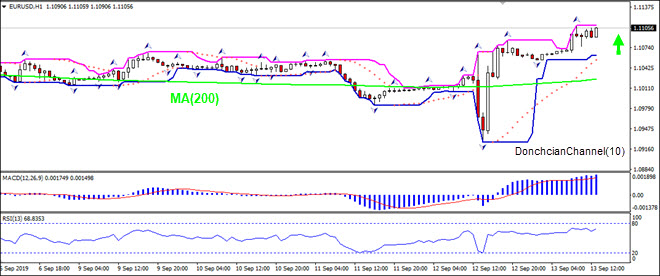
Euro-zone trade balance surplus rose in July when a slight decline was expected. Will the EURUSD rise?

EURUSD rising above MA(200)

On 1-hour timeframe EURUSD: H1 is in uptrend. The price has crossed above the 200-period moving average MA(200) which has started to rise.

Technical Analysis Summary

OrderBuy
Buy stopAbove 1.1109
Stop lossBelow 1.1055

Market Analysis provided by IFCMarkets

Azerbaijan cuts rate 10th time, inflation decides future

By CentralBankNews.info
Azerbaijan’s central bank cut its benchmark interest rate for the 10th time since February 2018 but signaled it may now pause by saying future decisions on interest rates will be based on actual and projected inflation along with the impact of internal and external risks to inflation.
The Central Bank of the Republic of Azerbaijan (CBA) cut its discount rate by 25 basis points to 8.0 percent and has now cut it by 7 percentage points since last February. It is CBA’s sixth rate cut this year, with the rate cut 175 points.
CBA’s reference to inflation determining its next rate move compares with its guidance from July when it said the trend toward a neutral policy stance would continue as long as inflation is expected to remain within its target of 4.0 percent, plus/minus 2 percentage points.
Today CBA said it latest forecast sees inflation remaining within its target range by the end of 2019 and while inflation expectations had not changed, external factors – such as volatile trade, currency and commodity markets in the context of worsening global growth – now have a greater potential to impact inflation than domestic factors.
Azerbaijan’s inflation rate eased to 2.6 percent in August from 2.7 percent in July but is expected to rise to within the target range by the end of this year due to rising fiscal spending and consumption.
In the first 7 months of the year, gross domestic product expanded by 2.5 percent, with the growth in the non-oil sector 3 percent and currency reserves have risen 10.5 percent, or by US$4.7 billion, since the start of the year to $49.4 billion.

www.CentralBankNews.info


GB100 Analysis: Positive data bullish for GB100 Stock Market

By IFCMarkets

Positive data bullish for GB100

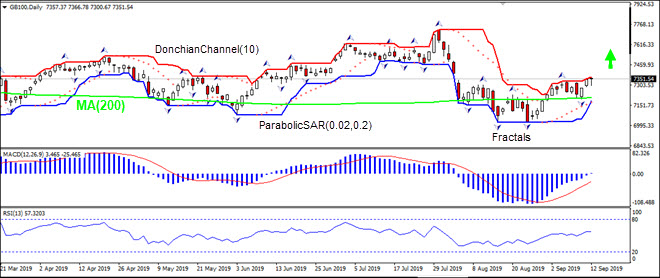
UK’s manufacturing output decline was less than expected. Will the GB100 stock index continue advancing?

UK data lately were positive on balance: contraction in manufacturing sector slowed while construction output grew in July. Manufacturing production declined 0.6% over year after 1.4% drop in June, while construction output rose 0.3% after 0.2% decline. And labor market remains strong: data indicated UK jobless rate fell back to lowest since mid-1970 – 3.8% after 3.9% in June. And British lawmakers are opposing Prime Minister Boris Johnson’s actions aimed at leading UK out of European Union without a deal in the end of October. Positive data are bullish for UK’s stock market index.

GB100 gaining above MA(200) 09/13/2019 Technical Analysis IFC Markets chart

On the daily timeframe GB100: D1 is rising after bouncing off the 200-day moving average MA(200).

  • The Donchian channel indicates uptrend: it is narrowing up.
  • The Parabolic indicator has formed a buy signal.
  • The MACD indicator is about to cross above the signal line and the gap is widening, which is a bullish signal.
  • The RSI oscillator is above 50 level but has not reached the overbought zone.

We believe the bullish momentum will continue as the price breaches above the upper boundary of Donchian channel at 7366.78. This level can be used as an entry point for placing a pending order to buy. The stop loss can be placed below the fractal low at 7196.94. After placing the order, the stop loss is to be moved every day to the next fractal low, following Parabolic signals. Thus, we are changing the expected profit/loss ratio to the breakeven point. If the price meets the stop loss level (7196.94) without reaching the order (7366.78), we recommend cancelling the order: the market has undergone internal changes which were not taken into account.

Technical Analysis Summary

OrderBuy
Buy stopAbove 7366.78
Stop lossBelow 7196.94

Market Analysis provided by IFCMarkets

Trade Hopes Weigh On Gold

By Orbex

Despite some two way action, gold prices are ending the week in the red, as of writing. Earlier in the week, gold prices were weighed down by a firm recover in risk sentiment. It had improved in response to better relations between the US and China. Equities initially rallied on the news that the next set of Trump’s tariffs are postponed for two weeks. This was in line with reports that China was considering US agricultural purchases.

Later in the week, this theme developed further. Reports highlighted that the Trump administration is now considering offering China a limited trade deal. This would postpone further tariffs and even roll back some of the tariffs already in place. This would be in exchange for a commitment to intellectual property as well as agricultural purchases.

On Wednesday Trump announced that a 5% levy increase which was due to take effect as of October 1st, would now be postponed for two weeks. Trump said that China had asked for the delay and are also making plans to remover some of the tariffs on US goods. China released a list of 16 US imports which will now be exempt from tariffs. This includes anti-cancer drugs and animal feed.

Writing on Twitter, Trump said:

“on October 1st, we have agreed, as a gesture of goodwill, to move the increased Tariffs on 250 Billion Dollar’s worth of goods (25% to 30%), from October 1st to October 15th

News of Trump’s postponed tariffs comes ahead of the next round of US/China trade talks due this month. The markets are now hopeful that a deal (even a partial deal) can be done. The negative impact of the nearly two-year-long trade war has been clear around the globe. As central banks roll out fresh easing to deal with the global downturn there is even more pressure on both sides to return to normal trading conditions.

Technical Perspective

xauusd

The sell-off in gold this week, which saw the rejection from 1522.75 continue, has now taken gold back below the upper line of the bullish channel running from 2015 lows. While gold remains capped by the 1522.75 level, a further retracement lower could be in store. While above the 1434.81 highs, the focus remains on a further grind to the upside.

Silver

Silver prices have broadly tracked the moves in gold this week. Prices have come under pressure as risk sentiment improves, though are fighting to stay in the green as of writing. Indeed, expectations of a Fed rate cut this month and the potential for a weaker USD, are offering some support in the near term.

Additionally, downside linked to its relationship with gold is being partially offset by higher equities prices. This is given silver’s frequent industrial usage. Optimism over an interim US/China trade deal is helping keep equities prices well bid into the end of the week, lending some support to silver also.

Technical Perspective

xagusd

The burst above 18.6404 last week proved short-lived with price quickly retreating back below the level. However, the subsequent downside move has not broken back below the 17.6936 level. Above here, the focus is on a further push to the topside in the near term.

By Orbex

EUR Surges Despite Fresh ECB Easing

By Orbex

Dollar Dives Down

The US dollar weakened significantly over the European morning on Friday as optimism over a partial US/China trade deal led equities higher, taking some of the safe-haven bid out of USD. The fall comes despite data yesterday which showed core inflation rising to one year high in August. For now, however, the market is still expecting the Fed to ease this month though pricing for a further hike in 2019 is receding. USD index trades 97.59 last.

EUR Rallies Despite ECB Easing

EURUSD remains firmly bid today as the market continues to rally in the wake of the ECB announcing a wave of easing measures at yesterday’s September meeting. Despite both a cut to the deposit rate and the restarting of QE, it seems that some were expecting a more aggressive move, leading EURUSD back up to challenge the 1.1112 level last.

Fading No-Deal Brexit Risks Boost GBP

GBPUSD has been firmly bid today. Optimism around the receding chances of a no-deal Brexit happening by October 31st has caused a strong short squeeze in GBP. Law passed this week means that unless a deal (or a no-deal exit) can be approved by parliament by October 19th, the PM must request an extension to Article 50 until January 31st, 2020. GBPUSD trades 1.2463 last with price having broken firmly above the 1.2382 level.

Risk Sentiment Strong Into Weekend

Risk assets have remained well supported over the final European session of the week in light of a fresh wave of stimulus in Europe, growing optimism around both a potential US / China trade deal and the aversion of a no-deal Brexit. SPX500 trades 3019.30 last, with price making its way back up to near all-time highs. The prospect of further Fed easing is also keeping the outlook bullish in the near term.

Softer USD Supports Gold & JPY

Safe-havens have both been a little higher today, despite the rally in risk sentiment, as a weaker USD creates space to the upside in both JPY and gold. USDJPY trades 107.99 last as the bearish USD move has seen price pulling away from recent highs. XAUUSD trades 1507.74 last with price rallying back up following the recent rejection at the 1522.75 level.

Crude Rallies on USD Dip

Oil prices have recovered off initial lows on the day in light of the strong move lower in USD. Earlier this week, the EIA reported a large drawdown in US crude stores though this was upstaged by a set of bearish forecasts from OPEC, which is now considering further production cuts in December. Crude trades 55.03 last.

Commodity Currencies Supported

USDCAD has softened today given the weakness in USD and the recovery in oil. Price trades 1.3220 last, though still above the 1.3207 level for now. US data later today could still turn the tide for USD though the focus on improvements in global trade expectations is keeping CAD supported for now.

AUDUSD remains well supported today also. The growing optimism around US/China trade negotiations following Trump postponing the start of the next round of tariffs, as well as news of a potential interim trade deal, is helping keep AUD sentiment buoyant with price trading .6874 last.

By Orbex

What Are The Best Forex Indicators For Trend Trading?

By Orbex

Given that there are so many indicators out there, some are obviously optimized for certain kinds of trading.

Trend traders need to focus more on certain aspects than day traders. So, trend traders developed indicators that meet their needs more specifically.

Of course, each person’s trading is different depending on personal factors. And you can’t rely on just one indicator! But, usually, the most popular indicators are popular for a reason.

In fact, some can be so popular that they become something of a self-fulfilling prophecy. Let’s go over a few of the indicators that experienced forex traders keep turning to, and vouching for their usefulness.

A quick note that most people don’t mention: forex as a unique and popular trading discipline is relatively new.

This means that most of the indicators that we use were developed with other assets in mind, such as stocks, bonds, commodities, etc. This means that their performance can be somewhat different than originally designed when you apply them to the forex markets. It’s helpful to keep that in mind when deciding to incorporate an indicator into your arsenal.

A Look Under the Hood

Trend traders are, as the name suggests, looking to identify trends to trade on. There are two parts; one is identifying a trend as it’s going along, and the other is identifying when a trend is starting and ending.

Ideally, a good indicator will be able to do both, but some are better at one job or the other.

The simplest, and often, therefore, more practical, are moving averages. Most indicators are based off some form of sophisticated moving averages. So, having a grounded understanding of moving averages is helpful for any kind of forex trading. Because they are so basic, they are also among the most commonly used.

It’s Mathematical

Moving averages smooth over the market for a period of time. This helps easily see where it’s trending. If you combine two moving averages, say a fast and a slow one, you’ll find that they cross over each other.

By definition, before a trend changes direction (ends a trend and creates a new one), the shorter MA has to cross over the longer one. Crossovers are so popular that they are almost seen as another indicator themselves.

MACD is probably the most popular forex trading indicator out there for any type of FX trader. And it’s no exception among trend traders!

As pointed out previously, it’s designed to identify inflection points in the FX market. It gives signals for when a new trend is being created, as well as showing a trend’s exhaustion.

Parabolic SAR

This indicator often gets a lot of attention because it’s quite sophisticated and helpful for identifying trend reversals. In fact, that’s exactly what it was designed to do. However, it’s often misunderstood, and falls out of use among many FX traders.

This is a pity because it’s quite useful in the forex markets, especially when used in combination with another indicator.

It works by placing a dot next to the market graph, showing the direction in which the next reversal will be. In other words, if the market is trending up, the dot will appear beneath the graph. If the trend is downwards, then the dot will appear above.

It’s Good Backup

The Parabolic SAR indicator works best in a trending market. It gives you signals for when you can hop on and grab some points as the market keeps to it’s trend. A combination of the indicator in two or more time frames helps to take advantage of a shorter term trend, while keeping an eye out for a potential reversal in a longer timeframe.

What a lot of forex traders find it useful for is to set trailing stop losses, and shaving some risk off the market.

Since the parabolic SAR shows where a reversal will likely hit, it’s helpful for placing stop losses where you’ll get the action without getting stopped out.

Remember to thoroughly backtest your strategy and keep track of your forex trading to make sure you are getting the most out of the market. While these indicators are common and useful for FX traders, none are a sure-fire way to make money.

That’s why your judgment as a forex trader is always the most important!

By Orbex


Forex Technical Analysis & Forecast 13.09.2019 (EURUSD, GBPUSD, USDCHF, USDJPY, AUDUSD, USDRUB, USDCAD, GOLD, BRENT, BTCUSD)

Article By RoboForex.com

EURUSD, “Euro vs US Dollar”

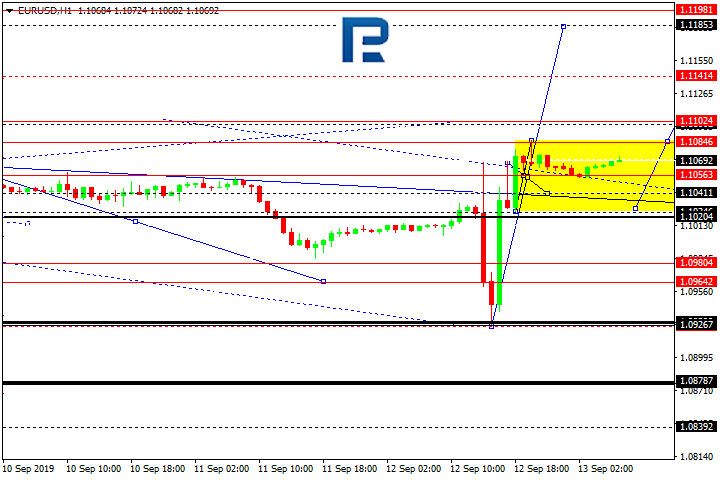
After finishing the descending wave at 1.0927 and almost forming Double Bottom pattern, EURUSD has completed the ascending impulse towards 1.1085; right now, it is consolidating around 1.1056. If later the price breaks this range to the upside, the instrument may resume trading upwards with the target at 1.1185; if to the downside – then start another decline to reach 1.1000.

EURUSD
Risk Warning: the result of previous trading operations do not guarantee the same results in the future

GBPUSD, “Great Britain Pound vs US Dollar”

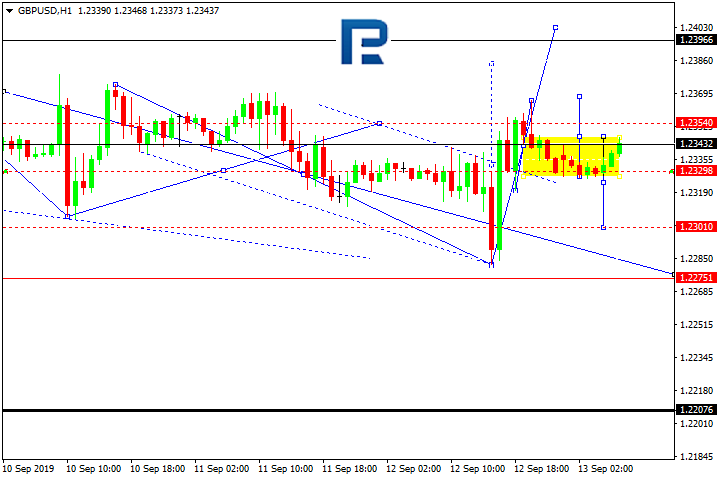
After completing the descending wave at 1.2288, GBPUSD has formed the ascending wave towards 1.2355. Possibly, today the pair may consolidate around 1.2343. If later the price breaks this range to the upside, the instrument may form one more ascending structure with the target at 1.2396; if to the downside – then start a new correction to reach 1.2300.

GBPUSD
Risk Warning: the result of previous trading operations do not guarantee the same results in the future

USDCHF, “US Dollar vs Swiss Franc”

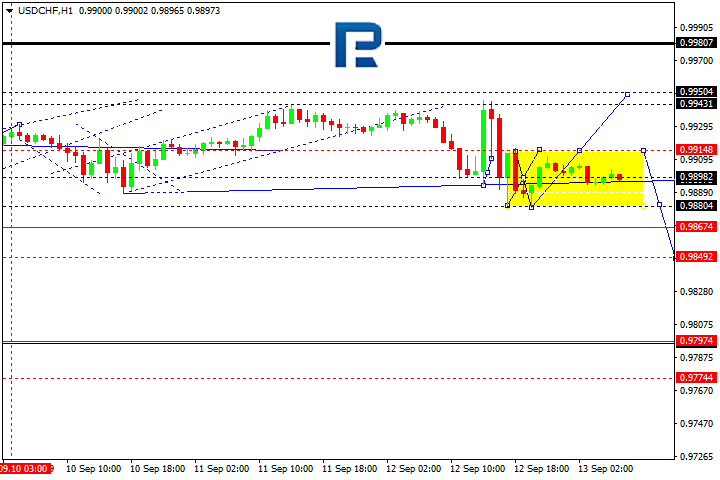
USDCHF has finished the descending impulse at 0.9898; right now, it is consolidating around this level. According to the main scenario, the price may break the range downwards and fall with the target at 0.9849.

USDCHF
Risk Warning: the result of previous trading operations do not guarantee the same results in the future

USDJPY, “US Dollar vs Japanese Yen”

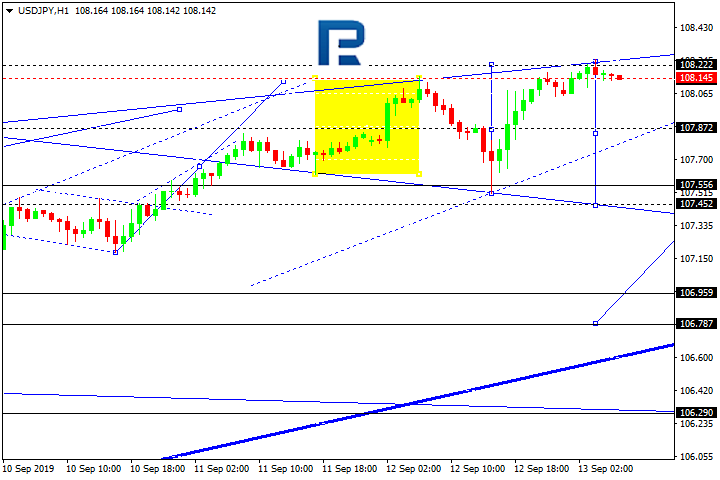
USDJPY is consolidating around 107.87. Today, the pair may form a new descending structure to reach 107.45 and then resume trading inside the uptrend with the target at 107.87.

USDJPY
Risk Warning: the result of previous trading operations do not guarantee the same results in the future

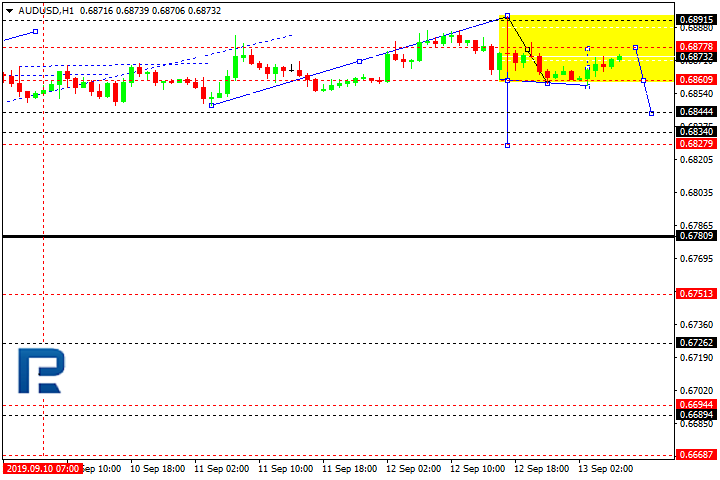
AUDUSD, “Australian Dollar vs US Dollar”

AUDUSD has completed the descending impulse towards 0.6860; right now, it is correcting to reach 0.6877. Possibly, today the pair may start another decline with the first target at 0.6828.

AUDUSD
Risk Warning: the result of previous trading operations do not guarantee the same results in the future

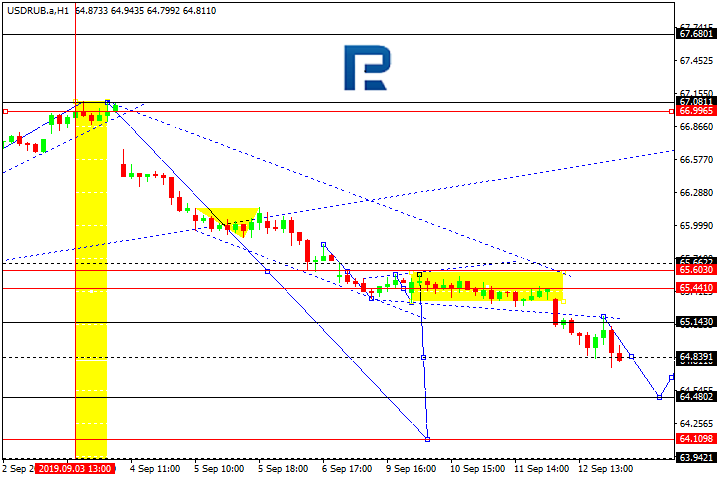
USDRUB, “US Dollar vs Russian Ruble”

USDRUB is moving downwards. Today, the pair may reach 64.44 and then resume trading upwards with the target at 64.84. Later, the market may continue moving downwards to reach 64.10.

USDRUB
Risk Warning: the result of previous trading operations do not guarantee the same results in the future

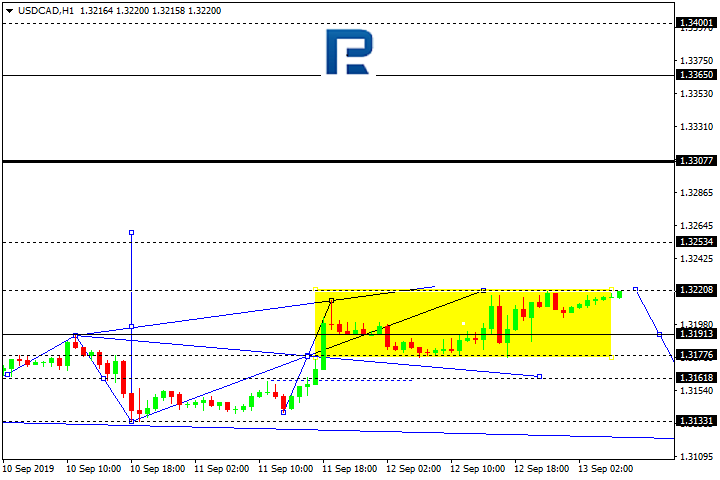
USDCAD, “US Dollar vs Canadian Dollar”

USDCAD is moving upwards to reach 1.3220. Possibly, the pair may reach this level and start a new correction towards 1.3190, at least. After that, the instrument may form one more ascending structure with the target at 1.3300.

USDCAD
Risk Warning: the result of previous trading operations do not guarantee the same results in the future

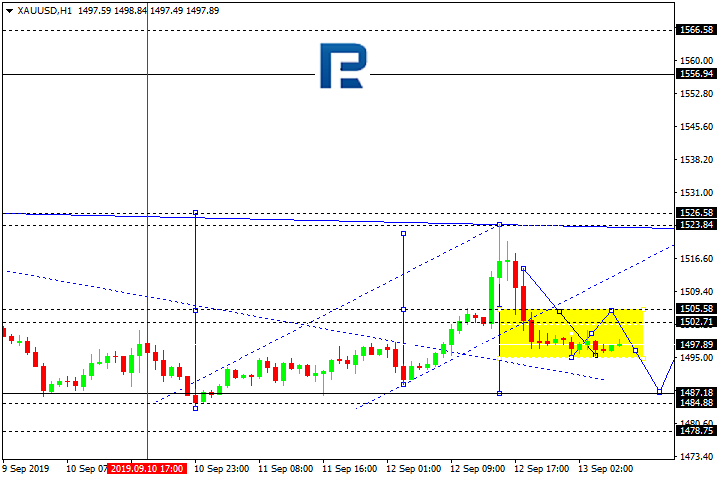
XAUUSD, “Gold vs US Dollar”

Gold is consolidating around 1505.50. If later the price breaks this range to the downside, the instrument may resume trading downwards with the target at 1487.20; if to the upside – then start another growth to reach 1526.60.

GOLD
Risk Warning: the result of previous trading operations do not guarantee the same results in the future

BRENT

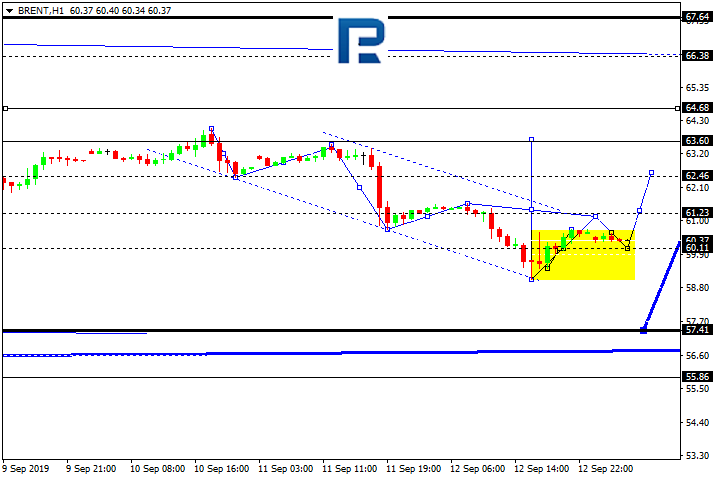
Brent is moving upwards to reach 61.23. Later, the market may form a new descending structure towards 60.11 and then resume trading inside the uptrend with the first target at 63.60.

BRENT
Risk Warning: the result of previous trading operations do not guarantee the same results in the future

BTCUSD, “Bitcoin vs US Dollar”

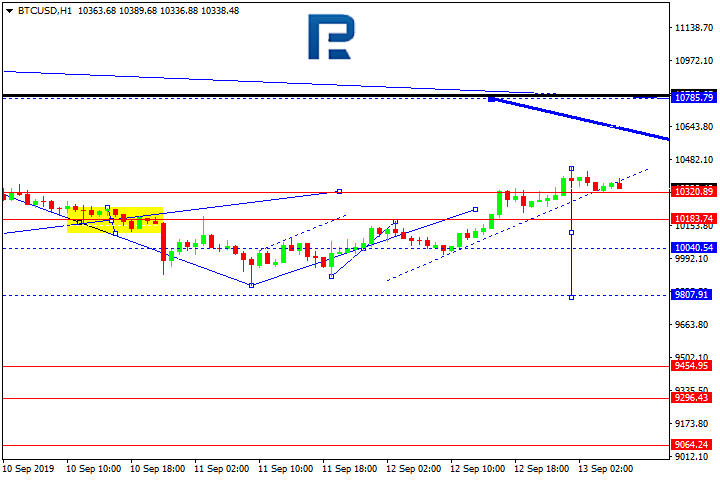
BTCUSD is moving downwards with the target at 9800.00. After that, the instrument may form one more ascending structure towards 10180.00 and then resume trading inside the downtrend with the first target at 9500.00.

BTCUSD

Article By RoboForex.com

Attention!
Forecasts presented in this section only reflect the author’s private opinion and should not be considered as guidance for trading. RoboForex LP bears no responsibility for trading results based on trading recommendations described in these analytical reviews.

Fibonacci Retracements Analysis 13.09.2019 (BITCOIN, ETHEREUM)

Article By RoboForex.com

BTCUSD, “Bitcoin vs US Dollar”

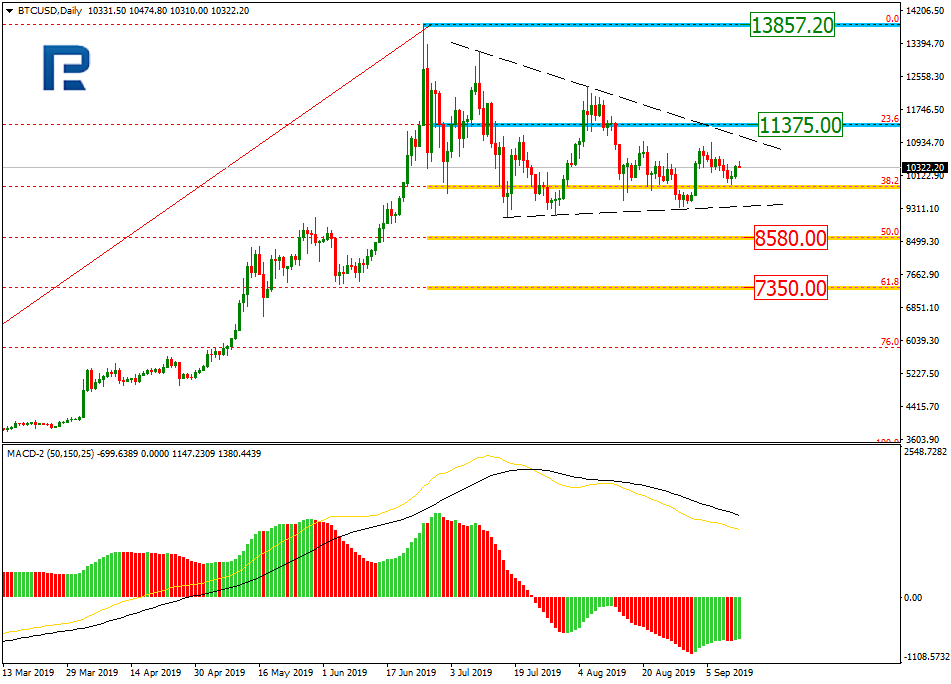
As we can see in the daily chart, the correctional Triangle continues close to 38.2% fibo. If the price breaks the current resistance level and 23.6% fibo at 11375.00, BTCUSD will continue growing towards the high at 13857.20. At the same time, MACD lines are heading downwards, which means that the decline may yet continue towards 50.0% and 61.8% fibo at 8580.00 and 7350.00 respectively.

BTCUSD
Risk Warning: the result of previous trading operations do not guarantee the same results in the future

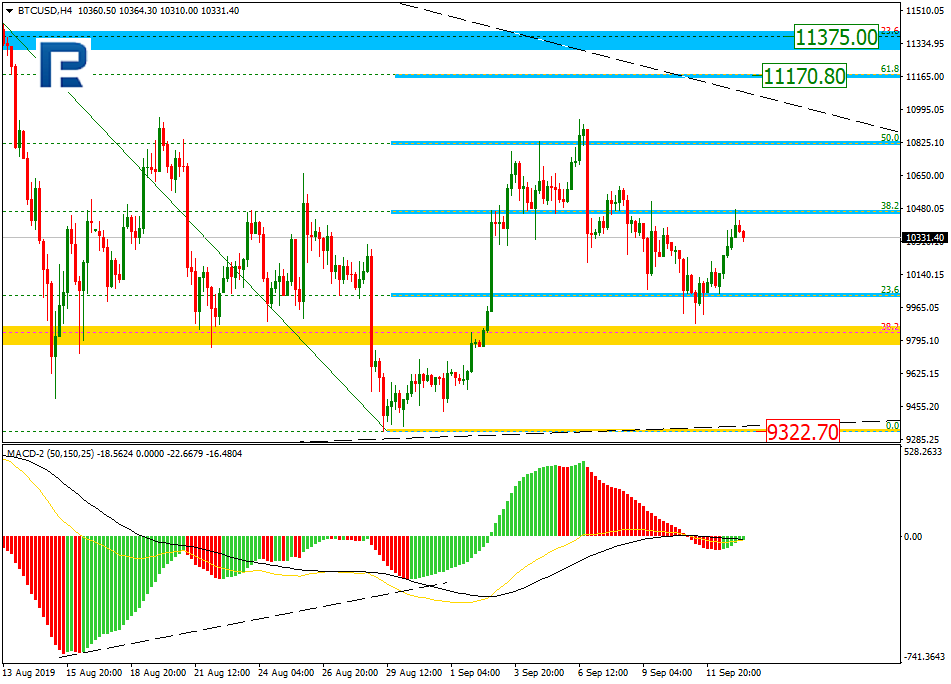
In the H4 chart, the pair is correcting to the upside after the convergence and has already reached 50.0% fibo. In the future, the correction may continue towards 61.8% fibo at 11170.00. The support is the low at 9322.70.

BTCUSD_H4
Risk Warning: the result of previous trading operations do not guarantee the same results in the future

ETHUSD, “Ethereum vs. US Dollar”

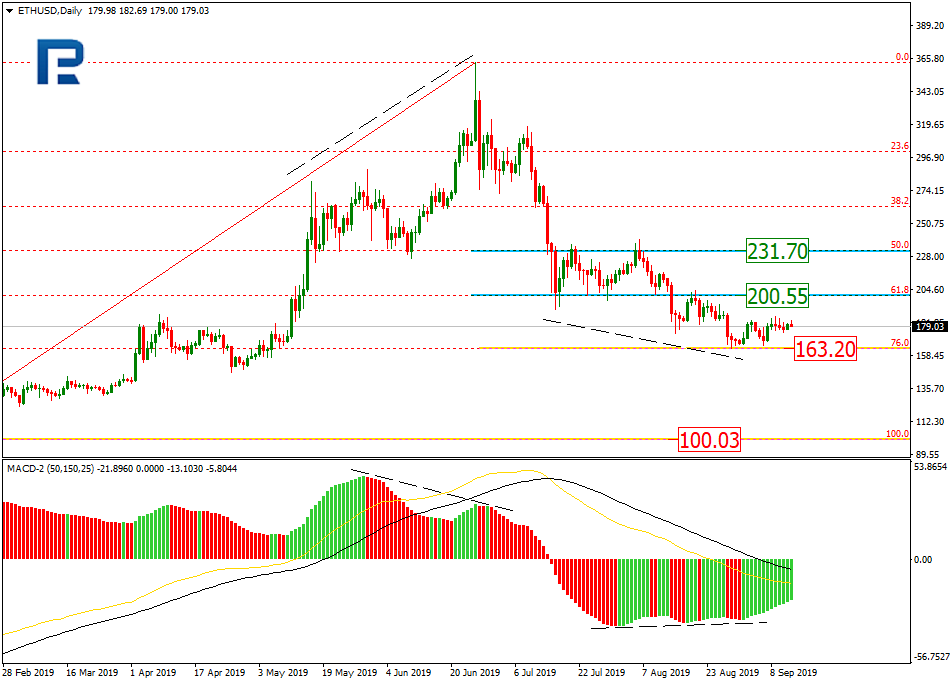
As we can see in the daily chart, the descending tendency reached 76.0% fibo and then there was a convergence on MACD. However, the pullback that started later can’t be called very significant. Still, the pullback may yet continue towards 61.8% and 50.0% fibo at 200.55 and 231.70 respectively. After breaking 163.20, the instrument may plummet to reach 100.03.

ETHEREUM
Risk Warning: the result of previous trading operations do not guarantee the same results in the future

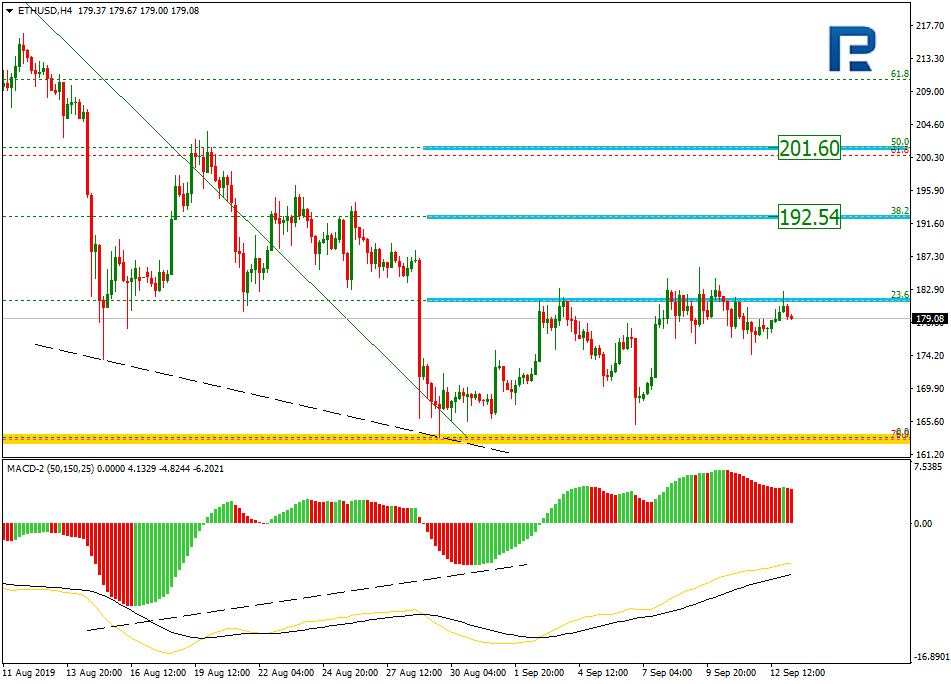
The H4 chart shows more detailed structure of the current correction. By now, the pair has already reached 23.6% fibo. Later, the price may continue growing towards 38.2% and 50.0% fibo 192.54 and 201.60 respectively.

ETHUSD

Article By RoboForex.com

Attention!
Forecasts presented in this section only reflect the author’s private opinion and should not be considered as guidance for trading. RoboForex LP bears no responsibility for trading results based on trading recommendations described in these analytical reviews.