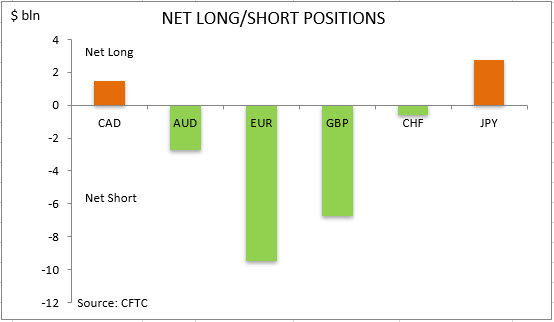
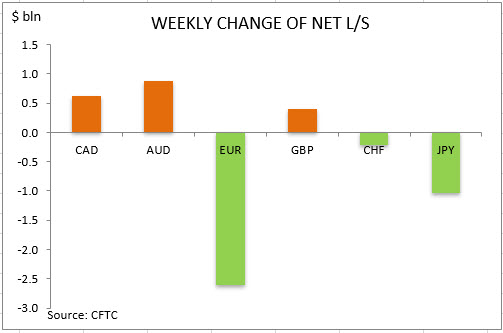
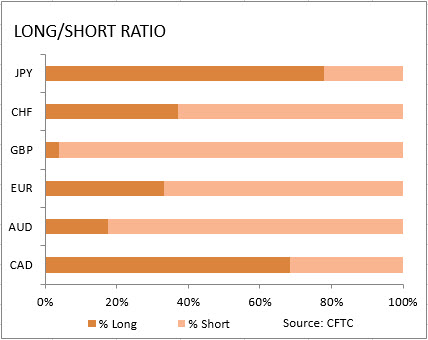
US dollar bullish bets rose to $17.34 from $15.28 billion against the major currencies during the one week period, according to the report of the Commodity Futures Trading Commission (CFTC) covering data up to September 24 and released on Friday September 27. The ICE US Dollar index USDX rose as US-China trade dispute concerns heightened after President Trump’s comment he wanted a complete trade deal with the China, not just an agreement for China to buy more US agricultural goods, while the Federal Reserve cut its benchmark federal funds rate a quarter percentage point without signaling further easing of monetary policy.
Note: This overview has an informative and tutorial character and is published for free. All the data, included in the overview, are received from public sources, recognized as more or less reliable. Moreover, there is no guarantee that the indicated information is full and precise. Overviews are not updated. The whole information in each overview, including opinion, indicators, charts and anything else, is provided only for familiarization purposes and is not financial advice or а recommendation. The whole text and its any part, as well as the charts cannot be considered as an offer to make a deal with any asset. IFC Markets and its employees under any circumstances are not liable for any action taken by someone else during or after reading the overview.
Global silver supply is heavily dependent on one factor that is overlooked by the majority of precious metals analysts. For some odd reason, analysts only consider the cost of this factor and not the future supply. Without this supply, 98% of the silver production from these two primary silver mines would not have been possible.
Without energy, silver mine supply would likely collapse more than 95+%. Unfortunately, analysts only focus on the cost of energy and not the future availability of it.
For example, even though the cost of diesel for Pan American Silver was approximately 7-8% of its total mining costs in 2018, without the 15.4 million gallons of diesel consumed by the company’s mines, the overwhelming majority of that silver would have stayed in the ground. I estimated Pan American Silver’s diesel cost by multiplying the 15.4 million gallons by a wholesale price of diesel of $2.50. This is just an estimate.
I decided to focus on Pan American Silver’s two highest ore-grade primary mines. The La Colorado Mine in Mexico had a silver ore grade of 11.5 ounces per ton (oz/t) and the San Vincente Mine in Bolivia was 11.6 oz/t. These two mines would use the least amount of fuel per oz of silver production versus the other mines. Thus, the figures below are a BEST CASE scenario and are quite conservative compared to the entire primary silver mining industry.
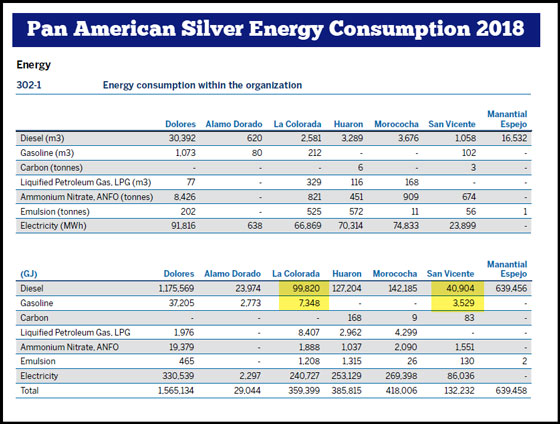
First, here are the different amounts of energy consumed by Pan American Silver’s mines:
table from Pan American Silver 2018 Sustainability Report
These figures are in GigaJoules, so I converted them to gallons. You will notice I did not consider any other energy sources, so the figures below are likely higher.
La Colorado & San Vincente Mines consumed = 151,601 GJ of Fuel
1 GJ Fuel = 6.825 gallons Fuel
La Colorado & San Vincente Mines Fuel consumed = 1,035,000 gallons Fuel
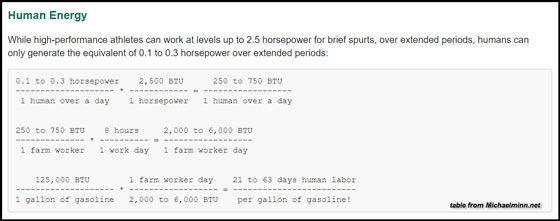
How much human work is the equivalent to a gallon of fuel? I have found different answers, but the average seems to be 1-gallon gasoline equals approximately 250 human hours of labor. While a gallon of diesel fuel has more energy than gasoline, I just used the gasoline figure to keep it simple. I used the data from this chart for the 1-gallon gas = 250 hours of human labor:
Again, doing some simple math:
1,035,000 gallons X 250 work hours/gal = 259,000,000 work hours
259,0000,000 work hours / 10 Hour work day = 25,900,000 workers a day
25,900,000 workers a day / 356 days = 71,000 workers (approx.)
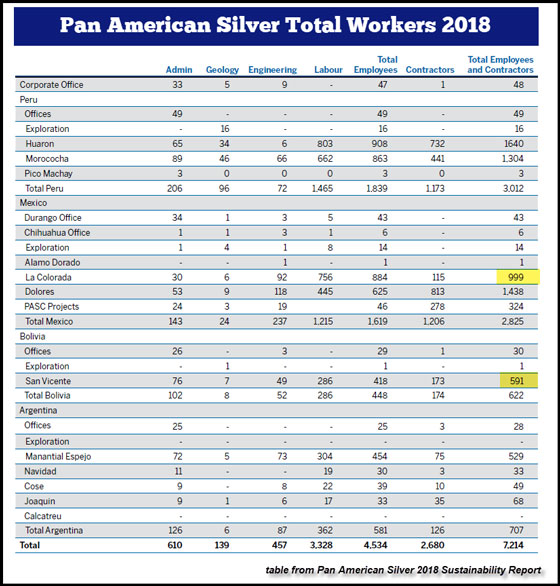
Here is Pan American Silver’s table on total employees and workers:
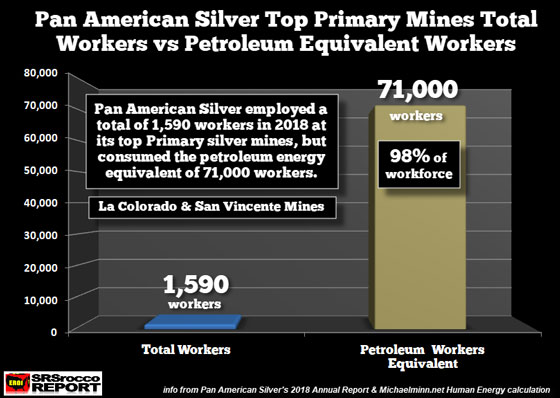
So, the La Colorado and San Vincente Mine employed a total of 1,590 workers in 2018. Now, if we compare the actual workers to the 71,000 petroleum equivalent workers last year at these two mines, here is the result:
Even though Pan American Silver employed 1,590 workers at these two mines in 2018, the liquid fuel consumed equaled a stunning 71,000 people working 10 hours a day, 365 days a year. Thus, the petroleum equivalent workers, from the diesel and gasoline consumed at the La Colorado and San Vicente Mines accounted for 98% of the total “Energy Workforce.”
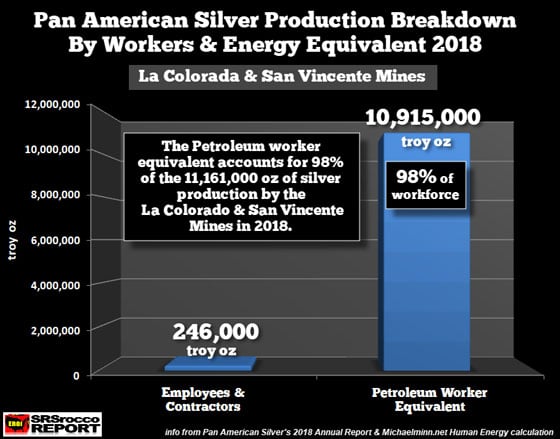
I really don’t think precious metals investors or analysts understand how critical liquid energy is to the silver mining industry, as well as the entire global economy. And, if we take it a step further and divide the amount of silver production between the real human workers versus petroleum equivalent workers, the labor from Pan American Silver’s workers only accounted for 246,000 oz of the total 11.2 million oz produced at these two mines last year:
However, if diesel supplies ran out, could these workers at these mines produce 246,000 oz of silver? Good question. But, we must remember, these mines are only producing silver at 11.5 oz per ton. It would take the mining, extraction, transportation, and refining of 1,000 tons to only get 11,500 oz of silver. Actually, the net yield after processing is only 10.5 oz/t.
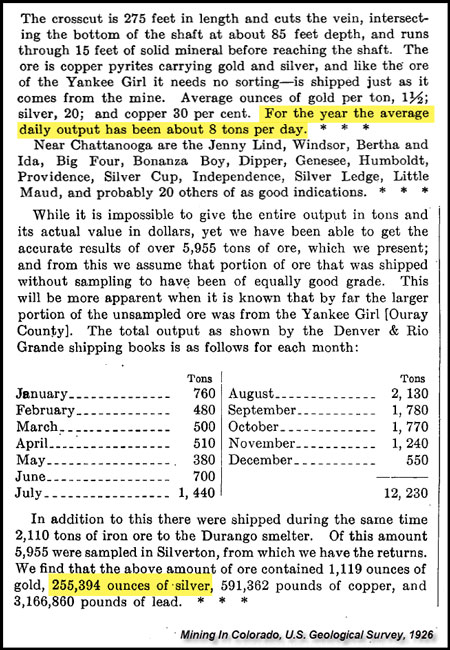
Let’s go back in time in Colorado during the late 1800s and see how many tons of ore miners were extracting. According to the U.S. Geological Survey publication, Mining In Colorado, 1926, here is the following excerpt:
At the Yankee Girl Mine in San Juan County in Colorado during 1883, the miners were extracting about 8 tons of ore per day. However, the monthly figures of tons shown above are totals for the entire San Juan County that year. If we divide the 255,394 oz of silver (highlighted) by the 12,230 tons, it equals nearly 21 oz per ton. Furthermore, 12,300 tons divided by 365 days a year is 34 tons per day for the entire county. Not much at all per day compared to the 2,900 tons of ore processed per day using GOBS of ENERGY by La Colorado and San Vincente Mines last year.
So, it would be a real TEST of human endurance if those 1,590 workers could produce 246,000 oz of silver in a year. They would have to mine, extract, transport, and refine 23,400 tons (rounded) of ore, 64 tons per day, to get that 246,000 oz of silver.
Oh by the way… I didn’t even include the Electric Energy consumed by these two mines, mostly in the processing of the ore. Electricity consumption at La Colorado and San Vincente was the equivalent of 153,000 laborers working 10 hours a day, 365 days a year. What do you think of them apples?
The world has no clue how vital oil is to the mining industry and the global economy. We have totally taken it for granted. When U.S. shale oil production finally peaks and crashes, the world will begin to enter the next economic stage, transitioning from BUILDING WEALTH to PROTECTING IT.
The Money Metals News Service provides market news and crisp commentary for investors following the precious metals markets.
Third time seems to be the charm! We are heading into the third meeting since the RBA last cut the reference rate.
It’s not the only major event coming up tomorrow, however. Among data to look out for, we have Manufacturing PMI and Building Approvals.
So, we could expect quite a bit of volatility in AUD and NZD pairs.
Today marks the end of the third quarter. This means that overnight, a large number of futures contracts will be rolled over, putting extra pressure on the market’s liquidity.
We’re also at the start of the release of third-quarter data, which also moves the market. All in all, it would be a good idea to keep an eye on price action for now.
What We Are Looking For
For the RBA rate decision, there is a pretty broad consensus that there will be a cut.
This, despite the lack of official release of quarterly data. Accompanying the rate decision there is a rate statement and later a scheduled press conference by Governor Lowe. Those factors all but confirm that we’ll get action out of the central bank.
As for the market reaction, given how sure everyone is about more easing, a 25 point cut has broadly been priced into the market. We wouldn’t expect a huge amount of volatility, and that might mean the Rate Statement will be the market mover.
That the statement will almost assuredly include a reiteration that the bank stands ready to take further action. What we’ll be looking at is how dovish the statement is, especially if there is future mention of action. We’ll also be focusing on what the bank thinks of potential negative rates and the potential of unconventional measures.
The Path Forward
The consensus has been that the reference rate would be at 0.75% by the end of the year. This implies one more cut.
So, if the bank opens the door to the rate falling to 0.5% in the next three months, we could say that would provide a dovish surprise to the market.
The other unlikely dovish surprise, that the RBA takes a page out of the RBNZ’s book and cuts by 50 basis points. But no analyst is expecting that.
While the economists surveyed by Bloomberg are pretty confident there will be a cut; the survey among Australia is not as sure.
Both coincide that the rate will be 0.75% by the end of the year, only a small majority of Aussies think we’ll get action this time around. The difference is explained by a differing interpretation of the same argument: that data since August has been largely the same.
This leads the bears to interpret it as implying more action is necessary to support the economy. Meanwhile, the bulls argue that if the data didn’t show the need to cut rates in September then it shouldn’t have changed the outlook for October.
Who’s Right?
On the one hand, we are moving into the more economically active spring and summer season in Australia.
Global trade uncertainty seems to have diminished. On the other, we have the minutes of the last meeting, which did not reference the previous action. This is typically a sign that the bank doesn’t think it needs to wait for new data.
Last week, Governor Lowe said that he’d been “surprised” by the recent downturn in Australia. He argued that the RBA can’t ignore the drop in rates around the world.
He echoed the “long period of low interest rates will be necessary” phrase, which would be the bit traders will be looking for during his next press conference. It would help to make the market feel more comfortable about the pricing in of policy going forward.
The longer-term question now is, how low will the RBA go?
The expected trajectory is to 0.5% by the end of the first quarter next year. Look for some market reaction if there is any talk about the rate approaching zero, and what the RBA might do about that.
The drill results and next steps are reviewed in a Mackie Research Capital Corp. report.
In a Sept. 17 research note, Mackie Research Capital Corp. analyst Bill Newman reported that Pan Orient Energy Corp. (POE:TSX.V) drilled a new oil discovery in Thailand, and testing is expected to begin soon. Drilling also is to commence shortly, in 3040 days, at Pan Orient’s Anggun-1X well in Indonesia now that the requisite construction is done.
Newman reviewed the results from the exploration well in Thailand that hit oil, L53-DD5ST1. It encountered about 15 meters (15m) of net oil pay within two separate sands, CC where it had net oil pay of 12m, and the deeper EE, where it had 3m. The new discovery is about 737m to the southwest of Pan Orient’s L53-DD oilfield.
Drilling at L53-DD5 will start once drilling, currently underway, at L53-DD6 finishes, which should be in about 14 days. “If testing proves that the DD5 discovery is commercial, it should provide an immediate production boost and set up low risk development opportunities for 2020,” commented Newman.
He added that Pan Orient has additional exploration wells to be drilled in Thailand before year-end, which also could help build momentum into next year.
As for the upcoming drilling of the Anggun-1X well, that process is expected to take about 31 days. “In the event the well is successful, Pan Orient plans to drill a follow-up appraisal well in 2020,” Newman noted.
The analyst reiterated the Buy recommendation and $3.25 per share target price that Mackie has on Pan Orient, which are due to its “strong financial position, growing production base in Thailand and high-impact exploration potential of the Anggun-1X exploration well in Indonesia.”
Disclosure: 1) Doresa Banning compiled this article for Streetwise Reports LLC and provides services to Streetwise reports as an independent contractor. She or members of her household own securities of the following companies mentioned in the article: None. She or members of her household are paid by the following companies mentioned in this article: None. 2) The following companies mentioned in this article are billboard sponsors of Streetwise Reports: Pan Orient Energy. Click here for important disclosures about sponsor fees. 3) Comments and opinions expressed are those of the specific experts and not of Streetwise Reports or its officers. The information provided above is for informational purposes only and is not a recommendation to buy or sell any security. 4) The article does not constitute investment advice. Each reader is encouraged to consult with his or her individual financial professional and any action a reader takes as a result of information presented here is his or her own responsibility. By opening this page, each reader accepts and agrees to Streetwise Reports’ terms of use and full legal disclaimer. This article is not a solicitation for investment. Streetwise Reports does not render general or specific investment advice and the information on Streetwise Reports should not be considered a recommendation to buy or sell any security. Streetwise Reports does not endorse or recommend the business, products, services or securities of any company mentioned on Streetwise Reports. 5) From time to time, Streetwise Reports LLC and its directors, officers, employees or members of their families, as well as persons interviewed for articles and interviews on the site, may have a long or short position in securities mentioned. Directors, officers, employees or members of their immediate families are prohibited from making purchases and/or sales of those securities in the open market or otherwise from the time of the interview or the decision to write an article until three business days after the publication of the interview or article. The foregoing prohibition does not apply to articles that in substance only restate previously published company releases. As of the date of this article, officers and/or employees of Streetwise Reports LLC (including members of their household) own securities of Pan Orient Energy Corp., a company mentioned in this article.
Disclosures from Mackie Research, Pan Orient Energy Corp., Update, September 17, 2018
RELEVANT DISCLOSURES APPLICABLE TO COMPANIES UNDER COVERAGE Relevant disclosures required under Rule 3400 applicable to companies under coverage discussed in this research report are available on our web site at www.mackieresearch.com.
ANALYST CERTIFICATION Each analyst of Mackie Research Capital Corporation whose name appears in this report hereby certifies that (i) the recommendations and opinions expressed in this research report accurately reflect the analyst’s personal views and (ii) no part of the research analyst’s compensation was or will be directly or indirectly related to the specific conclusions or recommendations expressed in this research report.
Mackie Research Capital Corporation, its directors, officers and other employees may, from time to time, have positions in the securities mentioned herein.
Shares of Aravive Inc. are trading higher after the firm posted positive data from the initial 12 patients enrolled in the Phase 1b portion of its study of AVB-500 used in the treatment of ovarian cancer.
Today, in a late-breaking oral presentation at the European Society for Medical Oncology Congress, clinical-stage biopharmaceutical company Aravive Inc. (ARAV:NASDAQ), which is developing treatments designed to halt the progression of life-threatening diseases including cancer and fibrosis, presented positive data from the initial 12 patients of the ongoing Phase 1b portion of the company’s Phase 1b/2 study of AVB-500 in ovarian cancer patients.
The company reported that the open-label, Phase 1b portion of the study of AVB-500 in patients with platinum-resistant recurrent ovarian cancer enrolled patients into two cohorts, one investigating a combination of AVB-500 with pegylated liposomal doxorubicin and the other, a combination with paclitaxel. The firm advised that in both study groups, AVB-500 treatment led to early proof of concept with overall best response rate by investigator determined RECIST v1.1 criteria and durable response in responders. AVB-500 was well tolerated with no dose limiting toxicities.
Investigator Bradley J. Monk, M.D., professor and director of the division of gynecologic oncology at Creighton University School of Medicine at St. Joseph’s Hospital and Medical Center in Phoenix, Ariz., commented, “Due to its aggressive nature, ovarian cancer has been particularly challenging to address therapeutically, so we are encouraged by the early positive efficacy signal…This clinical study continues to support previous literature that highlights the potential for agents that can inhibit the GAS6/AXL pathway to provide new treatment options for ovarian cancer patients.”
Aravive plans to report the detailed analysis once the data from the initial 30 patients on the current 10 mg/kg dose mature toward the end of the year. That data analysis will be evaluated to inform the regulatory strategy for AVB-500 as a treatment for platinum-resistant ovarian cancer. If current exposure response relationships are confirmed in the dose escalation portion of the expansion study by mid-2020, Aravive intends to explore the potential for an accelerated regulatory pathway for AVB-500 with the U.S. Food and Drug Administration (FDA). The FDA granted Fast Track Designation to Aravive Biologics’ AVB-500 in platinum-resistant recurrent ovarian cancer in 2018.
The company states that it is further exploring feasibility of biomarker-driven individualized dose adjustments. Aravive also plans to incorporate the exposure-response information into its planned studies in clear cell renal cancer and renal fibrosis trials.
Gail McIntyre, Ph.D., chief scientific officer of Aravive, stated, “Understanding that there is an exposure-response relationship where higher clinical benefit is seen in patients achieving higher drug levels is very promising for our program at this stage…It demonstrates that AVB-500 is contributing to the clinical benefit and it informs the dose that should be tested in pivotal studies.”
Aravive notes that more than 22,000 women in the U.S. develop ovarian cancer each year, and there are approximately 14,240 attributed deaths annually, making ovarian cancer the deadliest of gynecologic malignancies. Most women with ovarian cancer are diagnosed with advanced disease, after the tumor has already spread, and their disease rapidly becomes resistant to existing chemotherapies.
In a separate release today, Aravive announced that company management will participate at the upcoming Cantor Global Healthcare Investor Conference in New York on October 4, 2019.
Aravive Inc., formerly Versartis Inc., is based in Houston, Tex., and describes itself as a clinical-stage biopharmaceutical company developing treatments designed to halt the progression of life-threatening diseases, including cancer and fibrosis. The company identifies its lead product candidate as AVB-500, an ultra-high affinity decoy protein that targets the GAS6-AXL signaling pathway. The firm explains that by capturing serum GAS6, AVB-500 starves the AXL pathway of its signal, potentially halting the biological programming that promotes disease progression and that AXL receptor signaling plays an important role in multiple types of malignancies by promoting metastasis, cancer cell survival, resistance to treatments, and immune suppression. Aravive points out that the GAS6-AXL signaling pathway also plays a significant role in fibrogenesis. Aravive has initiated the Phase 1b portion of a Phase 1b/2 clinical trial of AVB-500 combined with standard of care therapies in patients with platinum-resistant ovarian cancer, and intends to expand development into additional oncology and fibrotic indications.
Aravive has a market capitalization of around $95.6 million with 11.28 million shares outstanding. ARAV shares opened slightly higher today at $8.66 (+$0.19, +2.24%) compared to yesterday’s $8.47 closing price. The stock has traded today between $8.52 and $9.72/share setting a 52-week intraday high price and is presently trading at $8.84 (+$0.37, +4.4%).
Disclosure: 1) Stephen Hytha compiled this article for Streetwise Reports LLC and provides services to Streetwise Reports as an independent contractor. He or members of his household own securities of the following companies mentioned in the article: None. He or members of his household are paid by the following companies mentioned in this article: None. 2) The following companies mentioned in this article are billboard sponsors of Streetwise Reports: None. Click here for important disclosures about sponsor fees. 3) Comments and opinions expressed are those of the specific experts and not of Streetwise Reports or its officers. The information provided above is for informational purposes only and is not a recommendation to buy or sell any security. 4) The article does not constitute investment advice. Each reader is encouraged to consult with his or her individual financial professional and any action a reader takes as a result of information presented here is his or her own responsibility. By opening this page, each reader accepts and agrees to Streetwise Reports’ terms of use and full legal disclaimer. This article is not a solicitation for investment. Streetwise Reports does not render general or specific investment advice and the information on Streetwise Reports should not be considered a recommendation to buy or sell any security. Streetwise Reports does not endorse or recommend the business, products, services or securities of any company mentioned on Streetwise Reports. 5) From time to time, Streetwise Reports LLC and its directors, officers, employees or members of their families, as well as persons interviewed for articles and interviews on the site, may have a long or short position in securities mentioned. Directors, officers, employees or members of their immediate families are prohibited from making purchases and/or sales of those securities in the open market or otherwise from the time of the interview or the decision to write an article until three business days after the publication of the interview or article. The foregoing prohibition does not apply to articles that in substance only restate previously published company releases. 6) This article does not constitute medical advice. Officers, employees and contributors to Streetwise Reports are not licensed medical professionals. Readers should always contact their healthcare professionals for medical advice.
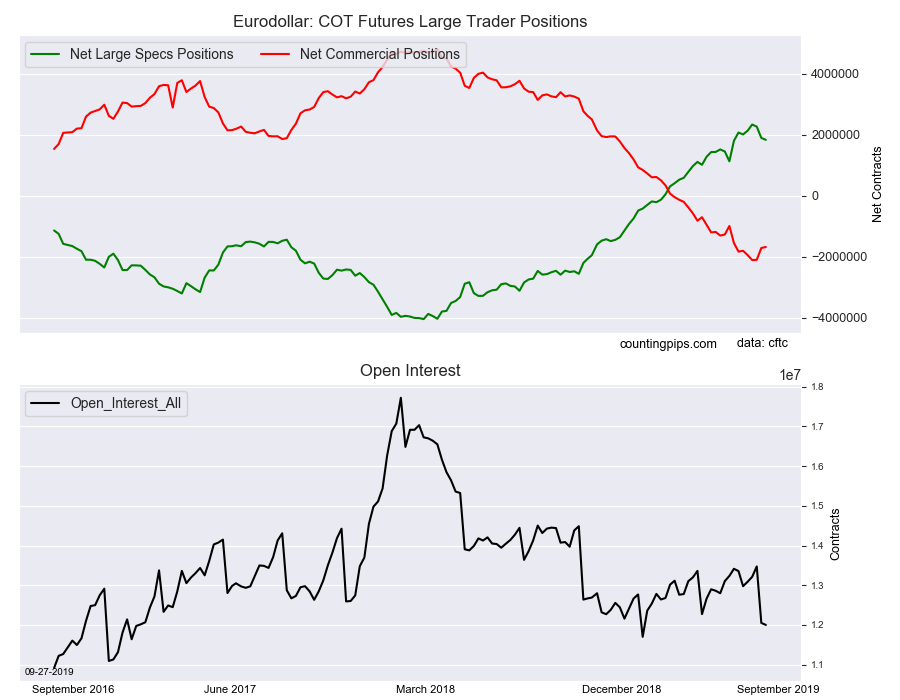
Large bond speculators reduced their bullish net positions in the Eurodollar futures markets again last week, according to the latest Commitment of Traders (COT) data released by the Commodity Futures Trading Commission (CFTC) on Friday.
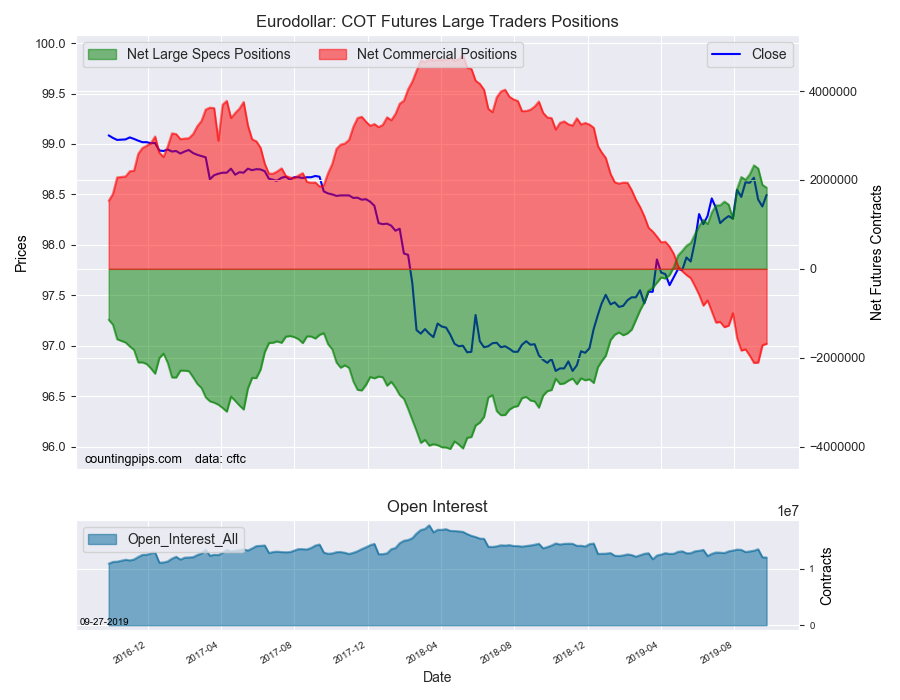
The non-commercial futures contracts of Eurodollar futures, traded by large speculators and hedge funds, totaled a net position of 1,827,324 contracts in the data reported through Tuesday September 24th. This was a weekly decrease of -63,525 net contracts from the previous week which had a total of 1,890,849 net contracts.
The week’s net position was the result of the gross bullish position (longs) sliding by -120,923 contracts (to a weekly total of 2,524,537 contracts) while the gross bearish position (shorts) fell by a lesser amount of -57,398 contracts for the week (to a total of 697,213 contracts).
Eurodollar speculators cut back on their bullish bets for a third straight week and by a total of -504,105 contracts in the last three weeks. The net position is back under the +2,000,000 contract level for a second straight week. The eurodollar speculative level has been in positive territory for twenty-three straight weeks (positions went from bearish to bullish on April 23rd) and after having spent the previous one hundred and forty-six weeks in a net bearish position.
Eurodollar Commercial Positions:
The commercial traders position, hedgers or traders engaged in buying and selling for business purposes, totaled a net position of -1,685,061 contracts on the week. This was a weekly uptick of 33,986 contracts from the total net of -1,719,047 contracts reported the previous week.
ED Futures:
Over the same weekly reporting time-frame, from Tuesday to Tuesday, the Eurodollar Futures closed at approximately $98.49 which was an uptick of $0.11 from the previous close of $98.38, according to unofficial market data.
*COT Report: The COT data, released weekly to the public each Friday, is updated through the most recent Tuesday (data is 3 days old) and shows a quick view of how large speculators or non-commercials (for-profit traders) as well as the commercial traders (hedgers & traders for business purposes) were positioned in the futures markets.
The CFTC categorizes trader positions according to commercial hedgers (traders who use futures contracts for hedging as part of the business), non-commercials (large traders who speculate to realize trading profits) and nonreportable traders (usually small traders/speculators).
We have now gone live with our new member’s area and it going to be amazing with all the new trading tools, indicators, and analysis we will be adding to it.
Watch this short video and get ready to be a full-fledged technical trader and trade stress–free and with confidences.
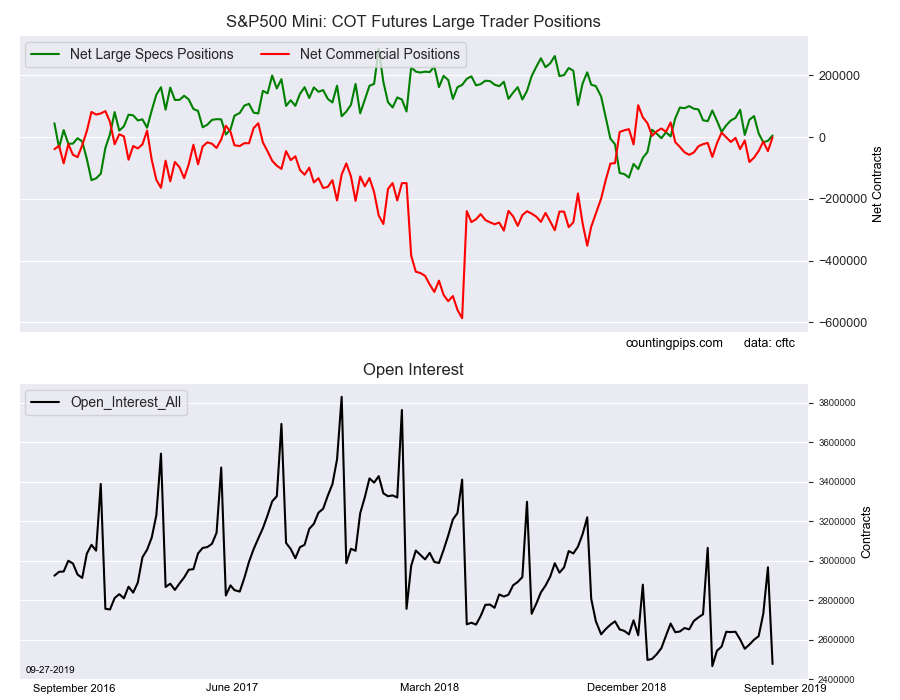
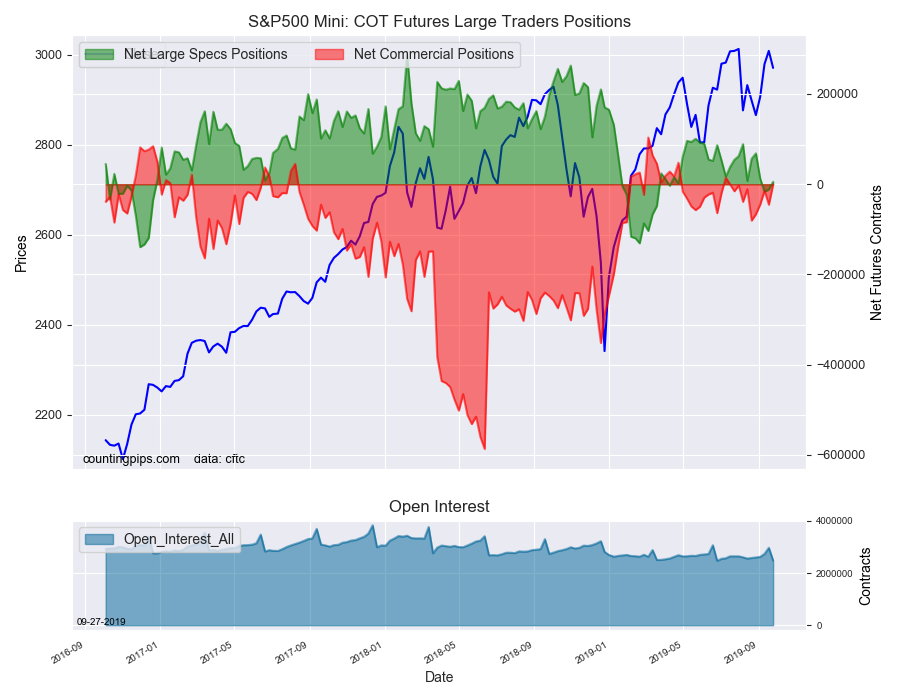
Large stock market speculators raised their bullish net positions in the S&P500 Mini futures markets last week, according to the latest Commitment of Traders (COT) data released by the Commodity Futures Trading Commission (CFTC) on Friday.
The non-commercial futures contracts of S&P500 Mini futures, traded by large speculators and hedge funds, totaled a net position of 5,474 contracts in the data reported through Tuesday September 24th. This was a weekly lift of 17,178 net contracts from the previous week which had a total of -11,704 net contracts.
The week’s net position was the result of the gross bullish position (longs) falling by -24,620 contracts (to a weekly total of 332,525 contracts) while the gross bearish position (shorts) decreased by an even greater amount of -41,798 contracts for the week (to a total of 327,051 contracts).
Speculators raised their long bets for a second consecutive week and pushed into a new overall bullish position. The speculative standing had previously fallen into a net bearish level on September 10th and remained there on September 17th before climbing back out last week.
S&P500 Mini Commercial Positions:
The commercial traders position, hedgers or traders engaged in buying and selling for business purposes, totaled a net position of -153 contracts on the week. This was a weekly rise of 45,078 contracts from the total net of -45,231 contracts reported the previous week.
S&P500 Mini Futures:
Over the same weekly reporting time-frame, from Tuesday to Tuesday, the S&P500 Mini Futures (Front Month) closed at approximately $2970.25 which was a decline of $-37.75 from the previous close of $3008.0, according to unofficial market data.
*COT Report: The COT data, released weekly to the public each Friday, is updated through the most recent Tuesday (data is 3 days old) and shows a quick view of how large speculators or non-commercials (for-profit traders) as well as the commercial traders (hedgers & traders for business purposes) were positioned in the futures markets.
The CFTC categorizes trader positions according to commercial hedgers (traders who use futures contracts for hedging as part of the business), non-commercials (large traders who speculate to realize trading profits) and nonreportable traders (usually small traders/speculators).
With the US and China due to hold a further round of face-to-face trade talks in Washington on October 10th, traders are hoping that both sides are able to find a compromise to put an end to the ongoing trade war. The US activated the first tariffs on Chinese goods in January of last year. The trade war (which has almost run for two years now) has blighted both the US and Chinese domestic economies as well as global activity as a whole. Once again, the latest headlines pose serious questions around the prospect of a deal being agreed. This comes just two weeks out from the scheduled talks.
Investment Limits Considered
Reports over the week indicate that the White House is considering implementing investment limits on capital flows into China as well as limits for Chinese companies listed on US exchanges. The move, which would fly in the face of China’s demand for tariffs and barriers to be reduced has been viewed as yet a further negotiating tactic from the Trump administration.
US Government Denies Reports
In a further twist, however, the US government issued a denial over the weekend. A spokeswoman for Steven Mnuchin, the US Treasury Secretary, issued a statement over the weekend saying that:
The risks of such a tool being used remain despite the denial. Indeed, a pair of bipartisan bills were already submitted to Congress. These intend to ensure that Chinese companies listed in the US have to comply with US auditing rules and regulatory oversight or face de-listing. The impact of these bills would be severe. The US has over 200 Chinese companies listed. All of these face restriction to US funding.
PBoC To Ease Further
On Friday, Chinese equities prices slid in response to the news. In response, the People’s Bank of Chian announced on Sunday that it would be increasing its adjustments to ensure “adequate liquidity” in the financial sector. This is to protect against further slowing of the economy. A statement issued by the PBoC said that it will “continue to implement a prudent monetary policy and increase the strength of counter-cyclical measures”.
Chinese Government To Open Up The Economy Further
The Chinese government has also been quick to reassure its citizens. Vice-commerce minister Wang Shouwen announced that the government would now be opening up some areas of the economy to foreign capital ahead of the next round of US/China trade talks due to take place a week after China’s week-long holiday to celebrate the founding of the People’s Republic of China.
China Manufacturing PMI Rises
Despite the announcement to further measures, there are some tentative signs that the Chinese economy is picking up. Data released overnight showed the Caixin China General Manufacturing PMI rose to 51.4. This was from 50.4 in August marking its highest reading since February 2018. Indeed, the breakdown of the data shows the rise was largely due to a jump in new orders.
Technical Perspective
With the market now two weeks out from the next round of trade talks, USDCNH continues to rise. Price is supported here due to expectations for further easing from the PBoC. Not only this but also from reduced rate cut expectations in the US.
USDCNH is once again challenging the 7.1393 level. This had been the initial 2019 highs over the summer. Above here, 2019 highs at 7.1967 will be the key resistance level to watch. To the downside, any fall lower is likely to find support into the retest of the 6.9861 highs. The rising trend line from Q2 lows comes in just ahead.
This week – September 29 through October 5 – central banks from 11 countries or jurisdictions are scheduled to decide on monetary policy: Bulgaria, Kyrgyz Republic, Angola, Jamaica, Dominican Republic, Australia, Iceland, Poland, Albania, Romania and India.
Following table includes the name of the country, the date of the next policy decision, the current policy rate, the result of the last policy decision, the change in the policy rate year to date, and the rate one year ago.
The table is updated when the latest decisions are announced and can always accessed by clicking on This Week.