On Friday, the US dollar fell against a basket of currency majors. The United States published mixed data on the labor market. Thus, 128,000 new jobs were created in the nonfarm sector of the country, which is higher than the forecasted value of 89,000. At the same time, the growth of average hourly earnings slowed down from 0.4% (m/m) to 0.2% (m/m ) The unemployment rate rose from 3.5% to 3.6%. ISM manufacturing PMI counted to 48.3 and was worse than the forecasted value of 48.9.
Meanwhile, news that Washington and Beijing would soon announce a new place where US President Donald Trump and Chinese President Xi Jinping would sign the “first phase” of the trade deal put additional support to the markets. It should be recalled that an APEC summit, at which officials were supposed to sign the deal, was to be held in Chile. However, the summit was soon canceled by the Chilean authorities. It also became known that on Friday phone negotiations between Vice Premier of the People’s Republic of China Liu He, US Trade Representative Robert Lighthizer and US Secretary of the Treasury Steven Mnuchin took place, during which the main provisions of the future agreement were concluded.
The “black gold” prices show positive dynamics. At the moment, futures for the WTI crude oil are testing the $56.60 mark per barrel.
Market Indicators
On Friday, there was the bullish sentiment in the US stock markets: #SPY (+0.93%), #DIA (+1.06%), #QQQ (+0.91%).
The 10-year US government bonds yield has moved away from local lows. At the moment, the indicator is at the level of 1.75-1.76%.
Last week, the USD weakened against a basket of world currencies. The USD index (#DX) completed the trading session in the red. The United States published mixed labor statistics for October. A weak report on PMI in the country’s manufacturing sector put additional pressure on the USD. At the moment, EUR/USD quotes are consolidating around 1.11500-1.11750. The trading instrument can grow further. Investors continue to monitor trade negotiations between Washington and Beijing. On Friday, US representative Robert Lightheiser and Secretary of Treasury Stephen Mnuchin made progress on a number of issues during a phone call with Chinese Deputy Prime Minister Liu He about an interim trade agreement. We recommend opening positions from key levels.
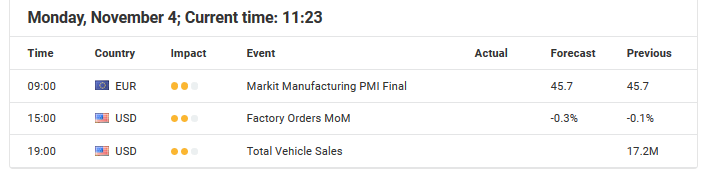
At 10:55 (GMT+2:00), the PMI for manufacturing sector of Germany will be published.
The price fixed above 50 MA and 100 MA, which signals the strength of buyers.
The MACD histogram is in the positive zone and continues to rise, which gives a strong signal to buy EUR/USD.
The Stochastic Oscillator is in the neutral zone, the %K line is below the %D line, which indicates a bearish sentiment.
Trading recommendations
Support levels: 1.11500, 1.11300, 1.11150
Resistance levels: 1.11750, 1.12000
If the price consolidates above 1.11750, expect further growth toward 1.12000-1.12200.
Alternatively, the quotes could decrease toward 1.11300-1.11100.
The GBP/USD currency pair
Technical indicators of the currency pair:
Prev Open: 1.29292
Open: 1.29280
% chg. over the last day: -0.05
Day’s range: 1.29280 – 1.29428
52 wk range: 1.1959 – 1.3385
An ambiguous technical pattern has developed on the GBP/USD currency pair. Sterling is consolidating. At the moment, the local support and resistance levels are: 1.29250 and 1.29450, respectively. GBP / USD quotes have the potential to decline. Market participants are waiting for new information on the Brexit issue. Today, investors will evaluate important economic releases from the UK. You should open positions from key levels.
At 11:30 (GMT+2:00), the UK will publish a PMI in the construction sector.
Indicators do not provide accurate signals: the price crossed 50 MA and 100 MA.
The MACD histogram is near the 0 mark.
The Stochastic Oscillator is in the neutral zone, the %K line is below the %D line, which indicates a bearish sentiment.
Trading recommendations
Support levels: 1.29250, 1.29000, 1.28650
Resistance levels: 1.29450, 1.29700, 1.30000
If the price consolidates below 1.29250, expect the quotes to fall toward 1.28900-1.28700.
Alternatively, the quotes could grow toward 1.29700-1.30000.
The USD/CAD currency pair
Technical indicators of the currency pair:
Prev Open: 1.31610
Open: 1.31366
% chg. over the last day: +0.15
Day’s range: 1.31331 – 1.31457
52 wk range: 1.2727 – 1.3664
The USD/CAD currency pair went down. The trading tool has updated local lows. Looney is currently consolidating in the range 1.31200-1.31450. Support for Looney is provided by the positive dynamics of oil quotes. The US dollar remains under pressure after the release of weak economic releases on Friday, November 01. We do not exclude a further drop in the USD / CAD quotes. We recommend opening positions from key levels.
The Economic News Feed for 04.11.2019 is calm.
Indicators do not give accurate signals: the price has fixed between 50 MA and 100 MA.
The MACD histogram is in the negative zone, indicating a bearish sentiment.
The Stochastic Oscillator is in the neutral zone, the %K line crossed the %D line. There are no signals at the moment.
Trading recommendations
Support levels: 1.31200, 1.31000, 1.30750
Resistance levels: 1.31450, 1.31700, 1.32000
If the price consolidates below 1.31200, expect the quotes to drop toward 1.30900-1.30700.
Alternatively, expect the quotes to rise toward 1.31700-1.31900.
The USD/JPY currency pair
Technical indicators of the currency pair:
Prev Open: 108.018
Open: 108.218
% chg. over the last day: +0.15
Day’s range: 108.182 – 108.323
52 wk range: 104.97 – 114.56
The USD/JPY currency pair went up after a significant drop last week. The trading instrument has set new local highs. At the moment, the USD/JPY quotes are testing the “mirror” resistance of 108.300. 108.100 is the immediate support. The trading instrument has the potential for further recovery. We advice you to pay attention to the dynamics of yield on US government bonds. Open positions from key levels.
Today, Japan’s financial markets are closed due to the holiday.
Indicators do not give accurate signals: the price has fixed between 50 MA and 100 MA.
The MACD histogram has moved into the positive zone, which indicates a further correction of the USD/JPY currency pair.
The Stochastic Oscillator is located near the overbought zone, the %K line is above the %D line, which gives a weak signal to buy USD/JPY.
Trading recommendations
Support levels: 108.300, 108.500, 108.700
Resistance levels: 108.100, 107.900
If the price consolidates above 108.300, expect a further correction USD/JPY toward 108.500-108.700.
Alternatively, the quotes could devrease toward 107.900-107.700.
In conversations with Maurice Jackson of Proven and Probable, Jayant Bhandari offers his thoughts on geopolitical unrest in the Middle East, Latin America, and elsewhere, and how these issues affect the precious metals markets and the accumulation of wealth.
Maurice: Joining us for a conversation is Jayant Bhandari, the founder of the world-renowned Capitalism & Morality, and a prominent, highly sought out advisor to institutional investors. We have a number of topics to address today, from geopolitics to unique buying opportunities in the natural resource space.
Beginning with geopolitics, let’s begin in the Middle East. Syria has a number of events that are unfolding there at the moment. Jayant, you and I had a discussion offline prior to our interview, and you had a number of concerns regarding the turmoil in Syria, specifically with the U.S. expatriating their troops from there, and yesterday the U.S. confirmed that they have killed the leader of ISIS. What has you concerned about Syria right now?
Jayant: I am actually extremely impressed with what Trump has been doing in the Middle East. He is reducing American influence and presence in the Middle East, which is exactly what you need to do. What you need to do is to let these people be forced into a situation where they talk with each other. It is not the job of Americans to sit in the Middle East and negotiate and arbitrate problems between these people.
Now, here is the problem. Islam is divided into something like 60, 70, or 80 different sects. The Middle East is an extremely tribal area and they are fighting with each other all the time. They have, indeed, been fighting with each other for the last millennia or more, probably two millennia or more, and they will continue to fight, because these are very tribal people. And, in fact, the problem is that the fight is not just between those 60 or 70 sects, the fight is within those sects as well, because the problem with tribalism is that everyone wants to be the tribal leader.
So the wars and problems in the Middle East are never, ever going to end, and it is best that America leaves the Middle East and lets these people run their affairs. The job of America is only one thing, and that is to make sure that they don’t let problems increase to a level that those problems become a problem for Americans and other Western allies. And this is, in my view, exactly what Trump has been doing. He wants to focus on problems that can become a problem for America, and the rest we should leave for the local people to deal with themselves.
Maurice: How does the killing of ISIS’ leader impact the power struggle here in Syria?
Jayant: There will always be a power struggle in the Middle East; there is no escape from it. The people there will always fight with each other, and there is nothing, absolutely nothing you can do about it. And Ill go beyond the Middle East: Islam is an issue, but the problem is tribalism and irrationalities of people of the Middle East, Africa, the Indian subcontinent, and most of Latin America. These people are socially structured in a way that they will always, always fight, and you can, by imposing your waysWestern wayson these people, only delay their problems and actually subsidize their problems, which means that their problems will increase to a limit that you can no longer control anymore.
So why let these problems increase in the first place? Let them fight with each other, and that will keep the population low. Now, that’s a very inhuman kind of a statement in a way, but really, there is simply no other possibility. They will always, always fight with each other. I am sitting in a Third World country right now, Maurice, and this is the way these societies operate.
Maurice: Truly unfortunate. A lot of innocent lives are going to be lost in situations like that, and they have been for, as you mentioned, millennia. Staying in the region, there are protests in Beirut. What’s going on there?
Jayant: Another Arab Spring is starting in the Middle East, and it’s a really big problem. Three legs of problems are considered good in the world today, [and] are quite erroneously, and those three things [are] democracy, education and prosperity. And all these three things, democracy, education and prosperity, [are] leading actually to a lot of problems in the Third World. Lebanon is striking and protesting against corruption and it sounds so good, we feel so warm when we hear about it, that these people are finally on the street. In fact, as much as one fourth of the population of Lebanon, in many cities, is out on the streets protesting against corruption.
Now, that should tell us that these people are waking up. They want to get rid of corruption from their societies. But really, if you interrogate these peopleand I again tell you, I’m sitting in a Third World country, I will be in the Middle East next weekthe problem with these people is that they indeed want corruption to stop, but they want other people to stop being corrupt. They don’t want themselves to not be corrupt. And that doesn’t really add up, because everyone wants to be corrupt, they just want other people not to be corrupt.
And the concept of democracy has corrupted the minds of these people. They think that democracy is some kind of magic wand. They don’t really want to understand the details and nuances of public policy, but they think all they have to do is to vote for the right people and make their country good. That does not work. And there is a another problem, and that is increasing prosperity, and I know you want to talk about Chile as well.
The problem is the more prosperous people become, the less they have, the more distractions they have, the more tiredthe more intellectually tiredthey are because they have nothing else to do in their lives. How much time can you spend drinking and watching the TV? And that is actually exactly when people go and they start creating troubles, that is exactly when revolutions happen. . . When prosperity increases, revolutions have a higher probability of happening, and that is exactly what is happening in Lebanon. It is not going to end well.
Maurice: Before we leave the Middle East, how about the situation with Saudi Arabia and Iran? Any comments?
Jayant: We always complain about why America enables a dictatorial government to stay in place in Saudi Arabia. I am actually completely on the side of America. This is one involvement America has got to do, and the problem is that if America leaves Saudi Arabia, Saudi Arabia is going to disintegrate. But worst of all, Iran will become the superpower in the Middle East, and compared to Iran, Saudi Arabia is a saint.
You have to have a presence in Saudi Arabia to make sure Iran behaves and does not develop nuclear weapons. And it is indeed America’s job, very charitably, and the rest of the world should thank America for it. It is indeed America’s job and the job of the rest of the world, to stop Iran from developing nuclear weapons, because they will develop it if they are not under pressure to not develop it, and that will be a massive nuisance for the world if they develop it. So everyone should thank America for doing charity work for the rest of humanity.
Maurice: Moving on to Kashmir. What is going on there?
Jayant: Kashmir is an interesting topic. It is a Muslim majority province, which was a part of what was the British Indian empire, and in 1947, when India and Pakistan became independent, Kashmir became an independent country. There were actually several other small, independent countries, which were subsequently subsumed by India and Pakistan, but Kashmir was left alone because it was a much bigger province, and at a certain point of timeI think sometime in late 1947 or ’48Pakistani insurgents started to occupy Kashmir when Kashmiri king decided to merge with India.
Now, here is the problem. The Kashmir [were a] Muslim majority and the king was a Hindu king, and that creates this strange problem between India and Pakistan, because Pakistan thinks that Kashmir legitimately belongs to Pakistan, and India thinks Kashmir belongs to India. Now, when Kashmir was incorporated into India, the understanding was that Kashmir would stay a special place within India, which means that Kashmir will have its own constitution and own flag. In August this year, Indian government removed that specialist status for Kashmir, and incorporated that fully into India.
And I have to say that every time I have talked with you in the last five years, I have talked about how bad the situation in India is, and how bad Modi is. And I will continue to say that, because Modi is an evil, horrible person for India, and India is getting degraded continuously. But at the same time, I must praise what he has done in Kashmir, because Kashmir has been suffering terrorism throughout these decades. And there was actually an expulsion of Hindus from Kashmir in 1990 under the supervision of Indian government, which was absolutely crazy, because a Hindu majority country allowed Hindus to be torn out of Kashmir in 1990.
So what Modi is doing is that he’s trying to restrict this control terrorism that has been happening in Kashmir, and Pakistan clearly is a big supporter of terrorism. And so Modi, by trying to fully incorporate Kashmir into India, is trying to reduce that problem. My view is that he will fail; my view is it will not work out. [The] Kashmir problem will become much worse, but someone had to do something, and that’s what Modi is doing.
Maurice: Let’s shift the narrative on to South America, where there are riots ongoing as we speak right now in Chile. What has your attention there?
Jayant: As you know Maurice, I completely dislike democracy. Democracy is the worst concept possible to govern a country. Augusto Pinochet, now, he had his own negative sides, but he tried to bring sanity to Chile. Chile would not have been what it is today without Pinochet. Now, Pinochet is seen as a negative character, but you have to remember that Pinochet came into power in Chile exactly when Marxists were trying to take over Chile.
Pinochet has been out of the scene for the last two and half decades, and my view is that the sanity that Pinochet imposed on Chile has slowly gone away. Chile has become much more prosperous and it has become much more democratic, and neither of these two things work very well, particularly under democracy, because people start to think that there’s something called a fair share, and I’m talking about the underclass. The underclasses start to think that because they have a fair share in the voting rights, they must also have their fair share in economic situation of the country, but that isn’t the way universes are structured. We should get paid for how much we produce, not based on our vote.
But, that is today the problem in Chile. They are fighting because the underclass wants more money, but unfortunately, money doesn’t grow on trees, and this means that this will be a suicidal path for Chile because they will fight for more money while destroying the economy, which means that they will actually have less money for everyone. And I feel sad for Chile, but again, in a democratic system, that has to happen, because populism is what rules democracies and populism means that the underclassthe least competent peopledecide public policy, which is very, very ironical.
Maurice: Well, if you feel sorry for Chile, let’s move north onto Venezuela. What are the latest developments there?
Jayant: Well, I have a Venezuelan friend, Jose Nino, who will be speaking at Capitalism & Morality, a seminar I run every year in Vancouver, Maurice, and I hope he will talk a bit about Venezuela. But whenever I talk with my Venezuelan friends, they just tell me the same thingthat the problem is that Venezuela is now in a vicious cycle. And that is actually also a problem with Brazil as well. The smartest people from these countries have been leaving these countries for the last 10 to 20 years now, which means that the brain drain has been a huge problem with Brazil and Venezuela, and you see a lot of Venezuelans and Brazilians in Miami, Houston, London. and Portugal. This is not going to end very well, because once you have lost your leaders in your country, your society just completely becomes incapable of governing itself, and that is exactly what happened to Venezuela.
They will do more wrongs to correct prior wrongs, and that is the problem with lack of leadership and existence of a democratic system. They will continue to do more wrongs and you can also see the same thing in Argentina, where Marcio was removed a couple of days back from his presidential position. He will lose his seat, and the extremely populist people will come back into power in Argentina, because the common guy simply does not understand economics and public policy, but he still has the vote.
Maurice: Truly unfortunate situation there. Before we leave geopolitics, Canada recently held their elections, in which the left won. Where are you surprised, and what type of implications will the results have on the natural resource space?
Jayant: Oh, I am heartbroken with what’s happened in Canada, and I think Canada has had only one last chance to correct its scores. Leftists have destroyed that country over the last 10 to 15 years. Canada has opened the gates wide open for refugees and immigrants. That is not how you can keep a society together, because you just destroy your society by bringing in all kinds of people into your country who bring in crime, disease, and worst of all, [a] cultural system that is alien to Western culture. And that is what Justin Trudeau has done over the last five years, and I think it will continue at a bit more acceleration over the next five years.
Now remember, Canada brings in about 1.5% or so new people into the country every year. So in the next five years, he will have brought in something like 7% to 10% new people in Canada. Canada brings in more people into it than any other country that I can think of, and Canada will culturally get destroyed. I really see no way out for Canada now because the proportion of leftist, left-leaning people is massive in Canada, and unfortunately, immigrants tend to predominantly vote for the left, which means that Canada will become more and more leftist as time goes by.
Now, what will happen to the natural resource sector? The natural resource sector will continue as it has. It will suffer in some parts of the country, like in Alberta. Now people in Alberta now want to leave the country, they want to have their own country, and I can fully understand that, but the problem is that leftists have become the base of basic value, even in Alberta. So I’m not even sure if a separation of Alberta will help Albertans.
In terms of natural resources, Maurice, natural resource nationalism is a problem everywhere in the world. Environmentalism is becoming a religion, a very, very fanatic religion, and you have to be careful everywhere now.
Maurice: You know, I asked that question because we often view Canada as being a safe jurisdiction, and this is one of the vices of that, when you have elections that come out this way and people don’t realize the ramifications longer term.
Jayant: Canada still has the rule of the law, and that is the great thing about Canada. The degradation will happen slowly because there are checks and balances on the government; they just can’t do anything they want to do. So fortunately, there are checks and balances, but one thing is for sure, that Canada is on a downward path right now and it will continue to get degraded unless something happens very quickly. I hope the government falls within a year, and that gives an opportunity for something like Maxime Bernier of People’s Party of Canada to come to power.
Maurice: Switching gears, what are the precious metal prices indicating to the market?
Jayant: There is a huge amount of geopolitical uncertainty in the world. The Middle East is in a crisis, and the more America reduces its involvement in the Middle East, the Middle East will get worse and worse. And exactly the same will happen on the Indian subcontinent as well, and these are exactly the people who consume most of the precious metals. . . . With economies of these countries deteriorating and the social problems of these countries getting worse, there will be a huge interest among these people to buy gold. Of course, the problem is that if the gold price keeps going up, they have that much less economic capacity to buy gold and silver. But I certainly see a huge amount of interest in gold and silver in these countries, and that will continue, and I think that is already reflecting in the price of gold and silver.
Maurice: Speaking of buying opportunities, within the five precious metals, silver, platinum and numismatic gold are on fire sale, relative to palladium and gold bullion. Do you use the price anomalies and distortions as buying opportunities for platinum and silver?
Jayant: I don’t even think there is anything called price anomaly. I think prices are what they are, and I don’t really try to play the ratios between these matters. I, of course, still think that gold and silver are precious metals, they are not commodities, and they will go up as social problems increase, but I am not sure which metal I should take a side for, because I don’t believe in those ratios and I don’t think they necessarily work.
Maurice: Jayant, a number of readers don’t understand the prudence and merit of owning physical precious metals. For someone that’s never purchased precious metals, what would you like to share with them?
Jayant: It’s extremely important that you protect your savings. Now, how do you protect your savings? If you don’t understand the stock market, you are very likely to lose your money in the stock market. A lot of people buy properties and flip properties, but this does not always work. It might have worked for a certain number of years, but it does not mean it will continue to work in the future. So what other opportunities do you have if you contrast the property market and you contrast the stock market? And you should not, because if you don’t understand these markets, you will be the sucker.
What is left [is] keeping your money in the banking system, or [buying] something that you can hold with yourself. Now, if you keep your money in the banking system, the problem is that you are owning a negative yield on your investment, which is absolutely crazy, which means that you will have less money in the bank in real terms, in the future, than you have now. So that brings you to gold and silver, because gold and silver at least give you zero yield, and more importantly, that wealth is in your own pocket, in your own control at your own house. That is why I think precious metals have a very important place in your investment strategy and diversification strategy.
Maurice: For [readers] that are interested in purchasing physical precious metals, please visit provenandprobable.com. We’re licensed through the state of Minnesota and proud to be an independent contractor for Miles Franklin Precious Metals Investments to service all your precious metals investments.
Moving onto junior mining companies. Jayant, you recently wrote a musing on the health of the space and a number of opportunities that you see. What are you noticing in space that has you so optimistic?
Jayant: What is very interesting is that over this year, the exploration and junior development-stage companies have fallen in price. If you look at the Venture index, it is actually as low as it was in the first week of January, despite the fact that the gold price has gone up 10% to 20% in the same duration, which means that in terms of profitabilities, the projected profitabilities of these companies has actually improved very significantly, particularly because cost of mining [hasn’t] really changed much.
Oil price continues to be low, and as a result, the projected profitability has gone up, and as a result, the valuation of these stocks should have gone up, but they have actually fallen. That is always very interesting opportunity, because there is blood running on the street, people are feeling very pessimistic, and that is exactly when you can make the easiest and best money, if you can identify good companies run by good management, companies that have good projects. If you can do that, you can actually make a lot of money, and this is truly the best opportunity that you can have. I want to be selling when the prices go up. Most people like to buy when prices are going up, I like to start selling at that time.
Maurice: Absolutely. Jayant, this is everyone’s favorite part of our interviewswhen we discuss arbitrage opportunities, because you’re the most respected name with a proven pedigree of success here. Do you have any to share with us?
Jayant: The year is coming to a close, there is a lot of pessimism in the market, and the end result is that there are not many mergers happening right now. I think they will pick up again early next year. But something that people might want to have a look at is a company called Core Gold Inc. (CGLD:TSX.V; CGLDF:OTCQX). Core Gold is trading at about $0.22 [per share], and it has a hostile takeover offer from an Australian company, and that offer values Core Gold about 90% higher than the current share price of Core Gold, which is a very nice upside. But, of course, there are a lot of risks, because this offer has not been accepted by Core Gold. Core Gold is looking at other opportunities, but at $0.22, I think the downside risk is limited and there could be a nice upside in owning Core Goldparticularly if this hostile takeover offer is accepted by Core Gold management.
Jayant: You just mentioned that two companies. Anaconda and Maritime Resources are two companies that I am paying a lot of attention to, and people should actually try to understand what’s the geographical situation between Anaconda, Maritime, and Rambler Metals & Mining Plc (RMM:AIM). And the interesting thing is that these people crisscross each other to deliver, they have projects and mills in that area, and they pass each other all the time, and they waste a lot of resources in moving these trucks and processing at faraway places, when they could be doing processing next door.
In my view, the three companies should merge. . .Anaconda and Maritime eventually have to merge; both offer an upside anyway. If the merge is actually economies of scale anyway between the two countries, there is a double upside if a merger happens. I think this will happen, and I am happy to just invest in them for the current upside anyway.
Another company, which you and I both like is Miramont Resources Corp. (MONT:CSE), and Miramont today fell to $08.5 per share, and that is not much higher than the cash value per share of this company. And these are always good opportunities when other people don’t care about these companies.
Maurice: And we’re proud to have Miramont Resources as a sponsor, and we are also very, very proud shareholders, and I’m actively buying Miramont Resources as we speak.
All right, moving on to philosophy. Mr. Bhandari, you are the founder of a philosophical forum focused on reason, argumentation and liberty. Sir, please introduce us to Capitalism & Morality.
Jayant: I have been running this seminar in Vancouver, Canada, for the last 10, 11 years and it gives me a huge amount of satisfaction to run this seminar. I want to invite people who speak on subjects to do with the greatness of Western civilization, and, in fact, the only civilization I have known in my life. And I want to do whatever I can to protect the concept of Western civilization. . .and hopefully to help people understand why Western civilization is so prosperous and peaceful compared to what happens elsewhere. And the next seminar will happen on the 25th of July next year in downtown Vancouver.
Maurice: Who are the featured speakers next year, and can you share what they will be discussing?
Jayant: I’m still working on the speakers, but the confirmed speakers are Marco Wutzer, Rick Rule, Adrian Day, Doug Casey. There will be a lot of other speakers. It will be a very interesting seminar, Maurice.
Maurice: Bob Moriarty, I know you’re listening to this interview, sir. I hope we get you in there finally.
Jayant: I would absolutely love to have Bob Moriarty come and speak one day. Maurice, there is a discount of 10% for your audience. They have to use coupon code JACKSON.
Maurice: All right. Mr. Bhandari, last question, sir. What did I forget to ask?
Jayant: We have covered a lot. I think what people have to really start understanding about societies around the world is to pay attention to the fact that these three things, democracy, education and prosperity, are actually having a negative effect on social stability around the world. Now, I’m not saying we should not have education and prosperity, all I’m saying is that understanding the problems that education and prosperity create, and democracy of course, which is a horrible, evil system, helps us alleviate the problems that we are facing today. Of course, that’s not going to happen because these are the three gods of today’s worlddemocracy, education and prosperityand certainly democracy’s a complete, evil system of ruling societies.
Maurice: Jayant, for someone listening that wants to learn more about your work, please share the website address.
Maurice: Before you make your next bullion purchase, be sure you call me. I’m a licensed representative for Miles Franklin Precious Metals Investments, where we provide a number of options to expand your precious metals portfolio, from physical delivery, offshore depositories, precious metal IRAs, and private blockchain distributed ledger technology.
Call me directly at (855) 505-1900 or you may e-mail [email protected].
Last but not least, please subscribe to provenandprobable.com, for mining insights and bullion sales.
Jayant Bhandari, the founder of Capitalism & Morality, thank you for joining us today on Proven and Probable.
Maurice Jackson is the founder of Proven and Probable, a site that aims to enrich its subscribers through education in precious metals and junior mining companies that will enrich the world.
Disclosure: 1) Maurice Jackson: I, or members of my immediate household or family, own shares of the following companies mentioned in this article: Miramont Resources. I personally am, or members of my immediate household or family are, paid by the following companies mentioned in this article: None. My company has a financial relationship with the following companies mentioned in this article: Miramont Resources is a sponsor of Proven and Probable. Proven and Probable disclosures are listed below. 2) The following companies mentioned in this article are billboard sponsors of Streetwise Reports: None. Click here for important disclosures about sponsor fees. 3) Statements and opinions expressed are the opinions of the author and not of Streetwise Reports or its officers. The author is wholly responsible for the validity of the statements. The author was not paid by Streetwise Reports for this article. Streetwise Reports was not paid by the author to publish or syndicate this article. The information provided above is for informational purposes only and is not a recommendation to buy or sell any security. Streetwise Reports requires contributing authors to disclose any shareholdings in, or economic relationships with, companies that they write about. Streetwise Reports relies upon the authors to accurately provide this information and Streetwise Reports has no means of verifying its accuracy. 4) This article does not constitute investment advice. Each reader is encouraged to consult with his or her individual financial professional and any action a reader takes as a result of information presented here is his or her own responsibility. By opening this page, each reader accepts and agrees to Streetwise Reports’ terms of use and full legal disclaimer. This article is not a solicitation for investment. Streetwise Reports does not render general or specific investment advice and the information on Streetwise Reports should not be considered a recommendation to buy or sell any security. Streetwise Reports does not endorse or recommend the business, products, services or securities of any company mentioned on Streetwise Reports. 5) From time to time, Streetwise Reports LLC and its directors, officers, employees or members of their families, as well as persons interviewed for articles and interviews on the site, may have a long or short position in securities mentioned. Directors, officers, employees or members of their immediate families are prohibited from making purchases and/or sales of those securities in the open market or otherwise from the time of the interview or the decision to write an article until three business days after the publication of the interview or article. The foregoing prohibition does not apply to articles that in substance only restate previously published company releases. As of the date of this article, officers and/or employees of Streetwise Reports LLC (including members of their household) own shares of Miramont Resources, a company mentioned in this article.
Proven and Probable LLC receives financial compensation from its sponsors. The compensation is used is to fund both sponsor-specific activities and general report activities, website, and general and administrative costs. Sponsor-specific activities may include aggregating content and publishing that content on the Proven and Probable website, creating and maintaining company landing pages, interviewing key management, posting a banner/billboard, and/or issuing press releases. The fees also cover the costs for Proven and Probable to publish sector-specific information on our site, and also to create content by interviewing experts in the sector. Monthly sponsorship fees range from $1,000 to $4,000 per month. Proven and Probable LLC does accept stock for payment of sponsorship fees. Sponsor pages may be considered advertising for the purposes of 18 U.S.C. 1734.
The Information presented in Proven and Probable is provided for educational and informational purposes only, without any express or implied warranty of any kind, including warranties of accuracy, completeness, or fitness for any particular purpose. The Information contained in or provided from or through this forum is not intended to be and does not constitute financial advice, investment advice, trading advice or any other advice. The Information on this forum and provided from or through this forum is general in nature and is not specific to you the User or anyone else. You should not make any decision, financial, investments, trading or otherwise, based on any of the information presented on this forum without undertaking independent due diligence and consultation with a professional broker or competent financial advisor. You understand that you are using any and all Information available on or through this forum at your own risk.
After the FED cut by 25 basis points last Wednesday, along with stating that the US central bank will act in a more data-dependent way regarding future monetary policy decisions, the ISM Manufacturing PMI printed at 48.3 points for October, rising slightly from a decade-low of 47.8 points, but still missing market expectations of 48.9 points, keeping near-term recession fears in the US elevated and thus fuelling hopes of further rate cuts and liquidity injections from the FED.
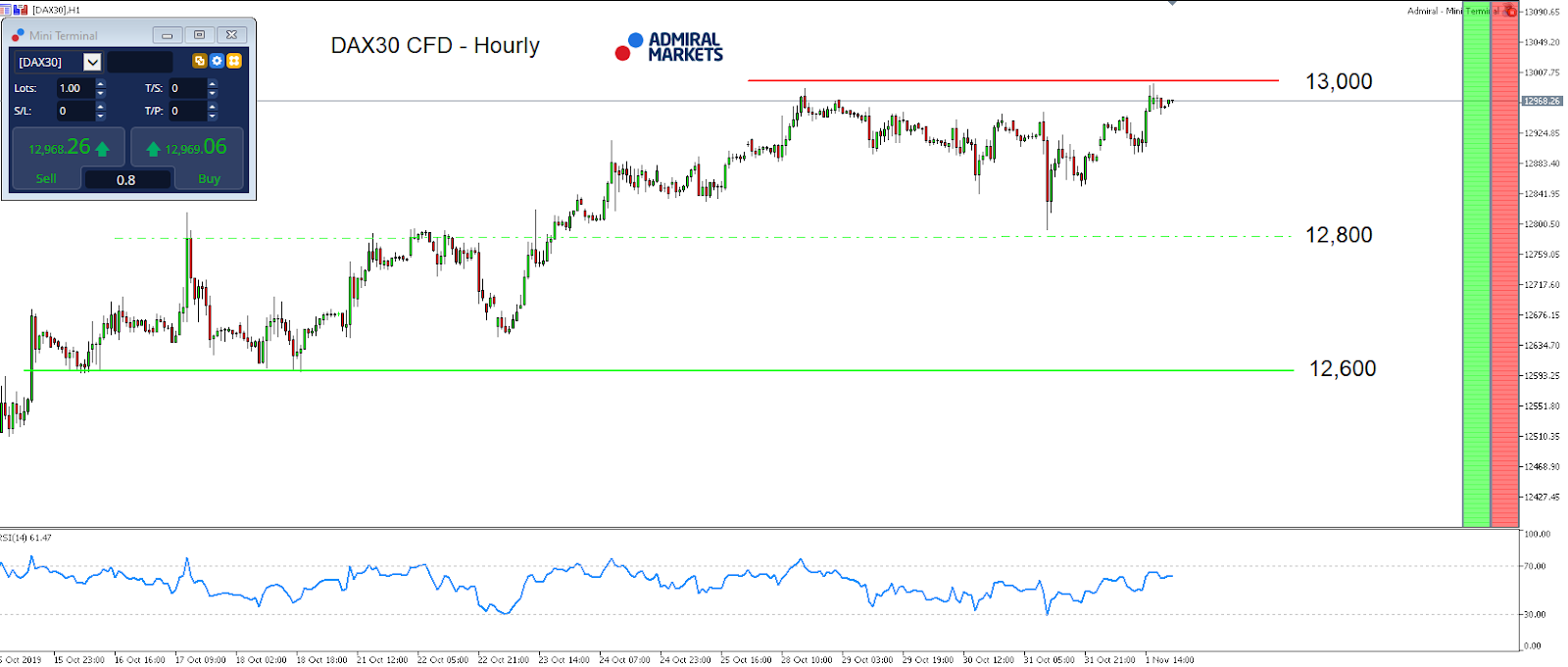
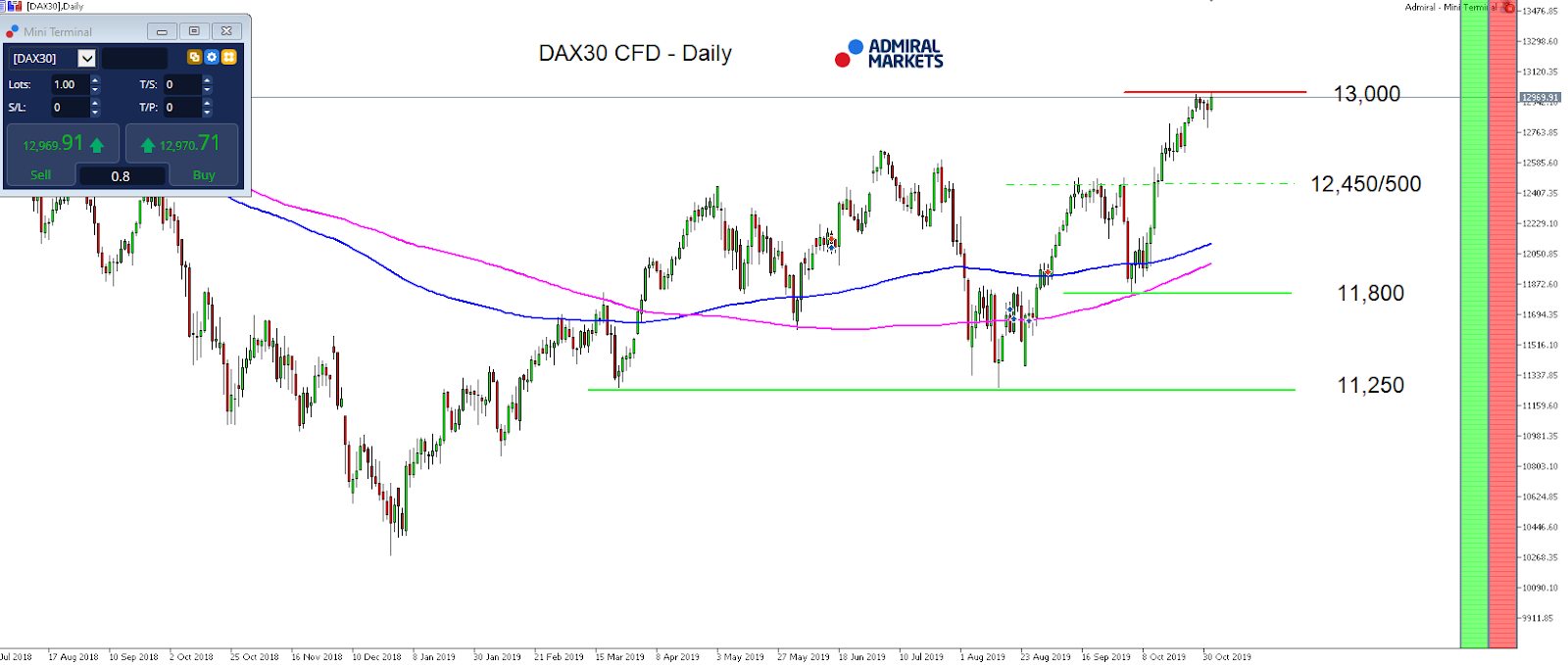
The DAX30 CFD fell short of breaking 13,000 points, but since the economic calendar is quite thin today, the DAX30 CFD will mainly be driven by technical components. In this respect, the German index finds a clear advantage on the long side.
If we get to see an attack, a squeeze higher to 13,050/100 seems likely. Still, given rising fears around trade positions hardening again between the US and China, we wouldn’t be too optimistic and would take long-engagements in equities only with a reduced position size.
On the downside, the focus clearly lies on the region around 12,800 points.
A break lower makes a further drop as low as 12,600 points an option, a little more conservative bearish target can already be found around 12,650/670 points.
Source: Admiral Markets MT5 with MT5SE Add-on DAX30 CFD Hourly chart (between 15 October 2019 to 01 November 2019). Accessed: 01 November 2019 at 10:00 PM GMT
Source: Admiral Markets MT5 with MT5SE Add-on DAX30 CFD Daily chart (between 26 July 2018 to 01 November 2019). Accessed: 01 November 2019 at 10:00 PM GMT
Please note: Past performance is not a reliable indicator of future results, or future performance.
In 2014, the value of the DAX30 CFD increased by 2.65%, in 2015, it increased by 9.56%, in 2016 it increased by 6.87%, in 2017 it increased by 12.51%, in 2018 it fell by 18.26%, meaning that after five years, it was up by 10.5%.
Disclaimer: The given data provides additional information regarding all analysis, estimates, prognosis, forecasts or other similar assessments or information (hereinafter “Analysis”) published on the website of Admiral Markets. Before making any investment decisions please pay close attention to the following:
This is a marketing communication. The analysis is published for informative purposes only and are in no way to be construed as investment advice or recommendation. It has not been prepared in accordance with legal requirements designed to promote the independence of investment research, and that it is not subject to any prohibition on dealing ahead of the dissemination of investment research.
Any investment decision is made by each client alone whereas Admiral Markets shall not be responsible for any loss or damage arising from any such decision, whether or not based on the Analysis.
Each of the Analysis is prepared by an independent analyst (Jens Klatt, Professional Trader and Analyst, hereinafter “Author”) based on the Author’s personal estimations.
To ensure that the interests of the clients would be protected and objectivity of the Analysis would not be damaged Admiral Markets has established relevant internal procedures for prevention and management of conflicts of interest.
Whilst every reasonable effort is taken to ensure that all sources of the Analysis are reliable and that all information is presented, as much as possible, in an understandable, timely, precise and complete manner, Admiral Markets does not guarantee the accuracy or completeness of any information contained within the Analysis. The presented figures refer that refer to any past performance is not a reliable indicator of future results.
The contents of the Analysis should not be construed as an express or implied promise, guarantee or implication by Admiral Markets that the client shall profit from the strategies therein or that losses in connection therewith may or shall be limited.
Any kind of previous or modeled performance of financial instruments indicated within the Publication should not be construed as an express or implied promise, guarantee or implication by Admiral Markets for any future performance. The value of the financial instrument may both increase and decrease and the preservation of the asset value is not guaranteed.
The projections included in the Analysis may be subject to additional fees, taxes or other charges, depending on the subject of the Publication. The price list applicable to the services provided by Admiral Markets is publicly available from the website of Admiral Markets.
Leveraged products (including contracts for difference) are speculative in nature and may result in losses or profit. Before you start trading, you should make sure that you understand all the risks.
US equities closed at all-time highs on upbeat NFP report
Dollar fell to three-month low due to trade optimism
Bank of England has a tough decision on Thursday
US stocks managed to reach a new record high on Friday with the S&P 500 closing at 3.066.9 after solid employment data showed the US economy added 128,000 jobs last month from September’s upwardly revised 180,000.
Sentiment also received a boost after a statement from US trade representative Robert Lighthizer and Treasury Secretary Steven Mnuchin indicated constructive talks with their Chinese counterpart Vice Premier Liu He on phase one of the US-China trade agreement.
Whether new highs will be seen this week depends on if a deal venue and timing are announced. However, until we get the details, data from the US and China will show how much damage the trade war has caused both economies. The US announces its trade balance for September on Tuesday and China will provide trade numbers for October on Friday. These numbers are likely to determine who has the upper hand heading into the next round of trade negotiations.
The US Dollar didn’t enjoy the rally we saw in equities. Instead the Greenback fell on Friday despite the robust jobs data. Two factors may explain the Dollar’s weakness which tested a three-month low against a basket of currencies. One is the optimism on US-China reaching a phase one trade deal, leading to less safe haven flows into the Greenback. The other factor is weak manufacturing data as the Institute of Supply Management (ISM) report showed that the sector contracted for a third consecutive month.
Markets are currently pricing a 44% chance of at least one rate cut by March 2020, and if there’s further evidence of deteriorating US business confidence, we’re likely to see those odds surge.
There are two conditions under which we may see Dollar bulls return, although both are extreme cases. The first would be a very strong US economy where money flows into US assets from across the globe. Or pessimism and fear of a global recession will encourage inflows into safe haven currencies like the Greenback. We are currently somewhere in the middle, and this is negative for the Dollar.
BoE interest rate decision
Investors will be closely watching the Bank of England’s interest rate decision on Thursday as the country prepares for a snap election amid deep divisions over Brexit.
In September, the central bank said it might consider a cut even if a no-deal Brexit is avoided on October 31. Although that scenario has been avoided for now, uncertainty is huge at the moment and that’s likely to put further pressure on the weakening economy.
Despite a rate cut not being expected this week, it will be interesting to see if one or two members of the MPC vote for a 25-basis point cut on Thursday. Such a vote would suggest that the BoE is tilting towards a more dovish stance in monetary policy and will increase the odds of a rate cut early next year. Any signs of the BoE indicating an easing of policy will likely lead to profit taking in the pound which has rallied more than 700 pips since October 10.
Disclaimer: The content in this article comprises personal opinions and should not be construed as containing personal and/or other investment advice and/or an offer of and/or solicitation for any transactions in financial instruments and/or a guarantee and/or prediction of future performance. ForexTime (FXTM), its affiliates, agents, directors, officers or employees do not guarantee the accuracy, validity, timeliness or completeness, of any information or data made available and assume no liability as to any loss arising from any investment based on the same.
Dollar weakened despite stronger than expected jobs report
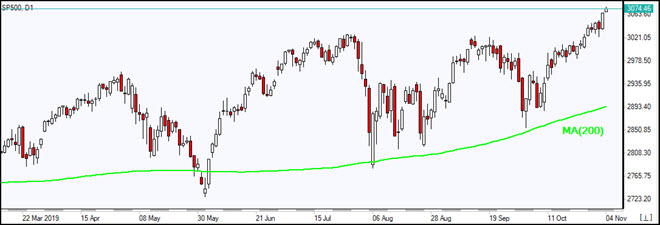
US stocks ended sharply higher on Friday on better than expected jobs report. The S&P 500 advanced 1% to fresh high 3066.91, widening its weekly gain to 1.9%. Dow Jones industrial gained 1.1% to 27347.36. The Nasdaq rose 1.1% to 8386.40. The dollar weakening continued despite US economy adding higher than expected 128 thousand new jobs in October. The live dollar index data show the ICE US Dollar index, a measure of the dollar’s strength against a basket of six rival currencies, slipped 0.1% to 97.18 and is lower currently. Futures on US stock indices point to higher openings.
FTSE 100 led European indexes gains
European stock market resumed advancing on Friday on US-China trade deal optimism. EUR/USD joined GBP/USD’s continued climb Friday with both pairs lower currently. The Stoxx Europe 600 Index gained 0.7% led by mining shares. The DAX 30 rose 0.7% Friday to 12866.79. France’s CAC 40 added 0.6% and UK’s FTSE 100 advanced 0.8% to 7302.42.
Hang Seng leads Asian Indexes gains
Asian stock indices are mostly rising today. Nikkei however ended 0.3% lower at 22850.77 despite yen continuing its slide against the dollar. China’s markets are rising as US Commerce Secretary Wilbur Ross said Sunday US companies will “very shortly” receive licenses for doing business with Huawei Technologies: both the Shanghai Composite Index is higher 0.6% and Hong Kong’s Hang Seng Index is up 1.8%. Australia’s All Ordinaries Index extended gains 0.3% despite Australian dollar extending its gains against the greenback.
Brent futures prices are edging lower today. Prices rose on Friday as the oil-field services firm Baker Hughes reported the number of rigs drilling for crude dropped by 5 this week to 691, down 183 rigs from the same time last year: Brent for January settlement rallied 3.5% to $61.69 a barrel Friday.
Note: This overview has an informative and tutorial character and is published for free. All the data, included in the overview, are received from public sources, recognized as more or less reliable. Moreover, there is no guarantee that the indicated information is full and precise. Overviews are not updated. The whole information in each overview, including opinion, indicators, charts and anything else, is provided only for familiarization purposes and is not financial advice or а recommendation. The whole text and its any part, as well as the charts cannot be considered as an offer to make a deal with any asset. IFC Markets and its employees under any circumstances are not liable for any action taken by someone else during or after reading the overview.
The company advised that in Q3/19 it achieved record revenue of $25.8 million, a 49% increase over the $17.3 million reported in Q3/18. The firm also stated that it posted record attributable gold equivalent ounces sold of 17,289 oz., up 21% versus 14,314 oz. sold in Q3/18. Sandstorm advised that in Q3/19, the average cash cost per attributable gold equivalent ounce was $288 resulting in cash operating margins of $1,203 per oz., compared to $248 per oz. and $960 per oz. respectively in the corresponding 2018 quarter.
The firm reported Net income of $6.2 million in Q3/19, compared to $2.1 million in Q3/18. The company advised that “Net income was higher when compared to the same period in 2018 driven by an increase in revenue and a $2.0 million increase in gains recognized on the revaluation of the company’s investments; whereby a gain of $2.1 million was recognized during the third quarter of 2019 largely driven by the change in fair value of the Americas Gold and Silver Corp. convertible debenture and Equinox Gold Corp. convertible debenture.”
Sandstorm also updated its Full-Year 2019 outlook indicating that “based on the company’s existing royalties, attributable gold equivalent ounces sold for 2019 is forecasted to be between 63,000 and 70,000 ounces. The company is forecasting attributable gold equivalent production of 140,000 ounces in 2023.”
The firm noted that in Q3/19 approximately 31% of the gold equivalent ounces sold by Sandstorm were attributable to mines located in Canada, 20% from the rest of North America, 35% from South America and 14% from other countries.
Streams and royalties on Canadian mines contributed 5,397 of the attributable gold equivalent ounces sold during the third quarter of 2019, a 2% decrease compared to the third quarter of 2018. In North America, excluding Canada, the attributable gold equivalent ounces sold from operations increased by 38% in Q3/19 over Q3/18 primarily due to an increase in gold equivalent ounces sold from the Santa Elena mine in Mexico. South America operations produced 88% more gold equivalent ounces in Q3/19 when compared to Q3/18 driven by the addition of royalty revenue from the Aurizona mine in Brazil and an increase in gold equivalent ounces sold from the Cerro Moro mine in Brazil. The firm additionally noted that streams and royalties on mines in other countries contributed 20% less gold equivalent ounces sold when compared to the third quarter of 2018 mostly due to a decrease in gold equivalent ounces sold from operations in Burkina Faso.
Sandstorm Gold is a gold royalty company headquartered in Vancouver, Canada which refers to itself as “The Gold Standard in Royalty Investments”. The company asserts that it has been a leader in reshaping the mine investment landscape with its innovative royalty model. Sandstorm provides upfront financing to gold mining companies searching for capital and receives in return the right to a percentage of the gold produced from a mine, for the entire life of the mine. The firm has a portfolio of over 185 royalties and operates in numerous countries and jurisdictions.
Sandstorm Gold has a market cap of about $1.1 billion with approximately 177.1 million shares outstanding. SAND shares opened today at $6.59 (+$0.24, +3.78%) over yesterday’s $6.35 closing price. The stock has traded today between $6.49-6.95/share approaching its 52-week high price of $7.02/share and is currently trading at $6.92 (+$0.57, +8.98%).
Disclosure: 1) Stephen Hytha compiled this article for Streetwise Reports LLC and provides services to Streetwise Reports as an independent contractor. He or members of his household own securities of the following companies mentioned in the article: None. He or members of his household are paid by the following companies mentioned in this article: None. 2) The following companies mentioned in this article are billboard sponsors of Streetwise Reports: None. Click here for important disclosures about sponsor fees. 3) Comments and opinions expressed are those of the specific experts and not of Streetwise Reports or its officers. The information provided above is for informational purposes only and is not a recommendation to buy or sell any security. 4) The article does not constitute investment advice. Each reader is encouraged to consult with his or her individual financial professional and any action a reader takes as a result of information presented here is his or her own responsibility. By opening this page, each reader accepts and agrees to Streetwise Reports’ terms of use and full legal disclaimer. This article is not a solicitation for investment. Streetwise Reports does not render general or specific investment advice and the information on Streetwise Reports should not be considered a recommendation to buy or sell any security. Streetwise Reports does not endorse or recommend the business, products, services or securities of any company mentioned on Streetwise Reports. 5) From time to time, Streetwise Reports LLC and its directors, officers, employees or members of their families, as well as persons interviewed for articles and interviews on the site, may have a long or short position in securities mentioned. Directors, officers, employees or members of their immediate families are prohibited from making purchases and/or sales of those securities in the open market or otherwise from the time of the interview or the decision to write an article until three business days after the publication of the interview or article. The foregoing prohibition does not apply to articles that in substance only restate previously published company releases.
Shares of BeiGene Ltd. traded 35% higher today to a new a 52-week intraday high after announcing a commercialization agreement for of XGEVA (denosumab), KYPROLIS (carfilzomib), and BLINCYTO (blinatumomab) with Amgen Inc. in China. As part of the partnership, Amgen will invest $2.7 billion in BeiGene for 20.5% equity ownership.
Late yesterday afternoon Chinese biotechnology firm BeiGene Ltd. (BGNE:NASDAQ; 06160:HKEX) and Amgen Inc. (AMGN:NASDAQ) announced a “global strategic oncology collaboration for the commercialization and development in China of Amgen’s XGEVA (denosumab), KYPROLIS (carfilzomib), and BLINCYTO (blinatumomab), and the joint global development of 20 oncology assets in Amgen’s pipeline, with BeiGene responsible for development and commercialization in China. In connection with the collaboration, Amgen will purchase a 20.5% stake in BeiGene for approximately $2.7 billion in cash at $174.85 per American Depositary Share (ADS).”
The price represents a 36% premium to BeiGene’s 30-day volume-weighted average share price as of October 30, 2019. Amgen will receive one seat on BeiGene’s Board of Directors as part of the terms of the agreement.
The report advised that the transactions have been approved by the boards of directors of both companies and are expected to close in Q1/20, subject to BeiGene’s shareholder majority approval and Hong Kong Stock Exchange and regulatory requirements and other customary closing conditions. BeiGene claims it has already received commitments from shareholders holding approximately 40% of its outstanding shares to vote in favor of the transactions.
John V. Oyler, Co-Founder, CEO, and Chairman of BeiGene commented, “Through this collaboration, Amgen, a true biotech pioneer and leader in our industry, has recognized the transformative potential of BeiGene’s unique clinical development capabilities to accelerate global drug development. We are thrilled to join forces with Amgen to realize the development and commercialization of this broad oncology pipeline with the aim of benefitting patients around the world…In addition, this alliance expands the portfolio available to our market-leading China commercial team, led by Dr. Xiaobin Wu, with the potential to bring as many as eight internally discovered and in-licensed innovative treatments to cancer patients by the end of 2020.”
Amgen’s Chairman and CEO Robert A. Bradway added, “This strategic collaboration with BeiGene will enable Amgen to serve significantly more patients by expanding our reach in the world’s most populous country. We’ve chosen an innovative strategic collaborator that can offer commercial and clinical reach with global quality standards…Cancer is a leading cause of death in China and will only become a more pressing public health issue as the Chinese population ages. We look forward to working with BeiGene to make a meaningful difference in the lives of millions of cancer patients in China and around the world.”
The report outlined that under the agreement, BeiGene will commercialize XGEVA, KYPROLIS and BLINCYTO in China for five or seven years, during which time the parties will equally share profits and losses. Following the commercialization period, BeiGene will have the right to retain one product and will be entitled to receive royalties on sales in China for an additional five years on the products not retained.
The release further indicated that BeiGene has agreed to jointly develop 20 Amgen oncology pipeline assets globally, which include targeted small-molecule agents such as AMG 510, a first-in-class investigational KRAS G12C inhibitor, as well as BiTE (Bispecific T cell Engager) antibodies, for solid and hematologic malignancies. The agreement further stipulates that for each pipeline asset that is approved in China, BeiGene will receive commercial rights for seven years from approval, during which time the parties will share equally in profits and losses.
BeiGene was established in Beijing, China in 2010. The company employs 3,000 people in China, the U.S., Australia and Europe and also has corporate offices in the Cayman Islands. The firm describes its business as a “global, commercial-stage, research-based biotechnology company focused on molecularly-targeted and immuno-oncology cancer therapeutics that is advancing a pipeline consisting of novel oral small molecules and monoclonal antibodies for cancer.” The Company’s main products include Zanubrutinib (BGB-3111), Tislelizumab (BGB-A317) and Pamiparib (BGB-290). The firm also markets several pharmaceutical products in China licensed from Celgene Corp. including ABRAXANE, REVLIMID and VIDAZA.
Amgen is headquartered in Thousand Oaks, Calif. and is one of the world’s largest biotechnology firms with a market cap of around $126.6 billion. The company states that it is committed to unlocking the potential of biology for patients suffering from serious illnesses by discovering, developing, manufacturing and delivering innovative human therapeutics. The firm claims that it uses tools like advanced human genetics to unravel the complexities of disease and understand the fundamentals of human biology. Some of the firms largest patented medicines include Enbrel, Prolia, XGEVA, Neulasta and Aranesp.
BeiGene started the day with a market capitalization of approximately $8.3 billion with about 60.35 million ADR shares outstanding. The stock has a 52-week price range of $108.00-187.56. BGNE shares opened much higher today at $170.00 (+$31.66, +22.89%) over yesterday’s $138.34 closing price. The stock set a new 52-week high intraday price in early morning trading and has traded today between $170.00 to $187.56/share. At present, BGNE’s shares are trading at $187.27 (+$48.93, +35.37%).
Disclosure: 1) Stephen Hytha compiled this article for Streetwise Reports LLC and provides services to Streetwise Reports as an independent contractor. He or members of his household own securities of the following companies mentioned in the article: None. He or members of his household are paid by the following companies mentioned in this article: None. 2) The following companies mentioned in this article are billboard sponsors of Streetwise Reports: None. Click here for important disclosures about sponsor fees. 3) Comments and opinions expressed are those of the specific experts and not of Streetwise Reports or its officers. The information provided above is for informational purposes only and is not a recommendation to buy or sell any security. 4) The article does not constitute investment advice. Each reader is encouraged to consult with his or her individual financial professional and any action a reader takes as a result of information presented here is his or her own responsibility. By opening this page, each reader accepts and agrees to Streetwise Reports’ terms of use and full legal disclaimer. This article is not a solicitation for investment. Streetwise Reports does not render general or specific investment advice and the information on Streetwise Reports should not be considered a recommendation to buy or sell any security. Streetwise Reports does not endorse or recommend the business, products, services or securities of any company mentioned on Streetwise Reports. 5) From time to time, Streetwise Reports LLC and its directors, officers, employees or members of their families, as well as persons interviewed for articles and interviews on the site, may have a long or short position in securities mentioned. Directors, officers, employees or members of their immediate families are prohibited from making purchases and/or sales of those securities in the open market or otherwise from the time of the interview or the decision to write an article until three business days after the publication of the interview or article. The foregoing prohibition does not apply to articles that in substance only restate previously published company releases. 6) This article does not constitute medical advice. Officers, employees and contributors to Streetwise Reports are not licensed medical professionals. Readers should always contact their healthcare professionals for medical advice.
Recently, the US stock market rallied to new all-time highs which prompted an almost immediate celebration. A day later, the US stock markets reacted by setting up multiple top rotation patterns. The next day, a moderate price rally set up after the US Fed decreased rates by 25 basis points. The next day, the markets sold off dramatically with heavier volume – prompting the metals and the VIX to rally.
We’ve been warning for weeks that the US markets were setting up into a Pennant/Flag formation within a tightening range biased to the upside. See our index trend analysis signals here. We believe the move in precious metals today may be indicative of a breakout/breakdown move in the markets – near the apex of the pennant formation on the Gold chart, below.
We believe this Pennant/flag formation on the Daily Gold chart aligns with the longer-term pennant formation that setup in the US stock market. We believe the breakout move in metals may be a very strong indication that the US stock market may begin a reversion price move, a deeper downside price rotation, that may result in a spike in the VIX and metals while the US, and potentially global, stock markets react to weakness that may drive a price correction over the next few weeks. This type of price correction may be just like the correction that happened near the end of 2018.
As we’ve been warning over the past few weeks, we believe the US and global stock markets are setting up in a very fragile price pattern. One that may result in a moderately deep price correction that may surprise investors over the next few weeks and months. Be prepared for some very large volatility and an increased risk of a potentially very deep price correction over the next 60 to 120+ days.
If gold continues as we suspect, a rally to the $1600 to $1650 level may be seen very quickly. Ultimately, this rally may continue to levels above $1700 to $1750 before the end of 2019. The speed of the rally in metals will relate to the amount of fear generated by any weakness in the global markets and the speed and severity of potential price collapse.
Silver, which should lag behind Gold initially, may see one of the biggest rallies drive prices well above $22 to $23 on the initial upside move – we may just have to wait for it to accelerate as Gold will likely lead this rally.
At this point, price is the true indicator. Technical analysis, price patterns, price theory, and other resources allow us to better understand what is likely to happen in the future. Any price failure after the US stock market reached these nominal new highs will prompt an attempt to retest recent price lows. This means the US stock market may attempt to retest the June 2019 lows or the December 2018 lows on deep price correction.
Read some of our past research posts to understand why this setup is so important for all traders to understand. Failure at this level could be a critical top formation that pushes the markets into a new trend.
October was the month of most major asset classes completing their consolidation phase. Natural gas was the big mover in October and subscribers and I took full advantage of the consolidation and breakout for a 15-24% gain and its till on fire and ready to rocket higher.
November will be the month of breakouts and breakdowns and should spark some trades. I feel the safe havens like bonds and metals will be turning a corner and starting to firm up and head higher but they may not start a big rally for several weeks or months.
If you like to catch assets starting new trends and trade 1x, 2x and 3x ETF’s the be sure to join my premium trade alert service called the Wealth Building Newsletter.
Here are the latest links to our coverage of the Commitment of Traders data changes.
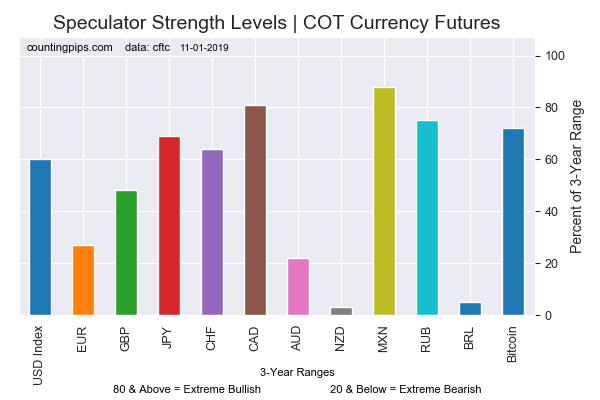
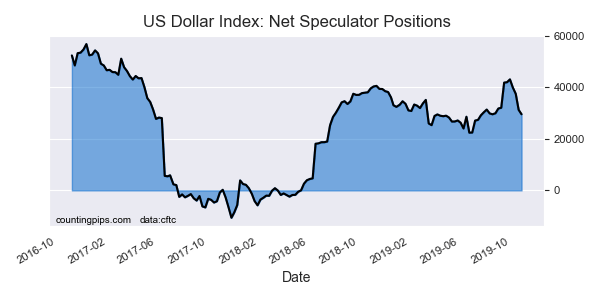
This week in the COT data, US Dollar Index speculators decreased their bullish bets for a fourth consecutive week this week. Speculators have now dropped their overall USD bullish position to the lowest level in 10 weeks.
Mexican peso positions jumped to the most bullish level in 22 weeks with a gain this week by over +15,000 contracts.
Canadian dollar speculators boosted their bullish bets for a third consecutive week and nudged the current bullish standing to the highest level of the past 97 weeks.
British pound sterling specs, with a hard Brexit off the table for now, sharply dropped their bearish bets by over 20,000 contracts in each of the past two weeks.
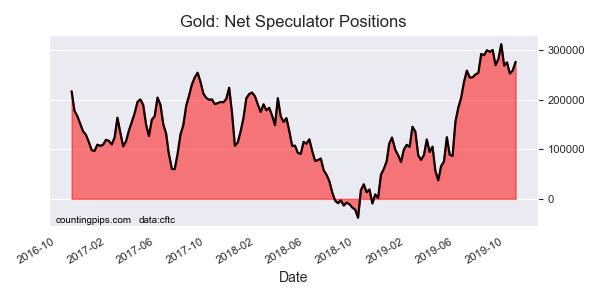
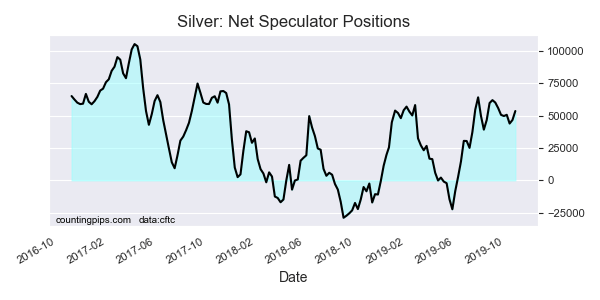
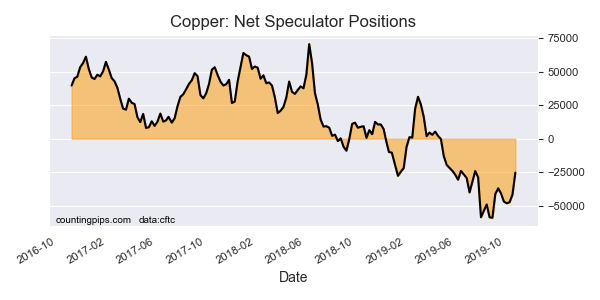
Precious metals speculators, meanwhile, bet in favor of Copper, Gold and Silver this week. Copper speculators sharply cut back on their bearish bets as the overall bearish position fell to the lowest bearish level in 3 months.
Gold speculators added to the existing bullish positions for the second straight week while Silver specs boostedtheir bullish bets for the third time in the past four weeks and pushed the current bullish position to a 6-week high.
VIX Volatility speculators once again raised their bearish bets and pushed the overall bearish position to the highest level on record at a total of -187,948 contracts. This new record bests the previous bearish level high of -180,359 contracts that was reached on April 30th.
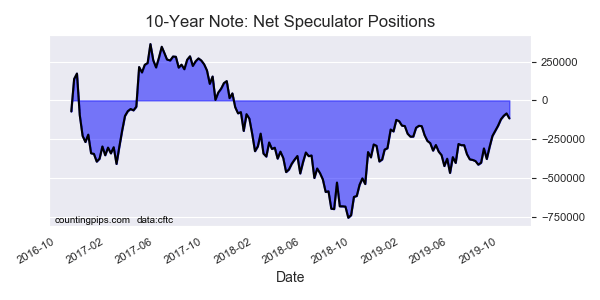
10-year note speculators increased their bearish bets this week for the first time in the past 8 weeks and boosted the net bearish position back above the -100,000 contract level for the first time since October 8th.
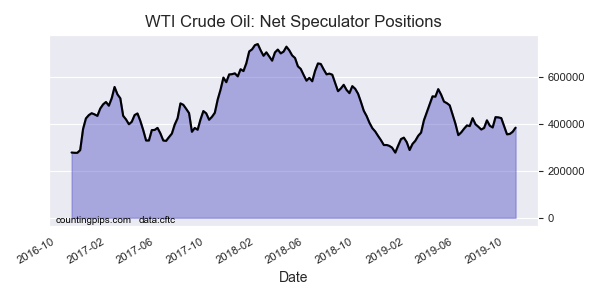
Finally, WTI crude oil speculators advanced their bullish bets for a third consecutive week although the current net position remains slightly below year’s average net position of +398,468 contracts.
Large currency speculators cut back on their net positions in the US Dollar Index futures markets this week, according to the latest Commitment of Traders (COT) data released by the Commodity Futures Trading Commission (CFTC) on Friday. See full article.
The large speculator contracts of WTI crude futures totaled a net position of 383,347 contracts, according to the latest data this week. This was a change of 17,175 contracts from the previous weekly total. See full article.
Large speculator contracts of the 10-Year Bond futures totaled a net position of -116,066 contracts, according to the latest data this week. This was a change of -31,713 contracts from the previous weekly total. See full article.
Large precious metals speculator contracts of the Gold futures totaled a net position of 276,515 contracts, according to the latest data this week. This was a change of 17,383 contracts from the previous weekly total. See full article.
Large stock market volatility speculator contracts of the VIX futures totaled a net position of -187,948 contracts, according to the latest data this week. This was a change of -16,712 contracts from the previous weekly total. See full article.
Large precious metals speculator contracts of the silver futures totaled a net position of 53,678 contracts, according to the latest data this week. This was a change of 6,935 contracts from the previous weekly total. See full article.
Metals speculator contracts of the copper futures totaled a net position of -25,225 contracts, according to the latest data this week. This was a change of 16,348 contracts from the previous weekly total. See full article.
*COT Report: The COT data, released weekly to the public each Friday, is updated through the most recent Tuesday (data is 3 days old) and shows a quick view of how large speculators or non-commercials (for-profit traders) were positioned in the futures markets.
The CFTC categorizes trader positions according to commercial hedgers (traders who use futures contracts for hedging as part of the business), non-commercials (large traders who speculate to realize trading profits) and nonreportable traders (usually small traders/speculators).