Alianza Minerals Hits High-Grade Silver at Haldane During First Stepout Drilling

By The Gold Report

Source: The Critical Investor for Streetwise Reports   11/08/2019

The Critical Investor does a deep dive into this explorer’s drill program at its Yukon silver project.

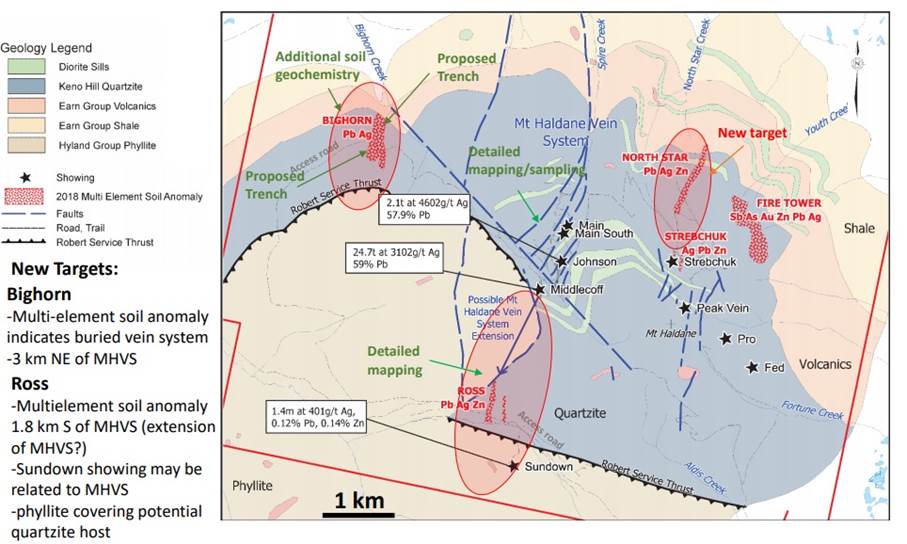
All cashed up after raising C$1.1 million in an oversubscribed financing in July, Alianza Minerals Ltd. (ANZ:TSX.V) was ready for its 2019 Phase II drill program at its flagship Haldane silver project, after the Phase I drill target defining program was completed earlier this summer, and drilling began in late August. The main focus for management were the new stepout targets like the Bighorn and Ross anomalies, and the extension of Mount Haldane Veins System (MHVS) targets, to indicate size potential, and are presented in red below:
Afbeelding met tekst, kaart  Automatisch gegenereerde beschrijving

A total of 963 meters was cored in four holes. It took quite a while, according to management the assay lab was relatively slow, an issue several explorers are dealing with this year.

On October 22, 2019, the company reported drilling had confirmed the presence of new silver-bearing vein targets at the Bighorn Zone. The first two holes of the program tested the Ross and Bighorn targets. One hole was completed at each of the Ross and Bighorn anomalies, with two holes targeting the A and B veins of the Middlecoff Zone in the Mt. Haldane Vein System target area.

Highlights of the first hole HLD19-15 at the Bighorn Anomaly include 125 g/t Ag and 4.4% Pb over 2.35m from 154.15m depth.
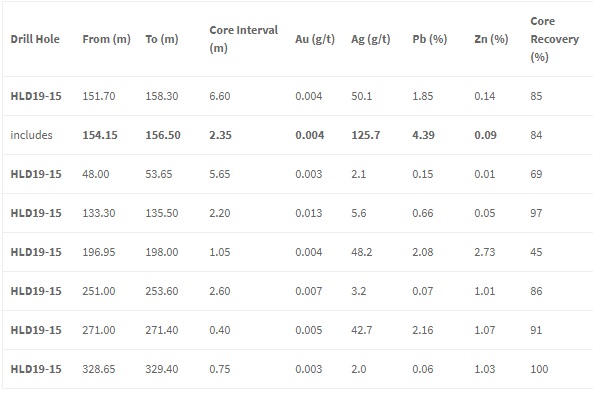
In itself this is not an economic intercept, as it would be a gold equivalent of 2.35m @ 3.5g/t AuEq (for underground, 5-6g/t Au at 2m wide at least is considered economic), but the fact it hit this kind of mineralization that far out of known mineralization is considered promising by management.

The hole HLD19-14 at the Ross anomaly did intersect zones of anomalous veining and disseminated mineralization in rocks overlying the prospective lower Keno Hill quartzite unit, but didn’t return significant values. It is believed by management that these are the manifestation of the target structures and that they may form cohesive veins at depth in the permissive units. According to the news release:

“The first hole of the program tested the Ross Anomaly, a 300m by 100 m Pb-Zn-Ag soil anomaly, approximately 3 km along trend from the Middlecoff Zone on the Mt Haldane Vein System. The anomaly sits in schist and phyllite of the Upper Keno Hill Formation (Sourdough Member) in the immediate hanging wall to the contact with the Lower Keno Hill quartzite.”

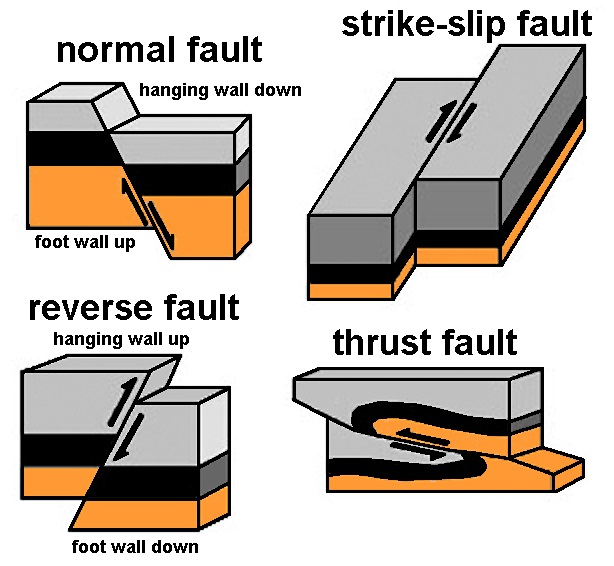
For some more understanding of geological concepts, here is an image explaining the concept of a hanging wall, at the same time describing four different basic fault concepts:
The news release continues:

“The Lower Keno Hill consists of massive quartzite and phyllitic quartzite, which are much better hosts for the vein-fault style of mineralization present on the Haldane Property and elsewhere in the Keno Hill District.

The hole intersected quartzite below 180 m suggesting the initial target may exist deeper on the section.”

As there is quite a bit of faulting going on at Keno Hill, this might very well be the case. CEO Jason Weber had the following to say about the first results: “The first-ever drill hole at the Bighorn Zone, almost three kilometers from known mineralization, successfully intersected at least four mineralized structures confirming a new zone for systematic follow-up drilling. The Ross hole, which also tested a new area, returned only anomalous lead and silver values, but appears to have intersected weak structures that may be conducive to forming veins in the more brittle Lower Keno Hill Quartzite that lies below.”

After asking a bit further about Ross, Jason commented: “It was great to get the result at Bighorn, and a bit frustrating that we were in the wrong rocks at Ross to form veins, but it looks like potential vein structures are located deeper here so the target isn’t dead at all. These results weren’t bad for the first ever holes at these targets. Obviously we would have liked some high-grade intersections but it is a great start nonetheless.”

Of course this is pure exploration, you look for all kinds of indicators of mineralization, you theorize about geological and mineralized concepts, you drill, you get new data, you fine tune or even overturn your original thesis, and you continue, until the target is killed or you hit economic mineralization. To me this is a solid start, as Alianza hit mineralization at three out of the first four holes. For comparison, the famous Hemlo and especially Eskay deposits were found only after dozens and dozens of drill holes, at the 76th and 109th attempt respectively to be precise.

At the Bighorn Zone, hole HLD19-15 was drilled from west to east near the center of the 900m by 150m, north-south trending, Pb-Ag-Sn soil anomaly.

The drill hole intersected four significant north trending, steep faults, plus several smaller faults all with associated mineralization. The most significant of these faults occurred at 150–159m depth. This fault appears to correlate with a silicified breccia/fault zone on surface. I consider this as a very interesting indication of mineralized zones extending to surface, and this zone is of course also still open at depth. Management believed that locally poor core recovery within these faults may have negatively impacted some results, but as far as I can see this doesn’t seem to occur often or at relatively long intercepts.

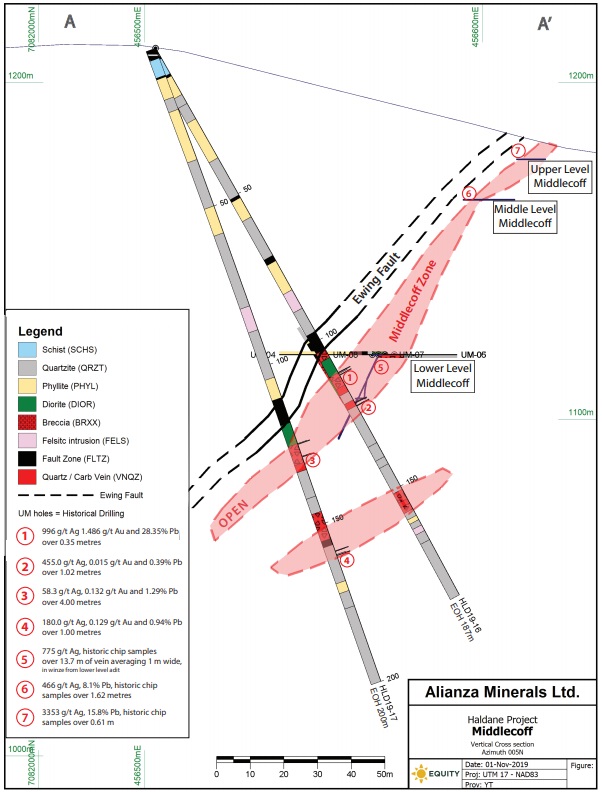
On November 1, 2019, the second batch of results of two holes was released. Holes HLD19-16 and HLD19-17 targeted the Middlecoff Zone along strike from a high-grade silver-bearing vein that had seen some interesting historical underground sampling at an average of 775 g/t Ag over 13.7 meters of strike in the past. Hole HLD19-16 targeted this zone along a shallow plunge and intersected significant mineralization in the Middlecoff Zone from 110.30 to 125.00 meters downhole.
Afbeelding met tekst, kaart  Automatisch gegenereerde beschrijving

The highlight here obviously was a very narrow but also very high grade 0.35m section of 996 g/t silver and 1.486 g/t gold. To put this in perspective, in order to mine underground a rule of thumb is that conventional mining equipment needs at least 2m to operate effectively, as already hinted on earlier. In this case it would mean a gold equivalent of 2m @4.3g/t AuEq, so it is still not economic, but it is a promising start for such a stepout. I liked the other intercepts a bit deeper as well, which seem to indicate fairly consistent dispersion of about 400-450g/t Ag over 1m normalized on average, which can be seen in this table of results for HLD19-16 and HLD19-17:
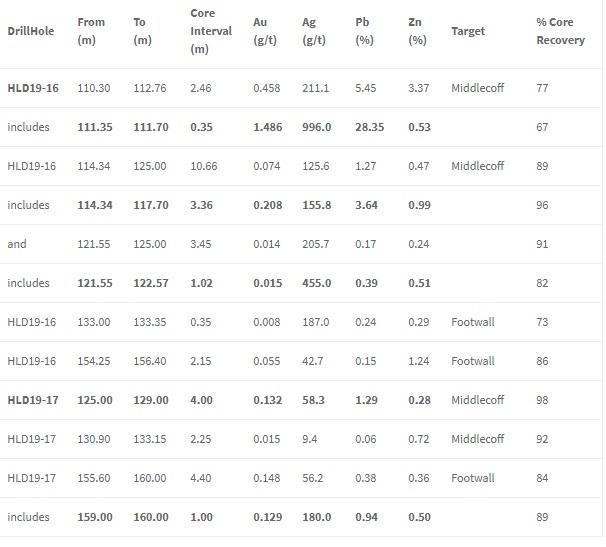
Hole HLD19-17 intersected a geologically similar section below the Ewing fault, but structures and veins are not as well-developed as in hole HLD19-16. The returned results were less significant as well, suggesting in my view less potential going at depth in this particular location. However, the Middlecoff vein–faults intersected in the current drilling and limited historical underground workings remain very much open to depth and in both directions along strike below the Ewing Fault.

CEO Jason Weber had this to say:

“Drilling at the Middlecoff Zone has confirmed the presence of a wide structure capable of hosting high-grade silver mineralization in a series of anastomosing faults. We are just starting to understand the orientation of the high-grade shoots that were targeted since the 1920s, and with the new information from this drilling we can adjust our interpretation and target drilling in subsequent phases.”

Afbeelding met buiten, berg, boom, gras  Automatisch gegenereerde beschrijving

After following up with him on this, he commented more in-depth on the results, the geology and the potential:

“The importance here lies in the fact that we are building continuity in the mineralization from the high-grade mineralization encountered underground in the 1960s. We have expanded the Middlecoff Zone to the south. The geometry has been tricky to figure out so far, but it looks like the host structure thickens in hole 16 and there may be a relatively flat high-grade shoot seen in hole 16, but not 17. We thought there could be a steep high-grade shoot but doesn’t mean below that it doesn’t thicken again. The vein-structure is still present but at lower grades. This is still heavily oxidized mineralization.

“In the main faults, mineralization is mostly oxidized so you don’t see much in the way of sulphide, just the weathered oxide minerals making it difficult to tell what the original mineral species were. That said, we know that there is a high-grade vein at the top of the Middlecoff that is different, carrying gold (about 1.5 g/t Au), with elevated copper and antimony. Looking at that chemistry it may be due to a sulphosalt mineral—it is great to see some of this really high-grade material. We know these structures that host mineralization are big, we know that the system produces very high grades so it is now a matter of finding where the veins could be thicker and higher grade.”

The oxidized and fractured nature made me wonder about the type of mining, and I asked Jason what is possible regarding this rock competence. According to him, this is the same scenario that exists elsewhere in the Keno District. Importantly, as you follow these vein-faults to depth (300 meters or more of vertical extent is not unheard of in the district) the oxidation decreases.

Aside from the section I received from him, I wondered if there will be more sections and maps coming soon, so it will be easier to interpret potential mineralization as an investor. I also asked him when drilling resumes, and what number of holes and meters drilled he has in mind, on what targets. He continued:

“We are working on a plan map to show the zone with respect to the three sets of underground workings and drilling to better illustrate it, although this is proving to be a challenge. The challenge is drill holes, and all three levels of underground workings catch the Middlecoff at different elevations so it doesn’t look like they join up projected to surface on a plan map. That is complicated by the Ewing fault which overlies the zone (and may cut it off in places).

“The next step is to get this and the workings into a workable format (sections and plans, 3D) so we can try to use the underground data in conjunction with the drilling to vector the next set of holes. This will be done over the winter and we will be back out there in the spring for the next drill program as soon as weather allows. I want to spend some more time with the data and incorporate what we have learned this year before outlining what the next program will be, but it is safe to say it will be heavily weighted on drilling. I would expect we would want to test Middlecoff and Bighorn again to expand on what we have identified there, and to test the idea that the target may be deeper at Ross.”

Besides Haldane and as a reminder, Alianza also has a JV with Hochschild in Nevada. Hochschild has optioned three Nevada sediment-hosted gold properties from Alianza. The BP and Bellview properties are located in the southern extension of the Carlin Trend, while the Horsethief property represents an off-trend gold target located 26 km east of Pioche, Nev. The Horsethief property is considered the most prospective by Alianza, and is the focus of attention.

Highlights of the latest program on Horsethief were reported on October 30, 2019, and include the discovery of new gold-bearing jasperoid, the identification of favorable carbonate host stratigraphy, and the mapping of alteration and structural features that may act as pathways for gold-bearing fluids at Horsethief.
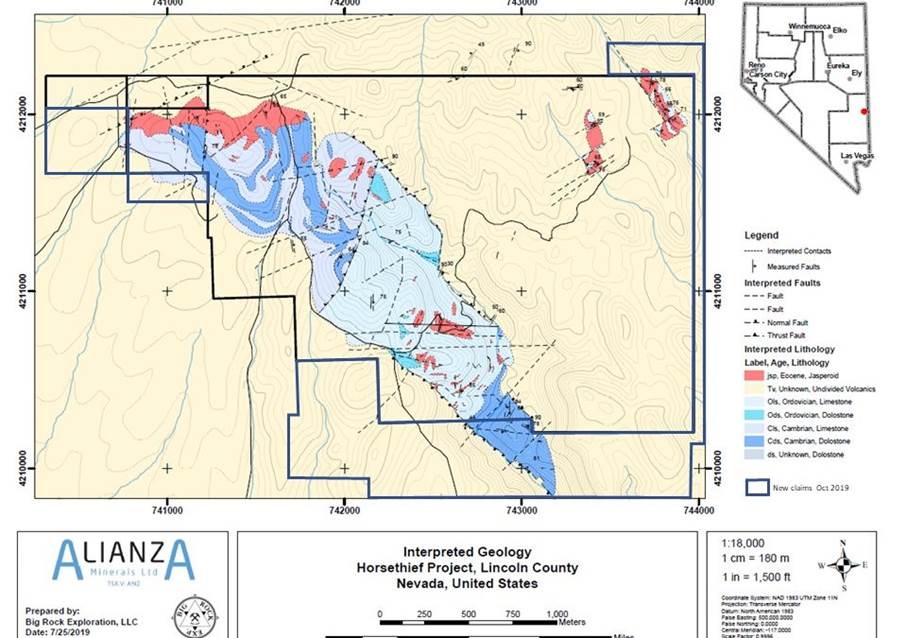
Alianza Minerals Identifies New Targets and Expands Horsethief Gold Project , NV

CEO Jason Weber was clearly enthusiastic about the reconnaissance (early stage) program results: “The 2019 exploration program was extremely successful, identifying new mineralized occurrences of jasperoid and prospective carbonate stratigraphy, illustrating potential for Horsethief to host a large gold-bearing system. However, the most interesting outcome was the identification of these features at or near the contact between Cambrian and Ordovician-aged rocks, which, are known to host large sediment-hosted gold deposits such as the Long Canyon Gold Mine.”

As a result, an additional 26 claims were staked to cover the jasperoid occurrence as well as prospective stratigraphy identified in the southern portion of the property. Jasperoid can be an important source of gold bearing mineralization, and Nevada is known for these occurrences, sometimes resulting in significant gold deposits. Alianza believes that jasperoid found to date may represent the lateral or vertical extents of a gold-bearing system at Horsethief which is what will be targeted in the drilling program planned for 2020.
Afbeelding met grond, gras, buiten, zitten  Automatisch gegenereerde beschrijving
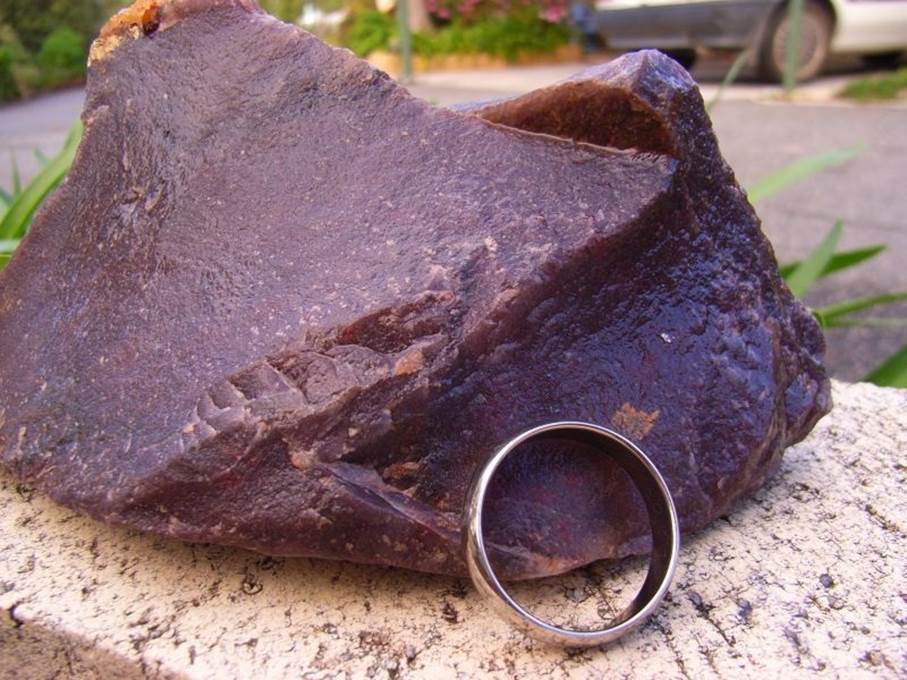
Jasperoid

Jasperoid breccias from Horsethief have returned gold values up to 1.221g/t (21.94g/t historically) from surface grab samples. Shallow historical drilling has tested the jasperoid exposures with one hole returning 0.79 g/t gold over 39.6m and four holes ending in mineralization.

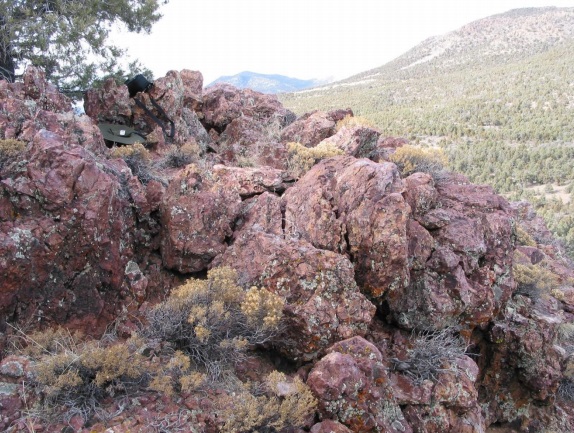
Horsethief hosts five primary drill targets; four target areas defined by surface exposures of altered carbonate rocks and one target at depth, interpreted from induced polarization (IP) and resistivity geophysical surveys. Exploration at Horsethief is targeting sediment-hosted gold mineralization in a window of Cambrian and Ordovician carbonate rocks overlain by volcanic flows and pyroclastics. Work by prior operators included mapping and sampling hematite-rich jasperoid breccia outcrops and shallow drilling. Historical drilling, generally 100 meters or less in depth, returned multiple intervals of gold mineralization including 13.7 meters averaging 1.2 g/t gold besides the jasperoid exposure drilling mentioned above. Subsequent geophysical surveys (Induced Polarization chargeability and resistivity) indicate that stratigraphy and potentially mineralized targets dip to the east under the volcanic cover and below the extent of prior drilling.

Management is working with Hochschild’s technical team to prioritize these targets for a 2,500 meter drilling program in 2020. The original plan was to start drilling Horsethief in October/November of this year, but since Hochschild reshuffled some priorities on exploration, this has been rescheduled for early next year unfortunately, since the silver price is doing relatively well lately.
Afbeelding met rots, buiten, lucht, berg  Automatisch gegenereerde beschrijving
Jasperoid Breccia outcrops; Horsethief North area

Conclusion

The first set of stepout drilling results from Haldane looks promising, as it extended known mineralized zones by quite a bit, although not directly hitting economic mineralization. As this would be fairly rare in itself and there are many targets to test, it is still early exploration days for Alianza Minerals, and I am looking forward to follow-up stepout/infill drilling after the winter break at Haldane. Horsethief doesn’t have a winter break like Haldane as it is in Nevada, but has to wait for operator Hochschild in order to see the start of drilling. When this will start early as they can next year, I expect a steady flow of drill results, doubling the chances on hitting something of economic interest. Stay tuned.

I hope you will find this article interesting and useful, and will have further interest in my upcoming articles on mining. To never miss a thing, please subscribe to my free newsletter on my website http://www.criticalinvestor.eu to get an email notice of my new articles soon after they are published.

The Critical Investor is a newsletter and comprehensive junior mining platform, providing analysis, blog and newsfeed and all sorts of information about junior mining. The editor is an avid and critical junior mining stock investor from The Netherlands, with an MSc background in construction/project management. Number cruncher at project economics, looking for high quality companies, mostly growth/turnaround/catalyst-driven to avoid too much dependence/influence of long-term commodity pricing/market sentiments, and often looking for long-term deep value. Getting burned in the past himself at junior mining investments by following overly positive sources that more often than not avoided to mention (hidden) risks or critical flaws, The Critical Investor learned his lesson well, and goes a few steps further ever since, providing a fresh, more in-depth, and critical vision on things, hence the name.

Sign up for our FREE newsletter at: www.streetwisereports.com/get-news

Disclaimer:

The author is not a registered investment advisor, and currently has a long position in this stock. Alianza Minerals is a sponsoring company. All facts are to be checked by the reader. For more information go to www.alianzaminerals.com and read the company’s profile and official documents on www.sedar.com, also for important risk disclosures. This article is provided for information purposes only, and is not intended to be investment advice of any kind, and all readers are encouraged to do their own due diligence, and talk to their own licensed investment advisors prior to making any investment decisions.

Streetwise Reports Disclosure:
1) The Critical Investor’s disclosures are listed above.
2) The following companies mentioned in the article are sponsors of Streetwise Reports: None. Click here for important disclosures about sponsor fees. The information provided above is for informational purposes only and is not a recommendation to buy or sell any security.
3) Statements and opinions expressed are the opinions of the author and not of Streetwise Reports or its officers. The author is wholly responsible for the validity of the statements. The author was not paid by Streetwise Reports for this article. Streetwise Reports was not paid by the author to publish or syndicate this article. Streetwise Reports requires contributing authors to disclose any shareholdings in, or economic relationships with, companies that they write about. Streetwise Reports relies upon the authors to accurately provide this information and Streetwise Reports has no means of verifying its accuracy.

4) The article does not constitute investment advice. Each reader is encouraged to consult with his or her individual financial professional and any action a reader takes as a result of information presented here is his or her own responsibility. By opening this page, each reader accepts and agrees to Streetwise Reports’ terms of use and full legal disclaimer. This article is not a solicitation for investment. Streetwise Reports does not render general or specific investment advice and the information on Streetwise Reports should not be considered a recommendation to buy or sell any security. Streetwise Reports does not endorse or recommend the business, products, services or securities of any company mentioned on Streetwise Reports.
5) From time to time, Streetwise Reports LLC and its directors, officers, employees or members of their families, as well as persons interviewed for articles and interviews on the site, may have a long or short position in securities mentioned. Directors, officers, employees or members of their immediate families are prohibited from making purchases and/or sales of those securities in the open market or otherwise from the time of the interview or the decision to write an article until three business days after the publication of the interview or article. The foregoing prohibition does not apply to articles that in substance only restate previously published company releases.

Charts and graphics provided by the author.

( Companies Mentioned: ANZ:TSX.V,
)

Lion One Hits Bigly

By The Gold Report

Source: Bob Moriarty for Streetwise Reports   11/07/2019

Bob Moriarty of 321gold discusses the implications of the drill results the company released at its gold project in Fiji.

When I found out Quinton Hennigh was going to be a geological advisor to Lion One Metals Ltd. (LIO:TSX.V; LOMLF:OTCQX) back in early 2019, I wrote about them. They just announced results that pretty much prove what I was trying to say. In technical terms, they hit Bigly.

Lion One talked about what they were aiming for in the drill program in a press release issued over a month ago as they began the drill program. They seem to have hit exactly what they were aiming for but are criminally remiss in not posting the latest press release on their GD web site. I shall chastise them severely.

2019-11-07 08:49 ET – News Release
Mr. Walter Berukoff reports

LION ONE EXPANDS NAVILAWA ALKALINE GOLD SYSTEM

Lion One Metals Ltd. has provided an update on recent exploration progress at its 100-per-cent-controlled Navilawa alkaline gold project in Fiji.

Drilling Highlights:

The first of a series of four deep diamond drill holes, TUDDH493 oriented eastward at an inclination of 55 degrees, is nearing its target depth of approximately 600 m after undercutting the entire Tuvatu lode network near the bottom of the current delineated resource. This hole targets a particular area where several high-grade structures appear to be converging.

Multiple mineralized intercepts are apparent in core from TUDDH493, most notably:
a 11.3 m interval of quartz veinlets in altered monzonite beginning at 318.6 m. This intercept is situated approximately 7 m from a high-grade interval in historic hole TUDDH160 that displayed assays up to 1,600 grams per tonne gold. Bright green roscoelite, a key indicator mineral at Tuvatu, is evident in some veinlets within the 11.3 m interval (Figure 1).

a 4 m interval of hydrothermal breccia beginning at 422.5 m. This breccia is unlike any mineralization previously observed at Tuvatu but closely resembles that seen in some lodes at the Vatukoula Gold Mine approximately 40 km to the northeast. The 4 m breccia zone occurs in monzonite and is cemented by vuggy quartz-adularia-pyrite veining (Figure 2). Specks of visible gold up to 2 mm across are observed in vugs at approximately 423 m (Figure 3). Lion One believes this intercept is highly significant and suggests the mineralizing system is evolving with depth at Tuvatu, a possible indication of further high-grade mineralization below.

For those who don’t understand techno babble in the resource sector, they have hit Bigly and exactly what they wanted to hit. The system does go a lot deeper than they have drilled before. I have no doubt it will be higher grade. For the skeptics in the crowd; sit on your hands and at the end of November when assays are released you can pay a lot more for the shares.

On the news, I increased my position by 50%. I love this story.

Lion One is an advertiser. I approached them, not the other way around and I never do that. I own shares and someday when they raise money, I will participate in the PP. I am biased. Do your own due diligence.

Lion One Metals
LIO-V $0.90 (Nov 07, 2019)
LOMLF OTCQX 103.1 million shares v
Lion One website.

Bob Moriarty founded 321gold.com, with his late wife, Barbara Moriarty, more than 16 years ago. They later added 321energy.com to cover oil, natural gas, gasoline, coal, solar, wind and nuclear energy. Both sites feature articles, editorial opinions, pricing figures and updates on current events affecting both sectors. Previously, Moriarty was a Marine F-4B and O-1 pilot with more than 832 missions in Vietnam. He holds 14 international aviation records.

Sign up for our FREE newsletter at: www.streetwisereports.com/get-news

Disclosure:
1) Bob Moriarty: I, or members of my immediate household or family, own shares of the following companies mentioned in this article: Lion One. Lion One is an advertiser on 321gold. I determined which companies would be included in this article based on my research and understanding of the sector.
2) The following companies mentioned are billboard sponsors of Streetwise Reports: Lion One. Click here for important disclosures about sponsor fees.
3) Statements and opinions expressed are the opinions of the author and not of Streetwise Reports or its officers. The author is wholly responsible for the validity of the statements. The author was not paid by Streetwise Reports for this article. Streetwise Reports was not paid by the author to publish or syndicate this article. The information provided above is for informational purposes only and is not a recommendation to buy or sell any security. Streetwise Reports requires contributing authors to disclose any shareholdings in, or economic relationships with, companies that they write about. Streetwise Reports relies upon the authors to accurately provide this information and Streetwise Reports has no means of verifying its accuracy.
4) The article does not constitute investment advice. Each reader is encouraged to consult with his or her individual financial professional and any action a reader takes as a result of information presented here is his or her own responsibility. By opening this page, each reader accepts and agrees to Streetwise Reports’ terms of use and full legal disclaimer. This article is not a solicitation for investment. Streetwise Reports does not render general or specific investment advice and the information on Streetwise Reports should not be considered a recommendation to buy or sell any security. Streetwise Reports does not endorse or recommend the business, products, services or securities of any company mentioned on Streetwise Reports.
5) From time to time, Streetwise Reports LLC and its directors, officers, employees or members of their families, as well as persons interviewed for articles and interviews on the site, may have a long or short position in securities mentioned. Directors, officers, employees or members of their immediate families are prohibited from making purchases and/or sales of those securities in the open market or otherwise from the time of the interview or the decision to write an article, until one week after the publication of the interview or article.

( Companies Mentioned: LIO:TSX.V; LOMLF:OTCQX,
)

Malaysia cuts reserve ratio to ensure enough liquidity

By CentralBankNews.info
Malaysia’s central bank lowered its minimum reserve requirement for commercial banks by 50 basis points to 3.0 percent, underscoring this is to ensure sufficient liquidity in the domestic financial system and not “a signal on the stance of monetary policy.”
Bank Negara Malaysia (BNM), which earlier this week left its benchmark interest rate steady at 3.0 percent, added in a statement on Nov. 8 the cut in the Statutory Reserve Requirement (SRR) would take effect on Nov. 16.
It said SRR is an instrument to management liquidity and the cut will support the functioning of the domestic financial markets and facilitate liquidity management by banks.
It is BNM’s first change in SRR since Feb. 1, 2016 when it was lowered 50 basis points to 3.50 percent.
During 2011 SRR was raised three times (April, May and July) to 4.0 percent from 1.0 percent, the level it was cut to during the Global Financial Crises. Since July 2011 SRR was then maintained at 4.0 percent until February 2016.
“The Overnight Policy Rate (OPR) is the sole indicator used to signal the stance of monetary policy” and announced after a meeting of the monetary policy committee.

www.CentralBankNews.info


COT Report: USD Speculators trim bets again. VIX bets hit new record. Gold, Crude Oil bets gain

By CountingPips.comReceive our weekly COT Reports by Email

Here are the latest links to our coverage of the Commitment of Traders data changes.

This week in the COT data, currency speculators cut back on their US Dollar Index bullish bets for a fifth straight week. The current USD bullish position is now at the lowest level in sixteen weeks.

Canadian dollar bullish bets surged again this week. CAD bets have risen by at least +10,000 contracts in each of the past three weeks.

Australian dollar bets improved for a third straight week and have brought the Aussie standing to the least bearish level (-26,794 net contracts) in forty-four weeks.

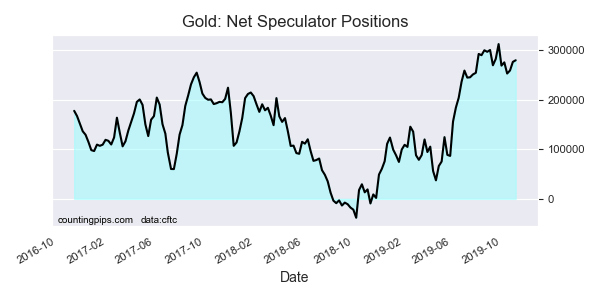
Precious metals speculators raised their Gold bullish positions this week for a third straight week and for the fourth time out of the past five weeks.

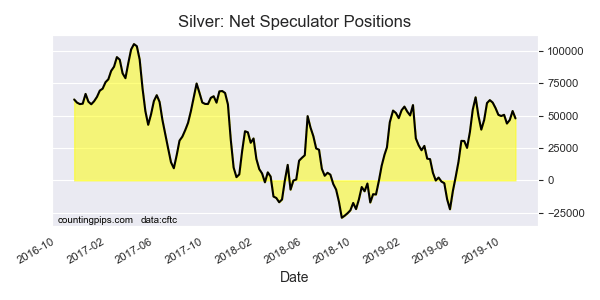
Silver speculators cut back on their bullish bets after two weeks of gains that had brought the bullish level to over the +50,000 contract threshold.

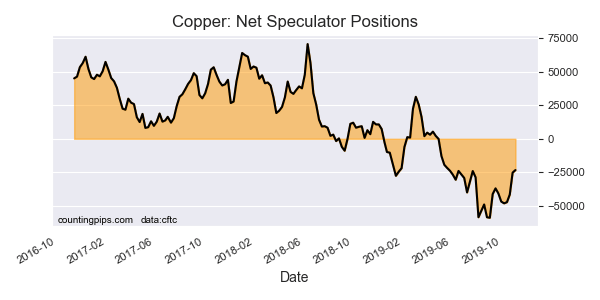
Copper speculators again reduced their bearish bets for the fourth straight week. The current bearish position (-23,311 contracts) is now less than half of the recent record high bearish position that was reached on September 3rd.

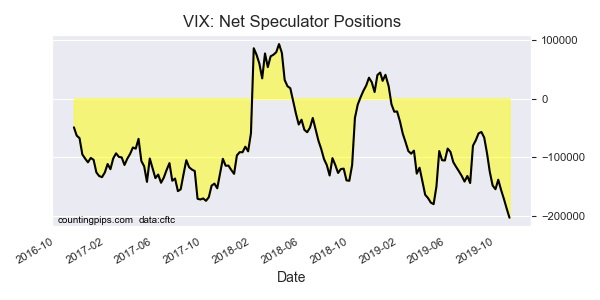
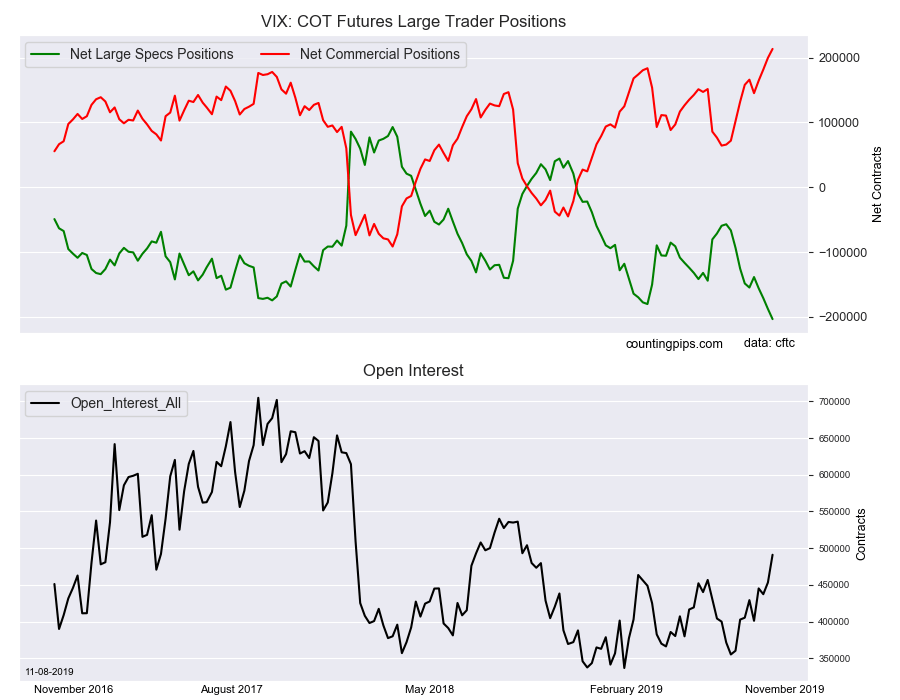
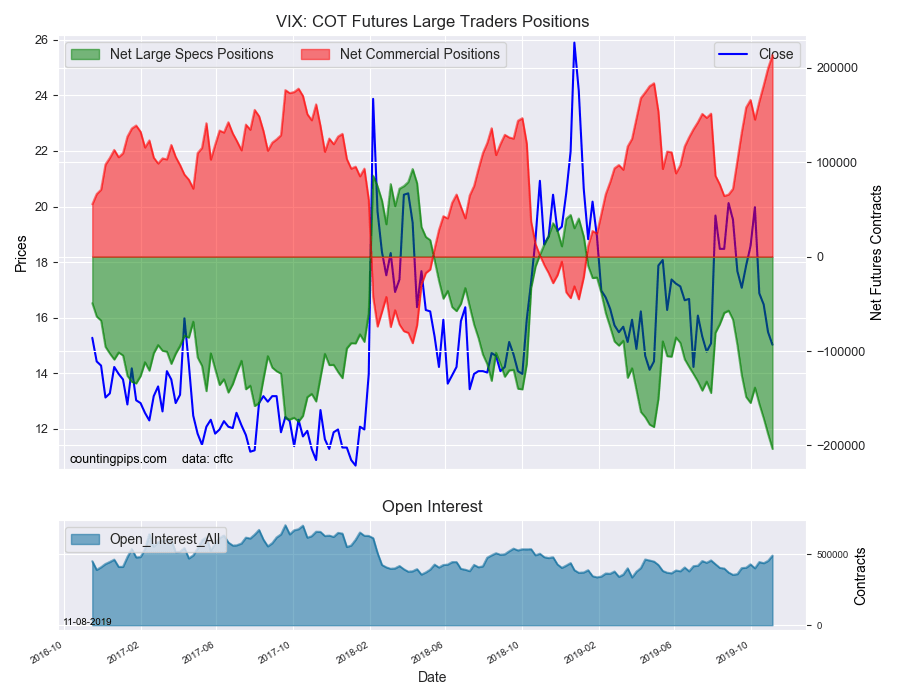
VIX speculators pushed their bearish bets higher for a fourth straight week and for the ninth time in the past ten weeks. Bearish bets hit a new record high level for a second straight week and it is the first time in history that bearish positions have been above the -200,000 net contract level.

The 10-Year Note speculators raised their bearish bets for a second straight week and by largest one-week amount (-115,390 contracts) in over a year.

Lastly, Crude oil speculative positions gained for a fourth straight week and have now risen by +51,055 contracts over that four week period. The bullish level is now back over the +400,000 net contract threshold.


US Dollar Index Speculators cut bullish bets for 5th week. AUD, CAD & MXN bets jump

Large currency speculators lowered their net positions in the US Dollar Index futures markets this week, according to the latest Commitment of Traders (COT) data released by the Commodity Futures Trading Commission (CFTC) on Friday. See full article.


WTI Crude Oil Speculators upped their bullish bets for 4th week

The large speculator contracts of WTI crude futures totaled a net position of 406,140 contracts, according to the latest data this week. This was a change of 22,793 contracts from the previous weekly total. See full article.


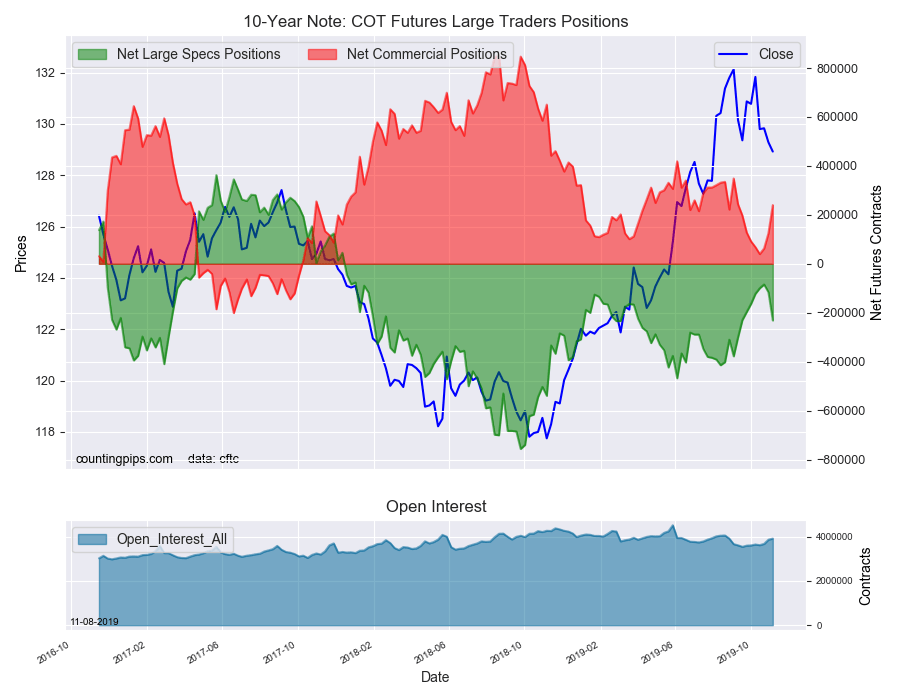
10-Year Note Speculators strongly added to their bearish bets for a 2nd week

Large speculator contracts of the 10-Year Bond futures totaled a net position of -231,456 contracts, according to the latest data this week. This was a change of -115,390 contracts from the previous weekly total. See full article.


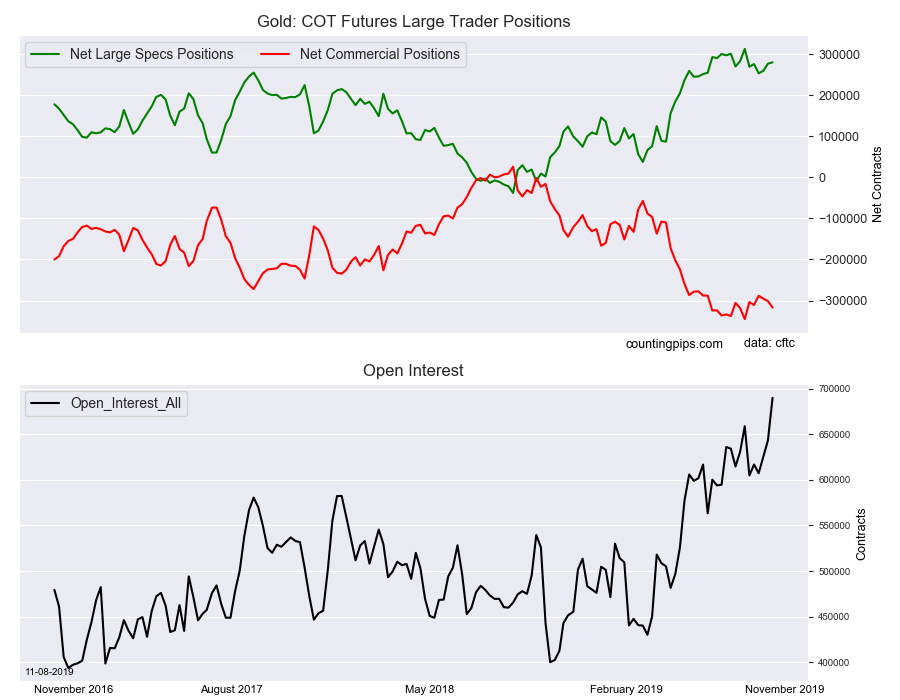
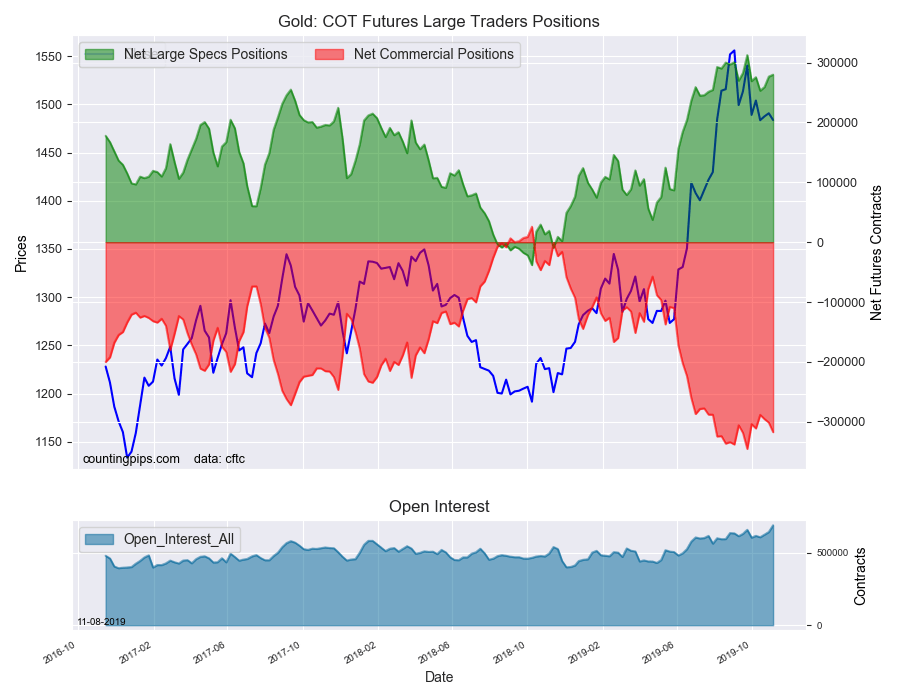
Gold Speculators raised their bullish bets for 3rd straight week

Large precious metals speculator contracts of the Gold futures totaled a net position of 279,828 contracts, according to the latest data this week. This was a change of 3,313 contracts from the previous weekly total. See full article.


VIX Speculators boosted their record bearish positions even further

Large stock market volatility speculator contracts of the VIX futures totaled a net position of -203,598 contracts, according to the latest data this week. This was a change of -15,650 contracts from the previous weekly total. See full article.


Silver Speculators trim bullish bets for 1st time in 3 weeks

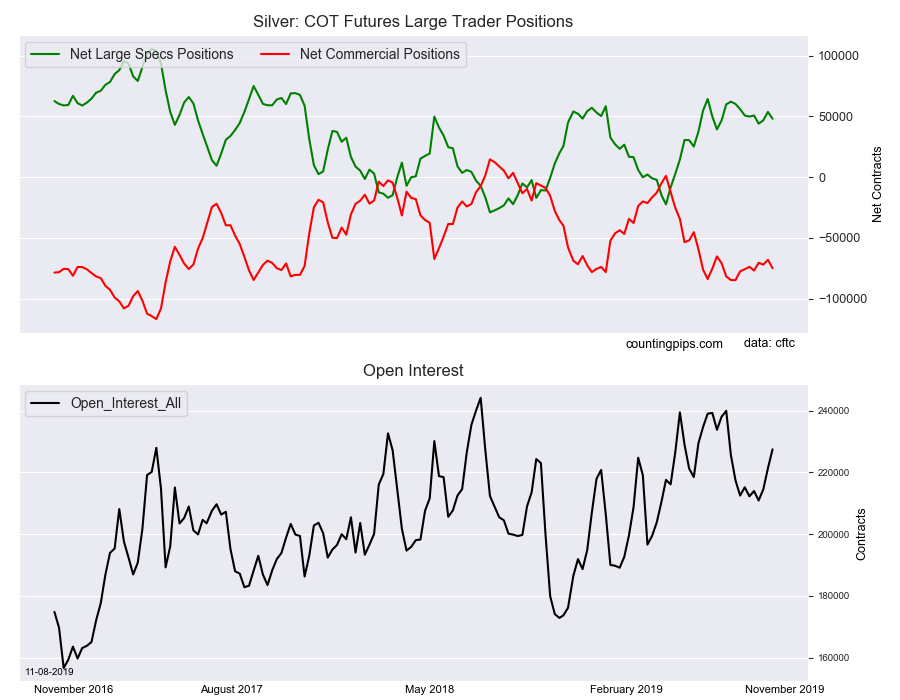
Large precious metals speculator contracts of the silver futures totaled a net position of 47,997 contracts, according to the latest data this week. This was a change of -5,681 contracts from the previous weekly total. See full article.


Copper Speculators continued to pare their bearish bets for 4th week

Metals speculator contracts of the copper futures totaled a net position of -23,311 contracts, according to the latest data this week. This was a change of 1,914 contracts from the previous weekly total. See full article.


Article By CountingPips.comReceive our weekly COT Reports by Email

*COT Report: The COT data, released weekly to the public each Friday, is updated through the most recent Tuesday (data is 3 days old) and shows a quick view of how large speculators or non-commercials (for-profit traders) were positioned in the futures markets.

The CFTC categorizes trader positions according to commercial hedgers (traders who use futures contracts for hedging as part of the business), non-commercials (large traders who speculate to realize trading profits) and nonreportable traders (usually small traders/speculators).

Find CFTC criteria here: (http://www.cftc.gov/MarketReports/CommitmentsofTraders/ExplanatoryNotes/index.htm).

US Dollar Index Speculators cut bullish bets for 5th week. AUD, CAD & MXN bets jump

November 9th – By CountingPips.comReceive our weekly COT Reports by Email

US Dollar Index Speculator Positions

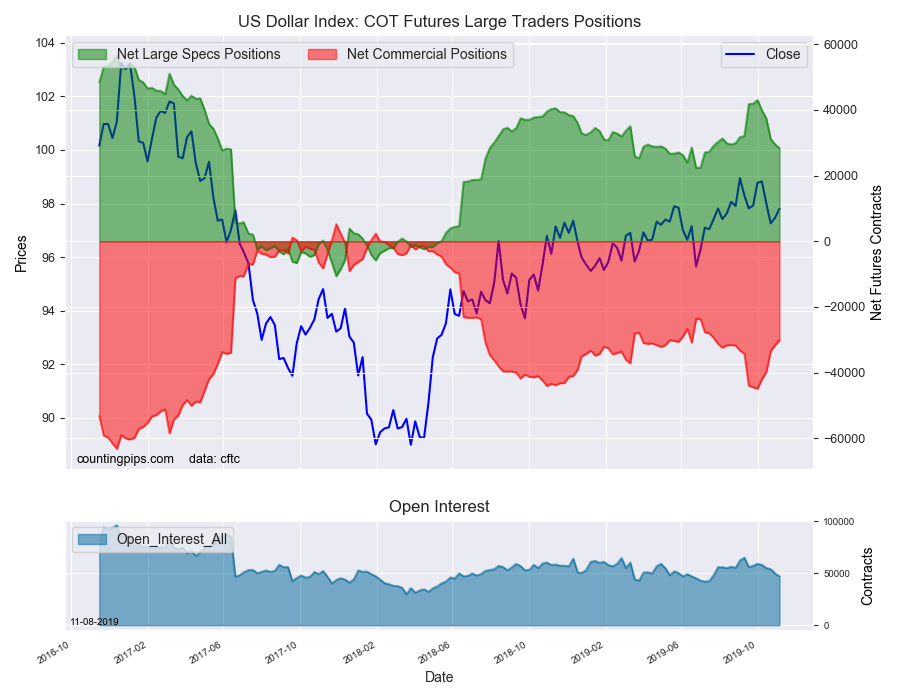
Large currency speculators continued to reduce their bullish net positions in the US Dollar Index futures markets this week, according to the latest Commitment of Traders (COT) data released by the Commodity Futures Trading Commission (CFTC) on Friday.

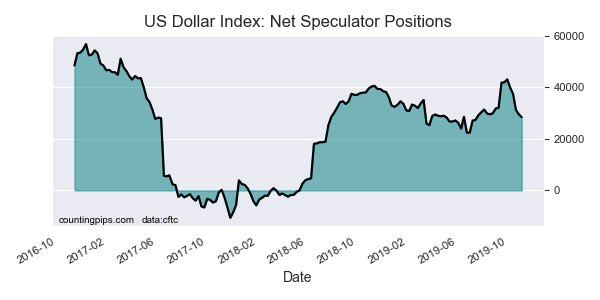
The non-commercial futures contracts of US Dollar Index futures, traded by large speculators and hedge funds, totaled a net position of 28,379 contracts in the data reported through Tuesday November 5th. This was a weekly lowering of -1,130 contracts from the previous week which had a total of 29,509 net contracts.

This week’s net position was the result of the gross bullish position (longs) dropping by -2,200 contracts (to a weekly total of 34,983 contracts) compared to the gross bearish position (shorts) which fell by a lesser amount of -1,070 contracts on the week (to a total of 6,604 contracts).

USD Index speculative positions fell again for a fifth straight week and have now declined by -14,649 contracts over that time-frame. The current bullish position is at the lowest level in sixteen weeks, dating back to July 16th. Despite the recent bearishness, the dollar bullish standing has now remained above the +20,000 net contract level for sixty-eight straight weeks.


Individual Currencies Data this week: AUD, CAD & MXN bets gain sharply

In the other major currency contracts data, we saw three substantial changes (+ or – 10,000 contracts) in the speculators category this week.

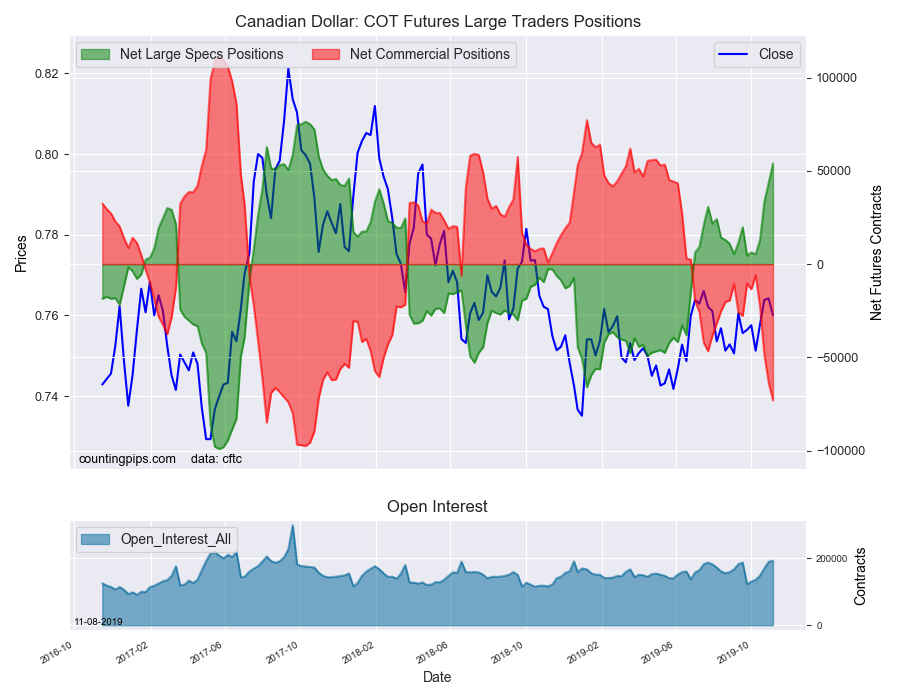
Canadian dollar bullish bets jumped sharply this week. CAD bets have risen by at least +10,000 contracts in each of the past three weeks and overall, have gained in the past four straight weeks. The current bullish standing (+54,002 contracts) for the CAD is now at the highest level in one hundred and five weeks, dating back to November of 2017.

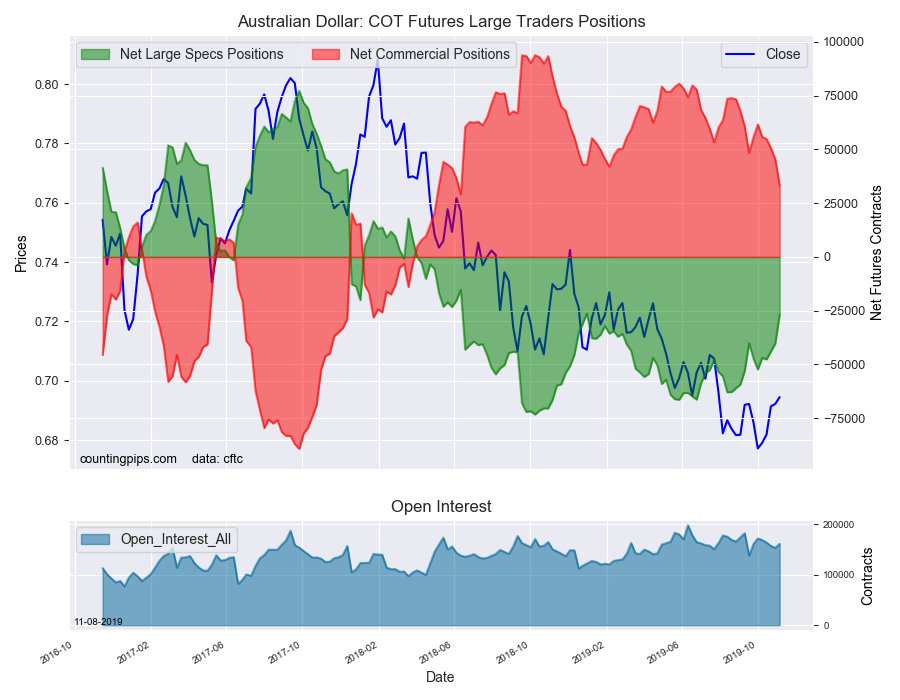
Australian dollar positions improved for a third straight week as bearish bets fell by more than 13,000 contracts this week. The recent improvements have brought the AUD bearish position down to the least bearish level (-26,794 net contracts) in forty-four weeks, dating back to December 31st of 2018.

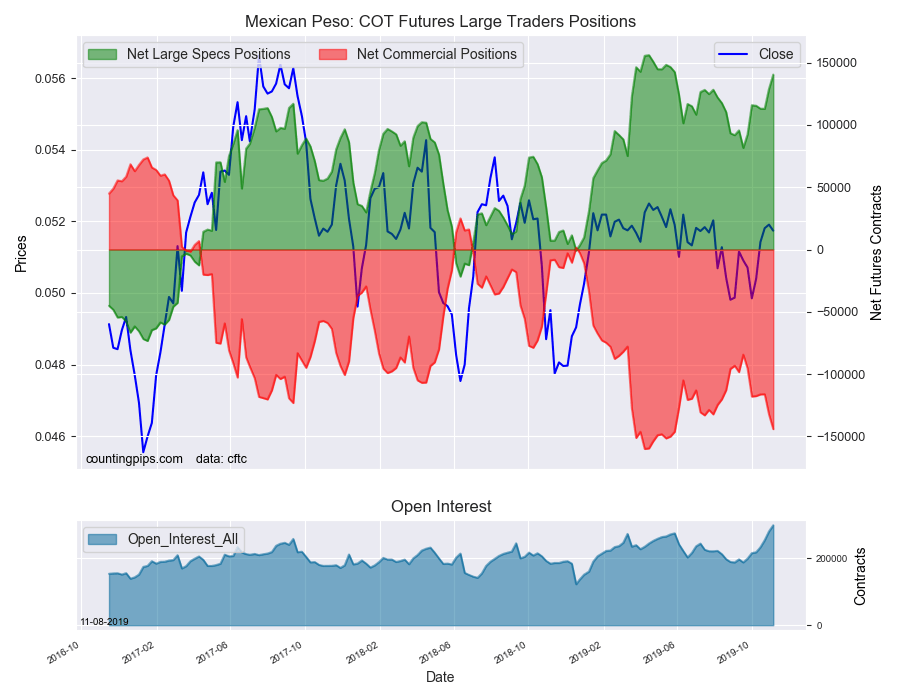
Mexican peso positions rose strongly again this week and have risen by at least +11,000 contracts for the second straight week. The current overall standing for Mexican peso positions is now at the most bullish spot in twenty-three weeks at over +140,000 net contracts. The all-time record bullish high was reached earlier this year in April with a total of +156,030 contracts.

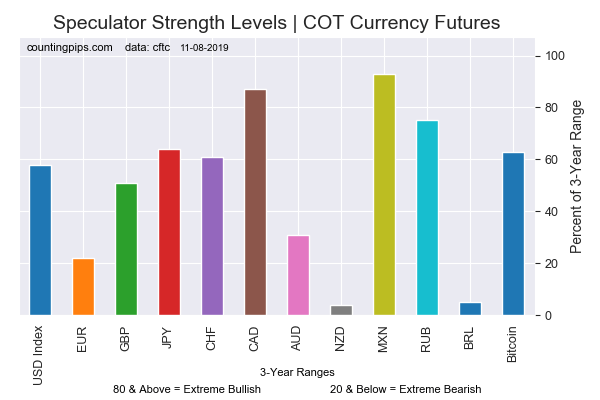
Overall, the major currencies that saw improving speculator positions this week were the British pound sterling (3,380 weekly change in contracts), Canadian dollar (10,413 contracts), Australian dollar (13,493 contracts), New Zealand dollar (1,438 contracts) and the Mexican peso (11,495 contracts).

The currencies whose speculative bets declined this week were the US dollar index (-1,130 weekly change in contracts), euro (-7,391 contracts), Japanese yen (-6,907 contracts) and the Swiss franc (-1,669 contracts).


Chart: Current Strength of Each Currency compared to their 3-Year Range

See the table and individual currency charts below.


Table of Large Speculator Levels & Weekly Changes:

CurrencyNet Speculator PositionSpecs Weekly Change
USD Index28,379-1,130
EuroFx-60,746-7,391
GBP-29,0353,380
JPY-26,605-6,907
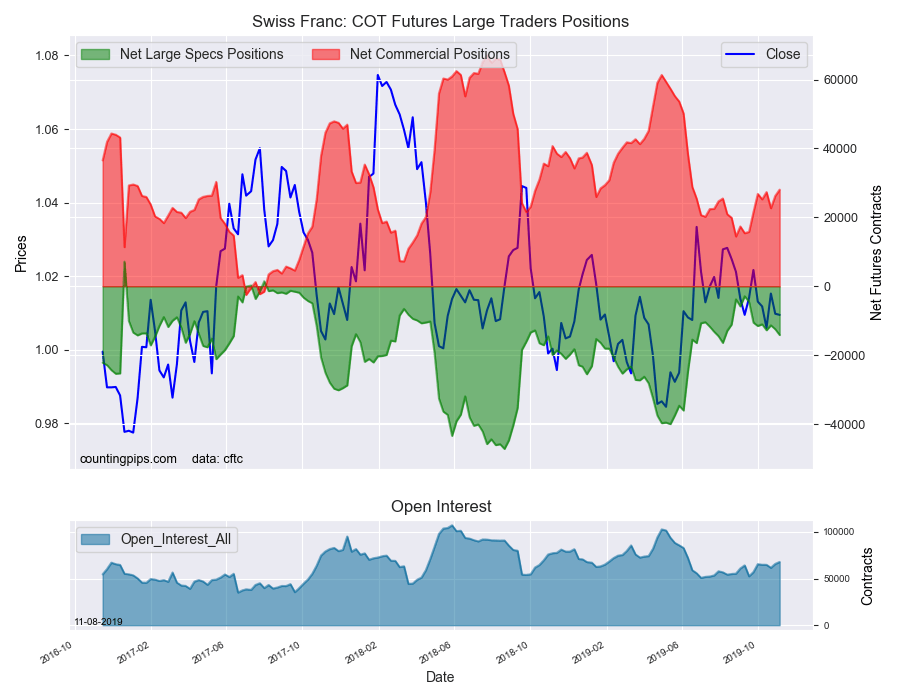
CHF-14,153-1,669
CAD54,00210,413
AUD-26,79413,493
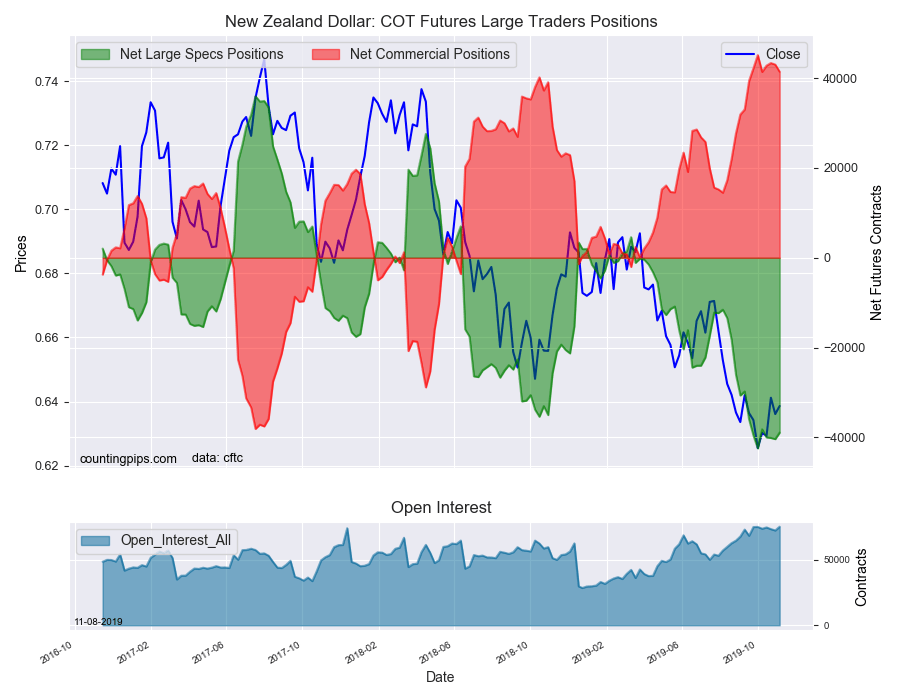
NZD-38,9651,438
MXN140,40211,495


This latest COT data is through Tuesday and shows a quick view of how large speculators or non-commercials (for-profit traders) were positioned in the futures markets. All currency positions are in direct relation to the US dollar where, for example, a bet for the euro is a bet that the euro will rise versus the dollar while a bet against the euro will be a bet that the dollar will gain versus the euro.


Weekly Charts: Large Trader Weekly Positions vs Price

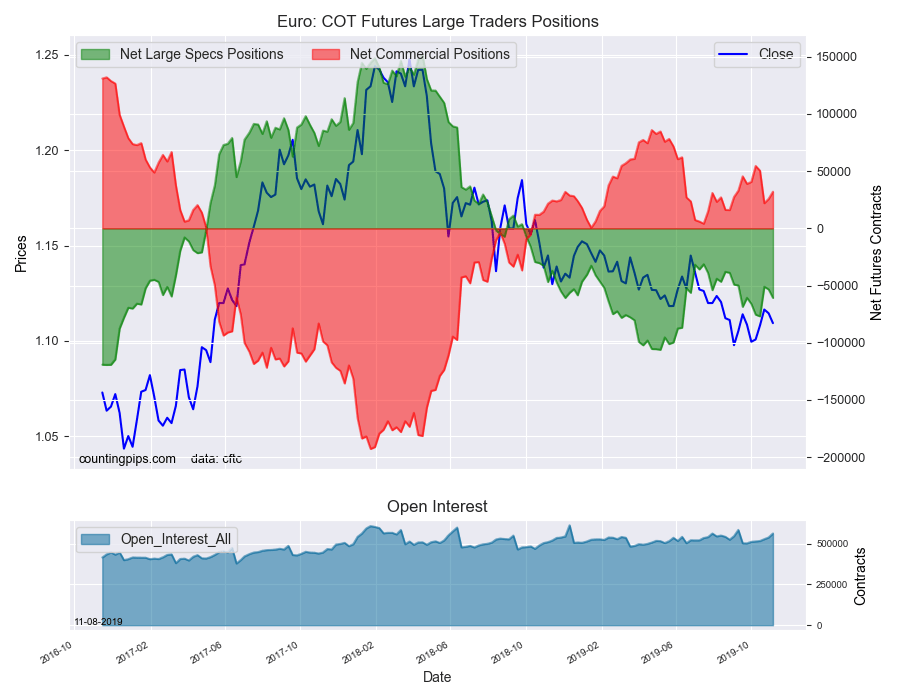
EuroFX:

The Euro large speculator standing this week reached a net position of -60,746 contracts in the data reported through Tuesday. This was a weekly decrease of -7,391 contracts from the previous week which had a total of -53,355 net contracts.


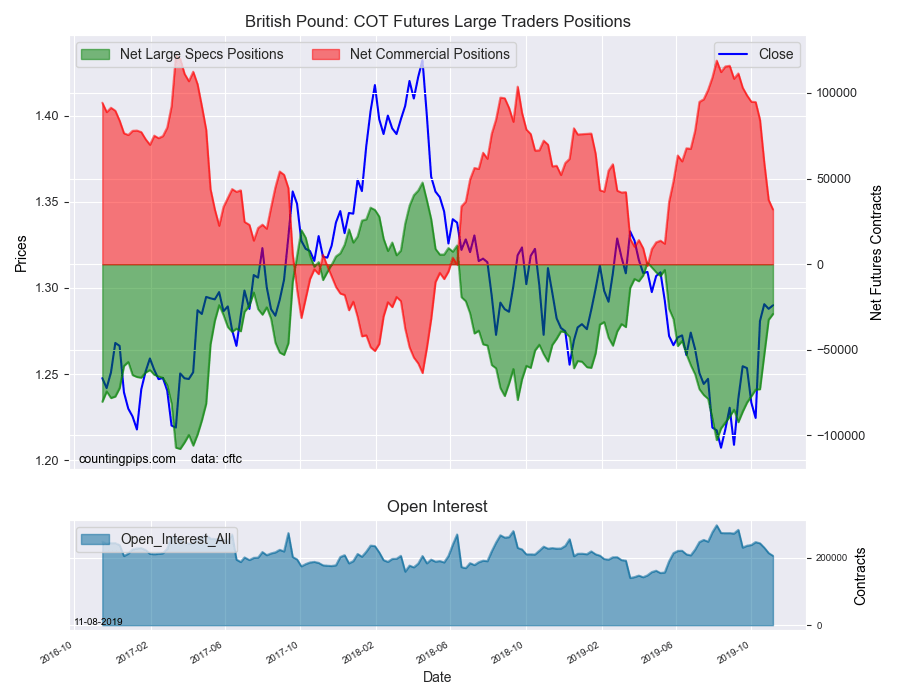
British Pound Sterling:

The large British pound sterling speculator level came in at a net position of -29,035 contracts in the data reported this week. This was a weekly rise of 3,380 contracts from the previous week which had a total of -32,415 net contracts.


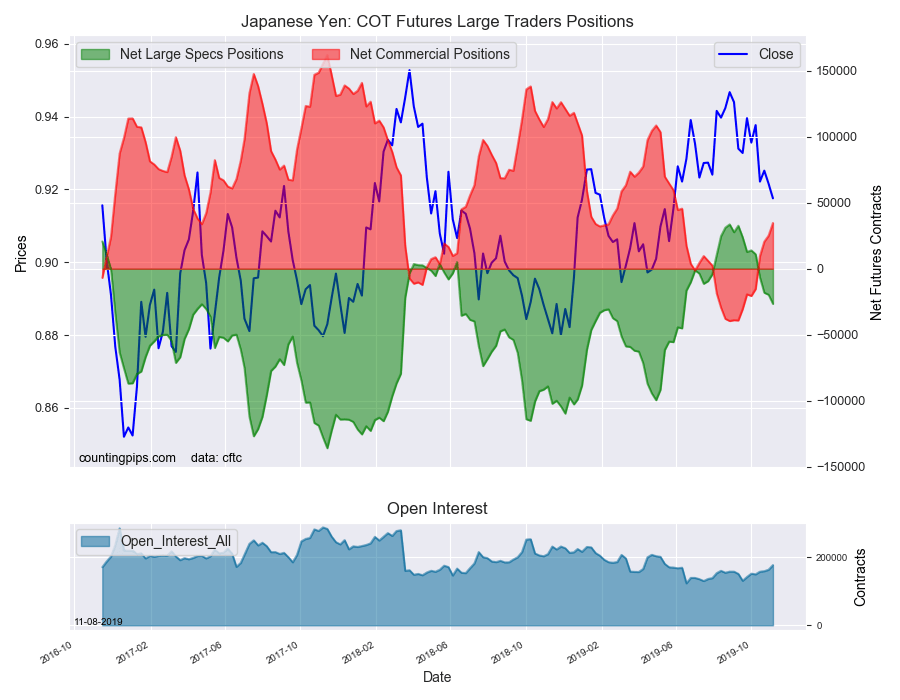
Japanese Yen:

Large Japanese yen speculators came in at a net position of -26,605 contracts in this week’s data. This was a weekly reduction of -6,907 contracts from the previous week which had a total of -19,698 net contracts.


Swiss Franc:

The Swiss franc speculator standing this week equaled a net position of -14,153 contracts in the data through Tuesday. This was a weekly decline of -1,669 contracts from the previous week which had a total of -12,484 net contracts.


Canadian Dollar:

Canadian dollar speculators resulted in a net position of 54,002 contracts this week. This was a boost of 10,413 contracts from the previous week which had a total of 43,589 net contracts.


Australian Dollar:

The large speculator positions in Australian dollar futures was a net position of -26,794 contracts this week in the data ending Tuesday. This was a weekly advance of 13,493 contracts from the previous week which had a total of -40,287 net contracts.


New Zealand Dollar:

The New Zealand dollar speculative standing recorded a net position of -38,965 contracts this week in the latest COT data. This was a weekly advance of 1,438 contracts from the previous week which had a total of -40,403 net contracts.


Mexican Peso:

Mexican peso speculators reached a net position of 140,402 contracts this week. This was a weekly gain of 11,495 contracts from the previous week which had a total of 128,907 net contracts.


Article By CountingPips.comReceive our weekly COT Reports by Email

*COT Report: The COT data, released weekly to the public each Friday, is updated through the most recent Tuesday (data is 3 days old) and shows a quick view of how large speculators or non-commercials (for-profit traders) were positioned in the futures markets.

The CFTC categorizes trader positions according to commercial hedgers (traders who use futures contracts for hedging as part of the business), non-commercials (large traders who speculate to realize trading profits) and nonreportable traders (usually small traders/speculators).

Find CFTC criteria here: (http://www.cftc.gov/MarketReports/CommitmentsofTraders/ExplanatoryNotes/index.htm).

WTI Crude Oil Speculators upped their bullish bets for 4th week

November 9th – By CountingPips.comReceive our weekly COT Reports by Email

WTI Crude Oil Non-Commercial Speculator Positions:

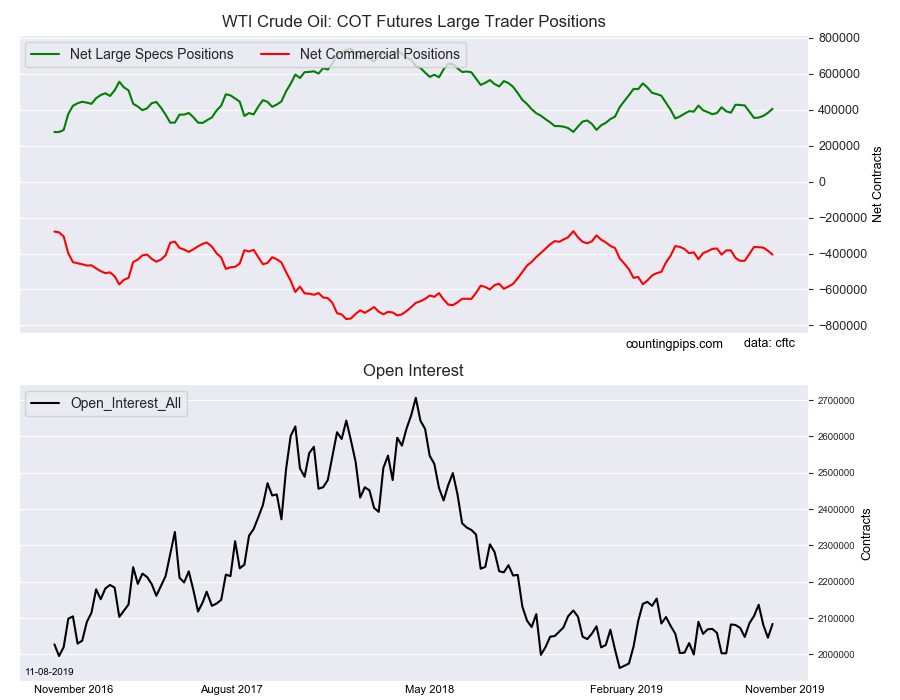
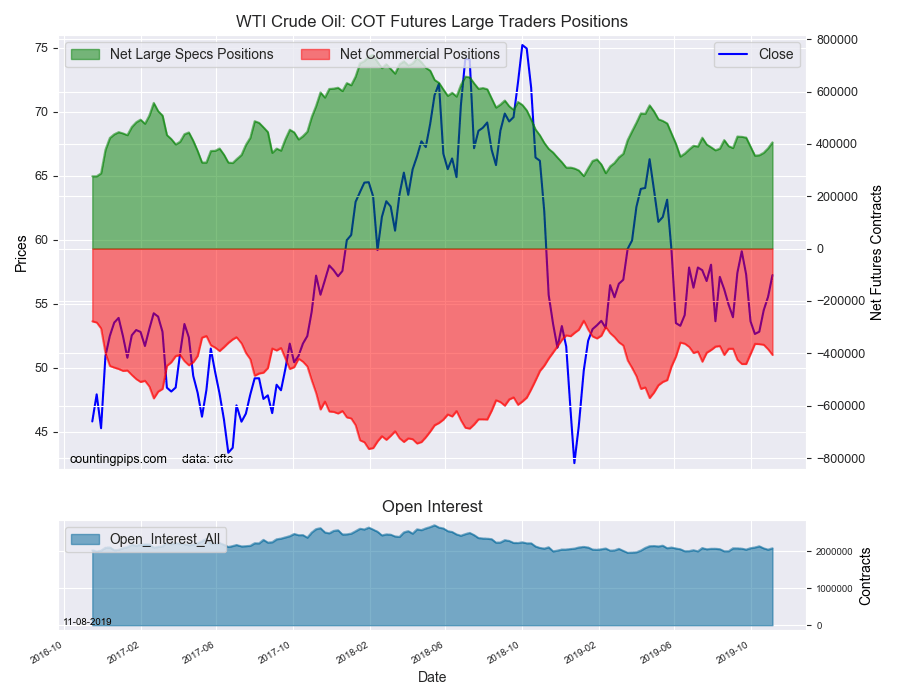
Large energy speculators raised their bullish net positions in the WTI Crude Oil futures markets this week, according to the latest Commitment of Traders (COT) data released by the Commodity Futures Trading Commission (CFTC) on Friday.

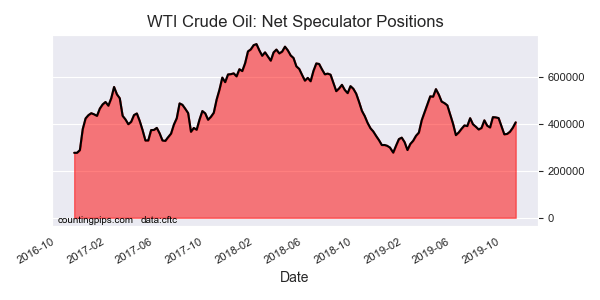
The non-commercial futures contracts of WTI Crude Oil futures, traded by large speculators and hedge funds, totaled a net position of 406,140 contracts in the data reported through Tuesday November 5th. This was a weekly change of 22,793 net contracts from the previous week which had a total of 383,347 net contracts.

The week’s net position was the result of the gross bullish position (longs) rising by 12,784 contracts (to a weekly total of 565,026 contracts) while the gross bearish position (shorts) dropped by -10,009 contracts for the week (to a total of 158,886 contracts).

Crude oil speculative positions gained for a fourth straight week and have now risen by +51,055 contracts over that four week period. The current bullish level is now back over the +400,000 net contract threshold for the first time in six weeks. Overall, the crude position has remained in bullish territory for a total of 548 weeks, dating back to May 5th of 2009.

WTI Crude Oil Commercial Positions:

The commercial traders position, hedgers or traders engaged in buying and selling for business purposes, totaled a net position of -405,946 contracts on the week. This was a weekly shortfall of -21,769 contracts from the total net of -384,177 contracts reported the previous week.

WTI Crude Oil Futures:

Over the same weekly reporting time-frame, from Tuesday to Tuesday, the WTI Crude Oil Futures (Front Month) closed at approximately $57.23 which was an increase of $1.69 from the previous close of $55.54, according to unofficial market data.

*COT Report: The COT data, released weekly to the public each Friday, is updated through the most recent Tuesday (data is 3 days old) and shows a quick view of how large speculators or non-commercials (for-profit traders) as well as the commercial traders (hedgers & traders for business purposes) were positioned in the futures markets.

The CFTC categorizes trader positions according to commercial hedgers (traders who use futures contracts for hedging as part of the business), non-commercials (large traders who speculate to realize trading profits) and nonreportable traders (usually small traders/speculators).

Find CFTC criteria here: (http://www.cftc.gov/MarketReports/CommitmentsofTraders/ExplanatoryNotes/index.htm).

Article By CountingPips.comReceive our weekly COT Reports by Email

10-Year Note Speculators strongly added to their bearish bets for a 2nd week

November 9th – By CountingPips.comReceive our weekly COT Reports by Email

10-Year Note Non-Commercial Speculator Positions:

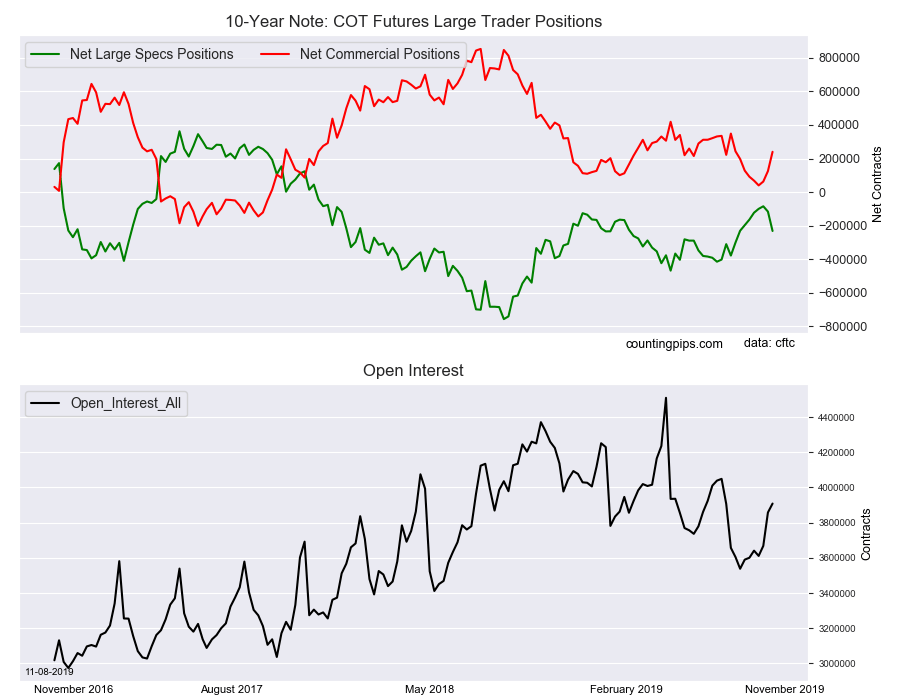
Large bond speculators sharply increased their bearish net positions in the 10-Year Note futures markets this week, according to the latest Commitment of Traders (COT) data released by the Commodity Futures Trading Commission (CFTC) on Friday.

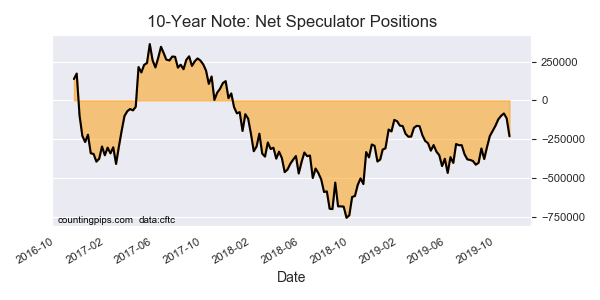
The non-commercial futures contracts of 10-Year Note futures, traded by large speculators and hedge funds, totaled a net position of -231,456 contracts in the data reported through Tuesday November 5th. This was a weekly change of -115,390 net contracts from the previous week which had a total of -116,066 net contracts.

The week’s net position was the result of the gross bullish position (longs) falling by -62,945 contracts (to a weekly total of 653,270 contracts) in addition to the gross bearish position (shorts) rising by 52,445 contracts for the week (to a total of 884,726 contracts).

10-Year speculators raised their bearish bets for a second straight week and by largest one-week amount (-115,390 contracts) in over a year, dating back to September of 2018. This recent bearishness pushes the overall position to the most bearish level in eight weeks with contracts back over the -200,000 net contract standing.

10-Year Note Commercial Positions:

The commercial traders position, hedgers or traders engaged in buying and selling for business purposes, totaled a net position of 240,121 contracts on the week. This was a weekly boost of 114,893 contracts from the total net of 125,228 contracts reported the previous week.

10-Year Note Futures:

Over the same weekly reporting time-frame, from Tuesday to Tuesday, the 10-Year Note Futures (Front Month) closed at approximately $128.92 which was a fall of $-0.35 from the previous close of $129.28, according to unofficial market data.

*COT Report: The COT data, released weekly to the public each Friday, is updated through the most recent Tuesday (data is 3 days old) and shows a quick view of how large speculators or non-commercials (for-profit traders) as well as the commercial traders (hedgers & traders for business purposes) were positioned in the futures markets.

The CFTC categorizes trader positions according to commercial hedgers (traders who use futures contracts for hedging as part of the business), non-commercials (large traders who speculate to realize trading profits) and nonreportable traders (usually small traders/speculators).

Find CFTC criteria here: (http://www.cftc.gov/MarketReports/CommitmentsofTraders/ExplanatoryNotes/index.htm).

Article By CountingPips.comReceive our weekly COT Reports by Email

Gold Speculators raised their bullish bets for 3rd straight week

November 9th – By CountingPips.comReceive our weekly COT Reports by Email

Gold Non-Commercial Speculator Positions:

Large precious metals speculators once again lifted their bullish net positions in the Gold futures markets this week, according to the latest Commitment of Traders (COT) data released by the Commodity Futures Trading Commission (CFTC) on Friday.

The non-commercial futures contracts of Gold futures, traded by large speculators and hedge funds, totaled a net position of 279,828 contracts in the data reported through Tuesday November 5th. This was a weekly change of 3,313 net contracts from the previous week which had a total of 276,515 net contracts.

The week’s net position was the result of the gross bullish position (longs) advancing by 9,168 contracts (to a weekly total of 344,591 contracts) while the gross bearish position (shorts) gained by a lesser amount of 5,855 contracts for the week (to a total of 64,763 contracts).

Gold speculators slightly boosted their bullish positions this week, pushing bets higher for a third straight week and for the fourth time out of the past five weeks. The gold position remains at the higher end of its bullish range as bets have continued to be higher than at least +250,000 net contracts for sixteen straight weeks.

Gold Commercial Positions:

The commercial traders position, hedgers or traders engaged in buying and selling for business purposes, totaled a net position of -317,138 contracts on the week. This was a weekly decrease of -15,922 contracts from the total net of -301,216 contracts reported the previous week.

Gold Futures:

Over the same weekly reporting time-frame, from Tuesday to Tuesday, the Gold Futures (Front Month) closed at approximately $1483.70 which was a decrease of $-7.0 from the previous close of $1490.70, according to unofficial market data.

*COT Report: The COT data, released weekly to the public each Friday, is updated through the most recent Tuesday (data is 3 days old) and shows a quick view of how large speculators or non-commercials (for-profit traders) as well as the commercial traders (hedgers & traders for business purposes) were positioned in the futures markets.

The CFTC categorizes trader positions according to commercial hedgers (traders who use futures contracts for hedging as part of the business), non-commercials (large traders who speculate to realize trading profits) and nonreportable traders (usually small traders/speculators).

Find CFTC criteria here: (http://www.cftc.gov/MarketReports/CommitmentsofTraders/ExplanatoryNotes/index.htm).

Article By CountingPips.comReceive our weekly COT Reports by Email


VIX Speculators boosted their record bearish positions even further

November 9th – By CountingPips.comReceive our weekly COT Reports by Email

VIX Non-Commercial Speculator Positions:

Large volatility speculators sharply raised their bearish net positions higher in the VIX futures markets this week, according to the latest Commitment of Traders (COT) data released by the Commodity Futures Trading Commission (CFTC) on Friday.

The non-commercial futures contracts of VIX futures, traded by large speculators and hedge funds, totaled a net position of -203,598 contracts in the data reported through Tuesday November 5th. This was a weekly change of -15,650 net contracts from the previous week which had a total of -187,948 net contracts.

The week’s net position was the result of the gross bullish position (longs) increasing by 3,932 contracts (to a weekly total of 84,775 contracts) while the gross bearish position (shorts) jumped by 19,582 contracts for the week (to a total of 288,373 contracts).

VIX speculators boosted their bearish bets for a fourth consecutive week and for the ninth time in the past ten weeks. Speculators have added a total of -64,918 contracts to the net position in just the past four weeks and by a total of -146,445 contracts in the past ten weeks. This continued bearishness has pushed bearish bets to a new record high level for a second straight week and it is the first time in history that bearish positions have been above the -200,000 net contract level.

VIX Commercial Positions:

The commercial traders position, hedgers or traders engaged in buying and selling for business purposes, totaled a net position of 213,539 contracts on the week. This was a weekly advance of 13,796 contracts from the total net of 199,743 contracts reported the previous week.

VIX Futures:

Over the same weekly reporting time-frame, from Tuesday to Tuesday, the VIX Futures (Front Month) closed at approximately $15.02 which was a drop of $-0.45 from the previous close of $15.47, according to unofficial market data.

*COT Report: The COT data, released weekly to the public each Friday, is updated through the most recent Tuesday (data is 3 days old) and shows a quick view of how large speculators or non-commercials (for-profit traders) as well as the commercial traders (hedgers & traders for business purposes) were positioned in the futures markets.

The CFTC categorizes trader positions according to commercial hedgers (traders who use futures contracts for hedging as part of the business), non-commercials (large traders who speculate to realize trading profits) and nonreportable traders (usually small traders/speculators).

Find CFTC criteria here: (http://www.cftc.gov/MarketReports/CommitmentsofTraders/ExplanatoryNotes/index.htm).

Article By CountingPips.comReceive our weekly COT Reports by Email

Silver Speculators trim bullish bets for 1st time in 3 weeks

November 9th – By CountingPips.comReceive our weekly COT Reports by Email

Silver Non-Commercial Speculator Positions:

Large precious metals speculators lowered their bullish net positions in the Silver futures markets this week, according to the latest Commitment of Traders (COT) data released by the Commodity Futures Trading Commission (CFTC) on Friday.

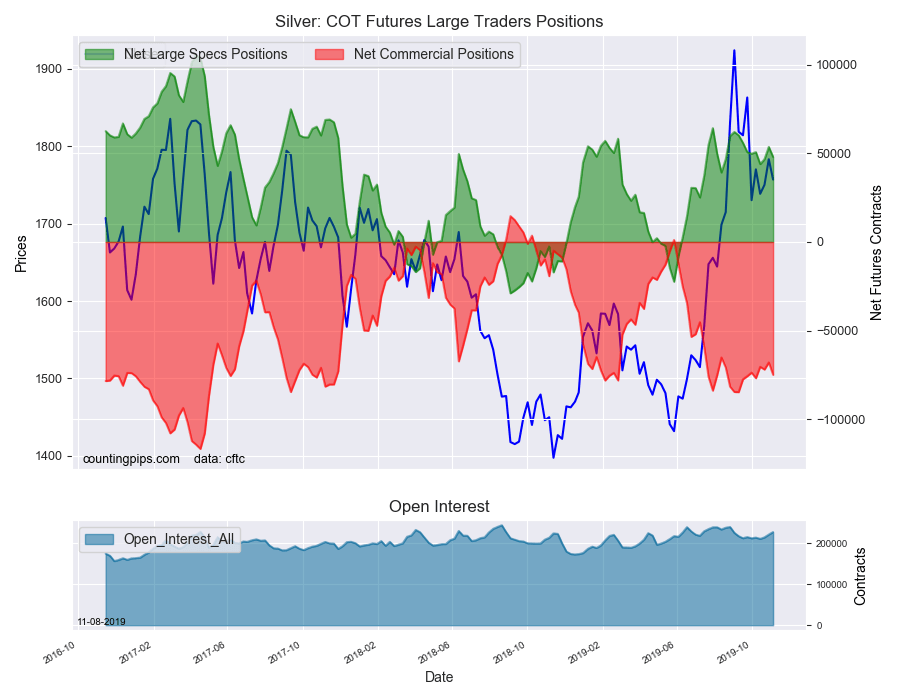
The non-commercial futures contracts of Silver futures, traded by large speculators and hedge funds, totaled a net position of 47,997 contracts in the data reported through Tuesday November 5th. This was a weekly decline of -5,681 net contracts from the previous week which had a total of 53,678 net contracts.

The week’s net position was the result of the gross bullish position (longs) advancing by 1,806 contracts (to a weekly total of 97,174 contracts) but being more than offset by the gross bearish position (shorts) that rose by a greater amount of 7,487 contracts for the week (to a total of 49,177 contracts).

Silver speculators cut back on their bullish positions following two weeks of gains that had put the bullish level back over the +50,000 contract threshold. The silver position continues to remain strongly bullish with long contracts staying above the +40,000 net level for the past twelve weeks. Overall, the silver position has been in a bullish position for twenty-two consecutive weeks since June 11th.

Silver Commercial Positions:

The commercial traders position, hedgers or traders engaged in buying and selling for business purposes, totaled a net position of -74,982 contracts on the week. This was a weekly loss of -6,937 contracts from the total net of -68,045 contracts reported the previous week.

Silver Futures:

Over the same weekly reporting time-frame, from Tuesday to Tuesday, the Silver Futures (Front Month) closed at approximately $1756.80 which was a decline of $-26.30 from the previous close of $1783.10, according to unofficial market data.

*COT Report: The COT data, released weekly to the public each Friday, is updated through the most recent Tuesday (data is 3 days old) and shows a quick view of how large speculators or non-commercials (for-profit traders) as well as the commercial traders (hedgers & traders for business purposes) were positioned in the futures markets.

The CFTC categorizes trader positions according to commercial hedgers (traders who use futures contracts for hedging as part of the business), non-commercials (large traders who speculate to realize trading profits) and nonreportable traders (usually small traders/speculators).

Find CFTC criteria here: (http://www.cftc.gov/MarketReports/CommitmentsofTraders/ExplanatoryNotes/index.htm).

Article By CountingPips.comReceive our weekly COT Reports by Email