The current status, catalysts and outlook for the immunotherapy are discussed in a ROTH Capital Partners report.
In a Nov. 7 research note, ROTH Capital Partners analyst Zegbeh Jallah reported that with respect to Aimmune Therapeutics Inc. (AIMT:NASDAQ), “all eyes remain on Palforzia’s U.S. approval and launch in 2020.” Palforzia is Aimmune’s lead candidate, an oral therapy for peanut allergy in youths aged 417.
In Q3/19, Palforzia received an “overwhelmingly positive vote from the U.S. Food and Drug Administration’s (FDA) allergy products advisory committee, in support of the approval,” Jallah noted. The FDA is scheduled to make a decision on Palforzia by January 2020, and approval is expected. ROTH models Q1/20 revenue from U.S. sales of Palforzia at about $4 million.
Jallah highlighted that ROTH does not expect any surprises from the FDA concerning the labeling of Palforzia. This is because the FDA and Aimmune continue to work together to finalize the risk evaluation and mitigation strategy (REMS) associated with the expected black box warning on Palforzia. “No surprises to the label or REMS for Palforzia upon approval will certainly be a positive for the stock,” she added.
The analyst indicated that an annual price for Palforzia of around $7,000 is reasonable given it is a specialty drug and will save insurers costs related to allergic reactions that do not receive immediate treatment. Pricing and a “very accommodative REMS” could be near-term catalysts for Aimmune prior to the FDA’s decision on Palforzia.
Another near-term catalyst for Aimmune could be the outcome of the advisory committee meeting concerning DBV Technologies SA’s (DBVT:NASDAQ) Viaskin, a peanut allergy patch for children ages 411. “If DBV is unable to get a majority advisory committee vote in favor of Viaskin, this would be a positive catalyst for Aimmune,” Jallah indicated.
With respect to Aimmune’s financial status, the biopharma ended Q3/19 with about $200 million in cash.
ROTH has a Buy rating and a $45 per share 12-month target price on Aimmune, whose stock is currently trading at around $27.64 per share.
Disclosure: 1) Doresa Banning compiled this article for Streetwise Reports LLC and provides services to Streetwise Reports as an independent contractor. She or members of her household own securities of the following companies mentioned in the article: None. She or members of her household are paid by the following companies mentioned in this article: None. 2) The following companies mentioned in this article are billboard sponsors of Streetwise Reports: None. Click here for important disclosures about sponsor fees. 3) Comments and opinions expressed are those of the specific experts and not of Streetwise Reports or its officers. The information provided above is for informational purposes only and is not a recommendation to buy or sell any security. 4) The article does not constitute investment advice. Each reader is encouraged to consult with his or her individual financial professional and any action a reader takes as a result of information presented here is his or her own responsibility. By opening this page, each reader accepts and agrees to Streetwise Reports’ terms of use and full legal disclaimer. This article is not a solicitation for investment. Streetwise Reports does not render general or specific investment advice and the information on Streetwise Reports should not be considered a recommendation to buy or sell any security. Streetwise Reports does not endorse or recommend the business, products, services or securities of any company mentioned on Streetwise Reports. 5) From time to time, Streetwise Reports LLC and its directors, officers, employees or members of their families, as well as persons interviewed for articles and interviews on the site, may have a long or short position in securities mentioned. Directors, officers, employees or members of their immediate families are prohibited from making purchases and/or sales of those securities in the open market or otherwise from the time of the interview or the decision to write an article until three business days after the publication of the interview or article. The foregoing prohibition does not apply to articles that in substance only restate previously published company releases.
Disclosures from ROTH Capital Partners, Aimmune Therapeutics Inc., Company Note, November 7, 2019
Regulation Analyst Certification (“Reg AC”): The research analyst primarily responsible for the content of this report certifies the following under Reg AC: I hereby certify that all views expressed in this report accurately reflect my personal views about the subject company or companies and its or their securities. I also certify that no part of my compensation was, is or will be, directly or indirectly, related to the specific recommendations or views expressed in this report.
ROTH makes a market in shares of Aimmune Therapeutics, Inc. and as such, buys and sells from customers on a principal basis.
ROTH Capital Partners, LLC expects to receive or intends to seek compensation for investment banking or other business relationships with the covered companies mentioned in this report in the next three months.
The notion of what constitutes a “stable” currency is a little different for every forex trader because it can have different implications depending on their trading style.
For most people, when you ask about the stability of a currency, people want to know if it will keep its value over time. In other words, usually, the one with the least inflation.
Forex traders are interested in how much the price of different currencies changes between each other, which is an entirely different question. In fact, in many cases, what a forex trader is thinking is often which is the most stable pair.
As usual, forex takes what should be a simple question, and then offers a much more complicated answer.
Biggest Isn’t Always Best
With a wide range of criteria for stability, it’s not surprising that there are several currencies that could be considered the most stable.
First would probably be the USD, which is still the world’s reserve currency and primary safe haven. Other currencies’ changes in value are measured against the dollar, making it effectively the currency yardstick.
Those factors don’t mean, however, that the currency isn’t subject to volatility in the markets. For a forex trader, who’s primarily interested in the price changes in currencies, this is an important gauge of stability.
The CHF often fills this role. The currency is tied to gold and the Swiss National Bank takes a hard-line stance on currency appreciation. Therefore, the franc is among the currencies with the least volatility.
Unconventional Measures
But if it’s just daily ups and downs that we are looking at, maybe the CNY could be considered the most “stable” since it is strictly controlled by the POBC within a certain range. But, it’s not a free-float currency. And it can change in value depending on the political interests of the country.
Norway’s would also be another currency that many might not immediately think of. But the krone is considered one of the safest currencies because Norway doesn’t have any net debt.
It’s a stand-alone currency and it isn’t tied to any other country. However, Norway is highly dependant on oil exports, which can generate some unexpected moves.
The Other Classics
Another candidate for the title of the most stable in the usual understanding would be the JPY.
The yen has had low inflation for an extended period of time, despite the BOJ’s efforts. However, the country has the highest debt in the world. Even so, Japan is a safe haven in times of uncertainty, and the currency can change value with respect to others depending on market risk perception.
Gold is still technically considered a currency and is an attractive store of value. However, compared to currencies in general, its price tends to vary considerably in the long and medium-term. Although it remains the go-to as a store of value, market perception of risk creates wide fluctuations in value.
So, Which Is It?
In the end, currency stability for a forex trader is something of a subjective idea.
Are you looking for a long-term currency that won’t fluctuate as much as others? Then probably you’re thinking of the US.
But if you’re looking for daily stability in that there won’t likely be a lot of price action, then you’re probably thinking the EURCHF cross.
A frequent thought among forex traders is how much money could they make through forex trading. There’s a realistic scenario, of course, but there’s also the theoretical upper limit of possibilities.
Well, technically yes; just like you can win the lottery.
How likely is it, though? And more importantly, are you willing to make the sacrifices that other people with more money have made? There’s also quite a bit of luck involved, right?
Let’s put all that aside for now, and figure out who did (or is doing) the best when it comes to forex trading.
What do You Mean by Richest?
You could make the case that most of the richest people in the world have done some degree of forex trading.
People like Warren Buffet who take currency positions to hedge other investments, for example, do use forex as part of a wide range of investment tools. But that feels like calling him a forex trader through a technicality.
Another example might be Jeff Bezos, who used to trade currencies before he started Amazon. Is he technically a forex trader? Well, he was. But he became the richest man in the world through other means, though his forex trading arguably helped.
Strictly Forex
Part of the problem with identifying the richest forex trader is that once you get above a certain amount of money, you start diversifying your investments. Diversification helps manage risk, and that’s how most successful traders operate.
So, let’s limit the definition to people who make their fortune solely on the basis of forex.
This includes people who might move on to invest in other things but still keep a significant currency portfolio because that’s their area of expertise.
If that’s the criteria we’re adhering to, then probably the richest and most famous forex trader would be George Soros.
How to Build a Fortune on Currencies
Soros was born in Hungary to a Jewish family during the Holocaust. It’s hard to start in a more “rags” place than that, if we want to tell a rags-to-riches story.
However, he managed to raise money to create an investment fund, on which he would base his later success.
He’s often known as “The Man Who Broke the Bank Of England” by taking a short position during Black Wednesday in the UK.
He took advantage of what he saw as a potential negative impact on the British pound on the European Exchange Rate Mechanism. This allowed him to make over $1 billion in a single day with just forex.
Other Top Contenders
Evidently Soros found himself in a somewhat unique position, that most FX traders won’t have the opportunity to do again.
There are, however, traders who have made substantial fortunes through consistent and rigorous forex trading. A notable example would be Stanley Druckenmiller, who helped manage Soros’ currency portfolio and is estimated to be worth more than $3.5B today.
Other forex traders who have been quite successful are also well known because they’ve transformed their experience and knowledge into books. Jack Schwager, for example, author of the Market Wizards books. Or Alexander Elder, who wrote a series of classic books on trading.
Back to Earth
Because of how George Soros made a substantial amount of his fortune, he might not be the best example for people starting out trading. He got lucky, but also he was prepared to take advantage of that luck.
Which is a recurring theme among the more successful traders; managing their money and building on their skills as much as possible so they have the means to take advantage of the situation when it arises.
Mickey Fulp, the Mercenary Geologist, sits down with Maurice Jackson of Proven and Probable to discuss silver and its position among the metals, as well as some of his favorite copper, gold and uranium companies.
Maurice Jackson: Joining us for a conversation is the Mercenary Geologist, Mickey Fulp.
Thank you for joining us. Two years ago, Mickey, we discussed the value propositions in tax-loss selling. Last year we did one on peak gold. I like to have your thoughts today regarding the value proposition of silver bullion, silver junior mining companies, and then those that extract silver, and if those aren’t the ones that we should be focusing our efforts on, then let’s find out what you are focusing your efforts on. So first let’s discuss silver bullion. There’s a number of speculators in the space that they’re always optimistic about the value proposition, currently the silver ratio is, what, in the 80s, mid-80s?
Mickey Fulp: 84 as of Friday.
Maurice Jackson: What are your thoughts on that? Does that surprise you? Should it be lower? Should it be higher or is it in the right place?
Mickey Fulp: Well, it is what it is. It’s what the market says it is. So it’s not my point to judge if it should be higher or lower. This is what the market says it is. I can go on historical precedent and good reasoning and say since January of 1970 to the present month, the mean of the gold-silver ratio has been 57, the median has been 59 so that is a normal, or the most common ratios, but it is varied since January of 1970 from around 20 to as high as 93 ½, which it reached a couple of months ago.
So it’s skewed toward the higher higher-value right now and that’s abnormal to say it in one word. It does not mean that it’s not going to stay there. If you look at the price of the ratios since global economic crisis, it’s moved almost continuously up and up with a couple of perturbations. So it can be argued we’re in a different paradigm. I’ve heard that argument. I don’t necessarily subscribe to that argument. I expect that ratio to come back down at some point. So that means that, yes, silver bullion is a value proposition right now predicated on the fact that historically it’s way high. But gold remains money and it’s debatable if silver’s money or not.
As far as the U.S. government is concerned, it was no longer money. We came off the bimetallic monetary standard in 1900. It was briefly money with Federal Reserve notes when Roosevelt took us off the gold standard, so 1933 to 1944 with the Federal Reserve notes, which could be exchanged for bullion. Then we went on the gold standard from 1944 to 1971. There was a brief period of time in the late 1960s, 1965, with minting for the most part gold and silver coins. And then there was a period of time until, if memory serves, 1968, where you could still convert a Federal Silver Note into either bullion, or coins first and then they cut that window, and then into bullion.
Maurice Jackson: Thanks to Lyndon Johnson, right?
Mickey Fulp: Yeah. And so since then I would argue that silver is not money in the United States, but it remains somewhat a monetary metal. Even though it’s used 60% for industrial purposes, mostly consumed in times of economic duress. It follows gold and is usually more volatile than gold. So we all own, or we should own, bags of junk silver and some silver bars, because at some point you’ll want to convert that into real money and gold. So if you’re going to buy bullion right now, I’d say buy silver, buy platinum too.
Maurice Jackson: I like the fact that you’re being very responsible. You didn’t give a price. You indicate it is a good value proposition and you used the ratios. And that’s a philosophy that I subscribed to as well. I think sometimes we get misconstrued into silver’s deeply discounted and is going to be at a certain currency value. And I think that’s sometimes disingenuous because you and I both don’t know that. We don’t know what that price is going to be, but if we use historical precedence, those ratios do seem to revert back to the mean. So I liked that. I’ve always admired your integrity regarding that. Let’s switch the conversation now to junior mining and those in particular that are focused in silver. I think you wrote a musing on that recently, did you not?
Mickey Fulp: Right. I wrote something with a somewhat provocative title, it was Are These Silver CEOs Insane or Simply Buggy Brained, or something on the effect of that. So the silver miners that exist in North America, or mine in North America and or South America for the most part, they’re not really silver companies. They’re lead-zinc companies of which silver is a by-product. They could also be copper companies that lead-zinc companies that have by-product silver, copper companies that have by-product silver, or gold companies that by-product silver, but that is never the determining metal. You still need, if you’re a lead-zinc silver company you’d need a lead-zinc smelter. So you’re really dependent on lead and zinc prices for a lot of the economics of your production and in demand for those two metals, and silver even though it may contribute more of your cash flow, is really dependent on the primary metals.
Maurice Jackson: Can I stop you there for a second?
Mickey Fulp: Yeah.
Maurice Jackson: Now is that, they’re not predominantly silver extractors, correct? Now is that from marketing? And also, is it the nomenclature of the company that they market themselves and it has silver in the title, so then the lay investor or speculator is thinking this is a silver play, but it’s really not?
Mickey Fulp: Correct. Well, they’re partially silver plays, but yeah, it’s a buzzword. It’s still viewed as a monetary metal. And that can be argued that it is, but it’s not money, but it follows gold. So yeah, it’s a marketing tool. You’re not going to call yourself First Majestic Lead and Zinc. That doesn’t excite anybody. You can’t really find a pure silver play anywhere in the world. Pan American Silver, First Majestic Silver, Endeavour Silver. Those are really base metal companies that have significant revenues from silver and that varies according to the price of silver, but really if you’ve got no demand for lead and zinc at the smelter, then you’re going to suffer as a silver company.
Maurice Jackson: Now, if silver extractors and their exploration companies don’t have your attention, would you mind sharing what does have your attention?
Mickey Fulp: I can go back to the usual things and that’s copper and gold. It’s easy to find good gold plays I think, and I cover a couple of good gold plays. Copper companies are harder to find, but good copper companies cover one of those. And I’m always interested in maintaining my positions in uranium companies. That metal is still a flushed down the toilet and will be until we see what happens with the Section 232 National Security Interests of Uranium by the Trump administration. That decision or the actions on that decision
Maurice Jackson: Pending. We’ll
Mickey Fulp: We’re still waiting for. It’s been punted first 90 days and now 30 days and we’ll see if it happens in mid-November here. I’m not holding my breath on that. In fact I’m probably crossing as many fingers and toes as I can, so.
Maurice Jackson: Now, Mick, you have to speak for the person listening to this interview. Give us the names.
Mickey Fulp: Sure. Copper Space. Very bullish on the prospects going forward and catalysts coming with Trilogy Metals Inc. (TMQ:NYSE.MKT; TMQ:TSX). Arguably the two best highest grade giant copper deposits in the geopolitically safe world in Alaska. Catalysts coming on that, that stock’s currently trading about $2 bucks U.S., trades almost exclusively on the New York American exchange. It’s been as high as $3.14 this year before it got knocked down by a bunch of algorithmic short sellers down to $1.50. It’s recovered to two bucks, so we expect a higher, or let me put it this way, there’s reason to think it’s going to have a higher stock price going forward. So that might be a buying op at this level.
In gold space, I cover two companies, Ely Gold Royalties Inc. (ELY:TSX.V; ELYGF:OTCQB). We picked that stock at 9 cents. It has recently traded as high as $0.47. Closed Friday at $0.41. It’s filling in the gaps as I predicted in a piece about five weeks ago that it was going to fill in this gap between low 30s and the low 40s. It filled that in. We’re looking for the next leg up on that stock.
I should also mention we got subscribers in Trilogy at 65 cents. That at one point was nearly a fivebagger. It’s still a threebagger. Ely Gold Royalties in at 9 cents and as high as 47, well that’s a five bagger. You can’t always buy or sell at the high or low, but we’ve made really good money for subscribers on that. And a new company I cover, Real Gold Resources. It’s a private deal right now. We offered it to subscribers about a month ago, maybe five weeks ago, a private placement opportunity through the company. That’s still open as the book has been allotted but now they’re over into an over-allotment for accredited subscribers. You can go to the email because it’s only available, but it’s easy to become a subscriber. You just sign up, it’s free and then you’ll have the ability to look at that private placement and get a decision. A new gold explorer in a Carlin-type gold play, big recon with drill success so far and it should be public very soon.
Maurice Jackson: Mickey, you missed one, which is uranium. Give us some companies you like in uranium.
Mickey Fulp: Well, I own Energy Fuels Inc. (EFR:TSX; UUUU:NYSE.American) and I own Uranium Energy Corp. (UEC:NYSE.MKT). Waiting for a better uranium environment. Energy Fuels, current producer, Uranium Energy Corp can ramp up very quickly in a couple of months or something, with production in South Texas. I’m also a shareholder of Azarga Uranium Corp. (AZZ:TSX; AZZUF:OTCQB) in permitting in South Dakota for a new ISR mine there. And I’ve got to say I own all of the above stocks. The three that I listed pay a sponsor fee and on my website I run a sponsor model, which allows me to give all my work to my free email subscribers.
Maurice Jackson: Two final questions for you, sir. What keeps you up at night that we don’t know about?
Mickey Fulp: Generally sporting events go late like a World Series, but I often work at night. I write sometimes at night. So working for myself I can get on the computer at midnight and work till 3:00 am if I’m so inclined, and I don’t sleep much.
Maurice Jackson: You’re one of the hardest working people in the industry. So I can vouch for that.
Mickey Fulp: So I sleep, I’m fine. I get five to six hours a night and I like to get up. I welcomed today when the sun came up an hour earlier according to the clock, because I don’t really like to get up in the dark but as soon as it gets light, man I’m up in good to go and knock on wood, I will continue to go to bed, whatever time I do at night and look at the clock and say, “Okay I need to get my five to six hours before I get to get up and go to work again.”
Maurice Jackson: Amen. Last question and that is what did I forget to ask?
Mickey Fulp: I don’t think you forgot anything.
Maurice Jackson: Well, I want to make sure we cover all of our bases because you have a large following and we want to provide them the best and most accurate information, because they trust you as a source as I trust you as a source and I value our relationship and the integrity that you bring to the space. You’re a very good steward to the space and I’ve learned a lot from you and I really do appreciate that.
Mickey Fulp: Well likewise and I appreciate the fact that you understand bullion and you’re a sales agent for Miles Franklin and my buddy Andy Schectman and the most honest bullion salesman that I know on the planet, and my go-to source for precious metals, bullion ,coins, bars, numismatics. You’ve always got something in that portfolio there that I’m tempted to buy and often do.
Maurice Jackson: We’re honored to be licensed and affiliated with Miles Franklin Precious Metals Investments and Andy Schectman is a great steward to the space. 30 years, no customer complaints. And if you’re reading this interview today and you’re interested in purchasing physical precious metals to be delivered to your residence, that is gold, silver, platinum, palladium and rhodium, precious metal IRAs, offshore depositories and private blockchain distributed ledger technology. Please give me a call at (855) 505-1900 or you may email [email protected]. And we also welcome you to visit our website www.provenandprobable.com, subscription is free.
Mickey if someone listening wants to get more information about your work, please share your with us.
Mickey Fulp:Mercenarygeologists.com is the website. About 90% of my products are available on the website. But to get stock picks, you’ve got to be a subscriber. To get the musings, the thought pieces, the think pieces and the commodity analysis, we restrict all that stuff to subscribers for at least a month or so. So to be timely, sign up and you’ll get the newsletter. And finally at Mercenary Geo join 52,000 Twitter followers. And we have lots of fun on that, and we hope that we make you laugh sometimes and we make you frown sometimes, but we always appreciate your feedback. And if you send me an email to [email protected] you will receive a response. It may ask you to become a free email subscriber before you get some rather sensitive information, but, hey, the price is free and we will respond unless you are a troll.
Maurice Jackson: Mickey Fulp, the Mercenary Geologist, thank you for joining us today on Proven and Probable.
Maurice Jackson is the founder of Proven and Probable, a site that aims to enrich its subscribers through education in precious metals and junior mining companies that will enrich the world.
Disclosure: 1) Maurice Jackson: I, or members of my immediate household or family, own shares of the following companies mentioned in this article: None. I personally am, or members of my immediate household or family are, paid by the following companies mentioned in this article: None. My company has a financial relationship with the following companies mentioned in this article: None. Proven and Probable disclosures are listed below. 2) Mickey Fulp: I, or members of my immediate household or family, own shares of the following companies mentioned in this article: All. I personally am, or members of my immediate household or family are, paid by the following companies mentioned in this article: None. My company has a financial relationship with the following companies mentioned in this article: None. 3) The following companies mentioned in this article are billboard sponsors of Streetwise Reports: Ely Gold Royalties, Energy Fuels and Azarga Uranium. Click here for important disclosures about sponsor fees. 4) Statements and opinions expressed are the opinions of the author and not of Streetwise Reports or its officers. The author is wholly responsible for the validity of the statements. The author was not paid by Streetwise Reports for this article. Streetwise Reports was not paid by the author to publish or syndicate this article. The information provided above is for informational purposes only and is not a recommendation to buy or sell any security. Streetwise Reports requires contributing authors to disclose any shareholdings in, or economic relationships with, companies that they write about. Streetwise Reports relies upon the authors to accurately provide this information and Streetwise Reports has no means of verifying its accuracy. 5) This article does not constitute investment advice. Each reader is encouraged to consult with his or her individual financial professional and any action a reader takes as a result of information presented here is his or her own responsibility. By opening this page, each reader accepts and agrees to Streetwise Reports’ terms of use and full legal disclaimer. This article is not a solicitation for investment. Streetwise Reports does not render general or specific investment advice and the information on Streetwise Reports should not be considered a recommendation to buy or sell any security. Streetwise Reports does not endorse or recommend the business, products, services or securities of any company mentioned on Streetwise Reports. 6) From time to time, Streetwise Reports LLC and its directors, officers, employees or members of their families, as well as persons interviewed for articles and interviews on the site, may have a long or short position in securities mentioned. Directors, officers, employees or members of their immediate families are prohibited from making purchases and/or sales of those securities in the open market or otherwise from the time of the interview or the decision to write an article until three business days after the publication of the interview or article. The foregoing prohibition does not apply to articles that in substance only restate previously published company releases. As of the date of this interview, officers and/or employees of Streetwise Reports LLC (including members of their household) own securities of Azarga Uranium, a company mentioned in this article.
Proven and Probable LLC receives financial compensation from its sponsors. The compensation is used is to fund both sponsor-specific activities and general report activities, website, and general and administrative costs. Sponsor-specific activities may include aggregating content and publishing that content on the Proven and Probable website, creating and maintaining company landing pages, interviewing key management, posting a banner/billboard, and/or issuing press releases. The fees also cover the costs for Proven and Probable to publish sector-specific information on our site, and also to create content by interviewing experts in the sector. Monthly sponsorship fees range from $1,000 to $4,000 per month. Proven and Probable LLC does accept stock for payment of sponsorship fees. Sponsor pages may be considered advertising for the purposes of 18 U.S.C. 1734.
The Information presented in Proven and Probable is provided for educational and informational purposes only, without any express or implied warranty of any kind, including warranties of accuracy, completeness, or fitness for any particular purpose. The Information contained in or provided from or through this forum is not intended to be and does not constitute financial advice, investment advice, trading advice or any other advice. The Information on this forum and provided from or through this forum is general in nature and is not specific to you the User or anyone else. You should not make any decision, financial, investments, trading or otherwise, based on any of the information presented on this forum without undertaking independent due diligence and consultation with a professional broker or competent financial advisor. You understand that you are using any and all Information available on or through this forum at your own risk.
US sugar shortage possibility bullish for sugar price
Bad weather raises possibility of sugar crop shortage in US. Will the sugar prices continue gaining?
Bad weather has raised the possibility of sugar crop shortage in US. Beet producers Western Sugar Cooperative and United Sugars Corp declared force majeure (meaning company is unable to meet its commercial commitments due to unforeseen events) as freezing temperatures hit the northern United States. Cold weather is also weighing on sugarcane growers in the south, according to World Weather Inc. Possible sugar shortage in US is bullish for sugar prices.
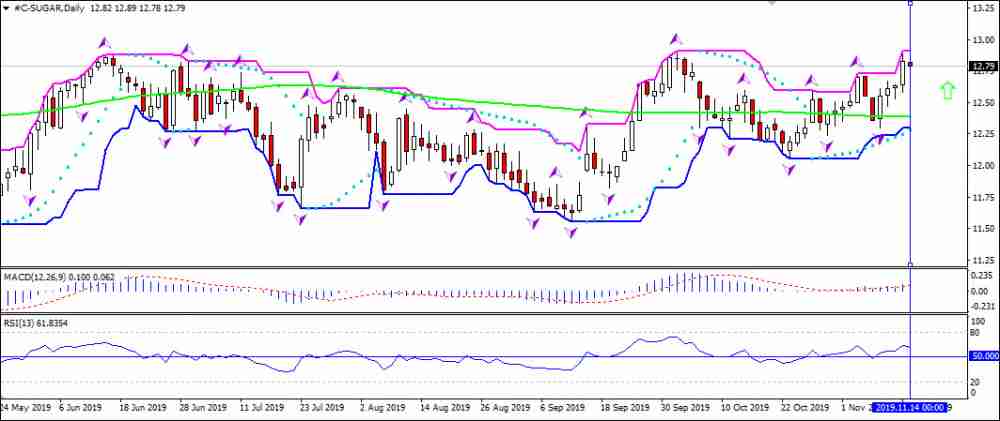
On the daily timeframe the SUGAR: D1 is above the 200-day moving average MA(200) which is falling.
The Parabolic indicator gives a buy signal.
The Donchian channel indicates no trend: it is flat.
The MACD indicator gives a bullish signal: it is above the signal line and the gap is widening.
We believe the bullish momentum will continue after the price breaches above the upper boundary of Donchian channel at 12.91. This level can be used as an entry point for placing a pending order to buy. The stop loss can be placed below the lower Donchian bound at 12.30. After placing the order, the stop loss is to be moved every day to the next fractal low, following Parabolic signals. Thus, we are changing the expected profit/loss ratio to the breakeven point. If the price meets the stop loss level (12.30) without reaching the order (12.915), we recommend cancelling the order: the market has undergone internal changes which were not taken into account.
The US Federal Reserve President Jerome Powell continued with this second day of testimony to Congress. The Fed chair is optimistic that the rate cuts from the central bank will help to revive growth in the United States.
Speaking to lawmakers, Powell indicated that he doesn’t see any bubbles in the markets. But the market reaction was muted to his comments.
A modest risk-on sentiment continues, and gold prices gained in the backdrop. A lack of fresh news on the trade talks front has also hit sentiment a bit.
Eurozone GDP Confirmed at 0.2%
The third quarter revision to the GDP figures for the eurozone came in without any surprises. The economy grew at a pace of 0.2% in the third quarter period ending September 2019. This was in line with the general forecasts.
It was also an unchanged print from the preliminary estimates given a few weeks ago. The data managed to push the euro slightly higher on the day.
EURUSD to Maintain the Upside
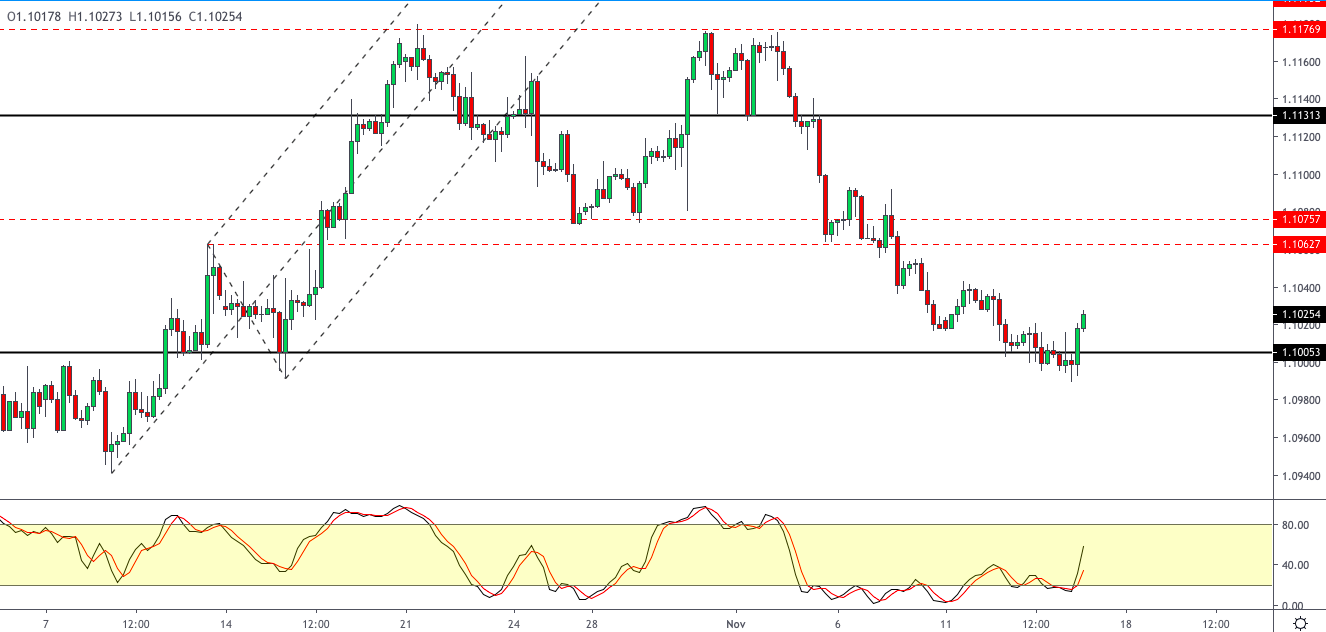
The common currency rebounded from the support level at 1.1000 where it was consolidating over the past few sessions. The rebound off this support comes as the Stochastics oscillator signals a bullish confirmation.
The resistance level at 1.1062 will be key to the upside for the moment.
Sterling Inches Higher Despite Weak Retail Sales
The monthly retail sales report for the UK disappointed. Data showed that retail sales fell 0.1% on the month in October. This was below estimates of a 0.2% increase and down from a flat price in the previous month.
The weak retail sales will likely dampen the growth for the region during the month.
GBPUSD Breakouts Off Resistance
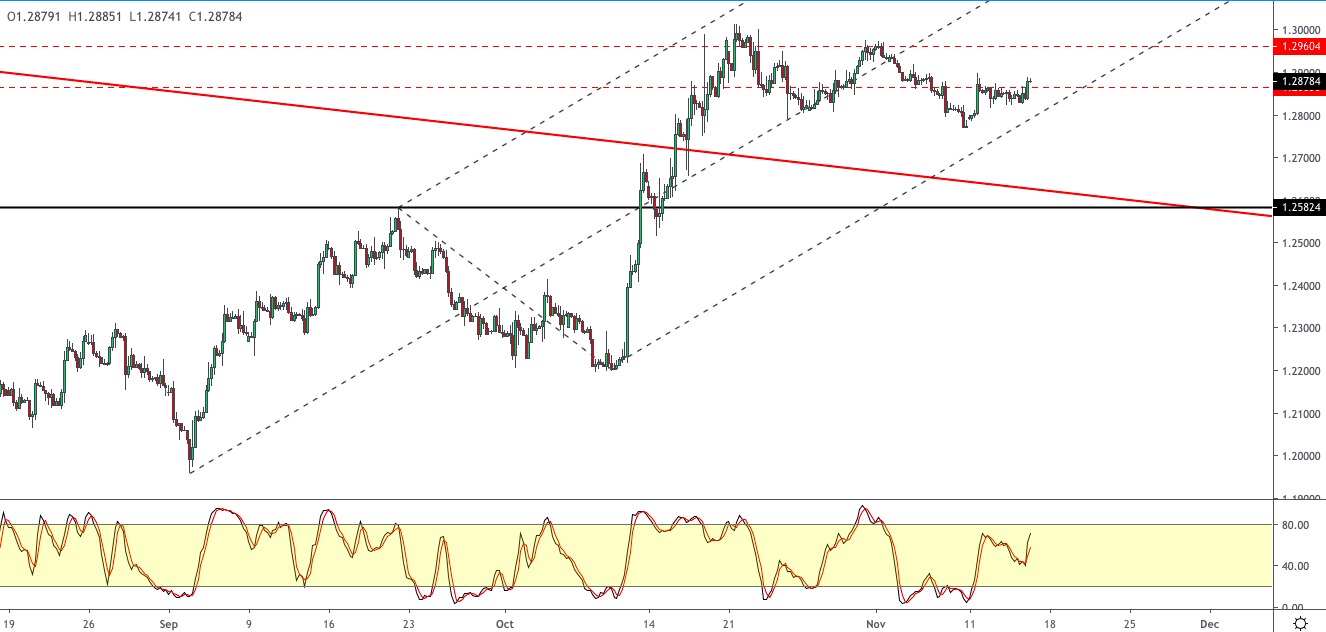
Cable broke to the upside breaching the resistance level of 1.2865. The current gains come amid renewal in the momentum.
Price action could, however, remain range-bound. The upside is limited to the resistance level of 1.2960 region in the near term. Further direction will gain momentum only on a breakout above this level.
Gold Gains as Trade Talks Hit a Stalemate
The precious metal was maintaining the upside on Thursday as the US and China trade talks hit a stalemate. There was no major news from the trade talks which has become one of the key points for investors.
Risk sentiment is back on as equities are retreating from the gains made earlier since last week.
XAUUSD Rises but Mind the Divergence
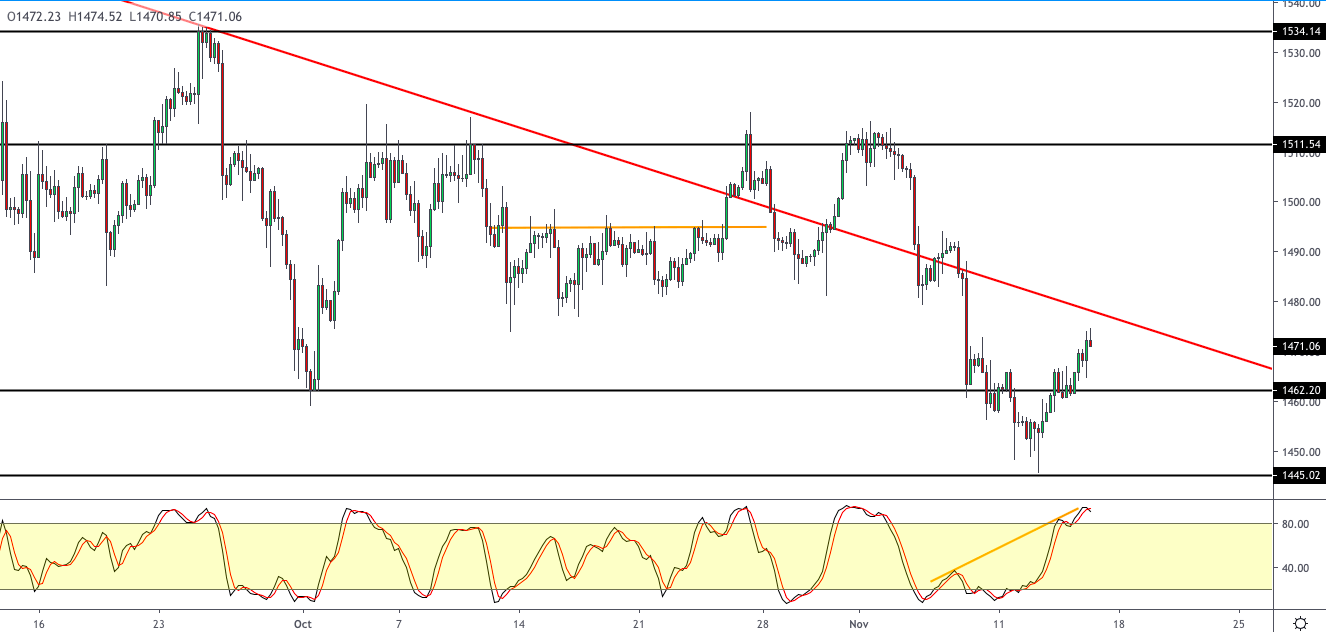
The precious metal has been rising steadily after breaching the support/resistance level of 1462. Price action is signaling a hidden bearish divergence.
This could potentially see the precious metal sliding back to the support area. If gold prices fail to break down lower, then the weekly chart will signal a doji that could indicate a reversal from last week’s declines.
Crude prices were knocked lower yesterday as the latest EIA inventories report highlighted a further build in US crude stores.
The Energy Information Administration reported that in the week ending November 8th, US crude stocks rose by a further 2.2 million barrels. This was higher than the 1.6 million barrel rise forecast.
It also marks the third consecutive week of inventory surpluses, highlighting the increasing supply/demand imbalance in the market.
Crude Imports Fall
The EIA report also noted that commercial crude imports were lower by 5.8 million barrels over the week. This marks their lowest reading since February 1996. Net US crude imports were down by 590k barrels.
Regionally, the Cushing delivery hub in Oklahoma saw its crude stores falling by 1.2 million barrels. This decline is the first such reduction following five straight weeks of inventory builds.
The EIA noted that this change was due to the Keystone pipeline being cut off. This was as a result of an oil spill that caused a major disruption to Canadian crude imports.
Gasoline Stores Rise, Distillate Stores Fall
Following six consecutive weeks of drawdowns, gasoline stores in the US rose last week.
Gasoline levels rose by 1.9 million barrels. This was considerably higher than the expected 1.2 million barrel increase forecast.
Distillate inventories, however, including diesel and heating oil, were lower by 2.5 million barrels over the week. This was far worse than the 950k barrel drop analysts were looking for.
Despite the fall in distillate stockpiles, the pickup in refinery utilisation rates offset some of the support offered. Refinery crude runs came in higher by 155k barrels per day. Meanwhile, utilization rates rose by 1.8% to 87.8% of total capacity.
US Crude Production Hits Record Highs
US production was also heavily bearish for crude prices. Production rose to a fresh high of 12.8 million barrels per day.
The rise this year has been a major headwind for crude prices. Over the first part of the year, crude prices were rising steadily as OPEC supply cuts helped curb the supply/demand imbalance in the market.
However, into the middle of the year, the rising US crude production caused the rally to stall and ultimately reverse.
As US production continued to print record highs, OPEC was forced to announce an extension to its cuts when it met in June. Now, as US production continues to rise, expectations are for the oil producer cartel to announce further measures in December.
As a result of rising US crude production, the EIA has revised its US production outlook higher twice this year already, creating a bearish outlook for prices. With OPEC forecasting falling crude demand in the near term, oil faces further negative pressure in the near term.
Technical Perspective
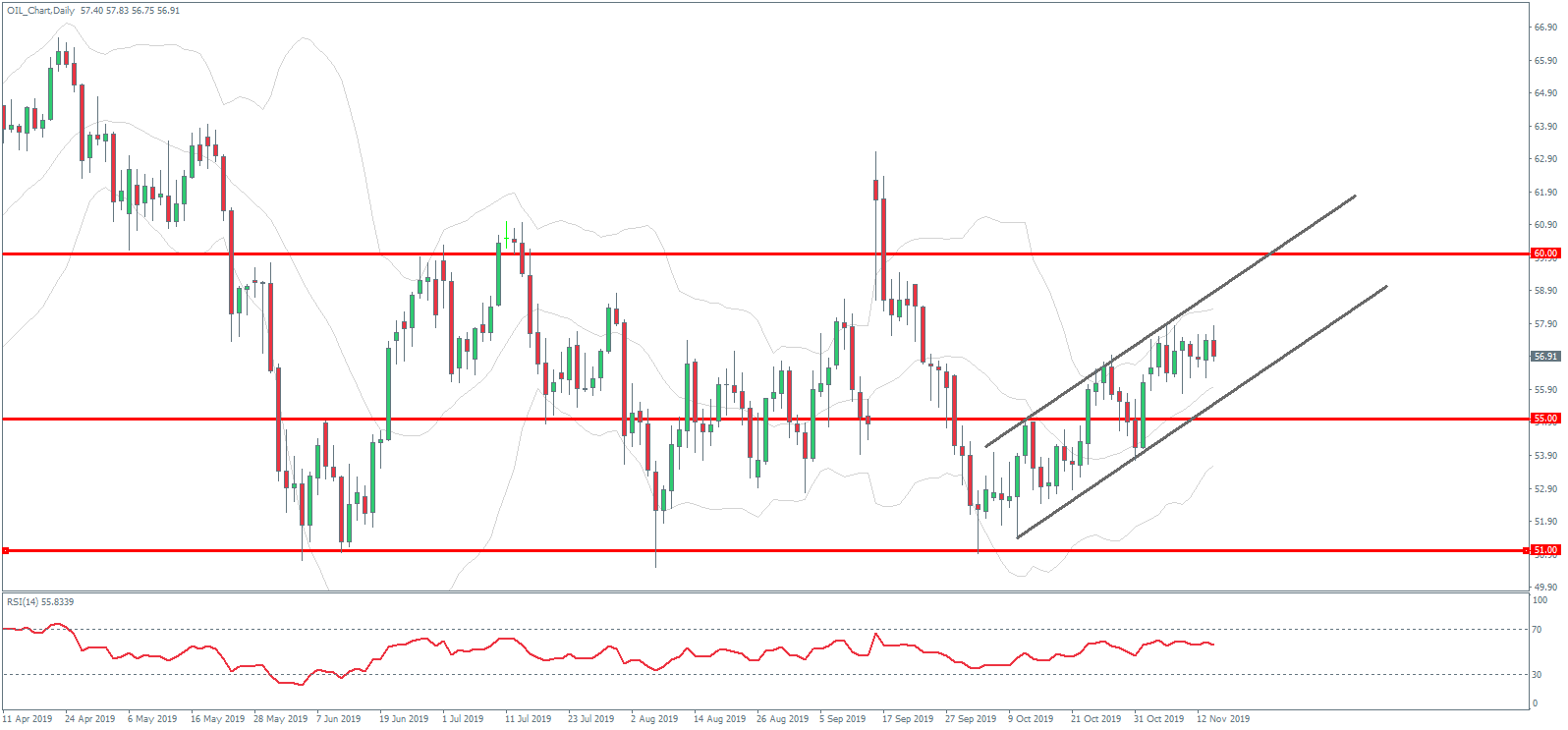
Crude prices have been moving higher from the latest test of the 51 level support. The rally, which has been framed by a bullish channel, has seen prices break above the 55 level.
While above here, focus remains on further upside with the 60 level the key marker to watch. However, momentum has stalled recently and with RSI flagging weakness, we could see a correction lower in the near term.
EURUSD has reached the target at 1.0988; right now, it is moving upwards to reach 1.1030. Later, the market may start a new correction towards 1.1004 and then form one more ascending structure with the target at 1.1050.
GBPUSD, “Great Britain Pound vs US Dollar”
GBPUSD has broken 1.2855 to the upside. Possibly, the pair may expand the range towards 1.2895 and then start another decline to return to 1.2955, thus forming a new consolidation range. If later the price breaks this range to the upside, the market may resume trading upwards with the target at 1.2950; if to the downside – continue the correction to reach 1.2760.
USDCHF, “US Dollar vs Swiss Franc”
USDCHF is forming the second rising impulse to break 0.9895. Later, the market may break this level and then continue trading upwards with the short-term target at 0.9917.
USDJPY, “US Dollar vs Japanese Yen”
USDJPY has extended the descending wave at 108.40; right now, it is moving upwards with the target at 108.71. After that, the instrument may start a new correction towards 108.48 and then form one more ascending structure with the short-term target at 108.95.
AUDUSD, “Australian Dollar vs US Dollar”
AUDUSD has reached its short-term target at 0.6773; right now, it is moving upwards with the target at 0.6797. Later, the market may start a new correction towards 0.6783 and then form one more ascending structure to reach 0.6805. After that, the instrument may break this level and continue growing with the short-term target at 0.6827.
USDRUB, “US Dollar vs Russian Ruble”
USDRUB has broken 64.28; right now, it is correcting towards 63.95. Later, the market may resume trading upwards with the target at 64.64.
USDCAD, “US Dollar vs Canadian Dollar”
After completing the ascending wave at 1.3268 and starting a new structure to the downside, USDCAD has broken 1,3235. Possibly, the pair may continue falling towards 1.3198. After that, the instrument may start a new correction to reach 1.3235.
XAUUSD, “Gold vs US Dollar”
Gold has reached its upside target at 1473.37; right now, it is falling with the first target at 1463.50. After that, the instrument may start another growth towards 1468.94 and then form a new descending structure to reach 1459.33.
BRENT
Brent has failed to fix above 63.03; right now, it is moving downwards. Today, the pair may fall to reach 61.98. If later the price breaks this level to the downside, the market may continue trading inside the downtrend with the target at 61.30.
BTCUSD, “Bitcoin vs US Dollar”
BTCUSD has broken 8550.00 downwards. Possibly, today the pair may test this level from below and then resume trading inside the downtrend with the target at 8424.00. Later, the market may break this level and continue falling to reach 8050.00.
Attention! Forecasts presented in this section only reflect the author’s private opinion and should not be considered as guidance for trading. RoboForex LP bears no responsibility for trading results based on trading recommendations described in these analytical reviews.
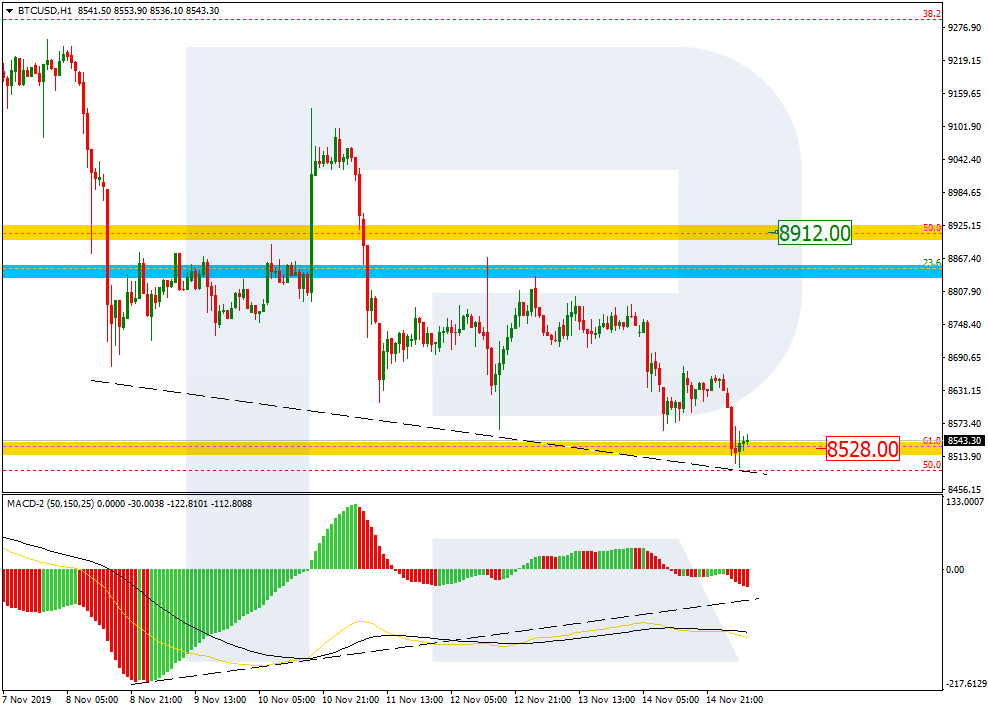
As we can see in the H4 chart, BTCUSD is still correcting downwards. By now, it has already broken 61.8% fibo and may continue falling to reach 76.0% fibo at 8080.50. However, if later the price continues its decline towards the low at 7302.00, this correction may transform into a new descending wave. So far, the main scenario implies that the market may complete the current correction and resume growing towards the high at 10521.60, and 50.0% and 61.8% fibo at 10572.00 and 11350.00 respectively.
In the H1 chart, there is a convergence on MACD while the pair is testing 61.8% fibo. Probably, it might be a turning period, but in order to reverse, the price must test the local resistance at 50.0% fibo (8912.00).
ETHUSD, “Ethereum vs. US Dollar”
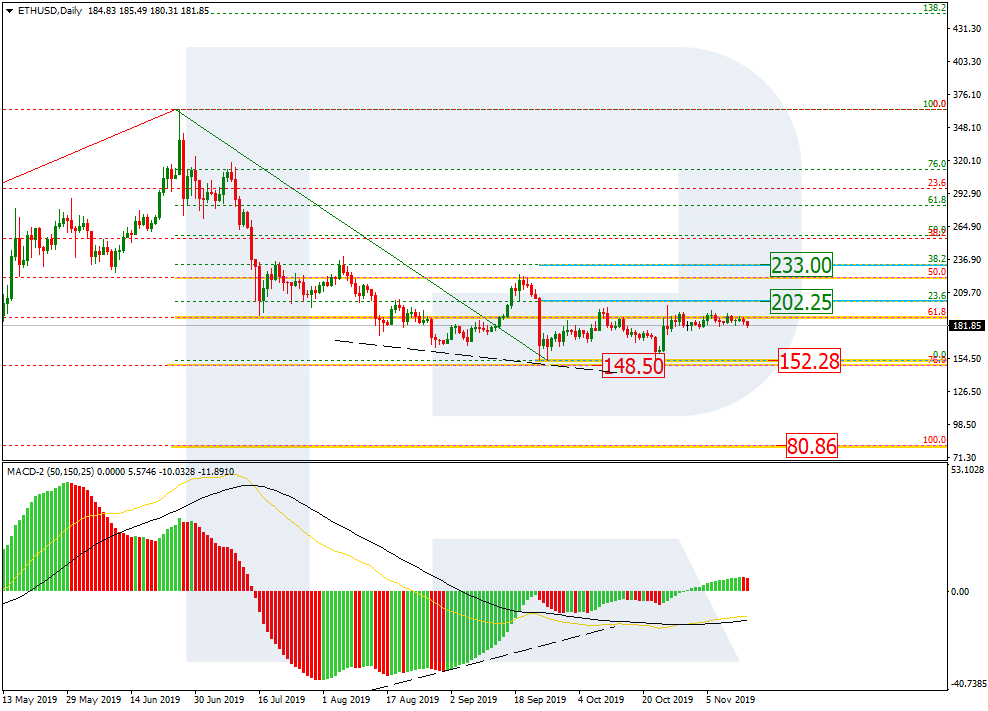
The daily chart shows the sideways correction. The pair is trying to reach 23.6% fibo at 202.25, but hasn’t been able to do it so far. After reaching this level, ETHUSD may continue moving towards the next upside target at 38.2% fibo (233.00). However, if later the price breaks the low at 152.28, the mid-term correction may continue towards 76.0% fibo at 148.50 and then this year’s low at 80.86.
The H4 chart shows more detailed structure of the current correction after the rising impulse. The correction is taking the form Triangle pattern and has already reached 50.0% fibo. In case of further decline, the next targets will be 61.8% and 76.0% fibo at 170.55 and 164.00.
Attention! Forecasts presented in this section only reflect the author’s private opinion and should not be considered as guidance for trading. RoboForex LP bears no responsibility for trading results based on trading recommendations described in these analytical reviews.
The euro-zone trade surplus rose to €18.7 billion in September from €12.6 billion in September 2018. Will the EURUSD rise?
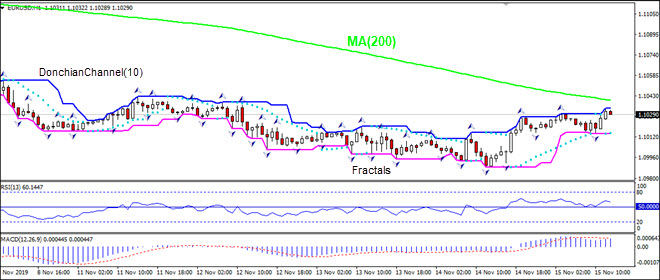
The price chart on 1-hour timeframe shows EURUSD: H1 is trading sideways. The price is rising toward the 200-period moving average MA(200) which is falling. And the RSI oscillator is above 50 level and has not reached the overbought zone. There is no trend yet formed, traders have to decide when it would be a best time to enter the market.