China cuts 7-day reverse repo rate 2 days before LPR

By CentralBankNews.info

For the second time in less than two weeks, China lowered one of its lending rates by 5 basis points, only two days before it publishes the rate on its new benchmark lending rate, the Loan Prime Rate (LPR).

The People’s Bank of China (PBOC) lowered its 7-day reverse repurchase rate on 180 billion yuan in liquidity to 2.50 percent from 2.55 percent, the first reduction since October 2015.

This cut follows a similar-sized 5 basis point cut in the longer-term Medium-Term Lending (MFL) to 3.25 percent on Nov. 5.

In recent years PBOC has been revamping its entire system for setting interest rates and on Aug. 17 it designated LPR as a benchmark lending rate, with the rate linked to MFL.

As part of that move, it changed the method for calculating LPR and now bases it on prices from 18 banks, including two foreign institutions, instead of 10 banks, with the banks required to link their LPR quotes to MFL.

LPR will be published by PBOC on the 20th of each month and on Aug. 20 the 1-year LPR was set at 4.25 percent, 10 basis points below the previous benchmark lending rate, and the 5-year LPR at 4.95 percent.

On Aug. 20 LPR was then set at 4.20 percent, down 5 basis points, while the 5-year LPR was unchanged at 4.85 percent.

www.CentralBankNews.info


Stocks notch back to back records

By IFCMarkets

Dollar weakening unabated

US stocks ended at new highs Monday despite reports Beijing is pessimistic over a trade deal after President Trump’s denial of agreement to roll back tariffs. The S&P 500 finished 0.05% higher at 3122.03. Dow Jones industrial added 0.1% to new record 28036.22. The Nasdaq composite gained 0.1% to 8549.94. The dollar weakening continued at steady pace as the National Association of Home Builders index of builder confidence edged one point lower in November, though still near the highest level for 2019. The live dollar index data show the ICE US Dollar index, a measure of the dollar’s strength against a basket of six rival currencies, slipped 0.2% to 997.81 and is lower currently. Futures on US stock indices point to higher openings.

FTSE 100 gains while other European indexes slip

European stock indexes pulled back on Monday as doubts a US-China deal is close resurfaced. The advance of both EUR/USD and GBP/USD was intact yesterday with both pairs climbing currently. The Stoxx Europe 600 index ended 0.1% lower led by auto shares down 2.3%. The DAX 30 lost 0.3% to 13207.01. France’s CAC 40 slid 0.2% while UK’s FTSE 100 added 0.1% to 7307.70.

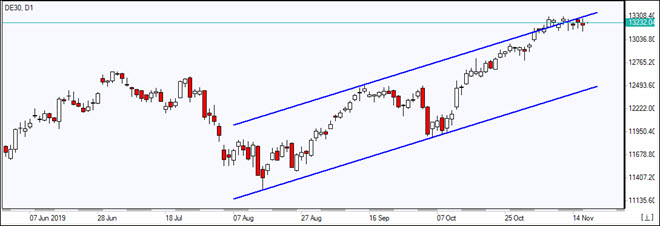
DE30 rises in the channel     11/19/2019 Market Overview IFC Markets chart

Hang Seng leads Asian Indexes gains

Asian stock indices are mixed today. Nikkei pulled back 0.5% to 23292.65 as yen’s climb against the dollar continued. Markets in China are rising led by technology shares after Washington issued a 90-day extension of a license on Monday allowing US companies to continue doing business with Chinese telecom giant Huawei. The Shanghai Composite Index is up 0.5% and Hong Kong’s Hang Seng Index is 1.3% higher. Australia’s All Ordinaries Index turned 0.7% higher as Australian dollar’s decline against the greenback continued as recent policy meeting minutes showed central bank is prepared to ease monetary policy further to support economic growth.

Brent futures prices are little changed today. Prices fell yesterday after Energy Information Administration monthly report forecast that crude oil production from seven major US shale plays will climb by 49,000 barrels a day in December to 9.133 million barrels a day : January Brent crude closed 1.4% lower at $62.44 a barrel on Monday.

Market Analysis provided by IFCMarkets

Note:
This overview has an informative and tutorial character and is published for free. All the data, included in the overview, are received from public sources, recognized as more or less reliable. Moreover, there is no guarantee that the indicated information is full and precise. Overviews are not updated. The whole information in each overview, including opinion, indicators, charts and anything else, is provided only for familiarization purposes and is not financial advice or а recommendation. The whole text and its any part, as well as the charts cannot be considered as an offer to make a deal with any asset. IFC Markets and its employees under any circumstances are not liable for any action taken by someone else during or after reading the overview.

Cracks in the Bullion Banks’ Price Management System

By Money Metals News Service

Department of Justice prosecutors charged a sixth JPMorgan executive for cheating in the precious metals markets.

Jeffrey Ruffo stands accused of racketeering and spoofing metals prices from 2008 – 2016, along with other crimes including conspiracy to commit wire fraud.

The indictment outlines nearly a decade spent coordinating with other traders in JPMorgan’s precious metals department to rig prices. The activity includes thousands of fraudulent trades placed for two purposes.

The first was to benefit favored JPMorgan clients at the expense of other investors.

Manipulation

The second was to benefit JPMorgan and the traders directly by cheating their own clients.

The investigation is ongoing, and more indictments, including charges against traders at other bullion banks, may be on the way. It appears that at least some of the executives now facing prison time have decided to cooperate and provide evidence against others involved.

The DOJ prosecutions are certainly a step in the right direction. It is getting harder for even the staunchest defenders of futures trading to dismiss price manipulation as a mere conspiracy theory.

The genuine prospect of prison time may be giving pause to any crooked bankers still working in the gold and silver markets. And, the story should be an eye opener for bullion bank clients and speculators still gambling in the rigged casino also known as the COMEX.

For those who have been watching this story, it is hard to fathom why anyone is still expecting fair treatment in the futures markets. It is clear, however, that plenty of confidence remains. Gold open interest made new all-time highs last week.

As long as investors rely upon the COMEX and other exchanges for price discovery, it is the job of federal regulators to do something to curb the rampant cheating. Unfortunately, the Commodity Futures Trading Commission, the primary regulator for futures markets, is still captured and/or incompetent.

The CFTC has taken no responsibility for its failed 5-year investigation of price manipulation in the silver market. Agency officials somehow managed to overlook the massive pile of evidence that DOJ investigators have rounded up.

They have taken almost no action despite the DOJ indictments and guilty pleas. JPMorgan is still active in the markets even though its bullion trading desk seems to operate like a criminal enterprise.

Rep. Alex Mooney

Rep. Alex Mooney (R-WV)
has emerged as a leader in
the sound money movement.

CFTC officials are in a quandary similar to those who constantly dismiss allegations of price manipulation as mere conspiracy theory.

It is getting harder and harder for them to ignore the facts.

Congressman Alex Mooney from West Virginia is asking Attorney General Bill Barr to have a look at the price rigging which continues largely unchecked by the CFTC. Price spoofing may just be the tip of the iceberg in terms of criminal activity.

The Congressmen previously sent letters to the CFTC with pointed questions about some of the questionable activity in the futures markets, but has yet to get a response.

All this begs the question about what the CFTC might do if dozens of bankers at multiple banks are ultimately convicted. Will officials there still be able to sit on their hands and protect their crooked friends on Wall Street from enforcement?


The Money Metals News Service provides market news and crisp commentary for investors following the precious metals markets.

Dollar strengthening continued on positive data

By IFCMarkets

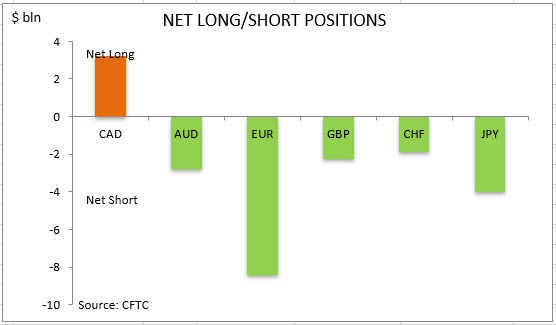
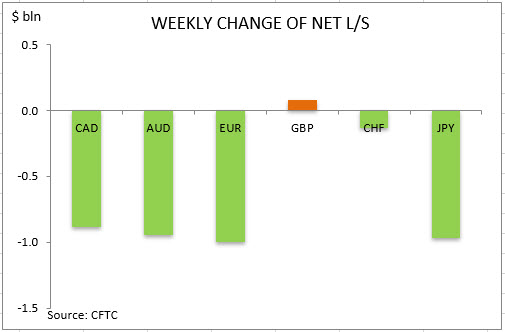
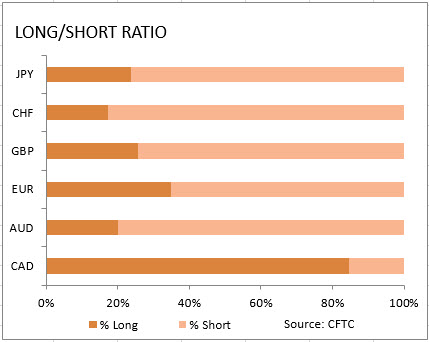
US dollar net long bets increase continued to $16.18 billion from $13.33 billion against the major currencies during the one week period, according to the report of the Commodity Futures Trading Commission (CFTC) covering data up to November 12 and released on Friday November 15. The ICE US dollar index advance continued on positive data and hawkish central bank officials’ comments: the University of Michigan consumer sentiment index rose to 95.7 from 95.5 in October, initial jobless claims were below forecast for the week, while Chicago Fed President Charles Evan said the US economy may not need additional interest rate cuts.


CFTC Sentiment vs Exchange Rate

November 12 2019BiasEx RateTrendPosition $ mlnWeekly Change
CADbullishpositive3202-882
AUDbearishnegative-2791-944
EURbearishpositive-8409-998
GBPbearishpositive-225978
CHFbearishpositive-1904-130
JPYbearishnegative-4015-968
Total-16175


commitment of traders net long short
commitment of traders weekly change
market sentiment ratio long short positions

Market Analysis provided by IFCMarkets

Note:
This overview has an informative and tutorial character and is published for free. All the data, included in the overview, are received from public sources, recognized as more or less reliable. Moreover, there is no guarantee that the indicated information is full and precise. Overviews are not updated. The whole information in each overview, including opinion, indicators, charts and anything else, is provided only for familiarization purposes and is not financial advice or а recommendation. The whole text and its any part, as well as the charts cannot be considered as an offer to make a deal with any asset. IFC Markets and its employees under any circumstances are not liable for any action taken by someone else during or after reading the overview.

The Two Best Indicators For Forex Newbies

By Orbex

Forex traders who are just starting out and want to get into technical FX trading can be a bit overwhelmed by the dizzying array of indicators available.

Each one has its own complications, pros, and cons. And it can certainly take some time to learn how to use them properly!

Picking the right forex indicator to start with can be a bit of a challenge. An option that some beginner FX traders take is to use a lot of indicators. Unfortunately, they soon find that they are inundated with signals, and fall into what some people call “analysis paralysis”.

Not having the time or attention to get the most out of each forex indicator, they find their strategies not as successful as if they’d focused on a few indicators.

So, where would be a good place to start?

The Best is a Matter of Personal Taste

One of the ways to go about this is to just use whichever indicator is the best.

However, virtually no FX trader uses only one indicator. And, often, the results forex traders get depend more on how they interpret the indicator than the indicator itself. That’s without getting into how money and risk management play into a forex trader’s strategy.

We could go with the most popular indicator, and conclude that if most experienced FX traders use it, then it must at least be near the top of the best.

The problem is that what’s best for experienced forex traders doesn’t mean it’s good for beginners. The MACD is a very sophisticated and versatile forex trading tool. But, that makes it harder for beginners to get used to right away.

The Basics Are Not Bad

The thing about beginners is that they are gaining experience. They will likely move on to more sophisticated tools in the future. And this is why Moving Averages are really the best indicator for beginners!

They are not a simple sure-fire way of winning at forex. But that’s fine because there is no such thing anyway!

More “advanced” indicators might give more clear signals, but you need to know how to interpret them.

The advantage of moving averages, whether exponential or simple, is that they form the basis of most other indicators. Getting experience in and a good grounding in MAs will help you in the future. As a more experienced forex trader, they’ll help you understand a more complex market as well as more complex indicators.

Stick With It

Moving averages can be a bit frustrating to work with. That’s because they are simply smoothing out price action without giving you all that much information.

But, you can combine different ones to generate your own signals, using mathematical principles. They are a great way to learn how to tweak settings in order to bring out the information you need from the forex market. If you are trading with a forex demo account, you absolutely have to be using moving averages at least a bit!

Another indicator that is also really easy to use, is the Relative Strength Index (RSI). It can help alleviate some of the frustration of the moving averages because it tends to be a lot clearer.

How it Works

RSI works by reading price action. It measures whether a currency pair is getting overbought or oversold, and therefore whether it is about to change direction.

When it moves beyond 70 in either direction, it means that the market will likely change direction in the near future. And there is a trade opportunity!

These two forex indicators tend to work really well together. In fact, you should use them to confirm each other before jumping into the market.

And they both serve as a useful base from which to move on to other more sophisticated forex trading indicators. Despite being relatively simple, they are quite versatile and can be used to build much more advanced forex trading strategies as you gain experience.

By Orbex
 

Equities In The Green

By Orbex

USD Recovering

It’s been a quiet start to the week for the US dollar. The USD index has been hovering around the 97.80 level this morning, still sitting at the bottom of last week’s declines for now. US CPI last week surprised to the upside, which has further weighed on US rate cut expectations, keeping USD risks tilted to the upside. This week, traders will receive the minutes from the October FOMC meeting which is expected to boost USD further.

EUR Lower

EURUSD is in the green so far today as the USD languishes on the back of weakness into the end of last week. The ECB meeting minutes will be the main focus this week, along with a raft of Eurozone PMI data sets. PMI data sets have been trending lower over recent months so any further weakness here will likely bring EUR lower. EURUSD trades 1.1059 last.

GBP Higher

GBPUSD has been higher so far today as traders continue to display optimism ahead of the UK general elections in December. Data released last week saw the UK avoid falling into a technical recession over Q3. While growth was a little slower than the BOE’s estimates, the 0.3% reading was a marked improvement on last quarter’s -0.2% level. GBPUSD trades 1.2952 last.

SPX500 Still Near Highs

Risk assets have been higher again today on the back of further US/China trade talks over the weekend. With a deal expected very soon, SPX500 continues to trade higher here with price at 3125.68 as of writing. A more optimistic tone from the Fed recently has also bolstered risk appetite here.

JPY & Gold Lower

Safe havens have been lower again today as better risk appetite has seen less flight to safety among investors. XAUUSD trades 1458.05 last, turning lower within the falling wedge which has framed price action over the last few months. USDJPY trades 109.01 last, moving back above the 108.84 level.

Crude Crumbles

Oil prices have been a little lower so far at the start of the week despite better expectations around US/China trade talks. Last week, the EIA reported a further build in US crude inventories adding further concern to the global oil demand outlook. Crude trades 57.45 last, sitting back above the 57 level for now.

Canadian CPI On Watch

USDCAD has been higher today as a result of weaker oil prices which are weighing on CAD. This week, CAD traders will be watching Canadian CPI which is the headline domestic data release. With the BOC having signaled the prospect of further rate cuts in the near future, any weakness will be heavily bearish for CAD at this point. USDCAD trades 1.3219 last.

AUD On The Rocks

AUDUSD has been lower today also as traders await further details on the ongoing US/China trade talks. Later today RBA governor Lowe speaks and traders will be keen to hear any guidance on RBA monetary policy. While the RBA remained on hold recently, further rate cuts are expected in the near term. AUDUSD trades .6805 last.

By Orbex


WTI/JPY Crude/Japanese Yen Analysis: Getting Ready for US-China Trade Talks

By IFCMarkets

Getting Ready for US-China Trade Talks

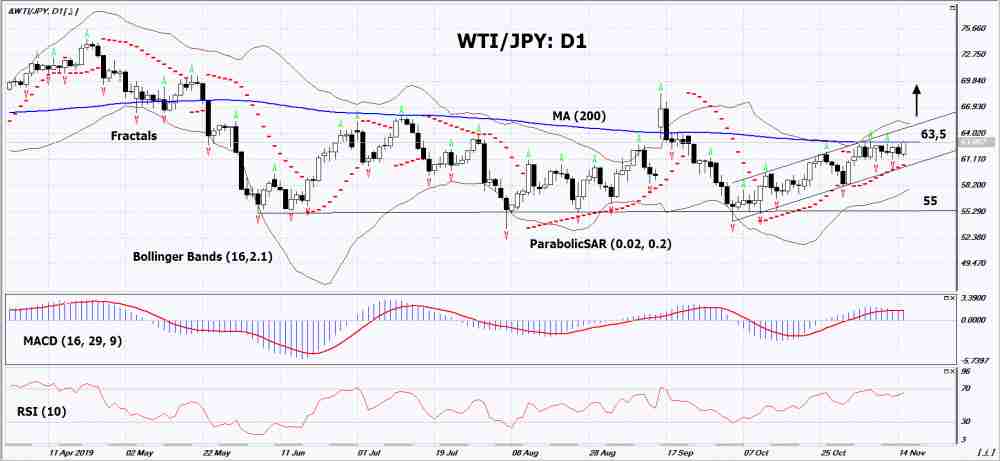
In this review, we suggest to consider the personal composite instrument (PCI) &WTI/JPY. It reflects the price dynamics of the portfolio of futures on WTI oil against the Japanese yen. Will the WTI/JPY rise??

Such dynamics means the weakening of the yen and strengthening of the oil. The dynamics of that PCI may depend on the success of US-Chinese trade talks. The Japanese yen, along with gold and the Swiss franc, is considered by investors as a “safe asset”. The demand of the Japanese yen may decline if the first phase of the trade agreement between the USA and China will be signed. At the same time, the demand of the oil may increase due to a decrease in risks for the global economy. During the last week, the economic adviser of the White House Larry Kudlow declared that there is a progress in trade talks between USA and China. The US Commerce Secretary Wilbur Ross expressed similar opinion. According to the International Energy Agency (IEA), the main increase of the oil production (at least 0.5 million barrels per day) should be executed by the countries who are non-OPEC members, such as USA, Brazil, Norway and Guyana by the next year. Meanwhile, oil production in the United States already reached a historic maximum at 13 million barrels per day (bwd). It is hard to state whether it will continue to grow. At the same time, the IEA expects an increase in the global oil demand by 6.6 million bwd in 2025. It may become the long-term factor in the stability of oil prices.

WTI/JPY

On the daily timeframe, WTI/JPY: D1 approached the upper boundary of the neutral trend, which aligns with the 200-day moving average line. Before opening a buy position, it must be broken up. Various technical analysis indicators have generated signals to increase. Further growth of quotations is possible in case of successful trade negotiations between the USA and China.

  • The Parabolic indicator gives a bullish signal.
  • The Bolinger bands narrowed, indicating a volatility decrease. The bottom line of the Bollinger has a slope up.
  • The RSI indicator is above 50. No divergence.
  • The MACD indicator gives a bullish signal.

The bullish momentum may develop in case if WTI/JPY will exceed its last two upper fractals and the 200-day moving average line: 63,5. This level may serve as an entry point. The initial stop loss may be placed below the Parabolic signal, the lower Bollinger band and the lower boundary of the neutral channel: 55. After opening the pending order, we shall move the stop to the next fractal low following the Bollinger and Parabolic signals. Thus, we are changing the potential profit/loss to the breakeven point. More risk-averse traders may switch to the 4-hour chart after the trade and place there a stop loss moving it in the direction of the trade. If the price meets the stop level (55) without reaching the order (63,5), we recommend to close the position: the market sustains internal changes that were not taken into account.

Summary of technical analysis

PositionBuy
Buy stopAbove 63,5
Stop lossBelow 55

Market Analysis provided by IFCMarkets

Banks “forced” to embrace tech innovations in order to survive

By ForexNewsNow

Banks “forced” to embrace tech innovations in order to survive

We’ve seen an obscene amount of banks collaborating with giant companies like Google, Amazon, and Apple to create an innovative approach to payments and make banking services more available. This trend has been going on for some time now and it’s a mix of these major tech companies wanting to provide a variety of services for their customers and with banks increasingly seeing the importance of adapting to their customer’s needs and staying up to date with all the fintech trends and services.

Now more and more banks are willing to talk about the necessity to evolve and collaborate in order to stay relevant and be able to compete with other entities. This is a global trend that surpasses the banking. Everyone is in on the importance of online presence and simplified technology application to their services. Financial companies are starting to adopt these technologies as well and become better accessible. The Forex brokers in Kenya are a primary example, as they have started moving to more simplified payment processing systems rather than banks. The same can be said for the fintech. So now, more and more people are speaking out about the importance of moving banks and financial technologies closer and collaborating on a more intense level.

“Banks are Fintechs”

Recently at a panel at CNBC’s East Tech West event in Guangzhou, China – David Rafalovsky, chief technology officer at Russian state-owned lender Sberbank brought up an interesting point about this worldwide trend of a bank going into fintech. Rafalovsky expressed his frustration with the common distinction that people make between fintech firms and banks. Rafalovsky believes that banks are fintech firms.

At the event, Henry Ma, the chief information officer at WeBank which is a Tencent backed online bank, pointed out that technological innovation opens a lot of doors for people that wouldn’t be able to access the traditional banking services since it requires less complicated procedures and is generally more widely accessible. Ma specifically referred to the group of people who benefit most from this as an untapped market, because really for the longest time this specific demographic was highly untouched by the financial sector.

According to the World Bank, around 1.7 billion people are “unbanked” meaning that they don’t have an account with a financial institution. And the reasons for that can be plentiful, but the main cause is that banks are still exclusive to some for a variety of reasons. Some people don’t have the necessary documentation some people didn’t qualify because of other reason, some may prefer to be more in control of their money. So the fintech and the recent rends are really a “golden opportunity” as mentioned by Henry Ma for these financial institutions to gain a lot of new clients. Both executives agreed that banks actually need to behave more like tech firms in order to keep up and avoid becoming useless.

The future of Banking

It might be too early for us to start thinking about banks becoming extinct but it might be for them. With Google, Apple and Amazon offering their services for transactions and Facebook even releasing its own cryptocurrency, it’s becoming evident that traditional banks have some competition. It’s not necessarily exclusive of banks, because these companies don’t really have the licensing to conduct these transactions, so they definitely need the backing of the banks and that what apple and google are doing, with Google giving more power to its partners. This is an inevitable process that will force more and more banks to seek the opportunities to incorporate more fintech into their banking systems and to collaborate with different companies that already have the trust of the consumers.

This doesn’t mean that banks don’t bring anything to these collaborations, besides their licenses to conduct these transactions. Banks have the capacity to compensate for the overall mistrust that surrounds most of these major companies, who have previously mishandled customer information.

This is a big reason why Facebook’s cryptocurrency – libra is getting so much pushback and is getting abandoned by major partners like visa and Mastercard that pulled out of the project because of Facebook’s unwillingness to embrace regulations that come with working companies like Visa and MasterCard to who answers o regulators. So these companies thought more innovative still lack a lot of qualities that banks bring to the table.

Comments made by Rafalovksy encapsulate the approach that will most likely bring the results that can be beneficial for all parties involved. It’s important that the banks are well-attended to the needs and standards of their customers and embrace technological innovations while maintaining their regulatory systems that make people trust these entities in the first place.

Like the chief tech officer of Sberbank said many banks, perhaps not all but many, are well-positioned to build brand new products. Banks really have to master technology in order to increase customer convenience and to keep them from going to less regulated, newer companies.

By ForexNewsNow


Trade Talks Continue, But Still No Deal

By Orbex

Trade Talks Continue

Risk sentiment remains surprisingly resilient this week given that US-China trade negotiations have stuttered recently.

President Trump and Chinese Premier Xi were supposed to have signed a trade deal this weekend at the APEC meeting in Chile. However, the meeting was canceled, leaving the two leaders without a venue to sign the deal.

As of last week, the countries’ leaders were looking to appoint a new venue to sign the deal. This essentially means that, for now, the deal is in limbo.

The nature of these talks remains fragile. In fact, just a few months ago, talks broke down and fresh tariffs were introduced. And yet, despite all that, traders are displaying a great deal of optimism.

Further Tariffs Threat

The US has warned China, or threatened rather, that if a deal is not done by December 15th, they will apply a further round of tariffs on $156 billion of Chinese goods.

For now, it seems the market is banking on the fact that China will want to avoid incurring further tariffs. This is especially true in light of recent data weakness showing the damage suffered by the Chinese economy.

Weekend Talks

Over the weekend, high-level officials from the two countries engaged in further talks. According to reports, these went well and have helped keep negotiations on course for a deal.

Chinese VP Liu He, China’s chief negotiator, spoke with Steve Mnuchin, the Treasury Secretary, and Robert Lighthizer, the US Trade Representative.

Following the talks, the Chinese commerce ministry released a statement saying that communications had been “constructive.” It said that they had agreed to keep in close contact ahead of signing the “phase one” deal.

Huawei Restrictions Lifted

Aside from the statements, recent actions from both sides have also been encouraging. China recently dismantled restrictions on US poultry imports. This was a gesture of good faith that the US promptly returned. The Trump administration extended a license allowing domestic firms to continue their dealings with Huawei.

The reversal of restrictions on Huawei is a significant indication of the US’ willingness to make a deal. Earlier in the year, the addition of Huawei to the Entities list (a list of Chinese companies prohibited from working with US firms) marked a severe escalation in US-China trade tensions.

Now, with Huawei allowed to deal with US firms again, relations are in much better health. Therefore, the road to a deal looks much clearer.

White House economic adviser Larry Kudlow told reporters last week “we are coming down to the short strokes” and are “in communication with them every single day.”

However, he did acknowledge that a deal was “not done yet.” For now, traders await further headlines. Though with equities well in the green today, it is clear that expectations are geared towards a deal being done soon.

Technical Perspective

The SPX500 continues to trade into fresh highs. The market has now broken above the bullish channel which has framed recent price action, reflecting an acceleration of demand. The previous highs of 2019 at 3027.92 remain the only local marker to note, offering support. While above this level, focus is on further upside.

By Orbex


EURUSD Analysis: Inflation decline bearish for EURUSD

By IFCMarkets

Inflation decline bearish for EURUSD

The euro-zone headline inflation declined to 0.7% in October 2019 from 0.8% in September. Will the EURUSD decline?

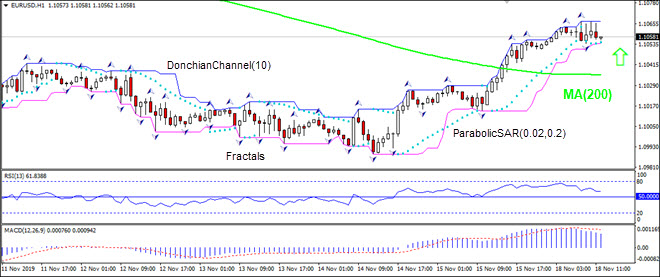
EURUSD rising above MA(200)

The price chart on 1-hour timeframe shows EURUSD: H1 is in uptrend. The price is rising above the 200-period moving average MA(200) which is level. The RSI oscillator is above 50 level and has not reached the overbought zone.

Technical Analysis Summary

OrderBuy
Buy stopAbove 1.1067
Stop lossBelow 1.1047

Market Analysis provided by IFCMarkets