Pakistan keeps rate for 2nd time as inflation seen easing

By CentralBankNews.info
Pakistan’s central bank left its policy rate steady for the second time, saying the current monetary policy stance was appropriate to bring inflation down to its target range as the recent uptick in inflation was temporary, the currency had risen and domestic demand was still soft.
The State Bank of Pakistan (SBP), which raised rates nine times between January 2018 and July 2019, said its projection for average inflation in FY20, which began on July 1, was broadly unchanged at 11 to 12 percent, up from an average of 7.3 percent in fiscal 2019.
Pakistan’s consumer prices rose a higher-than-expected 1.8 percent in October from September but on an annual basis, inflation eased to 11.08 percent in October from 12.55 percent in September, and SBP said the rise largely reflected higher administered prices and a rise in food prices.
If the rise in prices were sustained, the central bank said this could affect inflation expectations but it expects inflationary pressures to recede in the second half of the fiscal year and expects inflation to decline to its target range of 5 – 7 percent over the next 24 months.
After raising its rate by a total of 7.50 percentage points from January 2018 to curb rising inflation from a plunging rupee, SBP said in July that it was finished raising rates in response to the fall in the rupee and from now on interest rates would be set in response to the outlook for inflation.
Following an agreement with the International Monetary Fund (IMF) in May, which included a $6.0 billion support package and $38 billion from international partners, the rupee has steadied and trended upward since late July and was trading at 155.3 to the U.S dollar today, up 3.3 percent since August 1 but still down 10 percent since the start of this year.
Prior to the IMF deal, which included the introduction of a market-based exchange rate system, Pakistan followed a “strong rupee” exchange rate policy and effectively fixed it against the U.S. dollar at a rate that was too high, forcing SBP to burn through reserves to defend it.
Since the SBP’s previous monetary policy meeting in September, it noted three key developments: A current account surplus in October, an estimated surplus in the government’s primary balance in the first quarter of fiscal 2020, and expectations by businesses for inflation to fall in the near term, suggesting that inflation expectations remain anchored.
SBP also said recent economic data suggests that economic activity was strengthening in the export oriented and import-competing sectors while inward oriented sectors still see a slowdown.
It retained its forecast for GDP growth in FY20 of around 3.5 percent, up from 3.3 percent in FY19 but down from 5.2 percent in FY18.

The State Bank of Pakistan issued the following monetary policy statement:

“1. At its meeting on 22nd November 2019, the Monetary Policy Committee (MPC) decided to leave the policy rate unchanged at 13.25 percent. The decision reflected the MPC’s view that recent developments have had offsetting implications for the inflation outlook. On the one hand, recent inflation outturns have been on the higher side. On the other, the causes behind these outturns have primarily been increases in food prices which are expected to be temporary. Also market sentiment has begun to gradually improve on the back of sustained improvements in the current account and continued fiscal prudence. The MPC noted that the SBP’s projection for average inflation for FY20 remained broadly unchanged at 11 – 12 percent and maintaining the current monetary policy stance was appropriate.
2. In reaching this decision, the MPC considered key developments since the last MPC meeting, developments in the real, external and fiscal sectors, and the resulting outlook for monetary conditions and inflation.

Key developments since the last MPC meeting
3. There have been three key developments since the last MPC meeting. One, the current account balance recorded a surplus in October 2019 after a gap of four years, a clear indication of receding pressures on the country’s external accounts. Two, the government’s primary balance is estimated to record a surplus in the first quarter of FY20, a first since Q2-FY16. This, together with the end of deficit monetization has qualitatively improved the inflation outlook. Three, the most recent business confidence survey shows that businesses expect inflation to fall in the near term suggesting that inflation expectations remain anchored despite the recent increases in food prices.

Real sector
4. Recent economic data suggest that economic activity is strengthening in export oriented and import competing sectors while inward oriented sectors continue to experience a slowdown in activity. Specifically, large-scale manufacturing (LSM) shows gains in electronics, engineering goods and fertilizer sectors and decline in auto, food, and construction allied industries of steel and cement. The latest production estimates of major kharif crops suggest that agriculture sector is likely to grow in line with projections although cotton production is likely to remain below target. In sum, the SBP kept its projection for GDP growth for FY20 unchanged at around 3.5 percent.

External sector
5. The external sector continued to show steady improvement, reflecting the benefits of recent policy adjustments and other factors. In the first four months of the current fiscal year, the current account deficit contracted by 73.5 percent to US$ 1.5 billion. This improvement reflected a notable reduction in imports, a modest growth in exports and steady workers’ remittances. Export volumes, especially of rice, textile made- ups, leather products, and fish & meat, increased despite weakening external demand. The capital and financial account have also improved due to higher FDI and continued portfolio inflows reflecting renewed investor confidence.

6. On account of favorable balance of payment developments, the rupee has appreciated 5.6 percent since its low in June 2019. These favorable developments have allowed the SBP to begin rebuilding gross reserves
and reducing liabilities. Since the beginning of the fiscal year, gross reserves have risen by US$1.16 billion through November 15 and the SBP has reduced its foreign currency swaps / forward liabilities by US$1.95 billion through end October. The combined increase in net reserves from these two sources is well in excess of the US$863 million Special Convertible Rupee Account (SCRA) portfolio inflows in government securities since the beginning of the fiscal year.

Fiscal Sector
7. Fiscal consolidation gained traction during the year to date on account of broad-based taxation reforms and strict control over non-development expenditures. FBR tax collections grew 16.2 percent (y/y) in Jul-Oct FY20 compared to 6.4 percent during the same period last year. On the expenditure side, the federal releases for public sector development programs (PSDP) more than doubled to Rs 257 billion during Jul-Oct FY20 from Rs 105.5 billion during the same period last year. The increased infrastructure spending is expected to stimulate business activity in construction-allied industries. On the financing side, the government has strictly adhered to its commitment of zero fresh budgetary borrowing from SBP, which has not only helped the government meet its continuous performance criteria under the IMF program, but also bodes well for the inflation outlook. The MPC emphasized that continued fiscal prudence would remain critical for sustaining the improving market sentiment.

Monetary and inflation outlook
8. Private sector credit fell by Rs4.1billion during the first four months of the current fiscal year compared to an expansion of Rs 223.1 billion during the same period last year on account of slowing economic activity. However, fixed investment loans increased, supported by the SBP’s long term financing facility under which loans grew by Rs 11.3 billion during this period.
9. Inflation (based on the new index) rose 11 percent (y/y) and1.8 percent (m/m) in October 2019.These outturns, especially recent month-on-month outturns, were somewhat higher than expectations but largely reflected upward adjustments in administered prices and rise in prices of food items primarily due to temporary supply disruptions. The MPC noted that recent outturns of month-on-month inflation had been higher than in previous months and if sustained could affect inflation expectations. Nevertheless, in light of the temporary nature of these increases, continued softness in domestic demand, and recent appreciation of the currency on the back of improving market sentiment, the MPC was of the view that inflationary pressures were expected to recede in the second half of the fiscal year, as noted in the last MPS. The MPC noted that the current stance of monetary policy and real interest rates on a forward-looking basis were appropriate to bring inflation down to the target range of 5 – 7 percent over the next twenty-four months.”

    www.CentralBankNews.info


Muted Gold Shifts Safe-Haven Status To Silver?

By Orbex

Gold and silver moved up hand-in-hand until Wednesday. The precious metals were being heavily influenced by macroeconomics, more so than geopolitics, closer to the second half of the week.

On Thursday and intraday Friday, silver holds a better stance against the dollar compared to the somewhat muted gold.

This could remain the case as the US calendar is rather light for the rest of today’s trading session.

GOLD Mid-Week Bulishness Reversed on Positive US Manufacturing and House Data

Without fresh geopolitical flare-ups around the US-Sino trade deal, the marketplace decided to focus on risk appetite early in the week. Halfway through, safe havens were moving with an upbeat bias. This came on the back of weaker oil – i.e. risk – and a re-escalation of the Hong Kong drama.

The US passed a bill supporting human rights in Hong Kong unanimously. This angered China, who, in return, requested a tariff rollback extension to May 2020. Once again, another US slap dented the optimism of a phase-1 deal. The US turned the Hong-Kong matter into yet another weapon with which to pressurize China to “step up” to a trade deal.

Closer to the end of the week, gold received some sizeable take-profit bears. This was thanks to major developments supporting the geopolitical front early in the week waning off.

In fact, gold’s slide was also supported by the release of an upbeat Philly Fed Manufacturing Index on Wednesday. It slipped lower on Thursday after the US reported positive results on Existing Home Sales.

At the time of writing, gold is biased to the upside. Participants seem to be wanting clarity on trade weeks ahead Dec 15th tariffs increase rather than Gordon Sondland’s impeachment hearing. However, prices remain stable and are likely to close mixed.

XAUUSD Looking Muted as US Macros Offset Geo-Related Gains

Apart from the weekly price action, indicators suggest that gold could remain under pressure in the medium-term.

After the $1478 top was taken out markets slid, suggesting the completion of subminuette wave 4. We could expect correction before we start seeing further downside moves. However, it could be deep, or even revisit the previous top. The latter could form a triple complex correction.

Bears need to focus on whether a successful break below $1456 occurs or whether a retest is seen.

xauusd

Silver Gains Traction As Gold Hangs on Trade War Resolution

With the markets ignoring the impeachment headlines, silver seems to be gaining some traction. Especially as gold remains the subject of a battle between macros and geopolitics.

From a sentiment perspective, the trade war saga makes equity markets more cautious. And that should add longs in the precious metals! With US data pushing gold down and safe-havens waiting for clarity, market participants are jumping ship.

The OECD reported a slightly lower forecast in the global 2020 and 2021 GDP too overnight. This makes the case for silver bets a little more approachable.

XAGUSD Bullishness Near Breakout Levels Hints to Further Upside

The $17.20 level is a top that has helped activity stay particularly busy. Prices could head down for another bearish wave, completing the corrective impulse lower. However, the chances are slim as fresh highs keep being registered.

In fact, the second downside leg has reached the 61.8% Fibonacci extension of waves a and b. This makes the upside scenario more likely.

Should markets experience a successful breakout above $17.40, this could make the end of the minor correction 2.

xagusd

By Orbex


Kiniksa Pharma Awarded FDA Breakthrough Therapy Status for Pericarditis Treatment Drug

By The Life Science Report

Source: Streetwise Reports   11/20/2019

Shares of Kiniksa Pharmaceuticals opened nearly 30% higher today after the firm reported that the FDA granted Breakthrough Therapy designation for Rilonacept for the treatment of recurrent pericarditis.

This morning, Hamilton, Bermuda based biopharmaceutical company Kiniksa Pharmaceuticals Ltd. (KNSA:NASDAQ), which is focused on discovering, acquiring, developing and commercializing therapeutic medicines for patients with significant unmet medical needs, announced that “the U.S. Food and Drug Administration (FDA) granted Breakthrough Therapy designation for rilonacept for the treatment of recurrent pericarditis.”

The report indicated that “Kiniksa’s Breakthrough Therapy application was based on final data from an open-label Phase 2 clinical trial of rilonacept in a range of pericarditis populations that were included in a poster presentation at the American Heart Association Scientific Sessions on November 16, 2019.”

The firm explained that the “FDA defines Breakthrough Therapy designation as a process designed to expedite the development and review of drug candidates that are intended to treat a serious condition, and preliminary clinical evidence indicates that the drug candidate may demonstrate substantial improvement over available therapies on a clinically significant endpoint.”

The company identifies Rilonacept as “a weekly, subcutaneously-injected, recombinant fusion protein that blocks inflammatory cytokines interleukin-1α (IL-1α) and interleukin 1β (IL-1β) signaling.” Rilonacept in recurrent pericarditis is at present still classified as an investigational drug.

Kiniksa exclusively licensed rilonacept from Regeneron Pharmaceuticals Inc. for recurrent pericarditis and certain other indications. The company noted that “rilonacept was discovered and developed by Regeneron and is approved by the FDA under the brand name ARCALYST for the treatment of Cryopyrin-Associated Periodic Syndromes, which includes Familial Cold Autoinflammatory Syndrome and Muckle-Wells Syndrome.”

Kiniksa’s CEO and Chairman Sanj K. Patel commented, “We are pleased that the FDA has granted Breakthrough Therapy designation for rilonacept for the treatment of recurrent pericarditis, a painful and debilitating autoinflammatory cardiovascular disease…The final Phase 2 data presented at AHA showed rilonacept treatment improved clinically meaningful outcomes associated with unmet need in recurrent pericarditis, including rapid resolution of pericarditis episodes, tapering and discontinuation of corticosteroids without pericarditis recurrence, reduction in recurrences of pericarditis episodes while on treatment, and improvement in quality of life scores. We continue to enroll RHAPSODY, our pivotal Phase 3 clinical trial of rilonacept in recurrent pericarditis, and expect top-line data in the second half of 2020.”

The company describes the RHAPSODY study, which is taking place in the U.S., Australia, Israel and Italy, as an ongoing, global, randomized withdrawal (RW) design, pivotal Phase 3 clinical trial of rilonacept in patients with recurrent pericarditis. The firm advised that the study’s co-principal investigators are Dr. Allan Klein of Cleveland Clinic and Dr. Massimo Imazio of the University of Torino, Italy, and that top-line data from the study are expected in H2/20.

Kiniksa Pharmaceuticals is headquartered in Hamilton, Bermuda, and is a biopharmaceutical company focused on discovering, acquiring, developing and commercializing therapeutic medicines for patients suffering from debilitating autoinflammatory and autoimmune diseases with significant unmet medical need. Kiniksa’s pipeline of product candidates across various stages of development include Rilonacept for the potential treatment of recurrent pericarditis; Mavrilimumab for the potential treatment of giant cell arteritis; KPL-716 for the potential treatment of a variety of pruritic diseases, including prurigo nodularis, a chronic inflammatory skin condition; and several others.

Kiniksa has a market capitalization of around $380.9 million with about 58.88 million outstanding shares. KNSA shares opened nearly 30% higher today at $8.98 (+$2.04, +29.34%) over the prior day’s closing price of $6.94. The stock has traded today between $8.08 to $9.49 per share and currently is trading at $8.86 (+$1.92, +27.67%).

Sign up for our FREE newsletter at: www.streetwisereports.com/get-news

Disclosure:
1) Stephen Hytha compiled this article for Streetwise Reports LLC and provides services to Streetwise Reports as an independent contractor. He or members of his household own securities of the following companies mentioned in the article: None. He or members of his household are paid by the following companies mentioned in this article: None.
2) The following companies mentioned in this article are billboard sponsors of Streetwise Reports: None. Click here for important disclosures about sponsor fees.
3) Comments and opinions expressed are those of the specific experts and not of Streetwise Reports or its officers. The information provided above is for informational purposes only and is not a recommendation to buy or sell any security.
4) The article does not constitute investment advice. Each reader is encouraged to consult with his or her individual financial professional and any action a reader takes as a result of information presented here is his or her own responsibility. By opening this page, each reader accepts and agrees to Streetwise Reports’ terms of use and full legal disclaimer. This article is not a solicitation for investment. Streetwise Reports does not render general or specific investment advice and the information on Streetwise Reports should not be considered a recommendation to buy or sell any security. Streetwise Reports does not endorse or recommend the business, products, services or securities of any company mentioned on Streetwise Reports.
5) From time to time, Streetwise Reports LLC and its directors, officers, employees or members of their families, as well as persons interviewed for articles and interviews on the site, may have a long or short position in securities mentioned. Directors, officers, employees or members of their immediate families are prohibited from making purchases and/or sales of those securities in the open market or otherwise from the time of the interview or the decision to write an article until three business days after the publication of the interview or article. The foregoing prohibition does not apply to articles that in substance only restate previously published company releases.
6) This article does not constitute medical advice. Officers, employees and contributors to Streetwise Reports are not licensed medical professionals. Readers should always contact their healthcare professionals for medical advice.

( Companies Mentioned: KNSA:NASDAQ,
)

How Does Fibonacci Work In Forex?

By Orbex

The term Fibonacci in forex trading terms might evoke a sense of mystery. This can be especially true if you’ve just come across it for the very first time.

But, despite the mystery, the fact is that Fibonacci-based forex trading is actually very popular.

Traders use Fibonacci methods in a number of different ways. As a result, this has given way to different technical forex trading tools with a basis in the Fibonacci numbers.

In fact, aside from using Fibonacci levels directly, there are other means of technical analysis that rely heavily on Fibonacci levels that are also quite popular. These include wave counting methods such as Elliott Waves, as well as Harmonic patterns.

So far, there aren’t any academic studies that prove that Fibonacci levels are mystical. The simplest explanation is that Fibonacci levels work as a self-fulfilling prophecy. In other words, if enough market participants start watching the same levels, there is a good chance that these levels will begin to work.

In this article, we won’t get into the details such as the origins of Fibonacci, but rather look at the different ways forex traders use Fibonacci in their approach.

Different Ways to Use Fibonacci Methods in Trading

First and foremost, using Fibonacci levels as horizontal support and resistance levels are the most widely used techniques.

In this method, FX traders measure the recent wave. By connecting the wave’s highs and lows, the Fibonacci levels are drawn automatically.

Different forex traders have their own concept of Fibonacci levels. But the most widely used are the 38.2% and 61.8% retracement levels. If you pull up any FX chart and use the Fibonacci tool, you will almost always find some market interaction taking place at these levels.

The chart below illustrates this point. We select a random small wave within the trend and then we use the Fibonacci tool. You can see how price briefly hits the 61.8% retracement level which indicates support. Following this, price then bursts higher.

Fibonacci Support & Resistance

Other methods involve using Fibonacci speed resistance lines. The speed resistance lines is an old concept of technical analysis. But this is modified when you bring in the Fibonacci numbers into the picture.

The basis once again is the same. With the Fib levels, the general expectation is that price interacts at one of the Fibonacci levels either as support or resistance. The next chart below shows such an example of the Fib levels using the speed resistance lines.

Fibonacci based speed resistance lines

Do Fibonacci Numbers Give You an Edge?

By now you should be wondering if using Fibonacci numbers give you any kind of edge in the forex markets. Finding an edge as an FX trader requires you to have a piece of information that your peers have yet to discover.

So, in this context, where the Fibonacci levels are so widely known, by definition, there is no proven edge in the markets.

Even still, because forex trading is generally unique, some FX traders swear by Fibonacci levels.

For example, while the 200-day or 50-day moving averages are widely used in the markets, some FX traders prefer different periods. Fibonacci numbers rounded up such as 39-period of 62-periods, can be applied to moving averages, for example.

While the numbers merely change the sensitivity and slope to the market prices, they don’t quite give you an edge that will put you in the front seat.

The topic of Fibonacci numbers is, of course, highly debatable, especially in the forex trading community. For some FX traders, Fibonacci numbers are magic. For the rest, they might not yield the same results.

This leads us to an important observation about forex trading psychology and how it can influence both your mind and trading outcome.

By Orbex


HK50 Analysis: Weak data bearish for Hong Kong Stock Index HK50

By IFCMarkets

Weak data bearish for HK50

Hong Kong’s private sector contraction continued in October. Will the HK50 decline?

Hong Kong economic data were weak since its central bank mirrored Fed’s rate cut on October 31: retail sales’ 20.4% over year in September was the eighth straight month of drop. And the October reading of purchasing managers index was below 50 again, indicating acceleration of contraction in the private sector. Activities in private sector contracted for the nineteenth straight month as new orders dropped due to a record fall in new business from mainland China, pointing to weakness ahead too. The slump in activities is being attributed to US-China trade tensions, as well as protest related disruptions. And unemployment rose to 3.1% in the three months to October from 2.9% in the prior period. Continuing decline in activities in private business sector is bearish for HK50.

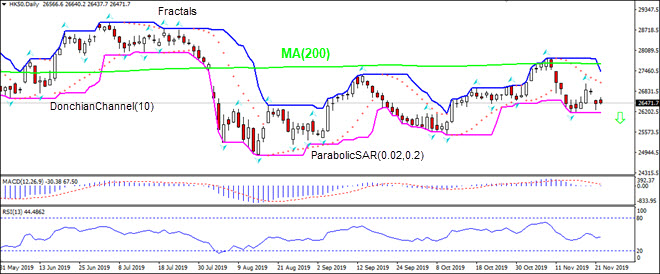
HK50 falling below MA(200) 11/22/2019 Technical Analysis IFC Markets chart

On the daily timeframe HK50: D1 is retracing lower after a rebound following the decline to 11-month low in the beginning of August.

We believe the bearish momentum will continue after the price breaches below the lower Donchian boundary at 26154. This level can be used as an entry point for placing a pending order to sell. The stop loss can be placed above the upper Donchian boundary at 27441.50. After placing the pending order the stop loss is to be moved every day to the next fractal high, following Parabolic signals. Thus, we are changing the expected profit/loss ratio to the breakeven point. If the price meets the stop-loss level (27441.50) without reaching the order (26154) we recommend cancelling the order: the market sustains internal changes which were not taken into account.

Technical Analysis Summary

OrderSell
Sell StopBelow 26154
Stop lossAbove 27441.50

Market Analysis provided by IFCMarkets

ICAN Leverages Leading California Brand with Expansion into Nevada, Introduces State-of-the-Art Pre-Roll Machine, for Aggressive Near-Term Growth

By The Life Science Report

Source: Knox Henderson for Streetwise Reports   11/20/2019

A recent acquisition is helping this company to expand its brand.

If a customer at any of the popular recreational outlet in California were to ask, “What’s your best pre-roll?” there is high probability that the answer would be “Tarantula.” That “happy” blend has helped to make ICAN the top infused brand in California with roughly US$3.3 million in sales January to July 2019, according to BDS Analytics. Since acquiring the brand and its Oakland operations, announced July 31 this year, ICAN (CSE: ICAN, OTCQB: ICNAF) has expanded its presence from 225 to 275 stores in California with the momentum to reach 300 by end of this year. Building on its brand equity, the company is bringing the popular ICAN brand to that other major recreational market, Nevada, with plans for a presence in more emerging friendly states.

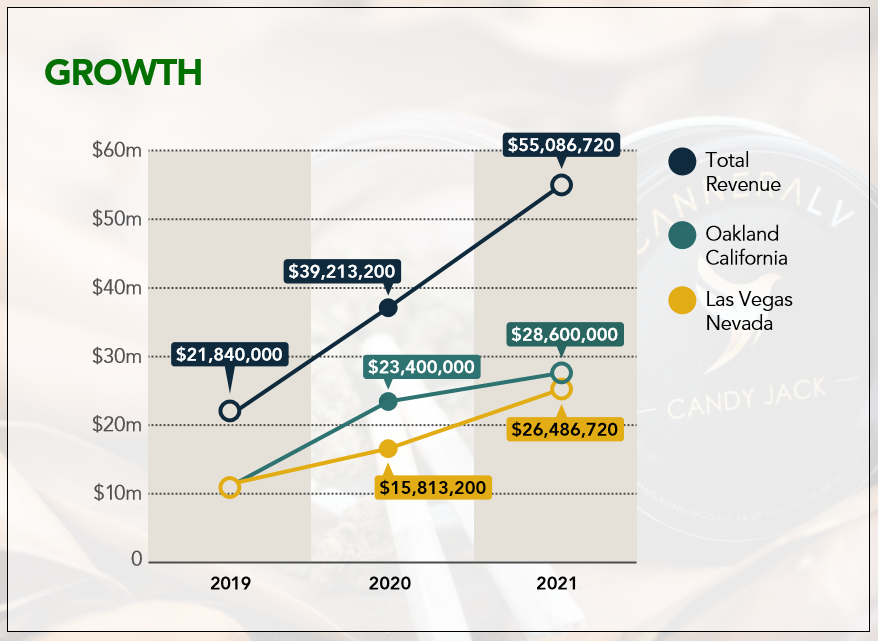
The chart below tells a compelling story. In 2018 the newly merged companies independently produced a combined US $6.5 million of revenue and the new ICAN is well funded for at least 12 months. Sales are forecast to grow from $9.0 million in 2019 toward $25 million in 2021. It’s not an unrealistic target given past successes in brand recognition, and the current sales pipeline and momentum. As to profitably, ICAN historically, and plans to continue to, operate within and a gross margin hovering in the 30% range. In a totally beaten down market, the winner and losers are becoming clear. ICAN is a winner because it’s doing a better job of further penetrating existing markets where the real revenues are with focus on quality.

ICAN

And then there is ICAN’s amazing new state-of-the art patented rolling machine, the first of which has been delivered to the company’s Oakland operations. It’s so advanced ICAN is not currently disclosing its design and full capacity but be assured it has been painstakingly crafted by engineers from a top tier Silicon Valley pharmaceutical automation engineering firm with clients that include Fortune 100 companies such as Genetec, Telsa, Baxter and Johnson & Johnson. The prototype automated machine is able to produce 600 pre-rolls per hour and requires two personnel to operate, with much higher capacity in next versions of the product.

ICAN’s initial game plan is to leverage its well-known brand and introduce other products/SKUs into the California market. “We have this existing channel that knows, trusts and loves the ICAN product and brand,” says ICAN Chief Strategy Officer Gus Boosalis. “By introducing additional products into that channel, we’ll continue to have organic growth in California, and next we’re going to introduce the brand to the Nevada market through our licensed cultivation and manufacturing facility. In addition to building our market to California and Nevada, we’ve had interest from parties that are well established and well-funded that want to license the brand into other emerging states, such as Michigan, Massachusetts, Colorado and Arizona. Once the key components of this company are set, we’ll have the ability to scale quickly as a result of our proprietary rolling machine.”

The low hanging fruit for ICAN is the infused pre-roll market where it has the #1 product by a wide margin and is also the #3 best seller. Having this kind of reputation from a loyal customer base bodes well for the future adaption rate of the company’s addition SKUs and gives it a leg-up as it expands into in other markets. The pre-roll market is estimated to be 492.8 million pre-rolls sold in 2018 across the United States and Canada, and it’s gaining momentum. This past July, consumers in California alone spent $25 million on pre-rolled, a 46% increase compared to July 2018.

Boosalis says there is still plenty of room for future growth in the overall market California when you consider about $3.1 billion of revenue from the licensed market stacks up to an assumed $8 billion in the non-licensed black market, “and the state government definitely wants to tax that revenue, so there is a motivation for more and more licensed stores.” Currently there are 620 licensed shops in California.

By 2022, the “legit” market in California is projected to jump to $7.7 billion. Nevada offers a large rotating new customer base with 40 million tourist each year. Flagship stores have helped the state’s year-to-date sales through July reach $396 million, a 22% increase from 2018. 2020 revenues, primarily from the 11 states where recreational adult use is approved, is expected to reach $15 billion, en-route to $25 billion by 2025, according to New Frontier Data. At this point 33 states have approved medicinal use. This means 68% of Americans live in states where medical use is legal and 25% live were recreational use is legal.

A History of Quality

ICAN itself started with its own licensed manufacturing and cultivation facilities in Nevada in 2016, then had its eyes set on GanjaGold in Oakland. “We put together the separate deals through late last year, the early part of this year. It made a lot of sense to combine everything under a single umbrella. So, we combined our assets in Nevada, including the real estate, into ICAN and then brought in the Oakland store with a legacy California brand that has a strong market recognition as a connoisseur brand of pre-rolled,” said Boosalis.

The founder of the Oakland operation, Alex Patel, is a well-known engineering pioneer who started from the ground floor in 2009. “Alex worked as a receptionist of a compassion club, to being a salesperson of different brands to working storefront, to being a broker of flower, all the while learning every facet of the industry and became an industry-known connoisseur of the product, a product visionary and great touch point of the culture,” says Boosalis.

Patel later embarked on making his own original and branded products and introduced the Tarantula. This would be the first product of its kind that was focused on top-shelf products, infused with concentrates and coated with a layer of keif. The product shattered conventional price points and breathed new life into what a pre-roll can be. This achievement has nurtured ICAN with tremendous brand equity.

By the end of 2018 ICAN’s Oakland operation grew its reputation of being a premium product company in 95 of 300 licensed stores in California, then after the state expanded to 600 licenses, ICAN jumped into 225 and is now heading for 300 by year-end. Customer have grown fond of the brands for a few reasons, according to Boosalis.

“What Alex did from the outset was worry about the quality of the flower but he also paid huge attention to the quality of pre-roll, the structure, the infusion, the consistency, to smoke well with no canoeing. We spend an hour per pound to de-stem and grind our flower using our in-house proprietary grinding technology. Our quality controls with the newly installed machine brings consistency throughout the process. We needed to lock this down before we engage in any licensing deals.”

ICAN’s Oakland operations also brought transparency into its product lines, with proper pricing so customers know what to expect from pre-rolls ranging in price from $12 to $22: Blue is indoor, Green is greenhouse and Red is outdoor. “Infused” means the paper has oil infused on it, so it is much more powerful in terms of potency. According to Boosalis, the infused market is about 20-25% of the pre-rolled market, and ICAN is working to capture more of the demographic by leveraging its success in the infused pre-rolled market. “The plan will give us shelf space, which will increase our same-store sales once we roll this out. We can also automate pre-rolled, offering a manufacturing service.”

Currently the ICAN/GanjaGold Oakland operations include a 32,000 sq. ft. fully licensed cultivation facility and fully licensed 2,700 sq. ft. manufacturing facility with state-of-the-art proprietary, custom pre-roll manufacturing equipment recently installed on-site. In Nevada, ICAN owns a 4,000 sq. ft. fully licensed cultivation facility with 10,000 sq. ft. of expansion space onsite. There is a fully licensed 3,000 sq. ft. manufacturing facility with additional 2,000 sq. ft. of expansion space. In terms of real estate, this is housed in a 100% owned 17,000 sq. ft. facility building on a 1.5-acre parcel fully zoned and permitted.

Share Structure

ICAN currently has 135 million shares outstanding post Oakland acquisition, with a reasonable 11 million warrants and 13 million options. In the July 31 news release, the Oakland operation cost $12.4 million in all equity as ICAN issued 40 million shares at $0.31 with a one-year hold to July 31, 2020. It now looks like Ganja will earn another 40 million-share milestone payment at the same terms with the completion of the rolling machine delivered before the end of the year for a consideration for US$24.8 million, bringing the share count to 175 million outstanding, so the prudent investor may want to wait until these shares, which also have a one year hold, are distributed before jumping in.

The Takeaway

It will be fun to watch the growth of ICAN and the expansion of its brands unfold, especially if you are sitting on some cheap stock, which you may want to pick up this point. What’s appealing is the existing track record and sensible growth in already accelerating markets where it has strong brand recognition. The simple strategy now just relies on execution: growth in number of dispensaries that shelves its brands, and growth per dispensary with new SKUs. The expansion into emerging states relies on licensing deals due to cross-state restrictions and scalability will be enabled with its high-capacity rolling machine. As Boosalis insists, people have come to expect premium quality from the ICAN brands—and they do not intend to disappoint them.

Disclosure:
1) Knox Henderson: I, or members of my immediate household or family, do not own shares of the following companies mentioned in this article: None. I personally am, or members of my immediate household or family are, paid by the following companies mentioned in this article: ICAN. My company has a financial relationship with the following companies mentioned in this article: None. I determined which companies would be included in this article based on my research and understanding of the sector.
2) The following companies mentioned in this article are billboard sponsors of Streetwise Reports: None. Click here for important disclosures about sponsor fees. An affiliate of Streetwise Reports is conducting a digital media marketing campaign for this article on behalf of ICAN. Please click here for more information. The information provided above is for informational purposes only and is not a recommendation to buy or sell any security.
3) Statements and opinions expressed are the opinions of the author and not of Streetwise Reports or its officers. The author is wholly responsible for the validity of the statements. The author was not paid by Streetwise Reports for this article. Streetwise Reports was not paid by the author to publish or syndicate this article. Streetwise Reports requires contributing authors to disclose any shareholdings in, or economic relationships with, companies that they write about. Streetwise Reports relies upon the authors to accurately provide this information and Streetwise Reports has no means of verifying its accuracy.
4) This article does not constitute investment advice. Each reader is encouraged to consult with his or her individual financial professional and any action a reader takes as a result of information presented here is his or her own responsibility. By opening this page, each reader accepts and agrees to Streetwise Reports’ terms of use and full legal disclaimer. This article is not a solicitation for investment. Streetwise Reports does not render general or specific investment advice and the information on Streetwise Reports should not be considered a recommendation to buy or sell any security. Streetwise Reports does not endorse or recommend the business, products, services or securities of any company mentioned on Streetwise Reports.
5) From time to time, Streetwise Reports and its directors, officers, employees or members of their families, as well as persons interviewed for articles and interviews on the site, may have a long or short position in securities mentioned. Directors, officers, employees or members of their immediate families are prohibited from making purchases and/or sales of those securities in the open market or otherwise from the time of the interview or the decision to write an article until three business days after the publication of the interview or article. The foregoing prohibition does not apply to articles that in substance only restate previously published company releases. As of the date of this article, officers and/or employees of Streetwise Reports LLC (including members of their household) own securities of ICAN, a company mentioned in this article.

( Companies Mentioned: ICAN:CSE; ICNAF:OTCQB,
)

Forex Technical Analysis & Forecast 22.11.2019 (EURUSD, GBPUSD, USDCHF, USDJPY, AUDUSD, USDRUB, USDCAD, GOLD, BRENT, BTCUSD)

Article By RoboForex.com

EURUSD, “Euro vs US Dollar”

EURUSD is forming one more descending impulse towards 1.1047. After that, the instrument may start a new growth to reach 1.1072, thus forming another consolidation range. If later the price breaks this range to the downside, the pair may resume trading downwards with the short-term target at 1.1027.

EURUSD
Risk Warning: the result of previous trading operations do not guarantee the same results in the future

GBPUSD, “Great Britain Pound vs US Dollar”

GBPUSD is forming another descending impulse towards 1.2873. After that, the instrument may resume growing to reach 1.2920. Later, the market may start a new decline with the target at 1.2770.

GBPUSD
Risk Warning: the result of previous trading operations do not guarantee the same results in the future

USDCHF, “US Dollar vs Swiss Franc”

USDCHF is forming the ascending impulse towards 0.9941. After that, the instrument may fall to reach 0.9922, thus forming a new consolidation range. If later the price breaks this range to the upside, the market may resume growing to reach 0.9969; if to the downside – start a new correction with the target at 0.9916.

USDCHF
Risk Warning: the result of previous trading operations do not guarantee the same results in the future

USDJPY, “US Dollar vs Japanese Yen”

USDJPY is still consolidating around 108.56. Possibly, the pair may form one more ascending structure towards 108.83 and then resume trading inside the downtrend to reach 108.08.

USDJPY
Risk Warning: the result of previous trading operations do not guarantee the same results in the future

AUDUSD, “Australian Dollar vs US Dollar”

AUDUSD is consolidating around 0.6792. Later, the market may break this range to the downside and continue trading inside the downtrend with the short-term target at 0.6763.

AUDUSD
Risk Warning: the result of previous trading operations do not guarantee the same results in the future

USDRUB, “US Dollar vs Russian Ruble”

USDRUB is consolidating around 63.73. Possibly, today the pair may fall to reach 63.45 and then form one more ascending structure to return to 63.72. If later the price breaks this range to the upside, the market may continue growing towards 64.40; if to the downside – form a new descending structure with the target at 63.30.

USDRUB
Risk Warning: the result of previous trading operations do not guarantee the same results in the future

USDCAD, “US Dollar vs Canadian Dollar”

USDCAD has finished the descending impulse towards 1.3270. Today, the pair may start a new growth to reach 1.3308, thus forming another consolidation range. If later the price breaks this range to the downside, the market may resume falling towards 1.3240; if to the upside – form one more ascending structure with the target at 1.3342.

USDCAD
Risk Warning: the result of previous trading operations do not guarantee the same results in the future

XAUUSD, “Gold vs US Dollar”

Gold has completed the descending impulse at 1461.91. Possibly, the pair may start a new correction towards 1470.20 and then continue trading inside the downtrend with the short-term target at 1463.60.

GOLD
Risk Warning: the result of previous trading operations do not guarantee the same results in the future

BRENT

Brent has finished the second ascending impulse towards 63.96. Possibly, today the pair may start another correction to reach 62.95, at least. After that, the instrument may resume trading upwards with the first target at 65.50.

BRENT
Risk Warning: the result of previous trading operations do not guarantee the same results in the future

BTCUSD, “Bitcoin vs US Dollar”

After breaking the consolidation range to the downside and reaching 7373.00, BTCUSD has completed the ascending impulse at 7650.00; right now, it is correcting towards 7510.00. Later, the market may resume trading upwards with the first target at 7850.00.

BITCOIN

Article By RoboForex.com

Attention!
Forecasts presented in this section only reflect the author’s private opinion and should not be considered as guidance for trading. RoboForex LP bears no responsibility for trading results based on trading recommendations described in these analytical reviews.

What Do Brokers Do Exactly In Forex?

By Orbex

The main function of forex brokers is to act as intermediaries between the FX trader and the interbank system, to use the technical term.

The interbank system refers to all the major banks and their connections where they send money to each other. Today, this is all digitized and happens electronically. But, since this system is for banks only, someone has to facilitate our connection to the system.

Major banks provide FX brokers with liquidity and pricing, which they then pass on to their customers. The currency marketplace is dominated by the major players, namely banks and institutions.

Forex brokers serve as a way to connect the retail FX trader or investor into the larger marketplace. This is because major banks are not interested in dealing with the “small” amounts of money that an individual FX trader would put into the market.

Accessing the Marketplace

Having an account with a forex broker means you can use your investment or speculation capital to buy and sell pairs of currencies.

This happens in two ways: opening a buy by purchasing one side of a currency pair with the other. For example, buying EUR with USD. By later doing the inverse and buying USD with EUR you close the transaction and accrue your profit or loss depending on the movement of the currencies while the buy was open.

Or, you can go in the opposite direction. This is when you sell EUR in exchange for USD. After the currency moves – hopefully, in your favor – you instruct your forex broker to close the position by buying EUR with the USD you have.

Security is Important

While these two practices are their main function, many forex brokers also offer other products.

For practical purposes as an FX trader, the broker acts as an intermediary between you and someone who wants to do the opposite trade as you. If you want to buy GBP, for example, the broker connects you to someone who wants to sell.

Additionally, the forex broker, by guaranteeing that you will honor your side of the trade with the funds in your account, also guarantees that the other FX trader will honor their side of the trade as well.

Reputable brokers are able to do this by having to guarantee available funds before joining the interbank system. They also only deal with other reputable forex brokers and banks.

Providing Leverage

Another important service for the forex market that brokers provide is substantial leverage.

Leverage is when the broker loans you money to invest through the broker, using your account as collateral. What this means is that you can multiply your forex trading potential by up to hundreds of times.

For example, say you want to trade $20, and your broker provides you with an account that is leveraged at 1:100. That means for the $20 that you put into your trade, your forex broker will loan you $1,980 in order to complete $2,000. In other words, 100 times the amount you put in. This allows you to make significantly larger trades.

Because of leverage, you can make more money on your trades, but you can also lose more money as well. This is why it’s essential to always assess your risk and practice money management to protect the funds in your account.

What Do They Get Out of It?

The way reputable forex brokers typically make money is through the bid-ask spread.

When they take your order and pass it through to the marketplace, they offer you a price that has a small difference between the asking price and the bidding price.

For example, EUR/USD 1.110/1.1102 means that there is a .0002 spread or 2 pips difference between the buying price and the selling price of that pair of currencies. This spread is what the forex broker collects as profit, avoiding using fixed price commissions. The spread can vary depending on the platform and market conditions like supply and demand.

The spread is easily digestible and transparent for FX traders and investors. This is why it’s the preferred system among reputable brokers. Because retail traders generally prefer to take advantage of significantly larger moves, the size of the spread is relatively small compared to the trader’s profitability. It’s also readily available information before you make trades. That being said, additional fees may also apply, such as swaps.

Some forex brokers may charge a fee per transaction or a monthly fee for access to a particular software interface. However, with high levels of competition, there is a drive to offer the most attractive service to the customer.

That means that most brokers minimize or completely eliminate all fees other than the spread. Usually the bigger the broker, the more they can take advantage of economies of scale. And the better ability they have to offer products without additional fees!

Practice Accounts

Before FX traders jump in and invest their savings or speculation capital, they can access demo accounts.

These accounts have minimal requirements and enable you to practice trading with no risk. It’s very handy to get a feel for both the market and the platform you are going to operate on. That way, you can track your progress and know when you are ready to start investing real money into forex trading.

Almost every experienced, successful FX trader not only started with a demo account but usually will keep at least one demo account even while trading real money. This allows you to practice strategies in real-time, test new ideas, and learn more about the market.

Providing Access to Information and Tracking

The final key function that brokers perform is directing market information and tracking to the FX trader.

Most brokers provide a wealth of information to their traders on all the relevant variables required to make trades. At the same time, you can analyze and track your progress and results.

It’s vital to be informed both before making a move and also after. This is so you can refine your process and make your next trading session better than the one before.

Successful FX traders are always honing their skills and absorbing new information. Most forex brokers make money when their traders do, so they are interested in helping their customers succeed.

If you are starting out with forex trading, you might want to consider working with a broker that provides comprehensive educational materials to help you get started and advance in your trading.

Remember that investing in the markets is always risky. Therefore, risk mitigation strategies are often the key to long term success in forex.

By Orbex


Fibonacci Retracements Analysis 22.11.2019 (BITCOIN, ETHEREUM)

Article By RoboForex.com

BTCUSD, “Bitcoin vs US Dollar”

As we can see in the daily chart, after a quick correctional impulse, BTCUSD is forming a new descending wave to break the local low at 7302.00. The next downside targets may be 61.8% and 76.0% fibo at 7220.50 and 5710.00 respectively. The key mid-term downside target is the low at 3121.90. the resistance is 38.2% fibo at 9760.00.

BTCUSD_D1
Risk Warning: the result of previous trading operations do not guarantee the same results in the future

In the H4 chart, after breaking the low at 7302, the pair may continue falling towards the post-correctional extension area between 138.2 and 161.8% fibo at 6070.00 and 5319.00 respectively.

BITCOIN_H4
Risk Warning: the result of previous trading operations do not guarantee the same results in the future

ETHUSD, “Ethereum vs. US Dollar”

As we can see in the H4 chart, the pair has completed the correction at 61.8% fibo. Right now, the price is trying to break the low at 152.28 and reach 76.0% fibo at 148.60. if it succeeds, the instrument may continue falling towards the post-correctional extension area between 138.2 and 161.8% fibo at 134.50 and 123.70 respectively.

ETHUSD_H4
Risk Warning: the result of previous trading operations do not guarantee the same results in the future

The H1 chart may show that the pair won’t stop falling in the nearest future, but it’s only at first glimpse. In fact, the price is already slowing down while getting close to the low at 152.28.

ETHEREUM_H1

Article By RoboForex.com

Attention!
Forecasts presented in this section only reflect the author’s private opinion and should not be considered as guidance for trading. RoboForex LP bears no responsibility for trading results based on trading recommendations described in these analytical reviews.

EURUSD Analysis: Subdued German activity bearish for EURUSD

By IFCMarkets

Subdued German activity bearish for EURUSD

The Composite PMI in Germany for November remained below 50 despite edging up for the second month. Will the EURUSD decline?

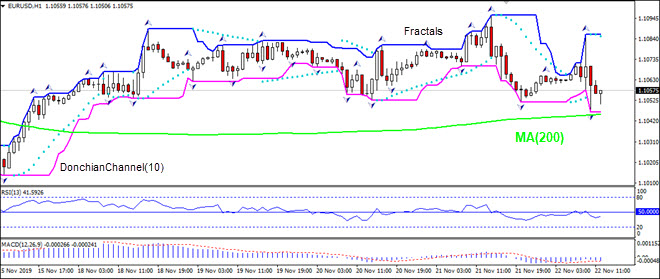
EURUSD falling toward MA(200)

The price chart on 1-hour timeframe shows EURUSD: H1 is trading sideways. The price is falling toward the 200-period moving average MA(200) which is rising. And the RSI oscillator is below 50 level and has not reached the oversold zone. There is no trend yet formed, traders have to decide when it would be a best time to enter the market.

Market Analysis provided by IFCMarkets