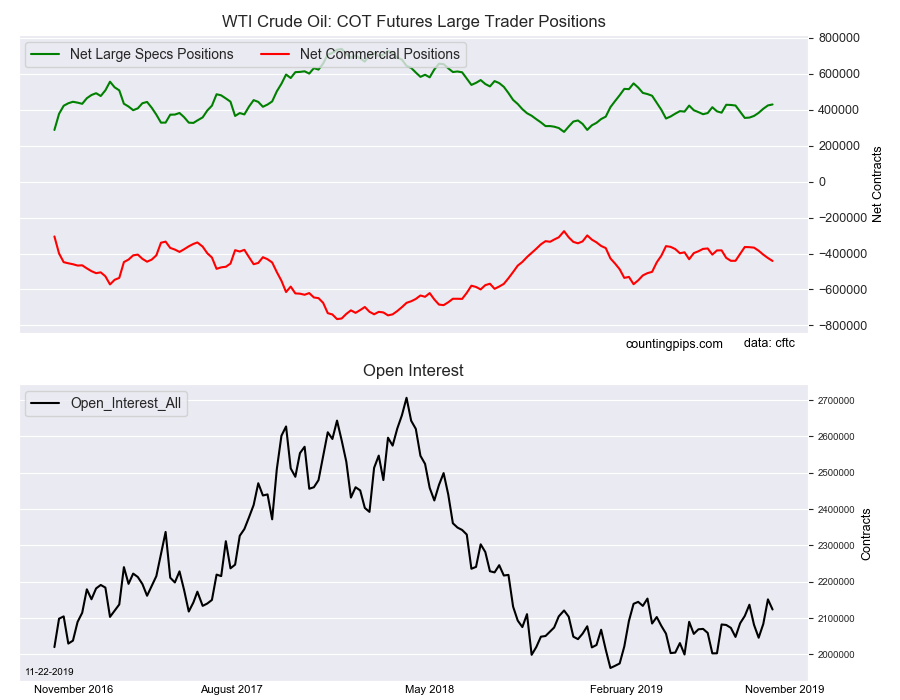
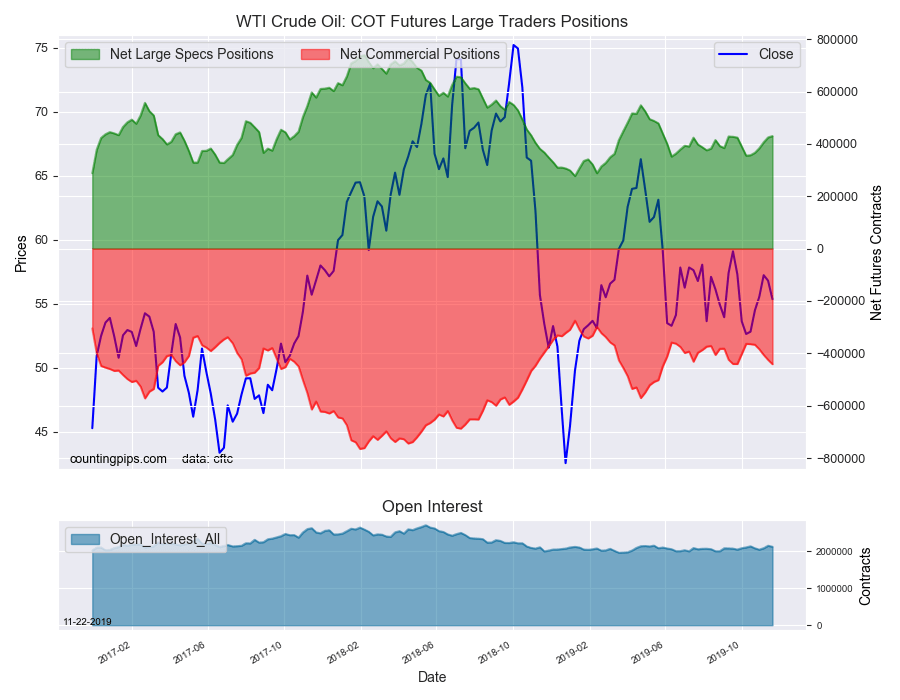
Large energy speculators continued to advance their bullish net positions in the WTI Crude Oil futures markets this week, according to the latest Commitment of Traders (COT) data released by the Commodity Futures Trading Commission (CFTC) on Friday.
The non-commercial futures contracts of WTI Crude Oil futures, traded by large speculators and hedge funds, totaled a net position of 429,975 contracts in the data reported through Tuesday November 19th. This was a weekly gain of 5,378 net contracts from the previous week which had a total of 424,597 net contracts.
The week’s net position was the result of the gross bullish position (longs) going up by 2,338 contracts (to a weekly total of 541,420 contracts) while the gross bearish position (shorts) declined by -3,040 contracts for the week (to a total of 111,445 contracts).
Crude oil speculators have now added to their bullish bets for a sixth straight week and by a total of +74,890 contracts over that period. The current standing of bullish positions is at the highest level (+429,975 contracts) in the past twenty-five weeks and above the +400,000 net contract level for three straight weeks.
WTI Crude Oil Commercial Positions:
The commercial traders position, hedgers or traders engaged in buying and selling for business purposes, totaled a net position of -441,144 contracts on the week. This was a weekly drop of -16,393 contracts from the total net of -424,751 contracts reported the previous week.
WTI Crude Oil Futures:
Over the same weekly reporting time-frame, from Tuesday to Tuesday, the WTI Crude Oil Futures (Front Month) closed at approximately $55.35 which was a shortfall of $-1.45 from the previous close of $56.80, according to unofficial market data.
*COT Report: The COT data, released weekly to the public each Friday, is updated through the most recent Tuesday (data is 3 days old) and shows a quick view of how large speculators or non-commercials (for-profit traders) as well as the commercial traders (hedgers & traders for business purposes) were positioned in the futures markets.
The CFTC categorizes trader positions according to commercial hedgers (traders who use futures contracts for hedging as part of the business), non-commercials (large traders who speculate to realize trading profits) and nonreportable traders (usually small traders/speculators).
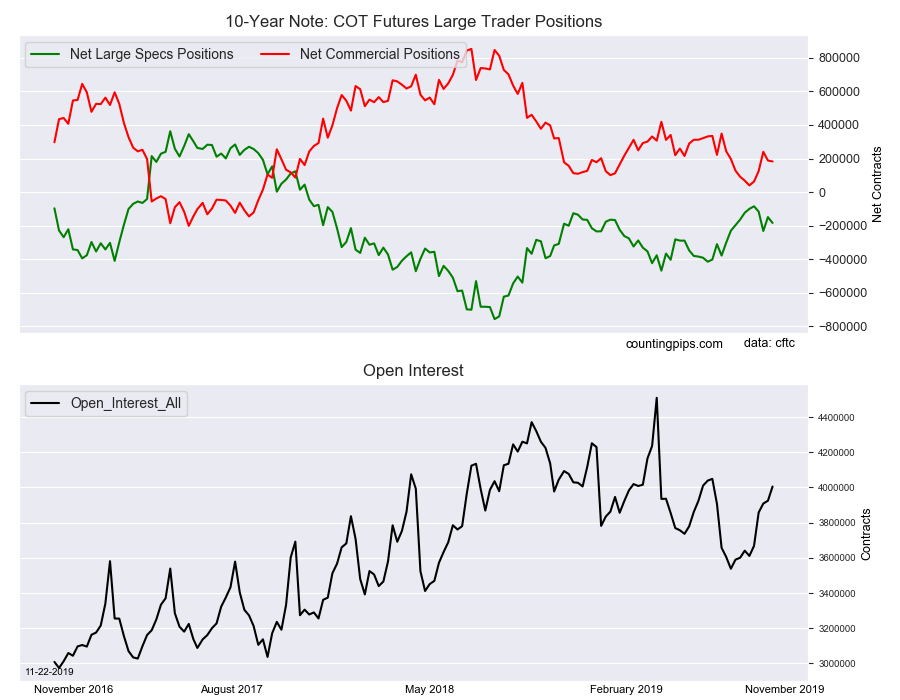
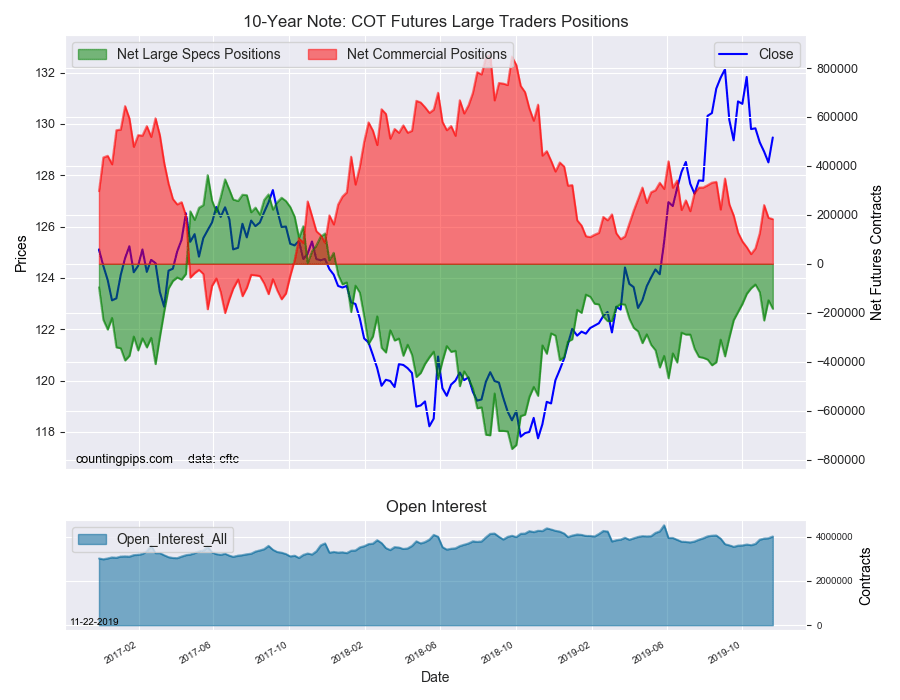
Large bond speculators pushed their bearish net positions higher in the 10-Year Note futures markets this week, according to the latest Commitment of Traders (COT) data released by the Commodity Futures Trading Commission (CFTC) on Friday.
The non-commercial futures contracts of 10-Year Note futures, traded by large speculators and hedge funds, totaled a net position of -183,524 contracts in the data reported through Tuesday November 19th. This was a weekly change of -34,730 net contracts from the previous week which had a total of -148,794 net contracts.
The week’s net position was the result of the gross bullish position (longs) going up by 25,397 contracts (to a weekly total of 677,709 contracts) while the gross bearish position (shorts) jumped by a greater amount of 60,127 contracts for the week (to a total of 861,233 contracts).
Ten-year note speculators increased their bearish bets for the third time in the past four weeks. This follows a streak of seven weeks from September 10th to October 22nd where bearish bets fell by a total of 293,514 contracts in that period. The current standing of -185,524 contracts is the fourth straight week with bearish bets above the -100,000 net contract level.
10-Year Note Commercial Positions:
The commercial traders position, hedgers or traders engaged in buying and selling for business purposes, totaled a net position of 182,638 contracts on the week. This was a weekly loss of -5,412 contracts from the total net of 188,050 contracts reported the previous week.
10-Year Note Futures:
Over the same weekly reporting time-frame, from Tuesday to Tuesday, the 10-Year Note Futures (Front Month) closed at approximately $129.46 which was a rise of $0.96 from the previous close of $128.50, according to unofficial market data.
*COT Report: The COT data, released weekly to the public each Friday, is updated through the most recent Tuesday (data is 3 days old) and shows a quick view of how large speculators or non-commercials (for-profit traders) as well as the commercial traders (hedgers & traders for business purposes) were positioned in the futures markets.
The CFTC categorizes trader positions according to commercial hedgers (traders who use futures contracts for hedging as part of the business), non-commercials (large traders who speculate to realize trading profits) and nonreportable traders (usually small traders/speculators).
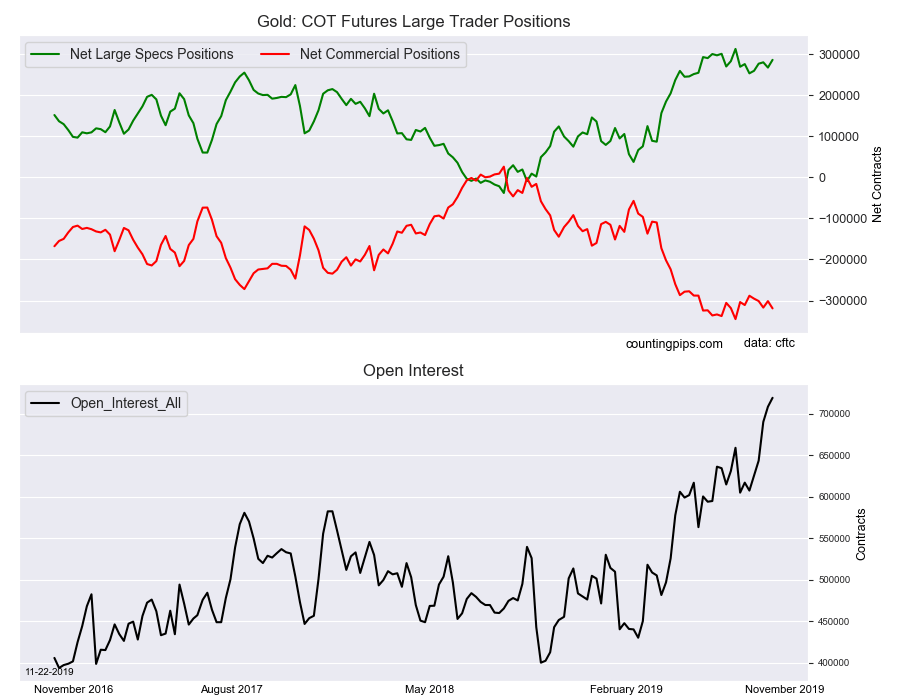
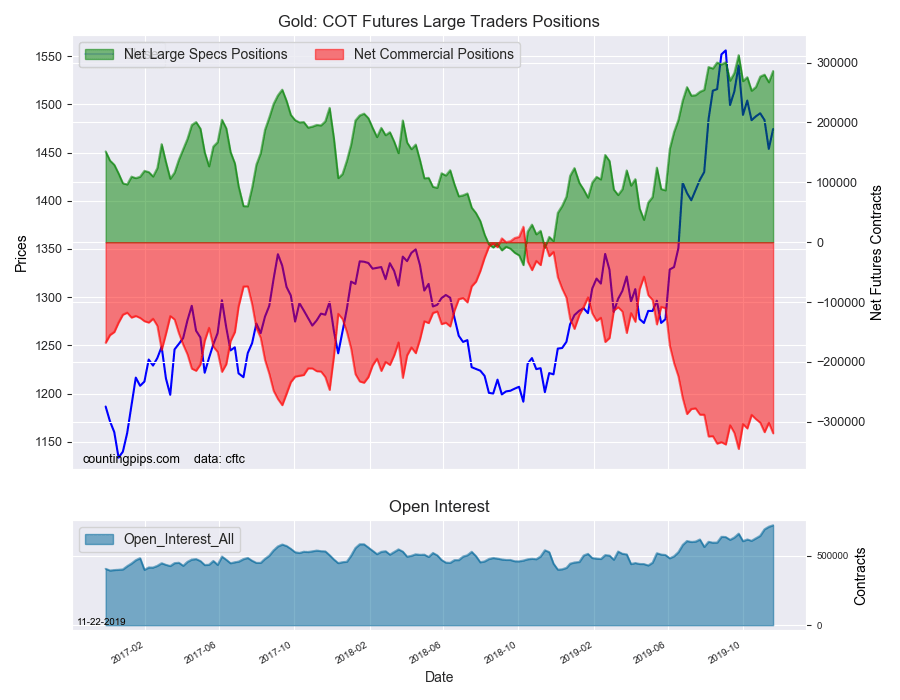
Large precious metals speculators continued to increase their bullish net positions in the Gold futures markets this week, according to the latest Commitment of Traders (COT) data released by the Commodity Futures Trading Commission (CFTC) on Friday.
The non-commercial futures contracts of Gold futures, traded by large speculators and hedge funds, totaled a net position of 285,859 contracts in the data reported through Tuesday November 19th. This was a weekly rise of 18,793 net contracts from the previous week which had a total of 267,066 net contracts.
The week’s net position was the result of the gross bullish position (longs) increasing by 14,107 contracts (to a weekly total of 337,296 contracts) while the gross bearish position (shorts) declined by -4,686 contracts for the week (to a total of 51,437 contracts).
Gold speculators added to their bullish bets by over +18,000 net contracts this week and now by a total of +32,832 contracts in the past five weeks. Gold positions have been above the +250,000 net contract level for eighteen straight weeks, dating back to late July. Further gains in positioning could see bullish bets back over the +300,000 net contract level for the first time since September 24th when the net position totaled +312,444 contracts.
Gold Commercial Positions:
The commercial traders position, hedgers or traders engaged in buying and selling for business purposes, totaled a net position of -319,095 contracts on the week. This was a weekly fall of -17,627 contracts from the total net of -301,468 contracts reported the previous week.
Gold Futures:
Over the same weekly reporting time-frame, from Tuesday to Tuesday, the Gold Futures (Front Month) closed at approximately $1474.30 which was an uptick of $20.60 from the previous close of $1453.70, according to unofficial market data.
*COT Report: The COT data, released weekly to the public each Friday, is updated through the most recent Tuesday (data is 3 days old) and shows a quick view of how large speculators or non-commercials (for-profit traders) as well as the commercial traders (hedgers & traders for business purposes) were positioned in the futures markets.
The CFTC categorizes trader positions according to commercial hedgers (traders who use futures contracts for hedging as part of the business), non-commercials (large traders who speculate to realize trading profits) and nonreportable traders (usually small traders/speculators).
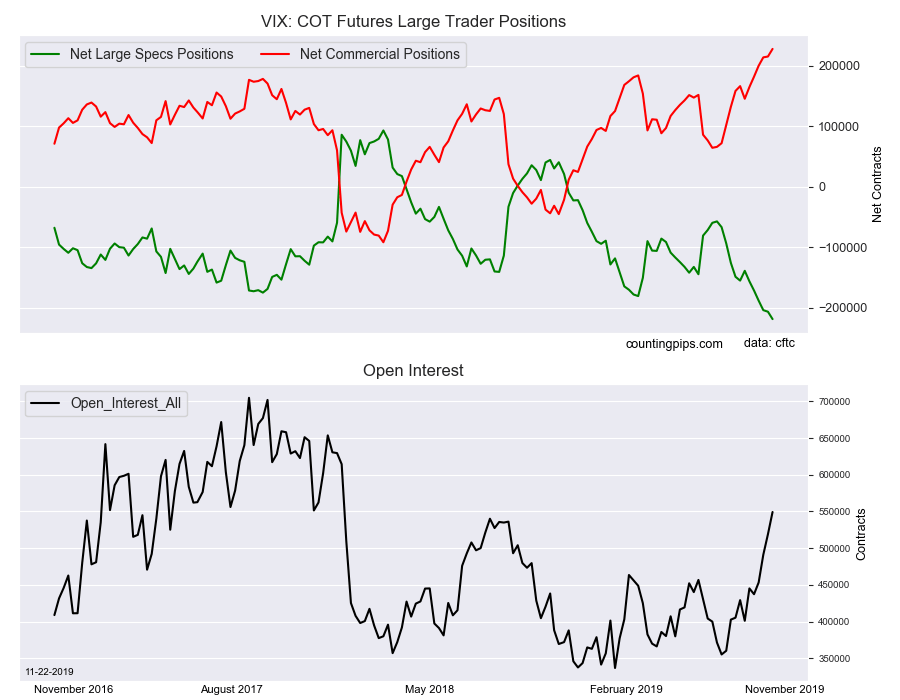
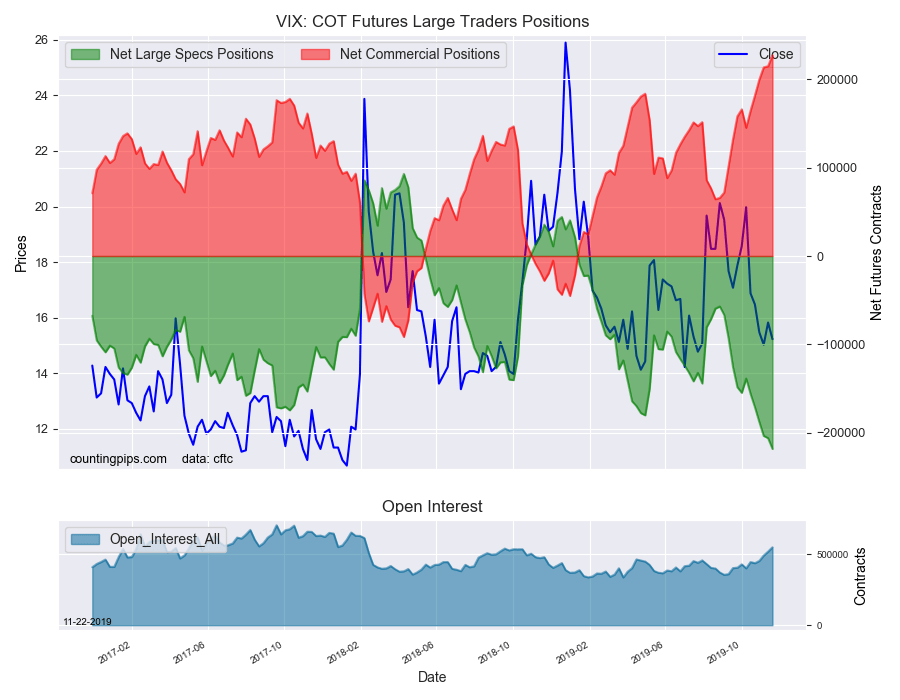
Large volatility speculators continued to push their bearish net positions higher in the VIX futures markets this week, according to the latest Commitment of Traders (COT) data released by the Commodity Futures Trading Commission (CFTC) on Friday.
The non-commercial futures contracts of VIX futures, traded by large speculators and hedge funds, totaled a net position of -218,362 contracts in the data reported through Tuesday November 19th. This was a weekly change of -12,205 net contracts from the previous week which had a total of -206,157 net contracts.
The week’s net position was the result of the gross bullish position (longs) advancing by 2,526 contracts (to a weekly total of 94,359 contracts) while the gross bearish position (shorts) increased by a greater amount of 14,731 contracts for the week (to a total of 312,721 contracts).
VIX speculators raised their bearish bets for a sixth consecutive week and for the eleventh time out of the past twelve weeks. This pushes the current VIX bearish position to another all-time record high at -218,362 contracts and marks the fourth straight week of new record highs.
VIX Commercial Positions:
The commercial traders position, hedgers or traders engaged in buying and selling for business purposes, totaled a net position of 227,456 contracts on the week. This was a weekly uptick of 12,569 contracts from the total net of 214,887 contracts reported the previous week.
VIX Futures:
Over the same weekly reporting time-frame, from Tuesday to Tuesday, the VIX Futures (Front Month) closed at approximately $15.22 which was a decrease of $-0.60 from the previous close of $15.82, according to unofficial market data.
*COT Report: The COT data, released weekly to the public each Friday, is updated through the most recent Tuesday (data is 3 days old) and shows a quick view of how large speculators or non-commercials (for-profit traders) as well as the commercial traders (hedgers & traders for business purposes) were positioned in the futures markets.
The CFTC categorizes trader positions according to commercial hedgers (traders who use futures contracts for hedging as part of the business), non-commercials (large traders who speculate to realize trading profits) and nonreportable traders (usually small traders/speculators).
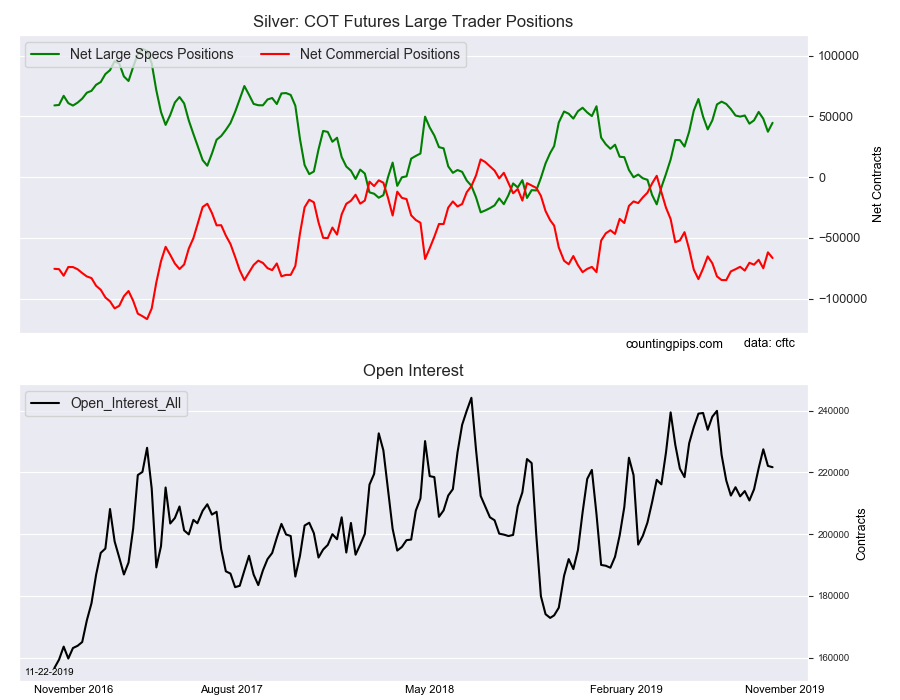
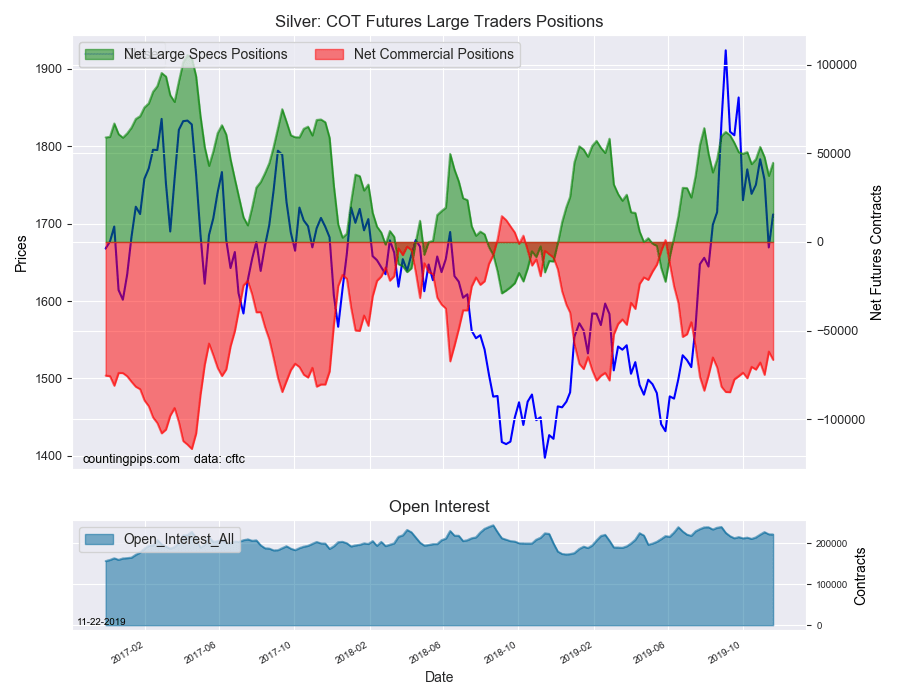
Large precious metals speculators raised their bullish net positions in the Silver futures markets this week, according to the latest Commitment of Traders (COT) data released by the Commodity Futures Trading Commission (CFTC) on Friday.
The non-commercial futures contracts of Silver futures, traded by large speculators and hedge funds, totaled a net position of 44,716 contracts in the data reported through Tuesday November 19th. This was a weekly gain of 7,352 net contracts from the previous week which had a total of 37,364 net contracts.
The week’s net position was the result of the gross bullish position (longs) increasing by 571 contracts (to a weekly total of 89,898 contracts) while the gross bearish position (shorts) dropped by -6,781 contracts for the week (to a total of 45,182 contracts).
Silver speculators raised their bullish bets after positions had fallen by a total of -16,314 contracts in the previous two weeks. This week’s gain brings the overall net position back above the +40,000 net contract level and marks the twenty-fourth week that silver positioning has been in bullish territory.
Silver Commercial Positions:
The commercial traders position, hedgers or traders engaged in buying and selling for business purposes, totaled a net position of -66,549 contracts on the week. This was a weekly drop of -4,657 contracts from the total net of -61,892 contracts reported the previous week.
Silver Futures:
Over the same weekly reporting time-frame, from Tuesday to Tuesday, the Silver Futures (Front Month) closed at approximately $1711.80 which was a boost of $42.60 from the previous close of $1669.20, according to unofficial market data.
*COT Report: The COT data, released weekly to the public each Friday, is updated through the most recent Tuesday (data is 3 days old) and shows a quick view of how large speculators or non-commercials (for-profit traders) as well as the commercial traders (hedgers & traders for business purposes) were positioned in the futures markets.
The CFTC categorizes trader positions according to commercial hedgers (traders who use futures contracts for hedging as part of the business), non-commercials (large traders who speculate to realize trading profits) and nonreportable traders (usually small traders/speculators).
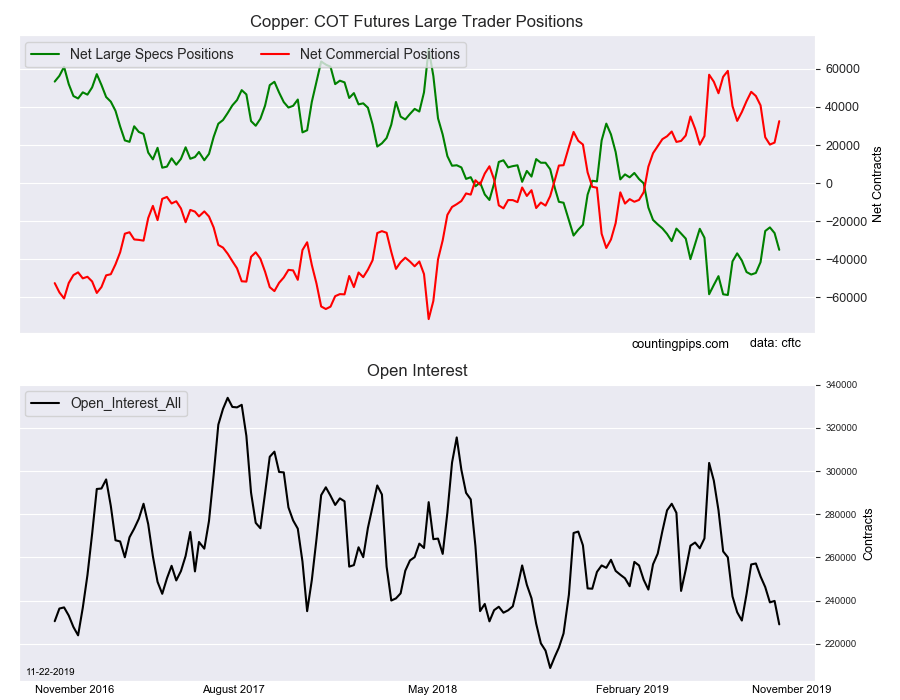
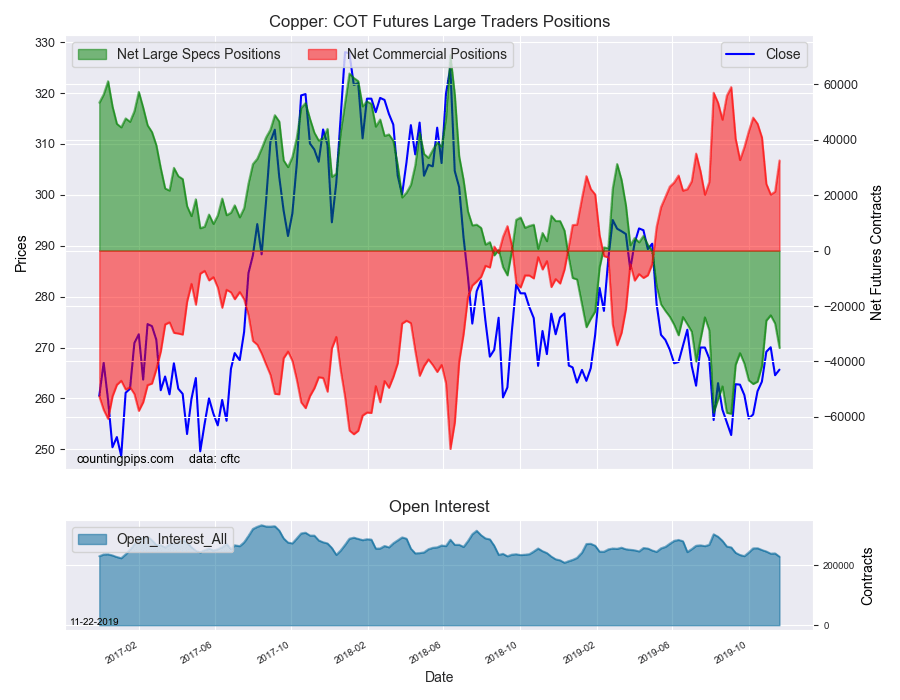
Large precious metals speculators increased their bearish net positions in the Copper futures markets this week, according to the latest Commitment of Traders (COT) data released by the Commodity Futures Trading Commission (CFTC) on Friday.
The non-commercial futures contracts of Copper futures, traded by large speculators and hedge funds, totaled a net position of -35,106 contracts in the data reported through Tuesday November 19th. This was a weekly change of -8,819 net contracts from the previous week which had a total of -26,287 net contracts.
The week’s net position was the result of the gross bullish position (longs) declining by -9,556 contracts (to a weekly total of 63,747 contracts) while the gross bearish position (shorts) fell by -737 contracts for the week (to a total of 98,853 contracts).
Copper speculators added to their bearish bets for a second straight week and by a total of -11,795 contracts over that 2-week period. This follows a four-week stretch that had seen the bearish bets fall from a total of -47,255 contracts on October 15th to a twenty-four week low of -23,311 contracts on November 5th. The current bearish position is now back above the -35,000 net contract level for the first time in four weeks.
Copper Commercial Positions:
The commercial traders position, hedgers or traders engaged in buying and selling for business purposes, totaled a net position of 32,554 contracts on the week. This was a weekly gain of 11,267 contracts from the total net of 21,287 contracts reported the previous week.
Copper Futures:
Over the same weekly reporting time-frame, from Tuesday to Tuesday, the Copper Futures (Front Month) closed at approximately $265.65 which was a rise of $1.10 from the previous close of $264.55, according to unofficial market data.
*COT Report: The COT data, released weekly to the public each Friday, is updated through the most recent Tuesday (data is 3 days old) and shows a quick view of how large speculators or non-commercials (for-profit traders) as well as the commercial traders (hedgers & traders for business purposes) were positioned in the futures markets.
The CFTC categorizes trader positions according to commercial hedgers (traders who use futures contracts for hedging as part of the business), non-commercials (large traders who speculate to realize trading profits) and nonreportable traders (usually small traders/speculators).
By CentralBankNews.info Paraguay’s central bank left its monetary policy rate steady at 4.0 percent for the second time in a row, saying the current accommodative policy stance is “for the time being” compatible with inflation hitting the target and future monetary policy decisions will continue to based on the evolution of domestic and external data. The Central Bank of Paraguay (BCP), which left its rate steady in October after five rate cuts from February to September by a total of 125 basis points, added data for local economic activity and consumption show signs of recovery but there is still a high level of uncertainty surrounding trade talks and Brexit, who’ll could affect the expected economic recovery in 2020. Inflation is still in the lower end of the target range, BCP added. Paraguay’s economy has been hit hard by several shocks this year, including drought and then flooding that affected agricultural output, along with economic weakness in Argentina and Brazil, which affected exports. Earlier this month the International Monetary Fund said it expected growth in Paraguay this year of close to zero but this should bounce back to 4 percent next year, supported by agriculture. Paraguay’s inflation rate fell to 2.4 percent in October, the lowest this year, from 2.6 percent in September, below the bank’s mid-target of 4.0 percent, plus/minus 2 percentage points. Gross domestic product shrank 3 percent year-on-year in the second quarter of this year, larger than the 2.1 percent decline in the first quarter.
In conversation with Maurice Jackson of Proven and Probable, the CEO of this firm talks about prospects in Nevada and Canada’s Yellowknife district, and discusses the company’s financial strategy.
Maurice Jackson: Joining us for conversation is Judson Culter, the CEO of Rover Metals Corp. (ROVR:TSX.V; ROVMF:OTCQB). Glad to have you back on the program, sir, to have you share the value proposition before us in Rover Metals, which is focused on emergent gold and silver opportunities in historic, gold-rich central Nevada in the United States and the Yellowknife district of the Northwest Territories of Canada. Mr. Culter, for someone new to the story, please introduce us to Rover Metals and the opportunity the company presents to the market.
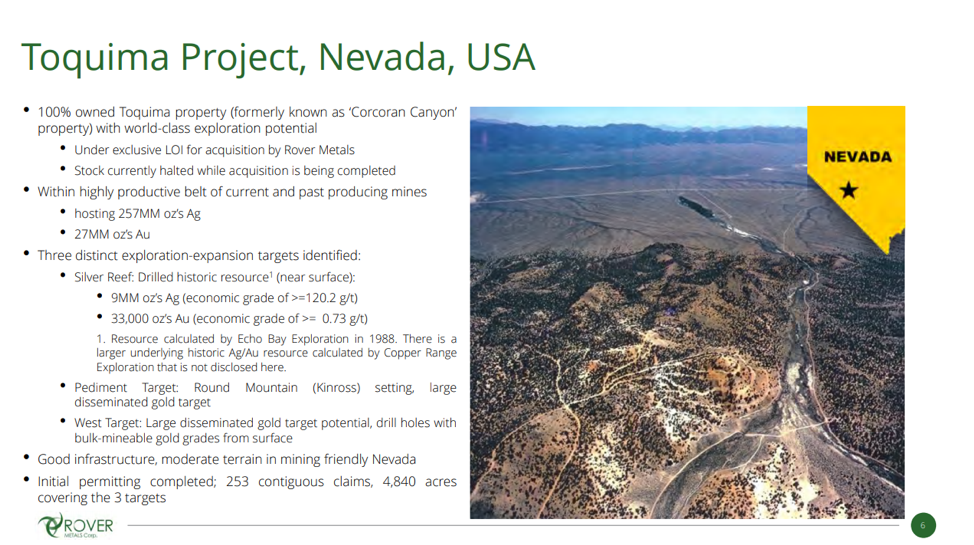
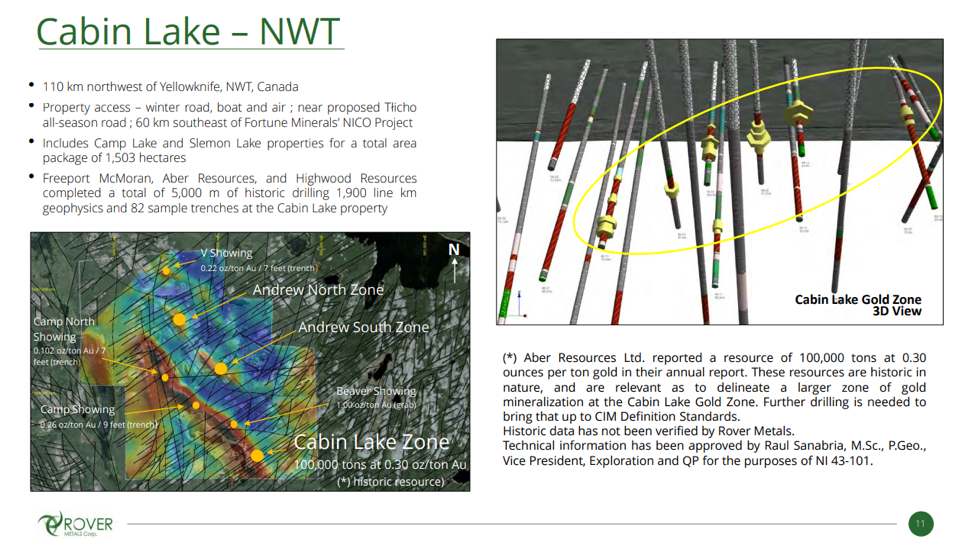
Judson Culter: Rover Metals has drill-ready gold and silver resources that we’re essentially looking to move up to an Inferred, or in the case of Nevada, Measured and Indicated resource in 2020. We’ve got some very high-grade silver in Nevada and with a gold equivalent of an economic grade up to one million ounces. And we’ve got also some very high-grade gold up in the Northern Canada to the tune of 14 grams per ton. So that’s a quick high level. When I say drill ready, what I mean is geophysics has been done, drill permits have been obtained.
Maurice Jackson: Mr. Culter, just to clarify, Rover Metals is early stage, is that correct?
Judson Culter: I would say prior to this acquisition in Nevada, we were early stage. We are in the process of finalizing an acquisition in Nevada, a very large historical resource that’s had 17,000 meters of drilling. And there’s a portion of that, the high-grade portion of 9 million ounces at 250 grams per ton silver. That’s an inferred resource. I think we are mid-stage in terms of a junior; certainly in terms of a mining company it’s fair to say we’re an early stage that is looking to get to that preliminary economic feasibility calculation within the next year to two years.
Maurice Jackson: Are the company’s projects brownfields exploration?
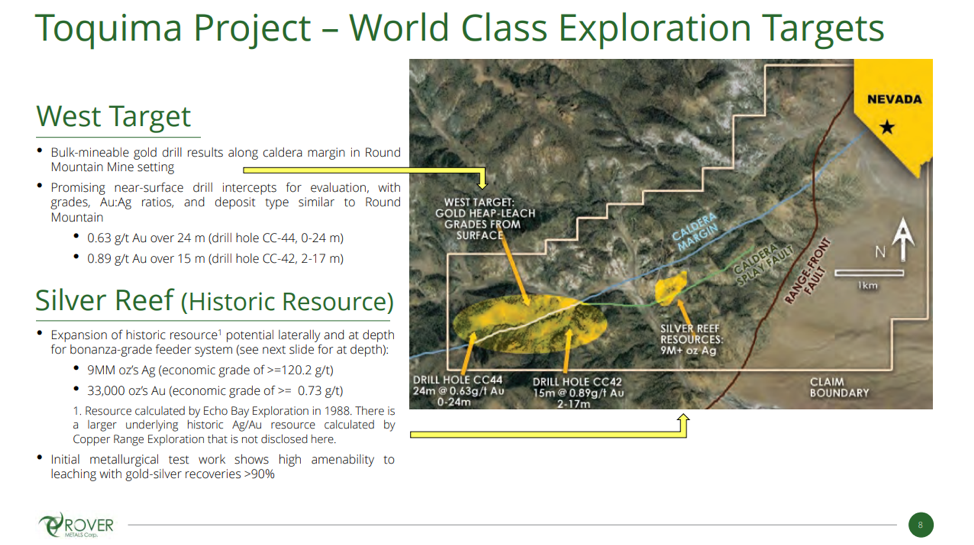
Judson Culter: [On] the Toquima Nevada asset, the silver portion of that is brownfields. We’ve got a step-out from the historic silver reef zone at our Toquima Project that is three-and-a-half kilometers of golden core, which is a greenfields target. It really just shows an extension of the historical resource, but it is a good anchor silver brownfields project for us in Nevada.
What we have up in Northern Canada, I would say, is an earlier stage greenfields high-grade gold resource to the tune of about 85,000 ounces. And there’s only been 7,500 meters of drilling, but I think we could, in a good gold market, in the bull market we’re heading into, quickly move that asset into the brownfields category as well.
Maurice Jackson: Let’s discuss a topic germane to the value proposition of Rover Metals that I believe a number of speculators may be overlooking. You and I had a conversation regarding your thoughts on merger and acquisition (M&A) market for the precious metals juniors that I thought was quite interesting. Mr. Culter, when is the M&A market for precious metals coming?
Judson Culter: Maurice, there’s a good chance for 2020. I think we follow very closely the published reserves of the producers and then there’s multiple credible online publications. The listener can just simply type that into Google and look at some of the graphs, where you could see a 10-year stack bar graph [showing] we’re in the lowest drawdown on precious metal resources in a decade. And with these kind of gold prices that we’re at, and Treasury’s getting topped up, I mean, it’s just business economics that you would be wanting to acquire projects when you’ve got the treasure to do it.
Maurice Jackson: Yeah, certainly is. And you look at just the fundamentals and the bureaucratic aspect of the mid-tiers in the major gold companies, they took the exploration side of their business model out and that left an opportunity for junior mining companies. But not just any junior mining company. It takes a company such as Rover Metals, I believe, that has the business acumen and geological acumen to make something come to fruition. And in this case, it looks like we have two opportunities, one in Canada and one in Nevada, which segues into my next question here. And that was, back in April Rover Metals announced an LOI [letter of intent] to purchase a strategic land package in central Nevada. Tell us about the project and the value proposition before us.
Judson Culter: I think the project is in a great location in Nevada. To start with the value proposition first: Again, on the M&A topic, I think Nevada will continue to stay one of the hottest jurisdictions for M&A, like it was in 2019. At the ultimate ivory-tower level, [it is] with the majors Barrick Gold Corp. (ABX:TSX; GOLD:NYSE) and Newmont Goldcorp Corp. (NEM:NYSE) and the JV [joint venture] that was formed. But it’s just a state where it’s just so business-friendly and there’s just such an endowment of resources there.
The sheer cost of exploration is perfect for the market we’re in. I think if we do see the M&A cycle, I think Nevada is the logical place for it to be. That’s the value proposition for us is the fact that we’re in Nevada. You’ve got just the boots on the ground, the resources, the support for the industry logistic-wise. Out of Reno, people are on the ground in places like Round Mountain for Kinross Gold Corp. (K:TSX; KGC:NYSE).
[You have] access to the workforce that you need, and just really the historic resource, who’s worked this project. Echo Bay did a significant amount of exploration there in the 1980s. We’ve built the database. It’s a good combination of RC [reverse circulation] drilling and diamond core drilling at this Toquima Project.
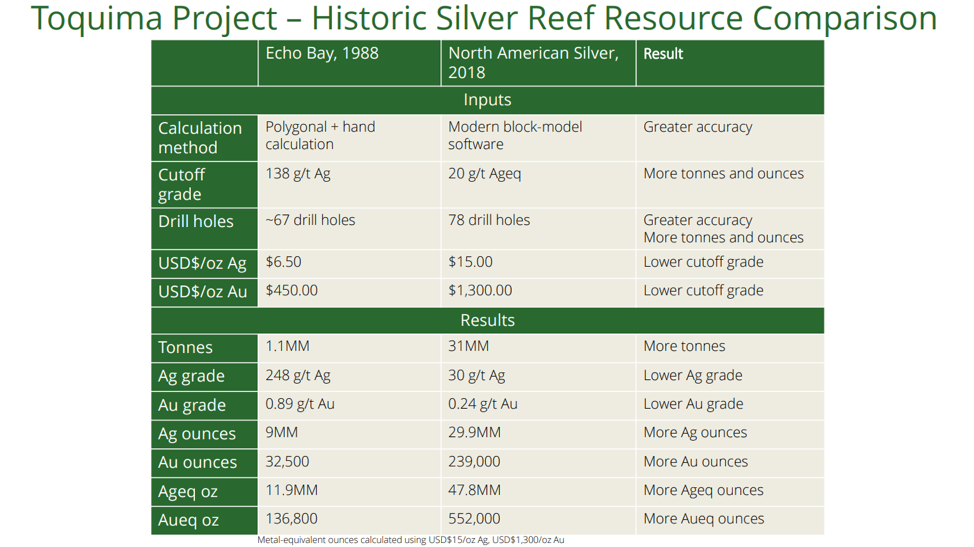
The opportunity is there’s up to 48 million ounces of economic-grade silver. Right now, we’re focused on moving the historic 9 million ounces of high-grade. But we’ve also think there’s up to 48 million ounces Measured and Indicated to be proven up. And then we’ve got this area [called] Toquima Caldera.
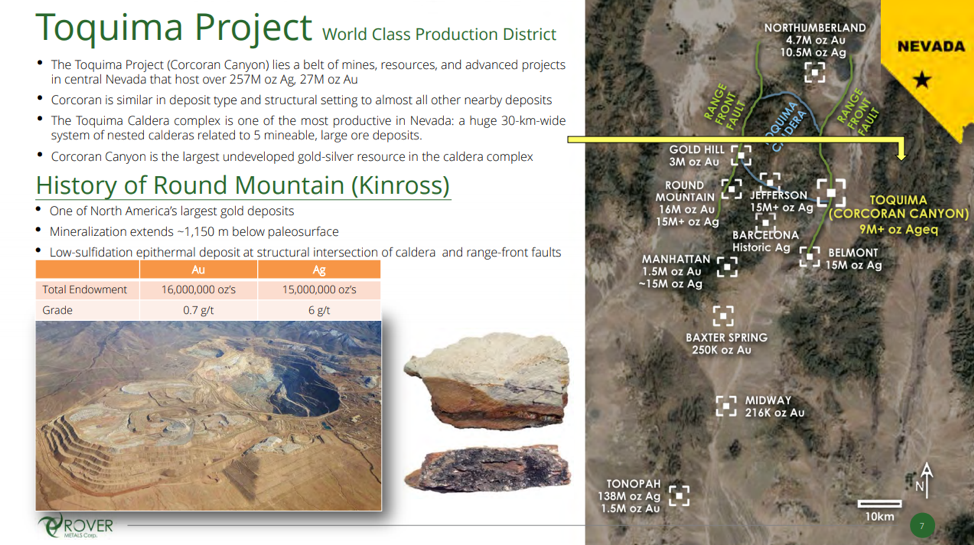
All these margins typically have gold within a 10-to-1 to silverhe alloy and just the pure geology of the region. In Kinross’ Round Mountain case, it’s actually like 2-to-1 gold to silver. And so. . .we think this is actually as much silver as there, and it’s been proven to be there. We believe this is actually a gold exploration target, just because of the comparables in the region. Look at Gold Hill, look at the Manhattan project, look at Baxter Springsthose are all gold projects and we’re talking about a 15-square-mile radius here. It’s just very unusual that there wouldn’t more gold in the Toquima Project.
Maurice Jackson: Mr. Culter, please provide us with an update on the LOI.
Judson Culter: Rover Metals is basically approved for this acquisition. What we’ve done over the summer months is we raised $300,000. What that $300,000 [in] proceeds was used for was to buy out the underlying option agreement for the Toquima asset. And so that means that there was six months left of a three-year option agreement. That option agreement is now fully satisfied. We’ve also renewed the claims in Nevada. So those claims are in good standing for a year. And on closing, the title is just ready to move over to Rover. The last piece of the acquisition is we’re looking to finance working capital of $500,000. This is future working capital. And that’s currently where the acquisition stands.
And as soon as we’ve closed on that CA$500,000 minimum, we would like to do a bit more. But right now, that’s the last piece of the acquisition. And that’s what we’ve been working on since Labor Day in September, since the first closing on the financing is the half-million we need to get to work. And I think the good news is, is that we’re ready to get in there early in the new year and start delivering exploration results to what looks to be a bull market for precious metals.
Maurice Jackson: But there’s more to the value proposition before us in Rover Metals. Judson, it just occurred to me that we haven’t spent too much time on your properties in the Northwest Territories. Let’s introduce [readers] to them. And the first of all, let’s begin with the Cabin Lake gold property and then let’s transition to the Up Town Gold project.
Judson Culter: The Cabin Lake is a project that has really got the support of the community in the North; stakeholders in Yellowknife and outside of Yellowknife. We’ve got the support of the local First Nations. We’ve got proven companies that have been at it about three years longer than we have that have gone to work 120 kilometers north of us. And they’ve recently delivered a three-million Inferred gold resource to the market.
The infrastructure that they’ve brought into our camp and in our region just bodes well for us. We’ve got a five-year exploration permit. This is high-grade gold. This is 14 grams per ton. We’ve only scratched the surface. There’s only been 7,500 meters of drilling. We think, with the gold markets that we’re heading into, that this is another very good supplementary asset to help us generate what we hope to be quarterly exploration news in 2020, 2021, moving forward.
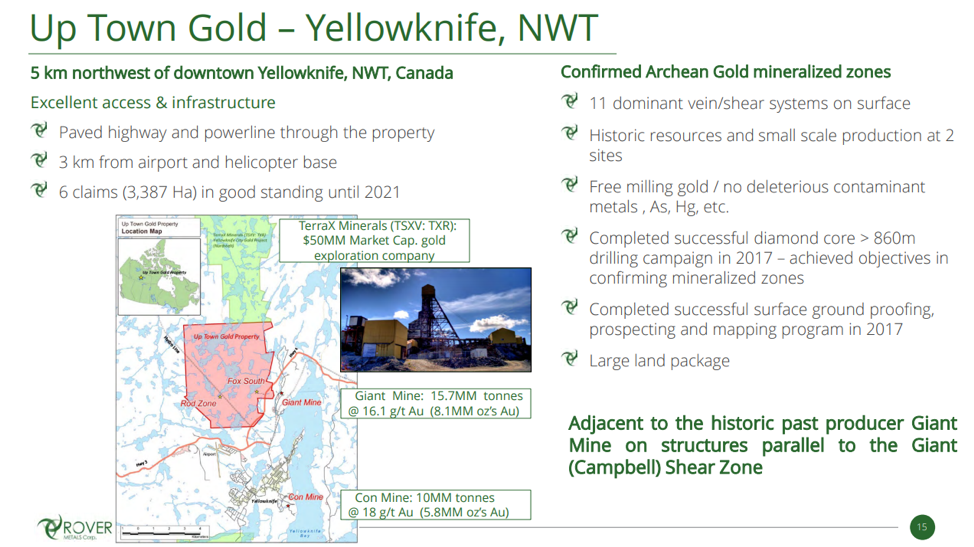
It’s a really interesting type of geology. It’s an iron formation. I guess a very good comparable might be the Lupin Mine that operated from 1983 up to 2003. It’s an exciting opportunity. We’ve got the Up Town Gold Project as well, right in the city of Yellowknife. Actually you’re flying out the airport, it’s almost the other side of the highway from the airport. That’s a little bit trickier geology. It’s a granite formation, but with the right gold market, with the ability to have a project right in the city limits really makes it, in terms of what’s required to be economic. That’s always been the opportunity with that project as well.
Maurice Jackson: Sticking with M&A, what does Rover Metals have to offer to perspective precious metals producers in terms of M&A?
Judson Culter: We are confident that we have a very economic deposit. I think we are very closewithin a yearto doing the hard work in terms of moving it up to a Measured and Indicated resource. And it’s just in such a mining-friendly jurisdiction that a smaller mid-tier producer would be a good candidate. It’s open pittable, at surface, and oxide. I believe for the right producer it’d be a great strategic fit. And I think. . .the most likely first strategic investment would be to come for the Nevada project.
Maurice Jackson: When is the next big opportunity for investors to get a piece of Rover Metals?
Judson Culter: There’s an opportunity right now, as we offering a financing opportunity (press release). One of the things that you don’t get in the open market is a stock purchase warrant and that’s incredibly valuable, especially when you look at current precious metal company prices. Rover Metals has been approved to issue a stock warrant at double the face value of our share price. And I think it’s no secret that there’s some real good buys in the precious metal sector right now. Why not get a five-year warrant in addition to a full common share? And that’s the value of the private placement that we’re offering right now.
I think anybody can do a little bit of research or listen to some of your interviews on investing in the precious metal resource sector. Holding both the warrant and the common share really allows you to do a little bit of future planning and hedge your success in a sector. We are taking some swings, but typically it’s the warrant that brings value to a lot of investors in the sector.
Maurice Jackson: Judson. One more time. How many years on that warrant again, sir?
Judson Culter: Five years.
Maurice Jackson: That’s not common.
Judson Culter: It’s almost like a half a mining cycle if you will, right? Or a full mining cycle, right? If we truly are going in to a bull market you’ve got a share essentially that comes into the money at $0.12, and you’re shielded for five years on that.
Maurice Jackson: But that’s just icing on the cake.
Judson Culter: Let’s just get back to that as well. These will be on this private placementreally the only outstanding warrants in our companybecause as of June, all of our existing warrants expire. Again, getting back to the value of the warrants that we’re offering in this financing, given that as we move forward, that just gets back to a tighter capital structure where, on the money that we’ve raised to date, some of the warrants will be expiring Dec. 31, but the remainder that are outstanding expire in June. These warrants at five years has got some real value. As they come into the market, there is a market for the shares on exercise just because of the fact they’re not competing with warrants from previous finances.
Maurice Jackson: Multilayered question: What is the next unanswered question for Rover Metals? When can we expect a response and what determines success?
Judson Culter: Well, I think for us the most exciting opportunity is the geophysics that we want to run on our Toquima Project in central Nevada. And we have a historical resource, the high-grade silver. What they’ve done on the project in the last five years is three-and-a-half kilometers of golden core stepout. Never had geophysics, never had magnetics, never had a drone-based airborne over top of it.
You’re talking about up to 48 million ounces of silver. We’ve got gold only targets here. I mean, this could just be such an amazing opportunity. And I think just emphasizing the geophysics, that’s something we can do in six to eight weeks.
Maurice Jackson: Switching gears. Mr. Culter, please share the current capital structure for Rover Metals.
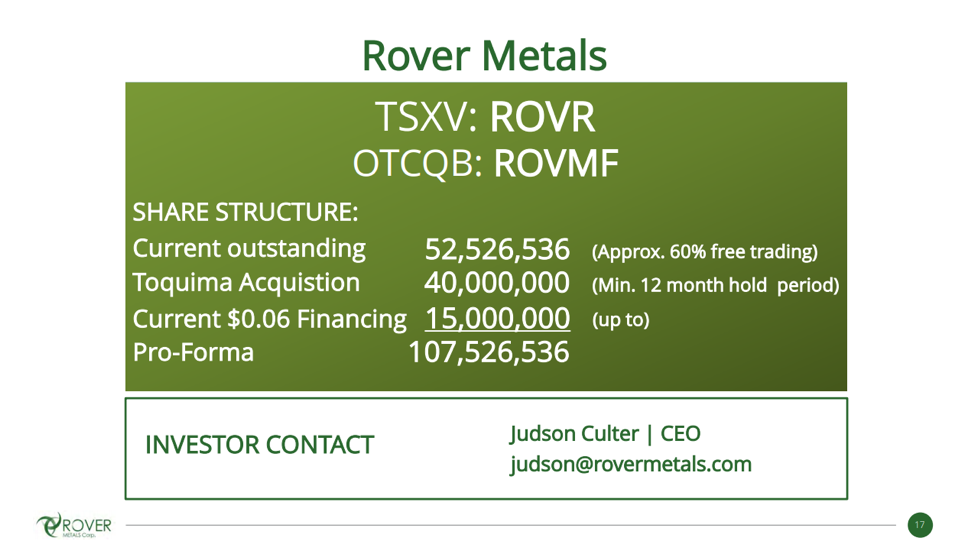
Judson Culter: We’ve got 52 million shares outstanding as of [this] date. Upon closing of our acquisition in Toquima, we will have 92 million shares outstanding. And that is not a control block to one person. . .it’s actually being distributed down to a 100 people, including Eric Sprott. There is an up to two-year hold period on those acquisition shares as well. Those shares won’t be in the market right away.
So, on a post-acquisition basis, we’ve got, as I said, 92 million shares out. And then if we add the financing shares, that puts us around 107 million shares outstanding. We own a majority of our projects outright. We’re not optioning; we’re not having to do earnings. You know, that’s a lot of real estate and resource owned by the company. And that’s reflective in that capital structure.
Maurice Jackson: The stock is currently halted on the Canadian Toronto Venture Exchange while still trading on the OTCQB. Can you provide us with some context on why and when the company expects to resume trading?
Judson Culter: We are targeting to close just before the new year on the acquisition, and that may stretch into January. That is our likely date to resume trading, just based on right now with the financingsthe money that’s being put together, where it’s coming from. Just some of the due diligence steps that, as you can appreciate with smart money in this sector, [is] what’s typically done to close. It’s just taking some time to get that financing done.
In terms of the OTCQB listing, we’re actually still trading on the OTCQB and I know that there’ll be some American investors that will be depositing about 400,000 shares that just recently had legends removed, and that will be free trading before 100,000 new shares going into the DTC OTC listing.
And so we may see a nice little run here before the end of the year, just based on the OTC trading. Because I do believe that we’ve seen some volume there already in the last few months, and one trade of $0.40, one at $0.17, and then another trade at $0.17. So it’ll be fun to just to see on speculation of closing of this acquisitionhow the OTC market trades here in the next couple months.
Maurice Jackson: Now you said that lightly, but let’s put that to some context here. You said $0.40, $0.17 and I believe it was $0.20 or $0.25. Is that correct?
Judson Culter: That’s right. And I think that’s all on just speculation around what we’re doing in Nevada. It’s also important to know who we’ve just added to our advisory role. That was our last press release. We just added Robert ShaferBob, as he likes to be called, to our advisory board. Bob was an early guy with Ken Ross, very senior executive. Well known in U.S. mining circles, very well respected, well known in Canadian markets. He was the president of the PDAC, I believe, three years ago.
Bob is joining us to provide technical expertise in Nevada. He has regional data to help us with our exploration program. He knows what works on geophysics and I also wouldn’t be surprised if there is some future M&A closer to the Toquima Project. Bob’s worth [a lot] just based on the relationships he carries in Nevada being his backyard. I don’t know, maybe the OTC was trading on that news as well. It’s hard to say.
Maurice Jackson: Yeah. But Judson, if we have readers, let that soak in for a second: those are U.S. numbers when you’re referencing the OTC. What was the price of Rover Metals on the TSX.V when it was halted?
Judson Culter: [It was] $0.06.5. So, yeah, it’s a nice boost and I mean, given that we’re financing at $0.06, it’s a pretty nice return for investors coming in and kind of showing them what’s in store for us as we look ahead. And 2020 really, I mean they’re supposed to be. . .I mean again, I’ll leave it to the listener to do the research on gold prices, but the ETFswhen they come into this sector, they come in in a big way. And I think what we’re seeing on the OTC is somewhat indicative of when we get called back to trade where our share price is headed.
Maurice Jackson: What are some of the biggest concerns and positive feedback you’ve been receiving from shareholders?
Judson Culter: It’s been very supportive. People just want to know, because during this whole period we haven’t been issuing as many press releases, so people just e-mail me or call me personally. There’s really not anything to be concerned about. From our side, during the halt, it was adding somebody of Bob Shafer’s caliber to the technical team[and] trying to pull in regional data, in addition, to Toquima, so that we really can plan the expiration appropriately and then get the financing doneand come back to trade with the intent that within a couple of weeks thereafter we’re getting to work, right? You need the people and the expertise and the knowledge in addition to great projects. That kind of stuff doesn’t happen overnight.
Maurice Jackson: Sir, what keeps you up at night that we don’t know about?
Judson Culter: Dreading my next interview with Proven and Probable. I get my feet held to the fire.
Maurice Jackson: Well, we certainly like to do that.
Judson Culter: That was tongue in cheek. Love being on the show.
Maurice Jackson: And also, by the way, for audience members, we want to share that we are enthusiastic of having Rover Metals as our newest sponsor. Thank you for coming onto the program, sir, for that as well. Last question, what did I forget to ask?
Judson Culter: As usual, Maurice, I think you covered it all. I think just to be in a position where we’re. . .moving projects up from a great historic resource, an abundance of data, to either an Inferred or a Measured and Indicated category in what hopefully will soon be an M&A market that’s just really a good summation of the stage where we’re at and for an investment as well as a company.
And really, I think the kind of travel that I think we’re looking forward to in 2020 in terms of what conferences we will be attending. We’ll have a very good U.S. presence in 2020, with real focus on the U.S. retail audience, with giving them the constant updates on what we’re doing in Nevada. Not to discount the Canadian market. It’s just the six-month focus is really on what’s going on in Nevada.
Maurice Jackson: For more information on Rover Metals visit www.rovermetals.com. Rover trades on the TSX.V: ROVR | OTC: ROVMF. For direct inquiries, please contact Judson Culter. And he may be also be reached at [email protected].
Before you make your next bullion purchase, make sure you call me. I’m your licensed representative from Miles Franklin Precious Metals Investments, where we provided a number of options to expand your precious metals portfolio. From physical delivery, offshore depositories, precious metal IRAs and private blockchain distributed ledger technology. Call me directly at (855) 505-1900 or you may email [email protected].
Finally, please subscribe to provenandprobable.com, where we provide mining insights and bullion sales. Subscription is free. As a reminder, Rover Metals is a sponsor of Proven and Probable, and we are proud shareholders for the virtues conveyed in today’s interview. Judson Culter of Rover Metals: Thank you for joining us today on Proven and Probable.
Maurice Jackson is the founder of Proven and Probable, a site that aims to enrich its subscribers through education in precious metals and junior mining companies that will enrich the world.
Disclosure: 1) Maurice Jackson: I, or members of my immediate household or family, own shares of the following companies mentioned in this article: Rover Metals. I personally am, or members of my immediate household or family are, paid by the following companies mentioned in this article: None. My company has a financial relationship with the following companies mentioned in this article: Rover Metals. Proven and Probable disclosures are listed below. 2) The following companies mentioned in this article are billboard sponsors of Streetwise Reports: None. Click here for important disclosures about sponsor fees. 3) Statements and opinions expressed are the opinions of the author and not of Streetwise Reports or its officers. The author is wholly responsible for the validity of the statements. The author was not paid by Streetwise Reports for this article. Streetwise Reports was not paid by the author to publish or syndicate this article. The information provided above is for informational purposes only and is not a recommendation to buy or sell any security. Streetwise Reports requires contributing authors to disclose any shareholdings in, or economic relationships with, companies that they write about. Streetwise Reports relies upon the authors to accurately provide this information and Streetwise Reports has no means of verifying its accuracy. 4) This article does not constitute investment advice. Each reader is encouraged to consult with his or her individual financial professional and any action a reader takes as a result of information presented here is his or her own responsibility. By opening this page, each reader accepts and agrees to Streetwise Reports’ terms of use and full legal disclaimer. This article is not a solicitation for investment. Streetwise Reports does not render general or specific investment advice and the information on Streetwise Reports should not be considered a recommendation to buy or sell any security. Streetwise Reports does not endorse or recommend the business, products, services or securities of any company mentioned on Streetwise Reports. 5) From time to time, Streetwise Reports LLC and its directors, officers, employees or members of their families, as well as persons interviewed for articles and interviews on the site, may have a long or short position in securities mentioned. Directors, officers, employees or members of their immediate families are prohibited from making purchases and/or sales of those securities in the open market or otherwise from the time of the interview or the decision to write an article until three business days after the publication of the interview or article. The foregoing prohibition does not apply to articles that in substance only restate previously published company releases.
Proven and Probable LLC receives financial compensation from its sponsors. The compensation is used is to fund both sponsor-specific activities and general report activities, website, and general and administrative costs. Sponsor-specific activities may include aggregating content and publishing that content on the Proven and Probable website, creating and maintaining company landing pages, interviewing key management, posting a banner/billboard, and/or issuing press releases. The fees also cover the costs for Proven and Probable to publish sector-specific information on our site, and also to create content by interviewing experts in the sector. Monthly sponsorship fees range from $1,000 to $4,000 per month. Proven and Probable LLC does accept stock for payment of sponsorship fees. Sponsor pages may be considered advertising for the purposes of 18 U.S.C. 1734.
The Information presented in Proven and Probable is provided for educational and informational purposes only, without any express or implied warranty of any kind, including warranties of accuracy, completeness, or fitness for any particular purpose. The Information contained in or provided from or through this forum is not intended to be and does not constitute financial advice, investment advice, trading advice or any other advice. The Information on this forum and provided from or through this forum is general in nature and is not specific to you the User or anyone else. You should not make any decision, financial, investments, trading or otherwise, based on any of the information presented on this forum without undertaking independent due diligence and consultation with a professional broker or competent financial advisor. You understand that you are using any and all Information available on or through this forum at your own risk.
Welcome to this week’s Market Wrap Podcast, I’m Mike Gleason.
Coming up David Morgan of The Morgan Report joins me for another wonderful interview on the state of the metals and the markets. David talks about checking your premises as a metals investor and lays out the case for why it’s more important now than ever to not lose your nerve despite some lackluster price action. He also discusses the changes underway in our monetary system, changes that everyone needs to take notice of. So, don’t miss my conversation with our good friend David Morgan, the man they call the Silver Guru, coming up after this week’s market update.
Precious metals markets attempted to make some progress earlier this week. Most of the actual price progress accrued to the white metals as gold lagged a bit.
Gold rallied up to the $1,480 level mid week before retreating on Thursday. As of this Friday recording, gold trades at $1,467 per ounce, down $2 or 0.1% since last Friday’s close.
Turning to the white metals, the silver market is showing a slight weekly advance of 0.4% to bring spot prices to $17.12 an ounce. Platinum is unchanged on the week at $895. And finally, palladium is perking up again and is posting a 3.4% gain this week to come in at $1,772 per ounce.
Markets haven’t reacted much to the impeachment circus playing out on Capitol Hill. Perhaps investors sense that despite the deep partisan divisions being put on public display, it is will business as usual when it comes to the big fiscal and monetary issues regardless of whether President Donald Trump is impeached.
In fact, lawmakers and the White House managed to agree to a stopgap spending bill on Thursday that averts a government shutdown. Politicians agreed to kick the can down the road until December 20th, when the threat of a shutdown will loom again if President Trump decides to play hardball with Congressional Democrats.
Trump signed the current spending bill despite the fact that it contained no new border wall funding or any meaningful spending concessions from Democrats. The bill will expand the already ballooning federal budget deficit.
In October the gap between government outlays and receipts grew by 34% from the previous year to $134 billion. The running budget deficit for the last 12 months rose above the $1 trillion mark for the first time in more than six years.
Few in Washington or on Wall Street seemed to notice or care. Everybody seems to think deficits don’t matter as long as the Federal Reserve keeps interest rates low and stands ready to buy government bonds in unlimited quantities.
Fed chairman Jerome Powell has expressed concerns over the budget deficit and the unwillingness of elected officials to make responsible fiscal policy decisions. Powell may prefer to not be in the position of papering over rising federal debt, but he is now effectively trapped in that role.
Minutes from the Federal Reserve’s October meeting were released on Wednesday. Fed officials expressed optimism about the economic outlook and pushed back against the idea of employing negative interest rates in the event of a recession.
President Trump has expressed support for negative interest rates. Some economists, including former Fed chief Alan Greenspan, have said negative rates are likely to make their way to the United States.
There has been a clear and observable correlation between the global stock of negative yielding bonds and investment demand for gold. To some extent that correlation has driven gold prices higher over the past year – though we haven’t seen the kind of spike we might see if U.S. rates go below zero.
Hard money is clearly a superior store of value when compared to national currency instruments that carry negative yields.
We welcome the increase in public awareness about sound money that will surely come with accelerating currency debasement. But unfortunately some bad actors will also come out of the woodwork to try to take advantage of people seeking the safety of gold and silver.
This week a company called Chase Metals was exposed for operating a scheme that targeted Boomers and older Fox News viewers in particular. The playbook was all too familiar to us. It was essentially a bait and switch, high pressure sales operation.
It goes like this: Spin a compelling narrative to prospective customers about the need to own precious metals, then trick them into purchasing particular types of coins that carry absurdly inflated mark-ups as compared to ordinary bullion coins.
Victims of the Chase Metals scheme were apparently led to believe that the silver coins they got pressured into buying carried some kind of special collectible value. The truth is that the buyers overpaid by up to 200% for silver bullion that wasn’t special at all.
Coin schemers like these unfortunately give our industry a bad name. But here at Money Metals Exchange, we are working to change that. We are committed to educating the public about precious metals, offering low-premium bullion products, and providing honest, no-pressure customer service. Our precious metals specialists are not only highly knowledgeable, but they are also not on commission, meaning they don’t have a perverse incentive to strong arm customers into buying something that is good of them, rather than good for the investor – the complete opposite of the boiler room, heavily commission based sales structure at many of the other outfits. As such we are proud of the industry-leading reputation we have built, one that earned us Precious Metals Dealer of the Year in the U.S. a couple of years back.
Well now, without further delay, let’s get right to this week’s exclusive interview.
Mike Gleason: It is my privilege now to welcome back our good friend David Morgan of The Morgan Report. David, it’s good to have you on as always and we appreciate the time today. How are you?
David Morgan: Mike, I’m well. Thank you for having me.
Mike Gleason: Well, we’ve had a significant correction in precious metals prices, especially in silver, and I wanted to get your thoughts on that to start out here. To us, it looked like the bullion banks sold futures contracts to lots of speculators who got interested in metals. Then as often happens, the speculators got taken out to the woodshed. However, open interest appears to still be rising. We would have expected that to fall after a couple weeks of lower prices and pain pushing those longs out of the market, so maybe something else is going on here. What do you make of the recent price correction and where do you think the markets might be headed in the short term? Do you think the selling might be over for now?
David Morgan: I do not. I think there’s probably more so on the head. I mean, it’s possible that we get a lift here to do a fake out from the longs, but I don’t like the structure of the Commitment of Traders. Silver hit about a three-and-a-half year high, which hit $19.65 which I believe was the top of this spot market. And we’ve had several instances over the last six, seven, eight years where the last day of trading was the low pick for the year in the metals. Traditionally they start moving up the end of the year, but that’s not been the seasonality for many years now. So, I think we’re going to drift off lower. It’s possible that the bottom is in, I called the four about a $1,450 on gold, about a 50% retracement from the $200 move that went from $1,350 to $1,550 when it finally broke that six year trading range and it’s done that. But yet in looking at the CoT, I think we probably going to see lower before we see higher.
Mike Gleason: Obviously one asked to kind of check it’s check their premises after a just the long period, especially in silver. Gold of course did reach that six year high silver has never gotten to that point or we haven’t really broken out of the trading range. I’m sure you’re probably doing this all the time, checking your premises and where things are, I mean is gold and silver still going to be a good place to be over the long run despite all the consternation and the difficulty that we’ve seen over the last few years?
David Morgan: Absolutely. I mean we’re facing something that’s really never been, taken place in monetary history at least what we know of recorded history, and we’re seeing the demise of the age of empire. I mean basically everything was built on this system, on money and the money system is actually designed to fail from the start. You cannot have infinite interest rates. And what it mean by that is the, the exponential function, the compounding of interest over and over and over again. They’ll go to infinity eventually. So, we’ve had adjustments and certainly some very big problems throughout monetary history. I mean there’s several that we can name. The point is, I don’t think it’s ever been one of this breadth and scope where basically you know that 7 billion people on the planet and very few will come out unscathed. It’s certainly not the end of the world, but there will be an adjustment and how big how hard and how long that adjustment is, no one really knows.
I think the main thing to do is to one, not panic and to realize that all the wealth stays in place. I mean all the agriculture, all of the oil fields, all the buildings, they’re all still there. But what takes place in a financial adjustment, a currency reset, any words that you want to use, is that the ownership changes basically. So, you have a lot of people that might be over leveraged, and the over leverage will take them out of the game so-to-speak. So, real estate investor that’s on the margin, that’s very leveraged, waiting for, let’s say hyperinflation to bail them out may have made the wrong bet. There will be deflationary forces. It’s inevitable because of the way capital markets are set up. So, when the bond market starts to fail, interest rates will start to be pushed up and that will decrease the value of the bonds.
And since they’re so massive and so widely spread out among the financial capital markets, they basically touch everything… pension plans, retirement savings, savings, even money markets, everything is basically touched by the debt markets. There’s nothing that really could escape it. So, this is something that had my eye on for years and I’ve always stated that, watch the bond market that holds the keys to the kingdom and the bond market really starts to be questioned for its ability to not just pay the interest, but what is the real value something that can never be paid off, i.e. the national debt? Then at some point you’ll probably start to see some movement in the bond market. I think of what happened in my lifetime. I don’t think we’ve got another five years, but people such as myself and others before me have made statements similar to that and then they’re wrong in their timing, and it’s very difficult to say when.
In fact, I was listening to a podcast this morning because I try best to stay up on all of this and his forecast was like 2047 and I forget how it came up with that number, but it never hurts to be early. And as the markets twist and turn the least valued assets right now, particularly silver and gold, somewhat relative to the S&P, the DOW, the real estate market or anything else. So, both metals are undervalued, particularly silver. So, when you buy something undervalued and add it to your portfolio or balance or rebalance your portfolio is something we really should consider.
Mike Gleason: Certainly, a key points that you hit on there is that it’s never bad to be early. You definitely don’t want to be late. Being too early as is not the of the world. Being too late is catastrophic.
It’s obviously not been a whole lot of fun for gold bugs these days. The Fed has returned to cutting interest rates. They are pouring hundreds of billions into the repo markets and they have launched a new program to purchase treasury notes, which looks suspiciously like Quantitative Easing. One might think all of the stimulus along with the trouble the Fed is trying to address in the repo markets would drive precious metals’ prices higher, but that isn’t what happened. For most investors the takeaway from all this extraordinary Fed policy seems to be “buy more stocks” and “there isn’t anything to worry about.” Do you think that is the right takeaway and can the Fed keep this party going a while longer?
David Morgan: Well, it’s not the right takeaway, but it certainly points to the fact that there is a lot of manipulation and control in these markets. I mean anyone that’s subjectively looking at the facts, as you just stated, sees that there’s more money printing going on. This repo thing is scarier than it looks and yet, the stock market continues to make new highs. I’m just repeating back what you said, but fundamentally all those facts should lead to higher precious metals’ prices and they don’t. And why is that? And the reason being, as almost anyone that’s ever listened to me or any most people on your show would say, look, it’s the paper paradigm that runs the futures markets. And that’s how the prices determined. And until that is broken enough for the market to settle based upon the physical market, you have the ability to basically control the price more or less.
And that’s unfortunate. People hear that and they get discouraged and he said, well, you know, why fight the Fed? I’m just going to be in the stock market. I don’t want to be the metals. But as we said in the last segment, it’s important to be prepared for what the eventuality is because nothing grows to the moon. The Fed Is not all mighty, even though it might seem that way at times, and we’re getting near the end. I do believe, I know that’s really tough to time, but I can’t see it going on much longer. Our debt is so high relative with the interest payments are, and this is with low interest rates. If interest rates get pushed higher as I outlined a moment ago that it’s more and more difficult to service the debt. So, no, the fundamental facts have probably never been more important for owning some precious metals.
And yet the market is just worn out. I mean it was a six year trading range for gold. It finally broke above it. It went up rather significantly. $200 on a $1,350 is a pretty good move given up half of it and it’s taken awhile, and people say, “Ah, that’s it.” And it would comment, and of course you could comment on my comment because as you know Mike I talk to many of the wholesalers and retailers in this marketplace and most of the bigger ones as well… and I was told by one rather significantly sized retail dealer that they were getting a four to one ratio, meaning they were buying back from retail, not on the wholesale side, about four times as much gold as they were actually putting through the door. So, most of this move has been based on the bigger money, in other words the ETF’s, hedge funds, banks, you know China, that type of thing.
Mike Gleason: Yeah, certainly that’s similar to our experience as well. Definitely kind of a skewed to one end there. Well we’d like to get your comments on the department of justice investigation of the bullion banks, they have indicted several bankers including six now from JPMorgan. They’ve gotten a few guilty pleas and some of these guys appear to be cooperating. The DOJ is going to be prosecuting using RICO laws, which implies there is evidence which goes beyond cheating by a few rogue traders. They are treating this activity like organized crime. On one hand we’re skeptical about whether the investigation is going to lead to real results. We’ll believe it when we see it when it comes to the federal government doing anything serious about corruption at major Wall Street banks. The banks pretty much own Washington DC, as we saw in 2008 when massive fraud led to exactly zero high level prosecutions and crooked bankers were handed bailouts instead. On the other hand though this prosecution does kind of look like it might be going somewhere. Do you think the DOJ might be serious about this investigation?
David Morgan: Oh, I certainly hope so. I agree with you. I mean, I’m on record as having said there’s going to be another, you know, wrist slap and that would be about it. But now that you know more are involved and it seems like there’s a bit of a pit bull attitude, meaning that the DOJ hasn’t given up or going away very easily this time. I am optimistic that may be just maybe they will actually pursue some justice in this case. It remains to be determined. So I’m slightly optimistic that I could have been wrong earlier when I said it’d be nothing more than another, you know, wind up everybody and then it’s just a wrist slap, pay the fine and go back to business as usual. It certainly hasn’t changed the trading structure of the COT. That would be one indication to me that the banks are scared that there’s going to be some real effort put forth to this investigation and the prosecution process. And so far it has not indicated that.
Mike Gleason: Getting back to metals prices here, David, the gold to silver ratio has been quite stubbornly stuck in the mid-eighties about 85 to one as we’re talking here today, we saw it get up to about 90 to one earlier this year and after a summer rally it fell. But I don’t think it quite got below 80 to one at any point. Although maybe it did inner day perhaps sometime over the summer, I don’t recall exactly. So, it seems like the ratio, like silver, is really stuck in a range. It’s between say, 80 and 90 to one. So, what do you make of the gold to silver ratio, David?
David Morgan: Well, it’s historically high. It’s been as high as a hundred a few times since the crime, 1873 when silver was really demonetized. When you have silver and gold performing the same function, which means money, it’s never traded above 20 to one. So, if you go back to ancient Egypt till 1873, basically, silver had a ratio of 20 ounces of silver to one ounce of gold or lower most of the time, lower like 12 to one 10 to one nine to one, that type of thing, until it became a commodity only. And so it really depends on how things on unravel going forward. And when the monetary demand for gold accelerates, it will spill over to the silver market. And once silver is thought of more on a monetary basis for investment basis, for protection basis or anything that you associate with protecting capital or making capital gains, that’s when you’ll see the ratio come down.
And I’m certain that it will, it’s just hard at this point in time when things have gone on for a long time. I mean the peak in silver was the end of April or early May 2011 and here we are at the year 2019 and silver has not performed as well as gold. Gold’s at a six-year high, but silver hit a three and a half year high and fell off rapidly. So it’s tough. I do still believe in the metals and it’s not because I’m stubborn is because I studied monetary history so deeply and intensively, and I know the outcome ahead is not one that’s very pretty for the fiat system and it’s apparent. I mean, if you just forget everything I’ve ever said about the precious metals, just look in the landscape of money as it’s perceived right now, there’s lots of alternative things going on in the monetary system.
Bitcoin is probably the prime example. There’s somebody somewhere that said, “Look, I’ve had enough with what the government’s control I’m going to try this one.” And of course there were a lot of copycats out there, but this is what happens at the end of the age of not only impart the end of the age of a currency experiment that has always failed in the past. So, that’s a good indicator. It doesn’t have to just be gold and silver as an alternative. They’re all alternatives that are coming to the fore all the time. Of course you have precious metals back cryptos to some extent and you have others that are associated with the different commodities and you have some that are just fiat, basically. They’re just an edict that says we’re only going to make this many. There’s some that are unlimited. Nonetheless, the main point is that there is a striving to find an alternative to the current monetary system.
Mike Gleason: Yeah. There certainly something that continues to go on underneath the surface when it comes to our monetary system and yeah, people need to take note of that and recognize that none of the problems of the last eight, 10 years have been resolved to any extent. In fact, they’ve only become worse. So, I think when we’re talking about checking our premises as precious metals minded folks, we need to keep that in mind.
Well lastly, David, let’s get to any final comments that you may want to leave us with today. Perhaps something that we haven’t covered yet. What are you going to be watching most closely or what do you think people ought to be focusing on?
David Morgan: Well, as I’ve always stated, I think the best thing to do, if you are inclined to understand where we are in our current economic system, it’s probably very wise to have some precious metals. And if you want to go beyond that… I mean, I don’t really like the state when I heard it, but it’s absolutely true…. one of these old timers, when I spoke to the Society of Mining Engineers very early on in this career, after my talk a guy came up and said, “Oh, I’ve always made more money and paper silver than I ever have paid in silver, silver.” And what he meant was not futures, he didn’t even mean options. What he meant was the mining equities. And so this is true. I mean, for example, when we had a great run in 2016 and I thought that the bull market had restarted for the precious metals certainly looked like it at the time, but at turned out I was wrong.
It might’ve been a false start. I’m not going to make an excuse. I was wrong. Nonetheless, it was a very big ramp up for the metals. We had a silver and gold performed from January 2016 all the way into September and then they started to correct. The point is the silver made a pretty nice percentage move, but we’ve traded First Majestic almost perfectly during that timeframe and during that timeframe it outperformed the metal like five to one. So, there are times when equities do play a part of the portfolio, but they’re for aggressive investors. It’s not something that’s a casual buy and hold type of situation. These are volatile, high beta, meaning high volatility stocks, and you pretty much have to know what you’re doing to perform well in a portfolio. And again, it would be part of an overall structure. It wouldn’t be just those shares because they do move up and down so rapidly.
Mike Gleason: Yeah, you either need to really know what you’re doing and how to identify and decipher a geologic survey put out by a mining company or you just need to get hooked up with people like The Morgan Report and let them do a lot of that analysis for you, like you’ve been doing such a great job over the years. Well, good stuff, David. It’s always a real pleasure and we appreciate your insights once again. Now before we let you go on that note, let’s tell people about The Morgan Report and how they can get on board and then follow you more closely.
David Morgan: Sure. Just go to TheMorganReport.com, our main website, give me a first name and an email. We’ll put you on the free list. You’ll get a weekly update, I call it the Weekly Perspective. I talk about the most important financial news that you probably won’t find anywhere else. Some of it’s mainstream, like a Bloomberg or Reuters or whatever. These are articles dug out that most people overlook or don’t have the time to find. And then I usually wrap up the end of the segment with some comment or commentary on both gold and silver, and it’s a good way to kind of catch the, let’s say, alternative view of the news. And it’s not just bloggers or anything like that. A lot of stuff is mainstream, but you got to know where to look to find it. And the main theme over the last say, several months, Mike, has been, there’s really a contraction in the global economy.
And the second thing is that we have a food situation that’s going to hit everybody here probably in the not too distant future. Probably within the next six months, year at the most. And this is something that may spark the metals because it’s pretty hard to hide rising food costs, or rising energy cost. The two things that Americans particularly pay attention to is how much does it cost me to eat? How much does it cost me to fill up my tank of gas? And so, I think that could, I’m not saying would but could, be a catalyst for people to say, “Why is this costing me so much, there must be inflation.” And in a way it is, but in other ways it was supply and demand. So, it’s going to be interesting to see how things progress during these very, very turbulent times and I don’t want to be overly aggressive on the gloom, doom type of scenario.
Certainly there’s a lot more to life than money, but nonetheless I think a chance favors the prepared mind. So, if you are prepared, you can sleep well at night and regardless if I’m off by a factor of a decade or not… it’s something, if you’re my age, you might pass on their kids… as long as you don’t over invest I think it’s actually the best way to protect yourself financially cause it’s outside of the current system. And that’s a key point that some have said but probably isn’t emphasized enough and everything fails as a thought experiment. Let’s say as an example, the banks go down because of some electrical failure somewhere. You can always go to your trusty coins and there they are, and they always have value. So, I’ll leave it at that Mike.
Mike Gleason: Yeah, very well put a good summary there and couldn’t agree more. Well, thanks again David. I hope you have a great Thanksgiving and we’ll be catching up with you again down the road. Take care of my friend.
And don’t forget to check back here next Friday for our next Weekly Market Wrap Podcast. Until then, this have been Mike Gleason with Money Metals Exchange, thanks for listening and have a great weekend everybody.
The Money Metals News Service provides market news and crisp commentary for investors following the precious metals markets.
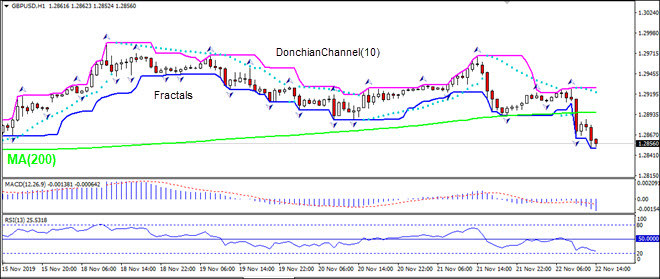
The UK Composite PMI for November remained below 50 for the second month in of the past three months. Will the GBPUSD decline?
The price chart on 1-hour timeframe shows GBPUSD: H1 is trading sideways. The price is falling below the 200-period moving average MA(200) which is level. And the RSI oscillator is below 50 level and has not reached the oversold zone. There is no trend yet formed, traders have to decide when it would be a best time to enter the market.