Kenya cuts rate 50 bps after interest rate cap is scrapped

By CentralBankNews.info
Kenya’s central bank lowered its benchmark interest rate only weeks after a controversial limit on commercial banks’ interest rates was scrapped, saying inflation expectations remain well anchored, the economy is operating below its potential level, and the continuing tightening of fiscal policy has made room for an accommodative monetary policy to support economic activity.
The Central Bank of Kenya (CBK) cut its Central Bank Rate (CBR) by 50 basis points to 8.50 percent and has now cut it by 300 basis points since it embarked on an easing cycle in May 2016.
But since July 2018 the monetary easing has been paused against a backdrop of an impaired transmission of CBK’s monetary policy after the government imposed a cap on commercial banks’ interest rates in September 2016, arguing lenders were not passing on the falling interest rates to borrowers.
But the rate cap, which was opposed by the International Monetary Fund (IMF) and found to have stifled lending growth and reduced the effectiveness of monetary policy, was annulled by the Nairobi High Court in March and scrapped earlier this month after Kenya’s parliament approved President Uhuru Kenyatta’s proposal.
CBK said its monetary policy committee “welcomed” the repeal of the interest rate cap, adding this had led to “a significant rationing of credit, particularly to the most vulnerable,” and removing it should “restore the clarity of monetary policy decisions and strengthen the transmission of monetary policy.”
In September CBK Governor Patrick Njoroge said there was scope to loosen its policy if the government sustains its efforts to reduce the budget deficit and earlier this month he then told Reuters the lifting of the cap on banks’ lending rates had removed one of the concerns the bank had about cutting interest rates.
The finance ministry has targeted a fiscal deficit in the current fiscal year of July 2019 – June 2020 year of 5.9 percent, down from 7.6 percent in 2018/19.
After rising to almost 12 percent in May 2017, Kenya’s inflation rate has decelerated and remains within the central bank’s target range of 5.0 percent, plus/minus 2.50 percentage points.
In October inflation rose to 4.95 percent from 3.83 percent, mainly due to temporary rise in maize grain and sifted flour while non-food inflation remains below 5 percent, “indicative of muted demand pressures and limited spillover effects of the excise tax indexation in July,” CBK said.
It added another adjustment in excise taxes in November are expected to have only a marginal impact on inflation, which is expected to remain within the target range in the near term.
Kenya’s shilling, which has been more stable in recent years after plunging in 2015, fell in the first part of the year but since early October it has bounced back.
Following the rate cut, the shilling dropped 0.45 percent to trade at 102.06 to the U.S. dollar,  up 1.7 percent since October 1 but marginally down since the start of this year.
“The foreign exchange market has remained stable, supported by the narrowing current account deficit and increased portfolio and other investment inflows,” CBK said, adding the current account deficit had narrowed to 4.1 percent of gross domestic product in the 12 months to September from 5.1 percent in September 2018 and is expected to narrow to 4.3 percent of GDP in 2019 from 5.0 percent in 2018.
Despite a hit to agricultural production in the first half of the year from a delayed onset and below average rain fall, CBK said the economy was resilient and GDP grew 5.6 percent in the first half and leading indicators suggest stronger growth in the second half, helped by growth in private sector credit to micro, small and medium-sized enterprises due to the deployment of innovative credit products and the repeal of the interest rate caps.

The Central Bank of Kenya issued the following statement:

The Monetary Policy Committee (MPC) met on November 25, 2019, to review the outcome of its previous policy decisions and recent economic developments. The meeting was held against a backdrop of domestic macroeconomic stability, the recent repeal of interest rate caps, and heightened global uncertainties and volatility in international markets.

  •   Month-on-month overall inflation remained well anchored within the target range in September and October 2019, largely due to relatively stable food prices and lower cost of energy. The inflation rate stood at 4.9 percent in October compared to 3.8 percent in September, mainly reflecting temporary effects of increases in the prices of maize grain and sifted flour. Non-food-non-fuel (NFNF) inflation remained below 5 percent, indicative of muted demand pressures and limited spillover effects of the excise tax indexation in July. Overall inflation is expected to remain within the target range in the near term due to lower food prices following improved weather conditions, and lower electricity prices. The November excise tax adjustments in the Finance Act 2019 are expected to only have a marginal impact on inflation.
  •   The foreign exchange market has remained stable, supported by the narrowing current account deficit and increased portfolio and other investment inflows. The current account deficit narrowed to 4.1 percent of GDP in the 12 months to September 2019 from 5.1 percent in September 2018. This largely reflected strong receipts from transport and tourism services, resilient diaspora remittances and lower imports of food and SGR-related equipment. The current account deficit is expected to narrow to 4.3 percent of GDP in 2019 from 5.0 percent in 2018.
  •   The CBK foreign exchange reserves, which currently stand at USD8,794 million (5.5 months of import cover), continue to provide adequate cover and a buffer against short- term shocks in the foreign exchange market.
  •   Private sector credit grew by 6.6 percent in the 12 months to October, compared to 7.0 percent in September. Strong growth in credit to the private sector was observed in the following sectors: trade (8.5 percent); finance and insurance (15.1 percent); consumer durables (28.6 percent); and private households (6.9 percent). Growth in private sector credit particularly to Micro, Small and Medium-sized Enterprises (MSMEs) is expected to increase due to the deployment of innovative credit products targeting the sector, and the repeal of interest rate caps.
  •   The banking sector remains stable and resilient. Average commercial banks’ liquidity and capital adequacy ratios stood at 51.2 percent and 18.3 percent, respectively, in October. The ratio of gross non-performing loans (NPLs) to gross loans declined marginally to 12.3 percent in October from 12.6 percent in August. In particular, there were decreases in NPLs in the real estate, transport and communication, and building and construction

    sectors reflecting increasing repayments and the enhanced recovery efforts by banks.

    •   The Committee welcomed the repeal of the interest rate caps on commercial bank loans,
      noting that they had led to a significant rationing of credit, particularly to the most vulnerable. It noted that this reform should restore the clarity of monetary policy decisions and strengthen the transmission of monetary policy. Further, banks have adopted the Banking Sector Charter, which defines a commitment to entrench a responsible and disciplined banking sector which is cognizant of, and responsive to, the needs of their customers.
    •   The economy remained resilient in the first half of 2019 despite the slowdown in agricultural production following the delayed onset and below average rainfall. Real GDP grew by 5.6 percent in the first half of 2019 supported by the non-agriculture sector particularly services. Leading indicators of economic activity suggest stronger growth in the second half of 2019, supported by agricultural production, growth of MSMEs, implementation of the Big 4 agenda, foreign direct investment and a stable macroeconomic environment.
    •   The MPC Private Sector Market Perception Survey conducted in November 2019 indicates that inflation expectations remain well anchored, mainly due to lower food prices following improved weather conditions. Respondents remained optimistic on economic prospects due to, among other factors, improved weather conditions, payments of pending bills by the government, growth in tourism, the expected increase in lending to MSMEs following the repeal of interest rate caps, implementation of the Big 4 agenda projects, ongoing public infrastructure investments, and a stable macroeconomic environment. Nevertheless, the optimism is moderated by concerns about the delay in the clearance of pending bills, reduced demand of some products, and the slowdown in global growth.
    •   Global growth has weakened further in 2019, largely due to continued uncertainties with regard to the trade tensions between the U.S. and China, other geopolitical developments and the uncertainties about Brexit. Central banks in major advanced economies have continued to implement more accommodative monetary policy to support growth and financial stability. The risk of increased volatility in the global financial markets remains high.
      The MPC noted that inflation expectations remained well anchored within the target range, and assessed that the economy was operating below its potential level. Furthermore, the Committee noted the ongoing tightening of fiscal policy and concluded there was room for accommodative monetary policy to support economic activity. The MPC therefore decided to lower the Central Bank Rate (CBR) to 8.50 percent from 9.00 percent. The Committee will closely monitor the impact of this change in its policy stance.
      The MPC will continue to closely monitor developments in the global and domestic economy, and stands ready to take additional measures as necessary.”

      www.CentralBankNews.info


Dollar net long bets rose on strong retail report

By IFCMarkets

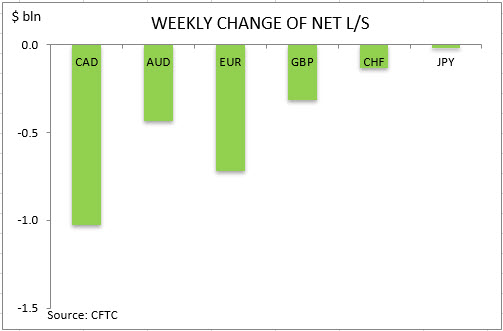
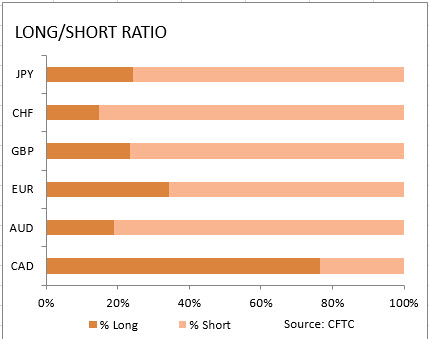
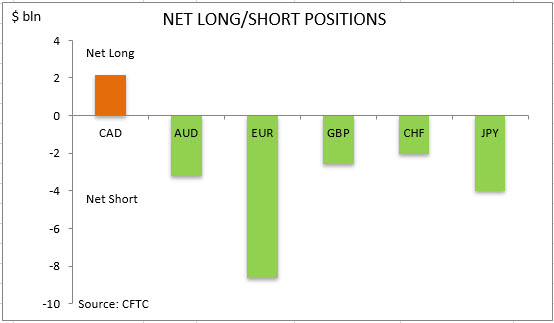
US dollar bullish bets rise continued to $18.36 billion from $16.18 billion against the major currencies during the one week period, according to the report of the Commodity Futures Trading Commission (CFTC) covering data up to November 19 and released on Friday November 22. The increase in bullish dollar bets was intact as retail sales growth rebounded in October to 0.3% after a 0.3% decline in September, despite US federal budget deficit’s 34% rise in October from a year ago, and St Louis Fed president Bullard said the “key risk” facing the US economy is a sharper-than-expected slowdown despite the Fed’s recent interest rate cuts.


CFTC Sentiment vs Exchange Rate

November 19 2019BiasEx RateTrendPosition $ mlnWeekly Change
CADbullishnegative2177-1025
AUDbearishnegative-3224-433
EURbearishnegative-8655-718
GBPbearishnegative-2577-318
CHFbearishnegative-2043-135
JPYbearishnegative-4034-20
Total-18356


commitment of traders net long short
commitment of traders weekly change
market sentiment ratio long short positions

Market Analysis provided by IFCMarkets

Note:
This overview has an informative and tutorial character and is published for free. All the data, included in the overview, are received from public sources, recognized as more or less reliable. Moreover, there is no guarantee that the indicated information is full and precise. Overviews are not updated. The whole information in each overview, including opinion, indicators, charts and anything else, is provided only for familiarization purposes and is not financial advice or а recommendation. The whole text and its any part, as well as the charts cannot be considered as an offer to make a deal with any asset. IFC Markets and its employees under any circumstances are not liable for any action taken by someone else during or after reading the overview.

Canadian Gold Miner Achieves ‘Strong Q3/19 Operationally’

By The Gold Report

Source: Streetwise Reports   11/21/2019

The company’s performance during the quarter is covered in a Haywood report.

In a Nov. 1 research note, Haywood analyst Kerry Smith reported that Equinox Gold Corp. (EQX:TSX.V), in its first quarter of commercial production at the Aurizona mine, “delivered a solid Q3/19, beating expectations, and is already generating free cash flow.”

Smith highlighted that Equinox’s Q3/19 financials beat expectations. Cash flow per share was US$0.33, above Haywood and consensus’ forecast of US$0.28 and US$0.31, respectively. Earnings per share of US$0.07 was slightly below consensus’ forecast of US$0.075.

As for gold production, Equinox yielded 62,656 ounces in Q3/19 from both its Aurizona and Mesquite mines at an average cash cost of US$800 per ounce (US$800/oz) versus Haywood’s projected 65,000 ounces (65 Koz) at an average cash cost of $895/oz.

Another achievement during the quarter, Smith pointed out, was commercial production from Aurizona, which began July 1. Subsequently, Aurizona delivered 29,350 ounces in Q3/19 at an average cash cost of US$781/oz. Production was just below Haywood’s 30 Koz estimate; average cash cost was well below its US$910/oz forecast. “The mine exceeded our expectations,” Smith commented. Accordingly, Haywood boosted its 2019 production projection for Aurizona to 75 Koz from 68 Koz.

As for Mesquite, it continued to do well, noted Smith, “delivering good cash flow with US$11.7 million in Q3/19.” This resulted from 33,306 ounces of production at an average cash cost of US$819/oz. This result compares to Haywood’s 34.9 Koz and US$945/oz cash cost projections. Haywood models 2019 production from Mesquite at 125 Koz.

At the end of Q3/19, Equinox had US$45.5 million in cash, restricted and unrestricted, an increase over that of Q2/19 of US$33 million.

Smith indicated that in other news, Equinox’s board of directors approved phase one construction at the miner’s Castle open-pit leach gold mine and a US$58 million budget for it. The company aims to pour first gold in Q3/20 at Castle for phase one. Phase two would be an expansion.

Along with first gold at Castle, other near-term catalysts are an initial mineral estimate for Tatajuba, expected in Q1/20, and a phase 2 feasibility study for Castle, anticipated in H2/20.

Haywood has a Buy rating and a CA$13.75 per share target price on Equinox. This represents a 61% projected return as the company’s current share price is around CA$7.95.

Sign up for our FREE newsletter at: www.streetwisereports.com/get-news

Disclosure:
1) Doresa Banning compiled this article for Streetwise Reports LLC and provides services to Streetwise Reports as an independent contractor. She or members of her household own securities of the following companies mentioned in the article: None. She or members of her household are paid by the following companies mentioned in this article: None.
2) The following companies mentioned in this article are billboard sponsors of Streetwise Reports: None. Click here for important disclosures about sponsor fees.
3) Comments and opinions expressed are those of the specific experts and not of Streetwise Reports or its officers. The information provided above is for informational purposes only and is not a recommendation to buy or sell any security.
4) The article does not constitute investment advice. Each reader is encouraged to consult with his or her individual financial professional and any action a reader takes as a result of information presented here is his or her own responsibility. By opening this page, each reader accepts and agrees to Streetwise Reports’ terms of use and full legal disclaimer. This article is not a solicitation for investment. Streetwise Reports does not render general or specific investment advice and the information on Streetwise Reports should not be considered a recommendation to buy or sell any security. Streetwise Reports does not endorse or recommend the business, products, services or securities of any company mentioned on Streetwise Reports.
5) From time to time, Streetwise Reports LLC and its directors, officers, employees or members of their families, as well as persons interviewed for articles and interviews on the site, may have a long or short position in securities mentioned. Directors, officers, employees or members of their immediate families are prohibited from making purchases and/or sales of those securities in the open market or otherwise from the time of the interview or the decision to write an article until three business days after the publication of the interview or article. The foregoing prohibition does not apply to articles that in substance only restate previously published company releases.

Disclosures from Haywood Securities, Equinox Gold Corp., November 1, 2019

Analyst Certification: I, Kerry Smith, hereby certify that the views expressed in this report (which includes the rating assigned to the issuer’s shares as well as the analytical substance and tone of the report) accurately reflect my/our personal views about the subject securities and the issuer. No part of my/our compensation was, is, or will be directly or indirectly related to the specific recommendations.

Important Disclosures

Important Disclosures:

▪The Analyst(s) preparing this report (or a member of the Analysts’ households) have a financial interest in Equinox Gold Corp. (EQX-V).

▪ As of the end of the month immediately preceding this publication either Haywood Securities, Inc., one of its subsidiaries, its officers or directors beneficially owned 1% or more of Equinox Gold Corp. (EQX-V).

▪ Haywood Securities, Inc. has reviewed lead projects of Equinox Gold Corp. (EQX-V), Harte Gold Corp. (HRT-V) and a portion of the expenses for this travel have been reimbursed by the issuer.

▪ Haywood Securities, Inc. or one of its subsidiaries has managed or co-managed or participated as selling group in a public offering of securities for Equinox Gold Corp. (EQX-V) in the last 12 months.

▪ Haywood Securities Inc. or an Affiliate has received compensation for investment banking services from Equinox Gold Corp. (EQX-V) in the past 12 months.

Other material conflict of interest of the research analyst of which the research analyst or Haywood Securities Inc. knows or has reason to know at the time of publication or at the time of public appearance: n/a.

Research policy is available here.

( Companies Mentioned: EQX:TSX.V,
)

Oil & Gas Royalty MLP Benefits from ‘Record Production in Q3/19’

The Energy Report

Source: Streetwise Reports   11/23/2019

The quarterly highlights are provided in a Raymond James report.

In a Nov. 7 research note, Raymond James analyst John Freeman wrote that Kimbell Royalty Partners, LP (KRP:NYSE) “reported record production in Q3/19, making way for about an 8% sequential distribution growth.”

This quarterly result exceeded consensus’ estimate by about 11% and Raymond James’ forecast by about 2%. Freeman highlighted that Kimbell achieved this despite the number of rigs on its acreage dropping in Q3/19 by 8%, driven by an industry slowdown. “We believe [this] is a testament to the low Proven Developed Producing (PDP) decline strategy that Kimbell employs,” he added.

Consequently, the master limited partnership (MLP) increased its Q4/19 guidance at the midpoint by about 5% to 11,600,000–12,800,000 barrels of oil equivalent per day, in line with the Street’s guidance.

One of the highlights in Q3/19 was the quick result from Kimbell adding a team member to “proactively search for and recover production in suspense across its asset base,” noted Freeman. Within only two months, the move benefitted the MLP to the tune of about $600,000 in cash flow that otherwise would have been delayed indefinitely. “This should be an incremental benefit as Kimbell continues to improve this process going forward, so we could see more positive surprises in future quarters on this front,” the analyst added.

Also in Q3/19, Kimbell’s microstrategy joint venture closed on $3 million worth of microscale deals. Since Q3/19 ended, the MLP closed another acquisition, $10 million for 186 net royal acres and 202 barrels of oil equivalent per day of current production from the STACK play, which will be accretive to discounted cash flow per unit in Q4/19. Additionally, management mentioned another significant potential purchase, in the Eagle Ford and late in the negotiations stage.

Freeman concluded, “We continue to favor Kimbell’s: 1) mineral interest business model (an asymmetric risk-reward play on development activity), 2) low PDP base decline rates (about 12%) and 3) aptitude for acquiring assets that are accretive to discounted cash flow per unit.”

Accordingly, Raymond James has a Strong Buy rating and a $19 per share target price on Kimbell Royalty.

The MLP’s stock was trading at the time of the report’s publication at around $14.28 per share, or a roughly 12% annualized yield, which Freeman described as surprising and significantly below where it should be, given Kimbell’s “steady, resilient production, distribution growth profile and favorable tax treatment through 2025.” The current stock price is $13.89.

Sign up for our FREE newsletter at: www.streetwisereports.com/get-news

Disclosure:
1) Doresa Banning compiled this article for Streetwise Reports LLC and provides services to Streetwise Reports as an independent contractor. She or members of her household own securities of the following companies mentioned in the article: None. She or members of her household are paid by the following companies mentioned in this article: None.
2) The following companies mentioned in this article are billboard sponsors of Streetwise Reports: None. Click here for important disclosures about sponsor fees.
3) Comments and opinions expressed are those of the specific experts and not of Streetwise Reports or its officers. The information provided above is for informational purposes only and is not a recommendation to buy or sell any security.
4) The article does not constitute investment advice. Each reader is encouraged to consult with his or her individual financial professional and any action a reader takes as a result of information presented here is his or her own responsibility. By opening this page, each reader accepts and agrees to Streetwise Reports’ terms of use and full legal disclaimer. This article is not a solicitation for investment. Streetwise Reports does not render general or specific investment advice and the information on Streetwise Reports should not be considered a recommendation to buy or sell any security. Streetwise Reports does not endorse or recommend the business, products, services or securities of any company mentioned on Streetwise Reports.
5) From time to time, Streetwise Reports LLC and its directors, officers, employees or members of their families, as well as persons interviewed for articles and interviews on the site, may have a long or short position in securities mentioned. Directors, officers, employees or members of their immediate families are prohibited from making purchases and/or sales of those securities in the open market or otherwise from the time of the interview or the decision to write an article until three business days after the publication of the interview or article. The foregoing prohibition does not apply to articles that in substance only restate previously published company releases.

Disclosures from Raymond James, Kimbell Royalty Partners LP, November 7, 2019

ANALYST INFORMATION

Analysts Holdings and Compensation: Equity analysts and their staffs at Raymond James are compensated based on a salary and bonus system. Several factors enter into the bonus determination, including quality and performance of research product, the analyst’s success in rating stocks versus an industry index, and support effectiveness to trading and the retail and institutional sales forces. Other factors may include but are not limited to: overall ratings from internal (other than investment banking) or external parties and the general productivity and revenue generated in covered stocks.

The analyst John Freeman, primarily responsible for the preparation of this research report, attests to the following: (1) that the views and opinions rendered in this research report reflect his or her personal views about the subject companies or issuers and (2) that no part of the research analyst’s compensation was, is, or will be directly or indirectly related to the specific recommendations or views in this research report. In addition, said analyst(s) has not received compensation from any subject company in the last 12 months.

RAYMOND JAMES RELATIONSHIP DISCLOSURES
Certain affiliates of the RJ Group expect to receive or intend to seek compensation for investment banking services from all companies under research coverage within the next three months.

Limited Partnerships may generate unrelated business taxable income (UBTI), which can create a tax liability that must be paid from a retirement account. To the extent that Raymond James is your IRA custodian, and there is potential tax liability for UBTI generated by the fund, Raymond James will take the necessary steps to pay the tax from the retirement account by working with a third party to compute the tax liability and prepare the IRS form 990-T for submission to the IRS.

Raymond James & Associates, Inc. makes a market in the shares of Kimbell Royalty Partners L.P.

Raymond James & Associates has managed or co-managed an offering of securities for Kimbell Royalty Partners L.P. within the past 12 months.

Additional Risk and Disclosure information, as well as more information on the Raymond James rating system and suitability categories, is available here.

( Companies Mentioned: KRP:NYSE,
)

Are Forex Robots Legal?

By Orbex

Foreign Exchange, as the name suggests, involves trading assets of different countries. The legal system of one country is complicated enough, but when you are dealing with several legal systems at once, nothing is as straightforward as it should be.

Some things that are normal and perfectly legal in Europe, such as offering to trade CFDs, can be quite illegal in the US.

Different regulatory systems are more or less permissive in what they allow traders to do. So, when it comes to robot trading in forex, the simple answer is:

Yes, it’s perfectly legal to trade with forex robots.

But, there are some caveats.

Just because it’s legal to trade with robots, it doesn’t mean that anything involving robot trading is OK.

It’s perfectly legal to drive a car, but there are lots of things that you can’t do with your car. Some brokers don’t allow traders to use robots for different practical and regulatory reasons. Generally, however, most established, reputable brokers will allow traders to use robots or EAs responsibly.

There is more to automated trading than just your trading. There is also the factor of supplying robots.

Some things are legal to use, but not legal to buy or sell. It matters whether you are using a robot you’ve created, whether the robot is being offered for download for free, or whether someone is profiting off of a robot with certain advertised characteristics.

Robots Are Not the Same as Regular Trading

As we’ve mentioned previously, there are several kinds of trading robots. The differences between the kinds of robots have a practical effect on how you interact with the market. In turn, that changes how regulators see what you are doing, and whether they are going to allow it.

In the context of regulation, we can discount semi-automatic robots. These are programs that track the market and do more sophisticated calculations for you in order to recommend a trade. But, in the end, you decide whether to enter the trade yourself or not. For practical effects, this is manual trading, though assisted by a program/robot.

The big issue comes in for fully automated trading robots that have access to your account, and trade the market without your direct input. That’s where most of the caveats come in.

In part, this is because they are a lot riskier (their selling point is that you don’t control what they are doing with your money), and they are often offered by businesses seeking to profit from selling robots instead of generating profits in the market.

Being Cautious Doesn’t Need to be Mandated by Law

Robots far from guarantee profits. Even the best ones simply follow a set of predetermined rules, and can’t respond to changes in the market situation.

But, people selling robots generally want to convince potential customers that their robot is better and worth buying. So even the honest sellers can exaggerate the benefits of their robot to unrealistic levels. That would be illegal.

But there are a wealth of people simply scamming by offering robots for sale that don’t perform at all as advertised. That is even more illegal!

Many brokers don’t allow robots, not because they have a problem with robots per sé, but they are worried that the trader has bought a robot that will end up ruining their account. This is why if you talk to most experienced traders, they will not recommend using robots until you’ve mastered manual trading yourself. That will help you identify the scams.

The legal problem that arises from using what’s often called a “scambot” is that it’s legal for you to use it and lose money. But the person selling it is another jurisdiction, so they can’t be held legally responsible for false advertising and losing your money.

You have to be very careful about promises of easy money. And just because something is legal, it doesn’t mean it’s safe, useful or even good!

Robots Are Tools, Not Miracles

It is true that algorithms are increasingly used in forex. And, automated trading can be helpful to improve your profits. But, they are tools to assist you in your trading. They shouldn’t be seen as a replacement for your decision making. And certainly not as a substitute for gaining experience and learning about the markets!

Reliable brokers will go out of their way to help educate their clients on how to trade, so do check out what your broker has to say about robots before you use them.

By Orbex


USD Rising Amidst Trade-Deal Jitters

By Orbex

USD Driving Higher

USD has been firmer this morning so far with the USD index trading up to 98.20 last. The FOMC meeting minutes last week revealed the Fed is still highly concerned over the risks to the US economy, noting a willingness to ease further should conditions require it. However, policymakers said they are comfortable keeping rates on hold for now.

EUR Under Pressure

EURUSD has been lower again today, extending last week’s losses. A quiet data schedule this week should leave EUR trading off USD flows, trade-talk headlines as well as Brexit developments. In terms of key domestic data focus, the CPI flash estimate on Friday is the key reading to watch. Last week, the ECB’s Lagarde said that risks to the eurozone economy remain persistent and called on greater fiscal support from EU leaders. EURUSD trades 1.1014 last.

All Eyes on The Elections

GBPUSD remains stagnant for now. With no tier-one domestic data due this week, focus will remain on the fluctuating UK elections landscape. For now, polls still show the Conservative party as the favorite to win. However, we still do not expect an outright majority, so focus remains on a potential coalition government. GBPUSD trades 1.2879 last, still holding within the recent consolidation for now.

Risk Markets Muted On Monday

Risk assets have had a muted start to the week. Uncertainty remains over the health of US-China trade talks. Last week Trump said that a deal was “potentially very close” to being signed. However, issues remain around China’s handling of the Hong Kong protests as well as its insistence that the US remove existing trade tariffs. SPX500 trades 3119.73 last, continuing to hold near the higher traded at the open last night.

Safe Havens Mixed

Safe havens have had a mixed start to the day given the lack of clarity over US-China trade talks. The uncertainty is leading JPY higher against USD and gold lower. USDJPY trades 10884 last. XAUUSD trades 1458.80 last. While safe-haven flows are being seen in JPY, the stronger USD is keeping gold weighed to the downside.

Crude Slides on China Fears

Oil prices have been a little lower so far on Monday, reflecting the slight loss of confidence in the ongoing US-China trade talks. Last week, the EIA reported a further build in US crude stores, keeping the pressure on the demand outlook for oil. Crude trades 57.75 last.

Crude Slide Weighing on CAD

USDCAD has been higher today as the strength in USD, along with weakness in oil prices, is weighing on CAD. Canadian GDP on Friday will be the key domestic data focus. BOC Governor Poloz noted at the bank’s last meeting that a further rate cut will likely be necessary for the future. As such, any weakness in GDP will likely weigh heavily on CAD. USDCAD is once again challenging the 1.33 level which price fell back below last week.

RBA’s Lowe Up Next

AUDUSD RBA Governor Lowe speaks tomorrow morning and his comments could give some insight as to whether any further RBA easing is coming this year. The RBA kept rates on hold recently, though noted its concern or the health of the global and domestic economy. Uncertainty around US-China trade talks is also keeping pressure on AUD here with AUDUSD trading .6788 last, just above last week’s lows for now.

By Orbex


Questions Surface Over Trade Talk Progress

By Orbex

Trump Comments Raise Questions

Hopes for a US-China trade deal were up in the air once again on Friday.

President Trump insisted that a trade deal was “potentially very close”. Speaking with reporters from Fox, Trump argued that “the bottom line is, we have a very good chance to make a deal”. However, the President explained that he is “not anxious” to make a deal as the US benefits from the current trade restrictions on China.

These comments sound a little less optimistic than the comments made earlier in the month when Trump said that the US and China had agreed on a “very substantial phase one deal”.

At the time, Trump also said that a deal could come “sooner than expected”. However, with the APEC meeting in Chile canceled and the deal not signed, the market is yet to receive a new date for signing.

Talks Losing Momentum

The sudden loss of momentum in trade talks feels eerily similar to what we saw earlier in the year. Talks collapsed in May despite supportive public comments from both sides.

Then, Trump claimed that China was stalling and backpedaling on terms ahead of signing. The collapse in talks led to a fresh wave of bi-lateral trade tariffs which weighed heavily on global growth.

China Positive on Deal Progress

Last week, the Chinese Ministry of Commerce said that China wanted to agree on a deal “on the basis of mutual respect and equality”. However, while speaking with Fox, Trump was keen to stress that he “didn’t like the word ‘equality’” adding:

“This can’t be like an even deal.”

Risks Around Hong Kong Situation

Both sides are keen to note that talks are still progressing. However, doubts are certainly present among market players.

The ongoing situation in Hong Kong presents a great risk to the health of negotiations with China. The Asian giant has staunchly warned the US not to interfere in domestic matters.

During his interview on Friday, Trump commented that “thousands of people would have been killed in Hong Kong” if not for China seeking to avoid damaging the ongoing trade talks.

For now, however, Trump is continuing to walk a fine line between satisfying the pressure from the international community and maintaining relations with China. He stated:

“We have to stand with Hong Kong, but I’m also standing with President Xi”.

China Still Faces Further Tariffs Risk

A further potential obstacle to the current deal is China’s insistence that the US remove current trade tariffs. So far, the terms of the agreement appear to include only the postponing of future tariffs. However, as yet, nothing has been said about the removal of current tariffs.

In November, the US Trade Secretary warned China that if there is no deal by December 15th, the US will activate the next planned phase of trade tariffs on nearly $160 billion of Chinese goods.

Rumours Of China Delay

This warning is particularly important. Especially given that rumors have been circulating recently that China is considering holding off on a trade deal until next year.

With Trump facing impeachment inquiries in the US, China is reportedly waiting to see how the situation develops thinking that the President might take a softer approach as a result of these proceedings.

However, the Chinese Commerce Ministry recently commented that these reports were not true and that a deal is still in the works.

Technical Perspective

The SPX500 is sitting just off the 3132.56 all-time highs for now. Despite the pull-back last week, dip buyers came in early and price is still holding firmly above the 3028.67 level (prior highs). While above this level, focus is on a further push higher with price remaining in the upper portion of the Bollinger Bands for now. With quite a bit of distance noted now, any retest of that level is likely only to come on negative trade-talk headlines of strong upside beats in US data.

By Orbex


Weekly Market Outlook: Eurozone Inflation & US GDP

By Orbex

The week ahead is quiet and short for the US markets. Thanksgiving on November 28th will see a slowdown in trading volumes as traders head into a long weekend.

Among other high ticket items this week, Canada will be releasing its monthly GDP figures on Friday. Monthly GDP is forecast to rise by 0.2% for September.

Germany’s IFO business climate data and expectations are starting the week off, which could see a market reaction.

Here’s a brief look at the key economic events coming up for the week ahead.

Fed Speech & Revised GDP Figures

The slow patch of economic data continues this week with a mix of high and low impact news releases for the United States. Among the line-up of events includes Fed Chair Powell’s speech and the revised GDP numbers.

US Q3 GDP to Hold Steady

The third and final estimates on the GDP number for the three months ending September 2019 are due this week on Wednesday.

The US economy is forecast to rise at 1.9%, marking an unchanged print from the previous estimates. This will confirm a below 2% growth rate in the US economy.

Besides the GDP data, other revisions include the quarter PCE report. The core personal consumption expenditure is set to rise higher from 1.5% to 2.3%, according to economists. Meanwhile, the GDP price index is also set to rise to 2.4% from 1.6% previously.

Durable goods orders are also due on the same day. US durable goods are set to fall for another month. Estimates show a 0.8% decline following a 1.2% decline earlier in September.

Powell Speech Unlikely to do Much for the Markets

Fed Chairman Jerome Powell will be speaking this week. The speech entitled Building on the gains from the long expansion will see some references to the economy.

So far, Fed officials are mum on US monetary policy after confirming that rates will be cut further. Investors remain tuned into Fed speeches for further direction on monetary policy.

Eurozone Inflation & French Data

A quiet week from the eurozone will focus on the preliminary inflation data from both the eurozone and France. Estimates show a modest increase in consumer prices. However, inflation is still far off from the ECB’s target rate.

Producer price index data alongside consumer sentiment reports for the eurozone will give us insights into the price pressures and sentiment in the region.

Eurozone Inflation to Slightly Rise in November

The preliminary inflation report for November will be coming out this Friday.

According to median estimates, consumer prices will rise slightly to 1.2% on the year in November. This marks a slight increase from the 1.1% increase registered in October.

But, investor focus will be on core inflation. Core inflation, which excludes volatile food and energy prices, fell to 0.7% on the year in October. For November, estimates point to a slight increase to 0.9% on the year.

Although the core inflation rate remains below 1%, forecasts point to a modest increase from the year before.

French GDP to Remain Steady at 0.3%

For the remainder of the week, data will also cover the regional reports. It’s a somewhat busy week for France as inflation and GDP reports are due.

The final GDP revision for France is likely to show that GDP is steady at 0.3%. This will mark an unchanged print from the previous estimates.

With the German economy slowing, focus has shifted to the French economy which is doing the heavy lifting in the eurozone. Besides the GDP numbers, the preliminary inflation data for France is also due.

Economists forecast that headline inflation in France will rise 1.1% on the year, following a 0.9% increase previously.

By Orbex


USD Rebounds, Closing With 4-Day Winning Streak

By Orbex

The USD rebounded strongly on Friday marking strong gains and a four-day winning streak. The gains come on the back of strong patch of economic reports from the US.

Elsewhere, reports from other regions were somewhat weaker in comparison. Late Friday, Trump, once again tweeted that a deal with China was close. This also gave the risk-on rally a modest push.

Euro Slips as Flash PMIs Stay Subdued

The euro was down over 0.41% on the day on Friday. Economic data saw the release of the flash manufacturing and services PMI numbers.

Data showed that manufacturing activity for the eurozone rose to 46.6 in November. This was slightly up from October’s 45.9. Services activity fell to 51.1 from 52.2 in October. IHS Markit data continues to show weak economic growth in the region.

EURUSD Extends Declines, but Support Could Hold

The common currency fell sharply on Friday. Price action is now closer to the support level of the 1.1000 region. This level could hold the declines in the near term and offer a short term respite. But, in the event that the EURUSD breaks down below this level, we can anticipate a retest of the previous lows at 1.0889.

UK Services PMI Contracts in November

The flash services and manufacturing PMI from the United Kingdom saw further deterioration in the economy. The services activity contracted, falling to 48.6 in November. This comes after services activity was at 50.0 in October. UK manufacturing activity was also weak, falling to 48.3, which is down from 49.6 in October.

GBPUSD Breaks Down Below Support

Following the weak reports, GBPUSD fell below the support level at 1.2865. The declines below this level comes after the cable was confined to the range. If the bearish momentum picks up, then GBPUSD could be looking to post further losses. The next lower support is at 1.2768.

Gold Dips on Upbeat US Data

The precious metal was weaker on Friday after a string of economic reports from the United States came out better than expected. The University of Michigan’s consumer sentiment index rose to 96.8. This was higher than the forecasts of 95.8. Meanwhile, flash manufacturing and services PMI numbers from IHS Markit also turned higher.

XAUUSD Back at 1462 Support

Attempts to rally off the support level near 1462 fail as XAUUSD closed back at support on Friday. There is a possibility for a rebound, especially with the Stochastics oscillator currently in the oversold level.

However, if gold falls below the 1462 level, we expect to see the declines pushing the price down to the 1440 handle next.

By Orbex


Uranium Major ‘Heading Into a Bigger Q4’

The Energy Report

Source: Streetwise Reports   11/23/2019

The Q3/19 results and the Q4/19 outlook are outlined in a BMO Capital Markets report.

In a Nov. 5 research note, BMO Capital Markets analyst Alexander Pearce wrote that following the reporting of Q3/19, the outlook for Cameco Corp. (CCO:TSX; CCJ:NYSE) “remains robust, with a strong balance sheet and upside potential if uranium prices recover quicker than expected.”

Q4/19 is expected to be more active than Q3/19, as is typical for the uranium company, Pearce noted. For one, BMO expects Cameco to make record purchases in Q4/19 of greater than 7,000,000 pounds (7 Mlb) of uranium, including 1.2 Mlb from Inkai, to meet the midpoint of guidance. Further, BMO expects Cameco to sell 13.5 Mlb of uranium in Q4/19, which would constitute a quarterly record and which should drive CA$157 million of free cash flow.

An improved uranium price would boost Cameco’s multiples, and BMO also expects the price to increase in the near term. This would result from a continued supply deficit and increased competitive tension in the spot market from Cameco’s purchases.

As for Q3/19, Pearce reported that Cameco experienced an estimated loss of CA$0.13 per share versus BMO’s forecast loss of CA$0.01. The loss was mostly due to the company selling less uranium than expected, a total 6.1 Mlb versus 7.2 Mlb. Regardless, Cameco subsequently maintained guidance for sales and purchases.

BMO lowered its EBITDA estimates, by 1% for 2019 to CA$408 million and by 2% for 2020 to CA$382 million.

Cameco ended Q3/19 with CA$132 million of net debt and expects to turn net cash in 2020, indicating the company is in a “robust position,” Pearce noted.

BMO has an Outperform rating and a CA$16 per share price target on Cameco, whose stock is currently trading at around CA$12.59 per share.

Sign up for our FREE newsletter at: www.streetwisereports.com/get-news

Disclosure:
1) Doresa Banning compiled this article for Streetwise Reports LLC and provides services to Streetwise Reports as an independent contractor. She or members of her household own securities of the following companies mentioned in the article: None. She or members of her household are paid by the following companies mentioned in this article: None.
2) The following companies mentioned in this article are billboard sponsors of Streetwise Reports: None. Click here for important disclosures about sponsor fees.
3) Comments and opinions expressed are those of the specific experts and not of Streetwise Reports or its officers. The information provided above is for informational purposes only and is not a recommendation to buy or sell any security.
4) The article does not constitute investment advice. Each reader is encouraged to consult with his or her individual financial professional and any action a reader takes as a result of information presented here is his or her own responsibility. By opening this page, each reader accepts and agrees to Streetwise Reports’ terms of use and full legal disclaimer. This article is not a solicitation for investment. Streetwise Reports does not render general or specific investment advice and the information on Streetwise Reports should not be considered a recommendation to buy or sell any security. Streetwise Reports does not endorse or recommend the business, products, services or securities of any company mentioned on Streetwise Reports.
5) From time to time, Streetwise Reports LLC and its directors, officers, employees or members of their families, as well as persons interviewed for articles and interviews on the site, may have a long or short position in securities mentioned. Directors, officers, employees or members of their immediate families are prohibited from making purchases and/or sales of those securities in the open market or otherwise from the time of the interview or the decision to write an article until three business days after the publication of the interview or article. The foregoing prohibition does not apply to articles that in substance only restate previously published company releases. As of the date of this article, officers and/or employees of Streetwise Reports LLC (including members of their household) own securities of Cameco, a company mentioned in this article.

Disclosures from BMO Capital Markets, Cameco, November 5, 2019


IMPORTANT DISCLOSURES

Analyst’s Certification
I, Alexander Pearce, hereby certify that the views expressed in this report accurately reflect my personal views about the subject securities or issuers. I also certify that no part of my compensation was, is, or will be, directly or indirectly, related to the specific recommendations or views expressed in this report.

Analysts who prepared this report are compensated based upon (among other factors) the overall profitability of BMO Capital Markets and their affiliates, which includes the overall profitability of investment banking services. Compensation for research is based on effectiveness in generating new ideas and in communication of ideas to clients, performance of recommendations, accuracy of earnings estimates, and service to clients.

Company Specific Disclosures
Disclosure 5: BMO Capital Markets or an affiliate received compensation for products or services other than investment banking services within the past 12 months from Cameco.
Disclosure 6C: Cameco is a client (or was a client) of BMO Nesbitt Burns Inc., BMO Capital Markets Corp., BMO Capital Markets Limited or an affiliate within the past 12 months: C) Non-Securities Related Services.
Disclosure 8A: BMO Capital Markets or an affiliate has a financial interest in 1% or more of any class of the equity securities of Cameco.
Disclosure 8C: BMO Capital Markets or an affiliate has a financial interest in 0.5% or more in the issued share capital of Cameco.
Disclosure 8D: BMO Capital Markets or an affiliate has a short financial interest in 0.5% or more in the issued share capital of Cameco.
Disclosure 9B: BMO Capital Markets makes a market in Cameco in United States.


For Important Disclosures on the stocks discussed in this report, please click here.

( Companies Mentioned: CCO:TSX; CCJ:NYSE,
)