Riverside Resources Takes on New Project in Ontario

By The Gold Report

Source: Maurice Jackson for Streetwise Reports   12/02/2019

Freeman Smith, VP of exploration at Riverside Resources, speaks to Maurice Jackson of Proven and Probable about his company’s exploration plans for its newest project in Ontario.

Maurice Jackson: Joining us for a conversation is Freeman Smith, the vice president of exploration for Riverside Resources Inc. (RRI:TSX.V; RVSDF:OTCQB).

Glad to have you on the program to discuss the latest developments coming from Riverside Resources Where Knowledge Is Golden. Mr. Smith, you have some exciting developments to share with readers regarding Riverside Resources’ footprint expansion in Ontario. Freeman, take us to Ontario and provide us with some historical mining context on the province.

Freeman Smith: I think we know that Ontario is one of the larger mining districts in the world, particularly the Greenstone Belt, one of the most famous being Timmins, which has produced several hundred million ounces over its lifetime, and it has a lot more share with us. A lesser known but not lesser significant is the Geraldton Greenstone Belt, which is just to the west of the Timmins Greenstone Belt and it hosts a number of deposits. The one that it’s quite interesting and got us into the area is the Hardrock gold deposit, which is currently at about 8.5 Moz. in reserves and resources.

Maurice Jackson: Speaking of the Geraldton Belt, Mr. Smith, please provide us some context for today’s discussion by introducing the Beardmore Geraldton Gold Belt.
Riverside Pichette map

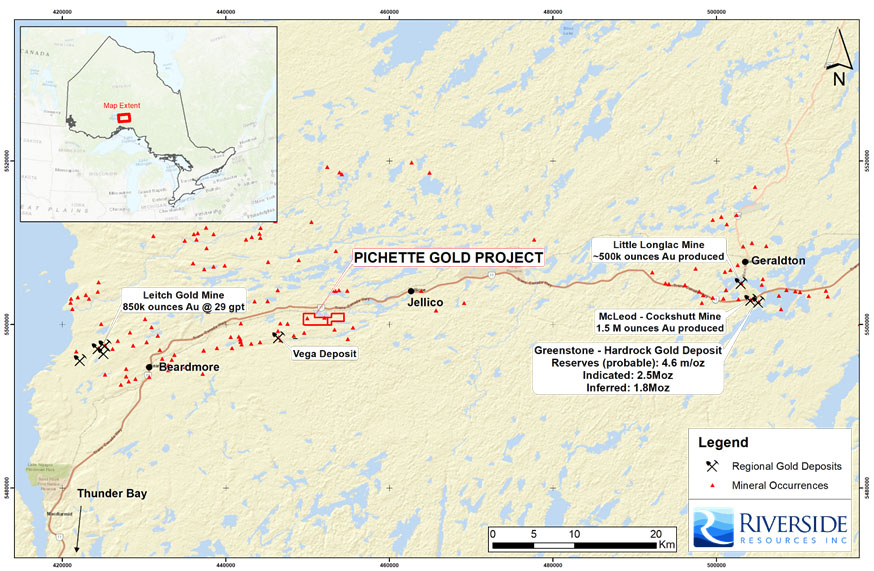
Freeman Smith: Well, Beardmore Geraldton, as the name implies, extends from a little town called Beardmore, east to another town called Geraldton, which is a larger mining district with quite a history. The nearest city would be Thunder Bay to the south and Timmins to the east. It’s probably in the order of 250 kilometers long and about 40 kilometers wide, and it hosts a number of deposits both past and present. One of the reasons we’re there is because of Greenstone’s activity in the area.

Maurice Jackson: Germane to the Beardmore Geraldton Gold Belt, Riverside has made a strategic acquisition there. Please introduce us to the newest project in the property bank.

Freeman Smith: The newest project is called the Pichette. It’s named after the original prospector that prospected in the area and found the Pichette Showing, which is near our project boundary. It’s high-grade gold in shear zones, very similar to other deposits and mines in the area. Looking at the Geraldton Greenstone Belt, this is a generalization of the whole area. The trend seems to be with mines tending along the road. The big elephant in the room, the reason we’re there, the one that attracted us to the area is called the Hardrock deposit. It’s been known about for a while and it was developed by Premier Mining. Eventually it brought in the partner Centerra Gold and they’ve been talking about production and going into production in the near future. That deposit itself with reserves and resources is over 8 million ounces, so by world standards it’s of high quality and it’s an elephant by any means.

Our project, the Pichette, in particular has a very similar geology in that it has steeply dipping metavolcanic units that are plunging gently to the west. This is what they’ve found at the bulk of their mineralization at Geraldton. That and the general jurisdiction being high in quality. You can see all the little red dots on the map. Those are prospects where people have sampled gold and have done small amounts of work, whether it be prospecting or drilling, one may not be able to tell from the map, but you can see that the area is pretty prolific for its gold.

Maurice Jackson: Freeman, why is this the right project for Riverside Resources and why now?

Freeman Smith: Well, as you know, we’re expanding into Canada, out of Mexico. Something we’ve been doing all summer. We like this part of Canada because of the past mining production successes and particularly high-grade gold. The Leitch Mine, very close to one of our projects and close to the Pichette is in the order of an ounce per ton, which is high-grade by any standard anywhere in the world.

But also, if you notice looking at the diagram, there’s a highway going right through it. That’s one of the major corridors and arteries for Ontario. It has access and situated right along it is a major power line and a natural gas pipeline, the Canadian national pipeline actually. So access to those, power, water, road, mining expertise, particularly in Geraldton and Thunder Bay, it’s all wrapped up in one little package for this area. International Airport at Thunder Bay is maybe two hours to the south, so that’s a good place to be working.

Maurice Jackson: Which, Freeman, if I may interject here, that’s very intriguing for a joint venture, or perspective joint venture partner there. It looks like you’ve reduced a lot of the capital expenditures by strategically having this location here in the Pichette Gold Project.

Freeman Smith: Absolutely, I think that’s one of the biggest attractions to the area. I like the idea of being able to drive my car up to the drill pad, one of the attractions for this area for sure. And as you may probably already know that permitting in Canada in general and in Ontario is excellent. Typically you apply for a permit and you have your answer within 50 days. So right now we have permits for most of our projects. Not on the Pichette yet because it’s just a new discovery, we’ve only been looking at it for a month, but we anticipate permits in place before Christmas or shortly after.

Permitting in Ontario is pretty straightforward. It’s a matter of filling out the right forms, connecting and contacting with First Nations and telling them what you’re going to do. And after that there’s a pretty simple procedure that you go through to get to the point of being able to drill.

Maurice Jackson: Now Freeman one more thing that’s important here is what is the relationship with the First Nations there?

Freeman Smith: The First Nation is Ontario. They’re pretty progressive as far as mining and mineral exploration goes. They understand the industry, so that always makes things easier in that they know what you’re doing and they’re not suspicious of maybe something they don’t want to see happen in their territories as happening. But these particular First Nations people in this area, we’ve already discussed with them and met with them and talked to them about our projects and details. They’re generally encouraging. They like to see the idea of jobs coming into the area. They like to see what they think of as their lands being developed for their future generations as well. Their big concerns are always environmental, which is something that we of course would be looking at in very close attention to anyways.

Maurice Jackson: Now what type of work has Riverside conducted in the field and what has your attention there the most?

Freeman Smith: We spent the good part of the month of November and the colder weather looking at what had been done in the past. There have been two drilling campaigns on the property. Some of this core is on site and some of it is being stored in Thunder Bay at the ministry’s warehouse, core warehouse. We looked at that first before we went in the field to get an idea for what we might expect to see on the surface, and we spent several days to a week driving the new roads. That area’s been recently logged, so it’s opened up the area and of course logging has roads, which are what essentially are known as trenches to geologists, they provide excellent exposure. So we drove these roads, we did some mapping, sampling, prospecting and carried out looking at the old trenches and the old drilling areas to see what we could learn there, and then we got chased out by the snow. So that was it for this season.

Maurice Jackson: Has Riverside identified prospective drill targets yet?
Pichette targets

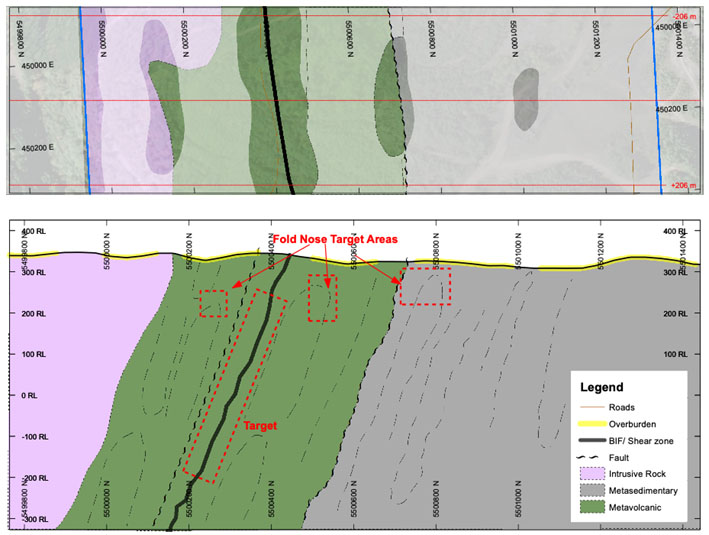
Freeman Smith: Yes. We’ve identified a number of targets related to contact zones and faults, which is fairly typical for orogenic deposits in Ontario. This sketch here is a generalized map, but what it does show is a large contact between the metaseds and the metavolcanics, and along this fault bounded contact you do find mineralization. You will find mineralization here, but also in the larger faults within the metavolcanics.

This one in particular in this banded iron formation. Banded iron information is sometimes responsible for hosting mineralization. Sometimes it’s in close proximity and in the Geraldton Greenstone Belt it seems that you always find this character playing a part of the role, whether he’s directly hosting the mineralization or whether he’s part of the package, it seems that the banded affirmations are always nearby.

And much like Geraldton you see these other boxes here that are described as nose folds, and in Geraldton and elsewhere you see deposition along the nose of the folds and even see this in Campbell and Campbell Lake and other areas where people are going back to old mineralized areas and looking at the structural geology and mapping out where this mineralization may be trending, and that’s common. What happens is we tend to set up our drills and we drill on centers and continue drilling until the program’s finished, not getting a chance to actually look at the structural geology, which is often one of the more important components of the deposition and hosting of the mineralization.

So in summary, I guess we have two types of potential hosts here. One would be sheer hosted and the other would be structurally hosted within the nose of folds.

Maurice Jackson: Now Freeman, can you please walk us through the cross section?

Freeman Smith: This one’s a fairly simplified and basic cross section, but for the most part we’re in what is known as the southern volcanic panel, or belt, of the Beardmore Geraldton Greenstone Belt and most of these panels, they dip steeply to the south, which it doesn’t show here exactly, but those are dipping to the south. And then you have to the south an intrusive body here, which is usually a good thing to see. There’s your heat source and maybe your engine for moving mineralized fluids around, concentrating them. And then to the north, which is gray, you have the metasedimentary rocks and these rocks in themselves can be fairly good hosts, but they’re also letting you know that you’re close to an important train boundary, which is mapped by the fault there, the squiggly black lines, and this is also an area where you may find mineralization as well.

Maurice Jackson: Before we close, what is the next unanswered question at the Pichette? When can we expect an answer and what determines success?

Freeman Smith: I think that the immediate next step would be getting permits. Now that we’ve completed our conversations and consultation with First Nations, I think we should be receiving those before Christmas. That will allow us to either go back out ourselves or go back out with a partner. What will determine success in that respect will be access and we have excellent access. So getting out to do what we want to do should be fairly simple at this point, in this stage, once we get permits.

Maurice Jackson: And let me ask you this, Mr. Smith, how about geophysics?

Freeman Smith: Geophysics is something that we consider like the next step. We’ve defined targets, but I think geophysics is the way to confirm and further support your theories for targeting and drilling, and that would be something we look at doing early in the new year if possible, possibly extending maybe into the spring.

Maurice Jackson: Mr. Smith, for someone listening that wants to get more information on Riverside Resources, please share the contact details.

Freeman Smith: rivres.com.

Maurice Jackson: As a reminder, Riverside Resources trades on the (TSX.V: RRI | OTCQB: RVSDF).

Before you make your next bullion purchase, make sure you call me. I’m a licensed representative for Miles Franklin Precious Metals Investments, where we provide a number of options to expand your precious metals portfolio from physical delivery, offshore depositories, precious metal IRAs and private blockchain distributed ledger technology. Call me directly at (855) 505-1900 or you may email [email protected]. Finally, we invite you to subscribe to provenandprobable.com, where we provide mining insights and bullion sales.

Riverside Resources is a sponsor of Proven and Probable, and we are proud shareholders for the virtues conveyed in today’s message.

Maurice Jackson is the founder of Proven and Probable, a site that aims to enrich its subscribers through education in precious metals and junior mining companies that will enrich the world.

Sign up for our FREE newsletter at: www.streetwisereports.com/get-news

Disclosure:
1) Maurice Jackson: I, or members of my immediate household or family, own shares of the following companies mentioned in this article: Riverside Resources. I personally am, or members of my immediate household or family are, paid by the following companies mentioned in this article: None. My company has a financial relationship with the following companies mentioned in this article: Riverside Resources is a sponsor of Proven and Probable. Proven and Probable disclosures are listed below.
2) The following companies mentioned in this article are billboard sponsors of Streetwise Reports: None. Click here for important disclosures about sponsor fees.
3) Statements and opinions expressed are the opinions of the author and not of Streetwise Reports or its officers. The author is wholly responsible for the validity of the statements. The author was not paid by Streetwise Reports for this article. Streetwise Reports was not paid by the author to publish or syndicate this article. The information provided above is for informational purposes only and is not a recommendation to buy or sell any security. Streetwise Reports requires contributing authors to disclose any shareholdings in, or economic relationships with, companies that they write about. Streetwise Reports relies upon the authors to accurately provide this information and Streetwise Reports has no means of verifying its accuracy.
4) This article does not constitute investment advice. Each reader is encouraged to consult with his or her individual financial professional and any action a reader takes as a result of information presented here is his or her own responsibility. By opening this page, each reader accepts and agrees to Streetwise Reports’ terms of use and full legal disclaimer. This article is not a solicitation for investment. Streetwise Reports does not render general or specific investment advice and the information on Streetwise Reports should not be considered a recommendation to buy or sell any security. Streetwise Reports does not endorse or recommend the business, products, services or securities of any company mentioned on Streetwise Reports.
5) From time to time, Streetwise Reports LLC and its directors, officers, employees or members of their families, as well as persons interviewed for articles and interviews on the site, may have a long or short position in securities mentioned. Directors, officers, employees or members of their immediate families are prohibited from making purchases and/or sales of those securities in the open market or otherwise from the time of the interview or the decision to write an article until three business days after the publication of the interview or article. The foregoing prohibition does not apply to articles that in substance only restate previously published company releases. As of the date of this article, officers and/or employees of Streetwise Reports LLC (including members of their household) own shares of Riverside Resources, a company mentioned in this article.

Proven and Probable LLC receives financial compensation from its sponsors. The compensation is used is to fund both sponsor-specific activities and general report activities, website, and general and administrative costs. Sponsor-specific activities may include aggregating content and publishing that content on the Proven and Probable website, creating and maintaining company landing pages, interviewing key management, posting a banner/billboard, and/or issuing press releases. The fees also cover the costs for Proven and Probable to publish sector-specific information on our site, and also to create content by interviewing experts in the sector. Monthly sponsorship fees range from $1,000 to $4,000 per month. Proven and Probable LLC does accept stock for payment of sponsorship fees. Sponsor pages may be considered advertising for the purposes of 18 U.S.C. 1734.

The Information presented in Proven and Probable is provided for educational and informational purposes only, without any express or implied warranty of any kind, including warranties of accuracy, completeness, or fitness for any particular purpose. The Information contained in or provided from or through this forum is not intended to be and does not constitute financial advice, investment advice, trading advice or any other advice. The Information on this forum and provided from or through this forum is general in nature and is not specific to you the User or anyone else. You should not make any decision, financial, investments, trading or otherwise, based on any of the information presented on this forum without undertaking independent due diligence and consultation with a professional broker or competent financial advisor. You understand that you are using any and all Information available on or through this forum at your own risk.

Images provided by the author.

( Companies Mentioned: RRI:TSX.V; RVSDF:OTCQB,
)

Donate to GATA in December, double your contribution, and maybe win a case of GATA wine

By Money Metals News Service

How good it is to have friends, especially when you’re up against nearly all the money and power in the world. GATA would not have lasted 20 years without our friends, and we won’t last another month without them. But because of them we will last until the struggle is won.

Almost as if to prove this, two of our friends popped up again the other day, each with a generous and brilliant proposal.

Stefan Gleason, president of Money Metals Exchange (https://www.moneymetals.com), noticed your secretary/treasurer’s recent and rather clumsy effort at fundraising and wrote that he would donate another $5,000 to GATA as a matching grant. That is, Stefan and Money Metals Exchange will match every dollar GATA raises up to $5,000 during December.

Almost simultaneously another supporter, Fay “Jack” Durrant, proprietor of the Fay J Winery in Texarkana, Texas (http://fayjwinery.com/), offered GATA three mixed cases of wine for use in a potential fundraising drawing. Not only that, but since he is in the private-label wine business, Fay offered to put a special GATA label on the bottles.

GATA Wine

With the permission of GATA artist Alain Despert, who painted the emblem of our campaign in pursuit of free and transparent monetary metals markets, we sent Fay an image of Alain’s painting and he quickly adapted it to what may be the most colorful wine label ever. Here’s a photo of some of the GATA private-label wine.

Fay also shipped a few bottles to your secretary/treasurer and GATA Chairman Bill Murphy for us to sample the other night. When we awoke the bottles were empty and we couldn’t remember which ones we liked best, but then we realized that they are all that good.

So GATA will run a fundraising campaign throughout December. Every donor this month will receive credit with the Fay J Winery for one drawing ticket for every $10 donated. If you want to be entered in the wine drawing for your donation by credit card, please send a note to me at [email protected], or, if you donate by check via U.S. mail, include a note with your e-mail address or phone number.

Your secretary/treasurer will forward to Fay the amount of your donation and your e-mail address or phone number, Fay will enter you in the drawing, the winners will be drawn in the first week of January, and Fay will contact them to arrange shipment of their case of wine.

Fay can ship wine only within the continental United States, but if a drawing winner lives beyond those borders, he will be welcome to collect his case in person in Texarkana and drink it there or, more practically, sell it to GATA, whose board members will promise to find good use for it at their annual meeting, or maybe even before.

All this will be a lot of effort on Fay’s part, on top of his contribution of the wine, so GATA is very grateful to him. Indeed, if we can make this fundraising drawing work, we may try marketing GATA private-label wine through the Fay J Winery. A bottle of GATA wine on your dinner table when you’re entertaining guests or a bottle given to friends during the holidays might be a great way of showing your support for the cause.

So please consider making a donation to GATA this month. Your contribution will be doubled by Stefan Gleason and Money Metals Exchange, you’ll sustain our struggle, and you might win a case of great wine. With luck before too long you may be able to pop open a bottle to celebrate the defeat of the market riggers.

To help, please visit our internet site’s donation page here.

CHRIS POWELL, Secretary/Treasurer
Gold Anti-Trust Action Committee Inc.
[email protected]


The Money Metals News Service provides market news and crisp commentary for investors following the precious metals markets.

Wyoming, Texas, Utah Top 2019’s Sound Money Index

By Money Metals News Service

Precious Metals Dealer, Sound Money Group Rank the 50 States’ Gold and Silver Policies

Charlotte, NC (December 3, 2019) – “Is Your State Destroying Your Money?” asks the Sound Money Defense League and Money Metals Exchange with the release of the 2019 Sound Money Index.

The Sound Money Index is the first index of its kind, ranking all 50 states using twelve different criteria to determine which states maintain the most pro- and anti-sound money policies in the country.

The Sound Money Index evaluates each state’s sales and income tax policies involving precious metals, whether a state recognizes the monetary role of gold and silver under the U.S. Constitution, whether a state holds pension, reserves, or debt denominated in gold or silver, whether a state has imposed precious metal dealer/investor harassment laws, and other criteria.

Wyoming, Texas, and Utah emerged the best states on sound money in the nation, and South Dakota, Alaska, New Hampshire, and Washington are not far behind.

Maine, Tennessee, Ohio, and Kentucky joined Vermont, Arkansas, and New Jersey as the worst states on this issue.

Money Metals Exchange, a national precious metals dealer recently ranked “Best in the USA,” and the Sound Money Defense League, a national, non-partisan sound money advocacy group joined together to produce the authoritative ranking.

“Federal policy and the privately owned banking cartel known as the Federal Reserve System are the root causes of inflation, instability, and currency devaluation,” noted Jp Cortez, Policy Director at the Sound Money Defense League.

“However, there are steps states can take to protect their citizens from the ill effects of America’s unbacked paper money system, and many of them are taking those steps,” Cortez noted.

The complete 2019 Sound Money Index is available here: https://www.moneymetals.com/guides/sound-money-index


The Money Metals News Service provides market news and crisp commentary for investors following the precious metals markets.

Upcoming Bank Of Canada Rate Decision

By Orbex

This is a pretty busy week for the CAD. Tomorrow’s rate decision is just the first of several major data points that could move the currency. There is an overwhelming consensus that the BOC will keep rates on hold one more time. But there is also a growing number of analysts who think monetary policy is out of step with reality. So, hold, but maybe more of a dovish tone in the statement.

The latest data – key among them Q3 GDP – has been in line with the central bank’s views and market expectations. Basically, the economy keeps running at the same pace as earlier in the year, with similar results. The trouble is, it’s below historic trends, and is causing increased pressure on regulators to do something.

The Market Reaction

What we’ll be looking for is any indication in the Rate Statement that what is called an “insurance cut” is being considered by the Bank. So far, Governor Poloz has been adamant that policy has been adequate, keeping a neutral stance. We’d also be very interested in any hints that the bank sees future risks.

The “insurance policy” rate cut implies the BOC doesn’t believe there are any fundamental difficulties in the economy. But, most of Canada’s trade partners have been cutting rates. The bond yield differential increases capital costs for domestic companies as well as makes it more difficult for exporters. With CAD gaining strength during the last month, the bank might want to signal that they are considering policies that would keep it from getting too strong.

The Outlook in the Longer Term

The latest survey among economists shows that there is a small majority who expect that there will be a rate cut at the first meeting of next year. However, spreads so far show that the market isn’t pricing it in yet. The majority gets a little bigger when asked about the chance of a rate cut in the first quarter of next year. However, most characterize this as a “bullish cut”; and that even if the bank does pull the trigger, they will be adamant that it is not starting a cut cycle.

On the other hand, the bank has yet to try to “jawbone” the market in its preferred direction, and many analysts say that a rate cut won’t happen until Poloz at least gives a few dovish speeches.

In either case, the expectation is for CAD weakness over the medium term due to regulatory pressure. Of course, if there is an agreement about US-China trade and oil demand increases following the reduction in market uncertainty, then things could change.

Going Forward

For the rest of the week, we could actually get more volatility from the data than the interest rate decision. This is since a hold is pretty much priced in at this point. The consensus among economists is that the data will show considerable improvements, with Ivey PMI coming back firmly into growth territory, as well as job adds returning to their usual trend.

By Orbex


Gold explodes higher on fresh risk aversion; Oil slips

By Lukman Otunuga, Research Analyst, ForexTime

Gold staged an incredibly rebound on Tuesday, jumping over 1% against the Dollar after U.S President Donald Trump said that a trade deal with China could be delayed until the 2020 elections.

Given how the delay will most likely result in prolonged uncertainty and tensions between the worlds two largest economies, Gold is positioned to shine through the market chaos. Appetite towards the precious metal should also receive a boost from global growth concerns, Brexit drama and renewed speculation around lower interest rates. Bulls will remain in the driving seat ahead of the ADP employment change and US jobs report scheduled for release later this week.

Focusing on the technical picture, Gold is bullish on the 4 hour timeframe with prices trading around $1480 as of writing. The upside momentum could send prices back towards the psychological $1500 level in the short to medium term. Alternatively, a breakdown below $1476.50 should encourage a decline back towards $1470.

Oil pressured by renewed trade uncertainty

Buying sentiment towards Oil was dealt a slight blow on Tuesday thanks to renewed uncertainty on the US-China trade front.

The prospects of more tensions between the two largest energy consumers in the world is bad news for Oil prices. Although expectations for deeper supply cuts from OPEC and its allies may prop prices higher gains, are poised to be capped by rising US production which hit a record high of 12.46 million in September. The outcome of this weeks OPEC meeting will certainly impact oil’s valuation for the rest of 2019. However, the primary driver influencing the commodity’s outlook will be US-China trade developments.

Focusing on the technical picture, Brent is under pressure on the daily timeframe with prices trading around $60.68 as of writing. Sustained weakness below $62 should encourage a decline towards $60. Should $60 prove to be an unreliable support, prices have the potential to slip towards $59.30.

Currency spotlight – GBPUSD

Sterling has appreciated against every single G10 currency today with prices currently flirting around 1.30 against the Dollar as of writing.

It will take a major catalyst or risk event for the GBPUSD to secure a solid daily close above the psychological 1.30 level. With the general elections less than two weeks away, the British Pound will remain a slave to the polls and market speculation.

Focusing on the technical picture, the GBPUSD has the potential to sink back towards 1.2930 in the near term if prices dip back below 1.2970.


Disclaimer: The content in this article comprises personal opinions and should not be construed as containing personal and/or other investment advice and/or an offer of and/or solicitation for any transactions in financial instruments and/or a guarantee and/or prediction of future performance. ForexTime (FXTM), its affiliates, agents, directors, officers or employees do not guarantee the accuracy, validity, timeliness or completeness, of any information or data made available and assume no liability as to any loss arising from any investment based on the same.


Forex-Time-LogoArticle by ForexTime

ForexTime Ltd (FXTM) is an award winning international online forex broker regulated by CySEC 185/12 www.forextime.com

AUD Explodes Overnight

By Orbex

USD Down on Manufacturing Miss

The US dollar has been under pressure over early trading on Tuesday as the reaction from yesterday’s data miss continues. The US ISM Manufacturing print for November came in below expectations at 48.1 vs 49.2 expected. Marking the fourth straight month in contractionary territory, the reading is a poor omen for the health of the US economy over the final quarter of the year. USD index trades 97.80.

Lagarde Say ECB Will Pusruse Inflation Target

EURUSD has taken advantage of the fall in USD to trade higher again today, extending yesterday’s gains. Speaking before European Parliament yesterday, new ECB chief Lagarde said that the ECB will be “resolute” in pursuing its goal of 2% inflation and noted that the bank’s accommodative monetary policy stance will remain in place. Lagarde heads her first policy meeting this month on the 12th. EURUSD trades 1.1080 last, back above the 1.1024 level once again.

GBP Rallies on USD Weakness

GBPUSD surged higher gain today, benefiting from USD weakness. Uncertainty ahead of the elections continues to obscure price action. The latest polls show Johnson’s lead having fallen lower into single digits. While the prospect of a surprise Labour win could increase the chances of Brexit being canceled, the outlook for the UK economy is worse as a result of Corbyn’s proposed economic policies. GBPUSD trades 1.2973 last, challenging the recent highs.

Equities Suffer Heavy Losses

Risk assets have stabilized a little so far, however, the tone remains weak on the back of the heavy sell-off seen yesterday. Another bout of US data weakness, along with news that China canceled a US military visit over the US backing of the Hong Kong protesters, has soured the mood on Tuesday. The market is now concerned about the likelihood of a deal being done given the dispute over Hong Kong. SPX500 trades 3119.73 last.

JPY & Gold Rally

Safe havens have started the day on a strong footing in light of the sell-off in equities over the last 24 hours. Both the Japanese yen and gold have been higher against USD, which came under pressure in response to manufacturing data weakness. USDJPY trades 109.03 last, turning back down towards the 108.84 level. XAUUSD trades 1464.32, still well below the 1500 level despite the recovery so far.

Crude Clings On

Crude prices have bounced over early European trading today. Despite the move lower in risk assets and raising fears over the US/China trade talks, crude prices have been supported by the move lower in USD. Later today, the API will release its inventories report for a first look at US crude levels over the last week, ahead of tomorrow’s headline EIA report. Crude trades 56.30 last.

Loonie Lower

USDCAD has been lower again today though, at 1.3294, is fighting hard to recoup yesterday’s losses. The BOC meets tomorrow and while a rate cut is not the base case scenario, following the bank’s warning at the last meeting, there is plenty of downside risk for CAD. If the BOC doesn’t cut rates, its outlook is likely to be more dovish than last time.

RBA Keeps Rates on Hold

AUDUSD is higher again today, benefiting from the weakness in USD. The RBA kept rates on hold during its final meeting of the year, keeping AUD supported in the near term. While concerns around the health of US/China trade talks are hindering risk appetite, for now, AUD seems to immune to this with traders happy to bid the Aussie up. AUDUSD trades .6859 last.

By Orbex


About To Relive The 2007 Real Estate Crash Again?

By TheTechnicalTraders.com

Does history repeat itself?  Are price patterns and chart patterns reliable enough to suggest that a global Real Estate market collapse may be set up?  What would it take for another Real Estate collapse to take place in today’s global market?

First, let’s start with this simple chart highlighting the “Bear Flag” setup from 2007 and the current 2019 Bear Flag setup.  This price pattern was enough of an early warning sign for our research team to run into our offices and tell us of the exciting pattern they just identified regarding Real Estate and what they thought could happen.  We listened to them share their ideas and concepts of how we have 11 months to go before the 2020 US Presidential election takes place and how higher risk delinquencies and foreclosures are starting to spike.  They suggested the political theater of the global markets and US election cycle will likely distract from the weakening economic cycle which could present enough “smoke and mirrors” to keep investors’ attention away from this potential collapse in the housing market.

Much like a magician attempts to distract you just long enough to pull of their new trick, could the political theater, global economic news cycles and the never-ending battle in Washington DC be just enough of a distraction that skilled traders miss this critical setup?  We hope not.

The peak that occurred in 2007 setup about 19 months before the 2008 Presidential election took place.  The 2019 peak occurs about 13 months before the 2020 Presidential election.  In both instances, a highly contentious political battle is taking place which may distract traders and investors from really paying attention to the underlying factors of the global markets.

A real estate crash is no something to dismiss. For most of the people, their home is the nest egg, or their largest investment and watching this asset tumble in value 10, 20, 30% or more is serious. Before you continue, take a couple of seconds and join our free trend signals email list.

2007 vs 2019 Real Estate Market Topping Formations

Recent economic data suggests that builders and permits experienced an increase over the past 60 days – which is vastly different than what happened in 2006-2007.  By the time the Bear Flag had setup in IYR in 2007, new building permits had already started to fall dramatically – for at least 12+ months prior to March 2007.  Currently, the number of building permits on record is sitting near 50% of the range established between 2000 and 2009.

We authored a number of research articles this year that more clearly highlight our expectations:
– PART II – Is The Fed Too Late To Prevent A Housing Market Crash?
Are Real Estate ETFs the Next Big Trade?

The recent increase in building permits could indicate a euphoric level of buying/flipping by builders and speculators thinking “its easy to make profits flipping these homes in this market”.  Much like the euphoric activity before the 2007 crash.

The collapse that happened after the Bear Flag setup in IYR in 2007 resulted in a dramatic -73% decline in value over a very short 24 month period.  Could something like this happen again in today’s market?

Our research team raised a couple of interesting points relating to the potential for a “rollover” type of event taking place over the next 12+ months.

First, the US Presidential election cycle could setup a very real fear that a new president could attempt to derail/damage the marketplace with new policies, taxes and other unknowns.

Second, the current Real Estate market has experienced real price growth for almost 10+ years since the 2009-2010 bottom and wage earners may already be priced out of certain markets – reducing overall demand at current price levels.

Third, a lot of recent news has been published showing massive amounts of people moving away from larger cities/states like New York, California, New Jersey, Chicago, and other locations.  These people are moving away from higher taxes and housing costs and trying to move to areas that are cheaper and quieter.

Forth, there are an estimated 40+ million “baby boomer” homes that must be liquidated over the next 10+ years as these people/families transition into elderly status.

The reality is that unless price levels revert to levels that make housing more affordable or earnings levels dramatically increase over the next 3+ years, the price level for homes in the US and Canada is already historically high.

2007 Real Estate Housing Selloff

Real Estate Prices/Valuation Testing 2007 Extreme Highs

How high?  Take a look at this last chart of IYR and pay attention to the fact that current price levels are already at the historic high price levels from 2007.  This should tell you almost all you need to know.

Unless earning levels somehow rise dramatically over the next 24 to 36+ months, housing prices are already at or near peak levels for most consumers – even if the US Fed decreases interest rates another 25 to 50 bp.

The other thing to consider is what type of new policies, taxes, costs would a new US president do to the housing market and global stock market?  What would happen in Bernie Sanders or Elizabeth Warren were to suddenly take the lead in the polls wanting to raise taxes on everyone and install new trillion-dollar policies while attacking America’s millionaires and billionaires?  Think that may have some pull on the markets?

Our researchers believe we should cautiously watch IYR for further signs of weakness over the next few weeks and months.  Yes, there is a very real potential that the US and global housing markets could collapse over the next few years – but right now we are looking at a Bear Flag pattern that may be an early warning sign of a potential price selloff.  Nothing is confirmed yet but any week now could spark the start of something ugly for home prices.

Yes, housing market economic data show some weakening while building permits and construction ramped up last month.  Housing has certainly reached a mature economic state and we believe any collapse in the global stock market could send a wave of fear throughout the housing market as people attempt to get out before prices start to collapse. We’ll keep you updated as we continue to watch the Real Estate market and our researchers pour over the data.

As a technical analysis and trader since 1997, I have been through a few bull/bear market cycles. I believe I have a good pulse on the market and timing key turning points for both short-term swing trading and long-term investment capital. The opportunities are massive/life-changing if handled properly.

We’ll keep you informed as this plays out with Wealth Building & Global Financial Reset Newsletter if you like what I offer, join me with the 1 or 2-year subscription to lock in the lowest rate possible and ride my coattails as I navigate these financial market and build wealth while others lose nearly everything they own during the next financial crisis. Join Now and Get a Free 1oz Silver Round or Gold Bar Shipped To You!

Chris Vermeulen
Founder of Technical Traders Ltd.

TheTechnicalTraders.com

GBPUSD Analysis: Smaller than forecast construction decline bullish for GBPUSD

By IFCMarkets

Smaller than forecast construction decline bullish for GBPUSD

The pace of decline in UK construction sector moderated in November to its slowest since July. Will the GBPUSD continue rising?

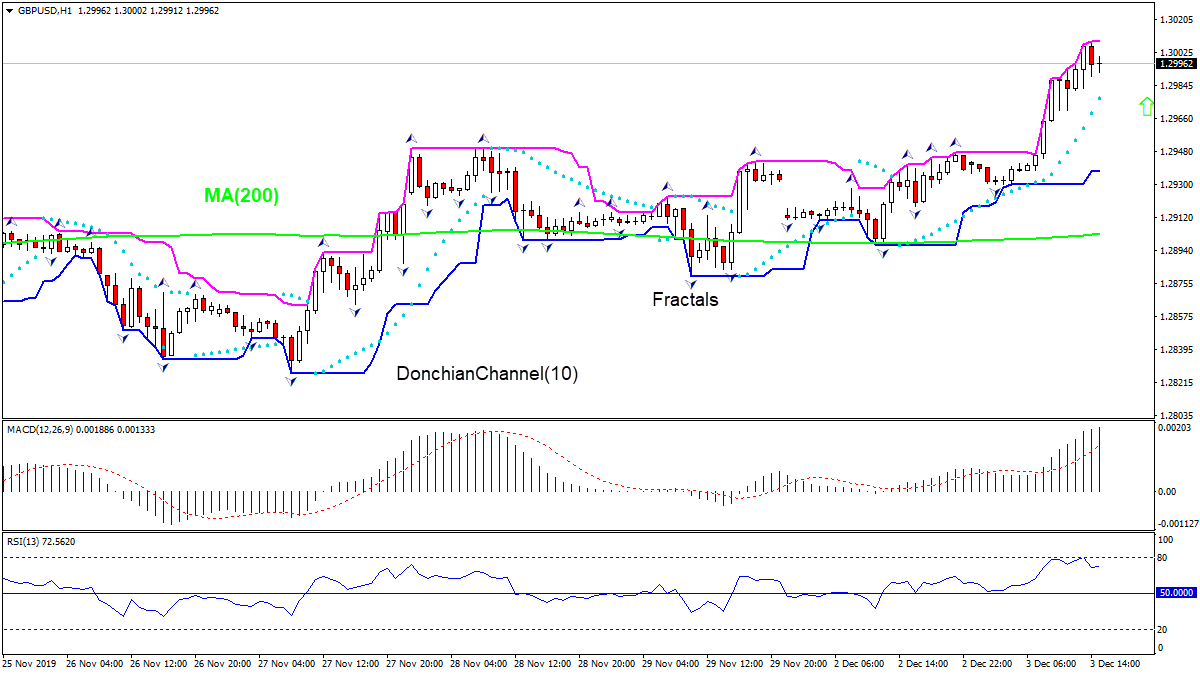
GBPUSD rising above MA(200)

The price chart on 1-hour timeframe shows GBPUSD: H1 is in uptrend. The price is rising above the 200-period moving average MA(200) which is rising. The RSI oscillator is above 50 level.

Technical Analysis Summary

OrderBuy
Buy stopAbove 1.3009
Stop lossBelow 1.2989

Market Analysis provided by IFCMarkets

What Are The Qualities Of A Good Trader?

By Orbex

Trading in the Forex markets can be an incredibly rewarding endeavor. Not only is their room for financial gain, but the academic challenge of conquering the FX markets is one that many people find irresistible.

However, wanting to trade and actually becoming a good FX trader are two very different things. Many Forex traders start with the right intentions. However, they quickly fall by the way-side as they allow bad habits and practices to shape their trading.

So, what are some of the key differences between successful and unsuccessful Forex traders? And what are the qualities of a good trader?

Dedication

As with all things in life, success in trading can only come as a result of dedication. Many new FX traders have dreams of making millions from trading in a very short space of time.

As any professional trader will tell you, however, the road to trading success is a long and arduous one.

Becoming a great trader requires a significant time investment above all else. Time to learn about the Forex markets, formulate a strategy, learn to backtest, hone that strategy, trade, journal etc…

Perseverance

Having dedication is one thing, but remaining dedicated over time is what separated the wheat from the chaff.

Many people can be dedicated for a short period of time, but continuing to apply yourself to the FX markets week after week, month by month, year on year requires perseverance and resilience.

Forex trading is not easy. Many people underestimate how difficult it is to operate in an environment where losing money is part of the process. If a Forex trader wants to become successful, they will have to remain dedicated and resilient in the face of ongoing turmoil.

Strategy-Based

Many new FX traders wrongly assume that becoming a successful trader is about being able to call every turn in the market and trade off of tuition and instinct.

While there is an incredibly slim percentage of successful traders who operate like this, the majority of successful Forex traders will tell you that learning/developing a strategy and sticking to it is the key to being successful in trading.

Operating in live market conditions can be incredibly stressful. The prospect of losing/gaining money can provoke emotional responses that are hard to handle. So, having a clearly defined strategy that has been well back-tested will help provide a guide to help keep you from straying.

Pragmatic

There is an aspect of trading that is incredibly important to manage when it comes to being successful. However, it isn’t talked about as much as it should be. That is the Forex trader’s ego.

Many struggling FX traders attach too much personal weight to their trades. They believe that if they have called a move, they have to hold onto it, even if the market is going against them.

This can often lead to damaging behavior such as the moving of stop losses or “doubling down” on positions. Successful FX traders know that the ability to adapt is vital to success and that Forex trading is not personal. If a trader buys the market but the market turns against them, they are comfortable taking a stop loss and reassessing.

Pragmatism is also important when it comes to strategies. Many FX traders spend a great deal of time developing or learning a strategy they believe in.

However, if the strategy is failing in live conditions, they are unable to see that perhaps they need a new one. That’s usually because they have already invested so much of themselves in their original strategy.

While “strategy hopping” is certainly to be avoided, Forex traders should always be monitoring and re-evaluating their strategies. And, if they find them not to be working as they should, they should be open to tweaking or changing it completely!

Risk-Savvy

Risk really is a double-edged sword when it comes to Forex trading.

Many new FX traders make the fatal mistake of deciding that they will trade aggressive position sizes. The thinking is that a strategy delivering 2:1 returns, traded at 5% per trade (for example) can deliver 10% per winning trade.

As such, the trader stands to double their money in just 10 winning trades. However, the overlooked part of this equation is that the trader can also lose their account in as little as 20 losing trades. Sadly, many new Forex traders will experience this before a string of 10 winners.

Professional FX traders will all tell you that managing your risk is absolutely crucial to achieving and maintaining success in the market. Using conservative trade sizing, always using a stop loss and taking traders where you stand to win more than you lose, will be far more beneficial to long term success than taking aggressive trades.

So, if you think you have these qualities then congratulations!

However, if you feel like you still need to work on some of these areas, then do not fear. Learning to develop the correct habits and disciplines is not easy. But, it certainly is achievable and will give you a far greater chance of becoming a successful Forex trader!

By Orbex


CORN Analysis: Bad weather in the US prevented corn harvest

By IFCMarkets

Bad weather in the US prevented corn harvest

A blizzard in the northwest US Midwest halted corn harvesting. Some farmers said that they would leave the crops unharvested until spring. Will
Corn prices
rise?

Bad weather is still observed in a number of regions of the world. It rains heavily in France and Britain, and there is a drought in Australia. 8 million acres of corn may remain unharvested in the US or nearly 10% of their total area. Meanwhile, global demand remains high. EU corn imports in the 2019/20 season, started in July, increased by 12% by December 1 compared to the same period of the previous season and amounted to 8.7 million tons. The agency Agroconsult expects a cumulative corn crop in Brazil in the 2019/2020 season in the amount of 102.4 million tons, which is slightly less than the last season’s crop – 103.1 million tons. Let us note that the Brazilian government has previously published an even more modest forecast of the country’s total corn crop in the amount of 98.3 million tons.

Corn

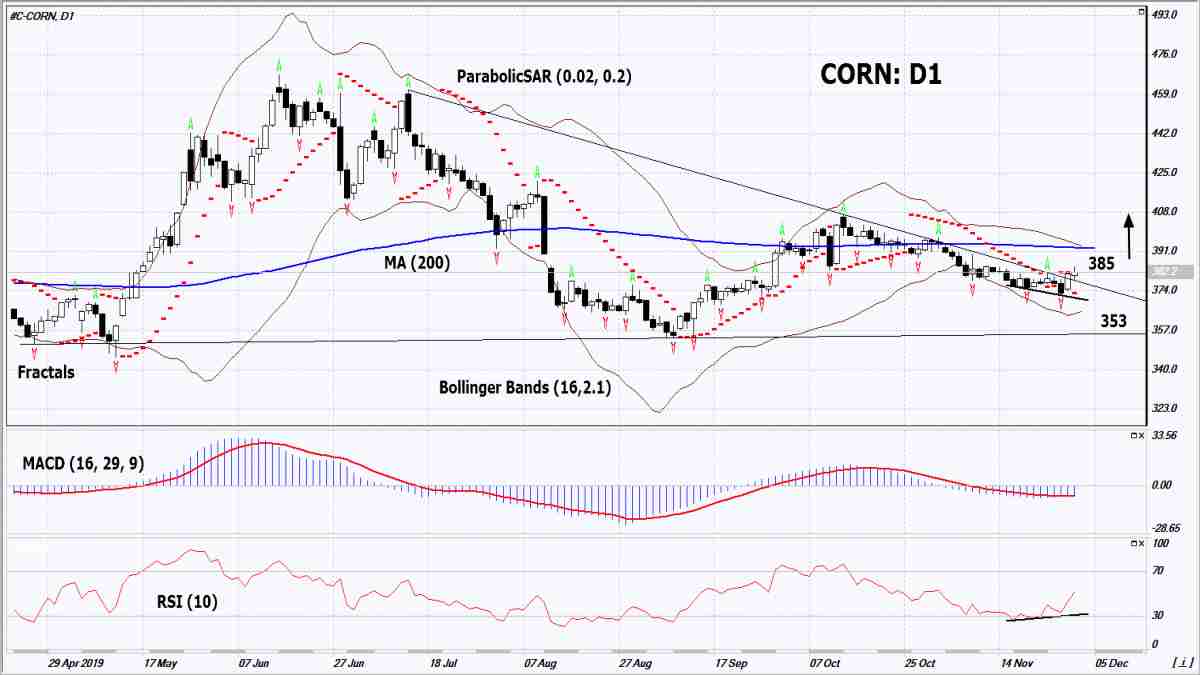
On the daily timeframe, Corn: D1 is trying to leave the downtrend and move upwards. A number of technical analysis indicators formed buy signals. The further price growth is possible in case of an increase in demand and a decrease in world crop.

  • The Parabolic indicator gives a bullish signal
  • The Bollinger bands have narrowed, which indicates low volatility. The lower Bollinger band is titled up.
  • The RSI indicator is above 50. It has formed a positive divergence.
  • The MACD indicator gives a bullish signal.

The bullish momentum may develop in case Corn exceeds the last fractal high at 385. This level may serve as an entry point. The initial stop loss may be placed below the September low, the Parabolic signal and the lower Bollinger band at 353. After opening the pending order, we shall move the stop to the next fractal low following the Bollinger and Parabolic signals. Thus, we are changing the potential profit/loss to the breakeven point. More risk-averse traders may switch to the 4-hour chart after the trade and place there a stop loss moving it in the direction of the trade. If the price meets the stop level (353) without reaching the order (385), we recommend closing the position: the market sustains internal changes that were not taken into account.

Summary of technical analysis

PositionBuy
Buy stopAbove 385
Stop lossBelow 353

Market Analysis provided by IFCMarkets