If you cannot relax while performing in the Forex markets, your trades will be random. Then you will fail to control the positions of the trades. The entry and exits will be inefficient according to the market conditions. On the other hand, you cannot ensure safe money management for the trades. This will reduce the profit potentials of the trades. Even worse for a rookie trader, the potential loss will be very high for him. Therefore, he will become more desperate for gaining profits. With this attitude, you can only last for a very small period in the Forex markets. When you are not securing the investment and the positions of the trades, you will experience frequent losers. Therefore, relaxing is necessary to take effective decisions for the trades. This article will provide a few important procedures for maintaining patience in the business.
To ensure quality performance in the markets of Forex, you will need an effective strategy. And you must consider the influence which provides appropriate ideas for relaxing your mentality. Use the following discussions and improve your strategies for securing the investment. Then focus on the execution process of the trades. Thus, you will be safe and secured with the career.
Do not aim for high profits
When you are aiming for high-profit margins, your mind will be desperate for it. For a rookie trader, executing trades will be a paranoia. Because he might not have enough ideas to secure the investment in the business. At the same time, you will also have very low ideas for securing the positions of the trades with an effective market analysis. Therefore, you cannot assure constructive performance. That is why the profit targets must be small while you are trading as a rookie. Think of effective procedures and try to control the trades.
If you can assure a profitable execution of the trades, simple change in the plans will help you gain high profits. But before managing it, you will need proper skills and strategy to develop. That is why you must relax and try to develop the procedures with the Forex trading demo app. Remember, demo accounts offer the perfect environment to master the skills.
Ensure appropriate analysis
When the trades will be uncontrolled, you will have high tensions of losing capital. This will not help to relax while participating in the Forex markets. Instead, your mind will be highly unstable while participating in the markets. At the same time, frustration and regrets will increase with potential losses. Therefore, you will fail to handle good quality performance in the business. As a result, your profession will return high potential losses consistently from the participations.so, you must use appropriate strategies to find suitable setups for the trades.
Use a simple plan to gain a decent amount of profits. Consider the policy while you are planning for the risk to reward ratio. Then you can perform efficiently and with relaxation. Moreover, you can also maintain an effective market analysis for understanding the volatility. This will help you to find suitable positions for the trades. And you can also assure safe stop-loss, take-profit for the trades.
Improve the edge consistently
When you are running a trading business, you will experience different market conditions. Moreover, your mind must be educated with almost every necessary aspect of executing trades safely. For a rookie trader, the majority of the procedures will be hard. You must learn about them gradually but without dedication yourself to learning about an efficient system, it is not possible. Therefore, you must have the mindset to improve the edge consistently. With appropriate notes and rules, you must refine the performance.
Use a trading journal to write down the rules and procedures of executing trades. On the other hand, include valuable charts and experiences in it to improve your strategies. It will be constructive for a profitable career. And you can also gain consistent profits from the trades without losing too much capital.
If you want to survive in the Forex market, ask yourself about the trading plans. Alongside them, you will also need to organize the strategy to ensure a quality trade execution. The management of the trades is possible only when a trader is focused on the process. Therefore, the system must be managed based on logics. All necessary procedures must be organized for a quality trade execution. Then with the necessary improvement of your trading ideas, you must prepare a strong execution plan. It will also indicate the improvement of the technical analysis to ensure quality performance. Most importantly, it will help the naïve Aussie traders to manage the investment business. So, you must create a perfect plan to define the most efficient experience in Forex market.
This article is dedicated to the idea of managing a quality trade execution. If you want to improve your trading edge and to manage a decent profit potential without losing too much, the following discussions will help you to manage that. There will be some important information provided in this article which is very influential for a safe and secure trading experience.
You will need patience in trading
To develop your trading edge for a safe experience in Forex, you must increase your patience. It is very vital for the improvement of the system. At the same time, you will also understand the markets properly. Therefore, your analysis will be correct for a suitable trade setup. Moreover, you can also secure the positions of the trades with proper caution. Thus, you will be safe in the currency trading industry. As we have mentioned, the safety of the trading capital should be the main concern of a rookie trader.
So, start thinking about the actual execution process and reduce your tension of making profits. Then increase efficiency by decent patience in your trading mind. Thus, you can focus on the improvement of the CFD trading edge to ensure a safe and secure trading career in the markets. Within a very short amount of time, you can manage a decent profit potential from the trades regularly.
Safety should be the main concern
The safety concern of the capital should be the main target of a trader. For a rookie trader, there should be nothing else to care about other than securing the investment. Thus, you can save yourself from losing too much. At the same time, you can also prepare a strong trading edge. With low-risk exposures, you will execute every trade correctly. Then the trading mind will be relaxed in the process. From there, you can easily manage a decent profit with effective market analysis and positioning of the trades. So, care about the security of the account balance. Then think of a strategic plan which will reduce the risk factors.
After making up your mind, try to participate in the Forex markets. Otherwise, any lucrative trade signal will reduce the profit potential of your trades. At the same time, you will also experience high potential loss from the executions.
Take time to improve the skills
When you will need a developed edge, it is important to think of the skills because without having efficient skills, you cannot reduce the risk exposures of the trades. At the same time, you can also lose control over the position of the trades. Thus, you can easily reduce the chance of making a profit from individual trades. Therefore a trader must focus on the skills while participating in the demo platform. Then you can prepare a strong trading edge which will be efficient for your profession.
You can secure the investment as well as manage a decent profit potential. Most importantly, your mind can perform consistently when the skills are developed. So, focus on the improvement of the trading plans and then try to get into the real markets for some decent profit potentials.
The details, finances and impact of the transaction are discussed in a CIBC report.
In a Dec. 6 research note, CIBC analyst Jamie Kubik wrote that Paramount Resources Ltd.’s (POU:TSX) disposing of 8,500 barrels of oil equivalent per day (8,500 boe/d) of production will not materially impact the energy company’s cash flow in the future. “We view the move favorably,” he added.
Paramount sold the assets for a total value of CA$55 million. Metrics of the transaction were “modest,” Kubik noted, at 320,000 net acres of mineral rights (CA$172 per acre), 8,500 boe/d production (CA$6,470/boe/d), 15.9 MMboe of Proven reserves (CA$3.46/boe) and 20.1 MMboe of Proven and Probable reserves (CA$2.74 per barrel).
In addition, Paramount’s capital plans for the assets were “minimal,” Kubik pointed out. Thus, CIBC lowered its estimated 2020 capital spend for the company to CA$550 million from CA$600 million. “With the disposition, Paramount will have less maintenance capital required for assets outside of its Montney acreage moving forward, and management has also pointed to cost savings in its recent drilling efforts,” noted Kubik.
Paramount has focused primarily on developing its Montney assets, Karr and Wapiti. Going forward, “further refinement of the portfolio is likely to be viewed favorably, helping enhance the financial and operational torque to the company’s flagship properties,” Kubik commented.
As for spending in 2020, CIBC expends it to be high to ramp up production at Karr and Wapiti and models the amount at about CA$150 million, Kubik wrote. Proceeds from the asset sale and from the flowthrough financing of CA$37.6 million “provide some added financial cushion” for Paramount as it heads into the new year.
CIBC has a Neutral rating and a CA$7.50 per share target price on Paramount, whose current stock price is about CA$6.63 per share.
Disclosure: 1) Doresa Banning compiled this article for Streetwise Reports LLC and provides services to Streetwise Reports as an independent contractor. She or members of her household own securities of the following companies mentioned in the article: None. She or members of her household are paid by the following companies mentioned in this article: None. 2) The following companies mentioned in this article are billboard sponsors of Streetwise Reports: None. Click here for important disclosures about sponsor fees. 3) Comments and opinions expressed are those of the specific experts and not of Streetwise Reports or its officers. The information provided above is for informational purposes only and is not a recommendation to buy or sell any security. 4) The article does not constitute investment advice. Each reader is encouraged to consult with his or her individual financial professional and any action a reader takes as a result of information presented here is his or her own responsibility. By opening this page, each reader accepts and agrees to Streetwise Reports’ terms of use and full legal disclaimer. This article is not a solicitation for investment. Streetwise Reports does not render general or specific investment advice and the information on Streetwise Reports should not be considered a recommendation to buy or sell any security. Streetwise Reports does not endorse or recommend the business, products, services or securities of any company mentioned on Streetwise Reports. 5) From time to time, Streetwise Reports LLC and its directors, officers, employees or members of their families, as well as persons interviewed for articles and interviews on the site, may have a long or short position in securities mentioned. Directors, officers, employees or members of their immediate families are prohibited from making purchases and/or sales of those securities in the open market or otherwise from the time of the interview or the decision to write an article until three business days after the publication of the interview or article. The foregoing prohibition does not apply to articles that in substance only restate previously published company releases.
Disclosures from CIBC, Paramount Resources Ltd., Earnings Update, December 6, 2019
Analyst Certification: Each CIBC World Markets Corp./Inc. research analyst named on the front page of this research report, or at the beginning of any subsection hereof, hereby certifies that (i) the recommendations and opinions expressed herein accurately reflect such research analyst’s personal views about the company and securities that are the subject of this report and all other companies and securities mentioned in this report that are covered by such research analyst and (ii) no part of the research analyst’s compensation was, is, or will be, directly or indirectly, related to the specific recommendations or views expressed by such research analyst in this report.
Potential Conflicts of Interest: Equity research analysts employed by CIBC World Markets Corp./Inc. are compensated from revenues generated by various CIBC World Markets Corp./Inc. businesses, including the CIBC World Markets Investment Banking Department. Research analysts do not receive compensation based upon revenues from specific investment banking transactions. CIBC World Markets Corp./Inc. generally prohibits any research analyst and any member of his or her household from executing trades in the securities of a company that such research analyst covers. Additionally, CIBC World Markets Corp./Inc. generally prohibits any research analyst from serving as an officer, director or advisory board member of a company that such analyst covers.
In addition to 1% ownership positions in covered companies that are required to be specifically disclosed in this report, CIBC World Markets Corp./Inc. may have a long position of less than 1% or a short position or deal as principal in the securities discussed herein, related securities or in options, futures or other derivative instruments based thereon.
Recipients of this report are advised that any or all of the foregoing arrangements, as well as more specific disclosures set forth below, may at times give rise to potential conflicts of interest.
CIBC World Markets Inc. does and seeks to do business with companies covered in its research reports. As a result, investors should be aware that CIBC World Markets Inc. may have a conflict of interest that could affect the objectivity of this report. Investors should consider this report as only a single factor in making their investment decision.
Important Disclosure Footnotes for Paramount Resources Ltd. (POU.TO)
2g CIBC World Markets Inc. expects to receive or intends to seek compensation for investment banking services from these companies in the next 3 months: Paramount Resources Ltd.
For important disclosure footnotes for companies mentioned in this report that are covered by CIBC World Markets Inc., click here: Disclaimers & Disclosures.
Welcome to this week’s Market Wrap Podcast, I’m Mike Gleason.
Coming up we’ll hear a truly fascinating interview with Keith Weiner of Monetary Metals and the Gold Standard Institute.
Keith tells us what led him to devote his second career to developing a new gold standard as a solution to our nation’s monetary problems. Keith also explains why the dollar, or Federal Reserve Note, is deeply immoral. So, don’t miss a wonderful interview with Keith Weiner, coming up after this week’s market update.
Gold and silver markets edged up this week but remain mired within a longer-term consolidation phase.
Last Friday, it appeared that silver was at risk of breaking down below its trading range for this fall. But prices recovered early this week and finished Thursday right back at the $17.00 level, where silver has been drawn to like a magnet.
So, the bullish scenario suggested by us and our guest expert, Greg Weldon, during last week’s podcast is still in play. We had noted that gold and silver mining stocks were breaking to the upside and outperforming the metals. That outperformance continued again this week, especially in the silver miners.
Spot silver currently checks in at $16.95 per ounce, up 1.7% since last Friday’s close. And gold is up 0.8% for the week to trade at $1,473 an ounce.
Bigger gains are being posted by base metals and PGMs. Copper prices jumped nearly 3% this week to hit a 7-month high. Platinum, despite giving back nearly $20 so far today still shows a weekly gain of 3.3% to trade at $930. And finally, palladium continues to defy gravity, up 2.2% for the week to reach another record high at $1,929 per ounce. It has fallen, though, today after threatening to reach nearly $2,000 an ounce in early day trading here on Friday.
Industrial metals are benefiting from on-again, off-again, now on-again trade progress with China. They are also reflecting rising inflationary pressures in the economy, bolstered by the Federal Reserve’s latest and most explicit policy messaging yet on wanting to engineer higher rates of inflation.
Fed Chairman Jerome Powell is now talking up inflation in ways that nobody in his position ever has before. At a press conference on Wednesday, Powell went so far as to call for a “significant” and “persistent” move up in inflation.
Jerome Powell: In order to move rates up, I would want to see inflation that’s persistent and that’s significant. A significant move up in inflation that’s also persistent. To move inflation expectations up from where they are, which appears to be a bit below 2%, will not happen overnight. It’ll have to happen over time as credibility is built. The Fed has great inflation credibility, but inflation expectations are anchored at about their 25-year average, which is a few ticks below 2%, and that underscores, I think, the challenge of getting inflation to move up. The committee has wanted inflation to be at 2% squarely at 2% for ever since I arrived in 2012, and it hasn’t happened. And it’s because of disinflationary forces around the world and they’ve been stronger than I think people understood them to be. But a number of people did write down overshoots of inflation as appropriate under appropriate policy.
For reasons they have never made clear to the public, Powell and company are upping the inflation ante from 2% to 2% plus overshoots.
Why are they are so obsessed with making sure the value of the U.S. dollar goes down at a more rapid pace? Well, the obvious but unspoken reason is because they want to promote spending and consumption, punish savers, and bail out debtors.
The largest debtholder being the U.S. government, it needs more dollars to be created somehow since tax revenues are falling far short of spending commitments, including interest payments owed on more than $23 trillion in outstanding debt.
Uncle Sam and his partners at the Fed would like to see the real value of debt diminished through inflation without triggering a corresponding increase in interest rates. One way to help achieve that objective is to convince the bond market to anchor its inflation expectations to an understated measure.
The Fed has convinced everyone that inflation is running persistently under 2% because the inflation gauge it uses produces a lowball number. The central bank’s preferred core Personal Consumption Expenditures index is running at an estimated 1.6% year-on-year.
But inflation as measured by the Consumer Price Index is running at 2.1% annually, according to the latest data reported by the Bureau of Labor Statistics on Wednesday. Other alternative measures show consumer costs rising at a much faster clip.
For example, analysis from Gordon Haskett Research Advisors showed that a basket of 76 typical items from Walmart and Target has gone up by about 5% this year. Housing rents are now climbing at a 5.4% rate. Medical and education costs are also each rising by over 5% annually.
When you consider that the Fed’s balance sheet is now surging at a double digit rate thanks to the new Quantitative Easing program that the Fed refuses to call QE, we seem to have a serious inflation problem that threatens to spill over into the economy.
The Fed would have us believe it’s a problem of too little inflation. Jerome Powell can continue to say that with a straight face only so long as hard asset prices remain depressed. But when gold follows palladium’s lead to new record highs, the Fed’s inflation mask will come off.
Well now, to hear about how gold can play a key role in restoring sound money to our monetary system and much more, let’s get right to this week’s exclusive interview.
Mike Gleason: It is my privilege now to welcome in Keith Weiner, CEO and Founder of Monetary Metals, and President of the Gold Standard Institute USA. Keith is a hard money advocate who has been an outspoken proponent for the gold standard and restoring sound money to our nation’s monetary system. Keith has a PhD from the New Austrian School of Economics, and his articles have appeared in numerous publications on Internet sites throughout the globe, and it’s a real pleasure to have him on with us today.
Keith, thanks so much for taking the time, and welcome.
Keith Weiner: Hey Mike. Thanks for having me on.
Mike Gleason: Well Keith, I think a good place to start would be to have you explain a little bit about your efforts to bring about the restoration of a gold standard. As a primer, give us some background on why you believe it’s necessary in returning confidence in the dollar and what kind of change it would bring to our nation’s finances which, as we both agree is quickly running off the rails. So, how did you get to the point? Why are you so passionate about this cause and ultimately why is it needed?
Keith Weiner: So, I was a classic computer nerd at one of the computer science school. Dropped out because I got bored, wanted to build a software company which I did from 1994-2008. Sold my software company which is called DiamondWare to a little company called Nortel Networks. The transaction was August 19th, 2008 that happened to be the last acquisition that Nortel ever did. They immediately right after that began spiraling out of control and entered bankruptcy by January 2009. And then I closed my transaction with a cash deal heading into the fall of 2008, the first it seemed very surreal to me if I was setting in 100% cash profession and too big to file banks watching everything go on sale, but then as things continued to go on, I began to become more and more alarmed and realized that the standard explanations for this didn’t make any sense.
I dove deeper and deeper into markets and economics just to understand and protect myself. The deeper I got in, the more I realized how serious the problem was and it clicked for me that I wanted my next venture to be part of the solution, and it was obvious even before I started to study economics too much, it was obvious that the solution had something to do with gold. If it was a normal world my next venture would have been another software company. But given the world as it is, I wanted to be part of the solution and that was, that was gold.
Mike Gleason: Now as many listening may already know we are fellow travelers and with the Sound Money Defense League a Money Metals public policy project we’ve been working on. Removing the sales and capital gains taxes on gold and silver at the state level among other things, you were deeply involved in the success in Arizona, so you know it can be an uphill battle but success is possible. One of our allies in this cause is Congressman Alex Mooney from West Virginia. Now, you recently wrote an open letter to Congressman Mooney about HR5404, the bill he introduced which would define the dollar as a fixed weight of gold.
In that letter you outlined why defining a dollar in terms of the fixed weight would be akin to price fixing and therefore dangerous. But, you certainly support sound money, so is there a practical way to relink the dollar to gold? What would a workable gold standard look like, Keith or would a different approach be better?
Keith Weiner: So, if you look back to 1792, the first Coinage Act, the dollar was not linked to gold. The dollar was a definition of a certain weight of gold or silver. And so we’ve had a series of evolutions, or maybe arguably call them de-volutions in the century since 1792. The net result of which is that by 1971, Nixon infamously, and if you haven’t seen by the way, there’s a YouTube of him in his little speech in 1971, infamously severing the last link between a dollar and gold. So, for the last 47 years, the 47th anniversary will be coming up August next month. After 47 years the dollar has been a pure irredeemable paper product that has no relationship whatsoever to gold. To put this in perspective, what that means is, when somebody borrows a dollar, or somebody lends a dollar, there is no expectation that gold has anything to do with the transaction. How do you come along and retroactively declare that actually it was a gold transaction?
And so I think in my letter I’m trying to remember what I said and what I didn’t say to Congressman Mooney. If you borrow let’s say $100,000 and the government comes along and retroactively says now the dollar is linked to gold, that means effectively your repaying gold. So, if the gold price was set low, let’s say a $100, that means it’ll take you 1,000 ounces of gold to get out of debt. You’ll be working the rest of your life, and your sons’ (lives) and their sons’ (lives) and probably never get out of debt.
On the other hand, if the gold price was $50,000, then would take only two American Gold Eagles that you hand over to your creditor and you’re out of debt. And so I think it’ll be the biggest worthy lobbying that Washington has ever seen. With all the creditors, and this in counterintuitive, all the creditors wanting a very low price of gold meaning that it would take lots and lots of ounces… they would be paid lots and lots of ounces for debtor to get out of debt and all the debtors would want a very high price of gold which means it would take very few ounces to get out of debt.
So, I think I said to him, I applaud your intentions, I applaud where you’re trying to go with this obviously, but I don’t think that’s a practical mechanism for getting there.
Mike Gleason: Yeah, certainly sounds pretty dangerous just like you described. Now it seems pretty far-fetched frankly to be talking about, a return of some sort of Gold Standard. Yes, Congressman Mooney introduced a Bill, but we doubt many of his peers in the mainstream are anywhere near supporting this kind of measure. In what context do you think Congress might actually pass an honest money bill, Keith. Is it going to take a total collapse in the dollar or do you sense there is, the makings of a viable political movement here?
Keith Weiner: All I can say of a total collapse I pray it never happens. If you look at 476 AD, it was pretty horrific. And the recovery took about 1,500 years before the world was back to the level achieved under Rome. In U.S. history there’s been a number of cases where we’ve had a bad or evil institution and Americans without necessarily having that crisis, had come to realize is wrong and repealed it. The first doesn’t quite fit my criteria, that being the end of slavery obviously there was a war over that. But, in more recent decades you had end of prohibition, and you had the end of Jim Crow and now we are having, I believe were having, I think there letting them allow the end of marijuana prohibition and also what’s called Right-to-try for terminally ill patients to get access to drugs that haven’t been FDA approved yet.
In each of these cases, I think it was Cato Institute published a book called Bootleggers and Baptists, the analogy being the Baptists are the moralizers, who provide cover for an evil institution, lets says prohibition, as being a little bit less emotional charged. And there was whole Temperance Movement, the idea being if you drink it was sinful and so forth. And there’s a bootlegger that profiteer off of it, and if alcohol is in the free market, that’s an above margin product, like any agricultural commodity. It’s like bottled water, or bottled soda. There’s not a lot of money to be made on it, but if you make it illegal then suddenly alcohol becomes a very expensive commodity.
And so, according to this Cato book, bootleggers and Baptists, have this unholy alliance working together to keep something illegal and yet something happened and what happened was the American public finally came to realization that this was wrong. That you can’t just make alcohol illegal, it has all kinds of damaging consequences to doing it. The government doesn’t have the right to do that, and when the questions starts getting made and people start coming on board with the idea that this needs to end, then it comes to end. And that came to its end and then subsequent to that was Jim Crow, and now marijuana, and I think generally same drivers. And so, could that happen with money, I think it could, provided people come to that same realization that what we currently have is outrageous. It’s unfair. It’s immoral. When people come to that realization it will change, and probably not a minute before.
Mike Gleason: Expand on that, what’s immoral about it?
Keith Weiner: So, when they pass a series of laws, and we’ll broadly call them legal tender laws, we are forced to use their debt as if it were money. So think about that. What we call money is a dollar, it says Federal Reserve Note on the dollar bill. Bill being an old word for credit, a note being a word for credit, a promissory note. We’re using their debt as if it were money. Now FDR did this in 1933 when he made gold illegal to possess, as in criminal, as in go to prison for possessing gold, the way it is for cocaine today. When he made it illegal for people to possess gold, that forces people to treat the government bond as if that was a conservative risk-free asset.
In fact, if you ask any regulated financial professional today, what’s a risk-free asset, they’ll say the government bond. And so, it forces everybody to turn to the government, and become a lender government, as if that was a risk-free proposition. And of course, I think it’s probably pretty well known in your audience, that the Federal Reserve, right on their website, says that their stated policy target is two percent debasement per annum. So, you’re forced to save enough paper, and they have a monetary policy of stealing two percent per year. So, I called it immoral because first of all you have no right to force people to use something, and secondly if you do force them to use something, you have no further right to then try to rob them at two percent per year.
Mike Gleason: Very good explanation there, and it kind of leads me into my next question. You spoke about bonds, and I wanted to ask you about one of the benefits of gold, in your view, is the idea of gold bonds. Please explain this concept for folks who may not be familiar, and tell us why you believe that states and individuals both should start adopting the issuance of gold bonds.
Keith Weiner: So, bonds is/are the payment of interest on gold and I think sort of the broader answer to everything we’ve been talking about today so far. My response to Congressman Mooney would be, if you want gold to begin circulating, you have to issue a gold bond, you have to pay interest on gold. Interest is the one thing that would pull gold out of private hoards, and into circulation. People have been hoarding gold for at least 5,000 years. They have been hiding it from their governments, and from their neighbors.
I had an interesting experience a couple of years ago, I was giving this talk about the gold hoard, and how nobody talks about how much gold they have. So I was at a club called the Phoenix Roadrunners. They’re this group of gold prospectors, who literally go up in “dem there hills”, looking for gold. I know they find some, because at the start of the meeting they gave away like three nuggets. One that somebody had contributed to the newsletter, one to somebody who was really helpful with the new members, and one to a third person for something or other. Then, it was my turn to talk, so I said raise your hand if you have some gold, any amount of gold, raise your hand.
You know Mike, not a single hand went up, and there was, I think 250, 300 people in the room. Including the three people that just got handed gold nuggets. Not a single hand goes up. So I said, thanks for proving my point, that people have been hiding this from everybody for thousands of years. Traditionally this was the sort of thing fathers didn’t even tell their kids, until on their deathbed, they would summon their oldest son, and say son, we have ten ounces of gold under the kitchen floorboards, under the stove, or whatever they would do, because it was so dangerous. I mean, the government could take it, the government could declare you to be a criminal, or a traitor. Your neighbors could come steal it, or slit your throat in the middle of the night. It was the sort of thing nobody wanted to talk about, nobody wants to acknowledge having (it). And the thing that will pull it out is interest.
If you say to somebody, lend me your gold, I’ll pay zero, then the answer is “I don’t have any gold.” If you talk to somebody, and said lend me your gold, I’ll pay you five percent. Well, there was a semi-famous incident involving J.P. Morgan, around one of the banking panics… I believe it was 1907, I haven’t found the documentation for that. If somebody comes up to you and says “Mr. Morgan, Mr. Morgan there’s a crisis in New York, there’s a shortage of gold, what are we going to do?” And so, he said “Raise the interest rate.” Four percent, he said will draw it off the continent. And if you think about it, in those days steamships and the costs and risks and time to get gold from Europe to New York. Five percent, he said will pull it down off the moon. And so, what he was doing was, first of all, illustrating the principle of how interest draws gold into the market, and secondly bracketing it, and saying four percent of hyperbole, five percent is fantasy.
So, in a talk I gave recently, and I put this in one of my papers, I saw a picture of a gold bond hanging on the wall of the Harvard Club in New York. This was a railroad bond, issued in 1905. It had a 92 year maturity, and it paid three and a half percent interest, obviously gold. And so, interest is the thing that makes the gold flow.
For a state government, such as Nevada, and I’ve been in a lot of discussions with the Nevada government about this. There’s a completely different proposition, and a very practical one, actually two. Number one, so the state has a lot of gold mining going on in Nevada. It’s the number one state for gold mining in the U.S. They produce about 160 tonnes of gold here every year. So the state gets, I believe its five percent royalty or tax on the gold production. So the state has a gold income, and that’s really the key to the whole thing. Now, the state of course sells the gold, or has the miners sell the gold, and so the state has the dollar proceeds from the sales of the gold.
And the state obviously is servicing conventional dollar bonds with this gold income, which means the state has a mismatch. It has a gold income servicing a dollar bond, or dollar liability. Which means, if the price of gold ever goes down, the state suddenly has an unexpected budget shortfall, a budget deficit. So, the first proposition to refinancing its paper bonds with gold bonds is it will eliminate the risk of this deficit, eliminate the gold price risk, that it is currently incurring.
The second thing that I think is the more interesting one, and that is the gold bond provides a mechanism to get out of debt. And that mechanism is when the state options off the gold bond, my proposal is don’t sell it for dollars, you’re not trying to raise dollars. If you want to raise dollars, sell regular bonds. And don’t sell it for gold, you’re not trying to raise gold. Gold itself is not really a use to you if you’re the state of Nevada. Tell the buyers that they have to bid in existing Nevada dollar bonds. That is they have to tender, go to the market and buy some Nevada paper, and then tender that, redeem that ultimately for the gold bond in exchange.
So, it’s a mechanism to redeem one form of debt, which is dollars, which is irredeemable debt normally, and exchange that for the new gold bond, which the state can amortize because it has a gold income, the mining tax that we just talked about. Now, what this does, is it sets up an exchange ratio between paper bonds and gold bonds. So, let me put some numbers to this, and make this pretty straightforward.
So, today that gold price is around $1,250 an ounce. Let’s say the state were to sell 1,000-ounce gold bond. That means that bond, a thousand ounces is worth 1.25 million dollars. So, what you’d expect to happen in the first option, is that buyers say okay, you’re giving 1.25 million dollars’ worth of gold, we will buy and bring it to you 1.25 million dollars’ worth of outstanding paper bonds to exchange for the gold bond.
However, we’re not talking about gold delivered today, this is a bond. We’re talking about gold, or dollars, payable in 10, or 20 or 30 years. So, now you start to think the dollar’s being debased at two percent per year, that’s the Fed’s target, and of course they can over shoot. What is that dollar going to be worth in 10, or 20 or 30 years versus what is the gold going to be worth.
And so, what I expect will happen, is the market will then offer more than 1.25 million dollars’ worth of outstanding Nevada bonds, in exchange for a thousand-ounce gold bonds. That as the market will retire existing Nevada state debt at a discount in order to get the gold bond.
So, that mechanism of retiring the debt at a discount, is a huge benefit to the state. If the state ends up retiring its debt at a 20 percent discount, that’s a huge benefit the state couldn’t get any other way.
Mike Gleason: Yeah, it’s very fascinating. Hopefully something that will actually gain more traction. There’s some tremendous advantages in all of that, as you just explained.
As we begin to wrap up here Keith, give us your take on the markets today. About whether or not you think we have honest price discovery, and where we go from here in the metals.
Keith Weiner: The broadest thing is no we don’t have honest price discovery, because the government teaches us their propaganda from the age of two, that gold is just a volatile commodity, and the dollar is money. But, in a narrower sense I think anybody who wants to buy physical gold, or gold futures, can do so, and I think there’s a market that provides the clearing price for that at any given moment.
Mike Gleason: Well, I certainly want to thank you for your time, it was a very enjoyable conversation, and we definitely support your efforts in pursuing and getting more traction to see sound money restored to our nations monetary system and more and more people will hopefully look at gold and silver as a solution to the global financial problems. So keep up the good work, and I hope we can speak with you again, and follow this as it continues to develop. Take care Keith.
Keith Weiner: Thanks, I look forward to it Mike.
Mike Gleason: Well, that will do it for this week. Thanks again to Keith Weiner of Monetary Metals and the Gold Standard Institute. For more information the web addresses are Monetary-Metals.com and GoldStandardInstitute.us and GoldStandardInstitute.net, be sure to check those out.
And check back here for next Friday for our next Weekly Market Wrap Podcast. Until then, this has been Mike Gleason with Money Metals Exchange. Thanks for listening, and have a great weekend everybody.
The Money Metals News Service provides market news and crisp commentary for investors following the precious metals markets.
Proteostasis Therapeutics’ shares traded higher today after the company reported positive results in its European Cystic Fibrosis study of organoids grown from human stem cells. The firm believes the ongoing ex-vivo study supports initiation of a human clinical trial in mid-2020, and potential for a Marketing Authorization Application in 2021.
This morning, clinical-stage biopharmaceutical company Proteostasis Therapeutics Inc. (PTI:NASDAQ), which is focused on the discovery and development of therapies to treat cystic fibrosis (CF), announced “positive, initial ex-vivo results of PTI’s proprietary cystic fibrosis transmembrane conductance regulator (CFTR) modulators, PTI-801, PTI-808 and PTI-428, in individuals with CF who are ineligible for the current standard of care CFTR modulator therapies due to their genotype. The data are part of a pan-European strategic initiative, known as HIT-CF (Human Individualized Therapy of CF).”
The HIT-CF Europe research project’s goal is to provide better treatment and improve the lives of people with CF and rare mutations. In the project, drug candidates are first tested on patient-derived organoids in qualified laboratories across Europe that are part of the European Cystic Fibrosis Society Clinical Trial Network. Based on the test results, a smaller group of patients will be invited to participate in a clinical trial with one or more investigational molecules from a participating pharmaceutical company.
The company explains in the report that organoids are cell cultures made from stem cells that grow in a culture dish and look similar to the organ from which they are derived. The firm advised that investigational drugs that target the basic defect of CF may have a positive effect and can be used in an organoid system to evaluate rare mutations.
According to the report, “rectal organoids from over 300 subjects have been collected for functional profiling and of those, 65 have been tested for response to PTI’s investigational drugs. Early results support the initiation of enrollment of responding subjects into HIT-CF’s clinical trial known as CHOICES, which is designed to evaluate the translation of organoid ex-vivo response to potential clinical benefit.” The CHOICES study is expected to commence in mid-2020 with initial data findings expected by year-end 2020. The firm noted that the trial will be the first ever personalized medicine-based study in CF. The firm is optimistic that the results may serve as the basis for a potential Marketing Authorization Application with the European Medicines Agency in 2021.
The company’s Chief Medical Officer Geoffrey Gilmartin, M.D., M.M.Sc., commented, “Proteostasis is honored to have been invited to participate in the HIT-CF project and is the only company in the group with a combination of novel CFTR modulators being tested ex-vivo…In Europe alone, there are more than 2,300 adult patients whose genotypes render them ineligible for approved CFTR modulators and exclude them from participating in clinical trials with this drug class. This project’s proposed personalized medicine approach is paving a potential new way to develop and provide access to novel CFTR modulators for patients with the most dire need for treatment options that target the cause of the disease. Additionally, based on an individual patient’s disease phenotype and not just the genetic designation, this approach could also create a new path towards more effective treatment for all people with CF.”
Christiane De Boeck, work package leader at HIT-CF and former president of ECFS, added, “The inequality in access to CFTR modulators is an acute problem across Europe where 1 in 5 individuals do not have a F508del mutation…At HIT-CF Europe, we believe that novel strategies such as personalized medicine and development of new treatment options are central to addressing the inequality of access across the continent. We are thrilled with these initial results and look forward to providing additional updates.”
Proteostasis Therapeutics, headquartered in Boston, Mass., is a clinical stage biopharmaceutical company developing novel small molecule therapeutics to treat cystic fibrosis and other diseases caused by dysfunctional protein processing. The firm focuses more specifically on identifying therapies that restore protein function.
Proteostasis has a market cap of about $203.0 million with approximately 51.13 million shares outstanding and a short interest around 5.7%. The stock has a 52-week price range of $0.61-5.80. PTI shares opened today at $4.30 (+$0.33, +8.31%) over yesterday’s $3.97 closing price. The stock has traded today between $4.105 and $4.72 per share and at present is trading at $4.295 (+$0.325, +8.19%).
Disclosure: 1) Stephen Hytha compiled this article for Streetwise Reports LLC and provides services to Streetwise Reports as an independent contractor. He or members of his household own securities of the following companies mentioned in the article: None. He or members of his household are paid by the following companies mentioned in this article: None. 2) The following companies mentioned in this article are billboard sponsors of Streetwise Reports: None. Click here for important disclosures about sponsor fees. 3) Comments and opinions expressed are those of the specific experts and not of Streetwise Reports or its officers. The information provided above is for informational purposes only and is not a recommendation to buy or sell any security. 4) The article does not constitute investment advice. Each reader is encouraged to consult with his or her individual financial professional and any action a reader takes as a result of information presented here is his or her own responsibility. By opening this page, each reader accepts and agrees to Streetwise Reports’ terms of use and full legal disclaimer. This article is not a solicitation for investment. Streetwise Reports does not render general or specific investment advice and the information on Streetwise Reports should not be considered a recommendation to buy or sell any security. Streetwise Reports does not endorse or recommend the business, products, services or securities of any company mentioned on Streetwise Reports. 5) From time to time, Streetwise Reports LLC and its directors, officers, employees or members of their families, as well as persons interviewed for articles and interviews on the site, may have a long or short position in securities mentioned. Directors, officers, employees or members of their immediate families are prohibited from making purchases and/or sales of those securities in the open market or otherwise from the time of the interview or the decision to write an article until three business days after the publication of the interview or article. The foregoing prohibition does not apply to articles that in substance only restate previously published company releases. 6) This article does not constitute medical advice. Officers, employees and contributors to Streetwise Reports are not licensed medical professionals. Readers should always contact their healthcare professionals for medical advice.
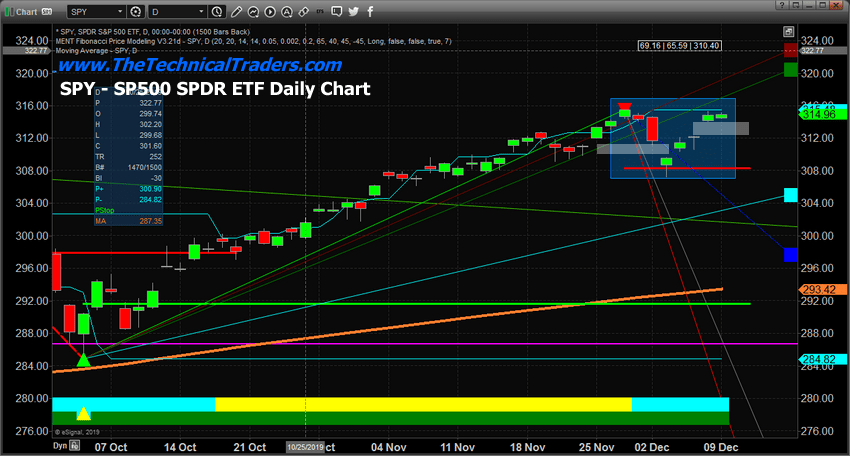
As holiday trading sets up in the global markets, the SPY is starting to show signs of volatility and warning of a potential top by gapping as price attempts to trade sideways. This type of top formation, along with the fact that the overnight REPO facility continues to roil the markets, continues to draw our researchers to the conclusion that some type of debt or liquidity issue is just below the surface of the global markets.
We believe the topping formation in the SPY may be a sign that the holiday trading, normally spanning from just before Thanksgiving to sometime after January 10th or 15th, may prompt a very volatile price rotation in the global markets. The lack of liquidity in the market at this time often leads to fairly narrow ranges in price. Yet we are seeing volatility continue to stay somewhat high at this time and the REPO issue hangs over the heads of nearly every investor at this time.
One of our friends, an ex-Chicago floor trader, wrote to us just a few days ago suggesting he was receiving phone calls from many friends and associates in the US and overseas about the REPO issue. We believe this issue is now taking root as a concern for global investors and could become a major issue for the markets going forward into 2020. Our friend’s suggestion was to “buy gold and to pair back equity positions”.
This SPY Daily chart highlights the GAPS in price that has our research team concerned. A breakdown below $308 would qualify as a new Bearish Price Trend. If the most recent gap is filled to the downside, the price may begin to accelerate lower, confirming our analysis.
On the flip side of that scenario, is a breakout above $315 that can hold for a couple of days or into the end of the week. That would trigger a new uptrend and possibly a Santa Rally.
This Weekly YM chart highlights the Hangman pattern set up last week with a very long lower wick. This pattern set up at the price high is very indicative of a topping formation. The fact that it set up just below the GREEN Bullish Price Trigger level near $28,175 suggests this level is acting as resistance. A breakdown in price near this level could prompt a move to levels below 26,000.
Traders need to stay cautious over the next 5+ weeks as the lack of volatility in the market may prompt some very big price moves. We believe the REPO issue may have some legs in the future and we believe a rotation may begin before Christmas 2019.
If liquidity continues to diminish, a flash crash type of event would not be uncommon. We believe there are serious risks of a downward price rotation in the works and urge our followers and members to prepare for unknown risks over the next 5+ weeks.
Normal trading volume will not likely start to pick back up till after January 15th. We have at least 4+ weeks of unknowns to contend with in a very illiquid market. We are going to trade with the short term market trends and be agile going into the new year.
S&P 500 & BOND TREND – DECEMBER 13
The stock market was setting up a topping pattern the past couple weeks but that has now been negated. The charts/technicals are bullish and so are we it’s that simple really.
Yesterday more chatter of tariffs and other news sparked a strong equities rally at the open bell which sent stocks sharply higher while bonds corrected. With yesterday’s S&P 500 hitting new highs after a fear-based correction two weeks ago the market is now back in rally mode and should have enough energy to sustain a rally into the year-end.
While we trade based on technical analysis, there will be days when news hitting the market and causes some large moves on the same day we have technical buy or sell signals. Like yesterday, for example, The past couple of trading sessions we have been talking about how the S&P 500 has to hie new highs to kick things back into a new uptrend after the previous week’s price correction. Yesterday, the SP500 broke to new highs, while bonds broke down triggering a new breakout rally in stocks. Sure there was news to help push price higher but none the less all our analysis has confirmed for the buy trigger.
We touch on other markets or news from time to time but we do not take any of the news into consideration for our trades. While there are many warning signs out there pointing to dark times ahead for the financial markets like the Repo market and many others, the reality is we follow the price, not the news. The market is climbing a wall of worry among educated traders and investors, and that’s what the market does best and we can’t fight it. Eventually, the price will turn down for a mega bear market and we will be there to profit from it, until then we ride the fearful rally higher.
The basis of Haywood’s investment thesis for this Canadian company is shared in a recent report.
In a Nov. 28 research note, analyst Mick Carew reported that Haywood initiated coverage on K92 Mining Inc. (KNT:TSX.V) with a Buy rating and a CA$4.75 per share target price. The current stock price is CA$2.62 per share.
“We like K92 as it represents one of the few companies implementing exploration, development and production concurrently and is set to increase capacity to 400,000 tons per annum next year,” commented Carew. The company funds its exploration and development programs with monies it generates from mining.
Carew presented the highlights of the K92 Mining story. One is the company successfully “juggling it all,” he wrote, referring to all mining stages. Evidence of this is the 179% year-to-date rise in K92’s share price and the company’s Q3/19 production exceeding guidance by 14%. K92 is mining gold from the Kora deposit, part of its Kainantu project in Papua New Guinea.
Another positive to K92, Carew noted, is that the Kora resource “should expand significantly,” to the estimated 5 million ounces of gold equivalent and, thus, warrant a larger mining operation. This is because the gold-copper mineralization there remains open along strike and at depth to the K1 and K2 veins. Additionally, high-grade linkage structures are present.
Further, Carew added, the company’s management and technical teams, with CEO John Lewins at the helm, are “strong.” Lewins has experience developing and operating many gold mines, in Asia, Africa, Australia and the Middle East.
In addition, K2 has an extensive land package with potential for epithermal and porphyry-style deposits, including the Judd vein and the Blue Lake porphyry project that “suggests district potential,” Carew pointed out.
The Blue Lake region will be further explored by K92 in the near term. Also, the company intends to continue drilling, with three underground and two surface diamond drill rigs, the Kora and Kora North deposits to expand the resource. Finally, K92 will continue working toward achieving its goal of a 400,000 ton per annum mine capacity and annual production of 120,000 gold equivalent ounces.
Carew pointed out that the market is undervaluing the progress made thus far at K92’s Kainantu project. “With an updated resource expected in Q1/20, along with doubling of capacity at its production facility by Q3/20, we believe there are significant events that could demonstrate material advancement for this well-managed company,” he added.
Disclosure: 1) Doresa Banning compiled this article for Streetwise Reports LLC and provides services to Streetwise Reports as an independent contractor. She or members of her household own securities of the following companies mentioned in the article: None. She or members of her household are paid by the following companies mentioned in this article: None. 2) The following companies mentioned in this article are billboard sponsors of Streetwise Reports: None. Click here for important disclosures about sponsor fees. 3) Comments and opinions expressed are those of the specific experts and not of Streetwise Reports or its officers. The information provided above is for informational purposes only and is not a recommendation to buy or sell any security. 4) The article does not constitute investment advice. Each reader is encouraged to consult with his or her individual financial professional and any action a reader takes as a result of information presented here is his or her own responsibility. By opening this page, each reader accepts and agrees to Streetwise Reports’ terms of use and full legal disclaimer. This article is not a solicitation for investment. Streetwise Reports does not render general or specific investment advice and the information on Streetwise Reports should not be considered a recommendation to buy or sell any security. Streetwise Reports does not endorse or recommend the business, products, services or securities of any company mentioned on Streetwise Reports. 5) From time to time, Streetwise Reports LLC and its directors, officers, employees or members of their families, as well as persons interviewed for articles and interviews on the site, may have a long or short position in securities mentioned. Directors, officers, employees or members of their immediate families are prohibited from making purchases and/or sales of those securities in the open market or otherwise from the time of the interview or the decision to write an article until three business days after the publication of the interview or article. The foregoing prohibition does not apply to articles that in substance only restate previously published company releases.
Disclosures from Haywood Securities, K92 Mining Inc., Initiating Coverage, November 28, 2019
Analyst Certification: I, Mick Carew, hereby certify that the views expressed in this report (which includes the rating assigned to the issuers shares as well as the analytical substance and tone of the report) accurately reflect my/our personal views about the subject securities and the issuer. No part of my/our compensation was, is, or will be directly or indirectly related to the specific recommendations.
Important Disclosures
Of the companies included in the report the following Important Disclosures apply: ▪ As of the end of the month immediately preceding this publication either Haywood Securities, Inc., one of its subsidiaries, its officers or directors beneficially owned 1% or more of Equinox Gold Corp. (EQX-V).
▪Haywood Securities, Inc. has reviewed lead projects of Barrick Gold Corp. (ABX-T), Equinox Gold Corp. (EQX-V), Roxgold Inc. (ROXG-T), K92 Mining Inc. (KNT-T) and a portion of the expenses for this travel may have been reimbursed by the issuer.
▪ Haywood Securities Inc. or an Affiliate has managed or co-managed or participated as selling group in a public offering of securities for K92 Mining Inc. (KNT-T) in the past 12 months.
▪ Haywood Securities Inc. or an Affiliate has received compensation for investment banking services from Equinox Gold Corp. (EQX-V) in the past 12 months.
Other material conflict of interest of the research analyst of which the research analyst or Haywood Securities Inc. knows or has reason to know at the time of publication or at the time of public appearance: n/a.
Slowing New Zealand manufacturing bearish for NZDUSD
New Zealand’s manufacturing sector expansion slowed in November. Will the NZDUSD decline?
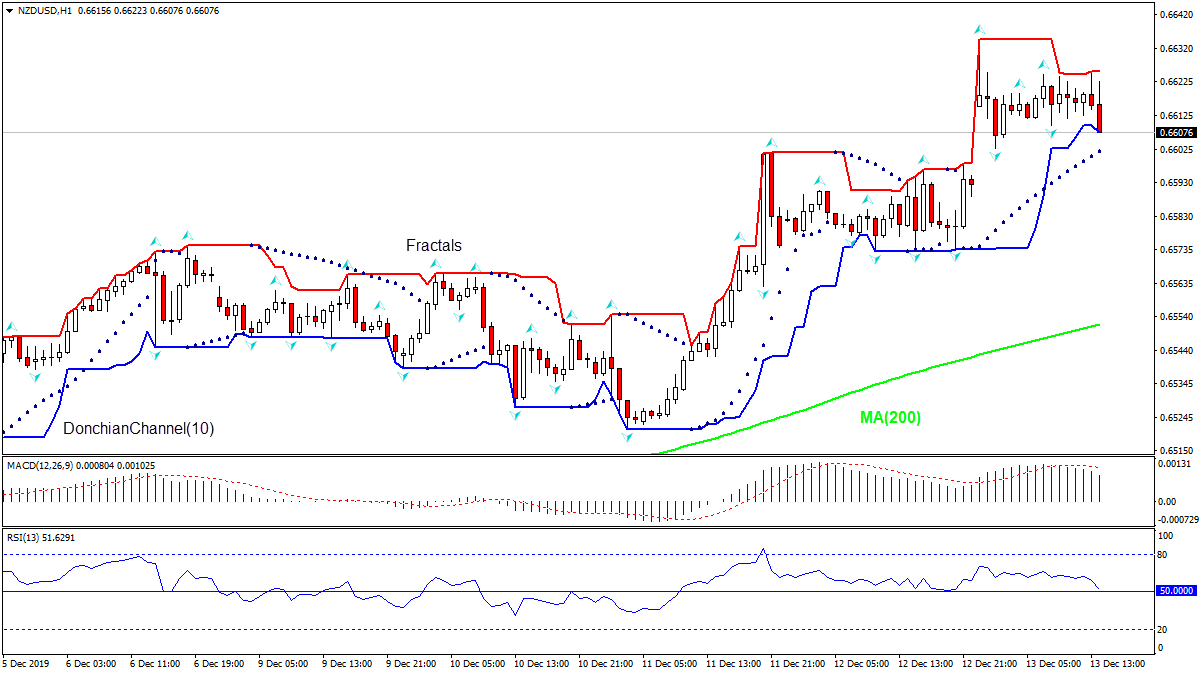
The price chart on 1-hour timeframe shows NZDUSD: H1 is trading sideways. The price is falling toward the 200-period moving average MA(200) which is rising. And the RSI oscillator is falling toward 50 level. There is no trend yet formed, traders have to decide when it would be a best time to enter the market.
The yellow metal was initially higher over the week on continuing market jitters ahead of a potential US-China trade deal. This combined with a weakened US dollar to help lift price.
Into the middle of the week, traders still had not been given great visibility over whether a trade deal was coming. The US administration warned China that, in case of a no-deal by December 15th, a new round of 15% tariffs would go live on $156 billion of Chinese products.
Over recent weeks, talks have seemingly stalled. And, despite reassurances from both sides, the market has been nervous over the prospect of fresh tariffs.
In light of recent efforts by the Chinese (removing some tariffs, increasing US agricultural purchases) there had been speculation that the US would postpone tariffs to allow talks to continue.
However, late in the week, gold was knocked lower. This came in response to reports that the sides had agreed on a phase-one trade deal “in principle.”
This offer has taken traders by surprise. This especially true given that, up until last week, Trump had been adamant against reducing tariffs. This update represents a significant improvement in the relations between the two sides.
Technical Perspective
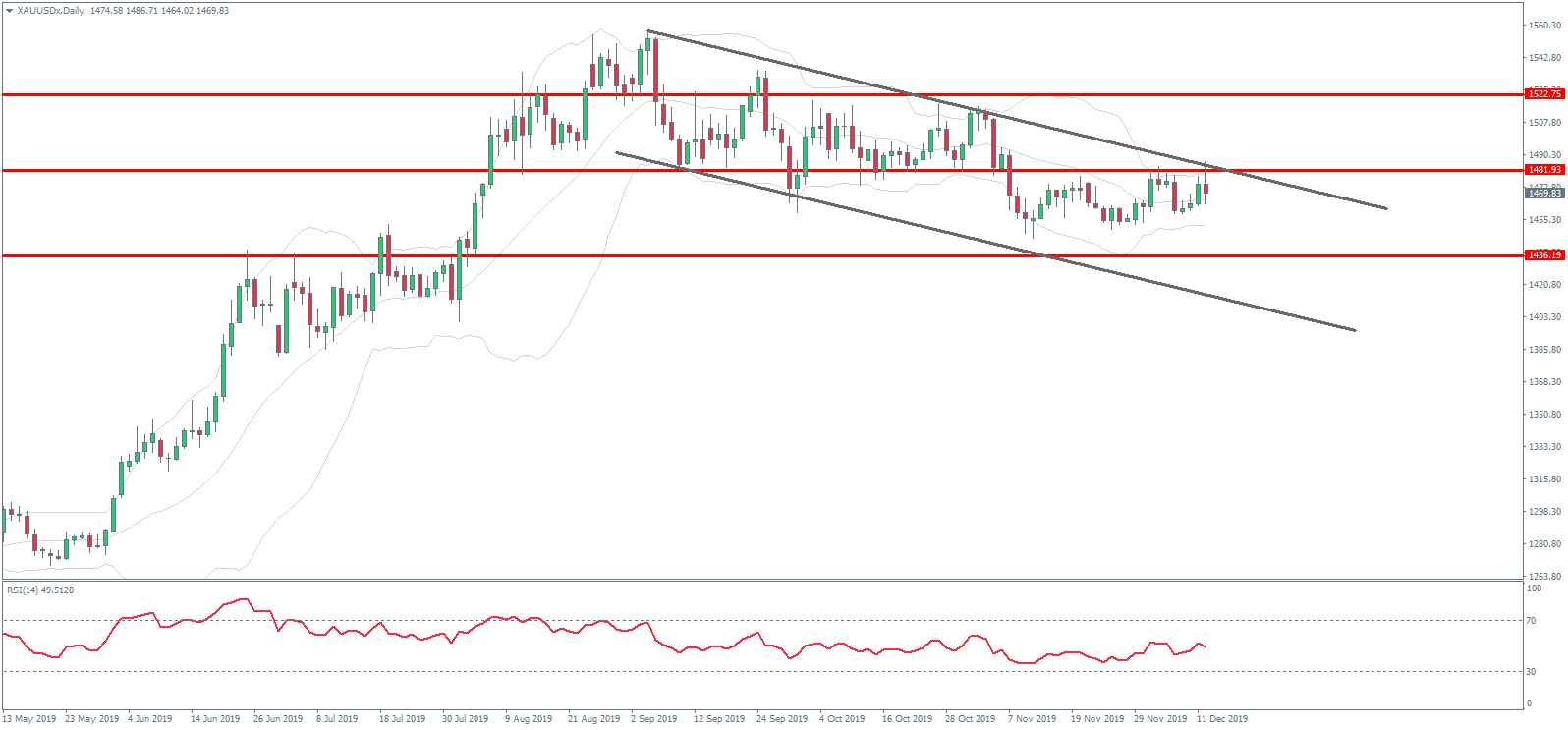
Gold prices continued to correct higher within the bearish channel which has framed the sell-off from 2019 highs. Price made a further test of the 1481.93 level which is still holding as resistance for now.
For now, we can still view the pattern as a corrective bull flag suggesting that upside could still materialize. If the price can break back above the 1481.93 level, the key level to watch in the short term is 1522.75. This is a major long-term pivot for gold. Above here, the focus will be on a move back up to the recent 1554.69 level.
Silver
Silver prices tracked the moves seen in gold across the week, rising higher to recover off last week’s lows. Along with cross-flow support seen from the safe-haven rally in gold, silver prices have also benefitted from a weaker USD this week.
At its December meeting, the Fed was well in-line with expectations, keeping rates unchanged. The Fed reiterated its message that the current policy rate remains appropriate and will likely continue to be so.
However, again, the Fed added that it would continue to monitor data to ensure economic performance is in line with the outlook. The US dollar weakened on the back of the meeting. Traders judged that the bank is still keeping the door to further easing open.
Technical Perspective
17.3408 has continued to hold as resistance for silver this week. While we can still view the current bearish channel as a corrective bull flag structure, for now, bulls will need to see price quickly back above the 17.3408 level.
Below 17.3408, the next major support level is down at 16.2130. This also holds the retest of the broken long-term bearish trend line. To the topside, the 18.6397 level remains the key marker to break.
Recent company announcements are discussed in a Pareto Securities report.
In a Dec. 10 research note, Pareto Securities analyst Tom Erik Kristiansen reported that Gulf Keystone Petroleum Ltd. (GKP:LSE) announced a $25 million share buyback and increased its 2019 production guidance. “Overall, we view today’s news as significantly positive,” he wrote.
The analyst addressed both developments.
Regarding the share buyback, the Gulf Keystone will increase the total amount of share buybacks it announced this year to US$50 million, the same amount that the company paid in 2019 in dividends. This equates to 20% of its enterprise value and 17% of its market cap. The energy firm not only did this but, also, continued to invest capital in increasing production. “We find this highly impressive,” commented Kristiansen.
As for its current financial status, oil and gas producer has a cash balance of US$206 million. “This also implies that Gulf Keystone will maintain a robust balance sheet,” Kristiansen indicated. In addition, the company is due to receive another export payment soon.
As for full-year 2019 production guidance, Kristiansen relayed that Gulf Keystone reverted back to its initial production estimate for Shaikan, located in Iraq’s Kurdistan region, to 32,00038,000 barrels per day (3238 MMbbl/d) gross from 3033 MMbbl/d (the company had lowered guidance to this range earlier this year). This change back to the higher guidance resulted from strong production from the first well drilled in the Shaikan field, which began on Nov. 13.
During that month, output averaged 40.58 MMbbl/d. Now, Shaikan production is higher, at around 40 MMbbl/d, denoting “stronger than expected production from the well,” Kristiansen highlighted. “This has also been the case for existing wells at the field, implying that the field continues to perform better than expected.”
Kristiansen noted that Gulf Keystone’s planned Shaikan production ramp-up to 50 MMbbl/d will be pushed back another quarter, now until Q3/20, because the company had to revise the drilling schedule. “While negative,” he added, “we continue to argue that the main risk is timing related (further delays cannot be ruled out given the track record) with recent production results further supporting that the field will get to 55 MMbbl/day as soon as more wells comes onstream.”
Once Shaikan reaches 55 MMbbl/day of production, Pareto expects the energy company will generate US$160 million per year of free cash flow. The firm has a Buy rating and a GBp350 per share target price on Gulf Keystone.
Disclosure: 1) Doresa Banning compiled this article for Streetwise Reports LLC and provides services to Streetwise Reports as an independent contractor. She or members of her household own securities of the following companies mentioned in the article: None. She or members of her household are paid by the following companies mentioned in this article: None. 2) The following companies mentioned in this article are billboard sponsors of Streetwise Reports: None. Click here for important disclosures about sponsor fees. 3) Comments and opinions expressed are those of the specific experts and not of Streetwise Reports or its officers. The information provided above is for informational purposes only and is not a recommendation to buy or sell any security. 4) The article does not constitute investment advice. Each reader is encouraged to consult with his or her individual financial professional and any action a reader takes as a result of information presented here is his or her own responsibility. By opening this page, each reader accepts and agrees to Streetwise Reports’ terms of use and full legal disclaimer. This article is not a solicitation for investment. Streetwise Reports does not render general or specific investment advice and the information on Streetwise Reports should not be considered a recommendation to buy or sell any security. Streetwise Reports does not endorse or recommend the business, products, services or securities of any company mentioned on Streetwise Reports. 5) From time to time, Streetwise Reports LLC and its directors, officers, employees or members of their families, as well as persons interviewed for articles and interviews on the site, may have a long or short position in securities mentioned. Directors, officers, employees or members of their immediate families are prohibited from making purchases and/or sales of those securities in the open market or otherwise from the time of the interview or the decision to write an article until three business days after the publication of the interview or article. The foregoing prohibition does not apply to articles that in substance only restate previously published company releases.
Disclosures from Pareto Securities AS, Gulf Keystone, December 10, 2019
This publication or report has been prepared solely by Pareto Securities Research.
Opinions or suggestions from Pareto Securities Research may deviate from recommendations or opinions presented by other departments or companies in the Pareto Securities Group. The reason may typically be the result of differing time horizons, methodologies, contexts or other factors.
Analysts Certification The research analyst(s) whose name(s) appear on research reports prepared by Pareto Securities Research certify that: (i) all of the views expressed in the research report accurately reflect their personal views about the subject security or issuer, and (ii) no part of the research analysts compensation was, is, or will be directly or indirectly related to the specific recommendations or views expressed by the research analysts in research reports that are prepared by Pareto Securities Research.
The research analysts whose names appears on research reports prepared by Pareto Securities Research received compensation that is based upon various factors including Pareto Securities total revenues, a portion of which are generated by Pareto Securities investment banking activities.
Conflicts of interest
Companies in the Pareto Securities Group, affiliates or staff of companies in the Pareto Securities Group, may perform services for, solicit business from, make a market in, hold long or short positions in, or otherwise be interested in the investments (including derivatives) of any company mentioned in the publication or report.
In addition Pareto Securities Group, or affiliates, may from time to time have a broking, advisory or other relationship with a company which is the subject of or referred to in the relevant Research, including acting as that companys official or sponsoring broker and providing corporate finance or other financial services. It is the policy of Pareto to seek to act as corporate adviser or broker to some of the companies which are covered by Pareto Securities Research. Accordingly companies covered in any Research may be the subject of marketing initiatives by the Corporate Finance Department.
To limit possible conflicts of interest and counter the abuse of inside knowledge, the analysts of Pareto Securities Research are subject to internal rules on sound ethical conduct, the management of inside information, handling of unpublished research material, contact with other units of the Group Companies and personal account dealing. The internal rules have been prepared in accordance with applicable legislation and relevant industry standards. The object of the internal rules is for example to ensure that no analyst will abuse or cause others to abuse confidential information. It is the policy of Pareto Securities Research that no link exists between revenues from capital markets activities and individual analyst remuneration. The Group Companies are members of national stockbrokers associations in each of the countries in which the Group Companies have their head offices. Internal rules have been developed in accordance with recommendations issued by the stockbrokers associations.
This material has been prepared following the Pareto Securities Conflict of Interest Policy. The guidelines in the policy include rules and measures aimed at achieving a sufficient degree of independence between various departments, business areas and sub-business areas within the Pareto Securities Group in order to, as far as possible, avoid conflicts of interest from arising between such departments, business areas and sub-business areas as well as their customers. One purpose of such measures is to restrict the flow of information between certain business areas and sub-business areas within the Pareto Securities Group, where conflicts of interest may arise and to safeguard the impartialness of the employees. For example, the Corporate Finance departments and certain other departments included in the Pareto Securities Group are surrounded by arrangements, so-called Chinese Walls, to restrict the flows of sensitive information from such departments. The internal guidelines also include, without limitation, rules aimed at securing the impartialness of, e.g., analysts working in the Pareto Securities Research departments, restrictions with regard to the remuneration paid to such analysts, requirements with respect to the independence of analysts from other departments within the Pareto Securities Group rules concerning contacts with covered companies and rules concerning personal account trading carried out by analysts.