Tullow Oil, Xiaomi, MU, Tesla & Boeing lead Weekly Top Gainers/Losers

By IFCMarkets

Top Gainers – The World Market

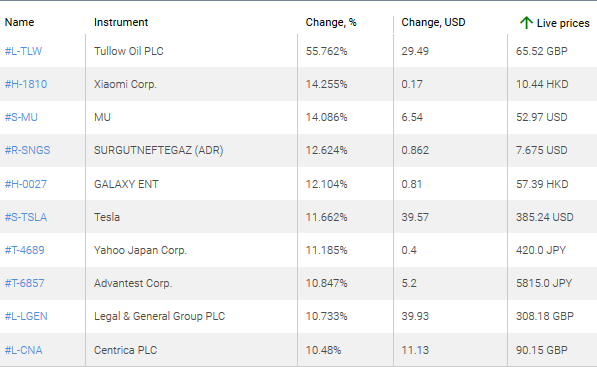
1. Tullow Oil PLC – a British oil company.

2. Xiaomi Corporation – a Chinese manufacturer of mobile phones and other communication devices.

market sentiment ratio long short positions

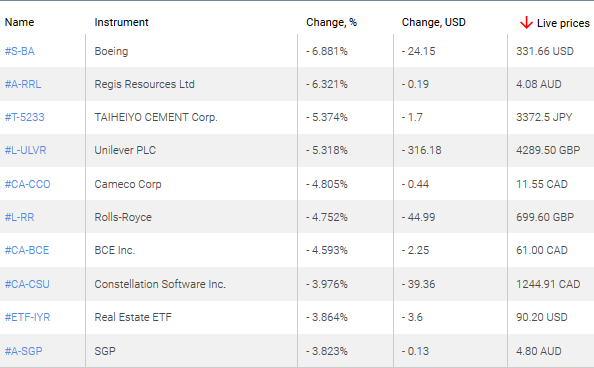
 Top Losers – The World Market

1. Boeing – an American aircraft company.

2. Regis Resources Ltd – an Australian non-ferrous metals producer.

market sentiment ratio long short positions

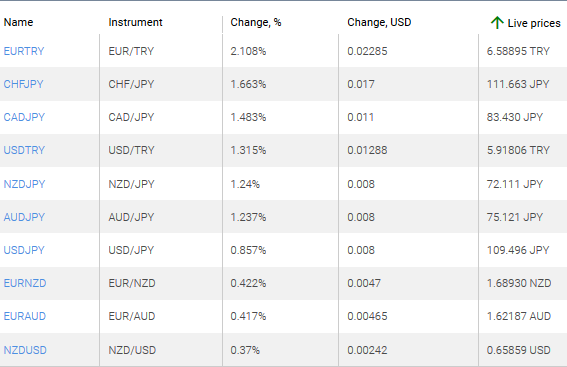
 Top Gainers – Foreign Exchange Market (Forex)

1. EURTRY, USDTRY – an increase in these charts means the weakening of the Turkish lira against the euro and the US dollar.

2. CHFJPY, CADJPY – an increase in these charts indicates the weakening of the Japanese yen against the Swiss franc and Canadian dollar.

market sentiment ratio long short positions

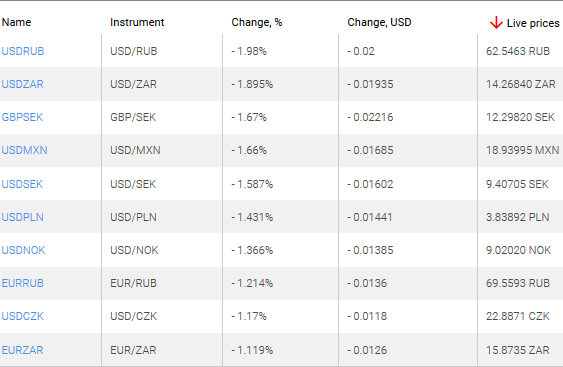
 Top Losers – Foreign Exchange Market (Forex)

1. USDRUB, USDZAR – a decrease in these charts means the weakening of the US dollar against the Russian ruble and the South African rand.

2. GBPSEK, USDSEK – a decrease in these charts means the strengthening of the Swedish krona against the British pound and the US dollar.

market sentiment ratio long short positions

Market Analysis provided by IFCMarkets

Note:
This overview has an informative and tutorial character and is published for free. All the data, included in the overview, are received from public sources, recognized as more or less reliable. Moreover, there is no guarantee that the indicated information is full and precise. Overviews are not updated. The whole information in each overview, including opinion, indicators, charts and anything else, is provided only for familiarization purposes and is not financial advice or а recommendation. The whole text and its any part, as well as the charts cannot be considered as an offer to make a deal with any asset. IFC Markets and its employees under any circumstances are not liable for any action taken by someone else during or after reading the overview.

Another Cut From Banxico?

By Orbex

The simple answer appears to be a near-universal, “yes”.

It seems that the only open question now is whether it will be a 25 basis point cut or a 50 pointer. Last week´s inflation report showed that it had slipped by a hair below the bank’s target. And they appear to be intent on making the most of it to support the economy!

With holiday trading looming immediately after the interest rate decision, most traders seem to be focusing on the implications for next year. If the Banxico cuts rates, it will be a decoupling from the Fed’s policy.

Initial moves by the Mexican regulator were seen as necessary to keep pace with easing from their northern neighbor.

The Trajectory

Even after three back-to-back rate cuts, and a fourth coming up, Mexico still has the highest interest rates in the world when adjusted for inflation. However, this hasn’t translated into extraordinary strength for the MXN, mostly out of concerns over the domestic situation.

The currency has been gathering some headwinds against the dollar following the announcement that the USMCA deal was finally moving forward in the US Congress.

Analysts have moved on from projecting that Banxico will take an insurance approach to maintain the interest rate spread with the country’s largest trade partner. The consensus is that, as long as inflation stays close to the target rate, they will be cutting rates as much as they can.

That would imply that economists are looking at a further five rate cuts by the end of next year. And this would leave the rate at 6.0%.

We Don’t Expect it to be Smooth Sailing

A major challenge to the peso and the central bank going forward is the 20% increase in the minimum wage. The increase was approved by Congress and will go into effect next year. This is after an already significant 16% increase this year.

That, it should be noted, didn’t cause the inflation rate to explode. So, perhaps the same will happen next year.

Banxico sees the economy as essentially flat this year. The bank forecasts growth to be between -0.2% and +0.2%, after the technical recession at the start of the year. For next year, they cut the growth outlook to just 0.8-1.8%, which would increase pressure for further easing policies.

So, What About 50 Points?

There seems to be little chance that the Banxico will cut more than 25 points at the next meeting. And the market appears to agree!

The bank has to thread the needle between lowering rates but not allowing inflation to get out of hand, and erasing the positive effect of more money in the economy.

Despite what is pretty sure to be four consecutive rate cuts, the Banxico still wants to keep its independent and conservative reputation. This would help prevent too much weakness in the MXN.

By Orbex


Markets Trade Cautiously As Brexit Concerns Rise

By Orbex

Investors remain cautious as the risk of a no-deal Brexit puts focus back on the UK. This comes amid a lack of any new reports on the US-China trade deal.

Economic data also remains sparse for the USD. There were some speeches from Fed members, but investors did not seem too keen.

Trading volumes are expected to slow as the holiday season nears.

Euro Slips Despite Annual Inflation Holding Steady

The euro gave back the gains from earlier in the week. Economic data shed light on the annual inflation report.

Consumer prices in the eurozone rose by 1.0% on the headline for the year ending November 2019. This was in line with the flash forecasts.

Core CPI was also within estimates, rising 1.3% annually.

EURUSD Could Rebound in the Near Term

The currency pair fell past the 1.1131 level. The current pace of declines will see the common currency testing the lower price level at 1.1100.

It is quite likely that the currency pair will rebound off this level. The Stochastics oscillator is looking to move out from the oversold levels. But in the short term, the EURUSD will remain range-bound within 1.1177 and 1.1072.

Sterling Continues its Descent

The pound sterling was seen adding another session of declines. The slump in the currency comes as investors price in the risk of a no-deal Brexit.

This comes due to the plans of the UK to leave the EU by end of next year, regardless of a deal with the EU. Economic data remains on the background with focus turning back to Brexit, after PM Johnson scored a majority win in the parliamentary elections.

Will the GBPUSD Fall Further?

The currency pair is currently trading near the lower support area of 1.3100. We expect some consolidation to take place at this level. The Stochastics is well oversold, indicating that the momentum will slow.

However, we expect that GBPUSD will now likely stay range-bound within 1.3100 and 1.2960.

Crude Oil Gains on EIA Report

Crude oil prices reversed the declines from Tuesday following the weekly inventory report. Oil prices initially fell after the API data saw a surprise build up in inventory.

However, the Energy Information Administration data showed that there was a draw of 1.1. million barrels for the week ending December 13.

WTI Likely to Retreat Off Current Highs

The bullish fundamentals have kept crude oil on track to test the resistance level of 61.00. But following this attempt, price action could see a retracement.

The recently breached resistance level of 58.65 is to become the likely candidate for a test of support. Establishing support here could strengthen the potential for further gains beyond the 61.00 level.

By Orbex


Philippine Water Crisis in International Perspective

By Dan Steinbock

By international comparison, the Philippines should not necessarily suffer from major water crises. So why has Metro Manila turned into a Cape Town?

According to data by World Resources International (WRI), 17 countries – home to one-quarter of the world’s population – are coping with “extremely high” levels of baseline water stress. That’s because irrigated agriculture, industries and municipalities withdraw annually more than 80% of available supply.

The list of these countries features Gulf nations (Qatar, Kuwait, Saudi Arabia), Middle East and North Africa (Israel, Lebanon, Iran, Libya), sub-Saharan Africa (Eritrea, Botswana), South Asia (India, Pakistan). A far larger group of countries face “high” levels of stress, where over 40% of available supply is withdrawn every year. The third group suffering from “medium” water stress features two dozen countries.

The countries that belong to the fourth group of “low-medium” baseline presumably suffer less from water stress. It includes the United States, Japan and UK, and Russia. Despite its water woes, the Philippines is listed in this group.

If water stress should be tolerable in the Philippines, why are realities different?

Management or mismanagement

The responsible government agencies and water companies argue that the private sector “saved” Metro Manila from the water crisis in the 1990s. Nevertheless, the concession agreements with Maynilad Water Services and Manila Water were heavily criticized at the time.

The defenders of the deal suggest that the government was compelled to sweeten up the concession agreement for companies so that they would be willing to patch up Manila’s water system. Yet, the agreement rests on an arrangement, which ensures companies lucrative profits, while risks were passed on to the government and consumers, due to controversial rate rebasing- setting of basic water rates.

Instead of investing on Philippine water safety, water companies seem to prefer substantial dividends. They have also spent millions for expenses like sports, “philanthropic donations,” and reportedly have departments with more managers than rank-and-file employees. Some of these oddities might be explained by the personal hobbies of Maynilad Water’s CEO “Manny” Pangilinan, a well-known sports patron and team owner. But private hobbies should not thrive at the public’s expense.

Maynilad Water also has interlocking corporate structures associating Pangilinan with Hong Kong-based First Pacific Company Ltd and the group’s investments in Metro Pacific Investment Corp, PLDT and Philex Mining Corp., and think-tanks that have parallel structures with U.S. organizations and controversial foreign interests – including ones that seek to shape domestic and regional geopolitics.

One might think that an exclusive focus on water security would be more warranted.

Collateral damage of foodborne diseases, dengue

In March, the World Health Organization (WHO) stated that in the Philippines 1 in 10 people still do not have access to improved water sources, especially in rural communities. In 2016, one of the top 10 leading causes of death in the Philippines was acute watery diarrhea, claiming over 139,000 lives. By spring, the situation was set to worsen as the country is beset by the El Niño phenomenon and climate change that can contribute to rising temperature, drying up water sources.

When water is scarce, people – particularly poorer people – are often forced to rely on drinking water sources that are not safe. And as they are unlikely to have sufficient water for basic hygiene, they become increasingly vulnerable to foodborne and waterborne diseases. Low or negative water pressure in pipes due to short supply attracts contaminants that put water quality at risk when the supply is restored.

Moreover, limited supply obliges people to store more water. If not handled properly (and the likelihood increases with poverty), this will provide more opportunities for mosquitoes to breed increasing cases of mosquito-borne diseases, such as dengue fever. According to Department of Health (DOH), more than 402,000 dengue cases were reported nationwide as of Nov. 16, a 92% increase from last year.

While the dengue explosion was affected by many forces, including lack of adequate vaccination and a severe typhoon season, it would be naïve to ignore the impact of severe water challenges through the year.

How water became an international challenge

Water crises are becoming more commonplace. In early fall, water reservoirs in Chennai, one of India’s megacities, were almost dry. Last year, South Africa was in headlines when the people of Cape Town barely avoided their water shutoff. And the year before, Rome had to start rationing water to conserve resources.

While increasing water challenges are often attributed to “climate change,” the underlying reasons are more complicated and go beyond the simple issue of drought. In a recent report, WRI discovered that water withdrawals globally have more than doubled since the 1960s, due to rising demand and show few signs of slowing down.

Many water companies explain the problems by reference to modernization and the rise of new middle-classes. In this view, population growth, development and urbanization are increasing water demands, while climate change is making precipitation and demand more variable.

Yet, none of these phenomena change overnight. Big shifts in population growth take decades, even generations. Development is a long-term process. The transition from agricultural societies to urban centers often requires four to five decades.

Successful businesses know how to adjust to fluctuations of demand in a proactive manner. The big question is why, instead of embracing a flexible long-term strategy, Philippine water companies have not adequately prepared for these challenges that have been building for decades?

About the Author:

Dr. Dan Steinbock is an internationally recognized strategist of the multipolar world and the founder of Difference Group. He has served at the India, China and America Institute (US), the Shanghai Institutes for International Studies (China) and the EU Center (Singapore). For more, see https://www.differencegroup.net/   

The original version was published by The Manila Times on December 16, 2019.


BRENT Analysis: Tighter US crude inventories bullish for BRENT

By IFCMarkets

Tighter US crude inventories bullish for BRENT

US crude oil inventories declined last week. Will the BRENT rise?

The crude oil output is set to be cut by 500,000 barrels per day starting in January by the Organization of the Petroleum Exporting Countries and other major producers, including Russia, as agreed by OPEC earlier this month. And the rising premium held by the nearby Brent contract over later-dated contracts confirm decline in global inventories according to Warren Patterson, head of commodities strategy at ING. Expectations of tighter supplies are bullish for Brent. On the short term supply side, the Energy Information Administration reported US crude inventory fell by 1.1 million barrels last week. Though the decline was smaller than SP Global Platts analysts forecast, data showed increased supply for gasoline up by 0.5% over year for the past four. It is an indication of recovering gasoline demand.

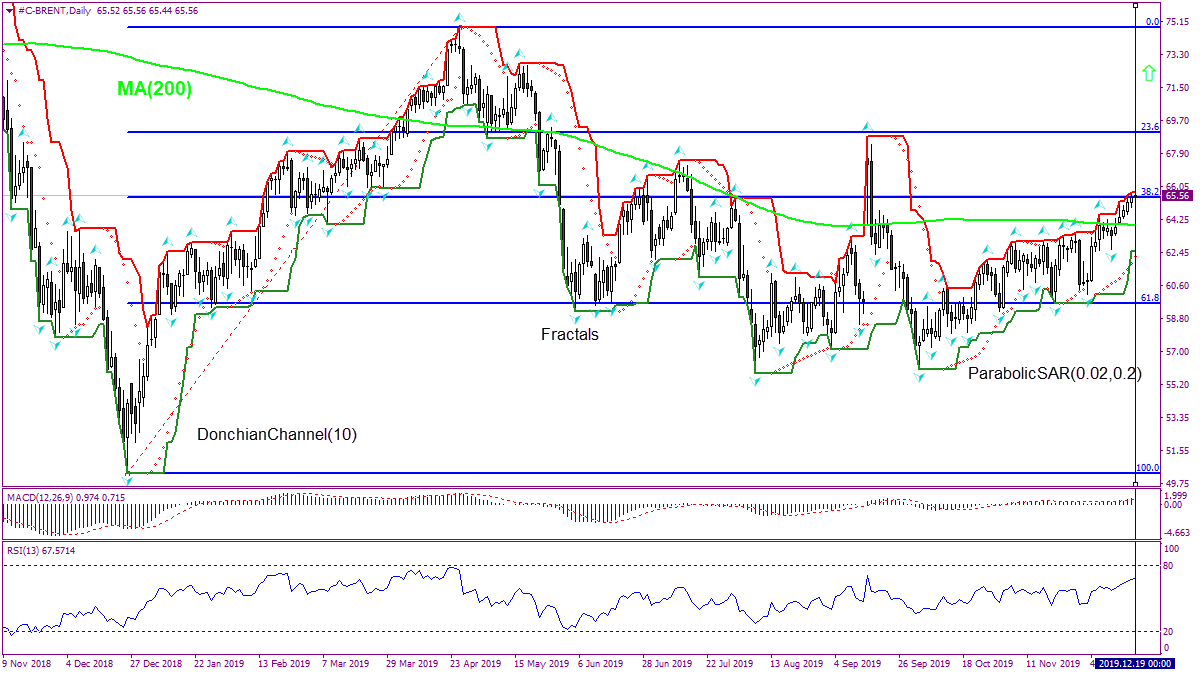
BRENT breaching Fibonacci 38.2 12/19/2019 Technical Analysis IFC Markets chart

On the daily timeframe the BRENT: D1 is rising above 200-day moving average MA(200), which is still inclined lower. The price is tesing Fibonacci 38.2 level, and further movement higher will confirm upward momentum.

  • The Parabolic indicator gives a buy signal.
  • The Donchian channel indicates uptrend, it is widening up.
  • The MACD indicator gives a bullish signal: it is above the signal line and the gap is widening.
  • The RSI oscillator is flat above the 50 level.

We believe the bullish momentum will continue after the price breaches above the upper boundary of Donchian channel at 65.74. A level above this can be used as an entry point for placing a pending order to buy. The stop loss can be placed below the lower Donchian boundary at 62.52. After placing the order, the stop loss is to be moved every day to the next fractal low, following Parabolic signals. Thus, we are changing the expected profit/loss ratio to the breakeven point. If the price meets the stop loss level (62.52) without reaching the order (above 65.74), we recommend cancelling the order: the market has undergone internal changes which were not taken into account.

Technical Analysis Summary

OrderBuy
Buy stopAbove 65.74
Stop lossBelow 62.52

Market Analysis provided by IFCMarkets

Oil Higher On Bullish EIA Report

By Orbex

Inventories Rise Despite API Report

Its been another solid week for crude oil which was driven higher again by a bullish report from the Energy Information Administration.

There had been some jitters earlier in the week due to a release from the API. This reported an unexpected build in US crude inventories last week.

However, the headline report from the EIA showed that in the week ending December 13th, US crude stocks were lower by 1.1 million barrels.

This was not as low as the 2.5 million barrels decrease expected in light of the inventory build reported by the API a day earlier. However, the market was clearly relieved, particularly on the back of an 800K barrel build over the prior month.

Gasoline Inventories Higher

The latest data from the EIA also showed that US gasoline inventories were higher by 2.5 million barrels. This extended gains from the prior week’s increase of 5.4 million barrels.

Gasoline production was notably higher over the week also, averaging 9.8 million barrels per day.

The report also showed that distillate fuel supplies, including heating oil and diesel, were higher by 1.5 million barrels. This figure marked a further extension from the prior week’s 4.1 million barrels. A production rate of 5.2 million barrels per day on average is what drove the result.

Elsewhere in the report, refinery processing rates held steady at 16.6 million barrels per day. Meanwhile, imports were slightly lower at 6.6 million barrels per day. This was down from 6.9 million barrels per day.

Tide Turning Positive For Crude

This latest report from the EIA comes amidst a backdrop of much more positive expectations among oil traders. The news that the US and China have agreed a phase one trade deal has significantly lifted the outlook for crude demand.

The trade war between the two leading global economies has been a major source of negative pressure for crude prices this year. With the phase-one trade deal complete, the two sides are due to start negotiations on the second phase soon after the turn of the year.

OPEC will be especially welcoming of the news. The oil cartel recently announced that it was increasing the level of its production cuts from 1.2 million barrels per day to 1.7 million barrels per day.

OPEC has cited the trade war as one of the main issues, along with rising US crude production, as the reason behind its production cuts. The cuts are still due to run until the end of Q1 2020 currently.

Technical Perspective

Crude prices are continuing to rally higher here with price holding above the 60 level for now. This region marked the top of the range which has framed the majority of price action over the last six months. Above here, focus is on a further push higher to test the 62.46 level next if price can break above the bearish trend line from 2019 highs which is currently being tested.

By Orbex


Ichimoku Cloud Analysis 19.12.2019 (AUDUSD, NZDUSD, USDCAD)

Article By RoboForex.com

AUDUSD, “Australian Dollar vs US Dollar”

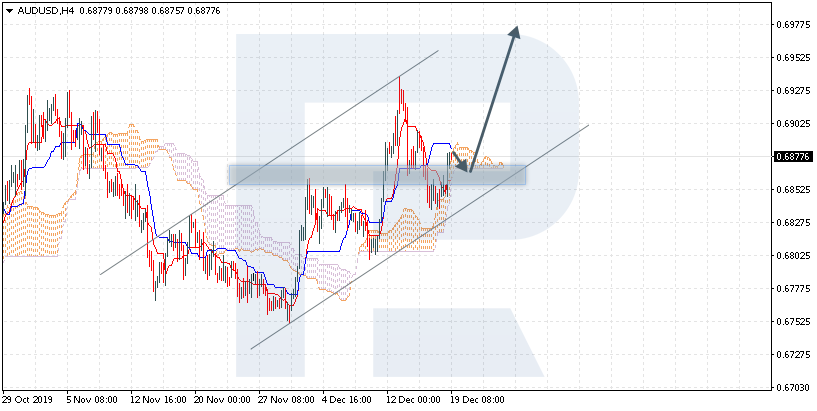
AUDUSD is trading at 0.6877; the instrument is moving above Ichimoku Cloud, thus indicating an ascending tendency. The markets could indicate that the price may test the cloud’s downside border at 0.6855 and then resume moving upwards to reach 0.6975. Another signal to confirm further ascending movement is the price’s rebounding from the support level. However, the scenario that implies further growth may be canceled if the price breaks the cloud’s downside border and fixes below 0.6835. In this case, the pair may continue falling towards 0.6725.

AUDUSD
Risk Warning: the result of previous trading operations do not guarantee the same results in the future

NZDUSD, “New Zealand Dollar vs US Dollar”

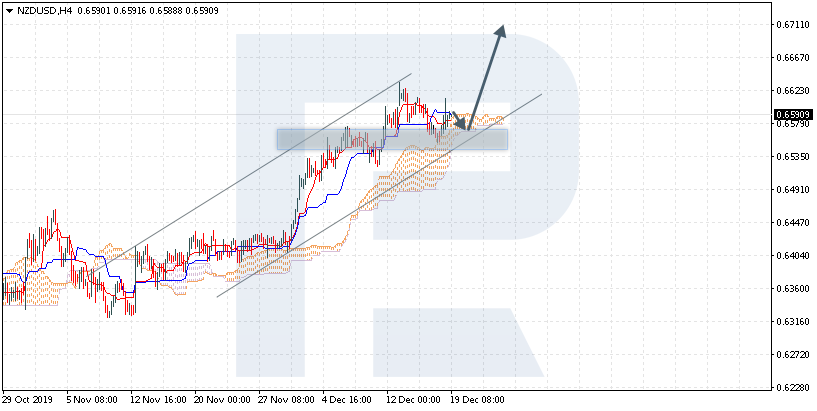
NZDUSD is trading at 0.6590; the instrument is moving above Ichimoku Cloud, thus indicating an ascending tendency. The markets could indicate that the price may test the cloud’s downside border at 0.6575 and then resume moving upwards to reach 0.6710. Another signal to confirm further ascending movement is the price’s rebounding from the rising channel’s downside border. However, the scenario that implies further growth may be canceled if the price breaks the cloud’s downside border and fixes below 0.6525. In this case, the pair may continue falling towards 0.6415.

NZDUSD
Risk Warning: the result of previous trading operations do not guarantee the same results in the future

USDCAD, “US Dollar vs Canadian Dollar”

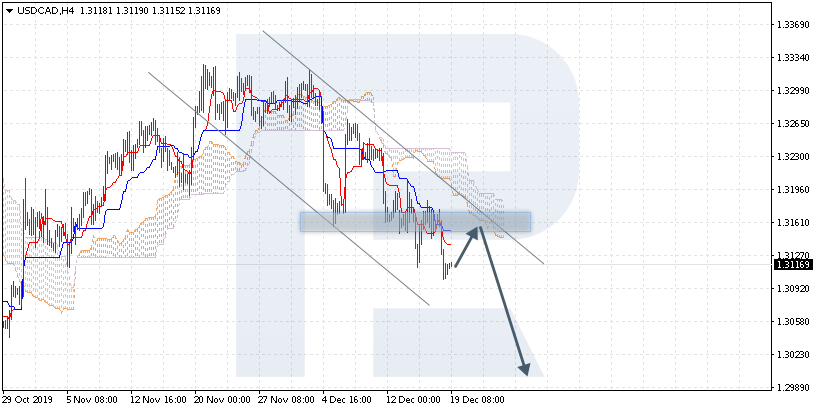
USDCAD is trading at 1.3116; the instrument is moving below Ichimoku Cloud, thus indicating a descending tendency. The markets could indicate that the price may test the cloud’s downside border at 1.3145 and then resume moving downwards to reach 1.3005. Another signal to confirm further descending movement is the price’s rebounding from the descending channel’s upside border. However, the scenario that implies further decline may be canceled if the price breaks the cloud’s upside border and fixes above 1.3245. In this case, the pair may continue growing towards 1.3305.

USDCAD

Article By RoboForex.com

Attention!
Forecasts presented in this section only reflect the author’s private opinion and should not be considered as guidance for trading. RoboForex LP bears no responsibility for trading results based on trading recommendations described in these analytical reviews.

Murrey Math Lines 19.12.2019 (USDCHF, GOLD)

Article By RoboForex.com

USDCHF, “US Dollar vs Swiss Franc”

In the H4 chart, USDCHF is moving below 3/8. In this case, the price is expected to break 1/8 and continue falling to reach the support at 0/8. However, this scenario may no longer be valid if the price breaks 2/8 to the upside. After that, the instrument may continue growing towards the resistance at 5/8.

USDCHF_H4
Risk Warning: the result of previous trading operations do not guarantee the same results in the future

As we can see in the M15 chart, the pair has broken the downside line of the VoltyChannel indicator and, as a result, may continue trading downwards.

USDCHF_M15
Risk Warning: the result of previous trading operations do not guarantee the same results in the future

XAUUSD, “Gold vs US Dollar”

As we can see in the H4 chart, XAUUSD is moving above 5/8. In this case, the price may break 7/8 and continue trading upwards to reach the resistance at 8/8. However, this scenario may no longer be valid if the price breaks 6/8 to the downside. After that, the instrument may continue falling towards the support at 5/8.

GOLD_H4
Risk Warning: the result of previous trading operations do not guarantee the same results in the future

In the M15 chart, the pair may break the upside line of the VoltyChannel indicator and, as a result, continue the ascending tendency.

GOLD_M15

Article By RoboForex.com

Attention!
Forecasts presented in this section only reflect the author’s private opinion and should not be considered as guidance for trading. RoboForex LP bears no responsibility for trading results based on trading recommendations described in these analytical reviews.

The Analytical Overview of the Main Currency Pairs on 2019.12.19

by JustForex

The EUR/USD currency pair

Technical indicators of the currency pair:
  • Prev Open: 1.11493
  • Open: 1.11128
  • % chg. over the last day: -0.31
  • Day’s range: 1.11122 – 1.11326
  • 52 wk range: 1.0879 – 1.1572

The EUR/USD currency pair is still in sideways movement. The technical picture is ambiguous. Participants in financial markets expect additional drivers. At the moment, the local support and resistance levels are 1.11100 and 1.11350, respectively. We recommend you yo keep track of up-to-date information regarding trade negotiations between Washington and Beijing. Today, investors will evaluate important economic releases from the United States. You should open positions from key levels.

The Economic News Feed for 19.12.2019:

  • – The index of production activity from the Federal Reserve Bank of Philadelphia (US) – 15:30 (GMT+2:00);
  • – sales in the secondary housing market (US) – 17:00 (GMT+2:00);
EUR/USD

Indicatorsdo not give accurate signals: 50 MA has crossed 100 MA.

The MACD histogram has approached the 0 mark. There are no signals at the moment.

The Stochastic Oscillator is in the neutral zone, the %K line has crossed the %D line. There are no exact signals.

Trading recommendations
  • Support levels: 1.11100, 1.10900, 1.10600
  • Resistance levels: 1.11350, 1.11550, 1.11700

If the price consolidates above 1.11350, expect the quotes to ascend toward 1.11600-1.11800.

Alternatively, the quotes could drop toward 1.10800-1.10600.

The GBP/USD currency pair

Technical indicators of the currency pair:
  • Prev Open: 1.31253
  • Open: 1.30801
  • % chg. over the last day: -0.34
  • Day’s range: 1.30705 – 1.30975
  • 52 wk range: 1.1959 – 1.3516

The GBP/USD currency pair has stabilized after a significant drop since the beginning of this week. Sterling is currently consolidating. The local support and resistance levels are: 1.30650 and 1.31350, respectively. Investors took a wait and see attitude before the meeting of the Bank of England. It is expected that the regulator will maintain the basic parameters of monetary policy at the same level. We recommend keeping track of up-to-date information regarding the Brexit process. Positions must be opened from key levels.

The Economic News Feed for 19.12.2019:

  • – Retail Sales Report (UK) – 11:30 (GMT+2:00);
  • – Decision on the Interest Rate from Bank of England (UK) – 14:00 (GMT+2:00);
GBP/USD

Indicators signal the power of sellers: the price has fixed below 50 MA and 100 MA.

The MACD histogram is in the negative zone, but above the signal line, which gives a weak signal to sell GBP/USD.

The Stochastic Oscillator is in the neutral zone, the %K line is above the %D line, which indicatesa bullish sentiment.

Trading recommendations
  • Support levels: 1.30650, 1.30300
  • Resistance levels: 1.31350, 1.32100, 1.33000

If the price consolidates below 1.30650, expect a further drop toward 1.30300-1.30000.

Alternatively, the quotes could grow toward 1.32000-1.32300.

The USD/CAD currency pair

Technical indicators of the currency pair:
  • Prev Open: 1.31593
  • Open: 1.31140
  • % chg. over the last day: -0.34
  • Day’s range: 1.31076 – 1.31197
  • 52 wk range: 1.3014 – 1.3664

USD/CAD has moved into a decline again. The trading tool has updated local lows. Looney is currently consolidating. The local support and resistance levels are 1.31000 and 1.31300, respectively. The Canadian dollar is supported by the positive dynamics of oil quotes. The USD/CAD currency pair has the potential for further decline. Today we recommend paying attention to statistics on the US economy. Open positions from key levels.

At 15:30 (GMT+2:00), a report on the volume of wholesale sales in Canada will be published.

USD/CAD

Indicators signal the power of sellers: the price has fixed below 50 MA and 100 MA.

The MACD histogram is in the negative zone but above the signal line, which gives a weak signal to sell USD/CAD.

The Stochastic Oscillator is in the neutral zone, the %K line is below the %D line, which indicates a bearish sentiment.

Trading recommendations
  • Support levels: 1.31000, 1.30700
  • Resistance levels: 1.31300, 1.31500, 1.31800

If the price consolidates below the round level of 1.31000, expect the quotes to rise toward 1.30700-1.30500.

Alternatively, the quotes could grow toward 1.31500-1.31700.

The USD/JPY currency pair

Technical indicators of the currency pair:
  • Prev Open: 109.472
  • Open: 109.575
  • % chg. over the last day: +0.08
  • Day’s range: 109.524 – 109.683
  • 52 wk range: 104.45 – 113.53

The USD/JPY currency pair continues to trade flat. Unidirectional trends are not observed. The trading tool tests local support and resistance levels: 109.400 and 109.650, respectively. USD/JPY quotes have the potential for further growth. We recommend that you pay attention to economic reports, as well as the dynamics of the yield of US government securities. Open positions from key levels.

The Bank of Japan, as expected, kept the basic parameters of monetary policy at the same level. The regulator has improved the forecast for Japan’s GDP growth in 2020.

USD/JPY

Indicators do not give accurate signals: the price is consolidating near 50 MA and 100 MA.

The MACD histogram has approached the 0 mark.

The Stochastic Oscillator is in the neutral zone, the %K line crossed the %D line. There are no signals at the moment.

Trading recommendations
  • Support levels: 109.400, 109.250, 109.050
  • Resistance levels: 109.650, 110.000

If the price consolidates above 109.650, expect a further growth toward 110.000-110.200.

Alternatively, the quotes could drop toward 109.250-109.100.

by JustForex

Investors Are Following the Process of D. Trump’s Impeachment

by JustForex

During yesterday’s trading, the US dollar was being traded without clear dynamics relative to a basket of major currencies. The dollar index (#DX) closed yesterday in the green zone (+0.19%). However, investors were surprised by the news that the US House of Representatives voted in favor of Donald Trump’s impeachment for abuse of power and opposition to Congress. In January, a vote will be held in the Republican Senate, after which it will become clear what awaits the current US President D. Trump. However, many analysts are confident that the Senate will not support Trump’s impeachment.

The British pound is still under pressure due to the uncertainty concerning Brexit. Today, investors expect the Bank of England interest rate decision. It is expected that the rate will remain unchanged at 0.75%. Also, financial market participants are waiting for new information on Brexit.

Today, during the Asian trading session, the Bank of Japan has decided on the interest rate. The regulator left the indicator at the level of -0.10%. The regulator raised its forecast for the country’s GDP growth for 2020. Positive Australian labor market report supported Aussie.

The “black gold” prices are changing slightly. Currently, futures for the WTI crude oil are testing the $60.85 mark per barrel. At 17:30 (GMT+2:00), crude oil inventories will be published.

Market Indicators

Yesterday, there was a variety of trends in the US stock market: #SPY (+0.01%), #DIA (-0.07%), #QQQ (+0.08%).

The 10-year US government bonds yield has increased significantly. At the moment, the indicator is at the level of 1.94-1.95%.

The Economic News Feed for 19.12.2019:
  • – Retail sales in the UK at 11:30 (GMT+2:00);
  • – Bank of England interest rate decision at 14:00 (GMT+2:00);
  • – Philadelphia Fed manufacturing index at 15:30 (GMT+2:00);
  • – Existing home sales in the US at 17:00 (GMT+2:00).

by JustForex