Greenback is losing ground relative to a basket of world currencies. Yesterday, the dollar index (#DX) moved away from local highs and closed in the red zone (-0.14%). Investors began to partially fix positions in the US dollar. Demand for risky assets resumed amid prospects for a settlement of the trade conflict between Washington and Beijing. The US currency has the potential to further decline relative to its main competitors.
It should be recalled that earlier the United States and China agreed to conclude the phase one trade agreement, which can be signed in early January. On Thursday, US President Donald Trump announced that a signing ceremony would be held soon and that the deal was being completed. These reports strengthened the demand for a group of commodity currencies. We also recommend following current information on the Brexit issue.
There is the bullish sentiment in the “black gold” market. Oil quotes reached three-month highs. At the moment, futures for the WTI crude oil are testing the $61.90 mark per barrel.
Market Indicators
Major US stock indices have set new historical highs.
The 10-year US yield government bonds continue to decline. At the moment, the indicator is at the level of 1.88-1.89%.
The Economic News Feed for 27.12.2019:
Today, the publication of important economic releases is not planned.
On Thursday the 26th of December, the euro 11 points up (1.1096) at the close of trading. There was no news to explain the recovery in price. Rising global stock indices and the general weakening of the dollar after Christmas helped to strengthen risky assets. These include the euro. Stock indices set new historic highs amid optimism in US-Chinese relations. Trump says the trade agreement is being translated into Chinese and will be concluded in early January 2020.
Day’s events (GMT+3):
12:00 Eurozone: Economic Bulletin.
19:00 USA: EIA Crude Oil Stocks Change (Dec 20).
21:00 USA: Baker Hughes US Oil Rig Count.
Current situation:
In Asian trading, the euro was up by 22 points (1.1122). The market will remain thin until the New Year. Yesterday, we wrote that we are more inclined see a strengthening in the euro until the end of December. According to seasonal cycles, statistics show that in the last week of December, the euro has strengthened 16 times (80%) out of 20 since 1999.
The Forex market remains in a festive mood after Christmas, bulls broke through the trend line. The price went up within the upwards channel. Stopped at 45 degrees from the low of 1.1069. In theory, the price should jump back up to the 67th degree – 1.1145.
We are concerned about several points, because of these points we do not like to trade in a thin market:
Decline in growth;
The euro index ran into resistance near the trend line, which passes through 102.11. We need a news item to provide the reason for a breakthrough before the weekend. The news calendar is empty, so you do not know what will act as a trigger for the offensive;
Stochastic is already in the sales area;
A third peak was formed at AO.
If the euro index breaks resistance, the growth of EURUSD pair will accelerate. By the end of the year, we predict strengthening of the euro.
Asian stocks are mirroring the climb in US equities, after all three US benchmark indices posted fresh record highs. Investors are clearly in high spirits during this year-end season, with the 2020 global economic outlook turning brighter in anticipation of the US-China “phase one” trade deal. The buying momentum is likely to be sustained, amid expectations that the manufacturing sectors around the world as well as global trade conditions can take advantage of the expected rollback of tariffs, while major central banks persist with their accommodative stance.
Brent trades at highest level since September
The risk-on mode is also clearly evident in Brent Oil, which is carving a path towards the psychologically-important $67/bbl mark. Investors will be closely eyeing the EIA US inventories data, due later today, to see whether Oil prices can be justified higher. With Brent’s 50-day moving average having already broken above its 100-day moving average earlier this month, Oil prices could climb another leg higher on signs that OPEC+ supply cuts will be extended past March 2020, falling US inventories, as well as evidence of demand-side improvements stemming from thawing global trade tensions.
Risk appetite needs to kick into another gear for USDJPY to push higher
The current risk-on momentum however doesn’t appear enough for USDJPY to punch above the 109.6 level for the time being, with the currency pair adhereing to its low-volatility character. As long as risk appetite can hold up, the expected bias for USDJPY is to the upside through Q1 2020, as it carves out slow and steady steps towards the 111.0 level.
Disclaimer: The content in this article comprises personal opinions and should not be construed as containing personal and/or other investment advice and/or an offer of and/or solicitation for any transactions in financial instruments and/or a guarantee and/or prediction of future performance. ForexTime (FXTM), its affiliates, agents, directors, officers or employees do not guarantee the accuracy, validity, timeliness or completeness, of any information or data made available and assume no liability as to any loss arising from any investment based on the same.
Dollar weakening continued despite strong labor data
US stock market rally was intact on Thursday supported by strong retail sales and labor market data. The S&P 500 gained 0.5% to new record 3239.91. The Dow Jones industrial average advanced 0.4% to fresh record 28621.39. Nasdaq composite index rallied 0.8% to 9022.39 led by 4% gain in Amazon after the e-commerce giant said the holiday shopping season broke all records. The dollar weakening continued despite Labor Department report new applications for unemployment benefits fell second week in a row: live dollar index data show the ICE US Dollar index, a measure of the dollar’s strength against a basket of six rival currencies, slipped 0.1% to 97.56 and is lower currently. Wall Street will reopen today with futures on US stock indices pointing to mixed openings.
European markets were closed on Thursday, reopen today
Hang Seng leads Asian Indexes gains
Asian stock indices are mixed today. Nikkei ended down 0.4% at 23837.72 with yen climb against dollar resuming. Chinese stocks are mixed: the Shanghai Composite Index is down 0.1% despite report China’s industrial profits grew at fastest in eight months, while Hong Kong’s Hang Seng Index is 1.2% higher. Australia’s All Ordinaries Index gained 0.4% as Australian dollar continues its climb against the greenback.
Brent rises on expectations of US inventories fall
Brent futures prices are extending gains today. Prices ended at a more than three-month high yesterday: February Brent crude rose 1.1% to $67.92 a barrel on Thursday. Today at 16:30 CET the Energy Information Administration will release US Crude Oil Inventories after American Petroleum Institute Tuesday report that US crude supplies fell by 7.9 million barrels last week.
Gold strengthening continues while Dollar weakens
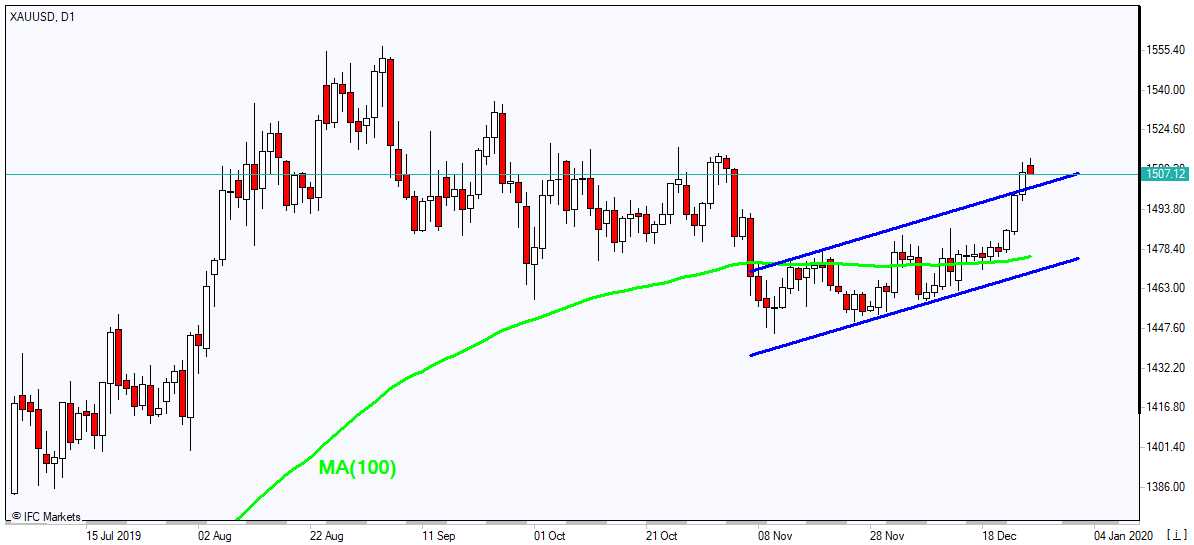
Gold prices are little changed today after third session of gains in a row on Thursday. Prices ended above $1500 yesterday as dollar weakening continued: February gold gained 0.6% to $1514.40 an ounce, the highest finish since the end of October.
Note: This overview has an informative and tutorial character and is published for free. All the data, included in the overview, are received from public sources, recognized as more or less reliable. Moreover, there is no guarantee that the indicated information is full and precise. Overviews are not updated. The whole information in each overview, including opinion, indicators, charts and anything else, is provided only for familiarization purposes and is not financial advice or а recommendation. The whole text and its any part, as well as the charts cannot be considered as an offer to make a deal with any asset. IFC Markets and its employees under any circumstances are not liable for any action taken by someone else during or after reading the overview.
By CentralBankNews.info Sri Lanka’s central bank maintained its accommodative monetary policy stance and its key interest rates, saying the government’s tax cuts and its moratorium on the repayment of bank loans by small and medium-sized enterprises (SMEs) “are likely to provide further impetus to the economy.” The Central Bank of Sri Lanka (CBS), which has cut key interest rates by a total of 100 basis points in 2019 and lowered the reserve requirement for banks by 250 basis points since November 2018, added the president’s policy statement on Jan. 3 will also provide further clarity as to the economic and fiscal policy in the medium term. It was the first monetary policy decision by CBS since economist and academic Weligamage Don Lakshman assumed the duties of governor on Dec. 24, replacing Indrajit Coomaraswamy who stepped down on Dec. 20 for personal reasons. The appointment of Lakshman as governor was one of the main economic appointments by Gotabaya Rajapaksa, who was elected president on Nov. 16. Rajapaksa, a former defense chief who oversaw the military defeat of Tamil separatists under his brother and then president Mahinda Rajapaksa 10 years ago, has said he will call a parliamentary election to consolidate his power. But Rajapaksa has already announced several measures to stimulate the economy, including cutting the value-added-tax on most goods to 8.0 percent from 15 percent as of Dec. 1 and an extension of the one-year moratorium on the repayment of bank loans of up to 300 million rupees by SMEs. “The decision by the monetary board is consistent with the aim of maintaining inflation in the 4-6 per cent range while supporting economic growth to reach its potential over the medium term” CBS said, adding the current accommodative policy stance was appropriate and there was “ample space for market lending rates to reduce without further adjustment in policy rates.” The central bank’s Standing Deposit Facility Rate (SDFR) stands at 7.0 percent, the Standing Lending Facility Rate (SLFR) at 8.0 percent and the Statutory Reserve Ratio (SRR) at 5.0 percent. Sri Lanka’s economy and its tourism sector is gradually recovering from the Easter Sunday suicide bombings, which killed more than 250 people, with annual growth accelerating to 2.7 percent in the third quarter from 1.5 percent in the second quarter. CBS said political stability and short-term measures to stimulate the economy will revive economic activity and it expects momentum to be sustained through the introduction of structural reforms in the medium to long term. As part of the cut to VAT on Dec. 1, tourism-related services will pay no VAT. Sri Lanka’s inflation rate eased to 4.4 percent in November from 5.4 percent in October and CBS said further softening of inflation could be expected to the tax cuts and a reduction in some administered prices but it still projects inflation will remain in the 4-6 percent range in the medium term. Sri Lanka’s rupee has been buffeted by the Easter Sunday bombings and political instability but has still managed to rise this year to trade at 181.3 to the U.S. dollar today, up 0.9 percent this year.
The Central Bank of Sri Lanka issued the following press release:
“The Monetary Board of the Central Bank of Sri Lanka, at its meeting held on 26 December 2019, decided to maintain its accommodative monetary policy stance with the Standing Deposit Facility Rate (SDFR) and the Standing Lending Facility Rate (SLFR) of the Central Bank remaining at their current levels of 7.00 per cent and 8.00 per cent, respectively. The Board arrived at this decision following a careful analysis of current and expected developments in the domestic economy and the financial market as well as the global economy. The decision of the Monetary Board is consistent with the aim of maintaining inflation in the 4-6 per cent range while supporting economic growth to reach its potential over the medium term. The pace of monetary policy easing in advanced economies appears to be slowing Most advanced economies, which followed a monetary easing path owing to the general economic slowdown and muted inflation expectations, appear to have paused further monetary easing. However, most of the emerging market policymakers remained open to further accommodation in the period ahead in order to stimulate activity in their economies.
Domestic economic activity to recover gradually
As per the provisional estimates released by the Department of Census and Statistics, the Sri Lankan economy grew at the slow pace of 2.7 per cent during the third quarter of 2019 following the growth of 1.5 per cent in the second quarter of the year. Agriculture related activities grew marginally by 0.4 per cent, while Services and Industry related activities expanded by 2.8 per cent and 3.3 per cent, respectively. Going forward, a steady revival of economic activity is envisaged, supported by improved political stability and short term measures to stimulate the economy. It is expected that this momentum will be sustained through the introduction of appropriate medium to long term structural reforms. Inflation to remain at low single digit levels in the near term, and stabilise within 4-6 per cent in the medium term Headline inflation, as measured by the year-on-year change in both Colombo Consumer Price Index (CCPI) and National Consumer Price Index (NCPI), decelerated in November 2019 driven by the slowdown in food inflation. Further softening of inflation could be expected in the period ahead mainly due to the impact of the downward tax revisions and the reduction in selected administratively determined prices. Nevertheless, weather affected food price movements could result in increased volatility in inflation in the near term. Projections indicate that inflation is likely to remain in the range of 4-6 per cent over the medium term, with the gradual closing of the negative output gap and well anchored inflation expectations. Relatively stable external sector amidst challenging economic conditions Performance on the trade front continued to improve during the first ten months of 2019 with imports contracting considerably and merchandise exports recording a modest growth, thereby leading to a cumulative contraction in the deficit in the trade account. Provisional data suggests a significantly lower current account deficit in the first nine months of 2019 compared to the corresponding period of 2018. The tourism sector, which suffered a setback following the Easter Sunday attacks, has since recorded a faster than expected recovery. Workers’ remittances were somewhat low, while outflows of foreign investment were observed from the Government securities market and the equity market during the year. Nevertheless, the Sri Lankan rupee appreciated against the US dollar by 0.7 per cent thus far during 2019, with mixed movements being recorded throughout the year. Meanwhile, gross official reserves remained at US dollars 7.5 billion by end November 2019, which were sufficient to cover 4.5 months of imports.
Growth of monetary and credit aggregates expected to accelerate in 2020
Although a steady expansion in credit disbursed to the private sector in absolute terms was observed during the four month period commencing August 2019, the year-on-year growth of private sector credit continued to decelerate thus far during the year. Driven by low credit expansion, the year- on-year growth of broad money (M2b) also continued to moderate. Going forward, money and credit aggregates are expected to recover gradually, with the expected continued decline in lending rates, and other mechanisms that are being introduced to revive economic activity. Market lending rates, which continued to decline, are expected to reduce further Market lending rates continued to adjust downward in response to monetary and regulatory measures taken by the Central Bank. However, the observed reduction thus far has been less than envisaged, and financial institutions are expected to meet the stipulated reduction in lending rates in the period ahead. Policy interest rates maintained at current levels In consideration of the current and expected macroeconomic developments as highlighted above, the Monetary Board, at its meeting held on 26 December 2019, was of the view that the current accommodative monetary policy stance is appropriate, and that there is ample space for market lending rates to reduce without further adjustment in policy rates. The Monetary Board also noted that the already announced tax relief as well as the proposed moratorium on capital repayments of bank loans for the SME sector are likely to provide further impetus to the economy. In addition, His Excellency the President is expected to announce the government’s policy statement on 03 January 2020, which will provide further clarity to the broad economic policy framework as well as the fiscal policy direction for the medium term. In this context, the Monetary Board decided to maintain the Standing Deposit Facility Rate (SDFR) and the Standing Lending Facility Rate (SLFR) of the Central Bank at their current levels of 7.00 per cent and 8.00 per cent, respectively.” www.CentralBankNews.info
Shares of Apache Corp. traded 16% higher today after the company reported that it has formed a joint venture with Total SA of France to explore and develop Block 58 offshore Suriname.
Late yesterday evening, oil and gas exploration and production company Apache Corp. (APA:NYSE) and producer and marketer of fuels, natural gas and low-carbon electricity Total S.A. (TOT:NYSE), announced that they have established a 50-50 joint venture (JV) agreement to explore and develop Block 58 offshore Suriname.
The firms outlined the terms of the agreement indicating that Apache and Total will each own a 50% working interest in Block 58. The report advised that this area is composed of approximately 1,400,000 acres in water depths that range from below 100 meters to over 2,100 meters. “Apache will operate the first three exploration wells in the block, including the Maka Central-1 well, and subsequently transfer operatorship to Total.”
The JV agreement provides that “Apache will receive various forms of consideration, including: $5 billion of cash carry on Apache’s first $7.5 billion of appraisal and development capital; 25% cash carry on all of Apache’s appraisal and development capital beyond the first $7.5 billion; various cash payments in conjunction with closing of the joint venture agreement and future production from joint development projects; and reimbursement of 50% of all costs incurred to date in Block 58.”
Both firms advised that the transaction is expected to close within three days and they have already received all of the necessary approvals from the governmental authorities in Suriname to proceed.
Apache’s CEO and President John J. Christmann commented, “Suriname Block 58 presents a unique, large-scale oil resource opportunity, and we are very pleased to welcome Total to our existing partnership with Staatsolie, the national oil company of Suriname. Total’s extensive offshore operational experience and global footprint make it an ideal partner for a block of this size and potential…Upon meeting certain drilling commitments, the partnership has the rights to explore the entire block through mid-2026 without acreage relinquishments. This provides for a thorough evaluation of the multiple play types we have identified in this emerging oil-prone basin.”
Patrick Pouyanné, chairman and CEO of Total, added, “We are very pleased to team up with Apache and Staatsolie, and to become operator of this promising license where we will bring our deepwater expertise. It is indeed a unique exploration opportunity in a prolific basin.”
Regarding the status of the initial exploration findings Apache CEO Christmann added, “Apache and Total are encouraged by the preliminary information and test results from the two upper Cretaceous play types encountered thus far…Deepening and testing operations continue at Maka Central-1. Following the completion of these activities, the rig will be moving to the next location. When the companies are prepared to fully characterize results of Maka Central-1, additional information will be provided.”
Total SA is an oil and gas company headquartered in Paris, France. The firm has a market cap of over $140 billion, employs over 100,000 people and has active operations in more than 130 countries. Total is a major energy player that produces and markets fuels, natural gas and low-carbon electricity.
Apache Corp. is an oil and gas exploration and production company based in Houston, Texas. The company explores for, develops and produces natural gas, crude oil and natural gas liquids. The company currently operates in the U.S., Egypt and the U.K. The company states that its mission is “to grow in an innovative, safe, environmentally responsible and profitable manner for the long-term benefit of our stakeholders.”
Apache has a market capitalization of about $8.5 billion with approximately 376 million shares outstanding and a short interest of around 5.9%. APA shares today at $24.08 (+$1.46, +6.45%) compared to Friday’s closing price of $22.62. The stock has traded today between $23.95 and $26.73/share and currently is trading at $26.59 (+$3.97, +17.55%).
Disclosure: 1) Stephen Hytha compiled this article for Streetwise Reports LLC and provides services to Streetwise Reports as an independent contractor. He or members of his household own securities of the following companies mentioned in the article: None. He or members of his household are paid by the following companies mentioned in this article: None. 2) The following companies mentioned in this article are billboard sponsors of Streetwise Reports: None. Click here for important disclosures about sponsor fees. 3) Comments and opinions expressed are those of the specific experts and not of Streetwise Reports or its officers. The information provided above is for informational purposes only and is not a recommendation to buy or sell any security. 4) The article does not constitute investment advice. Each reader is encouraged to consult with his or her individual financial professional and any action a reader takes as a result of information presented here is his or her own responsibility. By opening this page, each reader accepts and agrees to Streetwise Reports’ terms of use and full legal disclaimer. This article is not a solicitation for investment. Streetwise Reports does not render general or specific investment advice and the information on Streetwise Reports should not be considered a recommendation to buy or sell any security. Streetwise Reports does not endorse or recommend the business, products, services or securities of any company mentioned on Streetwise Reports. 5) From time to time, Streetwise Reports LLC and its directors, officers, employees or members of their families, as well as persons interviewed for articles and interviews on the site, may have a long or short position in securities mentioned. Directors, officers, employees or members of their immediate families are prohibited from making purchases and/or sales of those securities in the open market or otherwise from the time of the interview or the decision to write an article until three business days after the publication of the interview or article. The foregoing prohibition does not apply to articles that in substance only restate previously published company releases.
The key business and investment points are presented in a ROTH Capital Partners report.
In a Dec. 18 research note, analyst Jonathan Aschoff reported that ROTH Capital Partners initiated coverage on Inovio Pharmaceuticals Inc. (INO:NASDAQ) with a Buy rating and a “conservative” 12-month target price of $13 per share. The stock is trading at around $3.70 per share.
Aschoff reviewed Inovio’s two platforms. One, it is developing synthetic consensus full-length plasmid (SynCon) immunotherapies, or DNA vaccines for treatment and prevention of disease. Two, with its proprietary device CELLECTRA, the biotech can deliver its therapies using electroporation to boost cellular uptake and expression of unformulated DNA (only DNA and a saline buffer).
“Antigens produced by the SynCon platform are potentially capable of inducing the immune system to generate polyclonal antibodies or killer T-cells that have preventative or therapeutic functions, and the monoclonal antibodies produced would have direct therapeutic action,” Aschoff explained.
The analyst summarized the major investment points concerning Inovio. He highlighted that 2020 into early 2021 will be “catalyst rich” for the company with data readouts from two Phase 3 trials, four Phase 2 trials, and three Phase 1 trials.
For one, topline results from the Phase 3 program evaluating VGX-3100 in high-grade cervical intraepithelial neoplasia are expected to be released in Q4/20. Filing for U.S. Food and Drug Administration approval could occur in late 2021 and commercial sales could begin in 2023, “at an initial price of $10,000.”
The next studies Inovio plans to initiate are INO-3107 in recurrent respiratory papillomatosis and INO-5401 in glioblastoma multiforme, both of which ROTH expects will be “pivotal trials, thereby helping to rapidly advance these programs through the clinic,” Aschoff indicated. The forecasted starting prices for INO-3107 and INO-3107 are $50,000 and $100,000 per treatment course, respectively.
ROTH projected that Inovio will reach about $1 billion in total sales in 2030 from the three immunotherapies, VGX-3100, INO-3107 and INO-5401, and has based its valuation of Inovio on those. Any other commercial success will constitute upside.
“We believe that Inovio, especially with its HPV-related, precancer pipeline, has prudently selected areas of oncology that combine unmet need and, therefore, ultimately market demand, with a high likelihood of clinical success,” commented Aschoff.
Additionally, Inovio has a full pipeline of clinical candidates it also developed using the SynCon platform, including INO-5151 for prostate cancer, INO-1800 for hepatitis B virus, GLS-6150 for hepatitis C virus, INO-4212 for Ebola virus, GLS-5300 for Middle East respiratory syndrome, GLS-5700 for Zika virus infection, PENNVAX-GP for human immunodeficiency virus and INO-4500 for Lassa fever virus.
“It is relatively easy for Inovio to have so many ongoing programs because it is relatively easy for the company to generate its therapeutic candidates, once the rate-limiting step of target identification is complete,” wrote Aschoff. “The unformulated DNA plasmids, once the sequences are created, are quick and extremely cost efficient to manufacture.”
Disclosure: 1) Doresa Banning compiled this article for Streetwise Reports LLC and provides services to Streetwise Reports as an independent contractor. She or members of her household own securities of the following companies mentioned in the article: None. She or members of her household are paid by the following companies mentioned in this article: None. 2) The following companies mentioned in this article are billboard sponsors of Streetwise Reports: None. Click here for important disclosures about sponsor fees. 3) Comments and opinions expressed are those of the specific experts and not of Streetwise Reports or its officers. The information provided above is for informational purposes only and is not a recommendation to buy or sell any security. 4) The article does not constitute investment advice. Each reader is encouraged to consult with his or her individual financial professional and any action a reader takes as a result of information presented here is his or her own responsibility. By opening this page, each reader accepts and agrees to Streetwise Reports’ terms of use and full legal disclaimer. This article is not a solicitation for investment. Streetwise Reports does not render general or specific investment advice and the information on Streetwise Reports should not be considered a recommendation to buy or sell any security. Streetwise Reports does not endorse or recommend the business, products, services or securities of any company mentioned on Streetwise Reports. 5) From time to time, Streetwise Reports LLC and its directors, officers, employees or members of their families, as well as persons interviewed for articles and interviews on the site, may have a long or short position in securities mentioned. Directors, officers, employees or members of their immediate families are prohibited from making purchases and/or sales of those securities in the open market or otherwise from the time of the interview or the decision to write an article until three business days after the publication of the interview or article. The foregoing prohibition does not apply to articles that in substance only restate previously published company releases.
Disclosures from ROTH Capital Partners, Inovio Pharmaceuticals, Company Note, December 18, 2019
Regulation Analyst Certification (“Reg AC”): The research analyst primarily responsible for the content of this report certifies the following under Reg AC: I hereby certify that all views expressed in this report accurately reflect my personal views about the subject company or companies and its or their securities. I also certify that no part of my compensation was, is or will be, directly or indirectly, related to the specific recommendations or views expressed in this report.
ROTH makes a market in shares of Inovio Pharmaceuticals, Moderna, Inc. and Translate Bio, Inc. and as such, buys and sells from customers on a principal basis.
Shares of Inovio Pharmaceuticals may be subject to the Securities and Exchange Commission’s Penny Stock Rules, which may set forth sales practice requirements for certain low-priced securities.
ROTH Capital Partners, LLC expects to receive or intends to seek compensation for investment banking or other business relationships with the covered companies mentioned in this report in the next three months.
After receiving a favorable ruling on the NRC license, its focus shifts to project economics.
Azarga Uranium Corp. (AZZ:TSX; AZZUF:OTCQB; P8AA:FSE) recently announced that the Atomic Safety and Licensing Board (ASLB) issued its Final Initial Decision, resolving the final remaining contention for the Nuclear Regulatory Commission (NRC) license for the Dewey Burdock In-Situ Recovery Uranium Project in South Dakota in favor of the company.
This decision was lauded by industry analysts. Haywood analyst Colin Healey wrote on December 13, “The positive decision from the ASLB is a huge boost for Azarga and significantly de-risks the Dewey Burdock Project, opening the way for aggressive advancement including pursuing other required permits for future construction and production. . .With a Final Decision rendered, the outlook significantly improves as Azarga can push forward with additional permitting at Dewey Burdock unencumbered.”
Haywood has a Buy rating and a target price of CA$0.50 for Azarga. The stock is currently trading at around CA$0.21.
Eight Capital analyst David A. Talbot wrote on December 13, “In a positive move, the Atomic Safety and Licensing Board issued its final decision, resolving the final contention against 100%-owned Dewey Burdock (DB) project’s NRC License in favour of Azarga and NRC staff. This means its NRC Source & Byproduct Materials License is in good standing, free and clear of any further contentions.”
Eight Capital is maintaining its Buy recommendation for Azarga and a 12-month target price of CA$0.45.
Gerardo Del Real wrote in Junior Mining Trader on December 13 that the decision “is a major milestone for the company. . .The announcement paves the way for the Environmental Protection Agency (“EPA”) to issue the final Class III and Class V underground injection control permits which in turn paves the way for Azarga to become a prime takeout target.”
“The favorable resolution, announced this morning, of the final issue and the pending Nuclear Fuel Working Group recommendations (which are overdue), which should provide a very favorable tailwind to U.S. based uranium companies with high-margin assets like Azarga’s Dewey Burdock project, make Azarga a screaming buy,” Del Real added.
Blake Steele, president and CEO of Azarga, stated, “Resolution of the last remaining contention comes more than four years after the ASLB issued its Partial Initial Decision for the Dewey Burdock Project and marks a monumental achievement for the Company. The ASLB proceeding is now terminated and the Dewey Burdock Project NRC License is contention free for the first time since this proceeding commenced. This decision represents a key risk reduction event and a significant step towards realizing the full value of the Dewey Burdock Project.”
With the conclusion of the license decision, the analysts’ attention turned to Azarga’s Preliminary Economic Assessment (PEA), which the company updated on December 4. The company released highlights of the PEA:
Post-income tax IRR of 50% and NPV of US$147.5 million (at US$55 per pound uranium sales price and 8% discount rate)
14.3 million pounds of U3O8 production over 16 years; steady state production of approximately 1 million pounds per year achieved in year 3
Low initial capital expenditures estimated at US$31.7 million
Direct cash operating costs estimated at US$10.46 per pound of production
Colin Healey of Haywood wrote that the recent PEA impact was “muted based on the overhang of this event; robust economics now in focus. . .With all-in pre-tax cost of production of US$29/lb, Dewey Burdock should be a very resilient project capable of generating positive cash-flow even at currently depressed term market prices.”
David Talbot of Eight Capital noted, “The new PEA does help differentiate this project, in our opinion one of the best ISR projects in the USA, from others so that when the market potentially improves within the next 12-18 months, the seriousness of off-take discussions may heighten.”
Talbot stated that the updated PEA “was an improvement over previous studies given its longer 16-year LOM [life of mine]. The PEA was completed within confines of the 1 MM lb U3O8 pa limitation of the NRC license. DB economics appear highly sensitive to production rate (and timing), and potential production expansion from 1 MM to 1.5 MM lbs pa would be beneficial. Even within the current market, DB remains economic. That said, management has no desire to waste the asset, so we don’t believe construction to be pending until prices reach the $40-$45-$50/lb range.”
CEO Steele stated, “the results of the Preliminary Economic Assessment (“PEA”) for the Dewey Burdock Project cemented it as one of the preeminent undeveloped in-situ recovery uranium projects in the United States. The estimated cost profile and modest initial capital expenditures leave the Dewey Burdock Project well positioned to capitalize on the anticipated recovery in the uranium price. The robust PEA economics along with the ASLB decision continue to pave the way towards construction and further de-risk the Dewey Burdock Project.”
Disclosure: 1) Patrice Fusillo compiled this article for Streetwise Reports LLC and provides services to Streetwise Reports as an employee. She or members of her household own securities of the following companies mentioned in the article: None. She or members of her household are paid by the following companies mentioned in this article: None. 2) The following companies mentioned in this article are billboard sponsors of Streetwise Reports: Azarga Uranium. Click here for important disclosures about sponsor fees. 3) Comments and opinions expressed are those of the specific experts and not of Streetwise Reports or its officers. The information provided above is for informational purposes only and is not a recommendation to buy or sell any security. 4) The article does not constitute investment advice. Each reader is encouraged to consult with his or her individual financial professional and any action a reader takes as a result of information presented here is his or her own responsibility. By opening this page, each reader accepts and agrees to Streetwise Reports’ terms of use and full legal disclaimer. This article is not a solicitation for investment. Streetwise Reports does not render general or specific investment advice and the information on Streetwise Reports should not be considered a recommendation to buy or sell any security. Streetwise Reports does not endorse or recommend the business, products, services or securities of any company mentioned on Streetwise Reports. 5) From time to time, Streetwise Reports LLC and its directors, officers, employees or members of their families, as well as persons interviewed for articles and interviews on the site, may have a long or short position in securities mentioned. Directors, officers, employees or members of their immediate families are prohibited from making purchases and/or sales of those securities in the open market or otherwise from the time of the interview or the decision to write an article until three business days after the publication of the interview or article. The foregoing prohibition does not apply to articles that in substance only restate previously published company releases. As of the date of this article, officers and/or employees of Streetwise Reports LLC (including members of their household) own securities of Azarga Uranium, a company mentioned in this article.
Additional Disclosures Disclosures from Haywood, Azarga Uranium Corp., December 13, 2019
Analyst Certification: I, Colin Healey, hereby certify that the views expressed in this report (which includes the rating assigned to the issuers shares as well as the analytical substance and tone of the report) accurately reflect my/our personal views about the subject securities and the issuer. No part of my/our compensation was, is, or will be directly or indirectly related to the specific recommendations.
Important Disclosures
The following Important Disclosures apply:
▪ Haywood Securities, Inc. has reviewed lead projects of Uranium Energy Corp. (UEC-US) and a portion of the expenses for this travel may have been reimbursed by the issuer.
▪ Haywood Securities, Inc. or one of its subsidiaries has managed or co-managed or participated as selling group in a public offering of securities for Uranium Participation Corp. in the past 12 months.
Other material conflict of interest of the research analyst of which the research analyst or Haywood Securities Inc. knows or has reason to know at the time of publication or at the time of public appearance: n/a.
Disclosures from Eight Capital, Azarga Uranium Corp., Comment, December 13, 2019
Conflicts of Interest: Eight Capital has written procedures designed to identify and manage potential conflicts of interest that arise in connection with its research and other businesses. The compensation of each Research Analyst/Associate involved in the preparation of this research report is based competitively upon several criteria, including performance assessment criteria, the quality of research and the value of the services they provide to clients of Eight Capital. The Research Analyst compensation pool includes revenues from several sources, including sales, trading and investment banking. Research analysts and associates do not receive compensation based upon revenues from specific investment banking transactions.
Eight Capital generally restricts any research analyst/associate and any member of his or her household from executing trades in the securities of a company that such research analyst covers, with limited exception.
Research Analyst Certification Each Research Analyst and/or Associate who is involved in the preparation of this research report hereby certifies that: the views and recommendations expressed herein accurately reflect his/her personal views about any and all of the securities or issuers that are the subject matter of this research report; his/her compensation is not and will not be directly related to the specific recommendations or views expressed by the Research Analyst in this research report; they have not affected a trade in a security of any class of the issuer whether directly or indirectly through derivatives within the 30-day period prior to the publication of this research report; they have not distributed or discussed this Research Report to/with the issuer, investment banking at Eight Capital or any other third party except for the sole purpose of verifying factual information; and they are unaware of any other potential conflicts of interest.
The Research Analyst involved in the preparation of this research report does not have any authority whatsoever (actual, implied or apparent) to act on behalf of any issuer mentioned in this research report.
Junior Miner Trader Disclosures No statement or expression of opinion, or any other matter herein, directly or indirectly, is an offer or the solicitation of an offer to buy or sell the securities or financial instruments mentioned. While we believe the sources of information to be reliable, we in no way represent or guarantee the accuracy of the statements made herein. Outsider Club and Resource Stock Digest Trader does not provide individual investment counseling, act as an investment advisor, or individually advocate the purchase or sale of any security or investment. Neither the publisher nor the editors are registered investment advisors. Subscribers should not view this publication as offering personalized legal or investment counseling. Investments recommended in this publication should be made only after consulting with your investment advisor and only after reviewing the prospectus or financial statements of the company in question.
For most of this decade owning gold and gold-related investments has required the patience of Job, and the sector is so obscure that it is hard to be sure of anything.
But for months now the unusual developments have been piling up so much that it may be possible to regain some optimism.
There are indications of a shortage of metal not just at the New York Commodities Exchange, where for months now most contracts have been settled through a supposedly “emergency” procedure called “exchange for physicals,” but also in London, the hub of the world gold market, where the usual flow of metal to Switzerland recently reversed, with metal flowing back to London amid increasing demand.
This corresponded with announcements of gold acquisitions by central banks that had not shown any interest in gold.
The Comex has just quickly authorized a vast expansion in what bullion banks can use as collateral for their selling – “pledged gold” held off the exchange, supposedly in London, for whose existence and unimpairment there is no public evidence.
Amid these indications of shortages, the open interest in gold futures on the Comex keeps hitting record highs. The bullion banks selling the contracts seem to be acting as if the gold supply itself is infinite, not just the supply of gold paper.
Or maybe they are acting as if they have confidence that when real metal is exhausted, as it was in early 1968 when the previous gold price suppression scheme, the London Gold Pool, faltered and then collapsed, they will be immunized by a declaration of force majeure, cash settlement, an official revaluation of gold, and even capital controls on the monetary metal.
Any prediction about the gold price is of course just a guess.
But the developments described here are facts, and surreptitious intervention against gold is longstanding Western government policy amply documented by the GATA and confirmed by the refusal of the U.S. Treasury Department, Federal Reserve System, and Commodity Futures Trading Commission to answer some specific questions we have posed along with U.S. Rep. Alex X. Mooney of West Virginia.
Governments less enthusiastic about this market rigging have been on to it at least since 2004 when the Bank of Russia’s deputy chairman, Oleg V. Mozhaiskov, annoyed the London Bullion Market Association’s meeting in Moscow by mentioning GATA’s work.
This Russian central banker called the gold price “enigmatic” and slyly confessing to suspicion that “the real forces acting on the gold market are far from those of classic textbooks that explain to students how prices are born in a free market.”
It is hardly a stretch to suggest that these other governments, including Russia and China, have been acting on Mozhaiskov’s suspicion.
Indeed, the U.S. economists Paul Brodsky and Lee Quaintance hypothesized seven years ago that gold price suppression had become part of a central banking plan to redistribute world gold reserves in anticipation of an international currency reset that would push the gold price way up to hedge central banks against currency devaluations.
The infinite money lately being created and distributed by the Federal Reserve Bank of New York means infinite leverage in the markets, infinite market rigging, infinite speculation, infinite misallocation of capital, and infinite corruption.
But for infinite money creation to succeed, it requires infinite commodity price suppression, or else government currencies are ruined.
So what happens if the primary monetary commodity – gold – runs out, as it more or less did upon the collapse of the London Gold Pool in 1968 and the government-ordered suspension of the world’s main gold market?
Does that lead to von Mises’ crackup boom, a flight to hard assets?
Perhaps no one knows. But “what has been will be again, what has been done will be done again, and there is nothing new under the sun.”
Governments rig markets and particularly the monetary metals markets to sustain their power.
Governments undertake various forms of war against each other – military, political, and economic – to gain or restrict power.
And as his deputy explained to Secretary of State Henry Kissinger at the State Department in 1974, control of the gold price is control of the world, and gold is the secret knowledge of the financial universe.
The signs swirl all around us even as mainstream news organizations strive to ignore them and governments and central banks refuse to discuss them. So let us confidently hope that a little more light will come into the world again soon.
The Money Metals News Service provides market news and crisp commentary for investors following the precious metals markets.
Shares of Intra-Cellular Therapies opened greater than 100% higher today after the company reported that the FDA approved its antipsychotic CAPLYTA® (lumateperone) drug for the treatment of schizophrenia in adults.
This morning a biopharmaceutical company focused on the development of therapeutics for central nervous system (CNS) disorders, Intra-Cellular Therapies Inc. (ITCI:NASDAQ), announced that the U.S. Food and Drug Administration (FDA) has approved the company’s CAPLYTA® (lumateperone) for the treatment of schizophrenia in adults. The company stated that it expects the commercial launch of CAPLYTA to commence in late Q1/20.
Intra-Cellular notes that CAPLYTA is a once daily oral medicine approved for the treatment of schizophrenia in adults. The firm advised that it is also currently developing and studying CAPLYTA for applications in the treatment of bipolar depression; behavioral disturbances in patients with dementia, including Alzheimer’s disease; depression; and other neuropsychiatric and neurological disorders.
The company’s Chairman and CEO Dr. Sharon Mates commented, “We believe CAPLYTA provides healthcare providers a new, safe and effective treatment option to help the millions of adult patients with schizophrenia…This approval represents the culmination of years of scientific research. We are especially grateful to the patients, their caregivers, and the healthcare professionals who have contributed to the development of CAPLYTA.”
The firm explained in the report that schizophrenia is a chronic and lifelong mental illness that impacts approximately 2.4 million adults in the U.S. Acute episodes are typically characterized by psychotic symptoms, including hallucinations and delusions, frequently requiring hospitalization.
Jeffrey A. Lieberman, M.D., Lawrence C. Kolb Professor and Chairman of Psychiatry, Columbia University, College of Physicians and Surgeons, and Director, New York State Psychiatric Institute, added, “Schizophrenia is a complex disease that severely impacts patients and their families…Effective treatment provided in a timely fashion can be game-changing for people living with schizophrenia. The efficacy and safety profile of CAPLYTA approved by the FDA, offers healthcare providers an important new option for treating people living with schizophrenia.”
Intra-Cellular Therapies is headquartered in New York and states that its mission is “to develop innovative treatments to improve the lives of individuals suffering from neuropsychiatric and neurologic disorders, in order to reduce the burden on patients and their caregivers.” In addition to the first product, CAPLYTA, Intra-Cellular is also utilizing its phosphodiesterase (PDE) platform and other proprietary chemistry platforms to develop drugs for the treatment of CNS and other disorders. The firm indicated that ITI-214, the lead molecule in its PDE1 portfolio, is being developed for treatment of Parkinson’s disease symptoms and in treatment of heart failure.
Intra-Cellular Therapies began the day with a market capitalization of about $687.4 million with approximately 55.26 million outstanding shares and a short interest of around 19.5%. ITCI shares opened more than 100% higher today at $25.48 (+$13.04, +104.82%) over Friday’s closing price of $12.44. Following the open, the firm’s stock then proceeded even higher, setting a new 52-week high price this morning of $43.56/share. The stock has traded between $23.73 and $43.56 per share and is presently trading at $36.26 (+$23.82, +191.48%).
Disclosure: 1) Stephen Hytha compiled this article for Streetwise Reports LLC and provides services to Streetwise Reports as an independent contractor. He or members of his household own securities of the following companies mentioned in the article: None. He or members of his household are paid by the following companies mentioned in this article: None. 2) The following companies mentioned in this article are billboard sponsors of Streetwise Reports: None. Click here for important disclosures about sponsor fees. 3) Comments and opinions expressed are those of the specific experts and not of Streetwise Reports or its officers. The information provided above is for informational purposes only and is not a recommendation to buy or sell any security. 4) The article does not constitute investment advice. Each reader is encouraged to consult with his or her individual financial professional and any action a reader takes as a result of information presented here is his or her own responsibility. By opening this page, each reader accepts and agrees to Streetwise Reports’ terms of use and full legal disclaimer. This article is not a solicitation for investment. Streetwise Reports does not render general or specific investment advice and the information on Streetwise Reports should not be considered a recommendation to buy or sell any security. Streetwise Reports does not endorse or recommend the business, products, services or securities of any company mentioned on Streetwise Reports. 5) From time to time, Streetwise Reports LLC and its directors, officers, employees or members of their families, as well as persons interviewed for articles and interviews on the site, may have a long or short position in securities mentioned. Directors, officers, employees or members of their immediate families are prohibited from making purchases and/or sales of those securities in the open market or otherwise from the time of the interview or the decision to write an article until three business days after the publication of the interview or article. The foregoing prohibition does not apply to articles that in substance only restate previously published company releases. 6) This article does not constitute medical advice. Officers, employees and contributors to Streetwise Reports are not licensed medical professionals. Readers should always contact their healthcare professionals for medical advice.
 Current situation: