The Analytical Overview of the Main Currency Pairs on 2020.01.29

by JustForex

The EUR/USD currency pair

Technical indicators of the currency pair:
  • Prev Open: 1.10188
  • Open: 1.10222
  • % chg. over the last day: +0.02
  • Day’s range: 1.10113 – 1.10276
  • 52 wk range: 1.0879 – 1.1572

The EUR/USD currency pair is in sideways movement. There is no defined trend. At the moment local support and resistance levels are at 1.10000 and 1.10350, respectively. Today the Fed will announce its decision on the key interest rate. Financial markets participants expect the regulator to keep the main parameters of monetary policy at the same level. We recommend you to pay attention to comments and rhetoric of the Central Bank representatives. Open positions from key levels.

The Economic News Feed for 29.01.2020:

  • – Unfinished sales index in the US real estate market – 17:00 (GMT+2:00);
  • – US Federal Reserve interest rate decision – 21:00 (GMT+2:00).
EUR/USD

Indicators do not give accurate signals: the price has crossed 50 MA.

MACD histogram is near the 0 mark.

The stochastic oscillator is located in the oversold area, the %K line has crossed the %D line. No signals at the moment.

Trading recommendations
  • Support levels: 1.10000, 1.09700
  • Resistance levels: 1.10350, 1.10600, 1.10750

If the price fixes below 1.10000, expect a further decline toward 1.09700-1.09400.

Alternatively, the quotes could recover toward 1.10700-1.10900.

The GBP/USD currency pair

Technical indicators of the currency pair:
  • Prev Open: 1.30588
  • Open: 1.30271
  • % chg. over the last day: -0.24
  • Day’s range: 1.30152 – 1.30287
  • 52 wk range: 1.1959 – 1.3516

The technical picture on the GBP/USD currency pair is ambiguous. At the moment the sterling is consolidating. Local support and resistance levels are acting: 1.30000 and 1.30350, respectively. Investors are waiting for additional drivers. Today the key event will be the Fed meeting. We recommend opening positions from key levels.

The Economic News Feed for 29.01.2020 is calm.

GBP/USD

The price is fixed below 50 MA and 100 MA, which signals the strength of the sellers.

The MACD histogram is in the negative zone, but above the signal line, which gives a weak signal to sell GBP/USD.

The Stochastic Oscillator is in the neutral zone, the %K line is above the %D line, which indicates a bullish mood.

Trading recommendations
  • Support levels: 1.30000, 1.29650
  • Resistance levels: 1.30350, 1.30650, 1.31000

If the price fixes below 1.30000, GBP/USD quotes are expected to fall further toward 1.29650-1.29400.

Alternatively, the quotes could grow toward 1.30700-1.31000.

The USD/CAD currency pair

Technical indicators of the currency pair:
  • Prev Open: 1.31939
  • Open: 1.31550
  • % chg. over the last day: -0.24
  • Day’s range: 1.31537 – 1.31653
  • 52 wk range: 1.2949 – 1.3566

Yesterday USD/CAD quotes retreated from local highs. Currently, the CAD is consolidating in the range of 1.31450-1.31750. The trading instrument has potential for further correction after the prolonged rally. Today, investors’ attention is focused on the Fed meeting. Additional support for the Canadian dollar is provided by the oil quotes recovery. Positions should be opened from key levels.

The Economic News Feed for 29.01.2020 is calm.

USD/CAD

Indicators do not give accurate signals: the price has crossed 50 MA and 100 MA.

MACD has crossed into the negative zone, which indicates the development of bearish sentiments.

The Stochastic Oscillator is located in the neutral zone, the %K line is above the %D line, which gives a signal to buy USD/CAD.

Trading recommendations
  • Support levels: 1.31450, 1.31200, 1.30900.
  • Resistance levels: 1.31750, 1.32000, 1.32300.

If the price fixes below 1.31450, expect further correction toward 1.31000-1.30800.

Alternatively, the quotes could grow toward 1.32000-1.32300.

The USD/JPY currency pair

Technical indicators of the currency pair:
  • Prev Open: 108.889
  • Open: 109.120
  • % chg. over the last day: +0.23
  • Day’s range: 109.035 – 109.263
  • 52 wk range: 104.45 – 113.53

USD/JPY currency pair is in a flat. The technical pattern is ambiguous. At the moment the local support and resistance levels can be distinguished at 108.900 and 109.250. In the nearest future, a correction of USD/JPY quotes after a prolonged decline is not excluded. We expect the Fed to decide on the key interest rate. We also recommend you to pay attention to the US government bond yield dynamics. Open positions from key levels.

The Economic News Feed for 29.01.2020 is calm.

USD/JPY

Indicators do not give accurate signals: the price has crossed 50 MA and 100 MA.

The MACD histogram is in the positive zone but below the signal line, which gives a weak signal to buy USD/JPY.

The Stochastic Oscillator is in the neutral zone, the %K line is below the %D line, which indicates a bearish mood.

Trading recommendations
  • Support levels: 108.900, 108.750, 108.400
  • Resistance levels: 109.250, 109.650, 109.800

If the price fixes above 109.250, expect the quotes to correct toward 109.500-109.750.

Alternatively, the quotes could fall toward 108.700-108.400.

by JustForex
UK Future Is in the Focus of Attention

by JustForex

The US dollar did not change a lot against the basket of major currencies during yesterday’s trading session. The dollar index (#DX) closed in the green zone (+0.02%). On Wednesday, the Hong Kong government announced that it would limit transportation from the continent to prevent further spread of the virus. Meanwhile, the United States and Great Britain have advised their residents to avoid all trips to China.

Today, the European Parliament should ratify the agreement on Britain’s exit from the EU. Negotiations between the union and the UK on future relations should begin on March 3. Until this moment, Brussels and London will plan discussions, and determine the range of problems for discussion. Immediately after the UK officially leaves the EU, a transitional period will begin, which should end on December 31, 2020. Until that moment, Britain will remain in the European Customs Union and a single market. However, at the same time, the UK will lose membership in the European Parliament and the European Commission.

The “black gold” prices have been growing. Currently, futures for the WTI crude oil are testing the $54.05 mark per barrel. At 17:30 (GMT+2:00), US crude oil inventories will be published.

Market Indicators

Yesterday, there was the bullish sentiment in the US stock market: #SPY (+1.05%), #DIA (+0.68%), #QQQ (+1.54%).

The 10-year US government bonds increased. At the moment, the indicator is at the level of 1.62-1.63%.

The Economic News Feed for 29.01.2020:
  • – Pending home sales in the US at 17:00 (GMT+2:00);
  • – Fed interest rate decision at 21:00 (GMT+2:00).

by JustForex

Coronavirus results in Risk-off – Gold about to recapture 1,600 USD?

By Admiral Markets

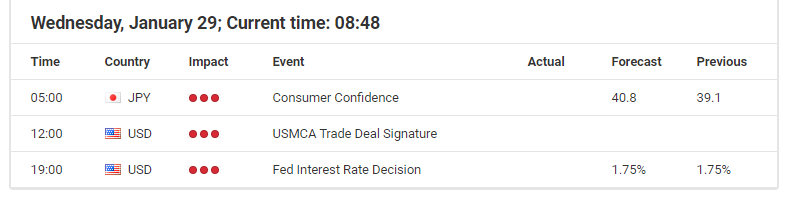
Source: Economic Events January 29, 2020 – Admiral Markets’ Forex Calendar

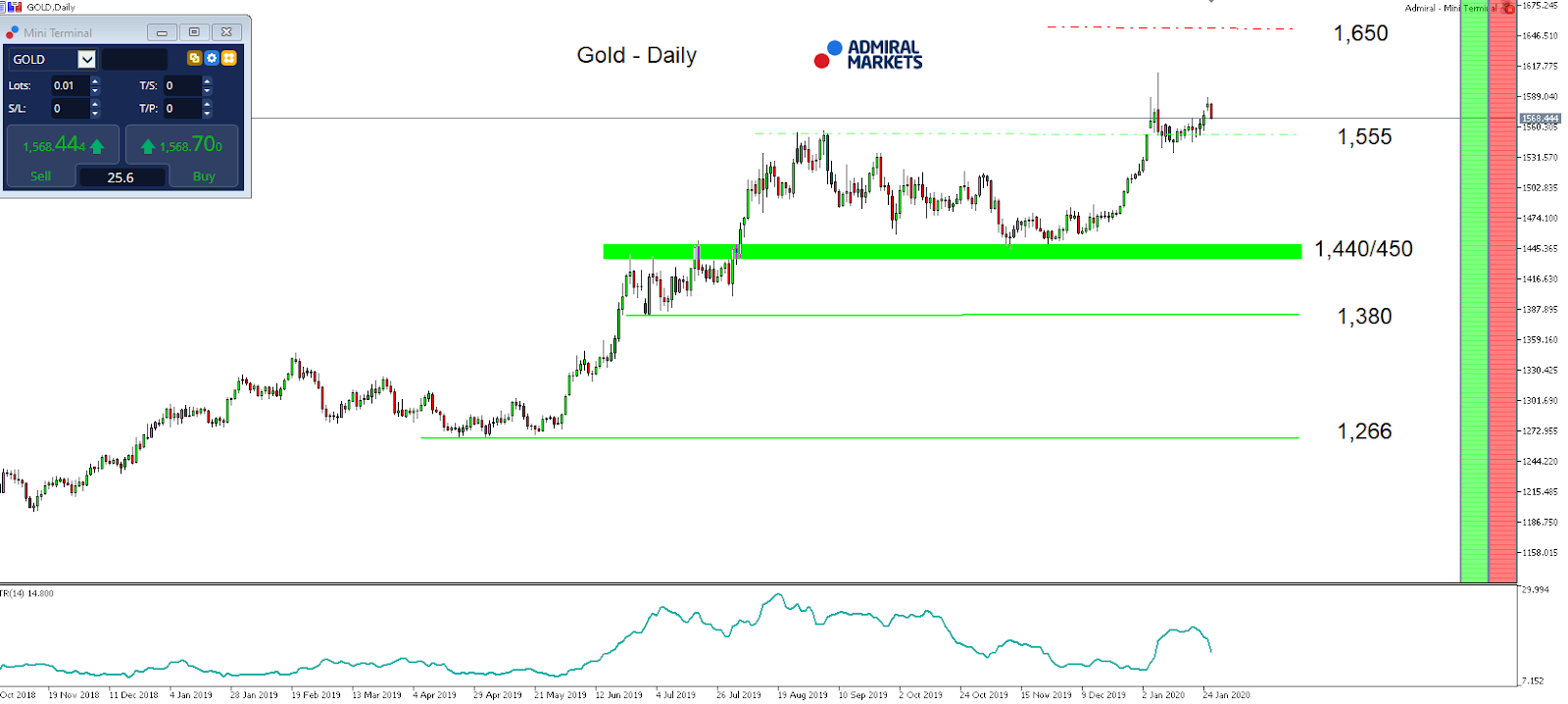
Gold has seen increasing demand against the region around 1,555 USD, approaching the 2019 yearly highs. The main driver was the latest news and developments on an outbreak of a new virus in China (Coronavirus) which currently sees a bigger impact on world financial markets and the risk tendency among market participants.

While the main question is whether these risk-off tendencies last (based on a 2017 paper, economists calculated that the expected annual losses from pandemic risk could amount to ‘only’ about $500 billion (ca. 0.6% of global income) per year), Gold still finds other, bullish drivers.

While today’s Fed rate decision shouldn’t deliver anything new and we don’t expect much from it, in fact, see a re-formulation of the status quo, any changes of the current forward guidance in regards to the recent funding pressures in the Repo market will be more dovish and thus positive for the precious metal.

Technically, we favour further gains in Gold, too. As long as we trade above 1,440/450 USD the potential next target on the upside can be found in the region around 1,650/700 USD.

And then there is also a noteworthy bullish seasonality.

Last week on Friday, Gold entered a bullish seasonal window, which lasts until February 4.

In more detail, the seasonal bullish pattern developed over the last 20 years with Gold seeing an average gain of 23.50 USD for 15 of the past 20 years.

In the remaining five years, it dropped on average only 11.73 USD, while the maximum loss of the pattern was 23.90 USD and the maximum drawdown being 26.05 USD, adding to the advantageous outlook for Gold bulls:

Source: Admiral Markets MT5 with MT5-SE Add-on Gold Daily chart (between October 17, 2018, to January 28, 2020). Accessed: January 28, 2020, at 10:00pm GMT – Please note: Past performance is not a reliable indicator of future results, or future performance.

In 2015, the value of Gold fell by 10.4%, in 2016 it increased by 8.1%, in 2017 it increased by 13.1%, in 2018, it fell by 1.6%, in 2019, it increased by 18.9%, meaning that after five years, it was up by 28%.

Discover the world’s #1 multi-asset platform

Admiral Markets offers professional traders the ability to trade with a custom, upgraded version of MetaTrader 5, allowing you to experience trading at a significantly higher, more rewarding level. Experience benefits such as the addition of the Market Heat Map, so you can compare various currency pairs to see which ones might be lucrative investments, access real-time trading data, and so much more. Click the banner below to start your FREE download of MT5 Supreme Edition!

Download MetaTrader 5 and begin trading today!

Disclaimer: The given data provides additional information regarding all analysis, estimates, prognosis, forecasts or other similar assessments or information (hereinafter “Analysis”) published on the website of Admiral Markets. Before making any investment decisions please pay close attention to the following:

  1. This is a marketing communication. The analysis is published for informative purposes only and are in no way to be construed as investment advice or recommendation. It has not been prepared in accordance with legal requirements designed to promote the independence of investment research, and that it is not subject to any prohibition on dealing ahead of the dissemination of investment research.
  2. Any investment decision is made by each client alone whereas Admiral Markets shall not be responsible for any loss or damage arising from any such decision, whether or not based on the Analysis.
  3. Each of the Analysis is prepared by an independent analyst (Jens Klatt, Professional Trader and Analyst, hereinafter “Author”) based on the Author’s personal estimations.
  4. To ensure that the interests of the clients would be protected and objectivity of the Analysis would not be damaged Admiral Markets has established relevant internal procedures for prevention and management of conflicts of interest.
  5. Whilst every reasonable effort is taken to ensure that all sources of the Analysis are reliable and that all information is presented, as much as possible, in an understandable, timely, precise and complete manner, Admiral Markets does not guarantee the accuracy or completeness of any information contained within the Analysis. The presented figures refer that refer to any past performance is not a reliable indicator of future results.
  6. The contents of the Analysis should not be construed as an express or implied promise, guarantee or implication by Admiral Markets that the client shall profit from the strategies therein or that losses in connection therewith may or shall be limited.
  7. Any kind of previous or modeled performance of financial instruments indicated within the Publication should not be construed as an express or implied promise, guarantee or implication by Admiral Markets for any future performance. The value of the financial instrument may both increase and decrease and the preservation of the asset value is not guaranteed.
  8. The projections included in the Analysis may be subject to additional fees, taxes or other charges, depending on the subject of the Publication. The price list applicable to the services provided by Admiral Markets is publicly available from the website of Admiral Markets.
  9. Leveraged products (including contracts for difference) are speculative in nature and may result in losses or profit. Before you start trading, you should make sure that you understand all the risks.

By Admiral Markets

EURUSD: euro remains under pressure

By Alpari.com

On Tuesday, January 28, trading on the euro finished up by three points. Demand for risky assets rose in the US session, amid recovery in stock indices after the fall.

Global markets stabilized, while Chinese markets are closed until February 3. The focus of market playuers has shifted towards US coprporate reporting. The EURUSD pair recovered from 1.0998 to 1.1028, including the Asian session.

Today’s events (GMT+3):

  • 10:00 Germany: Gfk Consumer Confidence Survey (Feb).
  • 12:00 Switzerland: ZEW Survey – Expectations (Jan).
  • 12:00 Eurozone: Private Loans (YoY) (Dec), M3 Money Supply (YoY) (Dec).
  • 16:30 USA: Goods Trade Balance (Dec).
  • 18:00 USA: Pending Home Sales (MoM) (Dec).
  • 18:30 USA: EIA Crude Oil Stocks Change (Jan 24).
  • 21:00 USA: Fed Interest Rate Decision.
  • 22:30 USA: FOMC Press Conference.

Рис. 1Current situation:

Expectations regarding a new low being set bore fruit. We have four lowering bottoms and a rebound to 1.1028. Technical conditions for an upwards correction to 1.1050 (at the 45th degree) have been created, but it is unlikely that bulls will be able to push the price to this level because of the ongoing events in China.

On Tuesday, Chinese President Xi Jinping said that China is confident of its capacity to bring the outbreak of coronavirus under control – the virus has claimed the lives of more than 132 people. Chinese experts say that the epidemic is very difficult to contain, since coronavirus has a long incubation period. Said period passes without symptoms, but the infection is capable of being transmitted.

There is not enough objective news to properly understand the depth of the situation. The Chinese authorities continue to boldly reassure everyone that everything is under control, but at the same time, there is a struggle with vloggers and bloggers. Several people are accused of spreading rumors of coronavirus on the Internet. One person was prosecuted for disseminating false information about pneumonia via social networks in Tianjin China, and six more were fined and warned about their future conduct. This was reported by Xinhua News Agency, citing information released by the City Department for Public Safety.

The governments of France, Japan, the United States and India have prepared planes to evacuate diplomats and their families. Why take them out if everything is under control? Why in a hurry to build a hospital with 1,000 beds by early February? Maybe the Chinese authorities are hiding a more harrowing version of the truth from us?

At the time of writing, the euro is worth 1.1006. The price underwent an adjustment – increasing by 76%. Major currencies are trading in the red, except for the yen. According to forecasts, the general view is that a decrease to 1.0992 could be on the cards. Then a rebound later, after the meeting of the US Federal Reserve and Chairman Jerome Powell’s subsequent news conference.

By Alpari.com

Hong Kong plays catch-up as rest of Asia catches breather from coronavirus woes

By Han Tan, Market Analyst, ForexTime

Hong Kong’s Hang Seng index plummeted by three percent after returning from the Lunar New Year break, although most other Asian assets are advancing on the day after US equities rebounded from their worst selloff since October. Risk sentiment is being given some reprieve from concerns over the novel coronavirus outbreak, following the positive surprise in Apple’s latest earnings, along with the better-than-expected US January consumer confidence, which served as distractions from the coronavirus gloom that has beset investors since mid-January.

Gold prices eased off the $1580 handle, USDJPY is now trading back above the 109.0 psychological level, while 10-year US Treasury yields’ dip into sub-1.60 percent levels proved short-lived for the time being.

Outbreak fears could yet trigger more losses in risk assets

Markets will be yearning for signs that the outbreak is stabilising. Otherwise, “risk-off” could well be the de facto mode in the interim. Investors are certainly cognisant of the USD2.6 trillion in market cap that have been erased from global equities since January 20, with more losses potentially in the pipeline for risk assets considering the persisting uncertainties surrounding the virus.

However, with history as a guide, global markets tend to rebound after such outbreaks, provided that the toll exerted on the global economy is not too damaging. A meaningful recovery in the markets however could be months away, as health authorities around the world continue efforts to contain the virus which has already claimed 100 lives and infected thousands.

Fed unlikely to rock defiant Dollar

The Federal Reserve is widely expected to leave US interest rates unchanged later today, which should help buffer the Dollar Index’s 1.6 percent year-to-date gain. The Dollar has managed to defy expectations for a softer performance in 2020, aided by a series of unforeseen events such as the US-Iran conflict and the ongoing coronavirus outbreak, which have elevated demand for the safe haven currency.

Signs that the US economy is poised to extend its record expansion, judging by the better-than-expected US consumer confidence in January, should also bolster the Greenback’s recent trajectory while allowing the US central bank to keep its policy settings unchanged for the time being. However, should downside risks such as the ongoing coronavirus outbreak leave a major dent in economic conditions around the world, central bankers may have to resume policy easing in order to sustain the still-fragile prospects of a global economic recovery this year.


Disclaimer: The content in this article comprises personal opinions and should not be construed as containing personal and/or other investment advice and/or an offer of and/or solicitation for any transactions in financial instruments and/or a guarantee and/or prediction of future performance. ForexTime (FXTM), its affiliates, agents, directors, officers or employees do not guarantee the accuracy, validity, timeliness or completeness, of any information or data made available and assume no liability as to any loss arising from any investment based on the same.


Forex-Time-LogoArticle by ForexTime

ForexTime Ltd (FXTM) is an award winning international online forex broker regulated by CySEC 185/12 www.forextime.com

There’s No Fever Like Gold Fever…

By Money Metals News Service

In late December 2019, a bill from the German finance ministry – which had passed the lower legislative house – proposed lowering the “anonymous purchase limit” for precious metals from €10,000 to €2,000 (about $2,200), a reduction of 80%.

At the current price, one could buy less than one and one-half troy ounces of gold without activating customer ID paperwork, and for businesses – a criminal background check!

This is an additional decline from the €15,000 mandated just two years ago. Set to become law in early 2020, the effect was immediate, as long lines outside a coin shop in Cologne show.

Some of the world’s largest banks – including several in Germany – have long made a habit of laundering literally billions of dollars, euros, and assorted financial instruments from questionable customers.

This all begs the question as to how further squeezing “the little man” by imposing onerous reporting over relatively tiny amounts of gold sales is going to accomplish anything constructive.

It turns out that this legislative effort is directly tied to European Union (EU) guidelines laid out in the anti-money laundering directive (AMLD5), requiring member state compliance. And some people wonder why Britain’s Labour Party – whose platform proposed adding still more regulatory burdens to the population – recently suffered such a devastating defeat.

Bitcoin.com reports the EU’s 5th anti-money laundering directive dictates that “non-transparent assets, accounts, and even private safety deposit boxes will now be subject to state information gathering by law.”

A user on Reddit remarked:

“They don’t want normal people to bank run their scam paper. Gold and hard assets is how you protect yourself from inflation. They (the governments/banks) want to know every single person that tries to get out of their cage…”

“…Gold is thus seen as one of the final hedges against irresponsible government policy, and the proposed new limits on precious metals, will leave residents of Germany with even fewer options.”

A German citizen remarks:

“I live in Germany and the thing is we have had a full-blown shortage going on for weeks now. All these people in the line will go home empty handed. The smart ones have been exchanging paper for gold weeks and months ago… you have these (off-putting) ones who think the supply will wait for them when they lift (themselves up) in the last second. The retailers have been sold out for weeks already. It might clear up in January when the new law is in place, but I am not betting on it. It could also indicate that we are close to something bigger.”

Here’s the rub, and you can take this to the bank…

Authorities in most countries in the world, and sadly becoming more common by the day in that bastion of “democracy” – the U.S., at every level equate the desire for privacy with doing something “nefarious.” Some of Merriam-Webster’s numerous words define the term as “bad, evil, unethical, unlawful, wicked, wrong,” etc. Take your pick.

Ignore the clueless non-observer who reels off the knee-jerk comment that “If I don’t have anything to hide… It’s a very dangerous slide from “Innocent until proven guilty” to just the opposite.

It’s a corrosive trend that has all too-commonly become the operative principle of those whom we’ve elected to serve us, but who have now decided, in their finite wisdom, that we should serve them.

Not just “the man in the street.” Despite the excitement (and profit-building opportunities) offered by gold and silver from 2001-11 affected not just “the man on the street” but CEOs of most mining companies who continue to project the future by looking into the rearview mirror.

Panic in a Chinese Line for 40 Gram Gold

(1948) 40 grams (a tael) equals about 1-1/4 oz of gold.

The knock-on effect meant that less money was spent on discovery, leading inexorably to lower production.

The overall result is that from the last decade, 2020 Reserves (the highest and most economically recoverable category of known ore deposit) for the world’s largest gold mining companies are down fully 26%.

David Morgan has long counseled newsletter subscribers to The Morgan Report, in addition to the tens of thousands who (weekly) receive The Free Morgan Report to start an accumulation program by acquiring physical gold and silver – viewing its role as insurance first, profit-potential second.

Own precious metals – i.e. honest money – paid for by fiat “paper promises.” On numerable occasions, over the thousands of years in which it has reliably fulfilled these roles, gold (and silver) have turned out to be literal life-savers in their own right.

Richard Davies toured Aceh, Indonesia after the 2004 tsunami that killed 250,000 people. He noted, “I met many survivors who were able to sell jewellery they were wearing… Wearing a gold bangle is like having enough cash on your wrist to employ a builder for a year… This traditional form of finance insulated Aceh and provided its entrepreneurs with rapid access to cash.”

If this doesn’t get your attention, then you’re just not paying attention!

Long before the move into gold becomes a full-fledged “rush,” smart money with deep pockets will have been activating their own accumulation plan.

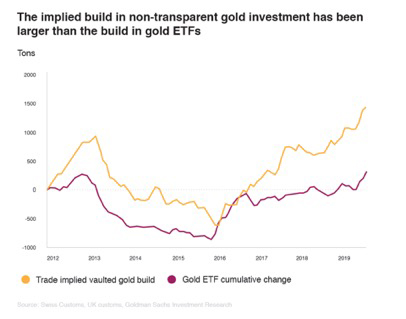
The chart below from Goldman Sachs research indicates what’s been going on under the radar. Gold ETF (visible) accumulation – which by the way has now officially reached record levels – is being substantially eclipsed by the build in non-transparent gold investment, as it is ensconced around the world in private vaults, kept “in hand” near one’s residence, or simply buried in the back yard.

The implied build in non-transparent gold investment has been larger than the build in gold ETFs

It’s not too late to accumulate! These and other data points, such as the current low level of U.S. Mint American Gold Eagle production – which follows demand – indicate that the majority of potential investors have yet to enter the gold space.

Act to strengthen your financial immune system by accumulating the desired level of metal now, before the ongoing gold-build morphs into a public-mania-infused “gold fever.” And before the concept of financial privacy and flexibility has become a relic of the not-too distant past.


The Money Metals News Service provides market news and crisp commentary for investors following the precious metals markets.

Getting Ready For Q4 Australian CPI

By Orbex

Despite the concerns about the potential economic impact from the wildfires and the spread of the coronavirus, the Australian Dollar has been moving higher this month.

The data coming out next could give that trend a further nudge, and put an end to speculation of a rate cut by the RBA.

Data reports over the last week have been confirming what some saw as green shoots in at the end of last year. Employment came in above expectations, and manufacturers expressed more optimism about the future than expected.

The surprise drop in unemployment might be followed by a jump in inflation. Therefore, this removes the two reasons the RBA has given for a rate cut.

The Measurements

There are several measures of CPI that come out at the same time. And they each have different effects on the market.

On the one hand, we have the standard measure of inflation. This is the one that most decision-makers follow. It has a direct impact on consumer sentiment and other economic factors.

The second is the RBA Trimmed Mean CPI. This is the preferred measure that the central bank uses when defining its policy. They feel it better reflects the long term trend.

It should be noted that the bank’s mandate to maintain price stability doesn’t specify which measure of CPI they are required to consider. Policy, therefore, can and is routinely influenced by the traditional measure of inflation.

What We Are Looking For

For the fourth quarter, expectations are for Australia’s CPI to come in at 0.5%. This in line with the prior quarter’s 0,5%.

A result like this would imply that the annualized inflation rate would be 2.1%, compared to 1.7% in the prior measurement. This is important because it’s over the RBA’s target of 2.0% long term inflation.

As for the quarterly Trimmed Mean CPI, we can expect that to come in at 0.4% also a repeat of the prior measure of 0.4%. On an annualized basis, that would bring it to 1.5% and slightly lower than the 1.6% prior.

Still not at the RBA’s target, but also not moving away. The potential cost of moving closer to unconventional measures would seem less appealing if inflation is at least holding its ground while other data improves.

Drivers

On the other hand, some of the reasons for the increase in inflation might not be long-lasting. Fuel prices, for example, have been falling since last quarter due to the expected drop in demand from the spread of the coronavirus.

Another factor could be self-fulfilling. The lower AUD last year helped support the increased prices of imported goods. But if the strengthening trend continues, that could reverse.

If the RBA doesn’t signal that low rates are here to stay for a while if not continue to suggest further cuts, the AUD could rise and undercut the bank’s efforts to boost inflation.

Increased inflation, especially above expectations, would likely support the AUD as we can expect potential action by the RBA to be postponed. However, a disconnect between the CPI and trimmed CPI could lead the RBA to continue to consider a rate cut even with higher inflation. Therefore, support for the AUD wouldn’t be as much.

And, if the data misses expectations, the currency could return to a descending pattern.

By Orbex


Apple’s earnings under the radar; Tesla shares on standby

By Lukman Otunuga, Research Analyst, ForexTime

Apple Inc. is perhaps the world’s most recognizable consumer technology brand with a stock market valuation beyond $1 trillion.

The tech giant’s domineering presence has certainly influenced different geographies ultimately becoming an important part of many people’s lives. While the outlook for Apple looks highly encouraging with the company shares gaining more than 6% since the start of the year, it remains uncertain whether first-quarter earnings will paint a similar picture.

Revenue is projected to come in at $88.5 billion, topping $84.3 billion in revenue during the same period a year earlier. Earnings are seen rising to $4.54 per share, compared to the $4.18 per share earned in the same period last year.

The argument for earnings to smash market forecasts revolve around bullish expectations for new iPhones, rising AirPod demand and growing momentum in Apple’s digital services. However, the coronavirus outbreak in China could throw a proverbial wrench into the works, especially if it results in supply chain disruptions and drop in demand.

Taking a look at the technical picture, Apple shares are heavily bullish on the daily charts. There have been consistently higher highs and higher lows with prices roughly $10 away from the all-time high of $323. If the company’s earnings dish out an upside surprise, shares are likely to push higher with $323 acting as the first point of interest. A breakout above this all-time high may open the doors towards $350.

Alternatively, a disappointing set of earnings will most likely dent buying sentiment towards Amazon stock with prices seen dipping back towards $305.


It’s earnings time for Tesla 

Tesla Inc. stock is slated to remain on standby as investors await the company’s Q4 and full-year results on Wednesday.

Market optimism over the company’s performance, strong international growth and profitability supported buying sentiment towards Tesla shares. While the future looks bright for the automotive and energy company, this needs to be reflected in earnings and revenues.

Wall Street expects Tesla to report a $1.62 per share gain for Q4 2019 while total revenues are forecast to hit $7 billion in the fourth quarter of 2019 compared to the $6.3 billion in the third quarter.

The technical picture remains in favour of bulls with prices trading roughly $30 away from the all-time high of $594.50 as of writing. A strong set of earnings could turbocharge Tesla shares with the first point of interest at $594.50 and potentially higher. Should the earnings disappoint, shares could sink back towards $538.50.


Disclaimer: The content in this article comprises personal opinions and should not be construed as containing personal and/or other investment advice and/or an offer of and/or solicitation for any transactions in financial instruments and/or a guarantee and/or prediction of future performance. ForexTime (FXTM), its affiliates, agents, directors, officers or employees do not guarantee the accuracy, validity, timeliness or completeness, of any information or data made available and assume no liability as to any loss arising from any investment based on the same.


Forex-Time-LogoArticle by ForexTime

ForexTime Ltd (FXTM) is an award winning international online forex broker regulated by CySEC 185/12 www.forextime.com

EURUSD Under Heavy Selling Pressure

By Orbex

USD Rally Continues

The US dollar continues to trade higher into the middle of the week as the reversal lower in equities keeps the greenback bid on Tuesday. Looking ahead, the main focus of the week will be tomorrow’s FOMC meeting. No change in policy is expected though traders will be keen to see if the Fed has shifted its view at all following the signing of the US/China trade deal. The USD index trades 97.80 last.

EUR Under Heavy Selling Pressure

EURUSD has been under heavy selling pressure all week as the rally in USD continues to weigh on price. Last week the ECB statement came with a mildly dovish tone. ECB chief Christine Lagarde warned markets not to think that ECB monetary policy will remain on auto-pilot while the ECB conducts its strategy review. EURUSD trades 1.1015.

GBP Lower on Brexit Trade Deal Fears

GBPUSD has been lower again today also with price now challenging the rising trend line ahead of the 1.2978 level. The latest-sell off comes amidst reports that the EU is demanding the European Council enforce trade deal rules, which Johnson has said is “unacceptable”. The headlines are fuelling worries over the likelihood of the two sides being able to agree a deal in the current timeframe.

Risk Assets Still Under Pressure

Risk assets have been lower again today. The outbreak of corona-virus, which has now claimed the lives of 80 people and spread as far as America, is fuelling worries of damage to the global economy. SPX500 trades 3248.58 last, having broken back under the 3261.46 level yesterday, which has held as resistance so far today.

JPY & Gold Higher Again

Safe havens have been firmer today with both JPY and gold rallying against USD, though gold’s upside move has been a little more tempered in light of USD strength. XAUUSD trades 1579.73 last, sitting just under the week’s highs. USDJPY trades 108.81 last.

Crude Holding At Support

Oil prices continue to hold near the week’s lows with crude holding just above the 52.73 level at 52.91 last. The outbreak of corona-virus has raised fears over the demand outlook for crude given the sharp hit to oil demand during the SARS outbreak in 2003. Later today, traders will get a first look at US oil inventories with the API report.

Loonie Testing Resistance

USDCAD has been higher again today with price trading up towards the 1.3207 level. The ongoing slide in crude prices, as well as the rally in USD, is helping keep the loonie in demand this week. The FOMC meeting tomorrow could fuel further upside if the Fed strikes a more optimistic tone.

Aussie Continues Lower

AUDUSD has been lower again today. Following the breakdown below the .6850 level, price is now trading 100 pips lower at .6748. Looking ahead today, Aussie traders will be waiting on the CPI release due over the Asian session which is expected to have ticked up over the final quarter of 2019.

By Orbex


Corona Virus Update: Chinese Economic Fears

By Orbex

The coronavirus outbreak continues to dominate news flows this week and is visibly weighing on risk appetite. The spread of the disease is drawing scary parallels with the 2003 SARS outbreak. As such, investor uncertainty is rapidly rising.

How Far Has the Virus Spread so Far?

As of yesterday, the current infection is just below 3000 with a death toll of just over 80. The increase in infections, as well as the mortality rate, is worrying. A week ago, only three people had died from the disease. In terms of the spread of the coronavirus, the infection has been noted in each of China’s 31 provinces along with confirmed cases in 11 other countries. Of these 11 other countries, which include five confirmed cases in the US, Thailand has the most so far with eight confirmed.

Is the Spread Getting Worse?

Sadly, health officials have confirmed that the spread of the virus is intensifying. Over the weekend, the top health minister in China said that the ability of the virus to spread (contagiousness) is getting stronger. He confirmed that the virus can now spread before any symptoms show up. This is a worrying development as it makes it even harder for airports to screen travelers for the virus. Another worrying report over the weekend noted that as many as 5 million people have already traveled out of Wuhan (the epicenter of the virus).  The city is now on lockdown. Governments are tracking the travelers who have gone abroad from China in an attempt to stop them from spreading the virus if they are infected.

Is this Virus Outbreak Similar to the 2003 SARS Episode?

The SARS outbreak in 2003 saw around 8000 people infected over the 4 months before it was contained. Of those infected, nearly 800 died. Clearly, the death toll was much higher in the case of the SARS outbreak. Compared with the SARS outbreak, authorities have also responded much quicker in terms of taking measures to combat the virus. The recent mutation of the virus is worrying. However, if health authorities can get the virus under control in less time than 2003, hopefully far fewer people will die.

How is the Economy Being Impacted?

In terms of economic impact, China will see the most damage. In 2003, retail sales and the service sector took the biggest hit. The impact this time around could actually be greater as the service sector has grown to 54% of GDP. This is compared with 42% of GDP in 2003.

In 2003, retail sales growth fell from 10% to 4.5% annually and a similar impact is likely to be seen this time around due to the countrywide lockdown.  Given the residual damage to the economy as a result of the two-year trade war with the US, the economic impact could be severe.This could lead the PBoC to further easing which should weigh on the Yuan

Technical Perspective

The rally in USDCNH over the last two weeks has seen price reversing sharply back above the broken 6.8982 level. Price is now very close to testing the key 7 level along with the broken bullish trend line from 2018 lows. This is a major level for USDCNH and a break back above here could be very bearish for CNH indeed.

By Orbex