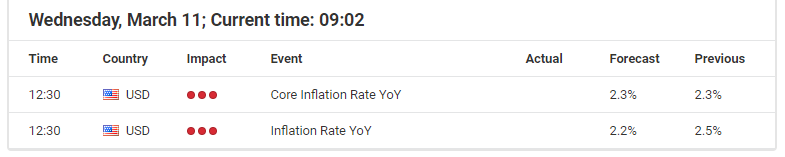
On Tuesday, US stocks quotes rose significantly after the record (since 2008) one-day fall on this Monday. US President Donald Trump said he would appeal to the Congress with a proposal to lower taxes in order to stimulate the US economy, which suffered recently from the outbreak of coronavirus. Market participants also expect the Fed’s second rate cut this year at a meeting on March 18. The S&P 500 (+4,94%), Nasdaq (+4,95%) and Dow Jones Industrial Average (+4,89%) indices fell. The financial (+ 6%) and energy (+ 5%) sectors of the S&P 500 index became the growth leaders yesterday. Shares of United Parcel Service (+ 6.5%) and Amazon.com (5.1%) rose due to high recommendations by brokerage companies. Yesterday, the turnover of US exchanges amounted to 15.8 billion shares, which is 37.5% more than the 20-day average. Today data on inflation will come out in the US. Their preliminary forecasts are positive. The ICE exchange index rose yesterday amid a statement made by US President Donald Trump on measures to stimulate the economy.
European stock indices rise today amid the Bank of England rate cut
European stocks stocks rose yesterday along with American stocks. Today, Bank of England cut the rate from 0.75% to 0.5% to stimulate the British economy and reduce the damage from the COVID-19 epidemic. Investors perceived this news very positively, as the likelihood of a decline in the ECB rate at tomorrow’s meeting on March 12 increases. The Bank of England joined the regulators of the United States, China, Canada and Australia, which lowered their rates earlier. The British FTSE 100 index rose 1.7% in the morning. Important economic data for January will be published today in Britain: monthly trade balance and GDP, industrial production and so on. EUR/USD quotes are being corrected down while chances of reducing the ECB rate rise.
Nikkei jumped up at almost 1% yesterday together with other indices
Asian indices fell today. Nikkei again approached a 15-month minimum. Investors are concerned about the reliability and condition of the assets of the Bank of Japan, which has implemented a super-soft monetary policy and bought up shares at the level of 19,500 points Nikkei.Note that a controlling stake in the Bank of Japan belongs to the Japanese Government, but they are listed on the Tokyo Stock Exchange. Today, these securities fell by 3.5% and updated the historical minimum. The Chinese Shanghai Composite Index today fell by 0.9%, while the Hong Kong’s Hang SengIndex fell by 0.6%. Investors doubt that government measures will be sufficient to support the economy. The yen fell today against the US currency to a psychological level of 105 yen per dollar.
Brent tried to adjust up, but so far unsuccessfully
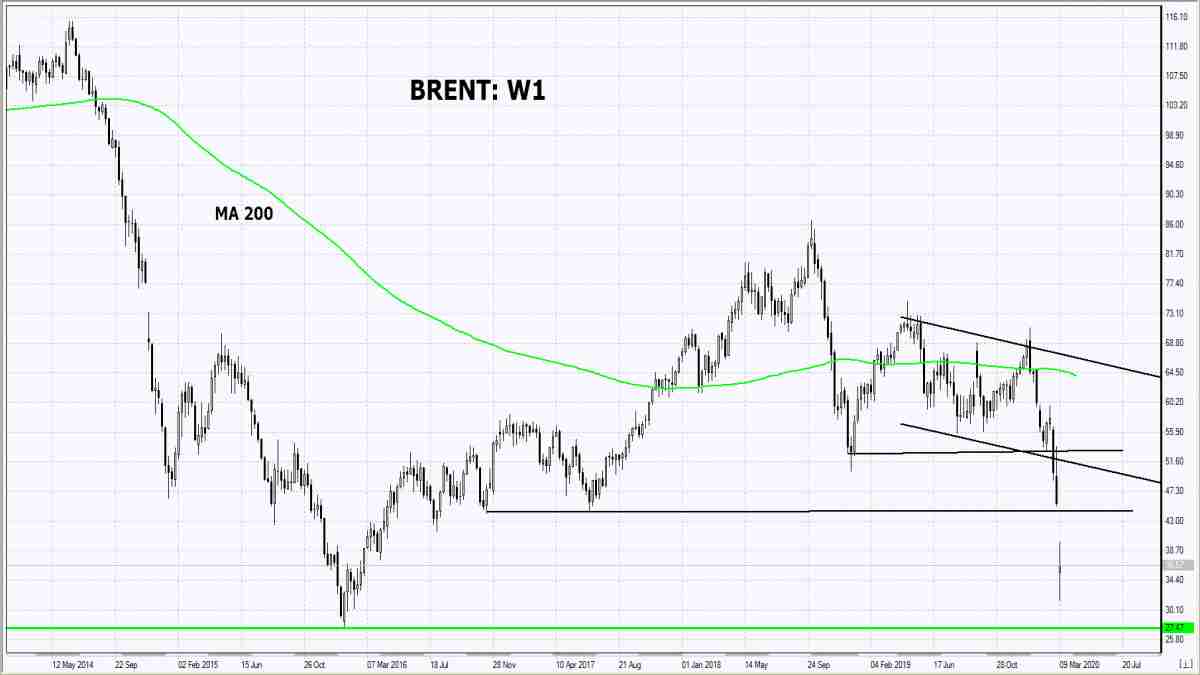
Quotes of Brent futures rolled down, failing to break through the resistance level of $ 40 per barrel. Saudi company Saudi Aramco announced an increase in production by 1 million barrels per day (bpd). In recent months, Saudi Arabia has mined 9.7 million bpd, but a lot of oil has appeared to be accumulated in storage. Currently, Saudi Arabia implements 12 million bpd and intends to increase sales to 13 million bpd in order to unload oil storage facilities. From their January peaks, Brent and WTI collapsed by about 2 times. This was facilitated by Russia’s decision to abandon restrictions on oil production and withdraw from the OPEC + agreement. The drop in oil quotes happened due to a decline in global business activity and a decrease in demand due to the epidemic of coronavirus and quarantine in a range of countries. Some Western agencies expect Brent to collapse on this negative situation to the lows of early 2016 – within $ 30 per barrel.
Note: This overview has an informative and tutorial character and is published for free. All the data, included in the overview, are received from public sources, recognized as more or less reliable. Moreover, there is no guarantee that the indicated information is full and precise. Overviews are not updated. The whole information in each overview, including opinion, indicators, charts and anything else, is provided only for familiarization purposes and is not financial advice or а recommendation. The whole text and its any part, as well as the charts cannot be considered as an offer to make a deal with any asset. IFC Markets and its employees under any circumstances are not liable for any action taken by someone else during or after reading the overview.
Global financial markets were hit by another risk-off wave at the start of the week, after oil prices collapsed in response to Russia resisting Saudi Arabia’s push for deeper production cuts at the OPEC meeting last week.
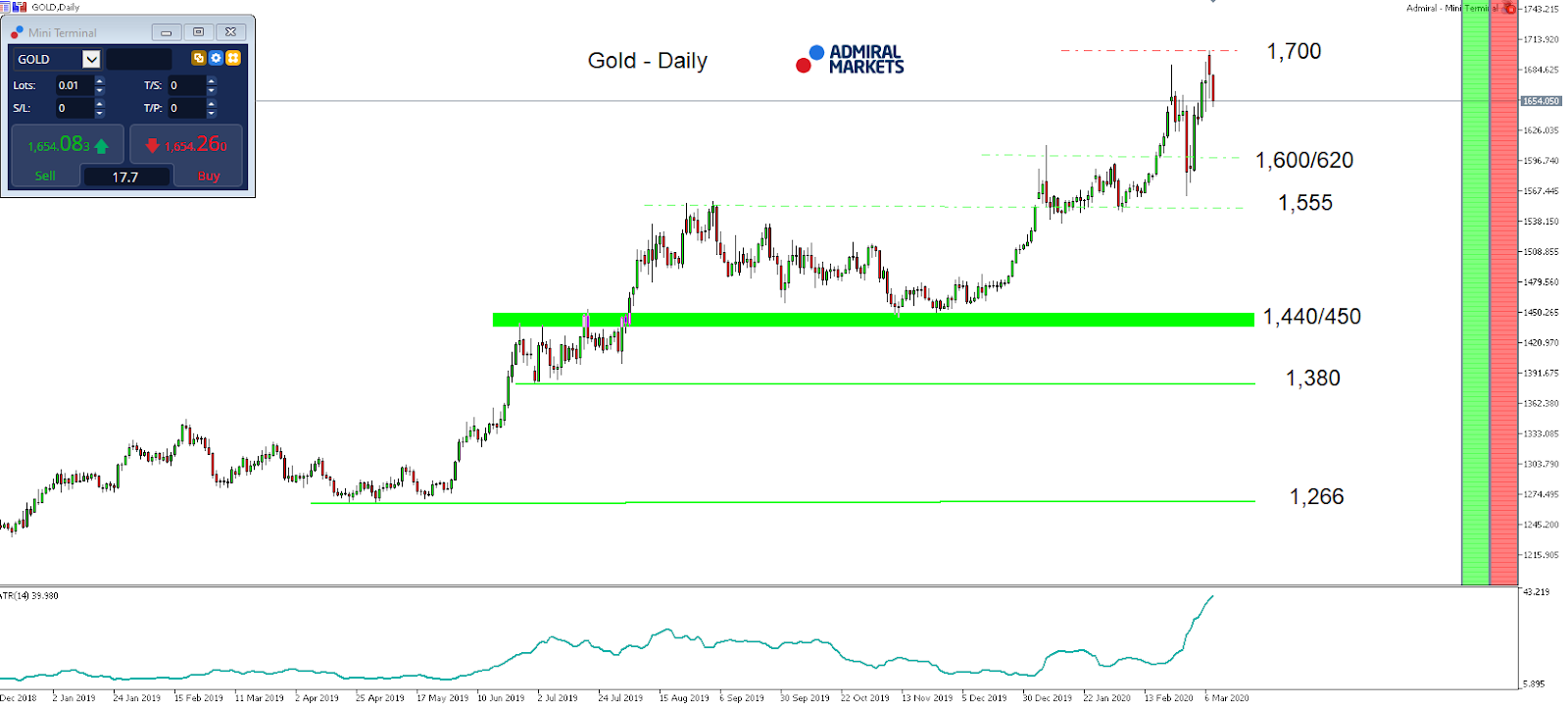
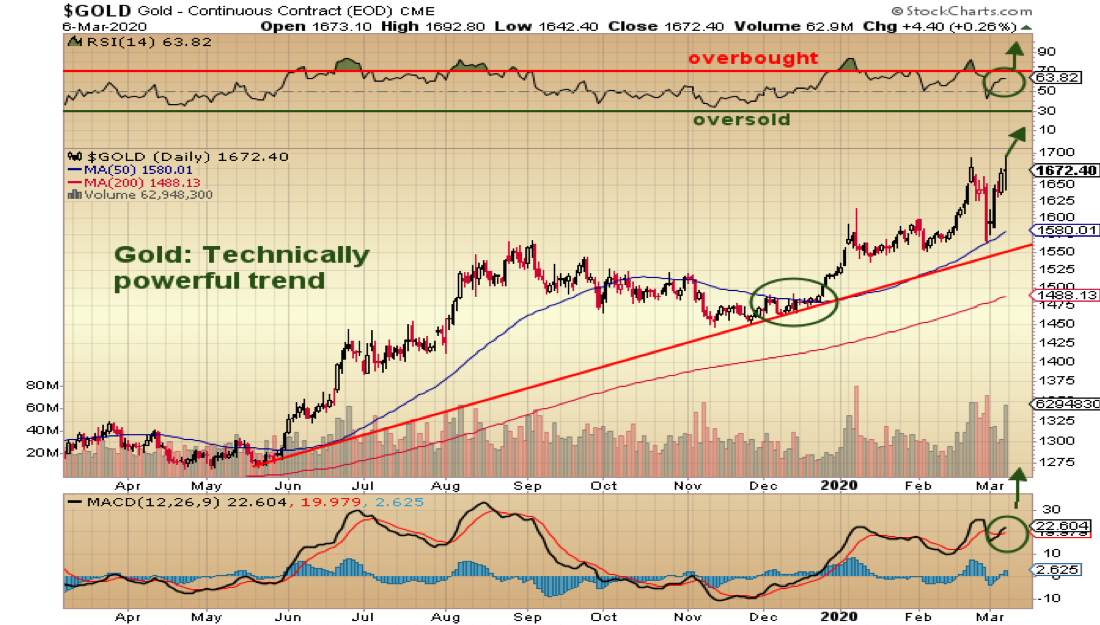
While Equity markets dropped massively, and market participants talked of a “Black Monday”, Gold failed to significantly break above 1,700 USD.
This seemed to be because traders sold profitable Gold positions to meet margin calls resulting out of dropping Equity prices.
But even if Gold lost some of its bullish momentum, the outlook stays very favourable for the precious metal: after the Fed announced its “emergency rate cut” last Tuesday, the first time since October 2008, and market participants expect further cuts by the Fed.
In fact, the Fed Watch Tool currently sees the Fed cutting another 75 basis points at the meeting on March 18, with volatility staying elevated and a clear risk-off bias among market participants, which should keep the pressure on US yields high. Thus, the outlook for Gold stays very positive and a sustainable break above 1,700 USD seems only to be a question of time.
Technically, the mode stays bullish as long as we trade above the daily trend support which can still be found around 1,535/545 USD:
Source: Admiral Markets MT5 with MT5-SE Add-on Gold Daily chart (between December 7, 2018, to March 10, 2020). Accessed: March 10, 2020, at 10:00pm GMT – Please note: Past performance is not a reliable indicator of future results, or future performance.
In 2015, the value of Gold fell by 10.4%, in 2016, it increased by 8.1%, in 2017, it increased by 13.1%, in 2018, it fell by 1.6%, in 2019, it increased by 18.9%, meaning that after five years, it was up by 28%.
Discover the world’s #1 multi-asset platform
Admiral Markets offers professional traders the ability to trade with a custom, upgraded version of MetaTrader 5, allowing you to experience trading at a significantly higher, more rewarding level. Experience benefits such as the addition of the Market Heat Map, so you can compare various currency pairs to see which ones might be lucrative investments, access real-time trading data, and so much more. Click the banner below to start your FREE download of MT5 Supreme Edition!
Disclaimer: The given data provides additional information regarding all analysis, estimates, prognosis, forecasts or other similar assessments or information (hereinafter “Analysis”) published on the website of Admiral Markets. Before making any investment decisions please pay close attention to the following:
This is a marketing communication. The analysis is published for informative purposes only and are in no way to be construed as investment advice or recommendation. It has not been prepared in accordance with legal requirements designed to promote the independence of investment research, and that it is not subject to any prohibition on dealing ahead of the dissemination of investment research.
Any investment decision is made by each client alone whereas Admiral Markets shall not be responsible for any loss or damage arising from any such decision, whether or not based on the Analysis.
Each of the Analysis is prepared by an independent analyst (Jens Klatt, Professional Trader and Analyst, hereinafter “Author”) based on the Author’s personal estimations.
To ensure that the interests of the clients would be protected and objectivity of the Analysis would not be damaged Admiral Markets has established relevant internal procedures for prevention and management of conflicts of interest.
Whilst every reasonable effort is taken to ensure that all sources of the Analysis are reliable and that all information is presented, as much as possible, in an understandable, timely, precise and complete manner, Admiral Markets does not guarantee the accuracy or completeness of any information contained within the Analysis. The presented figures refer that refer to any past performance is not a reliable indicator of future results.
The contents of the Analysis should not be construed as an express or implied promise, guarantee or implication by Admiral Markets that the client shall profit from the strategies therein or that losses in connection therewith may or shall be limited.
Any kind of previous or modeled performance of financial instruments indicated within the Publication should not be construed as an express or implied promise, guarantee or implication by Admiral Markets for any future performance. The value of the financial instrument may both increase and decrease and the preservation of the asset value is not guaranteed.
The projections included in the Analysis may be subject to additional fees, taxes or other charges, depending on the subject of the Publication. The price list applicable to the services provided by Admiral Markets is publicly available from the website of Admiral Markets.
Leveraged products (including contracts for difference) are speculative in nature and may result in losses or profit. Before you start trading, you should make sure that you understand all the risks.
GBPUSD faltered below the 1.29 psychological level before seeing a sharp recovery, after the Bank of England surprised markets with a 50-basis point inter-meeting rate cut. Likewise, EURGBP’s presence above 0.88 was swift but temporary. Sterling is currently weaker against all of its G10 counterparts, except for the US Dollar.
The BOE’s unanimous decision aims to help mitigate the downside economic and financial risks stemming from the coronavirus outbreak. Although investors have been expecting a BOE rate cut, following a similar move by the US Federal Reserve last week, the timing of the rate cut took market participants slightly by surprise, given that the central bank’s next policy meeting isn’t due until later this month. The market’s surprise was manifested in the Pound’s sudden drop.
While the move is deemed supportive over the near-term, the amount of policy ammunition that the BOE has at its disposal is now limited, with the benchmark interest rate at just 0.25 percent after today’s emergency move. Should downside risks become more prominent, the BOE’s potential policy responses may be significantly hampered moving forward.
With the Fed and the BOE now easing their respective policy settings, it’s highly likely that the European Central Bank will have to follow suit at its policy decision on Thursday. The monetary policy outlooks for these major central banks are set to dictate the near-term performances of the respective currencies, as long as uncertainties surrounding the coronavirus outbreak continue to weigh on the global economy.
Disclaimer: The content in this article comprises personal opinions and should not be construed as containing personal and/or other investment advice and/or an offer of and/or solicitation for any transactions in financial instruments and/or a guarantee and/or prediction of future performance. ForexTime (FXTM), its affiliates, agents, directors, officers or employees do not guarantee the accuracy, validity, timeliness or completeness, of any information or data made available and assume no liability as to any loss arising from any investment based on the same.
Despite Wall Street’s gains on Tuesday, the tide of risk aversion is rising again in the markets. Most Asian stocks are seeing another selloff, albeit to a lesser extent compared to recent sessions, while US futures are now pointing to losses. The risk-off mode is evident in the price action of safe haven assets: Gold bounced off the $1640 line to edge closer towards $1660, the Japanese Yen is strengthening by about 0.76 percent against the Greenback, while 10-year US Treasury yields are back below 0.7 percent.
Risk assets are expected to have a hard time hanging on to recent gains, as investors adjust to the new reality of the economic threat from SARS-CoV-2, and the global implications from depressed Oil prices. Such downside risks to global economic conditions are expected to fuel a policy easing bias among Asian central bankers, as they shore up their respective economies. The region’s policy easing bias, coupled with its economic vulnerabilities to the coronavirus outbreak, hampers Asian currencies’ ability to push back against the US Dollar over the near-term.
Dollar’s recovery predicated on US economic outperformance
The Dollar index’s break below the 95.0 psychological level proved fleeting, with DXY now strengthening back above the 96.0 line. The recent surge was fueled by hopes that the US government will roll out supportive measures to mitigate the negative impact of the coronavirus on the domestic economy.
Dollar traders have seemingly abandoned their data-dependent stance for the time being, with the Wednesday release of February’s US CPI unlikely to be a major trigger for the DXY, as the US policy response outlook dictates the Greenback’s near-term moves. The Greenback’s recent recovery could be on shaky ground in the near-term, considering that the Fed is make further reductions to US interest rates. The Fed funds futures currently point to another 25-basis point cut next week, with US interest rates potentially driven to zero by year-end. However, once markets fully price in expectations for Fed policy easing, the Dollar is expected to reclaim lost ground, as long as the US economy can outperform its developed peers.
Gold to remain in demand, despite recent dent from Dollar’s rebound
Although $1700 proved unsustainable for Gold bulls, the pace at which Bullion got to that psychological level suggests that investors’ propensity for risk aversion remains elevated. Although the Dollar’s rebound has taken some of the edge off Gold prices, Bullion is expected to remain above its 50-day moving average, as long as fears of a recession weigh on global market sentiment.
Brent’s climb may prove short-lived amid price war
After Monday’s dramatic decline, Brent futures are clawing their way back towards the psychological $40/bbl line. Oil’s supply-demand dynamics still point to a bias for weakness, as Saudi Arabia and Russia engage in a price war that threatens to push global markets into oversupplied conditions, at a time when global demand is being eroded by the coronavirus outbreak.
Disclaimer: The content in this article comprises personal opinions and should not be construed as containing personal and/or other investment advice and/or an offer of and/or solicitation for any transactions in financial instruments and/or a guarantee and/or prediction of future performance. ForexTime (FXTM), its affiliates, agents, directors, officers or employees do not guarantee the accuracy, validity, timeliness or completeness, of any information or data made available and assume no liability as to any loss arising from any investment based on the same.
Shares of AIM ImmunoTech traded more than 150% higher after the company reported that Japan’s National Institute of Infectious Diseases will test its Ampligen® drug as a potential treatment for the coronavirus.
Immuno-pharmaceutical company AIM ImmunoTech Inc. (AIM:NYSE.American), which focuses on research and development of therapeutics to treat immune disorders, viral diseases and multiple types of cancers, today announced that “the National Institute of Infectious Diseases (NIID) in Japan will begin testing AIM’s drug Ampligen® as a potential treatment for COVID-19, the new coronavirus infectious disease caused by SARS-CoV-2.” The company reported that the experimental program will be implemented and carried out at both the NIID and the University of Tokyo.
According to the report, “the testing and research are being conducted by Hideki Hasegawa, MD, Ph.D., Director of the NIID’s Influenza Virus Research Center, and Director of the World Health Organization (WHO) Collaborating Center for Reference and Research on Influenza, Tokyo and Takeshi Ichinohe, Ph.D., Department of Pathology at the NIID, Department of Biological Science and Technology, Tokyo University of Science.”
The company’s CEO Thomas K. Equels commented, “As we have been saying all along, this emerging pandemic is caused by a virus that has nearly identical regulatory RNA sequences to the original SARS coronavirus, known as SARS-CoV-1, in respect to pathogenesis. This means that the prior studies of Ampligen in SARS-CoV-1 animal experimentation may predict similar protective effects against the new virus. The WHO has recently renamed this emerging, highly pathogenic virus as SARS-CoV-2.”
“Ampligen had excellent antiviral activity against the earlier SARS coronavirus in U.S. National Institutes of Health-contracted animal experiments. In those studies of SARS-infected mice, Ampligen stands out as the only drug tested that conferred a significant survival effect: 100% of the Ampligen-treated mice survived, while none of the untreated mice survived. Because SARS-CoV-2 shares many critical similarities with SARS-CoV-1, Ampligen may have an important role to play in developing a protective early-onset therapy for this new highly pathogenic coronavirus in humans, where currently there is no known effective therapy. We are proud to work with Japan’s universally esteemed NIID in the battle to curb this emerging potential pandemic,” CEO Equels added.
The company explained that Ampligen (rintatolimod) is a broad-spectrum antiviral that it claims has an extremely well-developed safety profile. Rintatolimod is a double-stranded RNA which the firm is developing for debilitating diseases and disorders of the immune system.
AIM ImmunoTech is based in Ocala, Fla., and describes its business as “an immuno-pharma company focused on the research and development of therapeutics to treat immune disorders, viral diseases and multiple types of cancers.” The company stated that “its flagship products include the Argentina-approved drug rintatolimod (trade names Ampligen® or Rintamod®) and the FDA-approved drug Alferon N Injection®.” The firm believes that based on pre-clinical studies and clinical trials, Ampligen may have broad-spectrum anti-viral and anti-cancer properties. The firm indicated that it has already conducted clinical trials of Ampligen in cancer patients in the areas of renal cell carcinoma, malignant melanoma, colorectal cancer, advanced recurrent ovarian cancer and triple negative metastatic breast cancer. Additional financing is still required for funding clinical studies in these indication areas to confirm safety and efficacy before regulatory approvals can be obtained.
AIM ImmunoTech began the day with a market capitalization of around $46.3 million with approximately 22.06 million shares outstanding. AIM shares opened nearly 67% higher today at $3.50 (+$1.40, +66.67%) over Friday’s closing price of $2.10. The stock has traded today between $3.05 and $6.67 per share and is currently trading at $6.05 (+$3.95, +188.10%).
Disclosure: 1) Stephen Hytha compiled this article for Streetwise Reports LLC and provides services to Streetwise Reports as an independent contractor. He or members of his household own securities of the following companies mentioned in the article: None. He or members of his household are paid by the following companies mentioned in this article: None. 2) The following companies mentioned in this article are billboard sponsors of Streetwise Reports: None. Click here for important disclosures about sponsor fees. 3) Comments and opinions expressed are those of the specific experts and not of Streetwise Reports or its officers. The information provided above is for informational purposes only and is not a recommendation to buy or sell any security. 4) The article does not constitute investment advice. Each reader is encouraged to consult with his or her individual financial professional and any action a reader takes as a result of information presented here is his or her own responsibility. By opening this page, each reader accepts and agrees to Streetwise Reports’ terms of use and full legal disclaimer. This article is not a solicitation for investment. Streetwise Reports does not render general or specific investment advice and the information on Streetwise Reports should not be considered a recommendation to buy or sell any security. Streetwise Reports does not endorse or recommend the business, products, services or securities of any company mentioned on Streetwise Reports. 5) From time to time, Streetwise Reports LLC and its directors, officers, employees or members of their families, as well as persons interviewed for articles and interviews on the site, may have a long or short position in securities mentioned. Directors, officers, employees or members of their immediate families are prohibited from making purchases and/or sales of those securities in the open market or otherwise from the time of the interview or the decision to write an article until three business days after the publication of the interview or article. The foregoing prohibition does not apply to articles that in substance only restate previously published company releases. 6) This article does not constitute medical advice. Officers, employees and contributors to Streetwise Reports are not licensed medical professionals. Readers should always contact their healthcare professionals for medical advice.
The central of the Indian Ocean island of Mauritius lowered its key repo rate (KRR) by a further 50 basis points to 2.85 percent and slashed its forecast for economic growth this year, saying “the COVID-19 outbreak is expected to have a significant impact on the domestic economy.”
The Bank of Mauritius (BOM) last cut its rate in August 2019 in what it said was a pre-emptive move and although it maintained its policy rate in November and the 2020 growth forecast, it cut its 2019 growth estimate due to a less favorable outlook and rising downside risks.
Today BOM slashed its estimate for 2020 growth to 2.6 to 2.8 percent from November’s forecast of 4.0 percent, noting this was staff’s estimate “at this stage,” “considering the impact of the virus.
“The MPC (monetary policy committee) considered that an accommodative monetary policy was deemed appropriate to support domestic economic activity,” BOM said.
In the third quarter of 2019 Mauritius’ gross domestic product slowed to an annual rate of 3.1 percent from 3.5 percent.
“The uncertainty associated with the outbreak of COVID-19 is also likely to influence consumer and business confidence, which can potentially dent domestic spending and investment,” BOM said, adding downside risks to global growth have risen due to disruptions in global trade and travel activity, which will also lead to subdued global inflationary pressures.
Tourism accounts for some 15 percent of Mauritius’ economy.
Since December 2011 BOM has cut its rate six times and by a total of 2.65 percentage points, and in late February the government replaced Yandraduth Googoolye as governor with Harvesh Kumar Seegolam, the bank’s eight governor since it was established in 1967, along with the first deputy governor.
Today’s policy decision by the bank’s newly-constituted monetary policy committee was unanimous, and it confirmed it was ready to meet in between regular meetings if needed.
Inflation in Mauritius has risen in the last three months to 2.22 percent in February from 2.0 percent in January for the highest rate since November 2018.
Bank staff projected inflation of around 1.5 percent this year.
Mauritius’ rupee has been falling since February 2018 and fell further today to 37.3 to the U.S. dollar, down 2.4 percent this year and down 9.1 since the start of 2018.
The Bank of Mauritius released the following statement:
“The Monetary Policy Committee (MPC) of the Bank of Mauritius (Bank) unanimously voted to reduce the Key Repo Rate (KRR) by 50 basis points to 2.85 per cent per annum at its meeting today.
The MPC assessed latest international economic and financial developments and noted that the global economy is subject to heightened uncertainty and global financial markets are extremely volatile. The Committee considered that the OECD lowered its assessment of global growth for 2020 by half a percentage point to 2.4 per cent amid the COVID-19 outbreak. Downside risks to global growth have increased due to disruptions in global trade and travel activity. Global inflationary pressures are expected to remain subdued.
The COVID-19 outbreak is expected to have a significant impact on the domestic economy. The uncertainty associated with the outbreak of COVID-19 is also likely to influence consumer and business confidence, which can potentially dent domestic spending and investment. Bank staff estimates, at this stage, that considering the impact of COVID-19, real GDP growth rate would be between 2.6 to 2.8 per cent for 2020.
Both headline and core inflation have remained low. Bank staff is projecting headline inflation at about 1.5 per cent in 2020.
The MPC considered that an accommodative monetary policy was deemed appropriate to support domestic economic activity.
The next MPC meeting is scheduled on Wednesday 06 May 2020. The MPC stands ready to meet in between its regular meetings, if the need arises.
The MPC will issue the Minutes of its meeting on Tuesday 24 March 2020.”
There are times in my life where I am forced to fight the urge to do harm to people, something that I have never enjoyed, even when I was playing hockey in the violent Southern Hockey League in 1977. I have taken spears to the groin, butt-ends to the face, hooks to the throat and even suffered a slashed left eyelid over the twenty years I played but not once did I consider it anything “personal,” because it was all part of “the game,” and the choice I made to engage in “the game” was all mine and mine alone.
I can’t tell you the number of times that a five-minute major for butt-ending resulted in two or three goals against the penalized team and victory for the victims because, despite the violence of the offense, there were still rules. While the ’70s comprise an era of unprecedented violence in all leagues, broken rules affected outcomes, and there were many fearless players that would take the butt-end and commit no acts of retribution until late in the game, with their team comfortably ahead (or not at all, if the guy was 6’5″, 245 pounds and from Chibougamau).
The reason I am bringing this up is that, after listening to Boston Fed governor Eric Rosengren on Friday, I wanted desperately to commit a horrendous act upon this pitiable excuse for a “free market capitalist.” I actually snorted when I read the following:
“We should allow the central bank to purchase a broader range of securities or assets. Such a policy, however, would require a change in the Federal Reserve Act.”
In other words, what Mr. Rosengren is promoting is that the rules should be changed to allow the Fed to buy stocks in order to prevent a crash. There are two things inherently wrong in Mr. Rosengren’s demand. Firstly, there is no need to change the Federal Reserve Act, as this has been done four other times since it was first passed. The President’s Working Group on Capital Markets, created by the Reagan Administration after ’87 Crash, has been goosing stock prices for years, and most blatantly in December 2018, with the Mnuchin Christmas Eve “call to arms” of his private “plunge protection team” (PPT) that preceded a miraculous 1,000-point rebound in the Dow by New Year’s Day.
If they change the Act, you will have the U.S. Treasury and the Fed both chasing stocks, at which point the illusion of “free markets” loses even greater substance (than it already has) and the cosmetic appearance of the current market is wiped away.
Second, dovetailing back to my hockey analogy, if there are no rules protecting players from butt-ends, then the sport devolves into a spectator-less exercise in chaos, which is what almost gutted the National Hockey League (NHL) in the ’70s. If there are no rules deterring entities, especially government treasuries or government-sponsored entities (GSEs) like the Fed from illegally affecting stock prices, then there eventually will be no stock market participants left. No rules, no game, no spectators.
At the end of this past week, I watched a CNBC interview between the aging Wall Street cheerleader, Larry Kudlow, and anchor Carl Quintanilla, during which there occurred a number of revealing exchanges, the most shocking being the moment where the Quintanilla asked Kudlow why he would tell the American public a week earlier that COVID-19 was “largely contained,” and that everyone should be “buying this dip in stocks.”
That, in itself, was glaring proof that Kudlow was “in” on the actions of the U.S. Treasury as it would pertain to direct interventions in stock, bond, Forex, and precious metals markets. Further, it provided solid evidence that at least one member of the mainstream media (MSM) (Quintanilla) was/is willing to challenge the central planners that constantly intervene in financial markets to serve their own private agendas.
That stocks were rescued and gold bombed within a one-hour window in the early Friday trading session, and in the last forty-five minutes, remains a testimonial to a continuation of the status quo of incessant market interventions.
As investors, these blatant and often successful attempts at shaping sentiment through price control have had a numbing impact on behavior. After the criminal bailout of the U.S. banking thugs in 2008, investors were coddled shamelessly by constant interference. All stock market corrections were disallowed, and every advance in precious metals (gold) and alternative currencies (crypto) were crushed through the paper market facility known as the CME (or “Crimex,” as it is more appropriately named).
This Pavlovian response to pullbacks in equities and advances in gold by the younger generation of investors is, however, gradually being scrutinized due to the introduction of the COVID-19 pandemic. Even the most ardent believer in “The Fed’s got our backs!” school of thinking and investing is now being put to a very stringent test, and the reasons behind this are a) fear and b) common sense.
After forty-odd years of dealing in financial markets, I can safely say that there has always existed one overriding and overpowering stimulus to the impetus of investment decisions, and that stimulus is fear. In 2008, Ben Bernanke could tell the world that the financial crisis was “contained” until the point where collapsing stock prices and interbank lending freeze-ups finally sent the “dip-buyers” over the edge of the cliff of fear.
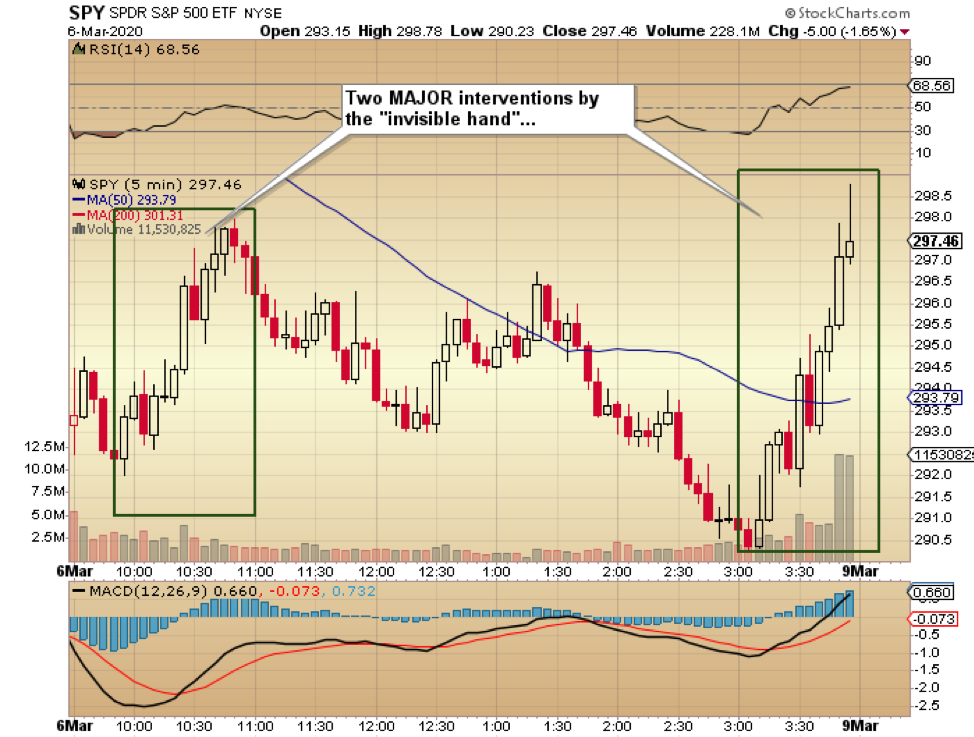
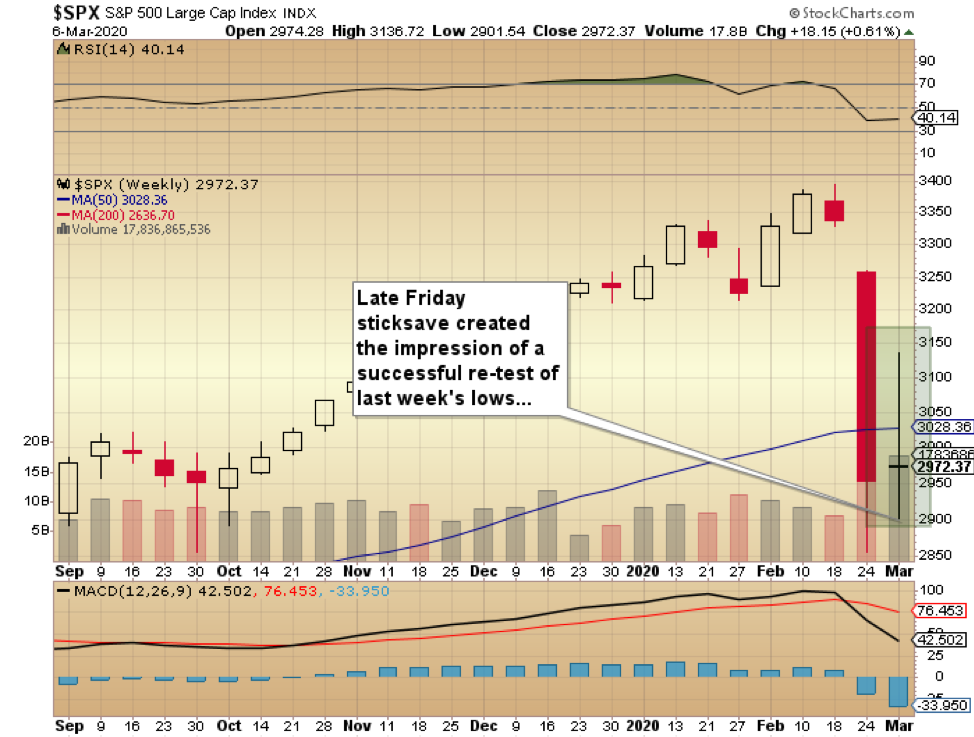
Likewise, here in 2020, not Donald Trump nor Jerome Powell nor Larry Kudlow could lift a finger to calm the markets so they resorted to not one, but two interventions on Friday, to first prevent a total collapse after a 108-point opening crash in the S&P, and then, with less than one hour to go in the week’s trading, another 80-point levitation designed to create the illusion of a successful retest of the 2,885 low of the prior week.
So, while the fear of a market crash was alleviated by the shenanigans of the central planners, it did nothing to appeal to the second reason for challenging the consensus view that “stocks are cheap!”, which is common sense. While the new generation of traders may have been infected with their own private virus called “blind faith in the Fed” for the past ten years, they now cannot dispute the helplessness of government or central bank actions to rectify the uncontained slowdown in business activity brought about by this pandemic.
The late rally on Friday may have soothed frayed mindsets over the weekend, but it surely failed to alter the spending patterns of millions upon millions of consumers and workers. No matter what Kudlow might say on a global cable channel like CNBC, he was surely shown the middle finger by a great many investors whose common sense prevailed.
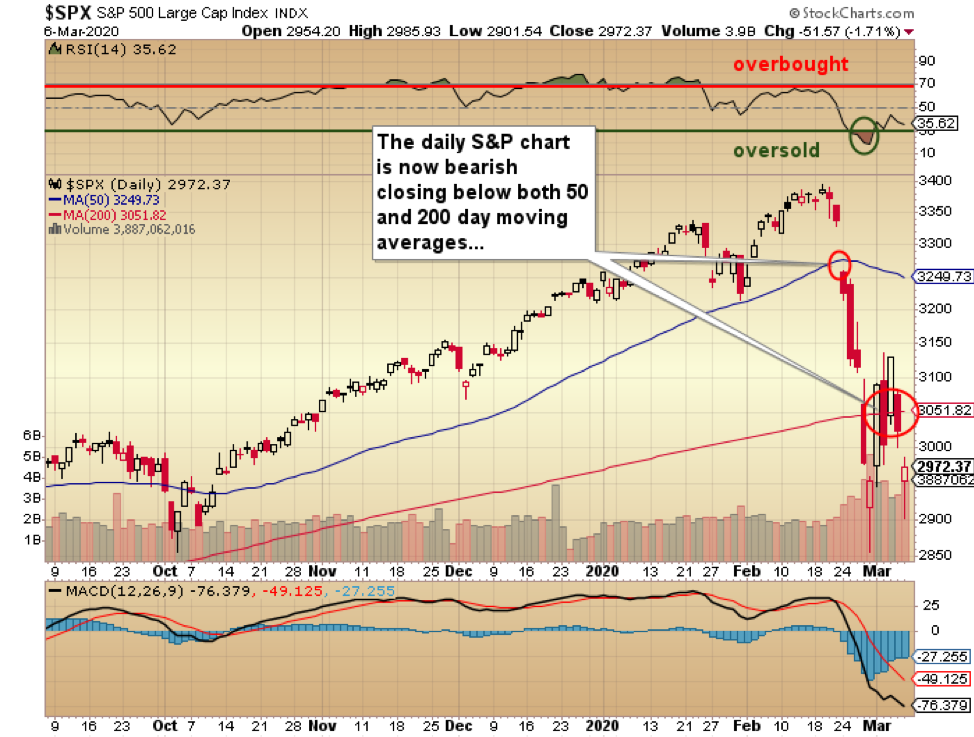
As embarrassing as it was blatant, that last-minute intervention by the elites failed to recapture the 200 daily moving average (200-dma) at 3051, but it did succeed in moving the relative strength index (RSI) back above 30so technically it is no longer in oversold territory, which is bad. The weekly chart shown below is even more significantly bearish on an intermediate-term basis, which means that rallies must be sold, and cash raised before succumbing to the pleadings of the banker-politico alliance.
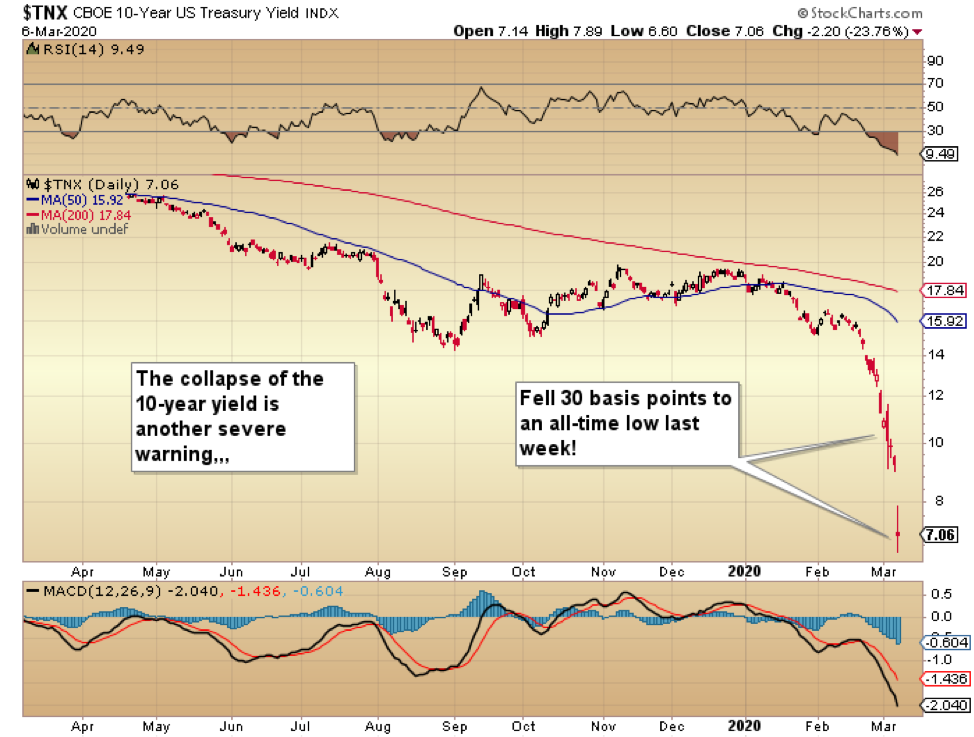
You will recall the chart I provided a few weeks ago, where I asked you all to trust the actions in bond yields (and copper) as guideposts. The 10-year bond is now trading at levels never before seenever. What this means is that gargantuan pools of investor capital are swarming to the perceived safety of 1) the U.S. dollar, and 2) fixed income, in an attempt to evade the risks brought about by the pandemic.
Not surprisingly, bonds have a great deal of common sense as their ascent in price acknowledges the severe negative impact on the travel industry, tourism, manufacturing and all related subsectors by an adversary totally out of the purview and control of central bank/treasury intentions.
As investors, when you read Barron’s or the Wall Street Journal over the weekend, you will find that COVID-19, stocks, and the 10-year yield will dominate. What you will not read aboutat least until page 14 or sois the safe haven performance of one other asset classgold. Gold’s year-to-date performance is now solidly black, and that is despite massive interventions, interference and manipulation by the banker-politico alliance. I am not going to speak about silver in this week’s missive; the level of market interference, despite the U.S. Department of Justice’s indictments of JP Morgan. continues to rise and the criminality is now beyond blatant. Further, a gold:silver ratio (GSR) above 95 is ridiculous when the ratio in nature is closer to 10. Farcical!
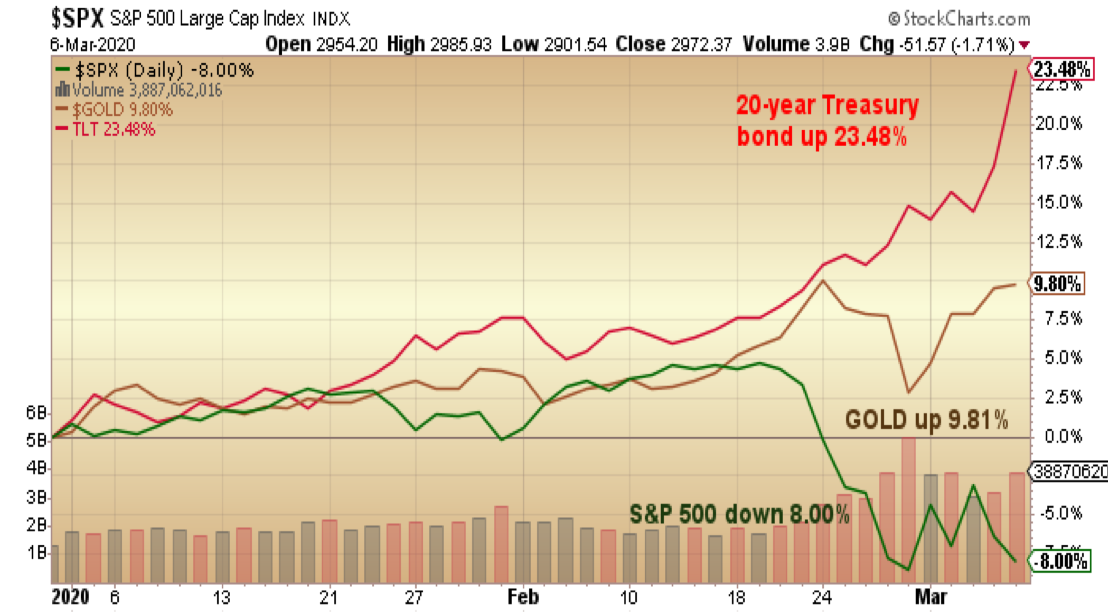
Gold closed out the week up 9.81% year to date (YTD), versus the 8% decline in the S&P. Underscoring the absurdity of the Kudlow coaxing to “buy the dip,” some very large investors opted for the 20-year Treasury bond, whose performance claims the prize with a stunning 23.48% return YTD.
There is a strong possibility of another rebound early this week, just as I called for a week ago, and into which I shorted the SPY (at US$310) and bought the April $280 puts (at US$4.30). The SPY hit US$290.93, and the puts touched $13.59, before the late Friday PPT maneuver took us out at $297.50 and $12 respectively. The GGMA portfolio is in good shape, although the more aggressive trading model is ahead on 11 out of 12 trades, with silver the only loser thus far. (e-mail me at [email protected] for more info.)
I will end this missive with another hockey story. I was at the Saint Louis Blues’ training camp in 1976, and one afternoon, while in the dressing room, a bunch of Blues’ regulars were all sitting around after practice talking to a rookie about what the minor leagues were like. Derek Sanderson, Chuck Lefley, Larry Patey and Bruce Affleck were all talking about how brutal it was to play in the “I” (International) or the “NA” (North American) or the “E” (Eastern) leagues. They all knew buddies that had played or were playing in these leagues, and the stories of gouged faces and lost teeth and bench-clearing brawls every game were legendary.
Well, just as one of the veterans was scaring the jockstrap off the rookie with a horror story about “the toughest league in the world”the “I”veteran Stanley Cup winner and former Bruins netminder Eddie Johnston, who won First All-Star honors while toiling in the “E,” jumped into the conversation and said, “You guys are all wrong. The toughest hockey league in the world is not any of ’em. The toughest league in the world ain’t even a pro league. It’s so brutal that there are not one, but three, Saint John ambulance guys there each night, and they all carry not one but three suture rolls.”
The rookie, now shivering with the specter of being assigned to this bohemian battleground, says to Eddie, “Where is it, EJ?” And Eddie says: “It’s the INCO Union League in Sudbury, Ontario!”
How about a playoff between them and the Bay Street banksters?
No rules, no game, lots of spectators.
Originally trained during the inflationary 1970s, Michael Ballanger is a graduate of Saint Louis University where he earned a Bachelor of Science in finance and a Bachelor of Art in marketing before completing post-graduate work at the Wharton School of Finance. With more than 30 years of experience as a junior mining and exploration specialist, as well as a solid background in corporate finance, Ballanger’s adherence to the concept of “Hard Assets” allows him to focus the practice on selecting opportunities in the global resource sector with emphasis on the precious metals exploration and development sector. Ballanger takes great pleasure in visiting mineral properties around the globe in the never-ending hunt for early-stage opportunities.
Disclosure: 1) Statements and opinions expressed are the opinions of Michael Ballanger and not of Streetwise Reports or its officers. Michael Ballanger is wholly responsible for the validity of the statements. Streetwise Reports was not involved in any aspect of the article preparation. Michael Ballanger was not paid by Streetwise Reports LLC for this article. Streetwise Reports was not paid by the author to publish or syndicate this article. 2) This article does not constitute investment advice. Each reader is encouraged to consult with his or her individual financial professional and any action a reader takes as a result of information presented here is his or her own responsibility. By opening this page, each reader accepts and agrees to Streetwise Reports’ terms of use and full legal disclaimer. This article is not a solicitation for investment. Streetwise Reports does not render general or specific investment advice and the information on Streetwise Reports should not be considered a recommendation to buy or sell any security. Streetwise Reports does not endorse or recommend the business, products, services or securities of any company mentioned on Streetwise Reports. 3) From time to time, Streetwise Reports LLC and its directors, officers, employees or members of their families, as well as persons interviewed for articles and interviews on the site, may have a long or short position in securities mentioned. Directors, officers, employees or members of their immediate families are prohibited from making purchases and/or sales of those securities in the open market or otherwise from the time of the interview or the decision to write an article until three business days after the publication of the interview or article. The foregoing prohibition does not apply to articles that in substance only restate previously published company releases.
Charts provided by the author.
Michael Ballanger Disclaimer: This letter makes no guarantee or warranty on the accuracy or completeness of the data provided. Nothing contained herein is intended or shall be deemed to be investment advice, implied or otherwise. This letter represents my views and replicates trades that I am making but nothing more than that. Always consult your registered advisor to assist you with your investments. I accept no liability for any loss arising from the use of the data contained on this letter. Options and junior mining stocks contain a high level of risk that may result in the loss of part or all invested capital and therefore are suitable for experienced and professional investors and traders only. One should be familiar with the risks involved in junior mining and options trading and we recommend consulting a financial adviser if you feel you do not understand the risks involved.
We appear to be entering the sort of scenario that doomsday preppers have been warning about for years. A pandemic is spreading death and panic around the world. Markets are crashing. Store shelves are emptying…
How long will it be before the economy grinds to a halt completely? How long will it be before the heavily leveraged financial system simply freezes up?
Emergency rate cuts by the Federal Reserve won’t necessarily keep the banks open. Central bankers won’t necessarily keep grocery stores supplied with food. And they won’t necessarily help you and your family survive the present crisis.
We don’t know if the worst is behind us or yet to come.
The point of preparedness isn’t to try to predict when a crisis will hit or how long it will last. The point is to always be ready for a worst-case scenario.
Why Bank Runs Occur
You don’t want to be among those lined up outside of a big box store hoping to fight your way to the last remaining inventories of toilet paper. Yes, frantic, sometimes combative bathroom tissue runs are now occurring across many parts of the world as panic buying sets in.
As Australian economist Alfredo R. Paloyo explains, “This panic buying is the result of the fear of missing out. It’s a phenomenon of consumer behaviour similar to what happens when there is a run on banks.
“A bank run occurs when depositors of a bank withdraw cash because they believe it might collapse. What we’re seeing now is a toilet-paper run.”
If social panic spreads and escalates, bank runs and closures will be a likely consequence. It’s driven by the same mass psychology that is now clearing store shelves.
Have a Personal Financial Plan B in Place
In our online, digital age, few people have any backup plan for when the financial system fails. The few bucks you likely carry in your wallet won’t get you far or last long.
Just as you should have emergency reserves of household essentials – bottles of water, non-perishable foods, necessary medications, disinfectant wipes, surgical masks, first aid kits, batteries, ammunition, and yes, toilet paper – you also need emergency reserves of cash.
Keep a few hundred dollars in $20 bills (since they are most widely accepted) somewhere hidden and safe in your home.
Of course, paper cash is a poor long-term store of value. And someday it may even be abolished and replaced with digital dollars.
Paper Cash Can Literally Spread Sickness
The World Health Organization (WHO) is using the coronavirus crisis as an opportunity to promote cashless technology. The WHO says banknotes may be spreading the virus and recommends people use contactless payments instead.
It’s true that paper cash is often riddled with infectious germs. During times like these, it’s especially important to wash your hands after handling cash.
A good scrubbing with plain soap and water will destroy and remove viruses including Covid-19, medical experts say. Hand sanitizer isn’t necessary unless you’re on the go and can’t get to a sink.
Unfortunately, the U.S. many decades abandoned a sounder and far sound more sanitary form of cash: silver coins.
Whereas dangerous pathogens can survive on paper notes for long periods, viruses and bacteria are naturally repelled by silver. In fact, silver’s antimicrobial properties are so impressive that many hospitals use silver-derived materials help inhibit the spread of infection.
How to Build a Sound Money Stash
While 90% silver dimes, quarters, and half-dollars may no longer be minted, they can still (for now) easily be obtained in the secondary market from bullion dealers – and for little to no premium above other common silver bullion products.
These historic pre-1965 silver coins are an essential part of any overall emergency preparedness strategy. Their relatively small denominations and widely recognized features make them ideal for use as money.
Of course, their silver content will make them worth far more than their face value in barter situations.
At silver spot prices as of this writing, a pre-1965 dime has an intrinsic metal value of $1.27. A silver quarter is worth $3.18. A silver half-dollar is equivalent to $6.35. And a Morgan or Peace silver dollar is worth an estimated $13.58 (though these coins will tend to command additional collectible premiums depending on their condition).
In addition to an emergency silver stash made up of a good variety of denominations, you will also want to add some gold for storing larger amounts of wealth/engaging in larger transactions.
You can round out your emergency money metals stash with some copper bullion rounds or copper pennies minted in 1982 or earlier. That way, you’ll never have to part with more silver or gold than you need to in order to complete a transaction.
Even if you think the chances are small that you’d ever need to use precious metals for barter, there’s no harm in acquiring the ability to do so. You’ll have some hard assets to your name that will offer long-term inflation protection. Your metals can also be sold into a highly liquid market for dollars whenever you want to ring the register.
In the meantime, being prepared for financial turmoil will give you peace of mind. You’ll feel more confident and rest easier knowing that you have a Plan B in place.
The Money Metals News Service provides market news and crisp commentary for investors following the precious metals markets.
We appear to be entering the sort of scenario that doomsday preppers have been warning about for years. A pandemic is spreading death and panic around the world. Markets are crashing. Store shelves are emptying…
How long will it be before the economy grinds to a halt completely? How long will it be before the heavily leveraged financial system simply freezes up?
Emergency rate cuts by the Federal Reserve won’t necessarily keep the banks open. Central bankers won’t necessarily keep grocery stores supplied with food. And they won’t necessarily help you and your family survive the present crisis.
We don’t know if the worst is behind us or yet to come.
The point of preparedness isn’t to try to predict when a crisis will hit or how long it will last. The point is to always be ready for a worst-case scenario.
Why Bank Runs Occur
You don’t want to be among those lined up outside of a big box store hoping to fight your way to the last remaining inventories of toilet paper. Yes, frantic, sometimes combative bathroom tissue runs are now occurring across many parts of the world as panic buying sets in.
As Australian economist Alfredo R. Paloyo explains, “This panic buying is the result of the fear of missing out. It’s a phenomenon of consumer behaviour similar to what happens when there is a run on banks.
“A bank run occurs when depositors of a bank withdraw cash because they believe it might collapse. What we’re seeing now is a toilet-paper run.”
If social panic spreads and escalates, bank runs and closures will be a likely consequence. It’s driven by the same mass psychology that is now clearing store shelves.
Have a Personal Financial Plan B in Place
In our online, digital age, few people have any backup plan for when the financial system fails. The few bucks you likely carry in your wallet won’t get you far or last long.
Just as you should have emergency reserves of household essentials – bottles of water, non-perishable foods, necessary medications, disinfectant wipes, surgical masks, first aid kits, batteries, ammunition, and yes, toilet paper – you also need emergency reserves of cash.
Keep a few hundred dollars in $20 bills (since they are most widely accepted) somewhere hidden and safe in your home.
Of course, paper cash is a poor long-term store of value. And someday it may even be abolished and replaced with digital dollars.
Paper Cash Can Literally Spread Sickness
The World Health Organization (WHO) is using the coronavirus crisis as an opportunity to promote cashless technology. The WHO says banknotes may be spreading the virus and recommends people use contactless payments instead.
It’s true that paper cash is often riddled with infectious germs. During times like these, it’s especially important to wash your hands after handling cash.
A good scrubbing with plain soap and water will destroy and remove viruses including Covid-19, medical experts say. Hand sanitizer isn’t necessary unless you’re on the go and can’t get to a sink.
Unfortunately, the U.S. many decades abandoned a sounder and far sound more sanitary form of cash: silver coins.
Whereas dangerous pathogens can survive on paper notes for long periods, viruses and bacteria are naturally repelled by silver. In fact, silver’s antimicrobial properties are so impressive that many hospitals use silver-derived materials help inhibit the spread of infection.
How to Build a Sound Money Stash
While 90% silver dimes, quarters, and half-dollars may no longer be minted, they can still (for now) easily be obtained in the secondary market from bullion dealers – and for little to no premium above other common silver bullion products.
These historic pre-1965 silver coins are an essential part of any overall emergency preparedness strategy. Their relatively small denominations and widely recognized features make them ideal for use as money.
Of course, their silver content will make them worth far more than their face value in barter situations.
At silver spot prices as of this writing, a pre-1965 dime has an intrinsic metal value of $1.27. A silver quarter is worth $3.18. A silver half-dollar is equivalent to $6.35. And a Morgan or Peace silver dollar is worth an estimated $13.58 (though these coins will tend to command additional collectible premiums depending on their condition).
In addition to an emergency silver stash made up of a good variety of denominations, you will also want to add some gold for storing larger amounts of wealth/engaging in larger transactions.
You can round out your emergency money metals stash with some copper bullion rounds or copper pennies minted in 1982 or earlier. That way, you’ll never have to part with more silver or gold than you need to in order to complete a transaction.
Even if you think the chances are small that you’d ever need to use precious metals for barter, there’s no harm in acquiring the ability to do so. You’ll have some hard assets to your name that will offer long-term inflation protection. Your metals can also be sold into a highly liquid market for dollars whenever you want to ring the register.
In the meantime, being prepared for financial turmoil will give you peace of mind. You’ll feel more confident and rest easier knowing that you have a Plan B in place.
The Money Metals News Service provides market news and crisp commentary for investors following the precious metals markets.
By Jameel Ahmad, Global Head of Currency Strategy and Market Research at FXTM, ForexTime
Global assets have attempted to rebound from a tremendous fall on Monday, but I still doubt how long the improved sentiment will last. This is because countries are still reporting more fresh cases of the virus, meaning for investors that concerns will remain over a prolonged economic fallout.
It would not surprise if UK, European and even US stock markets moved towards negative territory at some point before Tuesday trading concludes.
Away from world stock markets, FX and currencies are still finding volatility. Eyes remain on the USD that is slowly making a comeback and as Italy becomes a new epicenter of virus concerns, investors globally are starting to withdrawal profits from recent EURUSD positions. Should the US Administration, as expected announce fiscal measures to help the US economy combat the virus impact this can provide the USD with a further lift as it remains on a journey of recovery.
EURUSD, USDJPY and Gold are assets to keep an eye on should the USD attempt a comeback.
Disclaimer: The content in this article comprises personal opinions and should not be construed as containing personal and/or other investment advice and/or an offer of and/or solicitation for any transactions in financial instruments and/or a guarantee and/or prediction of future performance. ForexTime (FXTM), its affiliates, agents, directors, officers or employees do not guarantee the accuracy, validity, timeliness or completeness, of any information or data made available and assume no liability as to any loss arising from any investment based on the same.