By CentralBankNews.info The European Central Bank (ECB) surprised financial markets by maintaining its key interest rates, which are essentially already at the zero lower bound, but boosted its purchases of assets by 120 billion euros and will launch a new round of targeted longer-term refinancing operations (TLTROs) to “support bank lending to those affected most by the spread of the coronavirus, in particular small and medium-sized enterprises.” The ECB, the central bank for the 19 countries that share the euro currency, has maintained its benchmark refinancing rate at 0.0 percent and the lending rate key at 0.25 percent since March 2016, but lowered its deposit rate in September 2019 to the current level of minus 0.50 percent. “Although the Governing Council does not see material signs of strains in money markets or liquidity shortages in the banking system, these operations will provide an effective backstop in case of need,” the ECB said, referring to additional longer-term financing operations. The ECB confirmed its earlier guidance that it expect key rates to “remain at their present or lower levels until it has seen the inflation outlook robustly converge to a level sufficiently close to, but below 2% within its projection horizon…” A new round of targeted longer-term financing operations (TLROs) will begin in June and run until June 2021 but to bridge this gap, the ECB said it would conduct additional longer-term financing operations (LTROs) at fixed rate tenders will full allotment at a rate that is equal to the average rate on the deposit facility to “provide immediate liquidity support to the euro area financial system.” TLTROs became part of the ECB’s non-standard monetary policy tools in 2014 and a second one, known as TLTRO-II, was launched in March 2016. Banks that participated in those programs were able to borrow up to 30 percent of their outstanding loans to businesses and consumers, boosting the amount that banks can lend to the real economy at lower interest rates than the ECB normally offers. Loans under TLTRO-III will be on more favorable terms, the ECB said, to support lending to business most affected by the spread of the coronavirus, known as Covid-19, with interest rates as low as 25 basis points below the average interest rate on the main refinancing operations. For banks that maintain their levels of credit provision, the rate applied on these operations will be as low as 25 basis points below the average deposit facility over the period ending in June 2021. In addition, the maximum amount that banks can borrow under TLTRO-III is raised to 50 percent of their outstanding loans, and the ECB will look into collateral easing measures. In September last year the ECB restarted an earlier asset purchase program – known as quantitative easing (QE) – and began to purchase assets worth 20 billion euros from Nov. 1, 2019. The earlier asset purchase program was completed at the end of 2018 after the ECB had accumulated some 2.6 trillion euros of bonds. Today, the ECB said “a temporary envelope” of additional net asset purchases of 120 billion will be added until the end of the year and in combination with the existing asset purchase program (APP) will “support favorable financing conditions for the real economy in times of heightened uncertainty.” The ECB confirmed its earlier guidance that it expects these asset purchases to “run for as long as necessary to reinforce this accommodative impact on its policy rates, and to end shortly before it starts raising the key ECB interest rates.” Reinvestments from its maturing securities purchased under APP will also continue “for an extended period of time past the date when the Governing Council starts raising the key ECB interest rates, and in any case for as long as necessary to maintain favorable liquidity conditions and an ample degree of monetary accommodation.”
The European Central Bank released the following monetary policy statement and a statement regarding banking supervision:
“At today’s meeting the Governing Council decided on a comprehensive package of monetary policy measures:
(1) Additional longer-term refinancing operations (LTROs) will be conducted, temporarily, to provide immediate liquidity support to the euro area financial system. Although the Governing Council does not see material signs of strains in money markets or liquidity shortages in the banking system, these operations will provide an effective backstop in case of need. They will be carried out through a fixed rate tender procedure with full allotment, with an interest rate that is equal to the average rate on the deposit facility. The LTROs will provide liquidity at favourable terms to bridge the period until the TLTRO III operation in June 2020.
(2) In TLTRO III, considerably more favourable terms will be applied during the period from June 2020 to June 2021 to all TLTRO III operations outstanding during that same time. These operations will support bank lending to those affected most by the spread of the coronavirus, in particular small and medium-sized enterprises. Throughout this period, the interest rate on these TLTRO III operations will be 25 basis points below the average rate applied in the Eurosystem’s main refinancing operations. For counterparties that maintain their levels of credit provision, the rate applied in these operations will be lower, and, over the period ending in June 2021, can be as low as 25 basis points below the average interest rate on the deposit facility. Moreover, the maximum total amount that counterparties will henceforth be entitled to borrow in TLTRO III operations is raised to 50% of their stock of eligible loans as at 28 February 2019. In this context, the Governing Council will mandate the Eurosystem committees to investigate collateral easing measures to ensure that counterparties continue to be able to make full use of the funding support.
(3) A temporary envelope of additional net asset purchases of €120 billion will be added until the end of the year, ensuring a strong contribution from the private sector purchase programmes. In combination with the existing asset purchase programme (APP), this will support favourable financing conditions for the real economy in times of heightened uncertainty.
The Governing Council continues to expect net asset purchases to run for as long as necessary to reinforce the accommodative impact of its policy rates, and to end shortly before it starts raising the key ECB interest rates.
(4) The interest rate on the main refinancing operations and the interest rates on the marginal lending facility and the deposit facility will remain unchanged at 0.00%, 0.25% and -0.50% respectively. The Governing Council expects the key ECB interest rates to remain at their present or lower levels until it has seen the inflation outlook robustly converge to a level sufficiently close to, but below, 2% within its projection horizon, and such convergence has been consistently reflected in underlying inflation dynamics.
(5) Reinvestments of the principal payments from maturing securities purchased under the APP will continue, in full, for an extended period of time past the date when the Governing Council starts raising the key ECB interest rates, and in any case for as long as necessary to maintain favourable liquidity conditions and an ample degree of monetary accommodation.
Further details on the precise terms of the new operations will be published in dedicated press releases this afternoon at 15:30 CET.
The President of the ECB will comment on the considerations underlying these decisions at a press conference starting at 14:30 CET today”
——
“ECB Banking Supervision provides temporary capital and operational relief in reaction to coronavirus
12 March 2020
Banks can fully use capital and liquidity buffers, including Pillar 2 Guidance
Banks will benefit from relief in the composition of capital for Pillar 2 Requirements
ECB to consider operational flexibility in the implementation of bank-specific supervisory measures
The European Central Bank (ECB) today announced a number of measures to ensure that its directly supervised banks can continue to fulfil their role in funding the real economy as the economic effects of the coronavirus (COVID-19) become apparent.
“The coronavirus is proving to be a significant shock to our economies. Banks need to be in a position to continue financing households and corporates experiencing temporary difficulties. The supervisory measures agreed today aim to support banks in serving the economy and addressing operational challenges, including the pressure on their staff,” said Andrea Enria, Chair of the ECB Supervisory Board.
Capital and liquidity buffers have been designed with a view to allowing banks to withstand stressed situations like the current one. The European banking sector has built up a significant amount of these buffers. The ECB will allow banks to operate temporarily below the level of capital defined by the Pillar 2 Guidance (P2G), the capital conservation buffer (CCB) and the liquidity coverage ratio (LCR). The ECB considers that these temporary measures will be enhanced by the appropriate relaxation of the countercyclical capital buffer (CCyB) by the national macroprudential authorities.
Banks will also be allowed to partially use capital instruments that do not qualify as Common Equity Tier 1 (CET1) capital, for example Additional Tier 1 or Tier 2 instruments, to meet the Pillar 2 Requirements (P2R). This brings forward a measure that was initially scheduled to come into effect in January 2021, as part of the latest revision of the Capital Requirements Directive (CRD V).
The above measures provide significant capital relief to banks in support of the economy. Banks are expected to use the positive effects coming from these measures to support the economy and not to increase dividend distributions or variable remuneration.
In addition, the ECB is discussing with banks individual measures, such as adjusting timetables, processes and deadlines. For example, the ECB will consider rescheduling on-site inspections and extending deadlines for the implementation of remediation actions stemming from recent on-site inspections and internal model investigations, while ensuring the overall prudential soundness of the supervised banks. In this context, the ECB Guidance to banks on non-performing loans also provides supervisors with sufficient flexibility to adjust to bank-specific circumstances. Extending deadlines for certain non-critical supervisory measures and data requests will also be considered. In the light of the operational pressure on banks, the ECB supports the decision by the European Banking Authority to postpone the 2020 EBA EU-widestress test and will extend the postponement to all banks subject to the 2020 stress test.
Banks should continue to apply sound underwriting standards, pursue adequate policies regarding the recognition and coverage of non-performing exposures, and conduct solid capital and liquidity planning and robust risk management.
These actions follow a letter sent on 3 March 2020 to all significant banks to remind them of the critical need to consider and address the risk of a pandemic in their contingency strategies. Banks were asked to review their business continuity plans and consider what actions could be taken to enhance preparedness to minimise the potential adverse effects of the spread of the coronavirus. ECB Banking Supervision will engage with banks to ensure the continuity of their critical functions. The ECB Supervisory Board is monitoring developments; these measures will be revised as necessary.”
EURUSD is trading rather flat with the previous session’s volatility easing. This comes ahead of today’s ECB monetary policy meeting. As investors await the ECB’s announcement of easing measures, the downside pressure on the euro could build up.
Price action is currently near the 1.1300 handle. But there is scope for a decline to 1.1200 level. In the near term, we could expect this range to hold. But a lot will depend on how investors react to the ECB meeting today.
Sterling Unmoved by BoE Rate Cut
The pound sterling did not react much, losing just 0.29% intraday. Price action briefly tested the 1.2960 level to establish resistance. Following this, GBPUSD fell to the lower support at 1.2860. The declines will only be accelerating on a break down below this level. Otherwise, we expect GBPUSD to move sideways within the said levels.
Will Crude Oil Resume Declines?
Oil prices are reversing the gains from Tuesday as prices remain weak. This comes amid developing fundamentals especially with talks between Russia and Saudi Arabia.
The Stochastics oscillator remains somewhat poised to the downside. This will potentially form a bearish flat pattern on the oil charts. The support level at 28.00 will be critical in this scenario. For now, the upside is capped at 35.00.
Can XAUUSD Close Below the 1655 Handle?
Gold prices attempted a rally earlier on Wednesday only to give up those gains. But price action is trading below the 1655 handle for the moment. A convincing close below this level is required, for now, to create the downside bias. The next support is at 1631 handle.
We expect gold prices to remain muted in the run-up to the ECB meeting. The direction in the prices could likely be set following the outcome of the monetary policy meeting.
By OilPrice.com – If it’s not green, it’s not millennial–and that’s a big problem for a company like Uber, or Lyft. Millennials love ride-sharing, but they don’t appreciate the CO2 footprint that comes with it.
The immediate problem for Uber is this: The next-generation of ride-sharing is already here–born out of massive millennial demand. It’s green through and through, and it’s set to command some serious market share.
Millennials are driving a new mega-trend: impact-investing. Facedrive, the first ride-sharing company that lets you plant a tree while you drive, and choose exactly what kind of footprint you want to leave behind, is leading this new trend.
“It’s not just that millennials, and younger generations in general, are increasingly opting out of the expenses and hassles of owning and parking a car,” Facedrive CEO Sayan Navaratnam told Oilprice.com in a recent interview. “It’s phenomenally bigger than that: Millennials demand more conveniences, and they demand that they be green. We are giving them that before anyone else does.”
This Trend Is Already Mega
The biggest disruption in the world right now–outside of the coronavirus–is that major hedge funds are giving in to the pressure and moving money into things that are environmentally and socially responsible.
This is an ethics squeeze worth billions.
Jeff Bezos, the richest man on the planet, just committed a whopping $10 billion to a Global Earth Fund.
Larry Fink, the CEO of BlackRock–one of the world’s largest hedge funds, told CEOs around the world last month that climate change has become a “defining factor in companies’ long-term prospects”.
That, he said, would lead to a significant reallocation of capital–and it’s going to happen a lot sooner than anyone previously expected.
He’s far from alone.
“For the first time since WWII we sense a shift in which climate and the environment — not growth — will become the priority of governments and their citizens, as shortages of food, clean water and air become existential questions,” Saxo Bank Chief Economist Steen Jakobsen said in his latest quarterly outlook report.
Green stocks are set to eclipse the current technology monopolies, and even the world’s top oil traders are going green.
Last year alone, 479 green bonds were issued globally–a 25% increase over 2018. And 2020 is going to be a “bumper” year for green, according to Linklaters.
While this revolution in investing that is changing everything may seem sudden–it’s not. We can track its acceleration over the years and its path to becoming a mega-trend by 2019-2020.
“We’re all about grabbing onto the biggest trends in tech before they’re mega-trends. So that takes us back to 2016, when we first came up with the idea. Whenever a major new trend emerges, it’s the job of the truly innovative to step back and say ‘OK, this is an explosively great idea – so what’s wrong with it?’ When you figure that out, and you’ve got the right network and the right people behind you, you can jump in on one of the biggest trends and disrupt a massive market at exactly the right time,” Navaratnam said.
One problem for Uber was timing: This great idea emerged simultaneously with environmentally friendly investing, and both became more than passing fads but they haven’t quite kept step with one another.
It’s all about choice these days, and the disruption here is Facedrive’s offer of choice to the customer, who can seamlessly choose whether they want an EV or a hybrid, rather than a conventional car. And even if they choose conventional, they’re still making a green choice because the CO2 is being offset for them.
That’s a millennial must.
It’s also an investor must that’s attracting some huge names.
The drive for lower emissions has sparked the interest of commercial global mega-banks. Scotia Bank has already pledged over $100 billion to lower carbon emissions TD bank has also pledged billions. As larger more forward-thinking firms want to be associated with the ride-sharing company that has finally understood the market.
Nor has it gone unnoticed by celebrities, including Will Smith and Jada Pinkett Smith. Facedrive has invested in the celebrity couple’s WestBrook Global Inc., which gives them access not only to content distribution monetization on the side, but also to some 120 million additional social media followers.
The Green Ride of a Lifetime
The biggest negative impact associated with the explosive popularity of ride-hailing is pollution.
A recent study by the Union of Concerned Scientists estimates that the average (U.S.) ride-hailing trip results in 69% more pollution than whatever transportation option it displaced.
That’s a huge number, that scientists estimate is actually higher in densely populated areas. In this age of green investing, this is data that millennials find hard to swallow.
But now, they don’t have to. Now they can plant a tree every time they take a ride.
Facedrive ride-hailing offsets any CO2 emissions, and for the very first time in ride-sharing history, gives customers the choice to be even more environmentally conscious.
This is innovative, state-of-the-art, technology. FD’s in-app algorithm calculates estimated CO2 emissions for each car journey and allocates an equivalent monetary value to the local organizations to plant trees. They have partnered with Forest Ontario and have planted over 3,500 trees last year in their soft launch phase.
Facedrive allows its riders to choose between EVs, hybrids and traditional cars. It’s a choice no one’s ever given to consumers, and it means that it pleases everyone. For all those riders who are fine with the conventional, Facedrive is by no means sidelining them. They’re just offsetting the related emissions.
And it also resonates with the wallet because riders aren’t paying a premium for offsetting.
Local communities will also reap the benefits, which means that officialdom should be solidly on board.
Millennials Win Ride-Hailing Battle for Supremacy
The ride-sharing giants have been pushing for diversification with hefty bets on food and grocery delivery, scooter and bike rentals and even a proto-bank like Uber Money. Facedrive, too, is pushing diversification from the starting gate, with green delivery services.
But what the giants have ignored is environmental pressure–and that’s exactly where this battle for supremacy could be decided.
Millennial investors are nearly twice as likely to invest in companies or funds that target specific social or environmental outcomes.
And now, comes the next push, as Facedrive slides things into fifth gear by expanding into the U.S. and European markets in Q3-Q4 of 2020.
Ride-sharing has already been overwhelmingly sold to the public. That means that the next-gen, green version of this $235-billion global business doesn’t have to fork over a ton of capital to convince the market. They don’t have to pile on losses and some day hope for profitability. They just have to be green.
It’s Uber. Just better for the environment. And it’s exactly what millennials want.
Other tech companies poised to ride the ride-share boom:
Uber Technologies Inc. (NYSE: UBER)
The big story in tech last year was the Uber IPO—the ride-sharing app joined the market with a tepid showing, and it hasn’t done much business since.
It’s the cherry on top of a cake of trouble for the revolutionary tech company, which has suffered from a mountain of bad press. It’s controversial CEO Travis Kalanick was forced out over his behavior and the company’s struggle to generate revenue, but the new management hasn’t been able to do much better.
Uber keeps burning through money: in Q2 of 2019 it posted a $5 billion operating loss, linked in part to the expensive IPO.
Bears have been circling the wagons for a while, warning the Uber’s ration is unsustainable. But bulls have been quick to point out how other revolutionary tech companies like Amazon and Facebook posted losses after their IPOs, before going on to become fabulously profitable.
Plus, Uber’s losses are linked to its IPO and its rapid expansion rate: once the company solidifies its dominance of ride-sharing and makes inroads to self-driving cars, Uber’s profits are likely to prove sturdy.
Moreover, while $5 billion sounds like a lot, it pales in comparison with what other big companies have suffered through—GM posted $48 billion loss in 2009, and it’s held on despite it.
Lyft (NASDAQ:LYFT)
Lyft may be a bit overvalued, but it’s still sustainable.
Lyft went public in March for $87.24 and hit $88.60 on the first day of trading.
It’s shed over half that and has been treading water ever since. Lyft’s next earnings report is due on October 30th.
But $36 makes this a cheap stock for a ride-sharing market that’s killing taxi cabs and cutting in on car sales, too.
Right now, Lyft is valued at 4x its sales, and it’s still losing money—like Uber. But it does have over $3 billion in cash, and it is investing in micro-mobility, too, through bike-sharing startups.
General Motors (NYSE:GM) has created its own brand of electric bikes, called Ariv. The bikes were just launched this year, but have already captured the attention of the European market.
While they err on the side of pricey, coming in at $3,800 per unit, they do boast a high top speed and can travel a modest distance on a single charge.
The kicker for many, however, is that they can fold into an easily carriable pack, making them the perfect choice for a lot of commuters. Especially in big cities like London or Berlin.
Ford (NYSE:F) is taking a different approach. It’s swooped right into the scooter market, buying Spin for a clean $100 million.
Initially deployed in San Francisco back in 2017, Spin is widely considered to be a part of the Big Three of the scooter world, along with Lime and Bird.
While Ford’s buyout of Spin made headlines, it’s certainly not the first urban transportation alternative Ford’s sunk its teeth into.
In recent years, Ford also bought commuter shuttle service Chariot, Autonomic and TransLoc, aiming to ensure that it does not miss the boat as this new movement accelerates.
BAIDU (NYSE:BIDU), for its part, is taking on the automated car market. With more miles under its belt than any of its competitors in Beijing, it’s an easy choice for a number of investors.
Likewise, it has an equally large portfolio of innovative new technology…at a lower entry point than its competitors.
As the ‘Chinese Google,’ Baidu is following a similar path to its American counterpart. It began as a search engine but is quickly expanding into almost all things tech related.
From artificial intelligence to television and finance, Baidu’s ever-expanding reach is a not to be ignored. Especially for investors looking to stay on top of the new tech trends.
By. Charles Kennedy
**IMPORTANT! BY READING OUR CONTENT YOU EXPLICITLY AGREE TO THE FOLLOWING. PLEASE READ CAREFULLY**
Forward-Looking Statements
This publication contains forward-looking information which is subject to a variety of risks and uncertainties and other factors that could cause actual events or results to differ from those projected in the forward-looking statements. Forward looking statements in this publication include that the demand for ride sharing services will grow; that the demand for environmentally conscientious ride sharing services companies in particular will grow; that Facedrive will be able to fund its capital requirements in the near term and long term; and that Facedrive will be able to carry out its business plan. These forward-looking statements are subject to a variety of risks and uncertainties and other factors that could cause actual events or results to differ materially from those projected in the forward-looking information. Risks that could change or prevent these statements from coming to fruition include changing governmental laws and policies; the company’s ability to obtain and retain necessary licensing in each geographical area in which it operates; the success of the company’s expansion activities; the ability of the company to attract a sufficient number of drivers to meet the demands of customer riders; the ability of the company to attract drivers who have electric vehicles and hybrid cars; the ability of the company to keep operating costs and customer charges competitive with other ride-hailing companies; and the company’s ability to continue agreements on affordable terms with existing or new tree planting enterprises. The forward-looking information contained herein is given as of the date hereof and we assume no responsibility to update or revise such information to reflect new events or circumstances, except as required by law.
DISCLAIMERS
ADVERTISEMENT. This communication is not a recommendation to buy or sell securities. An affiliated company of Oilprice.com, Advanced Media Solutions Ltd, and their owners, managers, employees, and assigns (collectively “the Company”) has signed an agreement to be paid in shares to provide services to expand ridership and attract drivers in certain jurisdictions outside Canada and the United States. In addition, the owner of Oilprice.com has acquired additional shares of FaceDrive (TSX:FD.V) for personal investment. This compensation and share acquisition resulting in the beneficial owner of the Company having a major share position in FD.V is a major conflict with our ability to be unbiased, more specifically:
This communication is for entertainment purposes only. Never invest purely based on our communication. Therefore, this communication should be viewed as a commercial advertisement only. We have not investigated the background of the featured company. Frequently companies profiled in our alerts experience a large increase in volume and share price during the course of investor awareness marketing, which often end as soon as the investor awareness marketing ceases. The information in our communications and on our website has not been independently verified and is not guaranteed to be correct.
SHARE OWNERSHIP. The owner of Oilprice.com owns shares of this featured company and therefore has a substantial incentive to see the featured company’s stock perform well. The owner of Oilprice.com will not notify the market when it decides to buy more or sell shares of this issuer in the market. The owner of Oilprice.com will be buying and selling shares of this issuer for its own profit. This is why we stress that you conduct extensive due diligence as well as seek the advice of your financial advisor or a registered broker-dealer before investing in any securities.
NOT AN INVESTMENT ADVISOR. The Company is not registered or licensed by any governing body in any jurisdiction to give investing advice or provide investment recommendation. ALWAYS DO YOUR OWN RESEARCH and consult with a licensed investment professional before making an investment. This communication should not be used as a basis for making any investment.
RISK OF INVESTING. Investing is inherently risky. Don’t trade with money you can’t afford to lose. This is neither a solicitation nor an offer to Buy/Sell securities. No representation is being made that any stock acquisition will or is likely to achieve profits.
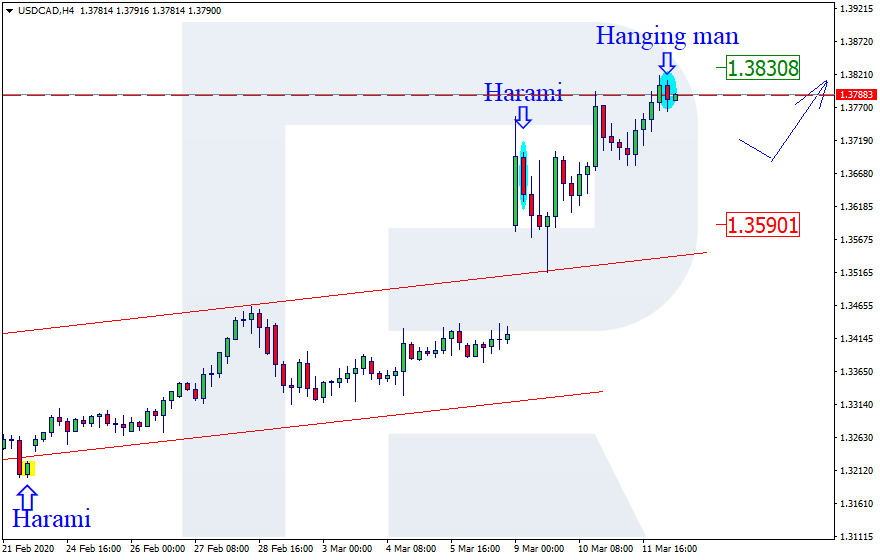
As we can see in the H4 chart, after finishing a Hanging Man pattern near the resistance level, USDCAD continues growing and updating its highs. Right now, the pair may start reversing; the downside target is at 1.3590. The current situation implies that after completing a pullback the price may resume growing towards 1.3830. At the same time, one shouldn’t exclude an opposite scenario, according to which the instrument may continue growing without forming a correction towards 1.3590.
AUDUSD, “Australian Dollar vs US Dollar”
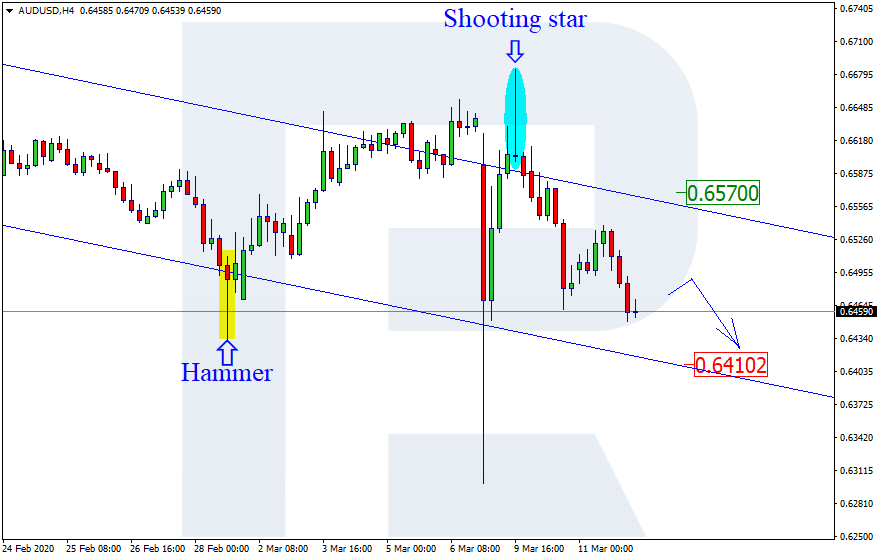
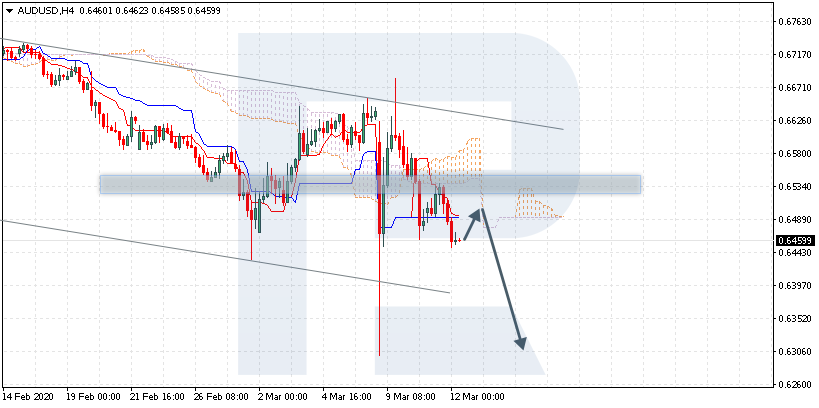
As we can see in the H4 chart, the pair continues the descending tendency. After completing a Shooting Star reversal pattern near the channel’s upside border, AUDUSD is still reversing. Later, the price may complete a correction and resume trading downwards to reach the channel’s downside border at 0.6410. Still, the instrument may choose a different scenario and continue falling without any corrections. A rebound from the current level is a less probable scenario, but it may happen. In this case, the target will be at 0.6570.
USDCHF, “US Dollar vs Swiss Franc”
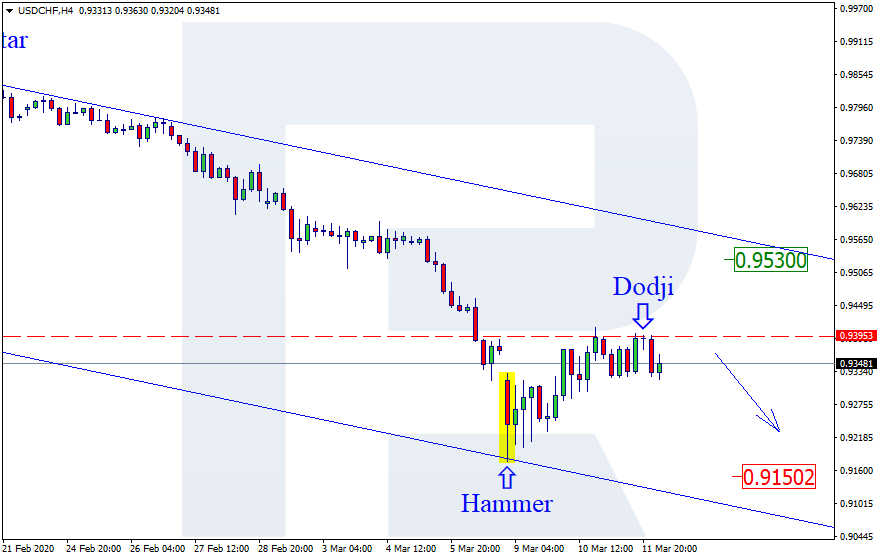
As we can see in the H4 chart, the descending tendency continues. By now, USDCHF has reversed after forming a Hammer reversal pattern and formed several more reversal patterns near the resistance level, including Doji. The current situation suggests that the pair may reverse and then continue the descending tendency with the target at 0.9150. However, one shouldn’t ignore another scenario, according to which the instrument may return to 0.9530.
Attention! Forecasts presented in this section only reflect the author’s private opinion and should not be considered as guidance for trading. RoboForex LP bears no responsibility for trading results based on trading recommendations described in these analytical reviews.
Note: This overview has an informative and tutorial character and is published for free. All the data, included in the overview, are received from public sources, recognized as more or less reliable. Moreover, there is no guarantee that the indicated information is full and precise. Overviews are not updated. The whole information in each overview, including opinion, indicators, charts and anything else, is provided only for familiarization purposes and is not financial advice or а recommendation. The whole text and its any part, as well as the charts cannot be considered as an offer to make a deal with any asset. IFC Markets and its employees under any circumstances are not liable for any action taken by someone else during or after reading the overview.
AUDUSD is trading at 0.6459; the instrument is moving below Ichimoku Cloud, thus indicating a descending tendency. The markets could indicate that the price may test the resistance area at 0.6490 and then resume moving downwards to reach 0.6305. Another signal to confirm further descending movement is the price’s rebounding from the resistance level. However, the scenario that implies further decline may be canceled if the price breaks the cloud’s upside border and fixes above 0.6555. In this case, the pair may continue growing towards 0.6645.
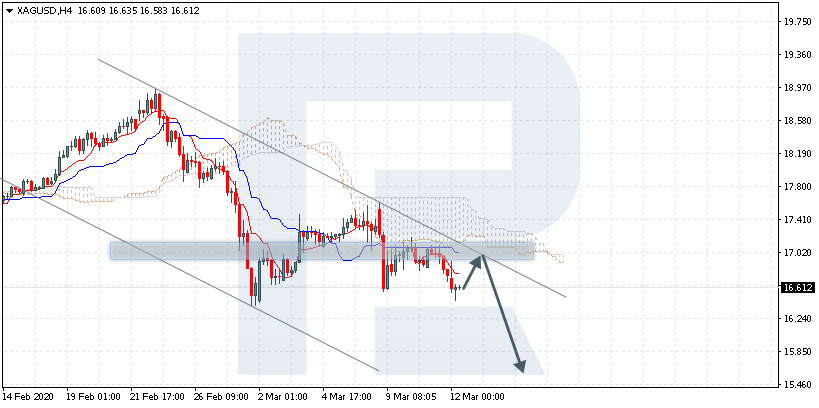
XAGUSD, “Silver vs US Dollar”
XAGUSD is trading at 16.61; the instrument is moving below Ichimoku Cloud, thus indicating a descending tendency. The markets could indicate that the price may test the cloud’s downside border at 16.95 and then resume moving downwards to reach 15.75. Another signal to confirm further descending movement is the price’s rebounding from the descending channel’s upside border. However, the scenario that implies further decline may be canceled if the price breaks the cloud’s upside border and fixes above 17.45. In this case, the pair may continue growing towards 18.25.
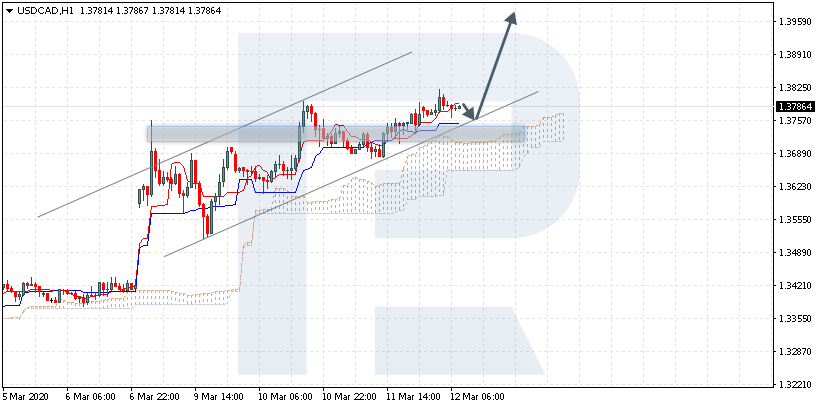
USDCAD, “US Dollar vs Canadian Dollar”
USDCAD is trading at 1.3786; the instrument is moving above Ichimoku Cloud, thus indicating an ascending tendency. The markets could indicate that the price may test Tenkan-Sen and Kijun-Sen at 1.3760 and then resume moving upwards to reach 1.3965. Another signal to confirm further ascending movement is the price’s rebounding from the rising channel’s downside border. However, the scenario that implies further growth may be canceled if the price breaks the cloud’s downside border and fixes below 1.3615. In this case, the pair may continue falling towards 1.3535.
Attention! Forecasts presented in this section only reflect the author’s private opinion and should not be considered as guidance for trading. RoboForex LP bears no responsibility for trading results based on trading recommendations described in these analytical reviews.
Technical setup bearish for EURUSD despite positive data
Euro-zone industrial production rose 2.3% over month in January after 1.8% decline in December, when a 1.4% growth was forecast. This is bullish for EURUSD. However, global equity markets are falling with uncertain economic prospects as coronavirus outbreak spreads globally. And technical setup is bearish ahead of ECB policy meeting where more monetary stimulus measures are expected to be announced.
On Wednesday, March 11, trading on the euro was down at the close. In the American session, the EURUSD pair returned to the bottom line of channel D3. The market situation remains uncertain. The World Health Organization has declared the coronavirus to be a global pandemic. Against the backdrop of this report, US stock indices again came under pressure. The euro fell ahead of the ECB meeting.
The speech given by US President Donald Trump also did not live up to expectations and contributed to the sale of risky assets. In his address to the nation, the president said he would instruct the US Treasury to postpone some tax payments, and urged Congress to immediately approve tax breaks on wages, which would give the economy extra liquidity of more than $200bn. USD.
Today’s news (GMT+3):
13:00 Eurozone: Industrial Production s.a. (MoM) (Jan).
15:30 USA: Producer Price Index ex Food & Energy (YoY) (Feb), Initial Jobless Claims 4-week average (Mar 6).
15:45 Eurozone: ECB Deposit Rate Decision.
16:30 Eurozone: ECB Monetary Policy Statement and Press Conference.
Current situation:
Market expectations were fully met. The price dropped to the lower line of the MA channel from the balance line (Lb). In Asian trading, the price quickly returned to the Lb. The increase in quotes was facilitated by the flight to the yen, franc and euro (as the funding currency). Oil prices collapsed by 6%. Futures on the S&P500 and DJIA indices fell by 5%.
At the time of writing, the euro is worth 1.1303. This review comes without a forecast, since an important event for the single currency is planned for today – the ECB Governing Council will meet. Later, ECB President Christine Lagarde will deliver a speech. Market players expect that the regulator will take measures to weaken the monetary policy and reduce the rate on deposits from -0.5% to -0.6%.
If there were to be no ECB meeting today, then we would consider an increase to 1.1390. After the morning rise, the current price pattern is ideal for growth, but Lagarde’s press conference brings further uncertainty to the market. Softening monetary policy and the news surrounding the pandemic will put pressure on the euro, so you need to fix your profits on long positions in a timely manner so as not to be caught up in a drawdown.
Dow in bear market as WHO designates coronavirus outbreak a pandemic
US stock market plunge renewed on Wednesday after the World Health Organization designated the global spread of coronavirus as pandemic. The S&P 500 fell 4.9% to 2741.38. The Dow Jones industrial average plummeted 5.85% to 23553.22 closing in a bear market, defined as a drop of at least 20% from a record intraday peak. Nasdaq slumped 4.88% to 7952.05. The dollar strengthening slowed as the consumer inflation annual rate slipped to 2.3% from 2.5% in January. The live dollar index data show the ICE US Dollar index, a measure of the dollar’s strength against a basket of six rival currencies, rose 0.4% to 96.66 but is lower currently. Futures on stock indexes are down after President Trump announced he would restrict travel between US and Europe for 30 days to fight the coronavirus outbreak.
FTSE 100 led European indexes retreat after Bank Of England rate cut
European stocks pulled back on Wednesday erasing earlier gains. Both EUR/USD and GBP/USD slowed their declines yesterday with both pairs higher currently. The Stoxx Europe 600 ended down 0.7% led by travel shares. Germany’s DAX 30 slid 0.4% to 10438.68. France’s CAC 40 lost 0.6% while UK’s FTSE 100 fell 1.4% to 5876.52 as Bank of England cut its main interest rate from 0.75% to 0.25% and announced new financing program to support small and medium-sized businesses, along with measures to help commercial banks boost lending. Furthermore, UK finance minister announced fiscal stimulus measures valued at around £30 billion ($39 billion). European stock indexes are down currently ahead of European Central Bank policy meeting today following ECB President Lagarde’s comment Tuesday Europe would “see a scenario that would remind many of us of the 2008 Great Financial Crisis” unless European authorities took coordinated action.
Asian indexes slump led by Australia’s All Ordinaries Index
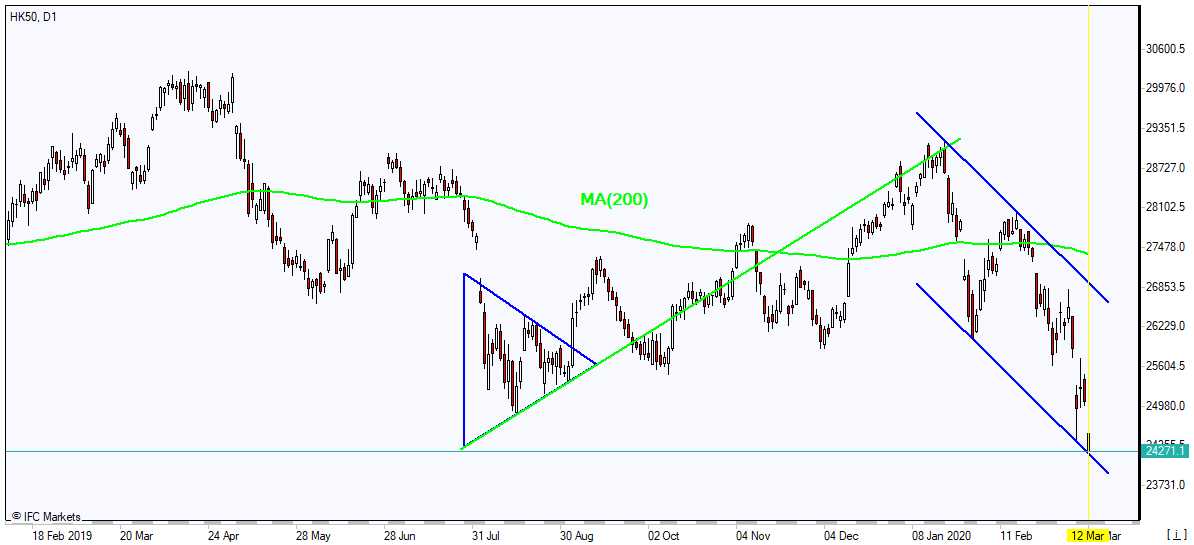
Asian stock indices are sharply lower today tracking changes on Wall Street overnight. Nikkei tumbled 4.6% to 18530.5 as yen accelerated its climbing against the dollar. Markets in China are falling: Shanghai Composite Index is 1.5% lower while Hong Kong’s Hang Seng Index is down 4.1%. Australia’s All Ordinaries Index plunged 7.4% despite Australian dollar’s continuing slide against the greenback.
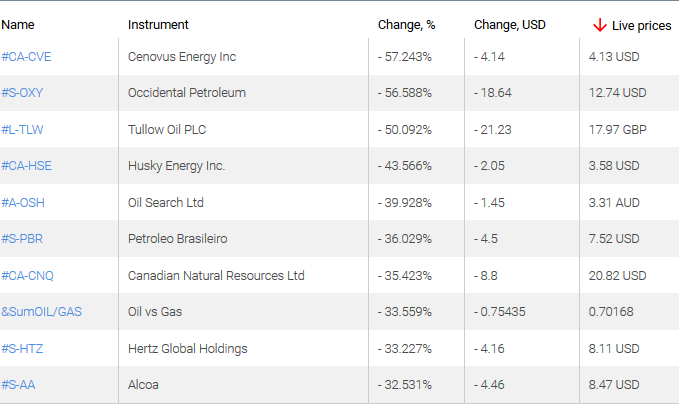
Brent futures prices are extending losses today. Prices fell yesterday after the Energy Information Administration report US crude oil inventories rose by bigger than expected 7.7 million barrels last week, seventh weekly rise in a row: May Brent added fell 3.8% to $35.79 on Wednesday.
Gold edges up as Dollar slips
Gold prices are lower today. The spot price of an ounce of gold slipped 0.9% to $1643 an ounce on Wednesday.
Note: This overview has an informative and tutorial character and is published for free. All the data, included in the overview, are received from public sources, recognized as more or less reliable. Moreover, there is no guarantee that the indicated information is full and precise. Overviews are not updated. The whole information in each overview, including opinion, indicators, charts and anything else, is provided only for familiarization purposes and is not financial advice or а recommendation. The whole text and its any part, as well as the charts cannot be considered as an offer to make a deal with any asset. IFC Markets and its employees under any circumstances are not liable for any action taken by someone else during or after reading the overview.
By Hussein Sayed, Chief Market Strategist (Gulf & MENA), ForexTime
Stocks dived across the globe, Oil plunged further and many companies are drawing down their credit lines after the World Health Organization declared the coronavirus a global pandemic.
Wednesday marked the end of the longest ever bull market for American blue-chip stocks, with the Dow Jones Industrial Average ending the session 20.3% below its February record high. The S&P 500 and Nasdaq Composite are also likely to close in bear market territory today, with futures indicating more than 3% declines at the open.
Markets are in complete crisis mode, past economic data has zero influence on investors’ decision, central bank emergency easing policies are not being effective and politicians’ actions are only adding more confusion. The one thing that investors are monitoring is how fast the coronavirus is spreading, how many lives is it taking and the number of countries and cities in complete lockdown. It literally feels like we are living in a science fiction movie.
President Trump’s address to the nation last night was underwhelming. It shows that the US, like many other countries, is unable to provide the right action in response to the virus spread. He simply couldn’t come up with strong stimulus measures to ease fears of businesses and consumers. A much-needed payroll tax cut doesn’t seem on the cards in the short term, and measures to isolate the US from Europe is only making the situation worse.
A global recession seems impossible to escape and a massive decline in corporate earnings is inevitable. What is even more worrying is the risks that come with such a recession. Corporates across the globe are over-leveraged after more than a decade of low interest rates, and companies with weak balance sheets are extremely vulnerable to such economic shocks. If the current health crisis develops into a credit crisis, we may see a further deep sell-off in equity markets as many companies won’t be able to survive for several months.
Investors sitting on the sidelines awaiting the right opportunity to buy cheap stocks will need to monitor corporate default rates. If the crisis persists for another two or three months, many companies will go bankrupt, especially those in the US energy sector which also have to deal with an Oil price war. Bankruptcies in this sector are hard to contain as other below investment-grade corporates will be impacted, and then there is a higher probability that the entire credit market freezes at a later stage.
Professional investors know that with every fall there is a rise. However, at this stage it’s extremely difficult to know the timing or the shape of the recovery. For the past two to three weeks, most economists were predicting a V-shaped recovery in the global economy. This assumption may be true if the coronavirus spread is contained within the next month or two. But if the health crisis takes longer to get resolved, we may end up with a worse financial crisis than 2008. The main problem is that central banks are left with few tools, so the recovery will become more of an L-shaped one and be far more prolonged.
Disclaimer: The content in this article comprises personal opinions and should not be construed as containing personal and/or other investment advice and/or an offer of and/or solicitation for any transactions in financial instruments and/or a guarantee and/or prediction of future performance. ForexTime (FXTM), its affiliates, agents, directors, officers or employees do not guarantee the accuracy, validity, timeliness or completeness, of any information or data made available and assume no liability as to any loss arising from any investment based on the same.