Lean Cattle Analysis: US Beef Demand Increases

By IFCMarkets

US Beef Demand Increases

According to the US Department of Agriculture (USDA), in February 2020 the slaughter of cattle in the United States amounted to 2.58 million heads. It decreased by 11% compared to January 2020, but increased by 5% compared to February 2019. According to USDA, the number of cattle placed on cattle placements in February fell by 8% compared to February 2019. Earlier, Tyson Foods, a large food company, noted that the demand for meat in the United States increased markedly against the backdrop of quarantine.
India has reduced domestic supplies of beef meat due to unverified rumors that cattle may be somehow affected by the Covid-19 virus. There are no official statements yet. Rumors spread in the Indian states of Karnataka, Goa and Maharashtra.

IndicatorVALUESignal
RSIBuy
MACDNeutral
MA(200)Neutral
FractalsNeutral
Parabolic SARBuy
Bollinger BandsNeutral


Summary of technical analysis

OrderBuy
Buy stopAbove 96
Stop lossBelow 86

Market Analysis provided by IFCMarkets

USDCHF: Wave Count Suggests Further Upside

By Orbex

The current USDCHF structure shows a completed cycle degree correction in wave x which is followed by a bullish zigzag consisting of primary sub-waves Ⓐ, Ⓑ, Ⓒ.

Wave Ⓐ,  which is still under development, consists of intermediate waves (1)-(2)-(3)-(4)-(5). At the time of writing, all but the corrective waves (4) and (5) haven’t completed.

Wave (4) can see an end near 0.9650, where the minor degree correction wave will be at the 50% of bullish impulse (3).

This could continue with the full completion in wave (5) above 0.9902, which is the previous high reached by impulse wave (3).

We can see the current decline though also as part of a deeper correction. This would suggest that wave (5) is completed, and the correction currently seen could be that of the bearish corrective wave Ⓑ , and in a complex form; (W)-(X)-(Y).

This correction could end near the 0.945 level, where the primary correction Ⓑ will have reached the 61.8% Fibonacci retracement of impulse wave Ⓐ. This is often seen in corrections of this type.

By Orbex


AUDUSD Analysis: AUDUSD rising despite deteriorated Australian data

By IFCMarkets

AUDUSD rising despite deteriorated Australian data

Australia’s private sector contracted in March: the service sector contraction accelerated while manufacturing sector expansion slowed, as evidenced by Commonwealth Bank’s Composite PMI report. Despite deteriorating Australian business activity data AUDUSD setup is bullish.

IndicatorVALUESignal
RSINeutral
MACDBuy
Donchian ChannelBuy
MA(200)Sell
FractalsBuy
Parabolic SARBuy


Summary of technical analysis

OrderBuy
Buy stopAbove 0.5975
Stop lossBelow 0.5866

Market Analysis provided by IFCMarkets

EURNZD – Potential Big Swing Coming Into Play

By Orbex

EURNZD has been on a retrace ever since it matched 10-year highs last week at 1.9927.

Technically, the pair is looking set to test back those highs and carving new ones, eventually.

However, at the present, we are likely to see deeper pullbacks ideally towards the 1.76 handle, before potentially reversing the course back upwards.

The weekly chart above points to the 1.76 handle as the main resistance of the channel. That was broken last week. If it comes back into play, it will likely act as strong support now.

The blue line above is an initial support structure (previous resistance), making it an initial downward target of the current retrace, coming roughly at the 1.83 handle.

If the 1.76 handle gets a test and provokes bounces, we could get going for a move back higher.

The 2-hour chart below sketches the very scenario. Price has broken outside of the symmetrical triangle and carries the potential for a move towards 1.83XX levels.

Under 1.83, the possibility of a deeper correction towards 1.76 becomes more likely. This is evident from the weekly and even the 2 hours charts, as there isn’t truly any strong support until the 1.76 handle, with the exception of the psychological 1.80 handle.

By Orbex


Philippines cuts banks’ reserve requirement 200 bps

By CentralBankNews.info
The Central Bank of the Philippines, which has cut its key interest rate twice this year, lowered its reserve requirement ratios on universal and commercial banks by 200 basis points to 12.0 percent, saying this is to “ensure sufficient domestic liquidity in support of economic activity amidst the global pandemic due to the Coronavirus Disease (COVID-19.)
In a statement, Bangko Sentral ng Pilipinas (BSP) said a special meeting of its monetary board had authorized Governor Benjamin Diokno to lower the reserve requirements by up to a maximum 400 basis points in 2020.
The board authorized Diokno to to determine the timing and extent of the reserve requirement reductions by taking into account the impact of the virus on liquidity in domestic markets, giving him flexibility to promptly address any strains in the market.
Following this decision, Diokno announced the 200 basis point cut as of March 30 to “calm markets and to encourage banks to continue lending to both retail and corporate sectors.”
Potential cuts to reserve requirements for other institutions will be explored, the statement added.
Last year BSP lowered its reserve requirements 500 basis points to 14 percent, most recently in October, and Diokno has said he aims to lower the rate to a single digit by 2023.
BSP has been easing its monetary policy stance since May 2019 and has lowered its overnight reverse repurchase (RRP) rate rate 5 times since then by a total of 150 basis points to 3.25 percent.
The most recent cut took place on March 19 when BSP also temporarily relaxed its regulations for compliance reporting by banks, the calculation of penalties on required reserves and single borrower limits to mitigate the risk of financial sector volatility and ensure adequate liquidity and credit.
On March 19 BSP lowered its forecast for inflation in 2020 to 2.2 percent from February’s 3.0 percent and the 2021 forecast to to 2.4 percent from 2.9 percent, due to the fall in oil prices, lower inflation in recent months and the adverse effects of the virus on global and domestic economic activity.
It also said the balance of risks to the inflation outlook now leans to the downside and uncertainty over the “potentially protracted pandemic poses significant downside risks to aggregate demand.”
On March 23 Diokno was quoted as telling reporters that BSP will buy 300 billion pesos of debt from the Treasury under a 3-month repurchase agreement, renewable for another 3 months, with the government using the funds to contain the impact of the virus.

Bangko Sentral ng Pilipinas issued the following statement:


“In a special Monetary Board (MB) meeting yesterday, the MB authorized Bangko Sentral ng Pilipinas (BSP) Governor Benjamin E. Diokno to reduce the reserve requirement (RR) ratios of BSP-supervised financial institutions of up to a maximum of 400 bps for 2020.
To properly calibrate reduction in the RR, the MB likewise authorized the BSP Governor to determine the timing, extent, and coverage of the reduction in the RR, taking into consideration the impact of COVID-19 on domestic liquidity. The authority given to the Governor to adjust the RR allows the BSP flexibility to promptly address any possible liquidity strain in the industry.
Pursuant to this authority, BSP Governor Diokno announced today a 200 bps reduction in the RR ratio of reservable liabilities of universal and commercial banks (U/KBs) effective 30 March 2020. Potential cuts on the reserve requirements for other banks and non-bank financial institutions will also be explored. The BSP will issue guidelines on these operational adjustments.
The RR cut is intended to calm the markets and to encourage banks to continue lending to both retail and corporate sectors. This will ensure sufficient domestic liquidity in support of economic activity amidst this global pandemic due to the Coronavirus Disease (COVID-19).
For further reserve requirement reductions, Governor Diokno said, “The BSP will have to assess the impact of COVID-19 on the broader economy.” He added that the behavior of banks, particularly their capacity to absorb, invest, and lend the freed-up liquidity, will likewise be a determining factor for further adjustments.”


Silver Surges Despite Death Cross Pattern

Silver Daily Chart

Silver powered higher in early trading on Tuesday, extending gains from Monday. The move came after the US Federal Reserve pledged to do whatever it takes to prop up the US economy. The unprecedented Fed action slowed down the scramble for cash that has been driven by panic and the liquidation of positions due to margin calls.

The historic new program from the Fed includes a commitment to unlimited bond purchases, billions in corporate loans backstopped and the extension of credit to small and medium-sized businesses. The Fed stated: “The coronavirus pandemic is causing tremendous hardship across the United States and around the world” adding that “aggressive efforts must be taken across the public and private sectors to limit the losses to jobs and incomes to promote a swift recovery once the disruptions abate.” The Fed news was not sufficient to lead to gains in US stock indices on Monday, but Asian and European markets are trading higher early on Tuesday.

According to data from Johns Hopkins University, at the time of this writing the total number of confirmed Coronavirus COVID-19 global cases has risen to 383,944 and 16,595 deaths. The World Health Organization (WHO) has warned that the coronavirus disease pandemic is accelerating. At a press conference on Monday, WHO Director-General Tedros Adhanom Ghebreyesus said: “It took 67 days from the first reported case to reach 100,000 cases, 11 days for second 100,000 cases, and just four days for the third 100,000 cases.”

Curiously, a bearish death cross pattern (50 period MA crossing below the 200 period MA) has formed on the daily chart after silver bounced from the lows made on March 18th. Support lies at the prior low of 11.60, while the 38% Fibonacci retracement of the recent swing at 14.41 represents potential resistance above. Normally safe havens in times of crisis, both gold and silver sold off during the financial crisis of 2008, before entering multi-year uptrends.

Dan Blystone, Scandinavian Capital Markets


Can Gold Breakout To The Upside?

By Orbex

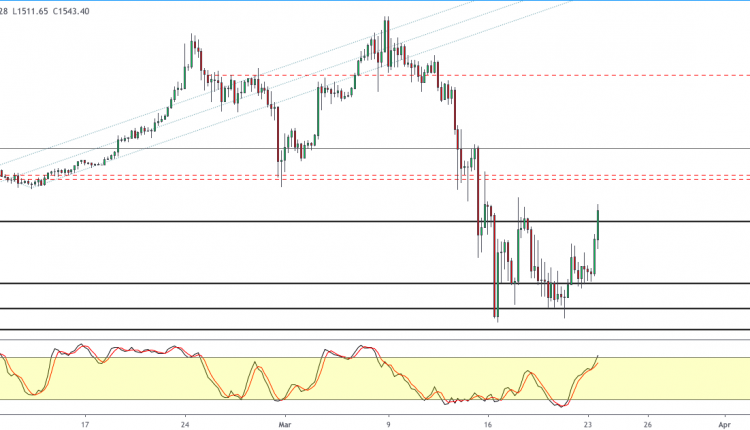
The precious metal made solid gains on Monday, rising close to 3% intraday.

The gains came as the Fed announced its open-ended asset purchases.

Technically, the rebound is, however, met with a hidden bearish divergence.

This means that price action could give back the gains rather quickly.

On the contrary, if XAUUSD forms a base near 1534, we expect further gains to come thereafter.

By Orbex


Preview: German IFO Paints A Depressing Picture

By Orbex

The only notable data for the European markets comes in the form of the German Final IFO Business Climate. And it is likely to make an impact on the euro!

According to the latest figures, sentiment among German businesses has been deteriorating at an alarming rate. Only last month, we saw the biggest drop since Aug 2009. The index fell from 96.0 to 87.7.

The slump in business expectations was also the quickest in 70 years of industry surveys, the IFO said. The service sector was also hit hard. In addition, the business climate indicator registered its lowest ever reading.

Right now, the companies surveyed remain pessimistic, with expectations of further weakening due to coronavirus. Therefore, the situation is likely to worsen for the economy as a whole.

Estimated Economic Impact of the COVID-19 Pandemic

The coronavirus crisis could cost the German economy between €255bn and €729bn in 2020, the IFO economic institute said earlier this week. In a statement, President Clemens Fuest said:

“The costs will probably exceed everything known from economic crises or natural disasters in Germany in recent decades.”

Economic indicators are backing the statement and pointing to a recession. This is true not only for Germany but for the euro area as a whole… That’s if we’re not already in one.

How much damage is suffered by most economies will depend on the duration of the crisis and lockdown.

Economists are expecting that the economy could shrink anywhere between 7.1% and 20.6% in 2020. This will have a direct impact on the country’s GDP, which could suffer a drop of between 0.7% and 1.6%.

What has the German Response Been so far?

The German government has decided to take stern measures to stop the spread of the virus. This includes a partial lockdown on sectors like restaurants, bars, and cafes.

We can, therefore, expect the labor market to dwindle considerably. About 1.8 million jobs could be cut, and these people are subject to social insurance contributions.

Given the situation, on Monday, Finance minister Olaf Scholz announced that €356bn of aid would be provided to support struggling businesses. This amounts to around 10% of Germany’s GDP!

Any Benefits from the Lockdown?

With manufacturing deep in recession and likely to remain there for a while, Germany might reach target greenhouse gas emissions (GHG). They target a 40% drop by the end of the year.

The notable slowdown in industrial activities and transportation are leading to lower gas emissions, perhaps it is the only healthier change the pandemic has resulted in.

With the recent lockdown in mind, Germany will meet the desired target.

Where time is of critical importance, is when this crisis starts deteriorating.

By Orbex


WTI Crude Oil Settles Back Near $22

By Orbex

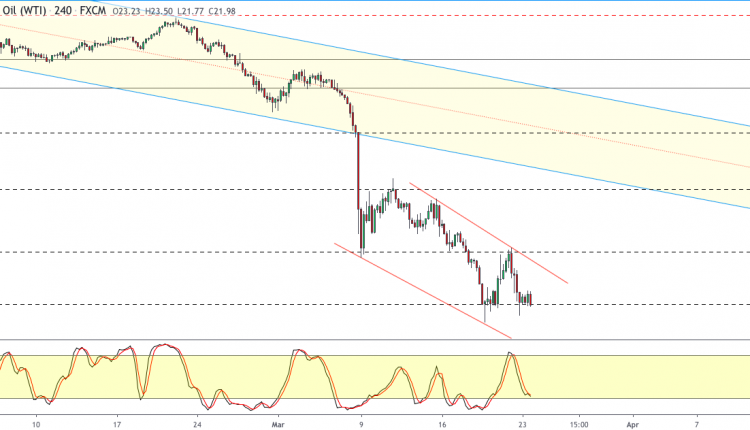
Crude oil prices are modestly weaker, down over 5% on the day.

This comes as price action is back to testing the support level of 22.00.

Given that this is a key price level, a break down lower could trigger further losses.

However, oil price action is looking to be at a critical point. The bias remains a bit mixed at this point.

By Orbex


Sterling Gives Back Gains From Previous Sessions

By Orbex

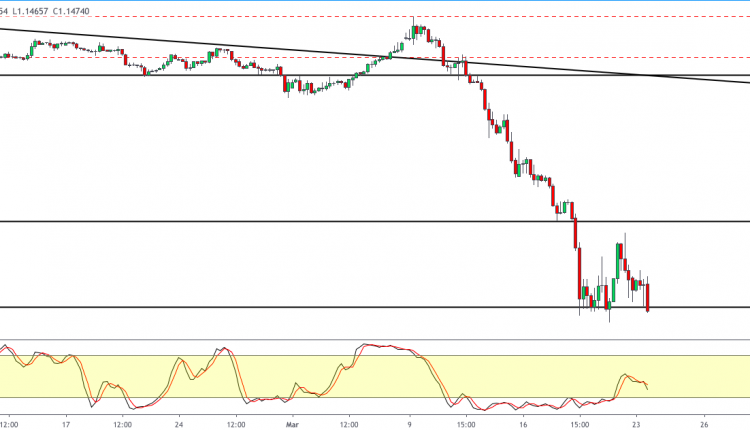
The British pound is trading weaker once again, down over 1.5% intraday.

The declines erase the modest gains from late last week. As price action tests the support area of 1.1477, this level is now at risk.

A break down below this support region could see the GBPUSD falling to fresh lows.

However, watch the Stochastics on the 4-hour chart which could suggest a possible larger correction in the making.

By Orbex