Infill and Expansion Drilling at Goliath Gold Project for Upcoming PFS Progressing According to Plan for Treasury Metals

By The Gold Report

Source: The Critical Investor for Streetwise Reports   04/27/2020

The Critical Investor discusses recent developments at the company that is exploring the Goliath Gold Project in Ontario.

Like most projects around the world, Treasury Metals Inc. (TML:TSX; TSRMF:OTCBB) is temporarily slowing down and shutting down drilling at its Goliath Gold project in Ontario, caused by the omnipresent COVID-19 pandemic, but as it has been completing over half of its drilling program before the virus broke out, it has been reporting several sets of drill results so far this year, and still has a few batches to come. Most of the intercepts are solid, nothing spectacular, but in line with the existing resource.

The goal has predominantly been to prove up the Measured and Indicated resource to Proven and Probable for the upcoming Pre-Feasibility Study (PFS), and this is proceeding well. The company is also looking to add ounces to expand the resource, but these will not be eligible for the PFS reserves, but will indicate future potential for production. I asked management several questions regarding exploration, advancements and adjustments because of the pandemic, and it seems despite the inevitable delays, Treasury Metals is still firmly on track.

All presented tables are my own material, unless stated otherwise.

All pictures are company material, unless stated otherwise.

All currencies are in US Dollars, unless stated otherwise.

Treasury Metals reported two sets of drill results in the first quarter, and a last one on April 2, 2020, all of which will be discussed in this update. In between, the company also sold several claims and royalties on the Shining Tree Gold property to Platinex (PTX.CSE) for equity on March 11, 2020.

Treasury Metals is excited to work with Platinex on Shining Tree. Platinex Chairman and CEO James Trusler is arguably one of the most experienced geological engineers in the sector with five discoveries throughout his career, primarily in Canada. He spent many years at Teck and Inco and therefore has seen most projects at some point in his career. According to CEO Greg Ferron, Jim has a strong technical team and they are very excited about the opportunity at Shining Tree. Investors will most likely see the adjacent Juby Gold project change hands in the short term, which will see a mid-tier gold produce immediately next door.

It has been a long time since, but I do hope Trusler will handle his corporate communications with the First Nations a bit differently compared to the 1999–2009 case. I ran into a pretty entertaining article about the issue. After a decade of disagreements and court cases, Platinex tried to force the issue in 2009 after Ontario took too much time, at least in its view, to make a decision on the matter. Trusler, already being the Platinex CEO at the time, was on the floatplane that tried to land at the lake nearby the project, however it was unable to as First Nations Chief Donny Morris was blocking the landing trajectory of the plane by dragging debris through the water with a small boat.

Morris did this since Platinex didn’t consult with his tribe about the visit, as Platinex repeatedly failed to consult them over the years, troubling relations to an absolute low. Since then, Platinex received $5 million and a 2.5% royalty for returning the Crown Land claims to Ontario in 2009, thus emerging victorious in the end, after it was allowed to do small scale exploration by the Supreme Court in 2007. This case received widespread attention, and formed the cornerstone of updating many mining acts nationwide with regards to timely and effective communication with Indigenous people like the First Nations. According to Trusler, the royalty is on one of the best greenfield platinum projects in the world, and he is actively working with all level of governments to encourage development of the project located near the Ring of Fire area in Ontario. Treasury will assist as it has a strong permitting track record.

So that’s a bit of entertaining history on the side. Let’s have a look at the actual transaction between Treasury and Platinex, which was announced on March 11, 2020. Both companies entered into a non-binding heads of agreement between the two companies to create a substantial gold focused property package in the Shining Tree District in northern Ontario.

The highlights are:

  • Treasury will transfer a 100% interest in its 280 claim unit, 5,045-hectare Shining Tree Fawcett East property to Platinex, to create a significant gold focused property package in northern Ontario
  • Treasury will transfer to Platinex several royalties comprising four Ontario and Chile based exploration projects covering gold, PGMs and base metal opportunities
  • In consideration for acquiring the Shining Tree East Property and the royalties, Platinex will issue to Treasury 12,500,000 common shares of Platinex and 5,000,000 non-transferable warrants of Platinex. Each warrant will be exercisable at a price of $0.05 per share for a period of three years from the date of issuance, provided that if the closing price of the Platinex shares is equal to or greater than $0.30 for a period of 20 consecutive trading days, Platinex will have the right to increase the exercise price of the warrants by giving a written notice to Treasury that the exercise price shall be increased to $0.15 per share on the date that is 10 days from the date of such notice. In addition, Treasury shall not exercise the warrants if such exercise would result in Treasury owning 20% or more of the issued and outstanding Platinex shares.

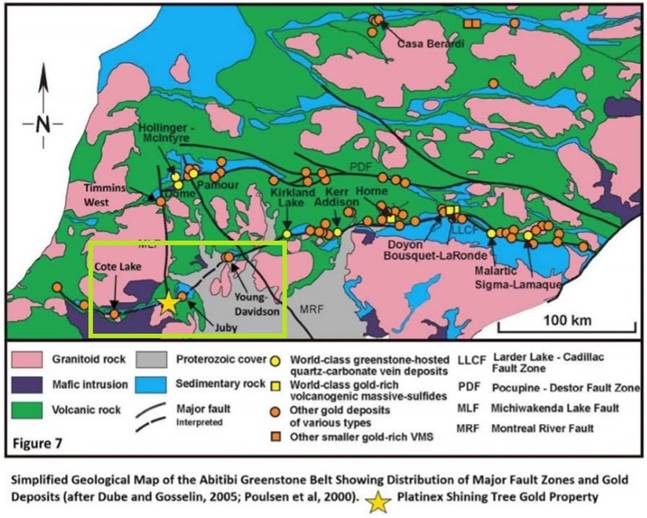
As Platinex was trading at 2.5c at the time of announcement, the Platinex share consideration had a value of $312,500. Considering the early stage of the properties, it has only seen mapping, sampling and very limited near surface drilling, it is hard to assign any value to the package. The remotely interesting thing about this claim package is that the Shining Tree Gold Camp is located in the southwest portion of the Abitibi Greenstone belt along the projected extension of the Larder Lake-Cadillac Break, next to the Juby Gold Project owned by Pan American Silver, and in between the operating Young-Davidson Mine owned by Alamos Gold and the advanced development Côté Lake project owned by IAMGold:
Afbeelding met tekst  Automatisch gegenereerde beschrijving

Of course these last two deposits aren’t at the doorstep of the Shining Tree project, but the trend is a very, very prolific one. I view the equity holding of Treasury in Platinex as a wild card at these times of rising gold prices. I am not sure if Platinex can raise sufficient funds to adequately drill out its project, but at least it is a risk-free option for Treasury on any hits. However, the stock is starting to see more volume since the transaction was announced.

After Treasury announced this deal, the company followed with some pretty nice drill results on April 2, 2020. The Main Zone drilling produced the following interesting highlights:

  • TL20-523 intersected 6.3 g/t Au over 19.5 m including 9.7 g/t Au over 12.0 m in the Main Zone Central Shoot
  • TL20-525 intersected 4.8 g/t Au over 9.0 m including 10.1 g/t Au over 4.0 m in the Main Zone East Shoot
  • TL20-522 intersected 2.9 g/t Au over 4.9 m in the Main Zone Central Shoot

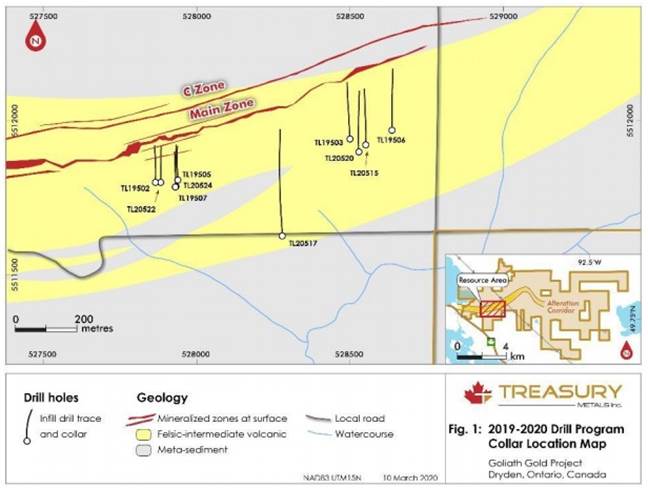
Holes 523 and 525 are located close to hole 522 and 524, which can be seen in the map below (see light green box), which indicated only a few of the drilled holes, unfortunately:
Afbeelding met tekst, kaart  Automatisch gegenereerde beschrijving

As far as the highlights of the drill results of the current campaign go, I put them together in a table, with the green marked intercepts being the most interesting as far as economic intercepts go:
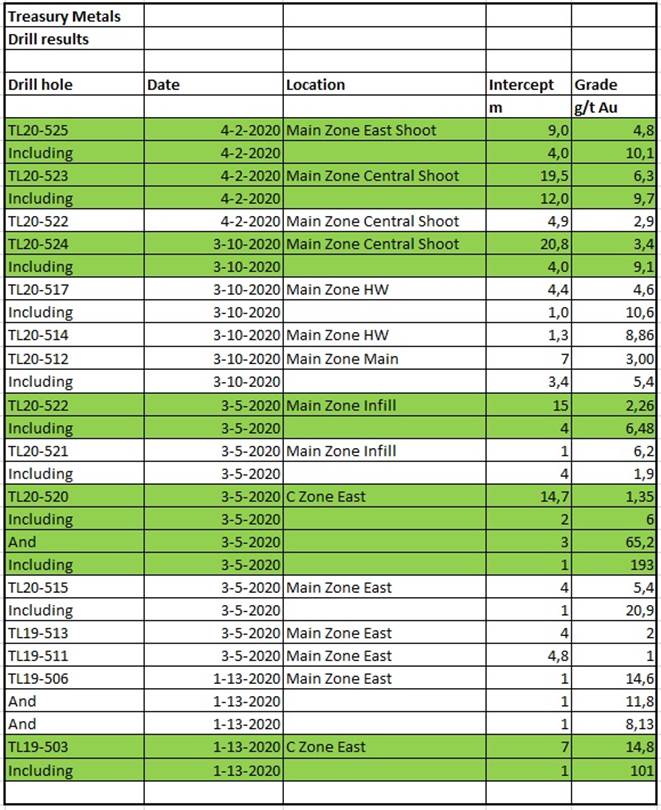
Intervals do not indicate true widths, with inclinations ranging -65 to -80°, meaning most intercept lengths are about 60–80% of reported lengths. A number of holes were left out that generated larger intervals with a lower grade at depth, being hardly economic at grades ranging between 0.5 g/t and 1.5 g/t Au below 200m. TL20-522 had two different results as the assays were divided over two batches. What to make of these results? It seems compared to earlier resource drilling, the infill results show solid continuity of the mineralized zone in the proposed mining areas, and show very good potential for the upgrade of mineral resources into the Measured category, without meaningful loss of grade and/or tonnage. Management added this statement in one of their news releases:

“A portion of the program has been focused on upgrading specific areas of the Main Zone shoots to the ‘Measured’ classification for inclusion as potential estimate ounces for the initial mine life years and for grade control purposes. Each of the reported holes have shown very good continuity of the mineralized areas with high grade.”

This sounds good, but I also wondered why they are after a higher degree of confidence for the resource just for the initial mine life years, as I (and certainly financiers of capex) would like to see equal confidence for at least the first 8 (repayment of debt usually is on 7–10 year schedules) of the 13 2017 PEA life of mine (LOM) years, if not simply all 13 years. CEO Greg Ferron answered in fact, as noted, primarily for the project financiers that require this level of spacing in those early years to ensure their capital is repaid on a quick repayment schedule if desired. The early years are extremely important at the Goliath as the cash flow from the open pit and first few years of the underground continue to fund required sustaining capital for continued underground development. Once the debt is repaid and first few years of the underground is developed the free cash flow will kick in. On a side note, if the C Zone underground exploration continues to show promising results, Treasury may have a more robust second UG production center.

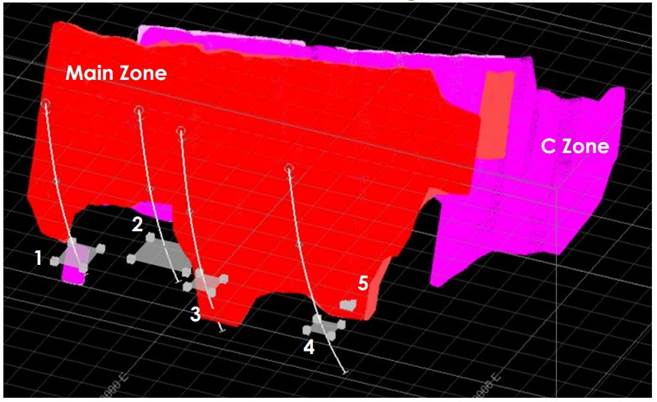
The ongoing proving up of continuity is quite an achievement, given the fact that Goliath is a pretty complex deposit. As a reminder, it is basically two lenses, which are build up around high grade pods. A basic 3D visualization of the lenses looks like this:
Afbeelding met voetbal, spelen, bal, klein  Automatisch gegenereerde beschrijving

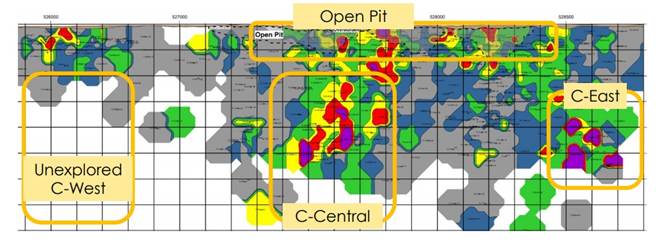
The high grade pod structure surrounded by lower grade mineralization can be seen here in conceptual long sections of both lenses, called the Main Zone and the C-Zone.

The C-Zone can be seen here:
Afbeelding met spel, kooi  Automatisch gegenereerde beschrijving

The Main Zone can be seen here:

Afbeelding met tekst, kaart  Automatisch gegenereerde beschrijving

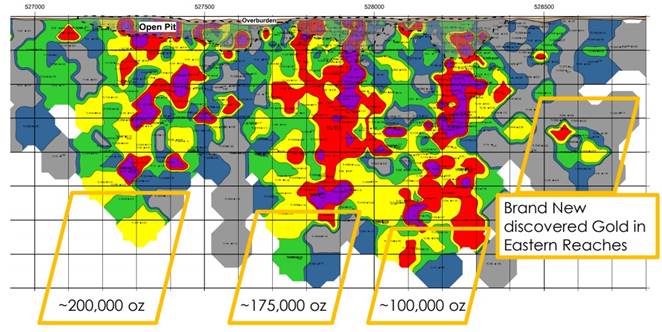
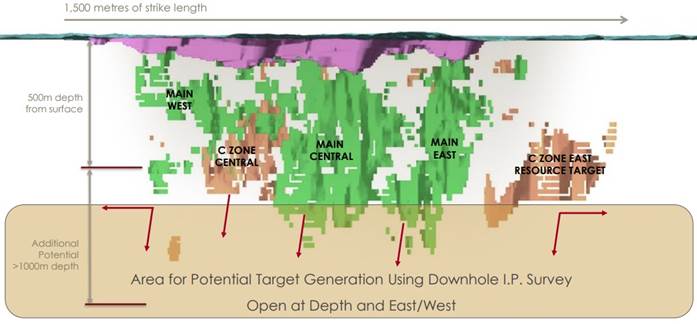
To me this is the most interesting picture of the entire data set available by the company, as it indicates 475,000 oz gold potential at depth, hypothetically substantially adding to the already NI 43-101 defined 1.46Moz AuEq resource. I asked Exploration Manager Adam Larsen why they think exactly there could be this kind of potential. He answered this:

“The lithological units which host the Goliath deposit are consistent down dip and drilling to date has given evidence that this host rock and the mineralized zones should continue at depth. The main issue is that adding resources at depth is pretty costly, as drilling at this time would need to be performed from surface and these expansion holes range from 600 to 1000m in length.”

As costs of drilling is estimated by the company at about $200–250/m, just one hole could easily cost a few hundred grand. What is often done in these situations is proving up Inferred potential, and leave up further resource delineation to the party that brings the deposit into production. During production there could be drilling from platforms at depth, which would obviously be much cheaper and faster. See below for a schematic overview alongside strike regarding potential at depth for the various targets and resource zones:
Afbeelding met kaart  Automatisch gegenereerde beschrijving

Following the most recent exploration updates (news releases dated April 2, March 10, March 5 and January 13, 2020), Treasury has now completed approximately 10,000 meters of the 15,000 meter program.

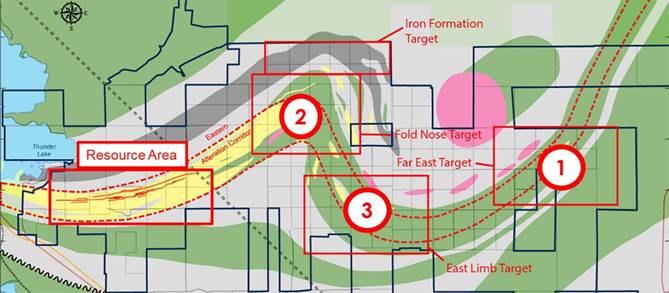
Treasury also worked on the second phase of the Soil Gas Hydrocarbon program, involving surface sampling exploration. Company geologists have collected 1,700 samples covering approximately 5 kilometers of strike length east of the Goliath Gold Deposit.

Here is a map showing the sampling targets:
Afbeelding met tekst, kaart  Automatisch gegenereerde beschrijving

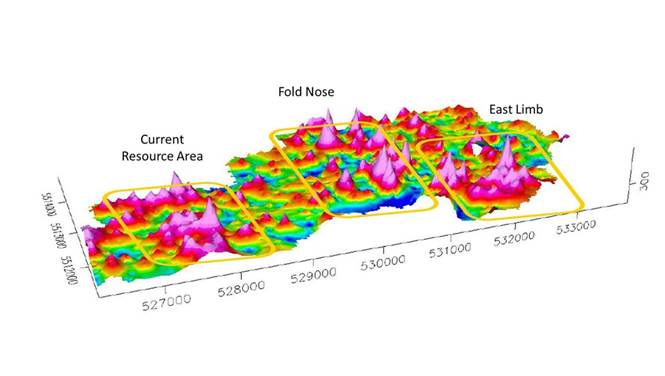
Below is a 3D visualization of the SGH program results, analogous to the results found across the current resource area, and given a confidence rating of 4.0 out of 6.0 (as a comparison, the resource area survey scored 5.0 out of 6.0), the target areas Fold Nose and East Limb appear to resemble the current resource for mineralized potential quite well:
Afbeelding met tekst  Automatisch gegenereerde beschrijving

Of course this is only surface sampling, but considering the established close relation between the current resource and this sampling method, management has hopes of finding economic mineralization in the target areas. I consider this method not to be more accurate than other surface methods, like gravity/magnetic surveys or metal sampling. According to Larsen, the team has been testing regional exploration techniques that pick up gold mineralization similar to the deposit at depth. Soil Gas Hydrocarbon sampling was first tested on the resource area and showed promising results. The main reason to use this technique is that it helps the geologists vector in on a potentially prospective area to focus with more detailed field work. Conventional soil samples were also collected during the program and will be interpreted and compiled with the SGH results where they can be incorporated into future exploration programs. The results so far bode well for more expansion drilling at these target areas. According to Larsen, the next steps for regional exploration include an expanded field program to continue soil sampling across the remainder of the property, infill sample and map the anomalous areas identified in the recent program, and potentially plan a regional drill program for Q3/Q4 2020 if warranted by favorable results.

Regarding current drilling activities, everything has come to a halt unfortunately, caused by the ongoing COVID-19 pandemic, as can be read in the news release:

“The company’s main priority during the ongoing COVID-19 pandemic is the safety of employees, contractors and communities. As such, we have implemented precautionary measures and adapted operations to aid in the containment of the virus. Drilling operations have been deferred for the time being, all non-essential travel has been suspended, and employees in both the project office in Dryden, Ontario and corporate head office in Toronto work remotely wherever possible and actively ensure physical distancing while our Company follows official health and safety guidance from the World Health Organization, Health Canada, Government of Ontario and local health regions. As a Company, we are committed to working together and assisting local communities where possible to stay informed and safe.”

As several countries across the globe are already talking about relaxing measurements, I asked management if they have any clues about returning to action. Ferron stated that they can’t do anything else but follow guidance as stated above, but they are ready to scale up activities as soon as the situation allows it. At this point, the company has sufficient funds, and currently has about C$2 million in the treasury, and a convertible debt of C$4.5 million, carrying an 8% interest. The debenture is held by two of the largest equity holders in the company, Extract Capital and DSC, which are supportive.

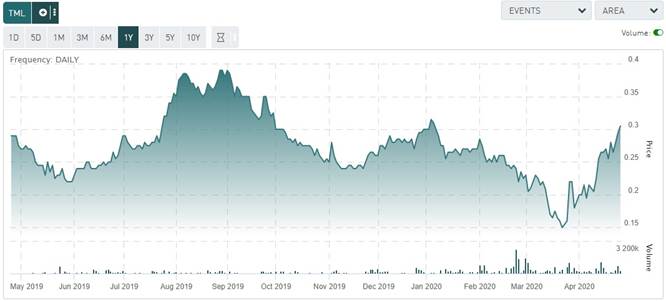
The share price of Treasury Metals looks like this:
Afbeelding met tekst, kaart  Automatisch gegenereerde beschrijving
Share price; 1 year time frame

The big COVID-19 sell-off around March 20, 2020, left scars on the chart for Treasury Metals as it did for almost any actively traded company worldwide. However it completely recovered at impressive volumes, as did almost all other companies, on the back of massive, global central bank stimulus programs to the tune of trillions, in turn triggering gold reaching almost US$1,800/oz recently. Personally I view this as a potential dead cat bounce for the markets with further downside potential, as I see the pandemic setting off a recession earlier than expected, with the financial figures forecasting mayhem for the coming 3–6 months. For now the recovery and especially the large volumes accompanying this for Treasury show strong support, and the recently hit 15c seems to be the low point here, probably caused by panic selling.

That low was a no-brainer for investors, as Treasury Metals is already severely undervalued at C$0.31. To establish this, let’s first rehash a few numbers of Goliath.

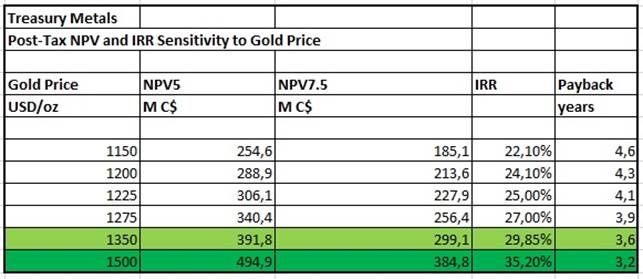
The current Goliath resource stands at 1.46 Moz AuEq, consisting of 83 koz Au Measured, 1.14 Moz Au Indicated and 220 koz Au Inferred, with an average grade of 1.40 g/t Au M&I for the open pit component, and 5.39 g/t Au for the underground component. The operation will be a combination of open pit and underground mining, with a low capex of C$133 million (plus a C$20 million reclamation bond, so in fact C$153 million). At a gold price of US$1650/oz, the estimated after-tax NPV5 is no less than C$600 million; the estimated after-tax internal rate of return (IRR) is 41%. Keep in mind the current market cap of Treasury is just C$51.7 million, which is just about 1/12th of the current NPV5. Usually, a PEA stage company with an economic project is valued at 10–20% of NPV5, with the environmental approvement in hand it is probably more adequately valued to the high side of this range. This is the PEA sensitivity for Goliath:
Afbeelding met schermafbeelding  Automatisch gegenereerde beschrijving

As the company is very close to completing a Pre-Feasibility Study (PFS), the reliability of Goliath Gold numbers will increase a great deal compared to the 2017 PEA. As a consequence, the intrinsic value of the project increases substantially as well. According to management, they expect the PFS to deliver PEA comparable figures, which would be impressive, as a PEA routinely errs to the upside. As the current annual production profile of Goliath Gold involves 87,850 oz Au and 160,000 oz Ag, I would like to see the company increase gold production for the PFS to the magical threshold (for mid tier producers) of 100,000 oz Au annually on average. This would, for example, need an adjustment of the life of mine from 13 years to 11 years, to get to an average of 103,823 oz Au per annum (pa). Maybe drilling could include more ounces as a second option, but these need to be converted into reserves as well, and this would need an additional resource update and lots of drilling, which I deem highly unlikely in the short term. If the PFS indeed delivers according to these ideas, Treasury Metals would become pretty interesting as a takeover target, as 100 koz pa / 1 Moz+ Au deposits with good PFS/FS economics, environmental permit granted and exploration upside have become very rare.

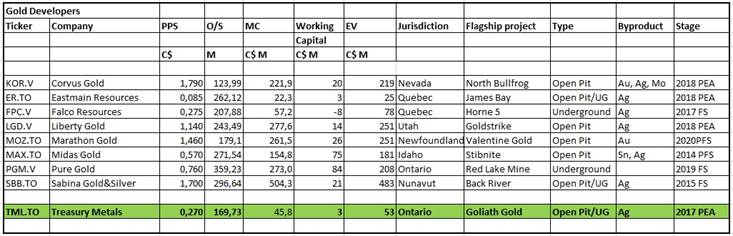
For further comparison, I updated my peer comparison with various companies, all having at least a PEA, all of them in Canada or the USA, gold-focused, and with different mining methods, as Treasury has a fairly unique combination of a small part open pit and largely underground:
And:
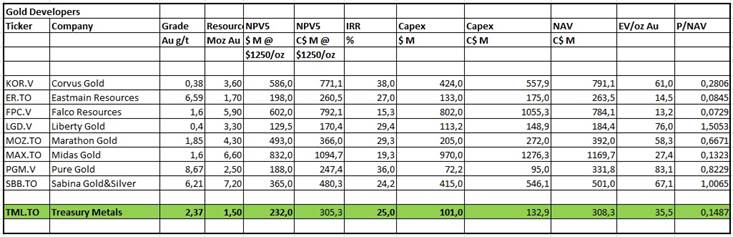
On an EV/oz and P/NAV basis, the company seems to be valued in the same range as companies with projects sporting very high capex and low IRR (Falco and Midas) aka leveraged plays, or companies with a fairly good project but failing management (Eastmain, however a turnaround is happening, results of this need to be seen). None of this is happening with Treasury, so I consider it solid value, flying under the radar of many investors.

5. Conclusion

Despite the COVID-19 pandemic being responsible for halting current exploration programs at Goliath Gold, Treasury managed to get out various sets of solid drill results, on both infill and expansion levels, and positive sampling. As a consequence, the Pre-Feasibility Study (PFS), expected this quarter, could likely contain the same economics as present in the 2017 PEA, making Treasury even more undervalued than it already is, based on various metrics, and the environmental approval in hand. Adjusting the life of mine in favor of annual production figures would be something well-liked by various interested parties for sure, likely also improving economics, btw. I like the upside resource potential of almost a half million ounces of gold a lot, as Goliath could go to 2 Moz AuEq that way. With gold rising to multi-year highs in the last weeks, the case for Treasury Metals becomes stronger and stronger.

I hope you will find this article interesting and useful, and will have further interest in my upcoming articles on mining. To never miss a thing, please subscribe to my free newsletter on my website, http://www.criticalinvestor.eu, and follow me on Seekingalpha.com, in order to get an email notice of my new articles soon after they are published.

The Critical Investor is a newsletter and comprehensive junior mining platform, providing analysis, blog and newsfeed and all sorts of information about junior mining. The editor is an avid and critical junior mining stock investor from The Netherlands, with an MSc background in construction/project management. Number cruncher at project economics, looking for high quality companies, mostly growth/turnaround/catalyst-driven to avoid too much dependence/influence of long-term commodity pricing/market sentiments, and often looking for long-term deep value. Getting burned in the past himself at junior mining investments by following overly positive sources that more often than not avoided to mention (hidden) risks or critical flaws, The Critical Investor learned his lesson well, and goes a few steps further ever since, providing a fresh, more in-depth, and critical vision on things, hence the name.

Sign up for our FREE newsletter at: www.streetwisereports.com/get-news

Disclaimer:

The author is not a registered investment advisor, and currently has a long position in this stock. Treasury Metals is a sponsoring company. All facts are to be checked by the reader. For more information go to www.treasurymetals.com and read the company’s profile and official documents on www.sedar.com, also for important risk disclosures. This article is provided for information purposes only, and is not intended to be investment advice of any kind, and all readers are encouraged to do their own due diligence, and talk to their own licensed investment advisors prior to making any investment decisions.

Streetwise Reports Disclosure:
1) The Critical Investor’s disclosures are listed above.
2) The following companies mentioned in the article are sponsors of Streetwise Reports: None. Click here for important disclosures about sponsor fees. The information provided above is for informational purposes only and is not a recommendation to buy or sell any security.
3) Statements and opinions expressed are the opinions of the author and not of Streetwise Reports or its officers. The author is wholly responsible for the validity of the statements. The author was not paid by Streetwise Reports for this article. Streetwise Reports was not paid by the author to publish or syndicate this article. Streetwise Reports requires contributing authors to disclose any shareholdings in, or economic relationships with, companies that they write about. Streetwise Reports relies upon the authors to accurately provide this information and Streetwise Reports has no means of verifying its accuracy.

4) The article does not constitute investment advice. Each reader is encouraged to consult with his or her individual financial professional and any action a reader takes as a result of information presented here is his or her own responsibility. By opening this page, each reader accepts and agrees to Streetwise Reports’ terms of use and full legal disclaimer. This article is not a solicitation for investment. Streetwise Reports does not render general or specific investment advice and the information on Streetwise Reports should not be considered a recommendation to buy or sell any security. Streetwise Reports does not endorse or recommend the business, products, services or securities of any company mentioned on Streetwise Reports.
5) From time to time, Streetwise Reports LLC and its directors, officers, employees or members of their families, as well as persons interviewed for articles and interviews on the site, may have a long or short position in securities mentioned. Directors, officers, employees or members of their immediate families are prohibited from making purchases and/or sales of those securities in the open market or otherwise from the time of the interview or the decision to write an article until three business days after the publication of the interview or article. The foregoing prohibition does not apply to articles that in substance only restate previously published company releases.

Charts and graphics provided by the author.

( Companies Mentioned: TML:TSX: TSRMF:OTCBB,
)

New Deal ‘Step In Right Direction Toward Turnaround for Energy Firm’

The Energy Report

Source: Streetwise Reports   04/27/2020

The new agreement and its potential impact on Point Loma Resources are discussed in a Mackie Research Capital Corp. report.

In an April 21 research note, Mackie Research Capital Corp. analyst Bill Newman wrote that the transaction outlined in Point Loma Resources Ltd. (PLX:TSX) new Wizard Lake sales agreement, with creditors for a total consideration of $2.9 million, “will help improve the balance sheet and put the company on a better footing to pursue its other development and exploration plays on its large, concentrated, high working interest acreage located in Central Alberta.”

Those assets, which provide additional upside for investors, Newman noted, include a conventional oil play in the Banff Formation, oil expansion plays in the Mannville and a shale oil resource play in the Duvernay.

Newman explained the terms of the new and the prior agreements.

The new agreement calls for the Calgary-based oil and gas firm, Point Loma Resources, to sell 97.5% of its 40% interest in the Wizard Lake development in Alberta, Canada, to its secured debenture holders and a secured creditor.

In exchange, all of Point Loma Resources’ outstanding secured debentures and total owed to the secured creditor will be canceled. Also, Point Loma will retain a 1% operating interest in Wizard Lake. The deal is expected to close on May 21, 2020.

In the prior arrangement, which was canceled on March 31, 2020, Point Loma Resources was to sell its 50% working interest in Wizard Lake to Whitebark Energy. The transaction was to be completed after three closings.

The first closing took place, in which Whitebark paid Point Loma $1.2 million for a 10% interest in Wizard Lake. Subsequently, Whitebark chose not to go through with the remaining two closings. Accordingly, at the end of March 2020, Point Loma owned 40% of Wizard Lake.

Taking into account the amount Whitebark paid Point Loma under the first agreement, the total consideration Point Loma is now to receive for its Wizard Lake interest, if the deal goes through, is $4.8 million, as calculated by Mackie Research, Newman indicated.

That number is derived from these components: from the past agreement, $1.2 million in cash already paid by Whitebark for a 10% interest in Wizard Lake, and from the new agreement, $2.9 million for the cancellation of debentures and secured debt and $700,000 for the reduction of a payout account.

Mackie Research has a Buy rating on Point Loma Resources and a target price of CA$0.15 per share. The current share price is CA$0.02.

Sign up for our FREE newsletter at: www.streetwisereports.com/get-news

Disclosure:
1) Doresa Banning compiled this article for Streetwise Reports LLC and provides services to Streetwise Reports as an independent contractor. She or members of her household own securities of the following companies mentioned in the article: None. She or members of her household are paid by the following companies mentioned in this article: None.
2) The following companies mentioned in this article are billboard sponsors of Streetwise Reports: None. Click here for important disclosures about sponsor fees.
3) Comments and opinions expressed are those of the specific experts and not of Streetwise Reports or its officers. The information provided above is for informational purposes only and is not a recommendation to buy or sell any security.
4) The article does not constitute investment advice. Each reader is encouraged to consult with his or her individual financial professional and any action a reader takes as a result of information presented here is his or her own responsibility. By opening this page, each reader accepts and agrees to Streetwise Reports’ terms of use and full legal disclaimer. This article is not a solicitation for investment. Streetwise Reports does not render general or specific investment advice and the information on Streetwise Reports should not be considered a recommendation to buy or sell any security. Streetwise Reports does not endorse or recommend the business, products, services or securities of any company mentioned on Streetwise Reports.
5) From time to time, Streetwise Reports LLC and its directors, officers, employees or members of their families, as well as persons interviewed for articles and interviews on the site, may have a long or short position in securities mentioned. Directors, officers, employees or members of their immediate families are prohibited from making purchases and/or sales of those securities in the open market or otherwise from the time of the interview or the decision to write an article until three business days after the publication of the interview or article. The foregoing prohibition does not apply to articles that in substance only restate previously published company releases.


Disclosures from Mackie Research, Point Loma Resources Ltd., Update, April 21, 2020

RELEVANT DISCLOSURES APPLICABLE TO COMPANIES UNDER COVERAGE
1. Within the last year, Mackie Research Capital Corporation has managed or co-managed an offering of securities by the
subject issuer.
2. Within the last year, Mackie Research Capital Corporation has received compensation for investment banking and related services from the subject issuer.
3. Relevant disclosures required under Rule 3400 applicable to companies under coverage discussed in this research report are available on our web site at www.mackieresearch.com.

ANALYST CERTIFICATION
Each analyst of Mackie Research Capital Corporation whose name appears in this report hereby certifies that (i) the recommendations and opinions expressed in this research report accurately reflect the analyst’s personal views and (ii) no part of the research analyst’s compensation was or will be directly or indirectly related to the specific conclusions or recommendations expressed in this research report.

( Companies Mentioned: PLX:TSX,
)

Gold and Oil: Remembering the ’70s

Though sector expert Michael Ballanger’s focus is on the precious metals, given current market conditions he sees potential in oil as well.

By The Gold Report – Source: Michael Ballanger for Streetwise Reports   04/27/2020

Before I get started on my weekly commentary, I want to thank you all for the waterfall of responses to A Boomer’s Plea posted last weekend, in what I must confess was my most impassioned missive of a multi-decade writing career. Speaking out as a member of the generation I chose to assail was an absolute joy, and I must tell you that the responses were almost unanimously similar across all age brackets. What surprised me was that the Millennials who read the article thanked me for writing it because finally they had some ammunition to put in front of their Grampa (as they argued for “free everything”). Even my 92-year-old (English) mother-in-law loved it, but said that I was “being too ‘ard on yaself.” Anyway, I thank you all.

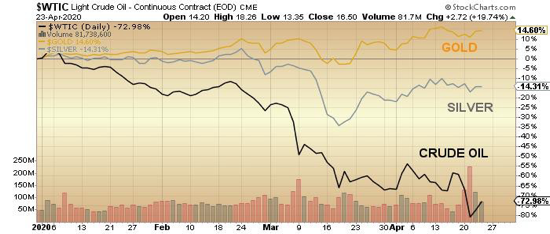
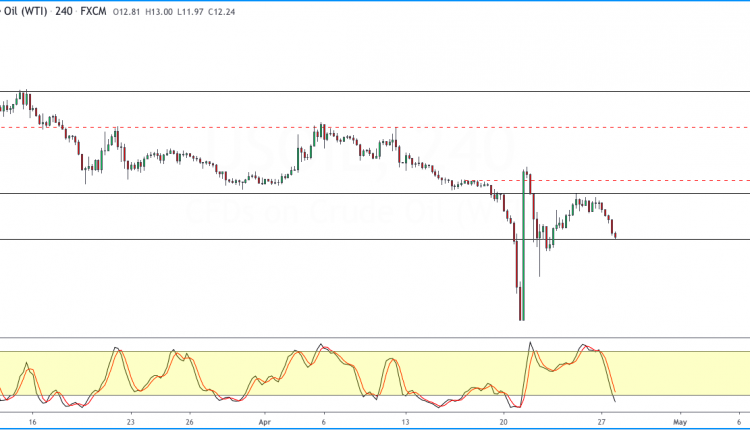
I think that March 16, 2020, and April 21, 2020, will be remembered as two dates in history that redefined the definition of “buy the panic,” because not only did investors have to cope with all of the headlines depicting doom and gloom, they were also up against all those supercomputers running algorithmic software designed to trade faster than all of us. Ironically, the algos could not cope with “irrational panic” and instead simply “followed instructions” laid down by the “code writers” and proceeded to sell May oil futures down to negative US$40 per barrel. I am going to repeat that: minus $40 per barrel.

. . .Pregnant pause allowing data to sink in. . .

I am usually not excessively demonstrative in speaking about oil, but it is close to my sexagenarian heart because I entered the securities industry in 1977 as a trainee in the midst of the biggest oil boom in Canadian history, centered in the West Pembina fields of Alberta. I watched all the salespeople scrambling around from desk to desk, desperateto get the latest scoop on the drilling results from Oakwood Pete or Ascot Pete or “the mighty Sundance.” I watched a salesman (as opposed to “wealth manager”) one morning take fifty orders to buy the entire issued capital of a junior oil explorer called Liberty Petroleum, after which he had a total meltdown because his compliance department said it was “too risky.” The orders were from the family members of a Saudi prince. The broker resigned the following day.

A good friend called me tonight to report that his private exploration deal over in the Middle East just made an absolutely humongous oil discovery above 465 feet depth that tested an economic 8,000 bpd (barrels per day), at which I a) spit out my coffee, and b) coughed loudly, and c) nearly soiled my garments. Let me give you some mathematics on an 8,000-bpd oil discovery: At the low trade on Tuesday for June crude oil futures, at US$6.50 per barrel, it is US$1.56 million per month. At tonight’s closing price of US$16.75 for June crude oil futures, it is US$4.02 million per month. Oil discoveries of that magnitude are generational wealth creators, and it is why the Middle East remains such a strategic region for the world powers.

I must explain something to you all. Wall Street hates gold but it loves oil. Wall Street does not understand gold, but it does understand and appreciate oil. Timed properly, investors can make a great deal of money in the oil sector and in the 1970s, it was gold and oil that dominated portfolios. Drilling in the Beaufort Sea with Dome Petroleum, Gulf Canada and Mobil captivated speculators for years, until the mighty Hibernia discovery offshore Newfoundland emerged as the new hotbed.

I mention this because the recent crash in oil represents an opportunity for serious capital gains once the world solves the economic shutdown issues and, coupled with gold, portfolios holding oil are perfectly hedged against the currency debasement actions occurring everywhere a central bank exists.

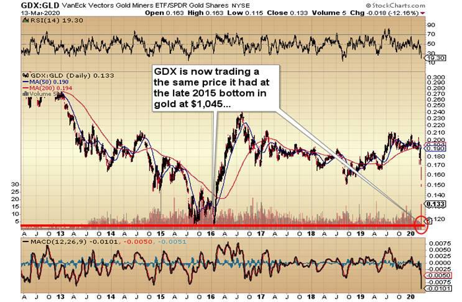
Moving to the gold miners, here is a chart from March 13, when I sent out my “Generational Buy” recommendation on the Senior Gold Miners as measured in terms of the gold ETF (GLD:US).

On the morning of March 16, 2020, the ratio of GDX (the Senior Miner exchange-traded fund [ETF]) to GLD (the physical gold ETF that tracks spot gold prices) had fallen all the way down to December 2015 levels, when gold reached its four-year nadir at $1,045 per ounce. I told subscribers that I was going to buy GDX on the Monday opening and I did, with three separate call option purchases for August expiry. Having now taken profits, those three purchases have made my year, because within the next five weeks, GDX has bolted from the 52-week low of US$16.18 that very morning to a six-year high of US$34.74 earlier this week. A double in five weeks!

So, with the precious metals stocks now the talk of the town and every wealth manager and his fuzzy-cheeked assistant scrambling for positioning in a sector they absolutely hate but must now own (because every other wealth manager in the office does), the space that was underloved and underowned three weeks ago is now hotter than Hades in July.

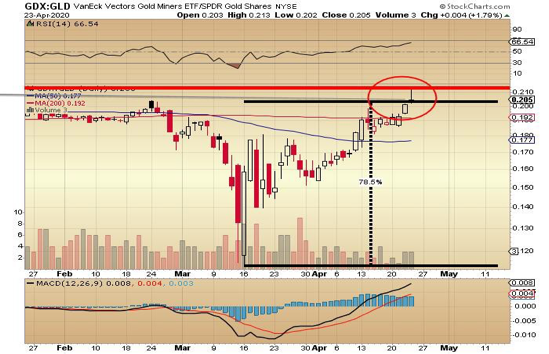
The same chart of the GDX-GLD ratio that screamed “Generational Buying Opportunity” in mid-March is shown below.

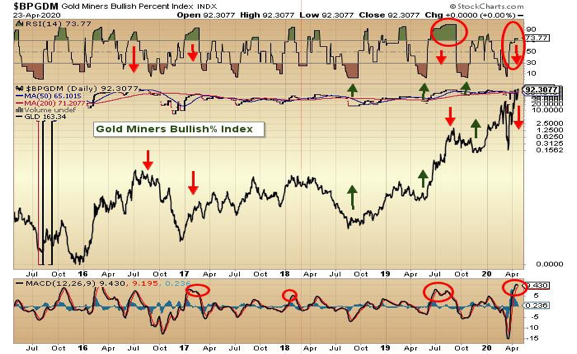
The ratio has advanced from 0.133 to 0.205, and is up 78.5% in the last five weeks, so naturally, with such huge gains staring me in the kisser, is it not prudent to pull in one’s horns and bunker some profits? Well, let me dig deeper and look at the Bullish Percent Index (BPI) for the gold miners. Since the lows in 2015, every time the BPI for the gold miners moves above 90, especially when coupled with a Daily Sentiment Index also above 90 (which it is), there has been a bout of profit-taking. If you recall last September, when I issued my sell signal for the precious metals (PMs), we had conditions like those of today.

Now, this does not mean I have turned bearish and am about to sell my entire physical stash or dump everything in the portfolio. What the charts are telling me is—quite simply—that caution is warranted. No new buying.

On April 21, the day that May crude crashed to minus US$40/barrel, I issued an email alert recommending three of the crude oil ETFs and then proceeded to add the following day. I opted for two unleveraged ETFs and one high-risk double-leveraged issue that is extremely volatile but down from over US$500 to under $20 since New Year’s Day. That is tantamount to buying the double leveraged junior miner ETF (JUNG:US) on March 19, at $35, down from over $1,000 in February.

The term “regression to the mean” is what always happens after a five-ten sigma event in any market, which is what we just went through. I see that happening in crude oil over the course of the next several weeks and since oil has not yet experienced any kind of meaningful recovery rally, the oil space is lower risk than gold at this time. Subscribers now have the list of oil issues I like and have acted accordingly.

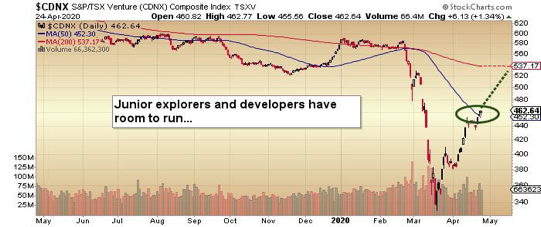
Last point of discussion for this week concerns the junior explorers and developers that I continue to hold and accumulate. I am also actively seeking out properties and projects where there exists either a gold or silver resource previously deemed either marginal or sub-economic, but unlike one year ago, when they were plentiful, most of the decent ones have been snapped up. The projects still largely orphaned by the investment community are the exploration deals, as this new generation of investors is leery of the risks associated with mineral exploration.

It is on this last point that I think the mood will be soon changing. Prior to 1973, oil exploration was nowhere near the investing radar screens, but with the oil embargo and wars and inflation, once oil prices began their decade-long, parabolic ascent to over $40/barrel, the juniors came alive with a vengeance and stayed in the limelight for most of the 1970s.

With gold about to break out to all-time highs sometime in 2020, the upside leverage will not be in the blue-chip senior or intermediate producers, but in the “penny dreadfuls” that become “dollar darlings” after a discovery is made. Right now, we are seeing a sharp increase in interest for those developer/explorers that have either a historical or an NI-43-101-compliant resource in excess of 1 million ounces of gold or 100 million ounces of silver, with gold attracting many more eyeballs than silver.

Most of these micro-cap issues trade on either the U.S. OTC market or the two Canadian junior markets, the TSX Venture Exchange or the Canadian Securities Exchange. I prefer the TSX.V for a number of reasons, but mainly because it has recently begun to trade sufficient volumes to support institutional participation. If the “penny dreadfuls” are to start blossoming into “dollar darlings,” it is the migration of the Millennials to the TSX.V that is jump-starting this metamorphosis.

In the COVID-19 March meltdown, the TSX.V was obliterated. exactly as happened in ’87, ’97 and 2008. In fact, it traded at the lowest level in its history since being merged with the old Vancouver and Alberta Stock Exchanges in the late ’90s! At the current 456 level, it is still beneath the January 2016 low at 466, when the HUI traded under 100 and gold was in the $1,050 range.

Now, in recent years, the bosses at the TSX.V decided to “diversify” away from resource exploration and development deals and proceeded to invite start-up technology issues (including crypto), and then cannabis to the party, leaving the door of risk wide open when the last two Millennial-driven manias blew up. First crypto, then weed, went crashing back to earth, taking the index and an entire generation of young investors with them.

The recent meltdown would not have been as devastating had the TSX.V been as gold-centric as it had been in 2008 or 2016. Nevertheless, at 456, the TSX.V is coming hard off the canvas largely due to the precious metal issuers, and for this reason I believe that it has the capability of doubling in 2020, and doubling again in 2021. With the global money conjurers running overtime and with every panic button on earth being multi-pressed, those junior gold and silver explorer/developers trading under a quarter are going to be dragged higher by the rise in the gold price. To wit, when the global China-driven commodity boom was in full bloom in 2007, the TSX.V was trading north of 3,350, or 7.3 times its current level.

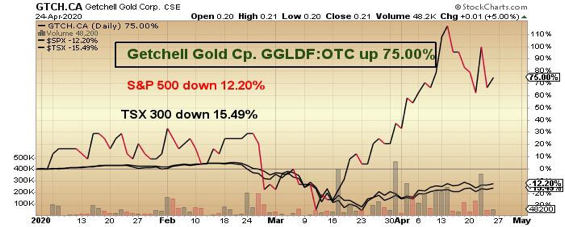
For these reasons, I have elected to overweight my portfolio with select junior developer/explorers such as Getchell Gold Corp. (GTCH:CSE), which remains up 75% year to date. This company remains infinitely attractive due to its 1,069,000 ounces of gold in the Fondaway Canyon asset in Nevada, and all kinds of blue-sky potential through its sensitivity to the gold price, substantial exploration potential, and the likelihood of rerating.

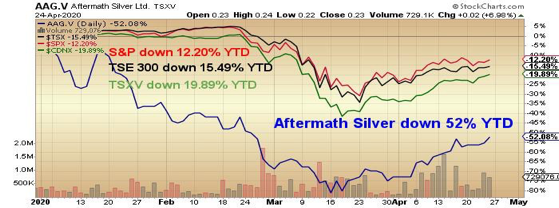
Another issue I currently hold, after first identifying it as an above average purchase candidate last summer, is Chilean silver developer Aftermath Silver Ltd. (AAG:TSX.V). While it is currently up over 120% from my initial entry in 2019, it ended last year as my best performer, up 500% since my first tweet at CA$0.10 in early July. With silver prices in the performance doghouse so far in 2020, Aftermath is the ideal silver deal if one still believes the “poor man’s gold” can recover from what has been a dismal showing.

I am building a larger list of juniors that I believe will have 10- or 20-bagger potential, and I see this subsector as “the place to be” as this multi-year bull market in gold unfolds. As more and more generalist money managers join the precious metals lovefest, an absolute tsunami of capital will be chasing the gold miners as they scramble up the ladder of risk, creating a trickle-down effect into the developer/explorer names. Therein lies the key to supersized returns for the balance of 2020.

Positioning early is going to be critical so fasten those seatbelts and keep all appendages inside the vehicle before the ride begins.

Originally trained during the inflationary 1970s, Michael Ballanger is a graduate of Saint Louis University where he earned a Bachelor of Science in finance and a Bachelor of Art in marketing before completing post-graduate work at the Wharton School of Finance. With more than 30 years of experience as a junior mining and exploration specialist, as well as a solid background in corporate finance, Ballanger’s adherence to the concept of “Hard Assets” allows him to focus the practice on selecting opportunities in the global resource sector with emphasis on the precious metals exploration and development sector. Ballanger takes great pleasure in visiting mineral properties around the globe in the never-ending hunt for early-stage opportunities.

Sign up for our FREE newsletter at: www.streetwisereports.com/get-news

Disclosure:
1) Michael J. Ballanger: I, or members of my immediate household or family, own securities of the following companies mentioned in this article: Aftermath Silver and Getchell Gold. My company has a financial relationship with the following companies referred to in this article: Aftermath Silver and Getchell Gold. I determined which companies would be included in this article based on my research and understanding of the sector. Additional disclosures are below.
2) The following companies mentioned in this article are billboard sponsors of Streetwise Reports: None. Click here for important disclosures about sponsor fees. As of the date of this article, an affiliate of Streetwise Reports has a consulting relationship with Aftermath Silver. Please click here for more information. Within the last six months, an affiliate of Streetwise Reports has disseminated information about the private placement of the following companies mentioned in this article: Aftermath.
3) Statements and opinions expressed are the opinions of the author and not of Streetwise Reports or its officers. The author is wholly responsible for the validity of the statements. The author was not paid by Streetwise Reports for this article. Streetwise Reports was not paid by the author to publish or syndicate this article. Streetwise Reports requires contributing authors to disclose any shareholdings in, or economic relationships with, companies that they write about. Streetwise Reports relies upon the authors to accurately provide this information and Streetwise Reports has no means of verifying its accuracy.
4) This article does not constitute investment advice. Each reader is encouraged to consult with his or her individual financial professional and any action a reader takes as a result of information presented here is his or her own responsibility. By opening this page, each reader accepts and agrees to Streetwise Reports’ terms of use and full legal disclaimer. This article is not a solicitation for investment. Streetwise Reports does not render general or specific investment advice and the information on Streetwise Reports should not be considered a recommendation to buy or sell any security. Streetwise Reports does not endorse or recommend the business, products, services or securities of any company mentioned on Streetwise Reports.
5) From time to time, Streetwise Reports LLC and its directors, officers, employees or members of their families, as well as persons interviewed for articles and interviews on the site, may have a long or short position in securities mentioned. Directors, officers, employees or members of their immediate families are prohibited from making purchases and/or sales of those securities in the open market or otherwise from the time of the interview or the decision to write an article until three business days after the publication of the interview or article. The foregoing prohibition does not apply to articles that in substance only restate previously published company releases. As of the date of this article, officers and/or employees of Streetwise Reports LLC (including members of their household) own securities of Aftermath Silver and Getchell Gold, companies mentioned in this article.

Charts provided by the author.

Michael Ballanger Disclaimer:
This letter makes no guarantee or warranty on the accuracy or completeness of the data provided. Nothing contained herein is intended or shall be deemed to be investment advice, implied or otherwise. This letter represents my views and replicates trades that I am making but nothing more than that. Always consult your registered advisor to assist you with your investments. I accept no liability for any loss arising from the use of the data contained on this letter. Options and junior mining stocks contain a high level of risk that may result in the loss of part or all invested capital and therefore are suitable for experienced and professional investors and traders only. One should be familiar with the risks involved in junior mining and options trading and we recommend consulting a financial adviser if you feel you do not understand the risks involved.

( Companies Mentioned: AAG:TSX.V,
GTCH:CSE,
)

Tajikistan reverses course and cuts rate 1st time in 2020

By CentralBankNews.info

Tajikistan’s central bank lowered its key interest rate for the first time this year, more than reversing a rate hike in January, to support the country’s economy from damages from the coronavirus pandemic, ensure liquidity in the banking system and achieve stable inflation.
The National Bank of Tajikistan (NBT) cut its refinancing rate by 100 basis points to 11.75 percent, its first cut this year after raising the rate in January by 50 basis points.
NBT was one of only five central banks to raise rates this year but three of these – the Czech Republic, Kazakhstan and now Tajikistan – have more than reversed the earlier cuts and switched to accommodative monetary policy to ease the negative economic impact of the virus.
Inflation in Tajikistan rose to 9.3 percent in March from 7.8 percent in February but NBT said the risks of inflation in the next quarter are now lower.
Just as the spread of COVID-19 has negatively impacted the global economy, Tajikistan’s economy has also been affected from reduced trade and investment, the limitation of cross-border relations, lower income, higher financial risks in financial institutions along with a deprecation of the somoni currency.
Tajikistan’s currency, the Somoni, which replaced the Tajikistani ruble in 2000, has been steadily deprecating since 2014 and on March 30 NBT made what it said was a one-time correction in the official U.S. dollar rate by up to 5.0 percent to ease the pressure in foreign exchange markets.
Today the somoni is trading around 10.25 to the dollar,  down just over 5 percent from around 9.70 at the start of the year.
NBT has been steadily lowering its rate since January 2018 in synch with falling inflation but a pickup in inflationary pressures last year forced the central bank – which is moving toward inflation targeting – to pause in its easing and raise the rate in February 2019.
It then lowered the rate a few months later, in May and then November last year.
But once again, inflation began trending upwards in the first quarter and in January this year the central bank raised the rate 50 basis points.
The hike came a few weeks after the International Monetary Fund (IMF) said tighter monetary policy might be needed to mitigate possible second-round effects from a rise in inflation due to base effects and higher food prices.
On April 8 NBT lowered its reserve requirements for financial institutions temporarily by 200 basis points to 1 percent from April 1 to Dec. 31, injecting 241.7 million somoni into the banking system.
The reserve ratio for foreign currencies was lowered by 400 points to 5.0 percent.

www.CentralBankNews.info


What’s Next, Trillion-Dollar Coins?

By Money Metals News Service

The massive set of stimulus measures rolled out last month by the Treasury Department and Federal Reserve has left many Americans wanting more… and politicians scheming for new ways to dole out additional trillions in cash.

Most taxpayers have already received their $1,200 “stimulus” payments. However, that one-time payment will do little to repair the long-term financial health of the 26 million (and rising) who are newly unemployed.

And it surely won’t bail out all the small business owners who were callously deemed “non-essential” and forced to shut down during this pandemic.

A national WalletHub survey found that 84% of Americans want another stimulus check.

The idea of getting free money is understandably appealing, especially during times of extreme economic anxiety.

But ultimately, there ain’t no such thing as a free lunch. All government handouts come at a cost that will be paid one way or another.

A group of young radical leftist Congresswomen – the “Squad,” as President Donald Trump calls them – want to use the current crisis to install a universal basic income scheme.

Squad members Rashida Tlaib and Pramila Jayapal recently issued a press release pushing the so-called Automatic BOOST to Communities Act.

The Squad’s proposal would “immediately provide a $2,000 payment using BOOST debit cards to every person in America as critical relief during the COVID-19 crisis, followed by $1,000 recurring monthly payments for one year after the end of the crisis,” according to the press release.

The proposal also calls for “boosting” digital payments infrastructure for the new debit card system and moving toward a “digital public currency wallet system” – i.e., a contactless, centrally traceable electronic dollar.

Helicopter Money

With the federal government already on track to run a record budget deficit well over $3 trillion this year, where will the additional trillions needed to fund BOOST payments come from? Tlaib and Jayapal think they have the answer: order the Treasury Department to mint trillion-dollar coins.

That is not a hyperbolic characterization of what they propose. They literally propose that monthly BOOST payments be “funded directly from the Treasury with no additional debt issued by minting two $1 trillion coins, and additional coins as necessary.”

It may be absurd from a sound money point of view, but that’s not to say it isn’t clever political marketing. The Squad can sell a multi-trillion-dollar spending program as being deficit neutral.

Plus, nobody’s taxes would immediately have to be raised in order to pay for it. The Federal Reserve would bear the cost by “buying” the Squad’s $1 trillion coins minted of platinum and crediting the U.S. Treasury’s account with the funds.

Ultimately, of course, all holders of U.S. Federal Reserve notes would bear the costs of the scheme. And to the extent that automatic guaranteed monthly payments disincentivize job seeking and job creation, they would diminish economic productivity and thus add pressure for further devaluations of the currency.

Perhaps these “Squad” members should study Zimbabwe’s disastrous experiment with multi-trillion-dollar currency denominations.

Instead of increasing the country’s wealth, Zimbabwe’s hyperinflationary monetary system, under the latter years of Marxist strongman Robert Mugabe’s rule, led to severe impoverishment – even though on paper the typical Zimbabwean had become a trillionaire.

The U.S. may be a long way from experiencing Zimbabwe-style hyperinflation in practice. But in principle, our fiscal and monetary policies are becoming increasingly Zimbabwean.

The Fed now openly acknowledges that our monetary system is predicated on an unlimited printing press.

It touts its willingness to run the printing press with reckless abandon to prop up everything from to bank accounts to junk bonds.

Minneapolis Fed President Neel Kashkari’s March 22nd appearance on 60 Minutes with Scott Pelley reflected quite clearly the central bank’s Zimbabwean mindset:

Pelley: Can you characterize everything that the Fed has done this past week, as essentially flooding the system with money?

Kashkari: Yes, exactly.

Pelley: And there’s no end to your ability to do that?

Kashkari: There is no end to our ability to do that.

Pelley: Is the Fed just going to print money?

Kashkari: That’s literally what Congress has told us to do. That’s the authority that they’ve given us.

Fed officials no longer even pay lip service to the idea that the Fed operates within a limited dual mandate “independent” of politics. If Congress tells the Federal Reserve to buy bonds, stocks, mortgages, or trillion-dollar coins, it will do so.

The less sound U.S. monetary policy becomes, the important it is for investors to seek out the protection of sound money in the form of gold and silver. The money metals cannot be debased by an unlimited printing press.

And for that matter, neither can platinum. A typical one-ounce platinum coin won’t suddenly become worth $1 trillion in the next stimulus package (the Platinum Eagles made available to the public carry an arbitrary face value of just $100).

Nevertheless, platinum may start garnering more attention as an especially undervalued metal that offers unlimited upside potential versus U.S. dollars.


The Money Metals News Service provides market news and crisp commentary for investors following the precious metals markets.

What future do airlines have? Three experts discuss

By Darren Ellis, Cranfield University; Jorge Guira, University of Reading, and Roger Tyers, University of Southampton

Airlines face an unprecedented international crisis in the wake of the coronavirus pandemic. The International Air Transport Association (IATA) estimates that the global industry will lose US$252 billion in 2020. Many airlines are cutting up to 90% of their flight capacity. On March 1, more than two million people in the US were flying per day. A month on, fewer than 100,000 people are going through airport security daily.

Some climate activists have welcomed the emptied skies, pointing to the dramatic fall in carbon emissions. But others worry that the bounce back and attempts to take back some of the losses might mean that an opportunity for fundamental, sustained change may be missed.

In the US, a federal government US$50 billion bailout fund – part of which will fund cash grants going towards airline workers, and the other part loans for the airlines themselves – was rolled out piecemeal in March, with revisions announced on April 14.

More than 200 airlines applied. American Airlines will get US$5.8 billion, Delta US$5.4 billion, and Southwest US$3.2 billion, among others. Donald Trump, the US president, stated that the airline bailout was needed to return the industry to “good shape” and was “not caused by them”. Another US$4 billion is available for cargo airlines and US$3 for contractors.

In the UK, it was initially announced that no industry-wide bailout would be offered. Instead, the industry would have to rely on broader aid packages covering 80% of salaries (below a cap) for furloughed employees. But subsequently, the government quickly gave easyJet a £600 million loan (US$740 million). Flybe, a smaller regional or “secondary” airline with pre-crisis financial issues, was not bailed out and collapsed. Many money-making routes Flybe ran have since been picked up by others.

Continental Europe is in worse shape. Italy has re-nationalised Alitalia, forming a new state-owned entity and investing €600 million (US$650 million). France has indicated it will do whatever it takes to bailout Air France/KLM (France owns 15% and the Dutch 13%), with a possible €6 billion bailout package (US$6.5 billion).

Meanwhile, Australia’s Qantas secured a A$1 billion loan (US$660 million). Debt-laden Virgin Australia, meanwhile, was denied a A$1.4 billion loan (US$880 million) and has subsequently plunged into voluntary administration. Singapore Airlines, however, got a US$13 billion aid package.

The airline industry has faced many crises before – 9/11 and the 2010 Icelandic volcano eruption, for example. But these pale in comparison to the economic hit that airlines are currently facing. Some are asking: can it recover? Is this an economic crisis that could reshape how we travel and live? Or will it turn out to be more of a pause, before returning to business as usual? And what role does the climate crisis play in all this – how will sustainability figure in any rebooting of the industry going forward?

We are all experts in the airline industry. Darren Ellis (Lecturer in Air Transport Management) considers these questions first, looking at the industry’s structure and response. Jorge Guira (Associate Professor in Law and Finance) then explores bailout options and likely future scenarios for the industry. Finally, Roger Tyers (Research Fellow in Environmental Sociology) considers how the industry might just be at a turning point in terms of how it tackles climate change.


This article is part of Conversation Insights

The Insights team generates long-form journalism derived from interdisciplinary research. The team is working with academics from different backgrounds who have been engaged in projects aimed at tackling societal and scientific challenges.


A global problem

Darren Ellis, Lecturer in Air Transport Management

Most of the global airline industry is currently grounded. Although some routes are still managing to operate, and there is evidence of a gradual domestic air market rebound in China, 2020 will certainly not see the 4.6 billion annual passengers of 2019. The long-term trend of ever-rising air passenger numbers year on year has been brought to a dramatic and rapid halt.

What this means for the global airline industry is vividly on display at airports around the globe as terminals remain empty and aircraft occupy any available parking space.

Like the predominately national response to the virus, so the airline industry is also seeing a wide range of policies and practices tailored and implemented almost exclusively at the national level. This means that some airlines, thanks to well-chosen national policies, will fare better, while others will flounder.

This is because beyond the multilateral single air market of Europe, the global industry remains firmly structured on a bilateral system. This web of country to country air service agreements (ASAs) is basically made up of trade treaties which governments sign with one another to determine the level of air access each is willing to permit. Even in Europe, the single air market essentially acts as one nation internally, while externally, individual European countries continue to deal with many countries on a bilateral basis.

The bilateral system is based on a bundle of rules and restrictions, including airline ownership (typically, a minimum of 51% of an airline must be owned by people from the country where the airline is based), national control, single airline citizenship and home base requirements. This effectively locks airlines into a single country or jurisdiction.

Despite this structure, global cooperation in aviation is strong, particularly across safety standardisation, but less so on the economic front. A lot of this cooperation happens via the International Civil Aviation Organization (ICAO), the industry’s specialised UN agency. Meanwhile, the IATA supports and lobbies on behalf of member airlines.

Likewise, international mergers and acquisitions are rare – aside from in Europe, where partial mergers have created dual and multiple brands like Air France/KLM. Where single airline brands have been created with cross border mergers – such as LATAM Airlines in South America – national aircraft registration and other restrictions remain in place, thereby reflecting multiple airlines in these respects.

Consequently, national responses will be front and centre as the industry responds to the current pandemic. In countries where a single flag carrier is based, such as Thailand and Singapore, governments are unlikely to let their airlines fail. While in others, where multiple airlines operate, a level playing field of assistance and support is more likely, even if outcomes differ widely. This is not to say that all airlines will necessarily survive what is likely to be an extended U-shaped crisis, unlike the more V-shaped crises of the past, such as 9/11 and the 2008 global financial crisis.

The national structure of the industry also highlights why major airlines failing is relatively rare. Yes, airlines have merged in domestic air markets like the US, and individual brands have disappeared as a result, but few major airlines have gone out of business because they failed. Even Swissair, which was famously bankrupt and defunct in late 2001, soon reappeared as Swiss International Airlines.

And so, although airline brands have come and gone, the industry had remained on a growth path for decades. It will take time to recover from the pandemic. Some airlines will fail. But widespread changes to the industry’s structure are unlikely to occur. People will, of course, need and want to travel by air again when this pandemic is over. Which airlines survive – and which go on to thrive – will largely depend on how successful individual countries’ economic support packages turn out to be.

Bailout essentials

Jorge Guira, Associate Professor in Law and Finance

The global outcomes of the crisis, then, are firmly anchored in national responses. The airline industry is cyclical: it is used to peaks and valleys. Bailouts have repeatedly been vital for airlines, so many countries have some sort of precedent to go by.

In any bailout, the key question is whether this is a solvency or liquidity crisis. Solvency means that the airline will be very unlikely to ever remain financially viable. Liquidity means that the airline has a high risk of running out of cash flow but should be solvent soon, if supported. Assessing this is sometimes complex.

Cash is king. “Streamlining” – a fancy word for cost cutting – can help. Unencumbered assets such as aeroplanes can be sold, or used as collateral for loans. But many planes are often leased, so this may be problematic.

Existing contracts must be reviewed. Breach of covenants, which are legally binding promises to do (or to refrain from doing) things in a certain way, may need to be waived. For instance, lease agreements for the planes often require flights to carry on, and business as usual is suspended at present. Other agreements require flights to maintain landing spaces in airports – leading to the “ghost planes” many were appalled by earlier on in the crisis, and that still continue.

Certain financial tests may not be met, such as how much debt there is compared to earnings. These can alarm creditors. And this can lead to deterioration in bond credit ratings, reflecting increased financial distress. Other triggers may also arise. Defaulting on one financial contract usually requires informing other creditors. This can trigger defaults on other agreements, creating a domino effect.

So renegotiating operating and financial contracts is crucial. Airlines may have to pick and choose who to pay first. Unions must be kept happy, and other stakeholders must focus on recovery.

All this means that state bailouts, help and other guarantees are crucial for the industry to survive. In the US, for example, net operating losses are carried forward and used to shield revenues and offset these from tax for when things return to normal.

If liquidity is the problem, the real issue is time: how long will it take for the airline to get back on its feet and resume flying more normally? If solvency is the problem, the company cannot survive the demand collapse it is facing. The COVID-19 pandemic is such a fraught time for airlines because of the difficulty in predicting when the crisis will end. This can complicate determining whether it is a more temporary liquidity crisis or a deeper solvency concern.

After 9/11, the airline industry completely shut down in the US. People witnessing the horrifying scenes of the Twin Towers’ collapse were hardly eager to board a plane. So, the government chose to step in to restore confidence. And it did so, successfully, by offering aid including loans and used warrants, which involves investing in airlines when the stock is at a reduced or rock bottom price and waiting for it to go up again. The US government’s COVID-19 financial rescue package parallels this approach.

The US approach is noteworthy because of its size and scale, and the fact that it is built on the 9/11 case and has been modified for the unique present circumstances. It is also an interesting counterpoint to the strategy of the strongly free market-oriented UK, and Australia, which has been more restrained in its approach.

Airline norms suggest that 25% of revenues should be kept in case of any emergency, but this has tended not to happen recently. Corporate earnings have generally not been held for a rainy day, and now that rainy day has arrived. This creates a classic moral hazard problem: many airlines seem to act as if they are too important to fail, because in the end, they believe they will be bailed out. And regulation does not otherwise hold any excesses in check.

Compounding this, some US airlines have recently been accumulating cheap debt, due to low interest rates and lots of credit availability. The five big US carriers, instead of paying off debt, have been spending 96% of available cash on stock buybacks. Many question whether airlines should be bailed out in these circumstances. Limits on paying dividends, buyback of stock, and other terms would logically apply here, as in the earlier US bailout measures announced in March.

While the US case may provide a helpful initial focus, the UK approach is likely to be highly influential, perhaps more so given the reduced resource level – and greater level of climate awareness – there. As Darren pointed out earlier, one model does not fit all but this may offer a useful comparative framework for other approaches that favour national champions or nationalisations.

The UK is reportedly considering partial nationalisation, such as in the case of British Airways. British Airways has furloughed 35,000 employees, with many pay packets supported by the government – for now. British Airways appears better placed to cherry pick key routes, assets and companies as it ranks in the top group for liquidity.

If Virgin Atlantic were to collapse, its size means it may fit in the too important to fail category. It appears that bailout talks are ongoing but Richard Branson’s life as an offshore UK resident, and Delta’s ownership of a 49% stake, present potential political clouds. Questions about whether it should get state aid given current crisis conditions also arise. This is generally forbidden, although the EU has temporarily indicated a COVID-19 relaxation of the rules. No environmental strings have apparently been attached, as former EU officials and others have suggested should be the case.

Overall, the survival of the global industry therefore depends on bailouts, not only to keep airlines afloat but also for the wider travel and leisure ecosystem.

The lack of of sustainability conditions in UK and indeed US bailouts appears to be mirrored globally. But a Green New Deal in a second recovery phase of aid could provide this. And greater awareness of the issue thanks to the likes of Greta Thunberg, an increased culture of working from home, and ongoing measures to increase accountability and reporting of emissions means this aspect may well play a vital role in the repackaging of airlines going into the future. Much of it begins with how emissions targeting interacts with the COVID-19 crisis.

Aviation and climate change

Roger Tyers, Research Fellow in Environmental Sociology

As Jorge says, for the growing number of people concerned by aviation’s rising carbon emissions, this pandemic may be a rare chance to do things differently. When air travel is eventually unpaused, can we set it on a more sustainable trajectory?

Even before this pandemic hit, aviation faced increasing pressure in the fight against climate change. While other sectors are slowly decarbonising, international aviation is forecast to double passenger numbers by 2037, meaning its share of global emissions may increase tenfold to 22% by 2050.

Most flights are taken by a relatively well-off minority, often for leisure reasons, and of questionable necessity. We might wonder whether it is wise to devote so much of our remaining carbon “allowance” to aviation over sectors like energy or food which – as we are now being reminded – are fundamental to human life.

Regulators at the UN’s ICAO have responded to calls for climate action with their Carbon Offset and Reduction Scheme for International Aviation (CORSIA) scheme. Under this, international aviation can continue to expand, as long as growth above a 2020 baseline is “net-neutral” in terms of emissions.

While critics cite numerous problems with it, the idea is to reduce emissions above the 2020 baseline through a combination of fuel efficiencies, improvements in air traffic management and biofuels. The remaining, huge shortfall in emissions will be covered by large-scale carbon offsetting. Last year, IATA estimated that about 2.5 billion tonnes of offsets will be required by CORSIA between 2021 and 2035.

This plan has been thrown into disarray by the COVID-19 crisis. The emissions baseline for CORSIA was supposed to be calculated based on 2019-20 flight figures. But given that the industry has come to a standstill – demand may take a 38% hit in 2020 – that baseline will be much lower than expected. So once flights resume, emissions growth post-2020 will be much higher than anyone predicted. Airlines will need to purchase many more carbon offset credits, raising operating costs and passing these onto customers.

Airlines trying to get back on their feet will be hostile to any such additional burdens, and will probably seek methods to recalculate the baseline in their favour. But for environmentalists, this might be an opportunity to strengthen CORSIA, which despite its flaws is the only current framework for tackling aviation emissions globally.

Some still consider CORSIA to be an elaborate sideshow. The real game-changer for sustainable aviation would be fuel tax reform, which might receive more scrutiny when attention shifts onto how to repay the eye-watering levels of public debt incurred during lockdown.

Since the 1944 Chicago Convention, which gave birth to ICAO and the modern aviation industry, putting VAT on flight tickets and tax on kerosene jet fuel has been effectively illegal. This is the primary reason why flying is relatively cheap compared to other transport modes, and arguably why the industry has under-invested in research into cleaner fuels.

With the most-polluting form of transport enjoying the lowest taxes, this regime has long been questionable in terms of emissions. It may soon become untenable in terms of tax justice, too. In 2018, France’s Gilets Jaunes movement was partly motivated by anger at increased fuel tax for cars and vans, while air travel continued to benefit from historic tax exemptions. This anger may return when governments inevitably raise taxes to repay their multi-billion-dollar COVID-19-related debts.

Campaigners are already demanding that any airline bailout be linked to tax reform, and there is huge potential there. Leaked EU papers in 2019 suggest that ending kerosene tax exemptions in Europe could raise €27 billion (US$29 billion) in revenues every year. Such sources of revenue may soon become irresistible, and national governments might seek to collect them unilaterally, with or without a coordinated ICAO response.

Tony Blair, the former UK prime minister, once said that no politician facing election would ever vote to end cheap air travel. But – to state the obvious – these are unprecedented times, and public attitudes to flying may well change.

On the demand side, once borders reopen, there could be a short-term travel boom as postponed flights are rebooked and stranded people fly home. But even after an official virus “all-clear”, those considering holidays may think twice before sharing cramped plane cabins with strangers. Business travellers, crucial to airline profits, may find that they’ve got so used to using Zoom, they don’t need always to fly to meetings in person.

As members of the industry admit, by the time passengers return to air travel in significant numbers, the airlines, routes and prices they find may look very different. Governments will face huge industry pressure to safeguard jobs and return to business as usual as soon as possible. But managed properly, this could be the start of a just and sustainable transition for aviation.

The future’s up in the air

All three of us feel the airline industry is at a key turning point. The size and scale of bailouts will vary. Government political will and philosophy, access to capital, and the viability of the industry itself are key factors that will inform whether a company is worth saving.

Any future must be based on the premise of preserving economic vibrancy while reducing climate risk. But not all governments will factor this in.

Events are moving fast, with Emirates in Dubai starting to test passengers for COVID-19 before boarding. Meanwhile, easyJet is considering social distancing on planes as part of a “de-densification” policy, with fewer passengers and higher prices, albeit across more routes.

Longer term, there are various ways this could play out. All depend upon the duration of the crisis and the confluence of political, legal and economic factors.

It is possible that market structure remains unchanged, with ownership of airlines staying relatively stable, supported by bailouts. Under this business-as-usual scenario, sustainability would incrementally be enhanced through airlines retiring older, less carbon efficient planes and replacing them with better ones. But this scenario is subject to tremendous uncertainty.

Or, sustainability might become more important after the crisis, thanks to increased environmental awareness, demand loss, and new green investment. This would take place at different speeds, with Europe perhaps being more proactive through government incentives and serious emissions targeting. The US would lag behind, but making some advances due to increased stakeholder concerns. In this scenario, there is some scaling down of travel to meet demand, which is reduced. Increased sustainable investment emerges. Due to partial recovery, a new normal emerges.

It is also possible that prolonged, severe shortage of capital and an awareness of the climate crisis could, hypothetically, lead to massive change. But governments’ concern for jobs is likely to crowd out environmental concerns. Political forces on the left and right would have to mend fences and agree that, in a depression-like scenario, a new world is needed, not just a new normal.

About the Authors:

Darren Ellis, Lecturer in Air Transport Management, Cranfield University; Jorge Guira, Associate Professor of Law and Finance, University of Reading, and Roger Tyers, Teaching and Research Fellow in Sociology, University of Southampton

This article is republished from The Conversation under a Creative Commons license. Read the original article.


Armenia cuts rate 2nd time in 2020 to boost stimulus

By CentralBankNews.info

Armenia’s central bank lowered its key policy rate for the second time this year and for the fourth time since February 2019 to boost monetary stimulus as the coronavirus will have a negative impact on the country’s economy.
The Central Bank of Armenia (CBA) cut its refinancing rate by another 25 basis points to 5.0 percent and has now cut it by 50 points this year following a cut in March.
CBA has been steadily lowering its interest rates since August 2015 when it rapidly cut rates 12 times by 450 points until the rate hit 6.0 by February 2017.
The central bank then paused for two years until February 2019 when it returned to the path of easing and has now cut the rate four times since then by a total of 100 basis points.
“Given the current and projected external and internal developments, the weakening demand, the current low inflation environment and the stabilization of financial markets, the CB board considers it expedient to increase the amount of monetary stimulus by reducing the refinancing rate,” CBA said.
“The council also considers that in the current situation it will be necessary to maintain the stimulus position in the medium term,” CBA said, adding inflation is expected to remain low.
The predominant risk is that inflation will deviate from its expected trajectory in a downward direction, CBA said, adding it “is ready to adjust the policy accordingly as needed.”
Economic activity in almost all sectors of Armenia’s declined in March from last year and this decline will deepen in the second quarter due to reduced supply and demand, the bank said, adding aggregate demand will remain weak in the future though this will be mitigated to some extent by the government’s stimulus.
At the same time, the uncertainties over the timing of the contagion and the economic recovery has risen to some extent and only after this eases, will it be possible to assess the longer-term changes in the structure and prospects of the country’s economy.
“It is estimated that all of this will continue to have a deflationary effect on the Armenian economy,” the central bank said, adding
Armenia’s inflation rate was negative for the second consecutive month in March at minus 0.1 percent after minus 0.5 percent in February.

www.CentralBankNews.info


WTI Crude Oil Gives Back The Gains, But Holds Steady

By Orbex

WTI crude oil prices are down over 28% on the day again.

This comes just after the commodity marked a strong rebound following last week’s drop into negative territory.

The declines in crude oil, however, keep prices within the range of 18.62 and 12.34.

The new declines come on the back of oversupply concerns.

As long as prices hold near the 12.34 level, we expect the declines to be limited, but expect volatility to rise on a breach below this level.

By Orbex


AUDUSD Analysis: AUDUSD rising despite contracting business activities in Australia

By IFCMarkets

AUDUSD rising despite contracting business activities in Australia

Private sector activity in Australia continued to contract in April: the Commonwealth Bank flash Composite PMI dropped to 22.4 in April, after declining to 39.4 in March. Readings above 50.0 signal an improvement in business activity, while readings below 50.0 indicate contraction. This is bearish for AUDUSD but the technical setup is bullish for the pair.

IndicatorVALUESignal
RSINeutral
MACDBuy
Donchian ChannelBuy
MA(200)Buy
FractalsNeutral
Parabolic SARBuy


Summary of technical analysis

OrderBuy
Buy stopAbove 0.6506
Stop lossBelow 0.6433

Market Analysis provided by IFCMarkets

GBPUSD Pulls Back After Modest Gains

By Orbex

The British pound is seen making a moderate pullback after prices continued to rise since Friday.

GBPUSD remains range-bound within the levels of 1.2485 and 1.2277.

In the near term, while there is a possibility that prices will pullback, there could be a higher low forming.

This puts the upside bias back into the picture.

But, GBPUSD will need to clear the upper end of the range at 1.2485 to continue further to the upside.

By Orbex