Following article was written by Ellen Brown, an attorney and founder of the Public Banking Institute. She is the author of twelve books, including the best-selling Web of Debt, and her latest book, The Public Bank Solution, which explores successful public banking models historically and globally.
Central Bank News will occasionally carry articles by guest contributors if they are of interest to our readers.
By Ellen Brown
Congress seems to be at war with the states. Only $150 billion of its nearly $3 trillion coronavirus relief package – a mere 5% – has been allocated to the 50 states; and they are not allowed to use it where they need it most, to plug the holes in their budgets caused by the mandatory shutdown. On April 22, Senate Majority Leader Mitch McConnell said he was opposed to additional federal aid to the states, and that his preference was to allow states to go bankrupt.
No such threat looms over the banks, which have made out extremely well in this crisis. The Federal Reserve has dropped interest rates to 0.25%, eliminated reserve requirements, and relaxed capital requirements. Banks can now borrow effectively for free, without restrictions on the money’s use. Following the playbook of the 2008-09 bailout, they can make the funds available to their Wall Street cronies to buy up distressed Main Street assets at fire sale prices, while continuing to lend to credit cardholders at 21%.
If there is a silver lining to all this, it is that the Fed’s relaxed liquidity rules have made it easier for state and local governments to set up their own publicly-owned banks, something they should do post haste to take advantage of the Fed’s very generous new accommodations for banks. These public banks can then lend to local businesses, municipal agencies, and local citizens at substantially reduced rates while replenishing the local government’s coffers, recharging the Main Street economy and the government’s revenue base.
The Covert War on the States
Payments going to state and local governments from the Coronavirus Relief Fund under the CARES Act may be used only for coronavirus-related expenses. They may not be used to cover expenses that were accounted for in their most recently approved budgets as of March 2020. The problem is that nearly everything local governments do is funded through their most recently approved budgets, and that funding will come up painfully short for all of the states due to increased costs and lost revenues forced by the coronavirus shutdown. Unlike the federal government, which can add a trillion dollars to the federal debt every year without fear of retribution, states and cities are required to balance their budgets. The Fed has opened a Municipal Liquidity Facility that may buy their municipal bonds, but this is still short-term debt, which must be repaid when due. Selling bonds will not fend off bankruptcy for states and cities that must balance their books.
States are not legally allowed to declare bankruptcy, but Sen. McConnell contendedthat “there’s no good reason for it not to be available.” He said, “we’ll certainly insist that anything we borrow to send down to the states is not spent on solving problems that they created for themselves over the years with their pension programs.” And that is evidently the real motive behind the bankruptcy push. McConnell wants states put through a bankruptcy reorganization to get rid of all those pesky pension agreements and the unions that negotiated them. But these are the safety nets against old age for which teachers, nurses, police and firefighters have worked for 30 or 40 years. It’s their money.
It has long been a goal of conservatives to privatize public pensions, forcing seniors into the riskier stock market. Lured in by market booms, their savings can then be raided by the periodic busts of the “business cycle,” while the more savvy insiders collect the spoils. Today political opportunists are using a crushing emergency that is devastating local economies to downsize the public sector and privatize everything.
Free Money for Banks: The Fed’s Very Liberal New Rules
Unlike the states, the banks were not facing bankruptcy from the economic shutdown; but their stocks were sinking fast. The Fed’s accommodations were said to be to encourage banks to “help meet demand for credit from households and businesses.” But while the banks’ own borrowing rates were dropped on March 15 from an already-low 1.5% to 0.25%, average credit card rates dropped in the following month only by 0.5% to 20.71%, still unconscionably high for out-of-work wage earners.
Although the Fed’s accommodations were allegedly to serve Main Street during the shutdown, Wall Street had a serious liquidity problem long before the pandemic hit. Troubles surfaced in September 2019, when repo market rates suddenly shot up to 10%. Before 2008, banks borrowed from each other in the fed funds market; but after 2008 they were afraid to lend to each other for fear the borrowing banks might be insolvent and might not pay the loans back. Instead the lenders turned to the repo market, where loans were supposedly secured with collateral. The problem was that the collateral could be “rehypothecated” or used for several loans at once; and by September 2019, the borrower side of the repo market had been taken over by hedge funds, which were notorious for risky rehypothecation. The lenders therefore again pulled out, forcing the Fed to step in to save the banks that are its true constituents. But that meant the Fed was backstopping the whole repo market, including the hedge funds, an untenable situation. So it flung the doors wide open to its discount window, where only banks could borrow.
The discount window is the Fed’s direct lending facility meant to help commercial banks manage short-term liquidity needs. In the past, banks have been reluctant to borrow there because its higher interest rate implied that the bank was on shaky ground and that no one else would lend to it. But the Fed has now eliminated that barrier. It said in a press release on March 15:
The Federal Reserve encourages depository institutions to turn to the discount window to help meet demands for credit from households and businesses at this time. In support of this goal, the Board today announced that it will lower the primary credit rate by 150 basis points to 0.25% …. To further enhance the role of the discount window as a tool for banks in addressing potential funding pressures, the Board also today announced that depository institutions may borrow from the discount window for periods as long as 90 days, prepayable and renewable by the borrower on a daily basis.
Banks can get virtually free loans from the discount window that can be rolled over from day to day as necessary. The press release said that the Fed had also eliminated the reserve requirement – the requirement that banks retain reserves equal to 10% of their deposits – and that it is “encouraging banks to use their capital and liquidity buffers as they lend to households and businesses who are affected by the coronavirus.” It seems that banks no longer need to worry about having deposits sufficient to back their loans. They can just borrow the needed liquidity at 0.25%, “renewable on a daily basis.” They don’t need to worry about “liquidity mismatches,” where they have borrowed short to lend long and the depositors have suddenly come for their money, leaving them without the funds to cover their loans. The Fed now has their backs, providing “primary credit” at its discount window to all banks in good standing on very easy terms. The Fed’s website states:
Generally, there are no restrictions on borrowers’ use of primary credit….Notably, eligible depository institutions may obtain primary credit without exhausting or even seeking funds from alternative sources. Minimal administration of and restrictions on the use of primary credit makes it a reliable funding source.
What State and Local Governments Can Do: Form Their Own Banks
On the positive side, these new easy terms make it much easier for local governments to own and operate their own banks, on the stellar model of the century-old Bank of North Dakota. To fast-track the process, a state could buy a bank that was for sale locally, which would already have FDIC insurance and a master account with the central bank (something needed to conduct business with other banks and the Fed). The state could then move its existing revenues and those it gets from the CARES Act Relief Fund into the bank as deposits. Since there is no longer a deposit requirement, it need not worry if these revenues get withdrawn and spent. Any shortfall can be covered by borrowing at 0.25% from the Fed’s discount window. The bank would need to make prudent loans to keep its books in balance, but if its capital base gets depleted from a few non-performing loans, that too apparently need not be a problem, since the Fed is “encouraging banks to use their capital and liquidity buffers.” The buffers were there for an emergency, said the Fed, and this is that emergency.
To cover startup costs and capitalization, the state might be able to use a portion of its CARES Relief Fund allotment. Its budget before March would not have included a public bank, which could serve as a critical source of funding for local businesses crushed by the shutdown and passed over by the bailout. Among the examples given of allowable uses for the relief funds are such things as “expenditures related to the provision of grants to small businesses to reimburse the costs of business interruption caused by required closures.” Providing below-market loans to small businesses would fall in that general category.
By using some of its CARES Act funds to capitalize a bank, the local government can leverage the money by 10 to 1. One hundred million dollars in equity can capitalize $1 billion in loans. With the state bank’s own borrowing costs effectively at 0%, its operating costs will be very low. It can make below-market loans to creditworthy local borrowers while still turning a profit, which can be used either to build up the bank’s capital base for more loans or to supplement the state’s revenues. The bank can also lend to its own government agencies short of funds due to the mandatory shutdown. The salubrious effect will be to jumpstart the local economy by putting new money into it. People can be put back to work, local infrastructure can be restored and expanded, and the local tax base can be replenished.
The coronavirus pandemic has demonstrated not only that the US needs to free itself from dependence on foreign markets by rebuilding its manufacturing base but that state and local governments need to free themselves from dependence on the federal government. Some state economies are larger than those of entire countries. Gov. Gavin Newsom, whose state ranks as the world’s fifth largest economy, has called California a “nation-state.” A sovereign nation-state needs its own bank.
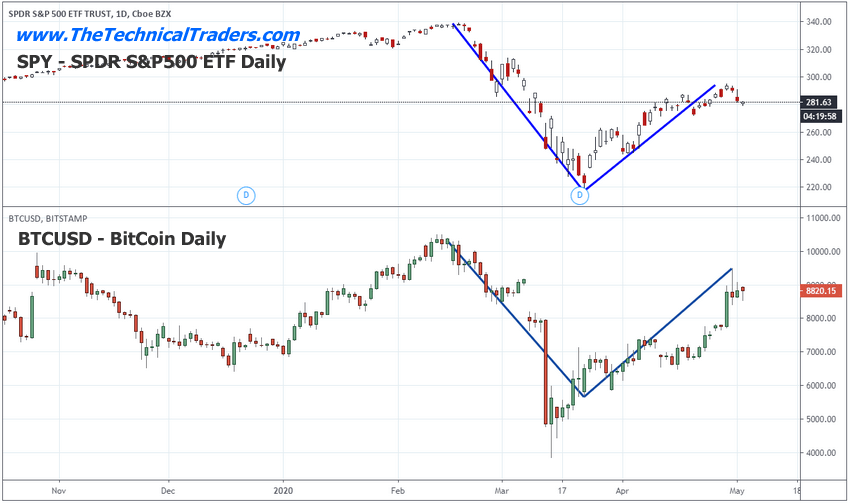
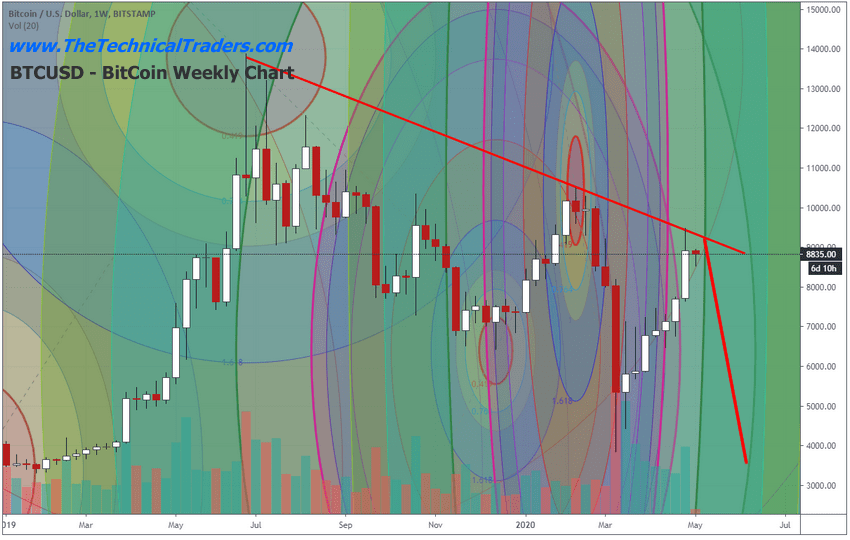
– If you pay attention to the trends taking place on the Weekly Bitcoin chart, you’ll notice that it has reacted to the global market Covid-19 trends almost exclusively since the beginning of 2020. After the end of 2019, the US stock market rallied on Q4: 2019 data and so did Bitcoin. The US Stock market peaked near February 20 and began a deeper selloff on February 25 – Bitcoin followed this pattern as well. When the US Fed initiated the stimulus on March 23, Bitcoin prices had already started to bottom in anticipation of the Fed stimulus and really began to rally after the Fed began intervening.
Before you continue, be sure to opt-in to our free market trend signals before closing this page, so you don’t miss our next special report!
Bitcoin VS S&P 500 Daily Chart Comparison
This is a bit unusual for Bitcoin, which in the past didn’t correlate to the US stock market trends all that well. What changed? We believe the sudden correlation of Bitcoin to the US Stock Market trends are related to investor psychology and the perceived efforts of the Central Banks in supporting the global economy.
We find it interesting that a decentralized cryptocurrency, which is supposed to be independent of global central banks and governments, suddenly aligns almost perfectly with the US stock market in correlation with the US Federal Reserve. It is almost as if Bitcoin prices are much more aligned with the global economy and global central banks as this crisis event unfolds. This suggests the true value of Bitcoin is not as an alternate, decentralized currency. The true value of Bitcoin is a hyper-speculative alternate store of value – unrelated to any real asset or oversight process.
What’s Next for Bitcoin – Weekly Chart
If our research is correct, the current downside price channel (Resistance) originating from the June 2019 highs will prompt a massive breakdown in price over the next 5+ weeks – possibly longer. There are two key factors that lead us to this conclusion. First, the correlation to the US stock market, which we believe will continue to move lower until an ultimate bottom is reached near July or August 2020. Second, the massive Fibonacci Price Amplitude Arc inflection point (the GREEN ARC) which will be reached in less than seven days.
If Bitcoin continues to mirror the US stock market price action and this inflection point does what we believe, then a massive breakdown in price may start to trend sometime between May 8 and May 14.
Daily Bitcoin Chart
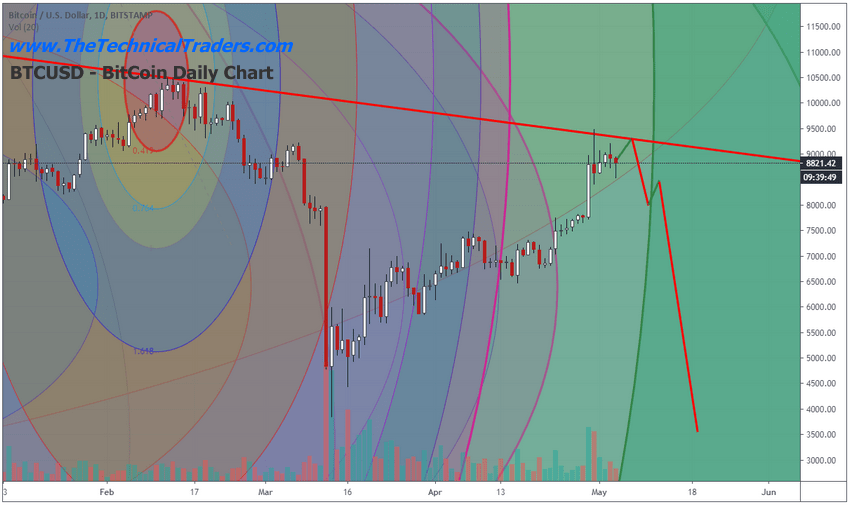
This Daily Bitcoin Chart shows you what we believe to be the most likely outcome going forward. A bit of upward price rotation to potentially retest the resistance level, then a moderate selloff, followed by a brief sideways trend before an even deeper selloff begins. This may be a map of what the US stock market may do over the exact same span of time.
CONCLUDING THOUGHTS:
Our researchers believe the ultimate bottom will set up near the end of Q3: 2020. We believe general weakness will push the US stock market price towards an ultimate low/bottom near July or August 2020. After that bottom completes, Q4: 2020 may see a moderate upside price trend as the Santa Rally mode kicks in. If Bitcoin mirrors this move, then it may attempt to move below the $3850 level and ultimately attempt to find a bottom below $3000.
Our researchers believe Bitcoin has recently aligned with the US stock market and the global central banks. If this is the case, then the “alternate decentralized currency” aspect of cryptos becomes a useless component of the market. If Bitcoin mirrors the SPY going forward, then it is just an expensive, highly volatile alternate measure of the US stock market and global central bank activities.
Watch for the price breakdown near May 10th or so.
As a technical analyst and trader since 1997, I have been through a few bull/bear market cycles in stocks and commodities. I believe I have a good pulse on the market and timing key turning points for investing and short-term swing traders. 2020 is an incredible year for traders and investors. Don’t miss all the incredible trends and trade setups.
Subscribers of my Active ETF Swing Trading Newsletter had our trading accounts close at a new high watermark. We not only exited the equities market as it started to roll over in February, but we profited from the sell-off in a very controlled way with TLT bonds for a 20% gain. This week we closed out SPY ETF trade taking advantage of this bounce and entered a new trade with our account is at another all-time high value.
Ride my coattails as I navigate these financial markets and build wealth while others watch most of their retirement funds drop 35-65% during the rest of this financial crisis going into late 2020 and early 2021.
Just think of this for a minute. While most of us have active trading accounts, what is even more important are our long-term investment and retirement accounts. Why? Because they are, in most cases, our largest store of wealth other than our homes, and if they are not protected during the next bear market, you could lose 25-50% or more of your net worth. The good news is we can preserve and even grow our long term capital when things get ugly like they are now and ill show you how and one of the best trades is one your financial advisor will never let you do because they do not make money from the trade/position.
If you have any type of retirement account and are looking for signals when to own equities, bonds, or cash, be sure to become a member of my Passive Long-Term ETF Investing Signals which we issued a new signal for subscribers.
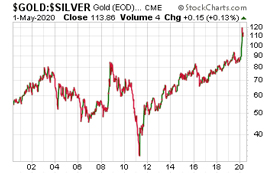
Silver is historically cheap relative to gold. The gold/silver ratio – the gold price divided by the silver price – reached all-time highs in March. Today the number of ounces of silver it takes to buy one ounce of gold is at 113 – very close to those highs.
Metals investors are wondering whether or not opportunity is knocking.
The fact is that silver has looked like a bargain relative to gold for a long while.
The gold/silver ratio consistently fluctuated between 70 and 90 over recent years. Even those levels were high relative to the historical average.
Unfortunately markets these days are far more likely than ever to punish people for making perfectly rational investment decisions.
The gold/silver ratio in the high 80s at the beginning of 2020 implied silver was the greater bargain, but investors who bought silver instead of gold lost ground when pandemic panic hit.
Many who would have considered silver a “no-brainer” versus gold at current prices are now second guessing. They wonder if something has changed.
Is silver going to trade primarily as an industrial metal? Is gold the only real safe haven asset or effective hedge against dollar devaluation?
While it is possible that investment trends and psychology have shifted permanently, we highly doubt it. Silver is underperforming in the paper markets only and those markets are disconnected from reality.
Investment demand for physical silver has never been higher. This is true both in the retail bullion markets and in the futures markets where there has been a huge spike in the number of contract holders standing for delivery.
Meanwhile, the inventory of actual bars in COMEX vaults relative to the number of paper ounces being traded just keeps dwindling.
There is plenty of demand for silver as a safe-haven – you just can’t tell by looking at the paper price. Consider that while the ratio of paper gold to paper silver is 113:1, the ratio is far lower when it comes to actual coins such as the American Eagle. The price of one gold American Eagle is equivalent to that of only 77 silver American Eagles.
Seasoned precious metals investors continue to favor silver here, even if they have been penalized for making that choice in recent years.
Despite the poor showing of silver in the broken paper markets, silver’s fundamentals will surely improve as the economy gradually reopens and industrial demand recovers.
And if the recent bull run in gold is the start of something much bigger, silver is very likely to outperform before that run is over.
The Money Metals News Service provides market news and crisp commentary for investors following the precious metals markets.
I can’t quite come to grips with all these guys now coming out with 25-minute videos they insist we watch instead of reading. Do they really believe that everyone has so much free time that they can pay attention to someone chattering away for 25 minutes?
Most of what you read or watch will be noise, meaningless stuff put out by guys who always have an agenda and certainly a bias. The majority has never had an original thought in their lives; all they do is parrot what some other fool has to say. When they want your money and that is pretty often, they figure out what you want to hear. That’s what they tell you, just like TV preachers and politicians.
There are a few diamonds amongst all the coal and clutter. One of my favorites is John Rubino of the Dollar Collapse. When you read him or listen to him speak, you are not getting recycled pabulum. You get clear thinking and logical conclusions, so rare among the rest of the pack. I eagerly read what he had to say last week and he hit a home run.
He wrote about a fund manager for the Equity Management Associates named Lawrence Lepard. Lawrence wrote a quarterly update and released it on March 31, 2020. It is a must read and you can email him at [email protected] and request a copy. If you are an accredited investor you may want to know that for 2019 the fund’s return was 97%. Or you can just go here.
A year ago I published an easy to read book I called Basic Investing in Resource Stocks, The Idiot’s Guide. You can read the book in a couple of hours; it’s not rocket science or brain surgery. It has just about the highest rating of any book I have ever seen on Amazon. That speaks well of how readers valued it, I think.
In the book one of the chapters talks about the predictions of “Experts”. In early 2011 someone approached me and asked me to forecast the price of gold. They had gone to 148 other “Experts” and each had picked a number. I’m not that smart and I don’t come equipped with crystal balls so I passed. No one can predict the future.
In his quarterly report, Lawrence Lepard had some interesting thoughts about the state of the economy and what gold might do. It’s a 26-page paper so I’m going to cut and paste the pertinent bits only.
QUARTERLY OVERVIEW
The US equity and most major stock markets crashed in the first quarter of 2020. The largest credit driven financial bubble in the history of the world just burst. The last time something like this happened was 1929, nearly 100 years ago. In the US, everything appeared to be fine until the peak on February 19th and then the bottom fell out. In the span of five weeks, the stock market (S&P500) plunged 34% from peak to trough. The COVID-19 virus was the trigger, but the US stock market was extremely overvalued and vulnerable. The three best performing assets in the quarter were cash, physical gold and government bonds. If you had money in most other financial assets, you lost money.
What happened in the first quarter amounted to a global margin call, as investors rushed to sell assets and raise cash or pay off debt. It was one of the strongest deflationary impulses in the history of markets. In many ways it resembled the crash of 1929 with the differences being that this one happened much more quickly and was not quite as deep. In 1929, the initial total decrease was 45% but it took 2.5 months. This one happened in five weeks. Note that in the Great Depression that began in 1929, from top to bottom, the Dow fell by 89% but it took three years to do so (with six intermittent big rallies in the stock market of between 16% and 48% during that multi-year bear market).
gold stocks were not spared in the first quarter of 2020 and, in fact, did worse than the general market. This is similar to what happened in the 2008 GFC. Gold and gold stocks fell, only to recover quickly within the next three months. They then went up 2.8x (gold) and 4.0x (gold stocks) over the next three years.
CREDIT BUBBLE, BUSINESS CYCLES AND THE VIRUS
What happened here (2008-2020) is that a classic credit bubble was blown as the byproduct of the Fed’s ZIRP policy (2008-2015). Artificially low interest rates fooled business people into misallocating credit and over expanding. As long as the free money flowed everything was fine.
In the eyes of the Fed “Deflation is the Devil”; thus, it is easy to anticipate the Government’s fiscal and monetary response. They will be required to deficit spend and print money with almost no end. Perhaps, they likely will resort to other measures, as their only alternative is to watch collapsing asset values and deflation wreak havoc on the economy. This would closely be followed by massive unemployment and widespread bankruptcies (i.e., a Depression).
With this current crisis, the amount of new money that needs to be created, to make up for the potential losses, is staggering. Credible analysts suggest that it could be in the range of between $10 and $40 Trillion. All to maintain the current pricing structure (i.e., no severe deflation). I believe there is some chance that it could be larger than these figures.
but the bottom line is that the Fed just agreed to back stop: the entire banking system; US government debt market; US Agency debt market; commercial paper market; money market funds; municipal bond market; foreign central banks; primary dealers (brokerage firms); student loans; car loans and other asset backed securities. In some cases the amounts involved are unlimited and in other cases there are limits which the Treasury and Fed have implied would be raised, if necessary.
What you have right here is the largest open ended, coordinated money printing operation in the history of mankind. The Fed is almost nationalizing a large portion of the US securities markets in order to prevent further collapse or a deflationary melt down. By the way they are behaving and coordinating their actions, it appears that the US Treasury and the Fed have effectively merged and become one entity.
This rate of growth in the Fed balance sheet is truly staggering. But wait, there is more. In conjunction with the programs above, the US Treasury announced a plan to reimburse employers for sick pay leave in conjunction with the COVID crisis. They also delayed the 2019 income tax filing deadline from April 15 to July 15. Finally, the US Congress got involved and passed the CARES Act which provides the following:
. Direct payments to taxpayers of $1,200 per individual or $2,500 per couple plus $500 per child. This is pure “Helicopter money” albeit a compassionate and necessary safety net, IMO; arguably, should be much larger.
So far I have agreed with just about everything Lawrence Lepard included in his quarterly review right up to the point he say the safety net should be much higher.
First a little history. We had a depression in 1920-1921 just after WW I ended. There were no safety nets, no unemployment, no health care, no benefits to business. Governments, state and Federal, did nothing for their citizens.
You were on your own. If you had savings and were responsible, you made it through ok. If you had no savings, well, you could either get a job or starve. But neighbors helped neighbors. Communities and churches helped each other.
The depression lasted only 18 months. Because the government did not see itself as a cornucopia of all goodness and wisdom. If governments handed out unlimited money, someone had to provide it. There are no free lunches.
Believing that governments can and should provide an unlimited supply of safety nets is like thinking that because Ted Bundy seems to like young women, he would make a great assistant to your Girl Scout Troop.
The government cannot be the solution; they caused the problem in the first place.
. Extended unemployment benefits in addition to state programs. $600 per week for 4 months. Total cost is estimated to be $250 Billion.
. Delay on payroll taxes, allowing employers to delay their payment until 2021.
. Waive the 10% penalty on early IRA and 401K withdrawals.
. Small business relief covering payrolls for 8 weeks if businesses retain their employees. Capped at $350 million, but Secretary Mnuchin stated on CNBC that it will be expanded, if needed.
. Loans and loan guarantees of $500 Billion for large corporations.
. Hospitals and healthcare providers will receive $140 Billion.
. State and local governments will receive $150 Billion.
. Agriculture Department will establish a bailout program of $50 Billion.
if the US Federal Government were a household, here’s what their finances would look like assuming they earn $100,000 per year. They spend $206,000 per year. They owe ~$1.1 million on balance sheet and an additional $4.7 million in off balance sheet liabilities. Is this household bankrupt? Does this household deserve a AAA (Fitch’s) or AA+ (Moody’s) credit rating?
The counter argument is that deficits have never affected the US’s ability to issue Treasury bonds in our great 200+ year history. Therefore an investor should “not fight the Fed”; rather simply have confidence in the “full faith and credit” of the Fed and their ability to monetize deficits and control inflation. I believe that faith may be misplaced.
However, let us postulate that one of the important properties of a currency is that it be a store of value. The dollar and gold are substitutes for one another in the store of value category. A study of economic history conclusively shows that to the degree that a Government is profligate then the value of that government’s currency suffers in gold terms. The next chart shows that relationship nicely in the US for the past eight years. Notice how there has been a tight fit between US Government Budget Deficits and the price of gold. The last point on the chart shows a $950 billion budget deficit and a $1,600 gold price. This relationship shows that the gold price rises $500 for every $500 Billion increase in the US Budget deficit. Earlier in this report I estimated that the US Government is on its way to recording a $6 Trillion annual deficit, which would portend a gold price of $6,600 per ounce (4x from gold’s current price), should this relationship hold.
Lawrence is being triple brilliant here. He is smart enough to recognize that he cannot predict either the future in general or the price of gold. What he has done that is nothing short of remarkable is to show that in the past when the deficit goes up $500 billion, gold goes up $500 an ounce. And his guess is for a $6 trillion increase in the deficit. Wow!!! I can accept that logic. It’s not a prediction.
BOND DOOM LOOP
The rapid decline in stock prices that we just saw was a large deflationary impulse. The Federal Reserve’s primary purpose is to address and solve this type of problem. The Fed is tasked with providing liquidity and fighting deflation
The only thing holding it all together is the Fed and its ability to expand credit. Chairman Bernanke assured us that a determined Fed could always address and solve the issue of deflation with Helicopter money. The problem is the amount being printed will get bigger and bigger because all the new debt needs to be serviced. Furthermore, if buyers and holders of US Government debt decide they have better places to put their money other than US Treasuries, then interest rates will rise (i.e., less bond demand combined with greater US Treasuries supplied = lower bond prices & higher yields). But, this is a real problem because higher interest rates increase the deficit requiring even MORE DEBT.
So, the FED will have to buy even more of the government bond market (e.g., issue more credit/print more money) in order to keep interest rates in check. Can you see where this is leading? This is a classic doom loop.
Printing money leads to more inflation, which leads bond holders to sell, which leads to the need for more printing. Eventually, when the Fed is printing money so rapidly that its value is disappearing daily then they will have another problem: hyperinflation.
This is why I say the Fed is trapped it’s a pick your poison game for them of (i) doing nothing = deflation & bad recessions vs. (ii) monetizing deficits but at the risk of debasing the dollar.
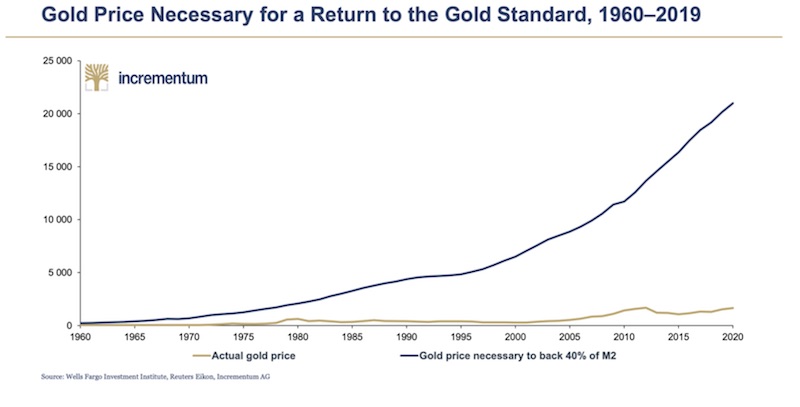
If the currency debasement gets bad enough and political leaders realize that hyperinflation is a real threat they could take action to do a monetary reset and return the US to a gold standard on some old dollars converted to new dollars basis. Others have done the math and the excellent analysts at Incrementum Ag have calculated the gold price that would be necessary to return the US Dollar to the gold standard. This work is presented in the following chart:
This schedule was computed before the present round of monetary expansion, so the true figure might be greater, but this suggests that it would take over$20,000 per ounce to return to a 40% gold backing of the dollar. Over 10x higher than today’s $1,700 price.
Of course a giant reason I think so much of Lawrence Lepard is that the conclusions he has come up with pretty much jibe with what I have been predicting for years. I’m perfectly comfortable knowing that if I happen to be dead wrong and look like an utter fool, at least I have someone I can hold hands with secure in the belief that great minds come from the same gutter.
The same government that couldn’t get out of their own way to safeguard Americans against a bad flu want you to believe they are all wise and all powerful. Well, that’s bull. We are in this mess because those idiots not only talk to each other in an echo chamber, they listen to each other as well. The one thing they never do is actually reflect on the progress or lack of progress they are making.
This depression that started just a short time ago will last for ten years if those fools have their way. They will keep trying to throw darts in a room with no light and the board is in the next room and they don’t know it. They will totally screw it up, put most Americans into poverty and continue to fail until some bright spark says, “Why don’t we just write off the debt and go to a gold standard? Then we get another chance to screw it up all over again.” Eighteen months after that the economy will be humming.
The Corona Virus and the Greatest Depression are providing us with the very best argument for having only tiny governments that you can grab by the stacking swivel and toss them into the toilet so you can drown them quickly.
Bob Moriarty founded 321gold.com, with his late wife, Barbara Moriarty, more than 16 years ago. They later added 321energy.com to cover oil, natural gas, gasoline, coal, solar, wind and nuclear energy. Both sites feature articles, editorial opinions, pricing figures and updates on current events affecting both sectors. Previously, Moriarty was a Marine F-4B and O-1 pilot with more than 832 missions in Vietnam. He holds 14 international aviation records.
Disclosure: 1) Statements and opinions expressed are the opinions of Bob Moriarty and not of Streetwise Reports or its officers. Bob Moriarty is wholly responsible for the validity of the statements. Streetwise Reports was not involved in the content preparation. Bob Moriarty was not paid by Streetwise Reports LLC for this article. Streetwise Reports was not paid by the author to publish or syndicate this article. 2) This article does not constitute investment advice. Each reader is encouraged to consult with his or her individual financial professional and any action a reader takes as a result of information presented here is his or her own responsibility. By opening this page, each reader accepts and agrees to Streetwise Reports’ terms of use and full legal disclaimer. This article is not a solicitation for investment. Streetwise Reports does not render general or specific investment advice and the information on Streetwise Reports should not be considered a recommendation to buy or sell any security. Streetwise Reports does not endorse or recommend the business, products, services or securities of any company mentioned on Streetwise Reports. 3) From time to time, Streetwise Reports LLC and its directors, officers, employees or members of their families, as well as persons interviewed for articles and interviews on the site, may have a long or short position in securities mentioned. Directors, officers, employees or members of their immediate families are prohibited from making purchases and/or sales of those securities in the open market or otherwise from the time of the interview or the decision to write an article until three business days after the publication of the interview or article. The foregoing prohibition does not apply to articles that in substance only restate previously published company releases.
By Jameel Ahmad, Global Head of Currency Strategy and Market Research at FXTM
The pessimism that began to take over the mood of financial markets sentiment late last week has continued into the new trading week, with riskier assets suffering and safe havens preferred.
World stock markets are lacking appetite, perhaps as investors question whether the rally in April can really be justified and this is taking fellow risk assets down with it. Emerging market currencies, and those currencies considered as ‘risk’ are the ones that are lower against the USD on Monday. This includes the GBPUSD, EURUSD and USDCAD.
There is an old saying in the financial world around ‘selling in May and going away’ and should this sentiment continue into the month, the likes of Gold and the USD could be considered as ‘winners’ from this change in investor attitude.
The GBPUSD has been the largest loser of the majors so far in May, erasing nearly 200 pips. Should the GBPUSD continue to drop the following recent support levels can be looked upon as potential levels of interest; the April 29 low at 1.2387, the April 21 low at 1.2297 and the April 20 low at 1.2164.
If each of these levels are breached then we are looking at an increased probability of the Pound falling below 1.20 against the USD for the first time since late March.
(GBPUSD Daily Timeframe FXTM MT4)
The EURUSD is another example of a pair that has come under selling pressure from a renewed USD environment. If the Eurodollar continues what could be the start of a new wave of lower prices, 1.0892, 1.0857 and 1.0809 are potential support levels for EURUSD on the Daily timeframe.
(EURUSD Daily Timeframe FXTM MT4)
Disclaimer: The content in this article comprises personal opinions and should not be construed as containing personal and/or other investment advice and/or an offer of and/or solicitation for any transactions in financial instruments and/or a guarantee and/or prediction of future performance. ForexTime (FXTM), its affiliates, agents, directors, officers or employees do not guarantee the accuracy, validity, timeliness or completeness, of any information or data made available and assume no liability as to any loss arising from any investment based on the same.
Continuing contraction in Switzerland’s manufacturing sector bullish for USDCHF
Switzerland’s manufacturing sector contraction accelerated in April: the manufacturing PMI declined to 40.7 from 43.7 in March, according to Procure trade association for purchasing and supply management. Readings below 50 indicate industry contraction. This is bullish for USDCHF.
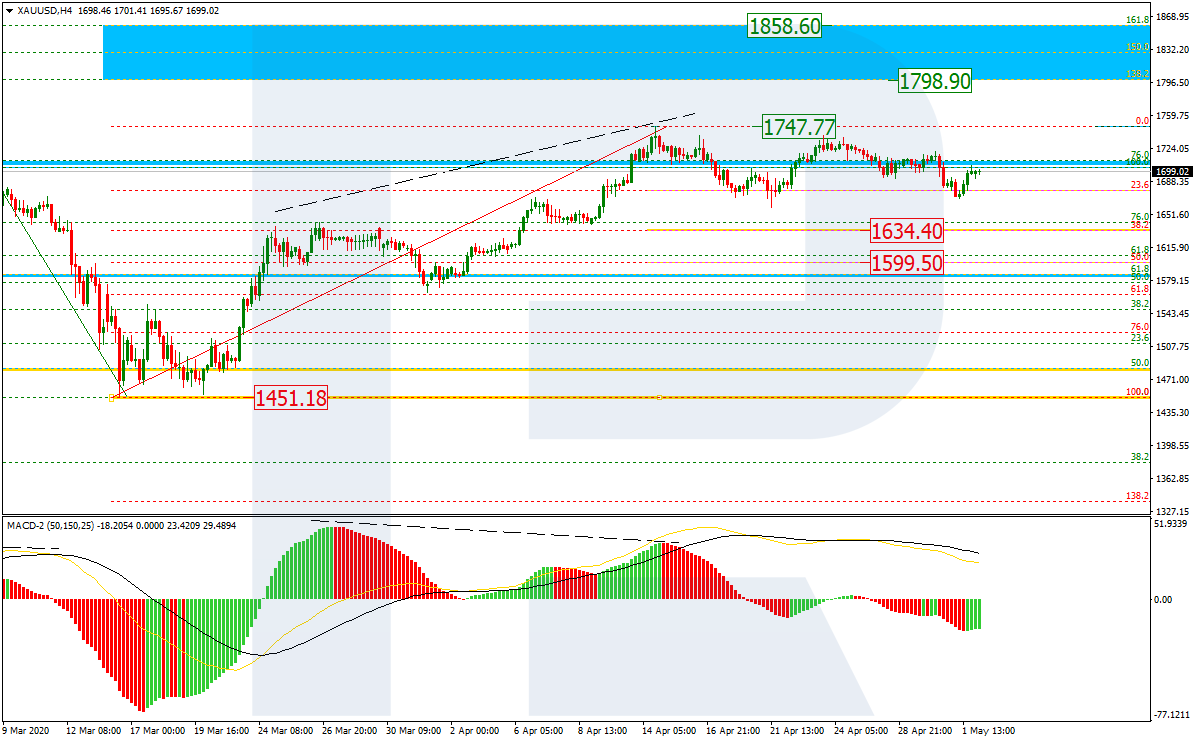
As we can see in the H4 chart, after falling and reaching 23.6% fibo, XAUUSD is moving towards the high at 1747.77. If the price breaks it, the pair may continue its growth to reach the post-correctional extension area between 138.2% and 161.8% fibo at 1798.90 and 1858.60 respectively. At the same time, one should note that the rising impulse was slowed down as it was approaching the high. In this case, there is a high probability of a new descending wave with the targets at 38.2% and 50.0% fibo at 1634.40 and 1599.50 respectively.
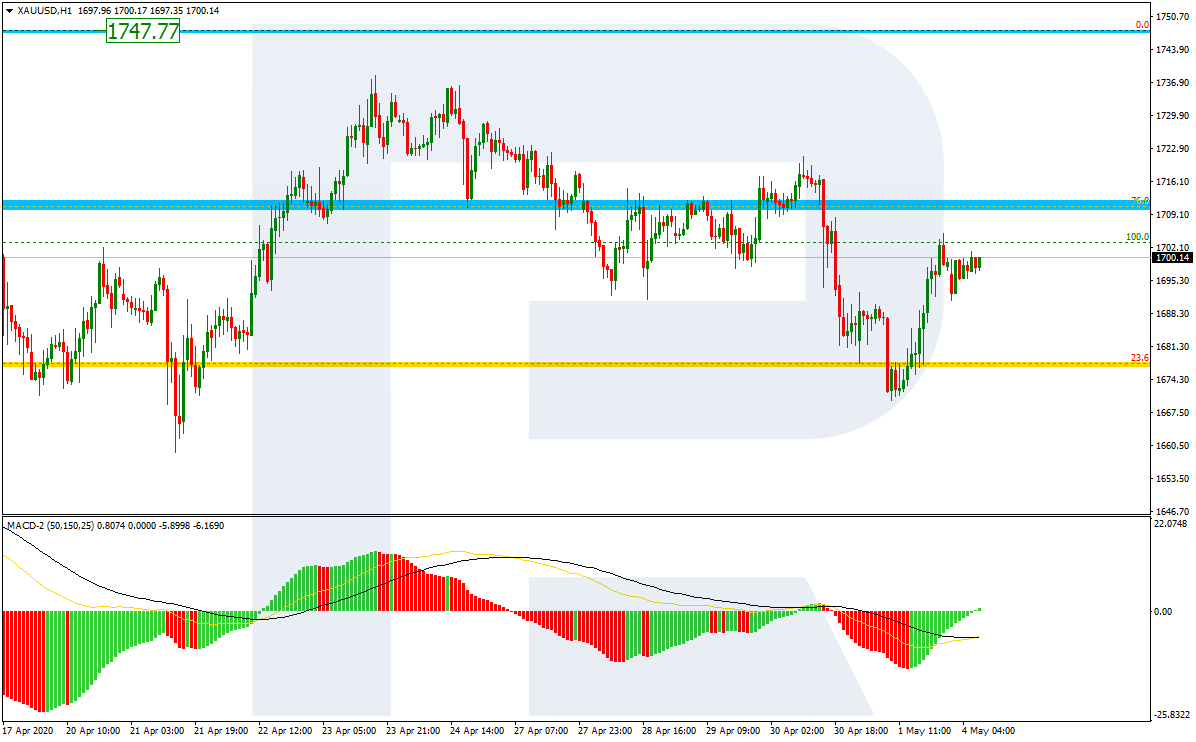
On H1, after a decline and another test of 23.6% Fibo, the quotations are heading for 1747.77, but this may be just a short-time pullback after a momentum of decline.
USDCHF, “US Dollar vs Swiss Franc”
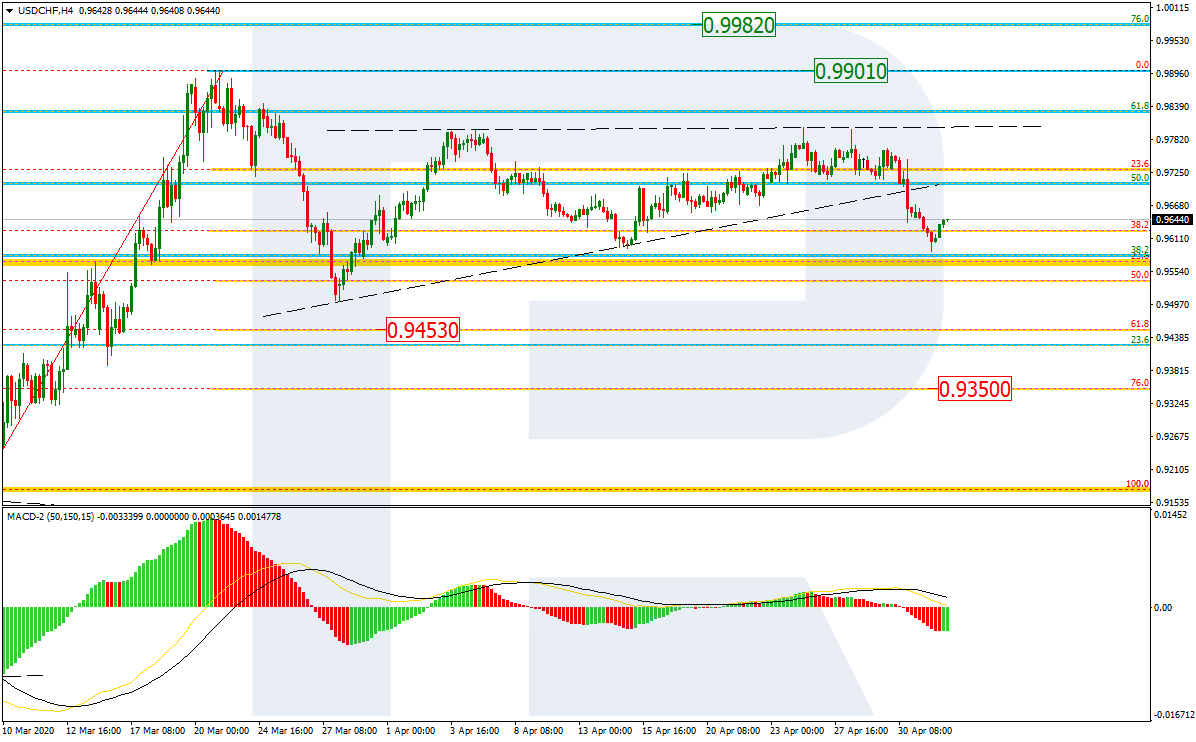
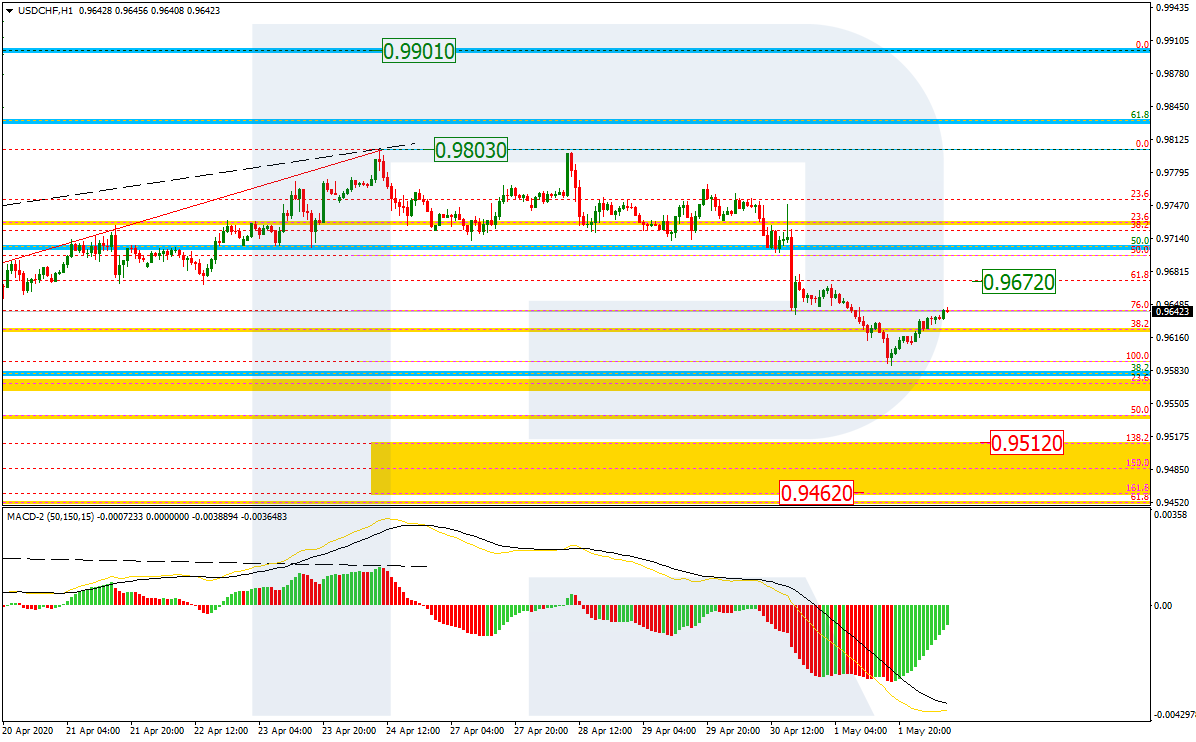
On H4, the last escape of the quotations from the upper border of the consolidation triangle was hardly a success. The quotations formed a strong momentum of a decline, hinting on possible extension of the correctional phase. The potential goal of the decline is 61.8% (0.9453) Fibo; after it is broken away, the decline may go on to 76.0% (0.9350).
On H1, there is a short-term pullback after a momentum of a decline to the local lows. The aim of the pullback may be at the current resistance level of 0.9672. After the correction is over, the quotations may go on declining. The next goals of the decline are in the post-correctional extension range of 138.2-161.8% (0.9512-0.9462) Fibo.
Attention! Forecasts presented in this section only reflect the author’s private opinion and should not be considered as guidance for trading. RoboForex LP bears no responsibility for trading results based on trading recommendations described in these analytical reviews.
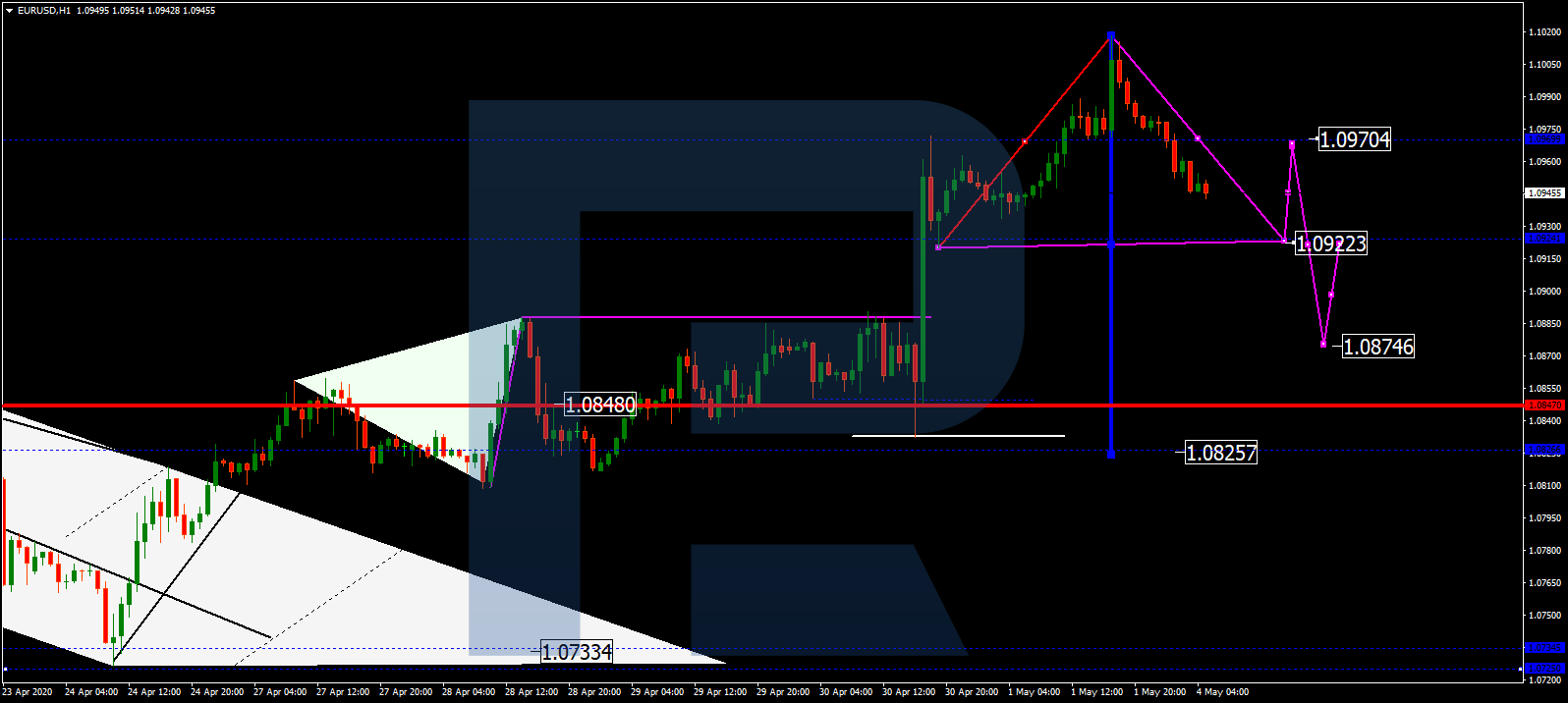
The currency pair has broken the level of 1.0970 upwards, extending the consolidation area to 1.1000. Today, the market is pushed to the lower border of this range. We are waiting for the level of 1.0922 to be reached, followed by growth to 1. 0970 and its test from below. Then the pair may return to 1.0922. After breaking it downwards, it may further decline to 1.0875. The goal is local.
GBPUSD, “Great Britain Pound vs US Dollar”
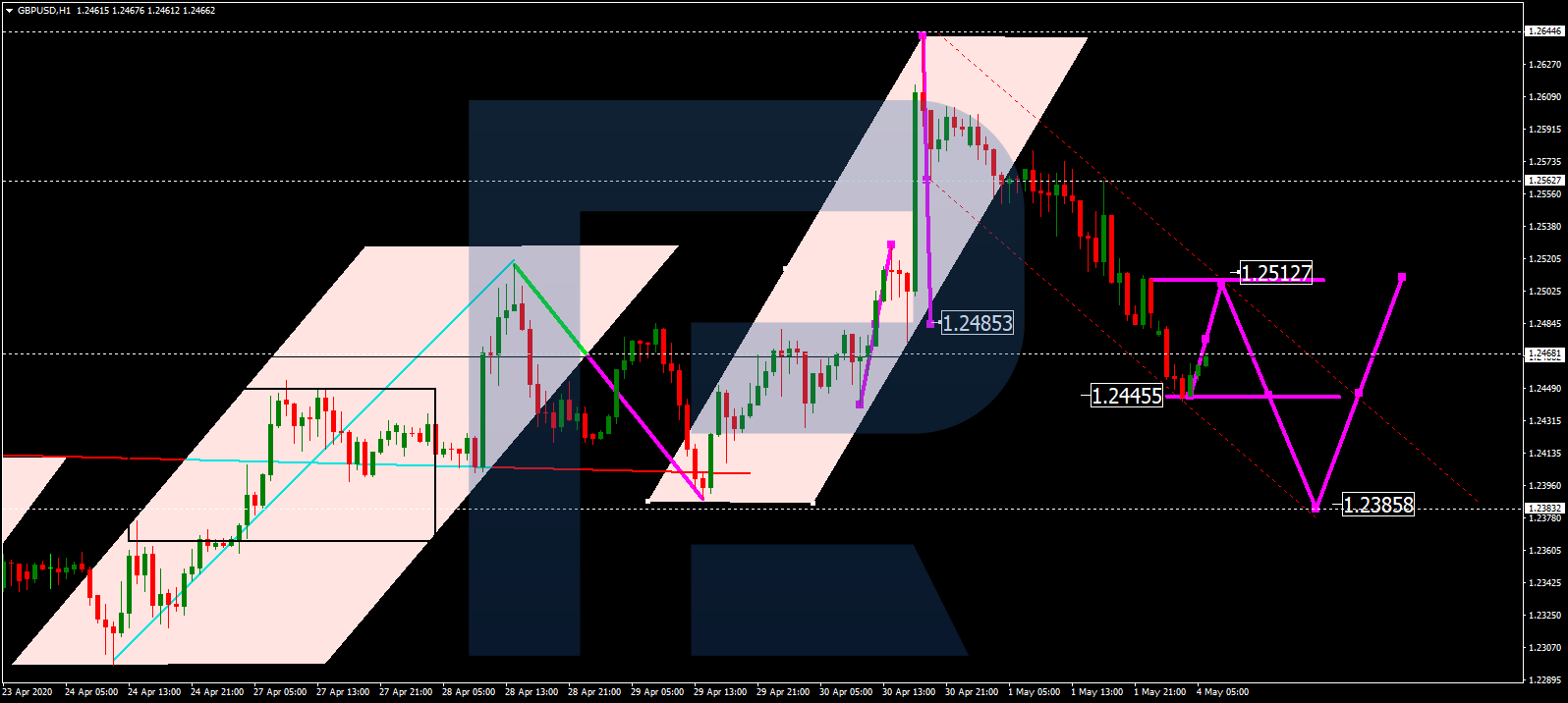
The currency pair reached the estimated goal of the decline at 1.2485. Today, the market has broken this level downwards. It may further decline to 1.2385. After this goal is reached, the pair may correct to 1.2515, testing this level from below. Then it may decline to 1.2310.
USDRUB, “US Dollar vs Russian Ruble”
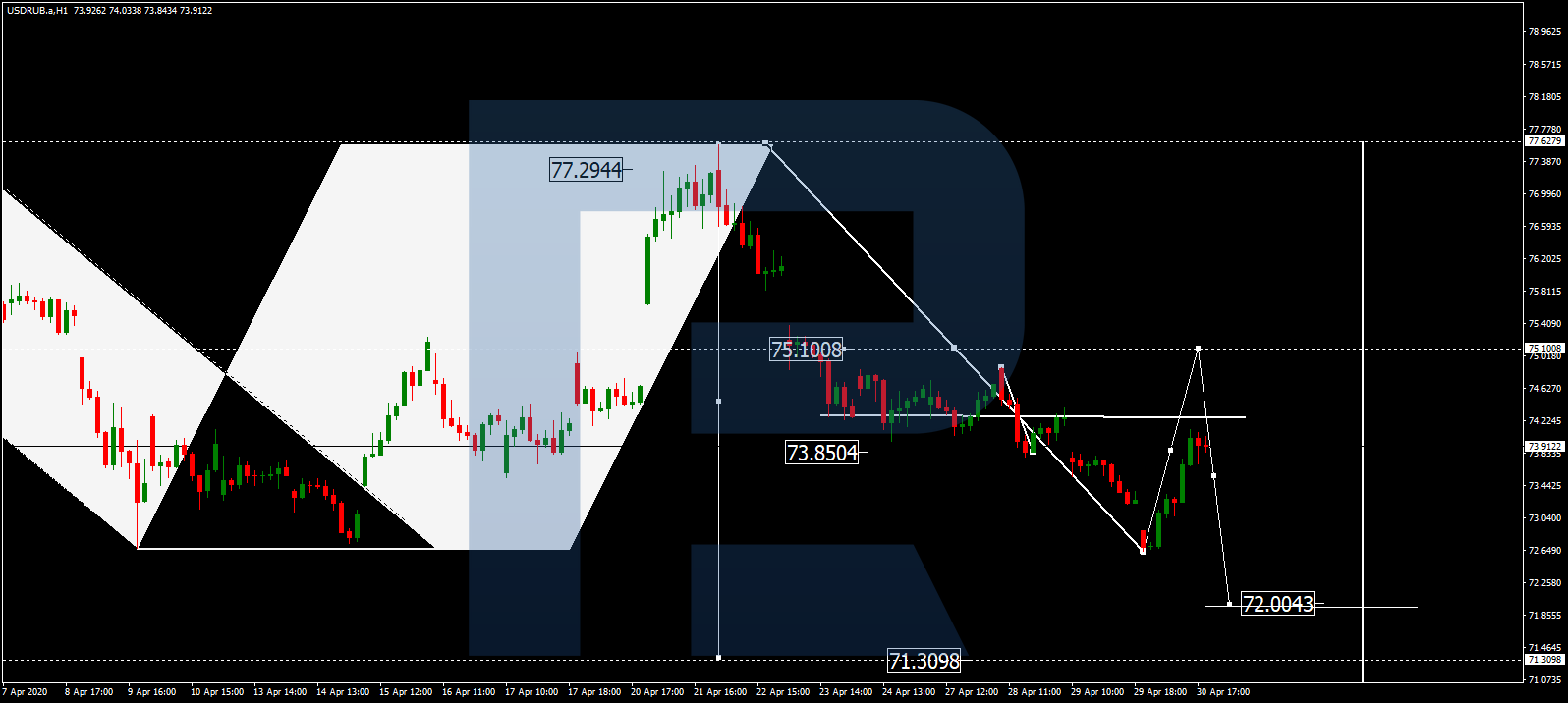
The currency pair has corrected to 74.10. At the market opening, we are expecting a decline to 72.00, followed by growth to 73.50 and a decline to 71.30. The goal is local.
USDJPY, “US Dollar vs Japanese Yen”
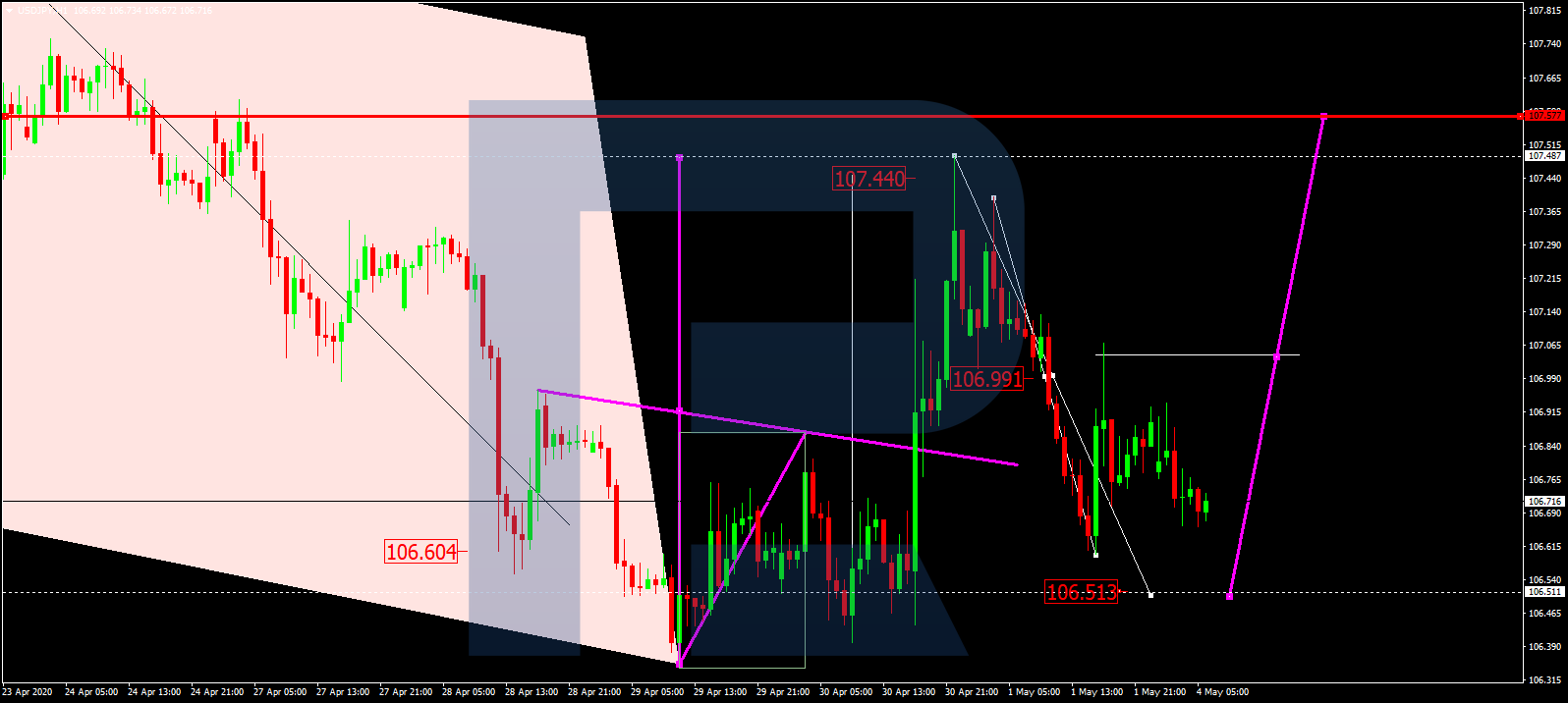
The currency pair goes on developing a correction. The market has returned to 106.60. At the moment, the market is trading in a consolidation range, which may extend to 106.52. Then the pair may grow to 107.07. Breaking this level upwards, it may further grow to 107.57.
USDCHF, “US Dollar vs Swiss Franc”
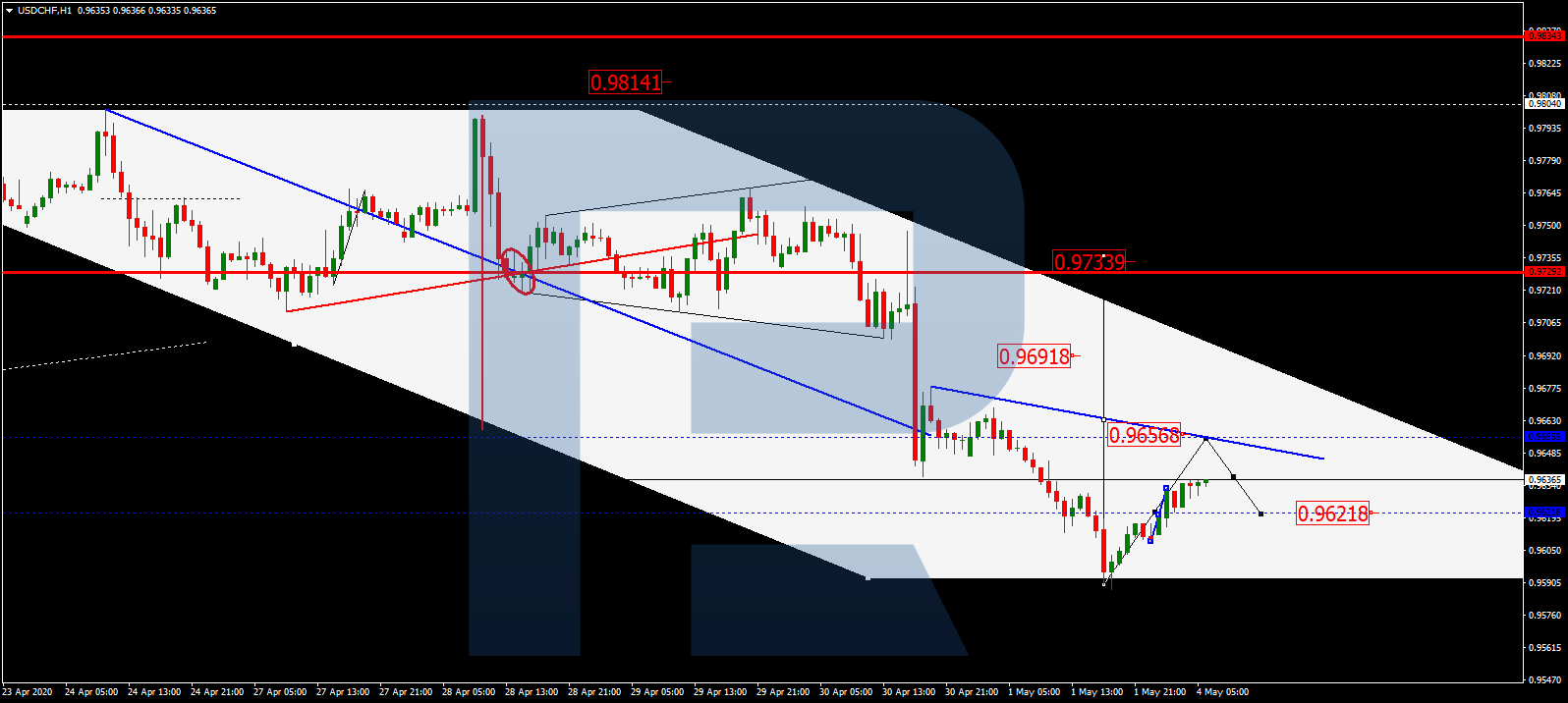
The currency pair has broken the consolidation area downwards, extending it to 0.9590. Today, the market is trading in a momentum of growth to 0.9656. Then it may correct to 0.9622. At these levels, a new consolidation area may develop. If the pair growth and breaks away 0. 9660, it may then grow to 0.9733. The goal is the first one of the uptrend.
AUDUSD, “Australian Dollar vs US Dollar”
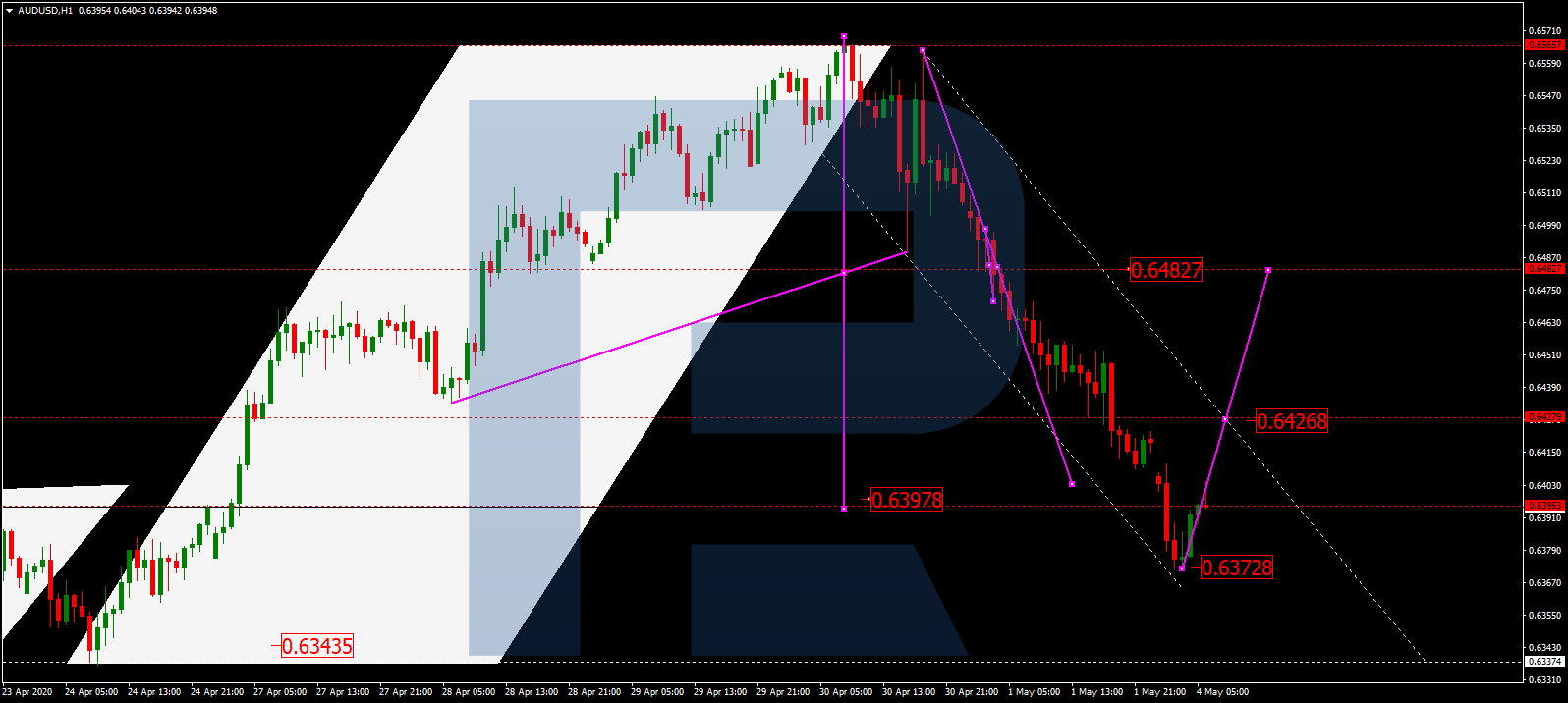
The currency pair keeps developing a declining wave. The market has reached the estimated goal of the first wave at 0.6396. At the moment, the market is trading in the consolidation area at the lows. The pair may break 0.6400 upwards and correct to 0.6484. And if it declines and breaks the level of 0.6373 downwards, it may then decline to 0.6333.
BRENT
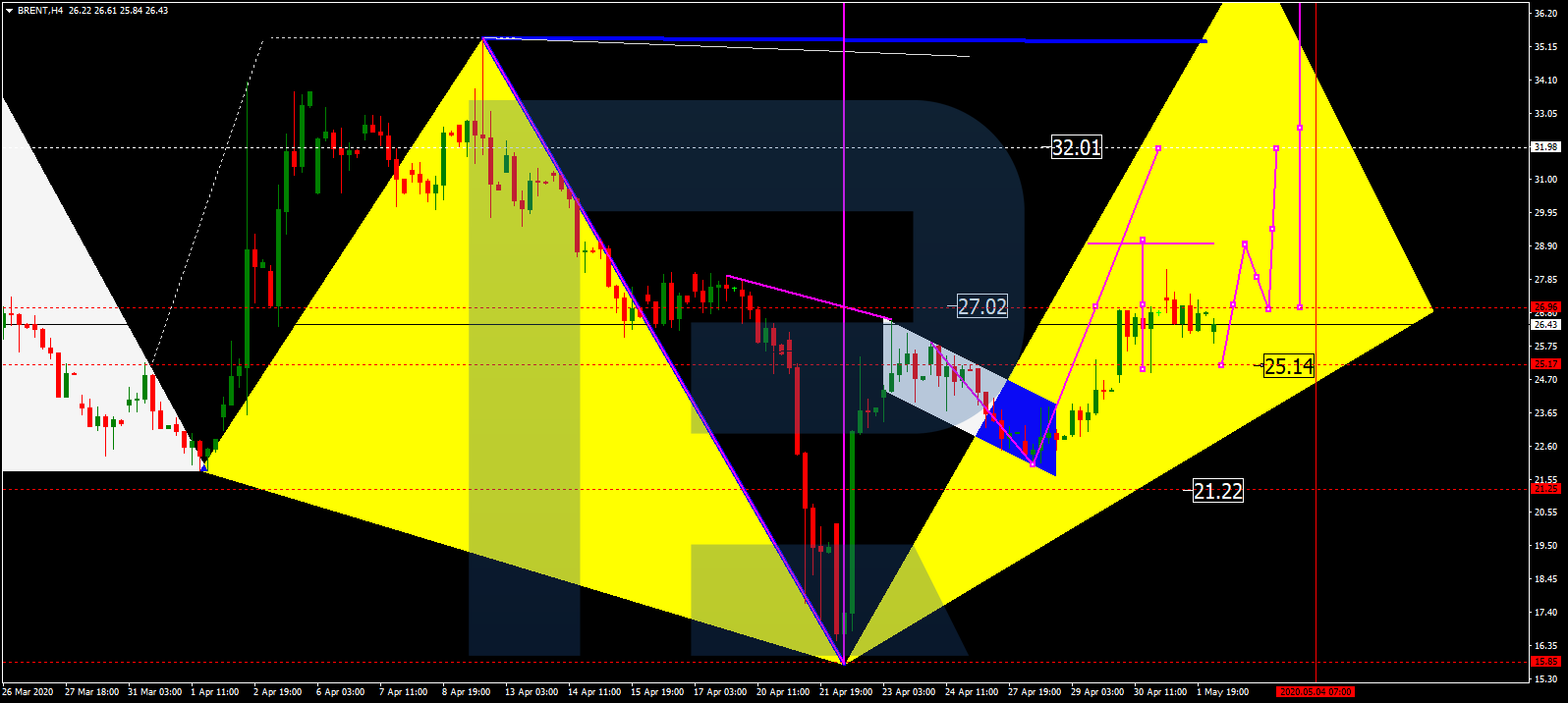
Oil keeps developing a consolidation area around 27.00. We are expecting it to extend to 29.00. Then the pair may decline to 27.00,testing it from above, and grow to 32.02. The goal is local.
XAUUSD, “Gold vs US Dollar”
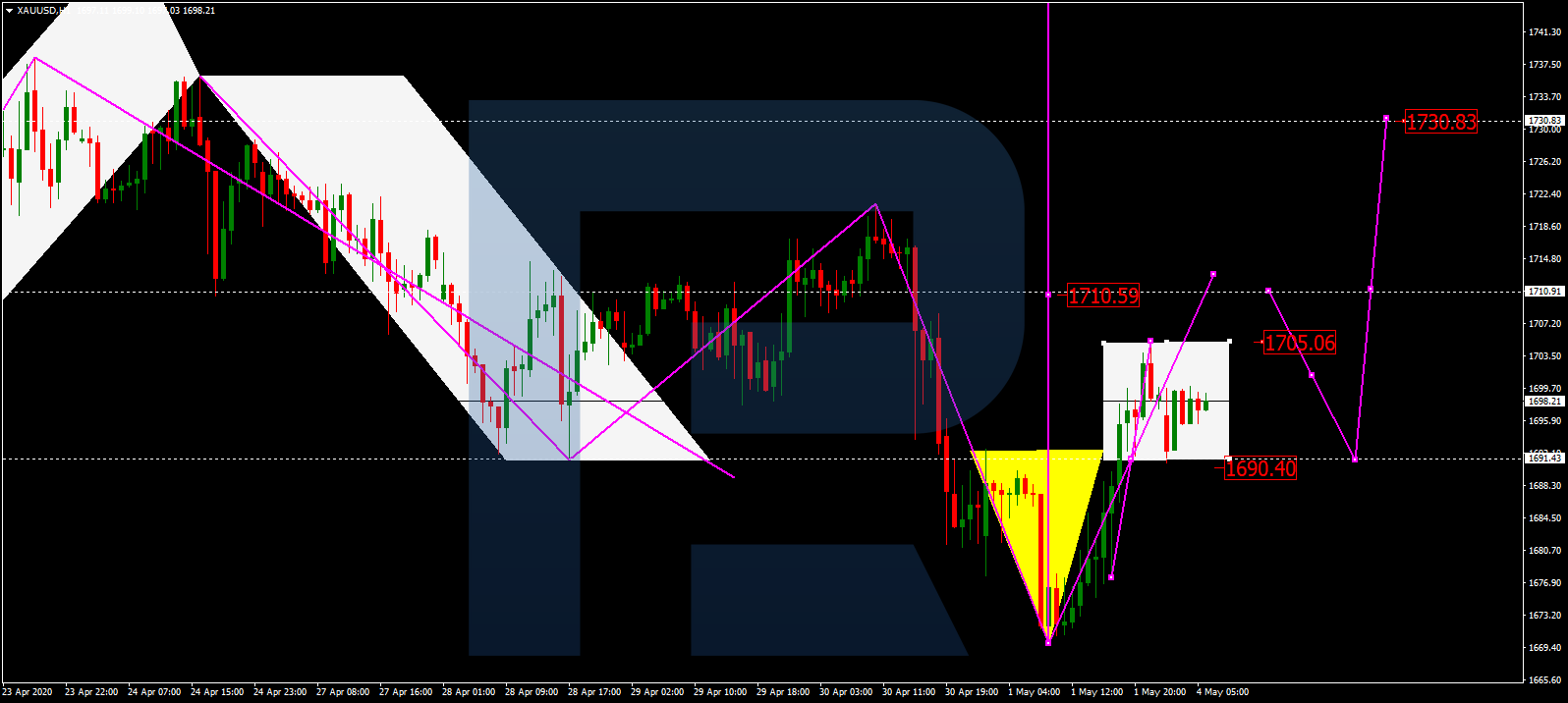
Gold keeps developing a wave of growth to 1712.00. After this level is reached, the pair may correct to 1690.50 and grow to 1730.00. The goal is local.
Bitcoin
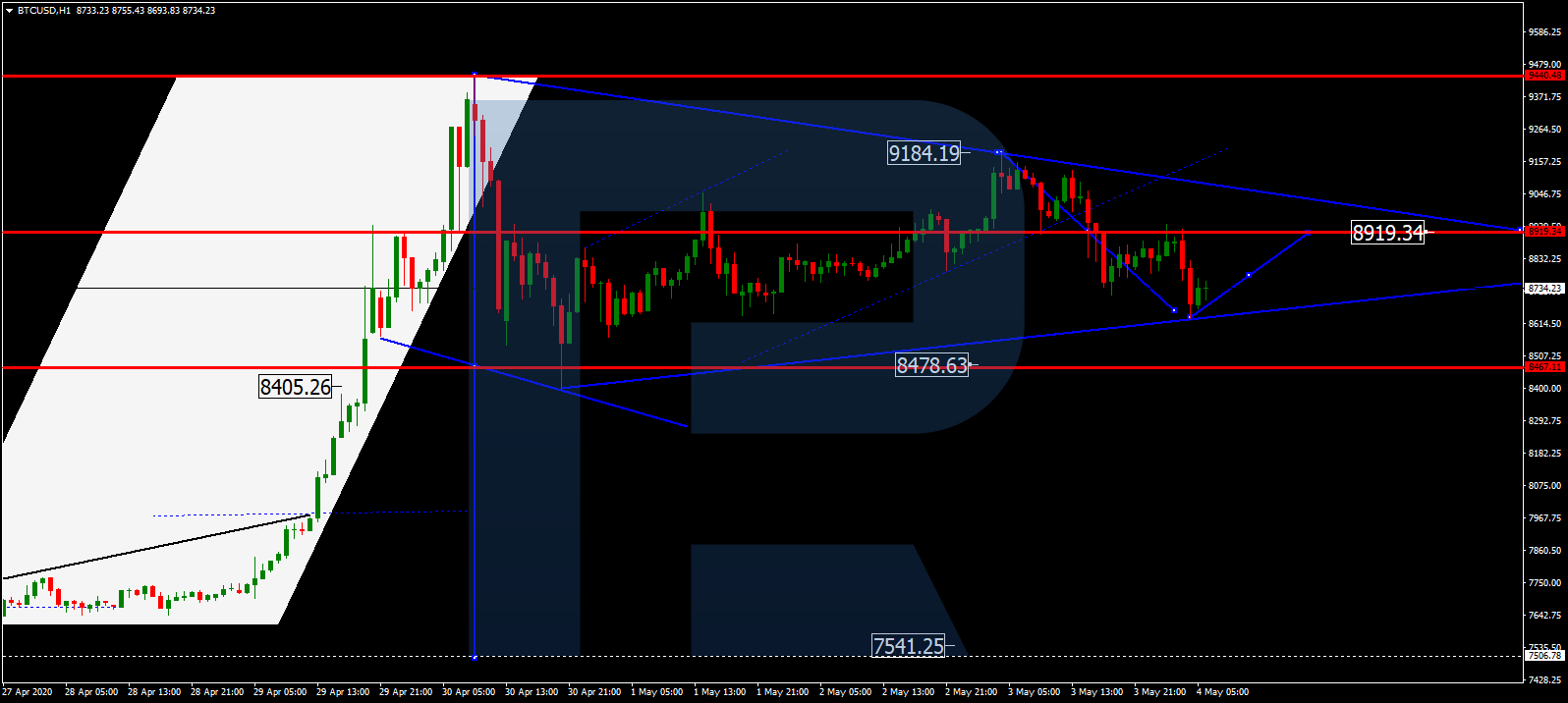
The market has demonstrated a wave of growth to 9180. The market today is trading in a wave of decline to 8618. Then a correction to 8919 is not excluded. A consolidation area is expected to develop at practically these levels. When the cryptocurrency escapes it downwards, it may further correct to 8470. Breaking this level downwards, too, the declining wave may develop to 7900. The goal is local.
S&P 500
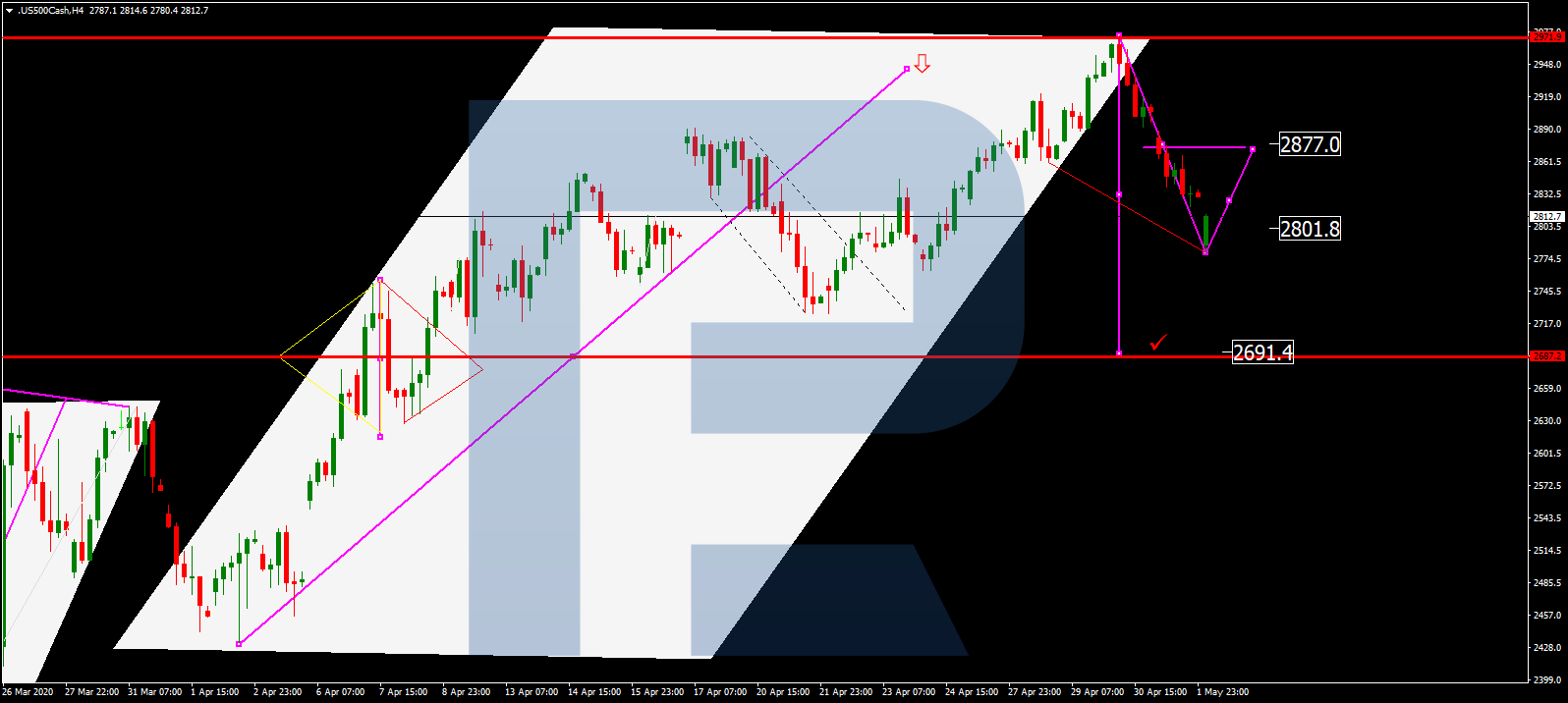
The index has performed a wave of decline to 2801.8. Today, the development of a consolidation range at these lows looks possible. However, it may grow to 2877.0 and then decline to 2691.4.
Attention! Forecasts presented in this section only reflect the author’s private opinion and should not be considered as guidance for trading. RoboForex LP bears no responsibility for trading results based on trading recommendations described in these analytical reviews.
US Q1 activity drops the most since the last recession
The first-quarter economic activity in the world’s largest economy fell at a rate of 4.8%. This was the fastest contraction seen since the last economic recession in 2008. The declines came as most parts of the economy were shut due to the Coronavirus situation.
The contraction comes on the back of a 2.1% increase in the last three months of 2019. Consumer spending fell 7.6% during the period led by a steep drop in services, healthcare, and goods.
The Federal Reserve held its monetary policy meeting last week. As widely expected, interest rates were unchanged at 0.00% – 0.25%. The central bank said that it will continue its aggressive policy until the US economy is up and running.
Fed Chair Jerome Powell said that medium-term risks remain over the coming year alongside the global economy as well. The Fed cut interest rates to near zero since the start of this year and relaunched massive asset purchases to stem the economic impact due to the pandemic.
Eurozone economic activity contracts at worst pace in history
Economic activity in the eurozone fell as the sharpest rate since record-keeping began. Data from Eurostat released last week showed that the eurozone economy contracted 3.8% in the first quarter. This was after the economy posted a modest 0.1% increase in the previous three months.
In another report, flash estimates on inflation showed that consumer prices slowed 0.4% in April, down from 0.7% in February. The declines were largely due to a 9.6% drop in energy prices.
ECB keeps policy unchanged, disappointing markets
The European Central bank held its monetary policy meeting last week. Investors felt disappointed as the ECB failed to announce any further measures to stem the economic decline. However, ECB Chief Lagarde said that the central bank was prepared to take any measure necessary.
The bank laid out plans to cut interest rates on its TLTRO II program if required. The euro rebounded, rising to the strongest levels in four weeks.
Upcoming Economic Events
RBA to keep policy steady amid tapering its bond purchases
The Reserve Bank of Australia will be holding its monetary policy meeting this week. Economists forecast that the RBA will leave interest rates at 0.25%. However, expectations are rising that the central bank will likely taper its bond purchases, following hints from the previous meeting in April.
Nevertheless, the central bank will need to do a balancing act so as not to sound too hawkish which will bolster the AUD’s strength.
Bank of England to remain on the sidelines for now
The Bank of England’s monetary policy meeting this week will be a non-event. The central bank meeting will also have a fairly limited impact on the pound sterling. This comes as interest rates are near zero and the bank bolstered its QE purchases.
Focus will be on how the UK economy will limp back to normalcy. PM Johnson has been hinting at following a phased approach to reopening the economy.
Big week ahead for USD
A number of economic events scheduled for the week ahead will be critical for the US dollar. Data includes manufacturing and non-manufacturing PMI from the Institute of Supply Management. Later in the week, the labor market reports from ADP and the nonfarm payrolls will be the big items on Thursday and Friday respectively.
All in all, the outlook remains grim as the US economy was in a lockdown for the month of April. Manufacturing activity is forecast to hit the lowest level since the financial crisis. Meanwhile, the unemployment rate is forecast to rise to 16% with the economy likely to shed 21 million jobs during the month.