Author Archive for InvestMacro – Page 93

Shipping Rates Plunge, Commodities and Stocks May Follow

By TheTechnicalTraders – An almost immediate reaction to the Coronavirus outbreak in China and throughout most of the world has sent shock-wave through the global markets – particularly seen in Shipping and Oil.  The actions within China to attempt to contain the virus spread include shutting down entire cities and setting up mass quarantine events.  It is estimated that as many as 8+ million people were quarantined within cities in China throughout the Chinese New Year.

Chinese President, Xi Jinping, warned recently that the Coronavirus, and the efforts to stop it, may greatly reduce the Chinese economy over the next few months.  The Chinese President urged top officials to refrain from “more restrictive measures” to contain the virus.  It is our opinion that more restrictive measures are essential to efforts to contain the spread of this virus and that further contraction in the Chinese economy, as well as other economies, are almost set in stone at this point.

Information we’ve received from some friends living in China and Hong Kong suggest travel is very restricted, face masks are very scarce, people are staying inside their homes and surviving as family units within very close contact with one another.  They are scared, trapped and unable to do anything other than try to wait this out.  Imagine what this is doing to the local economies, shops, offices, and businesses?

Reflectively, global shipping rates have collapsed over the past 30+ days as one of the first signs of the contraction in the global markets.  As of December 31, 2019, both Tanker and Dry-Bulk rates were hovering near $14,000 per day.  Now, this rate is near $2500 per day – a -82% decrease.  As you consider the broader aspects of this massive decrease in shipping rates, consider the global contagion event that may setup if the Belt-Road region is adversely hit with the Corona Virus.

Source: Bloomberg.com

SEA Shipping Sector ETF – Daily Chart

Shipping stocks are taking a beating. Factories are shut down, the product is not being shipped, and even product ready to be shipped many don’t want to take delivery for the time being.

From a short term standpoint, this sector is looking oversold, but depending on how much the virus spreads we could see another 20% from the current price.

China’s Belt-Road Infrastructure Projects

China’s Belt-Road Initiative consists of massive infrastructure, port, and other projects throughout Europe, Asia, India, Pakistan, Iran, Turkey, Russia, Africa, and other nations.  These projects have been initiated over the past 5+ years and are well underway.  We believe the spread of the Coronavirus may follow a path along with the Belt and Road projects and potentially infect a larger number of individuals over the next 30+ days than originally expected.  If this virus moves into the Middle East or Africa, containment may become very difficult.

The reality is that Shipping and Commodities could see a dramatic price decline as this virus outbreak continues over the next 60+ days.  Reports are already starting to hit the news wires that Autos and manufacturing supplies are starting to pile up and ports in China.  Without a functioning manufacturing sector and workers to keep everything running, China’s economy will grind to a halt very quickly.

This translates into lower Oil prices, lower raw material prices and higher metals prices.  A capital shift will continue to take place throughout the world where capital will move away from risky environments and towards more secure investment environments.  Thus, capital will move away from Asia, India, the Middle East and potentially Europe and towards the USA, Canada and possibly Mexico.  Everything depends on what happens over the next 60 to 90+ days with regards to this virus outbreak.

Monthly Crude Oil chart

This Monthly Crude Oil chart shows how quickly Oil rotated lower in January 2020.  Currently, Oil is trading near $50 per barrel and may break lower towards the $44 to $46 price level before finding any real support.  Overall, our research team believes Oil may reach as low as $35 to $36 ppb before reaching a bottom.  You can read our earlier research here: https://www.thetechnicaltraders.com/oil-begins-to-move-lower-will-our-predictions-come-true.  Within that research post, dated November 19, 2019, we highlighted our earlier predictive modeling research from July 2019 suggesting Oil would break substantially lower in November 2019 and again in February 2020.  We predicted this downside move in Oil nearly 8+ before it happened.

Transportation Index Monthly Chart

This Transportation Index Monthly chart highlights the sideways FLAG formation setting up in the US Transportation sector.  If the US market breaks lower as a result of lower global economic activity, we believe we will see the Transportation Index fall very quickly to levels below $9,500.  A breakdown in the Transportation Index would be an early warning sign that the US economy is headed towards a recession or contraction event.  Global shipping has already confirmed this event is taking place – yet the US Transportation sector has not shown much weakness.

Traders need to be very aware of the risks in the markets and the continued Capital Shift that is taking place throughout the planet.  Capital is running away from risk and pouring into more stable markets.  The ultimate risks to the global economy are for those nations where debt/economy levels are fragile, to begin with – which is why we highlighted the Belt Road project.  If China enters a protective mode where the Chinese Central Bank attempts to bail out Chinese companies/initiatives, we believe the Belt Road project could become a great risk.  And we believe this could happen very quickly given the current market environment.

The dynamics of global markets are changing very quickly.  It is time for traders to prepare for bigger volatility and large range sector rotation.  Follow our research, learn how we can help you stay ahead of these bigger moves in the markets.  2020 is going to be a fantastic year for skilled traders – you just have to stay ahead of the risks and be prepared to take advantage of the opportunities as they are presented.

Join my Swing Trading ETF Wealth Building Newsletter if you like what you read here and ride my coattails as I navigate these financial markets and build wealth while others lose nearly everything they own.

Chris Vermeulen
TheTechnicalTraders.com

NOTICE: Our free research does not constitute a trade recommendation or solicitation for our readers to take any action regarding this research.  It is provided for educational purposes only.  Our research team produces these research articles to share information with our followers/readers in an effort to try to keep you well informed.  Visit our web site (www.thetechnicaltraders.com) to learn how to take advantage of our members-only research and trading signals.



Forex Technical Analysis & Forecast 12.02.2020 (EURUSD, GBPUSD, USDCHF, USDJPY, AUDUSD, USDRUB, USDCAD, GOLD, BRENT, BTCUSD)

Article By RoboForex.com

EURUSD, “Euro vs US Dollar”

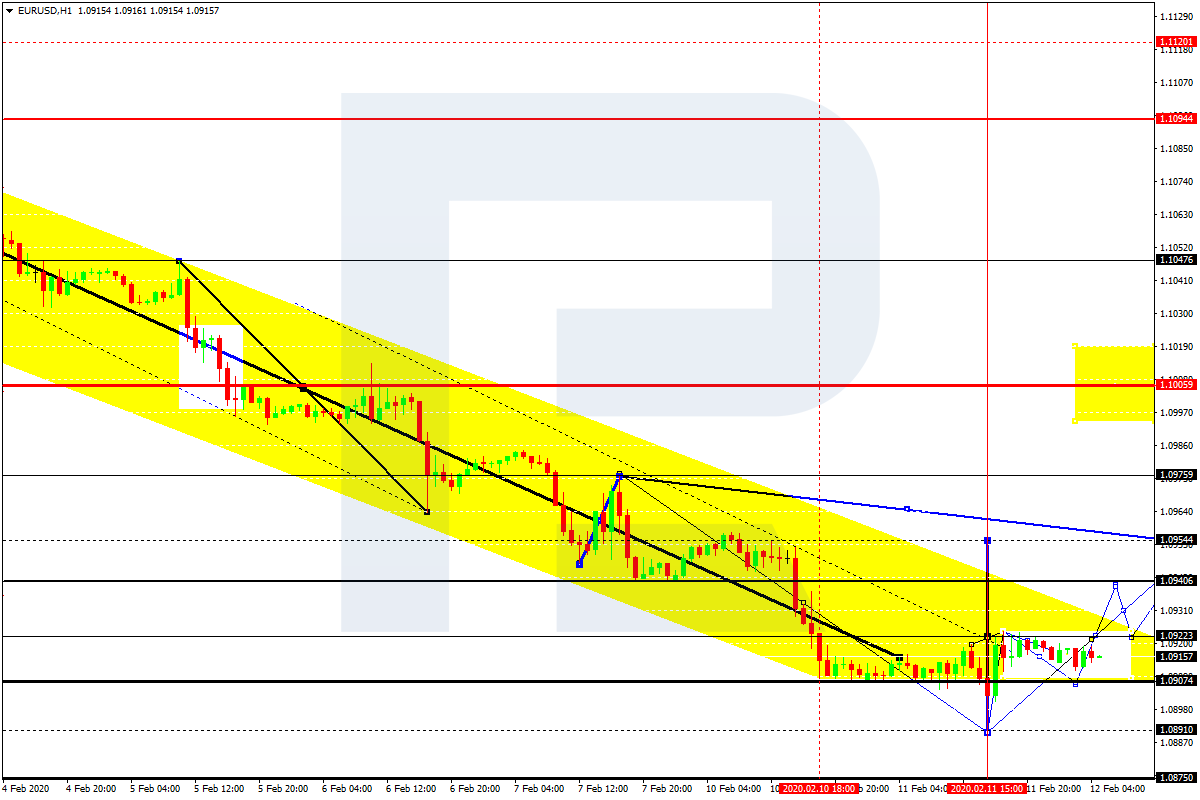
EURUSD has finished the ascending impulse from 1.0891. Possibly, today the pair may correct from 1.0924 to 1.0907, thus forming a new consolidation range between these two levels. If later the price breaks this range to the upside, the market may form one more ascending structure with the first target at 1.0955; if to the downside – start another decline to return to 1.0891.

EURUSD
Risk Warning: the result of previous trading operations do not guarantee the same results in the future

GBPUSD, “Great Britain Pound vs US Dollar”

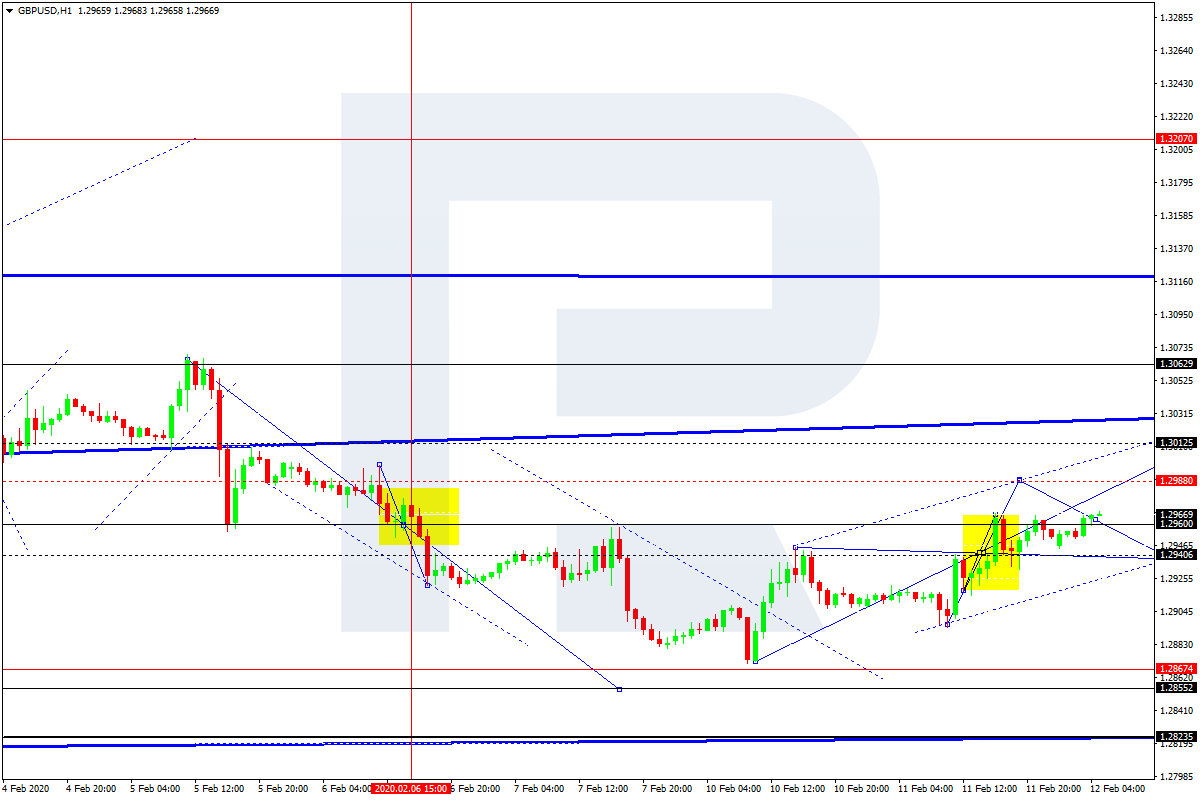
GBPUSD has formed another consolidation range around 1.2940; right now, it is trading upwards. Possibly, the pair may break the range to reach 1.2988 and continue the correction (an alternative scenario). The main scenario implies that the price may fall to break 1.2945 and then continue moving downwards with the target at 1.2855.

GBPUSD
Risk Warning: the result of previous trading operations do not guarantee the same results in the future

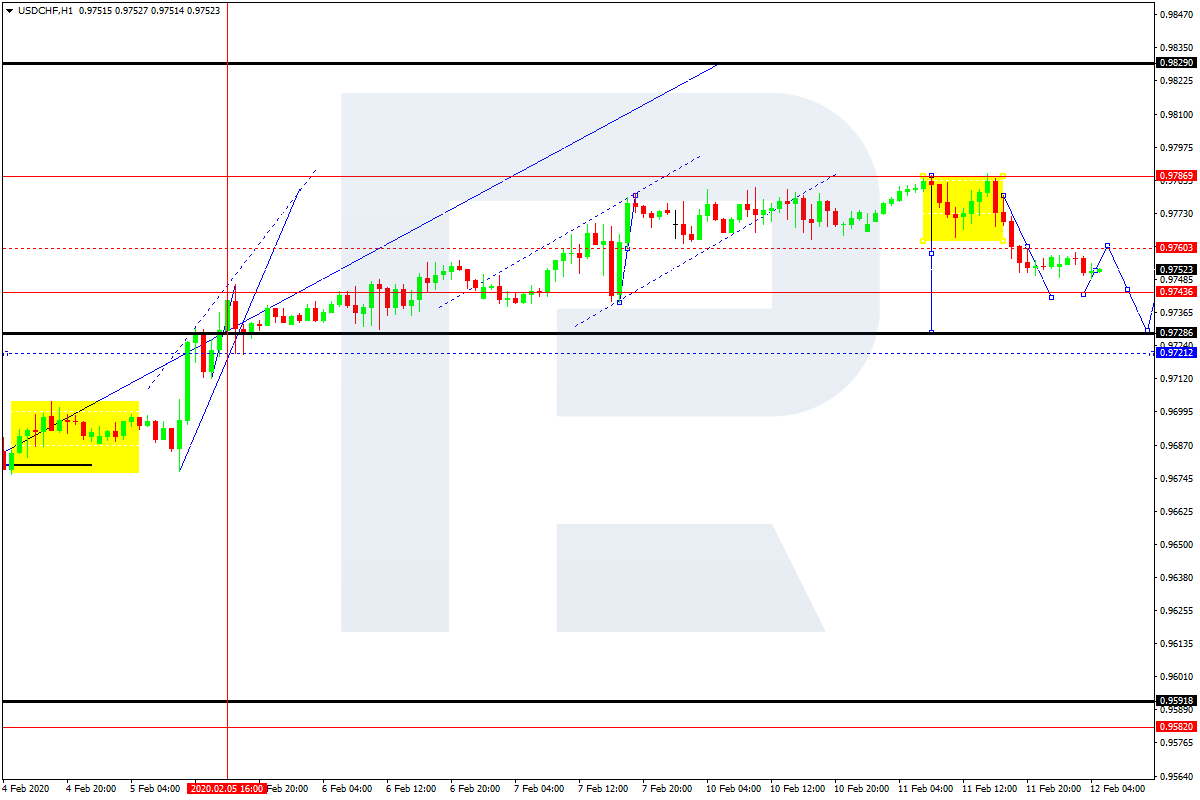
USDCHF, “US Dollar vs Swiss Franc”

USDCHF has broken 0.9760 downwards. Possibly, the pair may correct towards 0.9728 and then start another growth to break 0.9788. After that, the instrument may continue trading upwards with the target at 0.9829.

USDCHF
Risk Warning: the result of previous trading operations do not guarantee the same results in the future

USDJPY, “US Dollar vs Japanese Yen”

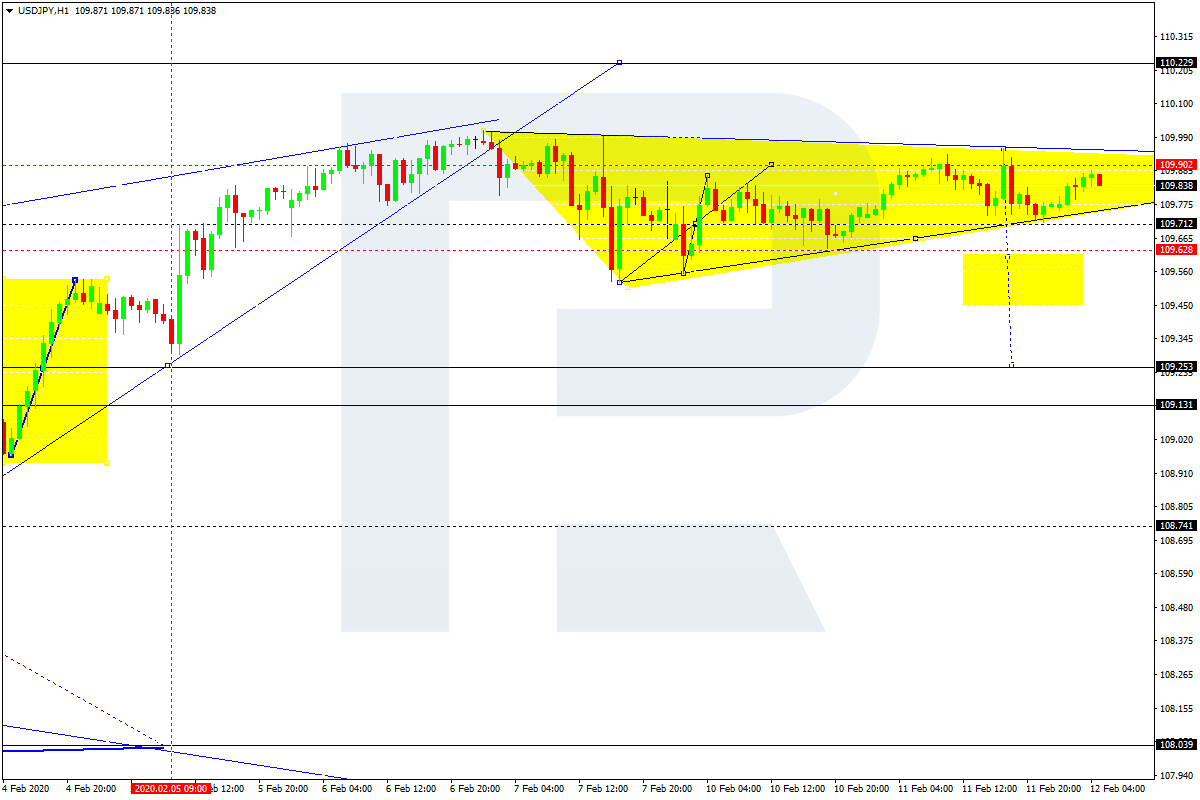
USDJPY is forming a narrow consolidating range around 109.71 in the form of a triangle. If later the price breaks this range to the downside at 109.60, the instrument may start a new correction with the target at 109.25; if to the upside at 109.90 – form one more ascending structure towards 110.22.

USDJPY
Risk Warning: the result of previous trading operations do not guarantee the same results in the future

AUDUSD, “Australian Dollar vs US Dollar”

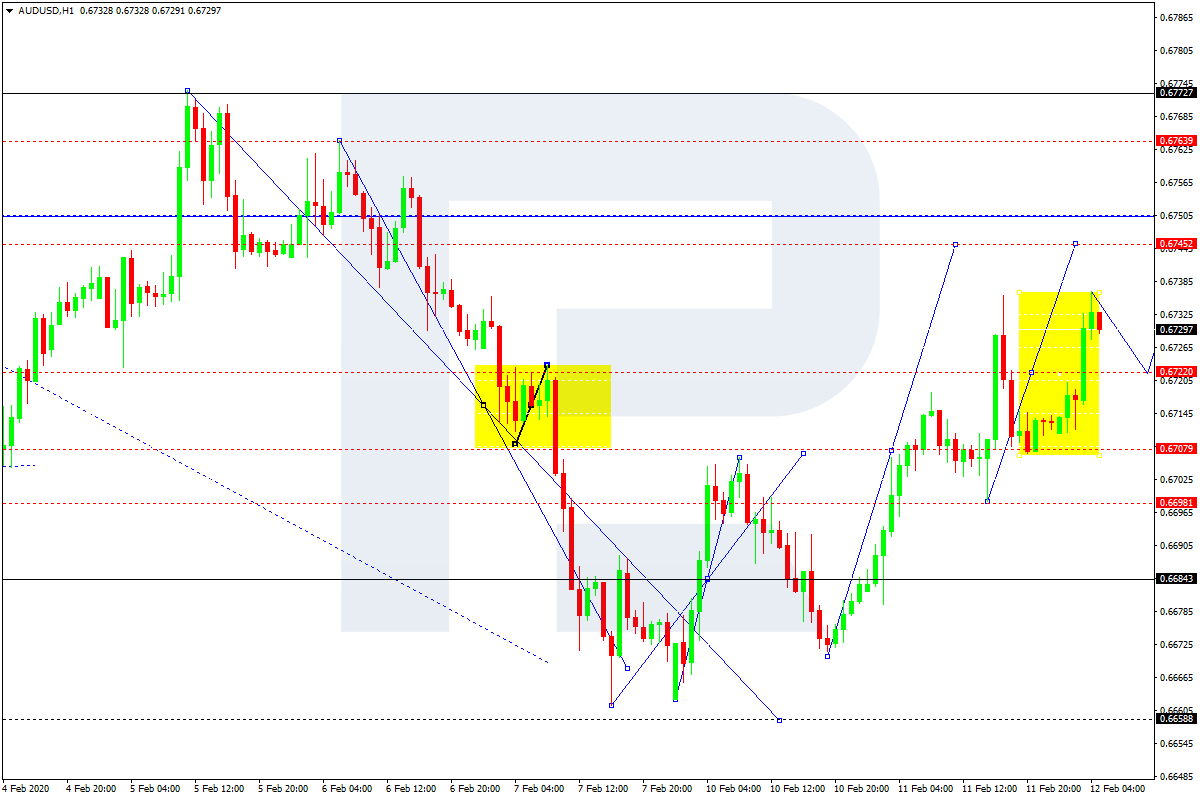
After forming another consolidation range around 0.6707, AUDUSD has broken it to the upside. Today, the pair may continue trading upwards to reach 0.6745 and then start a new descending structure with the target at 0.6707.

AUDUSD
Risk Warning: the result of previous trading operations do not guarantee the same results in the future

USDRUB, “US Dollar vs Russian Ruble”

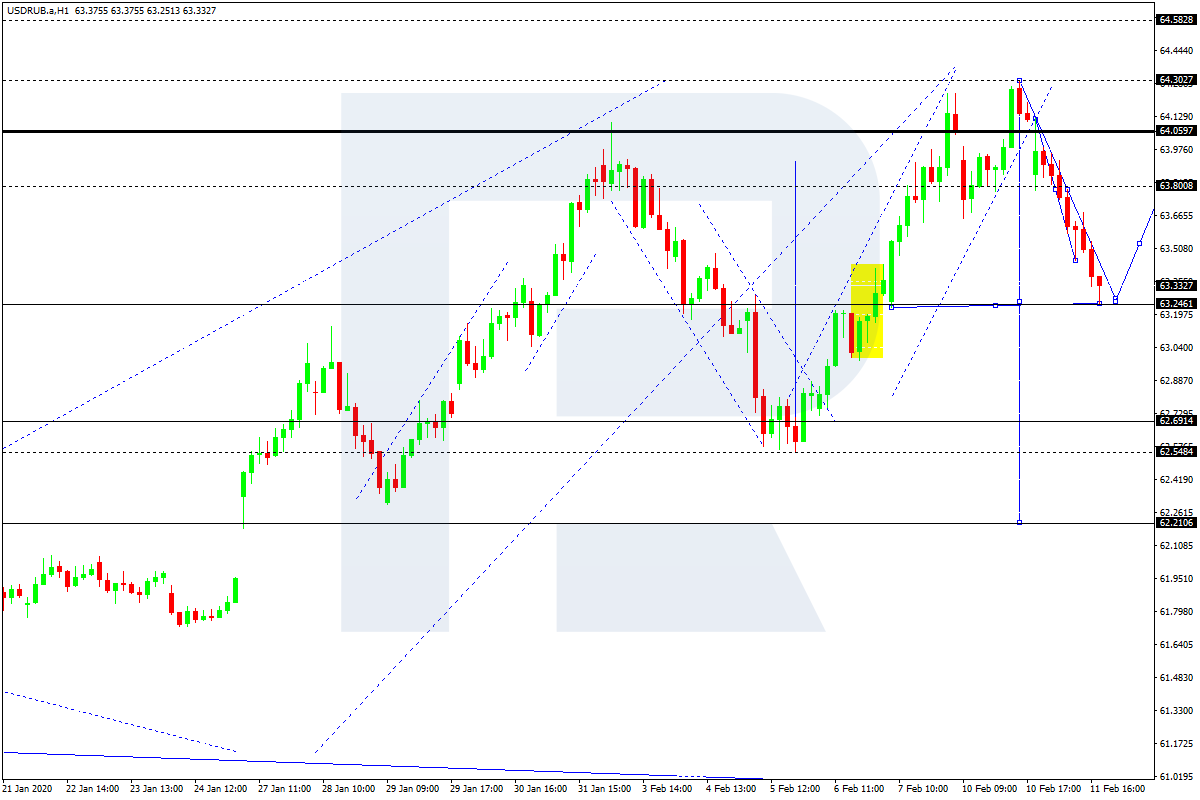
USDRUB has completed the descending impulse towards 63.25. Possibly, today the pair may correct to reach 63.80 and then start a new decline with the short-term target at 62.70.

USDRUB
Risk Warning: the result of previous trading operations do not guarantee the same results in the future

USDCAD, “US Dollar vs Canadian Dollar”

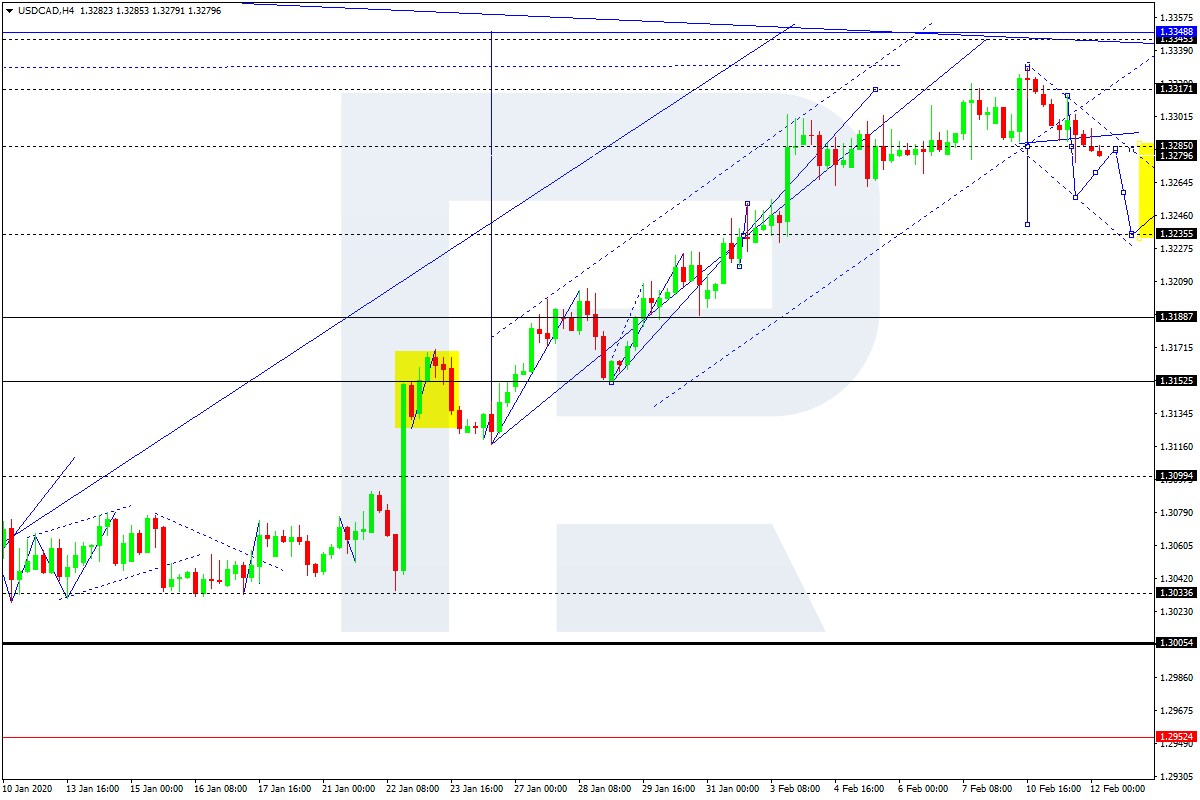
USDCAD is moving downwards. Possibly, the pair may reach 1.3233 and then resume trading upwards with the target at 1.3288, thus forming a new consolidation range. If later the price breaks this range to the downside, the instrument may start a new correction towards 1.3155; if to the upside – form one more ascending structure to reach 1.3345.

USDCAD
Risk Warning: the result of previous trading operations do not guarantee the same results in the future

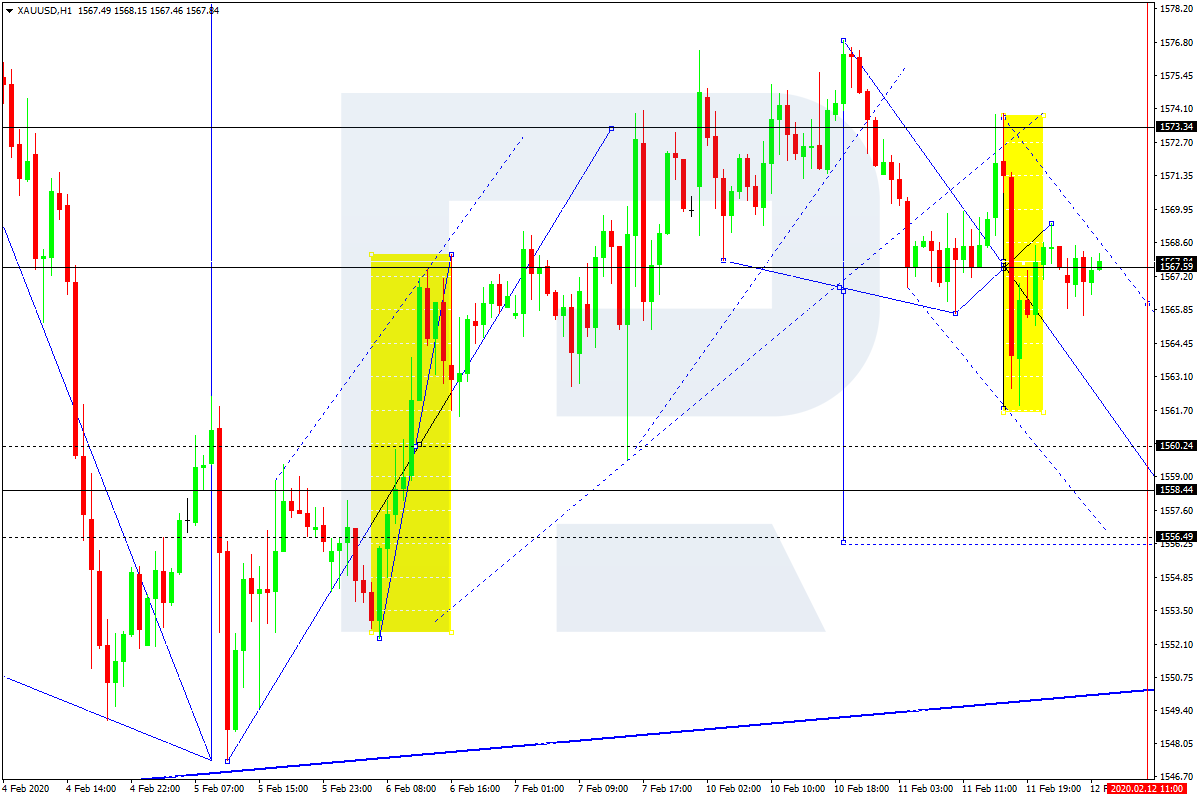
XAUUSD, “Gold vs US Dollar”

Gold is still consolidating around 1567.90. Today, the pair may fall to reach 1558.45 and then resume trading upwards to return to 1567.90.

GOLD
Risk Warning: the result of previous trading operations do not guarantee the same results in the future

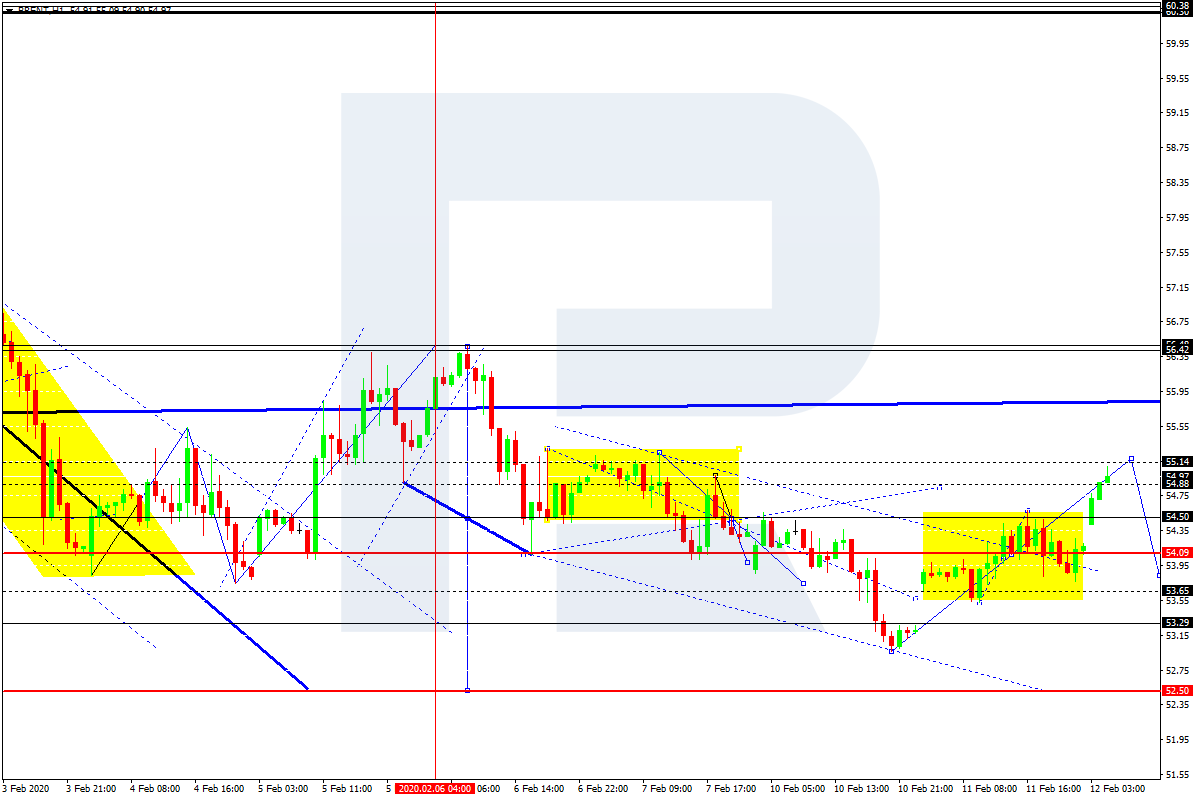
BRENT

Brent is moving upwards. Possibly, the pair may reach 55.15 and then form a new descending structure towards 54.10. If later the price falls and breaks 53.90, the instrument may continue falling with the target at 52.50; if grows and breaks 55.20 – form one more ascending structure to reach 56.45.

BRENT
Risk Warning: the result of previous trading operations do not guarantee the same results in the future

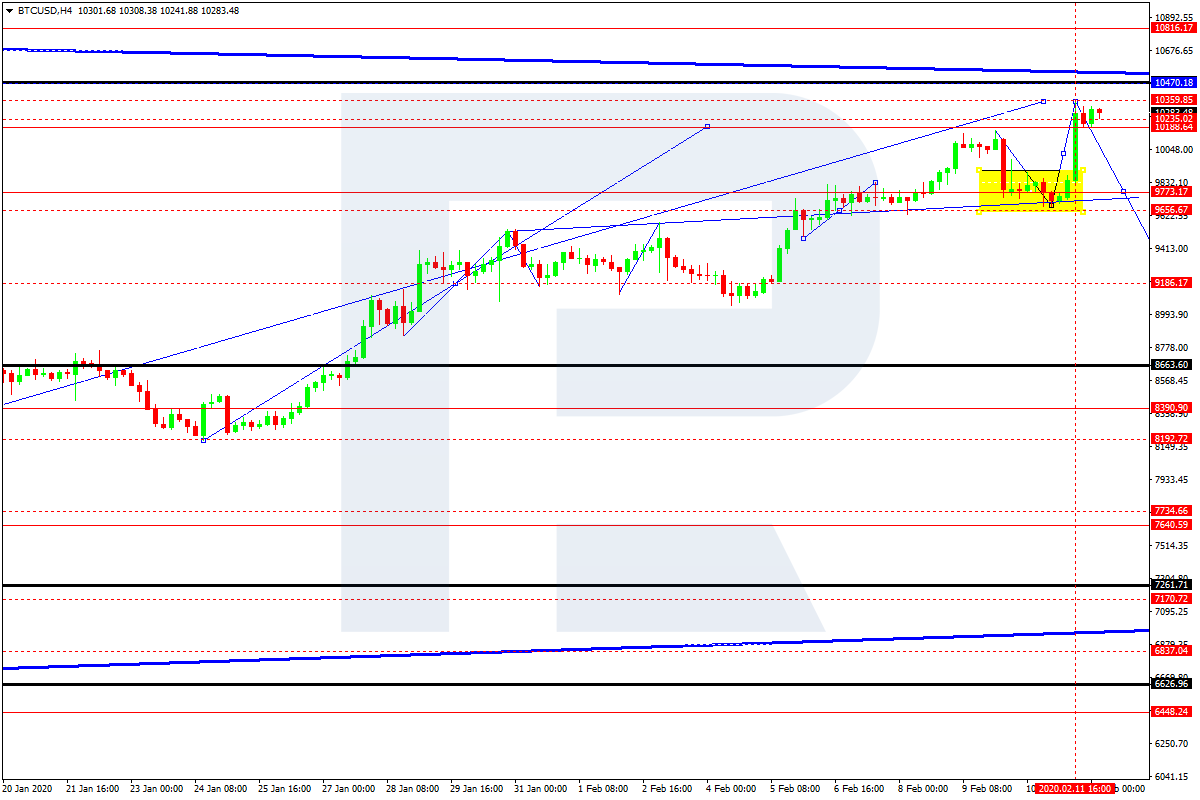
BTCUSD, “Bitcoin vs US Dollar”

BTCUSD has completed the ascending structure at 10300.00, thus almost reaching the short-term upside target; right now, it is consolidating close to the highs. According to the main scenario, the pair is expected to fall to break 9800.00 and continue the correction with the target at 8500.00, at least.

BITCOIN

Article By RoboForex.com

Attention!
Forecasts presented in this section only reflect the author’s private opinion and should not be considered as guidance for trading. RoboForex LP bears no responsibility for trading results based on trading recommendations described in these analytical reviews.

How Failed Int’l Cooperation Amplifies Virus Damage

By Dan Steinbock    

As the downgrades of the economic outlook for US, China and worldwide are about to begin, the virus outbreak may be steadying. Sadly, much of the economic, xenophobic and virus damage stems for lagging cooperation.

At the end of January, United States declared the 2019 novel coronavirus acute respiratory disease (nCoV ARD) an “unprecedented public health threat” followed by preparations “as if this were the next pandemic.” The unilateral action went against guidance by the World Health Organization (WHO).

Thanks to sensationalist media, the move also unleashed fear across America at the peak of the domestic flu season. Some 22 to 31 million Americans have already been infected with the seasonal flu, requiring up to 210,000 to 370,000 hospitalizations and causing 12,000 to 30,000 deaths, according to the CDC. As the Trump administration is preparing a $4.8 trillion budget with big safety-net cuts, it is focusing public attention on the virus outbreak.

Instead of a focus on the epidemiological facts, international headlines have focused on the expected “pandemic,” resulting in pressure campaigns against the WHO and an avalanche of xenophobic anti-Chinese incidents. The net effect will reverberate in downgraded economic outlooks in China, US and worldwide.

Here’s how it happened.

Rising number of cases, rapid outbreak deceleration

Even reputable media has contributed to misunderstandings. On February 4, New York Times reported: “Deaths in China Rise, With No Sign of Slowdown.” The first part of the sentence was true, but the second was misguided. In reality, the daily increase of new virus cases in China had just started to decelerate, while the pace of accumulated cases had been decelerating since mid-January.

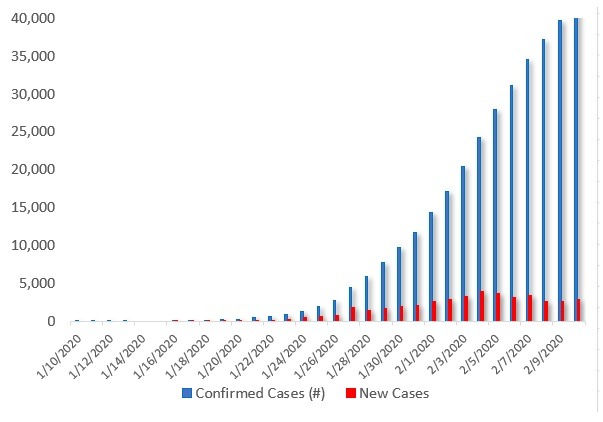
With the new coronavirus, there are now (2 pm Wuhan time, Feb 11) over 42,600 confirmed cases worldwide, while the number of deaths is more than 1,000. If the current pace prevails, the former figure will soon exceed 50,000, while the latter may climb to 2,000.

And yet, the number of the confirmed cases and deaths has remained relatively low – less than 500 and only 2, respectively – outside China. While these numbers will continue to increase, the low starting-point suggests that China’s costly and draconian measures may have saved many lives within and outside China.

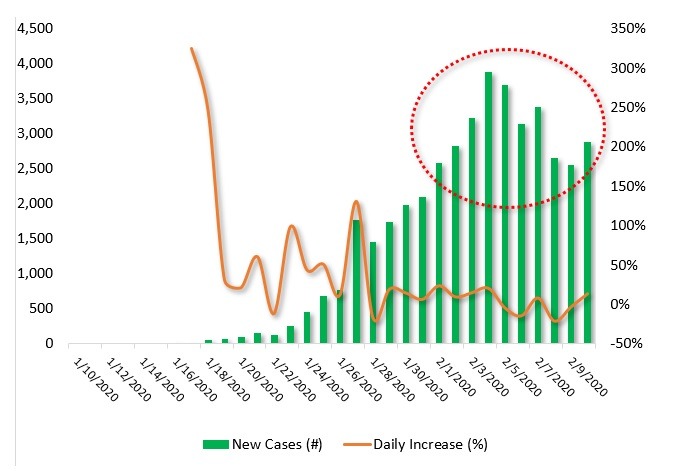
Moreover, the pace of the contagion is changing. The relative increase of the accumulated cases has decreased since mid-January. While the pace peaked at almost 100% after mid-January, it has declined to zero and below (Figure 1a). In turn, new cases increased steadily from mid-January soaring to almost 3,900 on February 4. But since then the numbers have fallen below 2,600 – from daily increase of almost 350% to zero and below (Figure 1b).

Figure Rising Accumulated Numbers, Falling Relative Rates

  • Daily Increase of Accumulated Cases, Jan 10 to Feb 9, 2020

  • Daily Increase of New Cases, Jan 10 to Feb 9, 2020

Source: DifferenceGroup. Data from China’s National Health Commission;

While the data could indicate a possible turnaround in the virus outbreak, there is no assurance that the deceleration will prevail. Since viruses can zigzag, these trends do not justify any complacency. And as the Lunar New Year holidays now end in China, new outbreak clusters are still possible, including outside China. But assuming current trends, we may be witnessing a crossroads – despite politicized international coverage.

Instead of virus outbreak, an ‘infodemic’

In late January, the World Health Organization (WHO) declared the outbreak a “public health emergency of international concern” (PHEIC) and urged attention to a global health emergency to foster a “coordinated international response.” The PHEIC was not motivated by China, but by the possible effects of the virus, if it would spread to countries with weaker healthcare systems. That’s why WHO has called for a $675 billion initiative to combat future virus outbreaks.

Instead, media hysteria contributed to ugly instances of xenophobia against people of Chinese and Asian descent. On February 2, the misinformation on global scale compelled the WHO to declare the coronavirus an “infodemic,” which “made it hard for people to find trustworthy sources and reliable guidance.”

Worse, WHO leaders were targeted in public pressure crusades, including an online petition campaign calling the WHO chief Tedros Adhanom Ghebreyesus to resign. In reality, Tedros, an Ethiopian public-health pioneer, has adhered to WHO guidelines regarding pandemics, supported research on virus causes and tried to foster member states’ cooperation against the outbreak.

The smear campaign is an ugly déjà vu. Amid the 2017 WHO election, Tedros was attacked for alleged cover-up of possible past cholera epidemics in Ethiopia. The odd allegations came from Lawrence Gostin, US law professor who advised the rival UK candidate (and has resurfaced as a critic of China’s anti-virus struggle). In the UN, the African Union dismissed the allegations as an “unfounded and unverified defamation campaign.” But now the same ugly campaign was back.

In contrast to Washington’s demands for WHO to declare the outbreak a “pandemic,” WHO has a six-stage pandemic classification, which requires a pandemic to be fatal, infectious and international. In the last pandemic, the 2009 H1N1 flu outbreak (swine flu), 150,000-300,000 people died around the world. The current outbreak has caused only two deaths outside China (both linked with Wuhan, the virus epicenter).

Oddly, as international coverage focused on China’s alleged conduct, which WHO mainly applauded, it ignored the actual conduct of other states, despite Tedros’s news bomb on February 4. It was not China, but countries outside China that had proved slow in sharing complete information about cases. Despite weeks of crisis and global health emergency, more than 60% of five member countries had failed to provide complete case reports to WHO.

As international cooperation lagged and precious time was lost, economic consequences have grown more severe.

Impact scenarios

After a month of the virus outbreak, three economic scenarios prevail. In the “SARS-like impact scenario,” a sharp quarterly effect, accounting for much of the damage, would be followed by a rebound. The broader impact would be relatively low and regional. The impact on annualized growth would be tolerable.

In China, the 1st quarter would be penalized by a 1.2% reduction to about 5% or less, while the 2nd quarter rebound would offset much (but not all) of the losses. U.S. growth could suffer a 0.4% slowdown of the annualized growth. In Japan, growth would fall closer to 0%. Due to supply chain disruptions, South Korea and Taiwan would take heavier hits. In Hong Kong, the outbreak will extend the technical recession into the 1st quarter. In Southeast Asia, downgrades would reduce growth closer to 4%. Annualized global growth would fall closer to 3.1%.

In the “extended impact scenario,” the adverse impact would last at least two quarters until early summer. In this case, the broader impact would be more severe and have an effect on global prospects, with rebound in the summer. The reductions in the US, China, and Japan would have a significant adverse impact in Asia and the global economy.

In the “accelerated impact scenario,” adverse damage would be far steeper, while a rebound would ensue only toward the end of the summer. The impact on annual growth would prove very significant, with dire repercussions in the global economy.

Today, consensus projections vary between the SARS-like and extended impact scenarios. If we are witnessing a sustained turnaround in new virus cases, there might be some reason for such hopes. Yet, international media coverage, pressures against WHO and lagging international cooperation indicate non-economic forces are fueling economic forecasts, while the risk of the extended impact scenario has increased. Finally, the accelerated impact scenario would undermine most of the post-2008 recovery with severe consequences to global prospects.

No virus outbreak will go by without adverse economic effects. But some of the impending damage could have been reduced with appropriate international cooperation.

About the Author:

Dr. Dan Steinbock is an internationally recognized strategist of the multipolar world and the founder of Difference Group. He has served at the India, China and America Institute (USA), Shanghai Institutes for International Studies (China) and the EU Center (Singapore). For more, see https://www.differencegroup.net

The original commentary was released by China-US Focus on Feb. 11, 2020


Fibonacci Retracements Analysis 12.02.2020 (GBPUSD, EURJPY)

Article By RoboForex.com

GBPUSD, “Great Britain Pound vs US Dollar”

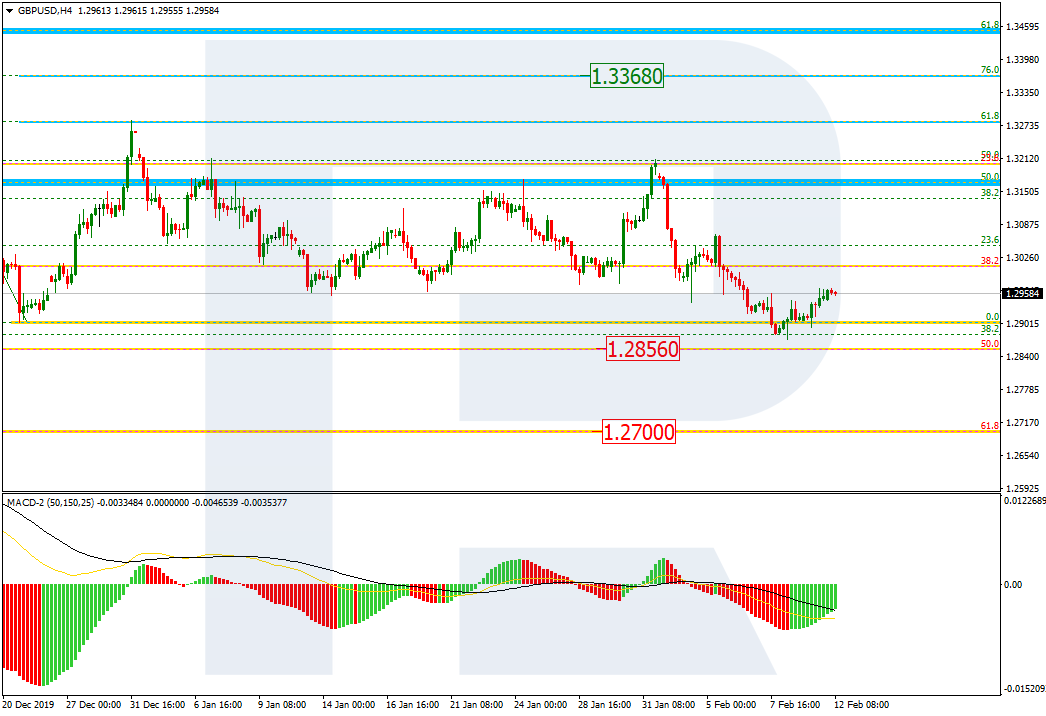
As we can see in the H4 chart, GBPUSD has tested the previous low, thus indicating that the price may continue falling towards 50.0% and 61.8% fibo at 1.2856 and 1.2700 respectively. in the nearest future, the instrument is expected to form a new correction to the upside.

GBPUSD_H4
Risk Warning: the result of previous trading operations do not guarantee the same results in the future

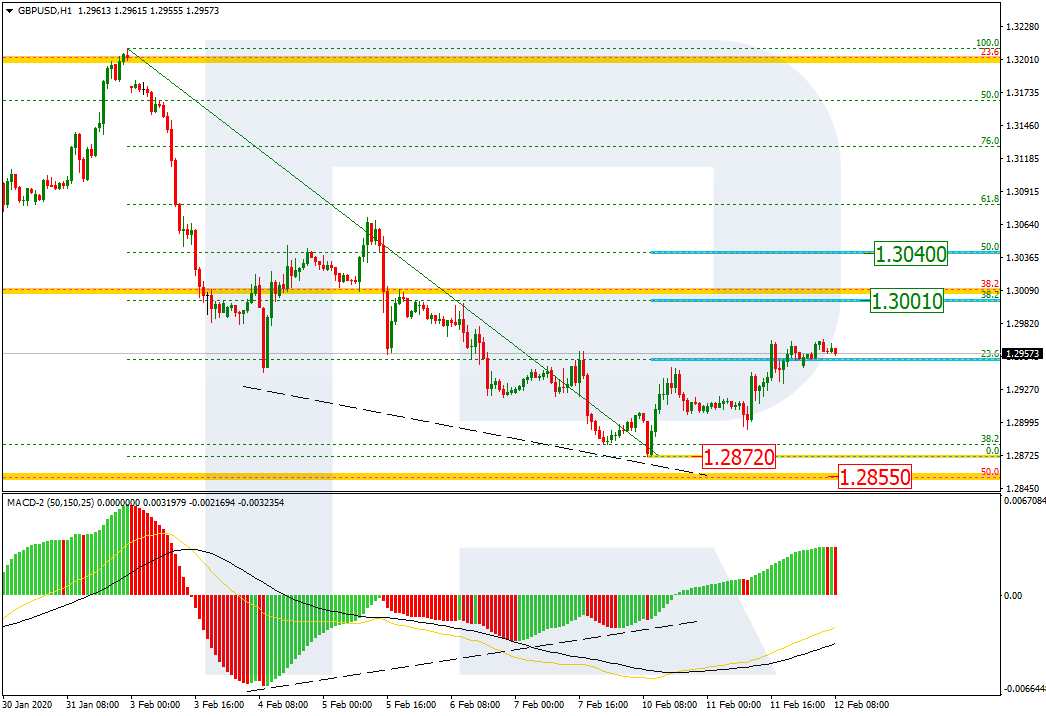
The H1 chart shows a rising correction after the convergence on MACD. By now, it has already reached 23.6% fibo and may continue growing towards 38.2% and 50.0% fibo at 1.3001 and 1.3040 respectively. The support is the low at 1.2872.

GBPUSD_H1
Risk Warning: the result of previous trading operations do not guarantee the same results in the future

EURJPY, “Euro vs. Japanese Yen”

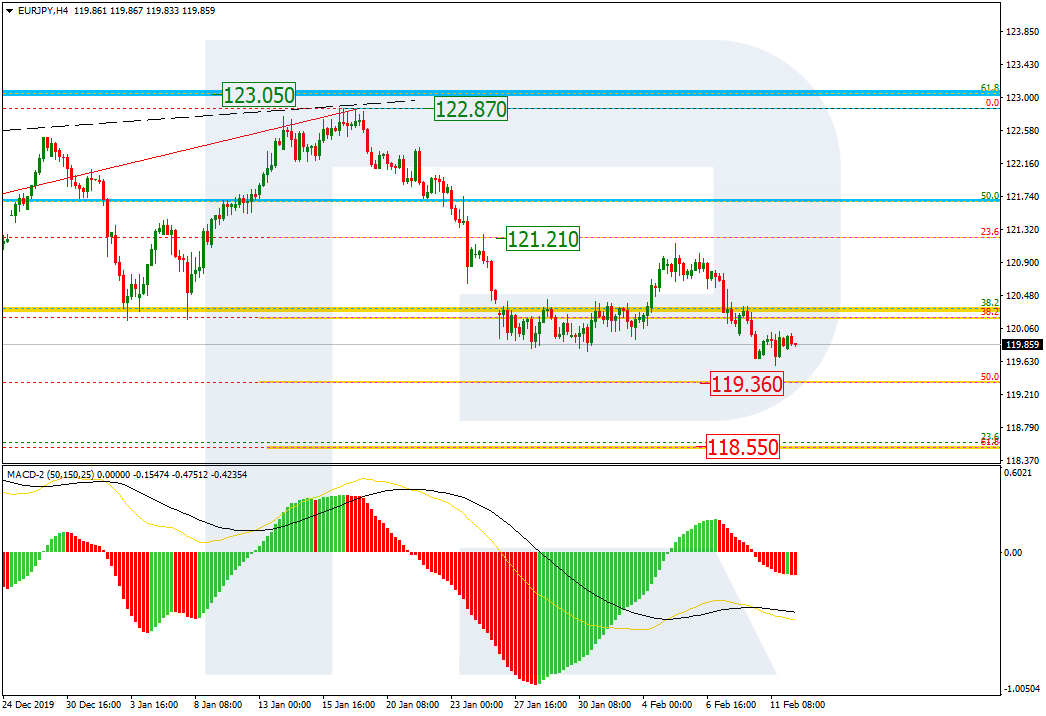
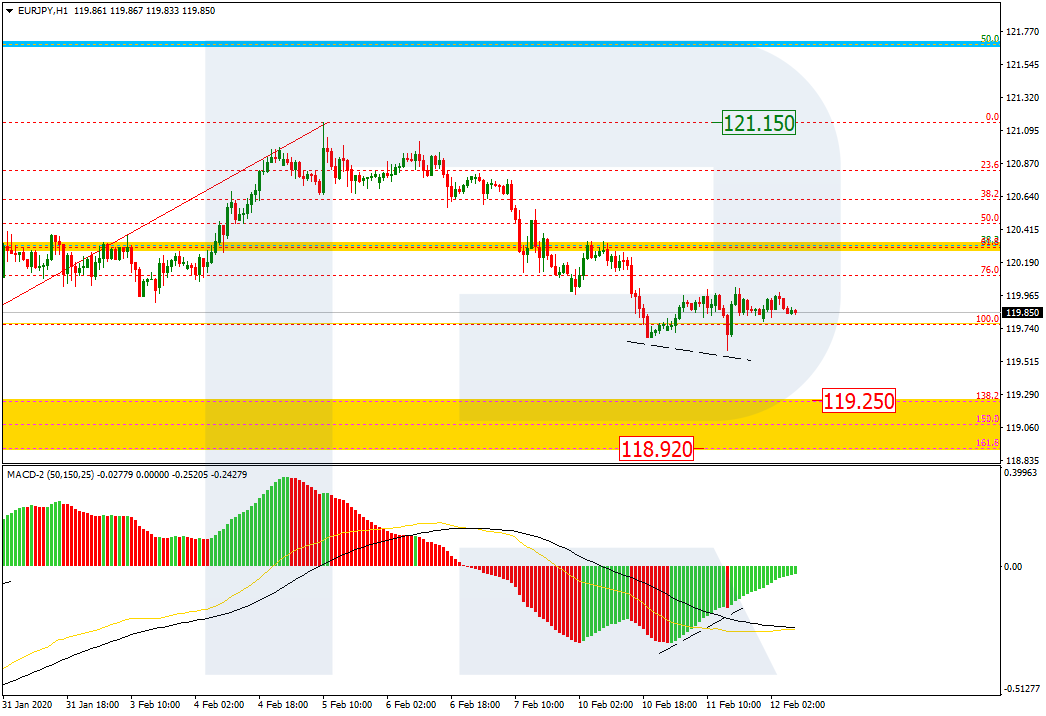
As we can see in the H4 chart, after finishing a pullback towards the resistance at 121.21, EURJPY is forming a new descending impulse, which has already updated the low. Later, the current decline may continue towards 50.0% and 61.8% fibo at 119.36 and 118.55 respectively.

EURJPY_H4
Risk Warning: the result of previous trading operations do not guarantee the same results in the future

The H1 chart shows a new correction to the upside after the convergence on MACD. After finishing the correction, the instrument may resume falling to reach the post-correctional extension area between 138.2% and 161.8% fibo at 191.25 and 118.92 respectively.

EURJPY_H1

Article By RoboForex.com

Attention!
Forecasts presented in this section only reflect the author’s private opinion and should not be considered as guidance for trading. RoboForex LP bears no responsibility for trading results based on trading recommendations described in these analytical reviews.

Investors Assess the Speech by Fed Chairman. The Reserve Bank of New Zealand Kept Interest Rate Unchanged

by JustForex

The US dollar has become stable against major competitors. The dollar index (#DX) closed yesterday’s trading session with a slight decrease (-0.18%). However, the demand for US currency remains at a fairly high level. Financial market participants assess the speech by Fed Chairman Jerome Powell for Congress. The official believes the economy is strong. He also noted that the Chinese coronavirus might have some influence on the United States, but it is too early to talk about it. The Central Bank monitors risks, but now the monetary policy is in line with the current situation.

The British pound has been growing after the publication of positive economic data from the UK. So, GDP (YoY) grew by 1.1% in the 4th quarter, which turned out to be better than the forecasted growth by 0.8%. GDP (m/m) grew by 0.3% instead of 0.2%. Manufacturing production (m/m) grew by 0.3 in December, although experts expected an increase by 0.5%.

Today, the Reserve Bank of New Zealand has decided on the interest rate during the Asian trading session. The indicator remained unchanged at 1.00%.

The “black gold” prices are rising. Currently, futures for the WTI crude oil are testing the $50.60 mark per barrel. At 17:30 (GMT+2:00), crude oil inventories will be published.

Market Indicators

Major US stock indices have updated historic highs again: #SPY (+0.17%), #DIA (+0.00%), #QQQ (+0.02%).

The 10-year US government bonds yield increased slightly. At the moment, the indicator is at the level of 1.62-1.63%.

The Economic News Feed for 12.02.2020:
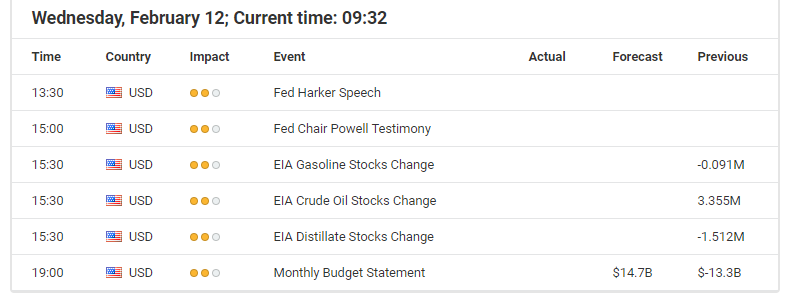
  • We recommend paying attention to the speech by Fed Chairman Powell.

by JustForex

The Analytical Overview of the Main Currency Pairs on 2020.02.12

by JustForex

The EUR/USD currency pair

Technical indicators of the currency pair:
  • Prev Open: 1.09107
  • Open: 1.09152
  • % chg. over the last day: +0.08
  • Day’s range: 1.09052 – 1.09209
  • 52 wk range: 1.0879 – 1.1572

The EUR/USD currency pair has become stable after a prolonged fall. At the moment, the trading instrument is consolidating near the round level of 1.09000. The 1.09400 mark is the key resistance. In the near future, a technical correction of EUR/USD quotes is not ruled out. The Fed Chairman said that he expected continued purchases of treasury securities by his department in the second quarter of 2020. Jerome Powell believes that it is too early to draw conclusions about the effects of coronavirus on the US economy. We recommend opening positions from key levels.

Today, the news feed is calm enough.

EUR/USD

Indicators signal the power of sellers: the price has fixed below 50 MA and 100 MA.

The MACD histogram is in the negative zone, indicating the bearish sentiment.

Stochastic Oscillator is in the oversold zone, the %K line is below the %D line, which gives a weak signal to sell EUR/USD.

Trading recommendations
  • Support levels: 1.09000, 1.08700
  • Resistance levels: 1.09400, 1.09700, 1.09900

If the price fixes below the round level of 1.09000, a further drop in the EUR/USD quotes is expected. The movement is tending to 1.08700-1.08500.

An alternative could be the growth of the EUR/USD currency pair to 1.09700-1.09900.

The GBP/USD currency pair

Technical indicators of the currency pair:
  • Prev Open: 1.29148
  • Open: 1.29518
  • % chg. over the last day: +0.32
  • Day’s range: 1.29484 – 1.29689
  • 52 wk range: 1.1959 – 1.3516

GBP/USD quotes are recovering. A trading instrument has reached local highs. Yesterday, Great Britain published a series of optimistic economic releases, which supports sterling. At the moment, the GBP/USD currency pair is consolidating in the range of 1.29200-1.2970. The technical pattern signals a further correction of the pound against the US dollar. Positions should be opened from key levels.

The news feed on the UK economy is fairly calm.

GBP/USD

Indicators do not give accurate signals: 50 MA has crossed 100 MA.

The MACD histogram has moved into the positive zone, indicating the bullish sentiment.

Stochastic Oscillator is in the neutral zone, the %K line is below the %D line, which gives a signal to sell GBP/USD.

Trading recommendations
  • Support levels: 1.29200, 1.28750, 1.28400
  • Resistance levels: 1.29700, 1.30100, 1.30450

If the price fixes above 1.29700, further growth of GBP/USD quotes is expected. The movement is tending to 1.30100-1.30400.

An alternative could be a decrease in the GBP/USD currency pair to 1.28800-1.28600.

The USD/CAD currency pair

Technical indicators of the currency pair:
  • Prev Open: 1.33168
  • Open: 1.32870
  • % chg. over the last day: -0.19
  • Day’s range: 1.32774 – 1.32958
  • 52 wk range: 1.2949 – 1.3566

The USD/CAD currency pair has been declining after a prolonged consolidation. Quotes have updated local lows. At the moment, the following key support and resistance levels can be identified: 1.32650 and 1.33000, respectively. Loonie has the potential for further growth. The recovery of oil quotes supports the Canadian dollar. Positions should be opened from key levels.

The publication of important economic releases from Canada is not planned.

USD/CAD

Indicators do not give accurate signals: 50 MA has crossed 100 MA.

The MACD histogram is in the negative zone, indicating the bearish sentiment.

Stochastic Oscillator is in the neutral zone, the %K line has crossed the %D line. There are no signals at the moment.

Trading recommendations
  • Support levels: 1.32650, 1.32450, 1.32200
  • Resistance levels: 1.33000, 1.33250

If the price fixes below 1.32650, USD/CAD quotes are expected to correct. The movement is tending to 1.32450-1.32200.

An alternative could be the growth of the USD/CAD currency pair to 1.33200-1.33400.

The USD/JPY currency pair

Technical indicators of the currency pair:
  • Prev Open: 109.746
  • Open: 109.783
  • % chg. over the last day: +0.01
  • Day’s range: 109.766 – 109.923
  • 52 wk range: 104.45 – 113.53

The USD/JPY currency pair is being traded in a flat. There is no defined trend. The local support and resistance levels are 109.700 and 110.000, respectively. In the near future, technical correction of the trading instrument is not ruled out. Investors continue to assess the risks of further spread of the epidemic from China. We recommend paying attention to the dynamics of US government bonds yield. Positions should be opened from key levels.

The news feed on Japan’s economy is calm.

USD/JPY

Indicators do not give accurate signals: 50 MA has crossed 100 MA.

The MACD histogram is near the 0 mark. There are no signals at the moment.

Stochastic Oscillator is in the neutral zone, the %K line has crossed the %D line. There are no signals at the moment.

Trading recommendations
  • Support levels: 109.700, 109.550, 109.300
  • Resistance levels: 110.000, 110.250

If the price fixes above 110,000, further growth of USD/JPY quotes is expected. The movement is tending to 110.250-110.400.

An alternative could be a decrease in the USD/JPY currency pair to 109.400-109.200.

by JustForex

Gold ignores solid NFP’s – will Powell’s testimony level the path up to 1,600?

By Admiral Markets

Source: Economic Events February 12, 2020 – Admiral Markets’ Forex Calendar

The outlook for Gold took a very positive turn in reaction to the solid Non-Farm Payrolls dataset last Friday.

The NFP’s increased by 225,000 in January, following an upwardly revised 147,000 rise in the previous month and beating market expectations of 160,000.

Still, expectations of market participants that the Fed will cut rates minimum once by 25 basis points in 2020 are still seen with a likelihood of around 80% (according to the Fed Watch Tool).

In addition to that, the focus in 10-year US Treasury yields is again at a technically important level of 1.50%, as a break lower having serious potential for an acceleration and dynamic move lower in US yields, favouring gains in Gold.

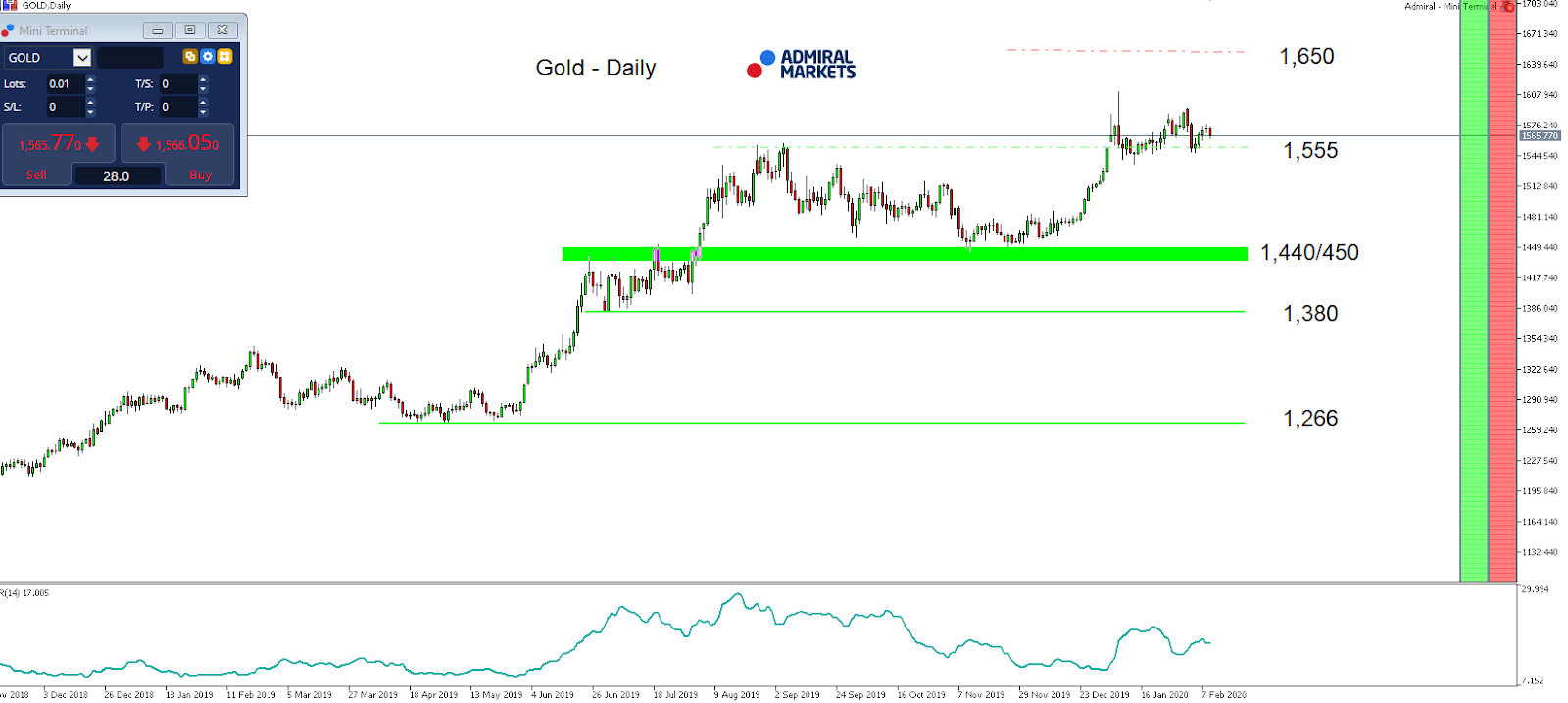
Technically, Gold saw strong demand against the region around 1,555 USD, the region of the 2019 yearly highs, thus helping the yellow metal to substantially trade above the daily trend-support around 1,440/450 USD.

With today’s semi-annual testimony before Congress, Fed chairman Powell and his remarks should be closely monitored. While chances seem low that Powell will massively deviate from the Fed statement which was provided two weeks ago, any hints towards an extension of the loose monetary policy and the Fed continuing to deliver massive monetary stimulus in regards to a potential liquidity drain in the Repo market could trigger bullish momentum in Gold again.

And even a drop back below 1,550 USD would only be short-term bearish, activating the region around 1,510/515 USD as potential long-trigger and keeping the potential next target on the upside around 1,650/700 USD active:

Source: Admiral Markets MT5 with MT5-SE Add-on Gold Daily chart (between November 9, 2018, to February 11, 2020). Accessed: February 11, 2020, at 10:00pm GMT – Please note: Past performance is not a reliable indicator of future results, or future performance.

In 2015, the value of Gold fell by 10.4%, in 2016, it increased by 8.1%, in 2017, it increased by 13.1%, in 2018, it fell by 1.6%, in 2019, it increased by 18.9%, meaning that after five years, it was up by 28%.

Discover the world’s #1 multi-asset platform

Admiral Markets offers professional traders the ability to trade with a custom, upgraded version of MetaTrader 5, allowing you to experience trading at a significantly higher, more rewarding level. Experience benefits such as the addition of the Market Heat Map, so you can compare various currency pairs to see which ones might be lucrative investments, access real-time trading data, and so much more. Click the banner below to start your FREE download of MT5 Supreme Edition!

Download MetaTrader 5 and begin trading today!

Disclaimer: The given data provides additional information regarding all analysis, estimates, prognosis, forecasts or other similar assessments or information (hereinafter “Analysis”) published on the website of Admiral Markets. Before making any investment decisions please pay close attention to the following:

  1. This is a marketing communication. The analysis is published for informative purposes only and are in no way to be construed as investment advice or recommendation. It has not been prepared in accordance with legal requirements designed to promote the independence of investment research, and that it is not subject to any prohibition on dealing ahead of the dissemination of investment research.
  2. Any investment decision is made by each client alone whereas Admiral Markets shall not be responsible for any loss or damage arising from any such decision, whether or not based on the Analysis.
  3. Each of the Analysis is prepared by an independent analyst (Jens Klatt, Professional Trader and Analyst, hereinafter “Author”) based on the Author’s personal estimations.
  4. To ensure that the interests of the clients would be protected and objectivity of the Analysis would not be damaged Admiral Markets has established relevant internal procedures for prevention and management of conflicts of interest.
  5. Whilst every reasonable effort is taken to ensure that all sources of the Analysis are reliable and that all information is presented, as much as possible, in an understandable, timely, precise and complete manner, Admiral Markets does not guarantee the accuracy or completeness of any information contained within the Analysis. The presented figures refer that refer to any past performance is not a reliable indicator of future results.
  6. The contents of the Analysis should not be construed as an express or implied promise, guarantee or implication by Admiral Markets that the client shall profit from the strategies therein or that losses in connection therewith may or shall be limited.
  7. Any kind of previous or modeled performance of financial instruments indicated within the Publication should not be construed as an express or implied promise, guarantee or implication by Admiral Markets for any future performance. The value of the financial instrument may both increase and decrease and the preservation of the asset value is not guaranteed.
  8. The projections included in the Analysis may be subject to additional fees, taxes or other charges, depending on the subject of the Publication. The price list applicable to the services provided by Admiral Markets is publicly available from the website of Admiral Markets.
  9. Leveraged products (including contracts for difference) are speculative in nature and may result in losses or profit. Before you start trading, you should make sure that you understand all the risks.

By Admiral Markets

How and When to Enter Day Trades & Swing Trade For Maximum Gains

By TheTechnicalTradersAnother interesting session for stocks and commodities and it allows me to share a day trading secret with you as well. This secret not only is a gold mine for day traders but it also helps with timing your entry and exits as a swing trader.

Today stocks opened lower and during pre-market hours it was looking really bearish, but once the 9:30 opening bell rang buyers flooded the market and drove the prices higher all session forming the typical intraday price action that happens during strong trending days.

I did a video on this year ago which I’ll share the link but take a look at today’s intraday price action, then watch this video as its a day traders DREAM – FREE MONEY!

TODAYS SP500 INDEX CHART:

NORMAL INTRADAY PRICE TENDS DURING STRONG MARKETS


Join my Swing Trading ETF Wealth Building Newsletter if you like what you read here and ride my coattails as I navigate these financial markets and build wealth while others lose nearly everything they own.

Chris Vermeulen
TheTechnicalTraders.com

NOTICE: Our free research does not constitute a trade recommendation or solicitation for our readers to take any action regarding this research.  It is provided for educational purposes only.  Our research team produces these research articles to share information with our followers/readers in an effort to try to keep you well informed.  Visit our web site (www.thetechnicaltraders.com) to learn how to take advantage of our members-only research and trading signals.


2020 – A Close Look At What To Expect

By TheTechnicalTraders.com

Quite a bit has changed in the global markets and future expectations over the past 4+ weeks.  Q4 2019 ended with a bang.  US/China Trade Deal, US signing the USMCA Continental Free Trade Agreement, BREXIT and now the Wuhan Virus.  On top of all of that, we’ve learned that Germany and Japan have entered a technical recession.  As Q4-2019 earnings continue to push the US stock market higher – what should traders expect going forward in 2020?

Volatility, Sector Rotation, and Continued US Stock Market Strength.

Our researchers have been pouring over our charts and predictive modeling tools to attempt to identify any signs of weakness or major price rotation.  There are early warning signs that the US Stock Market may be setting up for a moderate downside price rotation within the first 6 months of 2020, but we believe the continued Capital Shift that has been taking place over the past 24+ months will continue to drive foreign investment into the US and North American stock markets for quite a while in 2020 and 2021.

The interesting component to all of this, which should keep investor’s attention and really get them excited, is the chance that some type of foreign market disruption may take place in 2020 and 2021.  There are a number of things that could potentially disrupt foreign market expectations.

First on the list is this virus event in China (that seems to be spreading rapidly).  Second would be the news that Japan and Germany have entered a recession.  Further down the list is the very real possibility that many Asian and foreign nations could see a dramatic decrease in GDP and economic activity throughout much of 2020 and 2021.

It is far too early to make any real predictions, but traders need to be aware of the longer-term consequences of global markets entering a contraction phase related to a confluence of events that prompts central bank intervention while consumers, financial sectors and manufacturing and industrial sectors are pummeled.  Imagine what the global markets would look like if 25% to 55% of Asia, Europe, and Africa see a dramatic decrease in economic output, GDP and financial sector activities (on top of the potential for massive loan defaults).  It may spark another Credit Crisis Event – this time throughout the Emerging and Foreign markets.

A massive surge in US stock market valuation has taken place since the start of 2020.  It is very likely that foreign capital poured into the US stock market expecting continued price advancement and very strong earnings from Q4 2019.  This valuation appreciation really started to take place in early 2019 and continued throughout the past 14+ months.  We believe this valuation appreciation is foreign capital dumping into the US markets to chasing the strong US economic expectations.

We believe this surge into the US stock markets will continue until something changes future expectations.  The US Presidential election cycle would usually be enough to cause some sideways trading in the US stock market – maybe not this time.

The fact that Japan and Germany, as well as China very soon, have entered an economic recession would usually be enough to cause some sideways price rotation in the US stock market – maybe not this time.  The potential wide-spread economic contraction related to the Wuhan virus would normally be enough to cause some contraction or sideways trading in the US stock market – maybe not this time.

There is still a risk that price could revert to middle or lower price channel levels at any time in the future.  We’ve highlighted these levels on the charts below.  Yet, we have to caution traders that the foreign markets may be setting up for one of the largest capital shift events in recent history.  If any of these contagion events roil the foreign markets while the US economic activity and data continue to perform well, then we could be setting up for a massive shift away from risky foreign markets/emerging markets and watch global capital pour into Safe-Havens (metals/miners) and pour into the US stock market (US, Canada, Mexico).

We’ve authored numerous articles about how the foreign markets gorged themselves on debt after 2009 while easy money policies allowed them to borrow US dollars very cheaply.  We’ve highlighted how this debt is now hanging over these corporations, manufacturers and investors heads as a liability.  The recent REPO market activity suggests liquidity risks already exist in the global markets.  If these liquidity issues extend further, we could see a much broader market rotation within the US and foreign markets.

Dow Jones Industrial Average – Quarterly Chart

Currently, the US stock market appears to be near the upper range of a defined price channel.  Near these levels, it is not uncommon to see some downside price rotation to set up a new price advance within the price channels.  This INDU chart highlights the extended price channel trend, originating from 2008, and the more recent price channel (yellow) originating from 2015.  Any breakdown of these channels could prompt a much broader downside price move.

S&P 500 – Quarterly Chart

This SPY chart highlights the extended upside price trend in the US stock markets.  The SPY has recently breached the upper price channel level.  It may be setting up a new faster price channel, yet we believe this rally in early Q1 2020 is more of a reaction to the very strong 2019 US economic data and the continued capital shift pouring capital into the US markets.  A correction from these levels to near $275 would not be out of the question.

Transportation Sector – Quarterly Chart

This Transportation Index (TRAN) chart presents a very clear price channel and shows a moderate weakness recently in this sector.  The fact that the TRAN has consolidated into a middle range of the price channel while the other US stock market indexes continue to push higher suggests the valuation advance in the US stock market is mostly “capital chasing strength of the US economy” than a true economic expansion event.

2020 will likely continue to see more volatility, more price rotation, more US stock market strength and further risks of a reversion event.  We believe forward guidance for Q1 and Q2 will be revised lower as a result of these new global economic conditions originating from Asia, Europe, and Japan.

If the virus event spreads into Africa and the Middle East (think Belt-Road), then we could see a much broader correction event.  In the meantime, prepare for weaker future earnings related to the shut down of industry and consumer sectors throughout much of Asia.

If this “shut down” type of quarantining process extends throughout other areas of the world, then we need to start to expect a much broader economic contraction event.  Minor events can be absorbed by the broader markets.  Major events where global economies contract for many months or quarters can present a very dangerous event for investors.

Overall, we may see another 20 to 40+ days of “sliding higher” in the US stock market before we see any real risks become present for investors.  This means you should start preparing for any potential unknowns right now.  Plan accordingly as this event will likely result in a sudden and potentially violent change in price trend.

Join my Swing Trading ETF Wealth Building Newsletter if you like what you read here and ride my coattails as I navigate these financial markets and build wealth while others lose nearly everything they own.

Chris Vermeulen
TheTechnicalTraders.com

NOTICE: Our free research does not constitute a trade recommendation or solicitation for our readers to take any action regarding this research.  It is provided for educational purposes only.  Our research team produces these research articles to share information with our followers/readers in an effort to try to keep you well informed.  Visit our web site (www.thetechnicaltraders.com) to learn how to take advantage of our members-only research and trading signals.


Ichimoku Cloud Analysis 11.02.2020 (AUDUSD, NZDUSD, USDCAD)

Article By RoboForex.com

AUDUSD, “Australian Dollar vs US Dollar”

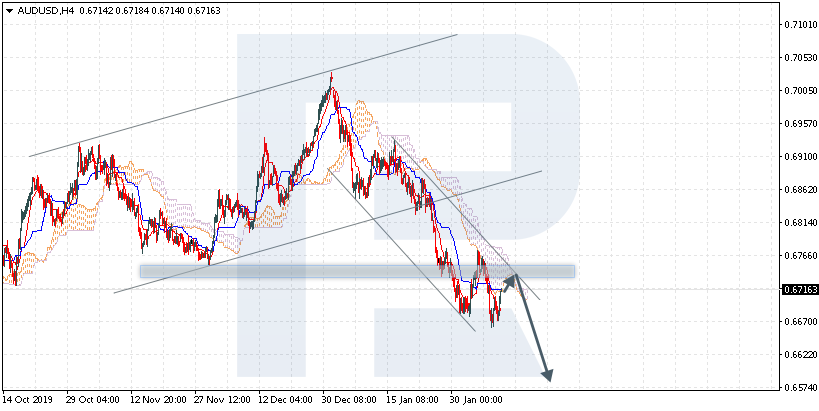
AUDUSD is trading at 0.6716; the instrument is moving below Ichimoku Cloud, thus indicating a descending tendency. The markets could indicate that the price may test the cloud’s downside border at 0.6720 and then resume moving downwards to reach 0.6555. Another signal to confirm further descending movement is the price’s rebounding from the descending channel’s upside border. However, the scenario that implies further decline may be canceled if the price breaks the cloud’s upside border and fixes above 0.6775. In this case, the pair may continue growing towards 0.6845. After breaking the support area and fixing below 0.6655, the price may resume moving downwards. As we can see in the daily chart, the instrument is rebounding from this level for the fourth time.

AUDUSD
Risk Warning: the result of previous trading operations do not guarantee the same results in the future

NZDUSD, “New Zealand Dollar vs US Dollar”

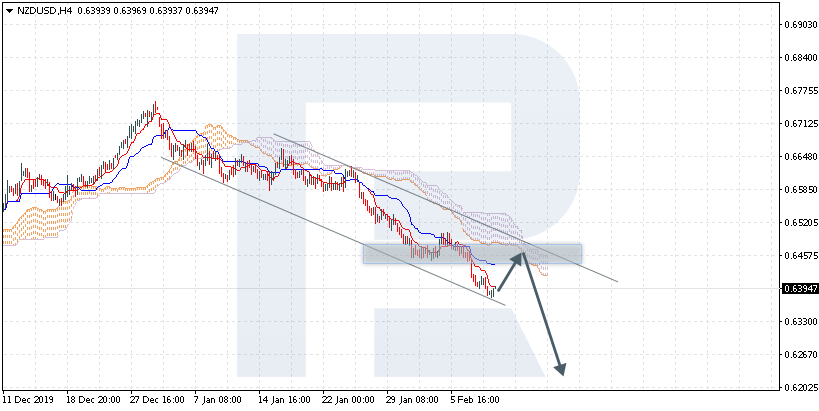
NZDUSD is trading at 0.6394; the instrument is moving below Ichimoku Cloud, thus indicating a descending tendency. The markets could indicate that the price may test the cloud’s downside border at 0.6455 and then resume moving downwards to reach 0.6245. Another signal to confirm further descending movement is the price’s rebounding from the descending channel’s upside border. However, the scenario that implies further decline may be canceled if the price breaks the cloud’s upside border and fixes above 0.6520. In this case, the pair may continue growing towards 0.6605.

NZDUSD
Risk Warning: the result of previous trading operations do not guarantee the same results in the future

USDCAD, “US Dollar vs Canadian Dollar”

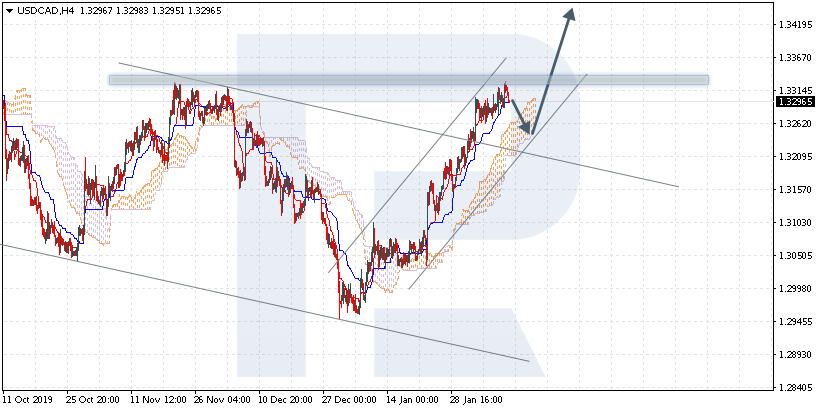
USDCAD is trading at 1.3296; the instrument is moving above Ichimoku Cloud, thus indicating an ascending tendency. The markets could indicate that the price may test the cloud’s downside border at 1.3255 and then resume moving upwards to reach 1.3445. Another signal to confirm further ascending movement is the price’s rebounding from the rising channel’s downside border. However, the scenario that implies further growth may be canceled if the price breaks the cloud’s downside border and fixes below 1.3195. In this case, the pair may continue falling towards 1.3105 and form Inverted Head & Shoulders pattern and completed its right Shoulder at 1.3050. Still, if the instrument breaks 1.3365, pattern will be no longer valid and the price may resume moving upwards.

USDCAD

Article By RoboForex.com

Attention!
Forecasts presented in this section only reflect the author’s private opinion and should not be considered as guidance for trading. RoboForex LP bears no responsibility for trading results based on trading recommendations described in these analytical reviews.