Author Archive for InvestMacro – Page 83

The Analytical Overview of the Main Currency Pairs on 2020.03.04

by JustForex

The EUR/USD currency pair

Technical indicators of the currency pair:
  • Prev Open: 1.11305
  • Open: 1.11711
  • % chg. over the last day: +0.38
  • Day’s range: 1.11434 – 1.11853
  • 52 wk range: 1.0879 – 1.1572

USD shows a steady downward trend against the basket of world currencies. Yesterday the Fed surprised investors by reducing the key interest rate range by 50 basis points to 1.00%-1.25%, two weeks before the scheduled policy meeting. Head of the Central Bank Powell said that the U.S. economy remains stable, but the virus COVID-19 brought new risks and problems. Currently, EUR/USD quotes are consolidating in the range of 1.11100-1.11850. We expect important economic reports from EU and the USA. Open positions from the key levels.

The Economic News Feed for 04.03.2020:

  • – Business Activity Indicators (EU) – 11:00 (GMT+2:00);
  • – ADP Nonfarm Employment Change (US) – 15:15 (GMT+2:00);
  • – ISM Non-Manufacturing PMI (US) – 17:00 (GMT+2:00);
EUR/USD

The indicators signal the power of buyers: the price has fixed above 50 MA and 100 MA.

MACD histogram is in the positive zone, which gives a signal to buy EUR/USD.

The Stochastic Oscillator is located in the oversold area, the %K line crossed the %D line. There are no signals at the moment.

Trading recommendations
  • Support levels: 1.11100, 1.10500, 1.10000
  • Resistance levels: 1.11850, 1.12200, 1.12500

If the price fixes above 1.11850, expect further growth toward 1.12200-1.12500.

Alternatively, the quotes could decline toward 1.10600-1.10400.

The GBP/USD currency pair

Technical indicators of the currency pair:
  • Prev Open: 1.27509
  • Open: 1.28117
  • % chg. over the last day: +0.54
  • Day’s range: 1.28011 – 1.28303
  • 52 wk range: 1.1959 – 1.3516

The technical pattern on GBP/USD currency pair is still ambiguous. GBP is being traded in a flat with a fairly wide range. Financial markets participants are waiting for additional drivers. At the moment local support and resistance levels are at 1.27850 and 1.28400, respectively. Today investors will evaluate important economic reports from UK and US. Open positions from the key levels.

At 11:30 (GMT+2:00) the UK will publish a number of indicators on business activity.

GBP/USD

Indicators do not give accurate signals: the price has fixed between 50 MA and 100 MA.

The MACD histogram is in the positive zone, but below the signal line, which gives a weak signal to buy GBP/USD.

The Stochastic Oscillator has reached the oversold zone, the %K line started crossing the %D line. There are no signals at the moment.

Trading recommendations
  • Support levels: 1.27850, 1.27400, 1.27000
  • Resistance levels: 1.28400, 1.29000

If the price fixes below the support level at 1.27850, expect the quotes to fall toward 1.27400-1.27000.

Alternatively, the quotes could grow toward 1.29000.

The USD/CAD currency pair

Technical indicators of the currency pair:
  • Prev Open: 1.33288
  • Open: 1.33829
  • % chg. over the last day: +0.40
  • Day’s range: 1.33447 – 1.33871
  • 52 wk range: 1.2949 – 1.3566

USD/CAD currency pair is being traded in a flat. There is no defined trend. The CAD is testing key support and resistance levels at 1.33200 and 1.33900, respectively. We do not rule out further correction of the trading instrument. Investors took a waiting position before the Bank of Canada meeting. We also recommend paying attention to the dynamics of oil quotations. Open positions from the key levels.

At 17:00 (GMT+2:00) Bank of Canada will announce its decision on the key interest rate.

USD/CAD

Indicators do not give accurate signals: the price has crossed 50 MA and 100 MA.

MACD histogram is near the 0 mark.

The Stochastic Oscillator is located in the neutral zone, the %K line is above the %D line, which indicates a bullish mood.

Trading recommendations
  • Support levels: 1.33200, 1.32650, 1.32150
  • Resistance levels: 1.33900, 1.34600

If the price fixes below 1.33200, expect further correction toward 1.32700-1.32400.

Alternatively, the quotes could grow toward 1.34300-1.34600.

The USD/JPY currency pair

Technical indicators of the currency pair:
  • Prev Open: 108.316
  • Open: 107.120
  • % chg. over the last day: -1.14
  • Day’s range: 106.847 – 107.688
  • 52 wk range: 104.45 – 113.53

USD/JPY quotes continue to show negative trends. Yen added more than 120 points in price against the US dollar yesterday. The trading instrument found support near the round level of 107.000. The mark 107.800 is the nearest resistance. Demand for safe haven currencies remains at a high level. We recommend keeping track of the current information regarding the coronavirus spread. Open positions from key levels.

The Economic News Feed for 04.03.2020 is calm.

USD/JPY

The indicators signal the sellers’ power: the price has fixed below 50 MA and 100 MA.

The MACD histogram is in the negative zone, but above the signal line, which gives a weak signal to sell USD/JPY.

The Stochastic Oscillator is in the neutral zone, the %K line has crossed the %D line. There are no signals at the moment.

Trading recommendations
  • Support levels: 107.000
  • Resistance levels: 107.800, 108.550, 109.300

If the price fixes below the round level of 107.000, USD/JPY quotes are expected to fall further. Potential for movement to 106.600-106.300.

Alternative is the correction of USD/JPY currency pair to 108.500-109.000.

by JustForex

The Hottest Tech Sector Of 2020: Interview With Sayan Navaratnam

By OilPrice.com – Uber transformed transportation when it spent a fortune turning ride-sharing into a mainstream mode of transportation. But the 2.0 version of ride-sharing is where the real disruption begins. It fixes everything that’s wrong and latches onto a mega-trend the giants shouldn’t have ignored: ethical investing. This is where drivers get a boost, riders get a choice, and CO2 goes neutral.

In an exclusive interview with Oilprice.com, Facedrive CEO Sayan Navaratnam discusses:

• What Uber got wrong
• What Facedrive got right
• What the new ride-sharing model looks like
• How green ride-sharing can please everyone
• And why we should really be paying attention to millennials on this growth runway

OP: The ridesharing space has exploded over recent years. How much more growth is left in the market?

SAYAN NAVARATNAM: There is a ton of mileage left on this growth runway for a very important reason: Millennials, and the younger generations in general, are increasingly opting out of car ownership. That’s the future. It’s a future of mobility without car payments, without parking payments, and without hassle. And it’s all being boosted further by rising vehicle prices and increasing fuel prices.

There are a lot of numbers out there for growth, and they’re all good. Market Research Future forecasts 20% growth for 2018-2023 … and we’re still in the early stages of adoption in many places.

Take Toronto, for example. Compared to other North American cities, Toronto is behind, but it’s seen consistent growth. And trends in rideshare growth suggest the market is not saturated and that growth will continue for the foreseeable future.

This was just ‘Ride-Share 1.0’. ‘Ride-Share 2.0’ will blow that away because it picks up on things that the first round didn’t while it was testing the market for a brand new idea.

OP: You are being called the climate friendly Uber and the ridesharing app for the environmentally conscious – how did the idea come about? And why do you think the industry is primed for disruption?

SAYAN NAVARATNAM: Listen, we’re all about grabbing onto the biggest trends in tech before they’re mega-trends. So that takes us back to 2016, when we first came up with the idea. Whenever a major new trend emerges, it’s the job of the truly innovative to step back and say ‘OK, this is an explosively great idea – so what’s wrong with it?’ When you figure that out, and you’ve got the right network and the right people behind you, you can jump in on one of the biggest trends and disrupt a massive market at exactly the right time.

We saw what was wrong, and what was wrong was that this great idea emerged pretty much at the same time as environmentally friendly investing began to become more than just a passing fad.

No one really saw it at the time, but the past 12 months have solidified it, and Facedrive got out in front of it a couple of years early. We saw the opportunity for Facedrive to be the technology of choice that would bring ride-sharing customers something they’ve never had before: A choice.

We gave them a choice to go electric, or hybrid – or stay conventional. And we let them be responsible consumers regardless of their choice by offsetting CO2. In many ways, our technology is an equalizer in a world that has become extremely polarized. Things like ‘flight-shaming’ don’t help. Choice does because with choice comes responsibility, without shame. Everybody wins.

OP: How, exactly, is Facedrive climate friendly? What’s the process?

SAYAN NAVARATNAM: It’s all about incentivizing both customers and drivers.

Facedrive pays drivers who drive electric or hybrid cars up to 85-90% of the fare to incentivize more eco-friendly vehicles on the road, while our competitors provide drivers with 70% of the fare. Through such incentives, we are actively changing behavior among drivers to reduce the CO2 emitted.

On the riders’ side, they can request EVs, hybrids, or gas-powered vehicles through the Facedrive App.

And it’s all seamless.

Our in-app algorithm calculates estimated CO2 for each journey and allocates a portion of the fare for carbon offset through tree-planting initiatives. We’ve got a partnership with Forests Ontario and other local tree-planting organizations.

In other words, you ride, you plant a tree. It’s simple.

And you can also track the number of trees you’ve planted on the app itself, as well as the impact of your decision to ride green. Last year alone, Facedrive planted over 3,500 trees in Ontario.

OP: Your larger competitors such as Uber and Lyft seem to be burning cash on an industrial level, and profitability seems very far away. How is Facedrive doing things differently than its competitors?

SAYAN NAVARATNAM: Quite simply, Facedrive doesn’t have to make the same capital investments that our competition made in marketing and navigating city bylaws. That’s already been done in ‘Ride-Sharing 1.0’. We’ve already seen the shift to ride-sharing as a popular mode of transportation, so Facedrive is better positioned to target riders and convert users to our platform based on our core values.

To put it another way: Ride-sharing has already been sold to the public. It takes a lot less money to sell the improved version that represents a win for everyone.

OP: Uber and Lyft have prioritized rapid expansion over a healthy balance sheet, taking on extra debt and offering mind-blowing discounts to penetrate new markets. What is Facedrive’s plan to enter new markets?

SAYAN NAVARATNAM: Again, we don’t have to prioritize in the same way, plus we’re offsetting CO2 at the same time—and without any premium to the cost.

We don’t blow out the balance sheet because when we launch in new cities, we test on a niche target audience first, like students and the environmentally conscious individuals. Afterwards, we fine-tune based on feedback and expand to the general public.

We have been operating in the Greater Toronto Area, London, Hamilton, Kitchener-Waterloo, Cambridge and Guelph. We will be launching in Orillia, Ottawa and Vancouver, B.C. soon. After that, later this year, it’s either the U.S. or the European market, so stay tuned for that progress.

OP: Uber and Lyft have spent tens of billions to build market awareness for ridesharing. How do you plan on taking market share away from them?

SAYAN NAVARATNAM: We know this is a two-sided market, and I don’t think the giants have recognized that quite enough, and they will pay for it. The two sides to that market are riders and drivers. If both aren’t happy, this doesn’t work – or it only works for a while, until something better comes along.

One of our key focuses is providing better one-on-one customer service support for riders and drivers, while also developing key partnerships within the regions we operate to build grassroots support.

Facedrive is also committed to staying affordable.

For example, we have successfully been able to get 20% of the market share in one of the cities within 6 months of launch. We have a lean business model that can be replicated as we continue to expand cities across the country and the global market.

OP: What other developments do you expect to see in the ridesharing space over the coming years?

SAYAN NAVARATNAM: We believe super apps will be the future of rideshare, because ride-sharing is as much about tech as it is about anything.

A full ecosystem with delivery, entertainment, gamification, social components with rideshare market being the core. So users can have access to everything from getting to work to eating to shopping – all in a single app. It’s the epitome of convenience with the huge added bonus of being green.

OP: As you’ve noted, ethical investing is getting huge traction. How do you plan on attracting these investment dollars and what sort of responses are you getting from institutions?

SAYAN NAVARATNAM: We are just being true to our core values of being an environmentally conscious and socially responsible company and that has enabled us to gain noteworthy attention from the investment community. These days, with ethical investing turning into a mega-trend, and the market for ethical services hardly being saturated, once the word spreads, institutions come calling.

There is a significant shortage in the marketplace for institutions and funds who are looking to invest in ESG companies. And, again, Facedrive got out in front of this well in advance. We saw the growing trend and we were ready when it went ‘mega’.

OP: In 5 years’ time, or 10 years’ time, where do you see Facedrive? What is the long-term vision?

SAYAN NAVARATNAM: Five years out, I’m sure we’ll be a household name, and not only known as a rideshare company. By then, we will have expanded to a one-stop shop for conscientious access to transportation to work, food delivery, shopping – any errand that can be done for you to make your life more convenient.

But we also plan to turn Facedrive into an extension of public transportation, especially in smaller municipalities that don’t have capital investments for transportation infrastructure.

Facedrive can be a solution to combat transportation issues, and that makes us welcome friends of local administrations. That, in turn, creates mountains of opportunities.

OP: What sort of reception are you getting from people who find out about the company and what you are doing?

SAYAN NAVARATNAM: The response has been overwhelmingly positive – and, importantly, from all interested parties: drivers, riders, officials, investors and the general public. Many support and align with the core values of the company – eco-friendly, responsible, sustainable, affordable. But again, without the shaming and polarizing effect.

OP: The idea is great – but how is the business actually doing? Are members of the public signing up and actually using the service?

SAYAN NAVARATNAM: Currently, we have 74,018 users who have downloaded and created an account on the Facedrive platform. We had over 53,000 ride requests in the month of January 2020 alone. That’s a 226% increase since August 2019.

Of the riders who become active, close to 40% stay active monthly. This number is consistently increasing due to the increase in the number of drivers coming online. Most of the growth is organic, with very few dollars spent on advertising or marketing campaigns. That’s why Facedrive’s ‘Ride-Share 2.0’ is so potentially disruptive.

OP: Sayan thanks for joining us and good luck with all of the exciting developments that are taking place at Facedrive.

For those of you interested in learning more about the Facedrive app, you can find out more at: https://www.facedrive.com/

As Facedrive leads the charge in Canada, other tech giants are spreading their ingluence across the world. From the United States to Europe and Asia, the future of mobility is quickly shifting away from traditional taxis to greener tech-driven alternatives.

Here are 5 global companies reshaping the world of transportation:

1 – Uber Technologies Inc. (NYSE: UBER)

The big story in tech last year was the Uber IPO—the ride-sharing app joined the market with a tepid showing, and it hasn’t done much business since.

It’s the cherry on top of a cake of trouble for the revolutionary tech company, which has suffered from a mountain of bad press. It’s controversial CEO Travis Kalanick was forced out over his behavior and the company’s struggle to generate revenue, but the new management hasn’t been able to do much better.

Uber keeps burning through money: in Q2 of 2019 it posted a $5 billion operating loss, linked in part to the expensive IPO.

Bears have been circling the wagons for a while, warning the Uber’s ration is unsustainable. But bulls have been quick to point out how other revolutionary tech companies like Amazon and Facebook posted losses after their IPOs, before going on to become fabulously profitable.

Plus, Uber’s losses are linked to its IPO and its rapid expansion rate: once the company solidifies its dominance of ride-sharing and makes inroads to self-driving cars, Uber’s profits are likely to prove sturdy.

Moreover, while $5 billion sounds like a lot, it pales in comparison with what other big companies have suffered through—GM posted $48 billion loss in 2009, and it’s held on despite it.

2 – Lyft (NASDAQ:LYFT)

Lyft may be a bit overvalued, but it’s still sustainable.

Lyft went public in March for $87.24 and hit $88.60 on the first day of trading.

It’s shed over half that and has been treading water ever since. Lyft’s next earnings report is due on October 30th.

But $36 makes this a cheap stock for a ride-sharing market that’s killing taxi cabs and cutting in on car sales, too.

Right now, Lyft is valued at 4x its sales, and it’s still losing money—like Uber. But it does have over $3 billion in cash, and it is investing in micro-mobility, too, through bike-sharing startups.

3 – General Motors (NYSE:GM) has created its own brand of electric bikes, called Ariv. The bikes were just launched this year, but have already captured the attention of the European market.

While they err on the side of pricey, coming in at $3,800 per unit, they do boast a high top speed and can travel a modest distance on a single charge.

The kicker for many, however, is that they can fold into an easily carriable pack, making them the perfect choice for a lot of commuters. Especially in big cities like London or Berlin.

4 – Ford (NYSE:F) is taking a different approach. It’s swooped right into the scooter market, buying Spin for a clean $100 million.

Initially deployed in San Francisco back in 2017, Spin is widely considered to be a part of the Big Three of the scooter world, along with Lime and Bird.

While Ford’s buyout of Spin made headlines, it’s certainly not the first urban transportation alternative Ford’s sunk its teeth into.

In recent years, Ford also bought commuter shuttle service Chariot, Autonomic and TransLoc, aiming to ensure that it does not miss the boat as this new movement accelerates.

5 – BAIDU (NYSE:BIDU), for its part, is taking on the automated car market. With more miles under its belt than any of its competitors in Beijing, it’s an easy choice for a number of investors.

Likewise, it has an equally large portfolio of innovative new technology…at a lower entry point than its competitors.

As the ‘Chinese Google,’ Baidu is following a similar path to its American counterpart. It began as a search engine but is quickly expanding into almost all things tech related.

From artificial intelligence to television and finance, Baidu’s ever-expanding reach is a not to be ignored. Especially for investors looking to stay on top of the new tech trends.

But back in Canada, the domestic tech boom is also helping to reshape the industry.

Here are 5 Canadian tech giants to watch as the new-mobility race heats up:

1 – Power Financial Corp (TSX:PWF) has been in the finance industry since 1984. The company operates in three segments: Lifeco, IGM and Pargesa Holding SA (Pargesa). And, with its holdings in a diversified portfolio spanning the United States and Europe, Power Financial is a leader in its field.

Focusing its investments in emerging industries, Power Financial stands to benefit by riding this wave into the future. The company’s forward-thinking attitude and liberal approach to technology is sure to leave investors satisfied.

2 – Kuuhubb Inc. (TSX: KUU.V) is a company active in the development and acquisition of lifestyle and mobile video game applications. Its strategy is to create sustainable shareholder value through its groundbreaking AI and big data applications suggest that its stock is currently undervalued, but it’s not likely this opportunity will last for much longer.

Though it’s focus is on mobile video games, Kuuhubb’s innovative technology and focus on Big Data makes it a likely target of acquisition and could be a key player in the mobile industry.

3 – The Descartes Systems Group Inc. (TSX:DSG) (commonly referred to as Descartes) is a Canadian multinational technology company specializing in logistics software, supply chain management software, and cloud-based services for logistics businesses. The company is making waves in the tech industry with its futuristic products and visionary leadership.

Recently, Descartes announced that it has successfully deployed its advanced capacity matching solution, Descartes MacroPoint Capacity Matching. The solution provides greater visibility and transparency within their network of carriers and brokers. This move could solidify the company as a key player in transportation logistics which is essential in the world of commerce.

4 – Kinaxis Inc (TSE:KXS) is a provider of cloud-based subscription software for supply chain operations. The Company offers RapidResponse as a collection of cloud-based configurable applications. The Company’s RapidResponse product provides supply chain planning and analytics capabilities that create the foundation for managing multiple, interconnected supply chain management processes, including demand planning, supply planning, inventory management, order fulfillment and capacity planning.

Kinaxis is a growing company, but the company has already carved out a significant piece of the pie. As a leader in its field, Kinaxis is a force which investors are keeping an eye on.

5 – Computer Modelling Group (TSE:CMG) is a software technology company producing reservoir simulation software for critical infrastructure. Computer Modeling Group LTD. Is a tempting trade for investors as it brings together two essential industries – tech and resources- which are going anywhere any time soon. Especially as the need for security grows, a tech company involved in the oil and gas industry has an incredible opportunity to offer other services.

While Computer Modelling Group focuses on the resource industry, its technology is definitely breaking ground. Founded nearly 40 years ago by Khalid Aziz, a renowned simulation developer, the company has proven that it has staying power. As the resource industry meets technology, this will be a stock to pay attention to.

By. James Stafford

**IMPORTANT! BY READING OUR CONTENT YOU EXPLICITLY AGREE TO THE FOLLOWING. PLEASE READ CAREFULLY**

Forward-Looking Statements

This publication contains forward-looking information which is subject to a variety of risks and uncertainties and other factors that could cause actual events or results to differ from those projected in the forward-looking statements. Forward looking statements in this publication include that the demand for ride sharing services will grow; that the demand for environmentally conscientious ride sharing services companies in particular will grow; that Facedrive will be able to fund its capital requirements in the near term and long term; and that Facedrive will be able to carry out its business plan. These forward-looking statements are subject to a variety of risks and uncertainties and other factors that could cause actual events or results to differ materially from those projected in the forward-looking information. Risks that could change or prevent these statements from coming to fruition include changing governmental laws and policies; the company’s ability to obtain and retain necessary licensing in each geographical area in which it operates; the success of the company’s expansion activities; the ability of the company to attract a sufficient number of drivers to meet the demands of customer riders; and the company’s ability to continue viable agreements with existing or new tree planting enterprises. The forward-looking information contained herein is given as of the date hereof and we assume no responsibility to update or revise such information to reflect new events or circumstances, except as required by law.

DISCLAIMERS

ADVERTISEMENT. This communication is not a recommendation to buy or sell securities. Oilprice.com, Advanced Media Solutions Ltd, and their owners, managers, employees, and assigns (collectively “the Company”) may in the future be paid by FD to disseminate future communications if this communication proves effective. In this case the Company has not been paid for this article. But the potential for future compensation is a major conflict with our ability to be unbiased, more specifically:

This communication is for entertainment purposes only. Never invest purely based on our communication. We have not been compensated by FD but may in the future be compensated to conduct investor awareness advertising and marketing for TSXV: FD.V. Therefore, this communication should be viewed as a commercial advertisement only. We have not investigated the background of the company. Frequently companies profiled in our alerts experience a large increase in volume and share price during the course of investor awareness marketing, which often end as soon as the investor awareness marketing ceases. The information in our communications and on our website has not been independently verified and is not guaranteed to be correct.

SHARE OWNERSHIP. The owner of Oilprice.com owns shares of this featured company and therefore has an additional incentive to see the featured company’s stock perform well. The owner of Oilprice.com will not notify the market when it decides to buy more or sell shares of this issuer in the market. The owner of Oilprice.com will be buying and selling shares of this issuer for its own profit. This is why we stress that you conduct extensive due diligence as well as seek the advice of your financial advisor or a registered broker-dealer before investing in any securities.

NOT AN INVESTMENT ADVISOR. The Company is not registered or licensed by any governing body in any jurisdiction to give investing advice or provide investment recommendation. ALWAYS DO YOUR OWN RESEARCH and consult with a licensed investment professional before making an investment. This communication should not be used as a basis for making any investment.

RISK OF INVESTING. Investing is inherently risky. Don’t trade with money you can’t afford to lose. This is neither a solicitation nor an offer to Buy/Sell securities. No representation is being made that any account will or is likely to achieve profits similar to those discussed.

Link to original article: https://oilprice.com/Interviews/The-Hottest-Tech-Sector-Of-2020-Interview-With-Sayan-Navaratnam.html

By James Stafford


Gold bulls cheer at the Fed emergency rate cut

By Admiral Markets

Economic Events

Source: Economic Events March 4, 2020 – Admiral Markets’ Forex Calendar

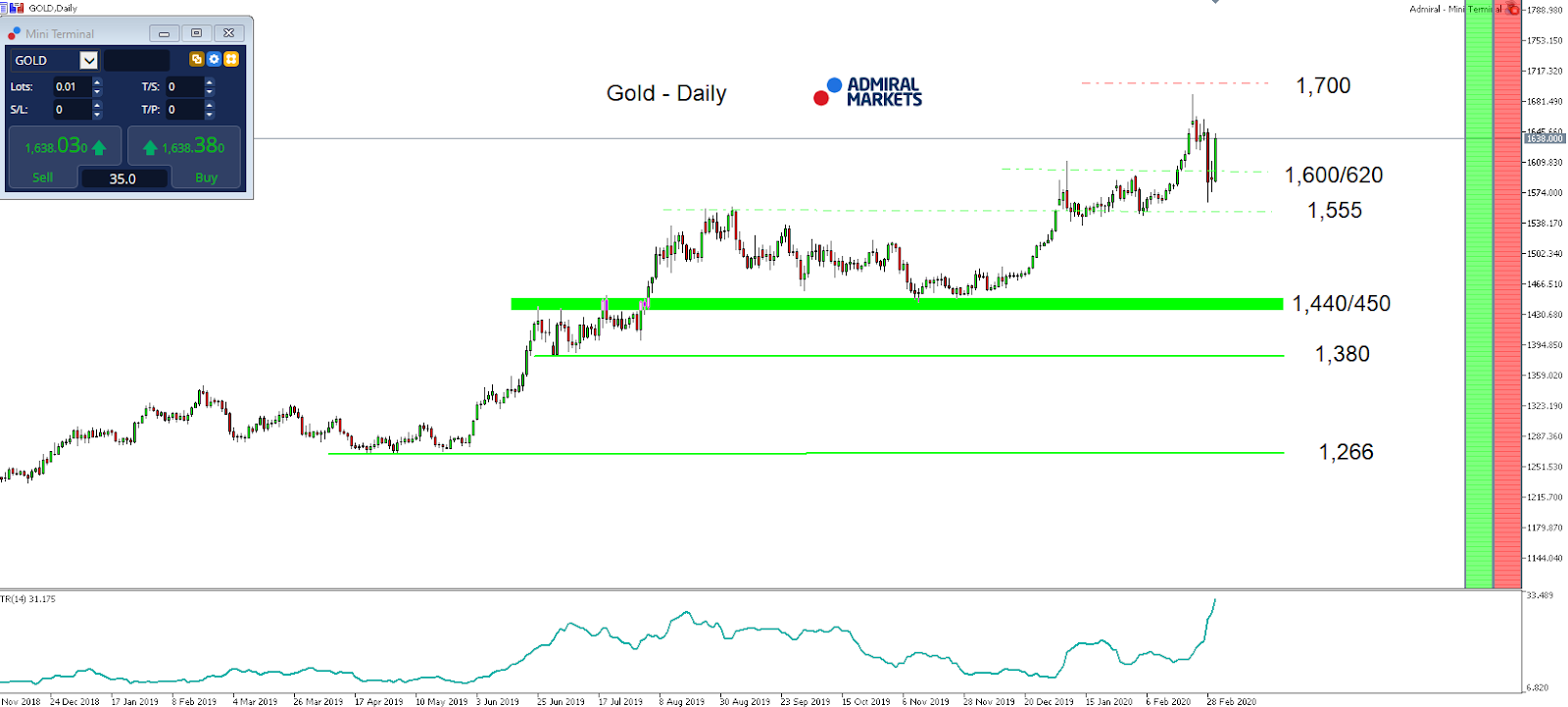
While Gold’s weak weekly close last Friday was certainly surprising, not only for Gold traders but among all market participants, the picture in the precious metal switched to very positive on Tuesday again.

After the Fed cut interest rates by 0.5% on Tuesday, Gold stormed back above 1,600 USD.

The US central bank was forced to take this step by recent developments around the Coronavirus, potential long-term negative impact on the US economy, the resulting risk-off mode with high volatility, and 10-year US-Treasury yields are set to drop towards and below 1.00% for the first time ever.

This is especially true, and volatility is expected to stay elevated since the worst is probably yet to come. The US CDC has stated that it wants to prepare the American public for the possibility that their lives will be disrupted in the US as the Coronavirus spreads.

Such developments will potentially force the Fed to ease their monetary policy even more, with US yields seeing another push lower, driving Gold higher and leaving room for a significant break above 1,700 USD.

On the downside, the daily trend support can be found around 1,535/545 USD with Gold staying bullish on a daily time-frame above that level.

Gold Daily chart

Source: Admiral Markets MT5 with MT5-SE Add-on Gold Daily chart (between November 30, 2018, to March 3, 2020). Accessed: March 3, 2020, at 10:00pm GMT – Please note: Past performance is not a reliable indicator of future results, or future performance.

In 2015, the value of Gold fell by 10.4%, in 2016, it increased by 8.1%, in 2017, it increased by 13.1%, in 2018, it fell by 1.6%, in 2019, it increased by 18.9%, meaning that after five years, it was up by 28%.

Discover the world’s #1 multi-asset platform

Admiral Markets offers professional traders the ability to trade with a custom, upgraded version of MetaTrader 5, allowing you to experience trading at a significantly higher, more rewarding level. Experience benefits such as the addition of the Market Heat Map, so you can compare various currency pairs to see which ones might be lucrative investments, access real-time trading data, and so much more. Click the banner below to start your FREE download of MT5 Supreme Edition!

Trade With MetaTrader 5

Disclaimer: The given data provides additional information regarding all analysis, estimates, prognosis, forecasts or other similar assessments or information (hereinafter “Analysis”) published on the website of Admiral Markets. Before making any investment decisions please pay close attention to the following:

  1. This is a marketing communication. The analysis is published for informative purposes only and are in no way to be construed as investment advice or recommendation. It has not been prepared in accordance with legal requirements designed to promote the independence of investment research, and that it is not subject to any prohibition on dealing ahead of the dissemination of investment research.
  2. Any investment decision is made by each client alone whereas Admiral Markets shall not be responsible for any loss or damage arising from any such decision, whether or not based on the Analysis.
  3. Each of the Analysis is prepared by an independent analyst (Jens Klatt, Professional Trader and Analyst, hereinafter “Author”) based on the Author’s personal estimations.
  4. To ensure that the interests of the clients would be protected and objectivity of the Analysis would not be damaged Admiral Markets has established relevant internal procedures for prevention and management of conflicts of interest.
  5. Whilst every reasonable effort is taken to ensure that all sources of the Analysis are reliable and that all information is presented, as much as possible, in an understandable, timely, precise and complete manner, Admiral Markets does not guarantee the accuracy or completeness of any information contained within the Analysis. The presented figures refer that refer to any past performance is not a reliable indicator of future results.
  6. The contents of the Analysis should not be construed as an express or implied promise, guarantee or implication by Admiral Markets that the client shall profit from the strategies therein or that losses in connection therewith may or shall be limited.
  7. Any kind of previous or modeled performance of financial instruments indicated within the Publication should not be construed as an express or implied promise, guarantee or implication by Admiral Markets for any future performance. The value of the financial instrument may both increase and decrease and the preservation of the asset value is not guaranteed.
  8. The projections included in the Analysis may be subject to additional fees, taxes or other charges, depending on the subject of the Publication. The price list applicable to the services provided by Admiral Markets is publicly available from the website of Admiral Markets.
  9. Leveraged products (including contracts for difference) are speculative in nature and may result in losses or profit. Before you start trading, you should make sure that you understand all the risks.

By Admiral Markets

Stock Market & Flu Breakdown Metrics – Where’s The Bottom?

By TheTechnicalTraders – The end of February was brutal for traders that were not prepared for the breakdown in the US stock markets.  The breakdown in price actually started on February 20th and 21st.  Most traders didn’t pay attention to these minor downside price rotations in the Technology sector (NQ) and the Financial sector.  The early downside price rotations in key sectors gave traders a bit of a warning that the markets were starting to shift away from the earnings-driven rally that had set up the recent peaks.

The other item that concerned the markets was the spread of the Corona Virus into Italy, Iran and other areas without known contact to areas of the virus origin.  Obviously, there had to be some process of contact for the virus to spread – but there are concerns now that the virus could be active within various societies throughout the incubation period and spreading to people in densely populated cities in these areas.  The idea of a “super spreader” event becomes very real if societies are not able to identify and contain the sources of these transmissions.

The fear that gripped the markets last week had been telegraphed for many weeks with the news and speculation that China and Asia were going to be hit with much weaker economic data in Q1 of 2020.  Almost anyone with a bit of common sense should understand the economic complications associated with quarantining millions of people for well over 30+ days would destroy economic activity in China. Even environmental data (NASA) suggests the Chinese economic activity has collapsed in 2020.

(Source: https://earthobservatory.nasa.gov)

It is time for skilled traders and investors to come to the realization that a Deflationary Recession is very likely given the scale and scope of the Corona Virus spread.  Although the numbers pale in comparison to the common Flu/Cold, the economic implications are far more severe.  As the virus spreads into the Middle East, Europe and Africa (think Belt Road Initiative) and early signs that it has already spread into parts of South America, one has to begin to wonder if this event could be something similar to Plague or Pandemic events of the past?

(Source: https://gisanddata.maps.arcgis.com)

As skilled traders, we need to try to stay ahead of these events, attempt to predict where risks and opportunities will arise and work to protect our assets while attempting to trade within these market events.  What happens if this event turns into an extended downside price rotation?  What happens if, collectively, the global central banks can’t support the markets as consumers globally move away from traditional spending and shopping activities?  What are the longer-term implications of this event as it unfolds?  Could this Virus event turn into a Global Deflationary Depression?

There are a few positives we need to report originating out of the US and Israel.  News of a potential vaccine produced by a Texas firm and an Israeli firm has been announced over the past 10+ days.  Both firms believe they will be able to engage in human trials of these vaccines within a few weeks.  Our advanced technology and computerized modeling systems allow us to respond to these types of virus events much faster than ever before.  If these vaccines are successful and can be distributed in mass throughout the globe, we may see this virus event come to a sudden positive conclusion.

The other good news is that the Corona Virus appears to be far less deadly than even the common Flu or Cold.  Currently, the reported numbers are (roughly) 87,000 infected and 3,000 deaths.  That results in a 3.4% mortality rate.  The 2019 mortality rate for pneumonia and influenza was 6.9% (Source: https://www.cdc.gov/).  The reality of the situation on the ground is that we will know more about these data points as we progress further in time.  Numbers change as the total scope of the issue is determined.

As skilled traders, our objective is to protect capital and identify opportunities for profits.  As horrible as it may seem to look at this global event and try to find ways to profit from it – that is really our main objective.  We’ve been getting calls from friends and clients asking us “should I buy airlines and other sectors right now?  This seeming like an incredible opportunity to buy into this weakness?”.  Our answer is a bit more complicated as we are attempting to predict the future event and we don’t believe the bottom has setup/formed yet.  The simple answer is “NO, you should not be buying into this weakness until we know a bottom has setup and risks to the global economy are more settled”.

Still, there are different opinions from institutional and private investors regarding the total scope of this event.  UBS recently issued a BUY for “rich clients” to take advantage of this drop in prices in Chinese and Emerging Markets (Source: https://finance.yahoo.com).  We don’t agree with this analysis quite yet – unless you have a very deep threshold for risk and potential losses.  Our research suggests the bottom will likely complete in May or June of 2020.

This ES chart highlights the downside rotation in price last week and the fact that our Dynamic Rotation modeling system is still suggesting the Weekly trend has not changed to Bearish from Bullish.  The fact is this downside price rotation is still above the YELLOW dashed line which represents trend support.  The Daily chart of the ES, below the Weekly chart, shows the Dynamic Rotation modeling system has already changed from a Bullish trend to moderate Bearish trend.  Because of this, skilled traders need to immediately protect open long positions and consider adjusting their portfolio allocations in preparation of extended downside price moves.

Our researchers believe the ultimate support level on the ES chart is near the $2590 level.  Price may pause near the $2975 level as this level coincides with previous tops in the market and identifies as moderate support.  Yet, we believe the ultimate support level is really near the $2590 level and that is the price this downside move will initially target.

This NQ chart also highlights the immediate downside price rotation in the NASDAQ and how the Weekly chart has yet to confirm any new Bearish price trend.  The Weekly chart still shows confirmed bullish price trends and suggests the recent downside price rotation was within volatility ranges.  The Daily chart has already changed from a Bullish to moderate Bearish trend.  Again, this suggests skilled traders should immediately attempt to lock in profits and prepare for any further downside price trends.

True support on the NQ chart is currently $6575.  This suggests the NQ has another 2000 points to fall (-23.5%) before any real price support will be found.  Be prepared for this move.

This SPY chart more clearly shows the scope of the downside price rotation.  The Weekly chart has already changed from GREEN to YELLOW – indicating a change in rotation price trend from Bullish to NEUTRAL on the Weekly chart.  The Daily chart shows a trend change from Bullish to Moderate Bearish (Pink) to BEARISH (Red).  This suggests the SPY price reaction has more clearly illustrated the risks of this downside price move and suggests extended downside trending may continue.

Our ultimate support level for the SPY is near $262 – another $35 lower (-11.75%).  If these ultimate support levels are reached, the total downside price rotation for all of these charts would total more than -20%.  Certainly more than a simple 8~10% correction.

This is why we believe skilled traders need to pay attention to our recent research and understand the total scope and scale of this move.  We’ve already been warning our friends and followers of the potential risks setting up in the markets.

February 24, 2020: HAS THE EQUITIES WATERFALL EVENT STARTED OR A BUYING OPPORTUNITY?

February 19, 2020: IS THE TECHNOLOGY SECTOR SETTING UP FOR A CRASH? PART III

We can’t make this warning clear enough for all of you right now – prepare for deeper downside price rotation and prepare for the potential of a Deflationary Recession event over the next 6+ months.

As a technical analysis and trader since 1997, I have been through a few bull/bear market cycles. I believe I have a good pulse on the market and timing key turning points for both short-term swing trading and long-term investment capital. The opportunities are massive/life-changing if handled properly.

I urge you visit my ETF Wealth Building Newsletter and if you like what I offer, join me with the 1-year subscription to lock in the lowest rate possible and ride my coattails as I navigate these financial market and build wealth while others lose nearly everything they own during the next financial crisis. Join Now and Get a Free 1oz Silver Bar!

Chris Vermeulen

TheTechnicalTraders.com


Investors eye opportunities as central banks discuss coronavirus action

By George Prior

Global investors are taking advantage of buying opportunities ahead of policymakers looking to take more coordinated action on propping up economies due to the negative impact of the ongoing coronavirus outbreak.

This is the message from Nigel Green, the chief executive and founder of deVere Group, one of the world’s largest independent financial advisory organizations, as G-7 finance ministers and central bank officials are due to hold a teleconference to discuss the issue on Tuesday.

U.S. Treasury Secretary Steven Mnuchin and Federal Reserve Chair Jerome Powell will lead a conference call taking place before Wall Street opens. Bank of Japan Governor Haruhiko Kuroda and European Central Bank President Christine Lagarde are also on the call, amongst others.

Mr Green notes: “For many, the joint statement will not go far enough, and there will be doubts about the effectiveness. This disappointment will dampen the market reaction somewhat.

“However, in general, the markets are looking for a reason to return to being bullish – which has been their default position for an unusually long time.

“This teleconference between G-7 finance ministers and central bankers will likely provide some of the reassurance they seek.”

He continues: “Many investors will be seeking to buy ahead of any potential measures aimed at cushioning the coronavirus blow kicking in, in order to take advantage of the current lower entry points and, therefore, the opportunities, while reducing risk at the same time.”

Last week, the deVere CEO said: “Until such time as governments pump liquidity into the markets, markets will be jittery triggering sell-offs.”

Mr Green affirms: “It was billed as ‘the worst global market sell-off since the 2008 crash’ but it then became an important buying-opportunity for many investors.

“Now, with a more coordinated international response in the pipeline, many investors can be expected to jump off the sidelines again.”

Previously, he noted: “In the current volatile environment, investors – including myself – will be revising their portfolios and drip-feeding new money into the market.”

The deVere CEO concludes: “Central banks and finance ministers of the G7 discussing an action plan to take on the far-reaching impact of coronavirus will buoy investors.

“Many will be seeking to increase their exposure to the markets ahead of the implementation of any measures that are rolled out as a result of this conversation.”

About:

deVere Group is one of the world’s largest independent advisors of specialist global financial solutions to international, local mass affluent, and high-net-worth clients.  It has a network of more than 70 offices across the world, over 80,000 clients and $12bn under advisement.

Japanese Candlesticks Analysis 03.03.2020 (GOLD, NZDUSD, GBPUSD)

Article By RoboForex.com

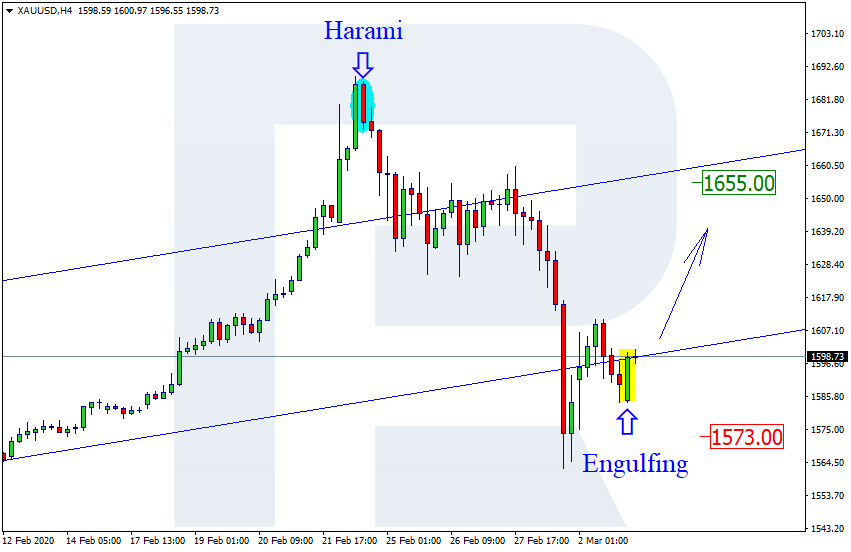
XAUUSD, “Gold vs US Dollar”

As we can see in the H4 chart, Gold has completed the correction; right now, it is resuming the ascending tendency continues and has already reached several reversal patterns, including Harami. The current situation implies that XAUUSD may reverse and get back into the rising channel. In this case, the upside target may be at 1655.00. However, one shouldn’t ignore another scenario, according to which the instrument may return to 1573.00.

GOLD
Risk Warning: the result of previous trading operations do not guarantee the same results in the future

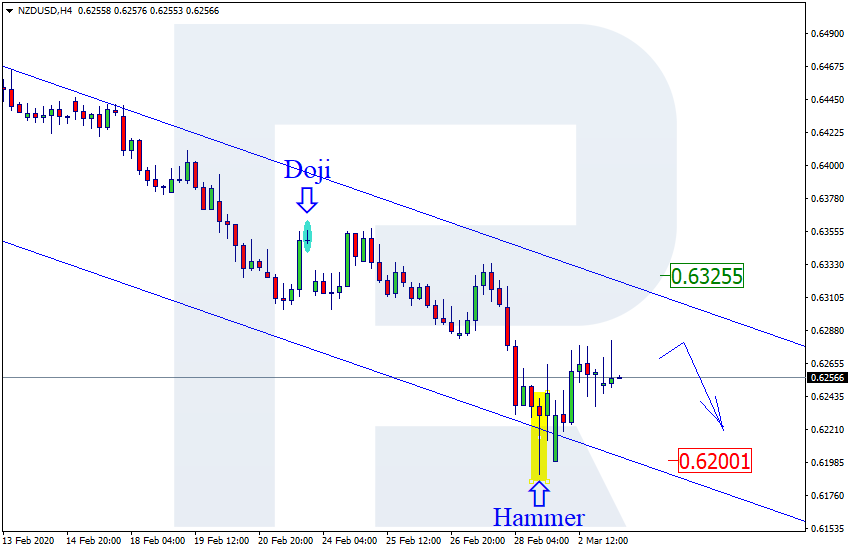
NZDUSD, “New Zealand vs. US Dollar”

As we can see in the H4 chart, the descending channel continues. After completing a Hammer reversal pattern close to the support level, NZDUSD is reversing. We may assume that after reversing the price may correct towards the channel’s upside border, and then resume falling. In this case, the downside target may be at 0.6200. At the same time, one shouldn’t exclude an opposite scenario, according to which the instrument may grow to return to 0.6325.

NZDUSD
Risk Warning: the result of previous trading operations do not guarantee the same results in the future

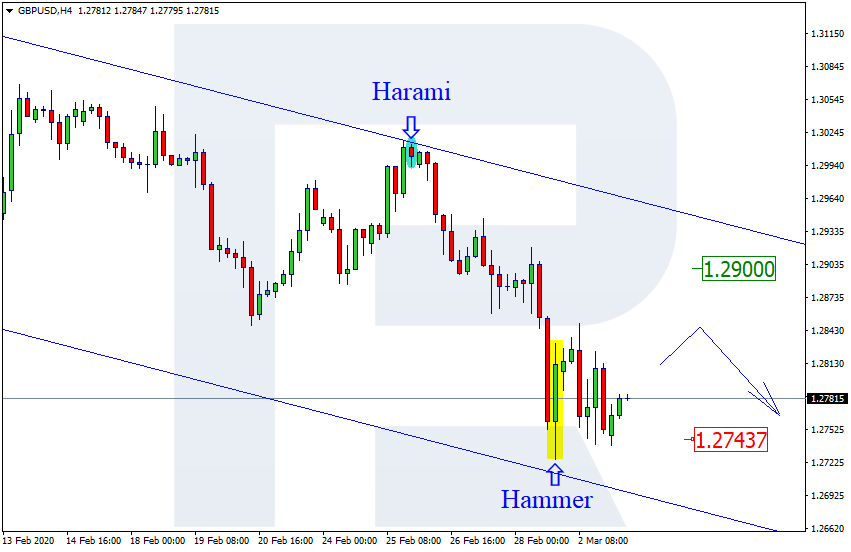
GBPUSD, “Great Britain Pound vs US Dollar”

As we can see in the H4 chart, the descending tendency continues. By now, GBPUSD has formed several reversal patterns, such as Hammer, close to the support level. Possibly, the pair may reverse and start a new correction towards 1.2900. Later, the market may continue falling to reach the support level. However, there is another scenario, which implies that the instrument may fall to reach 1.2743 without forming any significant corrections.

GBPUSD

Article By RoboForex.com

Attention!
Forecasts presented in this section only reflect the author’s private opinion and should not be considered as guidance for trading. RoboForex LP bears no responsibility for trading results based on trading recommendations described in these analytical reviews.

Ichimoku Cloud Analysis 03.03.2020 (AUDUSD, GBPUSD, BTCUSD)

Article By RoboForex.com

AUDUSD, “Australian Dollar vs US Dollar”

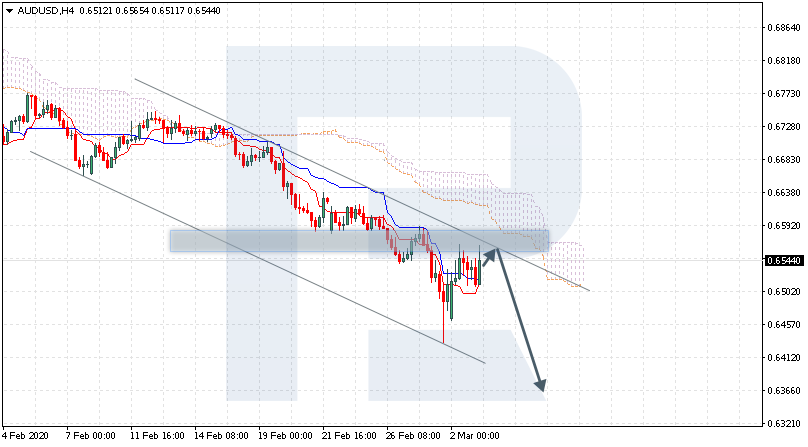
AUDUSD is trading at 0.6544; the instrument is moving below Ichimoku Cloud, thus indicating a descending tendency. The markets could indicate that the price may test the resistance area at 0.6565 and then resume moving downwards to reach 0.6365. Another signal to confirm further descending movement is the price’s rebounding from the descending channel’s upside border. However, the scenario that implies further decline may be canceled if the price breaks the cloud’s upside border and fixes above 0.6655. In this case, the pair may continue growing towards 0.6725.

AUDUSD
Risk Warning: the result of previous trading operations do not guarantee the same results in the future

GBPUSD, “Great Britain Pound vs US Dollar”

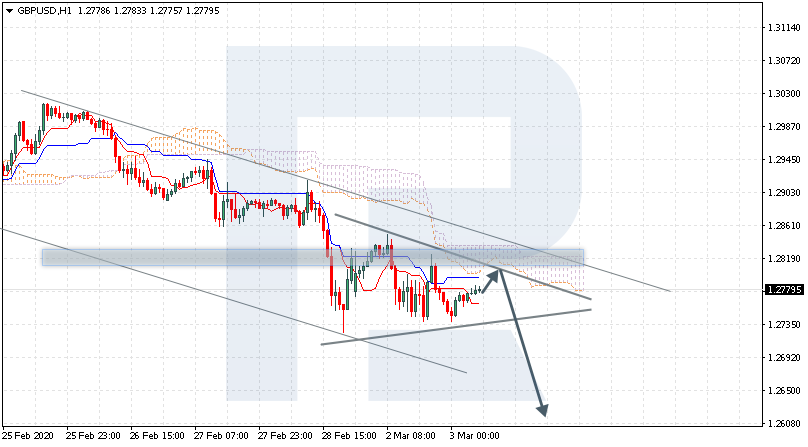
GBPUSD is trading at 1.2779; the instrument is moving below Ichimoku Cloud, thus indicating a descending tendency. The markets could indicate that the price may test the cloud’s downside border at 1.2795 and then resume moving downwards to reach 1.2605. Another signal to confirm further descending movement is the price’s rebounding from the upside border of a Triangle pattern. However, the scenario that implies further decline may be canceled if the price breaks the cloud’s upside border and fixes above 1.2865. In this case, the pair may continue growing towards 1.2935. After breaking the Triangle’s downside border and fixing below 1.2705, the price may resume moving downwards.

GBPUSD
Risk Warning: the result of previous trading operations do not guarantee the same results in the future

BTCUSD, “Bitcoin vs US Dollar”

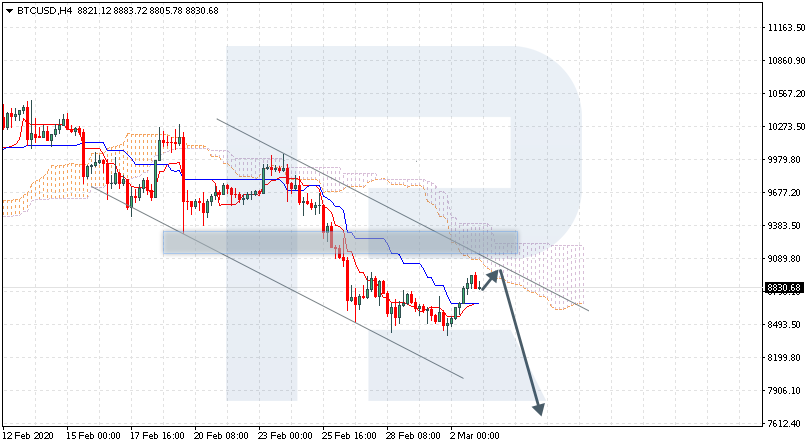
BTCUSD is trading at 8830.00; the instrument is moving below Ichimoku Cloud, thus indicating a descending tendency. The markets could indicate that the price may test the cloud’s downside border at 8865.00 and then resume moving downwards to reach 7615.00. Another signal to confirm further descending movement is the price’s rebounding from the descending channel’s upside border. However, the scenario that implies further decline may be canceled if the price breaks the cloud’s upside border and fixes above 9405.00. In this case, the pair may continue growing towards 9965.00.

BTCUSD

Article By RoboForex.com

Attention!
Forecasts presented in this section only reflect the author’s private opinion and should not be considered as guidance for trading. RoboForex LP bears no responsibility for trading results based on trading recommendations described in these analytical reviews.

The Analytical Overview of the Main Currency Pairs on 2020.03.03

by JustForex

The EUR/USD currency pair

Technical indicators of the currency pair:
  • Prev Open: 1.10416
  • Open: 1.11305
  • % chg. over the last day: +0.83
  • Day’s range: 1.11203 – 1.11555
  • 52 wk range: 1.0879 – 1.1572

Greenback continues to lose positions against the single currency. Yesterday the growth of EUR/USD quotes exceeded 100 points. The trading instrument reached two-month highs. The U.S. dollar remains under pressure amid growing expectations that the Fed will cut interest rates to support the U.S. economy amid the spread of the COVID-19 virus. Currently, the EUR/USD currency pair is consolidating in the range of 1.11100-1.11850. We expect inflation statistics from the EU. We recommend you to open positions from key levels.

At 12:00 (GMT+2:00) the EU will publish the report on inflation.

EUR/USD

The indicators signal the power of buyers: the price has fixed above 50 MA and 100 MA.

MACD histogram is in the positive zone, which gives a signal to buy EUR/USD.

The Stochastic Oscillator is in the neutral zone, the %K line crosses the %D line. There are no signals at the moment.

Trading recommendations
  • Support levels: 1.11100, 1.10500, 1.10000
  • Resistance levels: 1.11850, 1.12200, 1.12500

If the price fixes above 1.11850, expect further growth toward 1.12200-1.12500.

Alternatively, the quotes could descend toward 1.10600-1.10400.

The GBP/USD currency pair

Technical indicators of the currency pair:
  • Prev Open: 1.27878
  • Open: 1.27509
  • % chg. over the last day: -0.29
  • Day’s range: 1.27405 – 1.27973
  • 52 wk range: 1.1959 – 1.3516

The GBP/USD currency pair has stabilized. Financial markets participants are waiting for additional drivers. At the moment sterling is in sideways movement with a rather wide range. The key support and resistance levels are 1.27400 and 1.28100, respectively. Today investors will evaluate important economic reports from UK. We recommend you to open positions from key levels.

At 11:30 (GMT+2:00) an index of business activity in the UK construction sector will be published.

GBP/USD

The indicators signal the sellers’ power: the price has fixed below 50 MA and 100 MA.

The MACD histogram is in the negative zone but above the signal line, which gives a weak signal to sell GBP/USD.

The Stochastic Oscillator is located in the overbought zone, the %K line has crossed the %D line. There are no signals at the moment.

Trading recommendations
  • Support levels: 1.27400, 1.27000
  • Resistance levels: 1.28100, 1.28550, 1.29000

If the price fixes below the support level at 1.27400, expect the quotes to fall toward 1.27000-1.26800.

Alternatively, the quotes could grow toward 1.28500-1.28800.

The USD/CAD currency pair

Technical indicators of the currency pair:
  • Prev Open: 1.34332
  • Open: 1.33288
  • % chg. over the last day: -0.60
  • Day’s range: 1.33188 – 1.33629
  • 52 wk range: 1.2949 – 1.3566

There is a mixed technical picture on the USD/CAD currency pair. At the moment Loonie is consolidating. The trading instrument tests local support and resistance levels: 1.33200 and 1.33650, respectively. USD/CAD quotes can correct further. We recommend that you pay attention to the black gold price dynamics. We recommend you to open positions from key levels.

The Economic News Feed for 03.03.2020 is calm.

USD/CAD

Indicators do not give accurate signals: the price has crossed 100 MA.

Histogram of MACD is in the negative zone, which indicates a bearish sentiment.

The Stochastic Oscillator is located near the overbought zone, the %K line is above the %D line, which gives a weak signal to buy USD/CAD.

Trading recommendations
  • Support levels: 1.33200, 1.32950, 1.32650
  • Resistance levels: 1.33650, 1.34000, 1.34600

If the price fixes below 1.33200, expect the quotes to correct toward 1.32900-1.32600.

Alternatively, the quotes could grow toward 1.34000-1.34300.

The USD/JPY currency pair

Technical indicators of the currency pair:
  • Prev Open: 107.449
  • Open: 108.316
  • % chg. over the last day: +0.79
  • Day’s range: 107.661 – 108.536
  • 52 wk range: 104.45 – 113.53

USD/JPY quotes continue to consolidate after a prolonged decline. There is no defined trend. The trading instrument tests key support and resistance levels at 107.400 and 108.500, respectively. Technical correction of USD/JPY currency pair is not excluded in the nearest future. We recommend that you pay attention to the dynamics of the US government securities yield. We recommend you to open positions from key levels.

The Economic News Feed for 03.03.2020 is calm.

USD/JPY

Indicators do not give accurate signals: the price has crossed 50 MA.

The MACD histogram is near the 0 mark.

The Stochastic Oscillator started to exit the oversold area, the %K line is above the %D line, which indicates the development of bullish sentiment.

Trading recommendations
  • Support levels: 107.400, 107.000
  • Resistance levels: 108.500, 109.300, 110.000

If the price fixes above 108.500, USD/JPY quotes are expected to correct to 109.000-109.500.

Alternative, the quotes could decline toward 107.000.

by JustForex

EURUSD: rally continues ahead of Brexit talks

By Alpari.com

On Monday, March 2, trading on the euro was 90 points up at the close. The single currency received support from the sharp increase in the EURGBP pair, as well as the general weakening of the US dollar after the release of weak data. The euro strengthened against the GBP amid the upcoming Brexit negotiations. Investors are preparing for difficult negotiations. Negotiations will last until Thursday.

The USD came under pressure due to weak data concerning the business activity index in the US manufacturing sector. The negative impact of coronavirus on the global economy and weak economic data may force the US Federal Reserve to lower interest rates. The market expects that in March the regulator will lower the rate by 50 bp to 1.00-1.25% to support the economy.

Today’s events (GMT+3):

  • 12:30 UK: Markit Construction PMI (Feb).
  • 13:00 Eurozone : Consumer Price Index (YoY) (Feb), Unemployment Rate (Jan).
  • 22:50 USA: Fed’s Mester speech.

eur_030320

Current situation:

The news backdrop was favourable to the EURUSD pair. With the support from the main EURGBP cross, EURUSD rose to 1.1185. Bulls cancelled all divergences, dropping the price into a zone above the U3 line – sma55 (+1%). The price was not in this zone for long. At the time of writing, the euro is worth 1.1128. The correction equalled 45 degrees.

The speed of moving average lines has increased. In this regard, I am waiting for correction to the balance line (sma55), to 1.1070-1.1080. Since there is no “bearish” divergence between the price and the AO indicator, you need to be prepared for a new high to be set. In order to provoke bulls to ditch long positions, it is necessary to push the rate down below D1 (1.1030).

By Alpari.com

As COVID-19 Rocks Markets, Uncertainty Rises in ASEAN

By Dan Steinbock

As the virus momentum is shifting from China to other countries, Southeast Asia faces new economic pressures and indirect collateral damage, due to outbreaks in Japan and South Korea, and inadequate international preparedness.

Worldwide, the number of confirmed novel coronavirus (COVID-19) cases could exceed 100,000 in a matter of week or so. The momentum of the outbreak has shifted, however.

In early February, I predicted a turnaround in the growth rate of new virus cases in China, but acceleration internationally. That’s now the new normal. Until then, the cases in China were increasing exponentially. Now the momentum is increasingly outside China. In terms of the timeline, the number of confirmed cases outside China is now about the same as it was in the Chinese mainland about a month ago (Figure).

Figure The Shift in the Outbreak Momentum from China to Outside China

Source: WHO, China National Health Commission, Difference Group

Three scenarios – and current realities in China, US, Europe

After mid-January, I projected three probable virus impact scenarios in China. Let’s take a closer look at those scenarios in light of the new evidence.

In the first scenario of “SARS-like impact,” a sharp quarterly effect, accounting for much of the damage, would be followed by a rebound. The broader impact would be relatively low and regional. In the second scenario of “extended impact,” the adverse impact would last at least two quarters. The broader impact would be more severe and have an effect on global prospects, with rebound only in the summer. In the third scenario of “accelerated impact,” adverse damage would be far steeper with dire repercussions in the global economy.

Recently, IMF projected China’s growth to fall to 5.6% in 2020, while global growth would fall 0.1 percentage points from the expected 3.3%. In China, the rebound story is still possible. In light of the virus acceleration in the past month, the IMF’s global estimate may be too optimistic, however.

Prior to the virus outbreak, the IMF expected US growth to moderate from 2.3% in 2019 to 2% in 2020 and decline further to 1.7% in 2021, due to the anticipated waning support of fiscal and financial conditions. Recently, the IMF projected US growth to suffer a 0.4% slowdown in the annualized growth; from 2.0% to 1.6%. But that would require successful outbreak management.

In Europe, recessionary pressures come in a bad time, as German GDP is stalling, while France and Italy have been contracting. In the fourth quarter of 2019, the Eurozone real GDP grew only 0.1%; the weakest since the contraction in early 2013. If the Brexit and trade wars were not bad enough, there is worse ahead in the coming months, particularly if these pressures are not offset with appropriate fiscal and monetary support.

Rising pressures in Japan, ASEAN

In Japan, growth was expected to fall closer to 0%. After last fall’s consumption tax and the past month of economic and political turmoil, contraction is more likely and uncertainty overshadows the 2020 Olympics.

With more than 4,200 confirmed cases and more than 20 deaths, South Korea has been worst hit by the novel coronavirus outside of China. The dramatic escalation in just a week shows how a single super-spreader and belated quarantines can cause national havoc even in a relatively advanced nation. As the decline in exports will now be coupled by the decline of domestic demand, South Korea may contract in the first quarter, irrespective of the impending rate cuts and efforts at fiscal support.

Since Japan and South Korea are significant investors in Southeast Asia, their economic challenges will overshadow development in emerging Asia as well.

In ASEAN economies, downgrades were expected to reduce growth closer to 4%. In December, the Asian Development Bank (ADB) maintained 4.7% for 2020 on the basis of the anticipated mild recovery in China and the US. Since those recoveries are now undermined, old projections are unlikely to apply.

Even countries that have strong structural growth potential, including Indonesia and the Philippines, are not immune to indirect challenges as their trade, investment, migration and remittance flows depend on the state of the international, particularly regional environment.

In Southeast Asia, much also depends on whether the virus can be kept outside the region.

Around the world, significant downgrades loom ahead. The big question is whether the other major affected economies – US, EU/UK, Japan and largest emerging countries – can achieve China-like fast containment.

Early Chinese data, March is the critical month

According to new data, factory activity in China contracted at the fastest pace on record as the Purchasing Managers’ Index (PMI) fell to a record low of 35.7 from 50.0 in January. The services sector activity also posted the deepest contraction on record, with non-manufacturing PMI dropping to 29.6, from 54.1 in January.

Yet, both plunges were to be expected. For now, the outbreak has killed almost 3,000 people in mainland China and infected 80,000. Economic shocks translate to contractions. The real question is the strength of the post-shock rebound.

In China, the initial expectation in January was that the first quarter would be penalized by a reduction of 1.2 percentage points to about 5% or less, while the second quarter rebound would offset much (but not all) of the losses. While the hoped-for rebound effect is still viable; the question is how significant it will be. March data could still prove very high, given the low starting-point.

It is the assumptions of the first “SARS-like impact” scenario that fuel the bold projections by J.P. Morgan that the Chinese first quarter could go down to -4%, but second quarter would go up to +15%.

Today, the first – and most benign – “SARS-like impact” scenario is no longer likely. But nor is the second “extended impact” scenario inevitable if China gets back to business in March.

Yet, uncertainty is only beginning to grip the rest of the world – as evidenced by the past week’s dramatic market plunges in the US, Europe and Japan.

About the Author:

Dr. Dan Steinbock is an internationally recognized strategist of the multipolar world and the founder of Difference Group. He has served at the India, China and America Institute (USA), Shanghai Institutes for International Studies (China) and the EU Center (Singapore). For more, see https://www.differencegroup.net

A shorter version of the commentary was released by China Daily on March 2, 2020