After two days of significant sales, the AUD/USD pair got stabilized on Wednesday.
In the middle of the week, the Australian Dollar found a reason to get stabilized and recover against the USD. The current quote for the instrument is 0.7583. the weekly low was at 0.7543.
Today, they published the AiG Performance of Services Index, which increased up to 51.7 points in March after being 49.0 points the month before. The components of the report say that the employment and sales parameters improved, which is pretty good.
The construction sector and the defense industry also improved. AiG says it’s because of low rates and the population’s activity level.
However, households are still very careful in spending. It may be connected with the pretty expensive Aussie. By the way, yesterday the RBA returned its comment about the overvalued national currency to the regulator’s statement after the latest meeting.
The future behavior of the Australian Dollar will mostly depend on the market’s attitude to the USD. This evening, the FOMC Meeting Minutes are expected. Moreover, there are some significant voting in the USA Congress.
Attention! Forecasts presented in this section only reflect the author’s private opinion and should not be considered as guidance for trading. RoboForex LP bears no responsibility for trading results based on trading recommendations described in these analytical reviews.
Trading on the EUR/USD currency pair closed up at the end of Tuesday’s session. The single currency appreciated against the greenback from 1.0635 to 1.0671. The daily candlestick closed to form a hammer, emitting a bullish signal.
Markets are nervously awaiting the upcoming meeting between Trump and Xi. Talks may be strained given that trump has threatened to label China a currency manipulator in the past. Accordingly, an increase in market volatility is expected on Thursday.
After rising to 1.0700, the Euro fended off pressure from growing US bond yields. The growth in bond yields was a response to Trump’s announcement that he plans to increase infrastructure spending by about a trillion dollars.
Market expectations:
Macron is seen as likely to beat Le Pen in the second round of France’s presidential election. Market participants don’t believe that Le Pen has any chance of winning. As long as this remains the case, the Euro could break the 1.0900 level by the 23rd of April.
Trader attention will today be focused on the upcoming ADP report and the publication of the FOMC’s minutes. In Asia, the common European currency has risen to 1.0681. Seeing as a hammer has formed on the daily candlestick, and that there is no important news from Europe, I’m still expecting to see the Euro break 1.0700 in the form of an upwards correction.
The Euro closed up on Tuesday but didn’t reach the estimated 1.0700 level. Euro-bull activity was subdued by a rise in US bonds.
In Asia, buyers have managed to rewrite the highs of the last two days: 1.0681 and 1.0677. This is a good sign that the upwards movement will continue in the form of a correction. It’s worth noting that the 22nddegree has been broken through, from which a new impulse driving the trend has begun.
For today, I’m setting a target of 1.0712, and 1.0764 for the end of this week. In today’s European session, the trend line will run within a range of 1.0680 to 1.0686. Buyers need to break through this level as quickly as possible. A drop in the price past 1.0659 (22 degrees) will cast doubt on the possibility of such a breakthrough.
The daily Stochastic indicator has reversed upwards. As the price breaks 1.0702, the Euro’s rise will gather momentum. After testing the 67th degree, we can set a target of 1.0764.
My forecast stops at the publication of the FOMC’s minutes. I’m not sure how the market will react to this with Trump’s meeting with Xi looming.
Positives for the euro (+):
Fundamental:
(+) Head of the ECB, Mario Draghi, has hinted that the central bank may not need to provide any further stimulus to revitalise Europe’s economy. From April to December 2017, the ECB will reduce their monthly assets purchases from 80 to 60 billion EUR;
(+) ECB bosses have discussed the possibility of raising interest rates before the QE program comes to an end;
(+) On the 24th of March, Donald Trump withdrew his proposed healthcare bill to replace Obamacare from the US Congress’ agenda;
Technical (short-term):
(+) According to data from 28/03/17, large speculators on the Chicago Exchange have increased their long and decreased their short positions. Long positions have grown by 1,807 to 160,453 contracts, while short positions have fallen by 9,283 to 167,608 contracts. Net short positions have fallen from 18,245 to 7,155 contracts;
(+) In Asia, US 10Y bond yields have fallen by 0.09% to 2.348%;
(+) EURGBP (W): the CCI (20), AO and AC are up;
(+)EURGBP (D): the CCI (20) and Stochastic (5,3,3) are up;
(+) EURUSD (M): the Stochastic (5,3,3), AO, AC and CCI (20) are up;
(+) EURUSD (W): The Stochastic (5,3,3), AO, AC, and CCI (20) are up;
(+) EURUSD (D): the Stochastic (5,3,3) is up;
Negatives for the euro (-):
Fundamental:
(-) Eric Rosengren, president of the Boston Fed, argues that the central bank should raise interest rates every other session, meaning that he expects to see another 3 hikes this year;
(-) FOMC member Williams is envisaging another 2-3 rate hikes this year and isn’t ruling out the possibility of even more. The Fed could also start reducing its balance sheet this year, which is earlier than many economists had predicted;
(-) Dallas Fed president Kaplan has said 3 rate hikes in 2017 is his base case;
(-) FOMC member Mester says that the Fed needs to reduce the size of its balance sheet this year;
(-) St. Louis Fed president Bullard has said that the Federal Reserve needs to act quickly on normalising its balance sheet;
(-) According to CME Group’s FedWatch Tool, on Tuesday the 4th of April, the probability of a rate hike in May is has fallen from 6.4% to 5.3%, June 62.5% to 62.1% and in July from 68.2% to 66.8%;
(-) Political risks in Europe (French elections);
Technical factors (short-term):
(-) Small speculators on the Chicago exchange have reduced their long positions by 1,095 to 64,185 contracts and increased shorts by 10 to 63,103 contracts. Net long positions have fallen from 2,187 to 1,082 contracts;
(-) Short/long ratio according to myfxbook as of 7:07 EET: 23%/76%, lots: 10864/35963 (previous day: 9144/35234), positions: 40718/58683 (previous day: 34123/55724);
(-) German 10-year bond yields: 0.265% (down 4.67% from 04/04/17);
(-) US 10-year bond yields: 2.359% (up 1.33% from 04/04/17);
(-) EURGBP (M): the AC, AO, CCI (20) and Stochastic (5,3,3) indicators are down;
(-) EURGBP (W): The Stochastic (5,3,3) and CCI (20) are down;
(-) EURGBP (D): the AC and AO indicators are down;
(-) EURUSD (W): the Stochastic (5,3,3) is down;
(-) EURUSD (D): the AO, AC, and CCI (20) indicators are down;
Built into the price:
(-) The Ex-Prime Minister of France, Alain Juppe, has ruled himself out of participating in the presidential election;
(-) Fed member Evans is expecting 2-3 rate hikes in 2017. The Federal Reserve will make a decision about the next hike in June;
(-) President of the Philadelphia Fed, Harker, announced that the Federal Reserve will continue to gradually increase interest rates throughout 2017;
(+) François Bayrou, leader of the “Democratic Movement” party, has ruled out running for the presidency and thrown his weight behind independent candidate Emmanuel Macron;
(+) Marine Le Pen has had her EU parliamentary immunity from prosecution lifted for political reasons;
(+) US president Donald Trump favours a weaker dollar;
(+) The threshold for acceptable US government debt of 20.1 trillion USD may be reached by March this year. This will create headaches for new US president Donald Trump;
(+) The Greek government has made some progress in its talks with international creditors on the second stage of their reform program;
(+) Ewald Nowotny, a member of the ECB’s governing council, has said that the bank could raise the deposit rate before the main refinancing rate;
(+) ECB member Lautenschläger warns that it’s time to prepare for a change in the bank’s policy.
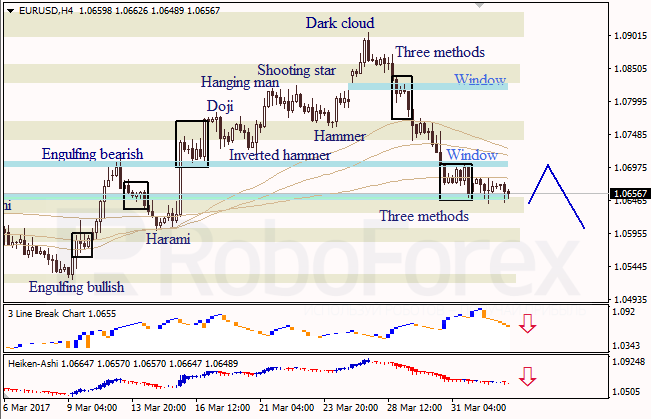
At the H4 chart of EUR USD, bearish Three Methods continuation pattern indicates a descending movement. The downside Window is a support level. Three Line Break chart and Heiken Ashi candlesticks confirm a bearish direction.
At the H1 chart of EUR USD, bullish Hammer pattern indicates an ascending correction. The Window in the middle is a support level. Three Line Break chart and Heiken Ashi candlesticks confirm a bearish direction.
USD JPY, “US Dollar vs. Japanese Yen”
At the H4 chart of USD JPY, bearish Three Methods continuation pattern indicated that the descending tendency continues. Three Line Break chart and Heiken Ashi candlesticks confirm a bearish direction.
Attention! Forecasts presented in this section only reflect the author’s private opinion and should not be considered as guidance for trading. RoboForex LP bears no responsibility for trading results based on trading recommendations described in these analytical reviews.
The EUR/USD instrument closed up after trading on Monday, leaving a long tail on the daily candlestick. There is an increased probability of the EUR/USD going through a correctional phase given that the EUR/GBP cross now favours buyers, with the pair’s three-day slide having come to an end.
It’s still too early to be sure, so we await confirmation, which will be given should the price overcome the 1.0680 and 1.0700 levels. What caused the slide to 1.0642 and subsequent sharp rebound is a mystery to me. By the day’s close, the Euro had restored from a minimum of 1.0642 to 1.0676.
Market expectations:
At the time of writing, the Euro is trading at 1.0670. Signals on the hourly timeframe are indicative of an imminent upwards correction. It seems the price has found its bottom in the 1.0640 – 1.0650 range. For Tuesday, I’m forecasting a restoration to around the 1.0700 mark.
Markets today will be directing their attention towards the publication of the FOMC’s minutes for their meeting in March (due 5th April), as well as the US jobs report to be published on the 7th, which should shed some light on the state of the US economy and its readiness for another rate hike.
On Monday, the Euro closed up. Monday against Friday didn’t work out. Buyers were subdued by some curious price swings at around 17:00 EET. Given that the Euro quickly returned to 1.0670 after falling to 1.0642, for Tuesday, I’m staying in the bull camp. The Euro’s rise has been facilitated by the EUR/GBP cross and falling US bond yields.
There are a few signs indicating a transition into a correctional phase for the Euro. First is the bullish divergence between the price and the AO and CCI indicators. Secondly, the trend line has been broken through. Thirdly, a V-model has formed following the rate’s quick restoration yesterday. A long tail has formed on the daily candlestick.
Cyclical analysis and patterns also indicate a strengthening Euro, but these have proved terrible methods of prognosis in the last couple of weeks. It feels as if these instruments are showing incorrect values due to external forces. After Brexit formally got underway, traders started converting Euros into pounds. The aim is unclear as of now. Clearly, they think that the pound has significantly depreciated, while the British government in promising to avoid a hard Brexit.
In order for the transition into a correctional phase to be confirmed, the EUR/USD pair must break the 1.0680 and 1.0700 levels. At the moment, the lb balance line is acting as a resistance.
The price is currently located at the 22nd degree. Trends show that the rate often bounces off of this level, so traders should be alert. Take my forecast with a pinch of salt, the likelihood of it working out is about 50/50. The case for the Euro’s strengthening has been made above. To see what could have a negative impact on the single currency, keep reading.
Positives for the euro (+):
Fundamental:
(+) Head of the ECB, Mario Draghi, has hinted that the central bank may not need to provide any further stimulus to revitalise Europe’s economy. From April to December 2017, the ECB will reduce their monthly assets purchases from 80 to 60 billion EUR;
(+) ECB bosses have discussed the possibility of raising interest rates before the QE program comes to an end;
(+) On the 24th of March, Donald Trump withdrew his proposed healthcare bill to replace Obamacare from the US Congress’ agenda;
Technical (short-term):
(+) According to data from 28/03/17, large speculators on the Chicago Exchange have increased their long and decreased their short positions. Long positions have grown by 1,807 to 160,453 contracts, while short positions have fallen by 9,283 to 167,608 contracts. Net short positions have fallen from 18,245 to 7,155 contracts;
(+) US 10-year bond yields: 2.328% (down 2.55% from 03/04/17);
(+) In Asia, US 10Y bond yields have fallen by 0.77% to 2.332%;
(+) EURGBP (W): the CCI (20), AO and AC are up;
(+)EURGBP (D): the CCI (20) is up;
(+) EURUSD (M): the Stochastic (5,3,3), AO, AC and CCI (20) are up;
(+) EURUSD (W): The Stochastic (5,3,3), AO, AC, and CCI (20) are up;
Negatives for the euro (-):
Fundamental:
(-) Eric Rosengren, president of the Boston Fed, argues that the central bank should raise interest rates every other session, meaning that he expects to see another 3 hikes this year;
(-) FOMC member Williams is envisaging another 2-3 rate hikes this year and isn’t ruling out the possibility of even more. The Fed could also start reducing its balance sheet this year, which is earlier than many economists had predicted;
(-) Dallas Fed president Kaplan has said 3 rate hikes in 2017 is his base case;
(-) FOMC member Mester says that the Fed needs to reduce the size of its balance sheet this year;
(-) St. Louis Fed president Bullard has said that the Federal Reserve needs to act quickly on normalising its balance sheet;
(-) According to CME Group’s FedWatch Tool, on Friday the 31st of March, the probability of a rate hike in May is still 6.4%. The probability in June has risen from 54.0% to 62.5% and in July from 60.8% to 68.2%;
(-) Political risks in Europe (French elections);
Technical factors (short-term):
(-) Small speculators on the Chicago exchange have reduced their long positions by 1,095 to 64,185 contracts and increased shorts by 10 to 63,103 contracts. Net long positions have fallen from 2,187 to 1,082 contracts;
(-) Short/long ratio according to myfxbook as of 06:54 EET: 20%/79%, lots: 9144/35234 (previous day: 5898/19599), positions: 34123/55724 (previous day: 21138/32715);
(-) German 10-year bond yields: 0.278% (down 15.24% from 03/04/17);
(-) EURGBP (M): the AC, AO, CCI (20) and Stochastic (5,3,3) indicators are down;
(-) EURGBP (W): The Stochastic (5,3,3) and CCI (20) are down;
(-) EURGBP (D): the AC, AO and Stochastic (5,3,3) indicators are down;
(-) EURUSD (W): the Stochastic (5,3,3) is down;
(-) EURUSD (D): the AO, AC, CCI (20) and Stochastic (5,3,3) indicators are down;
Built into the price:
(-) The Ex-Prime Minister of France, Alain Juppe, has ruled himself out of participating in the presidential election;
(-) Fed member Evans is expecting 2-3 rate hikes in 2017. The Federal Reserve will make a decision about the next hike in June;
(-) President of the Philadelphia Fed, Harker, announced that the Federal Reserve will continue to gradually increase interest rates throughout 2017;
(+) François Bayrou, leader of the “Democratic Movement” party, has ruled out running for the presidency and thrown his weight behind independent candidate Emmanuel Macron;
(+) Marine Le Pen has had her EU parliamentary immunity from prosecution lifted for political reasons;
(+) US president Donald Trump favours a weaker dollar;
(+) The threshold for acceptable US government debt of 20.1 trillion USD may be reached by March this year. This will create headaches for new US president Donald Trump;
(+) The Greek government has made some progress in its talks with international creditors on the second stage of their reform program;
(+) Ewald Nowotny, a member of the ECB’s governing council, has said that the bank could raise the deposit rate before the main refinancing rate;
(+) ECB member Lautenschläger warns that it’s time to prepare for a change in the bank’s policy.
The EUR/USD pair is about to finish the descending impulse in the wave [i]. Earlier, the price completed the wave 2in the form of the double zigzag. Consequently, soon the market may start a new local correction in the wave [ii].
At the M30 chart, the pair is probably forming the diagonal triangle in the wave (v) of [i]. If later the price rebounds from the pattern’s downside border, the market may start a new ascending correction.
GBP USD, “Great Britain Pound vs US Dollar”
After rebounding from the upside border of the horizontal triangle, the GBP/USD pair formed the descending impulse in the wave i. Yesterday, the price completed the wave ii and may soon start a new decline and form the bearish impulse in the wave iii.
As we can see at the H1 chart, the wave ii took the form of the zigzag and was followed by the descending impulse in the wave [1]. Possibly, later the price may form the descending extension in the wave [3] of iii.
USD JPY, “US Dollar vs Japanese Yen”
In case of the USD/JPY pair, the price continues forming the wave 2, which is taking the form of the double zigzag. Right now, the price is forming the descending impulse in the wave (c) of [y]. As a result, on Tuesday the market may break the low of the wave (a).
More detailed structure is shown on the H1 chart. It looks like the pair is about to complete the third wave in the wave (c). Consequently, in the nearest future the market may start a local correction in the wave iv of (c).
AUD USD, “Australian Dollar vs US Dollar”
After completing the horizontal triangle in the wave 4, the AUD/USD pair broke the low of the wave (i), which means that it resumed falling. As a result, in the nearest future the market may continue falling in the wave (iii).
As we can see at the H1 chart, the pair completed the wave (ii) in the form of the zigzag and right now is probably forming the extension in the wave (iii). In this case, later the market is expected to continue falling in the wave iii of (iii).
Attention! Forecasts presented in this section only reflect the author’s private opinion and should not be considered as guidance for trading. RoboForex LP bears no responsibility for trading results based on trading recommendations described in these analytical reviews.
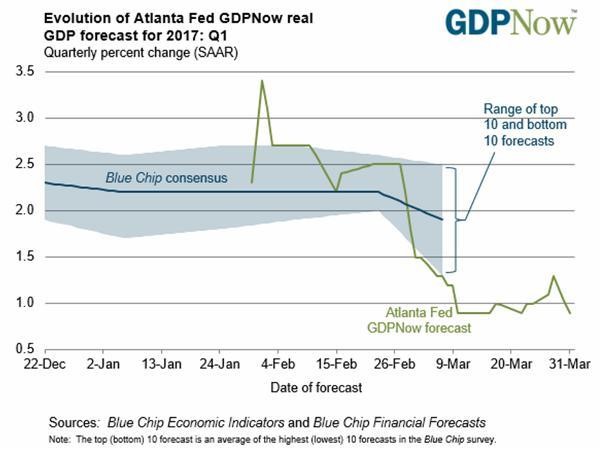
No one has the slightest idea of what is happening as insane levels of debt distort the model’s which economists use to forecast the future economic trends. From here on out, there will be unpleasant surprises all the way around. According to shadow stats, the GDP is in contraction at the rate of -2%.
The New Normal & Disconnect:
The FED and other agencies have taken on new responsibilities for managing systemic risk since the financial crisis of 2007.
What grade have they earned? The impact of implemented low-interest rates for savers has made them poorer. All pension plans, college endowments, and state retirement plans have been diminished and devastated by low-interest rates. Savers have suffered and will continue to do so because of ‘financial repression’.
Furthermore, because low-interest rates make savers poorer, the contracting economy has limped along with anemic growth rates. Low-interest rates have had a negative impact for almost everyone.
Preparing For The Big Crunch!
The FED will respond with even more aggressive money printing — which will then cause the entire monetary system to implode some day. Money is not wealth, but rather it is merely a claim on wealth. Debt is a claim on future money. The only way to have faith in our current monetary policies is if one believes that we can grow our economy and GDP out of this massive debt that we have created. The U.S. is already insolvent, meaning liabilities exceed assets. The U.S. has been spending, far beyond its’ means, for multiple decades while amassing tremendous amounts of public debt, private debt and entitlement liabilities.
The Austrian economist Ludwig von Mises said, “There is no means of avoiding the final collapse of a boom brought about by credit expansion. The alternative is only whether the crisis should come sooner as the result of voluntary abandonment of further credit expansion, or later as a final and total catastrophe of the currency system involved.”
U.S. economic growth began slowing down due to its’ acceleration of ‘too much debt’. Instead of allowing natural market forces to clear out the excessive debts, the Federal Reserve chose to go into overdrive to ‘remedy’ the problem. Its’ remedy? Drive interest rates to 0% to reduce the service burden of those debts and print trillions of fresh dollars which, in turn, would fund new borrowing.
Of course, no true ‘solution’ for resolving debt involves piling up even more of it. The only path that history has shown that works involves fiscal austerity and reducing debt. The only real solution is “a voluntary abandonment of the credit expansion”.
The only possible solution for recovery, today, is if the economy suddenly returns to an extremely rapid economic growth over an extended period of time. If during such a period of rapid growth does occur, we must use that windfall to pay down the outstanding debts! The intent of the FED treading into the never-before-tried ZIRP and NIRP waters was to ignite more borrowing, not more spending!
Pension plans have been ultimately decimated by these monetary policies!
Pension funds across the U.S. are desperate to overcome low interest rates and return to the time when future retirees were entitled to and could receive their full benefits. Pension funds which so many depend upon for their retirement security will lose trillions of dollars which will result in the depletion of receiving their benefits!
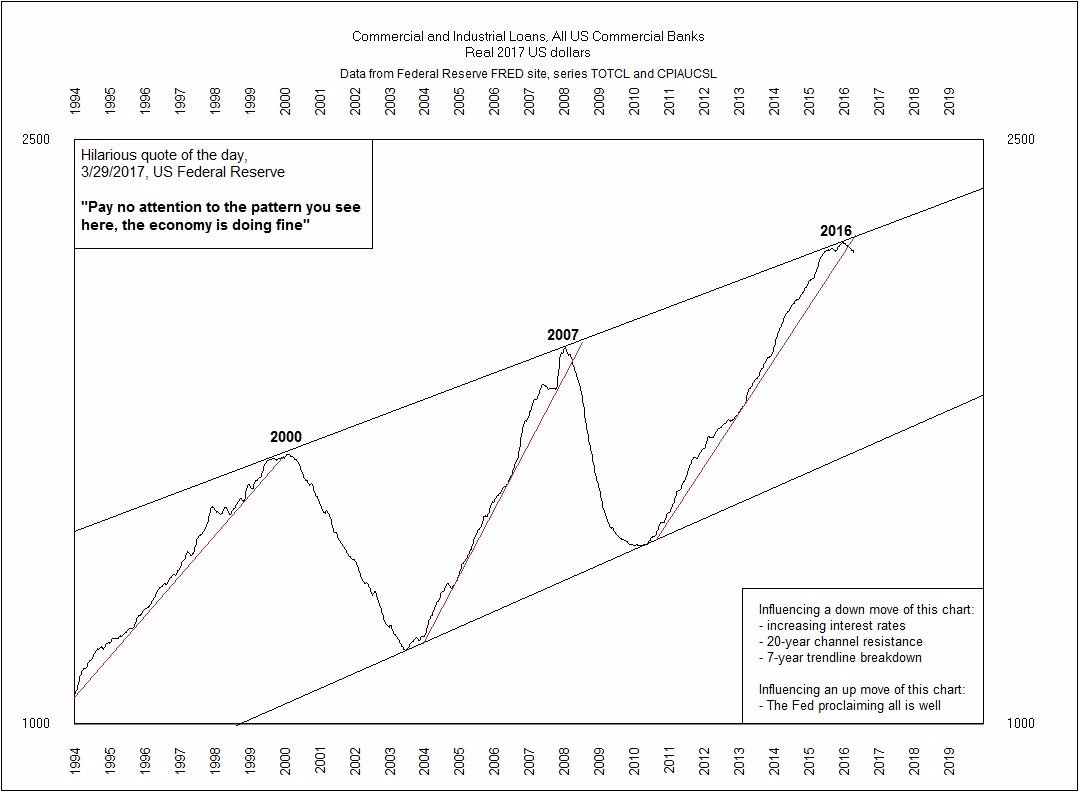
The chart below reflects the last two times that industrial and commercial loan contracts crashed which were in 1999 and 2007!{25 year chart} of all American Bank Commercial and Industrial Loans.The last 2 times loans contracted and broke down was 1999 & 2007
Making Real Profits!
Want to gain the edge you need to beat the markets? Or Better yet, profit during the next market correction through the use of Inverse Exchange Traded Funds?
Take advantage of my insight and expertise as I can help you grow your trading account. Tune in every morning for my video analysis and market forecasts at TheGoldAndOilGuy.com on all ‘asset classes’ and new ETF trade opportunities.
I am currently in a gold related trade. The last gold trade that I provided, returned a trade with NUGT resulting in an 112% Profit From Dec – Feb.
We use a combination of traditional technical analytical tools, Elliot Wave Counts and investor sentiment! This makes for Killer Trades with oversized Profits!
We always take half off of the table on all positions to lock in quick solid gains and then we ride the other half for much higher returns! We reduce our risk while keeping our gains!
It looks as though we are a couple of days away from the next major trade setup which could last several months with the potential for a 51-55% return. Be sure to keep informed by reading my newsletters and get my stock trades and leveraged ETF trades at www.ActiveTradingPartners.com
When I first began working in Forex, the term CFD seemed to have some magical properties as it could be applied to everything. As far as I could tell, corn was a CFD, and so was gold, oil, natural gas, and even some forex pairs, depending on who I asked.
But, when it was finally explained to me, things began to fall into place, and the importance of CFDs was clear, as was how to trade them.
CFD is an acronym that stands for “Contract For Difference”. It is a contract between a buyer and seller that has a time element associated with it. The term “difference” describes the difference between the value when the contract is opened, and when it is closed, at which time the buyer or seller will reimburse the other for this difference.
The contract is for an underlying instrument, so anything can be a CFD. The great advantage of a CFD is that there need be no physical exchange of items or shares which would attract capital gains or stamp duties or whatever local taxes are associated with the physical transfer of goods, services or ownership. As a result, it was first used as a derivative to provide exposure to hedge funds. Traders were able to own the value of the underlying asset without owning the actual asset, allowing them to offset their positions in a tax effective manner.
As a result of this flexibility, and its use as a hedge, CFD’s are widely available across all asset classes. It is possible to find CFD’s for forex, commodities, stocks, indices, ETFs, REITs,… basically anything that can be traded is available as a CFD.
It can be traded just like anything else on an exchange. So if you expect the underlying instrument to increase in value over the life of the contract, you would profit from a long position. If you believed that it will decrease in value, you should open a short position.
One of the more important things to bear in mind when trading a contract on an exchange is that the contracts have a finite life, and as a result, there might be different ways that the brokerage handles the end of a contract. Some brokerages allow the contract to run its full course, in which case the contract will close itself off, much like an option, at the close of the contract. Other brokerages undertake rollovers, where, for example, a corn contract with a close in August will be rolled over to a new contract for corn that has a close in October. Often this is done prior to the rollover date, so as to avoid the increase in volume and volatility that accompanies a contract as it comes closer to the close.
This second method is quite confusing for a trader, for 2 reasons. The first is that there is a significant difference between a ton of corn delivered in August and a ton of corn delivered in October (although not a ton of difference – sorry, I couldn’t help myself). Weather patterns, time of year and many other factors can impact supply and demand, which will impact the value of the underlying asset. This makes the new corn different in value from the old corn, and the value of the new contract will reflect as such. For those looking to cash in on their original contract, or ride out the later volatility for more profit, the rollover is not helpful.
The second reason is more about confusion on the part of the trader. Often the different life cycle stage of the new contact, as well as the value differences mentioned above, will mean that the price of the new contract is very different from the old contract. The broker adjusts the position by adding or subtracting the difference in swap, so if the profit decreases by $1000, this amount is added to the wap to ensure that no value is actually lost. However, understand this can be highly confusing for a trader who suddenly sees a profit of several thousand turn into a loss of several thousand overnight (or more likely the weekend), and really necessitates being forewarned.
CFD’s are a useful and exciting trading option, and if handled correctly, provide a wonderful opportunity for diversified trading. Remember the tricks and enjoy the experience.
About the Author:
Adinah Brown is a professional writer who has worked in a wide range of industry settings, including corporate industry, government and non-government organizations. Within many of these positions, Adinah has provided skilled marketing and advertising services and is currently the Content Manager at Leverate.
The EUR/USD pair reached the group of fibo-levels at 1.0680. If the price rebounds from this area, the market may start a new ascending correction.
At the H1 chart, the area reached by the price is confirmed by intraday fibo-levels. If the price starts new correction, the closest target for bulls will be the group of fibo-levels at 1.0750 – 1.0740.
EUR GBP, “Euro vs Great Britain Pound”
In case of the EUR/GBP pair, the current correction turned out to be deeper, but, as a result, the price rebounded from the group of local fibo-levels. Possibly, the market may resume its growth towards the area at 0.8850 – 0.8830.
As we can see at the H1 chart, several local fibo-levels provided support. The short-term bullish target is the area at 0.8650 – 0.8640. if the pair rebounds from this area, the market may start a new bearish correction.
Attention! Forecasts presented in this section only reflect the author’s private opinion and should not be considered as guidance for trading. RoboForex LP bears no responsibility for trading results based on trading recommendations described in these analytical reviews.
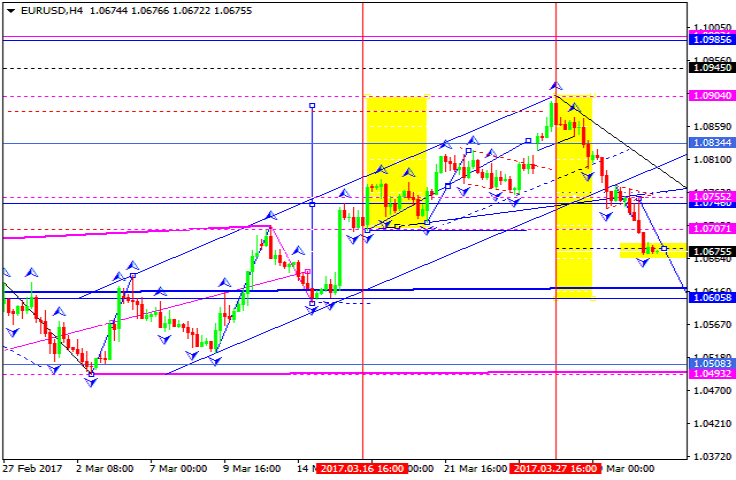
The EUR/USD pair is still moving downwards. As long as the price is falling, it may extend this wave and reach the targets. Possibly, today the price may consolidate around 1.0678, break it to the downside and then fall towards 1.0606. Later, in our opinion, the market may grow with the target at 1.0707 and then continue falling to reach 1.0508.
GBP USD, “Great Britain Pound vs US Dollar”
The GBP/USD pair has completed the fourth wave to return to 1.2488 and right now is consolidating. The main scenario implies that the price may fall inside the fifth wave towards 1.2357. Later, in our opinion, the market may be corrected with the target at 1.2488.
USD CHF, “US Dollar vs Swiss Franc”
The USD/CHF pair is still forming the ascending structure and right now is consolidating near the lows. Possibly, the price may grow towards 1.0065 and then return to 0.9970. After that, the instrument may grow to reach the local target.
USD JPY, “US Dollar vs Japanese Yen”
The USD/JPY pair has completed another ascending structure as the third wave. Possibly, the price may test 111.50 from above and then form the fifth wave towards 112.88. After that, the instrument may be corrected with the target at 111.50.
AUD USD, “Australian Dollar vs US Dollar”
The AUD/USD pair is falling towards 0.7541. Possibly, today the price may reach the first target at 0.7620.
USD RUB, “US Dollar vs Russian Ruble”
The USD/RUB pair has completed the third descending wave. Possibly, today the price may be corrected towards 57.06 and then form the fifth wave with the target at 55.50.
XAU USD, “Gold vs US Dollar”
Gold is trading to break the low of the first wave. Possibly, today the price may form a continuation pattern at 1242. Later, in our opinion, the market may fall towards the local target at 1233.
BRENT
Being under pressure, Brent is moving downwards. Possibly, the price may be corrected with the target at 52.10 to test it from above. After that, the instrument may grow to reach 53.50.
Attention! Forecasts presented in this section only reflect the author’s private opinion and should not be considered as guidance for trading. RoboForex LP bears no responsibility for trading results based on trading recommendations described in these analytical reviews.
The EUR/USD pair closed the week 1.28% down. The single currency initially appreciated after the release of macro-data from the US, but renewed its minimum following the collapse of the EUR/GBP and EUR/JPY cross pairs.
A slide in US bond yields should have strengthened the Euro, but trading in New York saw it lose ground against both the British pound and Kiwi dollar. Traders sought to close their positions ahead of the month’s and quarter’s close and they ignored plenty of bullish signals in the wake of Brexit being officially triggered. At the end of the month, the EUR/USD instrument is up 0.76%, and 1.33% for the quarter.
US statistics:
The University of Michigan consumer sentiment index grew to 96.9 (forecast: 97.6, previous reading: 96.3);
The Chicago business barometer grew to 57.7 (forecast: 56.9, previous reading: 57.4);
US personal income rose 0.4% in February (forecast: 0.4%, previous reading: 0.4%), while personal spending came in at 0.1% (forecasted: 0.2%, previous reading: 0.2%).
Market expectations:
The Euro has opened up at the beginning of this week and has restored from Friday’s low to 1.0678. Given that the pair closed down on Friday, today’s movement should go against this. According to my forecast, a renewal should begin after 10:00 EET from 1.0666 level. As the price approaches this level, it’s essential to keep an eye on the dynamics of the EUR/GBP cross as its fall could push the Euro back down to 1.0652. The target for restoration is 1.0703 on the 45th degree.
Day’s news (GMT+3):
10:15 Switzerland: retail sales (Feb);
10:30 Switzerland: PMI (Mar);
10:55 Germany: Markit manufacturing PMI (Mar);
11:00 Eurozone: Markit manufacturing PMI (Mar);
11:30 UK: Markit manufacturing PMI (Mar);
13:00 Eurozone: unemplyment rate (Feb), PPI (Feb);
16:30 Canada: RBC manufacturing PMI (Mar);
16:45 USA: Markit manufacturing PMI (Mar);
17:00 USA: construction spending (Feb), ISM manufacturing PMI (Mar);
17:30 Canada: BoC business outlook survey, USA: Fed’s William Dudley speech;
The EUR/USD instrument has now closed down 4 days in a row. Since the 27th of March, the pair has fallen by 61.2% (249 pips) on the upwards movement from 1.0495 to 1.0906. The target and support zones have been reached. If we see a decent rebound (past 1.0702), then we could see an upwards correction to 1.0750 in the coming days. For today, it will be enough to renew Friday’s maximum of 1.0702.
Given that our pair closed down on Friday, I’m expecting today’s movement to go against this. The target for the 45th degree is 1.0704. A session rally is expected from 1.0666 in a testing of the trend line after it was broken through. Should the Euro weaken, we should keep an eye on the EUR/GBP cross. If sentiment on the cross turns out to be bearish, we could see the Euro quickly return to 1.0652.
Between the price and the AO indicator, a bullish divergence has formed. In the event that the EUR/GBP cross doesn’t fall and US bond yields continue their slide, we could see our calculated target reached before 17:00 EET.
Positives for the euro (+):
Fundamental:
(+) Head of the ECB, Mario Draghi, has hinted that the central bank may not need to provide any further stimulus to revitalise Europe’s economy. From April to December 2017, the ECB will reduce their monthly assets purchases from 80 to 60 billion EUR;
(+) ECB bosses have discussed the possibility of raising interest rates before the QE program comes to an end;
(+) On the 24th of March, Donald Trump withdrew his proposed healthcare bill to replace Obamacare from the US Congress’ agenda.
Technical (short-term):
(+) According to data from 28/03/17, large speculators on the Chicago Exchange have increased their long and decreased their short positions. Long positions have grown by 1,807 to 160,453 contracts, while short positions have fallen by 9,283 to 167,608 contracts. Net short positions have fallen from 18,245 to 7,155 contracts;
(+) US 10-year bond yields: 2.389% (down 0.99% from 31/03/17);
(+) In Asia, US 10Y bond yields have fallen by 0.02% to 2.395%;
(+) EURGBP (W): the CCI (20), AO and AC are up;
(+) EURUSD (M): the Stochastic (5,3,3), AO, AC and CCI (20) are up;
(+) EURUSD (W): The Stochastic (5,3,3), AO, AC, and CCI (20) are up;
Negatives for the euro (-):
Fundamental:
(-) Eric Rosengren, president of the Boston Fed, argues that the central bank should raise interest rates every other session, meaning that he expects to see another 3 hikes this year;
(-) FOMC member Williams is envisaging another 2-3 rate hikes this year and isn’t ruling out the possibility of even more. The Fed could also start reducing its balance sheet this year, which is earlier than many economists had predicted;
(-) Dallas Fed president Kaplan has said 3 rate hikes in 2017 is his base case;
(-) FOMC member Mester says that the Fed needs to reduce the size of its balance sheet this year;
(-) St. Louis Fed president Bullard has said that the Federal Reserve needs to act quickly on normalising its balance sheet;
(-) According to CME Group’s FedWatch Tool, on Friday the 31st of March, the probability of a rate hike in May is still 6.4%. The probability in June has risen from 54.0% to 62.5% and in July from 60.8% to 68.2%;
(-) Political risks in Europe (French elections);
Technical factors (short-term):
(-) Small speculators on the Chicago exchange have reduced their long positions by 1,095 to 64,185 contracts and increased shorts by 10 to 63,103 contracts. Net long positions have fallen from 2,187 to 1,082 contracts;
(-) Short/long ratio according to myfxbook as of 06:54 EET: 23%/76%, lots: 5898/19599 (previous day: 17069/44373), positions: 21138/32715 (previous day: 41132/67660);
(-) German 10-year bond yields: 0.328% (down 3.52% from 31/03/17);
(-) EURGBP (M): the AC, AO, CCI (20) and Stochastic (5,3,3) indicators are down;
(-) EURGBP (W): The Stochastic (5,3,3) and CCI (20) are down;
(-) EURGBP (D): the AC, AO, CCI (20) and Stochastic (5,3,3) indicators are down;
(-) EURUSD (W): the Stochastic (5,3,3) is down;
(-) EURUSD (D): the AO, AC, CCI (20) and Stochastic (5,3,3) indicators are down;
Built into the price:
(-) The Ex-Prime Minister of France, Alain Juppe, has ruled himself out of participating in the presidential election;
(-) Fed member Evans is expecting 2-3 rate hikes in 2017. The Federal Reserve will make a decision about the next hike in June;
(-) President of the Philadelphia Fed, Harker, announced that the Federal Reserve will continue to gradually increase interest rates throughout 2017;
(+) François Bayrou, leader of the “Democratic Movement” party, has ruled out running for the presidency and thrown his weight behind independent candidate Emmanuel Macron;
(+) Marine Le Pen has had her EU parliamentary immunity from prosecution lifted for political reasons;
(+) US president Donald Trump favours a weaker dollar;
(+) The threshold for acceptable US government debt of 20.1 trillion USD may be reached by March this year. This will create headaches for new US president Donald Trump;
(+) The Greek government has made some progress in its talks with international creditors on the second stage of their reform program;
(+) Ewald Nowotny, a member of the ECB’s governing council, has said that the bank could raise the deposit rate before the main refinancing rate;
(+) ECB member Lautenschläger warns that it’s time to prepare for a change in the bank’s policy.