Author Archive for InvestMacro – Page 484

The Japanese Yen is planning to weaken

By Dmitriy Gurkovskiy, Senior Analyst at RoboForex

1. The Liberal Democratic Party won the early parliamentary elections in Japan.

2. “Abenomics” will remain the priority for the Japanese government.

3. Due to this, the Japanese Yen will tend to continue weakening.

“Abenomics” will continue. The Liberal Democratic Party led by the current Japanese Prime Minster, Shinzō Abe, secured a victory during the elections that took place last weekend. However, such results were expected: frankly speaking, the Opposition has nothing to offer instead of the current fiscal and monetary policy. Hardly anybody is ready to take responsibility for the weak inflation and the gradual increase of the national debt, but Abe, for example, is staying in power and continues being responsible for country’s financial and economic system together with the Bank of Japan.

It is quite possible that there will be a new coalition in the parliament including liberal democrats and Buddhists. In this case, they will have 310 seats out of 465. It will be enough to continue promoting their financial and economic ideas programs with no hassle.

What is “Abenomics”? It’s quite new market term, which includes all key aspects of the monetary policy carried out by the Japanese Cabinet of Ministers lead by Abe. This program is 5 years old and its primary goals are to make the country’s economy improve steadily, stabilize the inflation numbers, and weaken the Yen. “Abenomics” was criticized on many occasions, for example, for a “side effect” resulting in the national debt increase. However, there weren’t any other ideas that might be good enough for improving the country’s economy and the GDP without wasting decades.

For the Yen, Abe’s winning the elections means that the previous monetary policy carried out by the BoJ will remain the same. In general, it’s not good for the Japanese currency, which has updated its four months’ lows. On Monday morning, the USD/JPY pair was breaking the high at 114.00 it reached on July 11th, but a bit later the instrument moved a little lower. In the meantime, there are enough reasons for the pair to grow, because the currency market is not in need of “safe haven” assets right now.

From the point of view of the technical analysis, the long-term trend of the USD/JPY pair is bearish. At the moment, the pair is expected to test the upside border of the current descending channel. If it succeeds and breaks the border, the price may try to resume the uptrend.

If we take a look at the previous rising impulse inside the descending channel, we can see that it has been corrected by 61.8%, which means that the correction is over and the pair may start a new ascending impulse. The closest target of this impulse may be inside the post-correctional extension area between the retracements of 138.2% and 161.8% at 122.960 and 125.650 respectively. However, to confirm this scenario the instrument has to break the resistance level at 114.700 and the local high at 118.600. We should note that 125.650 is the multi years’ high and breaking it will be a serious test for investors.

In the short-term, the pair may grow quite steadily. Breaking 115.250 may result in reaching 117.300.


Author: Dmitriy Gurkovskiy, Senior Analyst at RoboForex


Attention!

Forecasts presented in this section only reflect the author’s private opinion and should not be considered as guidance for trading. RoboForex bears no responsibility for trading results based on trading recommendations described in these analytical reviews.


Short-term trading idea FX AUD/NZD – bull speculation: buyers preparing to exit the weekly range

By Gabriel Ojimadu, Alpari

Trading opportunities on the currency pair: The Kiwi dollar came under intense pressure following New Zealand’s parliamentary elections. The Aussie is expected to continue strengthening to reach 1.1425 (61.8% of the downwards wave from 1.1019 to 1.0371) by the beginning of December this year. After a month of consolidating at the beginning of 2018, 1.1425 level is likely to be broken, with subsequent growth to 1.1670 (100% of the downwards wave from 1.1019 to 1.0371). This forecast will be cancelled if the price breaks through the TR3 trend line.

Background

The previous idea on the AUDNZD pair was published on the 24th of July. At press time, the Aussie was trading at 1.0612 against the Kiwi. In the review, I was thinking that the pin bar model wasn’t working out and that after the dropping to 1.0550; the price would recover to 1.0868. In the end, the rate dropped to 1.0591 before jumping to 1.1144.

Current situation

In September, buyers successfully broke through the TR1 trend line at 1.0875 (point 1 on the chart). Growth slowed down at the TR2 trend line. After an unsuccessful attempt at breaking through 1.1140, buyers receded to 1.0824 in order to try and build up some speed. Last week, the price broke through the TR2 trend line at point 3.

The New Zealand dollar significantly weakened against a lot of the major currencies following the parliamentary elections. It slid following the formation of a new coalition government. Investors are worried about political uncertainty, which has weighed down on the New Zealand dollar.

The AUDNZD pair has been in a sideways trend since September 2014. There are about 900 pips separating the lower boundary of the A-A channel and 1.1429 level (high from June 2015). The weekly technical picture suggests a further rise for the Aussie against the Kiwi. According to the forecast, the Aussie will rise to 1.1425 (61.8% of the downwards wave from 1.1019 to 1.0371) by the beginning of December this year. After a month of consolidating at the beginning of 2018, a breakout of 1.1425 is likely, followed by further growth to 1.1670 (100% of the downwards wave from 1.1019 to 1.0371). This forecast will be cancelled if the TR3 line gets broken through.

Fig 1. Weekly chart. Source: TradingView

Source: https://alpari.com/en/analytics/reviews/trading_ideas/22559_23102017/


Short-term trading idea FX EUR/GBP – bear speculation: euro to drop to 0.8624

By Gabriel Ojimadu, Alpari

Trading opportunities on the currency pair: A double top has formed at the 50% level, which has strengthened the bearish engulfing candlestick pattern. Taking the bearish factors into account, the euro is expected to drop to 0.8624. A drop on the EURGBP pair to 0.8856 would be a positive signal for this forecast.

Background

The previous idea on the EURGBP pair was published on the 26th of June. At press time, the euro was trading at 0.8798. Given that a W-model had appeared on the weekly chart, we recommended keeping 0.9083 in your sights. Cycles were expecting a fall to 0.8652 by 10/07/17 followed by growth to 0.9081 by 15/08/17. The price kept trading above 0.8719. After briefly consolidating, the euro rose against the dollar by 6.45% to reach 0.9307.

Current situation

After hitting a one-year high, the euro receded to the July low. Sellers completely reversed the growth from 0.8743 to 0.9307 without any rebounds. On Friday, trading on the crosses closed down. The pound’s growth against the euro was facilitated by European Council president Tusk’s announcement that the heads of the European Union states had approved plans for the second phase of Brexit talks.

So, what do we have now? The price has corrected by 50% from the drop from 0.9307 to 0.8746. A double top has formed at the 50% level. On Friday, the daily candlestick closed to form a bearish engulfing pattern. After that, the price should recede to the TR line at 0.88 without stopping. I beg to differ. I reckon the price will return to the TR line by way of a W-model.

If, from 0.9307, we consider the formation of a three-wave downwards correction, the target for sellers is at the 0.8624 mark. A drop on the EURGBP pair to 0.8856 will be taken as a signal that this forecast is on track.

Fig 1. EURGBP daily chart. Source: TradingView

Japanese Candlesticks Analysis 23.10.2017 (GBP/USD, GOLD)

Article By RoboForex.com

GBP USD, “Great Britain Pound vs US Dollar”

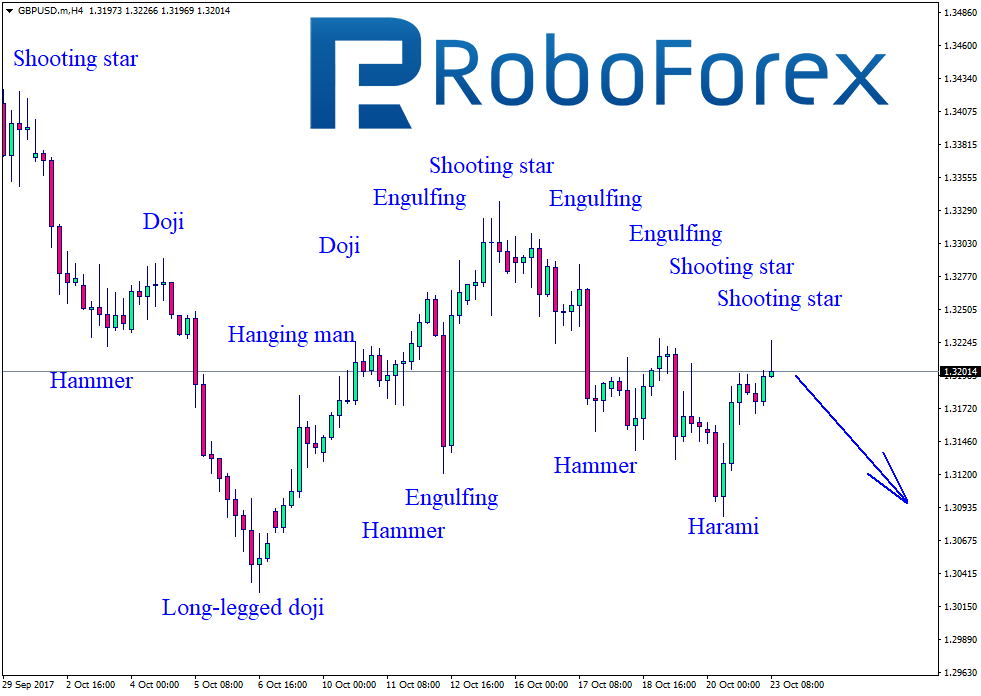
At the H4 chart, after being corrected to the upside, the GBP/USD pair continues falling and forming Engulfing, Doji, Hammer, and Shooting Star reversal patterns to define the borders of the channel. By now, the price has completed another correction towards the resistance level at 1.3215 and formed another Shooting Stat pattern. The downside target is the support level at 1.3046.

GBPUSD


XAU USD, “Gold vs US Dollar”

At the H4 chart, the instrument formed the ascending channel with Engulfing and Shooting Star patterns to define its borders. Later, the price tested the resistance level at 1305.00 and started falling. After another correction, the pair rebounded from the resistance level at 1290.00 with Engulfing and Doji patterns, broke the support level at 1277.50, and then continued falling. The downside target is still the support level at 1268.43.

GOLD


Article By RoboForex.com

Attention!
Forecasts presented in this section only reflect the author’s private opinion and should not be considered as guidance for trading. RoboForex LP bears no responsibility for trading results based on trading recommendations described in these analytical reviews.
The Xi Decade: New Thought for the New Era

By Dan Steinbock

In the Xi decade, Chinese transition to the post-industrial society will accelerate, despite the new normal in the world economy.

As the 19th National Congress of the Communist Party of China opened in Beijing, General Secretary Xi Jinping delivered a report about “building a moderately prosperous society” for a new era.

In his speech, Xi delivered a blueprint for China’s development for the next 5-15 years. In the process, he defined new thought for a new era.

Legacy of industrialization

In the 1980s, Deng Xiaoping launched the economic reforms and opening-up policies that created the foundation for Chinese revival. Jiang Zemin’s “Three Represents” opened the Party to more people, including business people. In turn, Hu Jintao’s “scientific development concept” sought to crystallize the key aspects of the quest for a harmonious society through development.

Nevertheless, these doctrines rested on the foundation of Deng’s legacy of industrialization, which had first been ignited in Mao’s 1950s and re-ignited with the 1960s “Four Modernizations” in agriculture, industry, defense as well as science and technology.

But it was Deng’s tough execution that finally enabled industrial revolution to take off in China, starting from the 1st-tier megacities in the coastal regions.

The progress has been stunning. In 1980, Chinese GDP per capita, adjusted to purchasing parity, was barely 2.5 percent of the U.S. per capita income. When Xi became CCP’s General Secretary in 2012, Chinese per capita income had increased tenfold to 23 percent of the US per capita income.

That was the old China of investment and net exports; China as the “world factory” of low costs and cheap prices. But it was also China of overcapacity and local debt; China that grew with foreign capital and domestic imitation, amid deep income polarization and great damage to the environment.

That would all change in the Xi era. From Deng to Hu, Chinese policies built on industrialization. In the Xi decade, these policies are driving transition to the post-industrial society.

Roadmap to post-industrial society

In the past half a decade, China has begun a massive rebalancing of the economy toward innovation and consumption. The new China is represented by rising costs and prices, but also by more indigenous innovation and premium domestic brands.

It is China of supply-side reforms and restructuring, painful but necessary transitions across industry sectors and geographic regions, particularly in the Northeast’s “Rust Belt.” It is China where excessive debt is no longer sanctioned and where deleveraging has begun.

In the Xi decade, development is not seen as a win-lose struggle between man and nature, but as a quest for an ecological civilization that China promotes through the Paris Accord – with or without the Trump administration.

In the new China, prosperity is no longer seen as the conspicuous privilege of few, but as the moderate goal for many. It is a nation in which the Chinese Dream means a moderately prosperous society and the eradication of poverty.

The new China is a strong sovereign state that will never again allow internal disintegration or foreign intrusions. That highlights the importance of the rule of law, and the struggle against corruption by both “tigers and flies” – the only effective way to put people first.

In Xi’s China, direct investment is no longer a foreign monopoly. Now Chinese capital is moving across borders and contributing to modernization not just in China and emerging Asia – but increasingly across the world.

China’s new international role

Internationally, the new China promotes more inclusive global governance creating institutions that look more like the world they pledge to serve. If the US-led Bretton Woods, Marshall Plan and North American Treaty Organization (NATO) defined the divisions of the Cold War; China promotes international cooperation, assistance and peaceful development in the 21st century.

Today, globalization proceeds through the One Belt and One Road (OBOR) initiative, supported by the BRICS New Development Bank (NDB) and the Asian Infrastructure Investment Bank (AIIB); multilateral development banks that represent the interests of emerging and developing nations – not just those of advanced economies.

As the new Xi roadmap will be executed across China, per capita income could climb to 35 percent of the US per capita income in 2022. In relative terms, that corresponds to US living standards in the early 1990s and those in Western Europe in late 90s. In advanced economies, such progress took two centuries; in China, just four decades.

That’s the China Xi envisioned in his speech last Wednesday. That’s his Chinese Dream – one that we all will know better by the early 2020s.

About the Author:

Dr Dan Steinbock is the founder of Difference Group and has served as research director at the India, China and America Institute (USA) and visiting fellow at the Shanghai Institutes for International Studies (China) and the EU Center (Singapore). For more, see http://www.differencegroup.net/ 

The original version was released by China Daily on October 22, 2017


EURUSD: correction expected via a new low

By Gabriel Ojimadu, Alpari

Previous:

On Friday the 20th of October, trading on the euro/dollar pair closed down. The dollar launched on attack on all fronts following the news that the US Senate had approved the 2018 budget. The single currency came under added pressure from the uncertainty surrounding Catalonia as well as a slide on the euro/pound cross.

The pound was given a boost against the euro following the announcement from European Council president Donald Tusk that the EU heads of state had approved preparations for the second stage of Brexit negotiations.

In the US session, the euro dropped to 1.1763. During Monday’s Asian session, sellers shifted the minimum to 1.1751.

Day’s news (GMT+3):

  • 24h New Zealand – Labour Day;
  • 08:00 Japan: leading economic index (Aug), coincident index (Aug);
  • 10:00 Eurozone: ECB’s Praet speech;
  • 13:00 Germany: German Buba monthly report;
  • 13:00 UK: CBI industrial trends survey (Oct);
  • 15:30 Canada: wholesale sales (Aug);
  • 15:30 USA: Chicago Fed national activity index (Sep);
  • 17:00 Eurozone: consumer confidence (Oct).

Fig 1. EURUSD rate on the hourly. Source: TradingView

Friday’s expectations of a drop on the euro to the 67th degree came off in full. On Monday, during trading in Asia, the rate dropped to 1.1751. The price’s slide stopped at around the 90th degree. 1.1722 marks a potential reversal level.

Considering that on Friday, the euro fell against the dollar all day, I’m expecting Monday’s candlestick to close up. The Catalonian crisis may deter traders from buying the euro. The Catalonian parliament is expected to announce a meeting date on which to issue a formal declaration of independence.

Since the Stochastic is up, and there aren’t any bullish divergences on the AO (with volume), today’s forecast expects a renewal of the Asian low at 1.1738. If you read the idea on the euro/pound cross, you’ll see that the euro could remain under pressure until the end of November this year.

A flat below 1.1785 would be good for sellers. In order for buyers to bring more bulls into the game, they need to push the price up higher than 1.1823 today. Could this happen on Monday? Yes, it could. Keep an eye on the news in Spain. If Catalonia doesn’t declare independence, the euro will rise across the board.

At the moment, the euro is trading up against just the yen. The yen reacted to Japanese Prime Minister Shinzo Abe’s election victory with a drop.

10 Reasons Trading Forex is Better than Trading Penny Stocks

By Adinah Brown

· Currencies are mostly traded out of necessity for transaction and funding purposes while penny stocks are almost always traded for speculation. The main forex pairs are less exposed to currency manipulation while the price of small cap company shares can be manipulated internally (pump and dump scams) and externally (rumour, failed takeover attempts). The real value of a stock is often hidden to speculators and there may be middlemen.

· Although penny stocks can double in price in a single day, they can also go the other direction. In fact, penny stocks can go to zero and they often do without the speculator being offered the opportunity to cut losses. Currencies usually only move within 1% either direction in a single day though misuse of leverage cancels out this advantage. Stop losses can be easily placed trading currencies.

· Only 50% of small businesses survive their fifth year in business and are heavily subject to business cycles. In contrast, currencies almost never go to zero and speculators holding losing currency positions often just wait it out until the market turns in the favor. Although an overnight premium may be paid, it can be received as well. Even if a currency speculator gets it wrong, there are strategies available to rectify the situation.

· While penny stocks suffer from a lack of public information and only those ‘really in the know’ have the key to accurate valuation estimates, there is a world of information applicable to currency pairs.  Trading strategies, technical indicators, economic data, market sentiment, fundamental indicators, expert analysis and so on can be called upon to predict currency direction. For novices it’s easier to bet on the direction of an economy, rather on the direction of an unfamiliar company.

· While currency markets are generally not regulated, credible forex brokers usually are. On the other hand, a stock broker recommending a penny stock might receive a commission kickback. Retail brokers receive no such kickbacks and generally don’t make trading recommendations. Additionally, online broker trading fees are also highly competitive. Stockbroker fees are substantial and take a large chunk out of profitable trade.

· Although margin lending can be accessed for trading penny stocks, a much higher amount of leverage can be accessed to trade currencies. You can trade currencies with as little as $100. Penny stocks may require more capital. Disclaimer: leverage can work both ways and misuse of it can lead to substantial losses.

· Trading penny stocks can be a painfully uneventful experience. A trader may have to wait weeks before the price of a stock moves up a cent. On the other hand, currency pairs are always moving with massive amounts of liquidity pushing the price in either direction. It may be more fun trading currencies but it can also be more stressful. Disclaimer: The author recommends holding currencies for days/weeks (and carry trading, not day trading).

· You can buy or sell a currency pair easily based on a prediction that the price may go up or down. It’s very hard to short penny stocks.

· You can trade currencies in all economic, geopolitical and financial environments. You can only really buy penny stocks in bull markets. Importantly, if a stock market tanks suddenly, the penny stocks listed on it will be steamrolled. Therefore, timing the business cycle is as important as picking the right stock.  Currency markets are also open 24/5.

· Due to the competitive environment for online forex brokers there are many competitions and offers available. Cash back rebates are also a clever way to receive a payment based on the volume of your trading. Penny stock trading doesn’t offer any such enticements.

With stocks extremely overvalued, geopolitical concerns, Fed unwinding of QE and concerns the business cycle is nearing an end, trading forex may be a good way to find a return in an era of extremely low yield.

About the Author:

Adinah Brown is a professional writer who has worked in a wide range of industry settings, including corporate industry, government and non-government organizations. Within many of these positions, Adinah has provided skilled marketing and advertising services and is currently the Content Manager at Leverate.


Forex Technical Analysis & Forecast 23.10.2017 (EUR/USD, GBP/USD, USD/CHF, USD/JPY, AUD/USD, USD/RUB, GOLD, BRENT)

Article By RoboForex.com

EUR USD, “Euro vs US Dollar”

The EUR/USD pair is consolidating and forming another descending structure to reach 1.1724. Possibly, today the price may reach the above-mentioned level and then start a new correction towards 1.1801. After that, the instrument may resume falling to break 1.1724. The local target is at 1.1650.

UERUSD


GBP USD, “Great Britain Pound vs US Dollar”

The GBP/USD pair has completed the descending wave and right now is being corrected towards 1.3214. Later, in our opinion, the market may fall to reach 1.3000, test 1.3115 from below, and then continue falling inside the downtrend with the target at 1.2820.

GBPUSD


USD CHF, “US Dollar vs Swiss Franc”

The market was opened with the gap this morning and the USD/CHF pair broke 0.9836 upwards. Possibly, the price may grow to reach 0.9837 and then start consolidating. If later the instrument breaks this range to the upside, the market may reach 0.9930; if to the downside – start another correction with the target at 0.9768.

USDCHF


USD JPY, “US Dollar vs Japanese Yen”

The USD/JPY pair has chosen an alternative scenario and right now is forming another ascending wave. We think, today the price may test 113.17 and then form another ascending structure to reach 115.00. After that, the instrument may fall with the target at 111.24.

USDJPY


AUD USD, “Australian Dollar vs US Dollar”

The AUD/USD pair has broken its consolidation range to the downside. Possibly, the price may fall and form the fifth wave to reach 0.7707. The local target is at 0.7749.

AUDUSD


USD RUB, “US Dollar vs Russian Ruble”

The USD/RUB pair is trading below 57.54 and may continue the correction to reach 57.86. Later, in our opinion, the market may continue falling inside the downtrend towards the local target at 56.65.

USDRUB


XAU USD, “Gold vs US Dollar”

Gold has broken 1279.60 downwards. Possibly, today the price may fall to break 1268.40 and then continue falling with the target at 1253.00.

GOLD


BRENT

Brent is forming another ascending structure. We think, today the price may grow to break 58.26. the local upside target is at 59.00. After that, the instrument may be corrected towards 57.40 and then start another growth to reach 59.50.

BRENT


RoboForex Analytical Department

Article By RoboForex.com

Attention!
Forecasts presented in this section only reflect the author’s private opinion and should not be considered as guidance for trading. RoboForex LP bears no responsibility for trading results based on trading recommendations described in these analytical reviews.

“Buy and Hold” … and Investing is Easy

By Elliott Wave International


3 Videos + 8 Charts = Opportunities You Need to See.

Join this free event hosted by Elliott Wave International and you’ll get a clear picture of what’s next in a variety of U.S. markets. After seeing these videos and charts you will be ready to jump on opportunities and sidestep risks in some major markets. This free report (a $29 value) will present a unique outlook and give you a new perspective on the markets you won’t get anywhere else.

Get your FREE report now – for a limited time!

This article was syndicated by Elliott Wave International and was originally published under the headline “Buy and Hold” … and Investing is Easy. EWI is the world’s largest market forecasting firm. Its staff of full-time analysts led by Chartered Market Technician Robert Prechter provides 24-hour-a-day market analysis to institutional and private investors around the world.

COT Report: US Dollar bets up for 3rd week. Crude, Metals bet go higher

By CountingPips.com

Here is a short summary and this week’s links (below) to the latest Commitment of Traders changes.

– US Dollar Speculators reduced USD bearish positions for 3rd week

– WTI Crude Oil Speculator bets rebounded after 2 down weeks, still above +400,000 contracts

– 10-Year Note Speculators pared bullish bets for 4th week to lowest level since April 18th

– Gold speculators slightly boosted bullish bets after 4 down weeks

– Large S&P500 Speculator bets turned into a very small bullish position

 Silver Speculator bets rose after 4 down weeks

– Copper Speculators boosted bullish bets higher for 3rd week to above the +50,000 level


Forex Speculators reduced US Dollar bearish positions for 3rd week

US Dollar net speculator positions leveled at $-12.65 billion as of Tuesday

The latest data for the weekly Commitment of Traders (COT) report, released by the Commodity Futures Trading Commission (CFTC) on Friday, showed that large traders and currency speculators cut back on bearish bets of the US dollar again last week. See full article


WTI Crude Oil Speculators advanced bullish net positions after 2 down weeks

The non-commercial contracts of WTI crude futures totaled a net position of 429,525 contracts, according to data from last week. This was a lift of 12,464 contracts from the previous weekly total. See full article


Gold Speculators edged bullish net positions higher, 1st rise in 5 weeks

The large speculator contracts of gold futures totaled a net position of 200,724 contracts. This was a weekly advance of 612 contracts from the previous week. See full article


10-Year Note Speculators sharply cut bullish net positions for 4th week

The large speculator contracts of 10-year treasury note futures totaled a net position of 106,291 contracts. This was a weekly reduction of -86,315 contracts from the previous week. See full article


S&P500 Speculators edged their net positions slightly higher this week

The large speculator contracts of S&P 500 futures totaled a net position of 336 contracts. This was a rise of 457 contracts from the reported data of the previous week. See full article


Silver Speculators added to bullish net positions for 1st time in 5 weeks

The non-commercial contracts of silver futures totaled a net position of 63,915 contracts, according to data from last week. This was a weekly gain of 4,807 contracts from the previous totals. See full article


Copper Speculators sharply boosted bullish net positions this week

The large speculator contracts of copper futures totaled a net position of 51,487 contracts. This was a weekly boost of 10,749 contracts from the data of the previous week. See full article


Article by CountingPips.com

The Commitment of Traders report data is published in raw form every Friday by the Commodity Futures Trading Commission (CFTC) and shows the futures positions of market participants as of the previous Tuesday (data is reported 3 days behind).

To learn more about this data please visit the CFTC website at http://www.cftc.gov/MarketReports/CommitmentsofTraders/index.htm