Author Archive for InvestMacro – Page 483

Ichimoku Cloud Analysis 25.10.2017 (AUD/USD, NZD/USD, USD/CAD)

Article By RoboForex.com

AUD USD, “Australian Dollar vs US Dollar”

The AUD/USD pair is trading at 0.7714; the instrument is still moving below Ichimoku Cloud, which means that it may continue falling. We should expect the price to test Tenkan-Sen and Kijun-Sen at 0.7760 and continue moving downwards to reach 0.7640. However, the scenario that implies further decline may be cancelled if the price breaks the upside border of the cloud and fixes below 0.7815. In this case, the pair may continue growing towards 0.7890.

AUDUSD


NZD USD, “New Zealand Dollar vs US Dollar”

The NZD/USD pair is trading at 0.6982; the instrument is still moving below Ichimoku Cloud, which means that it may continue falling. We should expect the price to test Tenkan-Sen and Kijun-Sen at 0.6950 and then continue moving downwards to reach 0.6810. However, the scenario that implies further decline may be cancelled if the price breaks the upside border of the cloud and fixes above 0.7065. In this case, the pair may continue growing towards 0.7150.

NZDUSD


USD CAD, “US Dollar vs Canadian Dollar”

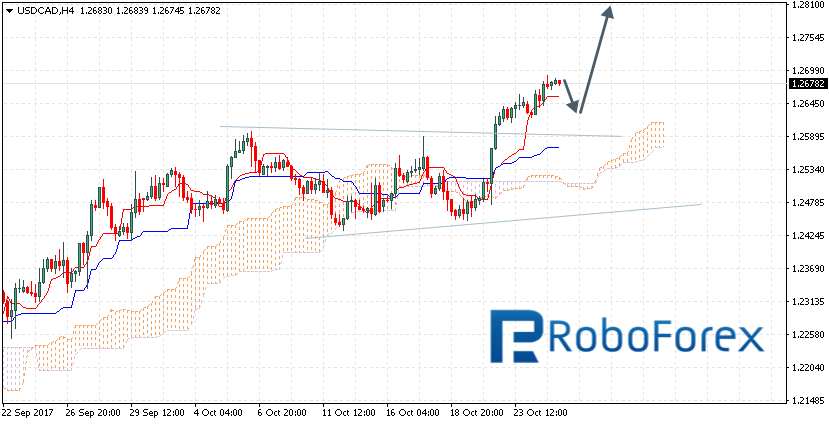
The USD/CAD pair is trading at 1.2678; the instrument is still moving above Ichimoku Cloud, which means that it may continue growing. We should expect the price to test Tenkan-Sen and Kijun-Sen at 1.2620 and then continue moving upwards to reach 1.2810. However, the scenario that implies further growth may be cancelled if the price breaks the downside border of the cloud and fixes below 1.2530. In this case, the pair may continue falling towards 1.2450.

USDCAD


RoboForex Analytical Department

Article By RoboForex.com

Attention!
Forecasts presented in this section only reflect the author’s private opinion and should not be considered as guidance for trading. RoboForex LP bears no responsibility for trading results based on trading recommendations described in these analytical reviews.

The Bitcoin Gold hard fork has taken place

By Veselin Petkov, Alpari

A new cryptocurrency was created today via a hard fork on the Bitcoin blockchain. Bitcoin Gold (BTG) was created after block 491,407. Below is a table comparing the key splits that have occurred (or will occur) in the Bitcoin (BTC) blockchain, including the newly created Bitcoin Gold:

According to the table, the supply of BTG is limited to 21 million units; the same as Bitcoin, Bitcoin Cash, and the potential SegWit2x split.

Bitcoin Gold will use a different proof of work algorithm to the original bitcoin. While bitcoin uses the SHA-256 algorithm, BTG will employ an algorithm called Equihash. Bitcoin Gold developers and enthusiasts see this as the new currency’s main improvement over the original bitcoin. The Bitcoin Gold website claims that the use of Equihash will allow any user from around the world to mine the cryptocurrency using a standard GPU (graphics processing unit). They further claim that this will help to decentralise and democratise the mining process, making the system’s infrastructure more sustainable and more in line with what Satoshi Nakamoto originally envisioned.

Bitcoin Gold’s block size will remain at its current level of 1MB, i.e. the same as that of the original bitcoin. New block will be created every 10 minutes on average (again, same as bitcoin). However, the difficulty of creating the next block will be revised after every individual block, as opposed to every 2 weeks on the Bitcoin network.

It’s important to note that a lot of cryptocurrency enthusiasts are sceptical about the Bitcoin Gold split. One subject of debate is that the Bitcoin Gold codebase contains a prerequisite of 8,000 blocks (100,000 BTG). This is evidenced by information that appeared on a cryptocurrency forum:

I don’t know how accurate this information is, but it’s fair to say that the current situation surrounding Bitcoin Gold is uncertain. It’s because of this that several exchanges have stated that they won’t be supporting the new currency, including the US-based Bittrex. While Bittrex did say that all its clients with a bitcoin balance would be credited with an equal balance in BTG, there’s no guarantee that BTG will be made available for trading.

Bitcoin Gold is expected to go live on the 1st of November. In my view, this split has yet to have much of an effect on the original bitcoin. Much more important for the cryptocurrency market is the proposed SegWit2x hard fork that is currently pencilled in for the 16th of November.

Fibonacci Retracements Analysis 25.10.2017 (GOLD, USD/CHF)

Article By RoboForex.com

XAU USD, “Gold vs US Dollar”

At the H4 chart, the XAU/USD pair is forming a new descending impulse, which has already corrected the previous uptrend by 76.0%. The next downside target may be the local low at 1260.60. if the price breaks it, the instrument may move towards the post-correctional extension area between the retracements of 138.2% and 161.8% at 1243.30 and 1232.74 respectively.

GOLD1

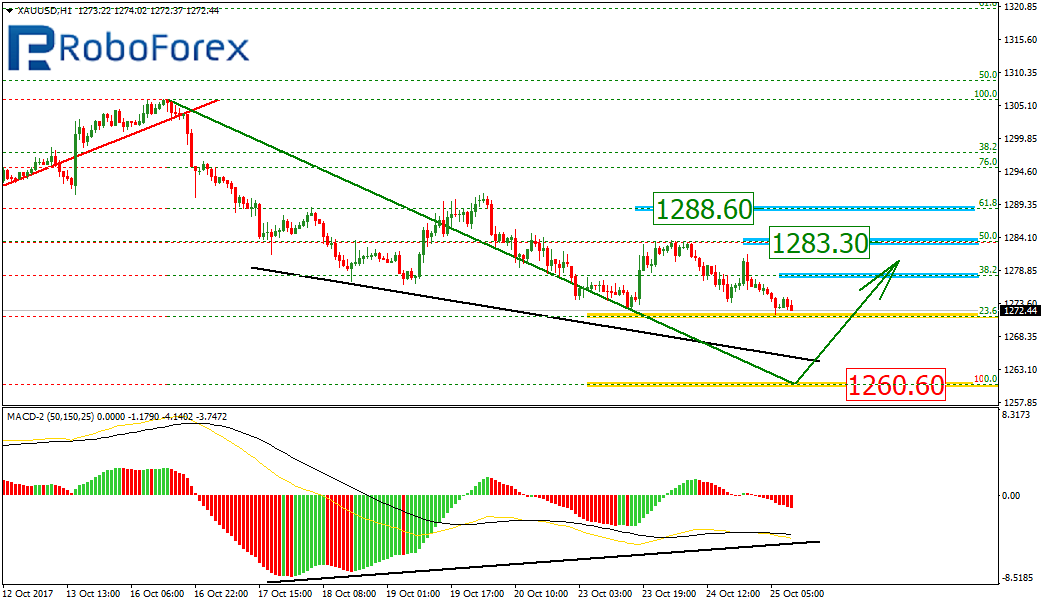
As we can see at the H1 chart, the pair is trading towards 1260.60. At the same time, the convergence is being formed, which may indicate a reverse to the upside. The main targets of this possible uptrend are the retracements of 50.0% and 61.8% at 1283.30 and 1288.60 respectively.

GOLD2


USD CHF, “US Dollar vs Swiss Franc”

As we can see at the H4 chart, the USD/CHF pair has already been corrected to the upside by 50.0% and may continue growing towards the retracements of 61.8% at 0.9990. The divergence that is being formed at the moment may indicate a possible correction after the price reaches its target. The closest targets of this possible correction will be the retracements of 23.6% and 38.2% at 0.9857 and 0.9774 respectively.

USDCHF1

At the H1 chart, the closest target of the uptrend is the retracement of 261.8% at 0.9957. The divergence, which is being formed right now, may show a possible correction to the downside with the target in the area between the retracements of 23.6% and 61.8% at 0.9904 and 0.9821 respectively.

USDCHF2


RoboForex Analytical Department

Article By RoboForex.com

Attention!
Forecasts presented in this section only reflect the author’s private opinion and should not be considered as guidance for trading. RoboForex LP bears no responsibility for trading results based on trading recommendations described in these analytical reviews.

EURUSD: 1.1730 likely to be tested again

By Gabriel Ojimadu, Alpari

Previous:

On Tuesday the 24th of October, trading on the euro/dollar pair closed up. The euro rose along with the dollar thanks to high demand for it on the crosses, but still ended up losing the ground it gained by the end of the session. The euro dropped from a session high of 1.1793 to 1.1758.

Pressure on the euro increased after news that Republican Party senators favour John Taylor (an advocate of high interest rates) for the post of Federal Reserve Chair. US 10Y bond yields jumped by 0.022 on this news to reach 2.427%.

Day’s news (GMT+3):

  • 11:00 Germany: IFO business climate (Oct), IFO expectations (Oct);
  • 11:30 UK: GDP (Q3), BBA mortgage approvals (Sep);
  • 15:30 USA: durable goods orders (Sep);
  • 16:00 USA: housing price index (Aug);
  • 17:00 Canada: BoC interest rate decision, BoC rate statement;
  • 17:00 USA: new home sales (Sep);
  • 17:30 USA: EIA crude oil stocks change (20 Oct);
  • 18:15 Canada: BoC press conference.

Fig 1. EURUSD rate on the hourly. Source: TradingView

Despite the fact that all the majors lost ground against the dollar yesterday, the euro/dollar pair closed up. My expectations of a correction rang true. The price missed the 1.18 mark by 7 pips.

Today, the situation is ambiguous. I’ve given a lot of thought as to whether the euro will rise or fall today. The thing is that the hourly cycles and intraday patterns with a 120-hour window indicate a rising euro, while the older timeframes point towards a decline.

The euro enjoyed increased demand yesterday on expectations that the ECB will announce a reduction in its QE program on Thursday. This is exactly what’s been throwing me off. In the end, I’ve gone for a decline for the euro based on the older timeframes and on the fact that the Aussie dollar is falling after the publication of Australian inflation data. The Aussie dollar could drag some other currencies down with it today. It’ll be interesting to see traders’ reaction to the UK’s GDP figures for Q3. The euro/pound cross could cause some unpredictable fluctuations on the euro/dollar pair.

The drop won’t happen if the TR trend line gets broken. On the current hour, it’s running through 1.1763.

The 5 Countries That Could Push Oil Prices Up

By OilPrice.com

Oil prices appear to be stuck in the $50s per barrel, but that doesn’t mean there aren’t serious supply risks to the market.

An unexpected disruption could occur at any moment, as has happened in the past, leading to a sudden and sharp jump in prices. Geopolitical tension has been largely irrelevant since the collapse of oil prices in 2014, but it’s making a return now that cracks have emerged in some key oil-producing nations. The threat of an outage will carry more weight as the oil market tightens.

“The ‘Fragile Five’ petrostates—Iran, Iraq, Libya, Nigeria and Venezuela—continue to see supply disruption potential, with northern Iraq crude exports at risk due to an escalation of tensions between the (Kurdistan Regional Government), Baghdad and Turkey, while the United States has decertified the 2015 Iran nuclear deal,” U.S. bank Citi said.

Indeed, five prominent oil-producing nations are beset with challenges, for varying reasons, all of which could spring a surprise on the oil market without any advanced notice.

Iraq. The most near-term supply risk comes from Iraq. The surprise seizure of Kirkuk’s oil fields by the Iraqi government has already disrupted some oil shipments. The Bai Hassan and Avana oil fields near Kirkuk remained shut as of October 19, keeping at least 275,000 bpd offline. The outages are expected to be temporary; a source told Reuters last week that they’re seeking certain equipment to bring the fields back online. An agent at the Turkish port of Ceyhan—the destination for Iraq’s northern oil exports—told Bloomberg that flows fell to 196,000 bpd as of October 19, implying an outage of about 400,000 bpd. Iraq represents the most obvious near-term threat to global supplies, but because the bulk of the country’s output is located in the south, far from the unrest, the potential outage is likely capped at 600,000 bpd, and would probably be temporary.

Iran. This one’s probably the biggest question mark on this list, and is in a much stronger position than its more fragile peers. The danger to Iran is a return of U.S. sanctions, which are by no means a given. Even then, it’s unclear if the U.S. has the ability to curtail Iranian oil exports. It might scare away new investment, but even U.S. Secretary of State Rex Tillerson went to lengths recently to assure European officials that it wouldn’t block business between European companies and Iran. Goldman Sachs estimates that in a relatively worst-case scenario of a return of U.S. sanctions, a few hundred thousand barrels of oil exports would be at risk—not the more than 1 mb/d of disrupted exports due to sanctions before the nuclear deal. At this point, though, potential outages are too hypothetical to be taken seriously. Iran probably won’t pose a supply risk to the market, at least not this year.

Libya. The North African OPEC member was exempted from the OPEC deal, and for much of the past year has represented a downside risk to oil prices, not an upside one. That is because it has nearly tripled its output from about 300,000 bpd in August 2016 up to about 850,000 bpd currently, down a bit from a recent peak at over 1 mb/d. But damage to some export terminals likely means that near-term production has a ceiling at about 1.25 mb/d, meaning Libya won’t be able to bring output back to pre-war levels of 1.6 mb/d. But because current output is now taken for granted and already baked into global pricing calculations, Libya now represents a supply risk to the market because an outage is entirely realistic due to ongoing instability. The country is nearing its ceiling for production, while there’s plenty of room for it to fall back.

Nigeria. The story here is similar to Libya. It was also exempted from the cuts because violence and instability previously knocked a sizable portion of output offline. But Libya’s restoration of output coincided with a similar reduction in violence in the Niger Delta. A ceasefire brought calm for much of the past year, allowing production to rebound from a low point of 1.2 mb/d last year, back up to 1.8 mb/d currently. Potential for further output gains is probably limited, not least because the country promised to limit production when it hit 1.8 mb/d. Meanwhile, peace in the Niger Delta remains fragile, and reports that militants have grown frustrated with the pace of talks with the government raises concerns about a return to violence. The rebound in Nigerian production is not assured.

Venezuela. The unfolding implosion of Venezuela almost ensures that more of the country’s oil production will erode, perhaps at a quickening pace. As of September, Venezuela only produced 1.89 mb/d, down from 3.2 mb/d in the late 1990s, but also down from nearly 2.4 mb/d as recently as 2015. Without cash, state-owned PDVSA can’t invest in new production and can’t even invest in maintenance to keep existing production from falling. Reports have surfaced suggesting that even the oil that is produced is suffering from declining quality, as PDVSA doesn’t have the means to properly treat its heavy crude. Worse, with huge debt payments coming due in the next few weeks, a debt default is possible. All of this adds up to a further deterioration in the country’s oil output.

Link to original article: https://oilprice.com/Geopolitics/International/The-5-Countries-That-Could-Push-Oil-Prices-Up.html

By Nick Cunningham for Oilprice.com


Stock Market Optimism Approaches Days of Roman Empire

Investors are placing a stock market bet of record degree

By Elliott Wave International

If there’s ever been a time to resist the impulse to follow the investing crowd, now is that time. Large speculators are making a bet that’s four times larger than what they made in January 2008. Take a look at this chart.


Learn to Use Extremes in Optimism to Time Your Investments Better

In this 14-minute video, you’ll learn how to combine Elliott wave analysis with extremes in market sentiment to reliably anticipate turning points in the markets. EWI Chief Market Analyst Steve Hochberg explains using an example in gold.

Get instant access

This article was syndicated by Elliott Wave International and was originally published under the headline Stock Market Optimism Approaches Days of Roman Empire. EWI is the world’s largest market forecasting firm. Its staff of full-time analysts led by Chartered Market Technician Robert Prechter provides 24-hour-a-day market analysis to institutional and private investors around the world.

China and Ratings Agencies’ Double Standards

Or why is China being penalized for its debt problem, but advanced economies aren’t?

By Dan Steinbock    

Today, rising debt is one of China’s key challenges. Recently, it led to the mainland’s rating cut by ratings agencies. Yet, many advanced economies have higher credit ratings than China, though their leverage ratios are worse.

In May 2017, Moody’s Investor Service downgraded China’s credit rating. In September, Standard & Poor’s, too, cut China’s credit rating, citing the risks from soaring debt.

Interestingly, S&P revised China’s outlook to stable from negative, although rating cuts usually go hand in hand with more negative outlook.

Like major advanced economies, China has now a debt challenge. Yet, the context is different and so are the implications.

Drivers of China’s leverage

In 2008, at the eve of the global crisis, China’s leverage – as measured by a ratio of credit to GDP – was 132 percent of the economy. Even in 2012, it was still barely 160 percent. Yet, today, it amounts to 258 percent of the economy and continues to soar. In relative terms, that’s almost twice as high as in 2008. Why has Chinese debt risen so rapidly?

Historically, the increase can be attributed to two surges. The first was the result of the $585 billion stimulus package of 2009, which supported the new infrastructure but also unleashed a huge amount of liquidity for speculation. Today, the latter is reflected by China’s excessive local government debt (whereas central government debt remains moderate).

Another sharp surge followed in 2016, which saw a huge credit expansion as banks extended a record $1.8 trillion of loans. It was driven by robust mortgage growth, despite government measures to cool housing prices. As a result, credit was growing twice as fast as the growth rate.

China’s leverage is likely to continue to rise to 288 percent of the economy by 2021. Nevertheless, the debt-taking is now slowing, which suggests that the central government’s effort to deleverage corporates has started to bite – already before the 19th Party Congress.

However, there is a degree of double-standard in China’s rating cut. Ratings agencies punch emerging economies around, but treat advanced economies with silk gloves.

High debt but privileged ratings

When China’s leverage is reported internationally, it triggers much concern about  the future. Indeed, that leverage (258% of GDP) is significantly higher than that of emerging economies overall (189% of GDP). But is the latter any longer an appropriate benchmark?

After all, most emerging nations are amid industrialization, but China is transitioning to a post-industrial society. That’s the goal of the rebalancing of the economy from investment and net exports to consumption and innovation, by around 2030.

Moreover, advanced economies’ leverage (268% of GDP) exceeds that of China. While the ratio of the US (251%) is close to that of the mainland, those of the UK (280%), Canada (296%) and France (299%) are significantly higher.

Yet, the credit ratings of these advanced economies – Canada (AAA), US (AA+), France (AA) and the UK (AA) – are substantially better than that of China (A+).

The ratings agencies appear to presume that the outlook of advanced economies is more stable than that of China. But is it?

Similar debt levels, different future prospects

In advanced economies, total debt has accrued in the past half a century; decades after industrialization. In these countries, the accrued debt is the result of high living standards that are no longer sustained by adequate growth and productivity. So leverage allows them to enjoy living standards that they can no longer afford to.

An even more interesting example is Japan in which leverage is one of the highest in the world (373% of GDP). While that rating is more than 100 percent higher than in China and continues to soar, thanks to record-low interest rates and massive monthly monetary injections, Japan’s current credit rating is A+; the same as China’s.

The context of leverage is very different in China, where excessive debt was accrued in only half a decade; not in the past half a century as in most advanced economies. Unlike the latter, different regions in China are still coping with different degrees of industrialization. Since the urbanization rate is around 56%, intensive urbanization will continue another decade or two, which will ensure solid growth prospects.

However, due to differences in economic development, Chinese living standards remain significantly lower relative to advanced economies. Nevertheless, they will double between 2010 and 2020, due to solid growth outlook and rising productivity.

Double standards

In advanced economies, debt is a secular burden; in China, it is a cyclical side-effect. Yet, China has been penalized with a lower credit rating than advanced economies, which suffer from secular stagnation and have little hope to reduce their debt.

For years, Chinese policymakers have advocated tougher measures against leverage. In late 2016, People’s Bank of China adopted a tighter monetary stance, while tightening began last May. Still tougher measures are likely to follow after the Party’s 19th Congress.

Indeed, the central government efforts to rein in corporate leverage could stabilize the prospects of downside financial risks by the early 2020s. Yet, even then credit growth will remain at levels that increase financial stress over time. What is even more problematic is that, after the next half a decade, advanced economies will face a far greater leverage distress that they will find challenging to reduce.

That’s precisely when ratings agencies’ double standards will come back haunting them as secular stagnation will only continue to deepen in advanced economies.

About the Author:

Dr Dan Steinbock is the founder of Difference Group and has served as research director at the India, China and America Institute (USA) and visiting fellow at the Shanghai Institutes for International Studies (China) and the EU Center (Singapore). For more, see http://www.differencegroup.net/ 

The original commentary was released by South China Morning Post on October 22, 2017


Fibonacci Retracements Analysis 24.10.2017 (AUD/USD, USD/CAD)

Article By RoboForex.com

AUD USD, “Australian Dollar vs US Dollar”

At the H4 chart, the AUD/USD pair is forming a new descending impulse inside the mid-term correctional downtrend. The closest target of the downtrend is the retracement of 61.8% at 0.7634. The targets of this descending impulse may inside the post-correctional extension area between the retracements of 138.2% and 161.8% at 0.7668 and 0.7629 respectively.

AUDUSD1

As we can see at the H1 chart, the pair is trading to the downside and may soon reach the retracement of 76.0% 0.7773. The next target is at 0.7733. In addition to that, the convergence is being formed, that’s why the instrument may start a new ascending correction after reaching the targets.

AUDUSD2


USD CAD, “US Dollar vs Canadian Dollar”

At the H4 chart, the USD/CAD pair is trading upwards to reach the retracements of 38.2% and 50.0% at 1.2722 and 1.2928 respectively. The support level is near the local low at 1.2064.

USDCAD1

As we can see at the H1 chart, the current ascending impulse has reached the retracement of 138.2% of the post-correctional extension area. If the price reached the retracement of 161.8% when the divergence is completed, the instrument may start a new descending correction. The main targets of this correction will be the retracements of 38.2%, 50.0%, and 61.8% at 1.2620, 1.2587, and 1.2555 respectively.

USDCAD2


RoboForex Analytical Department

Article By RoboForex.com

Attention!
Forecasts presented in this section only reflect the author’s private opinion and should not be considered as guidance for trading. RoboForex LP bears no responsibility for trading results based on trading recommendations described in these analytical reviews.

EURUSD: correction to 1.1800 in the works

By Gabriel Ojimadu, Alpari

Previous:

On Monday the 23rd of October, trading on the euro/dollar pair closed down. The rate dropped to 1.1725 during trading in Chicago. The euro fell on the back of a rising dollar and the Catalonian crisis.

The main driver for the dollar was the optimism surrounding tax reform in the US as well as Donald Trump’s announcement that he will soon nominate a candidate to head the Federal Reserve.

Day’s news (GMT+3):

  • 10:00 France: Markit services PMI (Oct), Markit manufacturing PMI (Oct);
  • 10:30 Germany: Markit services PMI (Oct), Markit manufacturing PMI (Oct);
  • 11:00 Eurozone: Markit services PMI (Oct), Markit manufacturing PMI (Oct);
  • 16:45 USA: Markit services PMI (Oct), Markit manufacturing PMI (Oct);
  • 17:00 USA: Richmond Fed manufacturing index (Oct);
  • 23:30 USA; API weekly crude oil stock.

Fig 1. EURUSD rate on the hourly. Source: TradingView

My predictions for yesterday came off in full. Sellers’ last visit to 1.1725 was one too many as now a bullish divergence has formed between the price and the AO. This is a buy signal for the euro and who knows from which level renewed sales will start.

There’s some more noise on the hourly timeframe, where traders are awaiting the results of the ECB meeting and Mario Draghi’s press conference (Thursday), as well as further developments from Madrid and Catalonia. Carles Puigdemont is set to speak in the Catalonian parliament today and offer a response to Madrid.

Since the hourly stochastic oscillator is up, my forecast has the euro dropping against the dollar to 1.1745 followed by a jump to 1.1880.

On the crosses, the euro is trading up against the dollar, franc, yen, Aussie, and Kiwi. This means that buyers have some pretty good support from them, who will most likely continue to buy during declines based on indicators on larger timeframes (4H, 6H, 8H). On the chart above, the stochastic is signaling the euro to rise for the rest of the trading session. The lower the price falls from Europe’s open, the lower the target will be for the US session.

Forex Technical Analysis & Forecast 24.10.2017 (EUR/USD, GBP/USD, USD/CHF, USD/JPY, AUD/USD, USD/RUB, GOLD, BRENT)

Article By RoboForex.com

EUR USD, “Euro vs US Dollar”

The EUR/USD pair has completed another descending wave and right now is being corrected with the target at 1.1800. After that, the instrument may resume falling to reach the local target is at 1.1650.

EURUSD


GBP USD, “Great Britain Pound vs US Dollar”

The GBP/USD pair has reached the target of the correction and right now is consolidating. If later the instrument breaks this range to the downside, the market may form another descending wave to reach 1.3008; if to the upside – continue growing with the target at 1.3298.

GBPUSD


USD CHF, “US Dollar vs Swiss Franc”

The USD/CHF pair is still consolidating above 0.9837. Possibly, today the price may grow to reach the local target at 0.9940. Later, in our opinion, the market may start another correction with the target at 0.9840.

USDCHF


USD JPY, “US Dollar vs Japanese Yen”

The USD/JPY pair is being corrected towards 113.17. After that, the instrument may grow to reach 115.00 and then start another correction with the target at 111.24.

USDJPY


AUD USD, “Australian Dollar vs US Dollar”

The AUD/USD pair has broken its consolidation range to the downside and right now is consolidating around 0.7815. We think, today the price may continue falling inside the downtrend to reach the local target at 0.7748.

AUDUSD


USD RUB, “US Dollar vs Russian Ruble”

The USD/RUB pair is trading below 57.54 and may continue the correction to reach 57.86. Later, in our opinion, the market may continue falling inside the downtrend towards the local target at 56.65.

USDRUB


XAU USD, “Gold vs US Dollar”

Gold is still consolidating around 1289. Possibly, today the price may return to 1289 to test it from below. After that, the instrument may continue falling with the target at 1252.

GOLD


BRENT

Brent is trading above 57.00. According to the main scenario, today the price may grow towards 58.30, break it, and then continue moving inside the uptrend to reach 59.50. An alternative scenario implies that the instrument may fall to reach 56.30 first and then start another growth to reach 59.50.

BRENT


RoboForex Analytical Department

Article By RoboForex.com

Attention!
Forecasts presented in this section only reflect the author’s private opinion and should not be considered as guidance for trading. RoboForex LP bears no responsibility for trading results based on trading recommendations described in these analytical reviews.