Author Archive for InvestMacro – Page 464

How To (and Not To) Navigate between US and China

By Dan Steinbock

The first 18 months of the Duterte government suggest that the effort to recalibrate the Philippines’ ties between the US and China is necessary, viable and vital.  

In the first half of the 2010s, Manila and Beijing were drifting toward a geopolitical clash. Nevertheless, former President Benigno Aquino III expected continuity to prevail under what he presumed to be the Roxas government.

Similarly, former President Obama anticipated that Hillary Clinton would be the next US president and that she would sustain his legacy in Asia.

But as I argued in the Philippines Institute for Development Studies (PIDS) in February 2016, What if Duterte would beat Roxas and Trump would win in Washington? That, I said, would change the rules of the game.

Washington’s retreat and return

After World War II, Manila cultivated close relations with Washington and supported the US through the Cold War, the War on Terror and was a major non-NATO ally.

Indeed, in the postwar era, the Philippines was seen as the most likely country to prosper in the region. And yet, during the Marcos decades and the deep ties with the US, the country fell behind the rest of Asia, despite the “People Power Revolution.”

At the time, China was focused mainly on its economic reforms and, after joining the World Trade Organization (WTO) in 2001, on its export-led growth. The latter prevailed until the global financial crisis, the Eurozone sovereign credit crisis and the rise of President Xi Jinping’s administration in the early 2010s.

Despite pledges of change, the Aquino era (2010-16) reaped only some benefits of easy catch-up growth and regional integration. Its anti-corruption struggle was not effective, the explosive drugs problem was largely neglected and poverty persisted. Worst of all, it failed to realize the economic potential of the Philippines.

Meanwhile, the Obama administration began its pivot to Asia, including the plan to move the majority of US warships to Asia Pacific by 2020. Unsurprisingly, China made its counter-moves in the region.

So President Aquino and Foreign Minister Albert del Rosario saw bilateral talks with China as futile, tried multilateral approach through the ASEAN and took the dispute to the international court, while opting for a new defense alliance with the US (2014 EDCA), which was followed by the return of the US Navy to Subic Bay.

Erosion of Manila-Beijing ties

In Beijing, the Philippines came to be seen as US military platform in Southeast Asia, with Vietnam a complement of Japan in East Asia. Washington encouraged rearmament in all three countries. In Japan, that meant the end of the pacifist postwar constitution; in the Philippines and Vietnam, rising military expenditures. In turn, US defense contractors reaped economic rents as tensions in the South China Sea drove up demand for weapons.

According to SIPRI, the US provided 90 percent of Japan’s weapons imports in 2012-16, while the Philippines started a military expansion program and increased arms imports by 426 percent from 2007 through the Aquino era.

The militarization benefited the Pentagon and some of its Western allies, but led to friction with China at precisely wrong time. As the Obama administration orchestrated its military pivot to Asia, it was alienating China, which was promoting regional financing by the BRICS New Development Bank, the Asian Infrastructure Investment Bank, and the huge One Belt One Road initiative.

The net effect? When Chinese foreign investment took off hugely in Asia, Philippines was largely bypassed. Instead, as Aquino and Rosario were struggling for what they felt were Manila’s vital sovereign interests in the region, the country grew geopolitically dependent on Washington.

Four scenarios but…

Before the 2016 Philippines election, there was real concern that the country was heading toward a confrontation with China in the South China Sea. Manila’s new defense alliance with Washington added to the distrust.

As Duterte won the election, the US Navy sent its third warship in less than seven months into the waters of the disputed South China Sea. In hindsight, such actions, which were seen as highly provocative in Beijing, probably reinforced Duterte’s determination to recalibrate ties between the US and China. But did he have any viable alternatives?

Depending on whether China and the Philippines would opt for a cooperative or assertive stance in bilateral relations, I argued that four scenarios cast a long shadow over Southeast Asia’s future at the PIDS and in the Foreign Service Institute soon after Duterte’s electoral triumph.

If Beijing refused cooperation with Manila, it would corner the Duterte government to rely even more on US security assurances. This I portrayed as a regional dead-end scenario.

Conversely, if Beijing would seek cooperation but Manila would take a back step, due to external pressure, the result would be a polarization scenario. In that case, Manila would have to lean even more on the US, while China might resort to even greater defensive measures. Both countries would lose economically.

In the third scenario, old policies would prevail, which would ensure the failure of bilateral talks, harden attitudes and increase the probability of proxy conflicts in South China Sea. That was the destabilization scenario – a costly nightmare economically and strategically, and possibly in human lives.

… Only one path to the future

The only reasonable approach, I argued then (as I did through the Aquino era), would start with a Sino-Philippines bilateral conversation that would lead to a  formal dialogue. The latter could reduce the weight of geopolitics, while supporting mutual gains in economic development. This stabilization scenario would be the most preferable economic, political and strategic trajectory for Manila, Beijing, the ASEAN and over time for Washington as well.

It is also the scenario that the Duterte government opted for, despite the alleged “Goldberg regime change plan” and the associated efforts at destabilization in the Philippines – the last relic of the Obama pivot.

Despite occasionally tough bilateral rhetoric and disagreements, peace and stability between the US and China, along with thriving bilateraL trade and investment, allows greater focus on economic development globally, particularly in broader Asia.

That’s what the Philippines needs – greater infrastructure investment for industrialization and urbanization, constitutional changes to ensure foreign investment increases by magnitude, sustained and inclusive economic growth, all of which should foster rising living standards and reduce poverty.

For the first time in decades, solid growth and economic catch-up may translate to substantial gains in the lives of ordinary Filipinos. Of course, the Duterte balancing act won’t be easy. But failure is not an option and the alternatives are worse.

About the Author:

Dr Steinbock is the founder of Difference Group and has served as research director at the India, China and America Institute (USA) and visiting fellow at the Shanghai Institutes for International Studies (China) and the EU Center (Singapore). For more, see http://www.differencegroup.net/ 

The original commentary was published by The Manila Times on December 4, 2017


Fibonacci Retracements Analysis 05.12.2017 (EUR/USD, USD/JPY)

Article By RoboForex.com

EUR USD, “Euro vs US Dollar”

As we can see at the H4 chart, the divergence was followed by a short-term correction, which has already reached the retracement of 38.2%. The next targets of this descending correction may be the retracements of 50.0%, 61.8%, and 76.0% at 1.1759, 1.1710, and 1.1652 respectively. At the same time, we should note that if the instrument breaks the local high at 1.1961, it will continue growing to update another high, which is at 1.2092.

EURUSD1

At the H1 chart, the EUR/UISD pair is trading between 1.1961 and 1.1806. If the price breaks the latter level, the instrument will fall towards 1.1759.

EURUSD2


USD JPY, “US Dollar vs. Japanese Yen”

At the H4 chart, the USD/JPY pair is forming the ascending impulse, which has already reached the retracement of 50.0%. The next upside targets may be the retracements of 61.8% and 76.0% at 113.24 and 113.78 respectively.

USDJPY1

At the H1 chart, the divergence is being formed, which indicates a short-term correction. By now, the correction has already reached the retracement of 23.6%. Later, the correction may continue towards the retracements of 38.2 and 50.0% at 112.22 and 111.96 respectively. After completing the correction, the instrument may resume growing to reach the post-correctional extension area between the retracements of 138.2% and 161.8% at 113.43 and 113.78 respectively.

USDJPY2


RoboForex Analytical Department

Article By RoboForex.com

Attention!
Forecasts presented in this section only reflect the author’s private opinion and should not be considered as guidance for trading. RoboForex LP bears no responsibility for trading results based on trading recommendations described in these analytical reviews.

Forex Technical Analysis & Forecast 05.12.2017 (EUR/USD, GBP/USD, USD/CHF, USD/JPY, AUD/USD, USD/RUB, GOLD, BRENT)

Article By RoboForex.com

EUR USD, “Euro vs US Dollar”

The EUR/USD pair is forming another consolidation range. Possibly, today the price may fall to break the downside border. The next target is at 1.1760.

EURUSD


GBP USD, “Great Britain Pound vs US Dollar”

The GBP/USD pair has completed the first descending impulse along with the correction. We think, today the price may fall to break the low of the first impulse. The local target is at 1.3363.

GBPUSD


USD CHF, “US Dollar vs Swiss Franc”

The USD/CHF pair is consolidating above 0.9830. Possibly, today the price may grow to break the upside border. The target is at 0.9930. After that, the instrument may start another correction to return to 0.9830.

USDCHF


USD JPY, “US Dollar vs Japanese Yen”

The USD/JPY pair has expanded the consolidation range t the downside. Possibly, the price may reach 112.14 and then resume growing towards the upside border. Later, in our opinion, the market may break 113.13 and then continue moving upwards with the target at 114.20.

USDJPY


AUD USD, “Australian Dollar vs US Dollar”

The AUD/USD pair is trading to expand the consolidation range upwards. The target is at 0.7661. After that, the instrument may fall towards the downside border, break 0.7551 downwards, and then continue falling with the target at 0.7452.

AUDUSD


USD RUB, “US Dollar vs Russian Ruble”

The USD/RUB pair has finished the ascending correctional wave. Possibly, today the price may start another descending wave to reach 58.30. Later, in our opinion, the market may resume growing with the target at 58.68.

USDRUB


XAU USD, “Gold vs US Dollar”

Gold is consolidating below 1277. We think, today the price may reach 1262 and then start another ascending structure towards 1277 (at least). After that, the instrument may resume falling with the target at 1250.

GOLD


BRENT

Brent is trading to the downside. Possibly, the price may reach 61.95 and then grow towards 63.30, thus forming a new consolidation channel. If later the price breaks this channel to the downside, the market may continue the correction towards 60.50; if to the upside – grow with the target at 66.20.

BRENT


RoboForex Analytical Department

Article By RoboForex.com

Attention!
Forecasts presented in this section only reflect the author’s private opinion and should not be considered as guidance for trading. RoboForex LP bears no responsibility for trading results based on trading recommendations described in these analytical reviews.

EURUSD: triangle beginning to take shape

By Gabriel Ojimadu, Alpari

Previous:

On Monday the 4th of December, trading on the euro/dollar pair closed down. The euro and the pound spent the day under the influence of political factors. Volatility was high on pairs including the pound.

After dropping during the morning hours, the pound surged 100 pips against the dollar after reports of a breakthrough in Brexit negotiations concerning the UK’s terms of exit from the EU. Accordingly, the euro came under pressure from this against the dollar via the euro/pound cross.

The pound then shed 120 pips against the dollar following a statement from European Commission President Jean-Claude Juncker. He said that they hadn’t managed to reach a final agreement with the UK and that they would try to address all issues in time for the EU leaders’ summit in mid-December. After this speech, the euro recovered from a low of 1.1829 to reach 1.1870 during today’s Asian session.

Day’s news (GMT+3):

  • 11:15 Spain: Markit services PMI (Nov).
  • 11:45 Italy: Markit services PMI (Nov).
  • 11:50 France: Markit services PMI (Nov).
  • 11:55 Germany: Markit services PMI (Nov).
  • 12:00 Eurozone: Markit services PMI (Nov).
  • 12:30 UK: Markit services PMI (Nov).
  • 13:00 Eurozone: retail sales (Oct).
  • 16:30 Canada: trade balance (Oct).
  • 16:30 USA: trade balance (Oct).
  • 17:45 USA: Markit services PMI (Nov).
  • 18:00 USA: ISM non-manufacturing PMI (Nov).

Fig 1. EURUSD hourly chart. Source: TradingView

Yesterday’s predictions came off in full. The euro dropped from the trend line and has now returned to the balance line (sma 55). This didn’t work out perfectly due to the volatility caused by political factors.

In Asia, the dollar is trading up against the pound (+0.07%) and the yen (+0.20%). On the crosses, the euro is trading down against the loonie (-0.01%) and Aussie (-0.64%). The main cross, the euro/pound, has appreciated by 0.13% to 0.8812. The price has broken out of the A-A channel. Sellers made it to the trend line, but prices closed above it, meaning the breakout wasn’t confirmed.

Considering the factors mentioned above, my forecast for Tuesday has the euro rising against the dollar to 1.1911/27. A breakout of 1.1940 will cancel the triangle formation and open the way towards 1.2090. This scenario won’t play out if the hourly candlestick closes below 1.1835.

Remember that the dollar is currently being propped up by the US Senate’s approval of the tax reform bill as well as the upcoming FOMC meeting.

Oil Will Be Led By Politics

By Dmitriy Gurkovskiy, Chief Analyst at RoboForex

The OPEC’s November decision on the extension of the agreement, which establishes strict borders and limits for the oil extracting countries, was quite logical. The agreement has been extended at least until the end of 2018. So, the main question for the nearest future is how the OPEC is going to terminate the agreement if the organization has no plan B.

On the first Monday of December, oil prices are trying to start a correction. Brent costs $63.41 (-0.5%); WTI lost 0.7% and right now is $57.98. Less than 4 weeks left until the end of the year, that’s why there are doubts that oil prices will update the highs reached this autumn.

Right now, political scandals that seem to have become a back-burner question are a key concern once again. Nobody forgot about them. We’re talking about the “Russian trail” during the 2016 electoral campaign, when Donald Trump defeated the other candidate and won the elections.

It became known that the former US National Security Advisor, Michael Flynn, is ready to provide evidence of Trump’s knowing about the contacts with Russian representatives. As a matter of fact, this is a testimony against the US President and it will put the pressure on all assets, which are risky one way or another. The Oil is one of them.

Due to this, the latest statistics on the Oil Rigs changes from Baker Hughes published last Friday didn’t attract much attention. However, it might be considered as “bearish”, because the Rig Count increased by 6 and now equals 929 units. The statistics over the last couple of months is looking rather mixed. To a certain degree, this is the reason why investors barely react to these numbers.

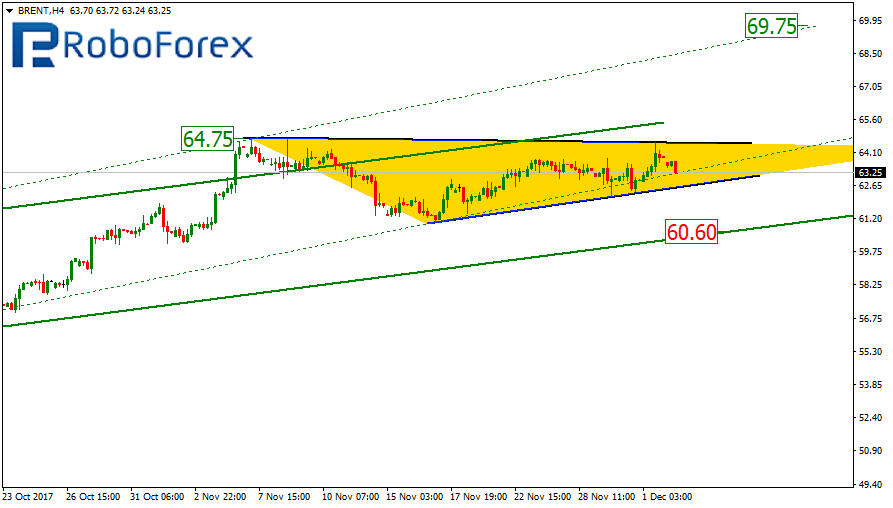
From the technical point of view, Brent is moving inside the uptrend; however, the tendency is being corrected to the downside for about a month. For form of the mid-term correctional trend looks like the Triangle pattern, which may be a short pause before further growth.

In the short-term, Brent may break the downside border of the triangle channel and the support level of the main trend. After that, the instrument is expected to rebound and start forming a new rising impulse with the main target at the current high at 64.75. If the price breaks this level, it may continue growing towards the upside border of the main trend channel close to 69.75.

Author: Dmitriy Gurkovskiy, Chief Analyst at RoboForex


Attention!

Forecasts presented in this section only reflect the author’s private opinion and should not be considered as guidance for trading. RoboForex bears no responsibility for trading results based on trading recommendations described in these analytical reviews.


Forex Technical Analysis & Forecast 04.12.2017 (EUR/USD, GBP/USD, USD/CHF, USD/JPY, AUD/USD, USD/RUB, GOLD, BRENT)

Article By RoboForex.com

EUR USD, “Euro vs US Dollar”

The EUR/USD pair is trading to the downside. Possibly, the price may reach 1.1848 and then grow towards 1.1894. After that, the instrument may fall with the target at 1.1804.

EURUSD


GBP USD, “Great Britain Pound vs US Dollar”

The GBP/USD pair is falling. We think, today the price may reach 1.3384 and then grow towards 1.4370. Later, in our opinion, the market may continue falling with the target at 1.3296.

GBPUSD


USD CHF, “US Dollar vs Swiss Franc”

The USD/CHF pair is moving upwards. Possibly, today the price may reach 0.9885 and then fall towards 0.9820. After that, the instrument may resume growing with the target at 0.9950.

USDCHF


USD JPY, “US Dollar vs Japanese Yen”

The USD/JPY pair is trading to the upside. Possibly, the price may break 112.79. The target is at 114.20. Later, in our opinion, the market may resume falling towards 112.80.

USDJPY


AUD USD, “Australian Dollar vs US Dollar”

The AUD/USD pair is consolidating above 0.7547. If later the price breaks this range to the downside, the market may fall towards 0.7496; if to the upside – grow with the target at 0.7660.

AUDUSD


USD RUB, “US Dollar vs Russian Ruble”

The USD/RUB pair is still moving upwards. Possibly, today the price may reach 58.85 and then fall to reach the downside of the consolidation range. After that, the instrument may break it and continue falling to reach the local target at 57.47.

USDRUB


XAU USD, “Gold vs US Dollar”

Gold is moving downwards. We think, today the price may reach 1268. Later, in our opinion, the market may start another ascending structure to reach 1283 and then resume falling with the target at 1262.

GOLD


BRENT

Brent is trading to the downside. Possibly, today the price may reach 63.15. After that, the instrument may be grow towards 64.69 and then resume falling with the target at 63.50.

BRENT


RoboForex Analytical Department

Article By RoboForex.com

Attention!
Forecasts presented in this section only reflect the author’s private opinion and should not be considered as guidance for trading. RoboForex LP bears no responsibility for trading results based on trading recommendations described in these analytical reviews.

Canada-China Trade Amid NAFTA Friction

By Dan Steinbock

As tensions prevail in the NAFTA talks, Canada is hedging its bets by fostering consensus for a trade agreement with China.

On Sunday, Canadian Prime Minister Justin Trudeau shall start a trade and tourism dialogue with Chinese officials during his ongoing visit to China. Canada and China began to talk about a free trade agreement (FTA) more than a year ago, following back-to-back meetings of Trudeau and Chinese Premier Li Keqiang in China and Ottawa.

While Canada completed consultations on the matter, three rounds of exploratory talks were held between the two sides from February to August.

Trudeau’s visit takes place after the fifth round of talks over the North American Free Trade Agreement (NAFTA) ended in Mexico City amid simmering tensions.

Hedging against the potential NAFTA collapse

Last year, the US bought three-fourths of Canadian exports, while Canada sourced almost two-thirds of its imports from America. US direct investment in Canada amounts to some $306 billion, while Canada’s investment in the US is almost $370 billion. But the US investment in Canada represents almost 20 percent of the latter’s GDP; while Canada’s investment in the US adds up to only 2 percent of the US’s GDP. The outcome of the NAFTA talks is thus far more important to Canada than to the US.

If the US withdraws from NAFTA, that would start a six-month legal process before official termination. While the Trump administration may see this as a negotiating tool to force Canada and Mexico to accept its demands, the latter could use the time to complete trade talks with Brazil and the European Union (EU).

Canada and Mexico are hedging their bets against a potential NAFTA collapse by pushing for deals with new partners, particularly with China and some other Asian countries.

In 2015, China bought 12 percent of Canadian exports, whereas Chinese exports accounted of 4 percent of Canadian total. A Chinese-Canadian FTA could strengthen bilateral trade and investment significantly.

Last year, the combined investment from China and Hong Kong in Canada soared to $26.4 billion, which is almost half of Asia Pacific investment in the country. But since the starting-point is low, China was only the eighth largest investor in Canada.

Canada’s former China ambassador Howard Balloch believes that Canada “should be able to negotiate with China” during the NAFTA talks. Canada has a “huge interest” in China and trade diversification whatever the outcome of the NAFTA talks.

Intriguingly, the latter are likely to coincide with the time that Canada and China would need to finalize an FTA agreement.

Political divisions, domestic support

With a population of more than 1.3 billion, China is perceived as a lucrative market for Canada’s agriculture and natural resources sectors. Last year, Trudeau’s cabinet approved the Trans Mountain pipeline expansion mainly to improve Canada’s ability to get oil to China.

However, there is an intense debate over the proposed FTA with China. While Trudeau’s Liberal Party supports greater bilateral trade, Conservative leader Andrew Scheer opposes a bilateral FTA. Relying on the “China threat” card, Conservatives have criticized the Liberals for allowing Chinese takeovers of Canadian businesses, while taking advantage of Canadian concerns about human rights and environmental standards.

What about ordinary Canadians? Asia Pacific Foundation’s polling suggests that a slight majority of 55 percent might support a Canadian-Chinese FTA, but UBC’s recent poll indicates that 70 percent of Canadians support the idea and only 20 percent are against it.

Such a shift would reflect greater economic interest in a bilateral trade deal – but also growing concern about the Trump White House, rising US protectionism and the potential NAFTA collapse.

Canada’s shift toward Asia

While US officials have sought to subdue NAFTA tensions by extending the timetable for renegotiations that may only pour oil on the simmering fire. In Mexico, tight elections in mid-2018 will complicate the NAFTA talks; in Canada, conservatives are positioning for the 2019 elections.

Nevertheless, Canada is losing its faith in the US. According to UBC, 36 percent of Canadians believe the US is a “more responsible global leader” than China (28%). Yet, 37 percent of the citizens are “uncertain” about the matter. Moreover, China is seen as doing more to “maintain peace” than the US and two-thirds of Canadians believe China will be the “largest economic power” by the 2020s.

Amid the new uncertainty, Canada is likely to do what it can to sustain NAFTA over time, while – at least under Trudeau – it is likely to seek a trade deal with China that would foster diversification, new investment at home and greater presence in Asia.

From China’s standpoint, a bilateral deal with Canada would open new doors to North America and pave way to the Free Trade Agreement of Asia Pacific (FTAAP), which would be broader and more inclusive than the current trade pact efforts.

About the Author:

The author is the founder of Difference Group and has served as research director at the India, China and America Institute (USA) and visiting fellow at the Shanghai Institutes for International Studies (China) and the EU Center (Singapore).

The original commentary was published by China Daily on December 4, 2017


Ichimoku Cloud Analysis 04.12.2017 (AUD/USD, NZD/USD, USD/CAD)

Article By RoboForex.com

AUD USD, “Australian Dollar vs US Dollar”

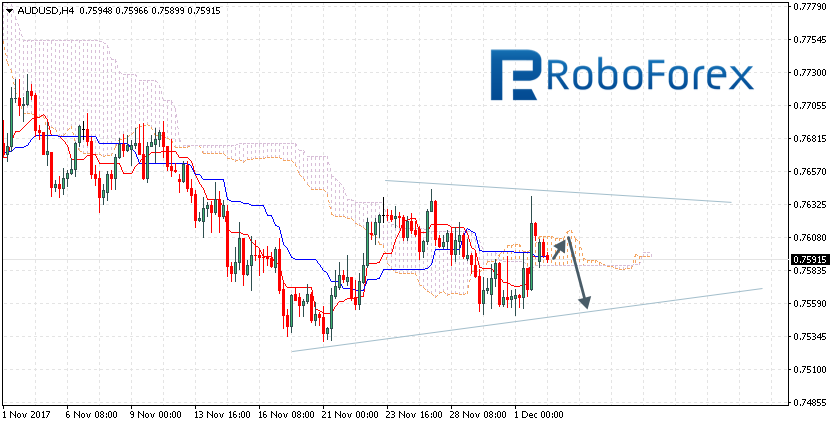
The AUD/USD pair is trading at 0.7591; the instrument is still moving inside Ichimoku Cloud, which means that it is moving sideways. We should expect the price to test the upside border of the cloud at 0.7610 and then continue moving downwards to reach 0.7560. However, the scenario that Implies further decline may be cancelled if the price breaks the upside border of the cloud and fixes above 0.7620. In this case, the pair may continue growing towards 0.7720. After breaking the downside border of the Triangle pattern and fixing below 0.7530, the price may resume falling.

AUDUSD


NZD USD, “New Zealand Dollar vs US Dollar”

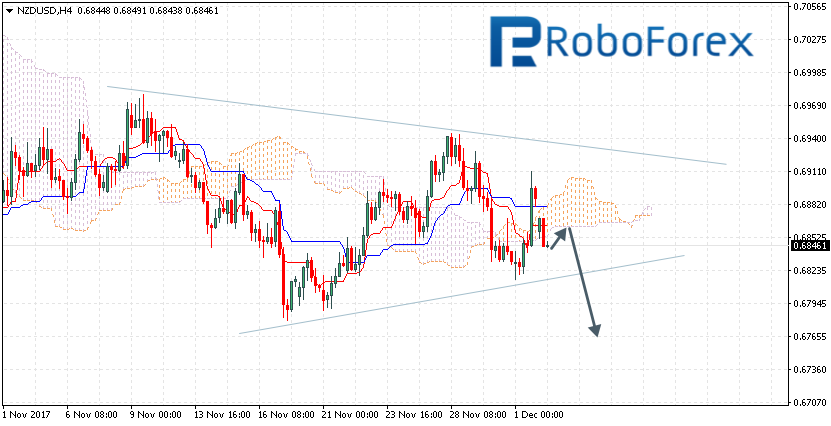
The NZD/USD pair is trading at 0.6846; the instrument is still moving below Ichimoku Cloud, which means that it may continue falling. We should expect the price to test the downside border of the cloud at 0.6830 and then continue moving downwards to reach 0.6765. However, the scenario that implies further decline may be cancelled if the price breaks the upside border of the cloud and fixes above 0.6920. In this case, the pair may continue growing towards 0.7020.

NZDUSD


USD CAD, “US Dollar vs Canadian Dollar”

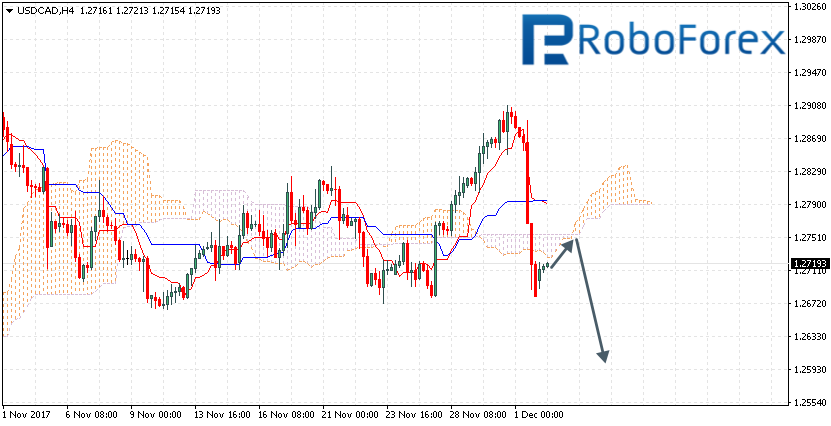
The USD/CAD pair is trading at 1.2719; the instrument is still moving below Ichimoku Cloud, which means that it may continue falling. We should expect the price to test the downside border of the cloud at 1.2740 and then continue moving downwards to reach 1.2690. However, the scenario that implies further decline may be cancelled if the price breaks the upside border of the cloud and fixes above 1.2805. In this case, the pair may continue growing towards 1.2910.

USDCAD


RoboForex Analytical Department

Article By RoboForex.com

Attention!
Forecasts presented in this section only reflect the author’s private opinion and should not be considered as guidance for trading. RoboForex LP bears no responsibility for trading results based on trading recommendations described in these analytical reviews.

EURUSD: buyers retreating to the trend line

By Gabriel Ojimadu, Alpari

Previous:

Friday’s trading on the euro/dollar pair closed slightly down. Sellers erased nearly all their gains in the US session after the news that former national security advisor Michael Flynn was ready to give testimony against Trump. The euro jumped 84 pips from 1.1851 to 1.1935. Once markets had calmed down, the euro receded to 1.1895.

Day’s news (GMT +3):

  • 12:30 UK: PMI construction (Nov).
  • 12:30 Eurozone: Sentix investor confidence (Dec).
  • 13:00 Eurozone: PPI (Oct).
  • 18:00 USA: factory orders (Oct).

Fig 1. EURUSD hourly chart. Source: TradingView

My expectations of a decline on Friday proved right, expect that before the drop, the euro the euro made it to 1.1940.

The dollar has opened up in Monday’s Asian session as traders react to the news coming out of the US buy buying dollars. US President Donald Trump on Sunday denied accusations of collusion with Russia, tweeting that Michael Flynn was fired back in February for lying both to the Vice president and FBI. The White House said that it did not feel under threat by Flynn’s admission of guilt to passing on false information to the FBI.

As the session opened, the euro dropped to 1.1856. The price had restored by 67 degrees on Friday, before dropping by the same amount today in Asia. At the time of writing, the euro is trading at 1.1868. A wedge is forming on the hourly timeframe, although it’s as yet unclear how the price will behave itself around its lower boundary.

Considering today’s opening and the bare European economic calendar, I tink the price should go towards the TR2 trend line at 1.1837. From here, I expect the euro to rise to the LB balance line (sma 55).

How to react to economic data – sit up or sell up?

By Adinah Brown

The big announcements is around the corner, and the markets sit poised, waiting. All of the analysts have an opinion on the expected announcements, the bears predicting the end of the world and the bulls predicting the beginning of glorious new highs. Everywhere you look, talking heads are predicting the direction of the market, consensuses are being put together by economists and the market is oscillating, tracking sideways on whispers and intrigue.

The news is upon us and it is time to determine what the exit strategy is. Do you sell or do you hold?

If the news is a larger, more important announcement, expect significant volatility once it is announced. There will be a lot of people in the market, and a lot of buy side and sell side activity. Volatility will increase the spreads and the chances of slippage. This factor needs to be taken into account because it cuts into profits and can potentially mean that the stop loss is missed. A large position can be a high stake game when trading an important piece of news.

One of the things that tends to happen after an announcement is a swift spike in the direction of the news. Traders quickly start to close positions to lock in profits or risk manage losses. New pending trades are executed, pushing the market further. Volume increases as new traders attempt to ride the wave. Whilst this phase is going on, contrarian traders are opening positions, ready to pounce on a wave that has overshot real value and profit from the decline. Often, a correction occurs and again traders scramble to open new positions or close losing ones. Scalpers quickly trade every move as the market reverses and swings errantly.

This phase can sometimes continue to post new lows or reverse quickly as new traders attempt to catch positions as they fall to attractive levels again. The market will often then correct itself a few times, each time reversing in smaller and smaller proportions until these converse factors play out and the new equilibrium is established.

One realistic method for trading these is price action trading. Normal lagging indicators are of no use in this market, since the movements happen too quickly to be captured by these indicators. Attempting to pick the sentiment of the market is pretty much impossible, since it is basically a trading frenzy, with trades being placed in both directions at the same time to catch whichever wave each trader thinks will net a profit. Price action trading simplifies the decision making process and allows the trader to react to the charts quickly. Long and short positions can be opened and closed quickly, locking in both the profit or preventing the loss.

Another method can be to set pending positions at a certain point that indicates an already strong movement in the profitable direction. This should be accompanied by a generous take profit and semi tight stop loss. It should also be watched carefully since the volatility could miss the close and a manual close might be needed.

For those that have positions prior to the announcement, with all the activity going on, it is best to set a generous take profit and wait to see if it is hit. If you want to hold the position for a long period, a hedge prior to the announcement or a pending hedge position might be better than a stop loss, since it allows your position to be open until you want to terminate it. This will allow you to close not only at the price point you want, but at a time when the volatility is not so high, preventing spreads from taking a significant part of your profit. It will also give you the chance to continue to hold that position, riding it to the new highs that the announcement has provided.

The decision to hold or sell ultimately depends on what you want to get out of the position. Of course, the only right answer is whatever nets you the most profit.

About the Author:

Adinah Brown is a professional writer who has worked in a wide range of industry settings, including corporate industry, government and non-government organizations. Within many of these positions, Adinah has provided skilled marketing and advertising services and is currently the Content Manager at Leverate.