Author Archive for InvestMacro – Page 463

Bitcoin’s rally is the dawn of the financial tech era – but it remains a gamble

By George Prior

Bitcoin’s rally heralds the dawn of the financial technology era, but it remains “a major gamble”, affirms the CEO of one of the world’s largest independent financial services organizations.

Nigel Green, founder and chief executive of deVere Group’s comment comes as the world’s largest cryptocurrency by market value reached a new lifetime high of $15,058 Thursday, appreciating by more than $3,000 in 36 hours.

Mr Green comments: “Bitcoin’s impressive current run continues, leaping over one psychological hurdle after another, and outstripping most previous expectations.  It has caught many experts and commentators off guard.

“The meteoric rise of Bitcoin underscores the demand and the need for digital currencies in today’s world. Bitcoin and others have identified this and are meeting those demands and needs and filling the void.”

He continues: “Whilst many Bitcoin investors are popping the champagne corks at the moment, some caution needs to be exercised too.

“Bitcoin remains a major gamble as it is very much an ‘unchartered waters’ asset – we’ve simply not experienced this before. Also, an asset that goes almost vertically up should typically raise alarm bells for investors.  In addition, many would argue that there’s limited underlying economic value.”

He adds: “But that said, the U.S. dollar is also a gamble.  America has 23 trillion in debts, so some would argue that its currency is also a risk.”

Mr Green goes on to say: “Of course, no-one knows for sure the short, medium, long-term future for Bitcoin.  But what we do know is that the blockchain technology that underpins it is revolutionary and is already changing the way the world handles money.

“This week’s rally has demonstrated without doubt that the already considerable marketplace for cryptocurrencies is growing and that it is likely to only grow at a faster pace in coming years.  As such, Jamie Dimon’s [CEO of JP Morgan] steadfast dismissal of Bitcoin is totally wrong.”

The deVere CEO concludes: “Today’s world needs cryptocurrencies. One or two of the existing ones will succeed, whether it’s Bitcoin or not remains to be seen. But the dawn of the financial technology era has arrived.”


deVere Group is one of the world’s largest independent advisors of specialist global financial solutions to international, local mass affluent, and high-net-worth clients.  It has a network of more than 70 offices across the world, over 80,000 clients and $12bn under advisement.


Ichimoku Cloud Analysis 07.12.2017 (AUD/USD, NZD/USD, USD/CAD)

Article By RoboForex.com

AUD USD, “Australian Dollar vs US Dollar”

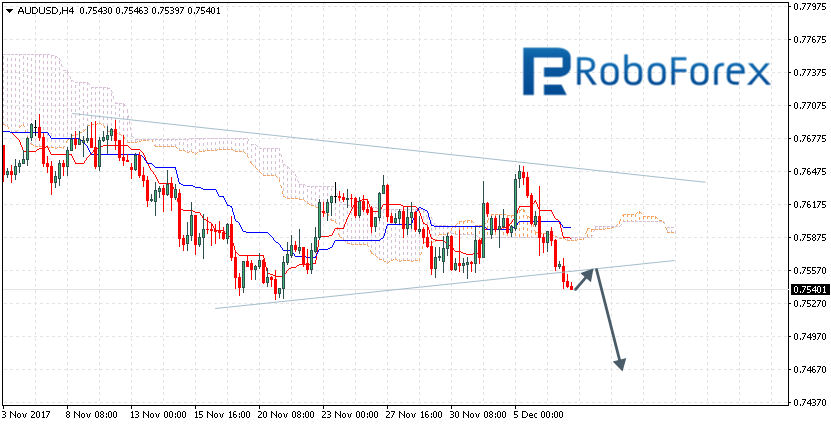
The AUD/USD pair is trading at 0.7540; the instrument is still moving below Ichimoku Cloud, which means that may continue falling. We should expect the price to test Tenkan-Sen and Kijun-Sen at 0.7560 and then continue moving downwards to reach 0.7470. However, the scenario that Implies further decline may be cancelled if the price breaks the upside border of the cloud and fixes above 0.7620. In this case, the pair may continue growing towards 0.7720. After rebounding from the downside border of the Triangle pattern, the price may resume falling.

AUDUSD


NZD USD, “New Zealand Dollar vs US Dollar”

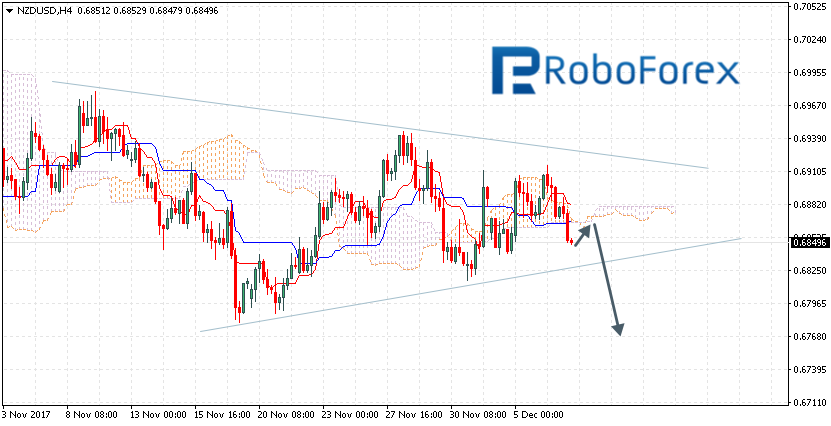
The NZD/USD pair is trading at 0.6849; the instrument is still moving inside the Triangle pattern. We should expect the price to test the broken border of the cloud at 0.6860 and then continue moving downwards to reach 0.6770. However, the scenario that implies further decline may be cancelled if the price breaks the upside border of the cloud and fixes above 0.6825. In this case, the pair may continue growing towards 0.6970. After breaking the downside border of the Triangle pattern and fixing above 0.6800, the price may resume falling.

NZDUSD


USD CAD, “US Dollar vs Canadian Dollar”

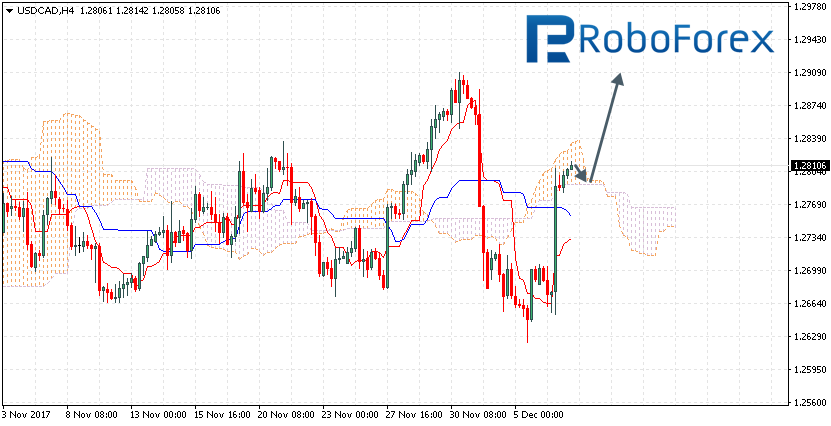
The USD/CAD pair is trading at 1.2810; the instrument is still moving inside Ichimoku Cloud, which means that it is moving sideways. We should expect the price to test the downside border of the cloud at 1.2739 and then continue moving upwards to reach 1.2900. However, the scenario that implies further growth may be cancelled if the price breaks the downside border of the cloud and fixes below 1.2770. In this case, the pair may continue falling towards 1.2660.

USDCAD


RoboForex Analytical Department

Article By RoboForex.com

Attention!
Forecasts presented in this section only reflect the author’s private opinion and should not be considered as guidance for trading. RoboForex LP bears no responsibility for trading results based on trading recommendations described in these analytical reviews.

Japanese Candlesticks Analysis 07.12.2017 (EUR/USD, USD/JPY)

Article By RoboForex.com

EUR USD, “Euro vs. US Dollar”

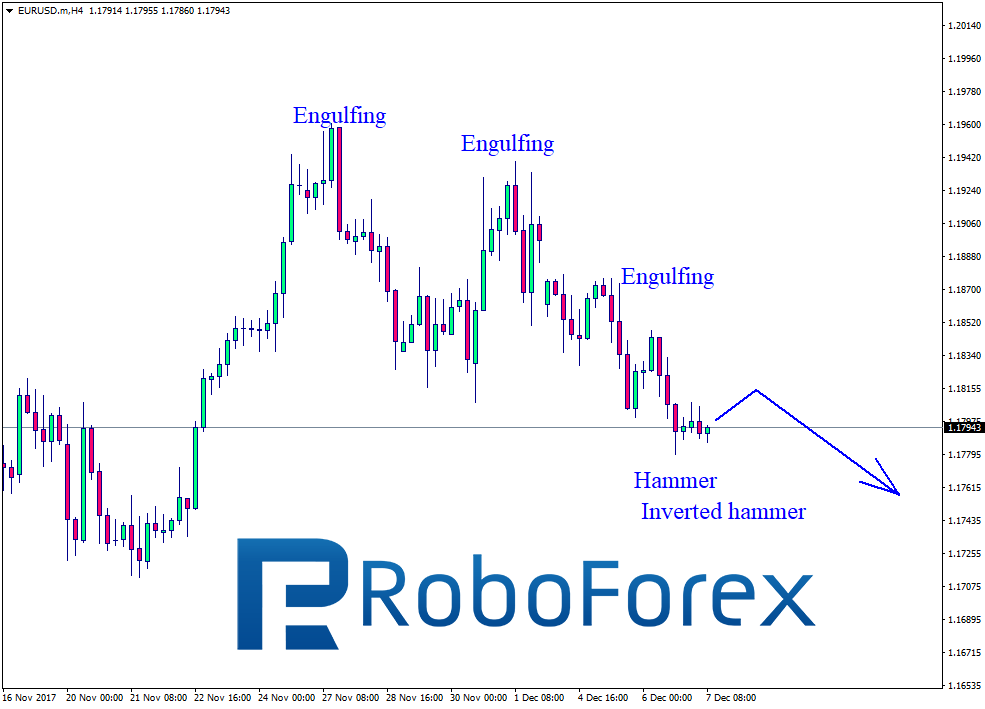
After reaching the support level, the EUR/USD pair has formed several Hammer and Inverted Hammer patterns. These reversal patterns are very unlikely to make the price reverse. However, they may result is a slight correction, which may later be followed by a further decline towards the next support level at 1.1731.

EURUSD


USD JPY, “US Dollar vs. Japanese Yen”

As we can see at the H4 chart, the USD/JPY pair has formed a slight correction with several Inverted Hammer and Harami patterns. These patterns indicate that the correction is over and the instrument may start moving to the upside to update its closest highs.

USDJPY


RoboForex Analytical Department

Article By RoboForex.com

Attention!
Forecasts presented in this section only reflect the author’s private opinion and should not be considered as guidance for trading. RoboForex LP bears no responsibility for trading results based on trading recommendations described in these analytical reviews.

EURUSD: buyers edging towards the 135th degree

By Gabriel Ojimadu, Alpari

Previous:

On Wednesday the 6th of December, trading on the euro/dollar closed down. The greenback made gains against most of the majors after significant progress was made in Congress regarding tax reform. Senate Republicans have agreed to talks with the House of Representatives to discuss the new legislation. Markets expect the two houses to reconcile their respective versions of the bill in the coming days. Meanwhile, markets are also bracing themselves for Friday’s NFP report as well as the upcoming FOMC meeting to be held on the 13th of December.

Day’s news (GMT+3):

  • 10:00 Germany: industrial production (Oct).
  • 10:45 France: trade balance (Oct).
  • 11:00 Switzerland: foreign currency reserves (Oct).
  • 11:30 UK: Halifax house prices (Nov).
  • 13:00 Eurozone: GDP (Q3);
  • 16:30 USA: initial jobless claims (1 Dec).
  • 16:30 Canada: building permits (Oct).
  • 18:00 Canada: Ivey PMI (Nov).
  • 23:00 USA: consumer credit change (Oct).

Fig 1. EURUSD hourly chart. Source: TradingView

I didn’t make a forecast on Wednesday because, with the euro trading at 1.1845, the situation was ambiguous. As trading opened in Europe, the euro bounced off the previously broken trend line and recommenced its decline with renewed vigour.

The euro initially returned to the 112th degree at 1.1799 before moving towards the lower boundary of the A-A channel. Interestingly, the euro dropped at the same time as US bond yields. The pressure on the EURUSD pair came from the EURGBP cross.

In Asia, our pair is currently trading sideways while the euro crosses are rising. This suggests that the dollar is attacking on all fronts and euro sellers are preparing to hit a new daily low.

Given that a bullish divergence has formed between the AO indicator and the 1.1801 and 1.1781 lows, once the 1.1781 low is retaken, this will form a double bullish divergence; a technical sign of a rebound.

I’ve gone for a rebound at 1.1772 because the 1365th degree runs through this level. The area between the 112th and 135th degrees is, in my view, a reversal zone. From 1.1772, I’d like to see a three-wave formation aiming at 1.1709. Keep an eye on the euro/pound cross. A triangle is forming on the 4-hour timeframe. Exiting it downwards would speed up the euro’s decline against the US dollar. I wouldn’t recommend buying euro in anticipation of a rebound as the correction could go on for as long as 40 hours without a rise. Take note of when the price breaks through the TR3 line and what sort of trading volumes are present at the time.

The One Indicator OPEC Must Watch

By OilPrice.com

“We will not let go of our current approach until we reach a balanced market,” Saudi oil minister Khalid al-Falih said Monday at a news conference in Riyadh.

OPEC ended months of speculation last week when it decided to extend its production cuts through the end of 2018, easing concerns that the limits would be lifted before the oil market was ready. But while it put some uncertainty to rest, the next question is what OPEC does when the oil market becomes “balanced”? What is the exit strategy?

There isn’t one at the moment, and we can assume OPEC doesn’t know what comes next. But we do know that the group has one key metric in mind: inventories. The target is to bring global oil inventories back down to the five-year average.

Oil inventories exploded between 2014 and 2017, hitting record levels that left the world awash in oil. That metric, arguably more than any other, exemplified the glut of supply that led to the crash of prices.

It has been a stubborn thing, getting those inventories back down to average levels. A wave of shale bankruptcies didn’t do it, the vanishing rig count didn’t do it either. That led OPEC and a handful of non-OPEC countries led by Russia to limit their production. But even that deal didn’t seem to be doing the trick at the start of 2017, as inventories remained stuck at elevated levels. The euphoria that followed the announcement of the initial deal gave way to a renewed sense of gloom, which pushed WTI back down into the low-$40s by mid-2017.

However, by the end of summer, the inventories finally started to move. And the declines accelerated in recent months, draining stocks at a rapid clip. Total crude and refined product inventories in OECD countries (the most visible and transparent metric used) has dropped to only 140 million barrels above the five-year average as of October, cutting the surplus from the start of 2017 by more than half.

The big question is when that surplus shrinks to zero. Saudi oil minister Khalid al-Falih warned that winter months tend to bring a dip in demand, which could meant the drawdowns slow for the rest of this year and in the first quarter of 2018. As such, the real progress won’t begin until probably the second quarter.

Aiding in OPEC’s effort is that the definition of “average” is constantly changing. With each passing day, the previous five years is increasingly made up of periods of time in which the oil market was in a glut. So, the “average” level for oil inventories today is a lot higher than it was three years ago. That means OPEC could achieve its objective with a lot more ease than if the target level was a fixed figure.

Demand is growing strongly, which will help soak up excess barrels as we head into next year. The supply picture is mixed, however. There is rising production in the U.S., Canada, Brazil and some other non-OPEC countries. On the other hand, OPEC countries will keep their output in check, and the inclusion of Nigeria and Libya under the cap will keep supply off the market. And Venezuela’s production will continue to fall.

Although estimates vary, the IEA sees the supply surplus returning—in the first quarter of 2018, the energy agency sees a glut of 0.6 mb/d. In other words, inventories could swell for a period of time, although OPEC is not as pessimistic. But both agree that by mid-year, the drawdowns will really pick up pace, and the objective of “balancing” the market will draw near.

That makes the review period for OPEC’s production limits in June very important. At that point, OPEC and non-OPEC countries will have to come up with an exit strategy. “The outlook for when we will hit the balanced market will be clearer in June, and we will start thinking of what we will do in 2019,” al-Falih told reporters on Monday. “The intent is not overnight to open the taps and flood the market.”

Link to original article: https://oilprice.com/Energy/Crude-Oil/The-One-Indicator-OPEC-Must-Watch.html

By Nick Cunningham of Oilprice.com


Fibonacci Retracements Analysis 06.12.2017 (GBP/USD, EUR/JPY)

Article By RoboForex.com

GBP USD, “Great Britain Pound vs US Dollar”

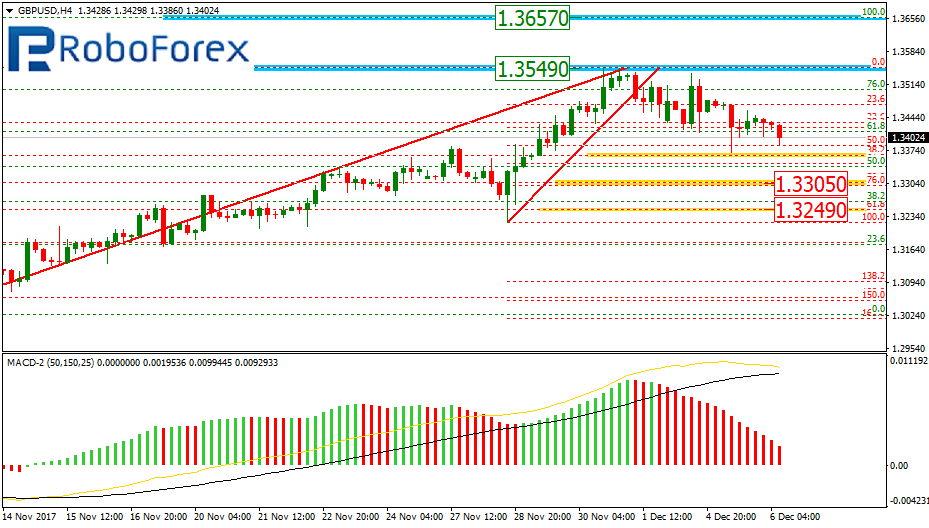
As we can see at the H4 chart, the GBP/USD pair is being corrected to the downside and has already reached the retracement of 38.2%. The closest downside targets are the retracements of 50.0% and 61.8% at 1.3305 and 1.3249 respectively. However, if we’re talking about a further growth, the targets will be near the short- and long-term highs at 1.3549 and 1.3657 respectively.

GBPUSD1

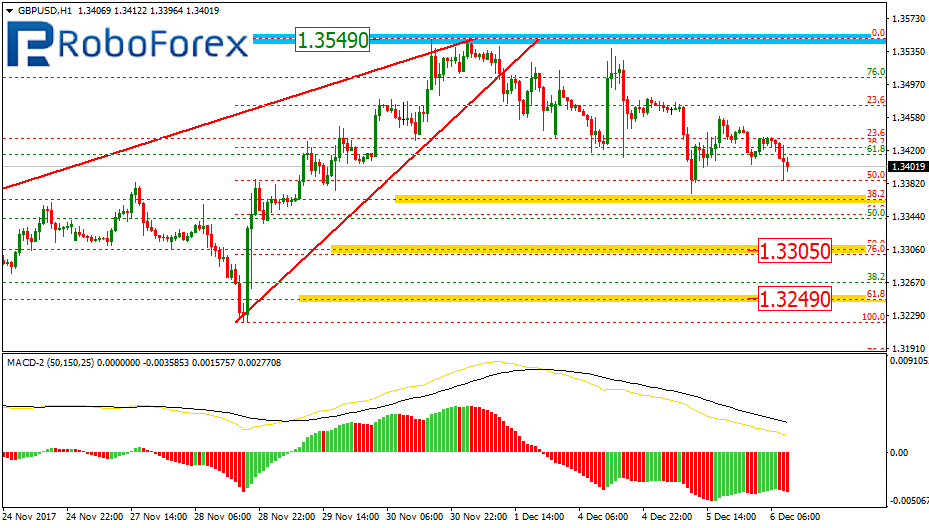
At the H1 chart, the situation is similar and confirms the scenario described above. The main trend is bearish.

GBPUSD2


EUR JPY, “Euro vs. Japanese Yen”

As we can see at the H4 chart, the EUR/JPY pair is getting closer to the retracement of 76.0% at 132.36. Later, the price may rebound from this level and start a new correction to the upside with the targets at the retracements of 23.6%, 38.2%, 50.0%, 61.8%, and 76.0% at 132.87, 133.13, 133.36, 133.60, and 133.88 respectively.

EURUSD1

At the H1 chart, the situation is the same and confirms the scenario described above.

EURJPY2


RoboForex Analytical Department

Article By RoboForex.com

Attention!
Forecasts presented in this section only reflect the author’s private opinion and should not be considered as guidance for trading. RoboForex LP bears no responsibility for trading results based on trading recommendations described in these analytical reviews.

Ichimoku Cloud Analysis 06.12.2017 (AUD/USD, NZD/USD, USD/CAD)

Article By RoboForex.com

AUD USD, “Australian Dollar vs US Dollar”

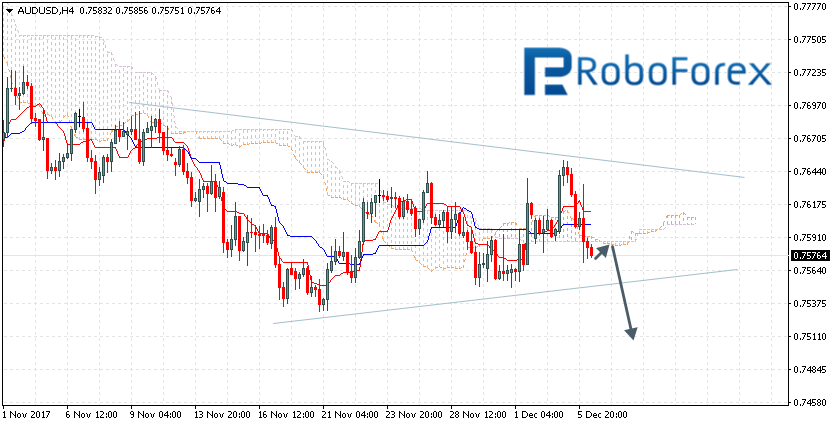
The AUD/USD pair is trading at 0.7576; the instrument is still moving below Ichimoku Cloud, which means that may continue falling. We should expect the price to test the broken border of the loud at 0.7585 and then continue moving downwards to reach 0.7510. However, the scenario that Implies further decline may be cancelled if the price breaks the upside border of the cloud and fixes above 0.7620. In this case, the pair may continue growing towards 0.7640. After breaking the downside border of the Triangle pattern and fixing below 0.7540, the price may resume falling.

AUDUSD


NZD USD, “New Zealand Dollar vs US Dollar”

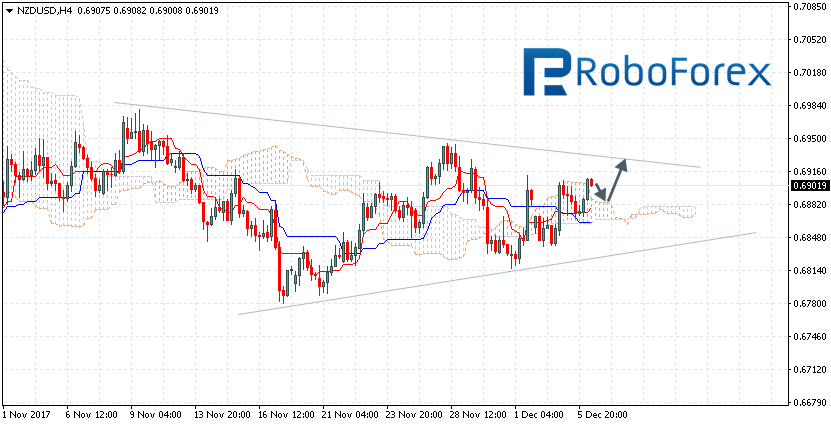
The NZD/USD pair is trading at 0.6901; the instrument is still moving above Ichimoku Cloud, which means that it may continue growing. We should expect the price to test the upside border of the cloud at 0.6890 and then continue moving upwards to reach 0.6930. However, the scenario that implies further growth may be cancelled if the price breaks the downside border of the cloud and fixes below 0.6825. In this case, the pair may continue falling towards 0.6650. After breaking the upside border of the Triangle pattern and fixing above 0.6950, the price may continue growing quickly.

NZDUSD


USD CAD, “US Dollar vs Canadian Dollar”

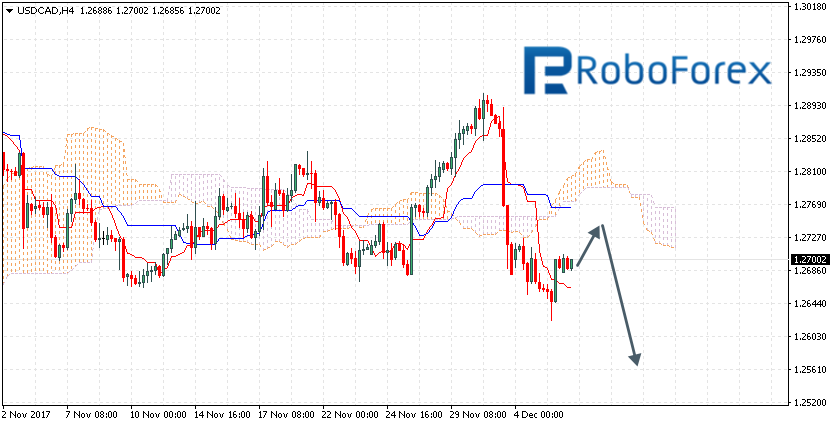
The USD/CAD pair is trading at 1.2700; the instrument is still moving below Ichimoku Cloud, which means that it may continue falling. We should expect the price to test Tenkan-Sen and Kijun-Sen at 1.2730 and then continue moving downwards to reach 1.2565. However, the scenario that implies further decline may be cancelled if the price breaks the upside border of the cloud and fixes above 1.2805. In this case, the pair may continue growing towards 1.2910.

USDCAD


RoboForex Analytical Department

Article By RoboForex.com

Attention!
Forecasts presented in this section only reflect the author’s private opinion and should not be considered as guidance for trading. RoboForex LP bears no responsibility for trading results based on trading recommendations described in these analytical reviews.

EURUSD: sitting below the trend line

By Gabriel Ojimadu, Alpari

Previous:

On Tuesday the 5th of December, trading on the euro/dollar pair closed down. I still can’t understand why the euro dropped from 1.1874 to 1.1801 against the dollar. At the time, US bond yields were trading down. This drop gathered pace during the US session. The US’s services PMI for November fell further than expected.

There are another two factors at play here that could have led investors to short the euro and buy dollars. The first is the US Congress’ approval of the tax reform bill. Secondly, the Senate’s banking committee has voted for Powell to chair the Federal Reserve.

Some believe that the market is undergoing a reversal in anticipation of Friday’s payrolls report. On Tuesday, trading on the euro/dollar closed at 1.1824.

Day’s news (GMT+3):

  • 10:00 Germany: factory orders (Oct).
  • 16:15 USA: ADP employment change (Nov).
  • 16:30 Canada: labour productivity (Q3).
  • 16:30 USA: nonfarm productivity (Q3), unit labour costs (Q3).
  • 18:00 Canada: interest rate decision, BoC rate statement.
  • 18:30 USA: EIA crude oil stocks change (1 Dec).

Fig 1. EURUSD hourly chart. Source: TradingView

My expectations of a rise for the euro on Tuesday did not come to pass. The euro bounced from the trend line and was then beaten back from the balance line by sellers. In the space of an hour the euro had returned to the balance line, and an hour later, broke through it.

Buyers tried to seize back control after the publication of a weak PPI report from ISM, but their efforts came to nothing. The drop intensified with the euro reaching 1.1801 as a breakout of the trend line is always a strong technical signal.

The rebound occurred at the 112th degree. At the time of writing, the euro is trading at 1.1841. There’s no forecast on the chart because I couldn’t determine which way the price will go today.

Now I’ll try to explain why it was so difficult to decide:

  1. The pattern of the last 120 bars (hourly timeframe) indicates the euro will rise to 1.1882.
  2. Hourly cycles point towards a decline to around yesterday’s low of 1.1801.
  3. The range 1.1844 – 1.1856 is a strong resistance. A lot of lines and levels intersect here.
  4. US 10Y bond yields are declining.
  5. Euro crosses are rising, expect against the yen.
  6. In today’s Asian session, the dynamics on the US dollar are mixed and it’s unclear how it will behave itself once trading opens in London.

Today’s key events for the foreign exchange market are the ADP employment report and the Bank of Canada’s interest rate decision.

Markets are expecting the NFP report to show a net increase in employment in November of around 200,000. The ADP report is expected to show an increase of 185,000 new jobs. If these figures fall in line with expectations, the reaction will be minimal. The ADP report has a short-term effect on currency markets when the figure is off by around 50,000.

An “Unprestigious” Preview of Debt Deflation

By Elliott Wave International


Evidence: Your Bond Fund Is Riskier Than You Think

Debt deflation has taken down a huge multinational builder. Pitfalls in the bond market are growing too risky for bond investors to ignore. Learn what you need to know in a free, new report from EWI’s Murray Gunn — “Your Bond Fund: It’s Riskier Than You Think.”

Get instant access!

This article was syndicated by Elliott Wave International and was originally published under the headline An “Unprestigious” Preview of Debt Deflation. EWI is the world’s largest market forecasting firm. Its staff of full-time analysts led by Chartered Market Technician Robert Prechter provides 24-hour-a-day market analysis to institutional and private investors around the world.

The Loonie Takes Flight — BUT a “Labor Miracle” is NOT the Reason Why

One day before the jobs numbers went viral, Elliott wave analysis already called for a USDCAD rally

By Elliott Wave International

Friday December 1 was a lucky break for loonie bulls. That day, the government agency Statistics Canada revealed the nation’s economy added 79,500 new jobs in November, “blowing past” the 10,000 that economists expected. As one major news source described it:

“Canadian dollar posted its biggest gain in nearly three months against its U.S. counterpart on Friday after a stronger-than-expected domestic jobs data fueled expectations for further Bank of Canada interest rate hikes early next year…”

“The labor miracle in Canada continues.” (Dec. 1 Reuters)

Absolutely, a jobs number that’s EIGHT times bigger than expected is a significant event for economists; some would even call it “miraculous.” But here’s the part we have trouble with: The spike was NOT the cause for the Canadian dollar’s surge.

The reason we know that is because Elliott wave analysis foresaw a loonie rally before the jobs “miracle” was released.

On November 30, a day before the surprise numbers went viral and stirred up a media frenzy, our Currency Pro Service editor Jim Martens set the stage for a decline in the USDCAD: (a falling U.S. dollar/rising Canadian dollar)

Here is Jim’s analysis from his November 30 Currency Pro Service intraday update:

November 30 2:30 PM:

“USDCAD pushed to a new high on the day. Despite the new high the rally from 1.2672 might still represent wave b of a larger flat correction. A double top with 1.2915 would best serve the flat scenario. It would lead to a wave c decline that reaches below 1.2666. — Jim”

Jim also referenced the upcoming jobs data report:

“Unemployment Claims is the next high impact economic release due out in the U.S. at 8:30 AM ET [Friday morning].”

Chart1

Obviously, Jim had no way of knowing that the jobs claims would outperform expectations eight-fold. His analysis wasn’t based on the “fundamental” data, but rather on the Elliott wave pattern unfolding on the USDCAD’s price chart.

The next chart shows you how the currency pair followed its Elliott wave script to a T, with the greenback plunging and the loonie rising.

Chart2

What makes forecasts like these possible is the fact that Elliott wave analysis tracks and forecasts market psychology. It’s the collective psychology of market players that create trends.

The loonie was poised to strengthen against the dollar regardless of what the labor report had said; there didn’t have to be any CAD-bullish news, period.


Trading Forex: How the Elliott Wave Principle Can Boost Your Forex Success

Learn how to put the power of the Wave Principle to work in your forex trading with this free, 14-page eBook. EWI Senior Currency Strategist Jim Martens shares actionable trading lessons and tips to help you find the best opportunities in the FX markets you trade.

Get Immediate Access!

This article was syndicated by Elliott Wave International and was originally published under the headline The Loonie Takes Flight — BUT a “Labor Miracle” is NOT the Reason Why. EWI is the world’s largest market forecasting firm. Its staff of full-time analysts led by Chartered Market Technician Robert Prechter provides 24-hour-a-day market analysis to institutional and private investors around the world.