Author Archive for InvestMacro – Page 448

Forex Technical Analysis & Forecast 24.01.2018 (EUR/USD, GBP/USD, USD/CHF, USD/JPY, AUD/USD, USD/RUB, GOLD, BRENT)

Article By RoboForex.com

EUR USD, “Euro vs US Dollar”

The EUR/USD pair is growing; it has expanded its consolidation range upwards. Possibly, the price may fall towards 1.2272 and then move upwards to reach 1.2350. Later, in our opinion, the market may fall towards the downside border of the channel at 1.2160. An alternative scenario suggests that the instrument may break the range to the upside and then continue moving upwards to reach 1.2400.

EURUSD


GBP/USD GBP USD, “Great Britain Pound vs US Dollar”

The GBP/USD pair is moving upwards. We think, today the price may fall to reach 1.3873 and then start another growth towards 1.3960. After that, the instrument may fall with the target at 1.3677.

GBPUSD


USD CHF, “US Dollar vs Swiss Franc”

The USD/CHF pair has completed the correction. Possibly, today the price may form the second ascending impulse with the target at 0.9645. Later, in our opinion, the market may break this level and continue growing towards 0.9750. An alternative scenario suggests that the instrument may extend the wave to reach 0.9529 and then grow towards 0.9650.

USDCHF


USD JPY, “US Dollar vs Japanese Yen”

The USD/JPY pair has broken 110.56 and expanded the range downwards. We think, today the price may form another ascending structure. After that, the instrument may continue falling towards 109.40.

USDJPY


AUD USD, “Australian Dollar vs US Dollar”

The AUD/USD pair is consolidating at the top of the ascending wave. Possibly, the price may forming another descending structure to reach 0.7982 and then grow towards 0.7992. If later the instrument breaks this range to the downside, the market may reach 0.7810; if to the upside – extend this wave towards 0.8050.

AUDUSD


USD RUB, “US Dollar vs Russian Ruble”

The USD/RUB pair is trading to break 56.38 downwards. Possibly, the price may continue falling towards 55.88. Later, in our opinion, the market may start another correction to reach 57.81.

USDRUB


XAU USD, “Gold vs US Dollar”

Gold is moving upwards. Possibly, the price may extend this structure towards 1350.00 and then fall to reach 1340.00. After that, the instrument may return to 1350.00, break it, and then continue growing with the target at 1375.00.

GOLD


BRENT

Brent has reached 70.20. Possibly, today the price may fall towards 69.35 and then grow to reach 70.30. After that, the instrument may break this level and then continue moving upwards with the target at 71.30.

BRENT


RoboForex Analytical Department

Article By RoboForex.com

Attention!
Forecasts presented in this section only reflect the author’s private opinion and should not be considered as guidance for trading. RoboForex LP bears no responsibility for trading results based on trading recommendations described in these analytical reviews.

EURUSD: euro has hit a new one-year high

By Gabriel Ojimadu, Alpari


Previous:

On Tuesday the 23rd of January, trading on the euro/dollar pair closed up. The end of the US government shutdown wasn’t enough to take the dollar back into positive territory. The greenback came under pressure during the US session after a drop in US bond yields.

Experts believe that the dollar’s decline is down to President Trump’s decision to introduce a 30% import duty on Chinese products. Additionally, the euro was bolstered by the high value of the ZEW index in Germany.

The euro rose to 1.2306 on the back of these events, but buyers were unable to push any higher. They went on the attack once again this morning in Asia to push the rate up to 1.2335.

Day’s news (GMT+3):

  • 11:00 France: Markit manufacturing PMI (Jan), Markit services PMI (Jan).
  • 11:30 Germany: Markit manufacturing PMI (Jan), Markit services PMI (Jan).
  • 12:00 Eurozone: Markit manufacturing PMI (Jan), Markit services PMI (Jan).
  • 12:30 UK: claimant count change (Dec), ILO unemployment rate (Nov), average earnings (Nov).
  • 17:00 USA: housing price index (Nov).
  • 17:45 USA: Markit manufacturing PMI (Jan), Markit services PMI (Jan).
  • 18:00 USA: existing home sales (Dec).
  • 18:30 USA: EIA crude oil stocks change (19 Jan).

Fig 1. EURUSD hourly chart. Source: TradingView

After the euro dropped to 1.2223, traders started shorting the dollar once again. In the Asian session, buyers shifted the 1.2323 high (17/01/18) to 1.2335 (23/01/18). The dollar declined across the board.

Taking into account the mixed dynamics of the euro crosses, a reversal should be forthcoming having reached the 1.2335 mark. Buyers are treading lightly ahead of tomorrow’s ECB meeting and the subsequent press conference with Mario Draghi.

Market participants aren’t expecting any changes to monetary policy. They will be more interested in Draghi’s speech and the Q&A session with journalists to follow. Traders will be looking at his answers for hints of curtailing the QE program. However, I believe that he will say that interest rates are set to remain low for the long term and that the curtailing of the QE program will be a gradual process.

I didn’t make a forecast on Tuesday and I’m not doing one today as the situation is ambiguous to me and scenarios for a decline aren’t working out due to fundamental factors. My short positions from the 18th of January have closed with a loss. I’ve highlighted some key levels on the chart. Personally, I’m taking a wait-and-see position for the time being.

Common mistakes made by the novice traders

Thousands of people are trading with other people trading strategies and many of them have developed their strategy well. They are trading with discipline and still, they are not making money. If you talk with them for some time, you will feel like they have been cheated by their luck and they are right in their strategy. When you talk with them and if you assess, how they trade the market, you will find that these people are making some mistakes that are very common in Forex. This is an online market and all the traders are learning the trends and patterns of the market, the indicators of the markets online. It is not possible for them to get to know these trends physically and many of them are getting wrong ideas of the markets. As a result, they are making many common mistakes in Forex. This article will tell you how you can avoid these common mistakes in your trades. You will find many of these mistakes to be hilarious but they have deadly consequences on your trades. If you do them for a long time, you may not have any money in your account to trade the market. Being a new trader Forex trading demo account should be your first pick.

Currency trading is often considered to be the most sophisticated profession in today’s world. For this very reason, the expert traders at UK always suggest the novice traders, trade with the money which they can afford to lose. It’s true that by using the high leverage trading account you can easily secure big profit but without learning the basic art of trading, chances are very high you will blow the trading account. You need to follow a paper-based trading journal just like the pro traders in the United Kingdom. During the weekend asses, your trading history and it will help you to learn from your trading mistake. If you don’t know how to trade currency, don’t trade with your real money. Use the Forex trading demo account unless you develop a solid trading system to deal with the dynamic nature of this market.

Risking too much

People in the United Kingdom are very smart while it comes to trading the live asset. First of all, they learn how to trade currency pair without taking too much risk. Instead of looking for the profit factor, learn how to manage your trade in an organized way. Make sure you are not risking more than 2-3% of your account capital in any trade. Always focus on investment and stay in the safe zone.

The circle of trading again and again

This is often known as overtrading and many people made these mistakes in Forex. It is not possible to know when you are overtrading the market as you will be indulged in trading. People who trade the market for the first time have the risks of overtrading their account. When you think this market is random and you can make your money if you place many trades, you will be overtrading in your account. One way to not to overtrade is by analyzing the market before you place your every trades in Forex.

Trying to let profit grow

It is good that you are making the profit consistently. When traders try to let their profits grow in Forex, this is when they begin to lose their money. If you do not use take-profit, you can make a lot of profit with your trades but you cannot make that always. You need to know how you can be trading the market and be happy with your profit. You should have set goals and follow your goals.

Following others

It is one of the mistakes that are made by all the traders in their careers.  You are a good trader and believe that in your mind. Trying to follow what others are doing in Forex can lose your money.

By Taylor Wilman


US Senate approved short-term spending bill until February 8, 2018

By IFCMarkets

On Monday, the US stock indices rose and updated historic highs

The US Senate approved the extension of government funding until February 8 of this year. After this the spending bill will be submitted to the House of Representatives for approval.

All this, in fact, cancels the risks of the government shutdown and increases investors’ optimism. So far, 55 companies from the S&P 500 list have reported. The profit of 44 of them exceeded preliminary forecasts. Currently, the majority of market participants are expecting the growth of the S&P 500 net profit by 12.4% in the Q4 of 2017. At the beginning of the earnings season the growth forecast was 12.2%. The highest increase was demonstrated by the stock quotes of the oil company Halliburton (+ 6.4%) due to its positive earnings report. The US dollar index almost did not react to the approval of the short-term spending bill and continued small fluctuations near its 3-year low. Today, no significant US statistics are expected to be published.

stock

On Monday, the European stock prices rose following the US

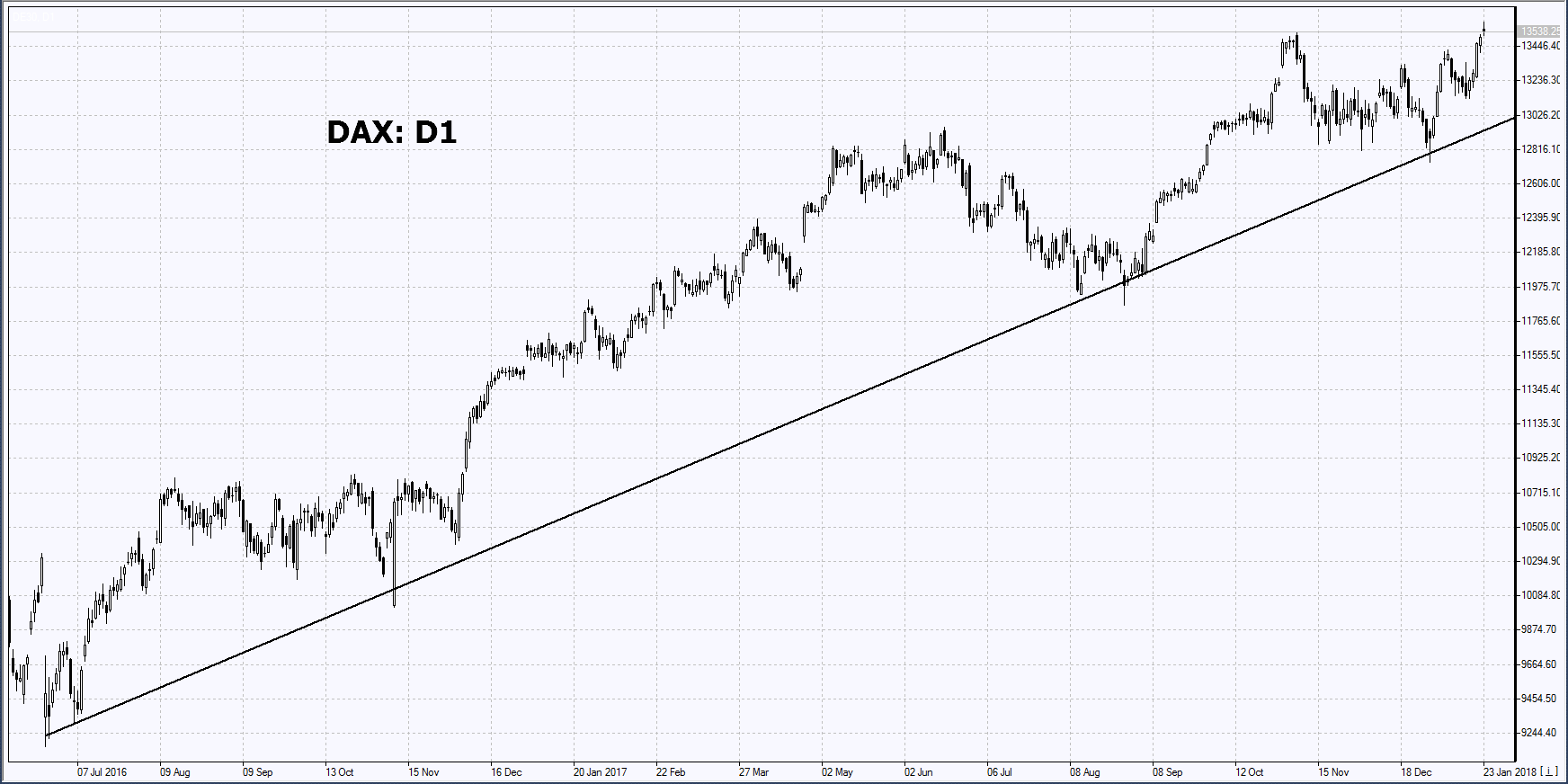
The positive trend continued on Tuesday as well. The German stock index DAX updated its historic high due to the publication of positive economic indicators in Germany, calculated by the Center for European Economic Research (ZEW).

Among the European companies, Easyjet (+ 5.3%), Carrefour (+ 6.4%) and Logitech (+ 4.2%) demonstrated the highest growth. This occurred due to the publication of positive quarterly earnings reports and forecasts. The euro is showing minimal fluctuations in anticipation of the next ECB meeting, which will be held on Thursday, January 25, 2018. Investors do not exclude that the ECB representatives may announce a monetary policy tightening. Such expectations contributed to the growth of the euro to the 3-year high. Today at 16-00 CET the eurozone consumer confidence index will be released. The outlook is positive.

Nikkei continued to grow on Tuesday and updated the 26-year high (since November 1991)

The stocks of Torii Pharmaceutical increased by 4.6% after the publication of a positive outlook for the company’s profit. Thanks to this, the index of the Japanese pharmaceutical sector grew by 1.2%. Also, the stocks of precision engineering and real estate companies were in demand. On Tuesday morning, the Bank of Japan meeting was held. It maintained its super-soft monetary policy. The head of the BoJ Haruhiko Kuroda said that in the current situation there was no need to raise the rate of minus 0.1%. The yen strengthened slightly after that.

Oil prices continue sluggish decline

Oil prices slightly increased after the International Monetary Fund review. The IMF raised its forecast for the global economic growth to 3.9% in 2018-2019. This is by 0.2% more than in its October review. Higher growth rates are expected to contribute to an increase in world oil consumption. The French bank BNP Paribas raised its forecast for oil prices by $10 in 2018 and expects the average price of WTI to be $60 per barrel and $65 for Brent. Bank Barclays raised the forecast of the average annual price of Brent by $5 to $60 per barrel.

On Tuesday, soybean prices have been rising for the 7th day in a row amid the drought in Argentina.

Market Analysis provided by IFCMarkets

Note:
This overview has an informative and tutorial character and is published for free. All the data, included in the overview, are received from public sources, recognized as more or less reliable. Moreover, there is no guarantee that the indicated information is full and precise. Overviews are not updated. The whole information in each overview, including opinion, indicators, charts and anything else, is provided only for familiarization purposes and is not financial advice or а recommendation. The whole text and its any part, as well as the charts cannot be considered as an offer to make a deal with any asset. IFC Markets and its employees under any circumstances are not liable for any action taken by someone else during or after reading the overview.

Eroding Petrodollar Versus Rising Petroyuan

By Dan Steinbock   

In the late 20th century, US petrodollar dominated the world economy. In the 21st century, we are witnessing the rise of the Chinese petroyuan. The former grew on the back of postwar growth in the advanced economies; the latter is fueled by industrialization in emerging and developed economies.

According to SWIFT, US dollar still accounts for 39% of international payments, as opposed to the euro (33%), the English pound (7%), Japanese yen (3%) and Chinese yuan (28%). But times are changing.

In October, China established a payment versus payment (PVP) system for transactions involving Chinese yuan and Russian ruble. The China Foreign Exchange Trade System (CFETS) hopes to launch similar systems with other currencies based on China’s huge multi-decade, multi-trillion One Belt One Road (OBOR) initiatives.

While the OBOR will expand links between major economies in Asia, Africa, Europe and Latin America, many member countries are possible candidates for yuan-denominated payment transactions.

In December, Iran announced it would join the Russia-led Eurasian Economic Union (EEU) in early 2018. It has not deployed US dollar in foreign-trade transactions since the early 2010s. The EEU is also likely to have a central role in the OBOR, and thus in future yuan-denominated transaction systems.

Rise and eclipse of petrodollar

After the 1945 Yalta Conference, which effectively divided Europe, the ailing President Franklin D. Roosevelt met Saudi Arabia’s King Ibn Saud. Bypassing the Brits, FDR and Saud agreed to a secret deal, which required Washington to provide Saudi Arabia military security in exchange for secure access to supplies of oil.

Despite periodic pressures, the pact survived for quarter of a century until the 1971 “Nixon Shock.” As the dire US economic prospects led President Nixon to the unilateral cancellation of the direct international convertibility of the US dollar to gold, the postwar Bretton Woods system of international financial exchange was replaced by a regime based on freely floating fiat currencies.

To deter the marginalization of US dollar, Nixon negotiated another deal, which ensured that Saudi Arabia would denominate all future oil sales in dollars, in exchange for US arms and protection. As other OPEC countries agreed to similar deals, global demand for US dollars – the “petrodollars” -soared.

The US-Saudi strategic partnership weathered seven decades of multiple regional wars. When the Fed began to pave way for rate hikes in 2014, the value of the dollar started to climb, though slower than expected. Oil prices plunged and are likely to stay relatively subdued for a protracted period. Nevertheless, President Trump signed a historical $110 billion arms deal with Saudi Arabia.

Ironically, oil markets remain priced in a currency that is burdened by debt and overstretch.

Rise of petroyuan

In the West, Chinese efforts are often portrayed as Beijing’s game to undermine the dollar’s global dominance. Yet, it is not in the interest of China to debunk the value of its US Treasuries, which are held in US dollars and still amount to $1.1 trillion. On the other hand, as the world’s leading oil importer, Chinese currency should have a central role in oil pricing.

Since 2012, China has hoped to price oil in yuan using gold-backed futures contracts in Shanghai. Yet, implementation depends on policymakers’ balancing act between market stability, which has been seen vital since the 2015 market volatility, and internationalization, which would require reduced capital controls and intervention and which is needed to attract overseas oil traders and producers.

Many of China’s major oil suppliers in Russia, Middle East and Asia already accept the yuan in payment transactions. Russia, Iraq, Indonesia and other countries, many of which play vital role in the OBOR initiatives, have joined in non-dollar trades. Oman, too, has a role in the plan, as evidenced by the Chinese contractors who are turning the dusty fishing village Duqm into a $10.7 billion Sino-Oman Industrial City.

If Saudi Arabia decides to adopt the yuan for some of its oil exports that would serve as a catalyst for a broader shift. And if major Chinese players will participate in Aramco’s initial public offering – a deal in which Hong Kong could serve as a venue for 5% stake ($100 billion) – that could sway Saudi views even further toward yuan.

As long as Washington, at least officially, supported global engagement, US dollar was sustained by America’s international alliances. With Trump’s “America First” stance, that era is fading. Pakistan is a case in point. When the White House suspended US aid to Pakistan, Islamabad announced that the Chinese yuan can be used for bilateral trade and investment activities. The latter will support the proposed Chinese-Pakistan $57 billion economic corridor – still another OBOR pillar.

Gradual, accumulative shift – unless…

US dollar’s coverage is slipping because structural conditions that supported its dominance have been softening since 1971. As long as emerging and developing economies depend on the US dollar, they remain exposed to US currency risk, US sovereign debt (which now accounts more than 106% of the US GDP), not to speak of the fluctuating politics of US sanctions regimes.  Still another U.S. government shutdown is a reminder of the structural fragility.

What we are witnessing is not an overnight effort to replace US dollar with Chinese yuan in international transactions, but a progressive shift to deploy yuan in those transactions in which Chinese economy plays a central role.

This shift is gradual, linear and accumulative. Today, global currency diversification is vital because an overconcentration of foreign assets denominated in the dollar could bring huge collateral damage.

However, if investors one day lose faith in the US dollar – say, due to a US debt crisis, a huge Trump policy blunder, a divisive bipartisan struggle for the White House, or still another military overstretch – the shift away from US dollar could turn disruptive, accelerative, and geometric.

About the Author:

Dr. Dan Steinbock is an internationally recognized strategist of the multipolar world. and the founder of Difference Group. He has served as at the India, China and America Institute (USA) , the Shanghai Institutes for International Studies (China) and the EU Center (Singapore). For more, see https://www.differencegroup.net/ 

The commentary was released by Georgetown Journal of International Affairs on January 18, 2018.


Japanese Candlesticks Analysis 23.01.2018 (EUR/USD, USD/JPY)

Article By RoboForex.com

EUR USD, “Euro vs. US Dollar”

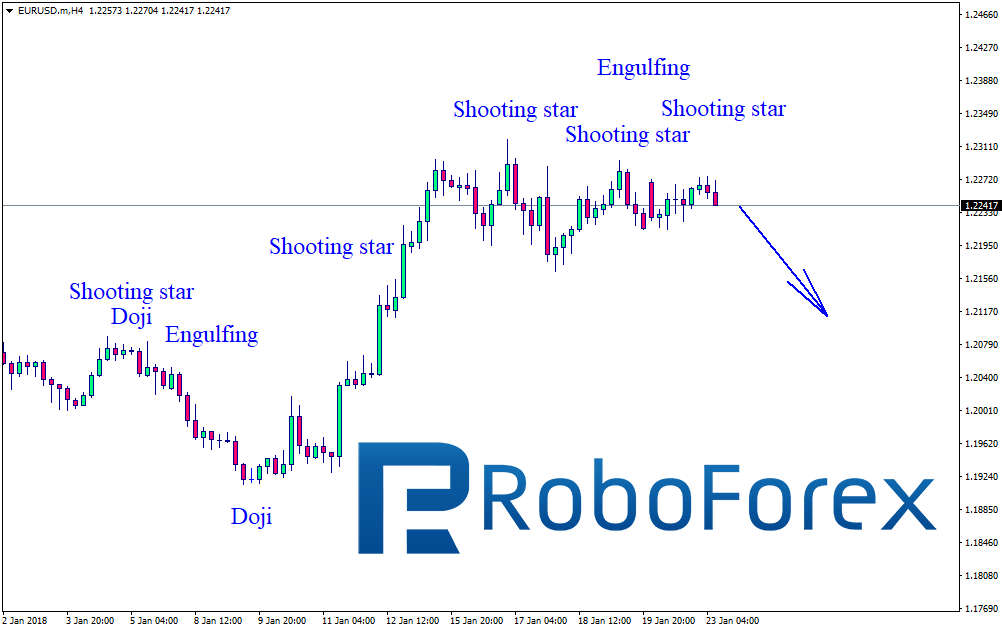
After almost reaching the resistance level, the EUR/USD pair has formed several Engulfing, Doji, and Shooting Star reversal pattern. The patterns may indicate that the price may reverse soon. A possible downside target will be the support level at 1.2073.

EURUSD


USD JPY, “US Dollar vs. Japanese Yen”

As we can see at the H4 chart, the USD/JPY pair is being corrected and forming a lot of Hammer and Inverted Hammer reversal patterns. These patterns indicate that the pullback may last longer than expected and the instrument may trade towards the resistance level at 112.10.

USDJPY


RoboForex Analytical Department

Article By RoboForex.com

Attention!
Forecasts presented in this section only reflect the author’s private opinion and should not be considered as guidance for trading. RoboForex LP bears no responsibility for trading results based on trading recommendations described in these analytical reviews.

Ichimoku Cloud Analysis 23.01.2018 (AUD/USD, NZD/USD, USD/CAD)

Article By RoboForex.com

AUD USD, “Australian Dollar vs US Dollar”

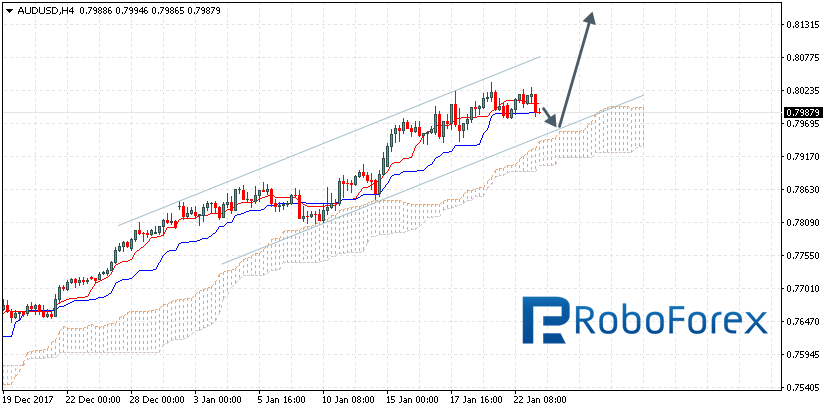
The AUD/USD pair is trading at 0.7987; the instrument is still moving above Ichimoku Cloud, which means that it may continue growing. We should expect the price to test the upside border of the cloud at 0.7970 and then continue moving upwards to reach 0.8130. Another signal to confirm further ascending movement is the price’s rebounding from the downside border of the rising channel. However, the scenario that Implies further growth may be cancelled if the price breaks the downside border of the cloud and fixes below 0.7890. In this case, the pair may continue falling towards 0.7780.

AUDUSD


NZD USD, “New Zealand Dollar vs US Dollar”

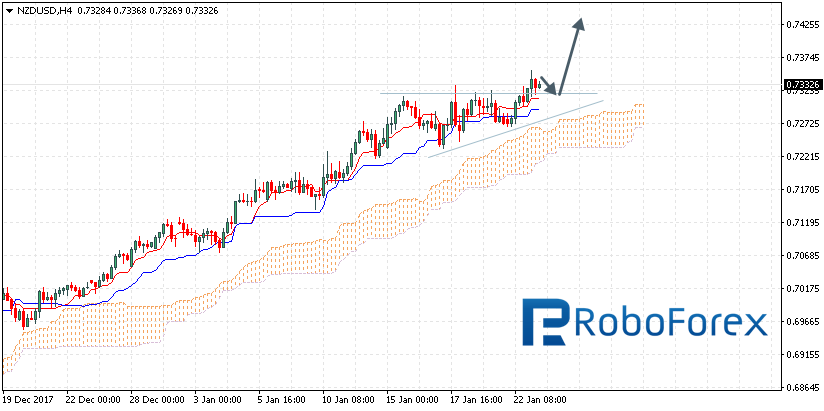
The NZD/USD pair is trading at 0.7332; the instrument is still moving above Ichimoku Cloud, which means that it may continue growing. We should expect the price to test Tenkan-Sen and Kijun-Sen at 0.7315 and then continue moving upwards to reach 0.7425. However, the scenario that implies further growth may be cancelled if the price breaks the downside border of the cloud and fixes below 0.7220. In this case, the pair may continue falling towards 0.7125. After rebounding from the Triangle pattern, the price may continue growing.

NZDUSD


USD CAD, “US Dollar vs Canadian Dollar”

The USD/CAD pair is trading at 1.2447; the instrument is still moving below Ichimoku Cloud, which means that it may continue falling. We should expect the price to test the downside border of the loud at 1.2460 and then move downwards to reach 1.2265. However, the scenario that implies further decline may be cancelled if the price breaks the upside border of the Triangle pattern and fixes above 1.2535. In this case, the pair may continue growing towards 1.2650. After breaking the downside border of the Triangle pattern and fixing below 1.2350, the price may continue falling.

USDCAD


RoboForex Analytical Department

Article By RoboForex.com

Attention!
Forecasts presented in this section only reflect the author’s private opinion and should not be considered as guidance for trading. RoboForex LP bears no responsibility for trading results based on trading recommendations described in these analytical reviews.

EURUSD: triangle formation

By Gabriel Ojimadu, Alpari

Previous:

On Monday the 22nd of January, trading on the euro closed slightly down against its opening price, and slightly up against Friday’s closing price. It was a very volatile day. I still can’t figure out why the market fluctuated so much and what traders were reacting to throughout the day.

Trading on the euro opened at 1.2270 after which sellers closed the gap, correcting the rate to 1.2214. In Europe, the euro restored to 1.2267 before returning to 1.2224. Buyers came into play once again before the end of the day, pushing the price up to 1.2258. In the end it came to 4 separate impulses in one trading day.

The euro received a boost from two news items. The first piece of news was the report from Germany that some significant progress had been made towards forming a coalition government. The second was the news of the US government shutdown over the weekend.

Last night, the Senate voted to extend government funding, bringing the shutdown to an end.

Day’s news (GMT+3):

  • 12:30 UK: public sector net borrowing (Dec).
  • 13:00 Germany: ZEW survey – economic sentiment (Jan).
  • 14:00 UK: CBI industrial trend survey – orders (Jan).
  • 18:00 Eurozone: consumer confidence (Jan).
  • 18:00 USA: Richmond Fed manufacturing index (Jan).

Fig 1. EURUSD hourly chart. Source: TradingView

Due to fundamental factors, trading on Monday was very volatile. My expectations of a decline for the euro didn’t come to pass. At the time of writing this review, the euro is trading at 1.2269 around the balance line (sma 55).

I’m not going to make a prediction for today, although I expect the euro, on the whole, to decline over the next few days. The only thing I’ll say is that it’s possible that short positions won’t survive for long enough to see the drop.

From the top of 1.2323, a triangle has formed. The waves aren’t ideal, but you could fit them into an a-b-c-d-e pattern. It could also turn into a narrowing triangle, in which case the price will exit downwards below 1.22.

The US House of Representatives has taken a short-term measure to keep the government funded until the 8th of February. Nevertheless, the dollar is in no hurry to appreciate. At the moment, it’s trading up against a lot of the majors.

The euro crosses, except for EURJPY, are providing support to euro bulls during today’s Asian session. There’s one thing bothering me about this situation. Buyers aren’t afraid of the upcoming ECB meeting and Mario Draghi’s subsequent press conference. Either they know something about Mario’s speech that we don’t, or they’re simply confident of the greenback’s further decline.

Last week, it was reported both by Reuters and Bloomberg that there wouldn’t be any changes to monetary policy at the ECB meeting on the 25th of January. Officials aren’t particularly fazed by the euro’s current upwards trajectory, but this does bring some ambiguity into the equation. Traders will once again be looking out for hints in Draghi’s rhetoric as to whether the bank’s stimulus programs could be curtailed.

Index Trend Trade Setups for the SP500 & NASDAQ

By www.TheTechnicalTraders.com

Over the past few weeks, we have been writing about our US major price predictions for the beginning of 2018 and how they have played out.  If you have been following our analysis, you have already learned that we predicted a 3~5% price increase in early January 2018 for most of the US major equity indexes as well as a period of brief stagnation near the middle of February.  Today, we are going to revisit these predictions to attempt to provide you with our updated price expectations.

As you read this article and review our analysis, please keep in mind that we are showing you an advanced price modeling system that is capable of learning from historical price activity as well as illustrating the highest probability outcomes of price based on its analysis of key “genomic” price patters and technical patterns.  The reason this is so important to understand is that we are illustrating 2~3+ month in advance based on our modeling systems interpretation of price action.  Imagine having the ability to predict 2 to 3 months in advance with a relatively high degree of accuracy for any stock symbol you like?  This is a very powerful analytical modeling system and we are happy to be sharing this research with our readers.

First, let’s review the SPY and the possibilities our Adaptive Dynamic Learning (ADL) price modeling system is showing us as well as how accurate the first few weeks predictions have been for 2018.

As you can see from the chart, below, our analysis on December 11, 2107 presented a series of YELLOW DASH lines that represent the highest probability outcome of price going forward.  If you take a close inspection of the price levels and Yellow Dash Lines near the end of 2017, you will see that actual price levels were muted in comparison to our predicted levels.  This happens when we get a brief anomaly in price action whereas price fails to meet our expectations.  When this happens, most of the time price will recover to near our predicted levels at some future point in time which makes these “anomaly triggers” quite profitable.  Imagine knowing that price “should be” near a certain price level but is currently 2~5% lower.  Obviously, one could take a long position and wait for the equity price to simply recover to the projected price level for easy profits.

This is one reason why we believed early January 2018 would prompt a strong rally and a continued rally.  The first few weeks of January 2018 were predicted to be well above $276-278 while price was hovering near $268 at the end of this year – that’s a 4% easy move.

Currently, the predicted price levels are still moderately bullish for the next 2~3 weeks before we begin a rather sharp “washout high rotation” – peaking near $285 by March 5th, 2018. This means, we should be expecting some more narrow price rallies to continue with somewhat diminishing volatility in the SPY before expecting a POP rally (really a “washout high candlestick pattern”) to form near February 15th.

After this Washout High patter forms, traders should protect longs and expect a 4~6%+ price contraction that will scare the markets.  Any price contraction of more than about 5% typically frightens the markets to a degree that people start talking about “bear trend possibilities”.  From the prediction of our ADL system, this looks to be a very fast and aggressive downward price swing in the SPY – so it could be news related.

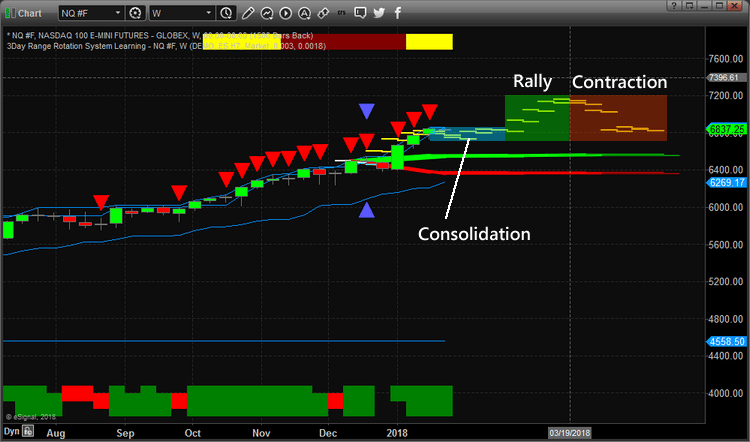
Our ADL system is predicting somewhat similar price action for the NASDAQ, yet we have a period of consolidation to get through first.  As you can see from the YELLOW DASH lines originating at the same December 11, 2017 time frame, the same type of setup happened in the NQ as with the SPY.  By the end of 2017, the NQ was dramatically lower ADL predicted price levels.  The ADL system was predicting the NQ would reach $6725 by the end of the first week in January 2018 while the actual price at the end of 2017 was $6408 – that represents a +315 pt range.  We took advantage of that “anomaly” by predicting a 3~6% rally in the QQQ ETF in the early portion of 2018 to our members.

Now that our predictions for the first part of 2018 have played out, lets focus on what is next.  The ADL system is predicting a stagnation in price action for the next 4~5 weeks with narrowed volatility and rotation.  We could still see some moderate volatility in price ranges, yet we expect the overall price advance to slow considerably over the next few weeks.

Somewhere near or after February 19th, we expect the NQ price to break to the upside with another 3~5% rally (again, another 350+ pt swing) that should end near March 15th and begin a dramatic downward price move.  The ending prediction of the ADL system for April 23, 2018 is $6846.25 – pretty much exactly where we are at right now.

So, knowing this information and knowing that both the SPY and NQ will likely top, or present a short-term topping formation near the middle of March 2018, what should you be doing?  How are you going to trade these opportunities?  Do you want more of our help in understanding how to profit from these moves?

That is exactly what Technical Traders Ltd. offers to our members through the Wealth Building Trading Newsletter.  Each day we provide detailed video market analysis and detailed market research to our members.  We identify trends, reversals, trading setups and global market research for all our valued members.  We help them find ways to profit from these moves while keeping them aware of the markets longer term objectives.

We’ve just completed the initial move of 2018.  The rest of this year is sure to be full of interesting and exciting trading activity.  We can’t wait to show you what happens with other asset classes and with equities after the March 2018 correction.  Visit www.TheTechnicalTraders.com to see how we can assist you in profiting from these market moves.  We just laid out a price map of the markets for the next 2~3 months for you to trade with.  Maybe it is time you considered the value we can offer you in terms of advanced predictive analysis and more?

By www.TheTechnicalTraders.com


GBP Doing Good Despite the Fundamentals

Author: Dmitriy Gurkovskiy, Chief Analyst at RoboForex

Last week was good for the British pound, and the cable is still near the few-month highs as we are heading into week 4 of January. It looks like the market has finally abandoned all concerns with the Brexit negotiations, allowing the politicians to put an end to the issue without any trouble.

Meanwhile, Theresa May said there will be no additional Brexit referendum. Indeed, the talks about second referendum are groundless, although this topic is being very much discussed. Still, the referendum that was held in June 2016 is well enough for making a strategic decision.

The third reading regarding Brexit took place in the House of Commons on Jan 17 and was successful. Thus, the law is passed, and so the UK will leave the EU on March 29, 2019, which means there’s a little more than a year for conducting the whole process, arriving to agreements, and designing the documents. This is very little time considering how hard such negotiations between the British and EU politicians usually are.

The pound’s reaction towards fundamentals is mostly neutral in January. More reactions come from London fixing, the USD falling or recovery, and the general interest of the market towards buying.

An exception when the pound did react to the fundamentals were the retail sales data released on Friday. Core retail sales fell by 1.5% MoM in December, while it rose by 1% in November. YoY growth is at 1.4%, with it being 1.5% last month and the expectations at 2.6%.

Technically, FGBP/USD is heading towards the important level of 1.4000. Both mid term and long term trends are stable, and currently the mid term trend aims to reach the long term channel resistance at 1.4110. This could potentially lead to the price reaching 1.4235, which, with the mid-term channel resistance broken out, is quite probable. However, the price is now testing the resistance that became support, and, most likely, the pound is going to rise to 1.4110 and then retrace to 1.3910. If it happens so, the next important level for the downtrend will be 1.3610.

Attention!

Forecasts presented in this section only reflect the author’s private opinion and should not be considered as guidance for trading. RoboForex bears no responsibility for trading results based on trading recommendations described in these analytical reviews.