Author Archive for InvestMacro – Page 367

EURUSD: bulls trying to turn the tide

By Gabriel Ojimadu, Alpari

Previous:

On Tuesday the 4th of September, trading on the EURUSD pair closed slightly down, although the rate dropped as far as 1.1530 during the US session. The pair hit a new low after a strong ISM manufacturing PMI report for the US. The index came out at its highest since 2004. The value for August was 61.3 against a forecast of 57.6 and a previous reading of 58.1.

I reckon that the euro’s decline gathered pace following the breakout of the support at 1.1594 (trend line of the upwards correctional movement) and the triggering of protective stop levels below this level and the 1.1585 low. By close, the euro had recovered to 1.1586. Including this morning’s growth, buyers have now recovered all the losses incurred yesterday.

Day’s news (GMT+3):

  • 10:50 France: Markit services PMI (Aug).
  • 10:55 Germany: Markit services PMI (Aug).
  • 11:00 Eurozone: Markit services PMI (Aug).
  • 11:30 UK: Markit services PMI (Aug).
  • 12:00 Eurozone: retail sales (Jul).
  • 15:30 Canada: imports (Jul), exports (Jul), labor productivity (Q2).
  • 15:30 US: trade balance (Jul).
  • 17:00 Canada: BoC interest rate decision and rate statement.

Fig 1. EURUSD hourly chart.

Current situation:

I wasn’t prepared for the euro’s decline yesterday, so I kept an eye on price fluctuations from the sidelines. In Asia, the rate has jumped to 1.1608 on the back of a strong Aussie dollar following positive GDP data.

At the time of writing, the euro is trading at 1.1594 against USD. At the current price level the situation is ambiguous given that the daily candlestick has a long tail. This is a harbinger of bullish sentiment.

The pair has rebounded from the trend line. In theory this is a good place to sell, but Tuesday’s candlestick suggests that the pair is set to rise at least as far as 1.1628. Given the situation, I can envision two different trade scenarios:

  1. A long position on the euro from 22 – 45 degrees with a target of 1.1625/30.
  2. Short the euro from 1.1625/30 if the pair goes up from its current level, but not too far.

I think the first scenario is more likely; i.e. buying on the rebound. There may be some difficulty in finding an entry point given that the euro crosses are trading up (which will push the euro up). Another factor is that the pair has rebounded from the trend line and with the trend on the hourly timeframe in a downwards channel, sellers could punish buyers by pegging them back to 1.1580. So, the lower we go, the more lucrative a trade will be.

Toward ‘America First’ NAFTA

By Dan Steinbock

Despite the Trump administration’s frantic last-minute efforts to hammer the NAFTA agreement, the attempt failed within the US timeline, so the talks continue. Why is the revised deal so important to the White House?

Last Friday, the trade talks between the United States and Canada broke off without an agreement.

The negotiations on the revised North American Free Trade Agreement (NAFTA) are not over, however. The talks continue and US Trade Representative Robert Lighthizer will meet again Canada’s foreign minister Chrystia Freeland.

Trump’s art of the deal

In the past year, the US and Mexican negotiators have been able to agree on a tentative outline for a new pact. The two also claim progress in the so-called “rules of origins” for automobiles, which govern how much of a car must be made within the NAFTA countries to avoid tariffs.

According to current rules, any car sold in North America that includes 62% of parts made within the region are exempt. However, the Trump administration wants to raise the figure to 75% hoping that more parts would be made in the U.S.

The current talks remain focused on agricultural issues, particularly the dairy industry. President Trump has called Canada’s dairy regulations protectionist and harmful to U.S. dairy farmers. In reality, both countries have their subsidy systems. Canada’s dairy sector operates under a regulated supply management system, whereas the U.S. government supports dairy farmers directly. Reportedly, U.S. support equaled 73% of U.S. dairy market returns in 2015.

In the dairy industry, the subsidies will artificially maintain lower prices, which effectively deter more competitive dairy industries, particularly from emerging and developing markets. In the automobile industry, the new NAFTA will increase the costs of cars sold in North America, which, in turn, will reduce offshoring, disrupt the ecosystems of car producers and translate to higher prices to consumers.

Under the revised NAFTA, a share of the car parts would have to be built by workers making at least $16 an hour. Adding vacation weeks and assuming 40 hours a week that ends up being an estimated $33,300 per year in salary. In the U.S., that’s only 55% of average per capita income; in Canada, almost 75%; but in Mexico, a whopping 360%, or 3.5 times higher than average per capita income. Under such rules, Mexico would gain the most, America still the least

The other implication is even more important. If the Trump administration will seek to project its revised NAFTA as a blueprint elsewhere in the world (as the Clinton administration tried with its NAFTA deal in the ‘90s), it would mean a war against all offshored production capacity outside the U.S – which in the past four decades have sustained relatively low prices for consumers in North America, while boosting living standards in less-prosperous economies.

If Canada will not agree to a revised NAFTA, Trump has vowed to sign a trade deal with just Mexico. He expects Canadian concessions because he thinks that the country has “no choice” but to make a deal. However, Freeland said on Friday that “Canada will only sign a deal which is good deal for Canada.”

Nevertheless, President Trump has informed Congress that he anticipates a signed trade deal with Mexico and possibly Canada in 90 days, according to U.S. Trade Representative Lighthizer’s statement.

From North American NAFTA to America First NAFTA

In the past year, Canada and Mexico have been hedging their bets against a potential NAFTA collapse by pushing for deals with new partners, particularly with China and other Asian countries.

NAFTA’s record has proven mixed since its inception in 1994. While the agreement has broadly benefited consumers, critics complain that it has contributed to investment outflows, unemployment, and offshoring. Nevertheless, most Americans support NAFTA, as does the majority of Canadians. However, NAFTA has not boosted consumer welfare significantly in Mexico, where per capita incomes have been lagging behind those in the U.S. and Canada.

In the U.S., the ongoing tariff wars and increasing friction with U.S. trade partners in the Americas, Europe, and Asia has added to uncertainty in the mid-term elections. In turn, Mexico is heading toward a dramatic transformation, which is precisely why Trump wants a signed deal before December when Mexico’s president will change.

Last July, the center-left López Obrador won a landslide victory in Mexico’s presidential election. While Obrador has long been a critic of NAFTA, his center-left election platform was more moderate. Unlike the incumbent center-right President Enrique Peña Nieto, he would not see the failure of the NAFTA renegotiation as fatal for Mexicans.

In Canada, conservatives have mocked Justin Trudeau’s government, posturing for the 2019 elections. Nevertheless, liberals have been rising in recent polls as Canadians rally behind Trudeau against Trump tariffs. As the three-way talks with Canada and Mexico fell apart in June, the U.S. has been conducting one-on-one talks with Mexico, ignoring Canada.

The separate bilateral trade deal with Mexico became possible only after the U.S. dropped its “sunset clause”; a trade mechanism to force a renegotiation of NAFTA every five years if the new terms failed to foster “more balanced trade” between the three member countries.

Relying on his imperial rule-and-divide strategy, Trump wanted U.S. Trade Representative Lighthizer to force an agreement, even a diluted one, with Mexico, so that Canada’s Trudeau would have to sign the final “America-First-NAFTA” deal.

Nevertheless, if and when the final treaty is signed, it will not be the one that Trump initially wanted. Moreover, due to general distrust on the Nieto government, Obrador is likely to monitor both the fine print and the execution of the treaty.

While Trudeau does need a deal, he is trapped between an unwillingness to settle for a “bad NAFTA” and an inability to reject a revised NAFTA treaty if both the U.S. and Mexico agree on final terms.

The take-it-or-leave-it stance

The goal of the NAFTA talks – and other FTA talks by the Trump administration – is not to achieve multilateral compromise. To the White House, that is bad history.

Instead, the strategic objective of the Trump White House is either to redefine the terms on the basis of U.S. economic leverage and unipolar geopolitics or – if that is not acceptable to other parties – to withdraw the U.S. from such FTAs.

That’s the strategy that Trump will soon try to force on the proposed new Trans-Pacific Partnership (TPP) in Asia Pacific, the new transatlantic TTIP with Europe, and other FTAs elsewhere.

In the Bush era, the White House defined loyalty in terms of security partnerships. As President Bush put it, “Either you are with us or you are against us.”

In the Trump era, the definition has changed, as evidenced by President Trump’s rhetoric. Now the assumption is, “Either you accept our redefined terms, or you get nothing.”

About the Author:

Dr. Dan Steinbock is an internationally recognized strategist of the multipolar world and the founder of Difference Group. He has served at the India, China and America Institute (US), the Shanghai Institutes for International Studies (China) and the EU Center (Singapore). For more, see https://www.differencegroup.net/ 

This commentary is based on Dr Steinbock’s recent briefing on “NAFTA amid ‘America First’ Headwinds.”


“Bulls” Are Pushing the Oil Upwards

By Dmitriy Gurkovskiy, Chief Analyst at RoboForex

The Oil is getting closer to its short-term highs and it seems like “bulls” really have a chance to make Brent break 80 USD and go higher. Although the most part of catalysts that helps “bulls” are speculative and passing, the price continues moving upwards because of momentum.

The news from the Middle East is in favor of “bulls”. It is not new, but still quite strong and influential. Frist of all, the Iran factor. Remember that the global oil market may lose the oil from Iran in two months due to the US sanctions. There are some options in the form of individual contracts, for example with China and India, which are now trying to circumvent sanction restrictions. However, so far the big picture says that the oil flow from Iran may really run short. In addition to that, there is a Libyan issue: suppliers are constantly facing interruptions in deliveries due to the complicated political situation in the country, which is not expected to get any better.

The second issue is directly connected with the first one: if Iran and Libya don’t provide the oil market with the amount of oil specified before, some kind of “supply void” will appear sooner or later. It will be rather difficult to fill this void even considering that right now countries-members of the OPEC+ are extracting oil almost without any restraints.

The short-term support factor for the oil is the hurricane season in the Gulf of Mexico. Last year, it had significant influence on the oil extraction in the area and the amount of oil stocks in the USA. Right now, forecasts of hurricanes that might take place in Florida are quite conflicting.

However, one thing that may be some kind of “bottleneck” for “bulls” is trade wars between the USA and China. Solution for this conflict of interests, which is directly influencing the oil demand, is very unlikely to appear in the next 9-12 months.

The H1 chart of Brent shows an ascending impulse inside the long-term uptrend. It looks like the current impulse is heading towards the high at 80.52. After reaching this level, the price is expected to resume falling inside a new correction. The first correctional target may be the support line of the current channel at 79.00. If the instrument breaks this level, the correction may continue towards 77.35, which is inside the downside projected channel.

Disclaimer

Any predictions contained herein are based on the authors’ particular opinion. This analysis shall not be treated as trading advice. RoboForex shall not be held liable for the results of the trades arising from relying upon trading recommendations and reviews contained herein.


Fibonacci Retracements Analysis 04.09.2018 (EURUSD, USDJPY)

Article By RoboForex.com

EURUSD, “Euro vs US Dollar”

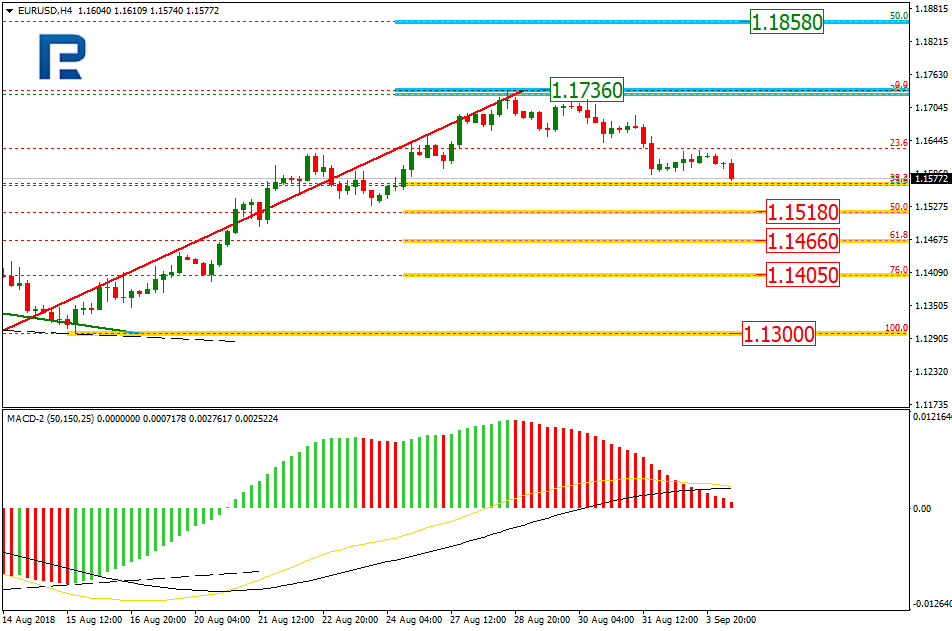
In the H4 chart, EURUSD has completed the correctional uptrend close to the retracement of 38.2% and right now is forming a new descending impulse. However, if the price breaks the current high, the uptrend may continue towards the retracement of 50.0% at 1.1858. The support level is the low at 1.1300.

EURUSD1
Risk Warning: the result of previous trading operations do not guarantee the same results in the future

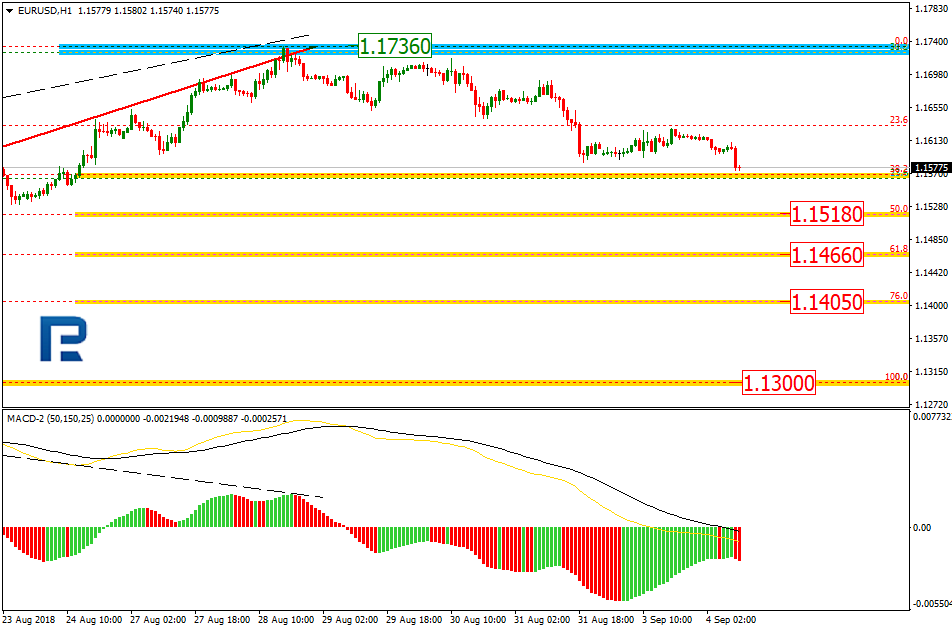
As we can see in the H1 chart, the pair has already reached the retracement of 38.2% and may continue falling towards the retracements of 50.0%, 61.8%, and 76.0% at 1.1518, 1.1466, and 1.1405 respectively.

EURUSD2
Risk Warning: the result of previous trading operations do not guarantee the same results in the future


USDJPY, “US Dollar vs. Japanese Yen”

As we can see in the H4 chart, the convergence made USDJPY reverse and start a new correctional uptrend, which is getting closer to the retracement of 61.8% at 111.87 and may continue towards the retracement of 76.0% at 112.35. The resistance level is the high at 113.18, the support one is the low at 109.78.

USDJPY1
Risk Warning: the result of previous trading operations do not guarantee the same results in the future

In the H1 chart, the pair is forming a new ascending impulse, which is getting closer to the retracement of 76.0% at 111.55. After breaking the short-term high at 111.83, the instrument may continue growing towards the post-correctional extension area between the retracements of 138.2% and 161.8% at 112.26 and 112.54  respectively.

USDJPY2
Risk Warning: the result of previous trading operations do not guarantee the same results in the future

Article By RoboForex.com

Attention!
Forecasts presented in this section only reflect the author’s private opinion and should not be considered as guidance for trading. RoboForex LP bears no responsibility for trading results based on trading recommendations described in these analytical reviews.

Ichimoku Cloud Analysis 04.09.2018 (AUDUSD, NZDUSD, USDCAD)

Article By RoboForex.com

AUDUSD, “Australian Dollar vs US Dollar”

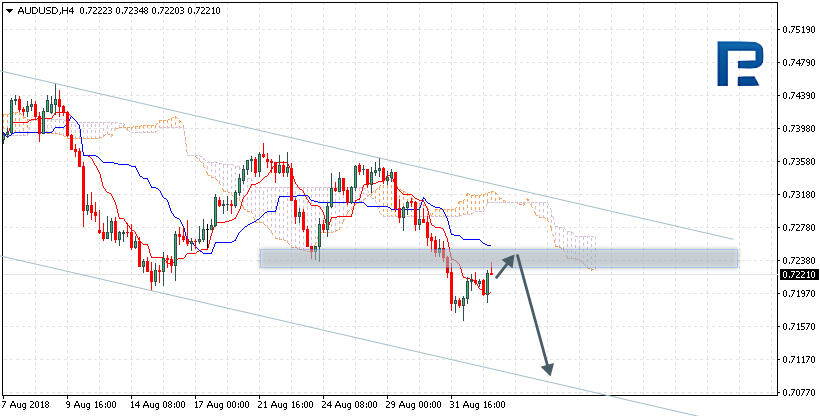
AUDUSD is trading at 0.7221; the instrument is moving below Ichimoku Cloud, which means that it may continue falling. The markets could indicate that the price may test Tenkan-Sen and Kijun-Sen at 0.7240 and then resume moving downwards to reach 0.7080. Another signal to confirm further descending movement is the price’s rebounding from the resistance level. However, the scenario that Implies further decline may be cancelled if the price breaks the upside border of the cloud and fixes above 0.7315. In this case, the pair may continue growing towards 0.7435.

AUDUSD
Risk Warning: the result of previous trading operations do not guarantee the same results in the future


NZDUSD, “New Zealand Dollar vs US Dollar”

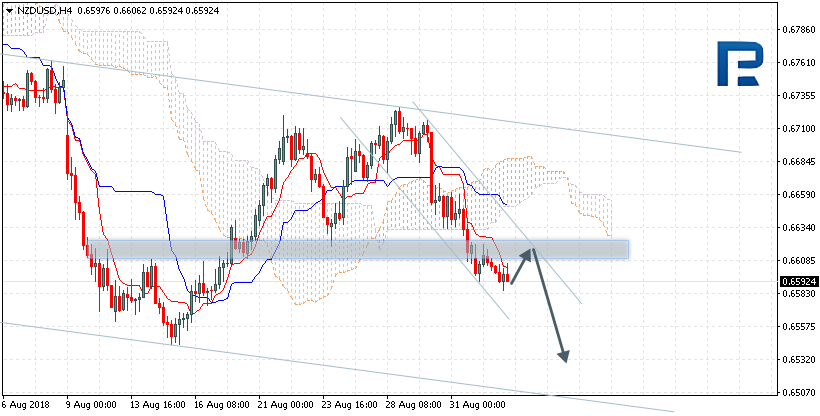
NZDUSD is trading at 0.6592; the instrument is moving below Ichimoku Cloud, which means that it may continue falling. The markets could indicate that the price may test Tenkan-Sen and Kijun-Sen at 0.6610 and then continue moving downwards to reach 0.6530. Another signal to confirm further descending movement is the price’s rebounding from the resistance level. However, the scenario that implies further decline may be cancelled if the price breaks the upside border of the cloud and fixes above 0.6665. In this case, the pair may continue growing towards 0.6740.

NZDUSD
Risk Warning: the result of previous trading operations do not guarantee the same results in the future


USDCAD, “US Dollar vs Canadian Dollar”

USDCAD is trading at 1.3104; the instrument is moving above Ichimoku Cloud, which means that it may continue growing. The markets could indicate that the price may test Tenkan-Sen and Kijun-Sen at 1.3070 and then resume moving upwards to reach 1.3205. Another signal to confirm further ascending movement is the price’s rebounding from the support level. However, the scenario that Implies further growth may be cancelled if the price breaks the downside border of the cloud and fixes below 1.2955. In this case, the pair may continue falling towards 1.2860. After breaking the channel’s upside border and fixing above 1.3225, the price may continue moving upwards.

USDCAD
Risk Warning: the result of previous trading operations do not guarantee the same results in the future

Article By RoboForex.com

Attention!
Forecasts presented in this section only reflect the author’s private opinion and should not be considered as guidance for trading. RoboForex LP bears no responsibility for trading results based on trading recommendations described in these analytical reviews.

The Analytical Overview of the Main Currency Pairs on 2018.09.04

Analytics by JustForex

The EUR/USD currency pair

Technical indicators of the currency pair:
  • Prev Open: 1.15958
  • Open: 1.16173
  • % chg. over the last day: +0.14
  • Day’s range: 1.15742 – 1.16192
  • 52 wk range: 1.0571 – 1.2557

Yesterday, trading on the EUR/USD currency pair was calm. The US financial markets were closed due to the holiday. Today, the EUR/USD quotes has been declining. At the moment, the trading instrument is testing the 1.15750 mark. The level of 1.15900 is already a “mirror” resistance. The EUR/USD currency pair has the potential for further decrease. Positions should be opened from the key levels.

The news feed on 2018.09.04:
  • – The index of economic activity in the US manufacturing sector from ISM at 17:00 (GMT+3:00).
EUR/USD

The price has fixed below 50 MA and 200 MA, which signals the power of sellers.

The MACD histogram is located in the negative zone and continues to decline, which indicates the bearish sentiment.

Stochastic Oscillator is in the neutral zone, the %K line is crossing the %D line. There are no signals at the moment.

Trading recommendations
  • Support levels: 1.15750, 1.15550, 1.15300
  • Resistance levels: 1.15900, 1.16300, 1.16600

If the price fixes below the local support of 1.15750, the EUR/USD quotes are expected to fall. The movement is tending to 1.15550-1.15300.

Alternative option. If the price fixes above 1.16100, we recommend considering purchases of EUR/USD. The movement is tending to 1.16400-1.16600.

The GBP/USD currency pair

Technical indicators of the currency pair:
  • Prev Open: 1.29131
  • Open: 1.28639
  • % chg. over the last day: -0.41
  • Day’s range: 1.28408 – 1.28756
  • 52 wk range: 1.2361 – 1.4345

The GBP/USD currency pair continues to show negative dynamics. The pound is under pressure due to uncertainty in the Brexit process and weak economic reports. In August, the index of economic activity in the UK manufacturing sector reached a two-year minimum. The indicator counted to 52.8, which is below market expectations at the level of 53.9. At the moment, the GBP/USD quotes are consolidating in the range of 1.28400-1.28700. The positions should be opened from these marks.

Important economic reports on 2018.09.04:
  • – The index of economic activity in the UK construction sector at 11:30 (GMT+3:00).
GBP/USD

The price has fixed below 50 MA and 200 MA, which signals the power of sellers.

The MACD histogram is in the negative zone, but above the signal line, which gives a weak signal to sell GBP/USD.

Stochastic Oscillator is located in the neutral zone, the %K line has crossed the %D line. There are no signals at the moment.

Trading recommendations
  • Support levels: 1.28400, 1.28000
  • Resistance levels: 1.28700, 1.29000, 1.29350

If the price fixes below the local support of 1.28400, further fall of the GBP/USD currency pair is expected. The movement is tending to the round level of 1.28000.

Alternative option. If the price fixes above the level of 1.28700, we recommend considering purchases of GBP/USD. The target movement level is 1.29000-1.29350.

The USD/CAD currency pair

Technical indicators of the currency pair:
  • Prev Open: 1.30722
  • Open: 1.30915
  • % chg. over the last day: +0.24
  • Day’s range: 1.30892 – 1.31251
  • 52 wk range: 1.2059 – 1.3795

The bullish sentiment continues to prevail on the USD/CAD currency pair. At the moment, quotes are testing the local resistance of 1.31250. The 1.30850 mark is already a “mirror” support. The trading instrument is tending to grow. We recommend paying attention to the news feed on the US economy. Positions should be opened from the key levels.

The publication of important economic reports from Canada is not planned.

USD/CAD

The price has fixed above 50 MA and 200 MA, which signals the power of buyers.

The MACD histogram is in the positive zone and continues to rise, which signals to buy USD/CAD.

Stochastic Oscillator is located in the neutral zone, the %K line is above the %D line, which also gives a signal to buy USD/CAD.

Trading recommendations
  • Support levels: 1.30850, 1.30500, 1.30200
  • Resistance levels: 1.31250, 1.31500

If the price fixes above the resistance level of 1.31250, the USD/CAD quotes are expected to grow. The movement is tending to 1.31500-1.31750.

Alternative option. If the price fixes below the “mirror” support of 1.30850, it is necessary to consider sales of USD/CAD. The movement is tending to 1.30500-1.30300.

The USD/JPY currency pair

Technical indicators of the currency pair:
  • Prev Open: 110.051
  • Open: 110.986
  • % chg. over the last day: -0.04
  • Day’s range: 110.901 – 111.463
  • 52 wk range: 104.56 – 114.74

The USD/JPY currency pair is growing. During today’s trading session, the growth of quotes has exceeded 45 points. The trading instrument approached the key resistance of 111.500. The 111.200 mark is already a “mirror” support. We do not exclude the further growth of the USD/JPY currency pair. We recommend opening positions from the key levels.

Today, the news feed on the economy of Japan is calm.

USD/JPY

Indicators point to the power of buyers: the price has fixed above 50 MA and 200 MA.

The MACD histogram has moved to the positive zone and continues to rise, which indicates the bullish sentiment.

Stochastic Oscillator is located in the overbought zone, the %K line is above the %D line, which gives a weak signal to buy USD/JPY.

Trading recommendations
  • Support levels: 111.200, 111.000, 110.750
  • Resistance levels: 111.500, 111.800

If the price fixes above the resistance level of 111.500, further growth of the USD/JPY quotes is expected. The movement is tending to 111.800-112.000.

An alternative may be decrease of the USD/JPY currency pair to the round level of 111.000.

Analytics by JustForex

The Dollar Index Has Been Growing

by JustForex

Yesterday, trading on currency majors was fairly calm. Weak trading activity and volatility were observed in the market. The financial markets of the US and Canada were closed due to the holidays. The pound was under pressure because of weak economic reports. In August, the index of economic activity in the UK manufacturing sector fell to 52.8 (two-year minimum). Market expectations were at the level of 53.9. Today, the dollar index (#DX) has been growing.

During the Asian trading session, the Reserve Bank of Australia, as expected, has kept the key interest rate at the previous level of 1.50%. Financial market participants expect important statistics from the UK and the US. Demand for the American currency is at a fairly high level. We recommend monitoring the current information regarding Brexit, as well as the trade conflict between the US and China.

The bullish sentiment prevails in the market of “black gold”. At the moment, futures for the WTI crude oil are testing a mark of $70.25 per barrel.

Market Indicators

On Friday, the major US stock indices showed mixed results: #SPY (0.00%), #DIA (-0.06%), #QQQ (+0.13%).

At the moment, the 10-year US government bonds yield is at the level of 2.87-2.88%.

The news feed on 04.09.2018:

– The index of economic activity in the UK construction sector at 11:30 (GMT+3:00);
– The Bank of England inflation report hearings at 15:15 (GMT+3:00);
– The index of economic activity in the US manufacturing sector from ISM at 17:00 (GMT+3:00).

by JustForex

EURUSD: correction could continue through to Thursday

By Gabriel Ojimadu, Alpari

Previous:

On Monday the 3rd of September, trading on the euro closed slightly up. Exchanges were closed in the US and Canada due to national holidays. This of course meant that activity was low during the US session. As trading closed in Europe, the euro had recovered to 1.1628.

The single currency also got some support against the greenback thanks to growth on the EURGBP cross. The pound declined following comments from EU representative Barnier that he is strongly opposed to British Prime Minister Theresa May’s latest proposals concerning Brexit. Michel Barnier is the EU’s top representative in post-Brexit trade negotiations with the UK.

Day’s news (GMT+3):

  • 10:15 Switzerland: CPI (Aug).
  • 11:30 UK: PMI construction (Aug).
  • 12:00 Eurozone: PPI (Jul).
  • 15:15 UK: inflation report hearings.
  • 16:45 US: Markit manufacturing PMI (Aug).
  • 17:00 US: ISM manufacturing PMI (Aug), construction spending (Jul).
  • 17:30 US: Fed’s Evans speech.
  • 22:30 US: total vehicle sales (Aug).

Fig 1. EURUSD hourly chart.

Current situation:

Everything turned out exactly as I expected yesterday. Bulls were met with resistance at around 1.1628. The pair didn’t make it to the 45th degree and the LB balance line (sma 55).

After publishing my review yesterday, I extended my forecast to the end of the week. I haven’t bothered adjusting it today since the rate hasn’t strayed from it by much. I’m going to keep my forecast for the week on the chart until Monday to see how accurate it is.

In Tuesday’s Asian session, the pair has returned to the lower boundary of the channel formed from the correction which started at 1.1585. From a technical standpoint, on the hourly timeframe it looks like the bears have their sights on 1.1555. I don’t mind if this happens, but hourly cycles and patterns suggest that the correction will continue through till Thursday. The market doesn’t owe anything to anyone, these are just calculations. There are resistance levels at the 45th degree (1.1639) and the LB line (1.1623).

Forex Technical Analysis & Forecast 03.09.2018 (EURUSD, GBPUSD, USDCHF, USDJPY, AUDUSD, USDRUB, GOLD, BRENT)

Article By RoboForex.com

EURUSD, “Euro vs US Dollar”

EURUSD is moving downwards to reach 1.1520. Possibly, today the pair may consolidate to grow towards 1.1617 and then fall with the short-term target at 1.1546. After that, the instrument may start a new correctional wave towards 1.1616 and then resume trading to the downside to reach the target at 1.1520.

EURUSD
Risk Warning: the result of previous trading operations do not guarantee the same results in the future


GBPUSD, “Great Britain Pound vs US Dollar”

GBPUSD is moving downwards to reach 1.2864. Later, the market may grow towards 1.2936 and then start another decline with the target at 1.2828.

GBPUSD
Risk Warning: the result of previous trading operations do not guarantee the same results in the future


USDCHF, “US Dollar vs Swiss Franc”

USDCHF is moving upwards. Possibly, today the pair may reach 0.9740 and then fall to reach 0.9670. After that, the instrument may form a new ascending structure with the first target at 0.9770.

USDCHF
Risk Warning: the result of previous trading operations do not guarantee the same results in the future


USDJPY, “US Dollar vs Japanese Yen”

USDJPY is forming the third descending wave. Today, the price may grow to reach 111.25, resume falling to break 110.68, and then continue falling inside the downtrend with the short-term target at 110.18. Later, the market may resume growing to return to 110.68 and then start another decline with the target at 109.55 to complete the first half of this descending wave.

USDJPY
Risk Warning: the result of previous trading operations do not guarantee the same results in the future


AUDUSD, “Australian Dollar vs US Dollar”

AUDUSD has broken its consolidation range downwards. Possibly, the pair may extend the third wave towards 0.7156 and then start another correction to reach 0.7256. After that, the instrument may form the fifth wave with the target at 0.7135.

AUDUSD
Risk Warning: the result of previous trading operations do not guarantee the same results in the future


USDRUB, “US Dollar vs Russian Ruble”

USDRUB is consolidating around 67.64. Possibly, today the pair may fall towards the downside border of the Triangle pattern at 67.15 and then resume growing to reach 67.70. Later, the market may continue falling inside the downtrend with the target at 65.75.

USDRUB
Risk Warning: the result of previous trading operations do not guarantee the same results in the future


XAUUSD, “Gold vs US Dollar”

Gold is moving downwards. Possibly, today the pair may reach 1191.80 and then grow towards 1200.00. Later, the market may resume trading to the downside to return to 1186.20.

GOLD
Risk Warning: the result of previous trading operations do not guarantee the same results in the future


BRENT

Brent is consolidating above 77.00. According to the main scenario, the pair is expected to break the range to the upside and reach 78.90. After that, the instrument may fall towards 78.04 and start another growth with the target at 82.00.

BRENT
Risk Warning: the result of previous trading operations do not guarantee the same results in the future

Article By RoboForex.com

Attention!
Forecasts presented in this section only reflect the author’s private opinion and should not be considered as guidance for trading. RoboForex LP bears no responsibility for trading results based on trading recommendations described in these analytical reviews.

The Australian Dollar is still under pressure. Overview for 03.09.2018

Article By RoboForex.com

In the morning, AUDUSD reached new lows, but later managed to start a correction.

On the first Monday of September, the Australian Dollar is still under “bearish” pressure against the USD. The current quote for the instrument is 0.7187.

The statistics published in the morning indicated that the Retail Sales didn’t change in July, although it was expected to add 0.2% m/m after expanding by 0.4% m/m in June. The components of the report show that sales declined for clothing, footwear and personal accessory retailing, department stores, and household goods retailing. Quite the opposite, sales in cafes, restaurants and takeaways, and food improved, thus minimizing an overall decline in the indicator.

Meanwhile, the AIG Manufacturing Index increased in August up to 56.7 points after being 52.0 points the month before.

This week, investors will be closely watching how things between the USA and China unfolds in their “trade wars”. It really matters for Australia and the Aussie, because China is its major trade and economic partner. The thing that makes investors worry is oncoming extension of import duties on Chinese goods. It’s quite clear why the USA are doing this: Donald Trump is trying to protect the country’s domestic production by creating conditions without competition. By the way, China hasn’t done the same yet.

Article By RoboForex.com

Attention!
Forecasts presented in this section only reflect the author’s private opinion and should not be considered as guidance for trading. RoboForex LP bears no responsibility for trading results based on trading recommendations described in these analytical reviews.