Author Archive for InvestMacro – Page 347

The US Dollar Index Is in the Negative Zone

by JustForex

The US currency weakened against a basket of major currencies. The US dollar index (#DX) closed in the negative zone (-0.18%). Yesterday, the US producer price index was published, which counted to 0.2% in September, as investors expected.

Today, investors will assess a report on inflation in the United States, which may affect the Fed’s views on further interest rate raising, as well as the dynamics of currency majors in the short term.

The British pound strengthened against the US dollar in the hope that the UK and the EU would soon conclude an agreement on Brexit. Weak economic data from the UK did not prevent the growth of the pound. Thus, the UK GDP counted to 0.0% and was worse than the forecasted value of 0.1%. The volume of production in the UK manufacturing industry fell by -0.2% in August, while investors expected a growth of 0.1%.

The “black gold” prices have been declining. At the moment, futures for the WTI crude oil are testing a mark of $72.20 per barrel. At 18:00 (GMT+3:00) a report on the US crude oil inventories will be published.

Market Indicators

Yesterday, aggressive sales were observed in the US stock market: #SPY (-3.17%), #DIA (-3.09%), #QQQ (-4.40%).

The 10-year US government bonds yield moved away from local highs. At the moment, the indicator is at the level of 3.16-3.17%.

The news feed on 2018.10.11:

– Publication of the ECB account of monetary policy meeting at 14:30 (GMT+3:00);
– Report on inflation in the US at 15:30 (GMT+3:00).

by JustForex

Dollar Engulfing Bearish Pattern Warns of Dollar Weakness

By TheTechnicalTraders.com

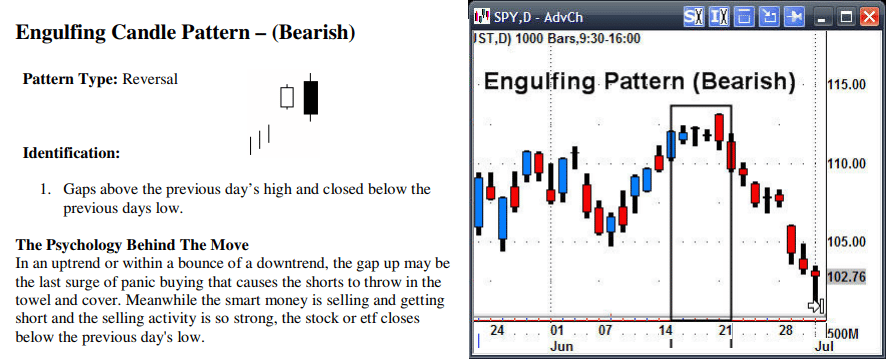
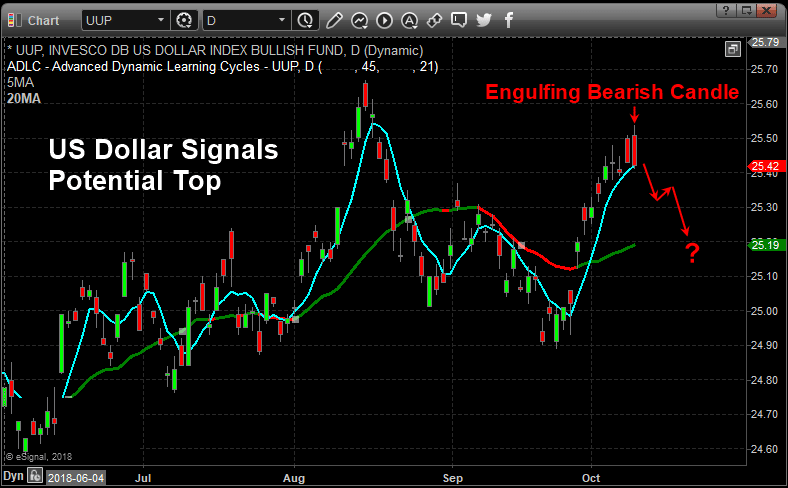
A unique setup has occurred in the UUP (Invesco DB US Dollar Index) that resembles an Engulfing Bearish type of pattern (even though it is not technically an Engulfing Bearish pattern).  Technically, an Engulfing Bearish pattern should consist of a green candle followed by a larger red candle whereas the red candle’s body (the open to close range) completely engulfs the previous candle’s body.  In the instance we are highlighting in this article, a unique variation of what we’ll call a “Completely Filled Engulfing Bearish” pattern is setting up.

This is when two red candles setup in an Engulfing Bearish type of formation – omitting the requirement that the first candle be green.  Japanese Candlesticks help us to identify the psychology of the market price in relation to our other specialized tools.  We believe this formation is important because both of the red candlesticks that make up this pattern opened much higher than the previous bar’s close and dramatically sold off into the close of each session.  We believe this type of rotation clearly illustrated that price is reaching resistance near $25.50 and pushing lower because of this strong resistance.  We also believe this resistance/pattern will setup a downside price move in the US Dollar very soon.


Below, we have highlighted the traditional formation of an Engulfing Bearish Candlestick pattern.  The example chart, to the right of this definition, shows another variation of the Engulfing Bearish pattern setting up after three minor sideways candles.  The interpretation of this Bearish Reversal pattern is subjective in terms of understanding the psychological representation of the Engulfing Bearish pattern.  This pattern represents a total reversal of power within the price bar where the buyers were in control at the open (resulting in a higher opening price) and lost control through the trading session to allow the sellers to drive the price much lower into the close of the trading session.  Thus, the Engulfing Bearish pattern represents a “key pivot point” in price that may prompt a larger downside move in the near future.

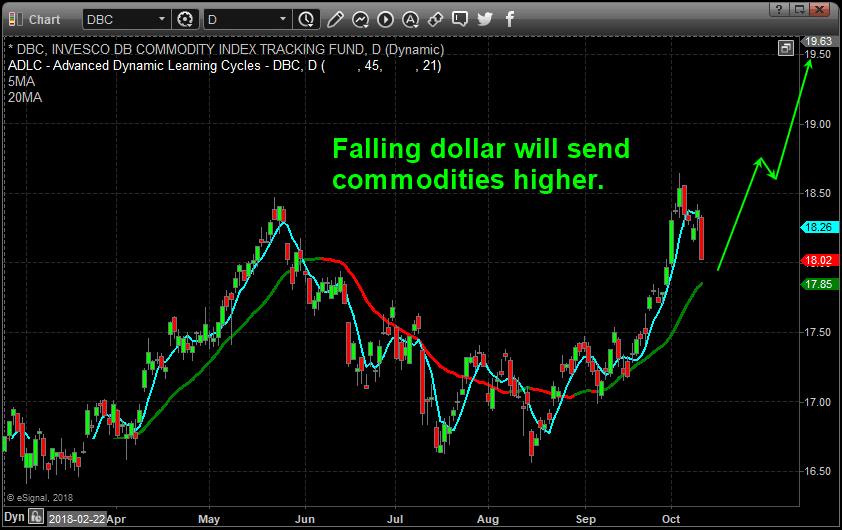
When we consider the totality of this US Dollar move, a falling US Dollar will result in a number of other relative price swings across almost all of the major global markets.  One thing that is immediate for our research team is that any price decrease in the US Dollar will likely prompt a further advance in the price of Commodities.  Commodities are tied to the US Dollar because almost all trade is based in UD Dollar value.  When the US Dollar rises, commodities become more expensive for foreign buyers.  When the US Dollar falls, commodities become less expensive for foreign buyers.  Therefore, any price decline in the value of the US Dollar should prompt an increase in commodity prices.

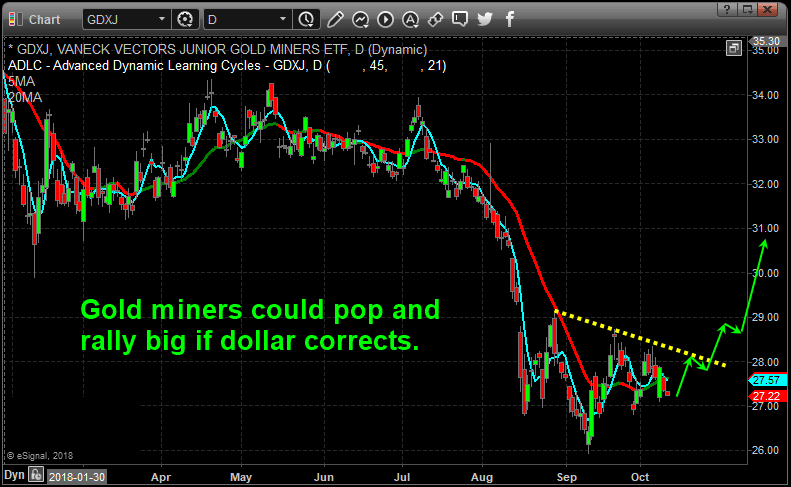
Additionally, any sharp decline in the price of the US Dollar should also prompt a rally in Precious Metals and Mining Stocks.  Precious Metals react to US Dollar pricing just like Commodities do.  As the US Dollar strengthens, Precious Metals tend to fall as a means to counter the increased cost basis for these metals.  Under normal economic pressures, the precious metals react to pricing based on fear of economic crisis events, raw demand and global currency valuations.  The few things that can dramatically alter this relationship are massive increases or decreases in demand and any type of global economic crisis events.  When these impetus factor act together, the Precious Metals sector can rocket higher or decline quickly as the fear or demand issues increase and decrease over time.


Our belief is that the US Dollar will rotate lower over the next few weeks headed into the uncertainty of the US mid-term elections and that the Commodities and Precious Metals markets will likely increase in relation to this US Dollar weakness.  These potential price swings present very clear opportunities for skilled traders. Our research team follows almost all of the global markets in an attempt to keep our subscribers aware of opportunities and trends that exist in the global markets.  If you want to see why our subscribers stay with us and believe in our ability to assist them in finding greater success, then visit TheTechnicalTraders.com.


EURUSD: euro rising against the dollar with sharp pullbacks

By Gabriel Ojimadu, Alpari

Previous:

On Wednesday the 10th of October, trading on the euro closed up. After a drop to 1.1480, the pair recovered to 1.1545. There are several potential factors behind this reversal:

  • A sharp drop in US10Y bond yields and the US dollar index. US10Y bond yields dropped from 3.24% to 3.16%. In Asia, they dropped further to 3.14%.
  • The decline of the US stock market. Investors have been selling shares across all industries as interest rate hikes from the US Fed make bonds attractive when the stock market is overheated.
  • The Brexit deal is about 80 – 85% complete and could be finalised by Wednesday the 17th of October. This is according to chief EU negotiator Michel Barnier. The pound is rising across the board. The EURUSD and GBPUSD pairs are moving in the same direction.

Day’s news (GMT+3):

  • 09:45 France: CPI (Sep).
  • 14:20 OPEC monthly report.
  • 14:30 Eurozone: ECB monetary policy meeting accounts.
  • 15:30 Canada: new housing price index (Aug).
  • 15:30 US: CPI (Sep), initial jobless claims (5 Oct).
  • 18:00 US: EIA crude oil stocks change.
  • 21:00 US: Federal budget balance (Sep).

Fig 1. EURUSD hourly chart.

Current situation:

Above I’ve laready listed the potential factors behind the euro’s rise. The rate rose to the 90th degree yesterday, before pushing further to the 112th today. As far as I see it, the 112 – 135 degree range is a reversal zone, but I didn’t manage to open a short position from 1.1565 in time. We’ll have to wait and see how the situation develops.

Oil prices collapsed yesterday, which took its toll on commodity currencies. The oil market faded to the background, however, following the decline in US bond yields. Speculators may return to it now, having remembered yesterday’s decline.

Our pair fell from a high of 1.1572 to 1.1548. Sellers are holding the rate up at the trend line drawn from 1.1432. On the current hour, this line runs through 1.1530. Taking into account the 3 consecutive higher highs on the AO indicator, it’s possible that trend line will be broken.

If the rate makes it to 1.1548, sellers will have a head and shoulders model within their sights. At this point it won’t matter so much whether or not it’s a true H&S formation. The real question is how many traders will spot the formation and how much money they’ll put on it. If the model forms, the rate will return to 1.1475. So, we’ve looked at the potential factors for a drop; now let’s look at the growth factors.

If the rate rebounds from the trend line, then against the backdrop of a broadly weaker dollar and a decline in US10Y bond yields, the bulls could test the 135th degree. From there we’ll head south again, since there’s a bearish divergence forming between the rate and the AO indicator.

The euro is rising against the dollar amid some sharp pullbacks. It’s as if markets are intentionally delaying buyers to make them believe in this new rally and to activate short limit orders on the euro. The current reversal has been confirmed on the daily timeframe. Now we need to test sellers’ intentions with a drop. If bearish activity is low, then following the correction, the rate will move up to 1.1650 and beyond.

Admiral Markets Named Best Forex and CFD Broker 3 Years Running

For the third year in a row, Admiral Markets UK Ltd has been awarded “Best Forex Broker 2018” and “Best CFD Broker 2018” in Germany by BrokerVergleich.de.

Over 10,000 of BrokerVergleich’s readers took part in the vote from July 24 to September 18. This popular ranking was then combined with an objective assessment from the judges, which focused on a comprehensive overview of the service provided, ranging from the cost of trading to customer support. Admiral Markets UK Ltd was then chosen as the leading broker in both the CFD and Forex categories!

“We are delighted to have received these awards from the BrokerVergleich community,” said Jens Chrzanowski, Co-CEO of Admiral Markets Group AS. “Admiral Markets has always made it a priority to offer the best possible service and trading conditions to our clients, and being awarded the title of Best Forex Broker and Best CFD Broker for the past three years shows us that we are on the right track.”

These are the sixth and seventh awards received by Admiral Markets in 2018, with Admiral Markets also having been named the Best CFD and Forex Broker by Deutsches Kundeninstitut, Onlinebroker-Portal, FxCuffs and Broker-Wahl. Admiral Markets was also named the Fairest/Best Price-Value Ratio of German CFD Brokers by Focus Money.

The entire Admiral Markets team considers these awards to be a symbol of the trust our clients put in our service, and they motivate us to deliver continuous improvements to our clients’ trading experience.

About Admiral Markets

Admiral Markets is a leading online trading provider specialising in equities, securities and contracts for difference. In addition to a wide range of financial instruments, Admiral Markets offers free educational materials, including analytics, webinars and seminars.

The First Casualty of Trade War Is Truth

By Dan Steinbock

As Trump tariffs continue to spread, an ideological war of words is redressing harsh protectionist realities. What is the state of Chinese growth amid the US tariffs? And what is the impact of the trade wars on global economic prospects?

Recently, US academic Yasheng Huang argued on Wall Street Journal that “Jack Ma is retiring. Is China’s economy losing steam?” By the same logic, Elon Musk’s forced resignation from Tesla would mean US slowdown.

Similarly, Bloomberg columnist Nisha Gopalan explains Ma’s retirement by claiming that the prosecution of corrupt business oligarchs in China signals economic weakness, despite corruption’s corrosive impact on private economy. In turn, Gordon F. Chang urges US tariffs against all Chinese imports as “necessary.” But these prophecies have a pathetic track record. In 2001, Chang published The Coming Collapse of China, even as Chinese economy was about to grow sixfold in a decade.

It is often said that the first casualty of war is truth. Trade war is no different. What is odd is not that times of peril offer opportunities to ideologists, or ideologies to opportunists. What’s odd is that, despite recurrent flawed predictions or prejudiced bias, partisan oracles continue to be given ample space in major global media.

Setting aside the hollow prophecies, where is Chinese economy today?

Chinese growth amid Trump’s trade wars

As the People’s Bank of China (PBOC) recently cut banks’ reserve requirements, Reuters headlined: “Trade war imperils [China’s] growth.” Yet, analysts saw the cut as an affirmation of Chinese government’s commitment to support the domestic economy. In the new, more challenging status quo, accommodative monetary policy is likely to continue, along with further fiscal easing.

In the short-term, China is responding and adjusting to US tariff wars. In 2018, growth forecast is 6.5% to 6.6%, thanks to strong first half of the year. Moderation in the second half will reflect US tariff wars and consequent slower demand growth.

For now, solid service sector growth, supported by monetary and fiscal support, has kept the economy on track. Inflation is moderating and current account surplus could narrow more than expected. Trump tariffs are designed to hurt export growth and thus the growth of manufacturing investment. Further, the White House’s sharpened tone suggests US trade hawks hope to instigate capital outflows from China.

In the medium-term, China is deleveraging, while reducing poverty and pollution, to sustain higher-quality growth. A year ago, shadow banking still peaked at more than 15% year-on-year; now its growth has plunged. While substandard loans and actual bank losses have been relatively low, “special mention” loans – a category slightly above nonperforming loans – remains substantial, though they have been declining.

In the long-term, Chinese economy is rebalancing as the sources of growth are shifting from investment and exports to consumption and innovation. On the supply side, the economy continues to move away from industry and toward services. On the demand side, consumption is increasingly fueling growth. Meanwhile, global innovation hubs are expanding from Shenzhen to Shanghai and Beijing.

Obviously, Trump’s trade offenses complicate and defer Chinese reforms, but the direction of these reforms prevails. There are no winners in a trade war. If the White House will up tariffs on all Chinese imports, the stakes will soar to $500 billion. That could penalize China by 1% of its GDP; but US GDP would suffer a 2% hit.

However, global economic prospects could suffer even more.

Undermining global prospects

The International Monetary Fund (IMF) has now cut its forecast on global economic growth to 3.7% percent for 2018 and 2019, citing rising trade protection. But that is an optimistic projection because it downplays the full impact of the Trump administration’s effective tariffs, retaliations impact, the inclusion of new potential tariff targets and subsequent collateral damage.

Following a sharp upswing in 2017, exports and imports in Asia have held up fairly well. But thanks to Trump’s new protectionism, world trade and investment are set to take severe hits. According to the World Trade Organization (WTO), merchandise trade volume growth was expected to increase 4.4% in 2018. But as tariffs escalate trade tensions, the outlook is likely to be penalized. In turn, world investment soared to $2 trillion before the 2008 global crisis. Last year, it fell to $1.5 trillion. As tariff wars spread, world investment is likely to languish even more.

Instead of confronting protectionism, Brussels and Tokyo still hope to gain exemptions to avoid Trump’s trade wrath. In the B20 Summit, the business voice of the G20, advanced economies have been pushing a policy proposal to address “state-related competitive distortions.” In advanced economies, the share of state-owned enterprises (SOEs) in national employment is about 5% to 15%. In the early days of Chinese reforms, the comparable figure in the mainland was over 75%; today barely 20%. However, advanced economies have had two centuries to reduce the role of SOEs in their economies; China barely two decades.

If confrontational approaches are favored by G20, then why not start by reviewing the role of US and EU agricultural subsidies that have caused irreparable harm to developing economies in Asia, Latin America and Asia for decades?

What G20 and the world economy needs today is not more friction, but a united front of advanced, emerging and developing economies for global trade. As long as that front remains absent, Trump’s trade hawks can continue their bilateral ‘rule-and-divide’ tactics against individual economies – instead of having to cope with the multilateral force of the global economy.

Over time, the alternative is the kind of global depression that was barely avoided in 2008.

About the Author:

Dan Steinbock is the founder of Difference Group and has served as research director of international business at the India, China and America Institute (US) and a visiting fellow at the Shanghai Institute for International Studies (China) and the EU Center (Singapore). For more, see http://www.differencegroup.net/    

A version of the commentary was released by China Daily on October 10, 2018.
 

Fibonacci Retracements Analysis 10.10.2018 (GBPUSD, EURJPY)

Article By RoboForex.com

GBPUSD, “Great Britain Pound vs US Dollar”

As we can see in the H4 chart, after completing the correction, GBPUSD started a new rising impulse, which is getting closer to the retracement of 76.0% at 1.3207. The main upside target is the current high at 1.3298. If the price breaks the high, the pair may continue trading towards the post-correctional extension area between the retracements of 138.2% and 161.8% at 1.3440 and 1.3532 respectively. The support level is at 1.2922.

GBPUSD1
Risk Warning: the result of previous trading operations do not guarantee the same results in the future

In the H1 chart, the pair is trading upwards, but once can see the divergence being formed, which may indicate a possible pullback after the price reaches the short-term target, the retracement of 76.0% at 1.3207. The targets of this pullback may be the retracements of 23.6%, 38.2%, and 50.0% at 1.3140, 1.3098, and 1.3064 respectively.

GBPUSD2
Risk Warning: the result of previous trading operations do not guarantee the same results in the future


EURJPY, “Euro vs. Japanese Yen”

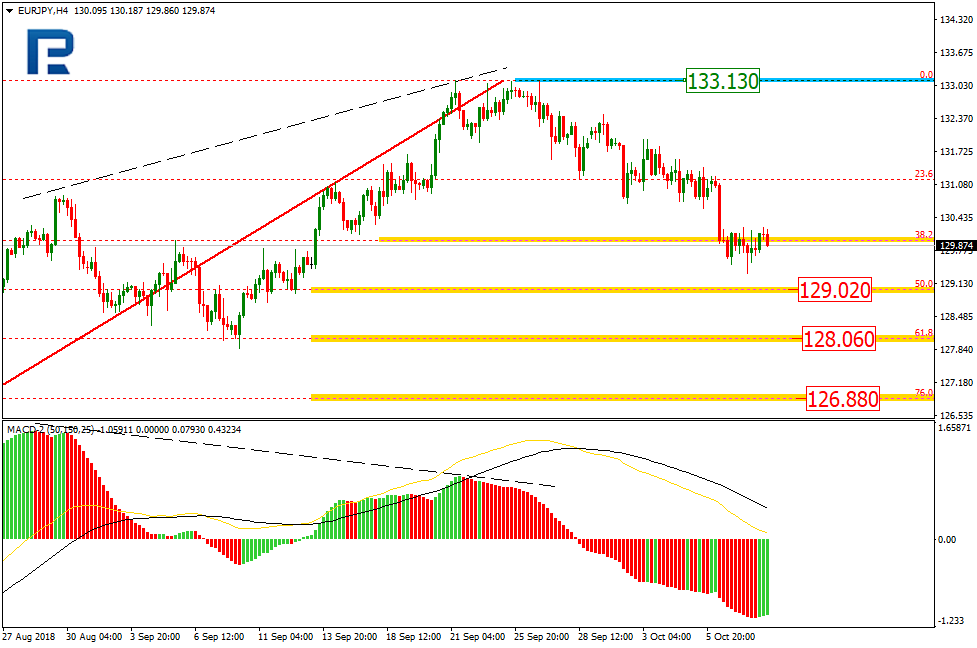
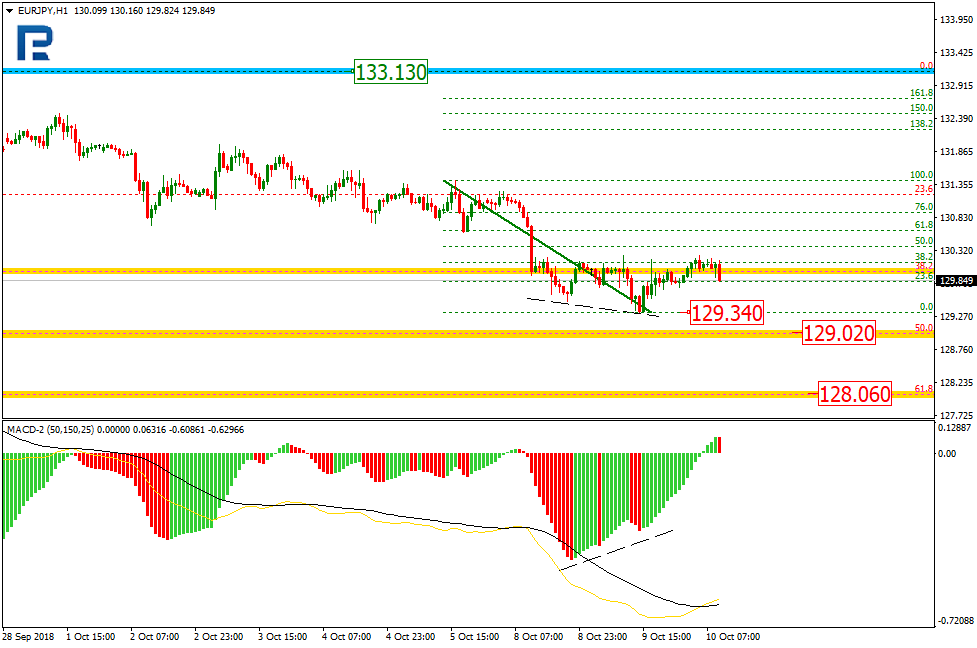
As we can see in the H4 chart, the divergence made EURJPY start a new correctional downtrend, which has already reached the retracement of 38.2%. The next possible targets are the retracements of 50.0%, 61.8%, and 76.0% at 129.02, 128.06, and 126.88 respectively. The resistance level is the high at 133.13.

EURUSD1
Risk Warning: the result of previous trading operations do not guarantee the same results in the future

In the H1 chart, the pair is forming a short-term ascending correction inside the main downtrend. If the price breaks the low at 129.34, the instrument may continue trading downwards.

EURJPY2
Risk Warning: the result of previous trading operations do not guarantee the same results in the future

Article By RoboForex.com

Attention!
Forecasts presented in this section only reflect the author’s private opinion and should not be considered as guidance for trading. RoboForex LP bears no responsibility for trading results based on trading recommendations described in these analytical reviews.

Forex Technical Analysis & Forecast 10.10.2018 (EURUSD, GBPUSD, USDCHF, USDJPY, AUDUSD, USDRUB, GOLD, BRENT)

Article By RoboForex.com

EURUSD, “Euro vs US Dollar”

After completing the wave to the downside, EURUSD has formed a new ascending impulse towards 1.1515, which is in the middle of the descending structure. Possibly, today the pair may fall towards 1.1474, thus forming a new consolidation range. If later the instrument breaks this range to the upside, the price may continue the correction to reach 1.1600; if to the downside – resume trading inside the downtrend with the target at 1.1344.

EURUSD
Risk Warning: the result of previous trading operations do not guarantee the same results in the future


GBPUSD, “Great Britain Pound vs US Dollar”

GBPUSD has reached the upside target. Today, the pair may reach 1.3098 and then grow towards 1.3166. After that, the instrument may form a new consolidation range with a reversal pattern. The price is expected start another descending structure with the target at 1.2860.

GBPUSD
Risk Warning: the result of previous trading operations do not guarantee the same results in the future


USDCHF, “US Dollar vs Swiss Franc”

USDCHF is still consolidating at the top of the ascending wave close to the downside border. If later the instrument breaks this range to the downside, the price may continue the correction to reach 0.9767. The first target is at 0.9860.

USDCHF
Risk Warning: the result of previous trading operations do not guarantee the same results in the future


USDJPY, “US Dollar vs Japanese Yen”

USDJPY is consolidating near the low of the third descending wave. If later the instrument breaks this range to the upside, the price may start another correction towards 113.52; if to the downside – continue trading inside the downtrend with the first target at 112.44.

USDJPY
Risk Warning: the result of previous trading operations do not guarantee the same results in the future


AUDUSD, “Australian Dollar vs US Dollar”

AUDUSD has broken its consolidation range upwards. Possibly, the pair may grow with the short-term target at 0.7136 and then fall to reach 0.7097. Later, the market may resume growing towards the first correctional target at 0.7155.

AUDUSD
Risk Warning: the result of previous trading operations do not guarantee the same results in the future


USDRUB, “US Dollar vs Russian Ruble”

USDRUB is being corrected. Possibly, today the pair may fall towards 66.07 and then grow with the short-term target at 67.08. Later, the market may resume falling with the target at 66.55 and then start another growth to reach 68.10.

USDRUB
Risk Warning: the result of previous trading operations do not guarantee the same results in the future


XAUUSD, “Gold vs US Dollar”

Gold is consolidating near the lows. If later the instrument breaks this range to the upside, the price may be corrected towards 1194.20; if to the downside – continue trading inside the downtrend with the target at 1179.10.

GOLD
Risk Warning: the result of previous trading operations do not guarantee the same results in the future


BRENT

Brent has finished the correctional wave at 85.55. Today, the pair may form a new consolidation range near the highs. If later the instrument breaks this range to the downside, the price may start the third descending wave with the target at 82.66.

BRENT
Risk Warning: the result of previous trading operations do not guarantee the same results in the future

Article By RoboForex.com

Attention!
Forecasts presented in this section only reflect the author’s private opinion and should not be considered as guidance for trading. RoboForex LP bears no responsibility for trading results based on trading recommendations described in these analytical reviews.

The Analytical Overview of the Main Currency Pairs on 2018.10.10

Analytics by JustForex

The EUR/USD currency pair

Technical indicators of the currency pair:
  • Prev Open: 1.14853
  • Open: 1.14884
  • % chg. over the last day: +0.11
  • Day’s range: 1.14830 – 1.15109
  • 52 wk range: 1.0571 – 1.2557

Yesterday, there was a variety of trends on the EUR/USD currency pair. Quotes have reached monthly lows, and then have started recovering. At the moment, the key support and resistance levels are 1.14800 and 1.15200, respectively. Trading instrument has the potential for further growth. Positions should be opened from the key levels.

The news feed on 2018.10.10:
  • – Producer price index in the US at 15:30 (GMT+3:00).
EUR/USD

Indicators do not send accurate signals: the price is being traded between 50 MA and 200 MA.

The MACD histogram is in the positive zone, but below the signal line, which gives a weak signal to buy EUR/USD.

Stochastic Oscillator is in the neutral zone, the %K line is below the %D line, which indicates the bearish sentiment.

Trading recommendations
  • Support levels: 1.14800, 1.14400
  • Resistance levels: 1.15200, 1.15500, 1.15800

If the price fixes below the support level of 1.14800, a further decline in the EUR/USD currency pair is expected. The movement is tending to 1.14400-1.14200.

An alternative may be the EUR/USD quotes growth to the level of 1.15500-1.15800.

The GBP/USD currency pair

Technical indicators of the currency pair:
  • Prev Open: 1.30789
  • Open: 1.31411
  • % chg. over the last day: +0.51
  • Day’s range: 1.31613 – 1.31673
  • 52 wk range: 1.2361 – 1.4345

The GBP/USD currency pair has begun to recover. The British pound strengthened against the US dollar after Dow Jones Newswires reported that an agreement on the Brexit terms could be reached by Monday. At the moment, the key support and resistance levels are: 1.31400 and 1.31800, respectively. We recommend opening positions from the key levels.

The news feed on 2018.10.10:
  • – Data on the UK GDP at 11:30 (GMT+3:00);
  • – The volume of production in the UK manufacturing industry at 11:30 (GMT+3:00).
GBP/USD

Indicators point to the bullish sentiment: price is being traded above 50 MA and 200 MA.

The MACD histogram is in the positive zone, but below the signal line, which gives a weak signal to buy GBP/USD.

Stochastic Oscillator is in the neutral zone, the %K line is below the %D line, which indicates the bearish sentiment.

Trading recommendations
  • Support levels: 1.31400, 1.31000, 1.30600
  • Resistance levels: 1.31800, 1.32300

If the price fixes above the level of 1.31800, the GBP/USD quotes are expected to grow. The movement is tending to 1.32300-1.32500.

Alternative option. If the price fixes below the 1.31400 mark, we recommend looking for entry points to the market to open short positions. The movement is tending to 1.31000-1.30600.

The USD/CAD currency pair

Technical indicators of the currency pair:
  • Prev Open: 1.29476
  • Open: 1.29460
  • % chg. over the last day: -0.21
  • Day’s range: 1.29454 – 1.29552
  • 52 wk range: 1.2059 – 1.3795

The technical pattern on the USD/CAD currency pair is ambiguous. The trading instrument is in a sideways trend. Financial market participants expect additional drivers. The USD/CAD quotes are consolidating in the range of 1.29300-1.29650. We recommend opening positions from these marks.

The news feed on the economy of Canada is calm.

USD/CAD

Indicators do not send accurate signals: the price is being traded between 50 MA and 200 MA.

The MACD histogram is in the negative zone, but above the signal line, which gives a weak signal to sell USD/CAD.

Stochastic Oscillator is in the neutral zone, the %K line is above the %D line, which gives a signal to buy USD/CAD.

Trading recommendations
  • Support levels: 1.29300, 1.28800
  • Resistance levels: 1.29650, 1.30000, 1.30300

If the price fixes below the support level of 1.29300, the USD/CAD currency pair is expected to decline. The movement is tending to 1.29000-1.28800.

Alternative option. If the price fixes above 1.29650, it is necessary to consider purchases of USD/CAD. The target level for profit taking is 1.30000-1.30200.

The USD/JPY currency pair

Technical indicators of the currency pair:
  • Prev Open: 113.149
  • Open: 112.979
  • % chg. over the last day: -0.19
  • Day’s range: 112.931 – 113.372
  • 52 wk range: 104.56 – 114.74

The technical pattern on the USD/JPY currency pair is ambiguous. The trading instrument is in a sideways movement. The local support and resistance levels are 112.900 and 113.250, respectively. We recommend paying attention to the US government bonds yield. Positions should be opened from the key levels.

Today, the news feed on the economy of Japan is calm.

USD/JPY

Indicators do not send accurate signals: the price is testing 50 MA.

The MACD histogram is in the negative zone, but above the signal line, which gives a weak signal to sell USD/JPY.

Stochastic Oscillator is in the neutral zone, the %K line is above the %D line, which indicates the bullish sentiment.

Trading recommendations
  • Support levels: 112.900, 112.600
  • Resistance levels: 113.250, 113.600, 114.000

If the price fixes below the support of 112.900, it is necessary to consider sales of USD/JPY. The movement is tending to 112.600-112.400.

An alternative may be the USD/JPY currency pair growth to the level of 113.600-114.000.

Analytics by JustForex

The US Dollar Index Keeps Current Levels

by JustForex

Yesterday, the US dollar weakened slightly against a basket of major currencies. The US dollar index (#DX) closed in the negative zone (-0.09%). The 10-year US government bonds yield has become stable. In general, demand for the US currency is still high.

Trade relations between the United States and China have escalated again. Chinese Foreign Minister Wang Yi accused the United States of escalating the trade conflict between the countries, as well as of Washington’s interference in the internal affairs of China. Due to political tension, demand for safe assets has increased.

The British pound strengthened against the US dollar after Dow Jones Newswires reported that an agreement on the Brexit terms could be reached by Monday. Today, we expect important economic statistics from the UK, which may affect the alignment of forces on currency pairs with the pound.

The “black gold” prices are consolidating. At the moment, futures for the WTI crude oil are testing a mark of $74.75 per barrel. At 23:30 (GMT+3:00) a report on the API weekly crude oil stock will be published.

Market Indicators

Yesterday, there was a variety of trends in the US stock market: #SPY (-0.15%), #DIA (-0.23%), #QQQ (+0.32%).

At the moment, the 10-year US government bonds yield is at the level of 3.21-3.22%.

The news feed on 2018.10.10:

– Data on the UK GDP at 11:30 (GMT+3:00);
– The volume of production in the UK manufacturing industry at 11:30 (GMT+3:00);
– Producer price index in the US at 15:30 (GMT+3:00).

by JustForex

EURUSD: impulsive trading on the euro

By Gabriel Ojimadu, Alpari

Previous:

On Tuesday the 9th of October, trading on the euro closed 5 pips down against the dollar. During the European session, the single currency dropped to 1.1432. The bulls recovered their losses in the US session, pushing the rate up to 1.1503. This upwards impulse was brought about by a renewed decline on the greenback, which occurred in response to a drop in US10Y bond yields.

News from the UK continued to exert an influence the Forex market. Officials announced that the EU and UK have made progress in negotiating the terms of exit. Trade terms could be finalised as early as Monday (15th of October).

Day’s news (GMT+3):

  • 09:45 France: industrial output (Aug).
  • 11:30 UK: GDP (MoM) (Aug), industrial production (Aug), manufacturing production (Aug), total trade balance (Aug).
  • 15:30 Canada: building permits (Aug).
  • 15:30 US: PPI (Sep).
  • 16:00 UK: NIESR GDP estimate (Sep).
  • 17:00 US: wholesale inventories (Aug).

Fig 1. EURUSD hourly chart.

Current situation:

The sharp recovery from 1.1432 has led to the formation of a long-legged doji on the daily timeframe. Despite this bullish signal, the pair could revisit the 45th degree at 1.1461 before rising.

Traders are mostly looking at the difference between German and Italian bonds. If the spread widens, this will give the bulls cause for concern. Aside from the Italian problem, markets will also be keeping a close eye on Brexit negotiations.

In short, any negative news concerning Brexit negotiations or the Italian budget will trigger a selloff of euros. The drop stopped around the trend line. I reckon that if the pair makes a move towards 1.16, it’ll be via a rebound from 1.1461.