Author Archive for InvestMacro – Page 271

The Analytical Overview of the Main Currency Pairs on 2019.03.12

Analytics by JustForex

The EUR/USD currency pair

Technical indicators of the currency pair:
  • Prev Open: 1.12342
  • Open: 1.12474
  • % chg. over the last day: +0.25
  • Day’s range: 1.12473 – 1.12739
  • 52 wk range: 1.1214 – 1.2557

EUR keeps recovering after the sharp fall last week. The EUR/USD quotes are testing the local resistance at 1.12700. 1.12450 acts as a mirror support. At the same time, EUR remains under pressure due to weak economic reports from the EU, as well a growing spread between Germany and US government bonds yields. Soon EUR/USD may start descending again. Right now the investors are looking at the UK Parliament and the Brexit vote. You should open positions from the key levels.

At 14:30 (GMT+2:00) the US will publish an inflation report.

EUR/USD

The indicators do not provide precise signals, the price fixed between 50 MA and 200 MA.

The MACD histogram is in the positive zone and keeps rising which points toward the further correction.

The Stochastic Oscillator is in the neutral zone, the %K line is above the %D line which points toward a bullish mood.

Trading recommendations
  • Support levels: 1.12450, 1.12200, 1.11800
  • Resistance levels: 1.12700, 1.12900, 1.13200

If the price fixes above 1.12700, expect the quotes to recover toward 1.13000-1.13200.

Alternatively, the quotes can descend toward 1.12200-1.12000.

The GBP/USD currency pair

Technical indicators of the currency pair:
  • Prev Open: 1.29668
  • Open: 1.31890
  • % chg. over the last day: +2.00
  • Day’s range: 1.31885 – 1.32871
  • 52 wk range: 1.2438 – 1.4378

GBP/USD had an aggressive sell-off yesterday. The pound added 250 points against the USD. Theresa May finalized the negotiations with Jean-Claud Yunker regarding the backstop instrument. Today the attention is focused on the vote in the UK Parliament regarding the new Brexit agreement. The exact time of the vote is unknown. You should keep an eye on this event. The GBP/USD quotes are consolidating around 1.31850-1.32500. You should open positions from these levels.

The Economic News Feed for 12.03.2019:

  • – GDP report (UK) – 11:30 (GMT+2:00);
  • – Industrial Production Volume (UK) – 11:30 (GMT+2:00);
GBP/USD

The price fixed above 50 MA and 200 MA which points to the power of the buyers.

The MACD histogram is in the positive zone but below the signal line, which gives a weak signal to buy GBP/USD.

The Stochastic Oscillator is in the neutral zone, the %K line is above the %D line, which points toward a bullish mood.

Trading recommendations
  • Support levels: 1.31850, 1.31100, 1.30700
  • Resistance levels: 1.32500, 1.33000

If the price fixes above the resistance level of 1.32500, expect the quotes to grow toward 1.33000-1.33500.

Alternatively, the quotes can fall toward 1.31200-1.30700.

The USD/CAD currency pair

Technical indicators of the currency pair:
  • Prev Open: 1.34148
  • Open: 1.33944
  • % chg. over the last day: -0.18
  • Day’s range: 1.33853 – 1.34060
  • 52 wk range: 1.2248 – 1.3664

USD/CAD keeps trading in a flat. There is no single defined trend. Right now the local support and resistance levels are 1.33850 and 1.34200. A technical correction for CAD is possible soon. Keep an eye on the US inflation report and the oil quotes dynamics. You should open positions from the key levels.

The Economic News Feed for 12.03.2019 is calm.

USD/CAD

The indicators do not provide precise data, the price fixed between 50 MA and 200 MA.

The MACD histogram is in the negative zone but above the signal line, which gives a weak signal to sell USD/CAD.

The Stochastic Oscillator is in the neutral zone, the %K line is crossing the %D line. There are no signals at the moment.

Trading recommendations
  • Support levels: 1.33850, 1.33350, 1.33000
  • Resistance levels: 1.34200, 1.34600, 1.35000

If the price fixes below 1.33850, expect the quotes to correct toward 1.33400-1.33200.

Alternatively, the quotes can grow toward 1.34600-1.34800.

The USD/JPY currency pair

Technical indicators of the currency pair:
  • Prev Open: 111.003
  • Open: 111.205
  • % chg. over the last day: +0.23
  • Day’s range: 111.193 – 111.464
  • 52 wk range: 104.56 – 114.56

USD/JPY has an ambiguous picture. Right now the quotes are consolidating, with local support and resistance being 111.200 and 111.500. The demand for safe haven assets grows before the Brexit vote. The investors are waiting for the US inflatio report. You should open positions from the key levels.

The Economic News Feed for 12.03.2019 is calm.

USD/JPY

The indicators do not provide precise signals, the price fixed between 50 MA and 200 MA

The MACD histogram is in the positive zone and keeps rising which points toward a bullish mood.

The Stochastic Oscillator is in the neutral zone, the %K line is above the %D line which points toward the growth of USD/JPY.

Trading recommendations
  • Support levels: 111.200, 110.900, 110.600
  • Resistance levels: 111.500, 111.800, 112.000

If the price fixes below 111.200, expect the quotes to fall toward 110.900-110.700.

Alternatively, the quotes can grow toward 111.800-112.000.

Analytics by JustForex

The Shift of the Philippine Peso Regime

By Dan Steinbock

In the Aquino era, the focus was on financial flows, which rested on a strong peso. In the Duterte era, it is on the huge investment drive, which can live with a weaker currency. The peso’s political economy is shifting.

Recently, international media have released contradictory peso reports. But the phenomenon is not new. For instance, Bloomberg’s Ditas Lopez first attributed the peso’s decline to Duterte two months before the actual election (April 27, 2016). Yet, after the election, the peso rose for weeks beating forecasts so that by late August 2016 even Bloomberg had to admit that he currency had completed the “best performance in Asia this month.”

That performance was mainly the net effect of a Duterte reassessment by the markets. Most media had vilified him as a threat (social media was a different story). But as Duterte launched his infrastructure agenda, observers realized that the country was not facing a “populist threat,” but a huge investment drive.

Yet, historically, infrastructure drives favor weaker currencies; a fact that got lost in the translation. Instead, much of the media, including Lopez, continued to lament that “Duterte’s peso rout runs counter to the booming Philippine economy” (September 29, 2016). The assumption was that a thriving economy must go hand in hand with a strong peso and that if this is not the case, then the economy cannot really be booming.

Perhaps that’s why Bloomberg later declared that “Asia’s ugly duckling of the year Is the Philippine peso” (March 2, 2017). Unfortunately, the facts told a different story: the peso erased the year’s loss as funds snapped up local stocks only a month later. That did not convince Lopez who now reported that peso is seen as “Asia’s worst performing currency next year” (December 22, 2017). Once again, peso was seen amid another “rout” (June 20, 2018).

The same story prevailed in early 2019, when Bloomberg reported that “peso faces new threat as Duterte gears up for poll” (January 7, 2019). With U.S. dollar at 53 peso, Lopez saw the peso among Asia’s biggest losers this year. Yet, it was followed by a very different piece, which was not authored by Lopez, but David Finnerty, Bloomberg’s foreign-exchange strategist who reported that “peso surprises to become Asia’s best currency” (March 3, 2019). By then, the peso had strengthened to 52. Yet, only hours later, Lopez, together with Siefrid Alegado, reported that “peso slumps as Philippines makes surprise Central Bank pick” (March 4, 2019). In this view, peso had plunged “most since 2013,” although the exchange-rate was 52.20.

As the peso has varied around 0.2% to 0.9% in the past two months, it may be prudent to ask whether such variation merits characterizations as “Asia’s biggest loser” or “Asia’s best currency.” Short-term fluctuations and ideological preferences of “strong” or “weak” peso seldom disclose long-term trends.

In reality, the underlying longer-term forces behind the short-term peso fluctuations seem to be structural. What we are witnessing a shift from one Philippine peso regime to another.

Toward the new peso political economy

Here’s the great difference between the Aquino and Duterte governments: In the Aquino era, the early promises to change the foreign direct investment (FDI) legislation paced an increase of capital flows in the early 2010s. But since the Aquino government failed to change the FDI legislation, these flows represented mainly portfolio and other investments, which eventually reversed into significant outflows. In the Duterte era, early optimism and promises to bring in more FDI have paced a dramatic increase of capital flows, which could be sustained until early 2020s (Figure 1).

Figure 1

In the Aquino era, financial flows ruled; in the Duterte era, investment counts*

* Capital Flows (In billions of U.S. dollars, + = inflow)

Source: Data from IMF (Sept. 2018)


When inflation reached an intolerable high of 6.7% last fall, it was boosted by a price effect associated with tax reforms, rising oil prices and a failure to manage rice prices. The slowing international economy penalized crude oil, which exceeded $75 in early October but is now around $56 (although a U.S.-Sino trade compromise could fuel prices again).

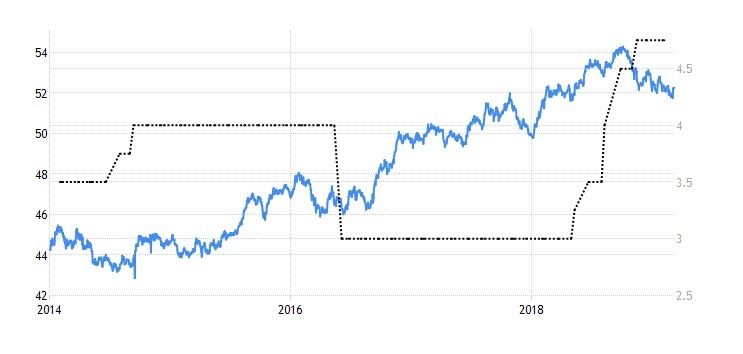
When inflation exceeded Philippine central bank’s (BSP) target range, rate hikes followed; belatedly. In the early Duterte era, interest rate had been cut from 4% to 3%, which prevailed until early 2018, even as peso weakened from 47 to 50 in 2017 and to 52 by early 2018. It was only when the rate hikes hit almost 5%, that inflation declined and peso strengthened to 52 (Figure 2).

Figure 2

How rate hikes subdued the peso in late 2018

What’s ahead?

Overheating is expected to weaken in 2019. Thanks to government measures to promote food supplies, inflation eased to 4% in February. Higher real yields are supporting the peso government bonds, despite the BSP projection that the current account deficit (CAD) could widen to 2.3% of GDP in 2019. In the past, the quota system failed to keep rice price in control; now the new import tariff system should stabilize it. The slowdown of electronic exports, which account for more than half of Philippine exports, is associated with U.S. trade wars.

One reason for the contradictory peso projections by the media is that they misjudged the succession outcome at BSP. After the premature death of Nestor Espenilla, the potential candidate list by Bloomberg’s Lopez and Alegado featured some 10 insiders, private-sector executives and wild cards – but not the next chief of the Bank. In a shrewd move, Duterte named his budget secretary Benjamin Diokno as BSP’s new chief.

In the government, Diokno had pursued an expansionary fiscal policy to finance infrastructure investments, along with Duterte’s financial chief Carlos Dominguez III. In the coming months, Diokno might lean toward an interest-rate cut, but only as long as it can be justified with easing inflation.

Some observers feel uncomfortable with current account deficit. Yet, the widening CAD is the effect of the infrastructure drive, which requires imports that support infrastructure expansion. Yet, despite the CAD, peso proved Asia’s best-performing currency in February, when it was fueled by the record $2.9 billion of remittances in December. Also, foreign investment into Philippine stocks and bonds recorded a net inflow of $763 million in January; quadruple the level of the previous year.

Most currencies in emerging markets have depreciated with the U.S. Fed’s rate hikes. But as U.S. expansion may have peaked, the Fed seems less hawkish. Yet, peso outperformance may not persist, thanks to the extremely challenging international environment.

The Duterte fiscal expansion has potential to continue well into the early 2020s – as long as international headwinds can be kept at bay.

About the Author:

Dr. Dan Steinbock is the founder of Difference Group and has served at the India, China and America Institute (US), Shanghai Institute for International Studies (China) and the EU Center (Singapore). For more, see http://www.differencegroup.net/ 

The original commentary was released by The Manila Times on March 11, 2019


Investors Are Focused on Brexit Vote

by JustForex

The US dollar weakened against a basket of major currencies despite the publication of positive economic data from the US. Thus, the core retail sales index rose by 0.9% in January, while experts expected growth by only 0.4%. Retail sales also increased by 0.2% in January, although experts did not expect growth. The dollar index (#DX) closed the trading session in the negative zone (-0.10%).

Investors are focused on Brexit. Today, the House of Commons of the UK should again start voting for the Brexit agreement, presented by Prime Minister, Theresa May. During the first vote, the Parliament rejected the Prime Minister’s deal. If the revote again fails, the events may develop in two scenarios: the UK will leave the EU without an agreement, or the Brexit date will be rescheduled. Yesterday, Theresa May also succeeded to agree with the European Commission President, Jean-Claude Juncker, on a legally binding instrument on the backstop – a backup insurance plan for the border between Ireland and Northern Ireland.

The “black gold” prices continue to rise. At the moment, futures for the WTI crude oil have approached $57.10 per barrel. At 22:30 (GMT+2:00), the API weekly crude oil stock will be published.

Market Indicators

Yesterday, aggressive purchases were observed in the US stock market: #SPY (+1.45%), #DIA (+0.80%), #QQQ (+2.08%).

At the moment, the 10-year US government bonds yield is at 2.66-2.67%.

The news feed on 12.03.2019:

– UK GDP data at 11:30 (GMT+2:00);
– Manufacturing production in the UK at 11:30 (GMT+2:00);
– Report on inflation in the US at 14:30 (GMT+2:00).

The exact time of the vote on the Brexit agreement is not yet known.

by JustForex

Oil: Friday’s drop already forgotten

By Alpari

On Friday, WTI oil took a hit, with the price shedding nearly 2 USD a barrel. By the end of the day, the asset had managed to recover nearly all of its losses, but what could be the reason behind such volatility and momentum? A quick look at the calendar shows no major data for the oil market. OPEC? Nope. Ahhhh NFP, yes! That report has the potential to shake markets to their foundations, especially when the reading comes out way below estimates. But wait a minute, after the NFP report, USD went into decline, which should help crude to climb higher in theory, so this doesn’t explain the drop that happened beforehand…

Here it is: “Norway’s $1 Trillion Sovereign Wealth Fund Is Dumping Oil Stocks”. This news definitely sent energy companies tumbling and most probably had also an impact on the price of oil itself. However, this was only temporary as we can see now. On Monday, on the other hand, we got some positive news for crude as the Saudis committed to further production cuts in the month ahead. That news has helped to push the price even higher and cover the tops from Friday’s candlestick.

Crude oil H4From a technical point of view, the drop from Friday involved a bearish breakout from the symmetrical triangle pattern. In addition to that, we broke the horizontal support at 55.7 USD/bbl. (yellow). The pullback created the false breakout pattern (blue), which very often produces a buy signal. We are back above the support and inside the symmetrical triangle pattern. Most of the time, when the price behaves like this, the resulting upswing continues and the bullish setup is profitable. We’ll see if that is the case here too. As long as we stay above the yellow support, the sentiment is positive.

Source: Oil: Friday’s drop already forgotten

EURUSD: markets await the results of the Brexit vote

By Matthew Anthony, Alpari

Previous:

On Monday the 11th of March, trading on the EURUSD pair closed up. In the US session, the euro rose to 1.1274 against the greenback. Traders has their eyes on the pound which surged by 300 pips to reach 1.3288 against the dollar ahead of Tuesday’s Brexit vote. The pair bounced from the reversal zone after reaching the U4 line, which is a rare occurrence on the hourly timeframe.

Markets expect the British parliament to vote down Theresa May’s Brexit deal, and then to vote to extend Article 50.

Day’s news (GMT+3):

  • 09:30 Australia: RBA’s Debelle speech.
  • 12:30 UK: GDP (Jan), industrial production (Jan), manufacturing production (Jan), total trade balance (Jan).
  • 13:45 Eurozone: ECB’s Lautenschläger speech.
  • 15:30 US: CPI (Feb).
  • 15:45 US: Fed’s Brainard speech.
  • N/A UK: Parliamentary vote on Brexit.

EURUSD H1

Current situation:

The pair has recovered to the trend line. Despite the collapse of the EURGBP cross, I expect the rate to drop today to the 45th degree at 1.1222. This level marks yesterday’s session low, which formed the third point of contact for the upwards channel. Along this channel, there’s a support running through 1.1239.

The trend line drawn from 1.1176 has bolstered the balance line, which is moving at the same pace a few pips below. I think it’s possible, but unlikely that the pair won’t exit the channel. At the same time, if we get a sharp recovery on the crosses, the EURUSD could jump to 1.1340 (catching up with the surging pound).

Today’s central focus for traders is the UK parliament’s vote on Theresa May’s Brexit deal. The pound has surged 300 pips. Markets have already factored in a positive outcome. Now we can expect to see a downwards correction. Considering the significance of this event, I think it better to observe the market from the sidelines. We don’t know the exact time of the vote.

DAX still above the supports but far from the ECB-induced euphoria

By Alpari

March did not start well for global indices. In this piece, we will focus on the DAX, because after the ECB decision on Thursday, this is theoretically the most interesting index at the moment. Easing measures usually bring us a relief rally on stocks. That was not the case with DAX, however. I think that the problem here lies a bit deeper and another round of printing money will not save the global economy.

DAX30 H4More and more investors are realising that for years, central banks broke the market with ultra-low rates and unprecedented amounts of QE. It hasn’t worked out too well, has it? I mean for economies, not for stocks, which are considered to be in a big bubble by some traders. Anyway, we have the ECB in full dove mode, but the DAX is not feeling that vibe. I wouldn’t say that we’re bearish here but we’re far from the usual euphoria.

From a technical view, DAX is still safe. We are above the mid-term upwards trend line (black) and above the horizontal support at 11,400 points, which is the most important one for now. As long as the price stays above it, we should see a further upswing. Only the DAX closing the day below those two supports would be a signal to go short, but the chances of that are rather limited.

Source: DAX still above the supports but far from the ECB-induced euphoria

This Stock Market Pop Could Fizzle Fast

By TheTechnicalTraders.com

The US stock market opened today with mixed opening prices.  The crash of the Ethiopian Boeing passenger jet prompted selling in the Blue Chips, particularly in Boeing (BA).  As of right now, the US stock markets have recovered quite well and have pushed higher by mid-day.

We believe this upward rotation may be short-lived and want to highlight the two Engulfing Bearish candlestick patterns that have formed recently.  The first, near the October 2018 highs, prompted a very deep price correction that ended on December 24, 2018.  The more recent, completed just on March 8, 2019, is setting up resistance just above recent highs ($175.95) and is still a very valid sell signal for the QQQ.  Unless the price is able to breach the $175.95 level over the next few weeks, this Engulfing Bearish candlestick pattern is technically the key pattern driving future expectations for the price.

Our February 17th research, “Get Ready For A Breakout Pattern Setup”: https://www.thetechnicaltraders.com/get-ready-for-the-breakout-pattern-setup-part-ii/, highlighted our expectations that the US Stock market would set up a larger Pennant formation with downward rotation near current levels.  This setup has, historically, been prominent in the markets and has setup larger upside breakout moves in the past.  We still believe this pattern is setting up and that downside price MUST take place before any new upside momentum breakout can begin to unfold.

Our belief is that today’s upside price move will falter throughout this week and prices will continue to decrease as the price trend continues.  The two Engulfing Bearish patterns are very strong indicators of potential downside price trends forming.  Again, unless the $175.95 level is breached, we strongly believe the downside price trend will continue.  Plan and prepare for a deeper price rotation before any upside momentum breakout pattern unfolds.

If you like our research and our level of insight into the markets, then take a minute to visit www.TheTechnicalTraders.com to learn how we help our clients find and execute for success.  We’ve been calling these market moves almost perfectly over the past 18+ months.  Learn how our research team can help you stay ahead of these swings in price and find new opportunities for skilled traders.  Take a minute to see how we can help you find and execute better trades by visiting www.TheTechnicalTraders.com today.

RECENT CLOSED TRADES

Chris Vermeulen
Technical Traders Ltd.
TheTechnicalTraders.com


Brexit Still Frightens Pound

The beginning of March was tough for the Pound. The reason why investors continue selling the British currency remains the same – any news relating to the Brexit one way or another.

Last week, several sources, from both the European Union and the United Kingdom, said that the Brexit talks broke down in a deadlock. The European Union rejected amendments to the Brexit agreement introduced by the United Kingdom. In addition to that, last Wednesday the Lords Chamber passed an amendment that implies a further Customs Union agreement with the EU, which would surely create more problems for the British Prime Minister Theresa May, who was already sick and tired of tackling obstacles on the way to the Brexit.

On Friday, it became known that the talks between European and British policymakers were still in progress, not without complications of course, but nevertheless. However, it was too late: at that time, investors were already worried a lot and not sure whether the talks might yet be efficient.

This week, the British Parliament will once again vote on the Brexit agreement, but before that, the European Union would like to see amendments relating to the Irish border. This is another reason that is keeping the Pound on its toes.

As we can see in the H4 chart, after breaking the support line of the current channel, GBPUSD continued the downtrend. The price may move into the downside projected channel and fall towards 1.2830. The resistance level is at 1.3100.

In the H1 chart, the short-term trend has broken the mid-term support line. Stochastic is inside the “oversold zone”; it confirms a stable downtrend and may indicate a possible pullback in the future, which may start after the instrument fixes inside a new channel.

By Dmitriy Gurkovskiy, Chief Analyst at RoboForex

Disclaimer

Any predictions contained herein are based on the authors’ particular opinion. This analysis shall not be treated as trading advice. RoboForex shall not be held liable for the results of the trades arising from relying upon trading recommendations and reviews contained herein.

Chinese Economic Data Shakes the Global Equities Markets

By TheTechnicalTraders.com

March 8th, 2019 may gain some level of infamy over the next few decades.  There were two big numbers released on this day, the current Chinese economic data and the US Jobs data for February 2019.  Both numbers fell drastically lower than analysts expected and the global stock markets dropped in pre-market trading by more than 1%.  Yet, something very interesting transpired through the trading day – a recovery rally.

The Chinese economic data was particularly devastating.  It leads our researchers to ask a very critical question, “is this going to be an orderly contraction or is this contraction going to extend into more chaos?”  Our research team believes the economic contraction in China will extend out into much of Asia and nations participating in the Belt Road Initiative (BRI) over the next 3~6+ months.  We believe a natural progression of “protectionist processes” will begin to take place throughout many of these nations as the money spigot from China dries up.  We believe this credit contraction and economic downturn will result in an extended repositioning of priorities, assets, and valuations throughout most of SE Asia and India.  It could extend into certain areas in Europe and Arabic nations.

(Source: Bloomberg Finance L.P.)


The economic data released by China points to a very real and excessive economic contraction.  YoY Exports reported as -16.6% vs. expected +6.6%.  YoY imports reported at -0.3% vs. +6.2%.  Trade Balance reported as $4.12B vs expected +26.20B.  Think about these numbers. In some cases, these values represent a -300 to -700% decrease from expected levels.  A recent Bloomberg article suggests the China GDP levels were inflated for the past 9 years or more (https://www.bloomberg.com/news/articles/2019-03-08/china-s-gdp-growth-pace-was-inflated-for-nine-years-study-finds)

As these new economic numbers work through the news cycle, we’re confident that a fairly large group of global investors are going to catch quite a few investors/traders off guard.  The recent rally in the Asian/Chinese equity markets has prompted a bit of complacency and upward price expectations by investors.  The rally, shown below, from early 2019 till now resulted in a +17.7% increase over a period of about 60 days.  We are confident this upside move attracted the attention of many global investors who likely piled into the trade expecting a US/China trade deal over the past 2 weeks to relieve any upside pricing pressures.  Now that the data is showing greater risk in the Chinese markets and how that may extend out to other regional markets becomes the top consideration for these investors.

The fact that the Chinese markets may contract by at least 8~15% over the next few weeks must concern larger investment firms and traders.  Depending on their leverage, this could be a complete disaster for some.  Any extended protectionist move by China and/or additional pressures on the credit/debt balance could push a new wave of defaults and extended downward pricing pressures.  Our researchers believe a move targeting recent October/December 2018 lows is not out of the question.

Custom Index – Custom Index chart by TradingView

As we’ve been suggesting in our recent research posts, we believe a new capital shift is taking place.  We believe investors were willing to take a risk to jump back into certain market segments where new valuation levels presented some clear opportunities (China, Europe, and others).  Yet, we also know that extended risks could quickly change this stance.  As renewed fear enters the global markets, it is very likely that a renewed “revaluation event” will take place and investors will start to scramble for safety.  This is the capital shift that we have been warning about – a dramatic shift of investment capital away from emerging markets and foreign opportunities move into US Blue Chips and Mid-Caps because of the true US Dollar based safe-haven investments.

Should our expectations of this dramatic capital shift accelerate over the next few months, we’ll likely see the current downward price rotation in the US stock market end sometime in early April as global capital resettles into the US equities.

In the next segment of this research post, we’ll share some critical data that may become a catalyst for the capital shift that we believe is currently taking place.

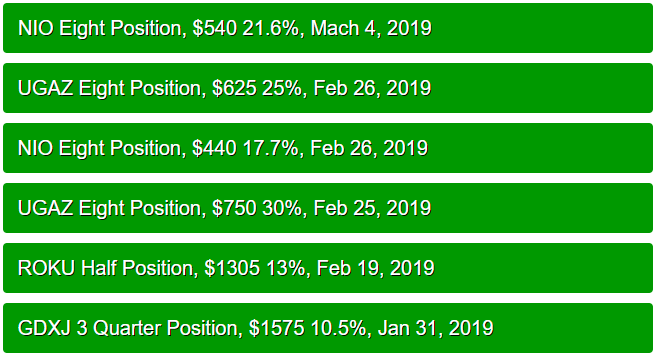
If you want to join a group of professional traders, researchers, and friends, take a look at our trading newsletter to learn how we can help you find and execute better trades each month.  We believe 2019 and 2020 will be incredible years for skilled traders and we are executing at the highest level we can to assist our members. We recently close some nice positions UGAZ 30%, NIO 21.6%, ROKU 13%, GDXJ 10.5%. In fact, we are about to launch our newest technology solution to better assist our members in creating future success. In fact, we are about to launch our newest technology solution to better assist our members in creating future success.

Our team has 53 years of experience in researching and trading makes analyzing the complex and ever-changing financial markets a natural process. We have a simple and highly effective way to provide our customers with the most convenient, accurate, and timely market forecasts available today. Our stock and ETF trading alerts are readily available through our exclusive membership service via email and SMS text. Our newsletter, Technical Trading Mastery book, and 3 Hour Trading Video Course are designed for both traders and investors. Also, some of our strategies have been fully automated for the ultimate trading experience.

RECENT CLOSED TRADES

Chris Vermeulen
Technical Traders Ltd.

TheTechnicalTraders.com

Forex Technical Analysis & Forecast 11.03.2019 (EURUSD, GBPUSD, USDCHF, USDJPY, AUDUSD, USDRUB, GOLD, BRENT)

Article By RoboForex.com

EURUSD, “Euro vs US Dollar”

EURUSD is consolidating. Possibly, the pair may reach 1.1250 and then fall towards 1.1220. Later, the market may break this range to the downside and continue trading inside the downtrend with the short-term target at 1.1100.

EURUSD
Risk Warning: the result of previous trading operations do not guarantee the same results in the future

GBPUSD, “Great Britain Pound vs US Dollar”

GBPUSD has almost reached the predicted downside target; it may yet continue falling towards 1.2922. Today, the pair may reach the target and then start a new consolidation range near the lows. After that, the instrument may form a new ascending structure towards 1.3015.

GBPUSD
Risk Warning: the result of previous trading operations do not guarantee the same results in the future

USDCHF, “US Dollar vs Swiss Franc”

USDCHF continues growing. Possibly, today the pair may reach 1.0111 and then form one more descending structure towards 1.0080. Later, the market may resume moving upwards with the short-term target at 1.0160.

USDCHF
Risk Warning: the result of previous trading operations do not guarantee the same results in the future

USDJPY, “US Dollar vs Japanese Yen”

USDJPY is consolidating above 110.97. If later the price breaks range to the upside, the instrument may be corrected to reach 111.36; if to the downside – resume trading inside the downtrend with the target at 110.57.

USDJPY
Risk Warning: the result of previous trading operations do not guarantee the same results in the future

AUDUSD, “Australian Dollar vs US Dollar”

AUDUSD is consolidating around 0.7061 and forming a downside continuation pattern. The short-term target is at 0.6926.

AUDUSD
Risk Warning: the result of previous trading operations do not guarantee the same results in the future

USDRUB, “US Dollar vs Russian Ruble”

USDRUB has completed the ascending structure at 66.12. Today, the pair may start a new decline towards 65.87 and then form a new ascending structure to complete the correction at 66.20. After that, the instrument may resume trading inside the downtrend with the target at 64.90.

USDRUB
Risk Warning: the result of previous trading operations do not guarantee the same results in the future

XAUUSD, “Gold vs US Dollar”

Gold has broken the consolidation range upwards. Possibly, the pair may be corrected towards 1305.11 and then form one more descending structure with the target at 1276.80.

GOLD
Risk Warning: the result of previous trading operations do not guarantee the same results in the future

BRENT

Brent has completed the Flag correctional pattern at 63.95; right now, it is moving upwards to reach 66.21. Later, the market may form one more descending structure towards 65.03, thus forming a new consolidation range. If later the price breaks range to the upside, the instrument may continue growing to reach 68.40; if to the downside – continue the correction with the target at 63.00.

BRENT
Risk Warning: the result of previous trading operations do not guarantee the same results in the future

Article By RoboForex.com

Attention!
Forecasts presented in this section only reflect the author’s private opinion and should not be considered as guidance for trading. RoboForex LP bears no responsibility for trading results based on trading recommendations described in these analytical reviews.