Author Archive for InvestMacro – Page 254

Investors Assess Important Macroeconomic Events

by JustForex

The US dollar is being traded without a clear dynamic after the release of the FOMC minutes. The FOMC minutes for March showed that the Fed would not adjust policy and planned to keep the key marks of monetary policy until the end of this year. However, some officials said they could change their views on the key interest rate. Although politicians noted that the US labor market looked strong, some of them said that the “deterioration” in the US economy could be intensified due to the large debt of American companies. They also noted a continuing weakness in the housing market. Yesterday, the dollar index (#DX) closed with a small minus (-0.05%).

Meanwhile, the US currency was supported by the news that the US and China were striving for progress in the negotiations on a possible trade agreement between the countries.

In particular, the Treasury Secretary Steven Mnuchin said that the parties agreed on a mechanism that would ensure the implementation and compliance of the trade agreement. The US claim China to implement significant reforms to end the theft of US intellectual property. Washington also wants Beijing to limit industrial subsidies, expand its markets for US companies and significantly increase purchases of US agricultural, energy and industrial products.

Financial market participants assess the results of the ECB meeting. So, the Central Bank left the key interest rates unchanged, as experts expected. The regulator announced it intended to keep interest rates at current levels until the end of 2019. The head of the Central Bank, Mario Draghi, is concerned about the growing risks in the Eurozone economy. The ECB will continue to reinvest the proceeds from the bonds purchased as part of the quantitative easing program to the fullest extent during the additional period after it starts raising interest rates.

The European Council agreed yesterday for a further extension of the Brexit deadline. The European Union extended the exit deadline until October 31, 2019. German Chancellor Angela Merkel insisted that the UK should not be expelled and leave the block without an agreement. The British pound was supported additionally by positive economic releases from the UK.

The “black gold” prices have become stable. Oil quotes are consolidating near annual highs. At the moment, futures for the WTI crude oil are testing the mark of $64.00 per barrel.

Market Indicators

Yesterday, the bullish sentiment was observed in the US stock market: #SPY (+0.34%), #DIA (+0.03%), #QQQ (+0.54%).

The 10-year US government bonds yield fell slightly. Currently, the figure is at the level of 2.48-2.49%.

The news feed for 2019.04.11:

– Initial jobless claims at 15:30 (GMT+3:00);
– Producer price index in the US at 15:30 (GMT+3:00).

by JustForex

EURUSD: sideways motion expected following sharp fluctuations

By Matthew Anthony, Alpari

Previous:

On Wednesday the 10th of April, trading on the euro closed up. Volatility was high on all currency pairs with the euro, especially during ECB President Mario Draghi’s speech. During his remarks, the euro shed 56 pips to reach 1.1230. This was a purposeful decline, but by the end of the day, the bulls recovered all their losses on the back of a weakened US dollar.

The European Central Bank’s meeting ended with monetary policy unchanged and interest rates remaining at their current levels. During his press conference, Mario Draghi warned about risks to economic growth in the Eurozone amid geopolitical uncertainty. The regulator has downgraded its inflation forecast for the Eurozone, and believes that some significant economic stimulus is needed. Details of the new TLTRO program will be announced in the coming meetings.

Day’s news (GMT+3):

  • 15:30 Canada: new housing price index (Feb).
  • 15:30 US: PPI (Mar), initial jobless claims (5 Apr).
  • 16:30 US: Fed’s Clarida speech.
  • 16:40 US: Fed’s Bullard speech.
  • 23:00 US: Fed’s Bowman speech.

EURUSD H1

Current situation:

The drop and subsequent rebound both amounted to 45 degrees. The payrolls report and Mario Draghi’s press conference are now behind us. Following an EU summit, a new Brexit date of the 31st of October has been approved. Now that this has been resolved, traders will turn their attentions towards the US and China, as well as US bond yields.

After yesterday’s intraday spike, I expect a drop from the 45th degree to 1.1256. If the pair rebounds from here and returns to 1.1280, I expect to see a further rise to 1.1310. The LB line is acting as an intermediate support at 1.1268.

Perception of Powell Put in Place – QE4 Looms

By Murray Gunn

For better or worse, the markets perceive that Fed chairman Powell has showed his hand.

The recent Federal Open Markets Committee (FOMC) minutes of the January meeting revealed almost unanimous agreement to announce a plan soon for ending the Fed’s policy of balance sheet reduction. This is the first step in an inevitable march towards the fourth round of quantitative easing (QE4).

If any more evidence were needed pointing to the fact that Fed policy is led by the markets, this surely is the icing on the cake. Stock markets tumble in the fourth quarter and, in January, not only does the Fed signal a reversal in its interest rate path, but the FOMC members have a collective buttock clench over its policy of reducing the trillions of dollars of new money created after the financial crisis of 2008. Music to conventional analysts’ ears. The “Powell Put” is in place. From this moment on, whenever stock markets fall, the buy-the-dippers will be full of confidence thinking that the Fed will come to the rescue.

And therein lies the problem.

You see, it’s all about causality. Or more succinctly, the perception of causality. Most market participants think that the stock market rally since December has been caused by the reversal in Fed policy. Not so. It was the decline in stock markets during the fourth quarter that caused the Fed’s U-turn. FOMC members are human. They have emotions. They herd, just like the rest of us.

The Socionomic Theory of Finance noted QE’s impotence with respect to moving market prices. Chapter 2 (read an excerpt here) shows that stocks did not respond commensurately to the Fed’s quantitative easing program. And forget about commodities. In July 2008, just two months before the onset of QE, commodity prices started their biggest bear market since 1932. As the author Robert Prechter noted, “Anyone applying exogenous-cause thinking to these data would have to conclude that QE worsened the collapse in commodity prices.”

Nevertheless, the fairytale of central bank policy dictating how financial markets and the economy perform persists. This will last until that ephemeral thing called confidence ceases to exist. In the next downturn, or the next, when QE4 is seen to make no difference whatsoever, at that point the market’s perception of the omnipotent Fed will falter. When it does, when markets come to the realization that the Fed is not the “secret sauce” that keeps stock markets going up, the fallout will be cataclysmic.

For more on monetary policy and market prices, read an excerpt of chapter 2 of The Socionomic Theory of Finance here.

Brexit delay: The pound will rally but business needs decision not more fudging

By George Prior

The pound will benefit from a relief rally – but little else has changed – as Theresa May is forced to concede a medium delay to Brexit, affirms the CEO of the world’s largest independent financial advisory organization.

The message from deVere Group’s Nigel Green comes as officials in Brussels say EU leaders have agreed a delay to Brexit to 31 October along with a review in June.

Mr Green says: “We can expect a relief rally of the pound, as investors digest the news that Brexit negotiations have longer to run, and the UK will not crash out of the EU on Friday, and the likelihood of a softer Brexit is significantly increased.

“A softer Brexit would be welcomed by businesses in the UK and those around the world that trade with Britain.

“Investors are advised to now be on the watch for this relief rally in Sterling, UK stocks, and also a mini spurt in economic activity in the UK, as delayed household and business spending takes place.”

“This medium extension period also makes a second referendum – a ‘confirmatory vote’ on any deal the Parliament finally agrees to – more likely, and with that a good chance of Brexit being voted down.

He continues: “In the meantime, this medium-length extension doesn’t change the fundamentals significantly. What businesses in the UK, the EU, and around the world that trade internationally need and want is decision, not further fudging.

“The best way to do this would be to put it back to the people in a second referendum.”

In March, the deVere CEO stated: “Allowing the public to vote and giving them a final say is quite simply the only credible solution now available.

“From inaccurate and often misleading campaigns to ineffective negotiations, the Brexit omnishambles has gone on long enough.

“Brexit will impact economic, security, diplomatic and foreign policy decisions for the UK for many decades.  After MPs have tried but failed, this issue is too important not to now be put back to the people.”

He stands by this position following the outcome of the emergency Brexit summit in Brussels.

Mr Green concludes: “All the continuing uncertainty makes it essential for those who are serious about safeguarding, creating and growing their wealth to ensure that their portfolios are properly diversified.  Diversification is the investor’s best weapon to mitigate risk and capitalise on the opportunities as they arise.”

About:

deVere Group is one of the world’s largest independent advisors of specialist global financial solutions to international, local mass affluent, and high-net-worth clients.  It has a network of more than 70 offices across the world, over 80,000 clients and $12bn under advisement.

Intra-day Fibonacci Modeling Shows Volatility Is About To Spike

By TheTechnicalTraders.com

Our research team, at Technical Traders Ltd. alerted us to a Fibonacci technical pattern that is setting up in the US stock market right now.  This pattern suggests that volatility will increase dramatically over the next few days/weeks as intra-day price action suggests deeper sideways price action may continue.

One of the key benefits of our proprietary Fibonacci price modeling system is that it automatically learns and adjusts to price action on different intervals.  So, by watching the results of this adaptive learning model on various intervals shows different types of setups and expectations, we can develop a consensus among the result to assist us in determining a likely outcome.  These models are showing that volatility will increase by expanding out the Fibonacci Trigger Levels for Bullish and Bearish price action.  As price begins to consolidate, the proprietary Fibonacci price modeling system adjusts internal computational measures to determine where and when the opportunity exists for trends to form.  When these Fibonacci Trigger levels move away from price, it typically suggests bigger moves are about to happen and that volatility will increase.

This 120 minute NQ chart highlights the expanded range of the Fibonacci Trigger Levels (called the Volatility Zone).  This is the clearest example of what we expect to become a normal price rotation zone for the NQ.  Right now, our expectations are that a range from 7500 to 7660 is expected.  This means we could see deeper price rotation closer to the 7500 level and up to near the 7660 level without any real trend being established.  Eventually, as price rotates and consolidates, these Fibonacci Trigger levels will adjust to better identify future trends.  Currently, they are warning of increased volatility and the likelihood of bigger price rotation ahead.

This 120-minute YM chart highlights the range of the volatility zone based on Fibonacci Projected Target levels.  Although the YM chart does not include the wider Fibonacci Trigger levels, we believe this increased volatility suggested by the NQ chart will carry over into the YM and ES charts as well.  Therefore, we believe the entire US stock market will enter a period of increased volatility over the next 5~15 days.

We have highlighted a price range from 25,750 to 26,500 as an expected rotational range.  It is highly likely that the 25,980 level will act as support, thus we believe any price move below this level will present a key buying opportunity for the final leg higher.  Overall, the extended volatility we expect should be a moderate price rotation before the final rally to new all-time price highs for the US stock market.  This rotation will present key buying opportunities for skilled traders wanting to catch that last 4~12% upside swing in the US stock market.

It is highly likely that the YM falls to near the 25,980 level (near the ORANGE Moving Average level) before finding key support.  Pay attention to this level going forward as it would be a good indicator of buying opportunities in the broader markets/stocks.

Do you want to find a team of dedicated researchers and traders that can help you find and execute better trades in 2019 and beyond?

Let our 55 years experience in researching and trading makes analyzing the complex and ever-changing financial markets a natural process. We have a simple and highly effective way to provide our customers with the most convenient, accurate, and timely market forecasts available today. Our stock and ETF trading alerts are readily available through our exclusive membership service via email and SMS text. Our newsletter, Technical Trading Mastery book, and Trading Courses are designed for both traders and investors. Also, some of our strategies have been fully automated for the ultimate trading experience.

Chris Vermeulen

TheTechnicalTraders.com


Smart Money Is Piling Into Oil

By OilPrice.com

Oil prices jumped to five-month highs this week, pushed higher by a bullish cocktail of supply outages, geopolitical unrest and a sputtering shale sector.

The most recent factor is the sudden eruption of the long simmering feud in Libya between rival factions. The attack on Tripoli by the Libyan National Army (LNA), a militia led by Khalifa Haftar, led to a spike in oil prices on Monday as the market priced in the possibility of supply outages.

One oil export terminal near Tripoli is the most obvious asset at risk. “If this port were to be shut down due to the fighting, this could see a delivery outage of up to 300,000 barrels per day,” Commerzbank said in a note on Tuesday. “The oil market is already undersupplied, so if supply from Libya also falls away the supply deficit will become even bigger.” Brent jumped to $71 and WTI to $64 on the news, the highest level in five months.

Intriguingly, speculators have only recently turned bullish on crude oil in terms of their positions in the futures market. “Indeed, our money-manager positioning index implies that speculative funds only moved from neutral to positive on oil in the latest week,” Standard Chartered wrote in a report on April 9. The investment bank argued that major investors only began to properly factor in geopolitical risk in the last few days, having overlooked risk for much of this year. Standard Chartered analysts said that the “supply security” of Libyan oil is “low,” and that output could decline in both the short and medium term.

Meanwhile, the U.S. shale industry has already begun to slow down. Weekly EIA data put U.S. output at 12.2 million barrels per day (mb/d) last week, a jump of 100,000 bpd from the week before (the EIA rounds off to the nearest 100,000 bpd on these weekly estimates). More accurate retrospective data found that U.S. production actually declined in January by 90,000 bpd, offering solid evidence of a slowdown.

Most analysts still see strong U.S. supply growth this year, but the gains have slowed significantly. Standard Chartered looked at three-month periods, which it argues shows a clear deceleration in production growth over the past year. “The 3m/3m change peaked at 861kb/d in August, and has declined since, reaching just 140kb/d in March,” the investment bank wrote.

Goldman Sachs argues that these bullish factors will continue. “We expect the drivers of this deficit to persist through 2Q19: the ‘shock and awe’ implementation of the OPEC cuts, global activity sequentially accelerating, further tightening of US oil sanctions and an only moderate increase in shale production for now,” Goldman analysts wrote in an April 8 report. However, the investment bank said that prices could begin to decline in the second half of the year as OPEC+ begins to unwind the production cuts and U.S. shale picks back up. On top of that, some “long-cycle” projects could hit the market in 2020, leading Goldman to project a $60 Brent price for next year.

In fact, while the oil market is moving very much in an upward direction, not everyone believes that it will last. “The mood is increasingly turning bullish, but several feedback loops are about to start spinning that stand in the way of a prolonged oil rally,” Norbert Ruecker of Julius Baer told Reuters. “Russia already signaled its willingness to raise oil output from June. Fuel remains costly in emerging markets, with soft currencies adding to high oil prices.” Russian President Vladimir Putin said at a forum in St. Petersburg that he was comfortable with oil prices where they are, and seemed to suggest that his government was not yet sold on the idea that OPEC+ should extend production cuts.

The higher prices go, especially over such a short time period, the more that cracks will begin to surface in the OPEC+ group. Saudi Arabia clearly wants to stick with the cuts, still smarting from the downturn last year. Russia is less keen.

Meanwhile, some economic concerns still linger. The IMF warned about slowing growth, expecting global GDP to expand by 3.3 percent this year, down from 3.6 percent last year. One glaring weak spot is the fact that emerging market currencies are lagging far behind the rally in commodities and global equities. Higher oil prices and a persistently strong U.S. dollar have put pressure on an array of currencies, and the weakness will make crude oil much pricier in many countries. That, in turn, could dampen demand.

Nevertheless, declining output in Iran and Venezuela, and the threat of severe outages in Libya, at a time when U.S. shale growth has slowed is a powerful combination pushing oil prices to new highs.

Link to article: https://oilprice.com/Energy/Crude-Oil/Smart-Money-Is-Piling-Into-Oil.html

By Nick Cunningham of Oilprice.com


Japanese Candlesticks Analysis 10.04.2019 (USDCAD, AUDUSD)

Article By RoboForex.com

USDCAD, “US Dollar vs Canadian Dollar”

As we can see in the H4 chart, USDCAD is still testing the support level and forming Hammer and Engulfing reversal patterns. Judging by the previous movements, it may be assumed that the instrument may finish the correction and then resume its ascending movement.

USDCAD
Risk Warning: the result of previous trading operations do not guarantee the same results in the future

AUDUSD, “Australian Dollar vs US Dollar”

As we can see in the H4 chart, AUDUSD is still trading upwards; right now, it is testing the resistance level and forming Inverted Engulfing and Hanging Man reversal patterns. Judging by the previous movements, right now it may be assumed that after finishing the pullback the instrument may start a new growth.

AUDUSD

Article By RoboForex.com

Attention!
Forecasts presented in this section only reflect the author’s private opinion and should not be considered as guidance for trading. RoboForex LP bears no responsibility for trading results based on trading recommendations described in these analytical reviews.

Ichimoku Cloud Analysis 10.04.2019 (AUDUSD, NZDUSD, USDCAD)

Article By RoboForex.com

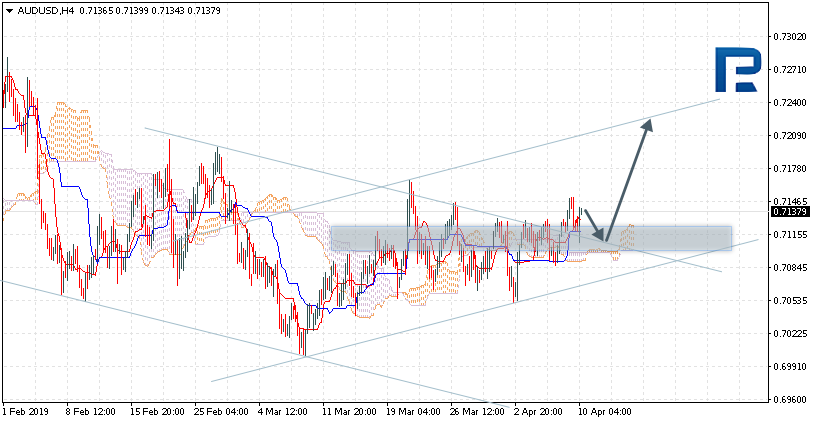
AUDUSD, “Australian Dollar vs US Dollar”

AUDUSD is trading at 0.7137; the instrument is moving above Ichimoku Cloud, thus indicating an ascending tendency. The markets could indicate that the price may test the upside border of the cloud at 0.7115 and then resume moving upwards to reach 0.7220. Another signal to confirm further ascending movement is the price’s rebounding from the channel’s upside border. However, the scenario that implies further growth may be cancelled if the price breaks the downside border of the cloud and fixes below 0.7075. In this case, the pair may continue falling towards 0.6975.

AUDUSD
Risk Warning: the result of previous trading operations do not guarantee the same results in the future

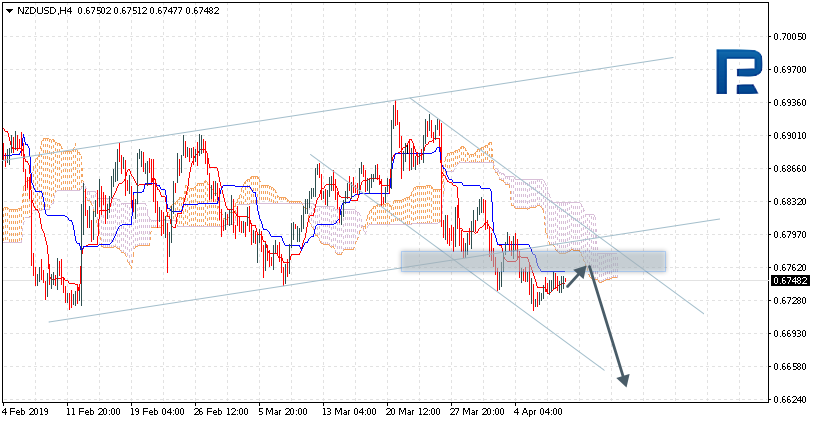
NZDUSD, “New Zealand Dollar vs US Dollar”

NZDUSD is trading at 0.6748; the instrument is moving below Ichimoku Cloud, thus indicating a descending tendency. The markets could indicate that the price may test the downside border of the cloud at 0.6760 and then resume moving downwards to reach 0.6630. Another signal to confirm further descending movement is the price’s rebounding from the channel’s upside border. However, the scenario that implies further decline may be cancelled if the price breaks the upside border of the cloud and fixes above 0.6815. In this case, the pair may continue growing towards 0.6900.

NZDUSD
Risk Warning: the result of previous trading operations do not guarantee the same results in the future

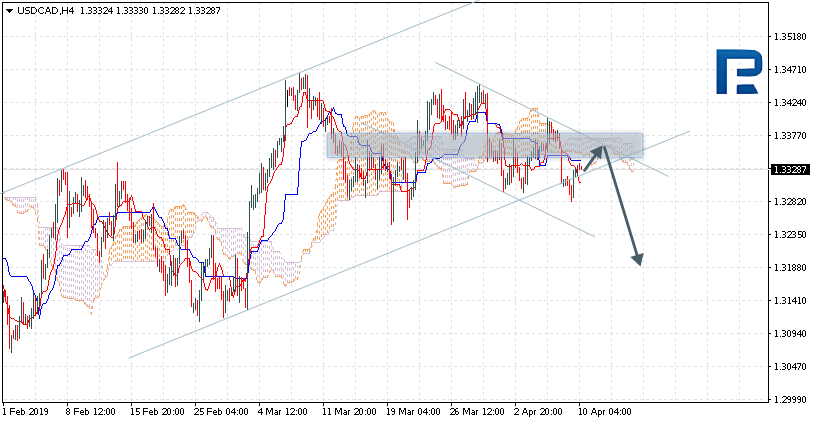
USDCAD, “US Dollar vs Canadian Dollar”

USDCAD is trading at 1.3328; the instrument is moving below Ichimoku Cloud, thus indicating a descending tendency. The markets could indicate that the price may test the downside border of the cloud at 1.3340 and then resume moving downwards to reach 1.3185. Another signal to confirm further descending movement is the price’s rebounding from the resistance level. However, the scenario that implies further decline may be cancelled if the price breaks the upside border of the cloud and fixes above 1.3390. In this case, the pair may continue growing towards 1.3495. After breaking the channel’s downside border and fixing below 1.3280, the price may continue moving downwards.

USDCAD
Risk Warning: the result of previous trading operations do not guarantee the same results in the future

Article By RoboForex.com

Attention!
Forecasts presented in this section only reflect the author’s private opinion and should not be considered as guidance for trading. RoboForex LP bears no responsibility for trading results based on trading recommendations described in these analytical reviews.

The Analytical Overview of the Main Currency Pairs on 2019.04.10

by JustForex

The EUR/USD currency pair

Technical indicators of the currency pair:
  • Prev Open: 1.12604
  • Open: 1.12615
  • % chg. over the last day: +0.04
  • Day’s range: 1.12555 – 1.12739
  • 52 wk range: 1.1214 – 1.2557

The news feed is very saturated today. The investors are waiting for the monetary policy meeting at ECB, FOMC Minutes publication and the EU leaders’ summit. Expect high trading activity and major volatility.

ECB is expected to keep the monetary policy at the same level. Keep an eye on the comments and rhetorics of its representatives. Earlier the Central Bank claimed that it might introduce additional stimulating measures in September. Right now the quotes are moving sideways, testing the supply zone at 1.12750-1.12850. The key support is 1.12550. You should open positions from these levels.

The Economic News Feed for 10.04.2019:

  • – The Key Interest Rate Announcement (EU) – 14:45 (GMT+3:00);
  • – Inflation report (US) – 15:30 (GMT+3:00);
  • – FOMC Minutes (US) – 21:00 (GMT+3:00);
EUR/USD

The indicators do not provide precise signals, the price is consolidating aorund 50 MA which acts as a strong dynamic support.

The MACD histogram is close to 0.

The Stochastic Oscillator is in the neutral zone, the %K line is above the %D line which points to the bullish mood.

Trading recommendations
  • Support levels: 1.12550, 1.12350, 1.12100
  • Resistance levels: 1.12750, 1.13000

If the price fixes above 1.12850, expect further correction toward 1.13250-1.13500.

Alternatively, the quotes can fall toward 1.12350-1.12100.

The GBP/USD currency pair

Technical indicators of the currency pair:
  • Prev Open: 1.30560
  • Open: 1.30474
  • % chg. over the last day: -0.07
  • Day’s range: 1.30423 – 1.30794
  • 52 wk range: 1.2438 – 1.4378

GBP/USD remains ambiguous. The pair is being traded in a narrow range of 1.30450-1.30800. The market participants are waiting for the EU summit, which will decide on the fate of Brexit. Donald Tusk previously offered a “flexible” Brexit delay, so keep an eye on this issue and open positions from the key levels.

The Economic News Feed for 10.04.2019:

  • – GDP Report (GB) – 11:30 (GMT+3:00);
  • – Industrial Production Volume (GB) – 11:30 (GMT+3:00);
  • – Trading Balance (GB) – 11:30 (GMT+3:00);
GBP/USD

The indicators do not provide precise signals, the price has crossed 50 MA and 200 MA.

The MACD histogram is close to 0.

The Stochastic Oscillator is near the overbought zone, the %K line started to cross the %D line. There are no signals at the moment.

Trading recommendations
  • Support levels: 1.30450, 1.30150, 1.29850
  • Resistance levels: 1.30800, 1.31200, 1.31900

If the price fixes above 1.30800, expect the quotes to grow toward 1.31200-1.31500.

Alternatively, the price can descend toward 1.30000.

This article reflects a personal opinion and should not be interpreted as an investment advice, and/or offer, and/or a persistent request for carrying out financial transactions, and/or a guarantee, and/or a forecast of future events.

Registration The USD/CAD currency pair

Technical indicators of the currency pair:
  • Prev Open: 1.33103
  • Open: 1.33207
  • % chg. over the last day: +0.11
  • Day’s range: 1.33207 – 1.33386
  • 52 wk range: 1.2248 – 1.3664

Yesterday USD/CAD retreated from the monthly minimums. CAD is consolidating around 1.33100-1.33350, the technical picture is ambiguous. The investors are waiting for important economic releases in the US. The demand for CAD remains high due to positive oil quotes dynamics. The trading instrument can descend further. Open positions from the key levels.

The Economic News Feed for 10.04.2019 is calm.

USD/CAD

The indicators do not provide precise signals, the price has crossed 50 MA.

The MACD histogram is close to 0.

The Stochastic Oscillator is next to the oversold zone, the %K line has crossed the %D line. There are no signals at the moment.

Trading recommendations
  • Support levels: 1.33100, 1.32850
  • Resistance levels: 1.33350, 1.33650, 1.33900

If the price fixes below 1.33100, expect the quotes to fall toward 1.32850-1.32600.

Alternatively, the quotes can grow toward 1.33600-1.33800.

The USD/JPY currency pair

Technical indicators of the currency pair:
  • Prev Open: 111.457
  • Open: 111.131
  • % chg. over the last day: -0.35
  • Day’s range: 111.060 – 111.228
  • 52 wk range: 104.56 – 114.56

USD/JPY started to descend. Yesterday the instrument updated the local minimums. 111.000 acts as a key support, 111.300 acts as a mirror support. USD/JPY has a potential to descend further. The demand on the safe assets is kept at the high level due to the stress on the US and European markets, as well as a slowdown in the world economy growth. You should open positions at the key levels.

The Economic News Feed for 10.04.2019 is calm.

USD/JPY

The indicators do not provide precise signals, 50 MA has crossed 200 MA.

MACD is in the negative zone but above the signal line, which gives a strong signal to sell USD/JPY.

The Stochastic Oscillator is in the neutral zone, the %K line has crossed the %D line. There are no signals at the moment.

Trading recommendations
  • Support levels: 111.000, 110.800, 110.500
  • Resistance levels: 111.300, 111.550, 111.800

If the price fixes below 111.000, the price can correct further toward 110.700-110.500.

Alternatively, the quotes cao grow toward 111.500-111.700.

by JustForex

Geopolitical Events Are in the Spotlight. We Expect High Trading Activity and Volatility

by JustForex

The dollar index (#DX) is consolidating near local lows before important events. Today, the news feed will be full of events. Investors expect the US inflation report for March, as well as the publication of the FOMC minutes. Earlier, the US Federal Reserve announced that it planned to keep interest rates unchanged until the end of this year. At the same time, the US President Donald Trump continues to criticize the actions of the regulator. He believes that the Central Bank has to ease interest rates, as well as to stop the decrease in the volume of assets on the balance sheet.

Also, investors will be focused on the ECB interest rate decision. Financial market participants expect the regulator to leave the key marks of monetary policy unchanged. Earlier, ECB President, Mario Draghi, said that the regulator was ready to consider the issue of introducing additional expansionary measures in September 2019. We recommend paying attention to the comments by the Central Bank representatives.

Today, a summit of EU member countries will also take place, at which the Brexit issue will be decided. The request by the British Prime Minister Theresa May to extend the deadline for the country’s exit from the block will be considered at the summit. Theresa May requests to extend the term of Article 50 of the EU Treaty until June 30, 2019. European Council President Donald Tusk, in turn, offered EU countries to consider a “flexible” extension of the Brexit deadline. He urges to do everything possible to avoid no-deal Brexit. We also recommend paying attention to important economic releases from the UK.

The demand for safe assets is still at a fairly high level amid new tension in trade between the US and Europe, as well as a slowdown in global economic growth. The United States announced the possibility of introduction of additional tariffs on European goods $11 billion worth. The International Monetary Fund has worsened its forecasts for the global economy in 2019 from 3.5% to 3.3%, which is the slowest growth since 2016.

The “black gold” prices are consolidating near annual highs. At the moment, futures for the WTI crude oil are testing the mark of $64.30 per barrel. At 17:30 (GMT+3:00), a report on crude oil inventories will be published in the US.

Market Indicators

Yesterday, the bearish sentiment was observed in the US stock market: #SPY (-0.51%), #DIA (-0.65%), #QQQ (-0.35%).

The 10-year US government bonds yield fell slightly. Currently, the indicator is at the level of 2.49-2.50%.

The news feed for 2019.04.10:

– UK GDP at 11:30 (GMT+3:00);
– Manufacturing production in the UK at 11:30 (GMT+3:00);
– ECB interest rate decision at 14:45 (GMT+3:00);
– Inflation report in the US at 15:30 (GMT+3:00);
– FOMC meeting minutes at 21:00 (GMT+3:00).

by JustForex