Author Archive for InvestMacro – Page 244

Forex Technical Analysis & Forecast 01.05.2019 (EURUSD, GBPUSD, USDCHF, USDJPY, AUDUSD, USDRUB, GOLD, BRENT)

Article By RoboForex.com

EURUSD, “Euro vs US Dollar”

EURUSD is forming a narrow consolidation range around 1.1210. Possibly, today the pair may fall to reach 1.1190 and then start another growth to return to 1.1210. Later, the market may break the range to the downside and resume trading inside the downtrend with the target at 1.1150.

EURUSD
Risk Warning: the result of previous trading operations do not guarantee the same results in the future

GBPUSD, “Great Britain Pound vs US Dollar”

GBPUSD is consolidating around 1.3025. Today, the pair may fall to reach 1.3000 and then form one more ascending structure to return to 1.3025. After that, the instrument may start a new decline with the target at 1.2955.

GBPUSD
Risk Warning: the result of previous trading operations do not guarantee the same results in the future

USDCHF, “US Dollar vs Swiss Franc”

USDCHF has reached the target at 1.0177. Possibly, today the pair may grow to break 1.0207 and then continue trading inside the uptrend with the target at 1.0233.

USDCHF
Risk Warning: the result of previous trading operations do not guarantee the same results in the future

USDJPY, “US Dollar vs Japanese Yen”

USDJPY is consolidating around 111.44. Today, the pair may grow to reach 111.61 and then form a new descending structure to break 111.22. Later, the market may continue falling with the short-term target at 110.99.

USDJPY
Risk Warning: the result of previous trading operations do not guarantee the same results in the future

AUDUSD, “Australian Dollar vs US Dollar”

AUDUSD is consolidating around 0.7033 without any particular direction. Possibly, the pair may grow towards 0.7072 and then start another decline to beak 0.7000. After that, the instrument may continue trading inside the downtrend with the target at 0.6932.

AUDUSD
Risk Warning: the result of previous trading operations do not guarantee the same results in the future

USDRUB, “US Dollar vs Russian Ruble”

USDRUB is consolidating around 64.60. According to the main scenario, the price is expected to form a new descending structure to reach 64.25 and then start another growth to return to 64.60. If later the price breaks the range to the downside, the instrument may resume trading inside the downtrend with the short-term target at 63.66.

USDRUB
Risk Warning: the result of previous trading operations do not guarantee the same results in the future

XAUUSD, “Gold vs US Dollar”

Gold has reached 1283.60; right now, it is trading downwards. Possibly, the pair may break 1280.33 and continue falling towards 1274.28. Later, the market may form one more ascending structure to return to 1280.33 and then resume trading inside the downtrend with the target at 1274.15.

GOLD
Risk Warning: the result of previous trading operations do not guarantee the same results in the future

BRENT

Brent is consolidating around 72.37. If later the price breaks the range to the upside, the instrument may resume trading inside the uptrend with the target at 76.50; if to the downside – start a new decline towards 70.30, form one more ascending structure to break 73.73, and then continue growing to reach 76.50.

BRENT
Risk Warning: the result of previous trading operations do not guarantee the same results in the future

Article By RoboForex.com

Attention!
Forecasts presented in this section only reflect the author’s private opinion and should not be considered as guidance for trading. RoboForex LP bears no responsibility for trading results based on trading recommendations described in these analytical reviews.

Fibonacci Retracements Analysis 01.05.2019 (GBPUSD, EURJPY)

Article By RoboForex.com

GBPUSD, “Great Britain Pound vs US Dollar”

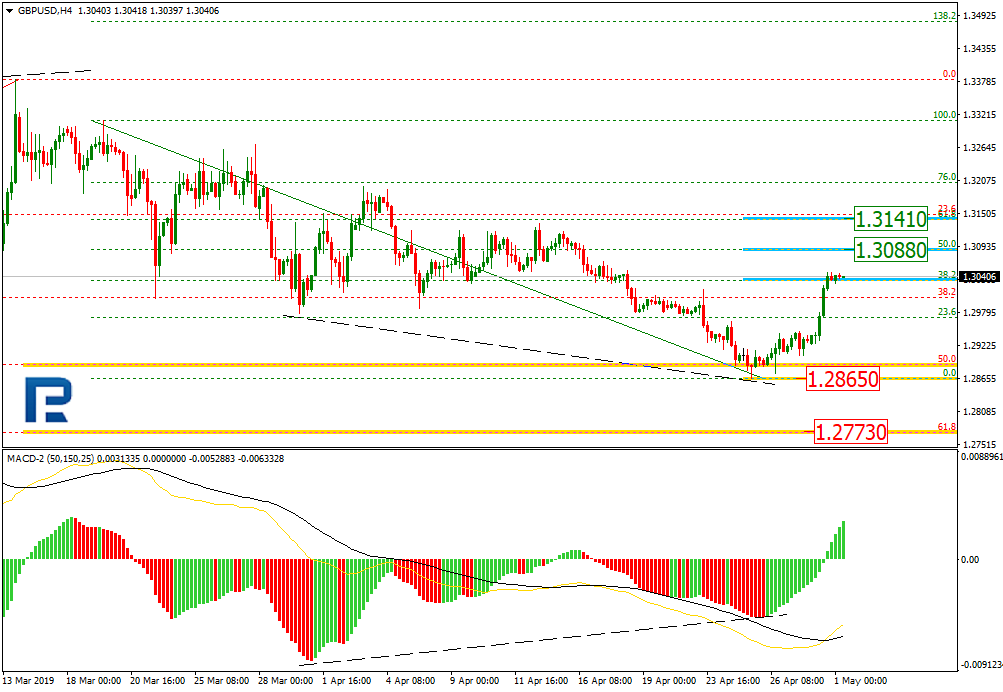
As we can see in the H4 chart, the convergence made GBPUSD start a new correctional uptrend, which has already reached the retracement of 38.2%. The next upside targets may be the retracements of 50.0% and 61.8% at 1.3088 and 1.3141 respectively. If the price breaks the low at 1.2865, the instrument may continue falling towards the long-term retracement of 61.8% at 1.2773.

GBPUSD1
Risk Warning: the result of previous trading operations do not guarantee the same results in the future

In the H1 chart, the price has reached the retracements of 38.2% and may start a new short-term pullback.

GBPUSD2
Risk Warning: the result of previous trading operations do not guarantee the same results in the future

EURJPY, “Euro vs. Japanese Yen”

As we can see in the H4 chart, after failing to reach the high at 127.50, EURJPY has resumed its mid-term descending correction. If the price breaks the low at 124.09, the instrument may continue trading downwards to reach the retracement of 50.0% at 122.7. The resistance is the high at 126.81.

EURJPY1
Risk Warning: the result of previous trading operations do not guarantee the same results in the future

In the H1 chart, the pair is being corrected upwards; it has already reached the retracement of 38.2%. The next targets may be the retracements of 50.0% and 61.8% at 125.45 and 125.77 respectively.

EURJPY2

Article By RoboForex.com

Attention!
Forecasts presented in this section only reflect the author’s private opinion and should not be considered as guidance for trading. RoboForex LP bears no responsibility for trading results based on trading recommendations described in these analytical reviews.

US Dollar Index Is in the Red. Investors Expect the Fed’s Decision on the Interest Rate

by JustForex

Yesterday, the US dollar weakened against a basket of major currencies despite positive economic statistics. Thus, consumer confidence index CB rose in April to 129.2, while experts expected 126.0. The index of pending home sales grew in March by 3.8%, although investors forecasted an increase by only 1.1%. However, the dollar index (#DX) updated weekly lows and closed in the negative zone (-0.39%). Today, investors have taken a wait-and-see attitude before the Fed’s decision on the interest rate. It is expected that the regulator will leave the figure at 2.50%.

The euro strengthened against the US dollar after the publication of optimistic economic data from Germany and the eurozone. The number of unemployed fell in April by 12K instead of the forecasted reduction by 6K. The eurozone GDP (YoY) grew by 1.2% instead of 1.1%, the eurozone GDP (QoQ) also grew by 0.4% instead of 0.3%.

Today in the Asian trading session weak economic data were released in New Zealand. Thus, employment declined in the first quarter by 0.2%, although experts expected a growth by 0.5%. Volatility in foreign exchange markets is reduced, as many countries celebrate International Labor Day.

The “black gold” prices are falling. At the moment, the WTI crude oil futures are testing the mark of $63.20 per barrel. At 17:30 (GMT+3:00) crude oil inventories will be published in the United States.

Market Indicators

Yesterday, in the US stock market, a variety of trends was observed: #SPY (+0.05%), #DIA (+0.13%), #QQQ (-0.77%).

The yield on 10-year US government bonds has fallen. Currently, the indicator is at the level of 2.50-2.51%.

The news feed on 05.01.2019:

– the manufacturing PMI in the UK at 11:30 (GMT+3:00);
– ADP nonfarm employment change in the US at 15:15 (GMT+3:00);
– ISM manufacturing employment in the US at 17:00 (GMT+3:00);
– the Fed’s decision on interest rate at 21:00 (GMT+3:00).

We also recommend paying attention to the speech by the head of the Bank of Canada Poloz.

by JustForex

How Close Are The Markets From Topping?

By TheTechnicalTraders.com

Now that most of the US Major Indexes have breached new all-time price highs, which we called over 5+ months ago, and many traders are starting to become concerned about how and where the markets may find resistance or begin to top, we are going to try to paint a very clear picture of the upside potential for the markets and why we believe volatility and price rotation may become a very big concern over the next few months.  Our objective is to try to help you stay informed of pending market rotation and to alert you that we may be nearing a period within the US markets where increased volatility is very likely.

Longer term, many years into the future, our predictive modeling systems are suggesting this upside price swing is far from over.  Our models suggest that price rotation will become a major factor over the next 12 to 15+ months – headed into the US Presidential election cycle of November 2020.  Our models are suggesting that the second half of this year could present an incredible opportunity for skilled investors as price volatility/rotation provide bigger price swings.  Additionally, our models suggest that early 2020 will provide even more opportunity for skilled traders who are able to understand the true price structure of the markets.  Get ready, thing are about to get really interesting and if you are not following our research or a member of our services, you might want to think about joining soon.

We are focusing this research post on the NQ, ES and YM futures charts (Daily).  We will include a longer-term YM chart near the end to highlight longer-term expectations.  Let’s start with the NQ Daily chart.

The NQ Daily chart, below, highlights our ongoing research, shows the 2018 deep price rotational low and the incredible rally to new all-time highs recently.  The most important aspect of this chart is the “Upside Target Zone” near the $8040 level and the fact that any rally to near these levels would represent an extended upside price rally near the upper range of the YELLOW price channel lines.  We believe any immediate price rotation may end near the $7500 level (between the two Fibonacci Target levels near $7400 & $7600) and could represent a pretty big increase in price volatility.


This ES Daily chart highlights the different in capabilities between the NQ and the ES.  While the NQ is already pushing into fairly stronger new price highs, the ES is struggling to get above the Sept/Oct 2018 highs and this is because very strong resistance is found between $2,872 and $2,928.  It is very likely that the price volatility will increase near these highs as price becomes more active in an attempt to break through this resistance.  It is also very likely that a downside price rotation may happen where price attempts to retest the $2,835 level (or lower) before finally pushing into a bigger upside price trend.  The Upside Target Zone highs are just below $3,000.  Therefore, we believe any move above $2,960 could represent an exhaustion top type of price formation.


This YM chart is set up very similarly to the ES chart.  Historical price highs are acting as a very strong price ceiling.  While the NQ is already pushing into fairly stronger new price highs, the YM continues to struggle to get above the Sept/Oct 2018 highs and this is because very strong resistance is found between 25,750 and 27,000.  Please take notice of the very narrow resistance channel (BOX) on this chart that highlights where we believe true price support/resistance is located.  We believe it is likely that a downside price rotation may happen where price attempts to retest the $26,000 level (or lower) before finally pushing into a bigger upside price trend.


As you can tell from our recent posts and this research, we believe price volatility is about to skyrocket higher as price rotates downward.  Our predictive modeling systems are suggesting that we are nearing the end of this current upside move where a downward price move will establish a new price base and allow price to, eventually, push much higher – well above current all-time high levels.

We’ve issued research posts regarding Presidential election cycles and how, generally, stock market prices decline 6 to 24 months before any US Presidential election.  We believe this pattern will continue this year and we are warning our followers to be prepared at this stage of the game.  No, it will not be a massive market crash like 2008-09.  It will be a downside price rotation that will present incredible opportunities for skilled traders.  If you want more of our specialized insight and analysis, then please visit www.TheTechnicalTraders.com to learn how we help our members find success.

Lastly, we’ve included this Weekly YM chart to show you just how volatile the markets are right now.  Pay very close attention to the Fibonacci Target Levels that are being drawn on this chart.  The downside target levels range from $16,000 to $21,060.  The upside target levels range from $30,000 to $32,435.  Top to bottom, The Fibonacci price modeling system is suggesting a total volatility range of over $16,000 for the YM Weekly chart and this usually suggests we are about to enter a period of bigger price rotation and much higher price volatility.


Right now, we suggest that you review some of our most recent posts to see how we’ve been calling these market moves, visit www.TheTechnicalTraders.com/FreeResearch/.  It is important for all of our followers to understand the risks of being complacent right now.  The markets are about to enter a period of about 24+ months where incredible opportunities will become evident for skilled traders. If you know what is going to happen, you can find opportunities everywhere.  If not, you are going to be on the wrong side of some very big moves.

Chris Vermeulen

Gold fights to deny the H&S and the triangle pattern

By Tomasz Wiśniewski, Chief analyst at Alpari Research & Analysis

One instrument which is currently in a very interesting place is gold. The precious metal has suffered a lot recently, mostly due to two factors. The first one is the stronger USD; we all know that gains on the greenback cause drops on commodities. The second factor is the Risk ON mode on stocks, which negatively affected the safe haven assets, particularly gold. Thanks to that, gold had made new yearly lows over the last week.

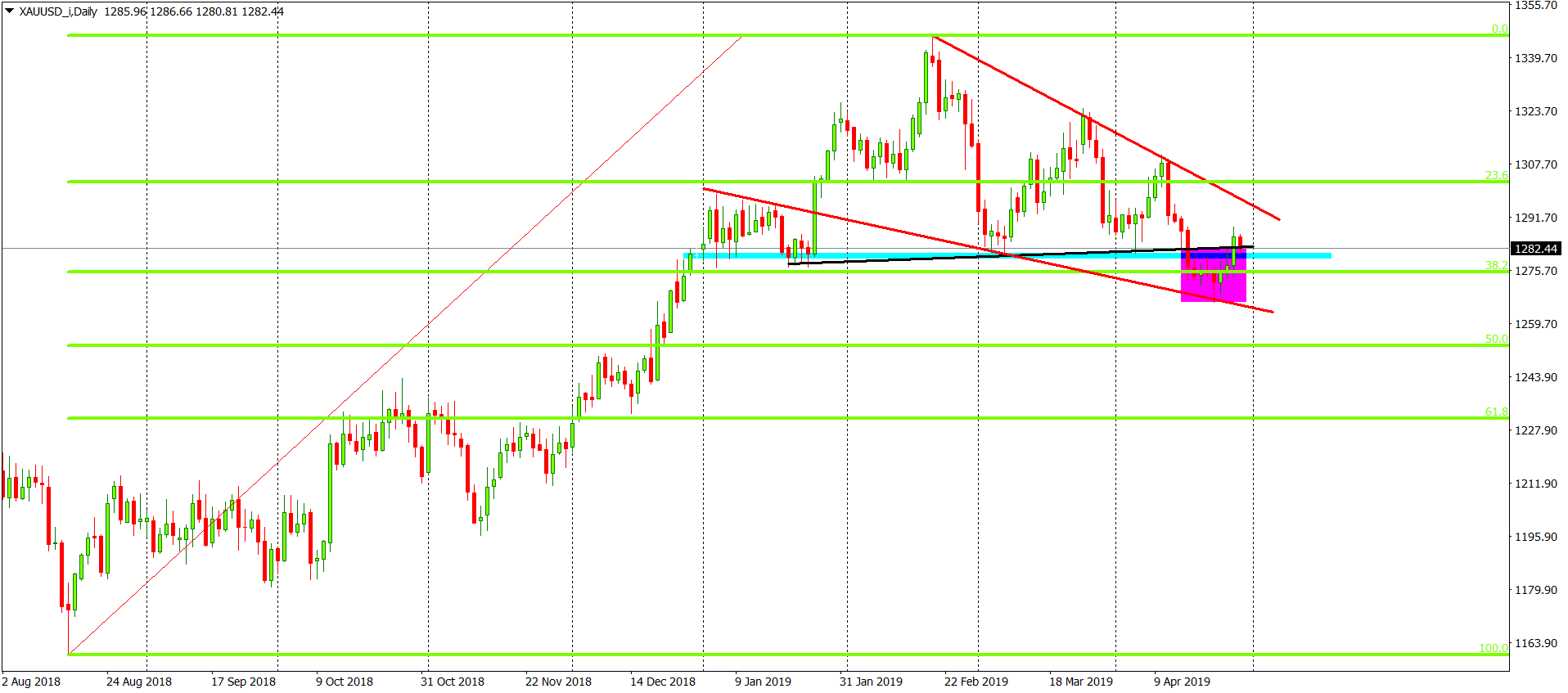
XAUUSD D1Now, let’s look on this from a distance. Last week’s drop was a bearish breakout of the symmetrical triangle pattern and the H&S. That gave us a strong sell signal but as we can see, this signal has been ignored by traders. Why ignored? Mainly because the price came back above the broken supports, i.e. above the lower line of the triangle (black) and the neckline (blue). In theory, that creates a false breakout pattern and brings us a more positive scenario.

This scenario is additionally driven by the fact that the price bounced from the 38.2% Fibonacci and that we are inside of a wedge pattern (red). The wedge is a trend continuation pattern and the main trend seen on the chart is positive. I like to play it safe, so I would say that we are currently in no-man’s land. How do we trade this? In my opinion, we should wait for a breakout from the wedge. A breakout to the upside would be a buy signal and breakout to the downside would be a signal to go short. Somehow, I think that first option is slightly more probable.

Source: Alpari

Ichimoku Cloud Analysis 30.04.2019 (AUDUSD, NZDUSD, USDCAD)

Article By RoboForex.com

AUDUSD, “Australian Dollar vs US Dollar”

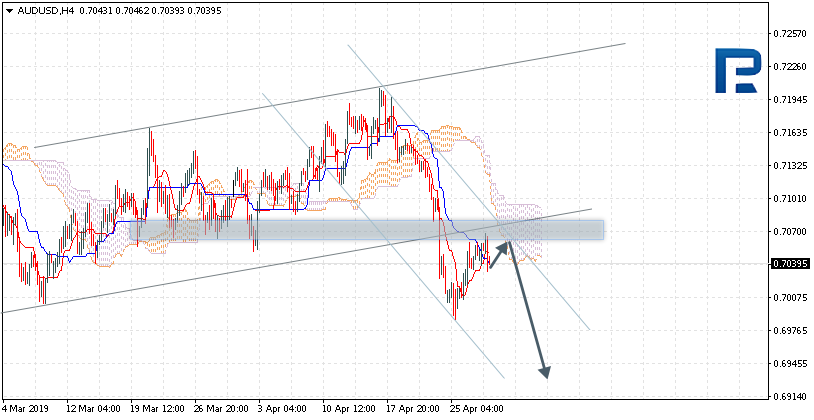
AUDUSD is trading at 0.7039; the instrument is moving below Ichimoku Cloud, thus indicating a descending tendency. The markets could indicate that the price may test the downside border of the cloud at 0.7055 and then resume moving downwards to reach 0.6935. Another signal to confirm further descending movement is the price’s rebounding from the channel’s upside border. However, the scenario that implies further decline may be cancelled if the price breaks the upside border of the cloud and fixes above 0.7105. In this case, the pair may continue growing towards 0.7175.

AUDUSD
Risk Warning: the result of previous trading operations do not guarantee the same results in the future

NZDUSD, “New Zealand Dollar vs US Dollar”

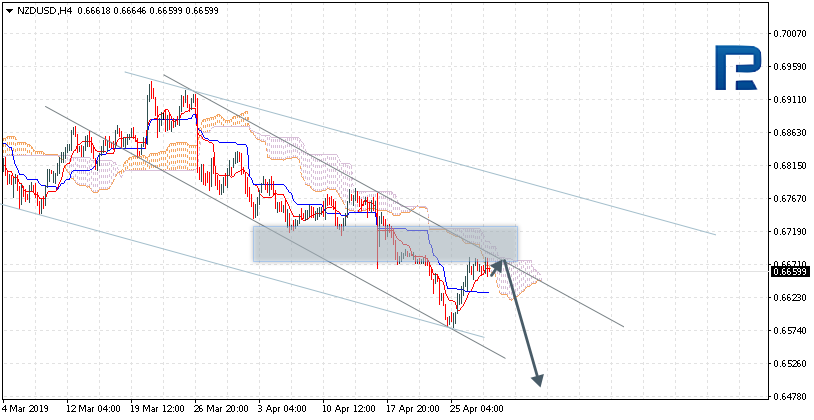
NZDUSD is trading at 0.6659; the instrument is moving below Ichimoku Cloud, thus indicating a descending tendency. The markets could indicate that the price may test the upside border of the cloud at 0.6670 and then resume moving downwards to reach 0.6485. Another signal to confirm further descending movement is the price’s rebounding from the resistance level. However, the scenario that implies further decline may be cancelled if the price breaks the upside border of the cloud and fixes above 0.6725. In this case, the pair may continue growing towards 0.6795.

NZDUSD
Risk Warning: the result of previous trading operations do not guarantee the same results in the future

USDCAD, “US Dollar vs Canadian Dollar”

USDCAD is trading at 1.3466; the instrument is moving above Ichimoku Cloud, thus indicating an ascending tendency. The markets could indicate that the price may test the upside border of the cloud at 1.3430 and then resume moving upwards to reach 1.3625. Another signal to confirm further ascending movement is the price’s rebounding from the support level. However, the scenario that implies further growth may be cancelled if the price breaks the downside border of the cloud and fixes below 1.3370. In this case, the pair may continue falling towards 1.3285.

USDCAD

Article By RoboForex.com

Attention!
Forecasts presented in this section only reflect the author’s private opinion and should not be considered as guidance for trading. RoboForex LP bears no responsibility for trading results based on trading recommendations described in these analytical reviews.

Japanese Candlesticks Analysis 30.04.2019 (GOLD, NZDUSD)

Article By RoboForex.com

XAUUSD, “Gold vs US Dollar”

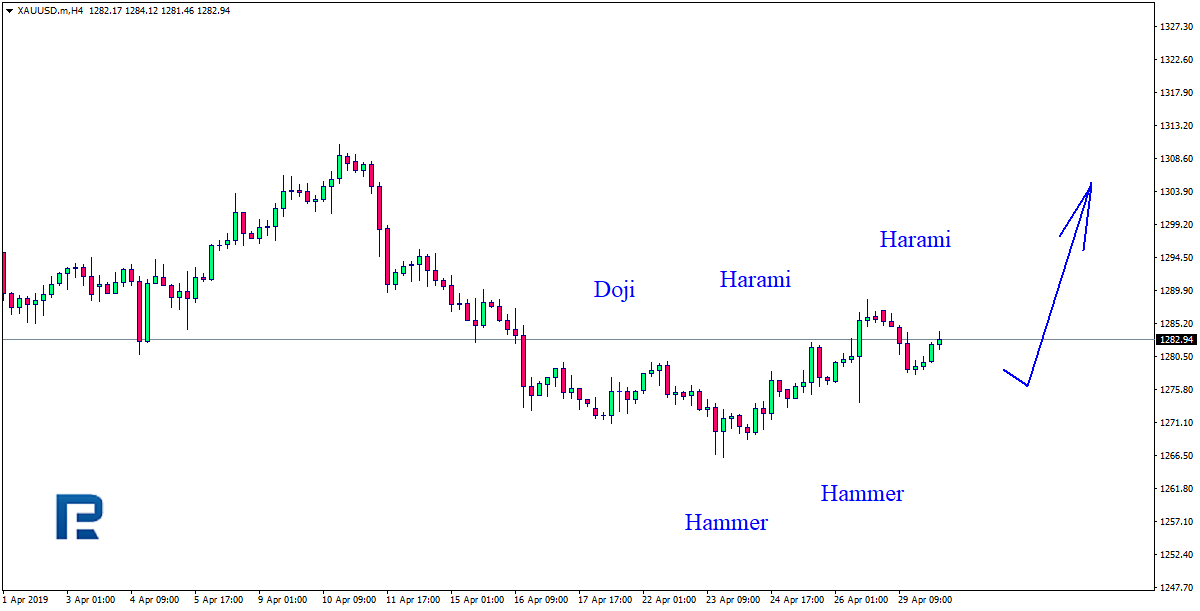
As we can see in the H4 chart, XAUUSD is still trading close to the support level and forming Hammer and Harami reversal patterns. Judging by the previous movements, it may be assumed that after testing the level, the instrument may continue its ascending movement.

GOLD
Risk Warning: the result of previous trading operations do not guarantee the same results in the future

NZDUSD, “New Zealand vs. US Dollar”

As we can see in the H4 chart, NZDUSD is still moving near the support level and forming Hammer, Engulfing, Long-Legged Doji, and Harami reversal patterns. Judging by the previous movements, it may be assumed that after testing the level, the instrument may continue its growth.

NZDUSD

Article By RoboForex.com

Attention!
Forecasts presented in this section only reflect the author’s private opinion and should not be considered as guidance for trading. RoboForex LP bears no responsibility for trading results based on trading recommendations described in these analytical reviews.

Gold May Give Us One More Chance With New Lows

By TheTechnicalTraders.com

Our proprietary price cycle tool is showing us that the Daily Gold cycles may dive a bit lower, possibly into the $1250 to $1265 level, over the next 3~7+ days before reaching an ultimate low.  We’ve been covering the precious metals markets like hawks because of our proprietary price modeling tools that suggested the April 21~24 dates as an ultimate low/momentum base pattern.  This new cycle formation highlights the potential that a deeper price low in Gold may set up over the next 5 to 7 days and it may become an incredible buying opportunity for skilled traders.

Taking a look at this cycle chart, we can see the deep price low that may target the $1270 levels or levels just below the $1270 price area.  It appears that this new price low may form somewhere near the end of this week, May 3rd, or early next week, May 6th or 7th.  Please pay attention to this potential price move as this may be the last low price reversal before a very strong upside price move.


You may remember our analysis from January 2019 regarding the ADL price predictions for Gold (the chart is below).  Pay very close attention to the “April/May 2019” dates as we are targeting that low price level right now and the upside price potential showing predicted price levels well above $1400.

Skilled traders need to try to understand a move like this in Gold will likely be predicated on some external global news events that create a level of fear in the markets.  We don’t know what they may be at the moment, but our suspicions are that they are going to be related to the EU and/or China (or both).

This is it.  This should be the last low price rotation (if it happens) before Gold begins to skyrocket higher.  Pay attention and remember we were very early in making this call – so it will be an incredible run if it happens as we predicted 5 months ago.

With a total of 55 years of technical analysis and trading between Brad Matheny, and myself Chris Vermeulen, our research and trading signals makes analyzing the complex and ever-changing financial markets a natural process. We have a simple and highly effective way to provide our customers with the most convenient, accurate, and timely market forecasts available today. Our stock and ETF trading alerts are readily available through our exclusive membership service via email and SMS text. Our newsletter, Technical Trading Mastery book, and Trading Courses are designed for both traders and investors. Also, some of our strategies have been fully automated for the ultimate trading experience.

Chris Vermeulen – TheTechnicalTraders.com


Climate gains in the West, Exported Pollution in the Rest

By Dan Steinbock

Recently, President Duterte slammed Canada for sending waste to the Philippines. Yet, the challenge is huge. Exported pollution from advanced economies penalizes the rest of the world and distorts climate gains.

President Duterte’s statement ensued after environmental groups’ renewed call for Canada to take back waste sent to the Philippines in the Aquino era, some six years ago.

According to the Pacific Center for Environmental Law and Litigation (PCELL), Ontario-based Chronic Inc. shipped 40-foot containers to the country in 2013, which is considered “illegal traffic” under Article 9 of the Basel Convention. More than 100 shipping containers arrived in Philippine ports around 2013-14.

The toxic discovery, made on Mindanao, is the third time in recent years that the Philippines has served as a dumping ground for hazardous foreign trash. South Korea has been the culprit on two occasions. Along with the Philippines, both South Korea and Canada are signatories to the Convention.

In the 2017 ASEAN Summit, Canada’s PM Justin Trudeau pledged to Duterte that “Canada is working hard to resolve the issue.” Trudeau portrays himself as a committed proponent of carbon tax at home and of climate-change struggle internationally.

Yet, little progress has been achieved.

Exporting pollution   

Effective since 1992, the international Basel Convention was created to reduce the movements of hazardous waste between nations and to prevent transfer of hazardous waste to the Third World.

Yet, it failed to contain the fatal practices. As a result, China, in summer 2017, imposed a ban on more than 20 types of waste imports, including recyclable plastic. As it became effective in January 2018, the waste plastic commodity market took a hit and behind-the-façade dumping likely intensified elsewhere – as waste shippers sought to escape regulatory penalties at home.

In the early 1990s many advanced economies still refused to take responsibility for the waste in the “Third World” saying they had little or nothing to do with it. The statements relied on research claiming that only 4% of hazardous wastes that came from OECD countries were shipped across international borders.

In reality, recent studies of carbon trade indicate that 25% or more of the world’s total emissions have been offshored into less-wealthy economies. Here’s the bottom line of the “pollution haven hypothesis”: When major advanced economies set up factories or offices abroad, they often look for the cheapest option in terms of resources, labor, land, and material access. Consequently, environmentally unsound practices expose vulnerable developing economies, which tend to have less stringent environmental regulations.

For instance, when Americans turn spent batteries to be recycled, they often end up in Mexico, where the lead is extracted by crude methods that are illegal in the U.S., due to tougher environmental standards on lead pollution. To avoid costly regulation at home, U.S. battery industry exports the lead to Mexico, which thus serves as America’s “pollution heaven.”

Today, there is increasing awareness of the detrimental impact of CO2 pollution on the world climate, yet countries vary widely in how they design and enforce environmental laws. That allows some multinational firms to look “environmentally friendly” in their advanced economies, even as they dump waste into less prosperous economies, which are then charged for pollution.

According to new research, firms headquartered in countries with strict environmental policies perform their polluting activities abroad; in countries with relatively weaker policies. Typically, these effects are stronger for firms in high-polluting industries and with poor corporate governance characteristics.

Although firms export pollution, they nevertheless emit less overall CO2 globally in response to strict environmental policies at home and use it as a “resource” for new green technologies – two birds with one stone, if you will.

Pollution gains in the West, by penalizing the rest

Here’s the dilemma: The U.S. and particularly the EU have made major strides in reducing greenhouse gas emissions at home. But when international trade is taken into account, advanced economies have effectively “outsourced” a big bulk of their carbon pollution overseas, by importing more steel, cement and other goods from factories in China, emerging Asia and elsewhere.

The UK, the first industrializer, cut its domestic emissions within its borders by one-third between 1990 and 2015. However, if these figures are re-assessed in terms of emissions from imported steel, the UK’s total carbon footprint has actually slightly increased. In the same period, progressive advanced countries, such as Japan and Germany, cut their own emissions, but doubled or tripled the carbon dioxide they offshored to China.

As long as no coordinated, long-term international effort is undertaken to address all contributing factors in climate change, key stakeholders, including multinationals, will find ways to partially circumvent strict environmental regulations in their wealthy home markets, while moving production capacity into relatively poorer emerging and developing economies.

When President Trump withdrew the United States from the Paris Climate Accord, had vital environmental regulatory practices dismantled and then began the push for “made in America” coal and steel (his trade hawks have deep ties with steel industry) and started oil exports for the first time in decades, he virtually ensured that environmental progress in the 20th century America will be undermined in the 21st century.

Yet, the problem is an old one. In 1992, Jim Puckett of Greenpeace, coined the term “toxic colonialism” for the dumping of industrial waste from the advanced West onto the territories of emerging and developing countries.

Environmental pollution has not disappeared from the advanced West; it has been exported to more vulnerable economies.

About the Author:

Dr. Dan Steinbock is the founder of Difference Group and has served at the India, China and America Institute (US), Shanghai Institute for International Studies (China) and the EU Center (Singapore). For more, see http://www.differencegroup.net/ 


AUD trying to recover after a heavy blow from local data

By Tomasz Wiśniewski, Chief analyst at Alpari Research & Analysis

The last few days have been pretty eventful for the Australian currency. The Aussie dollar was rocked by comments from central bank officials and economic data. Comments were generally positive for the currency, acknowledging a strong jobs market, for example, but the economic data released was rather negative for AUD. Traders decided to focus more on the numbers from the macro calendar, which is why AUD is currently in bearish territory with the near future looking bleak.

AUDUSD H1Apart from the fundamental factors playing a role here, we also have a strong technical influence. First of all, we can see that the decline started after the pair created a head and shoulders pattern (upper green rectangle). This pattern is negative, and allowed for a breakout of the lower line of the upwards channel formation (black) which had been supporting the AUDUSD pair since the beginning of April. The H&S formation induced a drop of more than 200 pips! Interestingly, this decline was made without any corrections. Truly a great display of bearish power. Sellers took a break only recently, on Thursday and Friday, where the pair created an inverse H&S formation (lower green rectangle). That structure started a correction which as we can see is still going on today.

The natural target for this rise is the combination of the orange horizontal resistance and the 38.2% Fibonacci. If the pair gets here and creates a bearish reversal pattern, it will be a great occasion to sell. On the other hand, the pair climbing back above that area will be a trigger to buy…but so far, only in the short term.

Source: Alpari