Author Archive for InvestMacro – Page 226

Home-buying: Bigger or Lower Down Payment?

This article was originally published by Uncapped Mortgage

You’ve got a job, you are able to pay off debts, and you have the capacity to pay off a monthly mortgage. The down payment may be the only thing keeping you from owning a home. A down payment is money you pay up-front to lock in a purchase deal of a home, vehicle, and other assets. It usually comes out of your own savings, a spouse or partner’s savings, or monetary gifts from family members.

One common question around home-buying is whether it is better to put in a bigger or a lower down payment.

The Common Practice

First, let’s see what the common practice is.

According to a 2016 report from the National Association of Realtors (NAR), the average down payment made by American home buyers is 11%. It is even lower for buyers aged 35 and under who typically have lower income than those in their 40s and 50s. Typically, home buyers want 90% loan-to-value when taking out a mortgage loan and make as low down payment as possible. Home buyers don’t want to spend their every last dime on a home as they know that the real spending comes after the home purchase. According to the NAR, buyers of a brand new home spend more than $10,000 on furnishings, appliances, and repairs in the first year after purchase. Buyers of existing homes spend more than $8,000 in that first year.

An independent study by NerdWallet, on the other hand, showed that a third of Americans think that you need to make a 20% down payment or more to buy a home. Viewed by generation, 21% of millennials think that this is required, as do 27% of Gen Xers and 36% of Baby Boomers. More than 40% of those who do not currently own a home say that the down payment is what holds them back. Despite the lower down payment options available, there is still confusion and misinformation regarding the required amount of down payment when purchasing a home.

Advantages of Both Options

The decision to either go big or go small on the down payment relies on many factors, and you must take the time to evaluate both options and see which fits you best. These factors may include your personal financial situation, marital status, age, income, credit history, and how much you’ve been able to save for the home purchase. Both options offer their own advantages. Let’s weigh in.

Bigger Down Payment


  • You end up paying less for your home. Paying 20% versus 5% down payment can spell huge savings down the road. Say you are buying a home worth $200,000. With a 20% downpayment, you only have $160,000 left on mortgage loan plus interest; while making a 5% downpayment leaves you with $190,000 on loan, which will garner a higher amount in interest. Plus, you can qualify for a lower interest if you pay a bigger down payment.


  • No more mortgage insurance. By paying a higher amount for the down payment, you can skip paying private mortgage insurance (PMI), which lenders require buyers who pay a low down payment as assurance that the latter will pay the larger loan amount over time and in full.
  • You’ll be more competitive. In a crowded market, a buyer who pays a bigger down payment is preferred by home sellers, as this is an indication that the buyer has solid finances and the mortgage loan is most likely to be approved.
  • Lower monthly obligations. Higher down payment means lower monthly payments. In the event that you change or lose your job, your lower monthly mortgage won’t make as much financial dent as a bigger one.
  • Increased borrowing power. Having lower monthly obligations can increase your likelihood to be approved of future loans. Lenders want to see that you still have more than enough income to pay monthly installments.

Smaller Downpayment


  • You’ll have emergency reserves. Paying a low downpayment leaves you with more cash to use for other expenses that go with owning a home. As mentioned earlier, owning a brand new house typically costs another $10,000 in the first year on furnishings, appliances, and other expenses. You should also have funds left for emergency expenses such as repairs.


  • You can buy your home earlier. It may take you a while to save for 20% of the price of your dream home. By buying your home earlier, you avoid higher interest rates in the future and take more advantage of the appreciating value of the property.
  • You get out of the “rent trap” sooner. It is even harder to save for down payment with the rising rental rates. By paying a lower down payment and owning a home sooner, you avoid the rising rents sooner, as well.
  • Opportunity cost. Even if you’ve saved for 20% of the price of the house you’re eyeing, you may opt to put down a lower amount and use the rest of the money for other purposes such as growing a business, saving for retirement, or remodelling a part of the home, which in turn, can increase the value of the property.

These are just some of the advantages of either option. Whether to go big or small on the down payment will really depend on your situation. Take due diligence in evaluating all factors and see which benefits you best. The downpayment plays a big role in your mortgage and home buying journey, so an informed decision is critical.


Second Half of 2019 – Expect The Unexpected

By TheTechnicalTraders.com

We believe the current price rotation is just the beginning of something much bigger.  Over the past 16+ months, we’ve been calling these tops and bottoms many months in advance.  In February/March 2018, we called the bottom and initiated a call that the US stock market would rally to establish new all-time highs.  Very few believed us at that time, but the markets did exactly what we predicted.  In September 2018, we called for the markets to experience weakness, pause after a quick downturn, then establish an “ultimate bottom” near November 2018 before rallying back to near all-time highs again.  At that time, everyone was betting the new market crash had taken over Wall Street and we were really the only ones suggesting the US stock market would rally back from the December 2018 lows.  Guess what happened?  The markets did exactly what we predicted and went on to hit new highs months later.

We’ve recently called the precious metals move perfectly with our originating research being done in October 2018.  We called the Oil downturn in 2018 as well as the rally starting near December 2018.  Now, we are going to share with you some incredible market insights and help you prepare for what will likely become the most frustrating next six months of trading for everyone.

Why is it going to be frustrating?  Because everyone has already made up their minds as to what they expect to happen in the markets and WHY.  We read a report today from an analyst that suggested he “moved into a defensive position and initiated positions in Inverse ETFs and Put Options”.  Probably a smart move if he timed it right.  What he’s going to do over the next 6 months will either make him a king or a pauper.

The fact is that the US stock market has initiated a very moderate downside price rotation recently and multiple levels of support must be breached before we could consider any of the recent downside pricing pressure as a “major trend reversal”.  We believe many of these analysts are hyperventilating with regards to this move and seeing what they want to see from it – THE BEAR MARKET.

At this time, we do not agree with this narrative.  Yes, the US stock market is under pricing pressure.  The US/China trade deal is far from completed and the new US/Mexico tariffs are sure to roil the markets. Europe has just completed EU elections and must continue to navigate the hard questions of future management and opportunity with a BREXIT hanging over everyone’s heads.  The Prime Minister of Malaysia is calling for a new “gold backed SE Asian currency” to help prevent the wild currency valuations as Malaysia saw in the mid-1990s.  The US Presidential election cycle is just 15 months away and it is sure to be a blood-bath in some ways.

Could it be the start of the bear market??  Maybe, but our research suggests otherwise.

Our research suggests there is still another chance that the US stock market could bottom after these recent lows find support and rally back to near all-time highs again.  Be cautious about how we stated this…  “could bottom after these recent lows find support and rally back to near all-time highs again” does not mean “rally beyond recent highs” or “another leg to the upside will take place”.  It means that we believe the current support will prompt a brief price rally back to “near all-time highs” before the end of August 2019.

This Weekly ES chart highlights the support levels we are watching and the peak zone near $2961.  We believe the current support levels will attempt to provide a floor for price above $2630 and will prompt an upside price channel that will likely see price climb higher from recent lows.

The bottom line here for the broad stock market is that we should see bounce over the next couple weeks, then we follow the market higher with a big rally or short a collapse in price.

This chart is a little noisy with analysis and our custom indicator lines but it shows key analysis levels. The same type of setup is also taking place in the NQ – although we believe the NQ may have a bit further downside price risk than the ES or YM at the moment. We believe the support levels near $6800  and $6400 will act as a price floor and attempt to drive price moderately higher over the next 25 to 45 days.  We believe the NQ will come under increased price pressure because of a capital rotation away from risk in Technology and future risk factors.

The YM is setting up very similar to the ES.  Very clear support and the current price level is still relatively bullish compared to the two most recent bigger downside price moves.  The idea that analysts could call this “The Big One” with little to know price confirmation is very confusing.  We believe support above $23,400 will likely hold and price will begin a moderate upside price move (within a channel/pennant formation) over the next 25 to 40+ days in the YM.

One very clear exception to this analysis would be a very clear price breakdown below the lowest support level while attempting to target the December 2018 lows.  Should this happen over the next 30 to 60 days without any sign of the support rotation and upward price channel we are expecting, then we would consider this analysis to have failed and we could be looking at a much bigger downside price move in the US stock markets.  At this point, we don’t believe this will happen UNLESS some massive US or foreign crisis event unfolds over the next 30 to 60+ days.

We believe a shift in the “Capital Shift” process we have been discussing for the past 2+ years is still taking place.  This is a “risk off” move prompted by a renewed FEAR level and currency price trends over the past 6+ months.

This currency chart clearly shows everyone is selling their currency and moving into what they believe is the safest currency which is the USD.

We believe Capital Shift process will go through a weakening process while fear drives investors out of high performing assets. This process will likely shift back towards searching for undervalued US equities as global investors seek new opportunities after these support levels prompt a base.  The hunt to find returns will eventually lead everyone back into the US stock market as there is too much turmoil in the global markets currently.

If you missed this move, sit back and wait for these support levels to settle and then look for new trade opportunities.  There will be lots of time to get into the BIG SHORT TRADE when it finally sets up and confirms.

BECOME A TECHNICAL TRADER TODAY AND 
TRADE WHAT MATTERS – PRICE ACTION! 
CLICK HERE

Chris Vermeulen
Technical Traders Ltd.


Japanese Candlesticks Analysis 04.06.2019 (USDCAD, AUDUSD)

Article By RoboForex.com

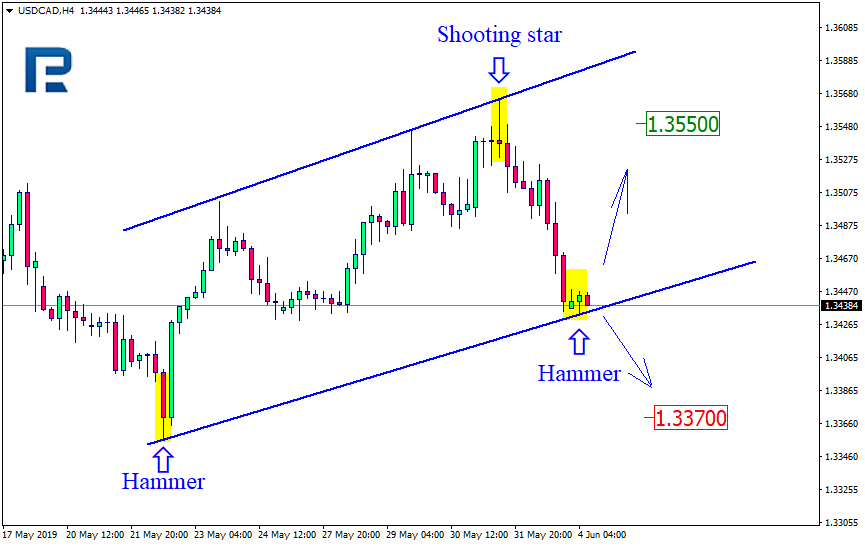
USDCAD, “US Dollar vs Canadian Dollar”

downside border, where Hammer pattern was formed earlier. Of course, there may be a reverse, which may be followed by a further growth towards 1.3550 to continue the ascending tendency. However, we shouldn’t ignore a possibility that the instrument may break the support level and resume its decline to reach 1.3370.

USDCAD
Risk Warning: the result of previous trading operations do not guarantee the same results in the future

AUDUSD, “Australian Dollar vs US Dollar”

As we can see in the H4 chart, the pair is forming an ascending channel. Right now, AUDUSD is testing its upside border, where Shooting Star pattern was formed earlier. Judging by the previous movements, at the moment it may be assumed that the instrument may reverse and move towards the support level at 0.6922. However, we shouldn’t ignore a possibility that the instrument may break the resistance level and resume its growth to reach 0.7040.

AUDUSD
Risk Warning: the result of previous trading operations do not guarantee the same results in the future

Article By RoboForex.com

Attention!
Forecasts presented in this section only reflect the author’s private opinion and should not be considered as guidance for trading. RoboForex LP bears no responsibility for trading results based on trading recommendations described in these analytical reviews.

Is Trump Reversing Course On Iran?

By Oilprice.com 

The Trump administration is attempting to dial down the tension with Iran, lowering the risk of military conflict and pushing for diplomatic negotiations.

On Sunday, U.S. Secretary of State Mike Pompeo said that the U.S. was ready to negotiate with Iran with “no preconditions,” a shift in strategy after laying out a list of 12 hardline demands last year, a list that seemed to be a set of preconditions. Meanwhile, last week, President Trump stated that he was not seeking regime change in Iran, contradicting his national security adviser, John Bolton, who has repeatedly advocated for toppling the regime in Tehran.

“We’re prepared to engage in a conversation with no preconditions,” Pompeo said in Switzerland. “We’re ready to sit down with them. But the American effort to fundamentally reverse the malign activity of the Islamic Republic, this revolutionary force, is going to continue.”

Trump also seems to be softening the policy on Iranian oil exports. In April, the administration announced that it would not extend any waivers on countries buying Iranian oil, a move intended to take Iran’s exports down to zero, as long promised. “The policy of zero Iranian imports originated with Secretary Pompeo,” a senior State Department official told the Washington Post in April. “He has executed this policy in tight coordination with the president every step of the way. Because the conditions to not grant any more [waivers] have now been met, we can now announce zero imports.”

However, there are some cracks forming in that policy. According to the Wall Street Journal, the U.S. will allow some countries to continue to import oil from Iran, essentially under their old waiver allotments. As long as they do not breach the ceiling they were granted under the original waivers, the U.S. won’t crack down, the WSJ said.

“So once people have reached that cap of what was negotiated…that then would be the limit of the oil that we would permit to move through that would not be sanctioned,” Brian Hook, the U.S. Special Representative for Iran, said in a telephone briefing on Thursday with reporters. “We will sanction any efforts to import Iranian crude oil beyond the limits that were negotiated in the period that ran from November through May.”

Trump officials said no to an extension of waivers in April, but the comments from Hook sounds a lot like a waiver extension – even if the administration does not want to call it as such. Hook’s comments to the press raised more questions than answers. Later, he clarified, saying that any oil that was purchased and/or in transit before the expiration of waivers on May 2 would be allowed. Anything after, would not. So, maybe no extension after all?

The confusing strategy from the White House notwithstanding, the U.S. has pulled back from the brink in the last two weeks. Trump does not seem to want a military conflict, even if he is in favor of the “maximum pressure” campaign. If there is any discernible foreign policy strategy from Trump, it is the pursuit of some high-profile “deal,” however vaguely defined. His image of a deal does not always conform to that of the U.S. foreign policy establishment, which leads to confusion and mixed signals.

Still, as he has with North Korea, he tends to allow conflict to escalate to the brink of war, then he abruptly calls for a deal. It’s too soon to say whether or not that will occur this time around, but Trump is now highlighting his desire for negotiation, whereas up until recently he allowed John Bolton to pursue a more aggressive tact. “I really believe that Iran would like to make a deal, and I think that’s very smart of them, and I think that’s a possibility to happen,” Trump said in Japan last week. In early May, Trump told reporters “What I’d like to see with Iran, I’d like to see them call me.”

Iran isn’t simply going to pick up the phone because Trump wants to chat, not after getting hammered by crippling sanctions. And certainly not after inking a sweeping deal with Trump’s predecessor, only to see it torn up. Anyone at all familiar with the history of U.S.-Iran relations would not bet on Iran rolling over. Instead, most political factions in Tehran tend to close ranks in the face of American pressure.

So, the standoff will likely continue. Iran’s oil production fell by 230,000 bpd in May to 2.32 million barrels per day, according to Bloomberg. Export data, as opposed to production, is harder to come by, but Reuters puts shipments at 400,000 bpd in May. Iran’s oil exports may not go to zero, even if they continue to tumble. Saudi Arabia added 170,000 bpd last month, going a long way in compensating for the outages in Iran.

The irony is that Trump’s trade war with China (and soon, Mexico) is cratering the oil market as demand could take a hit. That actually gives Trump more room to tighten the screws on Iranian oil exports. Oil market tightness – and high prices – forced the U.S. to repeatedly back off in the past year. With recession fears setting in, there could be plenty of slack in the market, allowing Trump to pursue the zero-export policy. It’s just not clear how far his administration wants to go.

Link to article: https://oilprice.com/Energy/Energy-General/Is-Trump-Reversing-Course-On-Iran.html

By Nick Cunningham of Oilprice.com

Ichimoku Cloud Analysis 04.06.2019 (AUDUSD, NZDUSD, USDCAD)

Article By RoboForex.com

AUDUSD, “Australian Dollar vs US Dollar”

AUDUSD is trading at 0.6979; the instrument is moving above Ichimoku Cloud, thus indicating an ascending tendency. The markets could indicate that the price may test Tenkan-Sen and Kijun-Sen at 0.6945 and then resume moving upwards to reach 0.7055. Another signal to confirm further ascending movement is the price’s rebounding from the channel’s downside border. However, the scenario that implies further growth may be cancelled if the price breaks the cloud’s downside border and fixes below 0.6890. In this case, the pair may continue falling towards 0.6805.

AUDUSD
Risk Warning: the result of previous trading operations do not guarantee the same results in the future

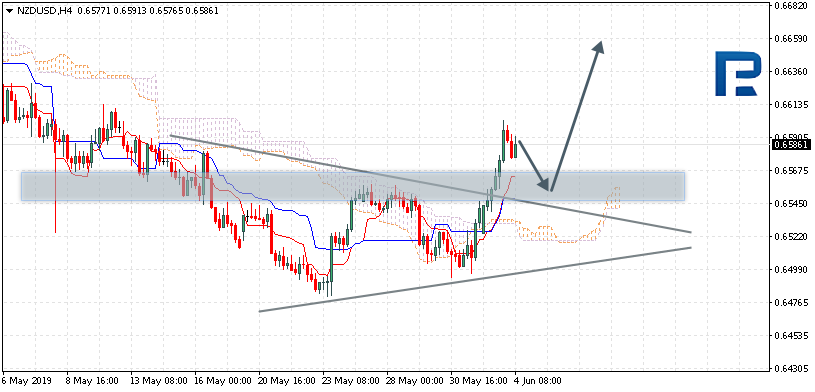
NZDUSD, “New Zealand Dollar vs US Dollar”

NZDUSD is trading at 0.6586; the instrument is moving above Ichimoku Cloud, thus indicating an ascending tendency. The markets could indicate that the price may test Tenkan-Sen and Kijun-Sen at 0.6555 and then resume moving upwards to reach 0.6660. Another signal to confirm further ascending movement is the price’s rebounding from the support level. However, the scenario that implies further growth may be cancelled if the price breaks the cloud’s downside border and fixes below 0.6500. In this case, the pair may continue falling towards 0.6435.

NZDUSD
Risk Warning: the result of previous trading operations do not guarantee the same results in the future

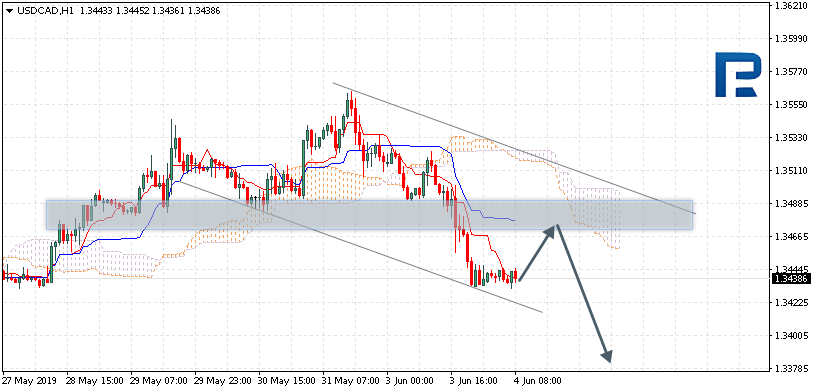
USDCAD, “US Dollar vs Canadian Dollar”

USDCAD is trading at 1.3438; the instrument is moving below Ichimoku Cloud, thus indicating a descending tendency. The markets could indicate that the price may test Tenkan-Sen and Kijun-Sen at 1.3470 and then resume moving downwards to reach 1.3375. Another signal to confirm further descending movement is the price’s rebounding from the resistance level. However, the scenario that implies further decline may be cancelled if the price breaks the cloud’s upside border and fixes above 1.3415. In this case, the pair may continue growing towards 1.3595.

USDCAD
Risk Warning: the result of previous trading operations do not guarantee the same results in the future

Article By RoboForex.com

Attention!
Forecasts presented in this section only reflect the author’s private opinion and should not be considered as guidance for trading. RoboForex LP bears no responsibility for trading results based on trading recommendations described in these analytical reviews.

The Analytical Overview of the Main Currency Pairs on 2019.06.04

by JustForex

The EUR/USD currency pair

Technical indicators of the currency pair:
  • Prev Open: 1.11603
  • Open: 1.12407
  • % chg. over the last day: +0.64
  • Day’s range: 1.12407 – 1.12576
  • 52 wk range: 1.1111 – 1.2009

USD got weakened yesterday against the other majors. The quotes grew by 85 points. The trading instrument updated the key extremums. The demand for USD fell after the comments made by the FOMC representative Bullard. The official stated the quotes descend “can be justified soon”, including the growing risks in the US economy which are caused by the growing tension in the world trade and weak inflation in the US. An additional pressure is caused by the weak business activity report in the industrial sector by ISM. The quotes are consolidating around 1.12350-1.12600. Open positions from these levels. The quotes can grow further.

The Economic News Feed for 04.06.2019:

  • – Consumer Price Index (EU) – 12:00 (GMT+3:00);
  • – Unemployment Rate Report (EU) – 12:00 (GMT+3:00);

Keep an eye on the statements by the head of the Federal Reserve.

EUR/USD

The price fixed above 50 MA and 200 MA which points to the power of the buyers.

The MACD histogram is in the positive zone but below the signal line which gives a weak signal to buy EUR/USD.

The Stochastic Oscillator is in the neutral zone, the %K line is crossing the %D line. There are no signals at the moment.

Trading recommendations
  • Support levels: 1.12600, 1.13000
  • Resistance levels: 1.12350, 1.12150, 1.11900

If the price fixes above the local resistance 1.12600 expect further growth towards 1.30000

Alternatively, the quotes can fall towards 1.12000-1.11800.

The GBP/USD currency pair

Technical indicators of the currency pair:
  • Prev Open: 1.26264
  • Open: 1.26639
  • % chg. over the last day: +0.19
  • Day’s range: 1.26558 – 1.26744
  • 52 wk range: 1.2438 – 1.3631

GBP/USD shows an ambiguous technical picture. GBP is consolidating. The local support and resistance levels are 1.26400 and 1.26750. The demand for USD lowered due to the growing expectations for the Federal Reserve to dencrease the rates next year. The quotes have prospects for recovery. The investors are waiting for reports fromt he UK. Open the positions from the key levels

At 11:30 (GMT+3:00) the UK will publish a construction PMI report.

GBP/USD

The price fixed above 200 MA which points to the power of the buyers.

The MACD histogram is in the positive zone and keeps rising which provides a strong indicator to buy GBP/USD

The Stochastic Oscillator is in the neutral zone, the %K line is crossing the %D line. There are no signals at the moment.

Trading recommendations
  • Support levels: 1.26400, 1.26100, 1.25850
  • Resistance levels: 1.26750, 1.27000, 1.27450

If the price fixes above 1.26750, expect growth towards 1.27000-1.27400.

Alternatively, the quotes can fall towards 1.26100-1.25850.

The USD/CAD currency pair

Technical indicators of the currency pair:
  • Prev Open: 1.35168
  • Open: 1.34403
  • % chg. over the last day: -0.59
  • Day’s range: 1.34328 – 1.34476
  • 52 wk range: 1.2727 – 1.3664

The quotes started to descend and set the new local minimums. USD is under pressure after the FOMC represetatives’ comments and weak economic releases. CAD is consolidating around 1.34300 and 1.34600. The quotes can descend further. Keep an eye on the oil quotes dynamics and open positions from the key levels.

The Economic News Feed for 04.06.2019 is calm.

USD/CAD

The indicators point to the power of the sellers, the price fixed below 50 MA and 200 MA.

The MACD histogram is in the negative zone but above the signal line which gives a weak signal to sell USD/CAD.

The Stochastic Oscillator is in the neutral zone, the %K line is crossing the %D line. There are no signals at the moment.

Trading recommendations
  • Support levels: 1.34300, 1.34000
  • Resistance levels: 1.34600, 1.34850, 1.35250

If the price fixes below 1.34300, expect further descend towards 1.34000-1.33800.

Alternatively, the quotes can grow toward 1.34800-1.35000.

The USD/JPY currency pair

Technical indicators of the currency pair:
  • Prev Open: 108.264
  • Open: 108.054
  • % chg. over the last day: -0.18
  • Day’s range: 107.857 – 108.087
  • 52 wk range: 104.97 – 114.56

USD/JPY keeps showing a negative trend and update the local minimums. The quotes are consolidating around 107.850-108.150. The JPY has a tendency to grow against th eUSD. The demand for safe assets remains high due to the growing risks in the world trade. Keep an eye on the US Treasury bonds’ yield and open positions from the key levels.

The Economic News Feed for 04.06.2019 is calm.

USD/JPY

The price fixed below 50 MA and 200 MA which points towards the power of the buyers.

The MACD histogram is in the negative zone and keeps descending which recommends selling USD/JPY.

The Stochastic Oscillator is in the neutral zone, the %K line is crossing the %D line. here are no signals at the moment.

Trading recommendations
  • Support levels: 107.850, 107.500
  • Resistance levels: 108.150, 108.450, 108.850

If the price fixed below 107.850, expect further descend towards 107.500-107.300.

Alternatively, the quotes can recover towards 108.450-108.800.

by JustForex

The US Dollar Is Declining due to Global Risks

by JustForex

The US dollar weakened against a basket of major currencies due to the impact of trade conflicts on the country’s economy. The dollar index (#DX) closed in the negative zone (-0.62%). Global trade relations are escalating. Yesterday, the President of the Federal Reserve Bank of St. Louis, James Bullard said that the regulator might be forced to reduce interest rates due to low inflation and the threat posed by the US trade conflict with China. The greenback was under pressure due to weak statistics on economic activity in the manufacturing sector of the United States. In addition, US President Donald Trump entrusted to exclude India from the list of countries that had trade privileges from June 5. He believes that India does not provide equitable and reasonable access to its markets.

The Australian dollar strengthened slightly against the US dollar during the Asian trading session. Thus, the Reserve Bank of Australia, as expected, lowered the interest rate for the first time in three years from 1.50% to 1.25%. Also, a report on retail sales was published, the figure fell by 0.1% in April, while experts forecasted growth by 0.2%.

The “black gold” prices are declining due to global risks. At the moment, futures for the WTI crude oil are testing the mark of $52.90 per barrel.

Market Indicators

Yesterday, there was a variety of trends in the US stock market: #SPY (-0.25%), #DIA (+0.11%), #QQQ (-2.20%).

The 10-year US government bonds yield has become stable after a continuous fall. At the moment, the indicator is at the level of 2.10-2.11%.

The news feed on 2019.06.04:

– UK construction PMI at 11:30 (GMT+3:00);
– Consumer price index in the Eurozone at 12:00 (GMT+3:00).

We also recommend paying attention to the speech by Fed Chairman Powell.

by JustForex

Fibonacci Support May Signal Bounce in Oil & Equities

By TheTechnicalTraders.com

We want to take a moment to point out that a Fibonacci 100% price move setup may prompt an upside price swing over the next few days and weeks.  Many traders fail to identify this setup and get caught up in the current price trend.  This happens because we lose focus on the fact that price always moves in segments or legs – from one peak or trough to another peak or trough.  The process of creating these segments or legs is usually structured in these types of Fibonacci price increment, and Fib targets I have personally found to be the most accurate for spotting profit taking and turning points.

We provide two very clear examples of this type of setup and how it has worked in the past.  We urge all traders to understand there are many examples of larger Fibonacci price expansion legs throughout history.  These examples of the 100% Fibonacci price leg are unique instances of price movement and, after confirmation of a base/reversal, can become very valid trading signals.

This first example is the ES (E-Mini S&P Futures).  You can see from this chart the earlier examples of the 100% Fibonacci price legs working in the October 2018 downward price move. The current downward price legs have set up a perfect 100% Fibonacci price expansion leg and we believe support may form near $2732.

We would normally wait for some type of price confirmation that this level is going to act as support – for example, a solid reversal bar or Japanese Candlestick price pattern.  After confirmation is achieved, a price rotation equal to 60% to 95% of the last downward price leg can be expected.

This next example shows Crude Oil and the most recent downward two Fibonacci Price Legs.  The first resulted in a very quick upside price rotation (highlighted by the green arrow near May 20).  The second downside Fibonacci Price Leg just ended near $53.30.

It is our belief that Oil will find support near this $53.30 level and rally back above $56 from these lows.  The only thing we are waiting for is some type of technical price confirmation of this bottom setup and we can expect a 4% to 8% upside price swing in Crude Oil.

Over the past 21+ months, we’ve highlighted some of the best tools and techniques we use to find great trading signals.  This one technique, the Fibonacci 100% Price Expansion Leg, is just one of the tools we use to find trades and targets for our trade alerts for members.

The more one understands how price works and how the markets operate as a Symphony of price actions, one can find opportunities for great trades almost all the time.  Skill and experience make the difference when deciding when to trade and what to trade and that’s what we provide.

More eye opening charts on currencies and gold here

We’ve now shown you two different price setups using Fibonacci price theory and the only thing we have to do is wait for a technical price confirmation before finding our entry trade.  We’ll see how this plays out over the next few days and weeks.  Remember, we are not proposing these as “major price bottoms”. They are “upside pullback trades” (bounces) at this point.  A bullish price pullback in a downtrend.

BECOME A TECHNICAL TRADER TODAY AND 
TRADE WHAT MATTERS – PRICE ACTION! 
CLICK HERE

Chris Vermeulen


Trump’s tea with Queen? His multi-front trade wars are more controversial

By George Prior

Trump’s controversial state visit to the UK is not as concerning as his escalating multi-front trade wars, affirms the boss of one of the world’s largest independent financial advisory organizations.

The comments from the CEO and founder of deVere Group, Nigel Green, comes as U.S. President Donald Trump arrives in London for a three-day state visit.

The president and First Lady Melania Trump will be guests of the Queen and attend a ceremony in Portsmouth to mark 75 years since the D-Day landings. He will also have official talks with the prime minister, Theresa May, at Downing Street.

Mass anti-Trump protests are expected and invitations to the banquet have been rejected by high profile figures, including the Mayor of London, Sadiq Khan, and leader of the official opposition, Jeremy Corbyn.

Nige Green says: “It is unfathomable that Trump’s banquet with the Queen is sparking more outrage and controversy than his trade policies that threaten to send the world into a global recession.

“Mr Trump is the democratically-elected leader of the U.S., the UK’s largest and most powerful ally in the world. To me, it seems pretty standard he would be afforded a state visit.  Strategically less important, and more controversial, undemocratically-elected, leaders have been welcomed in the same way.”

He continues: “Bizarrely, there have no heated mass protests and derogatory inflatables about Trump’s multi-front trade wars that make a global economic downturn a real possibility.

“Rising protectionism, the tit-for-tat dispute between the U.S. and China, the world’s two largest economies – and now possibly between the U.S. and Mexico too, will inevitably hit consumers around the world by making it harder for all firms to operate, encouraging them to push steeper prices onto their customers.

“This will drive demand lower – and this will force job and wealth-creating firms globally to cut costs, meaning less investment, fewer jobs, and, therefore, less tax revenue for governments.”

Last month, Mr Trump raised the tariffs on $200 billion worth of Chinese goods from 10 per cent to 25 per cent. U.S. representatives have also threatened to impose tariffs on $300 billion in remaining Chinese imports.

On Thursday, Trump took to Twitter to announce a 5 per cent tariff on all goods coming from Mexico would take effect on June 10. The tariff would then rise by 5 per cent each month, with tariffs topping out at 25 per cent by October. Trump said the tariffs come in response to illegal immigration issues.

The deVere CEO concludes: “Mr Trump’s protectionist, anti-globalisation policies have real consequences for people around the world, especially as China is wheeling out ‘counter measures,’ and the White House last week reopened the North American front in his global trade wars.

“There should be people on the streets calling for free trade and the scrapping of U.S.-led protectionism to boost the world economy.”

About:

deVere Group is one of the world’s largest independent advisors of specialist global financial solutions to international, local mass affluent, and high-net-worth clients.  It has a network of more than 70 offices across the world, over 80,000 clients and $12bn under advisement.

Gold Recovered After Plunging This Spring

By Dmitriy Gurkovskiy, Chief Analyst at RoboForex

Gold prices recovered early in the summer after plummeting in April and May. On Monday June 3rd, the instrument is trading at 1315.10 USD. We can see a slight correction, but there are enough reasons for a further growth.

Right now, the fundamental background is in favor of bulls. In general, there is only one reason for this, trade conflict between the USA and China. To get things even more complicated, the USA decided to have trade wars on two fronts and hardened its relations with Mexico. Nobody denies that the USA are very aggressive and protect only their own interests. Investors don’t like it and try to avoid risks. At the same time, demand for “safe haven” assets is going up. In this case, Gold stood to gain from this panic.

Obviously, trade wars between two global giants, Washington and Beijing, aren’t going to end today or tomorrow. Things are getting more serious and complicated as both parties are now placing restrictions on rare earth metals exports and laying charges of espionage. Probably, diplomatic means for agreeing on trade relations aren’t working anymore.

In this light, Gold has a potential to grow and may continue trading upwards for a while.

In the H4 chart, XAUUSD is trading below 1290.00. The instrument has reached its downside target at 1266.00; right now, it is forming a new correction. After breaking the correctional channel, the price may start another decline. From the technical point of view, this scenario is confirmed by Stochastic Oscillator; so far, its signal line indicates that the correction may yet continue, but may later be followed by the downtrend with the target at 1260.00.

The H1 chart shows the correction as well. Possibly, the pair may fall towards 1277.00. However, there is another scenario, according to which the correction may yet continue to reach 1290.00. After breaking the correctional channel, the price may resume the downtrend with the target at 1260.00. From the technical point of view, this scenario is confirmed by MACD Oscillator, as its signal line is reversing away from the “overbought area”. After breaking 1275.00, the downtrend may quicken.

Disclaimer

Any predictions contained herein are based on the authors’ particular opinion. This analysis shall not be treated as trading advice. RoboForex shall not be held liable for the results of the trades arising from relying upon trading recommendations and reviews contained herein.