Author Archive for InvestMacro – Page 183

The Analytical Overview of the Main Currency Pairs on 2019.08.20

by JustForex

The EUR/USD currency pair

Technical indicators of the currency pair:
  • Prev Open: 1.10921
  • Open: 1.10776
  • % chg. over the last day: -0.11
  • Day’s range: 1.10776 – 1.10885
  • 52 wk range: 1.1034 – 1.1817

The EUR/USD currency pair continues to consolidate. The technical picture is ambiguous. At the moment, the local support and resistance levels are: 1.10650 and 1.10950, respectively. The US president again criticized the Fed for a “strong” dollar. Donald Trump believes that the Central Bank in the near future should consider reducing the key interest rate by 100 basis points. We recommend opening from key levels.

In July, the producer price index in Germany rose by 0.1% compared with the forecasted value of 0.0%.

EUR/USD

Indicators point to the strength of sellers: the price has fixed below 50 MA and 100 MA.

The MACD histogram is in the negative zone but above the signal line, which gives a weak signal to sell EUR/USD.

The Stochastic Oscillator is in the neutral zone, the %K line is below the %D line, which also indicates a bearish sentiment.

Trading recommendations
  • Support levels: 1.10650, 1.10500
  • Resistance levels: 1.10950, 1.11300, 1.11650

If the price consolidates below the level of 1.10650, expect a further drop toward 1.10300-1.10000.

Alternatively, the price could grow toward 1.11200-1.11400.

The GBP/USD currency pair

Technical indicators of the currency pair:
  • Prev Open: 1.21500
  • Open: 1.21236
  • % chg. over the last day: -0.19
  • Day’s range: 1.21174 – 1.21380
  • 52 wk range: 1.2015 – 1.3385

An ambiguous technical picture has developed on the GBP/USD currency pair. The pound is currently in lateral movement. The key support and resistance levels are: 1.21000 and 1.21400, respectively. GBP/USD quotes have the potential for further growth. Market participants are waiting for new information regarding the Brexit process. Positions must be opened from key levels.

The Economic News Feed for 20.08.2019 is calm.

GBP/USD

Indicators do not give accurate signals: the price has fixed between 50 MA and 100 MA.

The MACD histogram is near the 0.

The Stochastic Oscillator is in the neutral zone, the %K line is below the %D line, which indicates a bearish sentiment.

Trading recommendations
  • Support levels: 1.21000, 1.20750, 1.20450
  • Resistance levels: 1.21400, 1.21750, 1.21900

If the price consolidates above 1.21400, expect further growth toward 1.21750-1.22000.

Alternatively, the price could decrease toward 1.20750-1.20600.

The USD/CAD currency pair

Technical indicators of the currency pair:
  • Prev Open: 1.32694
  • Open: 1.33234
  • % chg. over the last day: +0.39
  • Day’s range: 1.33087 – 1.33307
  • 52 wk range: 1.2727 – 1.3664

Yesterday, aggressive purchases were observed on the USD/CAD currency pair. Quotation growth exceeded 60 points. The CAD reached key extremes. At the moment, the trading instrument is consolidating in the range of 1.33000-1.33400. We do not exclude further growth of the USD / CAD currency pair. Today, the news background on the Canadian economy is quite calm. We recommend paying attention to the dynamics of oil quotes. Positions must be opened from key levels.

At 15:30 (GMT+3:00) we expect data on sales in the manufacturing sector of Canada.

USD/CAD

Indicators do not give accurate signals: 50 MA crossed 100 MA.

The MACD histogram is in the positive zone, but below the signal line, which gives a weak signal to buy USD/CAD.

The Stochastic Stochastic Oscillator is in the neutral zone, the %K line crossed the %D line. There are no signals at the moment.

Trading recommendations
  • Support levels: 1.33000, 1.32750, 1.32500
  • Resistance levels: 1.33400, 1.33700, 1.34000

If the price consolidates above 1.33400, expect further growth toward 1.33700-1.34000.

Alternatively, the price could drop toward 1.32750-1.32600.

The USD/JPY currency pair

Technical indicators of the currency pair:
  • Prev Open: 106.250
  • Open: 106.624
  • % chg. over the last day: +0.24
  • Day’s range: 106.429 – 106.692
  • 52 wk range: 104.97 – 114.56

The USD/JPY currency pair continues to consolidate. The technical picture is still mixed. At the moment, ецщ local support and resistance levels can be distinguished: 106.300 and 106.700. A trading instrument has a potential for growth. Participants in financial markets expect additional drivers. We recommend that you pay attention to the yield dynamics on the US Treasury bonds. Positions must be opened from key levels.

The Economic News Feed for 20.08.2019 is calm.

USD/JPY

The price fixed above 50 MA and 100 MA, which points to the strength of buyers.

The MACD histogram has approached the 0 mark. There are no signals at the moment.

The Stochastic Oscillator is in the neutral zone, the %K line is below the %D line, which indicates a bearish sentiment.

Trading recommendations
  • Support levels: 106.300, 106.000, 105.750
  • Resistance levels: 106.700, 107.000

If the price consolidates above 106.700, expect further growth toward 107.000-107.200.

Alternatively, the price could drop toward 106.000.

by JustForex

The Dollar Index Is Testing Three-Week Highs

by JustForex

The US dollar is being traded near three-week highs against a basket of major currencies. The 10-year US government bonds yield has moved away from recent lows due to the fact that the leading countries of the world intend to support their economies with various economic stimulus measures. Also, it became known that the United States extended the Huawei license. By extending the license, the company will still be able to purchase materials from US companies. A temporary license is extended until November 19th. Meanwhile, investors will closely monitor US-China trade relations. The US President has criticized the Fed for a “strong” dollar again. Donald Trump said the regulator should consider lowering the key interest rate by 100 basis points in the near future. The US dollar index (#DX) closed the trading session in the positive zone (+0.22%).

The euro fell against the US dollar after the publication of weak economic statistics. Thus, the Eurozone consumer price index rose only by 1.0% in July, while experts forecasted growth by 1.1%. The political situation in Italy is still unstable. German authorities are going to apply stimulus measures to avoid a recession in the country’s economy. Last week Chancellor of Germany, Angela Merkel, said that Germany’s economy is moving into a difficult phase.

The “black gold” prices are consolidating after growth the day before. Futures for the WTI crude oil are currently testing the $56.35 mark per barrel.

Market Indicators

Yesterday, the bullish sentiment was observed in the US stock markets: #SPY (+1.20%), #DIA (+0.95%), #QQQ (+1.59%).

The 10-year US government bonds yield has moved away from local highs. At the moment, the indicator is at the level of 1.57-1.58%.

The news feed for 2019.08.20:

Today, the publication of important economic news is not expected.

by JustForex

EURUSD: uncertainty from a technical perspective

By Alpari.com

Previous:

On Monday the 19th of August, trading on the euro closed down. The bulls were unable to keep the EURUSD pair in positive territory. The breakout of the trend line brought the rate down to 1.1076. At the beginning of the European session, the euro was being propped up by expectations that German would announce some fiscal stimulus measures.

Here we got some negative news. The German finance minister said that Germany may forego balancing the budget in favour of increased spending in the event of a recession.

In the evening, the euro dropped in response to remarks from the Federal Reserve’s Eric Rosengren, who said that he doesn’t currently see the case for rate slash, given the relative strength of the US economy and a lack of any serious threats. The Fed should focus more on economic statistics to determine the right time for a rate reduction.

Day’s news (GMT+3):

  • 13:00 UK: CBI industrial trends survey – orders (Aug).
  • 15:30 Canada: manufacturing shipments (Jun).

EURUSD H1Current situation:

The bulls failed to get a foothold above the balance line. The resurgent dollar forced them to close the long positions they had opened ahead of the European session.

At the time of writing, the euro is trading at 1.1077 against the greenback. As it stands, only the pound and the euro are trading down. In today’s Asian session, all the other majors are up against the dollar. Markets are still under pressure from the ECB’s governing council member Rehn’s remarks about the stimulus package being prepared for the Eurozone.

Investors now have their eyes fixed on the US, where the Federal Reserve will release the minutes of its latest meeting on Wednesday, followed by the annual conference at Jackson Hole from the 22nd to 24th of August, where Jerome Powell will speak.

Also note that the US Department of Commerce has granted an extension to telecoms giant Huawei that allows it to purchase supplies from US companies. Donald Trump has said that trade negotiations with China are set to continue.

Taking all these factors into account, it’s reasonable to expect high market volatility during the week, which could further increase with the FOMC minutes and developments at Jackson Hole.

From a technical point of view, we’ve now got a contradictory picture on the EURUSD pair. On the chart, we’ve highlighted the zone of 1.1069 – 1.1075, as well as the 1.1055 mark. The stochastic has reversed downwards, so there’s a high probability of a drop to 1.1069.

The 135th degree is a key level, so if we don’t get a bounce here, the pair could slide as far as 1.1020. The majors paint a mixed picture, while the EURGBP cross is trading up. The bears could drag the market down and cash in on their short positions.

By Alpari.com

The PH Dengue Outbreak and Rising Global Dengue Risks

By Dan Steinbock

In the future, dengue outbreaks will escalate worldwide. Due to tropical and socio-economic conditions, climate change (and covert biological efforts), dengue can only be contained through multipolar cooperation.

In mid-July, Philippines health authorities declared a “national dengue alert.” In early August, the Department of Health declared a National Dengue Epidemic. By now, the number of cases has soared to 170,000, with 720 deaths; that’s 100% higher relative to 2018, despite a delayed rainy season. The most affected age group among dengue deaths is 5-9 years.

The dengue outbreak in the Philippines and several other South and Southeast Asian countries is now international headline news. But how did dengue become “endemic” to these countries?

The conventional dengue narrative

By the 2010s, dengue caused the greatest human disease burden of any arbovirus – that is, viruses that are transmitted by mosquitoes, ticks, or other arthropods, including yellow fever – with estimated 10,000 deaths and 100 million symptomatic infections per year in over 125 countries.

Historically, the first epidemic instances of dengue occurred in Asia, Africa and North America in the late 18th century. The ecological disruption in Southeast Asia and the Pacific during and after World War II fostered conditions for increased transmission of mosquito-borne diseases.

The first recorded dengue hemorrhagic fever (DHF) epidemic occurred in Manila, in the early 1950s, but within 20 years the disease in epidemic form spread throughout Southeast Asia.

By the mid-1970s, dengue was the leading cause of hospitalization and death among children in the region, while epidemics intensified in the Pacific and the Americas. Since the 1980s and 1990s, epidemic dengue transmission has intensified further, with a global resurgence of dengue fever.

In this view, the Philippine dengue epidemic is the net effect of environmental conditions (last July was the warmest in recorded history), vaccination debacle (Dengvaxia mess, corruption), extreme weather (high precipitation), living conditions (high urban density), and socio-economic vulnerabilities (low living standards, high income polarization, weak public-health system).

Yet, medical studies presume that dengue is “endemic” to certain climate areas, even though it has been purposefully exploited ever since the postwar era. The Philippines has a special role in this dark history of experimentation on unwitting human subjects. US bio-tests began in the Philippines in 1906, when Richard P. Strong, then head of the Philippine Biological Laboratory, inoculated 24 inmates of Manila’s Bilibid Prison with a cholera vaccine that had been contaminated with plague causing 13 fatalities.

The covert dengue history

After World War II, the United States quietly augmented domestic efforts by recruiting major Nazi and Japanese bio-warfare scientists. As weaponization activities began with disease vectors in the early ‘50s, the focus was on plague-fleas, mosquitoes, and yellow fever. During tests in Utah, Georgia and Florida, hundreds of thousands of fleas and (yellow fever) mosquitoes were dispersed, according to US Army studies.

Until the early ‘70s, US program stockpiled dangerous bioagents and pursued research on many more. In 1972 the Biological Weapons Convention (BWC) banned the “offensive” use of biological and toxin weapons, yet the treaty, which suffers from verification and compliance issues, left the door open for “defensive” bio-warfare and “research” in major powers.

Historically, dengue fever had been the focus on US Army and CIA biological warfare researchers for more than half a century. US Army’s Biological Warfare facility at Fort Dietrick, Maryland, has experimented with dengue fever, as verified by US historians and congressional committees since the 70s. By 1981, Cuba struggled amid an epidemic of hemorrhagic dengue fever, although it did not have a history of severe dengue outbreaks.

During the Cold War, when biological agents were produced in industrial scale by the Soviet Union and the US, the threat of the mutually assured destruction constrained risks. After the Cold War, the Nunn-Lugar Cooperative Threat Reduction Program (CTRP) presumably aimed to keep the former Soviet Union’s nuclear and chemical infrastructure from rogue nations and terrorists. Yet, in 1996 Congress expanded the program internationally.

Branching from the Nunn-Lugar program, bio-labs are funded by the Defense Threat Reduction Agency (DTRA) under a multibillion dollar military Cooperative Biological Engagement Program (CBEP). The CBEP labs are located in 25 countries, including in Eastern Europe (e.g., Georgia and Ukraine), the Middle East, Africa and Southeast Asia – and the Philippines.

Critics claim that some of these locations have seen outbreaks of tropical diseases, which are not endemic to the area. After 2015, sand flies, which can be found in Philippines (and were tested on humans in US in early ‘70s), have infested areas in Tbilisi, Georgia. In turn, outbreaks of tropical diseases, such as dengue, have become more severe.

Until recently, there had been no dengue outbreak in the US since the 1930s. Presumably, dengue had been eradicated, despite global increases in incidence and severity, and immigration. But in 2009, Key West, Florida, several residents showed infection. According to a study by the Centers for Disease Control (CDC), the infection rate in the area was 5 to 8%. Mosquitoes known to spread dengue fever were found in more than half of US states.

According to CIA documents and the 1975 Congressional committee, three sites in Florida, Key West, Panama City and Avon Park, and in central Florida, had been used for experiments with mosquito-borne dengue fever and other biological agents.

Dengue scope, costs, severity will escalate

Thanks to global warming, the dengue challenge is likely to get worse. Risks from some vector-borne diseases, such as malaria and dengue fever, are projected to increase with warming from 1.5°C to 2°C. That, in turn, will cause an increase in the number of mosquitoes, a larger geographic range, and more individuals will be at risk of dengue fever.

In a recent study, the total annual global cost of dengue illness was estimated at $8-9 billion (with upside estimates at $20 billion). Rising temperatures imply that dengue will intensify in “already endemic areas.” By 2050, much of southeastern US will become suitable for dengue, inland areas of Australia, many of the larger cities in coastal China and Japan, and particularly in southern Africa. Globally some 2.3 billion more people will be at risk of dengue in 2080 compared to 2015, bringing the total population at risk to over 6.1 (high estimate 6.9) billion, or 60% of the world’s population.

The role of covert attempts in viral outbreaks is hard to assess, but the concern is rising. A new Pentagon program called “Insect Allies,” which is funded by the Defense Advanced Research Projects Agency (DARPA) and relies on gene editing, wants to infect insects with modified viruses, presumably to make US crops more resilient. Some international scientists believe such initiatives can easily be exploited as new bio-weapon systems programs, which violate the Biological Weapons Convention.

After the Cold War, US has dominated biological defense and research. With rising climate risks and geopolitical tensions, no single country should have monopoly over global biological agents in the 21st century, however. Potential conflicts of self-interest are obvious, tragic and potentially existential.

Like “dual-use” technologies that can be used for both peaceful and military objectives, biological agents can serve as potential antidotes and weapons. What we truly need is multipolar cooperation among the major advanced economies and largest emerging powers. Only such checks can constrain existential biological risks to vast urban populations in the future.

This commentary is based on Dr Steinbock’s fully-referenced research note on the dengue outbreak in the Philippines, climate change and rising global dengue risks.

About the Author:

Dr. Dan Steinbock is the founder of Difference Group and has served at India, China and America Institute (US), Shanghai Institute for International Studies (China) and EU Center (Singapore). For more, see http://www.differencegroup.net/ 

The original commentary was published by The Manila Times on August 18, 2019


The Next Breakdown And The Setup

By TheTechnicalTraders.com

If you’ve been following our research long enough, you’ll remember that we often discuss Fibonacci Price Theory and how we use it to try to identify opportunities and trends in the markets.  The basic premise of Fibonacci Price Theory is that price is always seeking to establish newer highs or newer lows with every rotation on the charts.  The theory is rather simple to understand and learn and it helps easily identify where support, resistance, and the trend is established.  Let’s take a minute to go over the basics of Fibonacci Price Theory before we continue.

This first example of Fibonacci Price Theory trend is a simple example that highlights the basic premise of the theory – price move always attempts to establish new price highs or new price lows in a trend.  Therefore, in a downtrend, we would attempt to observe price in a simple structure as you see on the left side of this example – establishing new lower lows and new lower highs in a series of waves.  In an uptrend, we would attempt to observe price in an opposite structure where new higher highs and new higher lows are set up.  Fairly simple so far – right?

In complex price rotations, we have to understand that we are changing the perspective of price trend when we are looking at different intervals of price data.  When we are investigating a 10-minute chart, we will see shorter-term Fibonacci price structure which may appear to be counter to our longer-term charts (Daily, Weekly or other intervals).  This is because the Fibonacci Price Theory works on all intervals and attempts to identify price structure and trend based on price rotations and true price structure.

In the complex example, below, we’ve drawn some samples that show price rotation within a trend.  The first example, on the left, is a continued DOWNTREND with a failed bullish high near the middle.  This happens often as price enters a congestion period.  Notice that after the initial new low, price rotated within a range, then broke out setting up the bullish “new high”, but then immediately failed and moved lower.  Sometimes you’ll hear us report this type of setup as a “washout high”.  This failed trigger immediately sets up a bigger downside price move as the price was unable to find support above the previous high levels.  As soon as price rotated lower after that peak and took out those previous highs, we should have been very cautious of the upside potential.  When it took out the most recent low (shown with the PINK box), that was our trigger that the bullish trend was OVER and the new bearish trend was setup.

On the right side, we have a complete price rotation (from bullish to bearish).  We can see the upside trend initially set up with a new price high, then price consolidated into a range.  Once price broke above the most recent range high (highlighted with the PINK box), that was a new bullish trigger that price should attempt to move higher.  After it broke the previous GREEN peak, that provides even further confirmation of an uptrend.

Once the second big peak setup, the price moved lower to set up a rotational low and high price that established our Fibonacci Price Theory trigger range.  A move above that last high would provide confirmation that the trend should continue to move higher and a move below that last low would provide confirmation that the trend has reversed into a bearish trend.  The price moved lower (see the PINK box) and we set up a new bearish price trend based on these simple price rotations.

We hope these examples allowed you to better understand the next series of charts below.  Look for these structures in the real price of these charts and see if you can see what we see in terms of the “Setup”.

Its this type of analysis and chart patterns that have allowed us to make over 24% profit in August with a few trades. Also, very soon we will be adding some incredible new trading tools that allow you to forecast the markets turning points, spot momentum, swing, and trend trades automatically.

First, let’s start with the YM 120-minute chart and what we believe is the SETUP for our August 19 breakdown prediction.  Looking at this chart, we have a DOUBLE-TOP type of setup on the left side where two price high setups aligned within a few ticks of one another.  What confirms this as a DOUBLE-TOP is the subsequent breakdown of price setting up the August 15 price low near 25,400.  Since that breakdown (establishing a new lower low), we can presume the trend is Bearish based on Fibonacci Price Theory and we can assume that a new breakdown trend may be setting up on the hard right edge of this chart.  This new rotation near the right edge of the chart may turn into a complex price rotation, but we believe the downside move will eventually become very clear to traders based on our August 19 breakdown prediction.

This YM 240 Minute chart reflects a different perspective of the same trend.  We still see the extended DOUBLE-TOP formation after the bigger breakdown in price in early August.  We also see the August 15 low as a complex price rotation setting up near the right edge of this chart.  Now, think about the examples we used to try to help you understand this type of Fibonacci Price Theory setup?  We have a big downside price move in early August – setting up a new bearish price trend.  In order for us to attempt to confirm a reversal of that bearish trend, we would need to see a price peak setup and be breached with a new higher high type of price setup. Given that no new price high has broken above the late July price highs and each subsequent price peak has set up in either a DOUBLE-TOP formation or a lower high type of price structure – what are we left to conclude?  This is still a bearish price trend setup and that means we should expect a new downside price leg to attempt to establish a new price low.

Here is the NQ 240 minute chart.  Take a look at this and use your new skills to try to understand why we believe the eventual price breakdown will happen?  This is almost exactly like the Complex Fibonacci Price Structure on the RIGHT SIDE of the example we provided (above).  A deep downside move sets up a bearish trend.  Moderate upside price rotation in early August sets up a bullish corrective wave (because no new price high broke above the 8050 highs).  After the corrective wave exhausted near August 15, it broke downward to establish the recent new low near 7400 (notice the attempted “washout high” near August 14th?).  Currently, the new price low from August 15 sets the trend as a confirmed downside bearish trend that we expect will setup another new price low below 7400.  The only thing that would change that is if the price were able to move above 7800 and establish a new higher high.

Lastly, here is the MC (S&P 400 MidCap) 240-minute chart.  We love using the MIDCAP and TRAN charts because they often provide a much clearer picture of true price structure than the ES, YM and NQ charts do.  Pay attention to the MAGENTA ARCS I’ve drawn on this chart.  See anything interesting?  I know that I see from this chart and why I believe my August 19th breakdown prediction is going to be accurate.  Take a minute to study this chart and come to your own conclusion about the price structure.

There you have it, folks.  We made a prediction about a July 2019 market top setup and an August 19 breakdown in price many months back.  How did we know about these setups?  We are using our proprietary price modeling and predictive modeling systems along with various technical analysis tools and years of study and research into technical analysis and price structures.  We can attempt to use our proprietary tools to help traders, like you, stay well ahead of these moves and find greater profits.

All we have to do now is wait for the new rotation in price to either confirm or invalidate our breakdown analysis.  At this point, it is all up to the price, investor confidence and “fear and greed”.

CONCLUDING THOUGHTS:

In short, you should be starting to get a feel of where each commodity and asset class is headed for the next 8+ months. The next step is knowing when and what to buy and sell as these turning points take place, and this is the hard part. If you want someone to guide you through the next 12-24 months complete with detailed market analysis and trade alerts (entry, targets and exit price levels) join my ETF Trading Newsletter.

Be prepared for these incredible price swings before they happen and learn how you can identify and trade these fantastic trading opportunities in 2019, 2020, and beyond with our  Wealth Building & Global Financial Reset Newsletter.  You won’t want to miss this big move, folks.  As you can see from our research, everything has been setting up for this move for many months.

Join me with a 1 or 2-year subscription to lock in the lowest rate possible and ride my coattails as I navigate these financial market and build wealth while others lose nearly everything they own during the next financial crisis.

As a technical analysis and trader since 1997, I have been through a few bull/bear market cycles. I believe I have a good pulse on the market and timing key turning points for both short-term swing trading and long-term investment capital. The opportunities starting to present themselves will be life-changing if handled properly.

FREE GOLD OR SILVER WITH MEMBERSHIP!

Kill two birds with one stone and subscribe to get your FREE PRECIOUS METAL (gold or silver) and get our trades that will make you wealthy during the next metals bull market and financial crisis!

Chris Vermeulen – TheTechnicalTraders.com


August 19 Turn Date – Are You Ready?

By TheTechnicalTraders.com

Our August 19 breakdown prediction from months ago has really taken root with many of our followers and readers.  We’ve been getting emails and messages from hundreds of our followers asking for updates regarding this prediction.  Well, here is the last update before the August 19th date (tomorrow) and we hope you have been taking our research to heart.

First, we believe the August 19 breakdown date will be the start of something that could last for more than 5 to 12+ months.  So, please understand that our predicted date is not a make-or-break type of scenario for traders.  It means that we believe this date, based on our cycle research, will become a critical inflection point in price that may lead to bigger price swings, more volatility and some type of market breakdown event.  Thus, if you have already prepared for this event – perfect.  If this is the first time you are reading about our August 19 breakdown prediction, then we suggest you take a bit of time to review the following research posts.

August 12, 2019: AUGUST 19 (CRAZY IVAN) EVENT ONLY A FEW DAYS AWAY

August 7, 2019: OUR CUSTOM INDEX CHARTS SUGGEST THE MARKETS ARE IN FOR A WILD RIDE

July 30, 2019: AUGUST 19 PRICE PEAK PREDICTION IS CONFIRMED BY OUR ADL PREDICTIVE SYSTEM

July 13, 2019: MID-AUGUST IS A CRITICAL TURNING POINT FOR US STOCKS

Originally, our research team identified July 2019 as a market top potential back in April/May 2019.  Later, our research team updated our analysis to include the August 19 breakdown date prediction based on our advanced predictive modeling tools and cycle analysis tools.  This became a critical event in the minds of our research team because it aligned with much of our other predictive research and aligned perfectly with what we were seeing in the charts as we neared the Summer.

The top prediction for July 2019 by our research team became true as we entered early August.  This confirmation of our research and prediction back in April/May helped to solidify our belief that our August 19th breakdown prediction would likely become valid as well.  Whenever we make a prediction many months in advance, one has to understand that we are using our predictive analysis tools to suggest what price “wants” to try to do in the future.  External events can alter the price level by many factors to create what we call a “price anomaly”.  When the external events and price predictive outcomes align as they have been doing over the past 4+ months, it lends quite a bit of credibility to our earlier predictive research.

In other words, we couldn’t be happier that our research team has been able to deliver incredible insight and analysis regarding the global markets and how the price will react over the past 4+ months.  This is something no other investment research firm on the planet is capable of doing with any degree of accuracy right now.  In fact, it is amazing to us that we’ll read some research post by a multi-national investment firm that may suggest something now that we’ve alerted our followers to 90 days earlier.

Now, onto some new details about the August 19th breakdown event…

First, be very cautious about investing in Cryptos throughout this event.  The initial move, if our research continues to play out, maybe an upside rally in BitCoin based on fear as the global markets start a breakdown process.  But we believe this move in Cryptos will be very short-lived as our current research suggests central banks, governments, and other institutions are getting ready to pounce on unregulated Crypto Currencies.  It is our belief that the breakdown event will possibly push Bitcoin higher on a “move to safety” rotation.  But once Bitcoin investors understand that governments and institutions are targeting these digital currency exchanges as criminal enterprises that threaten central banks and that there is no real safety in putting capital into a digital enterprise that can be shut down in minutes, we believe a rush to the exits will begin to take place.

We believe the shift to real physical assets will take place as a shift in asset valuations continues to take place.  We believe the downside risk in Bitcoin is currently at least 30 to 40% from current values.  Our initial downside target is a level near $5570 for Bitcoin with potential for price support near $7900.

Daily Bitcoin Chart

This Daily Bitcoin chart highlights arrows that we drew in mid-July based on our expectations for future price rotation.  You can see that price, for the most part, followed our expectations and stayed within the Fibonacci price channel, near the lower price levels, while navigating the MAGENTA Fibonacci price amplitude arc (across the tops in price) as it moved towards our August 19th breakdown date.  It is critical to understand that price will attempt to either establish new price highs or new price lows based on Fibonacci price theory.  It is our belief that an upside rally towards the $11,300 level will be the “last rally” before a breakdown price trend pushes Bitcoin much lower.  This is likely the reaction of the “flight to safety” that we suggested earlier.

Weekly Bitcoin Chart

This Weekly Bitcoin chart provides a broader picture of the same event and how it will likely play out in the near future.  Remember, initially, global investors will attempt to pike into anything that is quick, easy and efficient to protect against perceived capital risks.  We are certain that some investors will attempt to pile into Cryptos as the breakdown event starts.  The question is, will this transition of capital stay safe long enough for investors to capitalize on the move?  We don’t believe so based on our research.

If the price of Cryptos breaks through that Magenta Fibonacci price amplitude arc and initiates a move to new higher highs, then we’ll have to rethink our analysis.  But for right now, we are sticking to our belief that Cryptos will see an impulse rally that will quickly be followed by a breakdown event (likely the result of some government intervention or broader risk event).

Weekly S&P 500 Chart

This Weekly S&P 500 chart highlights what we believe is the most likely immediate price trend related to the October 2018 price decline.  If a downside price move does initiate as we expect because of the August 19 breakdown inflection point, we believe the S&P will target immediate support above $2400.  If you’ve followed any of our research, you already understand we believe the move dynamic economies on the planet are uniquely situated to actually benefit from this downside price event.  Therefore, we must understand that a “price exploration event”, like this, is a mechanism for investors to seek out true value levels for global assets.  All major price corrections are, in essence, a process of seeking out price levels where investors believe “true value” exists.

NASDAQ Weekly Transportation Index

The NASDAQ Transportation Index paints a very clear picture for our research team.  In fact, we find the TRAN particularly useful in our research of the global and US markets.  Even though we follow dozens of symbols and instruments, one of our key objectives is to attempt to validate our analysis across multiple instruments/charts and to attempt to identify faults in our expected outcomes.

The recent downside price move in the TRAN aligns perfectly with our August 19 breakdown expectation.  It is very likely that some news or pricing event over the next 7+ days pushes the TRAN below the RED price channel and downward towards the middle Standard Deviation level near $3900.  Once the TRAN breaks the RED support level, you should expect the US and global markets to also begin a broader move lower.

Ideally, the $3500 level should operate as a moderately hard price floor for this downside move.  $3900 would be considered the initial target of the downside price move whereas $3500 would be considered the initial “hard floor” support level.  Given these expectations, we have to consider the potential for a -15% to -25% initial downside price move in TRAN which would translate into a -18% to -35% downside price move in the S&P or NASDAQ.

CONCLUDING THOUGHTS:

In closing, August 19th is tomorrow (Monday).  This is where we’ll find out if our prediction will be viewed in the future as accurate or not.  The one thing about making public predictions for many months in advance is that you can’t go back and try to lie to your followers/readers.  Either it works out as we suggested or it does not.  We believe in the skills of our research team and predictive modeling systems.  We’ve seen how accurate they have been in the past and we believe we’ve delivered top-tier analysis to all of our followers and readers.  In fact, we know you can’t find anything like this type of research from other investment or research firms.

Over the next 10 to 30+ days, we’ll be able to look back at our August 19th prediction and say “we were right” or “we were wrong” – that is part of trading, folks.  You use your best tools to make an educated assessment of current and future expectations, then act on it (if you want).  We’ll follow up on the other side of August 19th with all of you.

Stay fluid as this event plays out, and most importantly, know that we don’t blindly trade on predictions, we use our short-term technical analysis and current market trends to enter and exit trades. The reality is, no matter if the markets roll over and crash or rocket higher, we will follow and trade with the market. The best thing about being technical traders is we don’t care which way the markets go. We just analyze and trade with the current market trend and make money in both directions and at the drop of a hat!.

If you want to trade and invest without the stress of a pending market collapse or missing out on another extended rally to new highs then join my Wealth Building Newsletter today and copy my proven technical trading setups and trade with me!

Chris Vermeulen
TheTechnicalTraders.com


Negative Yields Tell A Story Of Shifting Economic Leadership

By TheTechnicalTraders.com

Negative yields are becoming common for many of the world’s most mature economies.  The process of extending negative yields within these economies suggests that safety is more important than returns and that central banks realize that growth and increases in GDP are more important than positive returns on capital.  In the current economic environment, this suggests that global capital investors are seeking out alternative solutions to adequately develop longer-term opportunities and to develop native growth prospects that don’t currently exist.

Our research team has been researching this phenomenon and how it relates to the continued “capital shift” that is taking place throughout the globe.  We believe we have some answers for anyone interested in our opinions.  We also believe the longer-term answers will depend on what happens over the next 5 to 7 years throughout the globe and how economic expectations shift as well as how global debt is dealt with.

We urge all of our followers to read all of the segments of this research post about how the global central banks are pushing the envelope and have been for many years :

Aug 14, 2019: GLOBAL CENTRAL BANKS MOVE TO KEEP THE PARTY ROLLING

Throughout our research, we referenced a number of current articles to determine our own outcomes and expectations.  Some of the articles we used as reference are listed below.

Sources for some of our research:

Each of these resources helped to create a bigger picture of what we believe will likely happen and how the process may unfold.  We’ll start by attempting to understand the core elements of the negative yield perspective and how/when it may change.

Negative yields are a result of expected economic malaise rooted in the understanding that GDP growth and economic output are relatively flat and not expected to rise.  It comes down to the fact that if investors identified true growth opportunities in the major global economies, the yields for the debt instruments would reflect investor optimism (resulting in higher yields).  Thus, the core element of the current global economic malaise is that the planet is transitioning from a very fragile 19th-century economic model into something new – we call it the 21st-century economic model.

This process will likely take an additional 10+ years to really begin to complete and may require many false starts as the world begins to understand exactly what is required to make this transition.  Debt, as a process of engaging in economic activity, is something that is essential for some level of inflation, income, and the creation of future growth.  Debt becomes a major issue when growth declines over extended periods of time resulting in a default risk for some nations/countries.  Yet, as the human population continues to expand and global central banks continue to attempt to find the spark that will launch the new economic growth model, debt is essential to avoid economic contraction.

As we’ve hinted to, above, we believe the true answer is the transition away from 19th century economic structures that have resulted in massive risk factors (like unfunded pensions, unfunded state, and federal liabilities and massive global bank, investment banking and industrial level economic “black holes”) and to move towards true new world economic model.  What that looks like is something we are considering at the moment and have a few ideas of.

Currently, there are a few new industries that show promise across the globe in terms of the new 21st-century economy and fledgling new industries.

_  Cannabis industry

_  Human Care Services Industry

_  Alternate housing Solutions

_  Eco-Sustainability Solutions

_  Fintech Wealth Creation Solutions

_  Social/Infrastructure Restoration Solutions

We believe the next 10+ years will become very fluid as traditional economic models are replaced with newer, more alternative, types of economic solutions that spark real growth industries and opportunities.  We hope this process of transition initiates fairly quickly before any extended failure process takes place to start the reduction of capacity and resources that will be required for the rebuilding of the new 21st-century economy.  Time will tell.

What this means for the rest of us is that we need to stay very focused on the fact that transitional asset shifts are very likely over the next 10+ years.  The only time in history that we believe was similar to the current global economic environment was shortly after WWII.  Global debts had skyrocketed and economic expectations throughout the planet were mild at best.  Germany and most of Europe was beginning a rebuilding process while most of SE Asia and Japan were also attempting to rebuild and restructure after a brutal series of global wars.  Much of the outside world was still in some form of an undeveloped economic structure at that time.  For most of the developed world, the process of rebuilding and identifying real economic growth came nearly 20 years after the end of WWII – near the late 1950s and early 1960s as a type of Renaissance Era.

Given today’s world and how quickly things progress, we believe the process may take about 7 to 14 years to complete this time – depending on how quickly we are able to transition the global away from risks and systematic failures that are a result of clinging to failed 19th-century components.

It is our opinion that wild price rotations in a variety of global assets will plague the global markets over the next 7+ years as pools of capital are moved into and out of opportunities for returns and gains.  We believe all of the world’s global markets are at risk for these very volatile rotations in price levels and that individual segments of the global markets will become targets for price declines and advances as capital attempts to force a “price discovery” process that seeks to identify true price values.

The process of true price discovery is convoluted with the steps of shaking off old expectations, risks, liabilities, falsehoods, and processes while attempting to identify real future value and executing the steps to transition these resources into renewed future expectations.  It is almost like tearing down a structure in order to build something better and more efficient from the usable pieces of the old structure.

Our opinion is that skilled technical traders need to stay very fluid right now and to understand that broader risk factors are at play throughout the globe.  Every major and minor economy on the planet will likely feel some aspect of the transition that is taking place within the global economy.  We’ve highlighted a few charts, below, to show variations of risk as related to the trends that have taken place over the past 8+ years.  Two of these charts shows a Pitchfork type of price channel.  Once price breaks below these price channels, we enter a new territory of downward price trends that will begin the price discovery process.

This chart of the German DAX suggests the lower price trend channel is currently near $9300.  As time progresses, that channel continues to rise.  We would expect the $10,000 level to be a critical psychological level going forward.

This chart of the FSTE 100 shows a similar pattern where the lower price channel is near $5450 currently.  As we progress further in time, that level continues to rise.  We would suggest the $6000 will become critical for price support in the FTSE going forward.

The SPY sets up a similar pattern but shows more of our cycle and other research elements.  The lower BLUE price channel, near $240, is our current price channel providing longer-term support.  Below that level, we would fall back to the 2016 lows near $209.40.

Pay attention to what happens in the global markets over the next 6 to 18 months.  The US Presidential election, Brexit and a host of other global issues are still playing out.  We believe we are just starting this transition process and we believe now is the time for all skilled technical traders to fully understand that risks, price rotation, and true price discovery are very likely outcomes that may drive very wild price moves for many years into the future.

We urge all of our followers to read all of the segments of this research post about how the global central banks are pushing the envelope and have been for many years :

Aug 14, 2019: GLOBAL CENTRAL BANKS MOVE TO KEEP THE PARTY ROLLING

CONCLUDING THOUGHTS:

In closing, sit back and think about all the opportunities that will be created over the next 7+ years if you are skilled enough to trade these massive price swings.  Think about how the world will transition away from risk factors that continue to plague our future and towards something that will usher in a 50+ year run of opportunity and gains.  If you are young enough to enjoy this run, now is the time you will want to find a solid team of people that can help you navigate this process and find success.

We are only halfway into August and we have already closed out 24.16% in gains from the falling SP500 using SDS, and the pop in gold using UGLD, and from the oversold bounce and rally in silver miners SIL.

We urge all of our followers to pay attention to our research, consider your options very closely and prepare for this next move by pulling some of your active portfolio away from risks and into more protective measures.  This Crazy Ivan event is just 10 days away and we really want to urge all of our followers to not under-estimate this event cycle.

WARNING SIGNS ABOUT GOLD, SILVER, MINERS, AND S&P 500

In early June I posted a detailed video explaining in showing the bottoming formation and gold and where to spot the breakout level, I also talked about crude oil reaching it upside target after a double bottom, and I called short term top in the SP 500 index. This was one of my premarket videos for members it gives you a good taste of what you can expect each and every morning before the Opening Bell. Watch Video Here.

I then posted a detailed report talking about where the next bull and bear markets are and how to identify them. This report focused mainly on the SP 500 index and the gold miners index. My charts compared the 2008 market top and bear market along with the 2019 market prices today. See Comparison Charts Here.

On June 26th I posted that silver was likely to pause for a week or two before it took another run up on June 26. This played out perfectly as well and silver is now head up to our first key price target of $17. See Silver Price Cycle and Analysis.

More recently on July 16th, I warned that the next financial crisis (bear market) was scary close, possibly just a couple weeks away. The charts I posted will make you really start to worry. See Scary Bear Market Setup Charts.

FREE GOLD OR SILVER WITH MEMBERSHIP!

BECOME A TECHNICAL TRADER AND PROFIT
CLICK HERE

Chris Vermeulen


Technical Analysis 19.08.2019 (EURUSD, GBPUSD, USDCHF, USDJPY, AUDUSD, USDRUB, USDCAD, GOLD, BRENT, BTCUSD)

Article By RoboForex.com

EURUSD

The currency pair is trading in the second half of the third wave of decline to 1.1019. Today a decline to 1.1070 looks possible, upon the breakaway of which hitting 1. 1035 may become probable. The goal is local. Then growth to 1.1070 may follow, and then – a decline to 1.1019.

EURUSD
Risk Warning: the result of previous trading operations do not guarantee the same results in the future

GBPUSD

The instrument has realized an impulse for a decline to 1.2138 and its correction to 1.2161. Upon escaping this level downwards, the trend may continue to 1.2108, followed by the growth to 1.2135 and a decline to 1.2093. An alternative may be a renewal of 1.2180 in case of going upwards, followed by a decline along the trend.

GBPUSD
Risk Warning: the result of previous trading operations do not guarantee the same results in the future

USDCHF

The currency pair formed a consolidation range around 0.9777. Growth to 0.9850 looks possible, the goal is local. A correction to 0.9808 and growth to 0.9898 may follow. The goal is first.

USDCHF
Risk Warning: the result of previous trading operations do not guarantee the same results in the future

USDJPY

The instrument is forming a consolidation range around 106.35. Growth to 106.95 may follow. Upon breaking this level away, a potential for the wave continuation to 108.20 may appear.

USDJPY
Risk Warning: the result of previous trading operations do not guarantee the same results in the future

AUDUSD

The pair is trading in a structure of growth to 0.6808. The level may be hitted today, after which a consolidation range may form around it. After an escape upwards growth to 0.6880 may follow, the goal is local.

AUDUSD
Risk Warning: the result of previous trading operations do not guarantee the same results in the future

USDRUB

The pair is trading under pressure for growth. It may hit 66.70 and then decline to 65.75.

USDRUB
Risk Warning: the result of previous trading operations do not guarantee the same results in the future

USDCAD

The pair has completed a wave of declining to 1.3260,this structure regarded as a correction, which may extend to 1.3240. The main scenario is trend continuation uowards to 1.3360.

USDCAD
Risk Warning: the result of previous trading operations do not guarantee the same results in the future

GOLD

Gold is developing the consolidation range around 1507.40. The main scenario may be a decline to 1494.30. An alternative would be a spurt to 1534.75.

GOLD
Risk Warning: the result of previous trading operations do not guarantee the same results in the future

BRENT

Oil is trading under a pressure for growth. It may hit 59.72 and decline to 58.70, and then grow to 61.01. The goal is local.

BRENT
Risk Warning: the result of previous trading operations do not guarantee the same results in the future

BTCUSD

The instrument is trading under a pressure for growth. A breakaway of 10506.50 upwards is not excluded. The goal is at 10745.45. Then a decline to 9855.00 may follow. The goal is first.

BTCUSD

Article By RoboForex.com

Attention!
Forecasts presented in this section only reflect the author’s private opinion and should not be considered as guidance for trading. RoboForex LP bears no responsibility for trading results based on trading recommendations described in these analytical reviews.

Fibonacci Retracement Analysis 19.08.2019 (GOLD, USDCHF)

Article By RoboForex.com

GOLD

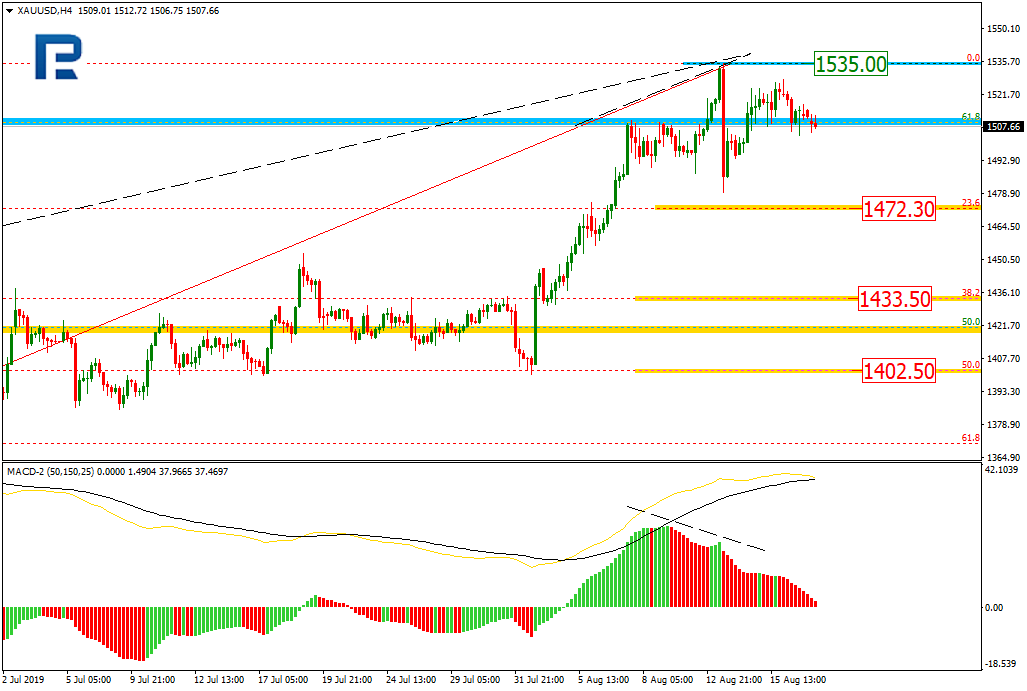
On H4, the instrument has formed two divergences upon reaching the long-term level of 61.8%: a long-term divergence and a short-term one. A stable decline to the levels of 23.6% (1472.30), 38.2% (1433.50) and 50.0% (1402.50) may follow, judging by the situation. The resistance is at the maximum of 1535.00.

GOLD_H4
Risk Warning: the result of previous trading operations do not guarantee the same results in the future

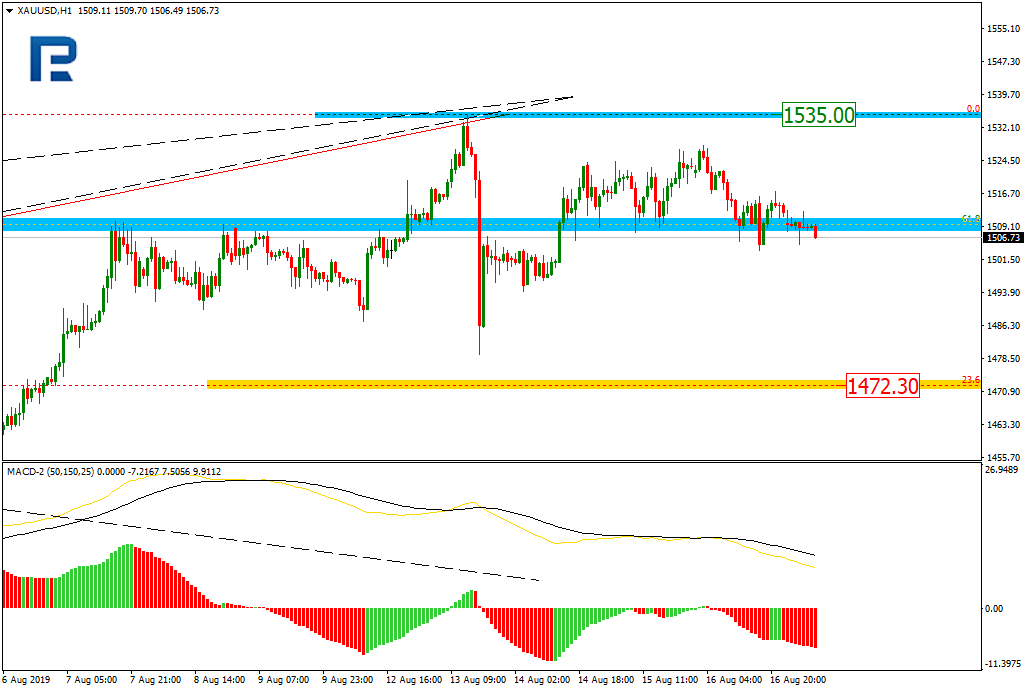
On H1, the quotations return to the long-term level of 61.8% Fibo after a swift impuse of descending. The closest aim of the new impulse may be at 23.6% (1472.30) Fibo.

GOLD_H1
Risk Warning: the result of previous trading operations do not guarantee the same results in the future

USDCHF

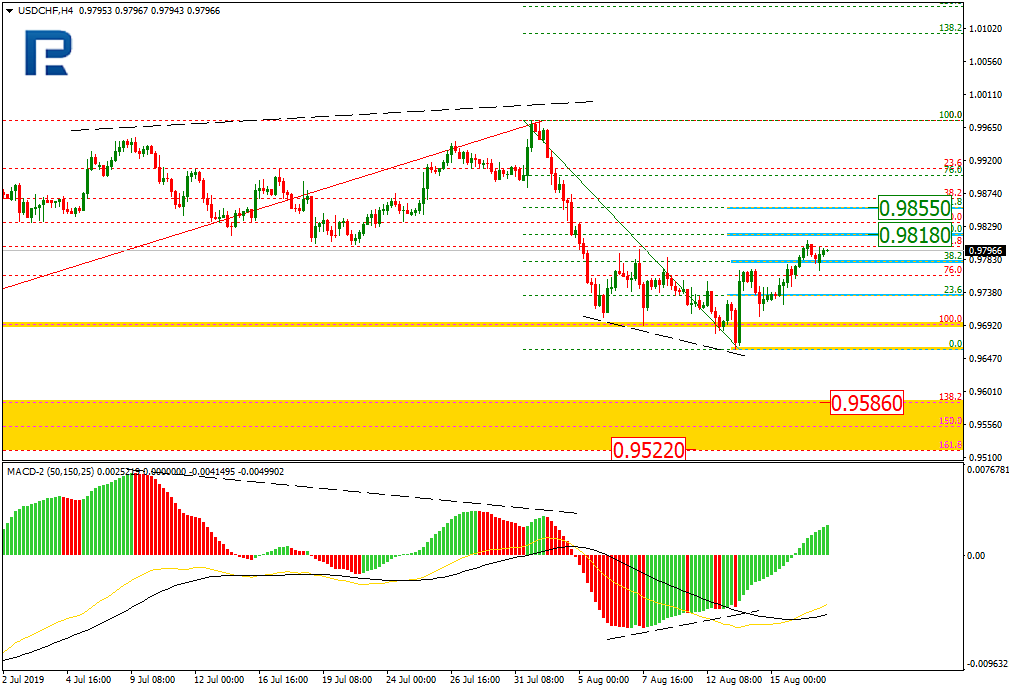
On H4, the instrument is developing a correction phase after testing the significant minimum, and a convergence. The correction has reached 38.2% Fibo by now. Further growth may aim at 50.0% (0.9818) and 61.8% (0.9855). A breakaway of the local minimum may be followed by a decline to a post-correctional extension of 138.2-161.8% (0.9586-0.9522).

USDCHF_H4
Risk Warning: the result of previous trading operations do not guarantee the same results in the future

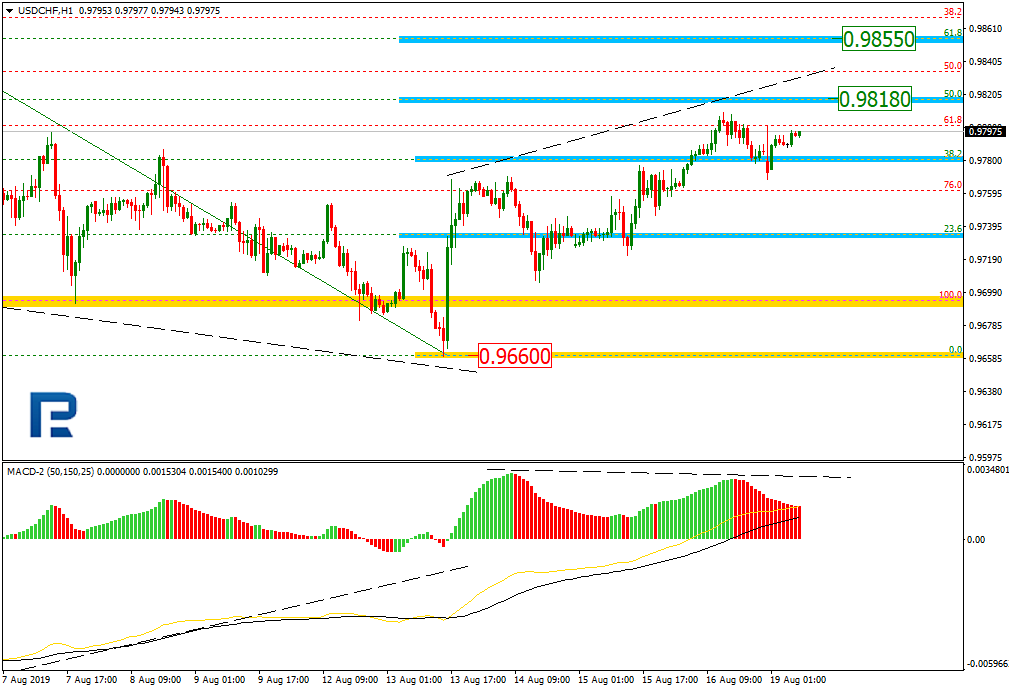
On H1 the pair is demonstrating an uptrend inside the previous declining wave. The growth is aiming at 50.0% (0.9818) Fibo; at the same time, a local divergence is forming, hinting on a potential for a reversal.

USDCHF_H1

Article By RoboForex.com

Attention!
Forecasts presented in this section only reflect the author’s private opinion and should not be considered as guidance for trading. RoboForex LP bears no responsibility for trading results based on trading recommendations described in these analytical reviews.

PART II – Silver, Transports, and Dow Jones Index At Targets – What Direct Next?

By TheTechnicalTraders.com

As you can probably imagine, we’ve received a ton of emails and questions about our recent predictions for precious metals and the August 19 breakdown date in the global markets.  It seems everyone is reading our research posts and is curious about how to prepare for these moves and how we came up with these predictions months in advance.  In this second part of our metals & Aug 19 update post, we’ll try to highlight our expectations going into the weekend prior to the Aug 19 breakdown date (Monday).

In the first part of this research post, we highlighted what we believe is the imminent completion of the MID Leg 1 upside move in precious metals.  Our research continues to suggest that we are still setting up a major LEG 1 upside move which should be considered a larger Elliot Wave structure.  Within this Wave (Leg) 1 formation, a typical 5 wave structure is likely to continue forming.  Currently, we are creating the Wave 3 of the total of 5 waves that will complete a finished upside Wave (Leg 1).

If our analysis is correct, the peak that ends Wave 1 could be well above $2000 for Gold and well above $24 to $28 for Silver.  Then, of course, we’ll set up for a corrective Wave #2 before another, BIGGER, upside wave #3 sets up in precious metals.

Taking a look at this Weekly Silver chart, you may be able to see the waves as we see them..

_  The upside price move from Dec 14, 2015, to July 4, 2016 sets up the initial upside Wave 1 leg.

_  The low in November 2018 sets up the end of corrective wave B from the initial bottom on December 14, 2015.

_  This setup suggests we are currently starting a Wave 3 upside move which is usually 1.5x larger (or more) than Wave 1.

_  Keep in mind that we believe all of these “minor wave” formations are part of a much larger 5 wave structure that is setting up.

As you look at the Fibonacci diagram, above, remember that within each of those waves (1 through 5), a typical complex price wave formation (1, 3, 5, or other more complex wave formation) will set up to complete the broader wave formation.  Therefore, as you review the chart below, keep in mind that we believe everything originating from the bottom on December 14, 2015, till now is still part of the WAVE 1 formation on that Elliot Wave chart.  We are just getting started with this move, folks.

Silver Weekly Chart with Wave 1

The YELLOW arrows we’ve drawn on this Silver chart are our expectations for Silver over the next 6+ weeks and will potentially complete the initial upside minor wave 3 formation/ Leg 1.  We do understand that Elliot Wave counting can be difficult to understand, but please allow use to preface this research by suggesting that every larger wave consists of smaller waves.  And those smaller waves, consist of sets of even smaller waves.  And so it continues all the way down to sub-one-minute charts. The point we’re trying to make is that the $21 endpoint on this chart is very likely just the end of Wave 1, subwave 3, impulse move C which may target a total of D moves before reaching the end of subwave 3.  To put it in more simple terms, we are only about 20% into this upside move right now based on our expectations.

Why is the move in precious metals so important for our August 19 breakdown date prediction?  Because we would expect precious metals to begin a massive price rally if the global stock markets were expecting some type of major downside rotational event.  A more into metals is a safety play for global investors.  If something is happening in the markets and fear becomes more evident, then precious metals should start to rally.  This sets up an expectation that some type of price revaluation event is likely to take place in the near future.

Thus, the upside price moves in Gold and Silver align perfectly with our August 19 breakdown expectation.  The key to this, in our opinion, is that Silver has really started to skyrocket on large volume.  This creates “confluence” in the metals group that fear is now driving investors into the lesser Silver market in preparation for a price reversion move soon.

Weekly Transportation Index chart

This Transportation Index chart highlights the fact that investors believe the future 3 to 6 months in the global economy will be moderately slower and that transportation activity and revenues will likely continue to diminish.  The Transportation Index is an excellent measure of future global economic expectations that can be used as a “general market indicator” for future expectations.

Dow Jones Weekly Chart

This YM Weekly chart highlights the key Fibonacci price trigger level that has setup near $26,170.  This is the critical price level for the YM to actually generate a confirmed Bearish price trend (end of week closing bar price level) which may be the initial downside price trigger.  As of the creation of this chart, the YM price was above this Fibonacci trigger level.  But as of right now, the YM price is already below the Fibonacci trigger level and if the YM closes the week below this level, then we would have a new confirmed Bearish Fibonacci price trend.

CONCLUDING THOUGHTS:

The interesting fact behind all of this is that these predictions were made by our research team months before today.  Our Gold prediction was initiated near October 5, 2018.  Our August 19 breakdown date was initiated near May 2019 (originally as a July Topping pattern expectation and later revised to the August 19 breakdown date).  All of these predictions were created using our proprietary price modeling, predictive analysis tools, and advanced cycle analysis tools.

We find it absolutely incredible that we are able to make these types of predictions many months into the future and watch the markets do exactly what we suggested would happen.  Obviously, we hope you are finding value in our research posts and modeling systems as well?

If you have not already prepared for the August 19 breakdown date prediction, we would suggest that you consider how you would want to protect any open long positions at this time (headed into the weekend) and set up your portfolio for a broader market rotation and upside move in precious metals over the next 3+ months.  It is not too late to take action to protect your assets – even weeks past August 19, you can still act to take advantage of these bigger price moves.  We are simply urging you to plan and prepare for these moves as you read our research posts.

FORECASTED MOVES FOR GOLD, SILVER, MINERS, AND STOCK INDEXES

In early June I posted a detailed video explaining in showing the bottoming formation and gold and where to spot the breakout level, I also talked about crude oil reaching it upside target after a double bottom, and I called short term top in the SP 500 index. This was one of my premarket videos for members it gives you a good taste of what you can expect each and every morning before the Opening Bell. Watch Video Here.

I then posted a detailed report talking about where the next bull and bear markets are and how to identify them. This report focused mainly on the SP 500 index and the gold miners index. My charts compared the 2008 market top and bear market along with the 2019 market prices today. See Comparison Charts Here.

On June 26th I posted that silver was likely to pause for a week or two before it took another run up on June 26. This played out perfectly as well and silver is now head up to our first key price target of $17. See Silver Price Cycle and Analysis.

More recently on July 16th, I warned that the next financial crisis (bear market) was scary close, possibly just a couple weeks away. The charts I posted will make you really start to worry. See Scary Bear Market Setup Charts.

JOIN ME AND TRADE WITH A PROVEN STRATEGY TODAY!

Chris Vermeulen