Author Archive for InvestMacro – Page 175

The Analytical Overview of the Main Currency Pairs on 2019.09.04

by JustForex

The EUR/USD currency pair

Technical indicators of the currency pair:
  • Prev Open: 1.09659
  • Open: 1.09720
  • % chg. over the last day: +0.05
  • Day’s range: 1.09685 – 1.09794
  • 52 wk range: 1.0931 – 1.1817

The dollar index retreated from local highs after a long rally. Investors began to partially fix positions on the greenback. Additional pressure on the US currency is provided by weak data on business activity in the US manufacturing sector from ISM. At the moment, EUR / USD quotes are consolidating in the range of 1.09500-1.09800. The single currency has the potential for further recovery. Positions must be opened from key levels.

The Economic News Feed for 04.09.2019:

  • – composite business activity index (PMI) from Markit in the eurozone – 11:00 (GMT+3:00);
  • – US trade balance – 15:30 (GMT+3:00);
  • – “The Beige Book” of the US Federal Reserve – 21:00 (GMT+3:00).
EUR/USD

Indicators of accurate signals do not give: the price has fixed between 50 MA and 100 MA.

The MACD histogram has moved into the positive zone, which indicates a correction of the EUR / USD currency pair.

The Stochastic Oscillator is in the neutral zone, the% K line began to cross the% D line. There are no signals at the moment.

Trading recommendations
  • Support levels: 1.09500, 1.09250, 1.09000
  • Resistance levels: 1.09800, 1.10000, 1.10350

If the price consolidates above 1.09800, expect further correction of EUR/USD quotes. The potential movement is to 1.10200-1.10400.

Alternatively, the quotes could decrease toward 1.09300-1.09000.

The GBP/USD currency pair

Technical indicators of the currency pair:
  • Prev Open: 1.20608
  • Open: 1.20724
  • % chg. over the last day: +0.19
  • Day’s range: 1.20722 – 1.21243
  • 52 wk range: 1.1995 – 1.3385

The GBP/USD currency pair began to recover. The trading instrument has updated local highs. Investors’ concerns about the “hard” Brexit have somewhat eased. The House of Commons of Great Britain supported the introduction of amendments to the agenda of the parliament, which will allow voting to ban the country’s exit from the EU without a deal. We recommend that you keep track of current information on this issue. At the moment, the local support and resistance levels are 1.20700 and 1.21200, respectively. GBP/USD quotes can grow further. Positions must be opened from key levels.

The Economic News Feed for 04.09.2019:

  • – composite index of business activity (PMI) – 11:30 (GMT+3:00);
  • – the business activity index in the service industry – 11:30 (GMT+3:00).
GBP/USD

Indicators do not give accurate signals: the price crossed 50 MA and 100 MA.

The MACD histogram is in the positive zone and above the signal line, which indicates a further recovery of the GBP / USD currency pair.

The Stochastic Oscillator is near the overbought zone, the %K line began to cross the %D line. There are no signals at the moment.

Trading recommendations
  • Support levels: 1.20700, 1.20150
  • Resistance levels: 1.21200, 1.21700, 1.22250

If the price consolidates above the local resistance of 1.21200, expect further growth toward 1.21600-1.21800.

Alternatively, the quotes could drop toward 1.20400-1.20200.

The USD/CAD currency pair

Technical indicators of the currency pair:
  • Prev Open: 1.33242
  • Open: 1.33345
  • % chg. over the last day: +0.10
  • Day’s range: 1.33168 – 1.33444
  • 52 wk range: 1.2727 – 1.3664

The technical picture on the USD / CAD currency pair is still ambiguous. Looney is in lateral movement. The trading tool tests the key support and resistance levels: 1.33150 and 1.33450, respectively. Participants in financial markets took a wait and see attitude before the meeting of the Bank of Canada. It is expected that the regulator will maintain the basic parameters of monetary policy at the same level. We also recommend paying attention to the dynamics of oil quotes. Positions must be opened from key levels.

At 17:00 (GMT+3:00) the Central Bank of Canada will announce its decision about the key interest rate.

USD/CAD

Indicators do not give accurate signals: the price crossed 50 MA and 100 MA.

The MACD histogram has moved into the negative zone, indicating a bearish sentiment.

The Stochastic Oscillator is in the oversold zone, the %K line crossed the %D line. There are no signals at the moment.

Trading recommendations
  • Support levels: 1.33150, 1.32800, 1.32550
  • Resistance levels: 1.33450, 1.33800, 1.34000

If the price consolidates below 1.33150, USD/CAD quotes are expected to fall. The potential movement is to 1.32800-1.32600.

Alternatively, the quotes could grow to 1.33700-1.34000.

The USD/JPY currency pair

Technical indicators of the currency pair:
  • Prev Open: 106.211
  • Open: 105.962
  • % chg. over the last day: -0.34
  • Day’s range: 105.830 – 106.245
  • 52 wk range: 104.97 – 114.56

The USD / JPY currency pair continues to trade flat. There is no defined trend. Investors expect additional drivers. At the moment, the following key support and resistance levels can be identified: 105.800 and 106.300. Financial market participants expect up-to-date information regarding the US/China trade conflict. We also recommend paying attention to the dynamics of yield on US government bonds. Positions must be opened from key levels.

The Economic News Feed for 04.09.2019 is calm.

USD/JPY

Indicators do not provide accurate signals: 50 MA crossed 100 MA.

The MACD histogram is near 0. There are no signals at the moment.

The Stochastic Oscillator is in the neutral zone, the %K line is above the %D line, which indicates bullish sentiment.

Trading recommendations
  • Support levels: 105.800, 105.600, 105.300
  • Resistance levels: 106.300, 106.700, 107.000

If the price consolidates above 106.300, expect the quotes to grow toward 106.700-107.000.

Alternatively, the quotes could drop toward 105.600-105.400.

by JustForex

The Euro and the Pound Have Recovered Some of the Losses. Waiting for the Bank of Canada Meeting

by JustForex

Investors began to fix positions in the US dollar after a protracted rally. The dollar index (#DX) has moved away from local highs. Weak economic releases put additional pressure on the greenback. Thus, the ISM manufacturing PMI in August amounted to 49.1 instead of the forecasted value of 51.1. Investors are still awaiting further information regarding the escalation of the trade war between the US and China.

Investors’ concerns about the “hard” Brexit have become weaker, triggering higher demand for the British pound. The British Prime Minister and Conservative Party Leader, Boris Johnson, lost a majority in the House of Commons yesterday after MP Philip Lee decided to move from conservative to liberal democrats. From now on, the UK government will be a minority cabinet. The official opposed the “hard” Brexit without a deal. The House of Commons of Great Britain supported the introduction of amendments to the agenda of the parliament, which will allow voting to ban the country’s exit from the EU without a deal. Boris Johnson himself believes that the bill that does not allow Britain to leave the EU without a deal greatly injures the country. This bill allows Brussels to impose its conditions.

Today, the attention of financial market participants will be directed to a meeting of the Bank of Canada. It is expected that the regulator will maintain the basic parameters of monetary policy at the same level. We recommend paying attention to the comments of the Central Bank representatives.

The “black gold” prices rise after falling the day before. At the moment, WTI crude oil futures are testing the $54.25 per barrel mark. At 23:30 (GMT+3:00) weekly crude oil inventories will be published according to the American Petroleum Institute.

Market indicators

Yesterday, the bearish sentiment was observed in the US stock markets: #SPY (-0.57%), #DIA (-0.80%), #QQQ (-0.97%).

The yield on 10-year US government bonds is consolidating near multi-year lows. At the moment, the indicator is at the level of 1.48-1.49%.

The news feed on 2019.09.04:

– Composite PMI from Markit in the eurozone at 11:00 (GMT+3:00);
– Composite PMI in the UK at 11:30 (GMT+3:00);
– US trade balance at 15:30 (GMT+3:00);
– A decision of the Bank of Canada at the key interest rate at 17:00 (GMT+3:00);
– The Fed’s Beige Book at 21:00 (GMT+3:00).

by JustForex

EURUSD: reversal candlestick setup on the daily timeframe

By Alpari.com

On Tuesday the 3rd of September, trading on the EURUSD pair closed significantly up. The daily candlestick has a bullish body, with a low of 1.0926 and a long tail. The pair reversed following weak US data and comments from FOMC member James Bullard.

The US manufacturing PMI came out below the 50-point mark, which signals a slowdown in economic growth and is the lowest value seen since January 2016. This took its toll across all exchanges, while Bullard sent the dollar into an even deeper correction.

Head of the St. Louis Fed James Bullard said that interest rates are too high for the current situation due to the drop in government bond yields and the influence of the US-China trade conflict. He is in favour of immediately slashing the key rate by 0.50%. These remarks sent Brent oil up by 2.7% and the EURUSD pair by 0.52%.

Day’s news (GMT+3):

  • 10:50 France: Markit services PMI (Aug).
  • 10:55 Germany: Markit services PMI (Aug).
  • 11:00 Eurozone: Markit services PMI (Aug).
  • 11:30 UK: Markit services PMI (Aug).
  • 12:00 Eurozone: retail sales (Jul).
  • 15:30 US: trade balance (Jul).
  • 15:30 Canada: international merchandise trade (Jul).
  • 17:00 Canada: BoC interest rate decision and rate statement.
  • 21:00 US: Fed’s Beige Book.

EURUSD H1Current situation:

On Tuesday, the bulls managed to recover all their losses from the morning session to set up a reversal candlestick on the daily timeframe. They were met with resistance at the 45th degree (1.0983), which they are now trying to break through.

The pair rebounded to reach the balance line. Since there was no downwards impulse from here, and the pair has spent the last 15 hours trading sideways within a narrow range, we’re expecting the correction to now continue to the 67th degree.

Washington and Beijing are yet to agree on the terms of their continued negotiations. As such, any negative news on this front will deter the bulls from entering the market.

By Alpari.com


The USD/CAD with a clear focus on the BoC rate decision on Wednesday

By Admiral Markets

Source: Economic Events September 4, 2019 – Admiral Markets’ Forex Calendar

Today’s focus will clearly be on the BoC rate decision. In a more and more uncertain market environment, with several central banks around the globe already having cut rates and/or will likely ease further, such a step seems imminent for the Canadian central bank.

Based on a further escalation of the trade dispute between the US and China, and several signs pointing to a potential recession at the horizon of the world’s biggest economy, a rate cut from the BoC wouldn’t come as a big surprise – at least not at first glance.

Upon further investigation, it becomes clear that the BoC would have enormous difficulties to justify such a rate cut since the latest economic indicators (like the Canadian inflation which came in at 2% (YoY) against 1.7% expected) pointed to solid growth of the Canadian economy.

Thus, swap markets are currently pricing in a less than 20% chance of a BoC rate cut today. But on the other hand, markets see a more than 70% chance of a rate cut till the end of the year.

With that in mind, the main focus today will be on rhetoric from BoC Governor Poloz: any signs of aggressive easing respectively deep rate cuts based on any further escalation of the trade war between the US and China, could shoot the USD/CAD back above 1.3400 levelling the path up to 1.3500/50.

If we see a surprising turn towards neutral rhetoric, pointing to a ‘wait-and-see’-approach, the Loonie could see a short-term squeeze leaving the currency pair with a chance to see another stint down to the region around 1.3200:

Source: Admiral Markets MT5 with MT5-SE Add-on USD/CAD Daily chart (between June 5, 2018, to September 3, 2019). Accessed: September 3, 2019, at 10:00pm GMT – Please note: Past performance is not a reliable indicator of future results, or future performance.

In 2014, the value of the USD/CAD increased by 9.4%, in 2015, it increased by 19.1%, in 2016, it fell by 2.9%, in 2017, it fell by 6.4%, in 2018, it increased by 8.4%, meaning that after five years, it was up by 28.4%.

Discover the world’s #1 multi-asset platform

Admiral Markets offers professional traders the ability to trade with a custom, upgraded version of MetaTrader 5, allowing you to experience trading at a significantly higher, more rewarding level. Experience benefits such as the addition of the Market Heat Map, so you can compare various currency pairs to see which ones might be lucrative investments, access real-time trading data, and so much more. Click the banner below to start your FREE download of MT5 Supreme Edition!

Download MetaTrader 5 and begin trading today!

Disclaimer: The given data provides additional information regarding all analysis, estimates, prognosis, forecasts or other similar assessments or information (hereinafter “Analysis”) published on the website of Admiral Markets. Before making any investment decisions please pay close attention to the following:

  1. This is a marketing communication. The analysis is published for informative purposes only and are in no way to be construed as investment advice or recommendation. It has not been prepared in accordance with legal requirements designed to promote the independence of investment research, and that it is not subject to any prohibition on dealing ahead of the dissemination of investment research.
  2. Any investment decision is made by each client alone whereas Admiral Markets shall not be responsible for any loss or damage arising from any such decision, whether or not based on the Analysis.
  3. Each of the Analysis is prepared by an independent analyst (Jens Klatt, Professional Trader and Analyst, hereinafter “Author”) based on the Author’s personal estimations.
  4. To ensure that the interests of the clients would be protected and objectivity of the Analysis would not be damaged Admiral Markets has established relevant internal procedures for prevention and management of conflicts of interest.
  5. Whilst every reasonable effort is taken to ensure that all sources of the Analysis are reliable and that all information is presented, as much as possible, in an understandable, timely, precise and complete manner, Admiral Markets does not guarantee the accuracy or completeness of any information contained within the Analysis. The presented figures refer that refer to any past performance is not a reliable indicator of future results.
  6. The contents of the Analysis should not be construed as an express or implied promise, guarantee or implication by Admiral Markets that the client shall profit from the strategies therein or that losses in connection therewith may or shall be limited.
  7. Any kind of previous or modeled performance of financial instruments indicated within the Publication should not be construed as an express or implied promise, guarantee or implication by Admiral Markets for any future performance. The value of the financial instrument may both increase and decrease and the preservation of the asset value is not guaranteed.
  8. The projections included in the Analysis may be subject to additional fees, taxes or other charges, depending on the subject of the Publication. The price list applicable to the services provided by Admiral Markets is publicly available from the website of Admiral Markets.
  9. Leveraged products (including contracts for difference) are speculative in nature and may result in losses or profit. Before you start trading, you should make sure that you understand all the risks.

By Admiral Markets

General election UK 2019? Take action now to safeguard your wealth: deVere CEO

By George Prior

With the UK parliament plunged into a historic crisis, it is essential to take steps to safeguard your wealth, warns the boss of one of the world’s largest independent financial advisory organizations.

The warning from Nigel Green, founder and CEO of deVere Group, comes as UK Prime Minister Boris Johnson lost the first round of a 48-hour Brexit battle in the House of Commons.

Mr Green says: “People might be bored by Brexit – but this is one of the biggest weeks in UK politics in decades and it will affect domestic and global investors.

“The Prime Minister lost his tiny working majority on Monday afternoon in an explosive session in the House of Commons, and now he’s lost his first Parliamentary Brexit battle.  In fact, Boris Johnson is the first prime minister in history to lose his first Commons vote.

“Lawmakers have, in effect, seized control of Parliament and will try and force through legislation to stop a no-deal Brexit.

“This now means that Boris Johnson will likely call a general election to be held next month in order to take control of parliament to go back to the EU with a convincing mandate.

“And this all comes after the PM controversially threatened to sack his own lawmakers who failed to support him in this vote.”

He affirms: “So many major question marks loom over the chain of events playing out in Westminster – not least because a general election needs the support of opposition party Labour.

“Jeremy Corbyn, the Labour leader, after months of calling for an election is now demanding no-deal is off the table before he agrees to go to the polls.

“In truth, all major parties are being tested like perhaps never before, there are major divisions in all camps, plus there is likely to be serious tactical voting in a general election.”

The deVere CEO goes on to say: “Should lawmakers prevent a no-deal Brexit at the end of next month, we can expect the pound to get a boost. But at the same time, political upheaval and a general election will likely push sterling down. As such, the UK’s currency remains volatile and vulnerable.”

He adds: “With the UK parliament plunged into a historic crisis, it is essential for domestic UK investors and international investors with exposure to UK assets to take steps to safeguard their assets.

“The investors best weapon to do this? Ensure their portfolios are properly diversified across asset class, sector and regions, and to remain invested to take advantage of the upsides.”

Mr Green concludes: “A good fund manager will help you seek out the opportunities that turbulence creates and mitigate potential risks as and when they are presented.”

About:

deVere Group is one of the world’s largest independent advisors of specialist global financial solutions to international, local mass affluent, and high-net-worth clients.  It has a network of more than 70 offices across the world, over 80,000 clients and $12bn under advisement


Understanding Trading Risks Is Crucial For Your Success

By TheTechnicalTraders.com

This article will most likely open your eyes and see a side of trading you usually don’t think about or possibly don’t understand, even though it is critical for your long term success as a trader and investor.

Not many people talk about trading risks and for a good reason. It’s not that exciting to most, and its a real sobering topic because its the reality of trading: trading is risky, and that you need to know how to manage risk appropriately and we don’t know how to do this. Most of us are generally too lazy to want to learn dry/boring subjects, especially when we don’t know much about them in the first place, and I’m guilty of this as well.

I urge you to take 4 minutes and read this trading risks explained in laymen terms below. At worst is a good refresher and will make you look at your current positions and see all your capital carries the same risk and if you are positioned for steady growth or potential account implosion if the asset class moves against you.

Understanding Trading and Investing Risk Types

RISK

noun

·        1.a situation involving exposure to danger: “flouting the law was too much of a risk” synonyms: possibilitychanceprobabilitylikelihooddanger, … more antonyms: impossibility

verb

·        1.expose (someone or something valued) to danger, harm, or loss:

There are many ways to define risk and different, disparate types of risk depending on investing in a home, doing business with a bank or investing in stocks, bonds, ETF’s, mutual funds, etc.

We know inherently, given my last week’s piece on the increasing amount of foreclosures occurring in the largest cities in the US, where housing has been robust, cities like San Jose, CA, San Francisco, Phoenix, Chicago, etc, that there is currently increasing risk in purchasing real estate at lofty prices and hoping that the market stays hot; that if you had to resell the real estate in the next few years one could get out at a similar price to the purchase price or even higher.

Given that we are towards the end of a boom housing cycle, this is probably not a reasonable risk to take, unless of course, one would be in it for the long haul. We call this liquidity risk or also buying an asset at a very high price as compared to its historical prices in a given market.

Another risk is if an investor, flush with cash, sat in cash and inflation were to take off or the price of goods and services continue to increase even without rampant inflation. This risk would be defined as purchasing power risk and puts the investor (or holder of cash) in an undesirable position of having their money NOT grow while the cost of goods and services around them grows. This can and does occur even if we are told that inflation is flat.

How does purchasing power risk show up?
Look at the cost of food in the past few years. How much does it cost to feed a family today? When one has investable cash and does not keep it up with the increasing costs of “living,” this is the real definition of purchasing power risk.

If on the other hand, an investor decides to enter into the bond and stock market and invests in the wrong asset class, this is the best-known risk defined as asset class risk. One invests in the fixed income markets, and rates go up and while the coupon may stay the same the principal amount of the investment goes down.

Likewise, someone decides to invest in technology stocks, and they go through a correction or decline, then that sector goes down, and one’s investment is negatively impacted. This is a sector or industry-specific concentration risk.

Another potential risk asset class or even sector-specific risk is if someone decides to invest only in small-cap stocks because they like the growth rates, and this area of concentration is enticing. However, there is an inherent risk:

a) interest rates go up which puts pressure on smaller companies;

b) the economy goes into a downturn and these stocks lose value and

c) most importantly, they want to get out of these stocks at some point (perhaps due to a and b above) and they cannot get out at a fair price because too many people are selling and there is not enough volume in the stock.

Then the problem for the small-cap investor may be getting out of these thinly traded stocks when the correction ensues. This is known as liquidity risk and can have a detrimental effect on the original portfolio value.

Perhaps one decides to invest in stocks and decides to appropriately diversify their investment into a longer-term buy and hold strategy and does so with high quality, dividend-paying stocks. This seems like a reasonable investment thesis and one that both institutions and individuals participate in every day.

However, what happens when we go through normal corrections or even enter a bear market and have a steady trending downward market. What does one do? Buy more as the stocks are going down? Wait until they seemingly bottom and then put more $ to work? We call this market and price risk, and it is from having $ invested in a down-trending market with no clear plan of getting out and not being sure of what the targets are that one should exercise to get out.

Then, as an investor playing in a professional market, you always have knowledge risk and unforeseen surprise risk. Knowledge risk is not knowing the “full” story and investing in a company that you may know little about and what the forward earnings projections are. Some that come to mind in recent time is GE, XOM, BBY, JCP and many others that seemed like very good, quality companies only to announce reorganizations, problems with their business or worse, potential bankruptcy.

The unforeseen surprise element, while similar, includes accounting errors (WorldCom), corruption (ENRON), and other factors that an investor may have little to no knowledge of.

Other investors like to trade and invest where they have little or no knowledge in emerging markets like Russia, China or Brazil only to surprised when political upheaval, slowing economies, currency risk or other factors can and will hit these markets hard and decimate speculative investor capital.

Investing in individual issues or sectors like marijuana stocks, biotech stocks, and country ETF’s can be treacherous and best left up to professionals and analysts who cover these companies, industries, and markets.


Very important facts about investing:

If you lose 10% on your investment capital, it takes at least 11% to get back to even       

If you lose 20%, it now takes 25% just to get back to even

If you lose 50%, it takes 100% just to get back to even


Facts About Growth:

FIFTEEN 5% WINNERS = 107% ROI

$500 PROFIT PER/MONTH = 30% ROI WITH $20K ANNUALLY

POSITION SIZING = TRADING SUCCESS


Technical Traders strives to accomplish critical things:

ONE: Make it easy for you to follow our trading suggestions and take the trades. We refrain from using exotic and hard to understand instruments, stocks, or ETF’s that are not readily available and have sufficient liquidity.

In other words, we trade things that we can enter (buy) and exit (sell) easily and quickly and do not depend on us getting an exact price. If we take the trade we usually get our order filled within a few cents from our original suggestion, by design, the trade can earn a significant profit. It does not depend on split-second timing like many other trade alert newsletter services.

TWO: We are very strict and very aware of position sizing. This is ONE of the most important ways to manage our risk and put the trader/investor (YOU) in a position that if the trade does not work, it will not hurt the overall portfolio too much and, more importantly we typically diversify with other positions at a similar time which diversifies the portfolio and allows you to reap the rewards from other disparate trades.

THREE: We have a set goal in mind when we put on the trade. These are well-defined targets as well as STOPS. If the trade works, we know where it is headed and what we will do along the way, usually resulting in taking off part or all of the trade with our targets being reached. If the trade does not work, we are out rather quickly with minimal damage to the overall portfolio.

FOUR: We always back up our rationale for why we put on the trade. One only need to watch our pre-market daily videos to get a view of why the trade set-up is occurring and what our expectations of the market are.

FIVE: We trade in a wide variety of markets and with a wide variety of instruments, mostly ETF’s that are 1x, 2x, and 3x leveraged.

If we have a strong conviction about the trade or a limited amount of capital left to put into a trade, we would instead use a levered 2x instrument, or 3x occasionally because we want to capture the move with some extra juice (leverage) to hit the target and get out. Many of our subscribers have seen us go into SSO or SDS inverse SP500 ETF’s for a day or two turnaround in the markets and experience a 1-3% move. We typically get out on those trades quickly, and YOU have benefitted from the use of leverage.

SIX: We like small but quick winning trades knowing that this helps compound wealth in the portfolio. Are you aware that short cab rides (or UBER) are much more profitable for the driver than all of the long runs, say to the Airport? Making a quick profit from a few swing trades lasting 2-20 days over and over is much more profitable than taking a long-term position. Nothing more frustrating than watching a long term position you have had for months or years turn south and give up all the profits. Months of mental stress and risk on your portfolio for little to no gain. Not our cup of tea.

SEVEN: We minimize Risk and Utilize Capital efficiently by making precision trades that have a high outcome of success and keeping our powder dry (in cash) while waiting to take advantage of optimal technical set-ups consistent with our approach of finding markets that present an excellent opportunity. If we have high conviction, then we may recommend you use a 2x or 3x levered ETF instrument with ample liquidity to get in and out of the trade. Examples of these would include our recent trade on SDS 2.5% (2 days), UGLD 24% (2 weeks), and plenty of others.

Please note that our suggested ETF trade recommendation portfolio from January 1, 2018, to June 30, 2019, produced a 70% return, non-compounded and close to a 100% return if you compounded the trades.

However, we did so on a capital base of approximately 50%. Meaning, that we took probably half of the risk a similar, fully participating portfolio in the market (buy and hold) might take. Our capital efficiency was extremely high since we were sitting in a safe asset class, about 50% of the time without incurring risk. Most of the time, the whole portfolio might have been 100% in cash when there was too much uncertainty, and trends were changing.

Factor in that there were occasions when we only had 25% or 50% invested and other times when we were fully invested. We guess that we were sitting in cash with part or all of the portfolio upwards of 50% of the time. That also means that we had a BETA of 0.5% to the market (for you technical gurus), and a return on equity probably close to 150% on invested capital during that 18 months which factors out to risk to about 1/3 to ½ less than an S&P 500 index fund, and an ALPHA so high it would be off the charts and our telling you what it is would be far too boastful.

I hope this detailed explanation of risk has helped you see risk in a new light and just how vital risk and position sizing are to the long term growth of your trading and investing account.

Our Wealth Building ETF Newsletter and our Professional Technical Wealth Advisor Newsletter and Trading Indicator Tools make trading and investing simple, logical, and profitable. With customers from over 182 countries of all types from individual traders with a few thousand dollars to billionaire money managers, we have the markets covered for you.

Get our world-class market analysis each day and our low-risk ETF trade alerts today!

Chris Vermeulen
Founder of Technical Traders Ltd.

By TheTechnicalTraders.com


10 Essential Data Science Packages for Python

By TJ Simmons for Kite.com

Interest in data science has risen remarkably in the last five years. And while there are many programming languages suited for data science and machine learning, Python is the most popular.

Since it’s the language of choice for machine learning, here’s a Python-centric roundup of ten essential data science packages, including the most popular machine learning packages.

Scikit-Learn

Scikit-Learn is a Python module for machine learning built on top of SciPy and NumPy. David Cournapeau started it as a Google Summer of Code project. Since then, it’s grown to over 20,000 commits and more than 90 releases. Companies such as J.P. Morgan and Spotify use it in their data science work.

Because Scikit-Learn has such a gentle learning curve, even the people on the business side of an organization can use it. For example, a range of tutorials on the Scikit-Learn website show you how to analyze real-world data sets. If you’re a beginner and want to pick up a machine learning library, Scikit-Learn is the one to start with.

Here’s what it requires:

  • Python 3.5 or higher.
  • NumPy 1.11.0 or higher.
  • SciPy 0.17.0 or higher.

PyTorch

PyTorch does two things very well. First, it accelerates tensor computation using strong GPU. Second, it builds dynamic neural networks on a tape-based autograd system, thus allowing reuse and greater performance. If you’re an academic or an engineer who wants an easy-to-learn package to perform these two things, PyTorch is for you.

PyTorch is excellent in specific cases. For instance, do you want to compute tensors faster by using a GPU, as I mentioned above? Use PyTorch because you can’t do that with NumPy. Want to use RNN for language processing? Use PyTorch because of its define-by-run feature. Or do you want to use deep learning but you’re just a beginner? Use PyTorch because Scikit-Learn doesn’t cater to deep learning.

Requirements for PyTorch depend on your operating system. The installation is slightly more complicated than, say, Scikit-Learn. I recommend using the “Get Started” page for guidance. It usually requires the following:

  • Python 3.6 or higher.
  • Conda 4.6.0 or higher.

Caffe

Caffe is one of the fastest implementations of a convolutional network, making it ideal for image recognition. It’s best for processing images.

Yangqing Jia started Caffe while working on his PhD at UC Berkeley. It’s released under the BSD 2-Clause license, and it’s touted as one of the fastest-performing deep-learning frameworks out there. According to the website, Caffe’s image processing is quite astounding. They claim it can process “over 60M images per day with a single NVIDIA K40 GPU.”

I should highlight that Caffe assumes you have at least a mid-level knowledge of machine learning, although the learning curve is still relatively gentle.

As with PyTorch, requirements depend on your operating system. Check the installation guide here. I recommend using the Docker version if you can so it works right out of the box. The compulsory dependencies are below:

  • CUDA for GPU mode.
    • Library version 7 or higher and the latest driver version are recommended, but releases in the 6s are fine too.
    • Versions 5.5 and 5.0 are compatible but considered legacy.
  • BLAS via ATLAS, MKL, or OpenBLAS.
  • Boost 1.55 or higher.

TensorFlow

TensorFlow is one of the most famous machine learning libraries for some very good reasons. It specializes in numerical computation using dataflow graphs.

Originally developed by Google Brain, TensorFlow is open sourced. It uses dataflow graphs and differentiable programming across a range of tasks, making it one of the most highly flexible and powerful machine learning libraries ever created.

If you need to process large data sets quickly, this is a library you shouldn’t ignore.

The most recent stable version is v1.13.1, but the new v2.0 is in beta now.

Theano

Theano is one of the earliest open-source software libraries for deep-learning development. It’s best for high-speed computation.

While Theano announced that it would stop major developments after the release of v1.0 in 2017, you can still study it for historical reasons. It’s made this list of top ten data science packages for Python because if you familiarize yourself with it, you’ll get a sense of how its innovations later evolved into the features you now see in competing libraries.

Pandas

Pandas is a powerful and flexible data analysis library written in Python. While not strictly a machine learning library, it’s well-suited for data analysis and manipulation for large data sets. In particular, I enjoy using it for its data structures, such as the DataFrame, the time series manipulation and analysis, and the numerical data tables. Many business-side employees of large organizations and startups can easily pick up Pandas to perform analysis. Plus, it’s fairly easy to learn, and it rivals competing libraries in terms of its features in data analysis.

If you want to use Pandas, here’s what you’ll need:

Keras

Keras is built for fast experimentation. It’s capable of running on top of other frameworks like TensorFlow, too. Keras is best for easy and fast prototyping as a deep learning library.

Keras is popular amongst deep learning library aficionados for its easy-to-use API. Jeff Hale created a compilation that ranked the major deep learning frameworks, and Keras compares very well.

The only requirement for Keras is one of three possible backend engines, like TensorFlow, Theano, or CNTK.

NumPy

NumPy is the fundamental package needed for scientific computing with Python. It’s an excellent choice for researchers who want an easy-to-use Python library for scientific computing. In fact, NumPy was designed for this purpose; it makes array computing a lot easier.

Originally, the code for NumPy was part of SciPy. However, scientists who need to use the array object in their work were having to install the large SciPy package. To avoid that, a new package was separated from SciPy and called NumPy.

If you want to use NumPy, you’ll need Python 2.6.x, 2.7.x, 3.2.x, or newer.

Matplotlib

Matplotlib is a Python 2D plotting library that makes it easy to produce cross-platform charts and figures.

So far in this roundup, we’ve covered plenty of machine learning, deep learning, and even fast computational frameworks. But with data science, you also need to draw graphs and charts. When you talk about data science and Python, Matplotlib is what comes to mind for plotting and data visualization. It’s ideal for publication-quality charts and figures across platforms.

For long-term support, the current stable version is v2.2.4, but you can get v3.0.3 for the latest features. It does require that you have Python 3 or newer, since support for Python 2 is being dropped.

SciPy

SciPy is a gigantic library of data science packages mainly focused on mathematics, science, and engineering. If you’re a data scientist or engineer who wants the whole kitchen sink when it comes to running technical and scientific computing, you’ve found your match with SciPy.

Since it builds on top of NumPy, SciPy has the same target audience. It has a wide collection of sub packages, each focused on niches such as Fourier transforms, signal processing, optimizing algorithms, spatial algorithms, and nearest neighbor. Essentially, this is the companion Python library for your typical data scientist.

As far as requirements go, you’ll need NumPy if you want SciPy. But that’s it.

Summary

This brings to an end my roundup of the 10 major data-science-related Python libraries. Is there something else you’d like us to cover that also uses Python extensively? Let us know!

And don’t forget that Kite can help you learn these packages faster with its ML-powered autocomplete as well as handy in-editor docs lookups. Check it out for free as an IDE plugin for any of the leading IDEs.

About the Author:

This article originally appeared on Kite.com.

(Reprinted with permission)


Ichimoku Cloud Analysis 03.09.2019 (AUDUSD, NZDUSD, USDCAD)

Article By RoboForex.com

AUDUSD, “Australian Dollar vs US Dollar”

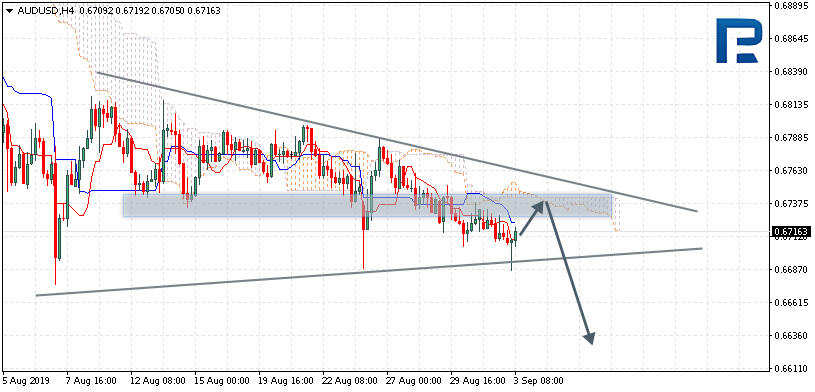
AUDUSD is trading at 0.6716; the instrument is moving below Ichimoku Cloud, thus indicating a descending tendency. The markets could indicate that the price may test the cloud’s downside border at 0.6740 and then resume moving downwards to reach 0.6635. Another signal to confirm further descending movement is the price’s rebounding the resistance level. However, the scenario that implies further decline may be canceled if the price breaks the cloud’s upside border and fixes above 0.6770. In this case, the pair may continue growing towards 0.6870. After breaking Triangle’s downside border and fixing below 0.6665, the price may continue moving downwards.

AUDUSD
Risk Warning: the result of previous trading operations do not guarantee the same results in the future

NZDUSD, “New Zealand Dollar vs US Dollar”

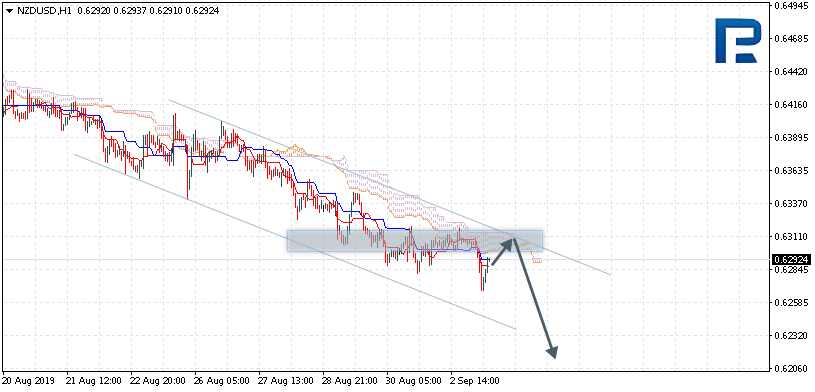
NZDUSD is trading at 0.6292; the instrument is moving below Ichimoku Cloud, thus indicating a descending tendency. The markets could indicate that the price may test the cloud’s upside border at 0.6310 and then resume moving downwards to reach 0.6205. Another signal to confirm further descending movement is the price’s rebounding from the descending channel’s upside border. However, the scenario that implies further decline may be canceled if the price breaks the cloud’s upside border and fixes above 0.6325. In this case, the pair may continue growing towards 0.6405.

NZDUSD
Risk Warning: the result of previous trading operations do not guarantee the same results in the future

USDCAD, “US Dollar vs Canadian Dollar”

USDCAD is trading at 1.3331; the instrument is moving above Ichimoku Cloud, thus indicating an ascending tendency. The markets could indicate that the price may test Tenkan-Sen and Kijun-Sen at 1.3310 and then resume moving upwards to reach 1.3420. Another signal to confirm further ascending movement is the price’s rebounding from the support level. However, the scenario that implies further growth may be canceled if the price breaks the cloud’s downside border and fixes below 1.3250. In this case, the pair may continue falling towards 1.3145.

USDCAD
Risk Warning: the result of previous trading operations do not guarantee the same results in the future

Article By RoboForex.com

Attention!
Forecasts presented in this section only reflect the author’s private opinion and should not be considered as guidance for trading. RoboForex LP bears no responsibility for trading results based on trading recommendations described in these analytical reviews.

Japanese Candlesticks Analysis 03.09.2019 (GOLD, NZDUSD)

Article By RoboForex.com

XAUUSD, “Gold vs US Dollar”

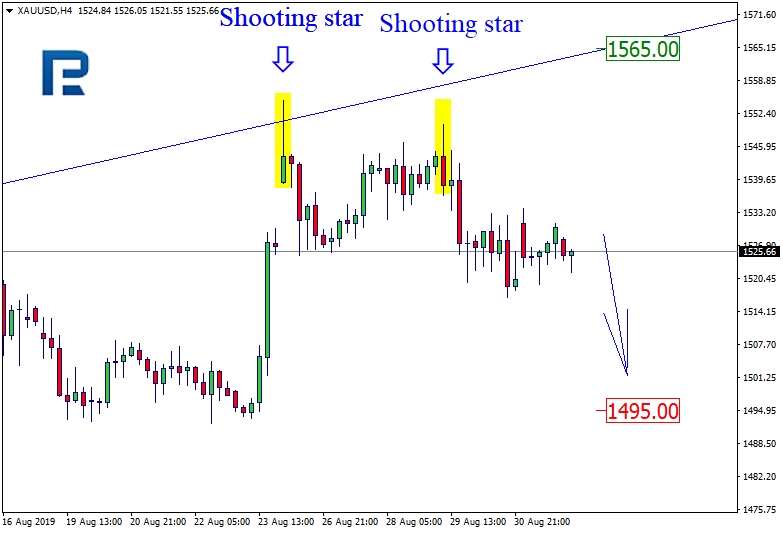
As we can see in the H4 chart, the ascending tendency continues. There was a gap at the beginning of the week; after completing another reversal pattern, Shooting Star, XAUUSD is still trading near the channel’s upside border. Right now, the pair is trading sideways. The downside target may be at 1495.00. At the same time, we shouldn’t exclude a possibility that the instrument may break the closest high, reach 1565.00 and continue forming the ascending channel.

GOLD
Risk Warning: the result of previous trading operations do not guarantee the same results in the future

NZDUSD, “New Zealand vs. US Dollar”

As we can see in the H4 chart, the descending channel continues. NZDUSD has formed Hammer reversal pattern close to the support level. Right now, the pair is reversing. At the moment, it may be assumed that after completing another correction, the price may fall to update its closest lows. At the same time, one shouldn’t exclude an opposite scenario, according to which the instrument may rebound from the support level and grow towards 0.6311.

NZDUSD

Article By RoboForex.com

Attention!
Forecasts presented in this section only reflect the author’s private opinion and should not be considered as guidance for trading. RoboForex LP bears no responsibility for trading results based on trading recommendations described in these analytical reviews.

How could Australia’s banks react to Facebook’s Libra?

By ForexNewsNow

It’s no secret that Libra has already ruffled some feathers with multiple central bank chairmen and government officials across the world.

Australian authorities have also commented on their opinion about the new project, saying that regulatory clarity is absolutely essential for Libra to work in Australia. But, as it stands right now Facebook doesn’t really require too much regulatory clarity with its Libra project. The only thing it requires is a banking license, which isn’t that hard to get in Australia as long as the applicant has sufficient capital.

How can Libra overtake local banks?

The first thing that comes to mind when thinking about the Libra project is, of course, the blockchain platform it is built on. This means that payment processing and at least a little bit more decentralization than a normal private bank in Australia is guaranteed.

Although payment speed may not be the sole focus of the Australian consumer, the fees at which people are forced to make those transactions could play a massive role.

But what fees? Aren’t fees for transferring funds between Australian banks minimal? Well, yes, but the fact is that Australia has quite a lot of outflowing capital as well, especially towards developing countries.

There are hundreds of thousands of migrants currently working in Australia, most of them are people who support their families abroad in developing countries such as India. Therefore, it’s up to them to transfer funds from local Australian banks to Indian banks abroad, which:

  1. Takes a long time
  2. Is connected to large fees

Naturally, nobody wants to wait for five business days before their transaction reaches their loved ones, and more importantly, they don’t want to pay 10% of their hard-earned money just to be able to send it.

Libra would provide the perfect solution for migrants like these as the transactions will most likely be instant, and the commission will number in cents at most.

Outpaced bank innovations

The next argument about Libra’s relevance in the region would be that they’ll tap into the unbanked customers market much easier than banks could ever dream to. Although this will mostly happen outside of Australia, it’s still relevant for local banks because of increased competition and the capability of Libra to provide better conditions in order to win over banks’ user base.

The direct effect for Australia would be in the far future though, around a decade or so, where the current unbanked population of Australia (the underaged citizens) will have much more exposure towards Facebook’s financial platform than anything else the banks can offer.

It’s no secret that the sooner you start marketing to your future customer base the more likely are you to beat your competitors, and Libra is indeed a very strong competitor.

The banks’ only hope

The only hope that bank has at the moment is Libra being outright banned in Australia and all the major countries from which people emigrate from.

Such a notion has already been heard in India, from where Australia gets most of its migrants, in skilled jobs like medicine and etc.

Although Australian banks did mention that Libra poses a threat, it’s not guaranteed that the government will implement laws to bail banks from their misfortune.

At this point, even politicians are starting to understand that traditional financial institutions are starting to feel much more comfortable than they should and don’t dedicate enough effort to innovation and the maximization of efficiency.

As long as Libra can offer a more comprehensive and transparent KYC and AML rules to the government, alongside tax processing and payments, why would governments bank outdated banking platforms? Corruption? In Australia? Doubtful.

Maybe people won’t be interested?

Another way that banks can go about wishful thinking is that maybe the user base will not be interested in Facebook’s attempts at becoming the world’s largest bank?

In fact, there is a basis for this assumption, as there was a survey conducted in Germany which shows that the local population isn’t too keen on trusting Facebook with their funds. An overwhelming majority of surveyed people said that they’d much rather have banks take care of their savings than have it all saved on a platform that’s been fined for mishandling user data.

Furthermore, there’s always a chance that Libra’s blockchain can be hacked, which is quite common in the industry. The reason why this poses as the biggest threat is the volume that the hackers can get their hands on.

Pretty much every hack before now has been on individual crypto exchanges, which mostly hold a very small chunk of available cryptos.

Having Libra hacked, which could potentially hold the funds or information of more than 2 billion people would be disastrous, but basing an argument about a possibility isn’t going to take the banks too far.

What can Australian banks do?

One thing that banks can work on to avoid being overtaken by Libra is implementing an innovative platform themselves. It doesn’t necessarily have to be on the blockchain. Pretty much anything that would provide similar advantages as Libra does, things like instant transactions and low fees is enough to render Facebook’s project obsolete.

One example that Australian banks can use is when Monex Securities implemented a commission-free platform for tapping into the local market. It introduced a completely new product for an already existing customer base, which is still in the process of “stealing” customers from other financial service providers in the country.

The only difference was that Monex Securities didn’t have as many controversies behind it, therefore it managed to win the trust of the exiting user base much easier. With Facebook, it’s going to be different thanks to all the user data shenanigans the company has been caught red-handed in.

The user support is still there for the banks, therefore they don’t need to hide behind arguments that Libra will disrupt the global economy. In fact, it has the capability of fixing it and making it better.

All that banks need to do to participate in the new trend, is to catch up and try to replicate the new market standards.

By ForexNewsNow